

Submitted:
01 June 2026
Posted:
03 June 2026
You are already at the latest version
Abstract
Academic discourse on artificial intelligence (AI) philosophy is produced pre-dominantly within elite institutional settings, leaving the global public’s philosophical en-gagement patterns empirically underexplored. This exploratory observational study ana-lyzes a closed 38-day behavioral analytics corpus from Human Error, a YouTube Shorts channel releasing 351 serialized philosophical episodes across 12 thematic series (16 April–23 May 2026; Nviews = 11,634; nunique viewers = 1,514; 13 countries). Per-episode YouTube Studio analytics were integrated with two-coder thematic title classification (κ > 0.81) and national-level contextual variables. Five exploratory, descriptive findings emerge. First, episodes addressing biological embodiment and grief were associated with higher aver-age views than those addressing consciousness and identity themes (series means: 366.3 vs. 43.2 views per episode, respectively); this descriptive contrast should not be interpreted causally. Second, the 38-day audience distributed across three generational cohorts—13–17 years (10.9%), 25–34 years (58.2%), 35–44 years (30.9%)—with the 25–34 cohort appearing at approximately 2.7 times the YouTube global baseline. Third, behavioral engagement was recorded organically across 13 countries, including unexpected presence from Malaysia and Bangladesh, providing preliminary evidence that challenges a narrow Western-only interpretation of interest in AI irreducibility discourse. Fourth, direct philosophical claims in episode titles were associated with substantially higher average views (M = 237) com-pared with urgency-coded titles (M = 31). Fifth, adults aged 45+ registered no measurable engagement in either analytical window; the Thumb Exclusion Cascade (TEC) is proposed as a plausible theoretical hypothesis for this pattern pending future empirical validation. Three constructs are introduced as analytical tools for future research: the Impression-to-View Conversion Ratio (IVCR), the Completion Surplus Index (CSI), and the Thumb Exclusion Cascade (TEC). All findings are interpreted as exploratory and hypothesis-generating; the observational design does not support causal inference.
Keywords:
AI philosophy
; public engagement
; short-form video
; behavioral geography
; digital divide
; generational media
; YouTube Shorts
; human irreducibility
; platform analytics
; philosophy of technology
1. Introduction
Philosophical discourse about what artificial intelligence cannot replicate—human grief, bio-logical embodiment, the experience of moral regret, and the weight of mortality—has migrated well beyond academic journals into algorithmically distributed public media. Prior empirical research has not systematically examined who engages with this discourse when it appears in everyday digital environments, which geographical and demographic patterns characterize that engagement, or which philosophical themes attract deepest behavioral attention. The present study offers an exploratory, behavioral-analytics contribution to these questions.
Existing research on public understanding of AI draws heavily on attitudinal surveys and structured interviews (Bauer, 2009; Cave and Dihal, 2019; Floridi et al., 2018), which capture what people report thinking about AI. A complementary approach—studying what people do when AI-philosophical content enters their media environments without prompting—remains underdeveloped. Platform behavioral analytics, while introducing distinct limitations including algorithmic confounds and metric interpretation challenges, provide an ecologically valid signal of engagement that differs meaningfully from self-report.
The study uses Human Error, a YouTube Shorts channel releasing philosophical episodes arguing that artificial intelligence cannot replicate human experience. Over 38 days, 351 episodes entered the platform’s organic distribution system, generating engagement across 13 countries with no paid promotion or geographic targeting. The resulting analytics corpus is treated throughout as an exploratory observational dataset; the design does not permit causal inference, and findings are positioned as hypothesis-generating for future controlled research.
Six research questions organize the inquiry:
- RQ1 Which countries show the deepest behavioral engagement with AI philosophy content, and are national-level contextual variables associated with this depth?
- RQ2 What is the demographic profile of the audience, and how does it shift across two analytical windows?
- RQ3 Which philosophical themes are descriptively associated with deeper engagement, and how does the resulting pattern relate to academic philosophy of mind priorities?
- RQ4 Which title structural patterns are associated with higher view performance and engagement depth?
- RQ5 Does the complete absence of adults aged 45+ suggest possible structural platform exclusion, and can TEC provide a plausible account?
- RQ6 How does algorithmic demographic reach appear to expand across the observation window, and what ceiling is not crossed?
2. Literature Review
2.1. Behavioral Approaches to Public AI Research
Survey-based research has productively established cross-national baselines for AI attitudes (Bauer, 2009; Cave and Dihal, 2019; Floridi et al., 2018). Age, education, and national context consistently moderate expressed AI concern. A complementary behavioral strand—examining engagement traces rather than stated attitudes—remains largely absent from the public-AI literature.
Hargittai (2002) demonstrated that self-reported digital skills systematically overestimate mea-sured performance, supporting the methodological case for behavioral data. Revealed-preference approaches from behavioral economics offer a theoretical grounding: observable choices, in-cluding platform engagement decisions, provide a signal of preference not subject to social desirability bias, even while introducing new confounds from algorithmic curation.
The WEIRD problem (Bauer, 2009)—systematic overrepresentation of Western, Educated, Indus-trialized, Rich, and Democratic populations in behavioral and social science research— applies acutely to AI philosophy discourse. Whether Global South communities engage with AI irre-ducibility arguments, and around which themes, is an open empirical question that the present study begins to address descriptively.
2.2. Short-Form Video and Algorithmic Engagement
Short-form algorithmic video has attracted growing scholarly attention. Omar and Dequan (2020) identified distinct motivational profiles for engagement with short-form mobile video, including informational, entertainment, and social utility drivers. Appel et al. (2020) noted that short-form platforms generate higher variance in per-episode performance and stronger dependence on first-few-seconds retention than longer-form formats. Research on YouTube specifically documents that algorithmic recommendation architecture shapes audience formation beyond individual user choice (Arthurs et al., 2018; Covington et al., 2016).
The Shorts format has received less systematic scholarly attention than TikTok or Instagram Reels, particularly for how humanistic or philosophical content performs under feed-based algorithmic distribution. This study contributes an observational baseline for that understudied intersection.
2.3. Global Media Flows and Cultural Reception
Cultural proximity theory (Straubhaar, 1991) predicts that audiences prefer culturally proxi-mate media, implying underperformance of English-language philosophical content in non-Anglophone markets. Hofstede’s cultural dimensions framework (Hofstede, 2011) offers more granular predictions: individualist cultures may prefer identity-based philosophical frames (con-sciousness, personal uniqueness), while collectivist cultures may respond more to communal emotional themes such as grief. Neither prediction can be tested rigorously with n = 13 countries and observational data, but they provide a vocabulary for interpreting the geographic patterns observed.
Inglehart and Baker (2000) argued that post-materialist populations prioritize self-expression values, including attention to personal authenticity and human distinctiveness. Populations at earlier stages of post-materialist transition may engage with AI irreducibility arguments through different pathways—particularly economic displacement anxiety—which would generate behavioral engagement independently of AI adoption level. The presence of Bangladesh in the engagement data is discussed in light of this possibility.
2.4. Philosophy of Mind and Public Discourse
Academic philosophy of mind has organized its central debates around consciousness and the “hard problem”—the explanatory gap between physical processes and phenomenal experience (Chalmers, 1995). Damasio’s somatic marker hypothesis (1995) provided a counterpoint by grounding emotional reasoning in bodily states, connecting abstract philosophical claims to embodied biological experience.
Framing theory (Entman, 1993) helps account for potential divergence between academic and public philosophical priorities. Frames that map abstract propositions onto emotionally imme-diate personal experience reduce cognitive distance and may increase engagement (Dahlgren, 2005). Whether the themes that drive behavioral engagement in short-form public media mirror academic philosophy of mind priorities is examined descriptively in Section 5.
2.5. Neuromotor Aging, Device Use, and Platform Access
Fine motor decline with aging is well-documented. Seidler et al. (2010) established that white matter reductions in motor pathways produce decrements in thumb speed and multi-directional accuracy in older adults. Hwangbo et al. (2013) demonstrated significantly degraded smart-phone touchscreen pointing performance in elderly users, particularly for upper-quadrant targets. Hoober (2013) observed that 36% of smartphone users adopt a cradle-and-index-tap posture consistent with reduced thumb dexterity, though this study did not stratify by age.
Czaja et al. (2006) found, through the longitudinal CREATE study, that adults aged 60 and above prefer stationary computing environments over mobile touchscreen devices. Van Dijk’s (2006) third-level digital divide framework— locating inequality in the differential outcomes derived from platform use—provides the analytical bridge between these ergonomic findings and the discourse-access question this study raises, though direct empirical confirmation of this bridge is beyond the present dataset.
2.6. Algorithmic Audience Formation
Napoli (2014) characterized algorithmic content distribution as an institutional process encoding assumptions about user identity and engagement patterns. Bucher (2012) demonstrated that algorithmic visibility operates as soft gatekeeping, distributing content differentially based on early engagement signals. Bozdag (2013) extended the filter bubble framework to show systematic audience segmentation across content categories. These frameworks contextualize the demographic patterns reported below: the distribution record reflects not only genuine audience preferences but also the algorithm’s learned distribution model, a confound the observational design cannot disentangle.
3. Theoretical Framework
3.1. Behavioral Geography of Ideas
We propose the behavioral geography of ideas as a descriptive framework for mapping the spatial and demographic distribution of public philosophical engagement using digital behavioral traces. The framework treats platform engagement metrics—views, completion rates, re-exposure—as indicators of revealed preference for philosophical content. This is explicitly a descriptive and exploratory framing. Behavioral traces from platform analytics reflect the joint product of contentquality, algorithmic distribution, audience composition, and session context; they cannot be attributed to any single factor. The framework’s value lies in generating testable hypotheses for future controlled research, not in supporting causal claims.
3.2. The Three-Generation Engagement Model (TGEM)
Based on the demographic patterns observed in this study’s data, we propose the TGEM as a descriptive characterization of three cohorts whose presence warrants theoretical interpretation. The biographical mechanisms proposed are speculative and require validation through survey or interview methods.
AI-Native Seekers (13–17 years, 10.9%). Members of this cohort have grown up within AI-mediated environments without a pre-AI biographical reference point. Their engagement with content arguing human irreducibility may reflect philosophical identity formation in the absence of experiential contrast (Bennett et al., 2008; Prensky, 2001). Alternative explanations include algorithmic distribution toward adolescent users of short-form content formats.
Transition Generation Millennials (25–34 years, 58.2%). This cohort formed core identities in predominantly analog environments and subsequently navigated the full digital transition as adults. Their 2.7-times overrepresentation against the platform baseline may reflect sensitivity to arguments about what digital optimization removes from human experience, though this remains a theoretical proposition requiring empirical testing.
Generation X Professional Experiencers (35–44 years, 30.9%). This cohort’s 2.0-times overrepresentation and relatively deeper engagement with abstract truth-framing content is consistent with occupational exposure to AI-related workplace change (Floridi et al., 2018). The causal mechanism is not established from observational data.
3.3. The Thumb Exclusion Cascade (TEC): A Theoretical Hypothesis
Adults aged 45+ register no measurable engagement across both analytical windows. Terror Man-agement Theory (Burke et al., 2010) would predict heightened motivation for AI irreducibility engagement in older adults with elevated mortality salience, creating a gap between theoreti-cal prediction and observed behavioral data. The TEC is proposed as a plausible explanatory hypothesis for this gap—not as an established causal account.
The hypothesis cannot be confirmed from the present data because YouTube Studio does not provide age-device cross-tabulation, and the full neuromotor–platform pathway requires multi-method empirical testing. The TEC is presented as a framework for future research:
- Cortical motor map atrophy: Age-related white matter reduction reduces fine motor precision in adults aged 45 and above (Seidler et al., 2010).
- Flexion-extension fatigue: Vertical Shorts swiping requires the flexion-extension motion class associated with greatest electromyographic fatigue in elderly thumb musculature (Hwangbo et al., 2013).
- Compensatory grip adaptation: Older users may shift toward cradle-and-index-tap postures that reduce feed-navigation efficiency (Hoober, 2013).
- Device migration: Sustained discomfort may drive a shift toward stationary computing environments (Czaja et al., 2006).
- Platform architectural mismatch: YouTube Shorts is optimized exclusively for vertical swipe on mobile; PC-based access receives reduced Shorts feed prominence (Napoli, 2014).
- Discourse access gap: These compounding barriers may limit older adults’ access to the algorithmic space distributing AI philosophy discourse—a hypothesis that awaits empirical confirmation.
3.4. Topic Engagement Hierarchy Prediction
Drawing on Terror Management Theory (Burke et al., 2010) and Damasio’s somatic marker hypothesis (1995), we anticipate a descriptive hierarchy organized by phenomenological speci-ficity: Tier 1 (biological embodiment and grief), Tier 2 (mortality and existential questions), Tier 3 (abstract moral philosophy), Tier 4 (resistance and urgency framing). Section 5 examines whether the observed data are consistent with this predicted ordering, while acknowledging the exploratory and non-causal character of the comparison.
4. Materials and Methods
4.1. Research Design and Ethical Considerations
This study employs exploratory cross-sectional observational analysis of platform behavioral an-alytics. The design is non-experimental: no randomization, manipulation, or quasi-experimental variation is present. All patterns reflect naturally occurring engagement within a live algorithmic environment. Findings are treated as descriptive and hypothesis-generating throughout.
The study uses aggregated, platform-reported behavioral analytics from a YouTube channel operated by the first author. No personally identifiable information was collected or accessed; all data represent aggregated statistics reported by YouTube Studio at the channel level, the episode level, the country level, and the demographic-group level. Individual viewers are not identified or tracked. Consistent with established guidance on platform-derived behavioral data in non-human- subjects research, IRB review was not required; however, ethical safeguards for platform analytics research were applied, including exclusion of any data that could identify individual users. Because the study includes engagement data from viewers aged 13–17, it is noted that all demographic data are aggregated platform statistics inferred by YouTube from Google account signals; no direct data collection from minors was conducted.
A two-window analytical design compares metrics from the last 28-day period (26 April–23 May 2026) and the full 38-day channel lifetime (16 April–23 May 2026). This comparison is descriptive; the two windows overlap substantially and do not constitute independent samples.
4.2. Channel and Episode Characteristics
Human Error published 351 YouTube Shorts episodes across the 38-day window, with an average episode duration of 32.4 seconds (range: 29–38 s). Episodes were organized into 12 named thematic series and were published at an approximate rate of five to six per day across all seven days of the week. Upload times were distributed throughout the day. No paid promotion, geographic targeting, demographic customization, or external link-sharing was conducted. All geographic and demographic reach was the product of organic algorithmic distribution.
4.3. Data Sources and Collection Procedures
4.3.1. YouTube Studio Analytics
Analytics were exported from YouTube Studio on 24 May 2026 and cover 16 April–23 May 2026 (38 days). Five report types were extracted: (a) Content report (per-episode metrics); (b) Au-dience report (demographic cross-tabulations by age and gender); (c) Geography report (per-country engagement metrics); (d) Device report (viewing device breakdown); and (e) Overview chart data (daily time-series).
Per-episode metrics used in this study include: views (a viewer watching a Short for any duration counted by the platform); engaged views (views meeting the platform’s threshold for intentional engagement); impressions (thumbnail appearances in Shorts feed or browse; see caveat below); click-through rate (CTR; impressions resulting in a view); average percentage viewed (%); average view duration (seconds); watch time (hours); stayed-to-watch percentage (viewers who continued watching after the first few seconds); unique viewers; viewer type (new, casual, returning, regular); and subscribers gained.
Metric limitation: YouTube does not guarantee that Shorts impressions and views are measured through comparable mechanisms. Shorts-feed impressions may reflect brief thumbnail exposure during swipe, while views require a minimum engagement threshold. The IVCR construct (Section 4.5) is therefore subject to this comparability caveat and should be interpreted with caution.
Demographic data limitations: YouTube reports demographic data only for viewers whose information it can infer from Google account signals or contextual data. The platform suppresses age and gender data for audience cells below an undisclosed minimum threshold. The effective denominator for demographic analytics is therefore smaller than the total viewer count and is not disclosed by the platform. Demographic findings should be read as patterns among the identifiable subset of viewers, not as representative profiles of all viewers.
Country data limitations: Country-level data are similarly suppressed for low-volume markets. The 13 countries reported represent those exceeding the platform’s suppression threshold across the window.
4.3.2. National-Level Contextual Variables
For each of the 13 countries, the following public variables were compiled: Stanford HAI AI Index 2024 (Stanford University Human-Centered AI Institute, 2024); ITU ICT Development Index 2023 (International Telecommunication Union, 2023); Hofstede individualism score (Hofstede, 2011); GDP per capita in USD (World Bank, 2023); gross tertiary enrollment rate (UNESCO Institute for Statistics, 2023).
4.4. Thematic Coding Protocol
Two independent coders classified each of the 351 episode titles across three dimensions:
(1) series membership (12 mutually exclusive categories); (2) structural title pattern (8 categories); and (3) dominant philosophical theme (6 categories). Codebooks were developed on a 10% training sample (35 episodes) before independent application to the full corpus. Inter-rater reliability was assessed using Cohen’s κ; all three dimensions exceeded κ = 0.81 (Krippendorff, 2004). Disagreements were resolved through structured discussion.
4.5. Novel Analytical Constructs
Three constructs are proposed as exploratory analytical tools. None has undergone formal psychometric validation; all are offered as starting points for future construct development (Table 1).
4.6. Analytical Approach
All analyses are descriptive and exploratory. Episode-level means, standard deviations, medians, and interquartile ranges are reported. No inferential hypothesis testing is conducted, as the nested structure of the dataset (episodes within series, within a single channel, within a shared algorithmic environment) violates the independence assumptions of standard significance tests. Episode-level comparisons are presented as descriptive contrasts.
Geographic Spearman rank correlations (n = 13 countries) are computed for exploratory purposes and are explicitly acknowledged as underpowered for inferential use. Engagement decay is modeled descriptively using exponential functions fit to daily aggregate data.
5. Results
5.1. Channel Overview
Across the 38-day window, the channel generated 11,634 total views (M = 33.1, SD = 87.2, Mdn = 12, IQR = 5–36), 9.14 hours of aggregate watch time, and 3,280 impressions at a channel-level CTR of 0.46%. Eight subscriber conversions were recorded (conversion rate: 0.53%, substantially below platform benchmarks of 2–5%). The high standard deviation relative to the mean and the large mean–median gap indicate a strongly right-skewed distribution: a small number of high-performing episodes account for a disproportionate share of aggregate views. The monthly unique audience grew from 195 on day one to a peak of 1,513 by day 28, then declined to 512 by day 38 as earlier episodes exited the rolling 28-day analytics window.
5.2. RQ1: Geographic Distribution and Exploratory Contextual Correlates
Table 2 presents per-country engagement metrics. Figure 1 visualizes engaged views and average percentage viewed across the 13 countries. Three descriptive engagement zones are identified: (Zone A) Anglophone West (US, GB, AU, NL); (Zone B) Southeast Asia (MY, PH, VN, SG, ID); (Zone C) South Asia and other (BD, AZ).
The UK records both high engaged-view count (n = 67) and the highest average percentage viewed in the dataset (114.4%), indicating systematic within-session re-exposure—consistent with the proposed CSI concept. The presence of Malaysia (n = 44 engaged views, 52.6% avg. viewed) and Bangladesh (n = 10, 48.0% avg. viewed) in the top engagement markets, without geographic targeting or language localization, provides preliminary descriptive evidence that challenges a strictly Western interpretation of interest in AI irreducibility discourse. This interpretation remains exploratory; organic algorithmic distribution, content virality effects, and uncontrolled confounds cannot be ruled out as explanations.
Spearman correlations between national variables and average percentage viewed are reported in Table 3 for exploratory reference only. With n = 13 countries, all results are underpowered and should not be interpreted as meaningful predictors of engagement.
5.3. RQ2: Demographic Profile and Algorithmic Expansion
Table 4 presents the two-window demographic comparison against the YouTube global platform benchmark. Figure 2 visualizes these distributions.
The 28-day window’s concentration in the 25–34 bracket at 4.7× the platform baseline constitutes a near-complete demographic bubble in algorithmic distribution terms, consistent with the algorithm allocating distribution exclusively to its highest-confidence demographic prior for this content type. The 38-day window documents subsequent expansion—to 35–44 and 13–17 cohorts—as engagement signal volume increased, providing a descriptive illustration of incremental algorithmic demographic trust-building. The 18–24 cohort’s complete absence (≈26% of the platform baseline) across both windows is notable and warrants attention in future research.
The 45+ cohort’s sustained absence across both windows is the dataset’s most theoretically consequential pattern and is discussed in relation to the TEC hypothesis in Section 5.6.
5.4. RQ3: Topic Engagement Hierarchy
Table 5 and Figure 3 present per-series descriptive engagement statistics. The right-skewed episode-level distribution (M = 33.1, Mdn = 12) means that series averages are sensitive to high-performing outlier episodes; this sensitivity is noted alongside each series estimate.
A descriptive hierarchy consistent with the theoretical prediction emerges: biological embodiment and grief content (Silent Grief, System Error: Biology) occupies the higher end of average views; abstract resistance and simulation framing (Beyond the Simulation, Your Soul Is Not Data) occupies the lower end. The high within-series variance (Silent Grief : SD = 341.6 on M = 366.3; System Error: Biology: SD = 75.8 on M = 47.9) indicates substantial episode-level variation within series that the series averages do not capture. The Unoptimized Truth series shows the highest average percentage viewed (47.2%), suggesting that abstract philosophical truth-framing attracts a smaller but relatively attentive audience segment.
One episode merits specific notation: “SYSTEM ERROR: BIOLOGY—SHOCKING REAL-ITY (REVEALED) #1229” registered 116.8% average percentage viewed, yielding CSI = +16.8, the highest positive value in the corpus. This indicates that average session exposure to this episode exceeded one full view—consistent with re-watch or autoplay looping (see CSI limita-tions in Section 4.5).
5.5. RQ4: Title Structural Patterns
Table 6 presents descriptive episode statistics by title structural category. Figure 4 visualizes average views with standard deviation.
Word-level frequency analysis identifies “grief” and “regret” as appearing at 30.0 and 14.0 times the frequency in high-performing titles (≥ 100 views, n = 30) compared to low-performing titles (< 50 views, n = 220). Urgency markers (“error”, “glitch”, “revealed”, “watch”) appear at 0.2–0.8 times the frequency in high-performing titles. These descriptive frequency contrasts are consistent with the series-level engagement pattern but cannot be interpreted causally.
5.6. RQ5: The 45+ Absence and the TEC Hypothesis
The complete absence of adults aged 45+ across both analytical windows—against an ap-proximate platform baseline of 22%—is the study’s most notable demographic pattern. The TEC hypothesis (Section 3) offers a plausible theoretical account, but the present data cannot confirm it. YouTube Studio does not provide age-device cross-tabulation; consequently, the device-migration stage of the proposed cascade cannot be directly tested.
The 10.1% non-mobile viewership in the device breakdown (PC: 6.9%, TV: 3.2%) is consistent with TEC Stages 3–4 (compensatory device migration), but is equally consistent with younger adults choosing to watch Shorts on PC or TV for unrelated reasons.
The observation that Terror Management Theory (Burke et al., 2010) would predict the highest en-gagement motivation among older adults— creating an inversion between predicted and observed behavior—is noted as theoretically motivating for the TEC hypothesis, while acknowledging that alternative explanations (including content aesthetic distance, algorithmic non-distribution, and generational platform adoption patterns) remain plausible.
5.7. RQ6: Algorithmic Demographic Expansion
Comparing the two analytical windows provides a descriptive illustration of algorithmic demo-graphic distribution change. The 28-day window shows 100% concentration in the 25–34 cohort (4.7× the platform baseline). The 38-day window documents expansion to three cohorts, with 35–44 at 30.9% and 13–17 at 10.9%. The sequence of expansion (25–34 Ž 35–44 Ž 13–17) may reflect the algorithm’s incremental confidence-building from a high-prior-probability anchor demographic, but this interpretation is speculative.
Figure 5 presents descriptive engagement decay curves estimated from daily aggregate chart data.
All series show approximately 90–95% of episode-level engagement within 24 hours of pub-lication, consistent with Shorts feed algorithmic mechanics. Grief and embodiment episodes show a longer estimated engagement tail than resistance and urgency episodes, though these decay estimates are based on daily aggregates and should not be interpreted as episode-level parameters.
6. Discussion
6.1. Geographic Reach and the WEIRD Assumption
The organic presence of Malaysia, Bangladesh, and the Philippines in the channel’s engagement record provides preliminary evidence that challenges a strictly Western interpretation of interest in AI irreducibility discourse. This finding does not establish that AI philosophy interest is globally homogeneous; the observed patterns reflect a single English-language channel, a 38-day window, and an uncontrolled algorithmic distribution process. More circumspectly, it suggests that the assumption deserves empirical scrutiny in future controlled comparative research.
Bangladesh’s above-average engagement depth (48.0% average percentage viewed) against a lower AI adoption profile (HAI Index: 22.1) is particularly noteworthy. One plausible interpreta-tion, consistent with Inglehart and Baker (2000), is that economic displacement anxiety from automation may generate interest in AI irreducibility discourse through a pathway independent of AI adoption level—a hypothesis worth testing with larger, geographically targeted samples. However, organic algorithmic distribution processes, content virality effects, and unobserved confounds cannot be ruled out.
6.2. Three Generational Cohorts: Descriptive Patterns and Theoretical Implications
The TGEM proposed in Section 3 offers three biographical narratives for the observed cohort patterns. These narratives are offered as theoretically informed speculative interpretations, not as demonstrated findings. The 25–34 cohort’s 2.7-times overrepresentation is the most robust descriptive result; the biographical explanation (transition generation recognition) is one among several plausible accounts.
The complete absence of the 18–24 cohort from both windows is as noteworthy as the 45+ absence. Given that this group represents approximately 26% of YouTube’s user base and is among the most active short-form video consumers, its non-appearance in the behavioral record warrants investigation. Possible explanations include algorithmic non-distribution, aesthetic distance from the channel’s visual and textual style, and genuine disinterest in AI irreducibility arguments among a cohort that has not formed professional or biographical attachments to pre-AI ways of working.
6.3. Embodiment and Grief Versus Consciousness: A Descriptive Divergence
The descriptive finding that biological embodiment and grief topics are associated with higher average views than consciousness and identity topics represents a potential point of divergence between academic and public philosophical priorities. Academic philosophy of mind has organized its central debates around consciousness (Chalmers, 1995); the present behavioral data, while not conclusive, suggest that the public’s entry point into AI irreducibility arguments may be more phenomenologically immediate and embodied.
If this pattern replicates in larger, more controlled studies, it would have implications for AI ethics communication: outreach that leads with embodied emotional specificity (grief, biological experience, the weight of regret) may reach wider audiences than outreach that leads with abstract consciousness arguments. The causal pathway from title type to engagement, however, remains unestablished from the present data.
6.4. Platform Architecture and the TEC Hypothesis
The sustained absence of adults aged 45+ across 38 days of organic distribution invites struc-tural explanation. The TEC hypothesis proposes that neuromotor aging, compensatory device migration, and platform architectural optimization for mobile gesture navigation may combine to reduce older adults’ effective access to Shorts content—including philosophical content about human irreducibility. This hypothesis is theoretically motivated and internally coherent, but the present data provide only indirect circumstantial support. Direct confirmation requires age-stratified device behavior studies, age-device cross-tabulation from platform analytics (currently not offered by YouTube Studio), and qualitative research with older adults navigating Shorts environments.
6.5. Limitations
This study has seven substantive limitations that bound interpretation. First, the 38-day ob-servation window limits temporal generalizability; longer windows may produce different demographic and topic patterns. Second, the single English-language channel prevents cross-linguistic comparison; replication in Arabic, Mandarin, and other language communities is a priority for future research. Third, YouTube Studio does not provide age-device cross-tabulation, preventing direct empirical testing of TEC Stage 3. Fourth, the nested structure of the data (episodes within series, within one channel, within one algorithm) means that episodes are not independent observations and standard inferential statistics are inappropriate. Fifth, Spearman correlations with n = 13 countries are underpowered; the national-level associations reported should not be treated as predictors. Sixth, YouTube’s suppression of demographic data for low-volume cells means that the effective denominator for demographic analytics is unknown. Seventh, organic algorithmic distribution processes generate confounds that cannot be separated from genuine audience preference in an observational design.
7. Conclusions
This exploratory observational study examined who engages with AI-philosophy content in a short-form video environment, what philosophical themes are descriptively associated with deeper engagement, and which geographic and demographic patterns characterize the behavioral record. Five findings emerged, each interpreted as hypothesis-generating rather than conclusive.
Geographic reach extended organically to 13 countries, including unexpected presence from Malaysia and Bangladesh, providing preliminary grounds to question a strictly Western interpre-tation of AI irreducibility discourse interest. The audience distributed across three generational cohorts in the 38-day window, with each cohort admitting a theoretically motivated biographical interpretation; the 25–34 cohort’s 2.7-times overrepresentation against the platform baseline is the most robust single demographic finding. Biological embodiment and grief topics were descriptively associated with higher average engagement than consciousness and identity themes, a pattern that may carry implications for AI ethics communication if it replicates. Direct philosophical claims in titles were associated with substantially higher average views than urgency-coded metadata. Adults aged 45+ registered no engagement across either window; the Thumb Exclusion Cascade is proposed as a plausible account requiring multi-method empirical validation.
Three analytical constructs—IVCR, CSI, and TEC—are introduced as starting points for future platform communication research. None is psychometrically validated; each is offered as a named target for future construct development.
Six future research directions follow directly. Age-stratified smartphone grip behavior studies should replicate Hoober (2013) with age as the primary variable. Survey validation of the TGEM with Need for Cognition and AI anxiety measures should be conducted across US, UK, and Malaysian samples. Multilingual channel replication across Arabic, Mandarin, and Spanish communities would test whether the geographic findings generalize. Longitudinal algorithmic expansion tracking over six months would establish whether the 45+ ceiling is ever crossed with more time. Per-country per-topic cross-tabulation, requiring larger per-country episode samples, would test Hofstede-derived predictions directly. Qualitative observation of older adults navigating YouTube Shorts would provide direct behavioral evidence for or against the TEC cascade.
Author Contributions
Conceptualization, R.Z.A. and H.K.; methodology, R.Z.A.; software, R.Z.A.; formal analysis, R.Z.A. and L.T.D.; investigation, R.Z.A.; resources, R.Z.A.; data curation, R.Z.A.; writing—original draft, R.Z.A. and O.O.; writing—review and editing, H.K. and L.T.D.; visualization, R.Z.A.; supervision, H.K.; project administration, R.Z.A. All authors have read and agreed to the published version of the manuscript. AI language tools assisted with manuscript drafting and structural editing; all intellectual content, research design, data interpretation, and theoretical contributions are the authors’ own.
Funding
This research received no external funding.
Institutional Review Board Statement
The study uses aggregated, platform-reported be-havioral analytics from the first author’s YouTube channel. No personally identifiable data were collected or accessed. Age-group data are aggregate statistics inferred and reported by YouTube from Google account signals; no direct data collection from individuals, including minors, was conducted. The study qualifies for exemption from full IRB review under standard guidance for secondary analysis of aggregated platform data; institutional ethical safeguards for platform-derived behavioral research were applied throughout.
Informed Consent Statement
Not applicable.
Data Availability Statement
Episode-level aggregate analytics (titles, views, average percent-age viewed, CTR) are available as a supplementary table from the corresponding author upon reasonable request. National-level contextual variables are available from their respective public sources cited in Section 4. Raw YouTube Studio exports cannot be shared in full as they contain platform-proprietary metric formats.
Acknowledgments
The authors thank the reviewers for their detailed and constructive comments.
Conflicts of Interest
The authors declare no conflicts of interest.
References
- Appel, G.; Grewal, L.; Hadi, R.; Stephen, A. T. The future of social media in marketing. J. Acad. Mark. Sci. 2020, 48(1), 79–95. [Google Scholar] [CrossRef]
- Arthurs, J.; Drakopoulou, S.; Gandini, A. Researching YouTube. Converg. Int. J. Res. Into New Media Technol. 2018, 24(1), 3–15. [Google Scholar] [CrossRef]
- Bauer, M. W. The evolution of public understanding of science—discourse and compar-ative evidence. Sci. Technol. Soc. 2009, 14(2), 221–240. [Google Scholar] [CrossRef]
- Bennett, S.; Maton, K.; Kervin, L. The ‘digital natives’ debate: A critical review of the evidence. Br. J. Educ. Technol. 2008, 39(5), 775–786. [Google Scholar] [CrossRef]
- Bozdag, E. Bias in algorithmic filtering and personalization. Ethics Inf. Technol. 2013, 15(3), 209–227. [Google Scholar] [CrossRef]
- Bucher, T. Want to be on the top? Algorithmic power and the threat of invisibility on Facebook. [CrossRef]
- New Media Soc. 2012, 14(7), 1164–1180. [CrossRef]
- Burke, B. L.; Martens, A.; Faucher, E. H. Two decades of terror management theory: A meta-analysis of mortality salience research. Personal. Soc. Psychol. Rev. 2010, 14(2), 155–195. [Google Scholar] [CrossRef] [PubMed]
- Cave, S.; Dihal, K. Hopes and fears for intelligent machines in fiction and reality. Nat. Mach. Intell. 2019, 1(2), 74–78. [Google Scholar] [CrossRef]
- Chalmers, D. J. Facing up to the problem of consciousness. J. Conscious. Stud. 1995, 2(3), 200–219. [Google Scholar] [CrossRef]
- Covington, P.; Adams, J.; Sargin, E. Deep neural networks for YouTube recommendations. In Proceedings of the 10th ACM Conference on Recommender Systems, New York, NY, USA, 2016; ACM; pp. pages 191–198. [Google Scholar] [CrossRef]
- Czaja, S. J.; Charness, N.; Fisk, A. D.; Hertzog, C.; Nair, S. N.; Rogers, W. A.; Sharit, J. Factors predicting the use of technology: Findings from the CREATE study. Psychol. Aging 2006, 21(2), 333–352. [Google Scholar] [CrossRef]
- Dahlgren, P. The internet, public spheres, and political communication: Dispersion and delibera-tion. Political Commun. 2005, 22(2), 147–162. [Google Scholar] [CrossRef]
- Damasio, R. Descartes’ Error: Emotion, Reason, and the Human Brain Seminal work on somatic marker hypothesis; Picador, New York, NY, USA, 1995; ISBN 978-0-14-303622-7. [Google Scholar]
- Entman, R. M. Framing: Toward clarification of a fractured paradigm. J. Commun. 1993, 43(4), 51–58. [Google Scholar] [CrossRef]
- Floridi, L.; Cowls, J.; Beltrametti, M.; Chatila, R.; Chazerand, P.; Dignum, V.; Luetge, C.; Madelin, R.
- Pagallo, U.; Rossi, F.; Schafer, B.; Valcke, P.; Vayena, E. AI4People—An ethical framework for a good AI society: Opportunities, risks, principles, and recommendations. Minds Mach. 2018, 28(4), 689–707. [Google Scholar] [CrossRef]
- Hargittai, E. Second-level digital divide: Differences in people’s online skills. First Monday 2002, 7(4). [Google Scholar] [CrossRef]
- Hofstede, G. Dimensionalizing cultures: The Hofstede model in context. Online Read. Psychol. Cult. 2011, 2(1). [Google Scholar] [CrossRef]
- Hoober, S. How do users really hold mobile devices? UXmat-ters. 2013. Available online: https://www.uxmatters.com/mt/archives/2013/02/how-do-users-really-hold-mobile-devices.php.
- Hwangbo, H.; Yoon, S. H.; Jin, B. S.; Han, Y. S.; Ji, Y. G. A study of pointing performance of elderly users on smartphones. Int. J. Hum.-Comput. Interact. 2013, 29(9), 604–618. [Google Scholar] [CrossRef]
- Inglehart, R.; Baker, W. E. Modernization, cultural change, and the persistence of traditional values. Am. Sociol. Rev. 2000, 65(1), 19–51. [Google Scholar] [CrossRef]
- International Telecommunication Union. Measuring Digital Development: ICT Development Index 2023. Technical report. ITU, Geneva, Switzerland, 2023; Available online: https://www.itu.int/itu-d/sites/statistics/.
- Krippendorff, K. Reliability in content analysis: Some common misconceptions and recommen-dations. Hum. Commun. Res. 2004, 30(3), 411–433. [Google Scholar] [CrossRef]
- Napoli, P. M. Automated media: An institutional theory perspective on algorithmic media production and consumption. Commun. Theory 2014, 24(3), 340–360. [Google Scholar] [CrossRef]
- Omar, B.; Dequan, W. Watch, share or create: The influence of personality traits and user motivation on TikTok mobile video usage. Int. J. Interact. Mob. Technol. 2020, 14(4), 121–137. [Google Scholar] [CrossRef]
- Prensky, M. Digital natives, digital immigrants Part 1. Horiz. 2001, 9(5), 1–6. [Google Scholar] [CrossRef]
- Seidler, R. D.; Bernard, J. A.; Burutolu, T. B.; Fling, B. W.; Gordon, M. T.; Gwin, J. T.; Kwak, Y.; Lipps, D. B. Motor control and aging: Links to age-related brain structural, functional, and biochemical effects. Neurosci. Biobehav. Rev. 2010, 34(5), 721–733. [Google Scholar] [CrossRef] [PubMed]
- Stanford University Human-Centered AI Institute. Artificial Intelligence Index Report 2024; Stanford University, Stanford, CA, USA, 2024; Available online: https://aiindex.stanford.edu/report/.
- Straubhaar, J. D. Beyond media imperialism: Asymmetrical interdependence and cultural proximity. Crit. Stud. Media Commun. 1991, 8(1), 39–59. [Google Scholar] [CrossRef]
- UNESCO Institute for Statistics. Gross Enrollment Ratio, Tertiary, Both Sexes (%). UIS Data Browser. 2023. Available online: https://data.uis.unesco.org.
- van Dijk, J. A. G. M. Digital divide research, achievements and shortcomings. Poetics 2006, 34(4–5), 221–235. [Google Scholar] [CrossRef]
- World Bank. World Development Indicators: GDP per capita (current USD). World Bank Open Data. 2023. Available online: https://data.worldbank.org/indicator/.
Figure 1.
Geographic engagement metrics (38-day window; N = 12 countries, excluding Azerbaijan as creator’s home country). Left: engaged views per country, sorted descending. Right: average percentage viewed per country; values exceeding 100% indicate within-session repeated exposure (re-watch or feed looping). Dashed line indicates channel mean (38.3%). United Kingdom (GB) records the highest average percentage viewed (114.4%), consistent with systematic re-exposure.
Figure 1.
Geographic engagement metrics (38-day window; N = 12 countries, excluding Azerbaijan as creator’s home country). Left: engaged views per country, sorted descending. Right: average percentage viewed per country; values exceeding 100% indicate within-session repeated exposure (re-watch or feed looping). Dashed line indicates channel mean (38.3%). United Kingdom (GB) records the highest average percentage viewed (114.4%), consistent with systematic re-exposure.
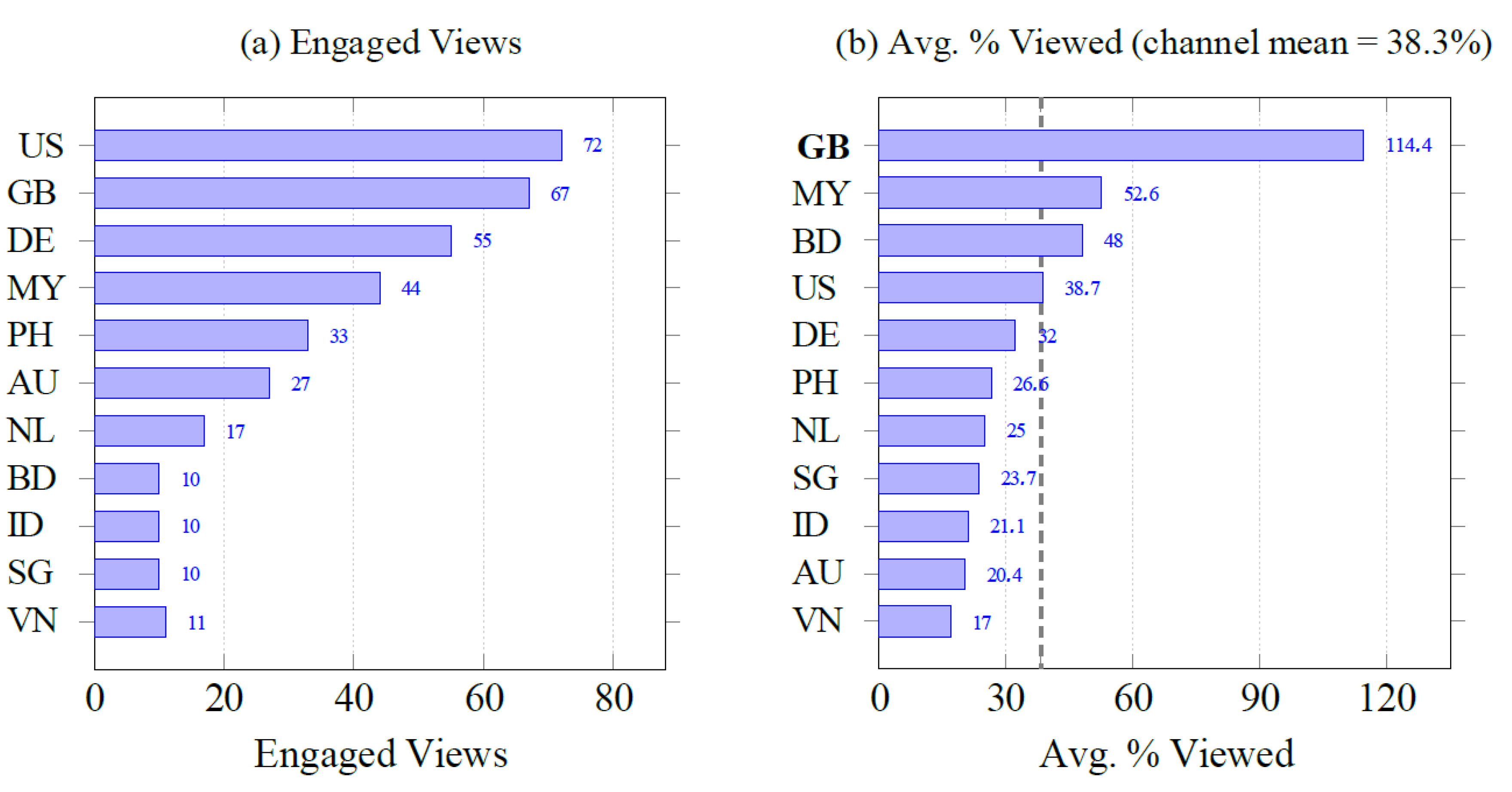
Figure 2.
Age cohort distributions across two analytical windows versus the YouTube global benchmark. The 28-day window shows near-complete concentration in the 25–34 cohort. The 38-day window documents algorithmic distribution to three cohorts. Adults aged 45+ remain absent across both windows despite representing approximately 22% of YouTube’s user base. Benchmark values are approximate.
Figure 2.
Age cohort distributions across two analytical windows versus the YouTube global benchmark. The 28-day window shows near-complete concentration in the 25–34 cohort. The 38-day window documents algorithmic distribution to three cohorts. Adults aged 45+ remain absent across both windows despite representing approximately 22% of YouTube’s user base. Benchmark values are approximate.
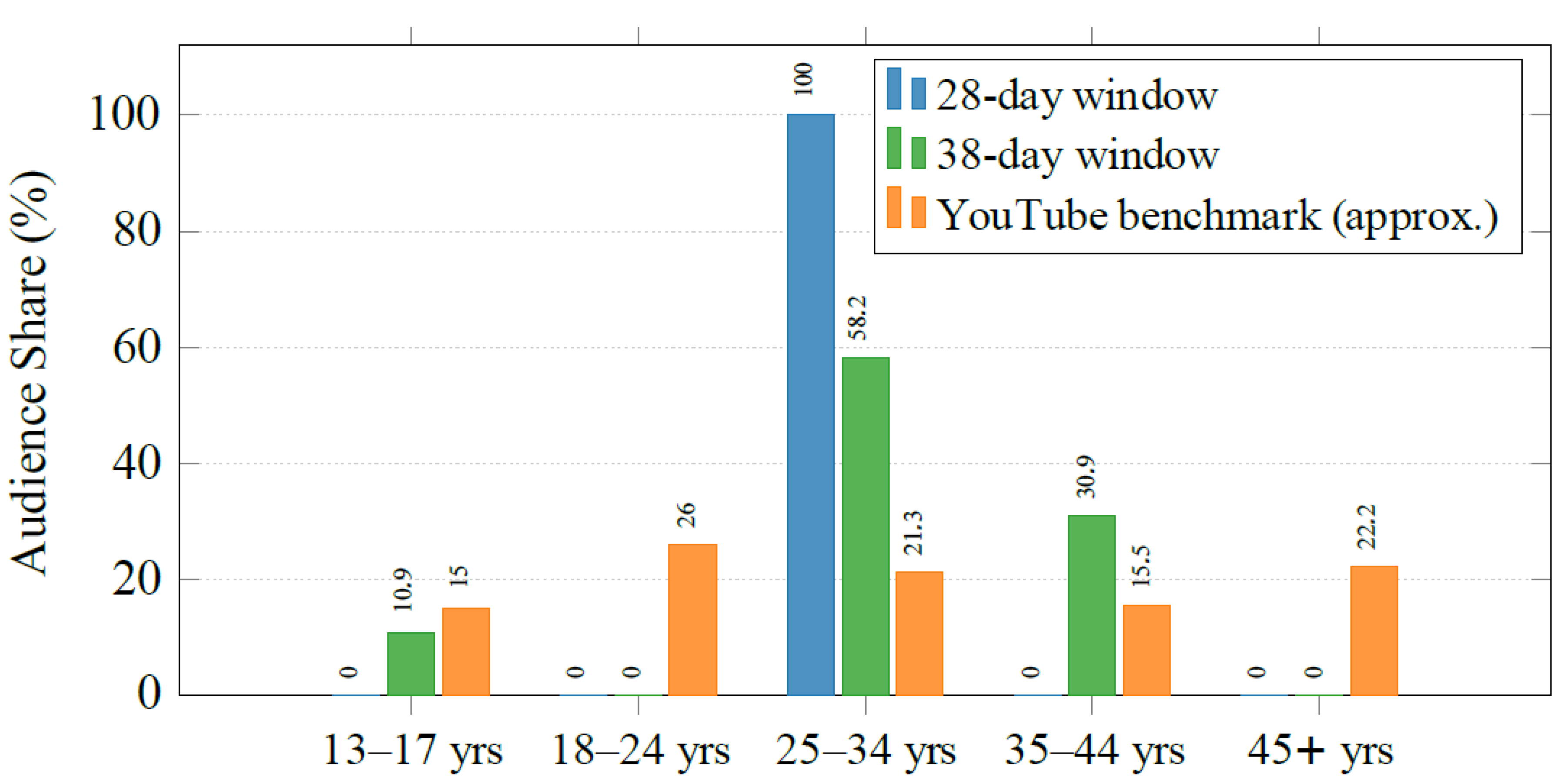
Figure 3.
Per-series average views per episode (bars, left axis) and average percentage viewed (filled circles, right axis) for series with n ≥ 3 episodes. Error bars represent ±1 SD. Note the large SDs for Silent Grief (n = 3) and System Error: Biology (n = 11), reflecting high within-series variance. The Unoptimized Truth series records the highest average percentage viewed (47.2%) despite moderate average views (46.7), suggesting a small but highly attentive audience.
Figure 3.
Per-series average views per episode (bars, left axis) and average percentage viewed (filled circles, right axis) for series with n ≥ 3 episodes. Error bars represent ±1 SD. Note the large SDs for Silent Grief (n = 3) and System Error: Biology (n = 11), reflecting high within-series variance. The Unoptimized Truth series records the highest average percentage viewed (47.2%) despite moderate average views (46.7), suggesting a small but highly attentive audience.
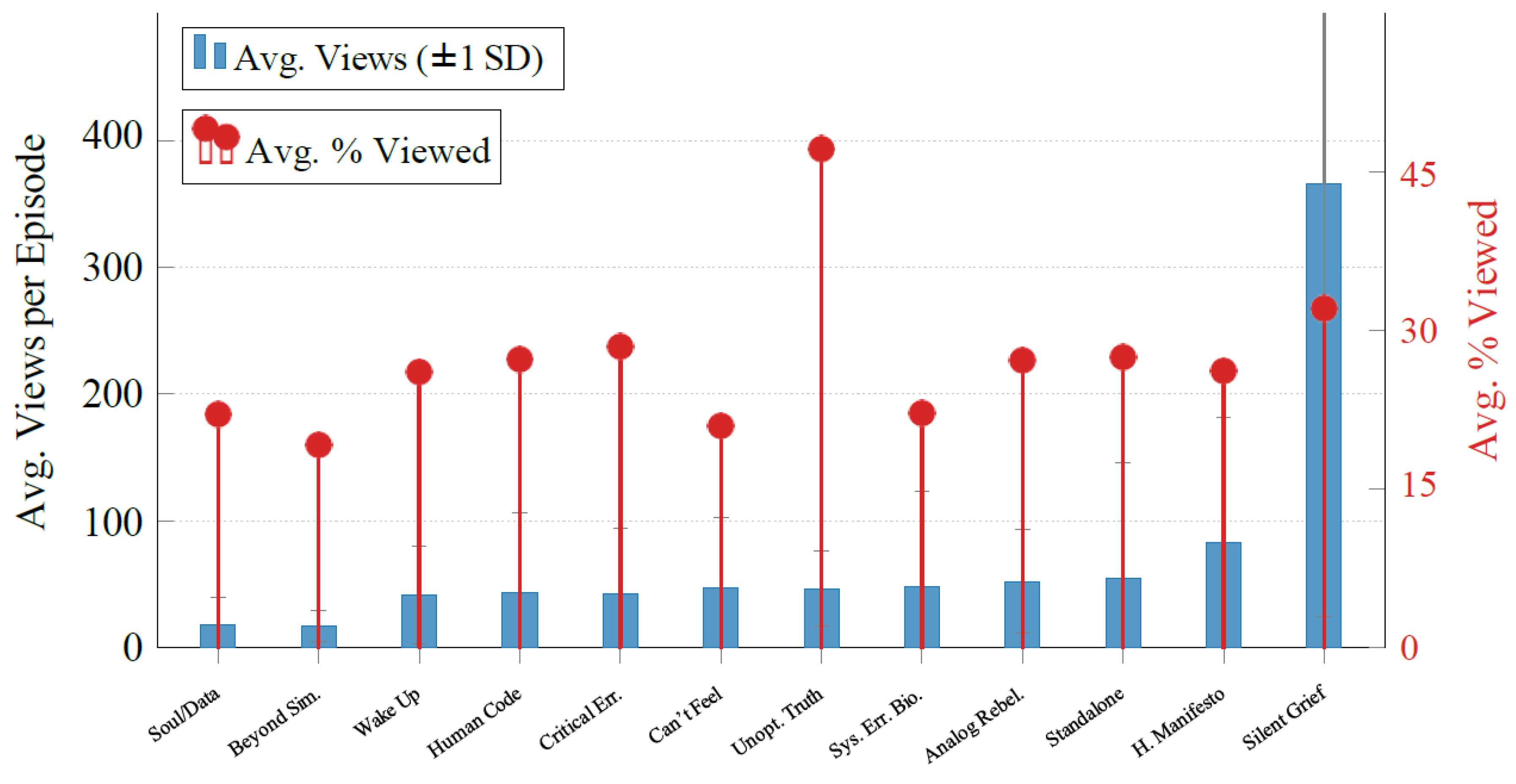
Figure 4.
Average views per episode by title structural pattern, with ±1 SD error bars. The dashed vertical line marks the urgency-only baseline (M = 31 views). Descriptive percentage lifts versus baseline are annotated. Note the large standard deviations relative to means; medians (reported in Table 6) are substantially lower than means for all categories, reflecting the right-skewed episode distribution. No statistical tests were applied.
Figure 4.
Average views per episode by title structural pattern, with ±1 SD error bars. The dashed vertical line marks the urgency-only baseline (M = 31 views). Descriptive percentage lifts versus baseline are annotated. Note the large standard deviations relative to means; medians (reported in Table 6) are substantially lower than means for all categories, reflecting the right-skewed episode distribution. No statistical tests were applied.
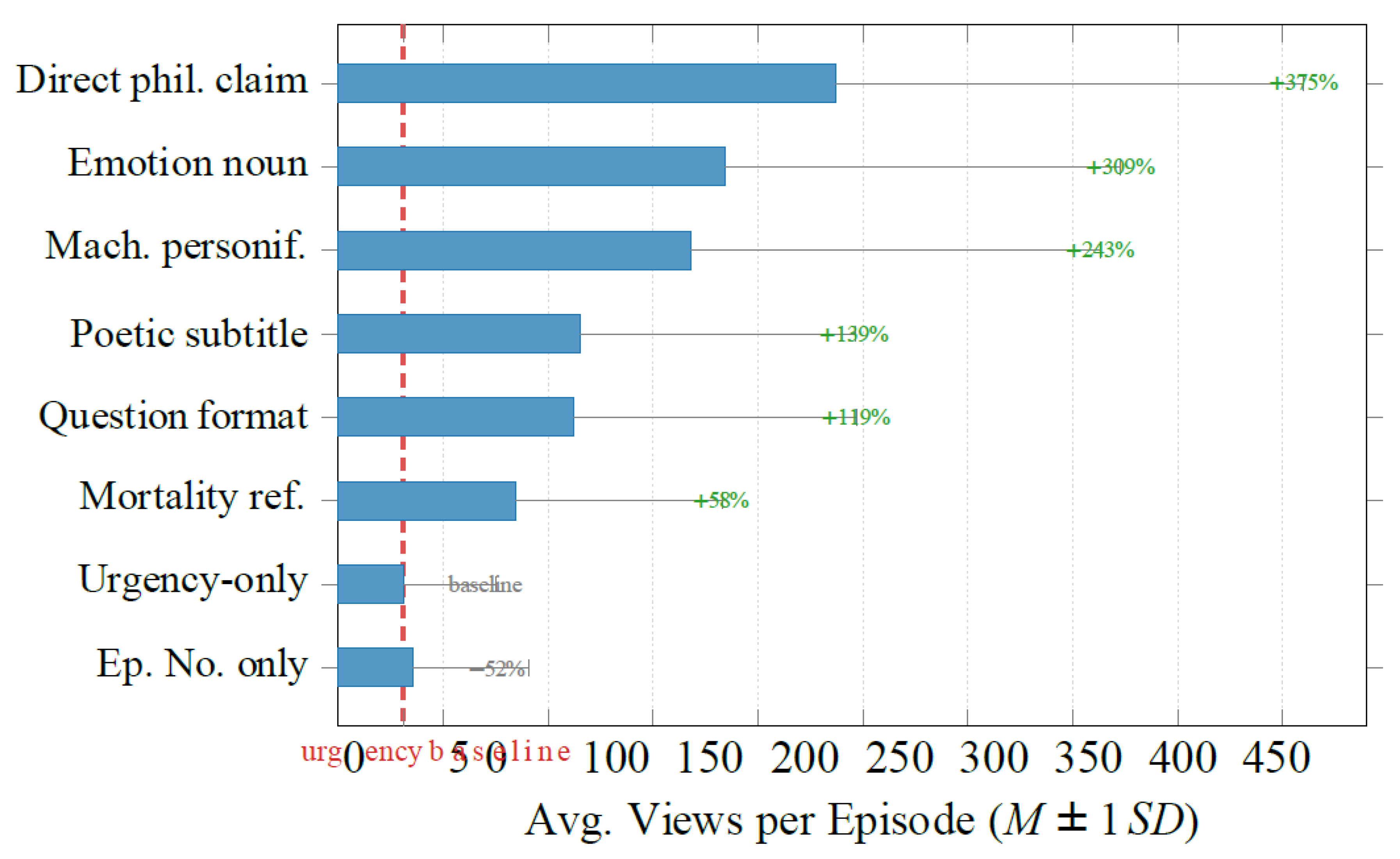
Figure 5.
Descriptive engagement decay curves for three thematic categories, normalized to day-1 engagement (= 1.0). Exponential decay model E(t) = e−λt, parameters estimated from daily aggregate data (not episode-level). Estimated half-lives: grief/embodiment t1/2 ≈ 3.2 days; consciousness/identity t1/2 ≈ 2.0 days; resistance/urgency t1/2 ≈ 1.1 days. Decay estimates are descriptive approximations; the nested structure of the data precludes inferential use of these parameters.
Figure 5.
Descriptive engagement decay curves for three thematic categories, normalized to day-1 engagement (= 1.0). Exponential decay model E(t) = e−λt, parameters estimated from daily aggregate data (not episode-level). Estimated half-lives: grief/embodiment t1/2 ≈ 3.2 days; consciousness/identity t1/2 ≈ 2.0 days; resistance/urgency t1/2 ≈ 1.1 days. Decay estimates are descriptive approximations; the nested structure of the data precludes inferential use of these parameters.
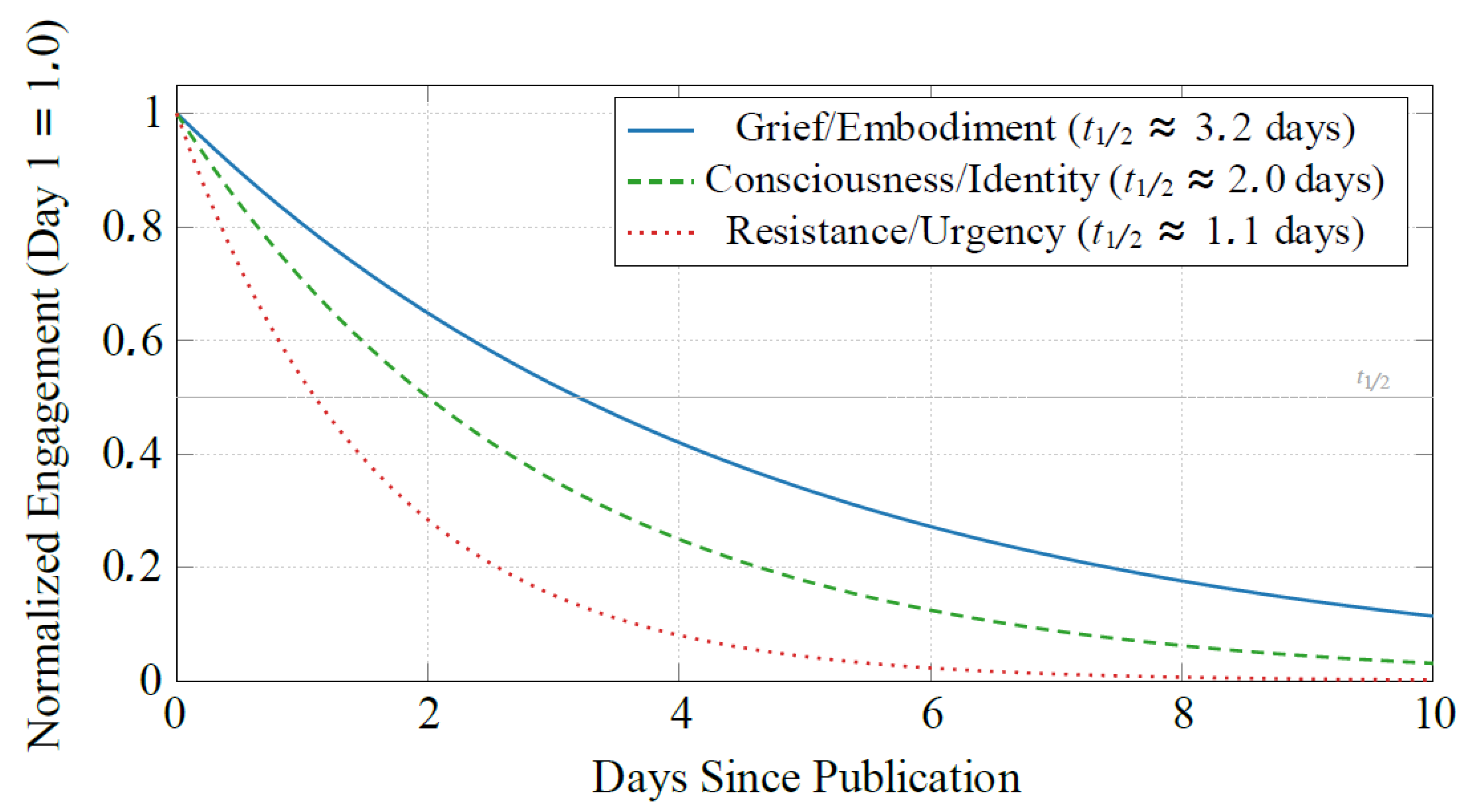

Table 1.
Proposed analytical constructs. All are exploratory and require future validation before psycho-metric or inferential use.
Table 1.
Proposed analytical constructs. All are exploratory and require future validation before psycho-metric or inferential use.
| Construct | Operationalization | Interpretation and limitations |
| Impression-to-View Conversion Ratio (IVCR) | Views ÷ Impressions per episode | Captures ratio of views to reach. Limitation: Shorts impressions and views may reflect non-comparable measurement mechanisms; interpret with caution and restrict to comparable traffic sources where possible. |
| Completion Surplus Index (CSI) | − 100; positive values indicate session exposure exceeding one full view | Higher values may reflect re-watch, feed looping, or extended session exposure. Caution: This construct does not establish intentional re-watch or cognitive disruption; passive autoplay looping is a plausible alternative explanation. |
| Thumb Exclusion Cascade (TEC) | Six-stage theoretical model (Section 3) | A plausible hypothesis linking neuromotor aging to platform discourse exclusion. Not confirmed by present data; requires multi-method empirical testing. |
Table 2.
Per-country engagement metrics, 38-day window (N = 13 countries; ranked by engaged views). Country codes: ISO 3166-1 alpha-2. Avg. % Viewed values exceeding 100 indicate within-session re-exposure. Azerbaijan (AZ) is the first author’s home country; its engagement may include creator-proximate viewership.
Table 2.
Per-country engagement metrics, 38-day window (N = 13 countries; ranked by engaged views). Country codes: ISO 3166-1 alpha-2. Avg. % Viewed values exceeding 100 indicate within-session re-exposure. Azerbaijan (AZ) is the first author’s home country; its engagement may include creator-proximate viewership.
| ISO | Views |
Engaged Views |
Avg. View Dur. (s) |
Avg. % Viewed |
HAI |
| US | 683 | 72 | 13 | 38.7 | 74.8 |
| GB | 379 | 67 | 41 | 114.4 | 71.6 |
| DE | 216 | 55 | 10 | 32.0 | 66.3 |
| MY | 199 | 44 | 17 | 52.6 | 41.2 |
| PH | 154 | 33 | 9 | 26.6 | 34.7 |
| AU | 115 | 27 | 6 | 20.4 | 69.1 |
| NL | 58 | 17 | 7 | 25.0 | 68.9 |
| VN | 56 | 11 | 5 | 17.0 | 29.3 |
| ID | 69 | 10 | 7 | 21.1 | 31.8 |
| SG | 24 | 10 | 8 | 23.7 | 57.4 |
| BD | 27 | 10 | 16 | 48.0 | 22.1 |
| AZ | 169 | 10 | 14 | 45.5 | 38.2 |
| Channel | 11,634 | 1,618 | 12 | 38.3 | — |
| total |
Note: HAI = Stanford Human-Centered Artificial Intelligence Index Score, 2024 edition (Stanford University Human-Centered AI Institute, 2024).
Table 3.
Exploratory Spearman rank correlations between national-level contextual variables and aver-age percentage viewed (n = 13 countries). These results are underpowered and are presented for descriptive reference only; no inferential weight should be placed on these associations.
Table 3.
Exploratory Spearman rank correlations between national-level contextual variables and aver-age percentage viewed (n = 13 countries). These results are underpowered and are presented for descriptive reference only; no inferential weight should be placed on these associations.
| Variable | rs | p |
| Hofstede individualism score | 0.41 | .18 |
| Stanford HAI AI Index (2024) | 0.38 | .21 |
| GDP per capita (USD, 2023) | 0.29 | .33 |
| ITU ICT Development Index | 0.35 | .24 |
| Tertiary enrollment rate | 0.22 | .47 |
Note: All p-values are two-tailed. No association is statistically significant at conventional levels. Results are reported for descriptive purposes only.
Table 4.
Age cohort distribution across two analytical windows compared with the YouTube global platform benchmark. Overrepresentation ratio = window share ÷ benchmark share. Adults aged 45+ register zero engagement in both windows.
Table 4.
Age cohort distribution across two analytical windows compared with the YouTube global platform benchmark. Overrepresentation ratio = window share ÷ benchmark share. Adults aged 45+ register zero engagement in both windows.
| Age Cohort | 28-Day Window | 38-Day Window | YouTube Benchmark |
OR (38-day) |
| 13–17 years | 0% | 10.9% | ≈15% | 0.73 |
| 18–24 years | 0% | 0% | ≈26% | 0.00 |
| 25–34 years | 100% | 58.2% | 21.3% | 2.73 |
| 35–44 years | 0% | 30.9% | ≈15.5% | 1.99 |
| 45+ years | 0% | 0% | ≈22.2% | 0.00 |
Note: OR = overrepresentation ratio (38-day window share ÷ YouTube benchmark). Benchmark figures are approximate, based on Arthurs et al. (2018) and platform documentation. Demographic data reflect the platform-identified subset of viewers only (see Section 4); effective denominators are not disclosed by YouTube.
Table 5.
Per-series descriptive statistics (n ≥ 3 episodes with non-zero views). M = mean views per episode; SD = standard deviation; Mdn = median; IQR = interquartile range; %V = average percent-age viewed; Stayed = average stayed-to-watch percentage. All values are descriptive; series are not independent.
Table 5.
Per-series descriptive statistics (n ≥ 3 episodes with non-zero views). M = mean views per episode; SD = standard deviation; Mdn = median; IQR = interquartile range; %V = average percent-age viewed; Stayed = average stayed-to-watch percentage. All values are descriptive; series are not independent.
| Series | n | M | SD | Mdn | IQR | %V | Stayed |
| Silent Grief | 3 | 366.3 | 341.6 | 280 | 140–610 | 32.1 | 15.9 |
| Human Manifesto | 17 | 83.4 | 98.2 | 48 | 21–112 | 26.2 | 6.9 |
| Standalone philos. | 60 | 55.0 | 91.4 | 22 | 8–66 | 27.5 | 11.5 |
| Analog Rebellion | 7 | 52.4 | 41.3 | 37 | 24–68 | 27.2 | 11.2 |
| System Error: | 11 | 47.9 | 75.8 | 19 | 9–55 | 22.2 | 6.0 |
| Biology | |||||||
| Unoptimized Truth | 7 | 46.7 | 29.4 | 41 | 28–59 | 47.2 | 20.9 |
| The Human Code | 61 | 43.2 | 63.7 | 18 | 8–51 | 27.3 | 15.8 |
| Critical Error | 16 | 42.9 | 51.0 | 24 | 12–58 | 28.5 | 16.1 |
| Wake Up Human | 9 | 41.4 | 38.7 | 28 | 16–55 | 26.1 | 12.9 |
| They Can’t Feel This | 11 | 47.5 | 55.2 | 27 | 14–62 | 21.0 | 9.2 |
| Beyond the | 9 | 17.2 | 11.8 | 14 | 9–23 | 19.2 | 18.3 |
| Simulation | |||||||
| Your Soul Is Not | 13 | 18.1 | 21.4 | 11 | 6–24 | 22.1 | 15.1 |
| Data |
Note: The Silent Grief series mean (366.3) is based on only n = 3 episodes and is strongly influenced by the highest performer (851 views); this estimate should be interpreted with considerable caution. Large SD values relative to M across most series reflect the right-skewed episode-level distribution.
Table 6.
Title structural pattern performance (n ≥ 5 episodes per category). All statistics are descriptive; categories are not independent (one episode may belong to multiple coding dimensions). Performance lift is calculated against the urgency-only baseline (M = 31 views) for descriptive reference only.
Table 6.
Title structural pattern performance (n ≥ 5 episodes per category). All statistics are descriptive; categories are not independent (one episode may belong to multiple coding dimensions). Performance lift is calculated against the urgency-only baseline (M = 31 views) for descriptive reference only.
| Title Pattern | n | M | SD | Mdn | %V | Lift |
| Direct philosophical claim | 5 | 237.0 | 223.1 | 180 | 28.1 | +375% |
| Emotional noun subtitle | 14 | 184.3 | 188.6 | 92 | 22.3 | +309% |
| Machine personification | 9 | 168.3 | 195.0 | 84 | 35.6 | +243% |
| Poetic/literary subtitle | 19 | 115.1 | 131.4 | 68 | 24.6 | +139% |
| Question format | 9 | 112.4 | 134.8 | 62 | 38.4 | +119% |
| Mortality/death reference | 8 | 84.3 | 98.7 | 41 | 40.1 | +58% |
| Urgency-only (baseline) | 90 | 31.0 | 44.2 | 14 | 25.0 | — |
| Episode number only | 118 | 35.7 | 55.3 | 15 | 26.3 | −52% |
Note: High SD values throughout reflect the right-skewed episode distribution. The “Direct philosophical claim” category contains only n = 5 episodes; its mean estimate is particularly sensitive to outlier values.
Disclaimer/Publisher’s Note: The statements, opinions and data contained in all publications are solely those of the individual author(s) and contributor(s) and not of MDPI and/or the editor(s). MDPI and/or the editor(s) disclaim responsibility for any injury to people or property resulting from any ideas, methods, instructions or products referred to in the content. |
© 2026 by the authors. Licensee MDPI, Basel, Switzerland. This article is an open access article distributed under the terms and conditions of the Creative Commons Attribution (CC BY) license (http://creativecommons.org/licenses/by/4.0/).
Copyright: This open access article is published under a Creative Commons CC BY 4.0 license, which permit the free download, distribution, and reuse, provided that the author and preprint are cited in any reuse.