

Submitted:
01 June 2026
Posted:
03 June 2026
You are already at the latest version
Abstract
In this paper, the Tricomi problem for a second-kind mixed-type equation with a lower-order term is studied in an unbounded domain. The elliptic part of the domain is a vertical half-strip, while the hyperbolic part is bounded by characteristics. Homogeneous Dirichlet conditions are imposed on the walls of the half-strip, gluing conditions are given on the parabolic degeneracy line, and the trace of the desired solution is prescribed on one of the characteristics. The uniqueness of the solution is proved using the extremum principle and the Zaremba–Giraud principle. The existence of the solution is established by the Green’s function method: in the elliptic part, the Green’s function of the mixed problem is constructed in the form of a rapidly convergent series; in the hyperbolic part, a generalized solution of the Cauchy problem of a special class is used. The functional relations on the degeneracy line lead to a singular integral equation, which is regularized by the Carleman–Vekua method into a Fredholm integral equation of the second kind with a weak singularity. Explicit formulas for the trace of the solution and its normal derivative are obtained. For a specific set of parameters, a numerical visualization of the solution is performed, the gluing conditions are verified, and a physical interpretation of the obtained graphs is given in the context of transonic gas dynamics. The results can be useful for mathematical modeling of flows in Laval nozzles and other problems of mechanics.
Keywords:
Tricomi problem
; second-kind mixed-type equation
; vertical half-strip
; Green’s function
; extremum principle
; Fredholm integral equation
; generalized solution of class R2
; hypergeometric function
MSC: 35M10; 35R11; 35R10; 33C10; 35A08
1. Introduction
A new stage in the development of the theory of boundary value problems for mixed-type equations is marked by the works of M.A. Lavrentiev [1], L. Bers [2], F.I. Frankl [3], and Chen Gui-Qiang G. [4], where the importance of the Tricomi problem and its generalizations is indicated in connection with transonic gas dynamics, magnetohydrodynamic flows with transition through the speed of sound and the Alfvén speed, the theory of infinitesimal bendings of surfaces, and many other issues of mechanics.
Most studies on mixed-type equations concern equations of the first kind with power degeneracy, for which the tangent to the parabolic line does not coincide with the characteristic direction. For the model equation of the first kind
the Tricomi problem in a domain whose elliptic part is a vertical half-strip was studied for in [5] and for in [6]. In [7] this problem was investigated for the generalized Tricomi equation
A physical justification of the Tricomi problem in domains where the elliptic part is a vertical half-strip was given in [8,9]. L.V. Ovsyannikov [8] used the velocity hodograph plane in the framework of transonic gas dynamics, where nonlinear equations become linear and near the speed of sound are approximated by the Tricomi equation. The approximate solution he constructed describes a transonic flow with a detached shock wave and a subsonic zone behind it in the form of a vertical half-strip; the sonic line corresponds to the parabolic degeneracy line .
The Tricomi problem for the second-kind mixed-type equation
in a bounded domain was first considered by I.L. Karol [10]. The elliptic part was bounded by the normal curve , the hyperbolic part by characteristics, and the degeneracy line itself is a characteristic. Following the idea of F.D. Tricomi, the N problem (Holmgren) in the elliptic part and the Cauchy problem in the hyperbolic part were solved using the Green’s function method, and then the solutions were glued together. The existence of the solution was reduced to an integral equation for , solvable due to the uniqueness theorem. Subsequent works (e.g., [11]) also considered bounded domains and used the representation of the N problem from [10]. It should be noted that the study of the N problem has not lost its relevance over time. For example, the article [12] examined the N problem for the Euler-Darboux equation with two degeneracy lines and its application to the problem of filtering contaminants in inhomogeneous media.
In the case where the elliptic part is a vertical half-strip, the shift problem on a characteristic of one family was studied in [13], where the N problem was solved by the Green’s function method. A nonlocal problem for the generalized Tricomi equation with a spectral parameter in an unbounded domain, the elliptic part of which is the upper half-plane, is considered in the article [14]. If the elliptic part is a horizontal half-strip, a nonlocal problem of Bitsadze–Samarskii type was investigated in our recent work [15]. For a mixed-type equation of the first kind with a singular coefficient, a nonlocal problem in an unbounded domain was studied in [16]. For the Tricomi problem for a second-kind mixed-type equation in an unbounded domain whose elliptic part is the first quadrant of the plane, see [17].
Interest in the Dirichlet problem for mixed-type equations increased after the works of F.I. Frankl, in which it was shown that many problems of transonic gas dynamics reduce precisely to the Dirichlet problem. The N problem models the determination of a gravitational or electromagnetic field in a domain where the potential is given on part of the boundary and its normal derivative on another part, and it guarantees well-posedness under more complex conditions than the classical Cauchy problem.
In this paper, for the first time, for a second-kind mixed-type equation with a lower term in an unbounded domain whose elliptic part is a vertical half-strip, the N problem is solved by the Green’s function method, explicit formulas for the trace and the normal derivative are obtained, and their numerical construction and visualization are performed. Verification of the gluing conditions confirms the correctness of the analytical calculations, and the physical interpretation of the graphs shows agreement with the qualitative picture of transonic flow in Laval nozzles.
The article is organized as follows. Section 2 recalls necessary facts from the theory of Riemann–Liouville fractional integro-differentiation and the main properties of the operators used. Section 3 states the problem : the mixed domain, the class of generalized solutions in the hyperbolic part, and the main functional relations on the degeneracy line. Section 4 is devoted to proving the uniqueness of the solution using the extremum principle and the Zaremba–Giraud principle. Section 5 presents the proof of existence: the Green’s function method constructs a representation of the solution in the elliptic half-strip, a singular integral equation for the normal derivative is derived, its Carleman–Vekua regularization reduces it to a Fredholm integral equation of the second kind; then explicit formulas for and are given. Section 6 contains a concrete example with , and , as well as a visualization of the solution, consistency checks, and physical interpretation. Section 7 formulates the main conclusions of the work.
2. Preliminaries
In this section, we recall the definitions of Riemann–Liouville fractional integrals and derivatives, as well as their main properties that will be used in the paper (for more details, see [18,19,20]).
Let the function be defined on the interval and . The left-sided and right-sided fractional integrals of order are defined respectively by
The Riemann–Liouville fractional derivatives of order are introduced by integer-order differentiation of the fractional integral. If , then
For , we set , . For negative order, the fractional derivative coincides with the integral: (), and similarly for the right endpoint.
In this paper, we use the compact notation and introduced in formulas (2) and (3) below. Essentially, for they coincide with the fractional integrals and , and for with the derivatives and (the exact sign convention is achieved by the definitions (2), (3)).
We list some properties of fractional operators that will be needed later.
- (i)
- Semigroup property. For any , and a sufficiently smooth function f,
- (ii)
- Relation with the derivative. If , then . If f possesses a summable fractional derivative , thenwhere and are constants (an analog of Taylor’s formula for fractional derivatives). Similar representations hold for the right endpoint.
- (iii)
- Action on power functions. For and such that ,
- (iv)
3. Problem Statement
Consider the equation
in the unbounded mixed domain , where
and is the domain in the half-plane bounded by the segment of the axis and by the two characteristics
of equation (1) emanating from the point . We introduce the notation
where a is any real number and n is the integer part of .
In the half-plane , equation (1) takes the form
In the characteristic coordinates
equation (4) transforms into the Euler–Darboux equation
with
It is known that the solution of the Cauchy problem for equation (6) with initial conditions
has the form (see [5]):
where
Returning to the original variables , we obtain
For any and , the expression (10) is a twice continuously differentiable solution of the Cauchy problem for equation (4) with initial data (8) in the domain .
An expression of the form (9) or (10) will be called a generalized solution of equation (4) in if and are continuous for .
In , we consider the following class of generalized solutions of the Cauchy problem introduced in [5].
Definition 1.
Without loss of generality, we assume ; from (11) it follows that and exists on . The following lemmas hold [5].
Lemma 1.
A generalized solution is continuous in the closed domain .
Lemma 2.
If a generalized solution , then the derivatives and are continuous in and
From (13), the main functional relation between and obtained from the hyperbolic region of equation (1) is obtained in the following form [5]:
where
and is a given function with , .
Problem 1
(Problem ). Find a function with the following properties:
- 1)
- where ;
- 2)
- and satisfies equation (1) in ;
- 3)
- is a generalized solution of class in ;
- 4)
- The partial derivative satisfies the gluing conditionwhich arises in solving the direct problem of Laval nozzle theory, and may have a singularity of order less than one at the ends of the interval ;
- 5)
- satisfies the boundary conditions
4. Uniqueness of the Solution
Theorem 1.
Problem has at most one solution.
Proof.
First, we prove that in . Assume the contrary. Then there exists a domain in which . Consequently,
and this value is attained at some point .
Denote , where
By the extremum principle for elliptic equations [21], we have . In view of condition (15), . Hence .
Suppose , i.e.,
If (respectively ), i.e., is a point of positive maximum (negative minimum) of , then from (19) it follows that (). On the other hand, by the Zaremba–Giraud principle [21], (). This contradiction shows that . Therefore, , i.e.,
Take an arbitrary number . By the same argument, we obtain
Since , we have
which implies , contradicting condition (16).
5. Existence of the Solution
We now proceed to prove the existence of a solution of problem . In the half-plane , equation (1) takes the form
Solving the problem by the Green’s function method in the domain , we obtain
where is the Green’s function of the problem, given by
with
being a fundamental solution of equation (20). Here is the Gauss hypergeometric function [22],
The Green’s function of the problem for equation (1) is constructed by the reflection method [23,24], using the mean value theorem and estimates for the hypergeometric function:
where is a constant. One can prove that
with and constants. By the Weierstrass test, these series converge absolutely and uniformly in the half-strip , .
Eliminating from (14) and (22), we obtain a singular integral equation for the unknown function , equivalent (in terms of solvability) to problem :
where
The conditions imposed on imply and . Applying the Carleman–Vekua regularization method [5,25,26], we obtain a Fredholm integral equation of the second kind with a weak singularity for , to which Fredholm theory applies. Its solvability follows from the uniqueness of the solution of the Tricomi problem, and the solution has the form
Now, from (14) we find
6. Example of Solution of Problem
Consider the following specific values of the parameters in problem :
and for . The conditions , are satisfied; guarantees (see (7)). The function belongs to and satisfies . It is prescribed on the characteristic (); on the characteristic , the condition is automatically satisfied due to and the structure of the general solution.
6.1. Parameter and Key Constants
6.2. Normal Derivative on the Degeneracy Line
By formula (24):
For ,
hence
The function is continuous on and has an integrable singularity of order at zero; it is bounded as . Thus belongs to class .
6.3. Trace on the Degeneracy Line
According to (25) and the computations of fractional derivatives and integrals, the trace is expressed in terms of hypergeometric functions. Substituting the found into (14) or (22) leads to a closed analytic representation, which is not written explicitly here for brevity. Numerical calculations show that , the function is continuous on and has a maximum near . The analytic properties of are fully consistent with the conditions of problem .
6.4. Solution in the Hyperbolic Domain
Passing to the characteristic coordinates
and using the generalized solution (10) with , , , we have
where . The integrals involving and are computed using quadrature formulas that account for the weight singularities. As , the initial conditions
hold, ensuring the correctness of the construction.
6.5. Solution in the Elliptic Half-Strip
In the elliptic part , the equation becomes
The fundamental solution for , is
and the hypergeometric function can be expressed in elementary form:
The Green’s function of the problem is given by the series
Computing the limit as required for (21), we obtain
Substituting from Section 6.2 into (21) gives the solution in ():
The series converges absolutely and uniformly for (as ). For and , the terms with t and cancel mutually, ensuring condition (15). As , the expression tends to , guaranteeing a continuous gluing with the hyperbolic part.
6.6. Visualization and Interpretation of the Solution
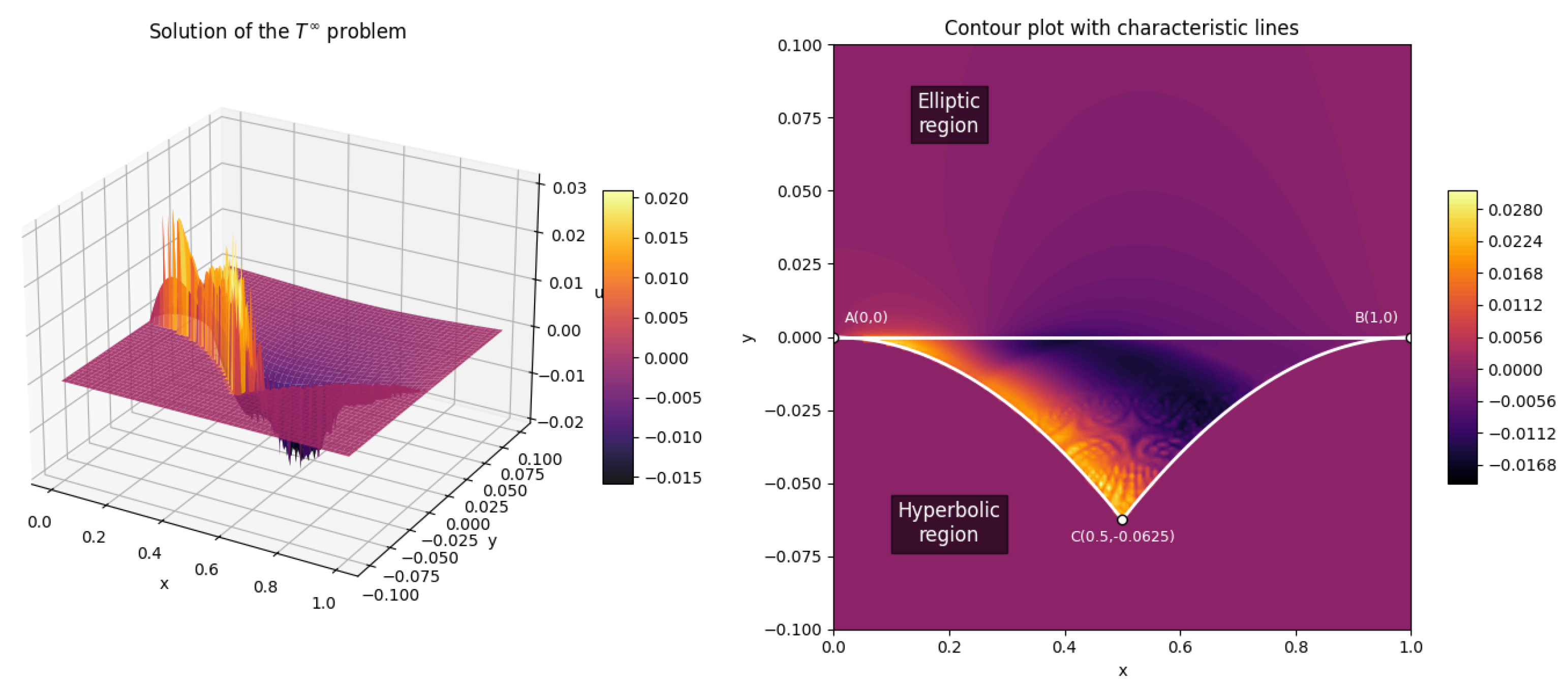
Figure 1 shows the numerical solution of problem for the above parameters.
The calculation was performed on a grid in the elliptic domain with singularity extraction; in the hyperbolic domain, Gauss–Jacobi quadratures [27,28] were used. The graphs were produced in Python [29,30].
The solution surface is smooth; in the hyperbolic region () the boundary condition on the characteristic and on are satisfied. In the elliptic part (), the solution is positive in the central zone and decays monotonically to zero as and on the vertical walls. Qualitatively, the picture corresponds to the perturbation potential in the subsonic region of a Laval nozzle with a continuous transition through the sonic line .
Thus, the constructed solution fully satisfies all conditions of problem and clearly demonstrates the effectiveness of the proposed method.
7. Conclusion
In this paper, the Tricomi problem for a second-kind mixed-type equation with a lower-order term in an unbounded domain whose elliptic part is a vertical half-strip and hyperbolic part is bounded by characteristics was investigated. The main results are as follows.
1) A uniqueness theorem for the solution of problem was proved using the extremum principle for elliptic equations and the Zaremba–Giraud principle.
2) Using the Green’s function method, an explicit representation of the solution in the elliptic half-strip was obtained in the form of a rapidly convergent series, while in the hyperbolic region a generalized solution of class was employed. The matching of these representations on the degeneracy line led to a singular integral equation, which was regularized by the Carleman–Vekua method and reduced to a Fredholm integral equation of the second kind with a weak singularity. The solvability of the latter follows from the proven uniqueness.
3) Explicit analytic formulas for the normal derivative and the trace on the degeneracy line were derived, expressed in terms of hypergeometric functions.
4) For the specific parameter values , and the boundary function , numerical calculations were performed and a three-dimensional surface and contour plot of the solution were constructed.
5) A physical interpretation of the graphs was given in the context of transonic gas dynamics. It was shown that the solution is continuous and smoothly crosses the sonic line, corresponding to the picture of shockless transonic flow in Laval nozzles.
The obtained results can be applied to the mathematical modeling of transonic flows, and the proposed method for constructing Green’s functions for degenerate elliptic equations in a half-strip and regularizing singular integral equations is of independent theoretical interest.
Author Contributions
Conceptualization, R.Z. and R.P.; methodology, R.Z.; software, R.P.; validation, A.K., R.Z. and R.P.; formal analysis, A.K.; investigation, A.K., R.Z. and R.P.; writing—original draft preparation, R.Z. and R.P.; writing—review and editing, R.Z. and R.P.; visualization, R.P. All authors have read and agreed to the published version of the manuscript.
Funding
The work was carried out within the framework of the agreement between IKIR FEB RAS and the Romanovsky Institute of Mathematics (Tashkent, Uzbekistan) No. 1117 dated 04.28.2022 (0469/01/22 NTMI) on mathematical research (problem formulation and study of its unique solvability) and the state assignment of IKIR FEB RAS No. 124012300245-2. Topic "Interaction of physical processes in the system of near space and geospheres" (2024-2028) (numerical calculations of the wave pattern and their visualization).
Institutional Review Board Statement
Not applicable.
Data Availability Statement
The original contributions presented in this study are included in the article. Further inquiries can be directed to the corresponding author.
Conflicts of Interest
The authors declare no conflicts of interest.
References
- Lavrentiev, M.A.; Bitsadze, A.V. On the problem of equations of mixed type. Dokl. Akad. Nauk SSSR 1950, 70, 485–488. (In Russian) [Google Scholar]
- Bers, L. Mathematical Aspects of Subsonic and Transonic Gas Dynamics; Courier Dover Publications: Mineola, NY, USA, 2016. [Google Scholar]
- Frankl, F.I. Selected Works on Gas Dynamics; Nauka: Moscow, Russia, 1973. (In Russian) [Google Scholar]
- Chen, Gui-Qiang G. Partial differential equations of mixed type—analysis and applications. Not. Am. Math. Soc. 2023, 70, 8–23. [Google Scholar] [CrossRef]
- Smirnov, M.M. Equations of Mixed Type; American Mathematical Society: Providence, RI, USA, 1978. [Google Scholar]
- Repin, O.A. The Tricomi problem for an equation of mixed type in a domain whose elliptic part is a half-strip. Differ. Equ. 1996, 32, 571–574. [Google Scholar]
- Zunnunov, R.T. Tricomi problem for a mixed-type equation in an unbounded domain. Uzb. Math. J. 2001, 2, 39–43. (In Russian) [Google Scholar]
- Ovsyannikov, L.V. On the motion of a wedge-shaped profile at the speed of sound. Proceedings of the Leningrad Air Force Engineering Academy named after A.F. Mozhaisky 1950, 33, 25–51. (In Russian) [Google Scholar]
- Falkovich, S.V. On one case of solving the Tricomi problem. Transonic Gas. Flows 1964, 1, 3–8. (In Russian) [Google Scholar]
- Karol, I.L. On a certain boundary value problem for an equation of mixed elliptic-hyperbolic type. Dokl. Akad. Nauk SSSR 1953, 88, 197–200. (In Russian) [Google Scholar]
- Ivashkina, G.A. On problems of Bitsadze–Samarskii type for the equation uxx+signy|y|muyy=0, 0. Differ. Equ. 1981, 17, 1078–1089. (In Russian) [Google Scholar]
- Podkletnova, S.V. Problem N for the Euler-Darboux equation with two degeneration lines in characteristic coordinates and a trivial coefficient for the derivative of the desired function with respect to the ordinate. Vestn. Samara Univ. Nat. Sci. Ser. 2026, 32, 167–191. [Google Scholar] [CrossRef]
- Zunnunov, R.T.; Ergashev, A.A. The problem with shift for an equation of mixed type of the second kind in an unbounded domain. Vestn. KRAUNC. Fiz.-Mat. Nauk. 2016, 1(12), 26–31. [Google Scholar] [CrossRef] [PubMed]
- Zunnunov, R.T. A nonlocal problem for a generalized Trikomi equation with a spectral parameter in the unbounded domain. Vestn. KRAUNC. Fiz.-mat. Nauk. 2021, 35, 17–26. [Google Scholar]
- Zunnunov, R.T.; Parovik, R.I.; Ergashev, A.A. A Bitsadze–Samarskii-type problem for a second-kind mixed-type equation in a domain with a horizontal half-strip as its elliptic part. Mathematics 2026, 14, 487. [Google Scholar] [CrossRef]
- Ruziev, M.; Parovik, R.; Zunnunov, R.; Yuldasheva, N. Non-local problems for the fractional order diffusion equation and the degenerate hyperbolic equation. Fractal Fract. 2024, 8, 538. [Google Scholar] [CrossRef]
- Zunnunov, R.T.; Bektosheva, Sh.A.; Parovik, R.I. Tricomi problem for a mixed-type equation of the second kind in a domain the elliptic part of which is the first quadrant of the plane. Vestn. KRAUNC. Fiz.-Mat. Nauk. 2026, 54, 93–103. [Google Scholar] [CrossRef]
- Samko, S. G.; Kilbas, A. A.; Marichev, O.I. Fractional Integrals and Derivatives: Theory and Applications; Gordon and Breach Science Publishers: Switzerland, 1993. [Google Scholar]
- Nakhushev, A.M. Fractional Calculus and Its Applications; FIZMATLIT: Moscow, Russia, 2003. [Google Scholar]
- Kilbas, A.A.; Srivastava, H.M.; Trujillo, J.J. Theory and Applications of Fractional Differential Equations; Elsevier: Amsterdam, The Netherlands, 2006. [Google Scholar]
- Bitsadze, A.V. Boundary Value Problems for Second Order Elliptic Equations; Elsevier: Amsterdam, The Netherlands, 2012. [Google Scholar]
- Lebedev, N.N. Special Functions and Their Applications; Prentice-Hall: London, UK, 1965. [Google Scholar]
- Dolgova, I.M.; Mel’nikov, I.A. Construction of Green’s functions and matrices for equations and systems of the elliptic type. J. Appl. Math. Mech. 1978, 42, 740–746. [Google Scholar] [CrossRef]
- Morse, P.M.; Feshbach, H. Methods of Theoretical Physics. Part I; McGraw-Hill: New York, NY, USA, 1953. [Google Scholar]
- Muskhelishvili, N.I.; Radok, J.R.M. Singular Integral Equations: Boundary Problems of Function Theory and Their Application to Mathematical Physics; Courier Corporation: North Chelmsford, MA, USA, 2008. [Google Scholar]
- Mirsaburov, M.; Makulbay, A.B.; Mirsaburova, G.M. A combined problem with local and nonlocal conditions for a class of mixed-type equations. Bull. Karaganda Univ. Math. Ser. 2025, 2(118), 163–176. [Google Scholar] [CrossRef]
- Gil, A.; Segura, J.; Temme, N.M. Noniterative computation of Gauss–Jacobi quadrature. SIAM J. Sci. Comput. 2019, 41, A668–A693. [Google Scholar] [CrossRef]
- Gil, A.; Segura, J.; Temme, N.M. Fast and reliable high-accuracy computation of Gauss–Jacobi quadrature. Numer. Algorithms 2021, 87, 1391–1419. [Google Scholar] [CrossRef]
- Van Horn, B.M.; Nguyen, Q. Hands-On Application Development with PyCharm: Build Applications Like a Pro with the Ultimate Python Development Tool; Packt Publishing Ltd., 2023. [Google Scholar]
- Shaw, Z.A. Learn Python the Hard Way; Addison-Wesley Professional: Carrollton, TX, USA, 2024. [Google Scholar]
Figure 1.
Surface and contour plot of the solution.
Disclaimer/Publisher’s Note: The statements, opinions and data contained in all publications are solely those of the individual author(s) and contributor(s) and not of MDPI and/or the editor(s). MDPI and/or the editor(s) disclaim responsibility for any injury to people or property resulting from any ideas, methods, instructions or products referred to in the content. |
© 2026 by the authors. Licensee MDPI, Basel, Switzerland. This article is an open access article distributed under the terms and conditions of the Creative Commons Attribution (CC BY) license (http://creativecommons.org/licenses/by/4.0/).
Copyright: This open access article is published under a Creative Commons CC BY 4.0 license, which permit the free download, distribution, and reuse, provided that the author and preprint are cited in any reuse.


