

Submitted:
01 June 2026
Posted:
02 June 2026
You are already at the latest version
Abstract
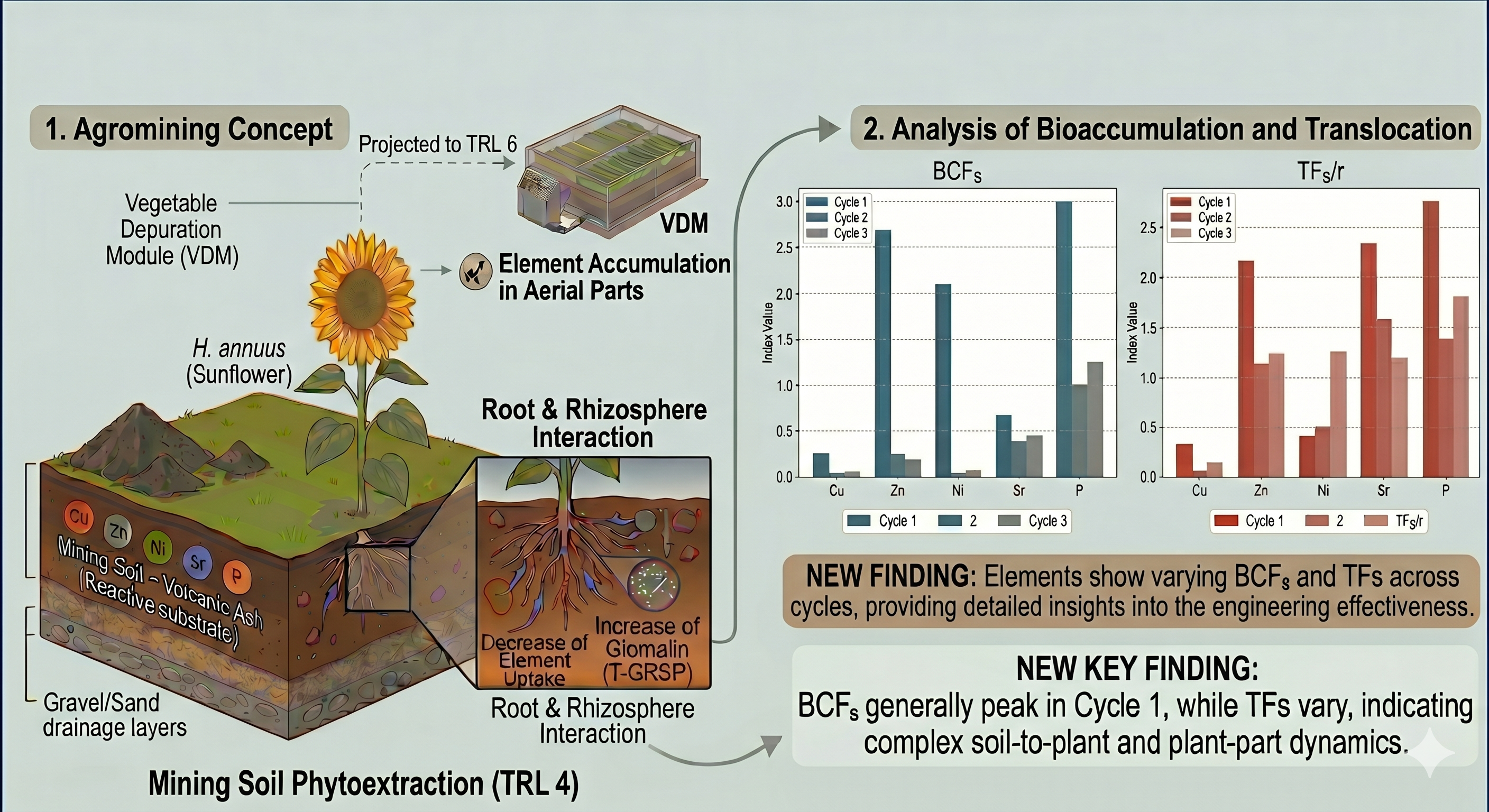
Phytoextraction is a sustainable strategy for removing potentially valuable elements from contaminated substrates while contributing to site remediation. However, the effectiveness of repeated phytoextractive cycles remains poorly investigated. This study evaluated the phytoextractive performance of Helianthus annuus (HA) cultivated on mining soil from Complejo Minero Fabril Sierra Pintada (Argentina) containing elevated concentrations of Ni, Zn, Sr, P, and Cu over three successive three-month cultivation cycles in TRL-4 bioreactors (BRs). The scalability of process was subsequently assessed throught projection to TRL 6 using a Vegetable Depuration Module (VDM). Elemental concentrations in soil and biomass were determined by X-ray fluorescence, while bioaccumulation coefficients, translocation factors, arbuscular mycorrhizal colonization, and glomalin-related soil proteins (GRSP) were assessed. Projected bioextractive potential in the TRL6 (VDM) during the first cycle reached 3.16 g Cu, 10.82 g Zn, 1.13 g Ni, 13.36 g Sr, and 136.91 g P. Phytoextractive efficiency declined markedly after the first cultivation cycle, indicat-ing that a single crop harvested at the flowering stage maximized element removal under the tested conditions. The accumulation of economically relevant elements in sunflower biomass could be integrated with downstream metal recovery processes, supporting the potential of HA for phytomining applications.
Keywords:
agromining
; metal(loid)s
; phytoextraction
; TRL 4-6
; bioavailability
; Helianthus annuus
; engineering cycles
1. Introduction
Phytomining represents a promising and sustainable approach for recovering valuable and critical elements from contaminated soils, low-grade ores, and secondary resources. The phytomining process integrates three main stages: (i) phytoextraction – in which plants are employed to take up target elements from soils; (ii) biomass processing and enrichment – involving the concentration of these elements from plant biomass into substrate; and (iii) extraction – the recovery of target elements from the enriched biomass, thereby completing the phytomining cycle. Recent developments have broadened the scope of phytomining to include Au, rare earth elements (REEs), and other elements, such as Mn, Cu, Cd, and Zn. While laboratory studies and field trials have shown the technical feasibility of phytomining for these elements, scaling up remains a significant challenge [1].
In recent years, substantial progress has been made in enhancing plant-based metal(loid)s accumulation, as well as in developing efficient methods for biomass processing and recovery. Advances in plant biotechnology include genetic engineering, the application of soil amendment, and the identification of hyperaccumulating plant species, aiming at increasing the concentrations of target elements in plant tissues [2]. Concurrently, growing attention has been directed toward cost-effective and environmentally sustainable extraction technologies, including electrochemical and bioleaching methods, that reduce environmental impact [3]. Despite these advancements, phytomining remains in the early stages of industrial implementation and requires continued multidisciplinary investigations.
Phytoextraction is a powerful technology that allows contaminated soils to be remediated while at the same time recovering some or all of the cost of the remediation process. For valuable chemical elements, it may even be possible to make a significant profit above and beyond the costs of the remediation operation [4]. There are more than 700 hyperaccumulator plant species reported. [5] found two hyperaccumulating, phytoremediation plants: Haumaniastrum robertii and Aeolanthus biformifolius. The most extreme Co hyperaccumulator, H. robertii, was able to accumulate up to 1 wt% Co, whereas the most extreme Cu hyperaccumulator, A. biformifolius, can accumulate up to 1 wt% Cu. Through this accumulation, large-scale use of H. robertii can yield up to 200 kg of Co from 20 tonnes of dry biomass per hectare per year. [6] investigated planting methods, population density, weed control practices, harvesting schedules and methods, pollination control, and seed processing. Such crop management studies have improved phytoextraction efficiency and provide a tool for farmers to conduct commercial production.
Agromining involves the cultivation of selected hyperaccumulator plant species (‘metal crops’) on low-grade ore bodies or mineralized (ultramafic) soils, or anthropogenic metal-rich materials (e.g., contaminated soils, mine spoils, industrial sludge), followed by harvesting and incineration of the biomass to recover target metals or salts. Full commercial agromining of Ni is underway in Europe (e.g., the Balkans, France) using Brassicaceae (notably Odontarrhena chalcidica—formerly Alyssum murale), and major trials in Malaysia are underway using Phyllanthus rufuschaneyi. Variable prices of commodity metals add constraints on the development of commercial agromining [7]. [8] assessed the use of biomass from Ni hyperaccumulator plants and explored the potential of biomass generated from fruit trees, olive trees, citrus and grapevines for bioenergy production in Albania, where also Odontarrhena calchidica can be cultivated across 11% of the country, with potential yields exceeding 150 kg of Ni per hectare. [6] demonstrated that, in fact, hyperaccumulators and ‘normal’ plants absorb metals from the same available (labile) pool of metals; however, hyperaccumulator plants exhibit an exceptional capacity to deplete this pool. For example, a single crop of N. caerulescens was shown to take up more than 20% of the available soil Cd [9] and up to 40% when soils were acidified to maximize Cd phytoavailability. Hyperaccumulators therefore act as effective “metal sinks”, preferentially extracting bioavailable metals and potentially reducing the metal burden available for uptake by co-cultivated edible crops in contaminated agricultural systems. Accordingly, intercropping systems combining hyperaccumulator and food crops have been proposed as a risk-management strategy to limit metal transfer into the human food chain, while simultaneously generating metal-rich biomass. [10] demonstrated that metals are much more available when present in leaf litter than in the soil. Consequently, the plant contributes to increasing the size of the available metal pool of the surface of the soil, a pool where it preferentially picks up metal ions during its life. Recent isotopic fractionation studies have revealed the contribution of the hyperaccumulator leaf litter plants to phytoavailable Ni in local ultramafic substrates [11]. However, Ni is rapidly adsorbed onto the Fe and Mn oxides within the substrate matrix. The authors emphasize that, although the Ni-rich aboveground biomass is removed through harvesting during agromining operations, Ni remains within less labile but slowly replenishing pools to sustain uptake by subsequent cropping cycles. This dynamic supports the long-term feasibility of agromining systems, where continuous replenishment of the bioavailable Ni fraction enables repeated phytoextraction cycles. The main characteristics of Ni hyperaccumulator plants that are considered for agromining include high biomass yield and high shoot Ni concentrations [12]. These species need to be fast-growing. In addition, “metal crops” with > 1% Ni in shoots are excellent candidates for economic agromining operations.
Two primary categories of plants can be suitable for phytomining: fast-growing species and hyperaccumulators. While fast-growing species such as poplar and willow generate substantial biomass, their metal uptake capabilities are generally lower than those of hyperaccumulators [13]. In contrast, hyperaccumulating plants [14] can accumulate exceptionally high metal concentrations from the soil without exhibiting signs of toxicity. Threshold values that define plant species as hyperaccumulator depend on the metals [15], including 10,000 mg/kg for Mn; 3000 mg/kg for Zn; 1000 mg/kg for REEs, Pb, As, and Ni; 300 mg/kg for Cr, Cu, and Co; 100 mg/kg for Tl, Ca, and Cd; 10 mg/kg for Hg; and 1 mg/kg for Pd, Pt, and Au [16,17] . These species span approximately 130 genera across 52 plant families, with the highest numbers found in Brassicaceae (83 species) and Phyllanthaceae (59 species) [16].
[1] point out the advantages and limitations of hyperaccumulating species in phytoextraction. The advantages include the exceptional ability to accumulate target metals to extremely high levels within plant tissues. However, their use is constrained by two main factors: low biomass production, which limits the total metal yield potential, and the limited availability of well-characterized hyperaccumulator species. In contrast, fast-growing plant species offer the advantage of producing substantially higher biomass, thereby increasing the overall potential for metal recovery. Besides classical hyperaccumulators, increasing attention has been directed toward high-biomass and stress-tolerant species capable of substantial metal removal despite lower tissue concentrations. Atriplex halimus has shown promising potential in saline and metal-contaminated soils due to its high adaptability, biomass production, and tolerance to harsh environmental conditions, making it a relevant candidate for low-input phytoremediation and phytomining applications [18].
However, the accumulation of metals in plants is still poorly investigated. Further research in plant biotechnology, including the search for new hyperaccumulator species, the development and use of soil amendments, and genetic modification, is necessary to enhance metal accumulation in plants for efficient phytoextraction. It is also necessary to link the extraction capacity to the number of annual cycles involved in phytomining, since annual yield is not constant due to changes in the bioavailability of chemical elements after the first growing cycle.
As previously stated, the bioavailability of metal(loid) varies depending on multiple factors, including crop species, intercropping systems, soil properties, the source of the chemical elements, organic matter content, pH, plant development stage, root exudates, biome, and broader environmental conditions. Crop performance in agromining/phytomining systems is commonly expressed as metal(loid) uptake per hectare per year, as well as metal(loid) concentration per unit of plant mass. Helianthus annuus is a fast-growing, high-biomass hyperaccumulator species, that has been reported in previous studies to uptake Zn, Cu, Ni, Sr, P, and other metals and metal(loid)s [19] but we do not know how it behaves in several successive crop cycles for agromining schemes. We hypothesize that soil or substrate alterations induced by repeated cultivation in agromining modify the bioavailability of the metal(loid)s. The objective of this study is to investigate the variability of metal(loid)s bioavailability across successive cultivation cycles of the same hyperaccumulator crop. This aspect is crucial for the design of agromining systems, as it whether soil amendments or intercropping strategies are required to sustain metal extraction efficiency.
2. Materials and Methods
2.1. Experimental Plan
The experimental workflow of this study consisted of four sequential phases:
(i) preliminary environmental characterization and selection of representative mining materials from the Sierra Pintada Uranium Mine (Argentina);
(ii) repeated phytoextraction cycles using Helianthus annuus cultivated in laboratory-scale bioreactors operated at TRL 4;
(iii) chemical, physicochemical, and microbiological characterization of soils and plant tissues during successive cultivation cycles; and
(iv) projection of the laboratory-scale bioextraction performance to a Vegetable Depuration Module (VDM) TRL 6 scenario.
The experimental strategy was designed to investigate the evolution of metal(loid) extraction efficiency during repeated phytoextractive cycles using the same contaminated substrate. To this purpose, sunflower plants were cultivated for three consecutive cycles of three months each. At the end of every cycle, plants were harvested, chemically characterized, and new plants were sown on the same substrate to evaluate the progressive modification of metal(loid) bioavailability and rhizosphere processes.
The selection of the experimental substrate was based on a preliminary environmental characterization of the Sierra Pintada mining area integrating remote sensing, mineralogical, and geochemical analyses previously described by [20]. Based on these results, sample S5P1 was identified as the most representative material for the present phytomining investigation due to its mineralogical characteristics and contamination level.
Finally, the extraction capacity observed in the laboratory-scale bioreactors was projected to a TRL 6 (VDM) in order to estimate the potential large-scale bioextractive performance of the system.
2.2. Study Area and Selection of Experimental Materials
2.2.1. Study Area and Sampling Sites
The Sierra Pintada Uranium mine, covering an area of 2007 ha, is located approximately 12 km to the southwest of Villa 25 de Mayo in Mendoza Province, Argentina (Figure 1). The deposit was discovered in 1968 through airborne radiometric surveys identifying a series of anomalies with subsequent corroboration of Uranium presence within the area. The area belongs to the so-called San Rafael Block, for the Sierra Pintada area. It is constituted by the basement of ancient lands (Devonian and Carboniferous), affected by intense tectonism and a profuse volcanic activity developed in the Lower Permian that led to the accumulation of an important sequence of volcanic clastic rocks [21]. The large volumes of intermediate and acid ignimbrites, as consequences of permo-triassic volcanism, generated favorable conditions for the concentration of Uranium deposits [22]. From 1975, the Sierra Pintada Manufacturing Mining Complex (SPMMC) operated for the production of Ammonium Diuranate, becoming the largest Uranium deposit exploited in Argentina. Mining activities were interrupted in 1997 due to the reduction in international commodity prices.
2.2.2. Remote Sensing and Material Selection
The selection of experimental materials was based on the integration of remote sensing and in situ characterization data following the methodology described by [23]and [20].
The spatial, spectral, and temporal resolution of satellite data together with data availability, data storage, and data handling limitations, have prevented the use of remote sensing in many potential applications. To try and overcome these limitations, the European Space Agency (ESA, Paris, France) and European Commission have developed a series of next-generation Earth Observation missions, called Sentinels, for land, ocean, and atmospheric monitoring, and each Sentinel mission is based on a constellation of satellites to provide accurate, timely, and free datasets. In this study, the multispectral.
Sentinel-2A image was downloaded from the ESA Copernicus Open Access hub and acquired in the Sierra Pintada mine area on 12 December 2018. The spatial resolution of the Sentinel-2A image is of 10 m in the visible and near- infrared range and 20 m in the short-wave infrared range, with spectral resolution ranging from 490 nm to 2190 nm. The 13 georeferenced samples, collected during the in situ sampling campaign, were overlaid on the satellite image and, for each sample, the spectral signature was acquired. Then, all the spectral signatures and mineralogical data were used as input for cluster analysis to obtain groups of spectrally and mineralogically similar samples. In particular, the average linkage between groups criterion (UPGMA algorithm) and Euclidean similarity index have been used. Afterwards, the supervised pixel-based classification was applied using the Spectral Angle Mapper (SAM) algorithm [23].
The selection of the experimental materials for this study was based on the preliminary environmental characterization and satellite mapping of the Sierra Pintada mining area (Argentina) conducted by [20].
Historically, limitations in spatial, spectral, and temporal resolution have constrained the application of remote sensing in mining environments. To address these challenges, this research utilizes the Sentinel-2 Earth Observation mission, which provides high-quality, open-access multispectral datasets. For this study, a Sentinel-2A image (acquired on 12 December 2018) was retrieved from the ESA Copernicus Open Access Hub, featuring a spatial resolution of 10 m (VNIR) and 20 m (SWIR), with spectral coverage from 490 nm to 2190 nm.
The methodology for integrating satellite and ground data followed the approach described by [23]. Briefly, an in situ campaign was conducted concurrently with the satellite overpass to collect soil and plant samples from 13 distinct sites. The georeferenced sampling points were overlaid on the satellite imagery to extract site-specific spectral signatures. These signatures, combined with mineralogical and chemical data, were processed using a cluster analysis—specifically the Unweighted Pair Group Method with Arithmetic Mean (UPGMA) and the Euclidean similarity index—to identify spectrally and mineralogically consistent groups [20,23].
Subsequently, a supervised pixel-based classification was performed using the Spectral Angle Mapper (SAM) algorithm. Based on the integration of these chemical-mineralogical results and the satellite-derived maps, sample S5P1 was identified as the most representative candidate for the current phytomining investigation due to its specific and level of impact.
2.3. Bioreactors at TRL 4 (BR) and to TRL 6 in Vegetable Depuration Module (MDV)
Four laboratory-scale bioreactors (BRs, TRL 4) were installed at the Bioenvironmental Laboratory (CNEA-FRSR, Mendoza). The reactors consisted of polycarbonate containers (30 cm × 60 cm; height 80 cm) connected to a leachate collection chamber used to monitor percolated water volumes and flow rates.
Each BR was filled with multiple filtration layers characterized by decreasing granulometry:
- coarse gravel (10 cm thickness; average diameter 10 cm);
- medium gravel (15 cm thickness; average diameter 5 cm);
- fine gravel (20 cm thickness; average diameter 1 cm);
- upper reactive layer (15 cm thickness) consisting of mine soil, volcanic ash (1:1 v/v), and 350 ppm ZnSO4-contaminated substrate (CS), as previously described by [20].
Reactor configuration conserved the same geometric, hydraulic, and physicochemical characteristics adopted in the Vegetable Depuration Module (VDM, TRL 6), including slope (6%), hydraulic retention time, vertical flow regime, and physicochemical conditions (pH and Eh). The VDM dimensions were 3 m × 5 m with a dedicated collection chamber. According to [24,25,26] the VDM filling system consisted of layered coarse gravel, fine gravel, pellets, and remediation substrate.
The BR system maintained a scale ratio of 1:100 with respect to the VDM, allowing subsequent projection of laboratory-scale extraction performance to TRL 6 conditions.
2.4. Phytoextraction Experiment
Six sunflower plants (Helianthus annuus) were cultivated in each BR containing contaminated substrate from the CMFSP area. Plants were grown for three months until post-flowering stage. At the end of each cultivation cycle, soils, roots, leaves, and flowers were collected for chemical, physical, and biological analyses. Soil pH and Eh were also monitored throughout the experiment.
At the end of the first cultivation cycle, plants were harvested and new sunflower plants were sown on the same substrate to initiate the second cycle. The same procedure was repeated for the third and final cycle, allowing the evaluation of repeated phytoextraction on the same contaminated matrix.
2.5. Analytical Methods
2.5.1. Chemical Analyses
The total concentration of heavy metals (Pb, Zn, Ag, Cu, Au, Cd, Ni, Cr, Sb, and V) and additional elements (P, Ca, Mg, Na, K, S, Mn, Fe, Sr, and Ba) in soils and substrates was determined by Wavelength Dispersive X-ray Fluorescence (WDXRF). Pressed pellets (28 mm diameter) were prepared using 3 g of dried material and analyzed using a Bruker S8
Tiger spectrometer. Quality control was performed using certified reference materials (NIST 2709a and 2710a), following ISO 17025 procedures.
2.5.2. Bioconcentration and Translocation Parameters
The phytoremediation performance was evaluated through the bioconcentration factor (BCF) and translocation factor (TF). The BCF was calculated as the ratio between metal(loid) concentration in plant tissues and soil concentration, while TF was calculated as the ratio between aerial and belowground tissues. Values greater than 1 indicated efficient accumulation or translocation processes.
2.5.3. Mycorrhizal Colonization and GRSP Analyses
Percentage frequency (%F) and intensity (%I) of arbuscular mycorrhizal colonization were determined after root staining using the modified [27] method. Root segments were microscopically analyzed using an Olympus BX51 microscope.
Easily extractable glomalin-related soil proteins (EE-GRSP) and total GRSP (T-GRSP) were quantified following [28] using sodium citrate extraction, autoclave-assisted extraction procedures, and Bradford colorimetric assay at 595 nm.
2.6. Estimation of Bioextractive Potential in VDM
The bioextractive potential (BP) was estimated by projecting the extraction capacity observed in BRs to the VDM system considering a scale ratio of 100 BR = 1 VDM. Calculations assumed a maximum density of 290 well-developed sunflower plants in the VDM.
The bioextractive potential was calculated according to the following equations:
and
where C_plantis the concentration of the target metal(loid) in plant tissues and Biomass_BRis the total biomass produced in the bioreactor system.
T-GRSP and EE-GRSP contents in the VDM were similarly estimated considering soil density and total VDM substrate volume.
2.7. Statistical Analysis
Data were subjected to analysis of variance (ANOVA), and significant differences among treatments were evaluated using Tukey’s HSD post hoc test (p ≤0.05). Differences in mycorrhizal colonization (%F and %I) among phytoremediation cycles were evaluated using the non-parametric Kruskal–Wallis test.
3. Results
The results of the experiments carried out in BR over three successive engineering cycles are shown in Table 1. Element concentrations measured in the different plant tissues (root, shoot and flower), relative to the initial soil concentrations of each cycle in the CMFSP mine substrate, were used to calculate the BCF and the TF.
The bioaccumulation and translocation results obtained during the three engineering cycles were subsequently used to estimate the potential large-scale bioextractive performance of the system under VDM operating conditions. Based on the biomass productivity reported by [24] for a VDM containing 290 sunflower plants, the total producible biomass (Table 2) and the corresponding accumulation potential (Table 3) of the investigated metals and metalloids were projected for a 2 m³ substrate system composed of mining soil and volcanic ash.
CMFSR soil contained AM fungal propagules capable of establishing mycorrhizal associations; however, overall fungal colonization levels remained very low. The frequency of AM root colonization (%F) in H. annuus plants grown in CMFSR soil remained low across all three cycles, with no significant differences detected among cycles (p > 0.05; p=0.0944) (Figure 2). In the first cycle, colonization was minimal (2.2 ± 2.2%) (media ± standard error), increasing in the second cycle (13.3 ± 4.7%) and stabilizing in the third cycle (13.3 ± 5.0%). Similarly, AM colonization intensity (%I) ranged between 30% and 40%, decreasing in the third cycle (15.3 ± 1.3%), but without significant differences among cycles (Figure 2).
GRSP content showed an overall increasing trend across phytoremediation cycles in both fractions (EE-GRSP and T-GRSP) (Figure 3). However, the concentration of EE-GRSP did not vary significantly among cycles, with values of 0.4 ± 0.2 mg g-1 dry soil) in the first cycle and a slight increase observed in the second and third cycle (0.6 ± 0.3 and 1.2 ± 0.2 mg g-1 dry soil, respectively). In contrast, T-GRSP differed significantly among cycles, with concentrations in the first cycle (1.3 ± 0.3 mg g-1 dry soil) being significantly lower than those recorded in the third cycle (2.8 ± 0.6 mg g-1 dry soil).
4. Discussion
The present study demonstrated that Helianthus annuus cultivated in CMFSR-derived substrate exhibited a marked phytoextractive response during the first engineering cycle, particularly for Zn, Ni, and P, followed by a substantial decline in bioaccumulation efficiency during subsequent cycles. The observed trends suggest that the phytoextraction performance of the system was strongly influenced by progressive depletion and immobilization of the bioavailable metal fraction. In parallel, translocation patterns and rhizosphere-related parameters indicated that plant–soil–microbial interactions evolved throughout the experimental cycles. Therefore, the discussion is structured around four main aspects: (i) the initial phytoextractive performance of H. annuus, (ii) the temporal decline in bioaccumulation efficiency, (iii) changes in metal translocation dynamics, and (iv) the potential role of arbuscular mycorrhizal fungi and glomalin-related soil proteins (GRSP) in regulating metal bioavailability and rhizosphere stabilization.
During the first cultivation cycle, H. annuus exhibited hyperaccumulator-like behaviour for Cu, Zn, Ni, Sr, and P, reaching values of 55 mg Cu, 188 mg Zn, and 20 mg Ni per kg of total biomass, while Sr and P reached of 233 and 2384 mg kg-1 dry biomass, respectively (Table 3).
These concentrations don’t exceed the threshold values proposed by [15,16,17] for Cu, Zn, and Ni hyperaccumulation, while [29] proposed concentrations above 1% dry weight for elements such as P and Sr. The results obtained during the first cycle are also consistent with previous studies reporting significant accumulation capacity of H. annuus for several metal(loid)s [30,31,32,33,34], although this behaviour was not maintained during the subsequent cycles.
The projected Ni phytoextraction yield reached 1126.66 mg Ni/m³ of substrate VDM (Table 3). [8] reported that Odontarrhena chalcidica, one of the most studied agromining species, may achieve yields exceeding 150 kg of Ni per hectare under optimized field conditions. When normalized to the VDM substrate volume and depth (0.15 m) the extraction values obtained in the present study differ by 2 orders of magnitude (0,751 kg of Ni per hectare), suggesting that H. annuus may represent a promising high-biomass candidate for short-term agromining-oriented applications under specific geochemical conditions.
A marked decrease in bioaccumulation coefficients was observed after the first cultivation cycle for Cu, Zn, and Ni in shoots, roots, and flowers (Table 1). For example, Zn BCFs decreased from 2.69 in the first cycle to 0.25 and 0.19 in the second and third cycles, respectively, while Ni BCFs decreased from 2.10 to 0.03 and 0.06. These results indicate that phytoextraction performance cannot be considered temporally constant, since extraction efficiency strongly depends on the persistence of the labile and phytoavailable metal fraction within the substrate.
This behaviour is consistent with the findings of [7] who demonstrated that both hyperaccumulator and non-hyperaccumulator plants extract metals from the same bioavailable (labile) pool, although hyperaccumulators exhibit a markedly greater depletion capacity. Similarly, [9] reported that a single crop of N. caerulescens removed more than 20% of the available Cd fraction from contaminated soil and even 40% if the soil were acidified to maximize Cd phytoextraction. Therefore, the strong decrease observed in the present work may reflect progressive depletion of the readily available metal fraction after the first engineering cycle.
In addition to depletion processes, the reduction in phytoavailability may also be associated with progressive immobilization mechanisms occurring within the rhizosphere. Metal(loid)s may become less mobile through sorption onto mineral surfaces, complexation with organic matter, precipitation/crystallization processes, and interactions with Fe and Mn oxides. Furthermore, rhizosphere-induced changes in pH and redox conditions, together with microbial activity and root exudation processes, may progressively stabilize metal fractions within the substrate [35,36].
Interestingly, although overall bioaccumulation decreased during subsequent cycles, some translocation factors increased over time, particularly for Ni and P. For instance, TFf/r values for Ni increased from 0.43 during the first cycle to 2.61 in the third cycle, while Zn TFf/r increased from 0.50 to 1.22 (Table 1). These trends suggest that, despite reduced overall availability, internal redistribution mechanisms remained active and may have been enhanced under progressive stress conditions. Because P is strongly associated with AM functioning and reproductive allocation, the increased P translocation toward aerial and reproductive tissues may reflect an efficient physiological response of the symbiosis [37]. Increased translocation toward reproductive tissues may also influence the long-term dynamics of phytoavailable elements within the system, since the deposition of flowers and aerial biomass onto the soil surface may contribute to the recycling of metal(loid)s into the upper rhizosphere layers, as previously discussed by [10].
The microbiological results provide additional insight into the progressive evolution of the rhizosphere during repeated phytoextraction cycles. Although AM root colonization remained relatively low throughout the experiment and no statistically significant differences were observed among cycles, T-GRSP increased significantly from the first to the third cycle. Glomalin-related proteins are known to contribute to soil aggregation and metal immobilization through sorption and organo-mineral interactions [38,39]. Therefore, the increase in T-GRSP may have contributed, at least partially, to the reduction in metal mobility and phytoavailability observed during the later cultivation cycles.
From an operational perspective, the results suggest that H. annuus may be particularly effective during the initial extraction stage of agromining-oriented remediation systems, whereas prolonged multi-cycle cultivation may require substrate management strategies aimed at restoring or maintaining metal bioavailability. Such approaches may include the application of amendments, rhizosphere engineering, microbial management, or intercropping strategies in order to sustain phytoextraction efficiency over time.
These results are consistent with our experiment, observing a marked decrease in bioaccumulation between the first and subsequent cycles (Table 1) for Cu, Zn, and Ni in leaves, roots, and flowers. This indicates that the behaviour of a crop for agromining is not constant over time, and yield can vary from year to year, either due to increased leaf litter, as noted by [10], or due to a lack of bioavailability, as found in this study, which can be due through the depletion of the soluble fraction or from fixation to soil molecular fractions, production of chelating agents (e.g., organic acids, metallothioneins), interactions of cell walls and regulation of transport processes at plasma membrane of both symbionts when the plant is under mycorrhizal conditions [40,41]. This information is useful because, when using H. annuus in agromining for the extraction of Ni, Cu, or Zn in mining soil with the geological and mineralogical characteristics described in the CMFSR, only one cycle of H. annuus should be used. In subsequent cycles, an amendment should be applied, or intercropping schemes should be designed, for example. Regarding root-to-leaf translocation, we observed a decrease towards the second cycle but an increasing trend towards the third cycle, as does translocation to the flower, which increases with each cycle. This factor is important because, as [10] points out, the fall of shoots or flowers to the ground represents an increase in the bioavailability of elements for subsequent crops. A decrease in bioaccumulation coefficients during prolonged crop exposure was also reported by [42].
5. Conclusions
Overall, the results demonstrate that the phytoextraction efficiency of Helianthus annuus strongly depends on the temporal evolution of element bioavailability within the substrate. The first engineering cycle showed the highest accumulation and extraction performance, highlighting the potential of sunflower-based systems for short-term phytoextraction and potential agromining applications in mining substrates. However, the progressive decline in bioaccumulation coefficients observed during subsequent cycles indicates that repeated cultivation may substantially reduce extraction efficiency, possibly due to depletion and/or stabilization of the labile fraction of the investigated elements. At the same time, the evolution of translocation factors and rhizo-sphere-related parameters suggests that plant–soil–microbial interactions progressively modify metal mobility and internal redistribution dynamics. These findings indicate that sustainable multi-cycle agromining systems will likely require active sub-strate management strategies aimed at maintaining phytoavailability over time. Nevertheless, the projected bioextractive potential obtained during the first cycle confirms that H. annuus represents a promising high-biomass candidate for phytomining-oriented remediation systems, where accumulated elements could subsequently be recovered through downstream hydrometallurgical processing.
Author Contributions
For research articles with several authors, a short paragraph specifying their individual contributions must be provided. The following statements should be used “Conceptualization, A.S, V.S., D.G., A.C., GC and S.M.; methodology, F.G., A.L.; software, G.J.; validation, G.C., SM and V.S.; formal analysis, A.S. V.S. and A.C.; investigation, A.C., V.S. and A.S.; resources, S.U.; data curation, F.G., and A.L; writing—original draft preparation, A.C., A.S., V.S., G.C., S.M, S.U.; writing—review and editing, A.C., S.U. and A.S.; visualization, S.U.; supervision, S.U; project administration, A.S.; funding acquisition, D.G., S.U. All authors have read and agreed to the published version of the manuscript.”.
Funding
This research was funded by National Atomic Energy Commission International Center of Earth Sciences. CNEA-FB -SEMILLA 2024-035 RS-2024-139680361-APN-CNEA#JGM- ’Capacidad remediadora de especies vegetales micorrizadas para la descontaminación de suelos de metales(loides) pesados de una región cuyana con olivares y la recuperación de materias primas críticas’, and CNR-CONICET 2025 bilateral cooperation project (23020250100037CO): From Mining Waste to Potential Resources: A Cross-Disciplinary Strategy for raw materials Recovery and Supply’. PID de la FRSR UTN SRMSEC 476: Capacidad fitorremediadora de la simbiosis micorrícica arbuscular para la descontaminación de suelos de metal(oid)es de una región cuyana con olivares.
Data Availability Statement
The data are part of the doctoral thesis work of Ana Rosa Castaño Gañán, MSc, and can be found in the thesis publication and the repository of the National Atomic Energy Commission (CNEA) and the Faculty of Exact and Natural Sciences of the National University of Cuyo (FCEN UNCUYO) when it is published.
Acknowledgments
We would like to thank Eng. Gabriela Coria for her administrative support, the scientific and technical team of the Nuclear Analysis Methodologies Laboratory, Chemistry Management, Constituyentes Atomic Center, National Atomic Energy Commission (CNEA), and the support of the authorities of the Technological Development Management of the CNEA and the San Rafael Regional Faculty of the National Technological University, Dr. Karina Pierpauli, Dr. Guido Berlín, Dr. Martín Gómez and Eng. Roberto Vilches.
Conflicts of Interest
The authors declare no conflicts of interest.
Abbreviations
The following abbreviations are used in this manuscript:
| REEs | Rare Earth Elements |
| TRL | Technology Readiness Level |
| VDM | Vegetable Depuration Module |
| CMFSR | Complejo Minero Fabril Sierra Pintada |
| S5P1 | Site with impacted mining soil used in this work |
| ESA | European Space Agency |
| SAM | Spectral Angle Mapper |
| UPGMA | Unweighted Pair Group Method with Arithmetic Mean |
| BR | Bioreactor |
| WDXRF | Wavelength Dispersive X-ray Fluorescence |
| EE-GRSP | Easily extractable glomalin-related soil proteins |
| T-GRSP | Total extractable glomalin-related soil proteins |
| BP | Bioextractive Potential |
| BCFs | Bioconcentration Factor in shoots |
| BCFr | Bioconcentration Factor in roots |
| BCFf | Bioconcentration Factor in flowers |
| TFs/r | Translocation Factor from root to shoot |
| TFf/s | Translocation Factor from shoot to flower |
| TFf/r | Translocation Factor from root to flower |
| CNEA | Comisión Nacional de Energía Atómica |
| FRSR | Facultad Regional San Rafael |
| %F | Percentage of frecuency |
| %I | Percentage of intensity |
| AM | Arbuscular mycorrhizal |
References
- Dinh, Truong; Dobó, Zsolt; Kovács, Helga. A Review of Phytomining. Mineral. Process. Extr. Metall. Rev. 2025, 1–16. [CrossRef]
- Richardson, K.; Mirkouei, A. Plant-based mineral extraction: A review of phytomining as a nature-inspired solution. Renew. Sustain. Energy Rev. 2026, 236, 116989. [Google Scholar] [CrossRef]
- Dinh, T.; Dobo, Z.; Kovacs, H. Phytomining of rare earth elements–a review. Chemosphere 2022, 297, 134259. [Google Scholar] [CrossRef]
- Angle, J. S.; Chaney, R. L.; Baker, A. J. M.; Li, Y.; Reeves, R.; Volk, V.; Roseberg, R.; Brewer, E.; Burke, S.; Nelkin, J. Developing commercial phytoextraction technologies: Practical considerations. S. Afr. J. Sci. 2001, 97, 619–23. [Google Scholar]
- van der Ent, Antony; Baker, Alan J. M.; Reeves, Roger D.; Chaney, Rufus L.; Anderson, Christopher W. N.; Meech, John A.; Erskine, Peter D.; Simonnot, Marie-Odile; Vaughan, James; Morel, Jean Louis; Echevarria, Guillaume; Fogliani, Bruno; Rongliang, Qiu; Mulligan, David R. Environ. Sci. Technol. 2015, 49(8), 4773–4780. [CrossRef]
- Li, Y.-M.; Chaney, R.; Brewer, E.; Roseberg, R.; Angle, J. S.; Baker, A.; Reeves, R.; Nelkin, J. Development of a technology for commercial phytoextraction of nickel: Economic and technical considerations. Plant Soil 2003, 249(1), 107–15. [Google Scholar] [CrossRef]
- Chaney, R.L.; Baker, A.J.M.; Morel, J.L. The Long Road to Developing Agromining/Phytomining. In Agromining: Farming for Metals. Mineral Resource Reviews; van der Ent, A., Baker, A.J., Echevarria, G., Simonnot, M.O., Morel, J.L., Eds.; Springer: Cham, 2021. [Google Scholar] [CrossRef]
- Bani, A.; Dodona, E.; Skura, E.; Brahushi, F.; Jojiç, E.; Sallaku, E.; Shallari, S. Evaluation of the potential of biomass use in Albania. Proc. Eng. 2025, 7(2), 939–946. [Google Scholar] [CrossRef]
- Gérard, E.; Echevarria, G.; Morel, C.; Sterckeman, T.; Morel, J. L. Isotopic exchange kinetics method for assessing cadmium availability in soils. In Trace Elements in Soil; CRC Press, 2001; pp. 143–160. [Google Scholar]
- Morais, I.; Campos, J. S.; Favas, P. J. C.; Pratas, J.; Pita, F.; Prasad, M. N. V. Nickel accumulation by Alyssum serpyllifolium subsp. lusitanicum (brassicaceae) from serpentine soils of Bragança and Morais (Portugal) ultramafic massifs: Plant–soil relationships and prospects for phytomining. Aust. J. Bot. 2015, 63(2), 17. [Google Scholar] [CrossRef]
- Estrade, N.; Cloquet, C.; Echevarria, G.; Sterckeman, T.; Deng, T.; Tang, Y.; Morel, J. L. Weathering and vegetation controls on nickel isotope fractionation in surface ultramafic environments (Albania). Earth Planet. Sci. Lett. 2015, 423, 24–35. [Google Scholar] [CrossRef]
- Chaney, R. L. Phytoextraction and phytomining of soil nickel. In Nickel in soils and plants; Tsadilas, C., Rinklebe, J., Selim, M., Eds.; CRC Press: Boca Raton, FL, 2018; pp. 341–74. [Google Scholar]
- Kovacs, H.; Szemmelveisz, K.; Palotas, A. B. Solubility analysis and disposal options of combustion residues from plants grown on contaminated mining area. Environ. Sci. Pollut. Res. 2013, 20(11), 7917–25. [Google Scholar] [CrossRef]
- Van der Ent, A.; Baker, A. J. M. M.; Reeves, R. D.; Pollard, A. J.; Schat, H. Hyperaccumulators of metal and metalloid trace elements: Facts and fiction. Plant Soil 2013, 362(1–2), 319–34. [Google Scholar] [CrossRef]
- Anderson, C. W. N.; Stewart, R. B.; Moreno, F. N.; Gardea-Torresdey, J. L.; Robinson, B. H.; Meech, J. A. Gold phytomining. Novel developments in a plant-based mining system. Proc. Gold. 2003 Conf. New Ind. Appl. Gold. 2003, 2, 35–45. [Google Scholar]
- Reeves, R. D.; Baker, A. J. M.; Jaffré, T.; Erskine, P. D.; Echevarria, G.; Ent, A. A global database for plants that hyperaccumulate metal and metalloid trace elements. New Phytol. 2018, 218(2), 407–11. [Google Scholar] [CrossRef]
- Rylott, E. L.; van der Ent, A. Harnessing hyperaccumulator plants to recover technology-critical metals: Where are we at? New Phytol. 2025, 246(3), 859–66. [Google Scholar] [CrossRef] [PubMed]
- Canu, M.; Milia, S.; Ubaldini, S.; Tamburini, E.; Carucci, A.; Cappai, G. Propagation of Atriplex halimus (Mediterranean Saltbush) in Multi-Contaminated Mine Tailings by Unrooted Cuttings. Appl. Sci. 2025, 15(13), 7027. [Google Scholar] [CrossRef]
- Scotti, A.; Milia, S.; Silvani, V.; Cappai, G.; Guglietta, D.; Trapasso, F.; Tempesta, E.; Passeri, D.; Godeas, A.; Gómez, M.; et al. Sustainable recovery of secondary and critical raw materials from classified mining residues using mycorrhizal-assisted phytoextraction. Metals 2021, 11, 1163. [Google Scholar] [CrossRef]
- Castaño, A.R.; Scotti, A.; Silvani, V.A.; Ubaldini, S.; Trapasso, F.; Tempesta, E.; Plá, R.R.; Giuffré, M.; Juarez, N.A.; Guglietta, D. Remote Sensing and Mycorrhizal-Assisted Phytoremediation for the Management of Mining Waste: Opportunities and Challenges to Raw Materials Supply. Minerals 2023, 13, 765. [Google Scholar] [CrossRef]
- Kleiman, L.E. El volcanismo permo-triásico y triásico del Bloque de San Rafael (Provincia de Mendoza): Su potencial uranífero. In Proceedings of the 12th Congreso Geológico Argentino, Mendoza, Argentina, 10–15 October 1993; Volume 5, pp. 284–293. [Google Scholar]
- Mansilla, M.Y.; Dieguez, S.R. Modelamiento geológico mediante “software” minero del sector Tigre I. La Terraza: Distrito Uranífero Sierra Pintada, provincia de Mendoza. Rev. De La CNRA 2013, 51–52, 21–31. [Google Scholar]
- Guglietta, D.; Belardi, G.; Casentini, B.; Passeri, D.; Ubaldini, S.; Salvatori, R.; Trapasso, F. Optimising the management of mining waste by means Sentinel-2 imagery: A case study in Joda West Iron and Manganese Mine (India). J. Sustain. Min. 2020, 19, 4. [Google Scholar] [CrossRef]
- Scotti, A.; Silvani, V. A.; Cerioni, J.; Visciglia, M.; Benavidez, M.; Godeas, A. Pilot testing of a bioremediation system for water and soils contaminated with heavy metals: vegetable depuration module. Int. J. Phytoremediation 2019, 21(9), 899–907. [Google Scholar] [CrossRef]
- Scotti, A.; Cerioni, J.; Reviglio, H.; Visciglia, M.; Cerioni, S.; Biondi, R.; Saavedra, V.; Litter, M.; Silvani, V.; Godeas, A.; et al. Scaling to technological readiness levels 6 in the bio-environmental laboratory. Robot. Autom. Eng. J. 2019, 4, 555–637. [Google Scholar] [CrossRef]
- Scotti, A.; Milia, S.; Silvani, V.; Cappai, G.; Guglietta, D.; Trapasso, F.; Tempesta, E.; Passeri, D.; Godeas, A.; Gómez, M.; et al. Sustainable recovery of secondary and critical raw materials from classified mining residues using mycorrhizal-assisted phytoextraction. Metals 2021, 11, 1163. [Google Scholar] [CrossRef]
- Phillips, J. M.; Hayman, D. S. Improved procedures for clearing roots and staining parasitic and vesicular-arbuscular mycorrhizal fungi for rapid assessment of infection. Trans. Br. Mycol. Soc. 1970, 55(1), 158–IN18. [Google Scholar] [CrossRef]
- Li, Y.; Xu, J.; Hu, J.; Zhang, T.; Wu, X.; Yang, Y. Arbuscular Mycorrhizal Fungi and Glomalin Play a Crucial Role in Soil Aggregate Stability in Pb-Contaminated Soil. Int. J. Environ. Res. Public Health 2022, 19, 5029. [Google Scholar] [CrossRef]
- Van der Ent, A.; et al. Exceptional Uptake and Accumulation of Chemical Elements in Plants: Extending the Hyperaccumulation Paradigm. In Agromining: Farming for Metals. Mineral Resource Reviews; van der Ent, A., Baker, A.J., Echevarria, G., Simonnot, M.O., Morel, J.L., Eds.; Springer: Cham, 2021. [Google Scholar] [CrossRef]
- Stoikou, V.; Andrianos, V.; Stasinos, S.; Kostakis, M.G.; Attiti, S.; Thomaidis, N.S.; Zabetakis, I. Μetal Uptake by Sunflower (Helianthus annuus) Irrigated with Water Polluted with Chromium and Nickel. Foods 2017, 6, 51. [Google Scholar] [CrossRef]
- Liñero, O.; Cornu, J. Y.; de Diego, A.; Bussière, S.; Coriou, C.; Thunot, S.; Nguyen, C. Source of Ca, Cd, Cu, Fe, K, Mg, Mn, Mo and Zn in grains of sunflower (Helianthus annuus) grown in nutrient solution: root uptake or remobilization from vegetative organs? Plant Soil 2018, 424(1), 435–450. [Google Scholar] [CrossRef]
- Sun, M.; Chen, X.; Yang, C. H.; Wen, Y. H.; Fan, Y. M.; Feng, M. Q.; Li, Q. Phytoremediation of strontium by different sunflower cultivars (Helianthus annuus L.): insights from accumulation traits and subcellular distribution. Int. J. Phytoremediation 2026, 28(5), 900–909. [Google Scholar] [CrossRef]
- de Oliveira, A.K.S.; Soares, E.B.; dos Santos, M.G.; Lins, H.A.; de Freitas Souza, M.; dos Santos Coêlho, E.; Silveira, L.M.; Mendonça, V.; Barros Júnior, A.P.; de Araújo Rangel Lopes, W. Efficiency of Phosphorus Use in Sunflower. Agronomy 2022, 12, 1558. [Google Scholar] [CrossRef]
- Sharma, N. C.; Starnes, D. L.; Sahi, S. V. Phytoextraction of excess soil phosphorus. Environ. Pollut. 2007, 146(1), 120–127. [Google Scholar] [CrossRef]
- Alloway, B.J. Heavy Metals in Soils, 2nd edition.; Blackie Academic and Professional: London, 1995; ISBN 0-7514-0198-6. [Google Scholar]
- Liu, Z.; Hamuti, A.; Abdulla, H.; Zhang, F.; Mao, X. Accumulation of Metallic Elements by Native Species Thriving in Two Mine Tailings in Aletai, China. Env. Earth Sci. 2016, 75, 781. [Google Scholar] [CrossRef]
- Smith, S.E.; Jakobsen, I.; Grønlund, M.; Smith, F.A. Roles of arbuscular mycorrhizas in plant phosphorus nutrition: interactions between pathways of phosphorus uptake in arbuscular mycorrhizal roots have important implications for understanding and manipulating plant phosphorus acquisition. Plant Physiol. 2011, 156(3), 1050–7, Epub 2011 Apr 5. [Google Scholar] [CrossRef] [PubMed] [PubMed Central]
- Zhang, X.; Wang, Z.; Lu, Y.; Wei, J.; Qi, S.; Wu, B.; Cheng, S. Sustainable Remediation of Soil and Water Utilizing Arbuscular Mycorrhizal Fungi: A Review. Microorganisms 2024, 12, 1255. [Google Scholar] [CrossRef] [PubMed]
- Cáceres-Mago, Karla; Salazar, M. Julieta; Becerra, Alejandra G. Glomalin in phytoremediation: bibliometric insights, advances, and mechanisms for heavy metal sequestration in contaminated soils. Int. J. Phytoremediation 2026, 28.6, 1060–1069. [Google Scholar] [CrossRef]
- Sessitsch, A.; Kuffner, M.; Kidd, P.; Vangronsveld, J.; Wenzel, W.W.; Fallmann, K.; Puschenreiter, M. The Role of Plant-Associated Bacteria in the Mobilization and Phytoextraction of Trace Elements in Contaminated Soils. Soil Biol. Biochem. 2013, 60, 182–194. [Google Scholar] [CrossRef]
- Li, H.; Wei, P.; Xiao, K.; Liu, W.; Zhang, W. (2025) - Arbuscular Mycorrhizal Fungi and Their Relationships with the Soil Nutrients and Heavy Metals in Ancient Trees in Blue-Crowned Laughingthrush Habitats. J. Fungi 2025, 11, 776. [Google Scholar] [CrossRef]
- Ait Hamadouche, N. Phytoremediation potential of Raphanus sativus L. for lead contaminated soil. Acta Biol. Szeged. 2012, 56(1), 43–49. [Google Scholar]
Figure 1.
Study area and sampling site S5P1 in Sierra Pintada Uranium mine (Mendoza, Argentina).
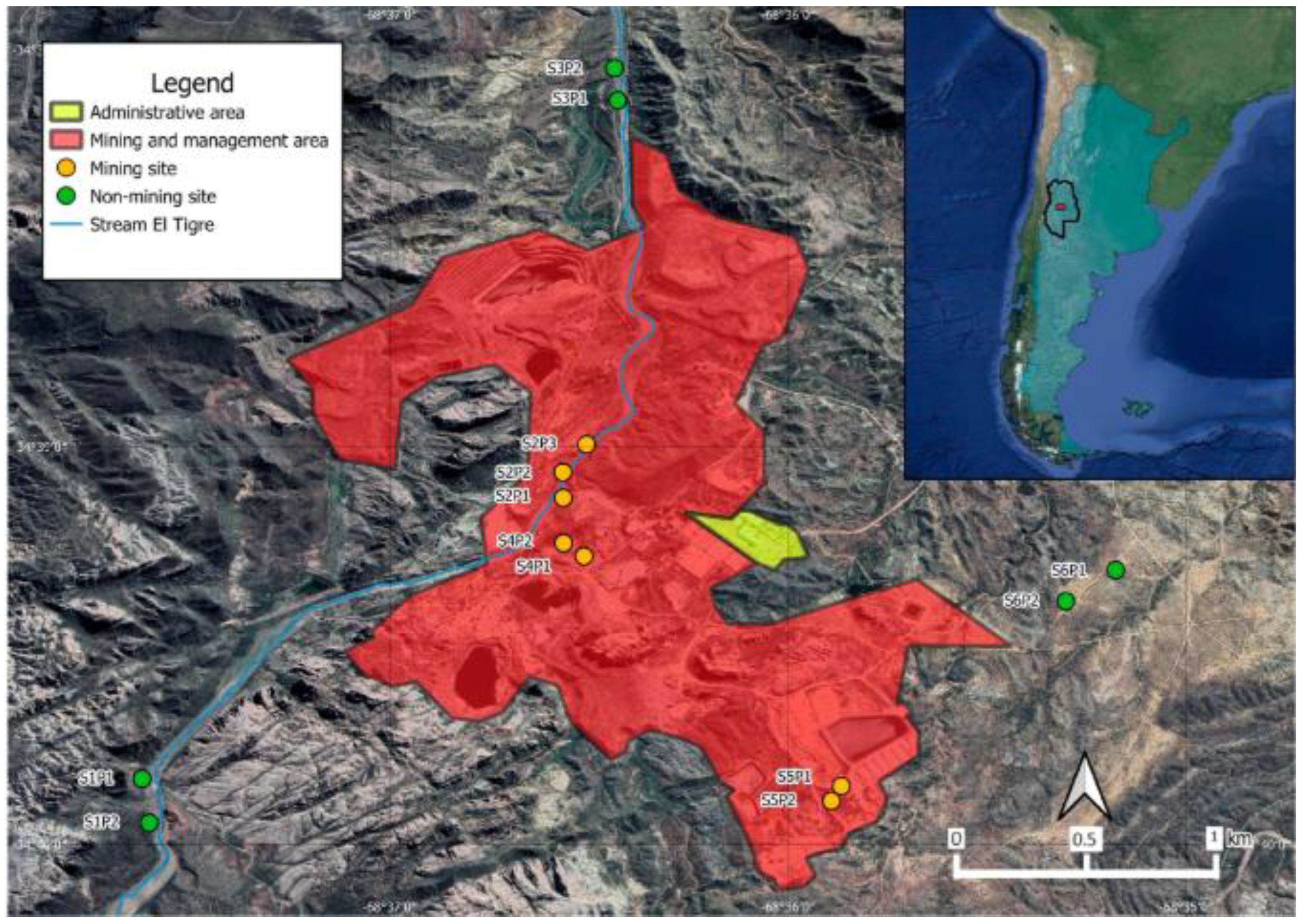
Figure 2.
Percentage of frequency (%F) and intensity (%I) of AM root colonization in Helianthus annuus plants grown in the bioreactors over three phytoremediation cycles. Values represent media and standard error. No significant differences among cycles were detected (p > 0.05).
Figure 2.
Percentage of frequency (%F) and intensity (%I) of AM root colonization in Helianthus annuus plants grown in the bioreactors over three phytoremediation cycles. Values represent media and standard error. No significant differences among cycles were detected (p > 0.05).
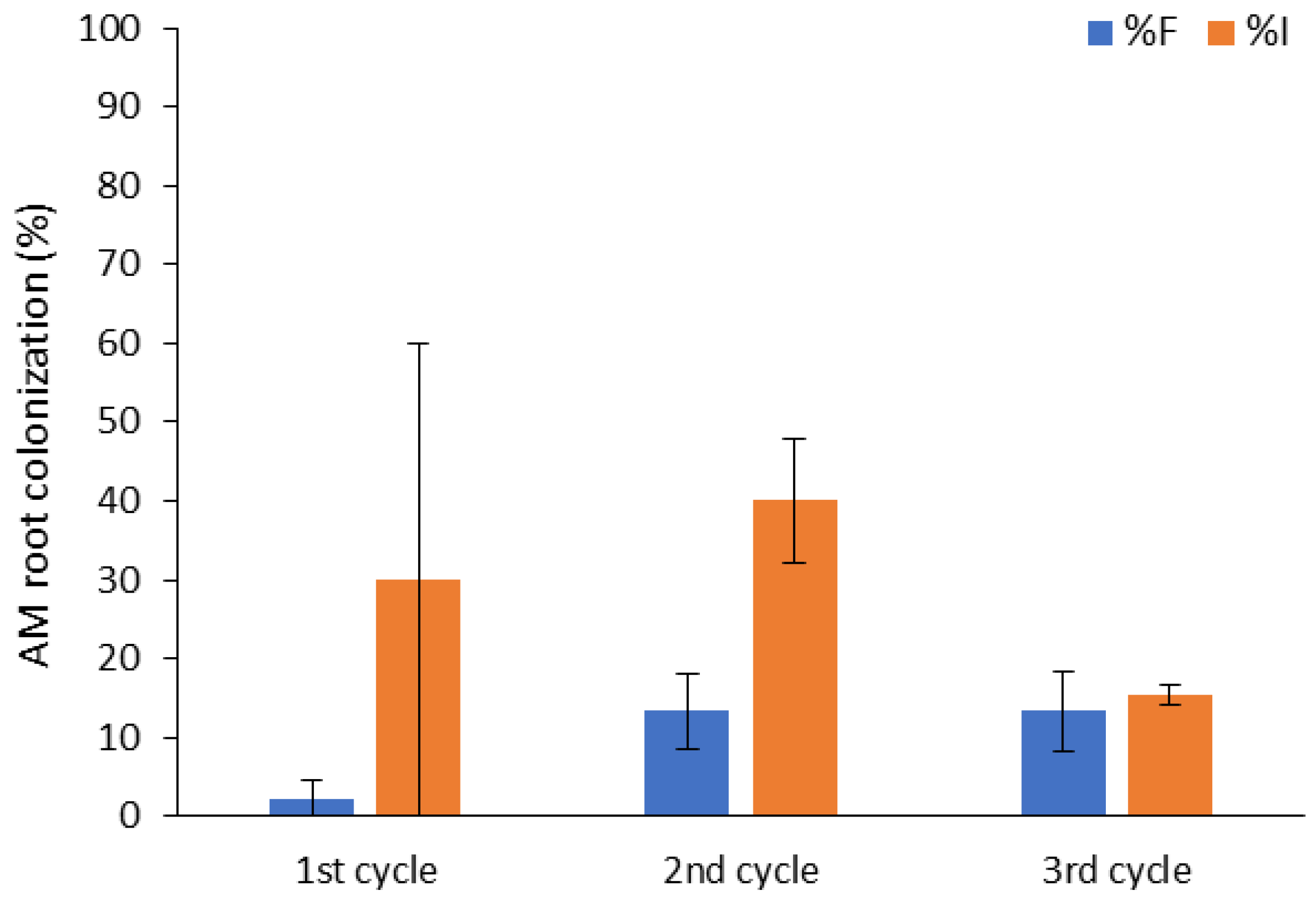
Figure 3.
Concentration of easily extractable Glomalin related-soil proteins (EE-GRSP, mg g-1 dry soil) and total GRSP (T-GRSP) in rhizosphere soils of Helianthus annuus plants grown in bioreactors over three phytoremediation cycles. Values represent media and standard error). Lowercase letters indicate differences among cycles for EE-GRSP; uppercase letters correspond to T-GRSP. Different letters denote significant differences according to ANOVA followed by Tukey test (p ≤0.05).
Figure 3.
Concentration of easily extractable Glomalin related-soil proteins (EE-GRSP, mg g-1 dry soil) and total GRSP (T-GRSP) in rhizosphere soils of Helianthus annuus plants grown in bioreactors over three phytoremediation cycles. Values represent media and standard error). Lowercase letters indicate differences among cycles for EE-GRSP; uppercase letters correspond to T-GRSP. Different letters denote significant differences according to ANOVA followed by Tukey test (p ≤0.05).
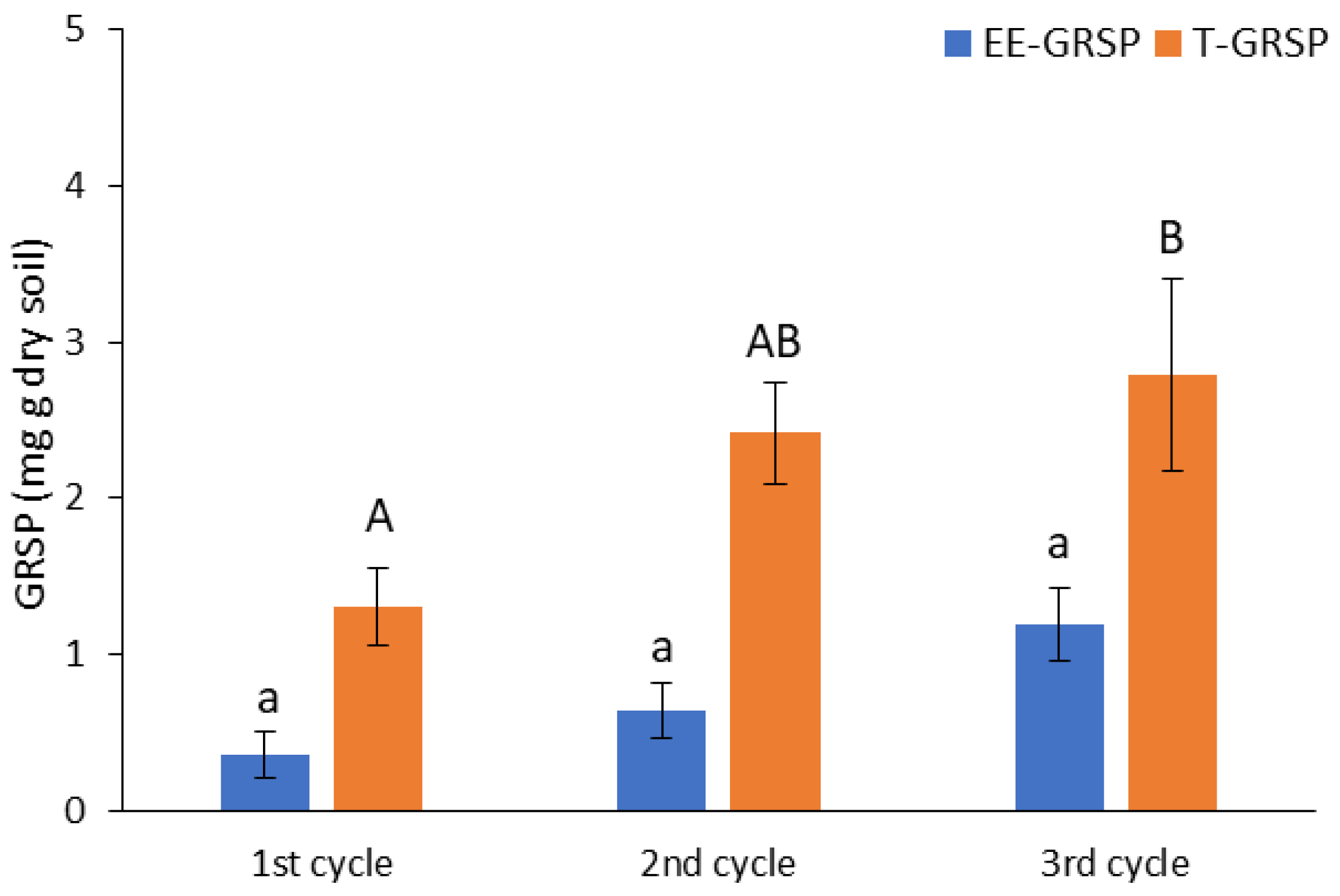

Table 1.
Results of parameters obtained in three engineering cycles. BCFs: Bioconcentration Factor in shoots; BCFr: Bioconcentration Factor in roots; BCFf: Bioconcentration Factor in flowers; TFs/r: Translocation Factor from root to shoot; TFf/s: Translocation Factor from shoot to flower; TFf/r: Translocation Factor from root to flower. In bold BCF and TF values greater than 1.
Table 1.
Results of parameters obtained in three engineering cycles. BCFs: Bioconcentration Factor in shoots; BCFr: Bioconcentration Factor in roots; BCFf: Bioconcentration Factor in flowers; TFs/r: Translocation Factor from root to shoot; TFf/s: Translocation Factor from shoot to flower; TFf/r: Translocation Factor from root to flower. In bold BCF and TF values greater than 1.
| Parameters Engineering Cycles | |||||||||
| Cycle | 1 | 2 | 3 | 1 | 2 | 3 | 1 | 2 | 3 |
| Parameter | BCFs | BCFr | BCFf | ||||||
| Cu | 0,26 | 0,03 | 0,05 | 0,76 | 0,37 | 0,37 | 0,11 | 0,02 | 0,02 |
| Zn | 2,69 | 0,25 | 0,19 | 1,24 | 0,22 | 0,16 | 0,62 | 0,16 | 0,19 |
| Ni | 2,1 | 0,03 | 0,06 | 5,19 | 0,07 | 0,05 | 2,24 | 0,1 | 0,13 |
| Sr | 0,66 | 0,38 | 0,46 | 0,28 | 0,24 | 0,24 | 0,19 | 0,18 | 0,26 |
| P | 3 | 1,01 | 1,26 | 1,09 | 0,74 | 0,7 | 5,51 | 1,62 | 3,81 |
| Parameter | TFs/r | TFf/s | TFf/r | ||||||
| Cu | 0,34 | 0,08 | 0,15 | 0,44 | 0,56 | 0,39 | 0,15 | 0,05 | 0,06 |
| Zn | 2,16 | 1,14 | 1,23 | 0,23 | 0,66 | 0,99 | 0,5 | 0,75 | 1,22 |
| Ni | 0,41 | 0,49 | 1,26 | 1,07 | 2,85 | 2,08 | 0,43 | 1,39 | 2,61 |
| Sr | 2,33 | 1,58 | 1,91 | 0,29 | 0,47 | 0,56 | 0,66 | 0,75 | 1,08 |
| P | 2,76 | 1,37 | 1,8 | 1,83 | 1,59 | 3,04 | 5,06 | 2,18 | 5,48 |
Table 2.
Total biomass obtained in MDV with 290 sunflower plants [24]. The standard deviation (SD) values are given in parentheses. Total biomass/ plant was 198 g.
Table 2.
Total biomass obtained in MDV with 290 sunflower plants [24]. The standard deviation (SD) values are given in parentheses. Total biomass/ plant was 198 g.
| Biomass (g)/plant (SD) | Total Biomass from VDM(kg) | |
|---|---|---|
| 62 (8) | 18 | Shoot |
| 34 (10) | 9,86 | Root |
| 102 (12) | 30,74 | Flower |
Table 3.
Projection of Bioextractive Potential extracted from each element studied in a VDM projection with 290 plants= 57,4 Kg and 2m3 mining subtract (1m3 mining soil plus 1 m3 volcanic ash).
Table 3.
Projection of Bioextractive Potential extracted from each element studied in a VDM projection with 290 plants= 57,4 Kg and 2m3 mining subtract (1m3 mining soil plus 1 m3 volcanic ash).
| Element | Shoots | SUB TOTAL (mg) | Roots | SUB TOTAL (mg) | Flowers | SUB TOTAL (mg) | BP VDM (mg) | Elements mg /kg total biomass |
|---|---|---|---|---|---|---|---|---|
| Cu ppm | 52 | 936 | 154 | 1518,44 | 23 | 707,02 | 3161,46 | 55 |
| Zn ppm | 365 | 6570 | 169 | 1666,34 | 84 | 2582,16 | 10818,5 | 188 |
| Ni ppm | 15 | 270 | 37 | 364,82 | 16 | 491,84 | 1126,66 | 20 |
| Sr ppm | 431 | 7758 | 185 | 1824,1 | 123 | 3781,02 | 13363,12 | 233 |
| P ppm | 1757 | 31626 | 636 | 6270,96 | 3221 | 99013,54 | 136910,5 | 2385 |
Disclaimer/Publisher’s Note: The statements, opinions and data contained in all publications are solely those of the individual author(s) and contributor(s) and not of MDPI and/or the editor(s). MDPI and/or the editor(s) disclaim responsibility for any injury to people or property resulting from any ideas, methods, instructions or products referred to in the content. |
© 2026 by the authors. Licensee MDPI, Basel, Switzerland. This article is an open access article distributed under the terms and conditions of the Creative Commons Attribution (CC BY) license (http://creativecommons.org/licenses/by/4.0/).
Copyright: This open access article is published under a Creative Commons CC BY 4.0 license, which permit the free download, distribution, and reuse, provided that the author and preprint are cited in any reuse.


