

Submitted:
29 May 2026
Posted:
02 June 2026
You are already at the latest version
Abstract
Objective: This study reports the development and psychometric validation of the Problematic and (Adaptive) AI Use Scale for University Students. The scale’s theoretical foundation integrates behavioral addiction frameworks, AI-related ethical considerations, and self-regulated learning perspectives. Method: A total of N=1114 university students were surveyed online. Participants responded to the 27 PAIU-U items and additional validation measures. The sample was randomly split for calibration (n₁=543) and validation (n₂=571). An exploratory factor analysis (EFA) was conducted to identify the factor structure, followed by confirmatory factor analysis (CFA) on the second subsample. Results: EFA revealed a coherent five-factor solution accounting for 57.5% of variance, with high item loadings that mapped onto the theorized dimensions. The factors identified were: (1) Salience/Preoccupation & Tolerance–Escalation, (2) Functional Reliance/Capability Erosion, (3) Social and Ethical Conflict & Harm, (4) Loss of Control & Academic Impairment, and (5) Mood Modification/Coping. Conclusion: The PAIU-U is introduced as a novel measure of university students’ problematic AI use and associated academic integrity lapses. The scale demonstrates a robust multidimensional structure aligned with behavioral addiction theory and academic ethics and shows strong reliability and initial evidence of validity.
Keywords:
academic integrity
; artificial intelligence
; problematic use
; behavioral addiction
; self-regulation
; scale development
; factor analysis
1. Introduction
The emergence of powerful generative AI tools has created a paradox in higher education. On one hand, AI systems like OpenAI’s GPT-3/ChatGPT can enhance learning by providing quick explanations, feedback, and writing assistance. On the other hand, these same tools pose serious challenges to academic integrity, as students may misuse them for completing assignments in dishonest ways (Tan & Maravilla, 2024). In early 2023, the public release of ChatGPT brought these issues to the forefront, as universities observed a surge in AI-assisted coursework and struggled to distinguish students’ original work from AI-generated content. Academic staff began voicing concerns that AI could facilitate novel forms of plagiarism and cheating that evade traditional detection methods (Khasawneh, 2024). For example, an AI can produce an entirely original essay that is not copied from existing sources, rendering standard plagiarism checks ineffective. This has prompted urgent conversations about how to uphold standards of honesty and authenticity in the age of AI (Balalle & Pannilage, 2025, Suh & Ahn, 2022).
Recent evidence suggests that AI misuse in academia is not a hypothetical risk but a present reality. A 2024 survey by the International Center for Academic Integrity found 58% of students admitted to using AI tools dishonestly on assignments (Tan & Maravilla, 2024). Similarly, a UK investigation reported nearly 7,000 documented cases of AI-based cheating in the 2023–24 academic year, a more than threefold increase from the prior year. These known cases likely represent “the tip of the iceberg”. The true prevalence of undiscovered AI-facilitated misconduct may be far higher. In one university survey, 88% of students reported using generative AI for some aspects of their assessments (Freeman, 2025). Not all such use is unethical—students often employ AI for innocuous purposes like explaining concepts or brainstorming ideas (Freeman, 2025)—but the sheer volume of usage means opportunities for misconduct have vastly expanded. Indeed, 43% of U.S. college students surveyed in early 2023 had already used AI tools like ChatGPT, and about 22% used them specifically to complete assignments or exams (Welding, 2023) Notably, just over half of students consider using AI in this manner to be cheating, while a sizeable minority do not see it as an integrity violation (Welding, L. 2023) (Singer-Freeman, et.al. 2025). This division in student perceptions—with 46% of American students not viewing AI-assisted homework as cheating (Singer-Freeman, et.al. 2025) underscores the ambiguity surrounding AI’s role in academic work.
The academic integrity risks associated with AI can take multiple forms. One obvious concern is plagiarism, where a student presents AI-generated text as their own writing (Academic Technology, University of Chicago, 2023). AI can produce fluent essays or solutions that may bypass plagiarism detectors, especially if the student paraphrases the AI output to “humanize” it. Another issue is undisclosed assistance: many universities allow limited use of AI (for example, for proofreading or preliminary research) if properly disclosed, but students may use it far beyond permissible bounds without reporting it. This includes using AI to write code, generate analysis, or complete entire assignments in secret. Such behavior violates honesty policies and undermines the assessment of genuine student ability. A related concern is contract cheating, traditionally defined as outsourcing one’s academic work to a third party (e.g., hiring an essay writer) (Bretag et al., 2019). AI tools now provide a first-party way to outsource work: instead of paying a human, students can prompt an AI to do it. While contract cheating via humans has been relatively low (estimated ~5% prevalence in pre-AI studies (Bretag et al., 2019), AI’s ease of access could make this form of cheating far more common. Additionally, AI misuse can create social and ethical conflicts: for instance, group projects may be disrupted if some members secretly rely on AI, or students may face ethical dilemmas about whether using AI constitutes “cheating” when rules are unclear (Tan & Maravilla, 2024). Many institutions have not yet updated their academic integrity policies to explicitly address AI, leaving a gray area in which students may justify their behavior or claim ignorance (Ana María ALONSO-RODRÍGUEZ, 2024).
Beyond explicit cheating, educators worry about the erosion of learning and skill development. Over-reliance on AI tools can impede students’ acquisition of fundamental skills in writing, critical thinking, and problem-solving (Tan & Maravilla, 2024; Singer-Freeman, et.al. 2025). If a student habitually turns to AI for answers or text generation, they may bypass the cognitive processes that lead to genuine understanding. Studies have shown that when students use AI to do homework exercises, their ability to solve similar problems unaided can decline (Singer-Freeman, et.al. 2025). In this sense, AI misuse parallels phenomena observed with other technologies: ease of access can foster dependency and reduce motivation to engage deeply with material. This aligns with self-regulation theories in education—students who struggle with self-control or time management might use AI as a crutch to cope with academic pressures, ultimately harming their own learning. Indeed, surveys reveal that the top reasons students use AI dishonestly are to save time and manage heavy workloads or stress (Freeman, 2025). Under high pressure, students may view AI as a tempting shortcut to meet deadlines or boost grades, especially if they believe “everyone is doing it.” The need for grades and fear of failure can override ethical considerations for some, a dynamic similar to other forms of academic misconduct.
Academic integrity scholarships have long studied why students cheat and how to prevent it, but generative AI represents a disruptive new variable. Traditional plagiarism involves copying existing text, which detection software can catch, whereas AI can produce original content on demand. Educators are responding by redesigning assessments (e.g., more oral exams, in-class writing) and by explicitly teaching about responsible AI use. However, there is a recognized need for a better understanding of which students are likely to misuse AI and in what ways. Research on academic misconduct suggests that individual factors (such as attitudes, personality, and self-regulation skills) and contextual factors (such as peer norms and clarity of policies) influence dishonest behavior (Tan & Maravilla, 2024; Singer-Freeman, et.al. 2025). It stands to reason that these factors also play a role in AI-related misconduct. For example, students with lower academic confidence or higher impulsivity might be more prone to inappropriate AI use. Without tools to measure students’ engagement with AI, it is difficult to empirically study these hypotheses.
In parallel, the field of behavioral addiction and technology use provides a useful lens. Over the past two decades, researchers have conceptualized excessive or maladaptive engagement with technologies (internet, social media, smartphones, gaming, etc.) as exhibiting addiction-like characteristics in some cases. Key components include salience (the activity dominates thoughts/behavior), mood modification (using the activity to regulate emotions), tolerance (needing increasing involvement to achieve satisfaction), withdrawal (discomfort when unable to engage), conflict (the activity causes problems with personal responsibilities or values), and relapse/loss of control (difficulty abstaining). Griffiths’ (2005) components model of addiction encapsulate these features, originally applied to gambling and later to internet use disorders. Problematic use of AI for schoolwork may share several of these features. For instance, a student might develop a habitual reliance on AI (tolerance) to the point that not using it causes anxiety or poor performance (withdrawal). They may spend more time crafting AI prompts than doing original work or feel unable to start assignments without AI assistance (salience, dependence). Some might use AI as a coping mechanism to deal with academic stress or writer’s block (mood modification). Overuse can then lead to harmful consequences—e.g., neglecting to learn essential skills, violating academic rules, or experiencing guilt and conflict over behavior. These parallels suggest that frameworks from digital addiction research can inform the measurement of problematic AI use. Indeed, prior studies on problematic internet use and academic procrastination show that students sometimes get “hooked” on external tools or platforms in ways that undermine their academic performance (for example, compulsive use of social media or smartphones during study time leads to lower grades and attention problems. In the same vein, habitual AI use could become a form of academic dependency.
Despite these converging concerns, there is currently a lack of validated measurement instruments to assess how students are using AI and to identify maladaptive patterns. Existing questionnaires mostly focus on general attitudes toward AI or digital technology. For example, researchers have developed scales for students’ attitudes toward AI (e.g., the General Attitudes toward Artificial Intelligence Scale, GAAIS (Sacco et al., 2025) and acceptance of AI-based systems (Sacco et al., 2025). Such instruments gauge perceptions (positive or negative) of AI but not behavioral engagement or potential misuse. Other surveys have measured overall AI usage frequency or intention (e.g., what percentage of students use AI, or would use it if allowed) (Freeman, 2025), but these do not capture the nuanced ways AI can both support and undermine learning. In related domains, there are well-established scales for problematic technology use, for instance, Young’s Internet Addiction Test (Young, 1998), the Smartphone Addiction Scale (Freeman, 2025), and the Facebook Addiction Scale—which assess symptoms like compulsive use and negative impacts. However, these tools are not tailored to the academic context or to AI specifically. There is a clear gap for an instrument that incorporates academic integrity dimensions (like rule-breaking and plagiarism via AI) alongside behavioral addiction dimensions (like overreliance and loss of control). A recent study by Marengo et al. (2025) developed a 13-item Generative AI Attitude Scale to measure students’ acceptance of generative AI, reflecting the growing interest in this area. Yet, to our knowledge, no published scale as of 2025 robustly captures problematic academic AI use, including ethically questionable behaviors.
To address this need, the present research introduces the Problematic AI Use Scale for University Students (PAIU-U) and evaluates its psychometric properties. The PAIU-U was designed to be a multidimensional measure, grounded in both the academic integrity literature and behavioral science. Its development was guided by several theoretical perspectives: (1) Behavioral addiction frameworks, particularly Griffiths’ criteria and contemporary models like Brand et al.’s I-PACE model, which highlight cognitive and emotional factors in excessive technology use. (2) AI ethics and integrity concepts, ensuring that the scale taps into behaviors that violate academic norms (e.g., using AI to cheat) as well as emerging ethical dilemmas students face with AI. (3) Self-regulation theory, given that unregulated use of AI may reflect or exacerbate self-regulatory failures in studying (e.g., using AI to avoid effort, akin to procrastination). By integrating these domains, this study aims to capture both the problematic aspects (e.g., compulsion, conflict, harm) and potentially adaptive aspects of AI use (e.g., efficient tool use that does not undermine integrity—though the focus is on the former). The scale’s name reflects this duality, acknowledging that not all AI use is negative; however, the emphasis is on identifying problematic patterns that educators and institutions should be concerned about.
This study situates the PAIU-U within the academic integrity scholarship. It responds to calls for empirically grounded understanding of AI’s impact on student behavior (Tan & Maravilla, 2024). By validating a measurement tool, opportunities for further research are created: for example, exploring correlations between PAIU-U scores and academic outcomes, or testing interventions to reduce problematic use. Importantly, such a scale can help evaluate the effectiveness of institutional policies and educational programs around AI. As universities implement honor code revisions and AI usage guidelines (Tan & Maravilla, 2024), having a way to measure student compliance and attitudes will be valuable. Ultimately, maintaining academic integrity in the age of AI will require not just detection and penalties, but also education and self-monitoring. The PAIU-U could be used in educational interventions to help students self-assess their AI usage habits and reflect on ethical boundaries.
In summary, the present research seeks to develop a reliable and valid instrument to assess university students’ problematic (and adaptive) academic use of AI. It is hypothesized that such use is a multidimensional construct, encompassing cognitive-behavioral symptoms (preoccupation, tolerance, compulsive use), negative outcomes (academic impairment, ethical conflicts), and regulatory issues (loss of control, mood-based use). The following sections outline the methods of scale development and validation, results of factor analyses and validity tests, and a discussion of implications for theory and practice in fostering educational integrity.
2. Method
2.1. Participants
Participants were 1,114 students (after data cleaning for completeness) enrolled at universities. The sample represented a diverse cross-section of university students in terms of demographics and study level. 73.2% of the participants identified as female (n=815) and 26.8% as male (n=299). Ages ranged from late teens to mid-40s, with a mean age in the early twenties. A slight majority of students (54.8%) were 18–24 years old, with 16.6% aged 25–29, about 15% in their 30s, and the remainder 40 or older. This reflects the inclusion of some graduate students and non-traditional students. In terms of academic level, 72.2% were undergraduates pursuing a Bachelor’s degree, 27.4% were Master’s students, and a small minority (0.4%, n=5) were doctoral students. The participants covered a range of academic disciplines (information on fields of study was collected but is not the focus of this analysis). All participants were recruited during the 2024–2025 academic year, a period when generative AI tools were increasingly available on campus.
Participation was voluntary. Students were invited via university email lists and learning management system announcements to complete an online survey about “AI use in academic work.” The recruitment aimed to obtain a broad sample across different faculties. No compensation was provided, to avoid coercion. Before proceeding to the survey, all participants gave informed consent after reading an explanation of the study’s purpose. Data was handled in aggregate, and no identifying information was collected beyond basic demographics.
2.2. Instrument: PAIU-U Scale Development
The primary measure in this study is the Problematic and (Adaptive) AI Use Scale for University Students (PAIU-U). The PAIU-U was developed through an iterative process of item generation based on literature and expert review. Initially, an item pool of Thirty statements was written to reflect various behaviors, thoughts, and consequences related to academic AI use. These items were grounded in known addiction indicators (e.g., “I feel restless when I can’t use AI for my work”) and integrity issues (e.g., “I have violated course rules by using AI”). After refinement and pilot testing for clarity, 27 items were retained for the final scale. Each item is a self-report statement (e.g., “I plan my tasks around when I can use AI” or “I have submitted AI-assisted work without disclosure”) describing a potential experience with AI during studying or completing assignments. Participants rated how often each statement applied to them on a 5-point Likert-type frequency scale (1 = Never, 2 = Rarely, 3 = Sometimes, 4 = Often, 5 = Very Often). Higher scores thus indicate more frequent engagement in the behavior or feeling described.
The 27 items are designed to capture five conceptual subscales, corresponding to the hypothesized factors (H1). Based on content, these subscales are:
- Cognitive Salience and Escalation: Items reflecting cognitive preoccupation with AI and needing to use it more over time. For example, an item states “I think about using AI tools even when I’m not studying”, indicating salience, and “Over time I have needed to use AI more (longer sessions or more prompts) to get the same results”, indicating tolerance or escalation. This factor merges the notion that AI use becomes central to the student’s academic routine and that their “dose” of AI tends to increase.
- Functional Dependence and Skill Erosion: Items reflecting a dependency on AI for academic functioning and a corresponding decline in one’s own abilities. For instance, “Without AI, I struggle to generate ideas or begin assignments” and “I rely on AI to make simple decisions I used to make on my own” tap into this dimension. These items suggest that students come to rely on AI as a crutch, potentially eroding their independent problem-solving or writing skills (self-regulatory erosion).
- Social and Ethical Conflict: Items representing interpersonal or ethical consequences of AI use that conflict with academic values. Examples include “My AI use has caused tension or conflict with peers or instructors (e.g., over originality, teamwork, rules)”, “I have used AI in ways that violated course or assessment policies”, and “I have submitted AI-assisted work without required disclosure when rules asked for it”. These items directly address academic integrity violations and the social fallout (such as damaged trust or rule-breaking) from AI misuse.
- Self-Regulatory Loss and Academic Skill Impairment: Items indicating an inability to regulate AI use and resulting academic performance issues. For example, “I spend more time using AI than I intend to” (loss of control over time), “I try to limit my AI use but cannot keep it up”, and “My AI use has negatively affected my grades, deadlines, or class attendance”. Another item, “I continue using AI even when it clearly derails my workflow”, illustrates compulsive use despite harmful impact. Collectively, this factor captures addictive behavior patterns and tangible academic harm (like missed deadlines or lower quality work due to AI distractions/errors).
- Mood Modification and Coping use: Items showing the use of AI as a coping strategy for emotional relief or avoidance of stress. For instance, “I use AI mainly to escape academic stress or unpleasant feelings” and “Using AI quickly improves my mood when I feel overwhelmed”. Another item, “I turn to AI instead of taking a break when I feel stuck”, suggests using AI for immediate comfort or as an avoidance mechanism. These items align with the concept of negative reinforcement in behavioral addictions, where the behavior is driven by relief from negative emotions].
Each subscale was intended to consist of 3–8 items in the final measure. Subscale scores are computed as the mean of constituent item ratings, making them directly comparable to the 1–5 response scale. Prior to analysis, item wording was carefully reviewed to ensure clarity and avoid double-barreled questions or leading language.
2.3. Procedure
Data collection was administered online via a secure survey platform. After giving informed consent, participants first answered demographic questions (age, gender, study level, major, etc.). They then completed the 27 PAIU-U items in a randomized order to prevent order effects. The survey took approximately 15–20 minutes to complete. To encourage honest reporting (especially since some items probe rule-breaking), anonymity was assured. Participants voluntarily provided their email addresses solely for the purpose of being contacted during the retest phase of the scale validation. No other identifying personal data were collected, and all responses remained anonymous. Email data were stored separately to be used only for re-contact, in line with ethical guidelines for voluntary participation and data protection. Ultimately, a complete-case analysis criterion was applied: only respondents who answered all 27 PAIU-U items (and the key validation items) were retained, yielding N=1114 for analysis.
Prior to main analyses, the dataset was randomly split into two halves using the survey software’s randomizer and verified in R. The first half (n1=543) served as a calibration sample for exploratory factor analysis (EFA), and the second half (n2=571) was held out as a validation sample for confirmatory factor analysis (CFA). Splitting the sample in this manner allows for more rigorous validation: the factor structure identified via EFA can be tested afresh on independent data. Such cross-validation is recommended to avoid overfitting in scale development (Fabrigar et al., 1999; Brown, 2015).
All procedures were approved by the Institutional Review Board (IRB) or ethics committee of the authors’ university. The study was reviewed under the category of minimal risk survey research. Participants were informed that they could skip any question or withdraw at any time, although complete-case analysis meant those who skipped key items were not included in the final dataset. Debriefing information was provided at the end of the survey, including resources on academic integrity and managing technology use, aligning with ethical best practices to mitigate any potential distress from recognizing one’s problematic behavior.
2.4. Statistical Analyses
The psychometric evaluation of the PAIU-U followed a multi-stage statistical procedure. First, an Exploratory Factor Analysis (EFA) was conducted in the calibration sample (n=543) using principal-axis factoring with oblique rotation, while a Varimax solution was additionally inspected to assess structural interpretability. Factor retention was determined through Kaiser’s criterion, scree plot inspection, and parallel analysis, combined with theoretical coherence. The KMO index (0.957) and Bartlett’s test (p<.001) confirmed the adequacy of the data for factor extraction.
In the validation sample (n=571), a Confirmatory Factor Analysis (CFA) with maximum likelihood estimation was performed, based on the EFA-derived structure. A five-factor model was tested and evaluated using CFI, TLI, RMSEA, and SRMR, while alternative models were compared via AIC and BIC. Standardized loadings, standard errors, and item-level R2 values were examined to assess convergent validity.
Reliability was estimated using Cronbach’s α, McDonald’s ω, and Composite Reliability (CR), with coefficients above 0.70 considered satisfactory. Convergent and discriminant validity were assessed through AVE, the Fornell–Larcker criterion, and HTMT ratios (<0.85–0.90). Criterion validity was examined via Pearson correlations between the subscales and 12 external indicators related to attitudes, behaviors, and academic self-efficacy. All analyses were conducted in R-lavaan Package and SPSSv30.
3. Results
3.1. Item Analysis
Variances, means, and standard deviations for all 27 items of the scale were estimated to examine item quality and detect potential dysfunctional items or polarization. Variances were expected to be between 0.5 and 1.5, and means between 1 and 2, which would indicate a normal response distribution. The frequency of AI use was rated on an anchored 5-point scale (1 = Never, 5 = Very Often).

Table 1.
Means, standard deviations and variance of the 27 items of PAIU for the total sample (N=1114).
Table 1.
Means, standard deviations and variance of the 27 items of PAIU for the total sample (N=1114).
| Items* | Mean | SD | Variance |
|---|---|---|---|
| 1. I think about using AI tools even when I’m not studying. | 2.96 | 1.14 | 1.31 |
| 2. I plan my tasks around when I can use AI. | 2.01 | 1.04 | 1.09 |
| 3. I feel a strong urge to open an AI tool when I sit down to work. | 2.41 | 1.15 | 1.31 |
| 4. I frequently check AI tools during activities that don’t require them (e.g., lectures, reading). | 2.13 | 1.13 | 1.28 |
| 5. I use AI mainly to escape academic stress or unpleasant feelings. | 2.03 | 1.10 | 1.21 |
| 6. Using AI quickly improves my mood when I feel overwhelmed. | 1.91 | 1.10 | 1.21 |
| 7. I turn to AI instead of taking a break when I feel stuck. | 1.72 | 1.01 | 1.02 |
| 8. Over time I have needed to use AI more (longer sessions or more prompts) to get the same results. | 2.15 | 1.07 | 1.14 |
| 9. I now use AI for tasks I previously did unaided. | 2.38 | 1.14 | 1.30 |
| 10. I keep adding new AI tools or plugins to achieve the effect I want. | 2.12 | 1.10 | 1.20 |
| 11. I feel irritated or anxious when I cannot use AI (e.g., during exams, outages, or in AI-restricted contexts). | 1.64 | 0.93 | 0.86 |
| 12. Being restricted from AI makes it hard to start or continue my work. | 1.89 | 0.99 | 0.99 |
| 13. I repeatedly check for access to AI tools during AI-free tasks. | 1.76 | 0.92 | 0.85 |
| 14. I feel restless until I can use an AI tool. | 1.50 | 0.79 | 0.63 |
| 15. I spend more time using AI than I intend to. | 1.99 | 1.09 | 1.20 |
| 16. I try to limit my AI use but cannot keep it up. | 1.70 | 0.97 | 0.93 |
| 17. I continue using AI even when it clearly derails my workflow. | 1.52 | 0.82 | 0.67 |
| 18. I find it difficult to stop using AI once I start. | 1.79 | 1.04 | 1.08 |
| 19. My AI use has negatively affected my grades, deadlines, or class attendance. | 1.34 | .68 | 0.46 |
| 20. My AI use has caused tension or conflict with peers or instructors (e.g., originality, teamwork, rules). | 1.35 | 0.76 | 0.57 |
| 21. I have used AI in ways that violated course or assessment policies. | 1.38 | 0.77 | 0.59 |
| 22. I have submitted AI-assisted work without required disclosure when rules asked for it. | 1.43 | 0.82 | 0.68 |
| 23. Because of AI use, I have avoided non-AI learning activities (e.g., practicing problems, drafting, reading). | 1.52 | 0.83 | 0.69 |
| 24. Without AI, I struggle to generate ideas or begin assignments. | 1.77 | 0.93 | 0.87 |
| 25. I rely on AI to make simple decisions I used to make on my own. | 1.65 | 0.98 | 0.95 |
| 26. I feel less confident in my independent writing or problem-solving than before I used AI. | 1.83 | 1.03 | 1.06 |
| 27. Feedback indicates my independent work is worse than my AI-assisted work. | 1.72 | 0.97 | 0.93 |
*1 = never to 5 = very often.
3.2. Item Inter Correlations
To further assess the performance of individual items, inter-item correlation analyses across the scale were conducted. Because the instrument comprises five distinct dimensions, separate correlation matrices were generated for each subscale. Based on the methodological criteria, items belonging to the same factor were expected to show positive and statistically significant associations, reflecting that they tap into the same underlying construct. As shown in Table 2, all inter-item correlations within the five subscales were positive and significant at the 0.01 level, ranging from r = 0.39 to r = 0.60. This pattern of results provides evidence supporting the construct validity of the measure.
3.3. Exploratory Factor Analysis
To highlight the internal structure of the items questions, an Explanatory Factor Analysis was performed on the 27-item PAIU-U core scale using a random sample, derived from the original data set of 1114 participants’ responses, via “psych” R package, using a non-orthogonal rotation technique (Varimax). Sampling adequacy was high (KMO=0.957); Bartlett’s test of sphericity was significant (χ2=8758.496, p<.001). Thus, a five-factor solution was extracted to match the intended theoretical structure. Factor items means, standard deviations and loadings on the five factors are presented in Table 3 below. Five factors with an eigenvalue of one or greater (Figure 1) were revealed, explaining 57.47% of the total variance.
As mentioned above the exploratory factor analysis yielded a coherent five-factor solution which accounted for 57.47% of the total variance, demonstrating a well-structured and theoretically meaningful factor solution. The pattern of loadings supports the multidimensional nature of the construct and provides evidence for the conceptual distinctiveness of each domain within the PAIU-U core scale.
The first factor, Salience / Preoccupation & Tolerance–Escalation (FA), was defined by items reflecting heightened cognitive involvement with the behavior (e.g., persistent thoughts, difficulty disengaging) and a progressive need for increased engagement to achieve the same psychological effect. Items such as ai01, ai02, ai03, ai04, ai08, ai09, and ai10 loaded strongly on this factor, indicating that these experiences represent a central component of problematic involvement.
The second factor, Functional Reliance / Capability Erosion (FB), captured the extent to which individuals increasingly depend on the behavior to manage daily functioning, accompanied by a gradual decline in their ability to regulate or limit use. Items ai11, ai12, ai15, ai18, ai24, ai25, ai26, and ai27 loaded on this dimension, suggesting that functional dependence and reduced self-regulatory capacity form a distinct and meaningful construct within the scale.
The third factor, Conflict & Harm (Social / Ethical) (FC), was characterized by items reflecting interpersonal strain, social consequences, and ethical concerns arising from the behavior. Items ai21, ai22, and ai23 demonstrated strong loadings, indicating that social disruption and value-based conflict constitute a separate domain of problematic engagement.
The fourth factor, Loss of Control and Harm to Academic Skills (FD), included items related to diminished self-control, impaired academic performance, and difficulty maintaining task-related focus. Items ai14, ai16, ai17, ai19, and ai20 loaded on this factor, highlighting the behavioral and cognitive impairments associated with excessive involvement.
Finally, the fifth factor, Mood Modification / Coping (FE), reflected the use of the behavior as a strategy for emotional regulation. Items ai05, ai06, and ai07 loaded strongly on this factor, indicating that individuals may engage in the behavior to alleviate negative affect or enhance mood states.
These five factors correspond closely to the hypothesized domains (H1 was supported). The EFA thus provided evidence of the PAIU-U’s multidimensional structure, with each factor representing a meaningful component of AI-related problematic engagement. The pattern of factor loadings supported the conceptual distinctiveness of each domain. Overall, the EFA solution was clean and theoretically interpretable.
3.4. Confirmatory Factor Analysis
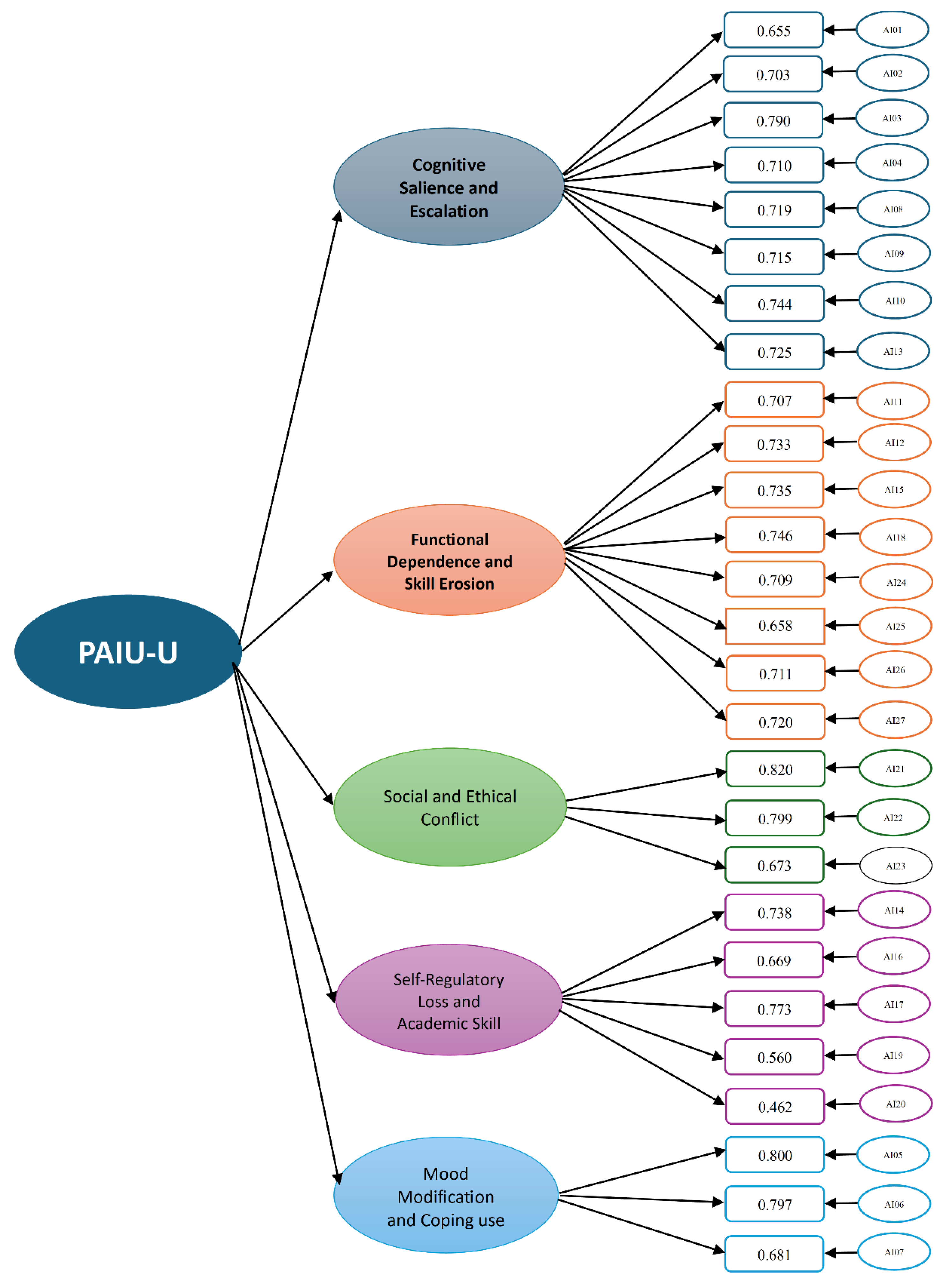
The confirmatory factor analysis (CFA) was conducted using maximum likelihood estimation (ML) on a sample of 571 participants. The model included 64 free parameters and specified a five-factor structure. Standardized and unstandardized factor loadings, along with the proportion of explained variance (R2) for each indicator, are presented in Table 4, while the graphical representation of the standardized factor loadings is presented in the path diagram bellow (Figure 2).
Overall, most items demonstrated strong and statistically significant loadings on their respective latent factors. Fully standardized loadings (Std. all) ranged from 0.462 to 0.820, indicating that most indicators were moderately to strongly associated with the underlying constructs. Several items particularly those loading on Factors FA, FB, and FC exceeded the commonly accepted threshold of 0.60, supporting good convergent validity. Items with lower R2 values (e.g., ai20, ai19) suggest weaker relationships with their latent factor and may reflect higher measurement error or conceptual divergence.
3.5. Model Fit
The overall model fit was evaluated using multiple indices and showed an acceptable, though not optimal, level of fit. The chi-square test was statistically significant, χ2(314) = 1375.26, p < .001, a result that is common in large samples due to the sensitivity of the chi-square statistic to sample size. Incremental fit indices indicated adequate improvement over the baseline model, with CFI = 0.876 and TLI = 0.861, values slightly below the conventional .90 cutoff but still reflective of meaningful model enhancement relative to the null structure (baseline χ2 = 8891.30, df = 351). Absolute fit indices further supported the model’s adequacy, as the RMSEA was 0.077 (90% CI [.073, .081]), falling within the range typically interpreted as acceptable, and the SRMR was 0.060, below the recommended threshold of .08, indicating good residual-based fit. Information criteria values (AIC = 34680.12, BIC = 34958.36, adjusted BIC = 34755.19) provide additional benchmarks for comparing this model with alternative specifications (see Table 5 more details).
3.6. Interpretation of Reliability Results
Taken together, the CFA results provide strong support for the proposed five factor structure. Most items load strongly on their intended factors, and the model demonstrates acceptable global fit according to RMSEA and SRMR, with incremental fit indices approaching recommended thresholds (Hu & Bentler, 1999). The pattern of loadings and R2 values supports the construct validity of the measurement model, although certain indicators may warrant further examination in future refinements.
Combining the reliability indices support the psychometric soundness of the measurement model. The strong alpha and omega coefficients indicate consistent item functioning within each factor, while the AVE values provide evidence of adequate convergent validity for most constructs. These results reinforce the theoretical coherence of the five factor structure and provide a solid foundation for subsequent structural analyses. (Table 6)
Figure 2.
Standardized factor loadings Scree plot from the CFA sample.
3.7. Reliability of Subscales
Each PAIU-U subscale demonstrated good internal consistency. For the five broad factors, Cronbach’s α values were: Salience/Tolerance α = 0.90, Functional Reliance α = 0.89, Conflict & Harm α = 0.80, Loss of Control/Impairment α = 0.78, Mood Modification α = 0.80. These all exceed the 0.70 threshold, indicating a reliable measurement. The 95% confidence intervals for α did not drop below 0.75 for any subscale, affirming stability. McDonald’s ω (McDonald, 1999) coefficients mirrored these results: ω = 0.90, 0.89, 0.81, 0.79, 0.81 respectively (differences between α and ω were negligible since the item loadings within factors were fairly uniform). For completeness, ω2 was also computed (a hierarchical omega for general factor) but since the model is multidimensional without a single higher-order factor, ω2 is not directly interpretable here (if anything, it suggested that a general factor would account for about 70% of total reliable variance, which aligns with factors being correlated).
Item analysis showed that no item’s removal would substantially increase α for its subscale; the maximum increase was 0.01, and in most cases removing an item would decrease α. This suggests that all items contribute meaningfully to their scales.
These results support internal consistency. More specifically PAIU-U questionnaire can yield reliable scores for each dimension and by extension for overall problematic AI use (though it is emphasized that subscale scores are more diagnostic).
3.8. Convergent and Discriminant Validity
Convergent validity was assessed using standardized factor loadings, Average Variance Extracted (AVE), and Composite Reliability (CR). All items demonstrated satisfactory standardized loadings (0.46 to 0.82), exceeding the recommended minimum of .50 and indicating that each indicator contributed meaningfully to its corresponding latent construct. The AVE values for four of the five factors FA (0.521), FB (0.514), FC (0.585), and FE (0.585) were above the .50 threshold, supporting adequate shared variance among items within each construct. The FD factor yielded a lower AVE (0.439), suggesting marginal convergent validity despite acceptable item loadings. Composite reliability values ranged from 0.781 to 0.896 across all factors, surpassing the 0.70 criterion and confirming strong internal consistency. Overall, the results provide solid evidence of convergent validity for the FA, FB, FC, and FE constructs, while the FD factor demonstrates borderline but acceptable convergence.
Table 7.
Overall assessment of convergent validity.
| Factor | Index | ||
|---|---|---|---|
| AVE | CR | FC | |
| FA | 0.521* | 0.896* | Good convergent validity |
| FB | 0.514* | 0.893* | Good convergent validity |
| FC | 0.585* | 0.809* | Good convergent validity |
| FD | 0.439 | 0.781* | Marginal convergent validity |
| FE | 0.585* | 0.804* | Good convergent validity |
First, the Average Variance Extracted (AVE) for each factor was calculated from the CFA loadings. Most factors had AVE around the target of 0.50. So, out of five, four met or exceeded 0.50, and one was slightly below mainly due to including a heterogeneous item. This is interpreted as generally good convergent validity—the latent factors are accounting for a substantial portion of item variance, consistent with the idea that each set of items measures a coherent construct.
Second, the Composite Reliability (CR) for each factor was strong, ranging from 0.78 to 0.89. CR, akin to omega, confirms that the items collectively have high reliability in representing the factor. All CR values easily exceed 0.70. This further supports that each subscale is well-defined and internally coherent (see Table 7 above).
3.9. Discriminant Validity Results
Discriminant validity was examined using the Fornell–Larcker criterion (Fornell, Larcker; 1981) and the Heterotrait–Monotrait ratio -HTMT (Henseler et.al, 2015). The Fornell–Larcker analysis indicated that the square roots of the AVE values for FC and FE exceeded their inter-factor correlations, supporting discriminant validity for these constructs. By Fornell–Larcker, each factor shared more variance with its own items than with any other factor’s items, except possibly a borderline between the academically oriented factors. This was interpreted as generally supporting discriminant validity, acknowledging that the boundary between some factors (like preoccupation and control) is expected to be somewhat blurry due to real conceptual overlap.
The HTMT results were below the conservative .90 threshold for all factor pairs, indicating acceptable discriminant validity overall, although the FA–FB and FB–FD pairs approached the upper boundary, reflecting partial redundancy. Taken together, the findings suggest that while discriminant validity is generally supported, the constructs FA, FB, and FD may represent closely related facets of a broader underlying dimension. The HTMT findings thus generally indicate that the factors are empirically distinguishable, providing strong evidence for discriminant validity in line with Henseler et al. (2015) guidelines.
In summary, PAIU-U subscales are moderately intercorrelated (consistent with them being facets of a common higher-order construct of “problematic AI use”), they are not redundant with each other. Each addresses a unique aspect that the others do not fully capture (Table 8).
3.10. Interpretation of Total Score
High overall PAIU-U scores correspond to high levels of problematic artificial intelligence use, as evidenced by increased responses on all five maladaptive behavior subscales. Students with higher total scores reported stronger cognitive engagement with artificial intelligence, increased dependence, and reduced academic self-efficacy, more frequent violations of ethics or policy, greater loss of self-regulation, and more intense use of artificial intelligence to modify mood or avoid stress. The distribution of total scores therefore reflects the severity of dysfunctional behaviors related to artificial intelligence, without contributing to adaptive or beneficial patterns of artificial intelligence use. Consequently, the total score serves as an overall indicator of maladaptive engagement with artificial intelligence rather than a balanced measure of both positive and negative use of artificial intelligence.
4. Discussion and Conclusions
This study developed and validated the Problematic AI Use Scale for University Students (PAIU-U), providing a timely tool to assess how the rise of generative AI is impacting student behaviors and academic integrity. The results offer several important insights. First, the PAIU-U revealed a multidimensional structure capturing a range of problematic AI use facets that closely align with established theories of behavioral addiction and digital engagement. Despite the novelty of AI in academia, students’ maladaptive interactions with these tools appear to manifest in patterns analogous to other technology-related addictions and academic misconduct behaviors. Second, the scale demonstrated strong psychometric properties: it is reliable, with subscales showing high internal consistency, and it has substantive evidence of validity (factorial, convergent, discriminant, and criterion validity). In the following, the meaning of each identified factor in light of theoretical frameworks is discussed and the implications for educational practice and integrity policy with directions for future research.
Theoretical Implications—Behavioral Addiction Perspective: The PAIU-U’s factors mirror core components of addiction models, suggesting that heavy academic AI use can indeed reach a “problematic” threshold akin to addictive behavior.
The first factor, Cognitive Salience and Escalation, captures how artificial intelligence tools can become cognitively dominant for some students, occupying their thoughts, shaping study routines, and leading to progressively longer or more frequent usage. This pattern closely resembles Griffiths’ (2005) components model of behavioral addiction, particularly the dimensions of salience and tolerance, wherein the activity becomes the central focus of an individual’s life and increasing engagement is required to attain the same psychological impact. The results of this study revealed that students frequently endorsed items such as “always feeling the urge to use AI when studying” and “needing longer AI sessions to feel satisfied,” clearly illustrating an escalation of engagement over time.
Such behavioral markers are consistent with broader literature on digital overuse. Studies of problematic internet gaming (Griffiths et al., 2015), smartphone addiction, and compulsive social media use (Andreassen et al., 2017; Kuss & Griffiths, 2012) similarly identify cognitive preoccupation and escalating use as core features. These findings suggest that although AI tools are not inherently addictive in a pharmacological sense, they can foster behavioral patterns of increasing dependency, especially in academically vulnerable populations (Cai et al., 2023; Kircaburun & Griffiths, 2018). This raises important concerns for educators and mental health professionals regarding the self-regulatory burden posed by educational AI tools.
The Functional Dependence and Skill Erosion factor is particularly noteworthy for educational contexts. It highlights a vicious cycle where reliance on AI as a functional aid (to do tasks or make decisions) potentially erodes the student’s own skills and confidence. Baumeister and Heatherton’s (1996) work on self-regulation failure posited that reliance on external sources of regulation can weaken internal self-control over time. This study’s findings resonate with this: students reported struggling to work without AI and feeling less capable in writing or problem-solving independently after using AI extensively. This is analogous to phenomena observed with calculators or GPS—over-reliance can diminish one’s mental math or navigation skills. In an academic integrity framework, this raises concern that even if a student isn’t intending to cheat, they might become so dependent on AI that they cannot perform adequately without it, thus feeling compelled to use it even when disallowed (e.g., closed-book exams). This factor thus bridges integrity and learning outcomes: excessive AI help might undermine learning, which in turn could tempt more misconduct (a student who has not learned might cheat to get by).
The Social and Ethical Conflict factor directly ties the scale to academic integrity violations. Items in this factor (violating rules, submitting work without disclosure) indicate outright misconduct facilitated by AI. The fact that these items hung together as a factor means students who did one such behavior often did the others—an integrity mindset or lack thereof. This aligns with general academic dishonesty research which finds that students who plagiarize are also likely to engage in other forms of cheating (McCabe & Trevino, 1997). Interestingly, it was found that a behavior like avoiding proper practice (item 23) loaded here as well, suggesting that students who cheat with AI also cut corners in learning in other ways (skipping learning activities). The presence of this factor validates that PAIU-U is not just an “addiction” scale but truly incorporates integrity breaches. Theoretically, it corresponds to the “conflict” component of addiction (conflict with values or others), and to what integrity scholars call “misconduct.” Its correlation with other factors implies that such misconduct does not occur in isolation; it is intertwined with patterns of overuse and dependence. This supports the notion of an “integrity-addiction link”—as a student becomes more dependent on AI, they may begin to rationalize unethical use of it. This factor confirms the need to monitor not just frequency of use but manner of use: it’s possible to use AI frequently without cheating (e.g., always using it for practice questions but not on actual assignments), but those who cross into misconduct territory form a distinct subgroup of concern.
The Self Regulatory Loss and Academic Skill factor speaks to self-regulation breakdowns. Students endorsing items here essentially admit they cannot regulate their AI usage and it is hurting their academics (grades, attendance). This aligns with general addiction criteria of continued use despite negative consequences and inability to cut back. Rosen et al. (2011) demonstrated how digital distractions impair academic performance (e.g., texting in class lowers test scores). Similarly, our participants who overused AI reported missing deadlines or performing worse academically because of it. It may seem counterintuitive that using AI—presumably to help with work—would hurt grades, but this likely reflects scenarios where over-reliance leads to procrastination (trusting AI will save you, then AI use itself taking time or producing flawed output). Or students might rely on AI and then disengage, leading to poor understanding and grades. Notably, one item in this factor was social conflict (tension with instructors/peers over AI), which indicates that a loss of control in using AI can spill over into interpersonal domains (like being accused of cheating or causing group project issues). This factor reinforces the idea that problematic AI use can have tangible negative outcomes, countering any argument that “if it helps me get my work done, what’s the harm?” The harm may not only be ethical but also educational.
The Mood Modification and Coping Use factor confirms that some students use AI as an emotional support or avoidance mechanism. This finding is in line with the I-PACE model of specific Internet-use disorders (Brand et al., 2016), which emphasizes that using an online application to alleviate negative mood can drive addictive use via negative reinforcement. Students who are anxious, overwhelmed, or bored may turn to AI tools to quickly relieve those feelings—for example, if stressed by an essay, they ask ChatGPT to draft it, feeling instant relief. While this might short-term improve mood, it reinforces reliance on AI for coping rather than developing resilience or time management. The presence of this factor suggests that interventions to reduce problematic AI use might need to address emotional factors, not just ethical reasoning. For instance, helping students manage academic stress or improving their coping skills could reduce the temptation to misuse AI as an “escape” or quick fix. In the academic integrity context, this underscores that misconduct is not always purely calculative (e.g., to get a better grade) but sometimes affect-driven (e.g., panicking and then cheating). Recognizing mood-related drivers can help educators design better support systems (like counseling, workload management) to preempt AI misuse.
Institutional and Educational Implications: The validation of the PAIU-U comes at a crucial time for universities formulating policies on AI. Many institutions are currently debating how to balance the legitimate educational uses of AI with preventive measures against misuse (Balalle & Pannilage, 2025; Tan & Maravilla, 2024) The PAIU-U can serve as a diagnostic tool in this process. For example, universities could use the scale (in an anonymized survey format) to gauge the prevalence of various problematic behaviors on their campus. If results show, say, a high average on the Ethical Conflict subscale, it signals that many students are violating AI-related rules, implying that either policies are not clear/enforced or that students do not buy into them. On the other hand, if many students score high on Salience and Reliance but not on Ethical Conflict, it suggests a lot of dependency that could lead to misconduct if not addressed, even if rules haven’t been broken yet. In this way, the scale can inform proactive integrity strategies.
Another application is in academic advising and support. Just as some universities screen for academic difficulty or mental health, they could screen for unhealthy AI usage habits. A student with extremely high PAIU-U scores might benefit from targeted advising: for instance, an advisor could counsel them on time management (if high on Mood Coping indicating stress use) or on writing skills (if high on Reliance indicating skill erosion). It’s important to note that the PAIU-U should not be used punitively—it’s a self-report measure, not proof of misconduct. Rather, it can be a self-reflection tool. The researchers envision that even giving students the scale to fill out and then discussing it could raise their awareness. Many students likely do not realize they are becoming over-dependent on AI or where the ethical lines are. The items themselves (covering things like violation of rules, inability to work without AI) could prompt self-reflection.
From an academic integrity office perspective, the subscales align with different aspects of misconduct. The Ethical Conflict subscale directly measures behavior that integrity officers want to minimize (cheating with AI). High scores there might correlate with actual academic misconduct incidents (a hypothesis for future research is that PAIU-U scores predict academic misconduct reports or Turnitin flags). If validated longitudinally, the scale could possibly be used to identify at-risk students for preventative education. For example, new students could take it as part of an orientation on AI ethics, and those scoring high might receive additional mentoring about acceptable practices. Moreover, the scale’s existence itself sends a message: it delineates what counts as problematic AI use. Faculty and students can use it to spark dialogue on what is appropriate vs. not. Many students currently are unsure where to draw the line (as seen by 46% not thinking AI use is cheating in some contexts) (Singer-Freeman, et.al. 2025). The PAIU-U provides a research-based delineation of problematic behaviors.
Relation to Academic Integrity Literature: The introduction of AI has been likened to earlier challenges such as contract cheating services and essay mills (Lancaster & Cotarlan, 2021)—new means to old ends. The findings reinforce that underlying academic integrity issues (like pressure, opportunity, rationalization) remain relevant. The difference is the scale: AI use is far more widespread and accessible than hiring an essay writer. The high percentage of students using AI without viewing it as cheating (Singer-Freeman, et.al. 2025) suggests a normalization of this behavior that did not occur with contract cheating (which a small minority engaged in, typically covertly) (Bretag et al., 2019). This raises a critical implication: education and policy need to evolve quickly. Students need clearer guidance on what constitutes acceptable AI use. The fact that participants answered items like “violated policy” implies policies exist—but if a large number still did it, enforcement or clarity might be lacking. Universities might consider adapting honor codes to explicitly mention AI (which, by 2025, many have started doing). More importantly, teaching why certain AI uses are prohibited is crucial. If students only hear “don’t use ChatGPT or you’ll be punished,” they might be unconvinced (especially if they see peers doing it). Instead, explaining that overusing AI can impair learning (supported by the findings of capability erosion and academic impairment) could appeal to students’ self-interest in actually getting an education, not just a grade.
Self-Regulation and Support: One striking aspect of the results is the interplay between AI misuse and poor self-regulation. This suggests that efforts to bolster students’ self-regulated learning skills could mitigate problematic AI use. For instance, teaching students effective time management, planning, and help-seeking strategies might reduce last-minute panicky reliance on AI (addressing the Mood Coping factor). Encouraging a growth mindset and skill practice might reduce the Capability Erosion, because students would be less tempted to let AI do the work if they are confident in their own skills. In essence, treating the cause (procrastination, lack of confidence, academic overload) can reduce the symptom (AI misuse). Academic integrity, often addressed through deterrence, could complement that with a supportive approach focusing on improving student learning habits.
To conclude, high overall PAIU-U scores reflect elevated levels of problematic artificial intelligence (AI) use in academic settings. These scores are primarily driven by maladaptive behavioral patterns across five domains: cognitive overengagement, dependence, ethical disengagement, self-regulation failure, and emotional coping. Students with higher total scores exhibit stronger cognitive absorption with AI tools, increased reliance on them for academic tasks, and diminished academic self-efficacy—patterns consistent with broader definitions of behavioral addiction (Montag & Walla, 2016; Kuss & Griffiths, 2017). Furthermore, elevated scores correlate with more frequent ethical violations, including plagiarism and misrepresentation, aligning with growing concerns around AI-facilitated academic misconduct (Cotton et al., 2023).
Loss of self-regulatory control and the use of AI as a means to modulate emotional states (e.g., stress, anxiety) further indicate dysfunctional usage patterns that parallel those seen in other domains of problematic digital behavior (Al-Rahmi et al., 2022). Importantly, the total score is not intended to capture balanced or beneficial engagement with AI technologies; rather, it functions as a unidimensional indicator of maladaptive use (Abdullah, 2025). This distinction supports the application of the PAIU-U as a risk-identification and policy-alignment tool for educational institutions seeking to promote ethical and sustainable AI use (UNESCO, 2023).
Limitations: This study has some limitations that warrant caution and further research. First, the data rely on self-report of sensitive behaviors (cheating, etc.). Although anonymity was ensured, there is always a risk of social desirability bias—some students might under-report unethical or problematic usage. The moderate means for those items (somewhere between “never” and “rarely” on average) might be underestimated by true prevalence. Future studies could incorporate more objective measures (if feasible), such as analyzing submission text for AI-generated features or using AI detection tools, to validate self-reports. That said, current AI detectors are not fully reliable, and our stance is that self-report captures the psychological aspect (the student acknowledging their behavior) which is precisely what was measured. Nonetheless, methodological triangulation (combining self-report with behavioral logs, peer reports, or even qualitative interviews) would enrich validation.
Second, the sample, while large, may not be fully representative of all universities or cultural contexts. Most participants were from a particular country/region (not disclosed here for anonymity). Norms around academic integrity and AI use may differ internationally. For example, in some educational cultures, using translation software or other AI might be more normalized or more stigmatized. Cross-cultural validation of the PAIU-U is an important next step. The factor structure was hypothesized to hold across cultures (since the addiction components are thought to be universal), but the base rates and perhaps the wording of certain items might need adaptation. The researchers have plans to translate and test the scale in at least two other languages. Measurement of invariance testing across cultural groups will ascertain if the tool functions equivalently (as recommended for any psychometric instrument.
Third, the current study is cross-sectional. The researchers cannot determine causality—whether heavy AI use caused academic problems or whether struggling students turned to AI—likely both reinforce each other in a feedback loop. A longitudinal design would help untangle this. Also, our understanding of the temporal stability of PAIU-U scores is limited; do students’ behaviors change over a semester, and can the scale detect that? A test–retest reliability check is needed. The study predicts moderate stability (since habits don’t change overnight) but also sensitivity to major events (e.g., a crackdown on AI by the university might reduce overt misconduct). In the future, following a cohort over time could also reveal if problematic AI use is a transient phenomenon for some (e.g., spikes during exam weeks) or a stable trait for others.
Additionally, the predictive validity of the PAIU-U remains to be established. For instance, it is yet unclear whether high scores on the scale can prospectively predict negative academic outcomes such as lower GPA or increased incidences of academic misconduct. Establishing such associations would significantly enhance the scale’s utility as a screening tool for early intervention (Hao et al., 2021; Chen et al., 2025). Although cross-sectional data in the present study revealed links between high PAIU-U scores and self-reported grade impact, objective academic records, such as official transcripts or documented cases of plagiarism, would serve as more robust indicators of the scale’s external validity (Kröner et. al., 2017; Flanigan & Babchuk, 2015).
Another limitation is that the current scale predominantly assesses problematic AI usage. While the scale’s full title includes “(Adaptive)” to acknowledge the existence of beneficial and regulated uses of AI, the items constructed and validated in this version skew toward maladaptive behaviors. This asymmetry reflects a larger issue in digital behavior research, where risk-oriented measures often overshadow investigations into adaptive or constructive use (Ng et al., 2022; Deterding et al., 2015). Future research could incorporate items that explicitly evaluate self-regulated, goal-oriented, or pedagogically sound applications of AI tools, which may inversely relate to the problematic dimensions (Cai et al., 2023). Until such refinements are introduced, the PAIU-U is best positioned as a risk-assessment instrument that flags individuals potentially vulnerable to harmful engagement with AI technologies. Nonetheless, exceptionally low scores across all factors might signal adaptive or minimal usage patterns, although such interpretations warrant cautious validation.
Future Directions: Building on this study’s findings, several avenues for continued research are outlined. One is testing the measurement invariance of the PAIU-U across different subgroups: by gender, academic level, or field of study. The sample had mostly undergraduates but also grad students; initial analyses (not fully reported) suggested the same factor structure fit both, but sample size for PhD students was too small to say. It would be interesting if, for instance, STEM vs. humanities students differ in their patterns of AI use (some literature suggests STEM and male students use AI more freely (Singer-Freeman, et.al. 2025). The scale could help quantify those differences. Ensuring the scale works equally for males and females (no gender bias in items) is also important; notable differential item functioning by gender were not found , but a formal invariance test would confirm that.
Another direction is to explore the PAIU-U in relation to other constructs and outcomes. For example, how does it relate to classical measures of academic dishonesty (like surveys that ask about cheating frequency in general)? How does it relate to existing “technology addiction” scales like smartphone or internet addiction measures? Moderate correlations are expected since problematic AI use is a specific facet of digital dependence. It might, however, be more predictive of academic outcomes than a general smartphone addiction scale, because it specifically addresses study-related behavior.
It is also suggested, using the scale to evaluate interventions. Universities are trying various approaches: some ban AI in assignments; others integrate it and teach ethical use. The effectiveness of these policies could be partially measured by surveying students with PAIU-U before and after policy implementation or educational workshops. A drop in scores, especially in Ethical Conflict, after an integrity workshop on AI would indicate improved student behavior/attitudes. Conversely, if an outright ban is instituted and PAIU-U scores remain high or even increase (perhaps because students go underground with their use), that would be instructive.
Finally, as AI tools evolve (new models, detectors, etc.), the scale may need updates. For example, if future AI tools include built-in citation or integrity features, the nature of misuse might shift. Items were designed at a level that should be robust to specific tech changes (e.g., “I add new AI plugins to get what I want” covers if they use more advanced tools). But continuous validation is wise. The “arms race” between AI generation and detection may also influence student behavior. If detection improves, students might feel more conflict or concealment (affecting Conflict factor). The PAIU-U scale could track such trends over time if repeated periodically (like an AI use barometer).
The PAIU-U scale addresses a critical gap in the intersection of academic integrity and educational technology by offering a validated instrument to quantify problematic AI use among university students. The findings affirm that such use is not a singular, isolated behavior, but rather a multifaceted syndrome comprising excessive engagement, ethical violations, dependency, and emotion-focused coping strategies (Abdullah, 2025; Cotton et al., 2023). This multidimensional conceptualization provides a nuanced understanding of how students interact with generative AI tools and underscores the complexity of the challenges faced by educators and institutions (Al-Rahmi et al., 2022).
Addressing problematic AI use thus requires holistic strategies. Interventions should not be limited to policing academic misconduct (which corresponds to the Social and Ethical Conflict factor), but must also focus on enhancing academic self-regulation and study strategies (relevant to the Self-Regulatory Loss and Functional Dependence and Skill Erosion factors), and bolstering student mental health and resilience (targeting the Mood Modification and Coping Use factor) (Kuss & Griffiths, 2017). As AI tools become increasingly embedded in educational environments, instruments like the PAIU-U will be vital for informing ethical policies, preventative interventions, and student support services (UNESCO, 2023).
Findings of this study ultimately reinforce a key message: AI in education offers great benefits, but without self-regulation and integrity, those benefits can be undermined by problematic use. By systematically measuring these behaviors, educators and researchers can better promote a culture where AI is used to enhance learning honestly, rather than to short-circuit it. The PAIU-U provides a means to benchmark our progress toward that goal and to identify where interventions are most needed.
References
- Abdullah, M. Y. Probing into EFL students’ perceptions about the impact of utilizing AI-powered tools on their academic writing practices. Education and Information Technologies 30 2025, 21189–21220. [Google Scholar] [CrossRef]
- Al-Rahmi, W. M.; Yahaya, N.; Alturki, U.; Alrobai, A.; Aldraiweesh, A. A.; Alsayed, A. O.; Kamin, Y. B. Social media-based collaborative learning: The effect on learning success with the moderating role of cyberstalking and cyberbullying. Interactive Learning Environments 2022, 30(8), 1434–1447. [Google Scholar] [CrossRef]
- Andreassen, C. S.; Pallesen, S.; Griffiths, M. D. The relationship between addictive use of social media, narcissism, and self-esteem: Findings from a large national survey. Addictive Behaviors 2017, 64, 287–293. [Google Scholar] [CrossRef] [PubMed]
- Balalle, H.; Pannilage, S. Reassessing academic integrity in the age of AI: A systematic literature review on AI and academic integrity. Social Sciences & Humanities Open 2025, 11, 101299. [Google Scholar] [CrossRef]
- Baumeister, R. F.; Heatherton, T. F. Self-regulation failure: An overview. Psychological Inquiry 1996, 7(1), 1–15. [Google Scholar] [CrossRef]
- Bretag, T.; Harper, R.; Burton, M.; Ellis, C.; Newton, P.; Rozenberg, P.; Saddiqui, S.; van Haeringen, K. Contract cheating: A survey of Australian university students. Studies in Higher Education 2019, 44(11), 1837–1856. [Google Scholar] [CrossRef]
- Brand, M.; Young, K. S.; Laier, C.; Wölfling, K.; Potenza, M. N. Integrating psychological and neurobiological considerations regarding the development and maintenance of specific Internet-use disorders: An Interaction of Person-Affect-Cognition-Execution (I-PACE) model. Neuroscience & Biobehavioral Reviews 2016, 71, 252–266. [Google Scholar] [CrossRef]
- Brown, T. A. Confirmatory factor analysis for applied research, 2nd ed.; The Guilford Press, 2015. [Google Scholar]
- Cotton, D. R. E.; Cotton, P. A.; Shipway, J. R. Chatting and cheating: Ensuring academic integrity in the era of ChatGPT. Innovations in Education and Teaching International 2023, 60(1), 103–113. [Google Scholar] [CrossRef]
- Deterding, S.; Dixon, D.; Khaled, R.; Nacke, L. From game design elements to gamefulness: Defining “gamification”; Proceedings of the 15th International Academic MindTrek Conference, 2015; pp. 9–15. [Google Scholar] [CrossRef]
- Fabrigar, L. R.; Wegener, D. T.; MacCallum, R. C.; Strahan, E. J. Evaluating the use of exploratory factor analysis in psychological research. Psychological Methods 1999, 4(3), 272–299. [Google Scholar] [CrossRef]
- Flanigan, A. E.; Babchuk, W. A. Online graduate students’ perceptions of best quality course experiences. The Quarterly Review of Distance Education 2015, 16(3), 83–96. Available online: https://www.infoagepub.com/quarterly-review-of-distance-education.html.
- Fornell, C.; Larcker, D. F. Evaluating structural equation models with unobservable variables and measurement error. Journal of Marketing Research 1981, 18(1), 39–50. [Google Scholar] [CrossRef]
- Freeman, J. Student generative AI survey 2025. Higher Education Policy Institute. 26 February 2025. Available online: https://www.hepi.ac.uk/reports/student-generative-ai-survey-2025/.
- Griffiths, M. D. A ‘components’ model of addiction within a biopsychosocial framework. Journal of Substance Use 2005, 10(4), 191–197. [Google Scholar] [CrossRef]
- Henseler, J.; Ringle, C. M.; Sarstedt, M. A new criterion for assessing discriminant validity in variance-based structural equation modeling. Journal of the Academy of Marketing Science 2015, 43(1), 115–135. [Google Scholar] [CrossRef]
- Hao, Z.; Jin, L.; Huang, J.; Lyu, R.; Cui, Q. Academic Burnout and Problematic Smartphone Use During the COVID-19 Pandemic: The Effects of Anxiety and Resilience. Frontiers in psychiatry 2021, 12, 725740. [Google Scholar] [CrossRef]
- Hu, L.; Bentler, P. M. Cutoff criteria for fit indexes in covariance structure analysis: Conventional criteria versus new alternatives. Structural Equation Modeling 1999, 6(1), 1–55. [Google Scholar] [CrossRef]
- International Center for Academic Integrity (ICAI). Academic integrity in the age of AI: Student perspectives [Survey report]. 2024. Available online: https://academicintegrity.org.
- Khasawneh, M. A. S. Academic integrity and the use of ChatGPT by EFL pre-service teachers. Journal of Infrastructure, Policy and Development 2024, 8(7), Article 4783. [Google Scholar] [CrossRef]
- Kircaburun, K.; Griffiths, M. D. Instagram addiction and the Big Five of personality: The mediating role of self-liking. Journal of behavioral addictions 2018, 7(1), 158–170. [Google Scholar] [CrossRef]
- Kröner, J.; Goussios, C.; Schaitz, C.; Streb, J.; Sosic-Vasic, Z. The construct validity of the German Academic Self-regulation Questionnaire (SRQ-A) within primary and secondary school children. Frontiers in Psychology 2017, 8, 1032. [Google Scholar] [CrossRef]
- Kuss, D. J.; Griffiths, M. D. Internet Gaming Addiction: A systematic review of empirical research. International Journal of Mental Health and Addiction 2012, 10(2), 278–296. [Google Scholar] [CrossRef]
- Kuss, D. J.; Griffiths, M. D. Social networking sites and addiction: Ten lessons learned. International Journal of Environmental Research and Public Health 2017, 14(3), 311. [Google Scholar] [CrossRef] [PubMed]
- Lancaster, T.; Cotarlan, C. Contract cheating by STEM students through a file sharing website: a Covid-19 pandemic perspective. Int J Educ Integr 2021, 17, 3. [Google Scholar] [CrossRef]
- Marengo, A.; Karaoglan-Yilmaz, F. G.; Yılmaz, R.; Ceylan, M. Development and validation of generative artificial intelligence attitude scale for students. Frontiers in Computer Science 2025, 7. [Google Scholar] [CrossRef]
- McDonald, R. P. Test theory: A unified treatment; Lawrence Erlbaum Associates, 1999. [Google Scholar] [CrossRef]
- McCabe, D. L.; Treviño, L. K. Individual and contextual influences on academic dishonesty: A multicampus investigation. Research in Higher Education 1997, 38(3), 379–396. [Google Scholar] [CrossRef]
- Montag, C.; Walla, P. Carpe diem instead of losing your social mind: Beyond digital addiction and why we all suffer from digital overuse. Cogent Psychology 2016, 3(1). [Google Scholar] [CrossRef]
- ALONSO-RODRÍGUEZ, Ana María. Towards a framework for ethical and effective AI use in education. Centre for Research in the Philosophy of Science and Technology (CIFYT). University of A Coruña. Spain. 2024. Available online: https://revistas.usal.es/tres/index.php/1130-3743/article/view/31821/29788.
- Griffiths, M.; Pontes, H.; Kuss, D. Clinical psychology of Internet addiction: a review of its conceptualization, prevalence, neuronal processes, and implications for treatment. Neuroscience and Neuroeconomics 2015, 11. [Google Scholar] [CrossRef]
- Rosen, L. D.; Lim, A. F.; Carrier, L. M.; Cheever, N. A. An Empirical Examination of the Educational Impact of Text Message-Induced Task Switching in the Classroom: Educational Implications and Strategies to Enhance Learning. Psicología Educativa. Revista de los Psicólogos de la Educación 2011, 17(2), 163–177. Available online: https://www.redalyc.org/articulo.oa?id=613765482004.
- Sacco, F.; Manzi, F.; Di Dio, C.; Schepman, A.; Rodway, P.; Massaro, D.; Marchetti, A. Validation of the general attitudes towards artificial intelligence scale in the Italian context and the role of trust. Computers in Human Behavior Reports 2025, 19, 100751. [Google Scholar] [CrossRef]
- Singer-Freeman, K.; Verbeke, K.; Barre, B. Generative AI usage among university students depends on academic level and task. Higher Learning Research Communications 2025, 15(2), 1–24. [Google Scholar] [CrossRef]
- Suh, W.; Ahn, S. Development and validation of a scale measuring student attitudes toward AI. SAGE Open 2022, 12(2), 1–12. [Google Scholar] [CrossRef]
- Tan, M. J. T.; Maravilla, N. M. A. T. Shaping integrity: why generative artificial intelligence does not have to undermine education. Frontiers in artificial intelligence 2024, 7, 1471224. [Google Scholar] [CrossRef]
- Cai, Z.; Mao, P.; Wang, Z.; Wang, D.; He, J.; Fan, X. Associations between problematic internet use and mental health Outcomes of Students: A Meta-analytic review. Adolescent Research Review 2023, 8(1), 45–62. [Google Scholar] [CrossRef] [PubMed]
- UNESCO. Guidance for generative AI in education and research. 2023. Available online: https://unesdoc.unesco.org/ark:/48223/pf0000386693.
- University of Chicago Academic Technology. Combating Academic Dishonesty, Part 6: ChatGPT, AI, and Academic Integrity. 2023. Available online: https://academictech.uchicago.edu/2023/01/23/combating-academic-dishonesty-part-6-chatgpt-ai-and-academic-integrity.
- Welding, L. Half of college students say using AI on schoolwork is cheating or plagiarism. BestColleges. 2023. Available online: https://www.bestcolleges.com/research/college-students-ai-tools-survey/.
- Chen, Z.; Zeng, J.; Liao, J.; Guo, C. The Association between Academic Stress and Problematic Internet Use among Adolescents: A Three-Level Meta-Analysis. Journal of Youth and Adolescence 2025, 54(7), 1779–1799. [Google Scholar] [CrossRef]
- Young, K. S. Internet addiction: The emergence of a new clinical disorder. CyberPsychology & Behavior 1998, 1(3), 237–244. [Google Scholar] [CrossRef]
Figure 1.
Scree plot from the EFA sample.
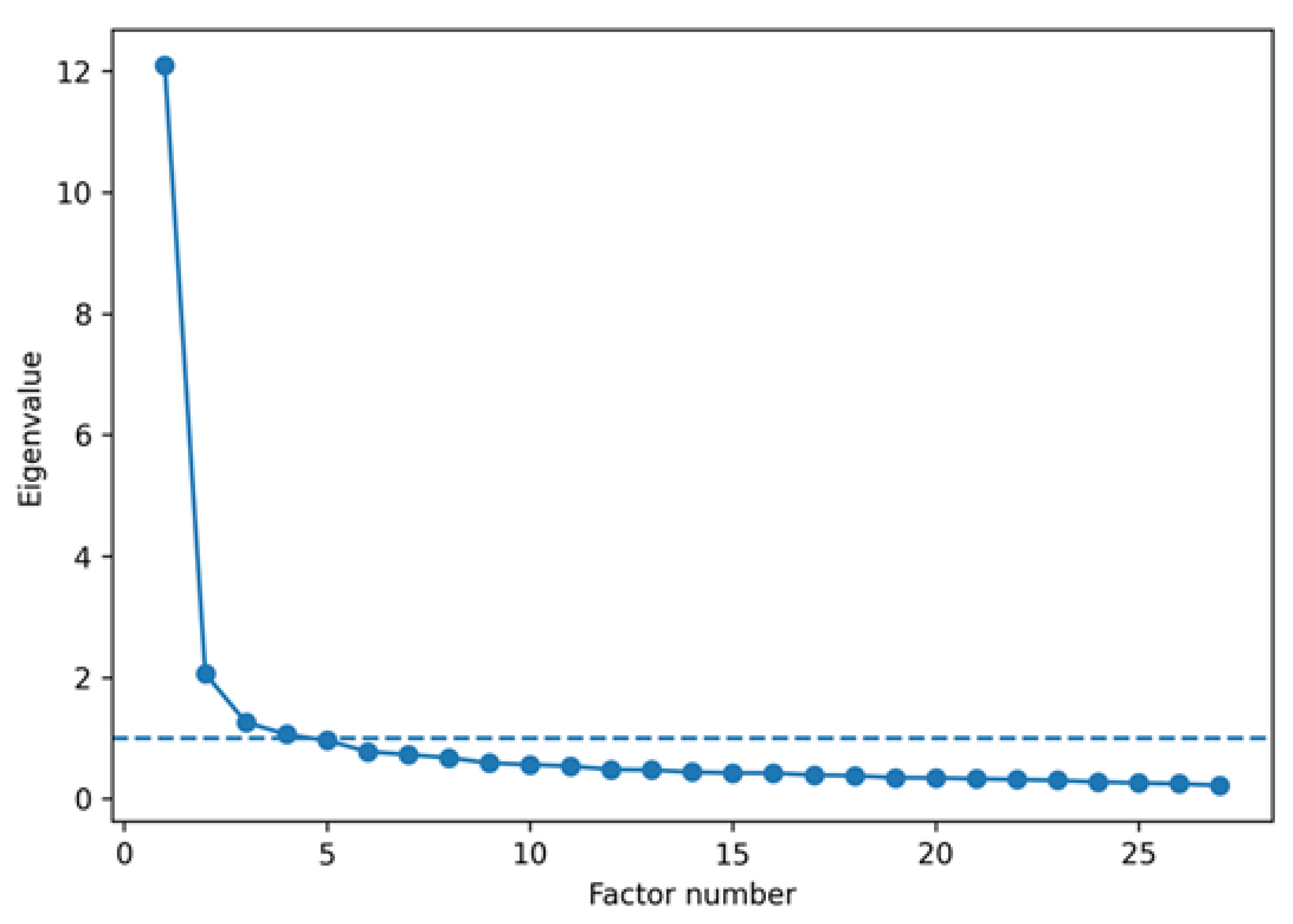
Table 2.
Inter-item correlations between the 5 PAIU for the total sample (N=1114).
|
Subscale 1 (Cronbach’s alpha =0.892) |
1 | 2 | 3 | 4 | 8 | 9 | 10 | 13 |
| 1. I think about using AI tools even when I’m not studying. | 1.00 | |||||||
| 2. I plan my tasks around when I can use AI. | 0.47 | 1.00 | ||||||
| 3. I feel a strong urge to open an AI tool when I sit down to work. | 0.55 | 0.58 | 1.00 | |||||
| 4. I frequently check AI tools during activities that don’t require them (e.g., lectures, reading). | 0.49 | 0.50 | 0.59 | 1.00 | ||||
| 8. Over time I have needed to use AI more (longer sessions or more prompts) to get the same results. | 0.45 | 0.47 | 0.53 | 0.49 | 1.00 | |||
| 9. I now use AI for tasks I previously did unaided. | 0.46 | 0.52 | 0.55 | 0.42 | 0.60 | 1.00 | ||
| 10. I keep adding new AI tools or plugins to achieve the effect I want. | 0.43 | 0.54 | 0.58 | 0.49 | 0.58 | 0.62 | 1.00 | |
| 13. I repeatedly check for access to AI tools during AIfree tasks-free tasks | 0.39 | 0.51 | 0.51 | 0.47 | 0.50 | 0.49 | 0.51 | 1.00 |
|
Subscale 2 (Cronbach’s alpha =0.898) |
11 | 12 | 15 | 18 | 24 | 25 | 26 | 27 |
| 11. I feel irritated or anxious when I cannot use AI (e.g., during exams, outages, or in AI-restricted contexts). | 1.00 | |||||||
| 12. Being restricted from AI makes it hard to start or continue my work. | 0.60 | 1.00 | ||||||
| 15. I spend more time using AI than I intend to. | 0.46 | 0.48 | 1.00 | |||||
| 18. I find it difficult to stop using AI once I start. | 0.51 | 0.52 | 0.58 | 1.00 | ||||
| 24. Without AI, I struggle to generate ideas or begin assignments. | 0.49 | 0.56 | 0.48 | 0.54 | 1.00 | |||
| 25. I rely on AI to make simple decisions I used to make on my own. | 0.49 | 0.43 | 0.53 | 0.50 | 0.54 | 1.00 | ||
| 26. I feel less confident in my independent writing or problem-solving than before I used AI. | 0.50 | 0.54 | 0.52 | 0.55 | 0.65 | 0.61 | 1.00 | |
| 27. Feedback indicates my independent work is worse than my AI-assisted work. | 0.50 | 0.52 | 0.48 | 0.49 | 0.56 | 0.49 | 0.63 | 1.00 |
| Subscale 3 (Cronbach’s alpha =0.815) | 21 | 22 | 23 | |||||
| 21. I have used AI in ways that violated course or assessment policies. | 1.00 | |||||||
| 22. I have submitted AI-assisted work without required disclosure when rules asked for it. | 0.69 | 1.00 | ||||||
| 23. Because of AI use, I have avoided non-AI learning activities (e.g., practicing problems, drafting, reading). | 0.56 | 0.54 | 1.00 | |||||
| Subscale 4 (Cronbach’s alpha =0.798) | 14 | 16 | 17 | 19 | 20 | |||
| 14. I feel restless until I can use an AI tool. | 1.00 | |||||||
| 16. I try to limit my AI use but cannot keep it up. | 0.46 | 1.00 | ||||||
| 17. I continue using AI even when it clearly derails my workflow. | 0.57 | 0.58 | 1.00 | |||||
| 19. My AI use has negatively affected my grades, deadlines, or class attendance. | 0.45 | 0.45 | 0.48 | 1.00 | ||||
| 20. My AI use has caused tension or conflict with peers or instructors (e.g., originality, teamwork, rules). | 0.34 | 0.31 | 0.37 | 0.48 | 1.00 | |||
| Subscale 5 (Cronbach’s alpha =0.803) | 5 | 6 | 7 | |||||
| 5. I use AI mainly to escape academic stress or unpleasant feelings. | 1.00 | |||||||
| 6. Using AI quickly improves my mood when I feel overwhelmed. | 0.67 | 1.00 | ||||||
| 7. I turn to AI instead of taking a break when I feel stuck. | 0.50 | 0.56 | 1.00 | |||||
Note: Every correlation is significant at the 0.01 level.
Table 3.
Factor Loadings for Exploratory Factor Analysis with Varimax Rotation on the 27-item PAIU-U core scale (N=543).
Table 3.
Factor Loadings for Exploratory Factor Analysis with Varimax Rotation on the 27-item PAIU-U core scale (N=543).
| Item | (FA) Cognitive Salience and Escalation |
(FB) Functional Dependence and Skill Erosion | (FC) Social and Ethical Conflict |
(FD) Self-Regulatory Loss and Academic Skill Impairment |
(FE) Mood Modification and Coping use |
|---|---|---|---|---|---|
| (ai01) I think about using AI tools even when I’m not studying. | 0.572 | ||||
| (ai02) I plan my tasks around when I can use AI. | 0.700 | ||||
| (ai03) I feel a strong urge to open an AI tool when I sit down to work. | 0.686 | ||||
| (ai04) I frequently check AI tools during activities that don’t require them (e.g., lectures, reading). | 0.577 | ||||
| (ai05) I use AI mainly to escape academic stress or unpleasant feelings. | 0.649 | ||||
| (ai06) Using AI quickly improves my mood when I feel overwhelmed. | 0.749 | ||||
| (ai07) I turn to AI instead of taking a break when I feel stuck. | 0.540 | ||||
| (ai08) Over time I have needed to use AI more (longer sessions or more prompts) to get the same results. | 0.593 | ||||
| (ai09) I now use AI for tasks I previously did unaided. | 0.640 | ||||
| (ai10) I keep adding new AI tools or plugins to achieve the effect I want. | 0.698 | ||||
| (ai11) I feel irritated or anxious when I cannot use AI (e.g., during exams, outages, or in AI-restricted contexts). | 0.456 | ||||
| (ai12) Being restricted from AI makes it hard to start or continue my work. | 0.478 | ||||
| (ai13) I repeatedly check for access to AI tools during AI-free tasks. | 0.470 | ||||
| (ai14) I feel restless until I can use an AI tool. | 0.484 | ||||
| (ai15) I spend more time using AI than I intend to. | 0.455 | ||||
| (ai16) I try to limit my AI use but cannot keep it up. | 0.487 | ||||
| (ai17) I continue using AI even when it clearly derails my workflow. | 0.507 | ||||
| (ai18) I find it difficult to stop using AI once I start. | 0.537 | ||||
| (ai19) My AI use has negatively affected my grades, deadlines, or class attendance. | 0.577 | ||||
| (ai20) My AI use has caused tension or conflict with peers or instructors (e.g., originality, teamwork, rules). | 0.509 | ||||
| (ai21) I have used AI in ways that violated course or assessment policies. | 0.711 | ||||
| (ai22) I have submitted AI-assisted work without required disclosure when rules asked for it. | 0.728 | ||||
| (ai23) Because of AI use, I have avoided non-AI learning activities (e.g., practicing problems, drafting, reading). | 0.560 | ||||
| (ai24) Without AI, I struggle to generate ideas or begin assignments. | 0.617 | ||||
| (ai25) I rely on AI to make simple decisions I used to make on my own. | 0.556 | ||||
| (ai26) I feel less confident in my independent writing or problem-solving than before I used AI. | 0.709 | ||||
| (ai27) Feedback indicates my independent work is worse than my AI-assisted work. | 0.465 |
Note. Factor loadings < .40 are suppressed.
Table 4.
Standardized and Unstandardized Factor Loadings, and R2 for the CFA Model.
| Factor | Item | Est. | Std. all | R2 |
|---|---|---|---|---|
| (FA) Cognitive Salience and Escalation | ai01 | 1.000 | 0.655 | 0.429 |
| ai02 | 1.014 | 0.703 | 0.495 | |
| ai03 | 1.259 | 0.790 | 0.624 | |
| ai04 | 1.121 | 0.710 | 0.504 | |
| ai08 | 1.030 | 0.719 | 0.518 | |
| ai09 | 1.088 | 0.715 | 0.512 | |
| ai10 | 1.092 | 0.744 | 0.554 | |
| ai13 | 0.942 | 0.725 | 0.526 | |
| (FB) Functional Dependence and Skill Erosion | ai11 | 1.000 | 0.707 | 0.500 |
| ai12 | 1.133 | 0.733 | 0.537 | |
| ai15 | 1.283 | 0.735 | 0.540 | |
| ai18 | 1.216 | 0.746 | 0.556 | |
| ai24 | 1.029 | 0.709 | 0.503 | |
| ai25 | 1.007 | 0.658 | 0.433 | |
| ai26 | 1.103 | 0.711 | 0.506 | |
| ai27 | 1.102 | 0.720 | 0.519 | |
|
(FC) Social and Ethical Conflict |
ai21 | 1.000 | 0.820 | 0.673 |
| ai22 | 0.995 | 0.799 | 0.638 | |
| ai23 | 0.853 | 0.673 | 0.453 | |
|
(FD) Self-Regulatory Loss and Academic Skill Impairment |
ai14 | 1.000 | 0.738 | 0.545 |
| ai16 | 1.066 | 0.669 | 0.448 | |
| ai17 | 1.107 | 0.773 | 0.597 | |
| ai19 | 0.639 | 0.560 | 0.314 | |
| ai20 | 0.596 | 0.462 | 0.214 | |
|
(FE) Mood Modification and Coping use |
ai05 | 1.000 | 0.800 | 0.640 |
| ai06 | 1.004 | 0.797 | 0.635 | |
| ai07 | 0.794 | 0.681 | 0.464 |
Note.: Every factor loading is significant at the 0.01 level; Est. = unstandardized loading; Std. all = fully standardized loading.
Table 5.
Standardized and Unstandardized Factor Loadings, and R2 for the CFA Model.
| Index | Value |
|---|---|
| Estimator | ML |
| Optimization method | NLMINB |
| Number of model parameters | 64 |
| Number of observations | 571 |
| Chi-square (User Model) | 1375.258 |
| Degrees of freedom | 314 |
| p-value (Chi-square) | |
| Chi-square (Baseline Model) | 8891.303 |
| Degrees of freedom (Baseline) | 351 |
| p-value (Baseline) | |
| CFI | 0.876 |
| TLI | 0.861 |
| Loglikelihood (H0) | –17276.062 |
| Loglikelihood (H1) | –16588.433 |
| AIC | 34680.123 |
| BIC | 34958.356 |
| Adjusted BIC | 34755.185 |
| RMSEA | 0.077 |
| RMSEA 90% CI | [0.073, 0.081] |
| p(RMSEA ≤ .05) | |
| SRMR | 0.060 |
Table 6.
Interpretation of Reliability Results derived from the CFA model.
| Index | Factors | ||||
|---|---|---|---|---|---|
| FA | FB | FC | FD | FE | |
| Cronbach’s alpha | 0.90 | 0.89 | 0.80 | 0.78 | 0.80 |
| McDonald’s ω | 0.90 | 0.89 | 0.81 | 0.79 | 0.81 |
| omega2 | 0.90 | 0.89 | 0.81 | 0.79 | 0.81 |
| omega3 | 0.90 | 0.89 | 0.82 | 0.77 | 0.81 |
| Average Variance Extracted (AVE) | 0.52 | 0.51 | 0.59 | 0.44 | 0.59 |
Table 8.
Overall assessment of discriminant validity.
| Index | Fornel—Larcker | ||||
|---|---|---|---|---|---|
| (FA) Cognitive Salience and Escalation | (FB) Functional Dependence and Skill Erosion | (FC) Social and Ethical Conflict | (FD) Self-Regulatory Loss and Academic Skill Impairment | (FE) Mood Modification and Coping use | |
| (FA) Cognitive Salience and Escalation | 0.721 | ||||
| (FB) Functional Dependence and Skill Erosion | 0.833 | 0.715 | |||
| (FC) Social and Ethical Conflict | 0.512 | 0.669 | 0.767 | ||
| (FD) Self-Regulatory Loss and Academic Skill Impairment | 0.739 | 0.933 | 0.679 | 0.651 | |
| (FE) Mood Modification and Coping use | 0.729 | 0.658 | 0.418 | 0.640 | 0.761 |
| Index | HTMT (Heterotrait—Monotrait ratio) | ||||
| FA | FB | FC | FD | FE | |
| (FA) Cognitive Salience and Escalation | 1.000 | ||||
| (FB) Functional Dependence and Skill Erosion | 0.827 | 1.000 | |||
| (FC) Social and Ethical Conflict | 0.540 | 0.708 | 1.000 | ||
| (FD) Self-Regulatory Loss and Academic Skill Impairment | 0.659 | 0.868 | 0.734 | 1.000 | |
| (FE) Mood Modification and Coping use | 0.735 | 0.674 | 0.459 | 0.624 | 1.000 |
Disclaimer/Publisher’s Note: The statements, opinions and data contained in all publications are solely those of the individual author(s) and contributor(s) and not of MDPI and/or the editor(s). MDPI and/or the editor(s) disclaim responsibility for any injury to people or property resulting from any ideas, methods, instructions or products referred to in the content. |
© 2026 by the authors. Licensee MDPI, Basel, Switzerland. This article is an open access article distributed under the terms and conditions of the Creative Commons Attribution (CC BY) license (http://creativecommons.org/licenses/by/4.0/).
Copyright: This open access article is published under a Creative Commons CC BY 4.0 license, which permit the free download, distribution, and reuse, provided that the author and preprint are cited in any reuse.