

Submitted:
26 May 2026
Posted:
01 June 2026
You are already at the latest version
Abstract
Rheumatoid arthritis (RA) is a disease of the immune system that leads to continuous synovial inflammation and the progressive breakdown of joints. As essential effector cells in innate immunity, macrophages can become either pro-inflammatory M1 or anti-inflammatory M2 phenotypes, playing a critical role in RA pathogenesis. A marked M1/M2 polarization imbalance exists in the synovial microenvironment of RA, in which excessive activation and accumulation of M1 macrophages serve as a key hub driving persistent inflammation, cartilage degradation, and bone erosion. This review systematically summarizes the polarization mechanisms of macrophages in RA, their core pathological functions, and recent advances in targeting these cells as therapeutic strategies, therefore delivering novel insights and references for RA treatment through targeted changes in macrophage polarization.
Keywords:
rheumatoid arthritis
; macrophage
; M1/M2 polarization
; signaling pathways
; metabolic reprogramming
; targeted therapy
; traditional Chinese medicine
1. Introduction
RA is an autoimmune disorder that mainly causes symmetric and erosive inflammation in the joints, primarily impacting the small joints in the extremities, with a worldwide prevalence of about 1% [1]. The primary pathological feature of RA is synovitis, which, as the disease advances, leads to permanent damage to cartilage and bone, eventually causing joint deformity and loss of function. Without timely treatment, the disability and deformity rate within three years can be as high as 75%, substantially reducing the quality of life experienced by patients [2]. Currently, conventional disease-modifying antirheumatic drugs (DMARDs), using methotrexate (MTX) as the main anchor medication, remain the mainstay of RA treatment, demonstrating significant efficacy in controlling disease activity and retarding joint destruction. However, approximately 30%-40% of RA patients show an inadequate response to MTX, resulting in persistent synovial inflammation, progressive joint damage, and difficult-to-control disease [3]. RA's pathogenesis is complicated, and recent findings point to macrophage polarization as a crucial element.
Adjusting macrophage phenotype and function in response to microenvironmental signals is known as macrophage polarization.The direction of polarization is governed by transcription factors,epigenetic mechanisms,and the tissue microenvironment [4], and M2 macrophages are also referred to as alternatively activated. M1 macrophages mainly produce pro-inflammatory cytokines, including tumor necrosis factor-α(TNF-α), interleukin-1β (IL-1β), and interleukin-6 (IL-6), thereby driving inflammation and tissue destruction; M2 macrophages mainly produce anti-inflammatory cytokines such as interleukin-10 (IL-10) and transforming growth factor-β (TGF-β), thereby promoting tissue repair and maintaining homeostasis [5]. In RA patients, M1 macrophages are markedly increased in the synovium and circulation, whereas M2 macrophages are relatively deficient [6], and The M1/M2 ratio is positively correlated with disease activity and the severity of bone erosion [7]. Thus, addressing the imbalance in macrophage polarization has become a vital research strategy for reestablishing immune homeostasis and achieving targeted therapy in RA. This review comprehensively outlines the polarization mechanisms of M1 and M2 macrophages in RA and their involvement in disease development, while also discussing recent progress in targeted treatments. This review seeks to deliver novel insights and references for the focused regulation of macrophage polarization in RA therapy.
2. Macrophage Origin and Heterogeneity
Macrophages play a crucial role in the body's innate immune system, first discovered and named by Élie Metchnikoff over 100 years ago. Conventionally, they were considered to derive only from hematopoietic stem cells. However, subsequent studies have demonstrated that they primarily arise from the embryonic yolk sac, fetal liver, and circulating monocytes [8]. Macrophages are generally classified into tissue-resident macrophages (TRMs) and monocyte-derived macrophages (MDMs) based on their origin. TRMs possess self-renewal capacity and maintain tissue homeostasis, whereas MDMs emerge under pathological conditions [9]. In RA, the relationship between the origin and function of synovial macrophages remains poorly defined, and it is still uncertain where specific myeloid cell subsets in the human synovium originate from. Therefore, elucidating the precise origin of synovial macrophages in RA patients will provide an opportunity to develop precision interventions that target the origin of particular cell subsets [10]. Studies have shown that TRMs, which are seeded during embryonic development, and MDMs, which are recruited from peripheral blood monocytes under inflammatory conditions, coexist within RA joints [11], with the latter having a major impact on inflammation in the joints. Single-cell sequencing technology has further revealed the complex lineage composition of RA synovial macrophages, including a pro-inflammatory subset characterized by CD48highS100A12+ cells that secrete pro-inflammatory cytokines; anti-inflammatory and reparative subsets, such as TREM2high, FOLR2highLYVE1+ macrophages; and functionally defined subsets, such as CD48+SPP1+ cells. Collectively, these subsets constitute a continuous phenotypic spectrum that transcends the conventional M1/M2 dichotomy [12]. Such phenotypic diversity is intimately linked to distinct metabolic features: glycolysis is the primary energy source for M1 macrophages, whereas M2 macrophages depend on oxidative phosphorylation (OXPHOS) [13]. Different subsets also exhibit differential responses to the same microenvironmental signals and varying susceptibility to apoptosis or ferroptosis; for instance, M2 macrophages are more prone to ferroptosis under iron overload conditions [14]. Therefore, recognizing macrophage heterogeneity is crucial for developing novel RA therapies that precisely target pathogenic subsets while preserving immune homeostasis.
Although recent single-cell studies indicate that macrophage activation states are more diverse than the conventional M1/M2 classification. Nevertheless, the M1/M2 framework still serves as a practical reference to define functional extremes in RA pathogenesis and therapeutic regulation. This review adopts the M1/M2 nomenclature while recognizing its inherent limitations.
3. Macrophage Polarization and Its Regulatory Mechanisms in RA
3.1. M1 Macrophage Polarization in RA
The excessive activation of M1 macrophages is crucial in the development of RA, and they predominantly infiltrate the sublining layer of the synovium. There, the infiltrated M1 macrophages act as key effector cells, promoting continuous synovial inflammation and joint destruction via the secretion of inflammatory cytokines. Furthermore, circulating peripheral blood monocytes, which are closely related to the origin of synovial tissue macrophages, also exhibit sustained hyperinflammatory and metabolically activated M1 phenotypic characteristics in RA patients [15]. Studies have confirmed a marked M1/M2 polarization imbalance in synovial macrophages from RA patients, characterized by a significant increase in CD86+ cells and a decrease in CD206+ cells [16]. M1 macrophages are responsible for the production and secretion of pro-inflammatory cytokines, including IL-1β, IL-6, and TNF-α, which directly encourage the growth and activation of fibroblast-like synoviocytes (FLS) and prompt them to release more inflammatory mediators and matrix metalloproteinases (MMPs), thereby initiating and exacerbating synovial inflammation. Furthermore, M1 macrophages exhibit high expression of MHC II molecules and co-stimulatory molecules (e.g., CD80 and CD86), thereby conferring potent antigen-presenting capacity. This enables them to activate naive T cells, especially Th1 and Th17 cells, thereby initiating and amplifying T cell-dependent adaptive immune responses and establishing a broader inflammatory network [17]. Simultaneously, this mechanism promotes the activation, multiplication, and the transformation of B cells into plasma cells, which subsequently generate autoantibodies like rheumatoid factor and anti-citrullinated protein antibodies [18]. The immune complexes formed by these autoantibodies can activate macrophages via Fc receptors and the complement system, driving them toward an M1 phenotype [19]. Furthermore, immune complexes created by anti-citrullinated protein antibodies and citrullinated proteins can engage with macrophages via Toll-like receptor 4 (TLR4) and Fc gamma receptor II (FcγRII), boosting the creation of pro-inflammatory elements such as TNF-α [20]. In rheumatoid arthritis, activated macrophages release chemokines that consistently attract peripheral blood monocytes to the synovium.; these newly recruited monocytes further differentiate into M1 macrophages within the local pro-inflammatory microenvironment, perpetuating and amplifying the inflammation [21]. Additionally, M1 macrophage polarization constitutes the core pathological process driving joint damage and bone erosion. These cells significantly increase RANKL expression and decrease osteoprotegerin (OPG) levels, which encourages osteoclast differentiation and bone resorption [22]. They also emit large amounts of pro-inflammatory substances such as IL-1β, TNF-α, and IL-6, along with chemokines and MMPs, which worsen synovial inflammation, encourage pannus development, and result in the damage of nearby cartilage and bone tissue [18] (Figure 1).
3.2. M2 Macrophages in RA
M2 macrophages exert protective effects in RA by suppressing inflammation, promoting tissue repair, and alleviating bone destruction, thereby ameliorating the disease [23] (Figure 2). M2 macrophages produce a range of anti-inflammatory cytokines including IL-10, IL-4, TGF-β, vascular endothelial growth factor (VEGF), and platelet-derived growth factor (PDGF). These cytokines suppress T cell activation and growth, are involved in Th2-type immune responses, and aid in tissue repair and the formation of new blood vessels [24,25]. In RA, M2 macrophages play a crucial role in controlling the differentiation of osteogenic cells and the formation of bone. The anti-inflammatory substances they release can prevent osteoclast differentiation and activation by lowering the expression of the RANK receptor and TRAP enzyme associated with osteoclasts [26]. Transforming macrophages from the M1 to the M2 phenotype can boost osteoblast growth, attachment, and mineralization, while also increasing the expression of genes related to bone formation, including runt-related transcription factor 2 (RUNX2), alkaline phosphatase (ALP), collagen type I alpha 1 chain (COL1A1), osteopontin (OPN), and osteocalcin (OCN) [27] (Figure 2).
A popular research focus in RA treatment is on altering macrophage polarization to the M2 phenotype or converting M1 macrophages into the M2 phenotype. Enhancing M2 macrophage function can considerably ease RA progression. Research [28] discovered that altering the miR-33/NLRP3 pathway can lead to macrophages polarizing into an M2 phenotype. Cell-based therapies have demonstrated the protective effects of M2 macrophages; for example, exosomes derived from adipose stem cells (ADSCs-EXO-ICA) have been shown to effectively inhibit glycolysis by targeting the ERK1/2/HIF-1α/GLUT1 pathway, therefore blocking the shift of macrophages to the M1 phenotype and supporting their polarization to M2, thus alleviating inflammation and protecting cartilage [15]. Moreover, the traditional biologic agent abatacept has demonstrated the ability to transform monocytes/macrophages from RA patients from the M1 to the M2 phenotype in vitro [29]. Therefore, the protective effects of M2 macrophages are reflected not only in their inherent anti-inflammatory and tissue-repair functions, but also in the remarkable plasticity of macrophages that enables their conversion from a pro-inflammatory state to a protective phenotype. This transition represents one of the core therapeutic strategies for restoring immune homeostasis in the joint and achieving disease remission.
3.3. Driving Factors of Macrophage Polarization Imbalance in RA
3.3.1. Aberrant Activation of Signaling Pathways
Several signaling pathways are essential in managing the imbalance between M1/M2 polarization. Previous research has confirmed that this process is accurately controlled by pathways like nuclear factor-kappa B (NF-κB), Janus kinase/signal transducer and activator of transcription (JAK/STAT), mitogen-activated protein kinase (MAPK), Notch, and phosphatidylinositol 3-kinase/protein kinase B (PI3K/Akt). Figure 3 and Figure 4 display the regulatory mechanisms of each pathway in macrophage polarization, which are elaborated on below.
- (1)
- NF-κB
In the progression of RA, NF-κB is an essential transcription factor that stimulates M1 macrophage activation. In RA, stimuli such as lipopolysaccharide (LPS), TNF-α, and IL-1β can activate the NF-κB pathway through receptors such as TLR4 on the macrophage surface, promoting the release of M1 pro-inflammatory cytokines like IL-1β, IL-6, and TNF-α, thus creating a self-perpetuating inflammatory cycle [30]. Moreover, this pathway reciprocally upregulates hypoxia-Inducible Factor 1α(HIF-1α) within the synovial microenvironment [31], jointly activating the NF-κB/HIF-1α axis, which causes an increase in reactive oxygen species (ROS) and promotes M1 macrophage polarization, accelerating disease progression. Thus, controlling the imbalance of macrophage polarization through the NF-κB signaling pathway aids in reducing inflammatory infiltration in the synovial tissue of RA, offering a possible intervention strategy for managing RA clinically.
- (2)
- JAK/STAT
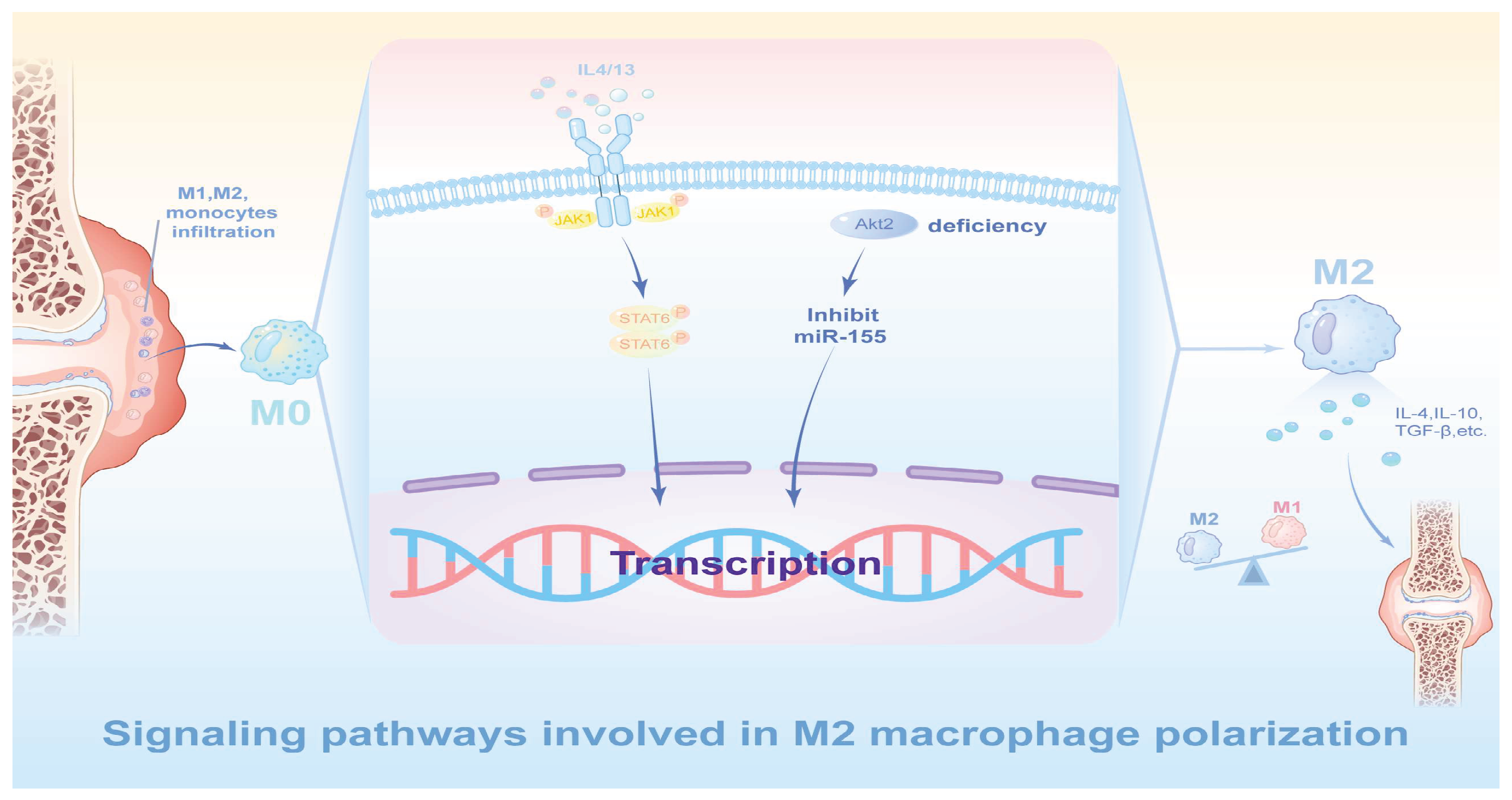
In RA, the JAK/STAT pathway's abnormal activation usually encourages M1 macrophage polarization and suppresses M2 polarization, thus continuing the harmful inflammation cycle. The JAK protein family comprises four receptor-associated tyrosine kinases—JAK1, JAK2, JAK3, and TYK2—while the STAT family encompasses signal transducer and activator of transcription proteins, including STAT1, STAT2, STAT3, STAT4, STAT5a/b, and STAT6. Among them, IFN-γ and IL-6 activate STAT1 via JAK1/JAK2, upregulate HIF-1α, and promote glycolysis, thus providing energy for M1 macrophages to amplify inflammation [32,33]. Recent studies have further revealed that chemokines, such as CCL7, can form an autocrine positive-feedback loop via CCR1/JAK2/STAT1, thereby enhancing M1 polarization [34]. On the other hand, IL-4/IL-13 can induce phosphorylation of STAT6, resulting in M2 polarization, decreased inflammation, and improved tissue repair [35]. Notably, the regulatory role of STAT3 is microenvironment-dependent: in the iron-enriched milieu of the RA synovium, M2 macrophages are more prone to ferroptosis, resulting in an M1/M2 imbalance; HMGB1 released from these ferroptotic M2 binds to TLR4 on M1 macrophages, triggering site-specific phosphorylation of STAT3 at Ser727, which boosts the production of pro-inflammatory elements such as IL-6 in M1 macrophages, further exacerbating inflammation [36]. Paradoxically, in the tumor microenvironment, deoxycholic acid can activate the TGR5/STAT3 signaling pathway via TGR5 receptor activation, thereby promoting M2 macrophage polarization [37]. An in-depth investigation of STAT3's differential responses across distinct microenvironments may yield novel strategies for targeted modulation of the M1/M2 balance.
- (3)
- MAPK
The MAPK family primarily includes ERK1/2, JNK1/2/3, and p38, which convert signals from outside the cell into responses within the cell and are crucial in managing the M1/M2 polarization equilibrium in RA. Through TLR4, LPS triggers p38/JNK and starts the NF-κB pathway, leading to M1 polarization and inflammation. Thus, inhibiting p38/JNK phosphorylation can attenuate M1 polarization [38]. The pro-inflammatory effects of the MAPK pathway are intricately linked to other signaling cascades. Research indicates that Nesfatin-1 enhances CCL2 expression dependent on NF-κB through the MEK/ERK and p38 pathways, facilitating monocyte movement and encouraging M1 macrophage polarization [39]. In RA joints, elevated CCL25/CCR9 signaling promotes monocyte migration and polarization toward an atypical M1 phenotype via p38/ERK pathway activation, leading to IL-8 and CCL2 secretion while inhibiting phagocytic function [40]. By blocking the CCL25/CCR9 axis and inhibiting the MAPK pathway, the differentiation of pro-inflammatory macrophages can be decreased, suggesting a new strategy for targeted regulation of macrophage polarization in the treatment of RA. In addition, neuroimmunological studies have demonstrated that nerve growth factor (NGF) binds to the TrkA receptor to activate the MEK/ERK pathway, promote the phosphorylation of the AP-1 transcription factor (c-Jun), and upregulate ICAM-1 expression in FLS, thereby enhancing monocyte adhesion. Simultaneously, FLS-derived secretions induce M1 macrophage polarization and intensify inflammation in RA. Targeting the NGF/TrkA/MEK/ERK axis is expected to suppress M1 macrophage polarization and monocyte infiltration, thereby alleviating RA progression [41].
- (4)
- Notch
In RA synovial tissue, the Notch signaling pathway, a highly conserved regulatory mechanism, is often activated abnormally. The stimulation of the Notch pathway leads to M1 polarization and the emission of pro-inflammatory cytokines, wherein DLL4-induced Notch signaling enhances the transcription of pro-inflammatory genes and increases M1 macrophage numbers by activating the MAPK, NF-κB, and Akt pathways [42]. Conversely, inhibiting the Notch pathway can encourage macrophages to polarize towards the M2 phenotype, thereby ameliorating RA symptoms and protecting the joint and surrounding tissues [43]. In RA synovial tissue, Notch-1/3 and HIF-1α are highly expressed, and under hypoxic conditions, HIF-1α directly upregulates Notch-1/3 expression; their downstream effectors, N1ICD/N3ICD, jointly mediate FLS activation, aggravating synovial hyperplasia, inflammation, and joint destruction [44]. Therefore, modulating the Notch pathway to correct the M1/M2 polarization imbalance may alter the inflammatory trajectory of RA and promote synovial tissue repair.
- (5)
- PI3K/Akt
The PI3K/Akt pathway plays a key role in the regulation of macrophage polarization, and its overactivation leads to increased M1 polarization and worsens inflammation. PI3K is a phosphatidylinositol kinase found inside cells, possessing serine/threonine kinase activity, and is made up of a heterodimer that functions as a protein kinase through its p110 catalytic subunit and p85 regulatory subunit. Akt, which is also referred to as protein kinase B, is made up of three isoforms: Akt1, Akt2, and Akt3, and it serves as the key effector molecule of PI3K. Studies indicate that the influence of the PI3K/Akt pathway on M1/M2 polarization is isoform-dependent: ablation of Akt1 promotes M1 polarization, whereas ablation of Akt2 facilitates M2 polarization [45]. Moreover, ARL4C, which is highly expressed in RA FLS, can alter inflammatory cytokine secretion by activating the PI3K/Akt and MAPK pathways, thereby driving macrophage M1 polarization in a paracrine manner [46]. Consequently, focusing on the PI3K/Akt pathway, particularly by inhibiting Akt2, aims to increase the count of M2 macrophages in synovial tissue, which will promote anti-inflammatory responses and tissue repair, offering new insights for precise modulation of M1/M2 polarization in RA therapy.
M0: unpolarized resting macrophages.
Figure 4.
Signaling pathways involved in M2 macrophage polarization. In RA, IL-4 and IL-13 bind to receptors on M0 macrophages. This activates JAK1, which in turn phosphorylates STAT6. Phosphorylated STAT6 forms dimers and enters the nucleus. This process promotes M2 polarization. Deletion of AKT2 suppresses miR-155 expression and skews macrophages toward the M2 phenotype. M2 macrophages then release anti-inflammatory cytokines, such as IL-4, IL-10, and TGF-β. These cytokines correct the M1/M2 imbalance and ameliorate synovial inflammation. Tissue repair is subsequently promoted.
Figure 4.
Signaling pathways involved in M2 macrophage polarization. In RA, IL-4 and IL-13 bind to receptors on M0 macrophages. This activates JAK1, which in turn phosphorylates STAT6. Phosphorylated STAT6 forms dimers and enters the nucleus. This process promotes M2 polarization. Deletion of AKT2 suppresses miR-155 expression and skews macrophages toward the M2 phenotype. M2 macrophages then release anti-inflammatory cytokines, such as IL-4, IL-10, and TGF-β. These cytokines correct the M1/M2 imbalance and ameliorate synovial inflammation. Tissue repair is subsequently promoted.
3.3.2. Metabolic Reprogramming
Previous studies largely regarded macrophage polarization as a passive response to specific cytokines. However, recent research has revealed that a single signal does not drive this process; rather, it is closely linked to macrophages' metabolic patterns. Under inflammatory stimuli, macrophages undergo metabolic reprogramming, which in turn governs their functional phenotypic switch [47]. This finding has offered a new viewpoint on how macrophages function in RA. Within the pathological microenvironment of RA, M1 and M2 macrophages have significantly different metabolic characteristics. M1 macrophages primarily rely on glycolysis for rapid ATP and lactate production, supporting their pro-inflammatory activities; in comparison, M2 macrophages depend more on OXPHOS, fatty acid oxidation, and glutamine metabolism to support anti-inflammatory and tissue repair activities [48]. Due to excessive cell proliferation and vascular dysfunction, the synovium in RA pathology swiftly establishes a localized hypoxic environment, which can upregulate HIF-1α expression. HIF-1α activation is, in turn, a critical factor driving aerobic glycolysis and M1 macrophage polarization, while simultaneously increasing the release of pro-inflammatory cytokines such as IL-1β, to reinforce M1 polarization.Therefore, inhibiting HIF-1α or key glycolytic enzyme activities can effectively attenuate macrophage pro-inflammatory responses [49]. Notably, there is a bidirectional regulatory relationship between synovial macrophages and the local microenvironment. Macrophages are highly sensitive to changes in metabolite concentrations in the microenvironment, while their own metabolic activities can, in turn, reshape the microenvironment by producing or consuming metabolites. In M1 macrophages, the tricarboxylic acid cycle (TCA), OXPHOS, and fatty acid oxidation are inhibited, causing a deficiency in mitochondrial OXPHOS and leading to the buildup of TCA intermediates like citrate and succinate. Among these, succinate accumulation induces ROS generation, further stabilizes HIF-1α expression, and simultaneously upregulates glycolysis-related genes such as SLC2A1 and LDHA [50]. In contrast, citrate accumulation interferes with the TCA cycle by increasing the mitochondrial citrate carrier and reducing isocitrate dehydrogenase activity. The aberrant accumulation of these two intermediates synergistically drives M1 polarization. Accordingly, targeted clearance of succinate and citrate, or inhibition of related pathways, can effectively curb excessive glycolytic activation in M1 macrophages. In addition to glycolysis, amino acid metabolism also influences macrophage polarization. Studies have shown that when macrophages utilize arginine via the nitric oxide synthesis pathway, M1 polarization is promoted [51]. Moreover, glutamine metabolism rate also plays a role in macrophage phenotype, where glutamine deficiency can lower the expression of genes specific to M2, such as IRF4, KLF4, and CD206, by modulating H3K27 methylation at gene promoter sites. Moreover, the overproduction of Indoleamine 2,3-dioxygenase (IDO), which is the key enzyme in the tryptophan–kynurenine pathway, can lead to the polarization of M2 macrophages. In contrast, IDO gene knockout confers a pro-inflammatory phenotype [52], suggesting that dysregulation of amino acid metabolism may be an important contributor to abnormal macrophage polarization in RA. Finally, abnormal lipid metabolism plays a role in controlling macrophage polarization. In the context of RA, disturbances in lipid metabolism can lead to significant ROS production and trigger pro-inflammatory pathways such as NF-κB, and suppress GPx4 activity, rendering M2 macrophages—which are inherently sensitive to ferroptosis—even more susceptible to ferroptosis; the HMGB1 released from ferroptotic M2 macrophages activates M1 macrophages through the TLR4/STAT3 axis, exacerbating the M1/M2 imbalance and thereby aggravating RA inflammation and tissue damage [36,53]. In summary, the various metabolic pathways in macrophages in RA are interconnected and mutually influential. An in-depth dissection of these metabolic mechanisms to regulate macrophage polarization direction offers substantial theoretical and practical benefits for RA's targeted therapy.
Beyond the key signaling pathways and energy metabolism pathways mentioned above, epigenetics profoundly influences macrophage function. Current studies have identified that miR-155 and miR-221-3p can promote M1 polarization in RA [54,55], while circRNA_17725 and circRNA_0066715 can facilitate M2 polarization [6,56]. Additionally, miR-548a-3p and Linc00514 could be potential targets for influencing macrophage polarization in RA [57,58]. N6-methyladenosine (m6A) modification is a critical epitranscriptomic modification. Recent studies have revealed that the methyltransferase METTL3 facilitates the maturation of pri-miR-221 by mediating m6A modification, thus affecting the polarization balance of RA macrophages, with its expression level correlates positively with how active the disease is [15]. In vitro experiments with cells have revealed that, under inflammatory conditions, WTAP expressed in RA FLS can increase m6A methylation of the circular RNA circ-CBLB in exosomes, leading to its degradation and, consequently, encouraging macrophages to shift towards the pro-inflammatory M1 type [59]. This holds potential value in balancing M1/M2 polarization for RA therapy.
4. Targeted Modulation Strategies
To adjust the imbalance in M1/M2 macrophage polarization in RA, researchers are actively exploring targeted therapeutic strategies that inhibit M1 macrophage activity while encouraging a shift towards the anti-inflammatory M2 type, thereby restoring intra-articular immune homeostasis and alleviating inflammation and tissue damage.
4.1. Novel Intelligent Nano-Drug Delivery Systems
In the RA synovium, M1 macrophages are the main type, secreting TNF-α, IL-1β, and ROS, which play a role in persistent inflammation and bone destruction. Transforming M1 macrophages into M2 macrophages is crucial for reestablishing immune balance in the joints. Nano-drug delivery systems can intervene in intracellular signaling by delivering functional molecules to correct the M1/M2 polarization imbalance and offer advantages such as high targeting specificity, enhanced bioavailability, and low systemic toxicity, thereby emerging as a research hotspot in RA therapy.
4.1.1. Microenvironment-Responsive Systems
The intra-articular microenvironment in RA patients is characterized by hypoxia, elevated ROS levels, low pH, and elevated MMP levels.Adjusting these conditions can help macrophages switch from the M1 to the M2 phenotype at the location of inflammation. Researchers have accordingly designed various microenvironment-responsive nanosystems. For instance, Yang F et al [60]constructed a nanomaterial (PCSN@MTX) assembled from molybdenum-based polyoxometalate, thiolated β-cyclodextrin and MTX. This material aggregates in the acidic joint microenvironment and, enhanced by ultrasound, efficiently scavenges ROS, generates oxygen, and downregulates HIF-1α, thereby reprogramming M1 macrophages into M2 macrophages. Kang Y et al [61]utilized mesenchymal stem cell (MSC)-derived apoptotic vesicles loaded with dexamethasone (Dex). The vesicle surface was modified with low-molecular-weight heparin (LMWH) via a ROS-responsive thioketal (TK) linker, forming a complex (D@ApoEV^FasL^∩L). When injected intravenously, the vesicles are directed to and gather in RA joints because of their MSC origin and their ability to home in on inflammation, along with LMWH binding to P-selectin on inflamed blood vessel cells. LMWH blocks neutrophil recruitment by competitively binding P-selectin. In a high-ROS environment, the TK linker breaks, leading to LMWH detachment and exposing FasL on the vesicles. Within the joint, the exposed FasL connects to Fas receptors on activated neutrophils, leading to their apoptosis via the Fas/FasL signaling pathway, which triggers macrophage repolarization. Simultaneously, the released Dex effectively scavenges excess ROS. In vivo and in vitro experiments confirmed that this strategy synergistically blocks neutrophil infiltration, induces their apoptosis, promotes M2 macrophage polarization, and scavenges ROS, thereby triggering an immune cascade, restoring joint immune homeostasis, and significantly ameliorating RA symptoms. To improve administration compliance, the teams of Xia T [62] integrated cerium/manganese oxide nanoparticles (BSA@NPs-MTX) with ROS-scavenging function into microneedle patches. Through transdermal delivery, these systems locally scavenge ROS, ameliorate hypoxia, and inhibit inflammatory pathways such as NF-κB, synergistically promoting M2 macrophage polarization. Jia N et al [63] constructed a pH-responsive, CD44/folate receptor dual-targeted nano-delivery system (RBA-NPs) for delivering roburic acid to treat RA. In an RA rat model, RBA-NPs effectively targeted inflamed joints, significantly improving symptoms, reducing inflammatory cytokine levels, and promoting bone repair. Research on mechanisms showed that RBA-NPs reduce EMP levels in M1 macrophages by blocking the ERK//HIF-1α/GLUT1 pathway, thus encouraging their transformation into the M2 phenotype, uncovering a new mechanism for regulating macrophage polarization through metabolic reprogramming. Leveraging the characteristic overexpression of MMPs in the RA joint microenvironment, Zhou R et al [7] developed a nano-therapeutic system named 2-APB@DGP-MM. The system employs nanoparticles coated with macrophage membranes to specifically deliver 2-aminoethyl diphenylborinate (2-APB). Its core mechanism involves a peptide segment in the nanoparticle carrier that is specifically cleaved by MMP-2, which is highly expressed in the RA inflammatory microenvironment. Upon reaching the inflamed joint, MMP-2 cleaves this peptide, triggering the on-demand release of 2-APB. The released 2-APB acts on joint macrophages, reprogramming them from M1 to M2 phenotype, thereby reducing inflammation at its source and aiding in tissue healing. Studies performed in vitro and in vivo showed the system's outstanding biocompatibility, enhanced cellular absorption, and its ability to significantly reduce synovial inflammation and cartilage damage in a collagen-induced arthritis (CIA) mouse model. These strategies provide new directions for overcoming the limitations of conventional therapies (Table 1).
4.1.2. Biomimetic Nano-Delivery Systems
Biomimetic systems endow nanocarriers with excellent biocompatibility, targeting ability, and immune evasion by mimicking natural biological structures. Key biomimetic structures include cell membranes, exosomes, proteins, and the extracellular matrix (ECM). Cell membrane camouflage systems utilize membrane structures from source cells to cloak nanoparticles, thereby conferring them with inflammatory targeting and long-circulating properties. Lin Y et al [64] constructed nanoparticles coated with a hybrid membrane of red blood cells and FLS, which precisely delivered drugs to joint lesions, drove macrophage repolarization, scavenged ROS, and inhibited synovial hyperplasia by intervening in the PI3K/Akt pathway, achieving dual anti-inflammatory/anti-proliferative effects. Exosomes, as endogenous intercellular communication carriers, serve as ideal delivery platforms with inherent targeting potential. Zhu Q et al [65] encapsulated MTX-loaded nanoparticles into adipose-derived stem cell-derived exosomes. Upon intravenous injection, these efficiently targeted inflamed joints, induced M2 macrophage polarization, and inhibited synovial invasion. Using proteins such as albumin as dynamic templates to guide nanoscale assembly enables the construction of structurally stable biomimetic carriers. Such systems can also incorporate targeting coatings for precise drug delivery and microenvironment remodeling. Lv L et al [66] utilized bovine serum albumin (BSA) as a dynamic template, combining macrophage membrane-coated cerium-based nanoparticles with MTX to achieve targeted delivery, ROS scavenging, and in situ oxygen supply, encouraging macrophages to transition from the M1 phenotype to the M2 phenotype. This approach overcomes the limitations of conventional synthetic DMARDs and single antioxidants, offering an innovative therapeutic strategy with translational potential. The ECM, as a biomimetic structure, can target and regulate macrophage phenotypes. Duan X et al [67] developed a novel Dex-loaded Col/Cs@ECM core-shell microsphere system. The ECM shell targets macrophages and initiates immunomodulation, while the Col/Cs core controls Dex release in the acidic intracellular environment, synergistically repolarizing M1 macrophages to M2. In vitro and in vivo RA models have verified its superior anti-inflammatory effects and high safety, and that it represents a new therapeutic strategy for RA with clinical potential (Table 1).
4.1.3. Multifunctional Integrated Nanoplatforms
The complex pathogenesis of RA involves multiple factors and pathways. Multifunctional integrated nanoplatforms combine active targeting, microenvironment-responsive drug release, and synergistic therapy, aligning well with the multifactorial nature of RA and representing a current hotspot in nanotechnology research. Wu M et al [68] created a versatile nanocapsule called RP/HP@Mn/L, which features a hollow polydopamine carrier infused with manganese ions, containing rapamycin (Rap) and paeoniflorin (Pae), and surface-modified with LMWH. Rap acts as an upstream core immunomodulator, inhibiting aberrant FLS proliferation and inducing M2 macrophage polarization. Pae provides extensive and gentle anti-inflammatory and immune-modulating effects, safeguarding cartilage and preventing bone damage. Mild photothermal therapy not only directly induces apoptosis of inflammatory cells but also mimics physiological hyperthermia, activating pathways like heat shock proteins to create a microenvironment conducive to tissue repair. The trio of components works together to influence various points throughout the pathological process, from immune system imbalance to tissue injury, effectively remodeling the synovial microenvironment. While inhibiting synovitis, this approach also promotes osteoblast differentiation. It achieves the dual therapeutic aims of alleviating joint inflammation and facilitating bone-cartilage repair by controlling key pathways such as PI3K-AKT and MAPK to inhibit osteoclast activity. Ma H et al [69] designed a composite nanomotor system (Rapa-FMn@PMS) based on polydopamine-hybridized mesoporous silica (PMS) nanoparticles as the core carrier. Manganese dioxide (MnO2) nanozymes were grown in situ on the surface, followed by folic acid (FA) modification and final physical adsorption of Rap. This device utilizes H2O2 enriched at the inflamed joint as fuel; MnO2 catalyzes its decomposition to produce O2, ameliorating hypoxia and propelling the nanomotor's autonomous movement, enhancing its diffusion and tissue penetration within the joint. The catechol groups in polydopamine confer cartilage adhesion properties, prolonging retention time at the inflamed site. In the acidic, high-ROS microenvironment of RA joints, the nanomotor degrades, releasing Rap, SiO44−, and Mn2+. SiO44− inhibits osteoclastogenesis, while Mn2+ and the released Rap promote cartilage regeneration. Additionally, released Rap inhibits the mTOR pathway, activates autophagy in macrophages, eliminates dysfunctional mitochondria, reduces ROS production at its source, and polarizes M1 macrophages to M2. In vitro and in vivo studies confirmed the nanomotor system's excellent targeted delivery, antioxidant, anti-inflammatory, and synergistic therapeutic effects for osteochondral repair. Furthermore, Wang X et al [70] developed a folate-functionalized aggregation-induced emission (AIE)-active nanoplatform (FA@4BC NPs). Besides precise targeting, this platform enables fluorescence imaging of activated macrophages in RA by identifying folate receptor-β. When Laser irradiates FA@4BC NPs, it generates singlet oxygen (1O2), which efficiently changes macrophage polarization from M1 to M2. In a CIA mouse model, FA@4BC NPs were injected into the joint, and subsequent in vivo imaging revealed that the nanoparticles specifically accumulated in the inflamed joints. Immunohistochemistry revealed significantly decreased expression of the M1 marker inducible nitric oxide synthase (iNOS) and increased expression of the M2 marker CD206, offering a novel multifunctional approach for precision theranostics in RA (Table 1).
Overall, current nano-delivery strategies targeting macrophage polarization regulation are advancing towards smarter, more biomimetic, and more integrated systems. These strategies not only focus on directly modulating immune cell phenotypes but also deeply integrate the sensing and remodeling of the pathological RA microenvironment. By synergizing multiple therapeutic mechanisms, they offer a promising roadmap for developing highly effective, low-toxicity novel RA therapies.Despite the promise, several challenges remain: ①most studies used CIA mouse models with acute inflammation, while chronic RA models with established erosion are rarely tested; ②nanomaterials containing heavy metals such as MnO2 and cerium still require systematic evaluation of long-term biosafety and in vivo distribution ; ③intra-articular injection, though effective, is invasive; systemic administration needs to overcome first-pass clearance and off-target effects.
4.2. Targeted Regulation of Macrophage Polarization by Traditional Chinese Medicine (TCM)
Rooted in holistic views and principles of syndrome differentiation, TCM demonstrates advantages in regulating immune homeostasis in RA through multi-component, multi-target synergy. Various studies have demonstrated that TCM can ease RA by adjusting the imbalance between M1 and M2 macrophages.
4.2.1. TCM Monomers
Extensive research indicates that various monomeric components can effectively adjust the M1/M2 polarization balance through the regulation of critical signaling pathways. A variety of components control inflammation by inhibiting central pro-inflammatory pathways. For example, triptolide can simultaneously inhibit the NF-κB, PI3K/AKT, and p38 MAPK pathways, driving macrophages toward the M2 phenotype [71]. Koumine specifically inhibits M1 polarization by suppressing the PI3K/AKT pathway [72]. Suberosin promotes M1 to M2 repolarization by targeting the JAK1/STAT3 signaling pathway and activating the STAT6 pathway [73]. Naringin antagonizes M1 polarization by inhibiting NLRP3 inflammasome activation while simultaneously suppressing osteoclastogenesis, thereby exerting dual protective effects [74]. Some components indirectly regulate M1/M2 polarization balance by activating endogenous protective pathways and ameliorating the oxidative stress microenvironment. A derivative of sinomenine enhances M2 conversion by allosterically activating heme oxygenase-1 (HO-1), providing anti-inflammatory, antioxidant, and bone-protective benefits[75]. 4-Methylcatechol synergistically regulates the Nrf2/HO-1 and NF-κB/NLRP3 axes, promoting M2 polarization and reducing pyroptosis . Additionally, curcumin has been found to affect multiple pathways, including NF-κB and STAT, inhibiting M1 polarization and inducing M2 polarization [76], while the aqueous extract of Saposhnikovia divaricata(Turcz.)Schisch(SADS) can simultaneously target TNF-α and RAGE signaling, modulating the cytokine profile and restoring the M1/M2 balance [77] (Table 2).
4.2.2. TCM Formulas
TCM formulas, with their complex compositions, exert effects through multi-target, multi-pathway mechanisms, making them a current research hotspot. The following sections elaborate on the mechanisms and research progress of various classic TCM formulas and empirical prescriptions in regulating macrophage polarization for RA treatment(Table 3).
Er miao San(EMS), originating from Danxi Xinfa, consists of equal proportions of Atractylodes Lancea(Thunb.)DC, Phellodendron amurense Rupr. It helps to clear heat and dry dampness, commonly used for treating syndromes where damp-heat descends. In modern medicine, it is frequently used to address inflammatory conditions such as RA. Liu M et al [28] discovered that Er Miao San modulates macrophage polarization by affecting the miRNA-33/NLRP3 signaling axis, which results in reduced secretion of inflammatory factors IL-1β, TNF-α, and IL-18.
Sanmiao pill (SMP), recorded in Yixue Zhengzhuan, add Achyranthes bidentata Blume to Er Miao San to enhance the downward direction of the formula's action. It exhibits effects of clearing heat, drying dampness, reducing swelling, and alleviating pain, and is clinically used for conditions like foot and knee joint swelling and pain due to damp-heat pouring downward. Jiang Q et al [78] found that San Miao Wan inhibits M1 macrophage polarization, reduces synovial inflammation, and ameliorates RA by activating peroxisome proliferator-activated receptor γ (PPARγ) and promoting its nuclear translocation, thereby inhibiting the HILPDA/DGAT1 pathway, reducing lipid droplet accumulation, and decreasing arachidonic acid storage in lipid droplets and prostaglandin E2 synthesis.
Wutou decoction(WTD), originating from Shanghan Zabing Lun, comprises Aconitum carmichaeli Debeaux, Astragalus mongholicus Bunge, Glycyrrhiza uralensis Fisch, Ephedra sinica Stapf, Paeonia lactiflora Pall. It helps to warm the meridians, dispel cold, eliminate dampness, and alleviate blockages, and is commonly used in clinical settings for RA. Lin W et al [79] demonstrated that WTD corrects the M1/M2 macrophage polarization imbalance and restores immune balance and tissue homeostasis through dual regulation of the NF-κB and PPARγ signaling pathways, eventually reducing synovial inflammation and aiding joint repair in RA. Yao Z's research team [80] optimized WTD to develop Fuhu Lijie Tang(FHLJT), composed of Sinomenium acutum (Thunb.)Rehd.et Wils, Aconitum carmichaeli Debx, Paeonia lactiflora Pall, Polygonum cuspidatum Siebold&Zucc, Astragalus membranaceus(Fisch.)Bunge, Rehmannia glutinosa(Gaertn.)Libosch.ex Fisch.&C.A.Mey. Transcriptomic analysis identified the PI3K-Akt and AMPK signaling pathways as core targets. Furthermore, it markedly reduced the abundance of citrullinated proteins in joint tissues of CIA rats, reduced the levels of key antigen-presenting proteins such as interferon gamma-inducible protein 30 (IFI30) and CD74, and suppressed the expression of MHC II molecules on M1 macrophages, which ultimately eased synovial inflammation.
Wuweiganlu(WGL) is a classic formula recorded in the Tibetan medical text Four Medical Tantras. It consists of five plateau-specific herbs: Rhododendron anthropogonoides Maxim, Juniperus angosturana R.P.Adams, Ephedra sinica Stapf, Myricaria platyphylla Maxim, Artemisia sieversiana Ehrh. It is commonly used for RA, gout, and various skin diseases. Wen Y et al [81] discovered that the aqueous extract of WGL contains various active components such as flavonoids, terpenes, organic oxides, carboxylic acids, and their derivatives. It can shift macrophage polarization from the M1 type to the M2 type, lower the levels of pro-inflammatory factors TNF-α and IL-1β, and enhance the expression of IL-10 and M2 markers. The molecular mechanism may involve modulation of inflammatory signaling pathways like JAK2/STAT3 and NF-κB.
JinWu JianGu capsule(JWJGC), based on the Miao ethnic formula Jinwu Jiangu Fang, is composed of Cibotium barometz (L.) J. Sm, Ptyas dhumnades Cantor, Periploca Forrestii Schltr,Panax notoginseng(Burk.)F. H. Chen, Curcuma longa L, Sinomenium acutum (Thunb.) Rehd. et Wils,etc. It is an empirically derived formula used long-term for RA. Ling Y et al [53] found that JWJGC activates the SLC7A11/GSH/GPX4 signaling pathway, reduces ROS accumulation in synovial tissue, decreases malondialdehyde (MDA) activity, increases superoxide dismutase (SOD) activity, and downregulates ferroptosis-related lipid metabolism pathways. This restores the M1/M2 polarization balance, reduces pro-inflammatory factor levels (TNF-α, IL-1β, IL-6), and ameliorates synovial inflammation, providing a new perspective on its modern pharmacological mechanisms.
5. Summary and Outlook
The pathological process of RA is highly complex, resulting from the interaction of multiple immune cell types and various molecular regulatory networks, with M1/M2 macrophage polarization imbalance representing a central issue. During the progression of RA, macrophages often exhibit excessive M1 activation and relative M2 deficiency. This imbalance not only maintains ongoing joint inflammation but also significantly contributes to continuous damage and the gradual breakdown of cartilage and bone tissue. A single factor does not determine the direction of macrophage polarization; rather, it is precisely regulated by multiple layers of mechanisms, including various core signaling pathways, energy metabolism patterns, and epigenetic mechanisms. In-depth investigation and dissection of this regulatory network are essential for building a solid scientific foundation for the development of targeted RA therapies.
Currently, research strategies for RA are shifting from traditional broad-spectrum anti-inflammation towards precise modulation of immune cell phenotypes. Among various strategies for targeted regulation of macrophage polarization, novel smart nanodelivery systems show significant potential. Their design has evolved from initial passive targeting to multifunctional platforms integrating microenvironment responsiveness, active targeting, and biomimetic camouflage, enabling more precise repolarization of macrophages and effective remodeling of the pathological joint microenvironment. Furthermore, TCM holds unique advantages in RA treatment. Leveraging its holistic regulatory characteristics involving multiple components and targets, both active ingredients from single herbs and classic TCM formulas can correct M1/M2 polarization imbalances by intervening in key signaling pathways. This underscores the value of integrating TCM and Western medicine for RA treatment.
Although some progress has been made in research targeting this area, significant challenges remain on the path forward. Macrophages within the joint exhibit high heterogeneity, and their phenotypes and functions extend far beyond the traditional binary classification. Achieving precision therapy requires an in-depth exploration of the specific functions of different macrophage subsets to develop targeted regulatory strategies. Currently, most targeted strategies are still in the preclinical research phase. Improving the in vivo stability and biosafety of nano-delivery systems, and facilitating their scale-up production and clinical translation, are critical issues that urgently need resolution.Additionally, given the significant individual variability among RA patients, future therapeutic strategies must be tailored to meet personalized needs. In conclusion, restoring local joint immune homeostasis by targeting macrophage polarization represents a highly promising approach for RA treatment. As researchers deepen their understanding of macrophage biology and its pathogenic mechanisms in RA, coupled with the cross-integration and synergistic development of nanotechnology, biotechnology, and TCM modernization research, it is anticipated that more precise, effective, and safer RA therapies will be developed in the future, offering novel strategies and approaches for the clinical management of this disease.
Author Contributions
Feng Hao: Writing - review & editing, Supervision, Funding acquisition.Jun Hu: Writing - review & editing, Supervision, Project administration. Hui Zuo: Writing - Original Draft, Writing - Review & Editing. Jiajia Sang: Conceptualization, Writing - Original Draft, Writing - Review & Editing. Enqi Fan : Writing - Original Draft, Writing - Review & Editing, Visualization. Long Zeng: Writing - Review & Editing. All authors have read and agreed to the published version of the manuscript.
Funding
This work was supported by the Program of the National Natural Science Foundation of China (No. 82274645).
Institutional Review Board Statement
Not applicable.
Informed Consent Statement
Not applicable.
Data Availability Statement
No new data were created or analyzed in this study.
Conflicts of Interest
The authors declare that they have no known competing financial interests or personal relationships that could have appeared to influence the work reported in this paper.
Abbreviations
| RA | Rheumatoid arthritis |
| DMARDs | disease-modifying antirheumatic drugs |
| MTX | methotrexate |
| TNF-α | tumor necrosis factor -α |
| IL-1β | interleukin-1β |
| IL-6 | interleukin-6 |
| IL-10 | interleukin-10 |
| TGF-β | transforming growth factor-β |
| TRMs | tissue-resident macrophages |
| MDMs | monocyte-derived macrophages |
| OXPHOS | oxidative phosphorylation |
| FLS | fibroblast-like synoviocytes |
| MMPs | matrix metalloproteinases |
| TLR4 | Toll-like receptor 4 |
| FcγRII | Fc gamma receptor II |
| OPG | osteoprotegerin |
| VEGF | vascular endothelial growth factor |
| PDGF | platelet-derived growth factor |
| TRAP | tartrate-resistant acid phosphatase |
| RUNX2 | runt-related transcription factor 2 |
| ALP | alkaline phosphatase |
| COL1A1 | collagen type I alpha 1 chain |
| OPN | osteopontin |
| OCN | osteocalcin |
| NF-κB | nuclear factor-kappa B |
| JAK/STAT | Janus kinase/signal transducer and activator of transcription |
| MAPK | mitogen-activated protein kinase |
| PI3K/Akt | phosphatidylinositol 3-kinase/protein kinase B |
| LPS | lipopolysaccharide |
| ROS | reactive oxygen species |
| NGF | nerve growth factor |
| HIF-1α | hypoxia-Inducible Factor 1α |
| TCA | tricarboxylic acid cycle |
| IDO | Indoleamine 2,3-dioxygenase |
| MSC | mesenchymal stem cell |
| Dex | dexamethasone |
| LMWH | low-molecular-weight heparin |
| TK | thioketal |
| CIA | collagen-induced arthritis |
| BSA | bovine serum albumin |
| ECM | extracellular matrix |
| Rap | rapamycin |
| Pae | paeoniflorin |
| PMS | polydopamine-hybridized mesoporous silica |
| MnO2 | Manganese dioxide |
| FA | folic acid |
| AIE | aggregation-induced emission |
| 1O2 | singlet oxygen |
| iNOS | inducible nitric oxide synthase |
| SADS | Saposhnikovia divaricataTurcz.Schisch |
| HO-1 | heme oxygenase-1 |
| EMS | Er miao San |
| SMP | Sanmiao pill |
| PPARγ | peroxisome proliferator-activated receptor γ |
| WTD | Wutou decoction |
| FHLJT | Fuhu Lijie Tang |
| IFI30 | interferon gamma-inducible protein 30 |
| WGL | Wuweiganlu |
| JWJGC | JinWu JianGu capsule |
| MDA | malondialdehyde |
| SOD | superoxide dismutase |
References
- Li, N.; Huang, W.; Wu, Z.; Xu, T.; Xing, L.; Zhao, Y.; Chen, S.; Chen, J.; Huang, B.; Zhao, Y.; Li, Q.; Chen, J.; Xu, H.; Tian, J.; Wang, Y.; Zhang, W., & Liang, Q. Lymph nodes-targeted nano-prodrug for precise B cell immunoregulation to prevent collagen-induced arthritis. Biomaterials 2026; 330: 124042. [CrossRef]
- Liu, S.; Song, L.-P.; Li, R.-B.; Feng, L.-H., & Zhu, H. Iguratimod promotes transformation of mononuclear macrophages in elderly patients with rheumatoid arthritis by nuclear factor-κB pathway. World Journal of Clinical Cases 2021; 9(10): 2181-2191. [CrossRef]
- Firestein, GS. Evolving concepts of rheumatoid arthritis. Nature. 2003 May;423(6937):356-361. PMID: 12748655. Nature 2003; May;423(6937): 356-361. [CrossRef]
- Ambarus, C.A.; Noordenbos, T.; de Hair, M.J.H.; Tak, P.P., & Baeten, D.L.P. Intimal lining layer macrophages but not synovial sublining macrophages display an IL-10 polarized-like phenotype in chronic synovitis. Arthritis Research & Therapy 2012; 14(2): R74. [CrossRef]
- Zheng, Y.; Wei, K.; Jiang, P.; Zhao, J.; Shan, Y.; Shi, Y.; Zhao, F.; Chang, C.; Li, Y.; Zhou, M.; Lv, X.; Guo, S., & He, D. Macrophage polarization in rheumatoid arthritis: signaling pathways, metabolic reprogramming, and crosstalk with synovial fibroblasts. Frontiers in Immunology 2024; 15: 1394108. [CrossRef]
- Wan L, L.J., Huang C, Zhu Z, Li F, Sun G, Wang K, Li S, Ma X, Chen X, Yuan W. Role of m6A modification and novel circ_0066715/miR-486-5p/ETS1 axis in rheumatoid arthritis macrophage polarization progression. . Aging (Albany NY) 2022; Dec 20;14(24): 10009-10026. [CrossRef]
- Zhou, R.; Xue, S.; Cheng, Y.; Chen, Y.; Wang, Y.; Xing, J.; Liu, H.; Xu, Y.; Lin, Y.; Pei, Z.; Wei, X.; Ding, J.; Li, S.; Wang, K.; Yao, F.; Zhao, Y.; Ding, C., & Hu, W. Macrophage membrane-camouflaged biomimetic nanoparticles for rheumatoid arthritis treatment via modulating macrophage polarization. Journal of Nanobiotechnology 2024; 22(1): 578. [CrossRef]
- Hashimoto, D.; Chow, A.; Noizat, C.; Teo, P.; Beasley, Mary B.; Leboeuf, M.; Becker, Christian D.; See, P.; Price, J.; Lucas, D.; Greter, M.; Mortha, A.; Boyer, Scott W.; Forsberg, E.C.; Tanaka, M.; van Rooijen, N.; García-Sastre, A.; Stanley, E.R.; Ginhoux, F.; Frenette, Paul S., & Merad, M. Tissue-Resident Macrophages Self-Maintain Locally throughout Adult Life with Minimal Contribution from Circulating Monocytes. Immunity 2013; 38(4): 792-804. [CrossRef]
- Alivernini, S.; MacDonald, L.; Elmesmari, A.; Finlay, S.; Tolusso, B.; Gigante, M.R.; Petricca, L.; Di Mario, C.; Bui, L.; Perniola, S.; Attar, M.; Gessi, M.; Fedele, A.L.; Chilaka, S.; Somma, D.; Sansom, S.N.; Filer, A.; McSharry, C.; Millar, N.L.; Kirschner, K.; Nerviani, A.; Lewis, M.J.; Pitzalis, C.; Clark, A.R.; Ferraccioli, G.; Udalova, I.; Buckley, C.D.; Gremese, E.; McInnes, I.B.; Otto, T.D., & Kurowska-Stolarska, M. Distinct synovial tissue macrophage subsets regulate inflammation and remission in rheumatoid arthritis. Nature Medicine 2020; 26(8): 1295-1306. [CrossRef]
- Hanlon, M.M.; Fearon, U., & Gravallese, E.M. Synovial Tissue Macrophage Heterogeneity in Rheumatoid Arthritis. European Journal of Immunology 2026; 56(1): e70124. [CrossRef]
- Knab K, C.D.a.K.G. Synovial Macrophage and Fibroblast Heterogeneity in Joint Homeostasis and Inflammation. Front 2022; Med: 9:862161. [CrossRef]
- Liu, H.; Wu, C.; Li, G.; Peng, X.; Zhang, Z.; Su, Z.; Lin, J.; Wang, X.; Shen, H.; Wu, Y.; Liu, W.; Wang, P., & Zheng, G. IRF7 orchestrates proinflammatory macrophage polarization and joint destruction in rheumatoid arthritis. Arthritis Research & Therapy 2025; 28(1): 10. [CrossRef]
- Cai, W.; Cheng, J.; Zong, S.; Yu, Y.; Wang, Y.; Song, Y.; He, R.; Yuan, S.; Chen, T.; Hu, M.; Pan, Y.; Ma, R.; Liu, H., & Wei, F. The glycolysis inhibitor 2-deoxyglucose ameliorates adjuvant-induced arthritis by regulating macrophage polarization in an AMPK-dependent manner. Molecular Immunology 2021; 140: 186-195. [CrossRef]
- Liu, Y.; Luo, X.; Chen, Y.; Dang, J.; Zeng, D.; Guo, X.; Weng, W.; Zhao, J.; Shi, X.; Chen, J.; Dong, B.; Zhong, S.; Ren, J.; Li, Y.; Wang, J.; Zhang, J.; Sun, J.; Xu, H.; Lu, Y.; Brand, D.; Zheng, S.G., & Pan, Y. Heterogeneous ferroptosis susceptibility of macrophages caused by focal iron overload exacerbates rheumatoid arthritis. Redox Biology 2024; 69: 103008. [CrossRef]
- Yan, Q.; Liu, H.; Sun, S.; Yang, Y.; Fan, D.; Yang, Y.; Zhao, Y.; Song, Z.; Chen, Y.; Zhu, R., & Zhang, Z. Adipose-derived stem cell exosomes loaded with icariin alleviates rheumatoid arthritis by modulating macrophage polarization in rats. Journal of Nanobiotechnology 2024; 22(1): 423. [CrossRef]
- Cheng, J.-w.; Yu, Y.; Zong, S.-y.; Cai, W.-w.; Wang, Y.; Song, Y.-n.; Xian, H., & Wei, F. Berberine ameliorates collagen-induced arthritis in mice by restoring macrophage polarization via AMPK/mTORC1 pathway switching glycolytic reprogramming. International Immunopharmacology 2023; 124: 111024. [CrossRef]
- Shapouri-Moghaddam, A.; Mohammadian, S.; Vazini, H.; Taghadosi, M.; Esmaeili, S.A.; Mardani, F.; Seifi, B.; Mohammadi, A.; Afshari, J.T., & Sahebkar, A. Macrophage plasticity, polarization, and function in health and disease. Journal of Cellular Physiology 2018; 233(9): 6425-6440. [CrossRef]
- Meng, M.; Yao, J.; Zhang, Y.; Sun, H., & Liu, M. Potential Anti-Rheumatoid Arthritis Activities and Mechanisms of Ganoderma lucidum Polysaccharides. Molecules 2023; 28(6): 2483. [CrossRef]
- Tian, X.; Chen, J.; Hong, Y.; Cao, Y.; Xiao, J., & Zhu, Y. Exploring the Role of Macrophages and Their Associated Structures in Rheumatoid Arthritis. Journal of Innate Immunity 2025; 17(1): 95-111. [CrossRef]
- Sokolove, J.; Zhao, X.; Chandra, P.E., & Robinson, W.H. Immune complexes containing citrullinated fibrinogen costimulate macrophages via Toll-like receptor 4 and Fcγ receptor. Arthritis & Rheumatism 2010; 63(1): 53-62. [CrossRef]
- Yeo, L.; Adlard, N.; Biehl, M.; Juarez, M.; Smallie, T.; Snow, M.; Buckley, C.D.; Raza, K.; Filer, A., & Scheel-Toellner, D. Expression of chemokines CXCL4 and CXCL7 by synovial macrophages defines an early stage of rheumatoid arthritis. Annals of the Rheumatic Diseases 2016; 75(4): 763-771. [CrossRef]
- Giraldo-Osorno, P.M.; Wirsig, K.; Asa'ad, F.; Omar, O.; Trobos, M.; Bernhardt, A., & Palmquist, A. Macrophage-to-osteocyte communication: Impact in a 3D in vitro implant-associated infection model. Acta Biomaterialia 2024; 186: 141-155. [CrossRef]
- Siouti, E., & Andreakos, E. The many facets of macrophages in rheumatoid arthritis. Biochemical Pharmacology 2019; 165: 152-169. [CrossRef]
- Du, Q.; Dickinson, A.; Nakuleswaran, P.; Maghami, S.; Alagoda, S.; Hook, A.L., & Ghaemmaghami, A.M. Targeting Macrophage Polarization for Reinstating Homeostasis following Tissue Damage. International Journal of Molecular Sciences 2024; 25(13): 7278. [CrossRef]
- Oishi, S.; Takano, R.; Tamura, S.; Tani, S.; Iwaizumi, M.; Hamaya, Y.; Takagaki, K.; Nagata, T.; Seto, S.; Horii, T.; Osawa, S.; Furuta, T.; Miyajima, H., & Sugimoto, K. M2 polarization of murine peritoneal macrophages induces regulatory cytokine production and suppresses T-cell proliferation. Immunology 2016; 149(3): 320-328. [CrossRef]
- Gao, X.; Ge, J.; Zhou, W.; Xu, L., & Geng, D. IL-10 inhibits osteoclast differentiation and osteolysis through MEG3/IRF8 pathway. Cellular Signalling 2022; 95: 110353. [CrossRef]
- You, Y.; Wang, W.; Li, Y.; Song, Y.; Jiao, J.; Wang, Y.; Chen, B.; Liu, J.; Qi, H., & Liang, Y. Aspirin/PLGA coated 3D-printed Ti-6Al-4V alloy modulate macrophage polarization to enhance osteoblast differentiation and osseointegration. Journal of Materials Science: Materials in Medicine 2022; 33(10): 73. [CrossRef]
- Liu, M.; Wang, J.; Chen, S.; Meng, X.; Cheng, Z.; Wang, J.; Tan, Y.; Su, W.; Lu, Z.; Zhang, M., & Jia, X. Exploring the effect of Er miao San-containing serum on macrophage polarization through miR-33/NLRP3 pathway. Journal of Ethnopharmacology 2023; 307: 116178. [CrossRef]
- Cutolo, M.; Soldano, S.; Gotelli, E.; Montagna, P.; Campitiello, R.; Paolino, S.; Pizzorni, C.; Sulli, A.; Smith, V., & Tardito, S. CTLA4-Ig treatment induces M1–M2 shift in cultured monocyte-derived macrophages from healthy subjects and rheumatoid arthritis patients. Arthritis Research & Therapy 2021; 23(1): 306. [CrossRef]
- Ge, G.; Bai, J.; Wang, Q.; Liang, X.; Tao, H.; Chen, H.; Wei, M.; Niu, J.; Yang, H.; Xu, Y.; Hao, Y.; Xue, Y., & Geng, D. Punicalagin ameliorates collagen-induced arthritis by downregulating M1 macrophage and pyroptosis via NF-κB signaling pathway. Science China Life Sciences 2021; 65(3): 588-603. [CrossRef]
- Li, Y.; Liang, Q.; Zhou, L.; Cao, Y.; Yang, J.; Li, J.; Liu, J.; Bi, J., & Liu, Y. An ROS-responsive artesunate prodrug nanosystem co-delivers dexamethasone for rheumatoid arthritis treatment through the HIF-1α/NF-κB cascade regulation of ROS scavenging and macrophage repolarization. Acta Biomaterialia 2022; 152: 406-424. [CrossRef]
- Ciobanu, D.; Poenariu, I.; Crnguș, L.-I.; Vreju, F.; Turcu-Stiolica, A.; Tica, A.; Padureanu, V.; Dumitrascu, R.; Banicioiu-Covei, S.; Dinescu, S.; Boldeanu, L.; Siloși, I.; Ungureanu, A.; Boldeanu, M.; Osiac, E., & Barbulescu, A. JAK/STAT pathway in pathology of rheumatoid arthritis (Review). Experimental and Therapeutic Medicine 2020; 20(4): 3498-3503. [CrossRef]
- Li, F.; Liu, Z.; Xu, Y.; Guo, Y.; Xu, Z.; Yuan, G.; Zhao, J.; Li, P.; Wang, R.; Howatson, J.; Li, X.; Guo, Y., & Gong, Y. Potential mechanisms of acupuncture treatment for rheumatoid arthritis: a study based on network topology and machine learning. Chinese Medicine 2025; 20(1): 164. [CrossRef]
- Chen, J.; Shi, S.; Li, X.; Gao, F.; Zhu, X.; Feng, R.; Hu, K.; Li, Y.; Chen, S.; Zhang, R.; Wang, X.; Ding, C.; Liu, G.; Chen, T., & Liang, W. CCL7 promotes macrophage polarization and synovitis to exacerbate rheumatoid arthritis. iScience 2025; 28(4): 112177. [CrossRef]
- Zhong, Y.-m.; Zhang, L.-l.; Lu, W.-t.; Shang, Y.-n., & Zhou, H.-y. Moxibustion regulates the polarization of macrophages through the IL-4/STAT6 pathway in rheumatoid arthritis. Cytokine 2022; 152: 155835. [CrossRef]
- Feng, Z.; Meng, F.; Huo, F.; Zhu, Y.; Qin, Y.; Gui, Y.; Zhang, H.; Lin, P.; He, Q.; Li, Y.; Geng, J., & Wu, J. Inhibition of ferroptosis rescues M2 macrophages and alleviates arthritis by suppressing the HMGB1/TLR4/STAT3 axis in M1 macrophages. Redox Biology 2024; 75: 103255. [CrossRef]
- Wu, J.; Zheng, w.; Ding, X.-z.; Jin, Q.-p., & Ding, M.-x. Deoxycholic Acid and Lipoteichoic Acid cooperatively drive macrophage M2/M1 polarization via TGR5/STAT3 and TLR2/NF-κB to fuel HCC progression in obesity. Metabolism Open 2025; 28: 100420. [CrossRef]
- de Oliveira, R.G.; de Campos Castilho, G.R.; da Cunha, A.L.; Miyajima, F., & de Oliveira Martins, D.T. Dilodendron bipinnatum Radlk. inhibits pro-inflammatory mediators through the induction of MKP-1 and the down-regulation of MAPKp38/JNK/NF-κB pathways and COX-2 in LPS-activated RAW 264.7 cells. Journal of Ethnopharmacology 2017; 202: 127-137. [CrossRef]
- Chang, J.-W.; Liu, S.-C.; Lin, Y.-Y.; He, X.-Y.; Wu, Y.-S.; Su, C.-M.; Tsai, C.-H.; Chen, H.-T.; Fong, Y.-C.; Hu, S.-L.; Huang, C.-C., & Tang, C.-H. Nesfatin-1 Stimulates CCL2-dependent Monocyte Migration And M1 Macrophage Polarization: Implications For Rheumatoid Arthritis Therapy. International Journal of Biological Sciences 2023; 19(1): 281-293. [CrossRef]
- Umar, S.; Palasiewicz, K.; Van Raemdonck, K.; Volin, M.V.; Romay, B.; Ahmad, I.; Tetali, C.; Sweiss, N.; Amin, M.A.; Zomorrodi, R.K., & Shahrara, S. CCL25 and CCR9 is a unique pathway that potentiates pannus formation by remodeling RA macrophages into mature osteoclasts. European Journal of Immunology 2021; 51(4): 903-914. [CrossRef]
- Lin, C.-Y.; Lee, K.-T.; Lin, Y.-Y.; Tsai, C.-H.; Ko, C.-Y.; Fong, Y.-C.; Hou, S.-M.; Chen, W.-L.; Huang, C.-C., & Tang, C.-H. NGF facilitates ICAM-1-dependent monocyte adhesion and M1 macrophage polarization in rheumatoid arthritis. International Immunopharmacology 2024; 130: 111733. [CrossRef]
- Fung, E.; Tang, S.-M.T.; Canner, J.P.; Morishige, K.; Arboleda-Velasquez, J.F.; Cardoso, A.A.; Carlesso, N.; Aster, J.C., & Aikawa, M. Delta-Like 4 Induces Notch Signaling in Macrophages. Circulation 2007; 115(23): 2948-2956. [CrossRef]
- Li, T.; Chen, W.; Zhang, Q., & Deng, C. Human-specific gene CHRFAM7A mediates M2 macrophage polarization via the Notch pathway to ameliorate hypertrophic scar formation. Biomedicine & Pharmacotherapy 2020; 131: 110611. [CrossRef]
- Chen, J.; Cheng, W.; Li, J.; Wang, Y.; Chen, J.; Shen, X.; Su, A.; Gan, D.; Ke, L.; Liu, G.; Lin, J.; Li, L.; Bai, X., & Zhang, P. Notch-1 and Notch-3 Mediate Hypoxia-Induced Activation of Synovial Fibroblasts in Rheumatoid Arthritis. Arthritis & Rheumatology 2021; 73(10): 1810-1819. [CrossRef]
- Arranz, A.; Doxaki, C.; Vergadi, E.; Martinez de la Torre, Y.; Vaporidi, K.; Lagoudaki, E.D.; Ieronymaki, E.; Androulidaki, A.; Venihaki, M.; Margioris, A.N.; Stathopoulos, E.N.; Tsichlis, P.N., & Tsatsanis, C. Akt1 and Akt2 protein kinases differentially contribute to macrophage polarization. Proceedings of the National Academy of Sciences 2012; 109(24): 9517-9522. [CrossRef]
- Tang, N.; Luo, X.; Ding, Z.; Shi, Y.; Cao, X., & Wu, S. Single-Cell Multi-Dimensional data analysis reveals the role of ARL4C in driving rheumatoid arthritis progression and Macrophage polarization dynamics. International Immunopharmacology 2024; 141: 112987. [CrossRef]
- Umar, S.; Palasiewicz, K.; Volin, M.V.; Romay, B.; Rahat, R.; Tetali, C.; Arami, S.; Guma, M.; Ascoli, C.; Sweiss, N.; Zomorrodi, R.K.; O’Neill, L.A.J., & Shahrara, S. Metabolic regulation of RA macrophages is distinct from RA fibroblasts and blockade of glycolysis alleviates inflammatory phenotype in both cell types. Cellular and Molecular Life Sciences 2021; 78(23): 7693-7707. [CrossRef]
- Xu, X.; Xu, P.; Shen, G.; Peng, X.; Liu, Z.; Chen, C.; Yu, W.; Su, Z.; Lin, J.; Zheng, G.; Ye, G.; Wang, P.; Xie, Z.; Wu, Y.; Shen, H., & Li, J. Targeting macrophage polarization by inhibiting Pim2 alleviates inflammatory arthritis via metabolic reprogramming. Cellular & Molecular Immunology 2025; 22(4): 418-436. [CrossRef]
- Gao, Y.; Chen, X.; Liu, L.; Xiu, J.; Wen, Y.; Yang, C.; Yang, D., & Yao, F. Transdermal microneedle integrating a biomimetic self-enhancing Fenton reaction nano-reactor for alleviating rheumatoid arthritis by inflammatory microenvironment remodeling. Theranostics 2025; 15(14): 7180-7196. [CrossRef]
- Yvan-Charvet L, T.E. Inflamed macrophages sans mitochondrial pyruvate carrier? Nature Metabolism 2023; 5: 724-726. [CrossRef]
- Yeramian, A.; Martin, L.; Arpa, L.; Bertran, J.; Soler, C.; McLeod, C.; Modolell, M.; Palacín, M.; Lloberas, J., & Celada, A. Macrophages require distinct arginine catabolism and transport systems for proliferation and for activation. European Journal of Immunology 2006; 36(6): 1516-1526. [CrossRef]
- Wang, X.-F.; Wang, H.-S.; Wang, H.; Zhang, F.; Wang, K.-F.; Guo, Q.; Zhang, G.; Cai, S.-H., & Du, J. The role of indoleamine 2,3-dioxygenase (IDO) in immune tolerance: Focus on macrophage polarization of THP-1 cells. Cellular Immunology 2014; 289(1-2): 42-48. [CrossRef]
- Ling, Y.; Yang, Y.; Ren, N.; Xu, H.; Cheng, C.; Lu, D.; Wang, Q.; Yao, X., & Ma, W. Jinwu Jiangu capsule attenuates rheumatoid arthritis via the SLC7A11/GSH/GPX4 pathway in M1 macrophages. Phytomedicine 2024; 135: 156232. [CrossRef]
- Paoletti, A.; Rohmer, J.; Ly, B.; Pascaud, J.; Rivière, E.; Seror, R.; Le Goff, B.; Nocturne, G., & Mariette, X. Monocyte/Macrophage Abnormalities Specific to Rheumatoid Arthritis Are Linked to miR-155 and Are Differentially Modulated by Different TNF Inhibitors. The Journal of Immunology 2019; 203(7): 1766-1775. [CrossRef]
- Quero, L.; Tiaden, A.N.; Hanser, E.; Roux, J.; Laski, A.; Hall, J., & Kyburz, D. miR-221-3p Drives the Shift of M2-Macrophages to a Pro-Inflammatory Function by Suppressing JAK3/STAT3 Activation. Frontiers in Immunology 2020; 10: 3087. [CrossRef]
- Yang, C.; Ni, B.; Li, C.; Sun, W.; Wang, Z.; Wang, H.; Hou, X.; Yan, S.; Wang, X.; Xu, D., & Ding, W. circRNA_17725 Promotes Macrophage Polarization towards M2 by Targeting FAM46C to Alleviate Arthritis. Mediators of Inflammation 2023; 2023: 1-15. [CrossRef]
- Tao, S.; Chen, Q.; Lin, C., & Dong, H. Linc00514 promotes breast cancer metastasis and M2 polarization of tumor-associated macrophages via Jagged1-mediated notch signaling pathway. Journal of Experimental & Clinical Cancer Research 2020; 39(1): 191. [CrossRef]
- Wang Y, Z.F., Gao G, Yan S, Zhang L, Wang L, Cai X, Wang X, Xu D, Wang J. MiR-548a-3p regulates inflammatory response via TLR4/NF-κB signaling pathway in rheumatoid arthritis. Journal of Cellular Biochemistry 2019; 120(2): 1133-1140. [CrossRef]
- Yan, D., & Wan, L. WTAP modulates macrophage polarization in rheumatoid arthritis by targeting exosomal circ-CBLB via m6A modification. Frontiers in Immunology 2025; 16: 1601259. [CrossRef]
- Yang, F.; Lv, J.; Huang, Y.; Ma, W., & Yang, Z. A supramolecular assembly strategy for the treatment of rheumatoid arthritis with ultrasound-augmented inflammatory microenvironment reprograming. Biomaterials 2025; 316: 123006. [CrossRef]
- Kang, Y.; Han, X.; Zhou, S.; Wang, X.; Wang, Y.; Song, P.; Su, X.; Qin, M.; Qian, D.; Meng, H.; Yan, J.; Pu, F., & Zhang, H. Engineered Apoptotic Extracellular Vesicles for Programmable Regulation of Neutrophil-Macrophage-ROS Pathogenic Axis to Reconstruct Rheumatoid Arthritis Microenvironment. Advanced Materials 2025; 38(3): e08072. [CrossRef]
- Xia, T.; Zhu, Y.; Li, K.; Hao, K.; Chai, Y.; Jiang, H.; Lou, C.; Yu, J.; Yang, W.; Wang, J.; Deng, J., & Wang, Z. Microneedles loaded with cerium-manganese oxide nanoparticles for targeting macrophages in the treatment of rheumatoid arthritis. Journal of Nanobiotechnology 2024; 22(1): 103. [CrossRef]
- Jia, N.; Gao, Y.; Li, M.; Liang, Y.; Li, Y.; Lin, Y.; Huang, S.; Lin, Q.; Sun, X.; He, Q.; Yao, Y.; Zhang, B.; Zhang, Z., & Zhang, L. Metabolic reprogramming of proinflammatory macrophages by target delivered roburic acid effectively ameliorates rheumatoid arthritis symptoms. Signal Transduction and Targeted Therapy 2023; 8(1): 280. [CrossRef]
- Lin, Y.; Tang, Y.; Yi, O.; Zhu, J.; Su, Z.; Li, G.; Zhou, H.; Liu, L.; Liu, B., & Cai, X. Graphene oxide quantum dots-loaded sinomenine hydrochloride nanocomplexes for effective treatment of rheumatoid arthritis via inducing macrophage repolarization and arresting abnormal proliferation of fibroblast-like synoviocytes. Journal of Nanobiotechnology 2024; 22(1): 383. [CrossRef]
- Zhu, Q.; Chen, R.; Wu, X.; Zhou, Y.; Wang, Z.; Zhang, H.; Zhu, H.; Sun, L., & Shuai, Z. Bioinspired exosome-SiO2 nanohybrid therapeutic for rheumatoid arthritis treatment. Theranostics 2025; 15(13): 6553-6571. [CrossRef]
- Lv, L.; Qiu, X.; Chen, W.; Lin, Z.; Guo, Y.; Shen, L.; Deng, Y., & Hu, Q. Oxygen-self-supplying biomimetic nanozymes synergize with methotrexate to reprogram macrophage polarization for rheumatoid arthritis therapy. Acta Biomaterialia 2026; 209: 566-582. [CrossRef]
- Duan, X.; Hu, K.; Wang, J.; Wang, X.; Long, X.; Lin, W.; Wu, C.; Weng, W.; Song, Z., & Cheng, K. Core-shell engineered Col/Cs@ECM microspheres for macrophage-targeted intracellular drug release in RA therapy. Bioactive Materials 2025; 54: 715-729. [CrossRef]
- Wu, M.; Xie, D.; Wang, L.; Liu, Z.; Bao, H.; Ye, T.; Hong, C.; Lin, J.; Chen, T.; Wu, A., & Li, Q. Spatiotemporally targeted nanocapsules combined with mild photothermal therapy regulate the synovial microenvironment in rheumatoid arthritis. Bioactive Materials 2026; 58: 33-48. [CrossRef]
- Ma, H.; Li, X.; Feng, X.; Li, Y.; Liu, D., & Han, L. Mesoporous Silica-Based Nanomotors Loaded with Rapamycin for Synergistic Treatment of Rheumatoid Arthritis. ACS Nano 2025; 19(25): 22914-22930. [CrossRef]
- Wang, X.; Liu, X.; Chen, J.; Wu, X.; Xia, Y.; Sun, L.; Yang, Y.; Li, Z., & Dai, H. Folate-guided AIE nanoparticles integrate macrophage-targeted fluorescence imaging and photodynamic immunomodulation in rheumatoid arthritis. Colloids and Surfaces B: Biointerfaces 2025; 256: 115021. [CrossRef]
- Wan, L.; Liu, J.; Huang, C.; Wang, K.; Zhu, Z., & Li, F. A novel pharmaceutical preparation of Tripterygium wilfordii Hook. f. regulates macrophage polarization to alleviate inflammation in rheumatoid arthritis. Journal of Pharmacy and Pharmacology 2023; 75(11): 1442-1457. [CrossRef]
- Lin, Y.-r.; Zheng, F.-t.; Xiong, B.-j.; Chen, Z.-h.; Chen, S.-t.; Fang, C.-n.; Yu, C.-x., & Yang, J. Koumine alleviates rheumatoid arthritis by regulating macrophage polarization. Journal of Ethnopharmacology 2023; 311: 116474. [CrossRef]
- Liu, H.; Li, Q.; Chen, Y.; Dong, M.; Liu, H.; Zhang, J.; Yang, L.; Yin, G., & Xie, Q. Suberosin attenuates rheumatoid arthritis by repolarizing macrophages and inhibiting synovitis via the JAK/STAT signaling pathway. Arthritis Research & Therapy 2025; 27(1): 12. [CrossRef]
- Wang, Q.; Peng, X.; Xu, H.; Zhao, Y.; Lu, X.; Lu, C.; Wang, Q.; Lu, W.; Sheng, Q.; Lu, X.; Xu, Y., & Geng, D. Narirutin mitigates inflammatory arthritis and osteoporosis through modulating macrophage phenotype and osteoclastogenesis. Journal of Orthopaedic Translation 2025; 54: 115-130. [CrossRef]
- Zheng, Y.-Z.; Kong, Y.; Zhuo, F.-F.; Shen, Y.; Wang, Y.-q.; Yang, Z.; Wang, T.; Yu, S.-M.; Li, L.; Yu, M.; Wei, T.-T.; Liu, D.; Xu, L.-Z.; Han, B.; Liu, F.; Xu, Z.; Zeng, K.-W., & Tu, P.-F. Discovery of sinomenine derivatives inhibiting macrophage polarization against rheumatoid arthritis through selectively targeting heme oxygenase-1. European Journal of Medicinal Chemistry 2025; 292: 117596. [CrossRef]
- Zhendong, Y.; Changjun, C.; Haocheng, H.; Qibin, L.; Dailing, C.; Linsong, T.; Xuecheng, S.; Gong, M., & Lei, Z. Regulation of macrophage polarization and pyroptosis by 4-methylcatechol alleviates collagen-induced arthritis via Nrf2/HO-1 and NF-κB/NLRP3 signaling pathways. International Immunopharmacology 2025; 146: 113855. [CrossRef]
- Xu, A.; Wen, Y.; Hou, B.; Zhang, S.; Nhamdriel, T.; Ma, X.; Cui, L.; Zhu, X.; Cai, W.; Qiu, L., & Sun, H. Aqueous extract of Saposhnikovia divaricata root alleviates rheumatoid arthritis by acting on TNF-α and RAGE signaling pathways. Biochemistry and Biophysics Reports 2025; 43: 102153. [CrossRef]
- Jiang, Q.; Jiang, X.; Xia, S.L.; Bu, Y.; Wang, Y.; Wu, H., & Deng, R. Sanmiao pill ameliorates rheumatoid arthritis via PPARγ-mediated lipid accumulation in macrophage: A multi-omics and experimental validation. Phytomedicine 2026; 150: 157697. [CrossRef]
- Lin, W.; Shen, P.; Huang, Y.; Han, L.; Ba, X.; Huang, Y.; Yan, J.; Li, T.; Xu, L.; Qin, K.; Chen, Z., & Tu, S. Wutou decoction attenuates the synovial inflammation of collagen-induced arthritis rats via regulating macrophage M1/M2 type polarization. Journal of Ethnopharmacology 2023; 301: 115802. [CrossRef]
- Yao, Z.; He, J.; Hu, M.; Yan, P.; Xu, Q.; Zhang, Q.; Lin, Y.; Liao, J.; Cai, X., & Liu, L. Fuhu Lijie Tang treats rheumatoid arthritis through multitarget therapy from autoantigen formation to bone destruction. Phytomedicine 2025; 145: 157086. [CrossRef]
- Wen, Y.; Zhang, S.; Meng, X.; Zhao, C.; Hou, B.; Zhu, X.; Cai, W.; Zhou, Y.; Qiu, L., & Sun, H. Water extracts of Tibetan medicine Wuweiganlu attenuates experimental arthritis via inducing macrophage polarization towards the M2 type. Journal of Ethnopharmacology 2024; 318: 116934. [CrossRef]
Figure 1.
M1 macrophages in rheumatoid arthritis. In RA, M1 macrophages are pivotal in the production and release of pro-inflammatory cytokines, including IL-1β, IL-6, and TNF-α. These cytokines exert a direct stimulatory effect on FLS, which subsequently secrete additional pro-inflammatory mediators, thereby exacerbating the inflammatory response. Furthermore, M1 macrophages exhibit high expression levels of MHC II molecules and co-stimulatory molecules such as CD80 and CD86, endowing them with a potent antigen-presenting capacity that activates Th1 and Th17 cells. This activation initiates and propagates T cell-dependent adaptive immune responses, thereby establishing an extensive inflammatory network. Additionally, M1 macrophages facilitate B cell proliferation and differentiation into plasma cells that produce autoantibodies, with the resultant immune complexes further intensifying inflammation at the lesion site. Moreover, M1 macrophages upregulate receptor activator of RANKL and downregulate OPG, thereby promoting osteoclast differentiation and bone resorption, which exacerbates inflammation, bone erosion, and pannus formation.
Figure 1.
M1 macrophages in rheumatoid arthritis. In RA, M1 macrophages are pivotal in the production and release of pro-inflammatory cytokines, including IL-1β, IL-6, and TNF-α. These cytokines exert a direct stimulatory effect on FLS, which subsequently secrete additional pro-inflammatory mediators, thereby exacerbating the inflammatory response. Furthermore, M1 macrophages exhibit high expression levels of MHC II molecules and co-stimulatory molecules such as CD80 and CD86, endowing them with a potent antigen-presenting capacity that activates Th1 and Th17 cells. This activation initiates and propagates T cell-dependent adaptive immune responses, thereby establishing an extensive inflammatory network. Additionally, M1 macrophages facilitate B cell proliferation and differentiation into plasma cells that produce autoantibodies, with the resultant immune complexes further intensifying inflammation at the lesion site. Moreover, M1 macrophages upregulate receptor activator of RANKL and downregulate OPG, thereby promoting osteoclast differentiation and bone resorption, which exacerbates inflammation, bone erosion, and pannus formation.
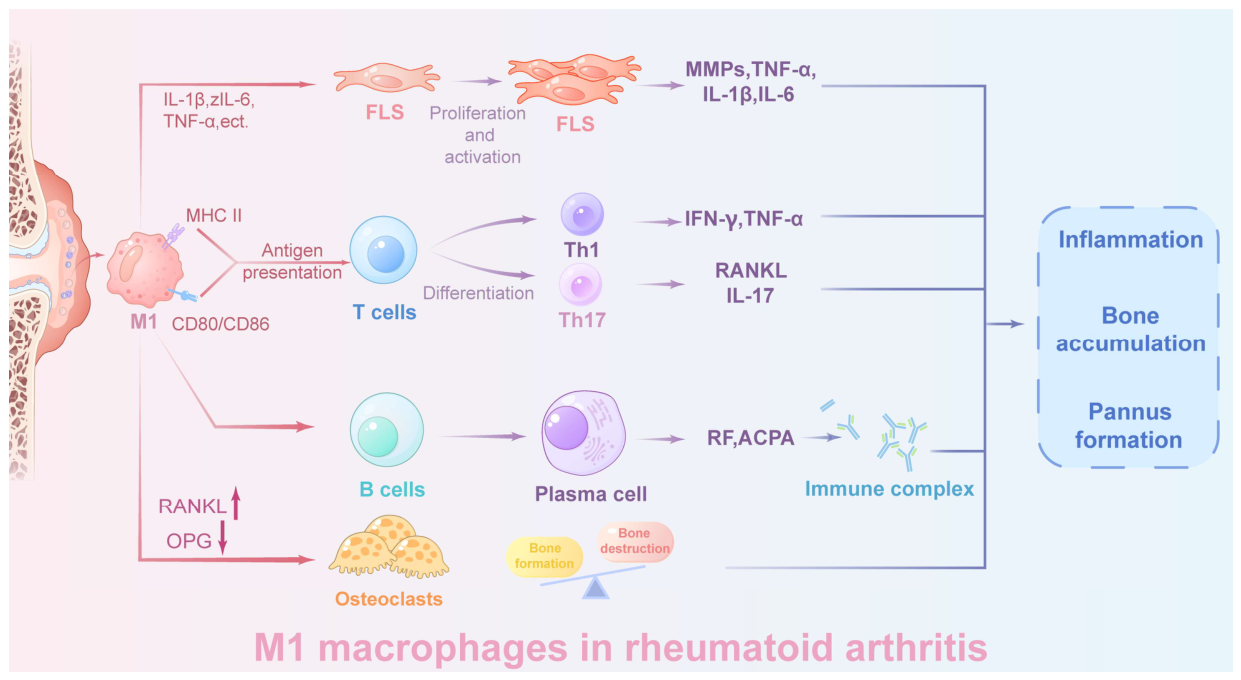
Figure 2.
M2 macrophages in rheumatoid arthritis. In RA, M2 macrophages are characterized by their secretion of anti-inflammatory cytokines, including IL-10 and IL-4. These cytokines play a pivotal role in inhibiting T cell activation and proliferation, facilitating Th2-type immune responses, and inducing the production of additional anti-inflammatory cytokines such as IL-4 and IL-13. Furthermore, M2 macrophages impede osteoclast differentiation and activation through the downregulation of receptor activator of RANK and TRAP expression. In addition, M2-polarized macrophages enhance the expression of osteogenic genes, including RUNX2, ALP, COL1A1, OPN, and OCN. Collectively, these activities of M2 macrophages mitigate the inflammation and bone destruction mediated by M1 macrophages, thereby contributing to the restoration of joint homeostasis.
Figure 2.
M2 macrophages in rheumatoid arthritis. In RA, M2 macrophages are characterized by their secretion of anti-inflammatory cytokines, including IL-10 and IL-4. These cytokines play a pivotal role in inhibiting T cell activation and proliferation, facilitating Th2-type immune responses, and inducing the production of additional anti-inflammatory cytokines such as IL-4 and IL-13. Furthermore, M2 macrophages impede osteoclast differentiation and activation through the downregulation of receptor activator of RANK and TRAP expression. In addition, M2-polarized macrophages enhance the expression of osteogenic genes, including RUNX2, ALP, COL1A1, OPN, and OCN. Collectively, these activities of M2 macrophages mitigate the inflammation and bone destruction mediated by M1 macrophages, thereby contributing to the restoration of joint homeostasis.
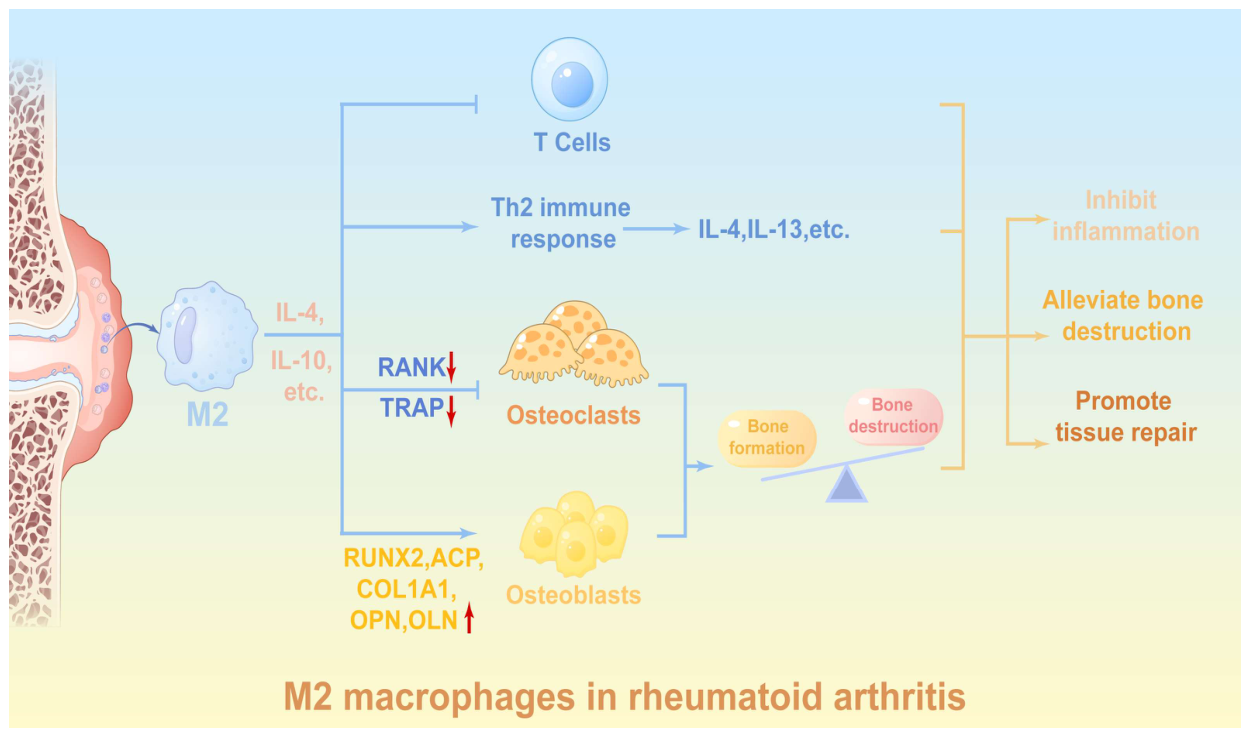
Figure 3.
Signaling pathways involved in M1 macrophage polarization. In RA, circulating monocytes migrate to the inflamed synovium and differentiate into M0 macrophages, which polarize to the M1 phenotype due to various intracellular signaling pathways, resulting in an M1/M2 imbalance. This polarization leads to the release of pro-inflammatory cytokines like IL-6, IL-1β, and TNF-α, worsening synovial inflammation. 1. NF-κB pathway: LPS binds to TLR4, activating the NF-κB pathway. NF-κB and HIF-1α mutually enhance each other, and in the hypoxic RA environment, HIF-1α drives glycolysis and ROS accumulation. This ROS stabilizes HIF-1α, creating a feedback loop that promotes M1 polarization and increases joint inflammation and damage. 2. JAK/STAT pathway: IFN-γ and IL-6 activate the JAK1/JAK2-STAT1 pathway, increasing HIF-1α expression. Additionally, HMGB1 can activate the JAK/STAT3 pathway via TLR4, further promoting M1 polarization. 3. MAPK pathway: LPS activates TLR4, leading to p38, ERK, and JNK activation, which promotes M1 polarization. 4. Notch pathway: DLL4 binding to Notch1/3 receptors on macrophages triggers cleavage events that release NICD, which enters the nucleus and activates NF-κB, MAPK, and Akt pathways, enhancing M1 marker expression. 5. PI3K/Akt pathway: ablation of Akt1 increases miR-155, favoring the M1 phenotype.
Figure 3.
Signaling pathways involved in M1 macrophage polarization. In RA, circulating monocytes migrate to the inflamed synovium and differentiate into M0 macrophages, which polarize to the M1 phenotype due to various intracellular signaling pathways, resulting in an M1/M2 imbalance. This polarization leads to the release of pro-inflammatory cytokines like IL-6, IL-1β, and TNF-α, worsening synovial inflammation. 1. NF-κB pathway: LPS binds to TLR4, activating the NF-κB pathway. NF-κB and HIF-1α mutually enhance each other, and in the hypoxic RA environment, HIF-1α drives glycolysis and ROS accumulation. This ROS stabilizes HIF-1α, creating a feedback loop that promotes M1 polarization and increases joint inflammation and damage. 2. JAK/STAT pathway: IFN-γ and IL-6 activate the JAK1/JAK2-STAT1 pathway, increasing HIF-1α expression. Additionally, HMGB1 can activate the JAK/STAT3 pathway via TLR4, further promoting M1 polarization. 3. MAPK pathway: LPS activates TLR4, leading to p38, ERK, and JNK activation, which promotes M1 polarization. 4. Notch pathway: DLL4 binding to Notch1/3 receptors on macrophages triggers cleavage events that release NICD, which enters the nucleus and activates NF-κB, MAPK, and Akt pathways, enhancing M1 marker expression. 5. PI3K/Akt pathway: ablation of Akt1 increases miR-155, favoring the M1 phenotype.
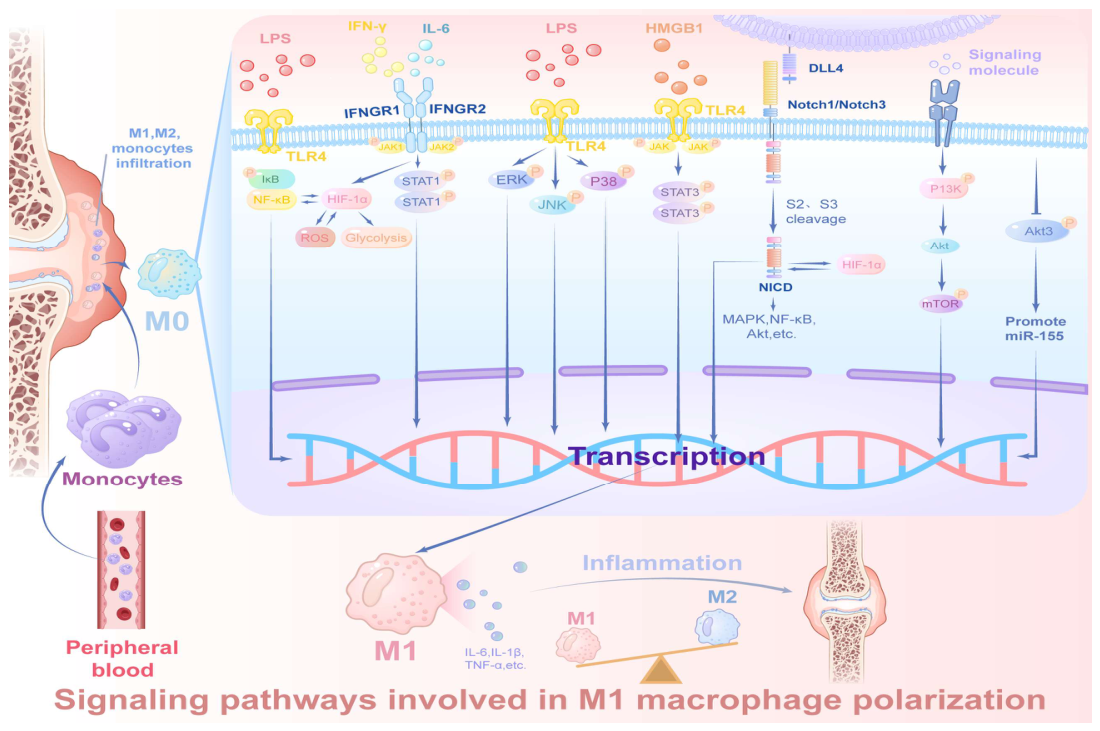

Table 1.
Nanodrug delivery systems for targeted regulation of macrophage polarization.
| Category | Nanoparticle | Main preparation technique | Administration route | Advantags | Ref |
|---|---|---|---|---|---|
| Microenvironment-Responsive Systems | PCSN@MTX | Self-assembly | Intravenous injection | Responsive to pH, increasing concentration in acidic joints; ultrasound boosts catalytic activity; ultrasound initiates drug release as needed; combined modulation of the immune microenvironment; excellent biocompatibility and stability. | [60] |
| D@ApoEVFasL∩L | Electroporation | Intravenous injection | ROS-responsive; multi-target regulation: blocks neutrophil recruitment, induces their apoptosis, promotes M2 polarization, and scavenges excess ROS to rebuild RA microenvironment; MSC-derived vesicles and LMWH enable targeted delivery to inflamed joints with good biocompatibility. | [61] | |
| BSA@NPs-MTX | Modified-SESD | Transdermal microneedle patch | Hypoxia-responsive; antioxidant and catalase-like; eliminates ROS to promote M1-to-M2 repolarization; MTX synergy; high bioavailability, low toxicity. | [62] | |
| RBA-NPs | Self-assembly | Intravenous injection | pH-responsive; CD44/folate receptor dual targeting; blocks the ERK/HIF-1α/GLUT1 pathway to inhibit glycolysis, driving M1-to-M2 repolarization. | [63] | |
| 2-APB@DGP- MM |
Chemical conjugation and physical self-assembly | Intra-articular injection | Drug release responsive to MMP; active targeting through macrophage membrane coating; effective control of macrophage polarization; minimal toxicity, excellent biosafety, high cellular uptake, and extended retention. | [7] | |
| Biomimetic Nano-Delivery Systems | HA@RFM@GP@SIN NPs | Nanoprecipitation | Intravenous injection | Hybrid RBC/FLS membrane coating confers immune evasion and homing targeting; dual anti-inflammatory and anti-proliferative synergy; multi-targeting, long circulation, excellent biocompatibility and safety. | [64] |
| AE@SiO2-MTX | Physical adsorption and chemical crosslinking | Intravenous injection | Adipose-derived stem cell exosome biomimetic coating; offers high efficiency in targeting, rapid uptake by cells, continuous drug release, and strong biocompatibility. | [65] | |
| MCB@MMs | Modified-SESD | Intravenous injection | Macrophage membrane biomimetic coating confers inflammatory targeting and immune evasion; self-oxygenation alleviates hypoxia; good biosafety. | [66] | |
| Col/Cs@ECM | Chemical conjugation | Intra-articular injection | ECM shell enables active targeting and immune priming; intracellular targeted release; efficient regulation of macrophage polarization; excellent biocompatibility and safety. | [67] | |
| Multifunctional Integrated Nanoplatforms | RP/HP@Mn/L | Chemical conjugation | Intravenous injection | Dual targeting of FLS and macrophages; combines mild photothermal therapy, chemotherapy, ROS scavenging, and O2 production for multi-mechanism synergistic remodeling of synovial microenvironment; nanocapsule structure enhances inflamed tissue penetration. | [68] |
| Rapa-FMn@PMS | Physical adsorption and chemical crosslinking | Intra-articular injection | The self-propelled movement of nanomotors improves their penetration and retention in joint tissues, while responsive drug release allows for delivery as needed. | [69] | |
| FA@4BC NPs | Nanoprecipitation | Intravenous injection | Combines fluorescence imaging with photodynamic immunomodulatory therapy for active targeting and real-time assessment of treatment effectiveness. | [70] |
Table 2.
Research progress on natural products and active ingredients targeting macrophage M1/M2 polarization in the treatment of RA.
Table 2.
Research progress on natural products and active ingredients targeting macrophage M1/M2 polarization in the treatment of RA.
| Active ingredient | Botanical source | Animal/cell model | Effect indicators and pathways | Macrophage polarization effect | Ref |
|---|---|---|---|---|---|
| Triptolide | Tripterygium wilfordii Hook.f. | AA rats | PI3K/Akt↓、NF-κB↓、MAPK↓、IL-10↑、IL-1β↓、IL-6↓、CXCL8↓、TNF-α↓、VEGF-A↓ | M1↓、M2↑ | [71] |
| Koumine | Gelsemium elegans Benth | AIA rats CIA mouse RAW264.7cells |
JAK1/STAT6↑、TNF-α↓、IL-6↓、IL-1β↓、IL-10↑、TGF-β↑、CD206↑、iNOS↓ | M1↓ | [72] |
| Suberosin | Plumbago zeylanica L | CIAmouse、RA-FLS、BMDM | JAK1/STAT6↑、JAK1/STAT3↓、 IL-10↑、TGF-β↑、 TNF-α↓、IL-1β↓、IL-6↓、MMP-1,3,9,13↓、 |
M1↓、M2↑ | [73] |
| Narirutin | Citrus medicinal materials | CIA mouse、RAW264.7cells、THP-1cells、BMMD | NF-κB↓、MAPK↓、NLRs↓、TNF-α↓、IL-1β↓、IL-6↓、IL-10↑、CD86↓、CD206↑、NLRP3↓、Caspase-1↓、GSDMD↓、NFATc1↓ | M1↓、M2↑ | [74] |
| 4-Methylcatechol | Converted from quercetin (widely present in onions, apples, and various fruits and vegetables) | CIA mouse | Nrf2/HO-1↑、NF-κB↓、L-10↑、TNF-α↓、IL-1β↓、IL-6↓、IL-1β↓、NLRP3↓、caspase-1↓、GSDMD-NT↓、iNOS↓、ARG-1↑、ROS↓ | M1↓、M2↑ | [75] |
| Curcumin | Curcuma longa L | AIA rats | NF-κB↓、ANA↓、 IL-1β↓、IL-8↓、CD68↓ |
M1↓ | [76] |
| Aqueous extracts of SADS | SADS | (IL1RA−/−)mouse、RAW264.7 cells | TNF-α↓、IL-6↓、RAGE↓、IL-10↑ | M1↓、M2↑ | [77] |
“↓”represents “inhibition”; ”↑”represents “promotion”.
Table 3.
Research progress on traditional Chinese medicine compounds in the treatment of rheumatoid arthritis by targeting macrophage M1/M2 polarization.
Table 3.
Research progress on traditional Chinese medicine compounds in the treatment of rheumatoid arthritis by targeting macrophage M1/M2 polarization.
| Traditional Chinese medicine compound | Composition | Experimental model | Mechanism of action | Effect on macrophage polarization | Ref |
|---|---|---|---|---|---|
| EMS | Atractylodes Lancea(Thunb.)DC, Phellodendron amurense Rupr. | RAW264.7 cells |
miRNA-33/NLRP3↓、TNF-α↓、IL-18↓、Arg-1↑、TGF-β↑、IL-10↑、iNOS↓、IL-1β↓ | M1↓、M2↑ | [28] |
| SMP | Atractylodes Lancea(Thunb.)DC, Phellodendron amurense Rupr, Achyranthes bidentata Blume. | CIA mouse | TNF-α↓、PGE2↓、IL-1β↓、iNOS↓、Arg-1↑、AA↓、20-carboxy-LTB4↓、12-Keto-LTB4↓、11,12-EET↑、DHA↑、DPA↑、DGLA↑、PPARγ↑ | M1↓ | [78] |
| WTD | Aconitum carmichaeli Debeaux, Astragalus mongholicus Bunge, Glycyrrhiza uralensis Fisch, Ephedra sinica Stapf, Paeonia lactiflora Pall. | RAW264.7cells,CIA mouse | NF-κB↓、TNF-α↓、IL-6↓、IL-1β↓、MCP-1↓、MMP3↓、PPARγ↑ | M1↓、M2↑ | [79] |
| FHLJT | Sinomenium acutum (Thunb.)Rehd.et Wils, Aconitum carmichaeli Debx, Paeonia lactiflora Pall, Polygonum cuspidatum Siebold&Zucc, Astragalus membranaceus(Fisch.)Bunge, Rehmannia glutinosa(Gaertn.)Libosch.ex Fisch.&C.A.Mey. | CIA mouse,RAW264.7 cells | PI3K-Akt↓、AMPK↑、IL-1β↓、TNF-α↓、IL-6↓,IL-10↑、CP↓、PADI2↓、PADI4↓、IFI30↓、CD74↓、CD206、TCR↓、BCR↓、IL-17A↓、LYN↓、p-LYN↓、RAC↓、p-RAC↓、VEGF↓、VEGFR2↓、p-VEGFR2↓、ANG-1↓、TIE2↓、MMP3↓、TRAP↓、NFATc1↓、c-Fos↓、CTSK↓、MMP9↓、 | M1↓、M2↑ | [80] |
| WGL | Rhododendron anthropogonoides Maxim, Juniperus angosturana R.P.Adams, Ephedra sinica Stapf, Myricaria platyphylla Maxim, Artemisia sieversiana Ehrh. | BMDM、CIA mouse | JAK2/STAT3↓、NF-κB↓、TNF-α↓、IL-6↓、CD68↓、CD86↓、CD68↑、CD163↑、Arg↑ | M1→M2 | [81] |
| JWJGC | Cibotium barometz (L.) J. Sm, Ptyas dhumnades Cantor, Periploca Forrestii Schltr,Panax notoginseng(Burk.)F. H. Chen, Curcuma longa L, Sinomenium acutum (Thunb.) Rehd. et Wils,etc. | CIA mouse | SLC7A11/GSH/GPX4↑、ROS↓、MDA↓,SOD↑、TNF-α↓、IL-1β↓、IL-6↓、TGF-β1、IL-10↑、ACSL4↓、FTH1↑、NLRP3↓、caspase-1↓ | M1↓、M2↑ | [53] |
“↓”represents “inhibition”; ”↑”represents “promotion”; “M1→M2” represents “M1-to-M2 repolarization”.
Disclaimer/Publisher’s Note: The statements, opinions and data contained in all publications are solely those of the individual author(s) and contributor(s) and not of MDPI and/or the editor(s). MDPI and/or the editor(s) disclaim responsibility for any injury to people or property resulting from any ideas, methods, instructions or products referred to in the content. |
© 2026 by the authors. Licensee MDPI, Basel, Switzerland. This article is an open access article distributed under the terms and conditions of the Creative Commons Attribution (CC BY) license (http://creativecommons.org/licenses/by/4.0/).
Copyright: This open access article is published under a Creative Commons CC BY 4.0 license, which permit the free download, distribution, and reuse, provided that the author and preprint are cited in any reuse.


