
Submitted:
30 May 2026
Posted:
01 June 2026
You are already at the latest version
Abstract
This study investigates the impact of geopolitical instability on corporate financial performance in emerging Asian economies by examining the mediating roles of supply chain resilience, currency volatility, and foreign investment confidence. The research adopts a quantitative cross-sectional design using survey data collected from 308 firms operating across Southeast Asia. Data were analyzed using Partial Least Squares Structural Equation Modeling (PLS-SEM) to evaluate the structural relationships among geopolitical risk factors and firm-level financial outcomes. The findings demonstrate that geopolitical instability significantly influences corporate financial performance primarily through financial transmission mechanisms. Currency volatility and foreign investment confidence emerge as the strongest mediating variables, indicating that exchange rate fluctuations and investor sentiment substantially shape firm performance under geopolitical uncertainty. In contrast, supply chain resilience improves operational adaptability but does not exert a statistically significant direct effect on financial performance. The model explains 66.7% of the variance in corporate financial performance, indicating substantial explanatory power. This study contributes to the literature by integrating operational, financial, and institutional perspectives into a unified framework of geopolitical risk transmission. The findings also provide managerial and policy implications, emphasizing the importance of financial risk management, institutional stability, governance transparency, and strategic resilience in mitigating the adverse effects of geopolitical turbulence in emerging Asian economies.
Keywords:
geopolitical risk
; corporate financial performance
; supply chain resilience
; currency volatility
; foreign investment confidence
Abstract
This study investigates the impact of geopolitical instability on corporate financial performance in emerging Asian economies by examining the mediating roles of supply chain resilience, currency volatility, and foreign investment confidence. The research adopts a quantitative cross-sectional design using survey data collected from 308 firms operating across Southeast Asia. Data were analyzed using Partial Least Squares Structural Equation Modeling (PLS-SEM) to evaluate the structural relationships among geopolitical risk factors and firm-level financial outcomes. The findings demonstrate that geopolitical instability significantly influences corporate financial performance primarily through financial transmission mechanisms. Currency volatility and foreign investment confidence emerge as the strongest mediating variables, indicating that exchange rate fluctuations and investor sentiment substantially shape firm performance under geopolitical uncertainty. In contrast, supply chain resilience improves operational adaptability but does not exert a statistically significant direct effect on financial performance. The model explains 66.7% of the variance in corporate financial performance, indicating substantial explanatory power. This study contributes to the literature by integrating operational, financial, and institutional perspectives into a unified framework of geopolitical risk transmission. The findings also provide managerial and policy implications, emphasizing the importance of financial risk management, institutional stability, governance transparency, and strategic resilience in mitigating the adverse effects of geopolitical turbulence in emerging Asian economies.
1. Introduction
For decades, theories of firm performance have rested on an implicit foundation: institutional stability and predictable market conditions. Geopolitical turbulence has shattered that foundation. Escalating trade conflicts, territorial disputes, and regional political instability are no longer exceptional disruptions but structural features of the global economy (Caldara & Iacoviello, 2022). Yet firm-level scholarship has yet to fully absorb their implications. The US-China trade war, persistent South China Sea tensions, and recurring political instability across Southeast Asia represent distinct but intersecting dimensions of geopolitical risk that fundamentally alter the environment in which firms operate. Existing research, however, has largely examined geopolitical risk through a macroeconomic lens—its effects on growth, trade flows, asset prices, and aggregate investment (Bajaj et al., 2023; Caldara & Iacoviello, 2022). This macro-level focus has generated valuable insights but has inadvertently reinforced a conceptualization of firms as passive recipients of external shocks. It offers limited purchase on a more urgent question: why do firms exposed to identical geopolitical disturbances exhibit such markedly different financial outcomes? This question is especially consequential for emerging Asian economies. Firms here operate within export-dependent production networks, face acute exposure to currency fluctuations, and rely heavily on foreign capital inflows (Athukorala, 2017; UNCTAD, 2023). Geopolitical shocks are not distant concerns but immediate operational realities. Yet existing theories struggle to explain the heterogeneity in how these firms navigate—and survive—such turbulence.
We argue that this heterogeneity arises because geopolitical turbulence transmits through three distinct but interconnected mechanisms that prior research has examined only in isolation. First, geopolitical shocks disrupt operational continuity by destabilizing global supply chains. Firms must invest in resilience-enhancing strategies—supplier diversification, logistical flexibility, inventory buffers—whose costs and uncertain returns directly shape financial performance (Ivanov, 2021). Second, geopolitical instability amplifies exchange rate volatility. This reshapes cost structures, compresses profit margins, and alters financial risk exposure, particularly for firms with unhedged foreign currency positions or cross-border operations (Bartram et al., 2010). Third, heightened geopolitical uncertainty erodes foreign investors' confidence in institutional stability and policy credibility. This constrains firms' access to external financing and depresses valuation multiples, affecting both the cost and availability of capital for growth (Bekaert et al., 2016). These channels do not operate in isolation. Supply chain disruptions may force firms into spot markets at unfavourable exchange rates, amplifying currency exposures. Currency volatility may heighten investor sensitivity to geopolitical events, magnifying shifts in foreign investment confidence. The mechanisms interact, yet the literature treats them separately. Isolated evidence links geopolitical risk to corporate investment behavior (Le & Tran, 2021), financial market volatility (Zhang et al., 2023), and currency returns (Liu, 2024). But these streams have developed in parallel rather than in conversation. No study has examined how operational, financial, and behavioral mechanisms operate jointly—and potentially interact—to transmit geopolitical shocks to firm performance. The literature lacks an integrated firm-level framework capable of explaining the multi-layered transmission process through which geopolitical turbulence shapes corporate financial outcomes.
We develop and test a multi-mediator model that conceptualizes supply chain resilience, currency volatility, and foreign investment confidence as interrelated transmission channels linking geopolitical turbulence to firm performance in emerging Asian markets. As illustrated in Figure 1, we examine how three distinct dimensions of geopolitical risk—US-China trade war effects, South China Sea tensions, and regional political instability—operate through these mediating mechanisms to shape corporate financial performance.
2. Literature Review and Hypothesis Development
2.1. Geopolitical Trade Conflicts and Supply Chain Resilience
Institutional uncertainty theory provides a powerful lens for understanding how geopolitical turbulence reshapes firm-level operational capabilities. North (1990) famously argued that institutions—the formal rules and informal constraints governing economic exchange—determine the transaction costs of coordination. When institutions stabilize, firms can plan, invest, and coordinate across borders with reasonable confidence. When institutions destabilize, transaction costs surge, contract enforceability weakens, and the predictability essential for complex production networks evaporates (Henisz, 2000). Geopolitical trade conflicts represent precisely such institutional shocks—exogenous disruptions that fundamentally alter the governance environment within which global supply chains operate. Trade conflicts, whether through tariffs, sanctions, or retaliatory measures, introduce policy uncertainty that cascades through supply networks. Firms that once relied on stable trading relationships suddenly face unpredictable cost structures, delayed shipments, and suppliers whose reliability can no longer be taken for granted. The coordination costs that institutional stability had minimized—costs of monitoring, enforcing, and adapting—re-emerge with force. Supply chain resilience, defined as the capacity to anticipate, absorb, and recover from disruptions, erodes not because any single disruption overwhelms the system but because the institutional foundation upon which resilience was built has fractured. Studies document that heightened tariffs and retaliatory measures did not simply raise costs; they fundamentally destabilized multinational supply networks, forcing firms into reactive revisions of sourcing and production strategies (Zhou, 2020; Mao & Görg, 2020). The uncertainty itself—the inability to predict what trade policies might look like next quarter, next year, or after the next election—proved as damaging as the tariffs themselves. Firms could not plan. They could only react. Some scholars argue that trade conflicts may inadvertently strengthen resilience by incentivizing diversification, reshoring, or regionalization (Gereffi, 2020; Bown, 2022). Firms forced to reduce dependence on any single source may emerge with more robust, distributed supply networks. This argument carries intuitive appeal. Adversity, after all, can breed adaptation. Yet institutional uncertainty theory suggests a more sobering conclusion. The adjustments firms make under geopolitical pressure are fundamentally different from the deliberate, strategic investments in resilience that occur under stable conditions. They are reactive, rushed, and often suboptimal choices made under constraint rather than from strength. Evenett (2021) documents how the diversification spurred by trade conflicts frequently produces fragmented, inefficient networks rather than genuinely resilient ones. The costs of adjustment compound, and the systemic vulnerabilities created by geopolitical fragmentation prove difficult to offset, particularly for firms with limited bargaining power and constrained resources. Deeply embedded in China-centric supply networks, these firms cannot easily disentangle themselves. Their redundancy is limited. Their bargaining power with larger partners is weak. When geopolitical shocks hit, they absorb disproportionate damage not because they are less capable but because their structural position leaves them few alternatives.
Thus, while trade conflicts may occasionally produce resilience-enhancing adaptations for some firms in some contexts, the dominant effect—particularly for the vulnerable firms at the heart of our study—is negative. Institutional uncertainty erodes the predictability essential for resilience. It transforms supply chains from coordinated systems into collections of reactive, short-term transactions. Therefore, we hypothesize:
Hypothesis 1.
Geopolitical trade conflicts negatively affect firms’ supply chain resilience.
2.2. Geopolitical Turbulence and Foreign Investment Confidence
From the perspective of real options theory and behavioral finance, heightened policy and geopolitical uncertainty increases the value of waiting, leading investors to delay, scale back, or redirect capital commitments when future payoffs become less predictable (Dixit & Pindyck, 1994; Pastor & Veronesi, 2013). Geopolitical turbulence amplifies uncertainty regarding regulatory continuity, trade access, and political stability, thereby eroding foreign investors’ confidence in host economies. As uncertainty rises, expected returns decline relative to perceived risk, weakening incentives for foreign direct investment (FDI). Empirical evidence from the US–China trade war supports this theoretical expectation. Studies show that trade policy uncertainty significantly reduces firm entry, investment commitment, and FDI inflows, particularly in economies closely integrated into global value chains (Cui & Li, 2023; Yan et al., 2022; Gao et al., 2024). While some research documents temporary investment diversion toward alternative destinations, such reallocation is largely defensive and does not reflect sustained improvements in investor confidence (Dong et al., 2025). Firm-level analyses further reveal that policy uncertainty constrains outward FDI and induces precautionary capital flight, as firms hedge against domestic and international risk exposure (Wu & Shao, 2023; Song et al., 2021). Importantly, emerging Asian economies are especially sensitive to fluctuations in foreign investment confidence due to their reliance on external capital, export-led growth strategies, and evolving institutional frameworks. Consequently, geopolitical trade conflicts are expected to exert a systematically negative influence on foreign investment confidence across the region. Therefore
Hypothesis 2.
Geopolitical trade conflicts negatively affect foreign investment confidence.
2.3. Maritime Geopolitical Risk and Supply Chain Resilience
Geopolitical risk associated with contested maritime regions introduces a distinct form of supply chain vulnerability by threatening the physical continuity of trade routes and logistical corridors. Transaction cost economics suggests that increased exposure to expropriation risk, transit disruption, and security uncertainty elevates coordination costs and reduces the efficiency of cross-border exchange (Williamson, 1985). The South China Sea (SCS), as a critical maritime chokepoint, exemplifies this mechanism, with escalating territorial tensions increasing transit risk, insurance costs, and routing uncertainty for firms reliant on maritime trade. Recent studies highlight geopolitical risk as a central determinant of global supply chain fragility, demonstrating that prolonged geopolitical tensions weaken network adaptability and increase disruption severity (Blessley & Mudambi, 2022; Huchzermeier & Stehle, 2025). Empirical evidence indicates that firms with concentrated exposure to contested trade corridors face disproportionately higher disruption risks, whereas diversification strategies only partially mitigate these vulnerabilities (Zhu et al., 2024). Although organizational practices such as enhanced information sharing may alleviate uncertainty, they are insufficient to neutralize persistent geopolitical stress in strategically sensitive regions (Coşkun & Erturgut, 2024).In the context of the SCS, geopolitical tensions necessitate costly adjustments in sourcing and routing decisions while leaving residual risk largely unresolved. Consequently, maritime geopolitical risk is expected to exert a negative effect on firm-level supply chain resilience. Therefore
Hypothesis 3.
Geopolitical tensions in contested maritime regions negatively affect supply chain resilience.
2.4. Maritime Geopolitical Risk and Foreign Investment Confidence
Behavioral and institutional theories suggest that geopolitical risk heightens investors’ risk perceptions by increasing uncertainty over political stability, security conditions, and policy continuity, thereby diminishing foreign investment confidence. Caldara and Iacoviello (2022) demonstrate that geopolitical risk shocks significantly suppress investment by amplifying market uncertainty and risk premiums. These effects are particularly pronounced in regions characterized by strategic competition and military tensions. Empirical studies confirm that geopolitical instability redirects capital flows and reduces FDI inflows across emerging and transition economies (Agoraki et al., 2024; Feng et al., 2023). Country-level evidence from Vietnam and Türkiye illustrates that heightened geopolitical risk undermines investor confidence and deters long-term capital commitments (Truong et al., 2024; Altiner & Bozkurt, 2023). In the specific context of the SCS, rising tensions have been shown to redirect strategic investments toward politically less volatile regions, reflecting investors’ sensitivity to maritime and security risks (Yu et al., 2021). Given the SCS’s central role in global trade, geopolitical instability in this region is likely to generate spillover effects that further erode foreign investment confidence across emerging Asia. Therefore
Hypothesis 4.
Geopolitical tensions in contested maritime regions negatively affect foreign investment confidence.
2.5. Maritime Geopolitical Risk and Currency Volatility
International finance theory suggests that exchange rates respond sharply to geopolitical shocks as investors reassess risk, reprice assets, and reallocate capital across borders under heightened uncertainty. In particular, geopolitical instability increases risk premia, accelerates capital flow reversals, and intensifies speculative activity, thereby amplifying exchange rate volatility (Akram, 2020; Caldara & Iacoviello, 2022). These effects are especially pronounced in emerging economies, where financial markets are less deep, policy credibility is evolving, and currencies are more sensitive to shifts in global risk sentiment. Geopolitical conflicts in strategic maritime regions, such as the South China Sea (SCS), represent a critical source of external shock to exchange rate stability. As a major conduit for global trade and energy transportation, instability in the SCS disrupts trade expectations, commodity flows, and cross-border investment, all of which are key determinants of currency valuation. Empirical evidence indicates that geopolitical risk significantly heightens exchange rate volatility in ASEAN economies, underscoring the susceptibility of regional currencies to maritime disputes and security tensions (Hui, 2021). Similarly, Adeosun et al. (2024) demonstrate that geopolitical shocks propagate volatility across financial markets, with currency markets exhibiting particularly strong responses due to their sensitivity to capital movements and policy uncertainty. Evidence from recent geopolitical conflicts further supports this mechanism. Studies show that large-scale geopolitical shocks, such as the Russia–Ukraine conflict, triggered pronounced foreign exchange volatility as investors engaged in rapid portfolio rebalancing and flight-to-safety behavior (Aliu et al., 2022; Akarsu & Gharehgozli, 2023). Comparable dynamics are expected in the context of the SCS, where heightened geopolitical tensions may disrupt energy trade routes, alter commodity prices, and induce speculative pressures in regional currency markets. Research also highlights the role of investor sentiment and contagion effects, showing that geopolitical shocks intensify volatility spillovers through exchange rate channels across interconnected economies (Asad et al., 2020; Abdulsalam & Onipede, 2023). Taken together, these theoretical and empirical insights suggest that escalating tensions in the South China Sea increase uncertainty over trade continuity, energy supply, and capital mobility, thereby amplifying exchange rate volatility through heightened risk perceptions, capital outflows, and speculative activity. thus
Hypothesis 5.
Geopolitical tensions in the South China Sea are positively associated with currency volatility.
2.6. Political Instability and Foreign Investment Confidence
Foreign investment confidence is fundamentally shaped by perceptions of political stability, institutional credibility, and policy continuity in host economies. Institutional theory posits that stable political environments reduce uncertainty, strengthen contract enforcement, and enhance the predictability of regulatory outcomes, thereby lowering transaction costs and encouraging long-term capital commitments (North, 1990; Henisz, 2000). Conversely, political instability undermines these institutional foundations, eroding investor confidence by increasing uncertainty over policy direction, governance quality, and security conditions. Real options theory further suggests that heightened political instability increases the value of waiting, leading investors to postpone or scale back irreversible investment decisions when future payoffs become uncertain (Dixit & Pindyck, 2012). Under such conditions, foreign investors demand higher risk premia or redirect capital toward more stable jurisdictions, weakening foreign investment confidence even in economies with otherwise attractive fundamentals. Behavioral finance complements this perspective by emphasizing that investors’ subjective risk perceptions and confidence are highly sensitive to political signals, magnifying capital withdrawal and hesitation during periods of instability (Pastor & Veronesi, 2013).
Empirical evidence consistently supports these theoretical expectations. Kiptoo (2024) demonstrates that political stability promotes FDI by enhancing policy predictability and institutional trust, while instability discourages capital inflows. Country-specific studies reinforce this relationship. For instance, Tjandrasa (2021) shows that political stability and institutional reforms significantly improve foreign investment attractiveness in Indonesia, underscoring investors’ sensitivity to governance quality. In fragile and vulnerability-prone economies, political instability exerts particularly strong deterrent effects. Bitar, Hamadeh, and Khoueiri (2019) find that insecurity and policy unpredictability in Lebanon significantly reduced FDI inflows, while Kurecic and Kokotovic (2017) document both immediate and persistent declines in foreign investment following episodes of political instability.
Institutional quality plays a critical moderating role in this relationship. Weak institutional frameworks amplify the adverse effects of political instability on foreign investment confidence by intensifying uncertainty and weakening enforcement mechanisms (Saha et al., 2022). Recent studies further highlight that political stability is essential not only for attracting FDI but also for sustaining innovation, green growth, and long-term economic development, all of which depend on credible and consistent policy environments (Qamruzzaman & Karim, 2024; Wang et al., 2024). Evidence from Indonesia similarly confirms that political stability enhances both foreign investment inflows and economic growth by reinforcing investor confidence in policy continuity and governance reliability (Kristofano & Febriani, 2024).
Taken together, this literature suggests that regional political instability undermines foreign investment confidence by increasing uncertainty, weakening institutional trust, and raising perceived business risk, thereby discouraging long-term capital commitments. Therefore
Hypothesis 6.
Regional political instability negatively affects foreign investment confidence.
2.7. Political Instability, Investor Behavior, and Exchange Rate Volatility
From a behavioral finance perspective, political instability influences exchange rates by shaping investor expectations and risk perceptions. Heightened geopolitical uncertainty erodes investor confidence, leading to precautionary capital withdrawals, currency depreciation pressures, and increased volatility as market participants respond heterogeneously to evolving information (Pastor & Veronesi, 2013). These dynamics are reinforced in emerging markets, where institutional fragility and limited monetary policy credibility magnify currency sensitivity to external shocks. Empirical studies consistently demonstrate that political and security shocks intensify exchange rate volatility by increasing firms’ and investors’ exposure to currency risk (Abbassi et al., 2022; Aliu et al., 2022). Hui (2021) further shows that ASEAN foreign exchange markets exhibit persistent volatility in response to geopolitical risk, reflecting the region’s exposure to political instability and capital flow fluctuations. Adeosun et al. (2024) provide additional evidence that geopolitical uncertainty, when combined with economic policy uncertainty, exacerbates financial instability and amplifies currency volatility.
Commodity-linked mechanisms further reinforce these effects. Political instability often disrupts energy and commodity markets, which in turn affect exchange rates in both exporting and importing economies. Akram (2020) demonstrates that oil-exporting countries experience heightened exchange rate volatility during periods of geopolitical uncertainty, while Liu et al. (2025) show that US–China geopolitical tensions transmit shocks through commodity markets, contributing to exchange rate instability. These findings align with contagion models in international finance, which emphasize the role of exchange rate channels in disseminating shocks across financial systems (Asad et al., 2020).
Accordingly, political instability associated with geopolitical tensions is expected to amplify exchange rate volatility through capital outflows, speculative behavior, and commodity-linked transmission mechanisms. Therefore
Hypothesis 7.
Geopolitical instability is positively associated with exchange rate volatility.
2.8. Supply Chain Resilience and Corporate Financial Performance
Supply chain resilience (SCR) refers to a firm’s capacity to anticipate, absorb, adapt to, and recover from disruptions while maintaining operational continuity and performance. Drawing on dynamic capabilities theory, resilient supply chains enable firms to reconfigure resources, sustain strategic flexibility, and mitigate performance losses under uncertainty, thereby contributing to superior financial outcomes. In volatile environments, SCR functions not merely as an operational attribute but as a strategic capability that enhances firms’ long-term competitiveness and profitability. Empirical evidence consistently supports the positive association between SCR and corporate financial performance. Firms with higher resilience demonstrate superior returns on assets, profit margins, and growth during periods of market turbulence (Li et al., 2017). Recent studies further show that resilience embedded within sustainable supply chain practices strengthens stakeholder trust and improves financial performance by aligning operational stability with long-term value creation (Zhu & Wu, 2022; Lin & Li, 2025). Digital capabilities reinforce this relationship by enhancing supply chain visibility, coordination, and recovery speed, allowing firms to translate resilience into tangible financial gains (Zhao et al., 2023).
Supply chain finance (SCF) has emerged as an important complementary mechanism through which resilience enhances financial performance. By easing working capital constraints and improving liquidity across supply networks, SCF strengthens firms’ ability to absorb shocks and sustain investment in innovation and operations (Zheng et al., 2025; Feng et al., 2024). Empirical evidence confirms that firms adopting SCF mechanisms exhibit improved financial outcomes across industries, particularly in environments characterized by financing frictions (Paul, 2025). While prior studies highlight sustainability, digitalization, and financial integration as key enablers of resilience, most examine these mechanisms in isolation, leaving limited understanding of their combined effects—especially in emerging economies.
Taken together, the literature indicates that SCR operates as a strategic capability that positively influences corporate financial performance by enhancing adaptability, reducing disruption-related losses, and supporting sustained value creation. Therefore
Hypothesis 8.
Supply chain resilience positively affects corporate financial performance.
2.9. Currency Volatility and Corporate Financial Performance
Currency volatility represents a critical external financial risk that affects firms’ cost structures, pricing strategies, investment decisions, and international competitiveness. International finance theory suggests that heightened exchange rate fluctuations increase uncertainty, raise transaction and hedging costs, and distort investment planning, thereby undermining firm-level financial performance—particularly in economies with limited risk-management capabilities.
Empirical research provides robust evidence of this negative relationship. Exchange rate volatility has been shown to weaken corporate profitability and financial stability across both developed and emerging markets (Bris et al., 2004; Morina et al., 2020). Recent firm-level studies confirm that exchange rate instability adversely affects performance by eroding margins, increasing financing costs, and discouraging long-term investment (Kim & Han, 2024; Aminaho, 2025). Macroeconomic evidence further indicates that volatile exchange rates impede productivity, trade competitiveness, and investment, reinforcing their detrimental effects on firm performance (Musyoki et al., 2012; Yensu et al., 2022; Fofanah, 2022). Importantly, the magnitude of these effects varies across institutional contexts. Firms in advanced economies often possess more sophisticated hedging instruments and financial depth, enabling them to partially buffer currency risk, whereas firms in emerging markets remain more exposed due to weaker financial infrastructure and limited access to risk management tools (Aminaho, 2025). This vulnerability underscores the importance of currency stability for sustaining corporate financial performance in emerging economies. Accordingly, the literature converges on the view that currency volatility undermines firm performance by increasing uncertainty, costs, and financial risk exposure. Therefore
Hypothesis 9.
Currency volatility negatively affects corporate financial performance.
2.10. Foreign Investment Confidence and Corporate Financial Performance
Foreign investment confidence reflects investors’ expectations regarding institutional credibility, governance quality, and long-term economic prospects in host economies. From an institutional and resource-based perspective, foreign investment enhances firm-level financial performance by providing access to capital, managerial expertise, advanced technologies, and global networks, thereby improving efficiency, governance, and competitive positioning. Empirical studies consistently demonstrate that firms with higher foreign ownership or stronger exposure to international investors exhibit superior financial performance, particularly in emerging and transitional economies (Pasali & Chaudhary, 2020). Foreign investors often impose more stringent governance practices and performance monitoring, contributing to enhanced profitability and productivity. Evidence from both developed and developing contexts supports this mechanism, showing that firms with foreign participation outperform domestic counterparts in financial outcomes (Bentivogli & Mirenda, 2016).
However, the strength of this relationship depends on firm-level and institutional conditions. Large firms are generally better positioned to leverage international networks and economies of scale, while smaller firms may face constraints related to absorptive capacity (Bentivogli & Mirenda, 2016). Moreover, weak institutional environments may dampen the positive effects of foreign investment by increasing risk and limiting effective governance transmission. Despite these contingencies, the literature broadly confirms that foreign investment confidence plays a critical role in enhancing firm-level financial performance through improved governance, innovation adoption, and global integration. Therefore
Hypothesis 10.
Foreign investment confidence positively affects corporate financial performance.
Development of Conceptual Model
Building on the above arguments, this study proposes a conceptual model that examines how geopolitical instability influences corporate financial performance through firm-level transmission mechanisms. Specifically, geopolitical risks—manifested through the US–China trade war, South China Sea tensions, and regional political instability—affect corporate outcomes indirectly via supply chain resilience, currency volatility, and foreign investment confidence. This framework integrates operational, financial, and institutional channels to explain how external geopolitical shocks are translated into firm-level financial performance, highlighting the strategic importance of resilience and investor confidence in navigating uncertainty within emerging Asian economies.
3. Methodology and Design
3.1. Research Design
This study adopts a quantitative, cross-sectional research design to examine how geopolitical instability influences corporate financial performance in Southeast Asia through multiple mediating mechanisms. The research framework integrates geopolitical risk factors with firm-level strategic and financial responses, requiring an analytical approach capable of simultaneously estimating complex causal relationships. To achieve this objective, Partial Least Squares Structural Equation Modeling (PLS-SEM) was employed. PLS-SEM is particularly suitable for this study for three reasons. First, the model incorporates multiple latent constructs and parallel mediators, increasing structural complexity. Second, the study emphasizes prediction and variance explanation, consistent with the objectives of PLS-SEM rather than strict theory confirmation. Third, several constructs—such as geopolitical tensions and investment confidence—represent context-dependent phenomena that benefit from PLS-SEM’s robustness to non-normal data distributions and moderate sample sizes (Hair et al., 2019; Hair et al., 2022). Accordingly, PLS-SEM is well aligned with the study’s exploratory–explanatory orientation and emerging-market context. The survey instrument was developed based on established and validated measurement scales, adapted carefully to reflect the geopolitical and institutional context of Southeast Asia. All constructs were operationalized as reflective latent variables and measured using multi-item indicators on a five-point Likert scale ranging from 1 (strongly disagree) to 5 (strongly agree).
Measures of geopolitical risk—including the US–China trade war, South China Sea tensions, and regional political instability—were adapted from prior political risk and international business research (Kobrin, 1982; Stevens & Newenham-Kahindi, 2021). Mediating constructs—Supply Chain Resilience (SCR), Currency Volatility (CV), and Foreign Investment Confidence (FIC)—were drawn from validated scales in the supply chain management and international finance literature (Pettit et al., 2019; Wang & Ngai, 2020). Corporate Financial Performance (CFP) was measured using subjective assessments of profitability, growth, and competitive position. Such perceptual measures are widely accepted as reliable proxies for objective performance, particularly in emerging-market contexts where secondary financial data are limited or inconsistent (Dess & Robinson, 1984).
To ensure content validity and contextual relevance, the questionnaire was reviewed by three academic experts specializing in international business and two senior industry practitioners with regional experience. A pilot study involving 35 respondents was conducted to assess item clarity and reliability, resulting in minor refinements to wording without altering construct meaning. The empirical setting comprises mid- to large-sized enterprises operating in Southeast Asia, with a focus on industries highly exposed to geopolitical and trade-related disruptions, including manufacturing, logistics, technology, and international business services. A purposive sampling strategy was adopted to target firms with direct exposure to cross-border trade, supply chain fragmentation, and international investment flows. Data were collected between March and June 2025 using structured questionnaires distributed through professional networks, industry associations, and targeted email invitations. A total of 420 questionnaires were disseminated, of which 308 valid responses were retained after excluding incomplete or inconsistent submissions, yielding an effective response rate of 74.3%.
The final sample size exceeds the minimum threshold recommended for PLS-SEM using the 10-times rule and satisfies the statistical power requirement (0.80) based on G-Power analysis (Cohen, 1988; Hair et al., 2022). The sectoral composition of the sample includes manufacturing (41%), logistics and shipping (27%), technology and electronics (19%), and business services (13%). In terms of firm size, 36% employ fewer than 500 employees, 44% employ between 500 and 1,000 employees, and 20% employ more than 1,000 employees. Respondents primarily held senior and middle management positions in supply chain management, finance, and strategic planning, ensuring informed assessments of firm-level performance and risk exposure. Data analysis was conducted using SmartPLS 4.0 following a two-stage analytical procedure. First, the measurement model was evaluated by assessing internal consistency reliability, convergent validity, and discriminant validity using composite reliability, average variance extracted (AVE), and the heterotrait–monotrait (HTMT) ratio. Second, the structural model was examined through path coefficients, coefficient of determination (R²), effect sizes (f²), and predictive relevance (Q²). To test the statistical significance of hypothesized relationships, a bootstrapping procedure with 5,000 resamples was applied. This non-parametric approach enhances the robustness of parameter estimates and mitigates concerns related to non-normal data distributions commonly associated with survey-based research (Henseler et al., 2009). Collectively, this analytical strategy ensures rigorous hypothesis testing and reliable inference regarding the mediating mechanisms linking geopolitical instability to corporate financial performance.
4. Findings and Analysis
Measurement Model Evaluation
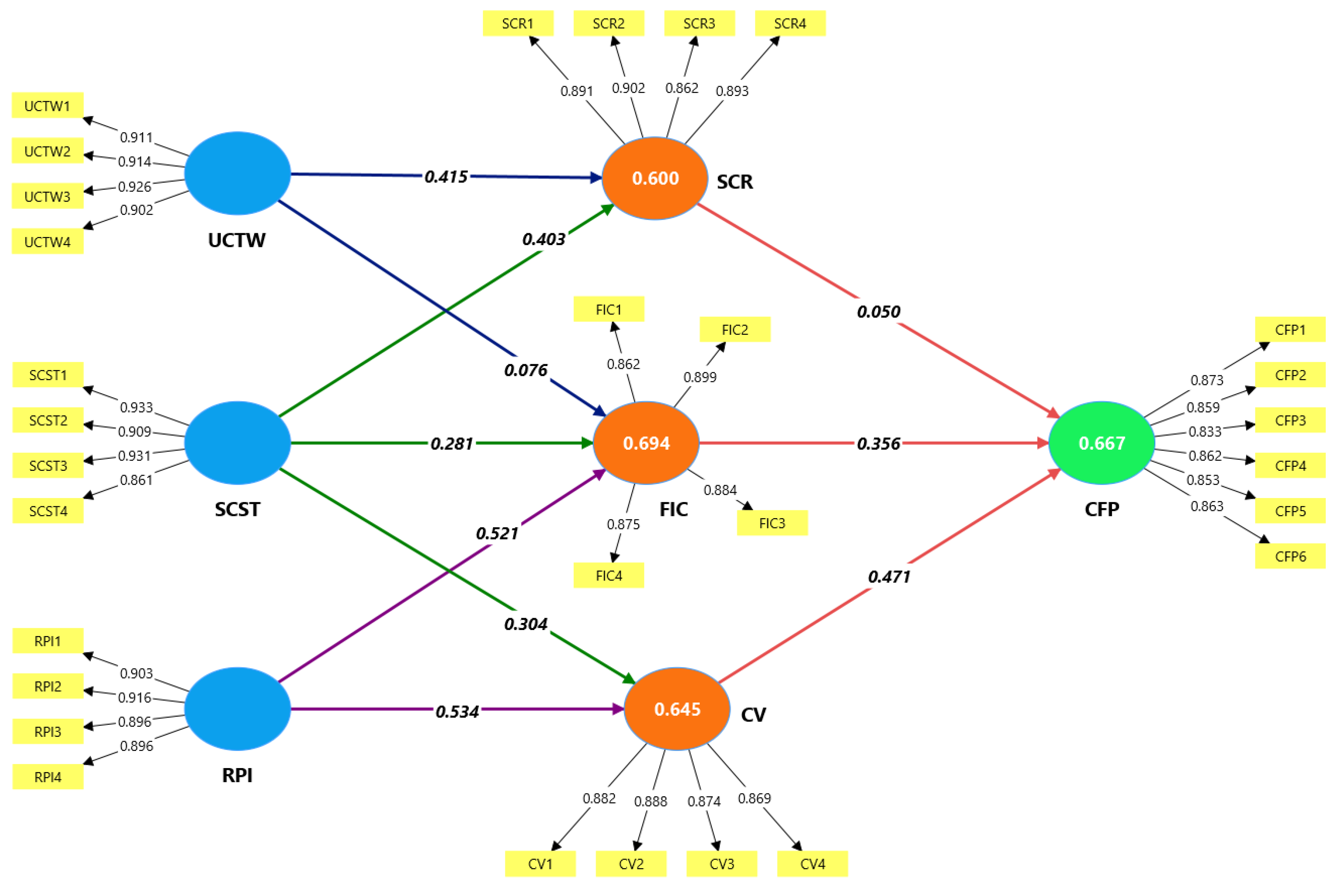
Findings: Measurement Model Evaluation
The measurement model was assessed using SmartPLS output, focusing on indicator reliability, construct reliability, convergent validity, and discriminant validity. As shown in Table 1, all outer loadings exceeded the minimum threshold of 0.70 (Hair et al., 2021), ranging from 0.833 (CFP3) to 0.933 (SCST1). This indicates that each indicator strongly contributes to its respective latent construct. The consistently high loadings across constructs such as CFP, CV, FIC, RPI, SCR, SCST, and UCTW demonstrate that the reflective indicators are reliable measures of their underlying constructs.
The results in Table 2 confirm that all constructs achieved high internal consistency. Cronbach’s alpha values ranged from 0.901 (CV) to 0.934 (UCTW), while composite reliabilities (ρc) were between 0.931 and 0.953 — all surpassing the recommended cut-off of 0.70 (Nunnally & Bernstein, 1994). The Average Variance Extracted (AVE) values were also robust, ranging from 0.735 (CFP) to 0.834 (UCTW), well above the 0.50 threshold (Fornell & Larcker, 1981). These results provide strong evidence of convergent validity, indicating that the indicators share a high proportion of variance in measuring their respective constructs. The Fornell–Larcker criterion results in Table 3 show that the square root of each construct’s AVE (diagonal values) was greater than its correlations with other constructs (off-diagonal values). For instance, the square root of AVE for CV (0.878) exceeded its correlations with CFP (0.783) and FIC (0.791). Similarly, UCTW (0.913) had a higher diagonal value than its correlations with other constructs such as RPI (0.806) and SCST (0.793). These findings confirm that all constructs are empirically distinct, satisfying the discriminant validity requirement.
The Heterotrait–Monotrait (HTMT) results in Table 4 further strengthen the evidence for discriminant validity. All HTMT ratios ranged from 0.615 (SCR–CFP) to 0.890 (RPI–FIC), below the conservative threshold of 0.90 (Henseler, Ringle, & Sarstedt, 2015). This indicates that each construct captures a unique dimension of the conceptual model, with no evidence of multicollinearity or redundancy among constructs.
The measurement model evaluation demonstrates strong reliability and validity across all constructs. The high outer loadings and AVE values confirm convergent validity, while both the Fornell–Larcker and HTMT criteria establish discriminant validity. These results collectively indicate that the latent constructs are well-defined, distinct, and measured consistently, thereby providing a solid foundation for evaluating the structural model in the next stage of analysis.
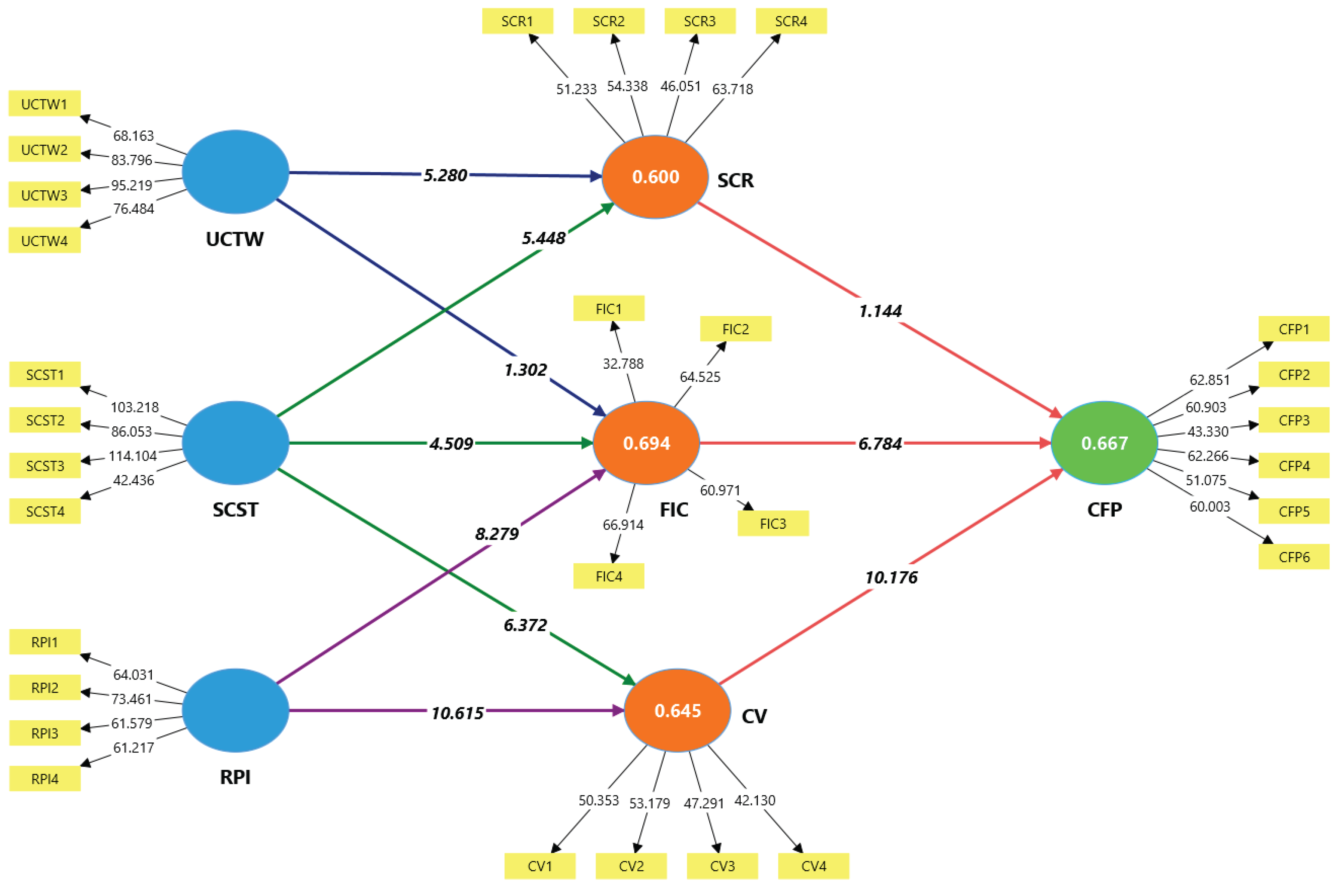

Table 5.
Coefficient of Determination (R² and Adjusted R²) for Endogenous Constructs. Structural Model Evaluation. R square (R2).
Table 5.
Coefficient of Determination (R² and Adjusted R²) for Endogenous Constructs. Structural Model Evaluation. R square (R2).
| R-square | R-square adjusted | |
| CFP | 0,667 | 0,664 |
| CV | 0,645 | 0,643 |
| FIC | 0,694 | 0,691 |
| SCR | 0,600 | 0,598 |
Table 6.
Effect Size (f²) of Exogenous Variables on Endogenous Constructs. F Square (F2).
| f-square | |
| CV -> CFP | 0,239 |
| FIC -> CFP | 0,126 |
| RPI -> CV | 0,259 |
| RPI -> FIC | 0,230 |
| SCR -> CFP | 0,004 |
| SCST -> CV | 0,084 |
| SCST -> FIC | 0,071 |
| SCST -> SCR | 0,151 |
| UCTW -> FIC | 0,006 |
| UCTW -> SCR | 0,160 |
Table 7.
Predictive Relevance (Q²) and Prediction Metrics (RMSE, MAE). Q Square (Q2).
| Q²predict | RMSE | MAE | |
| CFP | 0,567 | 0,665 | 0,540 |
| CV | 0,644 | 0,607 | 0,470 |
| FIC | 0,690 | 0,565 | 0,452 |
| SCR | 0,592 | 0,648 | 0,473 |
Figure 3.
Structural Model Evaluation Results: Path Coefficients, R², and Effect Sizes (SmartPLS Output).
Figure 3.
Structural Model Evaluation Results: Path Coefficients, R², and Effect Sizes (SmartPLS Output).
Table 8.
Path Coefficients of the Structural Model (SmartPLS Output). Path Coefficient.
| Original sample (O) | Sample mean (M) | Standard deviation (STDEV) | T statistics (|O/STDEV|) | P values | |
| CV -> CFP | 0,471 | 0,471 | 0,046 | 10,176 | 0,000 |
| FIC -> CFP | 0,356 | 0,358 | 0,052 | 6,784 | 0,000 |
| RPI -> CV | 0,534 | 0,532 | 0,050 | 10,615 | 0,000 |
| RPI -> FIC | 0,521 | 0,519 | 0,063 | 8,279 | 0,000 |
| SCR -> CFP | 0,050 | 0,047 | 0,044 | 1,144 | 0,253 |
| SCST -> CV | 0,304 | 0,305 | 0,048 | 6,372 | 0,000 |
| SCST -> FIC | 0,281 | 0,278 | 0,062 | 4,509 | 0,000 |
| SCST -> SCR | 0,403 | 0,408 | 0,074 | 5,448 | 0,000 |
| UCTW -> FIC | 0,076 | 0,079 | 0,058 | 1,302 | 0,193 |
| UCTW -> SCR | 0,415 | 0,409 | 0,079 | 5,280 | 0,000 |
Table 9.
Specific Indirect Effects in the Structural Model (SmartPLS Output). Specific Indirect Effect.
Table 9.
Specific Indirect Effects in the Structural Model (SmartPLS Output). Specific Indirect Effect.
| Original sample (O) | Sample mean (M) | Standard deviation (STDEV) | T statistics (|O/STDEV|) | P values | |
| RPI -> FIC -> CFP | 0,185 | 0,186 | 0,036 | 5,160 | 0,000 |
| SCST -> SCR -> CFP | 0,020 | 0,019 | 0,019 | 1,067 | 0,286 |
| RPI -> CV -> CFP | 0,251 | 0,251 | 0,036 | 6,899 | 0,000 |
| UCTW -> SCR -> CFP | 0,021 | 0,019 | 0,018 | 1,144 | 0,253 |
| SCST -> FIC -> CFP | 0,100 | 0,100 | 0,028 | 3,614 | 0,000 |
| SCST -> CV -> CFP | 0,143 | 0,143 | 0,026 | 5,478 | 0,000 |
| UCTW -> FIC -> CFP | 0,027 | 0,028 | 0,021 | 1,269 | 0,204 |
Structural Model Evaluation: An Advanced Analysis
The structural model demonstrates substantial explanatory capability in explaining firm-level financial outcomes under geopolitical instability. The coefficient of determination (R²) for Corporate Financial Performance (CFP) is 0.667 (adjusted R² = 0.664), indicating that approximately two-thirds of the variance in firm performance is explained by the proposed mediators and geopolitical risk factors. This level of explanatory power is considered substantial for firm-level studies in complex, uncertainty-driven environments. The mediating constructs also exhibit meaningful explanatory power. Foreign Investment Confidence (FIC) records an R² of 0.694, while Currency Volatility (CV) shows an R² of 0.645, indicating that geopolitical risk variables account for a significant proportion of variation in investor sentiment and exchange rate instability. Supply Chain Resilience (SCR) exhibits moderate explanatory power (R² = 0.600), reflecting the heterogeneous and context-dependent nature of operational adaptation across firms.
Effect size (f²) analysis further clarifies the relative importance of the predictors. Following Cohen (1988), values of 0.02, 0.15, and 0.35 indicate small, medium, and large effects, respectively. CV (f² = 0.239) and FIC (f² = 0.126) exert medium and small-to-medium effects on CFP, underscoring their economic relevance. Regional Political Instability (RPI) demonstrates medium effects on both CV (f² = 0.259) and FIC (f² = 0.230), highlighting its central role in transmitting geopolitical uncertainty to financial and investment channels. Predictive relevance was assessed using the blindfolding procedure. All endogenous constructs exhibit positive Q² values, confirming that the model possesses meaningful predictive relevance and is capable of reproducing observed data patterns beyond mere explanatory fit (Hair et al., 2019). Path coefficient estimates indicate that Currency Volatility (β = 0.471, t = 10.176, p < 0.001) and Foreign Investment Confidence (β = 0.356, t = 6.784, p < 0.001) significantly influence corporate financial performance. These results confirm that financial market instability and investor sentiment constitute primary transmission mechanisms through which geopolitical risks affect firm outcomes. Regional Political Instability significantly increases currency volatility (β = 0.534, t = 10.615, p < 0.001) and weakens foreign investment confidence (β = 0.521, t = 8.279, p < 0.001). South China Sea tensions also significantly affect CV, FIC, and SCR, reflecting their disruptive influence on trade routes, capital flows, and operational continuity. In contrast, the direct effects of SCR on CFP (β = 0.050, p > 0.05) and the US–China trade war on FIC (β = 0.076, p > 0.05) are not statistically significant, suggesting that their influence operates primarily through indirect mechanisms. Mediation analysis confirms this interpretation. Significant indirect effects are observed for RPI and SCST through CV and FIC, whereas mediation via SCR is not supported. These findings indicate that financial-market and investor-confidence channels dominate operational resilience mechanisms in shaping firm performance under geopolitical stress.
Theoretical and Practical Contribution
This study advances geopolitical risk theory in three important ways. First, it shifts the analytical focus from macroeconomic aggregates to firm-level transmission mechanisms, demonstrating that geopolitical instability affects corporate performance primarily through financial-market volatility and investor confidence rather than direct operational disruptions alone. Second, by integrating multiple mediators within a single structural framework, the study reconceptualizes geopolitical risk as a multichannel phenomenon, where financial and strategic pathways interact to shape firm outcomes. Third, the findings extend emerging-market theory by revealing that limited hedging capacity and dependence on foreign capital amplify the dominance of financial over operational mechanisms in Asia, thereby establishing clear boundary conditions for existing resilience theories. The results suggest that managerial responses to geopolitical instability should prioritize financial risk governance alongside operational resilience. Firms should strengthen currency risk management, enhance transparency to sustain investor confidence, and align governance practices with international standards. Policymakers, in turn, should focus on institutional stability, predictable regulatory environments, and regional cooperation to reduce risk premiums and support firm-level financial sustainability.
5. Limitations and Future Research
Despite its contributions, this study is limited by its cross-sectional design, which restricts causal inference over time. Longitudinal analyses could capture dynamic adaptation to sustained geopolitical shocks. Additionally, reliance on perceptual measures may introduce bias; future studies should triangulate survey data with archival financial indicators. Finally, comparative research across regions with differing institutional quality would further refine the generalizability of the proposed framework.
6. Conclusions
This study analyzes the impact of geopolitical instability on corporate financial performance through key mediating factors. By incorporating supply chain resilience, foreign investment confidence, and currency volatility into a structural framework, this study advances the theoretical and empirical understanding of firm-level responses to disruptions. The model shows significant explanatory capabilities, indicating that foreign investment confidence and currency volatility are critical in translating geopolitical risks into financial outcomes. From a theoretical perspective, this study enriches the geopolitical risk literature by linking macro-level instability with micro-level firm performance mechanisms in emerging Asian economies. The findings suggest that financial resilience depends on operational efficiency, institutional uncertainty management, investor confidence, and the mitigation of currency fluctuation exposure. In Practice, the results underscore the need for corporate leaders to integrate resilience building, currency risk management, and transparent governance into strategic planning during instability. Policymakers should enhance regional stability and institutional frameworks to bolster business confidence and economic adaptability. In conclusion, this study shows that geopolitical risks are strategic challenges that test organizational agility, financial discipline, and innovation capacity. By elucidating how firms can maintain financial performance amid uncertainty, this study provides insights into academic discourse and strategic management practices.
Funding
This research received no external funding.
Authors’ Contributions
Sugeng Suroso : Conceptualization, Formal analysis, Methodology, Supervision, Validation, Writing – review & editing; Sri Wulandari : Methodology, Data curation ,Writing – review & editing. Hajar Matari Fath Mala: Conceptualization, Data curation, Investigation, Validation, Visualization, Writing – review & editing.
Institutional Review Board Statement
Not applicable.
Informed Consent Statement
Not applicable.
Data Availability Statement
The raw data supporting the conclusions of this article will be made available by the authors on request.
Conflicts of Interest
The author declares no conflicts of interest, and there has been no significant financial support for this work that could have influenced its outcome.
References
- Abualjarayesh, N., & Habuda, H. (2025). A Comparing Study for Currencies Exchange Rates Fluctuations Due to the Shock in Russia-Ukraine War & Other Determinants. SSRN Electronic Journal. [CrossRef]
- Abbassi, W., Kumari, V., & Pandey, D. K. (2022). What makes firms vulnerable to the Russia–Ukraine crisis? The Journal of Risk Finance, 24(1), 24–39. [CrossRef]
- Abdulsalam, S. A., & Onipede, S. F. (2023). Economic policy uncertainty and the ECOWAS exchange rate mechanism. Scientific African, 21, e01844. [CrossRef]
- Adeosun, O. A., Anagreh, S., Tabash, M. I., & Vo, X. V. (2024). Return and volatility transmission among economic policy uncertainty, geopolitical risk and precious metals. Studies in Economics and Finance, 41(5), 1057–1084. [CrossRef]
- Agoraki, M.-E. K., Wu, H., Xu, T., & Yang, M. (2024). Money never sleeps: Capital flows under global risk and uncertainty. Journal of International Money and Finance, 141, 103013. [CrossRef]
- Aliu, F., Hašková, S., & Bajra, U. Q. (2022). Consequences of Russian invasion on Ukraine: evidence from foreign exchange rates. The Journal of Risk Finance, 24(1), 40–58. [CrossRef]
- Akram, Q. F. (2020). Oil price drivers, geopolitical uncertainty and oil exporters’ currencies. Energy Economics, 89, 104801. [CrossRef]
- Akarsu, M. Z., & Gharehgozli, O. (2023). The impact of the Russia-Ukraine War on European Union currencies: a high-frequency analysis. Policy Studies, 45(3–4), 353–376. [CrossRef]
- Altiner, a., & Bozkurt, e. (2023). Reflections of Geopolitical Risk on Foreign Direct Investments: The Case of Türkiye. İnsan ve Toplum Bilimleri Araştırmaları Dergisi, 12(3), 1292–130910.15869/itobiad.1271884Athukorala, P., & Menon, J. (2015). Global production sharing, trade patterns and determinants of trade flows: the role of East Asia. In Handbook on Trade and Development. Edward Elgar Publishing. https://doi.org/10.4337/9781781005316.00027.
- Amin, A. A., & Hamdan, A. M. (2018). Evaluating the effect of ownership structure on firm performance: Evidence from Saudi Arabian listed companies. Journal of Economic Cooperation & Development, 39(3), 65–92.
- Aminaho, F. (2025). The impact of exchange rate volatility on firm performance: Evidence from Nigerian Exchange (NGX) Group and London Stock Exchange (LSE) Group. SSRN Electronic Journal. [CrossRef]
- Asad, M., Tabash, M. I., Sheikh, U. A., Al-Muhanadi, M. M., & Ahmad, Z. (2020). Gold-oil-exchange rate volatility, Bombay stock exchange and global financial contagion 2008: Application of NARDL model with dynamic multipliers for evidences beyond symmetry. Cogent Business & Management, 7(1), 1849889. [CrossRef]
- Athukorala, P., & Wei, Z. (2017). ECONOMIC TRANSITION AND LABOUR MARKET DYNAMICS IN CHINA: AN INTERPRETATIVE SURVEY OF THE ‘TURNING POINT’ DEBATE. Journal of Economic Surveys, 32(2), 420–439. [CrossRef]
- Bajaj, n. K., Aziz, t., Kumari, s., Alenezi, m., & Mathkur, n. M. (2023). The Impact of Geopolitical Risk on Financial Conditions of Emerging Economies. The Journal of Asian Finance, Economics and Business, 10(1), 133–143. [CrossRef]
- Bartram, S. M., Brown, G. W., & Minton, B. A. (2010). Resolving the exposure puzzle: The many facets of exchange rate exposure. Journal of Financial Economics, 95(2), 148–173. [CrossRef]
- Bekaert, G., Harvey, C. R., Lundblad, C. T., & Siegel, S. (2016). Political risk and international valuation. Journal of Corporate Finance, 37, 1–23. [CrossRef]
- Bentivogli, C., & Mirenda, L. (2016). Foreign ownership and performance: Evidence from a panel of Italian firms (Bank of Italy Temi di Discussione (Working Paper) No. 1085). Bank of Italy. [CrossRef]
- Bitar, N., Hamadeh, M., & Khoueiri, R. (2019). Impact of political instability on foreign direct investment in Lebanon. Asian Social Science, 16(1), 41. [CrossRef]
- Blessley, M., & Mudambi, S. M. (2022). A trade war and a pandemic: Disruption and resilience in the food bank supply chain. Industrial Marketing Management, 102, 58–73. [CrossRef]
- Bown, C. P. (2021). The US–China trade war and Phase One agreement. Journal of Policy Modeling, 43(4), 805–843. [CrossRef]
- Bris, A., Koskinen, Y., & Pons, V. (2004). Corporate financial policies and performance around currency crises. The Journal of Business, 77(4), 749–796. [CrossRef]
- Cosar, K., & Thomas, B. (2021). The geopolitics of international trade in Southeast Asia. Review of World Economics, 157(1), 207–219. [CrossRef]
- Caldara, D., & Iacoviello, M. (2022). Measuring Geopolitical Risk. American Economic Review, 112(4), 1194–1225. [CrossRef]
- Coşkun, A. E., & Erturgut, R. (2024). How Do Uncertainties Affect Supply-Chain Resilience? The Moderating Role of Information Sharing for Sustainable Supply-Chain Management. Sustainability, 16(1), 131. [CrossRef]
- Cosar, K., & Thomas, B. (2021). The geopolitics of international trade in Southeast Asia. Review of World Economics / Weltwirtschaftliches Archiv, 157(1), 207–219. https://www.jstor.org/stable/48762824.
- Cui, C., & Li, L. S.-Z. (2023). Trade policy uncertainty and new firm entry: Evidence from China. Journal of Development Economics, 163, 103093. [CrossRef]
- Dawar, A., & Bai, Y. (2024). Impact of Geopolitical Risk on the Maritime Supply Chain: A Regional Analysis of the Effects on Global Trade. International Journal of Supply Chain Management, 13(3), 42–53. [CrossRef]
- Dixit, A. K., & Pindyck, R. S. (2012). Investment under Uncertainty. Princeton University Press. [CrossRef]
- Dong, L., Hidthiir, M. H. B., & Mansur, M. B. (2025). Economic Policy Uncertainty and China’s FDI Inflows: Moderating Effects of Financial Development and Political Stability. Journal of Risk and Financial Management, 18(7), 354. [CrossRef]
- Eichengreen, B. (2020). Why hasn’t the impact of the trade war been greater? Journal of Policy Modeling, 42(4), 820–828. [CrossRef]
- Evenett, S. J. (2019). Protectionism, state discrimination, and international business since the onset of the Global Financial Crisis. Journal of International Business Policy, 2(1), 9–36. [CrossRef]
- Fajgelbaum, P. D., & Khandelwal, A. K. (2022). The Economic Impacts of the US–China Trade War. Annual Review of Economics, 14(1), 205–228. [CrossRef]
- Feng, C., Han, L., Vigne, S., & Xu, Y. (2023). Geopolitical risk and the dynamics of international capital flows. Journal of International Financial Markets, Institutions and Money, 82, 101693. [CrossRef]
- Feng, J., Tang, J., Qi, Z., & Liu, J. (2024). Supply Chain Finance and Innovation Investment: Based on financing constraints. Finance Research Letters, 63, 105349. [CrossRef]
- Fernandez, M., Almaazmi, M. M., & Joseph, R. (2020). Foreign direct investment in Indonesia: An analysis from investors perspective. International Journal of Economics and Financial Issues, 10(5), 102–112. [CrossRef]
- Fofanah, P. (2022). Effects of exchange rate volatility on economic growth: Evidence from West Africa. International Journal of Business and Economics Research, 11(1), 32. [CrossRef]
- Gao, H., Chen, W., Li, J., & Zhou, T. (2024). Economic policy uncertainty and foreign direct investment: Evidence from China. Structural Change and Economic Dynamics, 70, 178–191. [CrossRef]
- Gereffi, G. (2020). What does the COVID-19 pandemic teach us about global value chains? The case of medical supplies. Journal of International Business Policy, 3(3), 287–301. [CrossRef]
- Hafiluddin, N., & Patunru, A. A. (2022). The Impact of Foreign Investment on Firm Performance: Indonesia After the 2007 FDI ReformIndonesia After the 2007 FDI Reform. Economics and Finance in Indonesia, 68(1), 37–50. [CrossRef]
- Henisz, W. J. (2000). The Institutional Environment for Multinational Investment. Journal of Law, Economics, & Organization, 16(2), 334–364. http://www.jstor.org/stable/3555095.
- Huchzermeier, A., & Stehle, H. (2025). Navigating Geopolitical Risks in Global Supply Chains: A Systematic Literature Review. SSRN Electronic Journal. [CrossRef]
- Hui, H. C. (2021). The long-run effects of geopolitical risk on foreign exchange markets: Evidence from some ASEAN countries. International Journal of Emerging Markets, 17(6), 1543–1564. [CrossRef]
- Ivanov, D. (2021). Supply Chain Viability and the COVID-19 pandemic: a conceptual and formal generalisation of four major adaptation strategies. International Journal of Production Research, 59(12), 3535–3552. [CrossRef]
- Juma, L., Alkharoossi, H., & Fernandez, M. (2021). Foreign direct investment in the Kingdom of Saudi Arabia: A diagnostic analysis. *International Journal of Research - GRANTHAALAYAH, 9*(8), 355–367. [CrossRef]
- Kim, T., & Han, J. M. (2024). The impact of exchange rate fluctuations on the performance of domestic manufacturing companies (KIET Industrial Economic Review, Vol. 29, No. 3, pp. 59-67). SSRN. https://ssrn.com/abstract=4916912.
- Kiptoo, J. (2024). The influence of political stability on foreign direct investment (FDI). International Journal of Developing Country Studies, 6(1), 74–86. [CrossRef]
- Kristofano, Y. Y., & Febriani, R. E. (2024). The role of political stability and foreign direct investment in Indonesia’s economic growth. Asian Journal of Applied Business and Management, 3(3), 261–276. [CrossRef]
- Kurecic, P., & Kokotovic, F. (2017). The relevance of political stability on FDI: A VAR analysis and ARDL models for selected small, developed, and instability threatened economies. Economies, 5(3), 22. [CrossRef]
- Liu, P. L., Lü, Z., & Yoon, S.-M. (2025). Impact of US–China tensions on the volatility, correlation, and hedging effects of gold and crude oil prices. Elsevier BV. [CrossRef]
- Le, A.-T., & Tran, T. P. (2021). Does geopolitical risk matter for corporate investment? Evidence from emerging countries in Asia. Journal of Multinational Financial Management, 62, 100703. [CrossRef]
- Liu, X., & Zhang, X. (2024). Geopolitical risk and currency returns. Journal of Banking & Finance, 161, 107097. [CrossRef]
- Li, X., Wu, Q., Holsapple, C. W., & Goldsby, T. (2017). An empirical examination of firm financial performance along dimensions of supply chain resilience. Management Research Review, 40(3), 254–269. [CrossRef]
- Likitwongkajon, N., & Vithessonthi, C. (2021). The short- and long-run effects of foreign investments on firm performance: Evidence from Asia Pacific. International Review of Economics & Finance, 75, 366–385. [CrossRef]
- Lin, Y., & Li, S. (2025). Supply chain resilience, ESG performance, and corporate growth. International Review of Economics & Finance, 97, 103763. [CrossRef]
- Mahmood, N., Shakil, M. H., Akinlaso, I. M., & Tasnia, M. (2019). Foreign direct investment and institutional stability: who drives whom? Journal of Economics, Finance and Administrative Science, 24(47), 145–156. [CrossRef]
- Mao, H., & Görg, H. (2020). Friends like this: The impact of the US–China trade war on global value chains. The World Economy, 43(7), 1776–1791. [CrossRef]
- Morina, F., Hysa, E., Ergün, U., Panait, M., & Voica, M. C. (2020). The effect of exchange rate volatility on economic growth: Case of the CEE countries. Journal of Risk and Financial Management, 13(8), 177. [CrossRef]
- Musyoki, D., Pokhariyal, G. P., & Pundo, M. (2012). The impact of real exchange rate volatility on economic growth: Kenyan evidence. Business and Economic Horizons, 7, 59–75. [CrossRef]
- Nguyen, T. H., Nguyen, T. G., & Nguyen, C. C. (2025). Economic policy uncertainty and foreign direct investment: The role of social connectedness in Vietnam. Economic Journal of Emerging Markets, 1–11. [CrossRef]
- Nguyen, P. T. L., Huynh, N. T., & Huynh, T. T. C. (2024). Foreign investment and the firm performance in emerging securities market: Evidence from Vietnam. Journal of Economics and Development, 26(2), 82–102. [CrossRef]
- North, D. C. (1990). Institutions, Institutional Change and Economic Performance. Cambridge University Press. [CrossRef]
- Paché, G. (2024). Do Tensions in the South China Sea Herald the Collapse of Global Supply Chains? International Journal of Managing Value and Supply Chains, 15(3), 01–12. [CrossRef]
- Pasali, S. S., & Chaudhary, A. (2020). Assessing the impact of foreign ownership on firm performance by size: Evidence from firms in developed and developing countries. Transnational Corporations, 27(2), 43–72. SSRN. https://ssrn.com/abstract=3692334.
- Paul, P. (2025). The role of supply chain finance in enhancing financial performance: Evidence from personal and home care product industry. Investment Management and Financial Innovations, 22(2), 77–85. [CrossRef]
- Pástor, Ľ., & Veronesi, P. (2013). Political uncertainty and risk premia. Journal of Financial Economics, 110(3), 520–545. [CrossRef]
- Pringpong, S., Maneenop, S., & Jaroenjitrkam, A. (2023). Geopolitical risk and firm value: Evidence from emerging markets. The North American Journal of Economics and Finance, 68, 101951. [CrossRef]
- Qamruzzaman, M., & Karim, S. (2024). Green energy, green innovation, and political stability led to green growth in OECD nations. Energy Strategy Reviews, 55, 101519. [CrossRef]
- Raja Hajarath, K. C. (2025). Geopolitical Trade Tensions and Their Strategic Impact on Global Supply Chains. International Journal of Global Innovations and Solutions, 2(2). [CrossRef]
- Rasshyvalov, D., Portnov, Y., Sigaieva, T., Alboshchii, O., & Rozumnyi, O. (2024). Navigating geopolitical risks: Implications for global supply chain management. Multidisciplinary Reviews, 7, 2024spe017. [CrossRef]
- Saha, S., Sadekin, M. N., & Saha, S. K. (2022). Effects of institutional quality on foreign direct investment inflow in lower-middle income countries. Heliyon, 8(10), e10828. [CrossRef]
- Song, Y., Hao, F., Hao, X., & Gozgor, G. (2021). Economic Policy Uncertainty, Outward Foreign Direct Investments, and Green Total Factor Productivity: Evidence from Firm-Level Data in China. Sustainability, 13(4), 2339. [CrossRef]
- Su, C. W., Dong, R., & Qin, M. (2025). Do geopolitical risks impede the global supply chain? Finance Research Letters, 85, 107811. [CrossRef]
- Tjandrasa, B. B. (2021). Determinants of political stability to support foreign investment in Indonesia. Petra International Journal of Business Studies, 4(2), 97–108. [CrossRef]
- Truong, L. D., Friday, H. S., & Pham, T. D. (2024). The Effects of Geopolitical Risk on Foreign Direct Investment in a Transition Economy: Evidence from Vietnam. Journal of Risk and Financial Management, 17(3), 101. [CrossRef]
- United Nations Conference on Trade and Development. (2023). Trade and Development Report 2023: Growth, debt and climate—realigning the global financial architecture (Overview). UNCTAD. https://unctad.org/system/files/official-document/tdr2023overview_en.pdf.
- Wang, R., Qamruzzaman, M., & Karim, S. (2024). Unveiling the power of education, political stability and ICT in shaping technological innovation in BRI nations. Heliyon, 10(9), e30142. [CrossRef]
- Warnes, I. (2022). The impact of exchange rate volatility on economic growth and international trade. Cultura Económica, 40(104), 49–67. [CrossRef]
- Wu, W., & Shao, C. (2023). How does home and host-country policy uncertainty affect outward FDI? Firm-level evidence from China. Economia Politica, 40(2), 495–515. [CrossRef]
- Yan, H., Xiao, W., Deng, Q., & Xiong, S. (2022). Analysis of the Impact of U.S. Trade Policy Uncertainty on China Based on Bayesian VAR Model. Journal of Mathematics, 2022(1). [CrossRef]
- Yensu, J., Nkrumah, S. K., Amankwah, S., & Ledi, K. K. (2022). The effect of exchange rate volatility on economic growth. Risk Governance and Control: Financial Markets and Institutions, 12(4), 33–45. [CrossRef]
- Yu, Z., Xiao, Y., & Li, J. (2021). How does geopolitical uncertainty affect Chinese overseas investment in the energy sector? Evidence from the South China Sea Dispute. Energy Economics, 100, 105361. [CrossRef]
- Zhang, Y., He, J., He, M., & Li, S. (2023). Geopolitical risk and stock market volatility: A global perspective. Finance Research Letters, 53, 103620. [CrossRef]
- Zhang, B., Ma, J., Khan, M. A., Repnikova, V., Shidlovskaya, K., Barykin, S., & Ahmad, M. S. (2023). The Effect of Economic Policy Uncertainty on Foreign Direct Investment in the Era of Global Value Chain: Evidence from the Asian Countries. Sustainability, 15(7), 6131. [CrossRef]
- Zhou, Y. (2020). The US-China trade war and global value chains. Всемирный банк (The World Bank).
- Zhao, N., Hong, J., & Lau, K. H. (2023). Impact of supply chain digitalization on supply chain resilience and performance: A multi-mediation model. International Journal of Production Economics, 259, 108817. [CrossRef]
- Zheng, M., Wang, R., Ye, J., & Li, T. (2025). How does supply chain finance enhance firms’ supply chain resilience? International Review of Economics & Finance, 102, 104231. [CrossRef]
- Zhu, M., Miao, S., Lam, H. K. S., Liang, C., & Yeung, A. C. L. (2024). Navigating through geopolitical risk: the role of supply chain concentration. International Journal of Operations & Production Management, 45(5), 1032–1065. [CrossRef]
- Zhu, X., & Wu, Y. J. (2022). How Does Supply Chain Resilience Affect Supply Chain Performance? The Mediating Effect of Sustainability. Sustainability, 14(21), 14626. [CrossRef]
Figure 1.
Research Conceptual Framework.
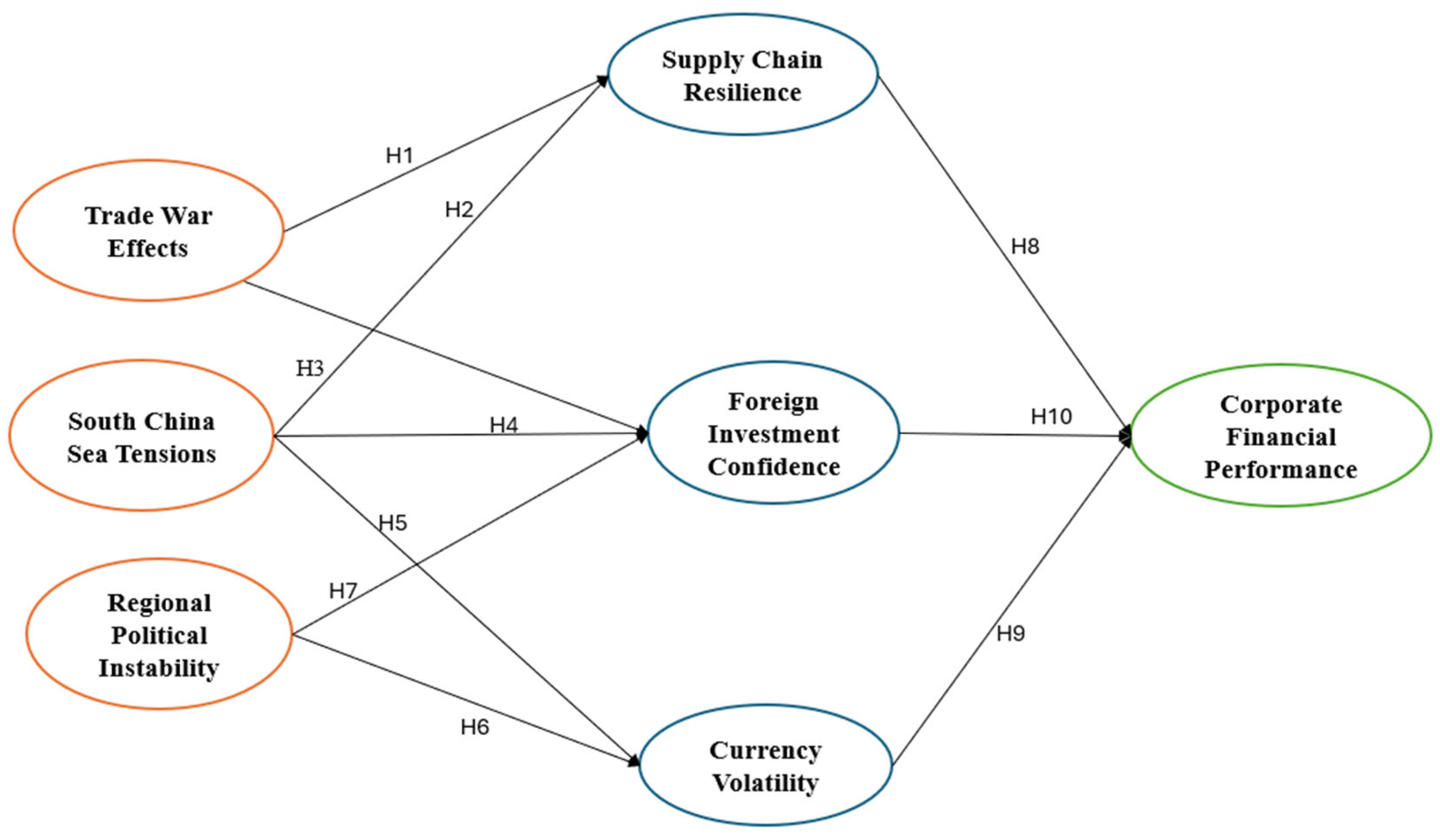
Table 1.
Measurement Model Evaluation Results: Outer Loadings. Measurement Model Outer loadings.
| Construct | Outer loadings |
| CFP1 <- CFP | 0,873 |
| CFP2 <- CFP | 0,859 |
| CFP3 <- CFP | 0,833 |
| CFP4 <- CFP | 0,862 |
| CFP5 <- CFP | 0,853 |
| CFP6 <- CFP | 0,863 |
| CV1 <- CV | 0,882 |
| CV2 <- CV | 0,888 |
| CV3 <- CV | 0,874 |
| CV4 <- CV | 0,869 |
| FIC1 <- FIC | 0,862 |
| FIC2 <- FIC | 0,899 |
| FIC3 <- FIC | 0,884 |
| FIC4 <- FIC | 0,875 |
| RPI1 <- RPI | 0,903 |
| RPI2 <- RPI | 0,916 |
| RPI3 <- RPI | 0,896 |
| RPI4 <- RPI | 0,896 |
| SCR1 <- SCR | 0,891 |
| SCR2 <- SCR | 0,902 |
| SCR3 <- SCR | 0,862 |
| SCR4 <- SCR | 0,893 |
| SCST1 <- SCST | 0,933 |
| SCST2 <- SCST | 0,909 |
| SCST3 <- SCST | 0,931 |
| SCST4 <- SCST | 0,861 |
| UCTW1 <- UCTW | 0,911 |
| UCTW2 <- UCTW | 0,914 |
| UCTW3 <- UCTW | 0,926 |
| UCTW4 <- UCTW | 0,902 |
Table 2.
Measurement Model Evaluation Reliability, and Validity (SmartPLS Output). Construct Reliability and Validity.
Table 2.
Measurement Model Evaluation Reliability, and Validity (SmartPLS Output). Construct Reliability and Validity.
| Cronbach's alpha | Composite reliability (rho_a) | Composite reliability (rho_c) | Average variance extracted (AVE) | |
| CFP | 0,928 | 0,928 | 0,943 | 0,735 |
| CV | 0,901 | 0,901 | 0,931 | 0,771 |
| FIC | 0,903 | 0,903 | 0,932 | 0,775 |
| RPI | 0,924 | 0,924 | 0,946 | 0,815 |
| SCR | 0,909 | 0,910 | 0,936 | 0,787 |
| SCST | 0,929 | 0,930 | 0,950 | 0,826 |
| UCTW | 0,934 | 0,934 | 0,953 | 0,834 |
Table 3.
Measurement Model Evaluation Results, Discriminant validity Fornell Lacker (SmartPLS Output). Discriminant validity. Fornell Lacker.
Table 3.
Measurement Model Evaluation Results, Discriminant validity Fornell Lacker (SmartPLS Output). Discriminant validity. Fornell Lacker.
| CFP | CV | FIC | RPI | SCR | SCST | UCTW | |
| CFP | 0,857 | ||||||
| CV | 0,783 | 0,878 | |||||
| FIC | 0,760 | 0,791 | 0,880 | ||||
| RPI | 0,732 | 0,784 | 0,813 | 0,903 | |||
| SCR | 0,566 | 0,607 | 0,646 | 0,755 | 0,887 | ||
| SCST | 0,716 | 0,744 | 0,770 | 0,823 | 0,732 | 0,909 | |
| UCTW | 0,594 | 0,683 | 0,718 | 0,806 | 0,735 | 0,793 | 0,913 |
Table 4.
Measurement Model Evaluation Results, Heterotrait-monotrait ratio (HTMT) - List (SmartPLS Output). Heterotrait-monotrait ratio (HTMT).
Table 4.
Measurement Model Evaluation Results, Heterotrait-monotrait ratio (HTMT) - List (SmartPLS Output). Heterotrait-monotrait ratio (HTMT).
| Construct | -ratio (HTMT) |
| CV <-> CFP | 0,855 |
| FIC <-> CFP | 0,830 |
| FIC <-> CV | 0,877 |
| RPI <-> CFP | 0,791 |
| RPI <-> CV | 0,859 |
| RPI <-> FIC | 0,890 |
| SCR <-> CFP | 0,615 |
| SCR <-> CV | 0,670 |
| SCR <-> FIC | 0,712 |
| SCR <-> RPI | 0,822 |
| SCST <-> CFP | 0,771 |
| SCST <-> CV | 0,812 |
| SCST <-> FIC | 0,840 |
| SCST <-> RPI | 0,887 |
| SCST <-> SCR | 0,796 |
| UCTW <-> CFP | 0,638 |
| UCTW <-> CV | 0,744 |
| UCTW <-> FIC | 0,782 |
| UCTW <-> RPI | 0,867 |
| UCTW <-> SCR | 0,797 |
| UCTW <-> SCST | 0,851 |
Disclaimer/Publisher’s Note: The statements, opinions and data contained in all publications are solely those of the individual author(s) and contributor(s) and not of MDPI and/or the editor(s). MDPI and/or the editor(s) disclaim responsibility for any injury to people or property resulting from any ideas, methods, instructions or products referred to in the content. |
© 2026 by the authors. Licensee MDPI, Basel, Switzerland. This article is an open access article distributed under the terms and conditions of the Creative Commons Attribution (CC BY) license (http://creativecommons.org/licenses/by/4.0/).
Copyright: This open access article is published under a Creative Commons CC BY 4.0 license, which permit the free download, distribution, and reuse, provided that the author and preprint are cited in any reuse.


