
Submitted:
30 May 2026
Posted:
02 June 2026
You are already at the latest version
Abstract
Type 2 diabetes mellitus is a highly prevalent, heterogeneous, and progressive chronic disease. In a large proportion of patients, management is based for many years on lifestyle intervention and non-insulin glucose-lowering therapies. This long pre-insulin phase represents a crucial clinical window, in which timely recognition of metabolic deterioration, therapeutic inertia, treatment response, and individual risk trajectories may substantially influence long-term outcomes. However, routine care is still frequently based on intermittent assessments, delayed treatment adaptation, and limited integration of clinical, biochemical, behavioral, and digital data. Artificial intelligence may offer a clinically relevant opportunity to move from reactive management to anticipatory care in non-insulin-treated type 2 diabetes. Rather than replacing clinical judgment or automating treatment decisions, artificial intelligence can support clinicians by identifying hidden patterns, predicting metabolic worsening, stratifying risk, improving the interpretation of glucose data, and personalizing follow-up intensity and therapeutic timing. In this setting, its most meaningful role may be to reduce the silent interval between early deterioration and clinical action. This structured narrative review discusses the rationale, current applications, near-future scenarios, and implementation barriers of artificial intelligence in non-insulin-treated type 2 diabetes. Particular attention is given to advanced interpretation of glycemic data, clinical decision support, prediction of treatment failure, remote monitoring, and the potential integration of multidimensional data into more precise and timely care pathways. The review also emphasizes the need for explainable, clinically validated, equitable, and ethically governed artificial intelligence tools that can be realistically embedded into everyday diabetology practice.
Keywords:
type 2 diabetes
; artificial intelligence
; non-insulin therapy
; therapeutic inertia
; anticipatory care
; clinical decision support
; digital health
; personalized medicine
; glucose monitoring
; metabolic deterioration
1. Introduction
Type 2 diabetes mellitus (T2D) is not a static condition, but a progressive and heterogeneous disease in which metabolic control, cardiovascular risk, renal function, body weight, liver involvement, adherence, and therapeutic response may evolve along markedly different trajectories [1,2,3,4,5,6]. For many patients, the largest part of the disease course occurs before insulin initiation, during a phase managed with lifestyle intervention and non-insulin glucose-lowering agents [4,5]. This period is clinically decisive: therapeutic intensification may be delayed, deterioration may remain partially hidden, and opportunities for earlier prevention may be missed [7,8].
Despite major advances in pharmacological treatment, everyday management of non-insulin-treated T2D remains frequently episodic. Decisions are commonly based on periodic visits, isolated laboratory values, and retrospective interpretation of glycated hemoglobin. Although HbA1c remains a central marker of medium-term glycemic exposure, it cannot fully capture short-term fluctuations, post-prandial excursions, glycemic variability, treatment adherence, behavioral patterns, or the dynamic interaction between metabolic control and cardiometabolic risk [2,3,4,5,9,10]. As a result, the clinician may recognize therapeutic failure only after it has become established.
This limitation is particularly relevant in a context increasingly characterized by data abundance but interpretative fragmentation. Patients may generate information through self-monitoring of blood glucose, intermittent or professional continuous glucose monitoring (CGM), body weight tracking, physical activity records, digital platforms, laboratory tests, prescription histories, and clinical notes [3,9,10,11,12,13]. However, these data often remain disconnected, underused, or interpreted only at widely spaced time points. The gap between available information and actionable clinical insight contributes to therapeutic inertia and to a model of care that is still predominantly reactive [7,8,14,15,16].
Artificial intelligence (AI) has the potential to address this gap. In non-insulin-treated T2D, its most promising function is not to replace the diabetologist or to automate therapeutic decisions, but to enhance the clinician’s ability to recognize clinically meaningful patterns before deterioration becomes evident [14,15,16]. By integrating multidimensional data, AI may help identify patients at higher risk of metabolic worsening, detect early signals of secondary treatment failure, suggest more appropriate timing of follow-up, and support more individualized therapeutic strategies [16,17,18,19,20,21].
The conceptual shift proposed in this review is therefore from reactive management to anticipatory care. Reactive management corrects after deterioration has already occurred. Anticipatory care aims to recognize trajectories, identify risk earlier, and intervene with greater precision before the clinical window narrows. This distinction is especially important in non-insulin-treated T2D, where treatment decisions are rarely urgent in the immediate sense, but often decisive over the medium and long term.
2. Methods: Literature Search Strategy and Article Selection
This article was designed as a structured narrative review focused on clinically plausible applications of AI in non-insulin-treated T2D. A pragmatic literature search was conducted using PubMed/MEDLINE, Scopus, and Google Scholar, combining terms related to the disease area and digital methodology, including: “type 2 diabetes”, “non-insulin-treated”, “artificial intelligence”, “machine learning”, “clinical decision support”, “therapeutic inertia”, “continuous glucose monitoring”, “digital health”, “remote monitoring”, “prediction”, “precision medicine”, “explainability”, and “AI governance”.
Priority was given to international guidelines, consensus statements, systematic or narrative reviews, clinically relevant observational studies, randomized trials, and methodological papers addressing AI implementation in health care. Articles primarily focused on type 1 diabetes, automated insulin delivery, closed-loop algorithms, or insulin dose automation were considered only when they provided relevant conceptual background. The objective was not to provide a systematic evidence synthesis, but to build a clinically oriented framework for the use of AI in the large and still underexplored population of patients with T2D not treated with insulin.
3. Why Non-Insulin-Treated Type 2 Diabetes Is a Key Scenario for Artificial Intelligence
The application of AI to diabetes has historically been dominated by insulin-treated disease, particularly type 1 diabetes, where automated insulin delivery, closed-loop systems, sensor-augmented pumps, and algorithm-driven dose modulation represent visible examples of digital innovation [3,14,16]. This focus is clinically understandable because insulin therapy requires frequent short-term decisions and carries an immediate risk of hypoglycemia. However, it has also contributed to an underestimation of the potential role of AI in the much larger population of patients with T2D who are not treated with insulin [1,16].
Non-insulin-treated T2D represents a different but equally important challenge. In this setting, the main problem is usually not minute-by-minute dose adjustment, but timely recognition of progressive loss of control, insufficient response to therapy, increasing cardiometabolic risk, and the need for treatment intensification [4,5,6,7,8]. These processes are gradual, multifactorial, and difficult to capture through isolated clinical encounters. AI may therefore be particularly useful not as an automation engine, but as a longitudinal interpretative tool [14,15,16,17].
Several features make this population especially suitable for AI applications. First, non-insulin-treated T2D is highly heterogeneous. Patients differ widely in age, disease duration, obesity phenotype, insulin resistance, beta-cell reserve, renal function, liver involvement, cardiovascular risk, socioeconomic context, adherence, and therapeutic exposure [5,6]. Second, treatment pathways are increasingly complex, with multiple drug classes that differ not only in glucose-lowering efficacy but also in effects on body weight, cardiovascular outcomes, renal protection, tolerability, persistence, and patient preferences [4,5]. Third, the timing of intensification is often uncertain, and delayed treatment adaptation remains one of the most persistent problems in routine care [7,8].
The potential value of AI lies precisely in the fact that the clinical problem is not fully solved by existing care models. Non-insulin-treated T2D is common, longitudinal, data-rich, and exposed to inertia. It is therefore an ideal setting for tools designed to improve timing, prioritization, and personalization of care.
4. From Reactive Management to Anticipatory Care
Reactive management remains deeply embedded in routine T2D care. In this model, patients are reassessed at predefined intervals, therapeutic decisions are made after laboratory deterioration is documented, and treatment intensification often occurs only when glycemic failure has become evident [7,8]. This approach is clinically familiar and operationally simple, but it may be poorly aligned with the progressive and dynamic nature of T2D.
In non-insulin-treated disease, deterioration often develops silently. A patient may remain apparently acceptable for months while fasting glucose rises, post-prandial excursions increase, weight changes, adherence weakens, or renal and cardiometabolic risk profiles worsen [5,6,9,10]. By the time HbA1c clearly exceeds target, the underlying trajectory may already have shifted. The consequence is not only delayed glycemic correction, but also a missed opportunity to protect the broader metabolic and vascular future of the patient.
Anticipatory care proposes a different logic. Rather than waiting for failure to become visible, it aims to identify early signals of unfavorable trajectory and to adapt care before the patient crosses a clinically meaningful threshold. This does not mean overtreatment or indiscriminate intensification. It means using available data more intelligently to distinguish stable patients from those who are beginning to drift, and to match the timing of intervention to the individual trajectory [14,15,16,17,18,19,20,21].
AI may support this transition by improving the continuity of interpretation. Traditional care often collects data in fragments; AI can help connect them over time. It may identify recurrent glycemic patterns, detect deviations from previous stability, combine biochemical and behavioral markers, and generate risk estimates that are updated as new information becomes available [14,15,16,17,18,19]. In this framework, the clinical question shifts from “What is the patient’s current HbA1c?” to “Where is this patient going, and how soon do we need to act?”
This conceptual transition is summarized in Figure 1.
5. Current Applications of Artificial Intelligence in Non-Insulin-Treated Type 2 Diabetes
Glycemic assessment in non-insulin-treated T2D is still largely centered on HbA1c, which remains an essential marker for evaluating medium-term glycemic exposure and guiding therapeutic targets [2,4,5]. However, HbA1c provides an averaged estimate and does not fully reflect short-term glycemic dynamics, post-prandial excursions, intra-day variability, nocturnal patterns, or the temporal relationship between glucose profiles, meals, physical activity, adherence, and pharmacological exposure [9,10].
AI may help overcome part of this limitation by improving the interpretation of glucose data generated through SMBG, intermittent CGM, professional CGM, or connected digital devices [3,9,10,11,12,13]. Its value does not lie simply in collecting more data, but in transforming fragmented measurements into clinically interpretable patterns [14,15,16,17]. Algorithms may identify recurring post-prandial peaks, early morning dysglycemia, excessive variability, progressive upward drift, or discordance between HbA1c and daily glucose profiles [10,14,17].
A second current application concerns therapeutic personalization and treatment intensification. Modern treatment of T2D increasingly requires decisions that go beyond glucose lowering alone, including body weight, cardiovascular risk, kidney function, liver disease, tolerability, adherence, patient preferences, drug availability, and cost [4,5,6]. AI may support this process by integrating multidimensional data and identifying patient profiles associated with different risks, treatment responses, or probabilities of therapeutic failure [6,14,15,16,17,18,19,20,21].
A practical example is the patient with progressive HbA1c worsening on metformin, increasing body weight, early albuminuria, and declining eGFR. In such a case, an AI-based decision-support system could help identify a trajectory compatible with secondary treatment failure and highlight the potential relevance of earlier intensification with agents providing cardiometabolic and renal protection, such as SGLT2 inhibitors or GLP-1 receptor agonist/GIP-based therapies. Importantly, such a system should not select treatment autonomously, but should support the clinician in recognizing the therapeutic window before stable organ damage or prolonged metabolic deterioration occurs [4,5,6,20,21].
A particularly important application is the reduction of therapeutic inertia. In routine care, intensification is often delayed even when glycemic targets are not met [7,8]. AI may help make risk more visible by identifying patients whose data suggest progressive deterioration or insufficient response before failure becomes obvious [18,19,20,21]. The clinical usefulness of these tools will depend on their ability to provide interpretable and actionable information rather than opaque risk scores [22,23,24,25,26].
Remote monitoring and digital follow-up represent a third domain. Patients may generate data on glucose, weight, blood pressure, physical activity, sleep, medication use, and self-reported symptoms [3,11,12,13,14,15,16]. Without intelligent filtering, these data may create overload and alert fatigue [22,23,24,25]. AI can potentially prioritize information, detect deviations from previous stability, and stratify patients according to the need for earlier review [14,15,16,17].
Finally, prediction of metabolic deterioration is the conceptual core of anticipatory care. Potential predictive targets include worsening HbA1c, loss of glycemic control, need for treatment intensification, weight gain, declining adherence, reduced persistence, progression of kidney disease, increasing cardiovascular risk, and transition toward more complex therapeutic regimens [17,18,19,20,21]. The predictive value of AI may be particularly strong when multiple weak signals are combined over time.
6. Near-Future Applications and Plausible Clinical Scenarios
The near future of AI in non-insulin-treated T2D will probably not be defined by fully autonomous therapeutic systems. More realistically, its clinical impact will depend on tools capable of improving the precision, timing, and continuity of routine decision-making [14,15,16,22,23,24,25]. In this setting, the most credible applications are those that can be embedded into existing care pathways, reduce information fragmentation, and support clinicians in identifying when and how to intervene.
A major limitation of current diabetes care is that relevant information is dispersed across electronic health records, laboratory databases, glucose meters, CGM platforms, prescription records, body weight measurements, blood pressure values, wearable devices, and patient-reported outcomes. AI could help integrate these heterogeneous data streams into a coherent representation of the patient’s trajectory [14,15,16]. Instead of presenting separate fragments, future systems may summarize longitudinal patterns, detect discordant trends, and highlight clinically meaningful changes.
One plausible near-future application is personalization of follow-up timing. Current schedules are often based on fixed intervals, local organization, or clinician availability. AI could support a more dynamic model by estimating the probability of near-term deterioration and suggesting follow-up intensity accordingly [17,18,19,20,21]. Patients with stable multidimensional profiles could continue routine monitoring, whereas patients showing early unfavorable trends could be prioritized for earlier review, laboratory reassessment, educational reinforcement, or therapeutic reconsideration.
Future systems may also expand risk stratification beyond glycemia alone. T2D is a cardiometabolic disease, and the patient’s future trajectory is shaped by the interaction among glycemia, body weight, blood pressure, lipids, kidney function, liver involvement, frailty, adherence, and social determinants of health [5,6]. AI may enable more granular stratification by combining metabolic, renal, hepatic, cardiovascular, and behavioral variables. However, this broader stratification increases the need for transparency and clinical plausibility [22,23,24,25,26].
Generative and conversational AI tools may support patient education, structured communication, administrative work, visit preparation, and preliminary triage [22,23,24,25,26,29]. In non-insulin-treated T2D, their most realistic near-term role is not autonomous counselling or treatment modification, but clinician-governed support: summarizing clinical histories, identifying missing information before the visit, drafting patient-friendly explanations of agreed therapeutic plans, reinforcing adherence messages, and collecting patient-reported information.
These applications require particular caution. Large language models may generate plausible but incorrect information, omit clinically relevant nuance, or produce recommendations that are not aligned with guidelines, local regulatory constraints, or the individual patient’s comorbidity profile [22,23,24,25,26,29,30]. This risk is especially important when outputs concern medication changes, risk communication, or interpretation of symptoms. For this reason, generative AI should remain supervised, auditable, and clearly separated from autonomous therapeutic decision-making.
A clinically acceptable use of generative AI should therefore be bounded by predefined tasks, validated content sources, escalation rules, and human review. In this framework, conversational systems may improve continuity and health literacy without transferring medical responsibility away from the diabetologist. Current and near-future applications are summarized in Table 1.
7. Limitations, Risks, and Barriers to Implementation
The clinical translation of AI in non-insulin-treated T2D remains limited by scientific, technical, organizational, ethical, regulatory, and cultural barriers [22,23,24,25,26,27,28,29,30]. These limitations are not marginal details: they determine whether an algorithm becomes a useful clinical instrument or another source of complexity in already overloaded diabetes care pathways.
AI depends on data quality. In T2D, relevant information is often incomplete, inconsistently coded, or distributed across disconnected systems. Missing data are not random: they often reflect social vulnerability, limited access to care, reduced engagement, or organizational barriers. Algorithms trained on selected populations, highly structured datasets, or technologically advanced settings may not generalize to older adults, patients with multimorbidity, socially disadvantaged individuals, or routine clinics [22,23,24,25,26].
From a methodological perspective, this problem should be explicitly understood as a missing-not-at-random (MNAR) issue rather than a simple technical inconvenience. In real-world diabetes care, missing values may reflect reduced access to care, lower digital literacy, socioeconomic vulnerability, fragmented follow-up, or lower patient engagement. Standard imputation strategies may therefore obscure clinically meaningful patterns in vulnerable subgroups and inadvertently reinforce selection bias. For AI tools intended to support anticipatory care, missingness itself may need to be treated as an informative signal, not merely as a defect to be statistically corrected [22,23,24,25,26].
AI may also amplify existing inequalities if it is developed and deployed without attention to equity. Patients who generate more digital data, use connected devices, attend visits regularly, and have better health literacy may be more visible to algorithmic systems. Conversely, those with limited digital access, language barriers, lower socioeconomic status, or fragmented care may be underrepresented in training datasets and less likely to benefit from digital tools [26,29,30].
Explainability is another central requirement. In diabetes care, treatment decisions require clinical reasoning, patient preferences, safety considerations, and shared responsibility. A black-box prediction that identifies a patient as high risk without explaining the underlying drivers may be difficult to trust and difficult to translate into action [22,23,24,25,26]. Clinicians need to understand whether risk is driven by rising glucose values, weight gain, worsening renal function, reduced adherence, previous treatment failure, or other factors.
In this context, explainable AI approaches such as LIME (Local Interpretable Model-agnostic Explanations) and SHAP (SHapley Additive exPlanations) may be useful because they estimate the relative contribution of individual variables to a model output [31,32]. For example, a predicted high risk of deterioration may be driven mainly by rising fasting glucose, worsening renal function, increasing glycemic variability, weight gain, or declining treatment persistence. This level of transparency may improve clinical trust and facilitate actionable interpretation, provided that explanations are presented in a format that is understandable within routine clinical workflow.
Even accurate tools may fail if poorly integrated into workflow. Busy diabetes clinics and primary care settings cannot accommodate additional platforms, excessive alerts, or outputs that require complex interpretation. AI outputs must be concise, timely, clinically meaningful, and connected to clear actions. Systems should define who receives the alert, who is responsible for acting on it, and how the response is documented [24,25,26,27,28,29,30].
Finally, AI in diabetes care raises regulatory and medico-legal questions. Predictive models and decision-support systems may evolve over time, interact with clinical workflows, and influence treatment decisions. Ethical governance is essential when models process sensitive health data or generate individualized risk predictions. Reporting standards such as CONSORT-AI and SPIRIT-AI, together with broader governance frameworks, are relevant to the design, evaluation, and implementation of these tools [27,28,29,30].
AI-based outputs should therefore be regarded as non-binding consultative support rather than autonomous clinical directives. Even when a decision-support system is technically validated, the final responsibility for diagnosis, therapeutic intensification, follow-up timing, and risk communication must remain with the clinician, who is required to interpret the algorithmic output in the context of the individual patient. This distinction is particularly important in the case of false negatives, false positives, or discordant clinical judgment, where algorithmic silence should not be interpreted as permission for therapeutic inertia [24,25,26,27,28,29,30].
Importantly, these barriers should not be considered in isolation. Data fragmentation, limited interoperability, missing-not-at-random data, unequal digital visibility, algorithmic opacity, and uncertain responsibility interact with each other and may reduce real-world effectiveness even when internal predictive performance appears satisfactory [22,23,24,25,26,27,28,29,30]. Missingness and digital visibility bias are closely linked: patients who use connected devices, attend visits regularly, and generate structured data may become disproportionately visible to AI systems, whereas patients with fragmented follow-up, lower digital literacy, or social vulnerability may be underrepresented or mischaracterized. Without specific governance, this interaction may create a two-speed model of care, in which AI improves management mainly for patients who are already better monitored. This is why clinical validation should assess not only discrimination or calibration, but also actionability, workflow impact, equity, safety, and the ability to reduce therapeutic inertia in routine care across different patient groups.
8. Practical Implications for Diabetologists
For diabetologists, the most useful way to interpret AI is not as a competing intelligence, but as a possible extension of clinical observation. The challenge in non-insulin-treated T2D is not the absence of therapeutic options, but the difficulty of using the right information at the right time to protect the patient’s future trajectory [4,5,6,7,8,14,15,16].
AI may help clinicians identify patients who are drifting before deterioration becomes evident, prioritize those who need earlier reassessment, and personalize follow-up intensity according to risk. It may support therapeutic decisions by organizing complex data and highlighting patterns that would otherwise remain hidden [14,15,16,17,18,19,20,21]. In this sense, its practical value lies in improving timing, prioritization, and precision.
However, AI should not flatten clinical reasoning into algorithmic obedience. The diabetologist remains essential for interpreting context, evaluating competing risks, discussing preferences, and deciding whether a predicted risk requires action. A model may indicate that a patient is at high risk of worsening control, but the clinician must understand whether this reflects disease progression, reduced adherence, socioeconomic difficulty, adverse effects, or an inappropriate therapeutic strategy [22,23,24,25,26].
In practical terms, the most relevant applications for routine diabetology may be simple and concrete: identifying who should be recalled earlier, who is likely to fail current therapy, who may benefit from structured education, who requires more intensive monitoring, and who may need therapeutic intensification before prolonged deterioration occurs. These are not abstract technological goals; they are everyday clinical problems.
9. Conclusions
AI is unlikely to transform non-insulin-treated T2D by replacing clinical judgment or automating therapeutic decisions. Its most credible and clinically meaningful contribution is different: helping clinicians recognize earlier when a patient’s trajectory is becoming unfavorable.
The management of non-insulin-treated T2D remains vulnerable to intermittent assessment, therapeutic inertia, fragmented data, and delayed recognition of metabolic deterioration. HbA1c, periodic visits, and conventional follow-up schedules remain essential, but they may not always capture the dynamic complexity of the disease [2,3,4,5,6,7,8,9,10]. AI may help bridge this gap by integrating multidimensional data, detecting hidden patterns, predicting deterioration, and supporting more individualized follow-up and treatment timing [14,15,16,17,18,19,20,21].
The central promise of AI in this setting is therefore the transition from reactive management to anticipatory care. This transition does not imply overtreatment, technological autonomy, or replacement of the diabetologist. Rather, it means using data more intelligently to see earlier, decide more precisely, and intervene before failure becomes established.
To achieve this promise, AI tools must be clinically validated, explainable, equitable, interoperable, and embedded into realistic care pathways [22,23,24,25,26,27,28,29,30]. Their success should not be judged only by predictive accuracy, but by their ability to reduce therapeutic inertia, improve patient trajectories, support safer decisions, and enhance the quality of clinical reasoning. In non-insulin-treated T2D, AI should be understood less as a new therapeutic actor and more as a new way of reading clinical time.
Author Contributions
Conceptualization, A.M.L. and B.A.; methodology, A.M.L.; investigation and literature review, A.M.L., E.C., L.G., S.E., O.A.O. and B.A.; resources, A.M.L., E.C., L.G., S.E., O.A.O. and B.A.; writing—original draft preparation, A.M.L.; writing—review and editing, E.C., L.G., S.E., O.A.O. and B.A.; visualization, A.M.L.; supervision, B.A.; project administration, A.M.L. and B.A. All authors have read and agreed to the published version of the manuscript.
Funding
This research received no external funding.
Institutional Review Board Statement
Not applicable. This article is a narrative review and does not involve human participants, patient data, or animal experiments.
Informed Consent Statement
Not applicable. This article is a narrative review and does not involve human participants.
Data Availability Statement
No new data were created or analyzed in this study. Data sharing is not applicable to this article.
Acknowledgments
Not applicable.
Conflicts of Interest
S.E. reports personal fees for lectures and/or advisory activities from Novo Nordisk, Servier, Daiichi Sankyo, Sanofi, AstraZeneca, Eli Lilly, Boehringer Ingelheim, outside the submitted work. A.M.L., E.C., L.G., B.A., and O.A.O. declare no conflicts of interest.
Use of Generative Artificial Intelligence
During the preparation of this manuscript, generative artificial intelligence tools were used to support language refinement and figure development. The authors reviewed and edited all outputs and take full responsibility for the content of this publication.
Abbreviations
| Abbreviation | Definition |
| AI | Artificial intelligence |
| CGM | Continuous glucose monitoring |
| DMT2 | Diabetes mellitus type 2 |
| eGFR | Estimated glomerular filtration rate |
| GLP-1RA | Glucagon-like peptide-1 receptor agonist |
| LIME | Local Interpretable Model-agnostic Explanations |
| MNAR | Missing not at random |
| SHAP | SHapley Additive exPlanations |
| SGLT2i | Sodium-glucose cotransporter-2 inhibitor |
| SMBG | Self-monitoring of blood glucose |
| T2D | Type 2 diabetes |
| UACR | Urinary albumin-to-creatinine ratio |
| XAI | Explainable artificial intelligence |
References
- International Diabetes Federation. IDF Diabetes Atlas, 11th ed.; International Diabetes Federation: Brussels, Belgium, 2025.
- American Diabetes Association Professional Practice Committee. 2. Diagnosis and Classification of Diabetes: Standards of Care in Diabetes—2026. Diabetes Care 2026, 49, S27–S54.
- American Diabetes Association Professional Practice Committee. Diabetes Technology: Standards of Care in Diabetes—Diabetes Care 2026, 49, S150–S182.
- American Diabetes Association Professional Practice Committee. Pharmacologic Approaches to Glycemic Treatment: Standards of Care in Diabetes—Diabetes Care 2026, 49, S183–S206.
- Davies, M.J.; Aroda, V.R.; Collins, B.S.; Gabbay, R.A.; Green, J.; Maruthur, N.M.; et al. Management of Hyperglycemia in Type 2 Diabetes, A Consensus Report by the American Diabetes Association and the European Association for the Study of Diabetes. Diabetes Care 2022, 45, 2753–2786. [CrossRef]
- Chung, W.K.; Erion, K.; Florez, J.C.; Hattersley, A.T.; Hivert, M.F.; Lee, C.G.; et al. Precision medicine in diabetes: A Consensus Report from the American Diabetes Association and the European Association for the Study of Diabetes. Diabetologia 2020, 63, 1671–1693. [CrossRef]
- Khunti, K.; Gomes, M.B.; Pocock, S.; Shestakova, M.V.; Pintat, S.; Fenici, P.; et al. Therapeutic inertia in the treatment of hyperglycaemia in patients with type 2 diabetes: A systematic review. Diabetes Obes. Metab. 2018, 20, 427–437. [CrossRef]
- Khunti, S.; Khunti, K.; Seidu, S. Therapeutic inertia in type 2 diabetes: Prevalence, causes, consequences and methods to overcome inertia. Ther. Adv. Endocrinol. Metab. 2019, 10, 2042018819844694. [CrossRef]
- Danne, T.; Nimri, R.; Battelino, T.; Bergenstal, R.M.; Close, K.L.; DeVries, J.H.; et al. International Consensus on Use of Continuous Glucose Monitoring. Diabetes Care 2017, 40, 1631–1640.
- Battelino, T.; Danne, T.; Bergenstal, R.M.; Amiel, S.A.; Beck, R.; Biester, T.; et al. Clinical Targets for Continuous Glucose Monitoring Data Interpretation: Recommendations From the International Consensus on Time in Range. Diabetes Care 2019, 42, 1593–1603. [CrossRef]
- Young, L.A.; Buse, J.B.; Weaver, M.A.; Vu, M.B.; Mitchell, C.M.; Blakeney, T.; et al. Glucose self-monitoring in non-insulin-treated patients with type 2 diabetes in primary care settings: A randomized trial. JAMA Intern. Med. 2017, 177, 920–929.
- Shields, S.; Thomas, S.; Kerr, D.; et al. Continuous glucose monitoring among adults with type 2 diabetes receiving non-insulin or basal insulin therapy in primary care. Sci. Rep. 2024, 14, 31990.
- Aronson, R.; Brown, R.E.; Abitbol, A.; Goldenberg, R.M.; Yale, J.F. Continuous glucose monitoring in non-insulin-treated type 2 diabetes: Evidence and practical considerations. Diabetes Obes. Metab. 2025.
- Contreras, I.; Vehí, J. Artificial Intelligence for Diabetes Management and Decision Support: Literature Review. J. Med. Internet Res. 2018, 20, e10775. [CrossRef]
- Dankwa-Mullan, I.; Rivo, M.; Sepulveda, M.; Park, Y.; Snowdon, J.; Rhee, K. Transforming Diabetes Care Through Artificial Intelligence: The Future Is Here. Popul. Health Manag. 2019, 22, 229–242. [CrossRef]
- Mackenzie, S.C.; Sainsbury, C.A.R.; Wake, D.J. Diabetes and artificial intelligence beyond the closed loop: A review of the landscape, promise and challenges. Diabetologia 2024, 67, 223–235. [CrossRef]
- Fan, Y.; Li, X.; Zhang, L.; Zeng, X.; Yang, X.; Yang, Y.; et al. Machine Learning Approaches to Predict Risks of Diabetic Complications and Poor Glycemic Control. Front. Endocrinol. 2021, 12, 734747.
- Kopitar, L.; Kocbek, P.; Cilar, L.; Sheikh, A.; Stiglic, G. Early detection of type 2 diabetes mellitus using machine learning-based prediction models. Sci. Rep. 2020, 10, 11981. [CrossRef]
- Ravizza, S.; Huschto, T.; Adamov, A.; Boehm, L.; Buesser, A.; Floether, F.F.; et al. Predicting the early risk of chronic kidney disease in patients with diabetes using real-world data. Nat. Med. 2019, 25, 57–59.
- Musacchio, N.; Zilich, R.; Masi, D.; Baccetti, F.; et al. A transparent machine learning algorithm uncovers HbA1c patterns associated with therapeutic inertia in patients with type 2 diabetes and failure of metformin monotherapy. Int. J. Med. Inform. 2024, 190, 105550. [CrossRef]
- Nicoletta, M.; Candido, R.; Di Bartolo, P.; Giorda, C.B.; Russo, G.; Nicolucci, A.; et al. Overcoming Therapeutic Inertia in Type 2 Diabetes: Exploring Machine Learning-Based Scenario Simulation for Improving Short-Term Glycemic Control. Mach. Learn. Knowl. Extr. 2024, 6, 438–453.
- Rajkomar, A.; Dean, J.; Kohane, I. Machine Learning in Medicine. N. Engl. J. Med. 2019, 380, 1347–1358.
- Topol, E.J. High-performance medicine: The convergence of human and artificial intelligence. Nat. Med. 2019, 25, 44–56. [CrossRef]
- Kelly, C.J.; Karthikesalingam, A.; Suleyman, M.; Corrado, G.; King, D. Key challenges for delivering clinical impact with artificial intelligence. BMC Med. 2019, 17, 195. [CrossRef]
- Matheny, M.E.; Whicher, D.; Thadaney Israni, S. Artificial Intelligence in Health Care: A Report From the National Academy of Medicine. JAMA 2020, 323, 509–510.
- Wiens, J.; Saria, S.; Sendak, M.; Ghassemi, M.; Liu, V.X.; Doshi-Velez, F.; et al. Do no harm: A roadmap for responsible machine learning for health care. Nat. Med. 2019, 25, 1337–1340. [CrossRef]
- Liu, X.; Rivera, S.C.; Moher, D.; Calvert, M.J.; Denniston, A.K. Reporting guidelines for clinical trial reports for interventions involving artificial intelligence: The CONSORT-AI extension. Nat. Med. 2020, 26, 1364–1374. [CrossRef]
- Rivera, S.C.; Liu, X.; Chan, A.W.; Denniston, A.K.; Calvert, M.J. Guidelines for clinical trial protocols for interventions involving artificial intelligence: The SPIRIT-AI extension. Nat. Med. 2020, 26, 1351–1363.
- World Health Organization. Ethics and Governance of Artificial Intelligence for Health; World Health Organization: Geneva, Switzerland, 2021.
- European Parliament and Council of the European Union. Regulation Laying Down Harmonised Rules on Artificial Intelligence (Artificial Intelligence Act); European Union: Brussels, Belgium, 2024.
- Ribeiro, M.T.; Singh, S.; Guestrin, C. “Why Should I Trust You?”: Explaining the Predictions of Any Classifier. In Proceedings of the 22nd ACM SIGKDD International Conference on Knowledge Discovery and Data Mining, San Francisco, CA, USA, 13–17 August 2016; pp. 1135–1144.
- Lundberg, S.M.; Lee, S.I. A unified approach to interpreting model predictions. Adv. Neural Inf. Process. Syst. 2017, 30, 4765–4774.
Figure 1.
Anticipatory care framework for non-insulin-treated type 2 diabetes. The framework illustrates the transition from reactive management to anticipatory care in non-insulin-treated T2D. Traditional reactive care relies on intermittent assessment, fragmented data interpretation, and treatment adaptation after deterioration becomes evident. In contrast, AI-supported anticipatory care integrates biochemical, clinical, glycemic, behavioral, and systems-level data into dynamic risk trajectories. AI-based interpretation may support earlier follow-up, targeted education, timely treatment intensification, and reduction of therapeutic inertia. The continuous feedback loop emphasizes that each clinical action generates new longitudinal data streams that refine future trajectory predictions and support personalization of care over time.
Figure 1.
Anticipatory care framework for non-insulin-treated type 2 diabetes. The framework illustrates the transition from reactive management to anticipatory care in non-insulin-treated T2D. Traditional reactive care relies on intermittent assessment, fragmented data interpretation, and treatment adaptation after deterioration becomes evident. In contrast, AI-supported anticipatory care integrates biochemical, clinical, glycemic, behavioral, and systems-level data into dynamic risk trajectories. AI-based interpretation may support earlier follow-up, targeted education, timely treatment intensification, and reduction of therapeutic inertia. The continuous feedback loop emphasizes that each clinical action generates new longitudinal data streams that refine future trajectory predictions and support personalization of care over time.
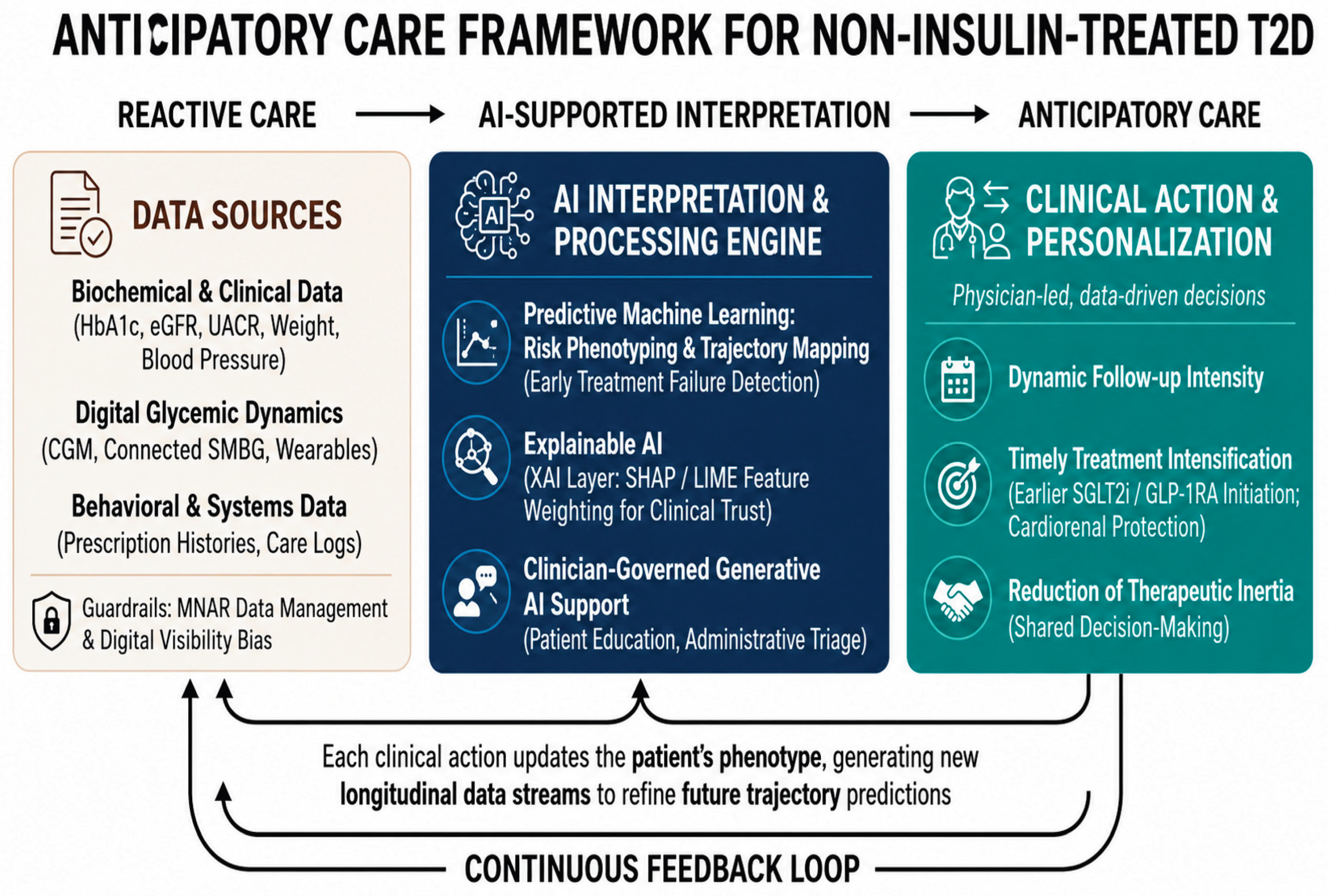

Table 1.
Current and near-future applications of AI in non-insulin-treated T2D. The table summarizes major clinical areas, data sources, AI functions, potential benefits, and implementation risks.
Table 1.
Current and near-future applications of AI in non-insulin-treated T2D. The table summarizes major clinical areas, data sources, AI functions, potential benefits, and implementation risks.
| Clinical area | Data sources | AI function | Potential clinical benefit | Main limitations / implementation risks |
|---|---|---|---|---|
| Glycemic interpretation | HbA1c, SMBG, CGM, meal/activity records | Pattern recognition, variability analysis, discordance detection | Better identification of hidden instability and early drift | Poor data quality, missing values, uncertain thresholds, limited access to CGM, digital visibility bias |
| Therapeutic personalization | Clinical history, labs, medications, comorbidities, adherence | Risk phenotyping, response prediction, scenario support | Earlier and more individualized intensification | Confounding by indication, limited external validation, black-box outputs requiring XAI approaches such as SHAP/LIME for clinical trust, unclear action thresholds |
| Remote follow-up | Glucose, weight, BP, activity, symptoms, prescription data | Trend detection, alert prioritization, adaptive monitoring | Earlier contact for patients who are deteriorating | Alert fatigue, workflow burden, unclear responsibility, lack of interoperability, unequal digital access |
| Progression prediction | Longitudinal clinical, biochemical, renal and behavioral data | Dynamic risk models | Prediction of loss of control, treatment failure, and complications | Bias, MNAR data, digital visibility bias, model drift, poor transportability, uncertain clinical actionability |
| Generative AI support | Clinical notes, education material, patient-reported information | Summarization, communication support, visit preparation | Reduced administrative burden and improved education | Hallucinations, plausible but incorrect outputs, need for human supervision, medico-legal uncertainty, risk of unsupervised therapeutic advice |
Disclaimer/Publisher’s Note: The statements, opinions and data contained in all publications are solely those of the individual author(s) and contributor(s) and not of MDPI and/or the editor(s). MDPI and/or the editor(s) disclaim responsibility for any injury to people or property resulting from any ideas, methods, instructions or products referred to in the content. |
© 2026 by the authors. Licensee MDPI, Basel, Switzerland. This article is an open access article distributed under the terms and conditions of the Creative Commons Attribution (CC BY) license (http://creativecommons.org/licenses/by/4.0/).
Copyright: This open access article is published under a Creative Commons CC BY 4.0 license, which permit the free download, distribution, and reuse, provided that the author and preprint are cited in any reuse.


