

Submitted:
29 May 2026
Posted:
01 June 2026
You are already at the latest version
Abstract
Marine-derived microorganisms are a rich source of structurally diverse natural products with significant pharmaceutical potential. In this study, three new cyclic lipopeptides, amylimycins A–C (1–3), were isolated from a marine-derived Bacillus amyloliquefaciens strain. The chemical structures of these compounds were elucidated through comprehensive spectroscopic analyses and chiral derivatization using 1-fluoro-2,4-dinitrophenyl-5-alanine amide (FDAA). Amylimycins A–C (1–3) were identified as bacillomycin D analogs belonging to the iturin family, characterized by a cyclic heptapeptide core linked to a β-amino fatty acid moiety. Notably, these compounds featured uncommon branched β-amino fatty acid chains with varied chain lengths, representing a distinctive structural characteristic among bacillomycin D analogs. Amylimycins A–C (1–3) showed moderate antibacterial activity against the Gram-positive bacteria Bacillus subtilis and Staphylococcus epidermidis, while displaying weak to no activity against the Gram-negative strains Escherichia coli and Pseudomonas fluorescens.
Keywords:
lipopeptides
; bacillomycin D
; Bacillus amyloliquefaciens
; antibacterial activities
1. Introduction
Marine microorganisms have emerged as a rich source of structurally diverse and biologically active natural products, many of which have exhibited significant pharmaceutical potential [1,2]. Among these, lipopeptides produced by marine-derived bacteria have attracted considerable attention because of their potent antibacterial, antifungal, and antiviral activities [3,4,5]. Lipopeptides are amphiphilic molecules consisting of a lipid moiety linked to a peptide structure, typically comprising a hydrophobic fatty acid tail and a hydrophilic peptide ring or chain [6]. This unique structural feature enables them to function as effective biosurfactants and to strongly interact with biological membranes [7]. Lipopeptides are produced by various microorganisms, including bacteria, fungi, and yeast. Among these, lipopeptides derived from Bacillus species have been most extensively studied [8]. Representative groups include surfactins, fengycins, and iturins; each of these is characterized by distinct peptide sequences, ring sizes, and fatty acid compositions [9].
From a biological standpoint, lipopeptides primarily exert their antimicrobial effects by disrupting microbial membranes [10]. Several members of this class have been successfully developed into clinically relevant therapeutics. For example, daptomycin, a cyclic lipopeptide antibiotic, is widely used for the treatment of serious infections caused by Gram-positive bacteria, including methicillin-resistant Staphylococcus aureus (MRSA) and vancomycin-resistant enterococci (VRE) [11]. Similarly, echinocandins, such as caspofungin, represent antifungal lipopeptides that inhibit β-glucan biosynthesis in fungal cell walls and are particularly effective against Candida species [12]. Moreover, pumilacidins derived from B. pumilus have exhibited antiviral activity against herpes simplex virus, along with other therapeutic effects [13].
Within this context, B. amyloliquefaciens is recognized as a prolific producer of cyclic lipopeptides, particularly surfactins and bacillomycin D analogs [14]. Bacillomycin D belongs to the iturin family of lipopeptides and is characterized by a cyclic heptapeptide linked to a β-amino fatty acid chain. This structural framework confers strong amphiphilicity, facilitating efficient interaction with biological membranes. Bacillomycin D and its analogs are well known for their potent antifungal activity, primarily through the disruption of membrane integrity via interactions with sterols, resulting in increased membrane permeability and cell lysis [15]. In addition to antifungal effects, some bacillomycin D derivatives have been reported to exhibit antibacterial and antiviral effects, highlighting their broad-spectrum bioactivity [14,16]. In this study, we report the isolation and structural elucidation of new bacillomycin D analogs, amylimycins A–C, obtained from a marine-derived B. amyloliquefaciens strain (Figure 1). We determined their structures using comprehensive spectroscopic analyses, including high-resolution mass spectrometry (HRMS) and nuclear magnetic resonance (NMR) techniques. We also determined the absolute configurations of the amino acid residues in the amylimycins through chiral derivatization. Furthermore, we evaluated their antibacterial activities against both Gram-positive and Gram-negative bacteria, demonstrating their potential as novel antimicrobial agents.
2. Results and Discussion
Amylimycin A (1) was purified as a white amorphous powder. Its molecular formula was determined to be C51H80N10O15, with an exact mass of m/z 1073.5885 [M + H]+ (calculated for C51H81N10O15, m/z 1073.5877), as confirmed by HRMS. The structure was determined using a combination of 1D and 2D NMR methods, including heteronuclear single quantum coherence (HSQC), correlation spectroscopy (COSY), heteronuclear multiple bond correlation (HMBC), and rotating-frame Overhauser effect spectroscopy (ROESY), together with infrared (IR) spectroscopy and mass spectrometry (MS). The NMR data for amylimycin A revealed the presence of 11 carbonyls (δC 174.7, 173.3, 172.1, 171.5, 171.4, 170.4, 170.3, 169.9, 169.6, 169.2, and 169.0) and seven amide protons (δH 8.54, 8.42, 8.32, 8.06, 8.04, 7.58, and 7.56), suggesting the presence of a peptide. Moreover, the 1D and 2D NMR (HSQC, COSY, HMBC, ROESY, and TOCSY) data for amylimycin A revealed the amino acid composition, which included two asparagine (Asn) residues, along with tyrosine (Tyr), proline (Pro), glutamic acid (Glu), serine (Ser), and threonine (Thr). The sequence of the seven amino acid residues was determined based on HMBC signals and ROESY correlations. Key HMBC correlations were observed: 6-NH of Tyr (δH 7.56) to C-1 of Asn-1 (δC 170.3), 15-NH of Asn-2 (δH 8.54) to C-5 of Tyr (δC 170.4), 24-NH of Glu (δH 8.04) to C-18 of Pro (δC 169.0), 29-NH of Ser (δH 8.42) to C-23 of Glu (δC 171.5), and 32-NH of Thr (δH 8.06) to C-28 of Ser (δC 173.3). Moreover, the HMBC signals from 2-NH of Asn-1 (δH 8.32) to C-35 of a β-amino acid (δC 169.9) and those from 37-NH of the β-amino acid (δH 7.58) to C-31 of Thr (δC 169.6) established the linkage between Asn-1 and the β-amino acid and between the β-amino acid and Thr, respectively (Figure 2). The arrangement of amino acid residues was also confirmed through ROESY correlations between the amide NH and the α proton of the adjacent amino acid. Consequently, the planar structure of amylimycin A was determined to be a cyclic lipopeptide similar to bacillomycin D. The HMBC data of the β-amino acid in amylimycin A revealed signals from CH3-51 (δH 0.84) to C-45 (δC 27.4), from CH3-50 (δH 0.81) to C-47 (δC 33.8), and from CH3-49 (δH 0.82) to C-47 (δC 33.8) and C-48 (δC 29.0), indicating that the β-amino acid is a newly characterized 3-amino-12,14-dimethylpentadecanoic acid. Consequently, the planar structure of compound 1 was determined to be cyclo[Asn-1–Tyr–Asn-2–Pro–Glu–Ser–Thr–3-amino-12,14-dimethylpentadecanoic acid] (Figures S1–S7, Table 1 and Table 2).
To determine the absolute configuration of amino acids in 1, l- and d-FDAA (1-fluoro-2,4-dinitrophenyl-5-l-/d-alanine amide) derivatization was performed. The retention times of the l- and d-FDAA-derivatized hydrolysates were 26.8 and 24.1 min for Tyr, 8.9 and 10.2 min for Pro, 7.1 and 7.8 min for Glu, 5.8 and 5.1 min for Ser, and 5.3 and 8.0 min for Thr, respectively. Two Asn-derived peaks were observed at 12.6 and 13.5 min, indicating the presence of both l- and d-Asn residues, and their stereochemistry was further confirmed by analyzing the previously reported biosynthetic gene cluster [17]. Thus, Asn-1, Pro, Glu, Thr in amylimycin A (1) were determined to be l-amino acids, whereas Tyr, Asn-2, and Ser were determined to be d-amino acids (Figures S24 and S25).
Amylimycin B (2) was purified as a white amorphous powder. Its molecular formula was determined to be C50H78N10O15, with an exact mass of m/z 1059.5681 [M + H]+ (calculated for C50H79N10O15, m/z 1059.5720). The 1H and 13C NMR spectra of compound 2 closely resembled those of compound 1, with the only difference being the absence of a methylene unit in the β-amino acid, as confirmed by the analysis of COSY, TOCSY, HSQC, and HMBC spectra (Figures S8–S15). The HMBC correlations of the β-amino acid in amylimycin B revealed cross-peaks from CH₃-50 (δH 0.84) to C-44 (δC 27.3), from CH₃-49 (δH 0.81) to C-46 (δC 33.4), and from CH₃-48 (δH 0.82) to both C-46 (δC 33.4) and C-47 (δC 29.1). These data indicate that the β-amino acid moiety is a novel β-amino acid, identified as 3-amino-11,13-dimethyltetradecanoic acid. Therefore, the planar structure of compound 2 was established as cyclo[Asn-1–Tyr–Asn-2–Pro–Glu–Ser–Thr–3-amino-11,13-dimethyltetradecanoic acid] (Table 1 and Table 2).
Amylimycin C (3) was obtained as a white amorphous powder. Its molecular formula was determined to be C49H76N10O15, with an exact mass of m/z 1045.5538 [M + H]+ (calculated for C49H77N10O15, m/z 1045.5564). The 1H and 13C NMR spectra of compound 3 were highly similar to those of compounds 1 and 2, with the only difference being the loss of methylene units in the β-amino acid moiety, which was verified based on 1D and 2D NMR spectra (Figures S16–S22). The HMBC correlations observed for the β-amino acid residue in 3 included cross-peaks between CH₃-49 (δH 0.83) and C-43 (δC 27.4), CH₃-48 (δH 0.81) and C-45 (δC 32.9), as well as CH₃-47 (δH 0.82) and both C-45 (δC 32.9) and C-46 (δC 29.1). Based on these correlations, the β-amino acid unit was identified as 3-amino-10,12-dimethyltridecanoic acid. Accordingly, the planar structure of compound 3 was determined to be cyclo[Asn-1–Tyr–Asn-2–Pro–Glu–Ser–Thr–3-amino-10,12-dimethyltridecanoic acid] (Table 1 and Table 2).
Molecular networking analysis of the ethyl acetate extract of B. amyloliquefaciens revealed that the lipopeptides were organized into a distinct molecular cluster containing amylimycins A–C (1–3). This clustering pattern indicates a high degree of similarity in their MS/MS fragmentation profiles, suggesting that these compounds share closely related structural features. In particular, the grouping of amylimycins within the same cluster suggests a common biosynthetic origin and comparable core scaffolds with minor structural variations. These molecular networking data provide supporting evidence for the structural relatedness of these compounds and facilitate the identification of new analogs within the same chemical family (Figure 3a). In addition, a separate cluster corresponding to the previously reported amylifactins A–D was also observed [18], supporting the reliability of the molecular networking analysis for dereplication of known metabolites (Figure 3b). Furthermore, a new target cluster composed of unidentified lipopeptide-related nodes was detected, suggesting the presence of additional analogs within this molecular family (Figure 3c).
To evaluate the antibacterial activity of amylimycins A–C (1–3) against Gram-positive bacteria, including Bacillus subtilis and Staphylococcus epidermidis, and Gram-negative bacteria, including Escherichia coli and Pseudomonas fluorescens, a minimum inhibitory concentration (MIC) assay was conducted. Amylimycins A–C (1–3) were serially diluted in twofold dilutions, with concentrations ranging from 128 to 0.25 µg/mL, to evaluate their antibacterial activity. The antibacterial activities of 1–3 were more pronounced against Gram-positive bacteria than against Gram-negative bacteria. In particular, 1–3 exhibited moderate activity against B. subtilis and S. epidermidis, whereas weak or no activity was observed against E. coli and P. fluorescens. This selective activity may be associated with differences in the cell envelope structures of Gram-positive and Gram-negative bacteria, particularly the presence of an outer membrane in Gram-negative bacteria that can limit the penetration of amphiphilic compounds such as lipopeptides. In addition, the relatively stronger activity of amylimycin A (1) suggests that structural variations in the lipid moiety may influence antibacterial potency (Table 3).
In this study, three unreported lipopeptides, amylimycins A–C (1–3), were isolated from the ethyl acetate extract of B. amyloliquefaciens, and their structures were characterized. These compounds possess a distinctive structural feature in which the β-amino fatty acid moiety contains two methyl branches along the alkyl chain. Although iso- or anteiso-type fatty acid chains are commonly observed in lipopeptides [9,19], the presence of β-amino fatty acids containing two methyl branches is highly unusual in natural products. To the best of our knowledge, this is only the second reported lipopeptide containing this type of dual-branched β-amino acid, following amylifactins [18]. This unique structural characteristic distinguishes the amylimycins from known bacillomycin D analogs and highlights their structural novelty.
3. Experimental Section
3.1. General Experimental Procedures
Ultraviolet (UV) spectra were acquired using a Cary 100 UV–VIS spectrophotometer (Varian, Palo Alto, CA, USA) with a 1-cm micro quartz cuvette, and IR spectra were obtained using a Cary 630 Fourier transform IR spectrometer (Agilent Technologies, Santa Clara, CA, USA). Optical rotations were measured using an Optronic P3000 polarimeter (KRÜSS GmbH, Hamburg, Germany). The 1H (850 MHz) and 13C (212 MHz) NMR experiments were performed using a Bruker 850 MHz NMR spectrometer (Bruker Corp., Billerica, MA, USA) at NCIRF, Seoul, Republic of Korea, while the 1H (900 MHz) and 13C (225 MHz) NMR experiments were performed using a 900 MHz NMR spectrometer (Bruker Corp.) at the Korea Basic Science Institute, Ochang, Republic of Korea. An Agilent 6530 iFunnel quadrupole-time of flight mass spectrometer (Q-TOF-MS) linked with an Agilent 1290 UHPLC system was used to acquire high-resolution electrospray ionization mass spectrometry (HR-ESI-MS) data. The compounds were purified using an Agilent 1100 series capillary LC system combined with a Waters Micromass ZQ mass spectrometer (Waters Corp., Milford, MA, USA).
3.2. Bacterial Isolation
The halophyte Suaeda maritima (L.) Dumort was obtained from the tidal flats of Songdo-dong, Incheon, Republic of Korea (37° 23′ 10.7″ N, 126° 40′ 38.9″ E). The whole parts of S. maritima were disinfected by soaking in 5% NaClO for 5 min and then wiped with 70% aqueous ethanol. The sterilized parts were flaked and placed on solid isolation media for 14 days to isolate endophytes: Czapek‒Dox media with sea salt (30 g sucrose, 2 g NaNO3, 1 g K2HPO4, 0.5 g MgCl2, 0.5 g KCl, 0.01 g FeCl2, 100 mg cycloheximide, 33 g sea salt, and 18 g agar per liter of sterilized water); chitin media with sea salt (6 g chitin, 0.75 g K2HPO4, 0.5 g MgSO4·7H2O, 3.5 g KH2PO4, 10 mg FeSO4·7H2O, 10 mg MnCl2·4H2O, 10 mg ZnSO4·7H2O, 100 mg cycloheximide, 33 g sea salt, and 36 g agar per liter of sterilized water); and A1 media with sea salt (10 g starch, 4 g yeast extract, 2 g peptone, 100 mg cycloheximide, 33 g sea salt, and 18 g agar per liter of sterilized water). To obtain single strains, each colony from the isolation media was inoculated into fresh solid media. The marine-derived strain W2-2 was identified as B. amyloliquefaciens based on 16S rRNA gene sequence analysis using two primer pairs: 785F (5′-GGA TTA GAT ACC CTG GTA-3′) and 907R (5′-CCG TCA ATT CMT TTR AGT TT-3′). The sequence for the 16S rRNA of strain W2-2 has been submitted to the NCBI (accession number PQ565561).
3.3. Bacterial Cultivation and Purification of Amylimycins A–C
The W2-2 strain was cultured on a solid LB-PDB mixed medium consisting of 5 g tryptone, 2.5 g yeast extract, 5 g NaCl, 2 g potato starch, 10 g dextrose, 33 g sea salt, and 18 g agar per liter of sterilized water at 28 °C. The culture was inoculated into a 250 mL Erlenmeyer flask containing 150 mL of LB-PDB mixed broth and incubated at 28 °C with shaking at 200 rpm for 7 days. Subsequently, 100 mL of seed culture was inoculated into each 2 L Erlenmeyer flask containing 1.2 L of LB-PDB mixed broth. The culture was fermented for 3 days at 28 °C with shaking at 200 rpm. The entire culture (12 L in total) was subjected to extraction using ethyl acetate/water partitioning. Following drying with anhydrous sodium sulfate, the ethyl acetate layer was concentrated in vacuo. The dried extracts were loaded onto a prepacked S*Pure SPE-C18 column (SPure Pte Ltd., Singapore) and eluted stepwise using 20%, 40%, 60%, 80%, and 100% aqueous methanol. Amylimycins were eluted in 60% aqueous methanol. The 60% aqueous methanol fraction was further purified via semipreparative LC‒MS using 45% aqueous acetonitrile with a 0.1% formic acid solvent system over 30 min (flow rate: 3 mL/min) to yield pure compounds, such as amylimycin A (Rt 23.1 min), amylimycin B (Rt 18.6 min), and amylimycin C (Rt 16.7 min).
Amylimycin A (1):
White amorphous powder; IR vmax (ATR) 3309, 2920, 2831, 1651, and 1024 cm−1; UV (MeOH) λmax 202, 220, and 270 nm; HR-ESI-MS m/z 1073.5885 [M + H]+ (calculated for C51H81N10O15 m/z 1073.5877) (Figure S23); 1H NMR (DMSO-d6, 900 MHz); and 13C NMR (DMSO-d6, 225 MHz).
Amylimycin B (2):
White amorphous powder; IR vmax (ATR) 3306, 2924, 2833, 1654, and 1028 cm−1; UV (MeOH) λmax 202, 220, and 270 nm; HR-ESI-MS m/z 1059.5681 [M + H]+ (calculated for C50H79N10O15 m/z 1059.5720) (Figure S23); 1H NMR (DMSO-d6, 850 MHz); and 13C NMR (DMSO-d6, 212 MHz).
Amylimycin C (3):
White amorphous powder; IR vmax (ATR) 3307, 2923, 2833, 1652, and 1022 cm−1; UV (MeOH) λmax 202, 220, and 270 nm; HR-ESI-MS m/z 1045.5538 [M + H]+ (calculated for C49H77N10O15 m/z 1045.5564) (Figure S23); 1H NMR (DMSO-d6, 850 MHz); and 13C NMR (DMSO-d6, 212 MHz).
3.4. Analysis of Metabolites and Molecular Networking
To analyze the metabolites of B. amyloliquefaciens, molecular networks based on tandem MS were constructed using the Global Natural Product Social Molecular Network (GNPS) platform. The ethyl acetate extract of B. amyloliquefaciens culture was dried in vacuo, dissolved in methanol at a concentration of 250 μg/mL, and analyzed with LC‒MS using a YMC-Triart C18 column (150 × 2.0 mm, 5 μm) (YMC Korea, Seongnam, Korea). The MS experiment was conducted under the following conditions: a drying gas temperature of 300 °C with a flow rate of 8 L/min, a sheath gas temperature of 350 °C with a flow rate of 11 L/min, a capillary voltage of +3.5 kV, and operation in positive ion mode. The MS/MS data of the B. amyloliquefaciens extract were converted to GNPS-compatible format (mzML) using the MS-Convert program, and the converted files were then used to build an MS/MS molecular network via the GNPS web server. The parameters were set as follows: precursor ion mass tolerance, 2.0 Da; product ion tolerance, 0.05 Da; molecular network cosine score, 0.5; minimum number of matched fragment ions, 6; and minimum cluster size, 2. After the analysis, the data were visualized using Cytoscape 3.10.3 software (https://gnps.ucsd.edu/ProteoSAFe/static/gnps-splash.jsp) [20,21].
3.5. Determination of the Configuration of Amino Acids in Amylimycins A–C
The absolute configurations of amino acids in amylimycins A–C (1–3) were determined using the advanced Marfey’s method [22]. Amylimycin A (1, 1 mg) was hydrolyzed with 0.5 mL of 6 N aqueous HCl at 115 °C for 24 h under stirring. The reaction vials were then cooled in an ice bath for 3 min. The mixtures were dissolved in water and evaporated under reduced pressure. To completely remove residual HCl, this process was repeated three times, followed by lyophilization for 24 h. The resulting acid hydrolysates containing free amino acids were divided into two portions, each dissolved in 100 μL of 1 N NaHCO₃. Subsequently, 50 μL of either l-FDAA or d-FDAA (10 mg/mL in acetone) was added to each solution. The reaction mixtures were heated at 80 °C for 3 min and then quenched with 50 μL of 2 N HCl, followed by the addition of 300 μL of 50% aqueous acetonitrile. Finally, 10-μL aliquots of each reaction mixture were analyzed by LC-QTOF-MS using a gradient system (10%–40% aqueous acetonitrile containing 0.1% formic acid over 40 min for Asn and Tyr(Bis), and 20%–60% for the other amino acids; flow rate, 0.5 mL/min) on a YMC-Triart C18 column (150 × 2.0 mm, 5 μm) in negative ion mode.
3.6. Antibacterial Activity Assay
The MICs of amylimycins A–C (1–3) were evaluated against Gram-positive bacteria, including B. subtilis KCCM 11316 and S. epidermidis KCCM 35494, and Gram-negative bacteria, including E. coli KCCM 11234 and P. fluorescens KCCM 11362. Each strain was inoculated into LB broth supplemented with amylimycins in 48-well plates. The compounds were dissolved in DMSO and tested over a concentration range of 0.25–128 μg/mL using twofold serial dilutions. The plates were then incubated at 28 °C with shaking at 180 rpm for 24 h. Bacterial growth was monitored by measuring the absorbance at 600 nm using an Infinite M200 plate reader (Tecan Group Ltd., Männedorf, Switzerland). Kanamycin and DMSO served as positive and negative controls, respectively. The MIC was defined as the lowest concentration that completely inhibited visible growth. All assays were performed in triplicate.
Supplementary Materials
The following supporting information can be downloaded at the website of this paper posted on Preprints.org: Figure S1. 1H NMR spectrum (900 MHz) of amylimycin A (1) in DMSO-d6; Figure S2. 13C NMR spectrum (225 MHz) of amylimycin A (1) in DMSO-d6; Figure S3. COSY NMR spectrum of amylimycin A (1) in DMSO-d6; Figure S4. ROESY NMR spectrum of amylimycin A (1) in DMSO-d6; Figure S5. TOCSY NMR spectrum of amylimycin A (1) in DMSO-d6; Figure S6. HSQC NMR spectrum of amylimycin A (1) in DMSO-d6; Figure S7. HMBC NMR spectrum of amylimycin A (1) in DMSO-d6; Figure S8. 1H NMR spectrum (850 MHz) of amylimycin B (2) in DMSO-d6; Figure S9. 13C NMR spectrum (212 MHz) of amylimycin B (2) in DMSO-d6; Figure S10. COSY NMR spectrum of amylimycin B (2) in DMSO-d6; Figure S11. Magnified COSY spectrum of amylimycin B (2) in DMSO-d6; Figure S12. ROESY NMR spectrum of amylimycin B (2) in DMSO-d6; Figure S13. TOCSY NMR spectrum of amylimycin B (2) in DMSO-d6; Figure S14. HSQC NMR spectrum of amylimycin B (2) in DMSO-d6; Figure S15. HMBC NMR spectrum of amylimycin B (2) in DMSO-d6; Figure S16. 1H NMR spectrum (850 MHz) of amylimycin C (3) in DMSO-d6; Figure S17. 13C NMR spectrum (212 MHz) of amylimycin C (3) in DMSO-d6; Figure S18. COSY NMR spectrum of amylimycin C (3) in DMSO-d6; Figure S19. ROESY NMR spectrum of amylimycin C (3) in DMSO-d6; Figure S20. TOCSY NMR spectrum of amylimycin C (3) in DMSO-d6; Figure S21. HSQC NMR spectrum of amylimycin C (3) in DMSO-d6; Figure S22. HMBC NMR spectrum of amylimycin C (3) in DMSO-d6; Figure S23. Mass spectra of amylimycins A–C (1–3); Figure S24. Marfey’s analysis of amylimycin A (1) and standard amino acids (20–60% aqueous acetonitrile containing 0.1% formic acid over 40 min).; Figure S25. Marfey’s analysis of amylimycin A (1) and standard amino acids (10–40% aqueous acetonitrile containing 0.1% formic acid over 40 min).
Author Contributions
Conceptualization, J.L., S.U., and S.H.K.; funding acquisition, S.U. and S.H.K.; methodology, J.L.; supervision, S.U. and S.H.K.; and writing, J.L., S.U., and S.H.K. All authors have read and agreed to the published version of the manuscript.
Data Availability Statement
Data are contained in the article or Supplementary Materials.
Acknowledgments
This research was supported by grants from the National Research Foundation of Korea (NRF) funded by the Ministry of Science and ICT (RS-2023-00279790 and RS-2025-00557311).
Conflicts of Interest
The authors declare no conflict of interest.
References
- Atanasov, A.G.; Zotchev, S.B.; Dirsch, V.M.; Orhan, I.E.; Banach, M.; Rollinger, J.M.; Barreca, D.; Weckwerth, W.; Bauer, R.; Bayer, E.A.; et al. Natural products in drug discovery: advances and opportunities. Nat. Rev. Drug Discov. 2021, 20, 200–216. [Google Scholar] [CrossRef]
- Fenical, W. Marine microbial natural products: the evolution of a new field of science. J. Antibiot. 2020, 73, 481–487. [Google Scholar] [CrossRef] [PubMed]
- Hoste, A.C.R.; Smeralda, W.; Cugnet, A.; Brostaux, Y.; Deleu, M.; Garigliany, M.; Jacques, P. The structure of lipopeptides impacts their antiviral activity and mode of action against SARS-CoV-2 in vitro. Appl. Environ. Microbiol. 2024, 90, e0103624. [Google Scholar] [CrossRef]
- Karamanis, P.; Kiernan, M.; Muldoon, J.; Doyle, F.; Evans, P.; Murphy, C.D.; Rubini, M. Novel synthesis of the antifungal cyclic lipopeptide iturin A and its fluorinated analog for structure-activity relationship studies. Chem. Eur. J. 2025, 31, e01341. [Google Scholar] [CrossRef]
- Buttress, J.A.; Schäfer, A.-B.; Koh, A.; Wheatley, J.; Mickiewicz, K.; Wenzel, M.; Strahl, H. The last resort antibiotic daptomycin exhibits two independent antibacterial mechanisms of action. Nat. Commun. 2025, 16, 10320. [Google Scholar] [CrossRef]
- Sani, A.; Qin, W.-Q.; Li, J.-Y.; Liu, Y.-F.; Zhou, L.; Yang, S.-Z.; Mu, B.-Z. Structural diversity and applications of lipopeptide biosurfactants as biocontrol agents against phytopathogens: A review. Microbiol. Res. 2024, 278, 127518. [Google Scholar] [CrossRef]
- Mnif, I.; Ghribi, D. Review lipopeptides biosurfactants: Mean classes and new insights for industrial, biomedical, and environmental applications. Biopolymers 2015, 104, 129–147. [Google Scholar] [CrossRef]
- Zhao, H.; Shao, D.; Jiang, C.; Shi, J.; Li, Q.; Huang, Q.; Rajoka, M.S.R.; Yang, H.; Jin, M. Biological activity of lipopeptides from Bacillus. Appl. Microbiol. Biotechnol. 2017, 101, 5951–5960. [Google Scholar] [CrossRef]
- Ongena, M.; Jacques, P. Bacillus lipopeptides: versatile weapons for plant disease biocontrol. Trends Microbiol. 2008, 16, 115–125. [Google Scholar] [CrossRef] [PubMed]
- Coronel, J.R.; Marqués, A.; Manresa, Á.; Aranda, F.J.; Teruel, J.A.; Ortiz, A. Interaction of the lipopeptide biosurfactant lichenysin with phosphatidylcholine model membranes. Langmuir 2017, 33, 9997–10005. [Google Scholar] [CrossRef] [PubMed]
- Beiras-Fernandez, A.; Vogt, F.; Sodian, R.; Weis, F. Daptomycin: a novel lipopeptide antibiotic against Gram-positive pathogens. Infect. Drug Resist. 2010, 3, 95–101. [Google Scholar] [CrossRef]
- Sumiyoshi, M.; Miyazaki, T.; Makau, J.N.; Mizuta, S.; Tanaka, Y.; Ishikawa, T.; Makimura, K.; Hirayama, T.; Takazono, T.; Saijo, T.; et al. Novel and potent antimicrobial effects of caspofungin on drug-resistant Candida and bacteria. Sci. Rep. 2020, 10, 17745. [Google Scholar] [CrossRef]
- Xiu, P.; Liu, R.; Zhang, D.; Sun, C. Pumilacidin-like lipopeptides derived from marine bacterium Bacillus sp. strain 176 suppress the motility of Vibrio alginolyticus. Appl. Environ. Microbiol. 2017, 83, e00450-00417. [Google Scholar] [CrossRef]
- Liu, Z.; Luo, Y.; Lin, R.; Li, C.; Zhao, H.; Aman, H.M.; Wisal, M.A.; Dong, H.; Liu, D.; Yu, X.; et al. C15-bacillomycin D produced by Bacillus amyloliquefaciens 4-9-2 suppress Fusarium graminearum infection and mycotoxin biosynthesis. Front. Microbiol. 2025. [Google Scholar] [CrossRef]
- Gu, Q.; Yang, Y.; Yuan, Q.; Shi, G.; Wu, L.; Lou, Z.; Huo, R.; Wu, H.; Borriss, R.; Gao, X. Bacillomycin D produced by Bacillus amyloliquefaciens is involved in the antagonistic interaction with the plant-pathogenic fungus Fusarium graminearum. Appl. Environ. Microbiol. 2017, 83. [Google Scholar] [CrossRef] [PubMed]
- Xu, Z.; Mandic-Mulec, I.; Zhang, H.; Liu, Y.; Sun, X.; Feng, H.; Xun, W.; Zhang, N.; Shen, Q.; Zhang, R. Antibiotic Bacillomycin D affects iron acquisition and biofilm formation in Bacillus velezensis through a Btr-mediated FeuABC-dependent pathway. Cell Rep. 2019, 29, 1192–1202.e1195. [Google Scholar] [CrossRef] [PubMed]
- Lv, Z.; Ma, W.; Zhang, P.; Lu, Z.; Zhou, L.; Meng, F.; Wang, Z.; Bie, X. Deletion of COM donor and acceptor domains and the interaction between modules in bacillomycin D produced by Bacillus amyloliquefaciens. Synth. Syst. Biotechnol. 2022, 7, 989–1001. [Google Scholar] [CrossRef] [PubMed]
- Um, S.; Lee, J.; Kim, S.H. Efficient stereochemical analysis of hydroxy fatty acids using PGME and PAME derivatization. Anal. Chem. 2025, 97, 12947–12952. [Google Scholar] [CrossRef]
- Tanaka, K.; Ishihara, A.; Nakajima, H. Isolation of anteiso-C17, iso-C17, iso-C16, and iso-C15 bacillomycin D from Bacillus amyloliquefaciens SD-32 and their antifungal activities against plant pathogens. J. Agric. Food Chem. 2014, 62, 1469–1476. [Google Scholar] [CrossRef]
- Wang, M.; Carver, J.J.; Phelan, V.V.; Sanchez, L.M.; Garg, N.; Peng, Y.; Nguyen, D.D.; Watrous, J.; Kapono, C.A.; Luzzatto-Knaan, T.; et al. Sharing and community curation of mass spectrometry data with Global Natural Products Social Molecular Networking. Nat. Biotechnol. 2016, 34, 828–837. [Google Scholar] [CrossRef]
- Ono, K.; Fong, D.; Gao, C.; Churas, C.; Pillich, R.; Lenkiewicz, J.; Pratt, D.; Pico, Alexander R.; Hanspers, K.; Xin, Y.; et al. Cytoscape Web: bringing network biology to the browser. Nucleic Acids Res. 2025, 53, W203–W212. [Google Scholar] [CrossRef]
- Fujii, K.; Ikai, Y.; Oka, H.; Suzuki, M.; Harada, K.-i. A Nonempirical method using LC/MS for determination of the absolute configuration of constituent amino acids in a peptide: combination of Marfey’s method with mass spectrometry and its practical application. Anal. Chem. 1997, 69, 5146–5151. [Google Scholar] [CrossRef]
Figure 1.
Chemical structures of amylimycins A–C (1–3).
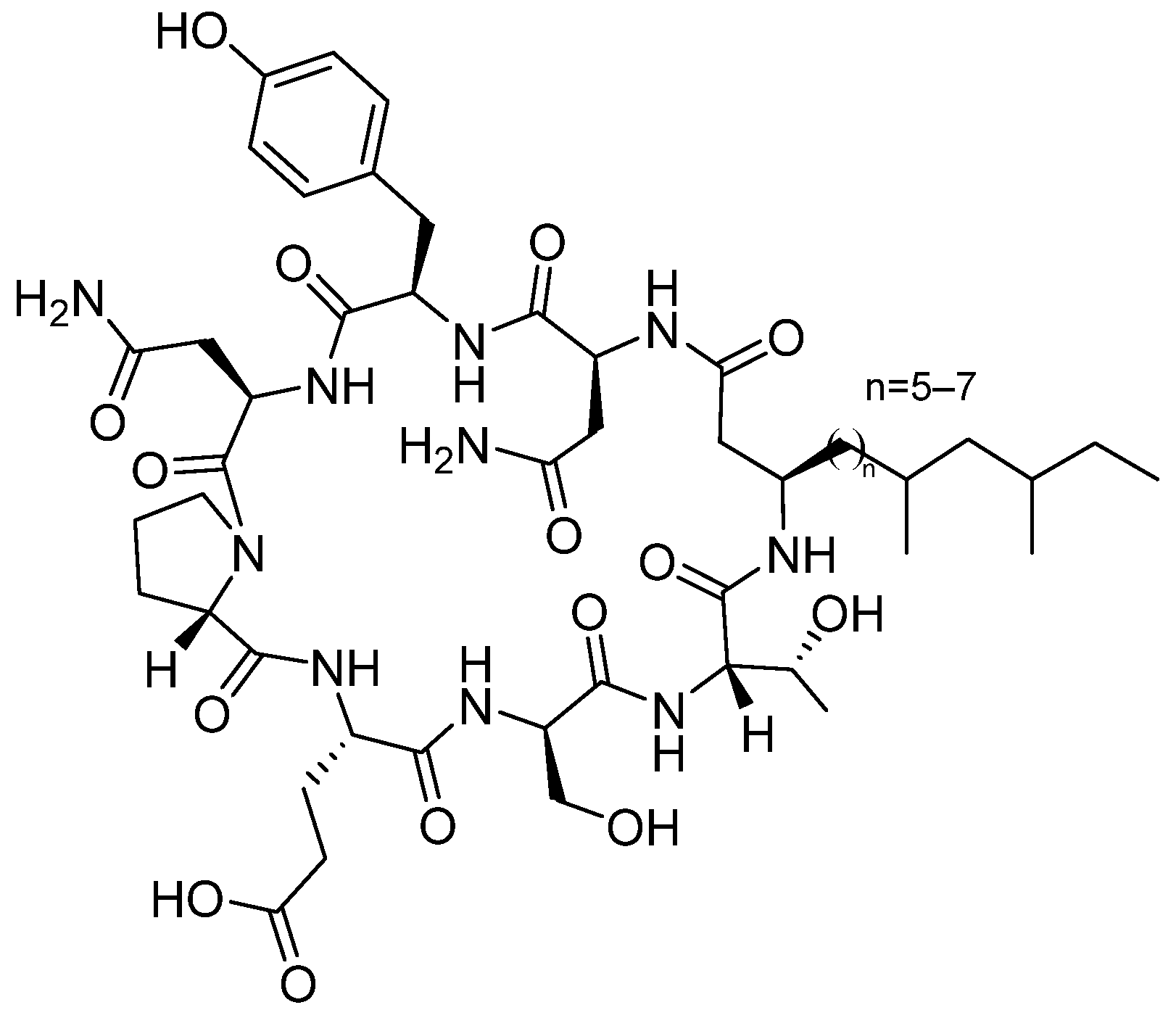
Figure 2.
Key COSY and HMBC correlations of 1.
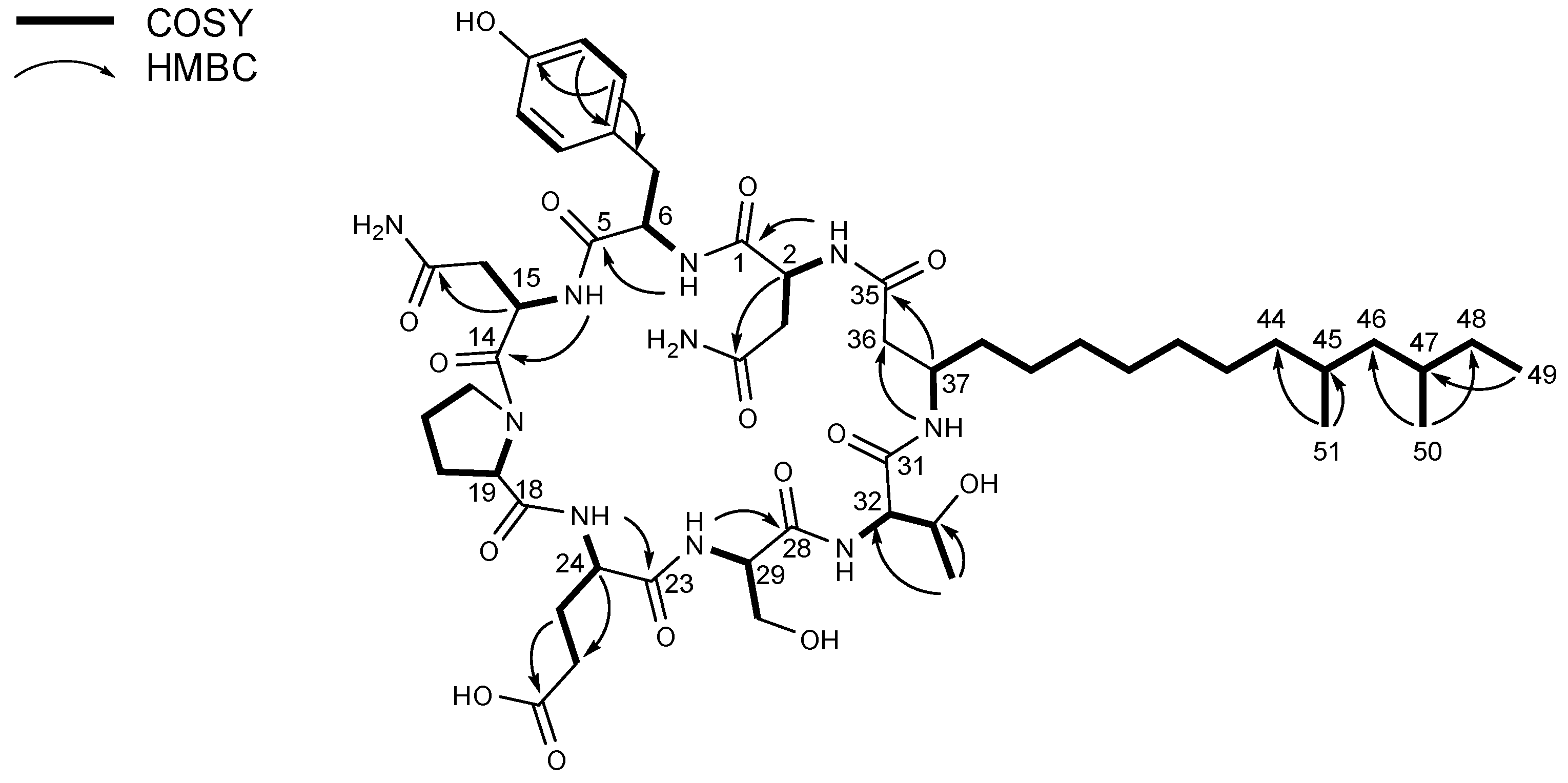
Figure 3.
(a) GNPS cluster assigned to lipopeptides from the ethyl acetate extract of B. amyloliquefaciens. (b) Cluster corresponding to the known amylifactins A–D and their associated molecular features. (c) Target molecular network cluster containing the newly identified lipopeptides. Numbers on nodes denote compounds 1–3. 1, amylimycin A (m/z 1073.58 [M + H]+); 2, amylimycin B (m/z 1059.56 [M + H]+); and 3, amylimycin C (m/z 1045.54 [M + H]+).
Figure 3.
(a) GNPS cluster assigned to lipopeptides from the ethyl acetate extract of B. amyloliquefaciens. (b) Cluster corresponding to the known amylifactins A–D and their associated molecular features. (c) Target molecular network cluster containing the newly identified lipopeptides. Numbers on nodes denote compounds 1–3. 1, amylimycin A (m/z 1073.58 [M + H]+); 2, amylimycin B (m/z 1059.56 [M + H]+); and 3, amylimycin C (m/z 1045.54 [M + H]+).
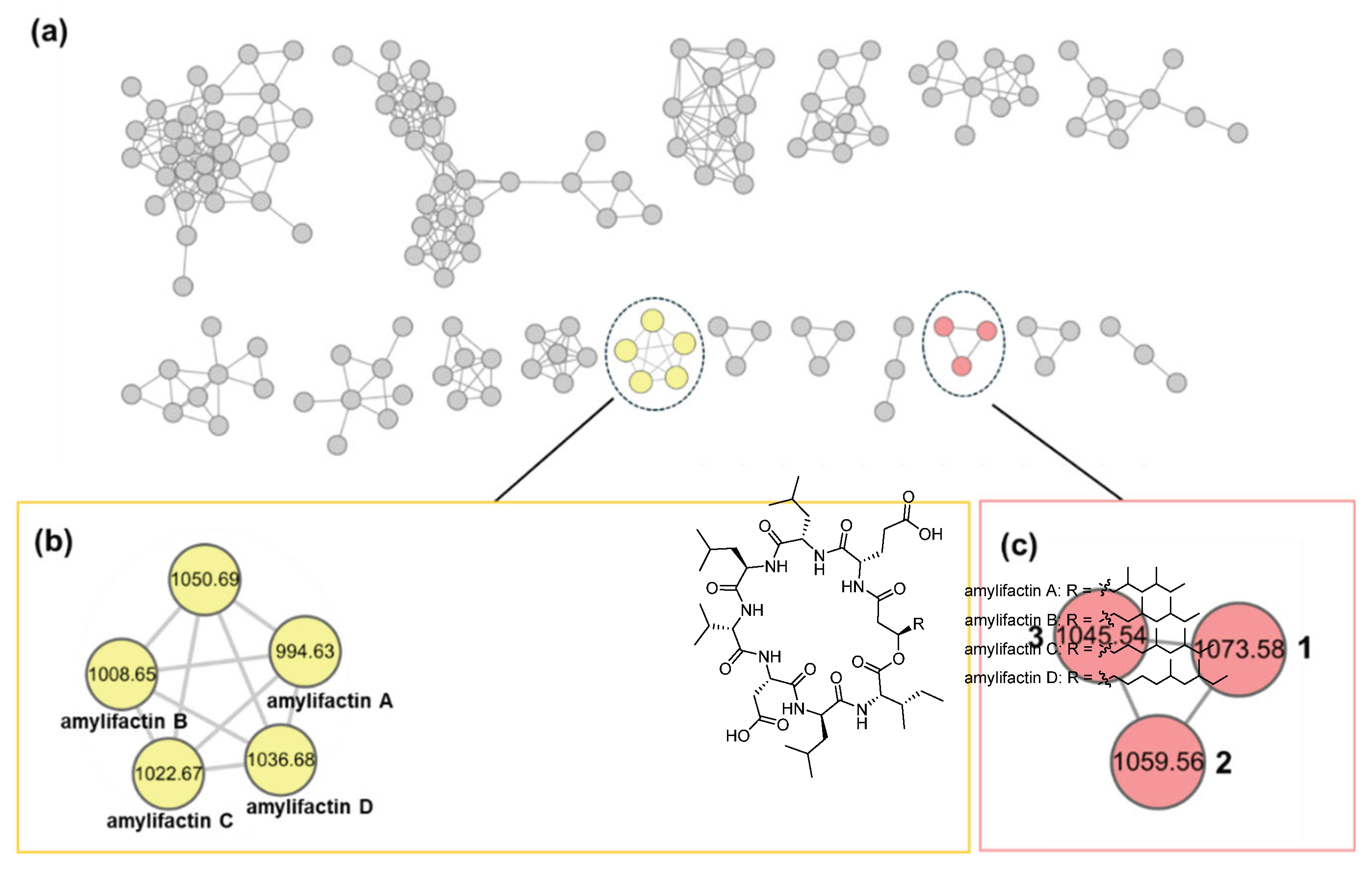

Table 1.
1H spectroscopic data of amylimycins A–C (1–3).
| position | 1a | 2b | 3b | ||||||||||||
| δH | mult (J in Hz) | δH | mult (J in Hz) | δH | mult (J in Hz) | ||||||||||
| l-Asn-1 | l-Asn-1 | l-Asn-1 | |||||||||||||
| 1 | C | 1 | C | 1 | C | ||||||||||
| 2 | CH | 4.67 | m | 2 | CH | 4.66 | m | 2 | CH | 4.65 | m | ||||
| 3 | CH2 | 2.22 | m | 3 | CH2 | 2.22* | m | 3 | CH2 | 2.22* | m | ||||
| 2.64 | m | ||||||||||||||
| 4 | C | 4 | C | 4 | C | ||||||||||
| 2-NH | 8.32 | m | 2-NH | 8.22 | m | 2-NH | 8.20 | m | |||||||
| d-Tyr | d-Tyr | d-Tyr | |||||||||||||
| 5 | C | 5 | C | 5 | C | ||||||||||
| 6 | CH | 4.36 | m | 6 | CH | 4.34 | m | 6 | CH | 4.34 | m | ||||
| 7 | CH2 | 2.60 | m | 7 | CH2 | 2.68 | m | 7 | CH2 | 2.64 | m | ||||
| 2.98 | m | 2.97 | m | 2.98 | m | ||||||||||
| 8 | C | 8 | C | 8 | C | ||||||||||
| 9/13 | CH | 7.00 | d (8.0) | 9/13 | CH | 6.99 | d (8.0) | 9/13 | CH | 7.00 | d (8.0) | ||||
| 10/12 | CH | 6.62 | d (8.0) | 10/12 | CH | 6.61 | d (8.0) | 10/12 | CH | 6.61 | d (8.0) | ||||
| 11 | C | 11 | C | 11 | C | ||||||||||
| 6-NH | 7.56 | d (8.0) | 6-NH | 7.59 | m | 6-NH | 7.57 | m | |||||||
| d-Asn-2 | d-Asn-2 | d-Asn-2 | |||||||||||||
| 14 | C | 14 | C | 14 | C | ||||||||||
| 15 | CH | 4.50 | m | 15 | CH | 4.50 | m | 15 | CH | 4.50 | m | ||||
| 16 | CH2 | 2.31 | m | 16 | CH2 | 2.31 | m | 16 | CH2 | 2.31* | m | ||||
| 2.67 | dd (5.0,15.0) | 2.62 | m | ||||||||||||
| 17 | C | 17 | C | 17 | C | ||||||||||
| 15-NH | 8.54 | d (6.5) | 15-NH | 8.23 | m | 15-NH | 8.22 | m | |||||||
| l-Pro | l-Pro | l-Pro | |||||||||||||
| 18 | C | 18 | C | 18 | C | ||||||||||
| 19 | CH | 4.17 | m | 19 | CH | 4.19 | m | 19 | CH | 4.20 | m | ||||
| 20 | CH2 | 2.05* | m | 20 | CH2 | 2.02* | m | 20 | CH2 | 2.04* | m | ||||
| 21 | CH2 | 1.77* | m | 21 | CH2 | 1.77* | m | 21 | CH2 | 1.76* | m | ||||
| 22 | CH2 | 3.30 | m | 22 | CH2 | 3.46* | m | 22 | CH2 | 3.47* | m | ||||
| 3.38 | m | ||||||||||||||
| l-Glu | l-Glu | l-Glu | |||||||||||||
| 23 | C | 23 | C | 23 | C | ||||||||||
| 24 | CH | 4.58 | dd (5.5, 14.0) | 24 | CH | 4.57 | m | 24 | CH | 4.56 | m | ||||
| 25 | CH2 | 1.87 | m | 25 | CH2 | 1.86 | m | 25 | CH2 | 1.84 | m | ||||
| 1.93 | m | 1.93 | m | 1.91 | m | ||||||||||
| 26 | CH2 | 2.20* | m | 26 | CH2 | 2.17* | m | 26 | CH2 | 2.18* | m | ||||
| 27 | C | 27 | C | 27 | C | ||||||||||
| 24-NH | 8.04 | m | 24-NH | 8.08 | m | 24-NH | 8.06 | m | |||||||
| d-Ser | d-Ser | d-Ser | |||||||||||||
| 28 | C | 28 | C | 28 | C | ||||||||||
| 29 | CH | 4.36 | m | 29 | CH | 4.36 | m | 29 | CH | 4.36 | m | ||||
| 30 | CH2 | 3.57* | m | 30 | CH2 | 3.65* | m | 30 | CH2 | 3.65* | m | ||||
| 29-NH | 8.42 | d (6.0) | 29-NH | 8.47 | m | 29-NH | 8.45 | m | |||||||
| l-Thr | l-Thr | l-Thr | |||||||||||||
| 31 | C | 31 | C | 31 | C | ||||||||||
| 32 | CH | 4.07 | m | 32 | CH | 4.08 | m | 32 | CH | 4.09 | m | ||||
| 33 | CH | 4.16 | m | 33 | CH | 4.14 | m | 33 | CH | 4.14 | m | ||||
| 34 | CH3 | 1.01 | d (6.5) | 34 | CH3 | 1.00 | d (6.5) | 34 | CH3 | 1.00 | d (6.5) | ||||
| 32-NH | 8.06 | d (9.0) | 32-NH | 8.06 | m | 32-NH | 8.06 | m | |||||||
| β-amino acid | β-amino acid | β-amino acid | |||||||||||||
| 35 | C | 35 | C | 35 | C | ||||||||||
| 36 | CH2 | 2.19 | m | 36 | CH2 | 2.38* | dd (5.5, 1.5) | 36 | CH2 | 2.39* | dd (5.5, 1.5) | ||||
| 2.39 | m | 37 | CH | 3.88 | m | 37 | CH | 3.88 | m | ||||||
| 37 | CH | 4.10 | m | 38 | CH2 | 1.50* | m | 38 | CH2 | 1.55* | m | ||||
| 38 | CH2 | 1.53* | m | 39–42 | CH2 | 1.23* | m | 39–41 | CH2 | 1.23* | m | ||||
| 39–43 | CH2 | 1.22* | m | 43 | CH2 | 1.12* | m | 42 | CH2 | 1.12* | m | ||||
| 44 | CH2 | 1.12* | m | 44 | CH | 1.49 | m | 43 | CH | 1.49 | dt (13.5, 6.5) | ||||
| 45 | CH | 1.49 | dt (13.5, 6.5) | 45 | CH2 | 1.05 | m | 44 | CH2 | 1.06* | m | ||||
| 46 | CH2 | 1.05 | m | 1.25 | m | 45 | CH | 1.25 | m | ||||||
| 1.25 | m | 46 | CH | 1.28 | m | 46 | CH2 | 1.13* | m | ||||||
| 47 | CH | 1.28 | m | 47 | CH2 | 1.10* | m | 47 | CH3 | 0.82 | m | ||||
| 48 | CH2 | 1.10* | m | 48 | CH3 | 0.82 | m | 48 | CH3 | 0.81 | m | ||||
| 49 | CH3 | 0.82 | m | 49 | CH3 | 0.81 | m | 49 | CH3 | 0.83 | d (6.5) | ||||
| 50 | CH3 | 0.81 | m | 50 | CH3 | 0.84 | d (6.5) | 37-NH | 7.50 | m | |||||
| 51 | CH3 | 0.84 | d (6.5) | 37-NH | 7.52 | m | |||||||||
| 37-NH | 7.58 | d (8.0) | |||||||||||||
aAcquired at 900 MHz for 1H in (DMSO-d6). bAcquired at 850 MHz for 1H in (DMSO-d6). * Overlapped signals.
Table 2.
13C spectroscopic data of amylimycins A–C (1–3).
| position | 1a | 2b | 3b | ||||||||||||||||||||||||||
| δC | δC | δC | |||||||||||||||||||||||||||
| l-Asn-1 | l-Asn-1 | l-Asn-1 | |||||||||||||||||||||||||||
| 1 | C | 170.3 | 1 | C | 170.1 | 1 | C | 170.0 | |||||||||||||||||||||
| 2 | CH | 48.8 | 2 | CH | 48.8 | 2 | CH | 49.1 | |||||||||||||||||||||
| 3 | CH2 | 36.8 | 3 | CH2 | 36.8 | 3 | CH2 | 36.8 | |||||||||||||||||||||
| 4 | C | 171.4 | 4 | C | 171.3 | 4 | C | 171.5 | |||||||||||||||||||||
| d-Tyr | d-Tyr | d-Tyr | |||||||||||||||||||||||||||
| 5 | C | 170.4 | 5 | C | 170.9 | 5 | C | 170.3 | |||||||||||||||||||||
| 6 | CH | 56.1 | 6 | CH | 56.1 | 6 | CH | 56.0 | |||||||||||||||||||||
| 7 | CH2 | 35.6 | 7 | CH2 | 35.7 | 7 | CH2 | 35.5 | |||||||||||||||||||||
| 8 | C | 128.1 | 8 | C | 129.1 | 8 | C | 129.1 | |||||||||||||||||||||
| 9/13 | CH | 130.1 | 9/13 | CH | 130.1 | 9/13 | CH | 130.1 | |||||||||||||||||||||
| 10/12 | CH | 114.8 | 10/12 | CH | 114.7 | 10/12 | CH | 114.8 | |||||||||||||||||||||
| 11 | C | 155.6 | 11 | C | 155.6 | 11 | C | 155.8 | |||||||||||||||||||||
| d-Asn-2 | d-Asn-2 | d-Asn-2 | |||||||||||||||||||||||||||
| 14 | C | 169.2 | 14 | C | 169.3 | 14 | C | 169.2 | |||||||||||||||||||||
| 15 | CH | 48.1 | 15 | CH | 48.1 | 15 | CH | 48.2 | |||||||||||||||||||||
| 16 | CH2 | 36.2 | 16 | CH2 | 36.2 | 16 | CH2 | 36.2 | |||||||||||||||||||||
| 17 | C | 172.1 | 17 | C | 172.1 | 17 | C | 172.2 | |||||||||||||||||||||
| l-Pro | l-Pro | l-Pro | |||||||||||||||||||||||||||
| 18 | C | 169.0 | 18 | C | 169.1 | 18 | C | 169.1 | |||||||||||||||||||||
| 19 | CH | 58.7 | 19 | CH | 58.6 | 19 | CH | 58.7 | |||||||||||||||||||||
| 20 | CH2 | 28.6 | 20 | CH2 | 28.6 | 20 | CH2 | 28.6 | |||||||||||||||||||||
| 21 | CH2 | 24.5 | 21 | CH2 | 24.5 | 21 | CH2 | 24.7 | |||||||||||||||||||||
| 22 | CH2 | 46.6 | 22 | CH2 | 46.7 | 22 | CH2 | 46.8 | |||||||||||||||||||||
| l-Glu | l-Glu | l-Glu | |||||||||||||||||||||||||||
| 23 | C | 171.5 | 23 | C | 171.3 | 23 | C | 171.0 | |||||||||||||||||||||
| 24 | CH | 49.9 | 24 | CH | 49.5 | 24 | CH | 50.0 | |||||||||||||||||||||
| 25 | CH2 | 28.5 | 25 | CH2 | 28.4 | 25 | CH2 | 28.4 | |||||||||||||||||||||
| 26 | CH2 | 31.3 | 26 | CH2 | 31.5 | 26 | CH2 | 31.6 | |||||||||||||||||||||
| 27 | C | 174.7 | 27 | C | 174.2 | 27 | C | 174.2 | |||||||||||||||||||||
| d-Ser | d-Ser | d-Ser | |||||||||||||||||||||||||||
| 28 | C | 173.3 | 28 | C | 173.1 | 28 | C | 173.2 | |||||||||||||||||||||
| 29 | CH | 53.0 | 29 | CH | 53.1 | 29 | CH | 53.1 | |||||||||||||||||||||
| 30 | CH2 | 61.3 | 30 | CH2 | 61.3 | 30 | CH2 | 61.3 | |||||||||||||||||||||
| l-Thr | l-Thr | l-Thr | |||||||||||||||||||||||||||
| 31 | C | 169.6 | 31 | C | 169.6 | 31 | C | 169.4 | |||||||||||||||||||||
| 32 | CH | 58.3 | 32 | CH | 58.3 | 32 | CH | 58.2 | |||||||||||||||||||||
| 33 | CH | 65.8 | 33 | CH | 65.8 | 33 | CH | 65.9 | |||||||||||||||||||||
| 34 | CH3 | 20.1 | 34 | CH3 | 20.0 | 34 | CH3 | 20.1 | |||||||||||||||||||||
| β-amino acid | β-amino acid | β-amino acid | |||||||||||||||||||||||||||
| 35 | C | 169.9 | 35 | C | 169.9 | 35 | C | 170.0 | |||||||||||||||||||||
| 36 | CH2 | 42.6 | 36 | CH2 | 42.5 | 36 | CH2 | 42.9 | |||||||||||||||||||||
| 37 | CH | 45.4 | 37 | CH | 45.8 | 37 | CH | 46.1 | |||||||||||||||||||||
| 38 | CH2 | 31.9 | 38 | CH2 | 32.0 | 38 | CH2 | 31.9 | |||||||||||||||||||||
| 39–43 | CH2 | 26.5–29.1 | 39–42 | CH2 | 26.7–29.1 | 39–41 | CH2 | 26.5–28.9 | |||||||||||||||||||||
| 44 | CH2 | 38.4 | 43 | CH2 | 38.5 | 42 | CH2 | 38.5 | |||||||||||||||||||||
| 45 | CH | 27.4 | 44 | CH | 27.3 | 43 | CH | 27.4 | |||||||||||||||||||||
| 46 | CH2 | 36.0 | 45 | CH2 | 35.9 | 44 | CH2 | 36.0 | |||||||||||||||||||||
| 47 | CH | 33.8 | 46 | CH | 33.4 | 45 | CH | 32.9 | |||||||||||||||||||||
| 48 | CH2 | 29.0 | 47 | CH2 | 29.1 | 46 | CH2 | 29.1 | |||||||||||||||||||||
| 49 | CH3 | 11.2 | 48 | CH3 | 11.2 | 47 | CH3 | 11.3 | |||||||||||||||||||||
| 50 | CH3 | 19.6 | 49 | CH3 | 19.1 | 48 | CH3 | 19.1 | |||||||||||||||||||||
| 51 | CH3 | 22.6 | 50 | CH3 | 22.4 | 49 | CH3 | 22.5 | |||||||||||||||||||||
aAcquired at 225 MHz for 13C in (DMSO-d6). bAcquired at 212 MHz for 13C in (DMSO-d6). * Overlapped signals.
Table 3.
Antibacterial activity (MIC, μg/mL) of amylimycins A–C (1–3).
| Strains | 1 | 2 | 3 | kanamycin |
| B. subtilis KCCM 11316 | 16 | 32 | 32 | 2 |
| S. epidermidis KCCM 35494 | 32 | 32 | 64 | 0.5 |
| E. coli KCCM 11234 | 64 | 64 | >128 | 1 |
| P. fluorescens KCCM 11362 | >128 | >128 | >128 | 1 |
Disclaimer/Publisher’s Note: The statements, opinions and data contained in all publications are solely those of the individual author(s) and contributor(s) and not of MDPI and/or the editor(s). MDPI and/or the editor(s) disclaim responsibility for any injury to people or property resulting from any ideas, methods, instructions or products referred to in the content. |
© 2026 by the authors. Licensee MDPI, Basel, Switzerland. This article is an open access article distributed under the terms and conditions of the Creative Commons Attribution (CC BY) license (http://creativecommons.org/licenses/by/4.0/).
Copyright: This open access article is published under a Creative Commons CC BY 4.0 license, which permit the free download, distribution, and reuse, provided that the author and preprint are cited in any reuse.


