
Submitted:
30 May 2026
Posted:
01 June 2026
You are already at the latest version
Abstract
Large language models (LLMs) are increasingly used to simulate human populations via persona prompting, often under the assumptions that richer persona descriptions improve behavioral fidelity, similarly sized attribute combinations are equally simulatable, and persona definitions generalize across tasks. In this work, we formalize these assumptions and systematically evaluate them across multiple architectures, scales, and simulation settings. We identify a fundamental limitation we term persona manifold collapse, where increasingly expressive persona specifications lead to systematic contraction of representational and behavioral diversity. Across models, increasing persona complexity consistently reduces inter-persona separation in latent space and weakens behavioral differentiation in downstream simulation tasks. These effects persist across multiple analyses as richer personas fail to preserve human subgroup disagreement, performance varies across attribute combinations of similar size, and adding descriptive detail often degrades rather than improves simulation fidelity. Surprisingly, simple Age-Gender personas consistently outperform richly specified Ideal Customer Profiles (ICPs) across industries, achieving substantially higher downstream prediction accuracy. We find that collapse is not uniform across attributes. Certain combinations remain behaviorally stable and preserve stronger alignment with human responses, forming localized regions we term alignment bridges. Together, our results provide empirical and conceptual foundations for understanding the limits of persona-conditioned simulation, highlighting the need for representation-aware persona construction rather than increasing persona expressivity alone.
Keywords:
large language models
; persona simulation in LLMs
; persona prompting
; human simulation in LLMs
; LCBM
; large content and behavior models
; large behavior models
1. Introduction
Recent literature reflects heightened enthusiasm around persona prompting and LLM personalization, alongside a growing body of work exploring applications in automated human studies [1,2,7,11,12,13,16,19,23], human behavior simulation [5,15], personalization [20,21], user modeling [6,17,18], design ideation [10,26], and data generation [8,9,22,27]. Across these settings, persona prompting is increasingly used to construct synthetic populations that act as proxies for real users and participants.
In this paradigm, models are conditioned on demographic personas and treated as synthetic respondents capable of generating survey answers at scale. Researchers construct “digital twins” of human respondents using demographic attributes and prompt LLMs to generate responses on their behalf, effectively replacing traditional survey collection with synthetic sampling [2,13]. Building on this premise, LLMs have been used to recover canonical findings in behavioral economics and social psychology [1,12], predict responses on the General Social Survey and Big Five inventories [23], and simulate participant behavior in social-science experiments, treating the model as a proxy population whose aggregate behavior approximates outcomes in unseen scientific studies [11]. Together, these works advance the claim that human samples used in social-science research can be substantially replaced by persona-conditioned synthetic respondents.
Beyond automating human studies, similar ideas have also been adopted for downstream applications, where persona-conditioned models serve as proxies for diverse user populations [10]. Persona-conditioned agents have similarly been used in market research to elicit willingness-to-pay and replicate consumer experiments [7,16], in recommender-system evaluation to simulate clicks, ratings, and multi-turn dialogue in place of live users [6,18], and in automated A/B testing, where structured persona agents navigate live webpages and aggregate outcomes across simulated populations to estimate treatment effects prior to deployment [17]. Persona conditioning has also been applied to audience-targeted content generation, where LLM-written advertisements match or surpass human-written ones in influencing user engagement [20], and more broadly to social simulations in which agents emulate human behaviors, preferences, and judgments [5]. Across these settings, persona prompting has emerged as a common primitive for substituting synthetic for human input when recruiting real participants is slow, costly, or otherwise constrained.
Whereas the applications described above use persona agents to substitute for human input in downstream studies, content generation, and product evaluation, persona prompting has increasingly begun to shape the development of LLMs themselves. In particular, large-scale synthetic persona datasets such as the Nemotron Personas dataset [22] extend this paradigm to training and evaluation by constructing personas from demographic, contextual, and behavioral attributes, such as age, country, education level, career goals, hobbies, and internet usage patterns. These datasets comprise hundreds of thousands to millions of synthetic personas defined over structured attribute spaces (e.g., 22 persona and contextual traits), enabling systematic coverage of population diversity and controlled training and evaluation across diverse persona types.
Beyond structured attribute based personas, personas have been extended to expressive narrative forms encoding psychological traits, preferences, values, and lived experiences inferred from structured web knowledge, online profiles, LLM chat logs, and long-term interaction histories. PersonaHUB [9] constructs large-scale persona collections from web knowledge and uses them to generate diverse synthetic personas. DEEPPERSONA [27] further argues that existing personas are “shallow and simplistic,” introducing personas with hundreds of structured attributes and long-form profiles approaching 1MB of text. Building on these ideas, recent systems instantiate agents through long biographical narratives encoding decades of relationships, beliefs, motivations, and experiences. These personas are increasingly used across dialogue systems and simulations, and also for alignment, where synthetic populations replace the human respondents that traditionally provide preferences, judgments, and feedback (RLAIF). These developments mark a shift where LLM-based personas no longer merely simulate users downstream, but increasingly shape the data and feedback signals used to build LLMs themselves.
Yet as personas move from simulating users to shaping the models themselves, the assumptions underlying this paradigm become increasingly consequential. Several such assumptions, though rarely made explicit, structure how persona-based simulation is designed and interpreted.
Expressivity A central assumption is that increasing the descriptive richness of personas improves simulation fidelity. This motivates the construction of highly expressive personas in prior work. For instance, DEEPPERSONA [27] explicitly argues that existing personas are “shallow and simplistic” and introduces narrative-complete personas with rich psychological traits, preferences, and life histories to improve alignment and task performance. Similarly, Nemotron Personas [22] are designed around increasing attribute richness for “behavioral realism,” incorporating structured demographic fields along with rich narrative components such as career goals, skills, and hobbies. Persona generation approaches based on long-form social data further emphasize richer conditioning to improve emotional and behavioral realism.
Attribute Fidelity. Another implicit assumption is that all persona attribute combinations of the same size are similarly simulatable by LLMs. Concretely, if a model can faithfully simulate one 3-attribute persona (e.g., defined by a particular value tuple{education, income, race}), it is implicitly assumed that it should also simulate all other 3-attribute personas (e.g., {income, political affiliation, race}) with comparable fidelity. This assumption appears in large-scale persona generation works as PersonaHUB [9], which samples personas from fixed attribute schemas and treats them as interchangeable generators across downstream tasks, and Nemotron [22], which constructs large persona pools using the same 22 persona and contextual attributes for training, evaluation, and safety testing.
Specificity. A related assumption is that adding more attributes to a persona, improves simulation fidelity. Concretely, if a model faithfully simulates a persona defined by N attributes, adding an additional attribute is expected to provide more specific behavioral grounding rather than degrade performance. This assumption motivates progressive persona enrichment in prior works like DEEPPERSONA [27] incrementally expands personas using structured taxonomies containing hundreds of attributes, while Nemotron [22] explicitly favors richer personas defined over 22 demographic, contextual, and behavioral fields. Other persona-generation frameworks similarly rely on multi-stage attribute expansion under the premise that greater specificity leads to more faithful simulation.
Task Generalization. Finally, persona definitions are often assumed to generalize across tasks. PersonaHub [9] reuses the same personas across diverse tasks such as mathematical reasoning, QA, and generation, while Nemotron [22] applies fixed personas across training, evaluation, and safety testing. Survey simulation works further assume that personas conditioned on demographic attributes generalize across domains such as opinion prediction, narrative generation, and behavioral tasks.
Together, literature reflects a common view that richer, larger, and more structured personas lead to more faithful and generalizable simulation of human behavior. As persona prompting is increasingly deployed in settings such as automated human studies, design ideation, and A/B testing, its outputs can influence both scientific conclusions and the content surfaced to users. Yet these assumptions are rarely systematically validated, despite entire pipelines being built on top of them. This raises a critical question: do assumptions about persona fidelity actually hold? Further, when personas appear plausible to humans, it remains unclear whether LLMs meaningfully interpret and act on them in a consistent and behaviorally faithful manner.
We conduct two complementary analyses to evaluate whether the assumptions underlying persona-based simulation hold in practice. First, we study the latent representation of personas by analyzing how persona embeddings evolve as attributes are incrementally added. This allows us to directly test assumptions about attribute enrichment and specificity, if richer personas provide more faithful behavioral grounding, persona representations should become more distinct and behaviorally separable as additional attributes are introduced. Second, we perform empirical validation through downstream simulation tasks, assessing whether persona-conditioned agents preserve human opinion differences across demographic subgroups and whether these representations translate into faithful simulation across tasks.
For the first experiment, we construct personas through hierarchical attribute composition, ranging from minimal two-attribute specifications such as Age, Gender to progressively richer profiles incorporating attributes like Education, Decision Style, and Background. We then extract persona-conditioned hidden-state embeddings across subjective and preference-oriented prompts (details in Table A16) We define persona distance as the mean pairwise Euclidean distance between persona embeddings at each level of attribute enrichment, using it as a proxy for behavioral separation between personas. Under the standard assumption that richer personas encode more specific and distinctive behavioral information, adding new attributes should either increase separation between persona representations or leave existing distinctions unchanged. Intuitively, if two personas already differ along attributes such as age and gender, introducing additional information such as education, decision style, or background should further refine these differences rather than collapse them into more similar representations.
Contrary to this expectation, we observe a systematic contraction of the persona manifold as additional attributes are introduced. On Qwen-72B-Vision-Instruct, the mean persona distance drops from for minimal personas to for the richest configurations, a reduction of nearly 60% (Table A1). Similar declines appear across Qwen3-8B and LLaMA-3.2-90B-Vision-Instruct, indicating robustness across architectures and scales. Figure 1 visualizes this progressive collapse in embedding space. We term this phenomenon persona manifold collapse: increasing persona complexity drives representations toward narrower and more homogeneous latent regions, reducing rather than expanding behavioral diversity.
To test whether persona manifold collapse extends beyond our controlled setup, we evaluate Nemotron [22] and PersonaHub [9] by measuring mean pairwise persona distances (Table A2). Both datasets are constructed under the assumption that richer and more structured personas improve simulation fidelity, with PersonaHub relying on large-scale fixed attribute schemas and Nemotron emphasizing attribute richness for behavioral realism. Despite this, both datasets exhibit substantially lower latent separation than minimal two-attribute personas. For example, on Qwen-72B, Nemotron achieves a mean distance of only , compared to for simple Age–Gender personas under the same model. These results indicate that increasing descriptive richness and attribute complexity do not necessarily produce more diverse or behaviorally separated representations, but instead reproduce the same collapse pattern observed in our controlled experiments. Additional ablations show that persona manifold collapse cannot be fully explained by attention saturation from long prompts or sensitivity to superficial paraphrasing. Persona representations remain relatively stable across large variations in prompt length and semantically equivalent reformulations, suggesting that the collapse arises more fundamentally from representational interference between attributes rather than prompt formatting effects (Table A3 and Table A4). Details in Section 2.1.
To further examine the behavioral consequences of persona manifold collapse, we test whether persona-conditioned LLMs preserve disagreement between real human subpopulations across socio-political opinion (OpinionQA), moral reasoning (Moral Machine), and aesthetic preference (Website Likability) tasks [3,24,25]. If persona-conditioned models preserved human demographic variation, subgroup pairs with strong disagreement in human annotations would also remain behaviorally separated in model outputs, resulting in strong positive correlations. Instead, correlations remain weak or negative across all tasks (Table A5 and Table A6). For example, GPT-4o reaches on Website Likability, while LLaMA-3.2-90B-Vision-Instruct reaches approximately on Moral Machine. These results indicate that demographic groups exhibiting strong disagreement in human populations often collapse toward similar persona-conditioned outputs, limiting the ability of LLMs to preserve fine-grained behavioral diversity. Details in Section 2.2.
In summary, our results challenge several core assumptions underlying persona-conditioned simulation. Increasing persona specificity does not reliably improve behavioral fidelity, similarly sized attribute combinations are not equally simulatable, and personas that appear effective in one domain do not consistently generalize across tasks. Instead, across embedding analyses, downstream behavioral evaluations, and real-world prediction tasks, we observe consistent evidence of persona manifold collapse, where increasingly rich persona specifications reduce representational and behavioral diversity. However, these findings do not imply that persona prompting is uniformly ineffective. We find that the collapse is not equally severe across all attributes and attribute combinations. Certain combinations remain substantially more stable than others and preserve stronger behavioral separation and alignment with human responses. These results suggest that effective persona design depends less on maximizing persona richness and more on identifying behaviorally stable attribute combinations.
We first examine this phenomenon in a marketing and user-behavior simulation setting. Prior work on persona-conditioned LLM populations has reported competitive performance on tasks such as opinion QA, website preference evaluation, and advertising response prediction [5], motivating increasingly expressive persona specifications such as Ideal Customer Profiles (ICPs) that encode demographic, psychographic, and behavioral attributes. Under the standard assumption that richer personas improve behavioral fidelity, ICPs should outperform simple demographic personas. However, we observe the opposite trend. Across industries, minimal Age–Gender personas consistently outperform both auto-generated and expert-defined ICPs, achieving an average accuracy of , compared to for auto-generated ICPs and for expert-defined brand ICPs (Table A7 and Table A8). These simple demographic personas therefore emerge as alignment bridges, suggesting that effective simulation depends less on maximal persona expressivity and more on whether the selected attributes align with stable latent factors represented by the model. Supporting this, our ablation experiments show that personas with strong alignment remain consistently strong even after substantial elaboration, while weak personas remain weak, indicating that stable attribute configurations preserve their relative behavior despite increasing descriptive complexity (Table A9). Details in Section 2.3.
Taken together, our results challenge several core assumptions underlying persona-conditioned simulation. Increasing descriptive depth does not reliably improve alignment, personas with the same number of attributes do not exhibit comparable fidelity, adding additional attributes can substantially degrade behavioral separation, and personas that appear effective in one domain often fail to generalize across tasks. Across latent-space analyses and downstream behavioral evaluations, we observe a consistent pattern of persona manifold collapse, where increasing persona complexity contracts rather than expands effective behavioral diversity. At the same time, this collapse is not uniform across attributes: certain attribute combinations remain comparatively stable and continue to preserve stronger alignment with human behavior. These alignment bridges suggest that effective persona design depends less on maximizing expressivity and more on identifying stable, behaviorally meaningful attribute configurations that models can reliably represent.
2. Experiments
We conduct three complementary experiments to examine the limits of persona-conditioned simulation in large language models. First, we analyze how persona embeddings evolve as attributes are incrementally combined, probing whether richer personas expand or contract the latent representation space. Second, we evaluate whether persona-conditioned LLMs preserve human behavioral variation across demographic subgroups across diverse tasks. Third, we study how these representational effects translate to downstream simulation performance in real-world marketing and user-behavior prediction tasks. Detailed experimental protocols and results are presented in Section A.1.
2.1. Investigating the Persona Manifold Collapse
Experimental Setup: To systematically investigate persona manifold collapse, we design a controlled embedding-space analysis in which persona complexity is incrementally increased by adding attributes of greater semantic richness, from minimal demographic descriptors (e.g., age and gender) to combinations of demographic and psychographic factors. This provides a principled way to probe how persona expressivity shapes latent geometry. If richer personas induce distinct internal states, the representational manifold should expand, increasing inter-persona distances. Conversely, contraction of these distances as attributes are added directly indicates persona manifold collapse. We quantify this effect by measuring pairwise inter-persona distances across successive enrichment levels.
Persona Construction. We construct personas using a hierarchical additive attribute scheme inspired by marketing, audience segmentation, and social-science survey design. Personas are progressively enriched from simple demographic attributes to more detailed behavioral and psychographic descriptions, allowing controlled analysis of how increasing persona complexity affects latent representations. At each level, we add one new attribute dimension, producing progressively richer persona specifications through additive composition. We then enumerate valid combinations of attribute values to construct persona populations with increasing semantic richness. Figure 1 illustrates this construction process, and representative persona prompts are provided in Appendix Section A.3.
Persona Representation. For each persona, we prompt the language model with a fixed set of subjective and preference-oriented queries spanning domains such as advertising perception, web aesthetics evaluation, lifestyle and attitudinal judgment. The detailed set of questions is given in Appendix Section A.2. We obtain a vector representation for each persona by extracting the final-layer hidden states corresponding to the generated responses and averaging them across all queries. This yields a single embedding vector per persona, capturing the aggregate effect of persona conditioning on the model’s internal representations.
Quantifying Manifold Collapse. Let denote the persona complexity level, and let denote the set of persona embeddings constructed at level ℓ, where is the number of personas at that level. For each level, the pairwise Euclidean distance matrix is computed, with entries
Representational diversity at level ℓ is summarized using the mean and standard deviation of the entries of .
Findings: Under the hypothesis that increasing persona richness through additional attributes expands behavioral expressivity, these distances should increase monotonically with ℓ, reflecting a widening of the persona manifold. Instead, we observe a systematic contraction of inter-persona distances as ℓ increases (Table A1), indicating that progressively richer persona specifications lead to increasingly similar latent representations. Across models, the magnitude of this collapse is substantial, reaching for Qwen3-8B, for Qwen-72B-Vision-Instruct, and for LLaMA-3.2-90B-Vision-Instruct, while even base models exhibit consistent 20– contraction. We further find that this behavior extends beyond our controlled personas to large-scale persona datasets such as Nemotron and PersonaHub, both of which exhibit substantially lower latent separation than simple Age–Gender personas despite relying on richer attribute schemas (Table A2). Together, these results constitute direct empirical evidence of persona manifold collapse. Additional ablations investigating attention saturation, prompt sensitivity, and attribute-level stability (Table A3, Table A10, Table A4, Table A11, and Table A12) show that the collapse cannot be explained solely by longer prompts or superficial prompt reformulations, and that certain attribute combinations remain substantially more stable than others across tasks and models.
2.2. Testing Human Opinion Variance via Inter-Persona Similarity Trends
Experimental Setup: We evaluate persona-conditioned simulation across three domains spanning socio-political reasoning, moral judgment, and visual preference. OpinionQA evaluates alignment with human responses on socio-political issues such as taxation, immigration, and climate policy, where opinions vary systematically across demographic groups [25]. Moral Machine evaluates persona-conditioned decision making in trolley-style moral dilemmas with strong subgroup differences across country, education, religiosity, and political orientation [3]. Website Likability measures demographic variation in aesthetic preference by asking models to predict human likability scores for website screenshots [24].
Together, these tasks provide complementary settings for evaluating whether persona-conditioned LLMs preserve behavioral variation across demographic subgroups. All tasks contain large-scale human annotations, enabling direct comparison between real population disagreement and LLM-based persona simulations. Human subgroups are defined using combinations of demographic, socioeconomic, behavioral, and geographic attributes, including age, gender, education, income, profession, political orientation, religiosity, and country (Table A13). Prior work on LLM-based social simulation has similarly used these tasks to evaluate persona-conditioned agents [4,5,25].
Identifying Population Disagreement Pairs: Let denote the set of available persona attributes, where each attribute takes values from a finite domain . A demographic subgroup g is defined as a conjunction of up to four attribute-value assignments:
where and . This construction yields a large collection of population subgroups spanning diverse demographic, socioeconomic, behavioral, and political characteristics.
For each subgroup g, we compute its empirical behavioral profile from human annotations within a given task. Depending on the task, this profile corresponds to distributions of website ratings, socio-political survey responses, or moral-decision preferences. We then measure disagreement between two subgroups by computing the distance between their empirical behavioral profiles over the set of shared evaluation instances:
where denotes the shared evaluation set, denotes the empirical response distribution of subgroup g on instance s, and d denotes the task-specific distributional distance metric. We exhaustively enumerate valid subgroup pairs and rank them according to , selecting highly divergent subgroup pairs as test cases for evaluating whether persona-conditioned LLMs preserve fine-grained human behavioral differences. Representative subgroup attributes are listed in Table A13.
LLM-Based Population Simulation. For each high-divergence subgroup pair , we convert structured attribute specifications into natural-language persona prompts and use them to condition LLM-based agents. Depending on the task, agents generate website likability ratings, socio-political survey responses, or moral decisions, enabling direct comparison with human subgroup behavior. Following prior work [5,25], models are evaluated using task-specific prompting protocols with in-context examples where appropriate.
Quantifying Human–LLM Behavioral Divergence. Let denote the set of evaluation instances and let be a selected subgroup pair. For each subgroup and evaluation instance, we obtain both human responses and persona-conditioned LLM predictions. We then compute subgroup-level behavioral disagreement by measuring distances between empirical response distributions across shared evaluation instances:
where denotes the subgroup response distribution on instance s, and d denotes the task-specific distributional distance metric. For OpinionQA, following Santurkar et al. [25], we additionally measure alignment between subgroup-level human responses and persona-conditioned model predictions.
Human–LLM Distance Correlation. To evaluate whether persona-conditioned models preserve behavioral variation across demographic populations, we compute correlations between human subgroup disagreement and LLM subgroup separation:
Findings: A strong positive correlation would indicate that demographic subgroup pairs exhibiting large disagreement in human annotations also remain behaviorally separated in persona-conditioned model outputs. Instead, correlations remain consistently weak or negative across all three tasks (Table A5 and Table A6). For example, GPT-4o reaches on Website Likability, while LLaMA-3.2-90B-Vision-Instruct reaches approximately on Moral Machine. Even the strongest positive result remains relatively weak, with Qwen3-8B-Base reaching only on OpinionQA. In practice, this means that demographic groups that humans treat as substantially different often produce very similar persona-conditioned outputs, indicating behavioral flattening across populations. The behavior also varies considerably across tasks and models, showing that persona definitions that appear effective in one domain do not reliably generalize to others, and that attribute combinations with the same number of attributes can exhibit substantially different behavioral fidelity. Together, these results provide downstream behavioral evidence of persona manifold collapse.
2.3. Quantifying Impact of Persona Manifold Collapse on Simulation Ability
We study the impact of persona complexity on downstream simulation performance in two realistic behavioral prediction tasks: (i) user engagement with brand-authored social media posts, and (ii) click-through rate prediction for marketing emails. Together, these tasks evaluate whether richer, expert-defined personas improve simulation accuracy or whether increasing persona complexity instead degrades performance despite more detailed persona specifications.
Experimental Setup. Tweet Engagement Prediction. We study tweet engagement prediction across the technology, airlines, and fashion industries using brand-authored social media posts from the CBC dataset [14], where the goal is to predict human engagement percentiles. Email CTR Prediction. We additionally evaluate click-through rate (CTR) prediction on a large-scale marketing email dataset from an industry collaboration in the creative sector, where the task is to predict whether an email achieves high or low engagement based on its content and target audience.
Persona Construction. For each brand (tweet) and campaign (email), we construct persona agents using Ideal Customer Profiles (ICPs) generated by GPT-5.2 with web-search augmentation. These ICPs describe target customer archetypes grounded in publicly available world knowledge and are manually verified for plausibility. We then instantiate a population of agents using detailed narrative persona prompts derived from these ICPs, enabling controlled evaluation of how rich, expert-defined persona specifications affect simulation performance. More details in Appendix Section A.4.
Persona-Based Simulation. Given a brand or campaign and its associated persona agents, each agent independently predicts outputs for all test examples. Predictions are generated by conditioning the LLM on both the task prompt and the persona narrative. For each example, we aggregate predictions across agents via simple averaging, forming an ensemble-based simulation of collective human response similar to protocol defined in [5].
Evaluation Metrics. Following the evaluation framework introduced in Khandelwal et al. [14], we measure simulation performance using a two-way classification accuracy metric based on a fixed engagement threshold. Specifically, both ground-truth engagement scores and aggregated persona predictions are binarized into high and low engagement classes using the same threshold, and accuracy is computed between predicted and true labels. We report per-industry accuracy for tweet engagement prediction and overall accuracy for the email CTR task, enabling systematic comparison across industries, domains, and persona configurations.
Findings: Across both tweet engagement and email CTR prediction tasks, simple demographic personas consistently outperform richer customer-profile-based personas (Table A7 and Table A8). In the email CTR task, Age–Gender personas achieve accuracy compared to for auto-generated ICP agents and for standard prompting baselines. Similar trends appear across all tweet engagement domains. Additional ablations show that this behavior cannot be explained solely by prompt length or attention saturation. Expanding persona descriptions to narratives exceeding 2000 tokens does not consistently improve performance, and elaborating personas preserves their relative alignment with human moral reasoning (Table A9 and Table A10). Together, these results challenge the assumptions that richer personas necessarily improve behavioral fidelity or that adding more attributes and descriptive detail yields finer-grained simulation behavior, further supporting the broader pattern of persona manifold collapse.
2.4. Discovering Alignment Bridges in the Persona Manifold
Method. To further investigate which persona configurations remain behaviorally stable despite the broader pattern of collapse, we perform a greedy search over attribute combinations by repeatedly evaluating persona-conditioned simulations across multiple tasks and settings. Starting from simple demographic personas, we systematically vary and expand attribute compositions while tracking downstream performance and behavioral separation. This allows us to identify stable attribute combinations that consistently preserve stronger alignment with human behavior, as well as unstable combinations that repeatedly induce representational collapse and behavioral homogenization.
Findings: Persona manifold collapse is not uniform across attributes (Table A11 and Table A12). Certain attributes, such as education in OpinionQA and gender in Moral Machine, consistently remain more stable across combinations and act as alignment bridges. For example, combinations such as Education + Gender and Gender + Religious preserve stronger alignment with human behavior across models. In contrast, political identity and income frequently act as collapse triggers, substantially reducing behavioral fidelity when combined with other attributes. Notably, some attributes that perform well individually degrade sharply in larger combinations, indicating that persona attributes do not combine independently or additively. Personas constructed from stable attribute combinations also exhibit substantially larger inter-persona distances than collapse-prone personas, reaching versus on Qwen-72B-VL and versus on Qwen-8B. Together, these results show that effective persona design depends not only on which attributes are used, but also on how those attributes interact within the model representation space.
3. Results and Discussion
Overall, our experiments reveal a consistent pattern of persona manifold collapse across latent representations, downstream behavioral simulation, and real-world prediction tasks. Collectively, these results challenge the core assumptions that richer personas necessarily improve behavioral fidelity, that attribute combinations of similar complexity are equally simulatable, and that persona definitions generalize reliably across tasks and domains. Instead, richer persona specifications systematically reduce inter-persona separation, fail to preserve human subgroup disagreement, and often underperform simpler demographic personas in downstream tasks. At the same time, the collapse is not uniform across attributes, with certain combinations remaining substantially more stable than others. We summarize several broader implications of these findings below and refer readers to the corresponding experimental sections for detailed analysis and quantitative results.
Persona manifold collapse is model-agnostic. Across reasoning and non-reasoning models, spanning both LLMs and VLMs, increasing persona complexity consistently reduces behavioral diversity (Table A1). The magnitude of collapse ranges from in Qwen3-8B-Base to in Qwen-72B-Vision-Instruct, with similarly strong contraction observed across all evaluated architectures. This consistency suggests that persona manifold collapse is not tied to a specific model type, scale, or architecture.
To better understand the mechanisms underlying persona manifold collapse, we investigate three possible causes suggested by prior work alignment-induced homogenization, sensitivity to prompt wording, and attention saturation from increasingly long persona descriptions.
Alignment amplifies persona manifold collapse. Prior work such as ALPHA [4] and Santurkar et al. [25] suggests that alignment can homogenize model behavior. Consistent with this, instruction-tuned models exhibit substantially stronger collapse than their base counterparts (Table A1), with collapse increasing from roughly to in Qwen-72B and from to in LLaMA-3.2-90B.
Effect of prompt sensitivity on persona manifold collapse. To test whether collapse is driven by superficial prompt wording, we evaluate semantically equivalent paraphrases of the same personas while keeping all underlying attributes fixed. Pairwise persona distances remain highly stable across paraphrases for both Qwen-8B and Qwen-72B (Table A4), indicating that persona manifold collapse cannot be explained solely by prompt sensitivity. These results suggest that the specific attributes used are substantially more important than surface-level phrasing or stylistic expressivity.
Effect of attention saturation on persona manifold collapse. We further test whether collapse arises from increasingly long persona prompts by varying persona length from short tabular descriptions to narratives exceeding 2000 tokens while keeping attributes fixed. If attention saturation were the primary cause, performance and persona separation would degrade monotonically with length. Instead, both remain non-monotonic across prompt lengths (Table A3 and Table A10), suggesting that collapse cannot be fully explained by long-context degradation alone. Together, these results indicate that attribute composition plays a substantially more important role than prompt length or narrative detail.
Failure is consistent across task types. This pattern persists across fundamentally different settings, including scalar judgments, opinion distributions, and discrete moral decisions. Despite substantial differences in output space and task structure, correlations remain uniformly weak, indicating that personas that appear behaviorally faithful in one domain do not reliably preserve demographic variation across other tasks.
4. Conclusion
Our results show that increasing persona richness does not reliably improve behavioral fidelity and instead often leads to persona manifold collapse, where representational and behavioral diversity contract as additional attributes are introduced. This pattern persists across models, tasks, and simulation settings, challenging the assumptions that richer personas necessarily yield better simulation fidelity, that similarly sized attribute combinations are equally simulatable, and that persona definitions generalize reliably across domains. However, the collapse is not uniform across attributes. Certain combinations remain substantially more stable and preserve stronger alignment with human behavior, suggesting that effective persona design depends less on maximizing persona expressivity and more on identifying behaviorally robust attribute combinations. We hope these findings motivate more representation-aware approaches to persona construction and evaluation in future work.
Appendix A
Appendix A.1. Experimental Results
Across three complementary experimental settings, we consistently observe strong evidence of persona manifold collapse and its downstream consequences. First, embedding-space analyses reveal a systematic contraction of inter-persona distances as additional attributes are introduced, with richer persona specifications producing progressively more compressed latent representations rather than greater behavioral separation (Table A1). Second, in controlled human–LLM comparison experiments spanning socio-political opinion, moral reasoning, and website likability judgments, correlations between human subgroup disagreement and persona-conditioned model divergence remain weak or negative, indicating that persona-conditioned agents fail to preserve fine-grained demographic opinion variance (Table A5 and Table A6). Third, in downstream simulation tasks including advertising engagement prediction, email click-through-rate estimation, and social media response modeling, simple low-dimensional personas consistently outperform richer expert-defined persona constructions, despite using substantially less descriptive information (Table A7 and Table A8). Additional analyses further show that these effects cannot be explained purely by prompt length, attention saturation, or superficial prompt phrasing, but instead arise from representational interference between persona attributes (Table A3, Table A10, and Table A4). Together, these results establish persona manifold collapse as a robust, model-agnostic phenomenon that directly degrades behavioral fidelity in downstream simulation settings.
Appendix A.2. Persona Simulation Questions
We curate a diverse set of questions designed to elicit rich and varied responses across multiple behavioral, perceptual, and personal dimensions. These questions span sufficient breadth and depth to induce differentiated latent embeddings when answered by individuals with diverse demographic and psychographic profiles. We use this question set to evaluate whether large language models are able to preserve and reflect such diversity in their generated responses. Questions added in Table A14 and Table A15.
Appendix A.3. Example Persona Prompt Construction
To illustrate how persona specifications are composed from natural-language attribute descriptions, we present representative examples of combined persona prompts generated under different attribute configurations. Each persona prompt is formed by concatenating attribute-specific narratives drawn from demographic, behavioral, and psychographic taxonomies, resulting in progressively richer and more expressive persona descriptions. These examples demonstrate the compositional structure of our persona construction pipeline and provide transparency into the semantic content used to condition the model. Table A16 reports representative prompt instantiations spanning diverse attribute combinations.
Appendix A.4. Persona Prompts and Ideal Customer Profiles
Table A17 presents the full set of brand-specific ideal customer profiles (ICPs) and corresponding persona prompts used in our experiments, spanning multiple commercial domains including technology, aviation, and fashion. For each brand, we include two representative prompts that capture distinct but realistic user archetypes relevant to the brand’s product portfolio. These personas are designed to reflect practical decision-making contexts, domain-specific constraints, and real-world motivations, enabling controlled evaluation of model behavior across heterogeneous consumer and enterprise settings.
Appendix A.5. Limitations
Our study focuses primarily on persona-conditioned simulation in contemporary open and closed LLMs and VLMs, and therefore does not exhaustively cover all possible architectures, prompting strategies, or alignment procedures. While we evaluate multiple tasks spanning socio-political opinion, moral reasoning, aesthetic preference, and engagement prediction, there may exist domains where richer personas provide stronger benefits than those observed here. Finally, although we identify stable attribute combinations that partially resist collapse, we do not provide an exhaustive list of alignment bridges and collapse triggers, so there can exist better bridges, which would need more systematic exploration.
Appendix A.6. Broader Impact
Persona-conditioned LLMs are increasingly used for applications such as population simulation, survey modeling, marketing analysis, and decision support. Our findings suggest that richer persona specifications do not necessarily improve behavioral fidelity and can instead reduce representational and behavioral diversity through persona manifold collapse. This has important implications for the reliability of simulated populations in high-stakes settings, where assumptions about demographic realism may lead to misleading conclusions or biased decisions. At the same time, our work identifies promising directions for more reliable persona construction through behaviorally stable attribute combinations. We hope these findings encourage more careful evaluation of persona-conditioned systems and motivate future work on representation-aware simulation methods.
Appendix A.7. Experimental Compute Resources
All experiments were conducted using a cluster of 8 NVIDIA A100 GPUs. A standard evaluation run, including persona generation, latent representation extraction, and downstream simulation, requires approximately 30 minutes of GPU compute time depending on the model and task setting. We use GPT-5.2 with web-search augmentation for generating ICP-based personas and GPT-4o for selected downstream evaluation and comparison experiments.

Table A1.
Mean and standard deviation of pairwise distances between persona embeddings as personas are progressively enriched through hierarchical attribute composition, ranging from minimal Age, Gender specifications to richer profiles incorporating Education, Decision Style, and Background. Pairwise distance is computed in the latent embedding space and serves as a proxy for behavioral separation between personas. Under the standard assumption that adding attributes increases persona specificity and behavioral distinctiveness, distances would be expected to increase or remain stable as personas become more expressive. Instead, across nearly all architectures and scales, we observe systematic persona manifold collapse, where increasing persona complexity contracts representations toward narrower and more homogeneous latent regions. The trend is particularly pronounced in instruction-tuned models, suggesting that richer persona specifications reduce, rather than expand, effective behavioral separation.
Table A1.
Mean and standard deviation of pairwise distances between persona embeddings as personas are progressively enriched through hierarchical attribute composition, ranging from minimal Age, Gender specifications to richer profiles incorporating Education, Decision Style, and Background. Pairwise distance is computed in the latent embedding space and serves as a proxy for behavioral separation between personas. Under the standard assumption that adding attributes increases persona specificity and behavioral distinctiveness, distances would be expected to increase or remain stable as personas become more expressive. Instead, across nearly all architectures and scales, we observe systematic persona manifold collapse, where increasing persona complexity contracts representations toward narrower and more homogeneous latent regions. The trend is particularly pronounced in instruction-tuned models, suggesting that richer persona specifications reduce, rather than expand, effective behavioral separation.
| Model | Persona Attribute Composition | Mean | Std. |
|---|---|---|---|
| Qwen3-8B-Base | Age–Gender | 4.1049 | 2.6814 |
| Age–Gender–Education | 3.8419 | 2.0556 | |
| Age–Gender–Education–Decision Style | 3.2433 | 1.8979 | |
| Age–Gender–Education–Decision Style–Background | 3.1651 | 1.4104 | |
| Qwen3-8B | Age–Gender | 7.8125 | 1.7960 |
| Age–Gender–Education | 4.3983 | 2.4780 | |
| Age–Gender–Education–Decision Style | 3.5126 | 1.8817 | |
| Age–Gender–Education–Decision Style–Background | 3.5976 | 1.5944 | |
| Qwen-72B-Base | Age–Gender | 9.1269 | 6.4293 |
| Age–Gender–Education | 7.1331 | 4.1803 | |
| Age–Gender–Education–Decision Style | 6.8915 | 4.3034 | |
| Age–Gender–Education–Decision Style–Background | 5.9719 | 4.1135 | |
| Qwen-72B-Vision-Instruct | Age–Gender | 14.3750 | 3.8437 |
| Age–Gender–Education | 7.5516 | 4.6803 | |
| Age–Gender–Education–Decision Style | 6.3337 | 3.7011 | |
| Age–Gender–Education–Decision Style–Background | 5.9044 | 2.4421 | |
| LLaMA-3.2-90B-Vision-Base | Age–Gender | 8.2301 | 5.0318 |
| Age–Gender–Education | 7.1083 | 4.1847 | |
| Age–Gender–Education–Decision Style | 6.7774 | 5.2504 | |
| Age–Gender–Education–Decision Style–Background | 5.8248 | 3.4800 | |
| LLaMA-3.2-90B-Vision-Instruct | Age–Gender | 14.1875 | 3.8590 |
| Age–Gender–Education | 7.8917 | 4.9873 | |
| Age–Gender–Education–Decision Style | 7.1684 | 4.1993 | |
| Age–Gender–Education–Decision Style–Background | 6.4267 | 4.0643 |
Table A2.
Mean pairwise distances between persona embeddings for widely used persona corpora and simple attribute-based personas. Despite being constructed with substantially richer and more expressive persona descriptions, curated datasets such as Nemotron and PersonaHub exhibit significantly lower separation in latent space compared to minimal Age–Gender personas. This suggests that increasing descriptive richness and attribute complexity do not necessarily produce more behaviorally distinct representations, providing further evidence of persona manifold collapse.
Table A2.
Mean pairwise distances between persona embeddings for widely used persona corpora and simple attribute-based personas. Despite being constructed with substantially richer and more expressive persona descriptions, curated datasets such as Nemotron and PersonaHub exhibit significantly lower separation in latent space compared to minimal Age–Gender personas. This suggests that increasing descriptive richness and attribute complexity do not necessarily produce more behaviorally distinct representations, providing further evidence of persona manifold collapse.
| Model | Nemotron | PersonaHub | Age-Gender |
|---|---|---|---|
| Qwen-8B | 1.7956 | 3.8406 | 7.8125 |
| Qwen-72B | 5.2495 | 6.8355 | 14.3750 |
Table A3.
Effect of persona length and formatting on pairwise persona separation. Persona descriptions vary from compact tabular formats (12 tokens) to long-form narrative personas exceeding 2000 tokens while preserving the same core attributes. If persona manifold collapse were primarily caused by attention saturation or context dilution, increasing prompt length would be expected to systematically contract persona representations. Instead, pairwise distances remain relatively stable across large variations in persona length, and in several cases even increase for longer personas. These results indicate that persona manifold collapse is not merely an artifact of long prompts or limited attention capacity, but instead arises from how additional attributes interact within the latent representation space.
Table A3.
Effect of persona length and formatting on pairwise persona separation. Persona descriptions vary from compact tabular formats (12 tokens) to long-form narrative personas exceeding 2000 tokens while preserving the same core attributes. If persona manifold collapse were primarily caused by attention saturation or context dilution, increasing prompt length would be expected to systematically contract persona representations. Instead, pairwise distances remain relatively stable across large variations in persona length, and in several cases even increase for longer personas. These results indicate that persona manifold collapse is not merely an artifact of long prompts or limited attention capacity, but instead arises from how additional attributes interact within the latent representation space.
| Model | Persona Format | Tokens | Mean | Std. |
|---|---|---|---|---|
| Qwen-72B-Vision-Instruct | Tabular (JSON) | 12 | 9.9364 | 5.6761 |
| Shortest | 15 | 14.5678 | 7.5822 | |
| Short | 150 | 14.7993 | 8.4612 | |
| Paper Version | 1080 | 13.0967 | 5.6680 | |
| Medium | 1570 | 14.1680 | 7.9029 | |
| Long | 2050 | 15.3884 | 10.5479 | |
| Qwen-8B | Tabular (JSON) | 12 | 5.8692 | 2.9637 |
| Shortest | 15 | 7.0946 | 3.8733 | |
| Short | 150 | 7.8463 | 3.8253 | |
| Paper Version | 1080 | 5.6255 | 3.4585 | |
| Medium | 1570 | 8.9235 | 3.4073 | |
| Long | 2050 | 8.2392 | 5.3727 |
Table A4.
Prompt sensitivity analysis across semantically equivalent persona paraphrases. Each variant preserves the same underlying persona attributes while altering only surface-level phrasing. Mean pairwise distances remain highly consistent across paraphrases for both Qwen-8B and Qwen-72B, indicating that latent persona separation is relatively stable to minor prompt reformulations. Unlike persona manifold collapse, which emerges from increasing attribute complexity and representational interaction, superficial paraphrasing alone does not substantially alter the geometry of persona representations.
Table A4.
Prompt sensitivity analysis across semantically equivalent persona paraphrases. Each variant preserves the same underlying persona attributes while altering only surface-level phrasing. Mean pairwise distances remain highly consistent across paraphrases for both Qwen-8B and Qwen-72B, indicating that latent persona separation is relatively stable to minor prompt reformulations. Unlike persona manifold collapse, which emerges from increasing attribute complexity and representational interaction, superficial paraphrasing alone does not substantially alter the geometry of persona representations.
| Model | Prompt Variant | Mean | Std. |
|---|---|---|---|
| Qwen-8B | Variant 1 | 8.5006 | 3.8609 |
| Variant 2 | 8.2976 | 3.4696 | |
| Variant 3 | 8.4951 | 3.8699 | |
| Qwen-72B | Variant 1 | 16.3381 | 8.6070 |
| Variant 2 | 16.3269 | 6.3472 | |
| Variant 3 | 16.8079 | 10.9789 |
Table A5.
Pearson correlation between human subgroup disagreement and persona-conditioned model-output separation on the Website Likability task. If persona-conditioned LLMs faithfully preserved human opinion variance, subgroup pairs exhibiting strong disagreement in human annotations would also remain well separated in model outputs, yielding strong positive correlations. Instead, all evaluated models exhibit weak or negative correlations, indicating substantial behavioral flattening across demographic groups. This suggests that even when human populations strongly diverge in visual preference judgments, persona-conditioned LLMs often collapse toward similar response distributions, providing downstream behavioral evidence of persona manifold collapse.
Table A5.
Pearson correlation between human subgroup disagreement and persona-conditioned model-output separation on the Website Likability task. If persona-conditioned LLMs faithfully preserved human opinion variance, subgroup pairs exhibiting strong disagreement in human annotations would also remain well separated in model outputs, yielding strong positive correlations. Instead, all evaluated models exhibit weak or negative correlations, indicating substantial behavioral flattening across demographic groups. This suggests that even when human populations strongly diverge in visual preference judgments, persona-conditioned LLMs often collapse toward similar response distributions, providing downstream behavioral evidence of persona manifold collapse.
| Model | Correlation |
|---|---|
| GPT-4o | |
| Qwen-72B-VL_Instruct | |
| LLaMA-3.2-90B-Vision-Instruct | |
| Qwen-7B-VL_Instruct |
Table A6.
Pearson correlation between human subgroup disagreement and persona-conditioned model-output separation across OpinionQA and Moral Machine. OpinionQA evaluates socio-political opinions on issues such as taxation, immigration, and climate policy, while Moral Machine evaluates moral reasoning in trolley-style ethical dilemmas. Strong positive correlations would indicate that subgroup pairs exhibiting larger disagreement in human annotations also remain behaviorally distinct in model outputs. Instead, correlations remain weak or negative across most models and tasks, suggesting that persona-conditioned LLMs fail to preserve the relative structure of human disagreement. This provides downstream behavioral evidence that persona manifold collapse extends beyond latent representations into population-level simulation behavior.
Table A6.
Pearson correlation between human subgroup disagreement and persona-conditioned model-output separation across OpinionQA and Moral Machine. OpinionQA evaluates socio-political opinions on issues such as taxation, immigration, and climate policy, while Moral Machine evaluates moral reasoning in trolley-style ethical dilemmas. Strong positive correlations would indicate that subgroup pairs exhibiting larger disagreement in human annotations also remain behaviorally distinct in model outputs. Instead, correlations remain weak or negative across most models and tasks, suggesting that persona-conditioned LLMs fail to preserve the relative structure of human disagreement. This provides downstream behavioral evidence that persona manifold collapse extends beyond latent representations into population-level simulation behavior.
| Model | OpinionQA | Moral Machine |
|---|---|---|
| Qwen3-8B-Base | 0.2979 | 0.0887 |
| Qwen3-8B | 0.2616 | -0.0748 |
| Qwen-72B-Base | 0.1443 | -0.0661 |
| Qwen-72B-Vision-Instruct | -0.1172 | -0.2926 |
| LLaMA-3.2-90B-Vision-Base | -0.2646 | -0.2866 |
| LLaMA-3.2-90B-Vision-Instruct | -0.2646 | -0.2987 |
Table A7.
Performance comparison across agent configurations on the email CTR prediction task. Persona-conditioned social agents constructed using simple demographic attributes (Age and Gender) substantially outperform baseline prompting approaches and customer-agent setups, suggesting that even minimal structured personas can provide strong behavioral grounding for downstream prediction tasks.
Table A7.
Performance comparison across agent configurations on the email CTR prediction task. Persona-conditioned social agents constructed using simple demographic attributes (Age and Gender) substantially outperform baseline prompting approaches and customer-agent setups, suggesting that even minimal structured personas can provide strong behavioral grounding for downstream prediction tasks.
| Agent Setup | Persona Attributes | Accuracy |
|---|---|---|
| Baseline GPT | – | 50.00 |
| 5-shot Prompting | GPT-4o Examples | 52.57 |
| Customer Agents | Auto ICP | 58.57 |
| Social Agents | Age & Gender | 70.00 |
Table A8.
Performance across persona-based agent configurations and industry domains for the tweet engagement prediction task. Simple demographic personas based on Age and Gender consistently outperform both baseline prompting and customer-profile-based agent configurations across Fashion, Airlines, and Tech domains, suggesting that lightweight structured personas can provide stronger behavioral grounding than more complex customer profiling pipelines.
Table A8.
Performance across persona-based agent configurations and industry domains for the tweet engagement prediction task. Simple demographic personas based on Age and Gender consistently outperform both baseline prompting and customer-profile-based agent configurations across Fashion, Airlines, and Tech domains, suggesting that lightweight structured personas can provide stronger behavioral grounding than more complex customer profiling pipelines.
| Agent Setup | Persona Attributes | Fashion | Airlines | Tech |
|---|---|---|---|---|
| Baseline GPT | – | 48.88 | 51.20 | 49.56 |
| Social Agents | Age & Gender | 61.24 | 62.20 | 61.95 |
| Customer Agents | Auto ICP | 50.55 | 53.98 | 53.46 |
| Customer Agents | Brand ICP | 51.49 | 47.28 | 53.46 |
Table A9.
Effect of persona elaboration on alignment with human moral reasoning. Each persona is expanded by approximately 1200–1500 additional tokens while preserving the same underlying attributes. If richer narrative detail improved representational fidelity, one would expect substantial alignment gains after elaboration. Instead, alignment changes remain marginal, and the relative ordering of personas is preserved: personas that are highly aligned with human responses remain highly aligned, while poorly aligned personas remain poorly aligned. These results suggest that increasing descriptive richness alone does not fundamentally alter behavioral fidelity, further indicating that persona manifold collapse is not simply resolved through longer or more elaborate persona descriptions.
Table A9.
Effect of persona elaboration on alignment with human moral reasoning. Each persona is expanded by approximately 1200–1500 additional tokens while preserving the same underlying attributes. If richer narrative detail improved representational fidelity, one would expect substantial alignment gains after elaboration. Instead, alignment changes remain marginal, and the relative ordering of personas is preserved: personas that are highly aligned with human responses remain highly aligned, while poorly aligned personas remain poorly aligned. These results suggest that increasing descriptive richness alone does not fundamentally alter behavioral fidelity, further indicating that persona manifold collapse is not simply resolved through longer or more elaborate persona descriptions.
| Persona | Original | Elaborate | % |
|---|---|---|---|
| top_1 | 0.82 | 0.78 | -4.88% |
| top_2 | 0.81 | 0.79 | -2.47% |
| top_3 | 0.80 | 0.79 | -1.25% |
| mid_1 | 0.77 | 0.75 | -2.60% |
| mid_2 | 0.77 | 0.75 | -1.30% |
| mid_3 | 0.70 | 0.72 | +2.86% |
| mid_4 | 0.69 | 0.69 | 0.00% |
| bottom_1 | 0.46 | 0.50 | +6.52% |
| bottom_2 | 0.46 | 0.49 | +6.52% |
| bottom_3 | 0.43 | 0.43 | +2.33% |
Table A10.
Effect of persona length on downstream tweet engagement prediction accuracy while keeping the underlying persona attributes fixed. Persona descriptions range from compact tabular forms (12 tokens) to long-form narratives exceeding 2000 tokens. If persona manifold collapse primarily arose from attention saturation or context dilution, performance would be expected to degrade monotonically as persona length increases. Instead, accuracy remains non-monotonic across prompt lengths, with both extremely short (15-token) and substantially longer (1570-token) personas achieving identical peak performance. These results suggest that attention saturation alone does not explain persona manifold collapse, pointing instead toward representational interference arising from attribute composition.
Table A10.
Effect of persona length on downstream tweet engagement prediction accuracy while keeping the underlying persona attributes fixed. Persona descriptions range from compact tabular forms (12 tokens) to long-form narratives exceeding 2000 tokens. If persona manifold collapse primarily arose from attention saturation or context dilution, performance would be expected to degrade monotonically as persona length increases. Instead, accuracy remains non-monotonic across prompt lengths, with both extremely short (15-token) and substantially longer (1570-token) personas achieving identical peak performance. These results suggest that attention saturation alone does not explain persona manifold collapse, pointing instead toward representational interference arising from attribute composition.
| Persona Type | Tokens | Accuracy |
|---|---|---|
| persona_tabular | 12 | 58.8 |
| persona_shortest | 15 | 63.7 |
| persona_short | 150 | 60.0 |
| persona_paper_version | 1080 | 53.8 |
| persona_medium | 1570 | 63.7 |
| persona_long | 2050 | 58.8 |
Table A11.
Model- and task-dependent alignment bridges underlying persona manifold collapse. Alignment bridges correspond to attribute combinations that remain behaviorally stable and preserve stronger alignment with human annotations, while collapse triggers correspond to combinations that consistently destabilize persona fidelity. Across both OpinionQA and Moral Machine, stable attributes differ across models and tasks: education acts as a strong anchor in socio-political opinion modeling, whereas gender emerges as a stronger bridge in moral reasoning. In contrast, political identity and income frequently induce collapse and reduce alignment. These results suggest that persona manifold collapse is heterogeneous across attribute dimensions rather than uniformly distributed, indicating that certain attribute combinations remain representationally robust even as others collapse.
Table A11.
Model- and task-dependent alignment bridges underlying persona manifold collapse. Alignment bridges correspond to attribute combinations that remain behaviorally stable and preserve stronger alignment with human annotations, while collapse triggers correspond to combinations that consistently destabilize persona fidelity. Across both OpinionQA and Moral Machine, stable attributes differ across models and tasks: education acts as a strong anchor in socio-political opinion modeling, whereas gender emerges as a stronger bridge in moral reasoning. In contrast, political identity and income frequently induce collapse and reduce alignment. These results suggest that persona manifold collapse is heterogeneous across attribute dimensions rather than uniformly distributed, indicating that certain attribute combinations remain representationally robust even as others collapse.
| Model | Anchor | Alignment Bridge (Stable) | Collapse Trigger (Unstable) |
|---|---|---|---|
| Qwen-8B | Gender | Gender + Religious | Political + Income |
| Qwen-72B-VL | Gender | Gender + Political | Political + Religious |
| Qwen3-8B | Education | Education + Gender | Political + Income |
| Qwen-72B-VL | Education | Education + Race | Political + Race + Income |
Table A12.
Inter-persona distances for personas constructed from alignment bridges (stable attribute combinations) versus collapse-triggering attributes (unstable combinations). For each model, we construct two groups of personas by selecting 10 personas composed of stable attribute combinations and 10 composed of unstable combinations, then measure mean pairwise distances within each group. Personas built from alignment bridges exhibit substantially larger separation in latent space compared to collapse-prone personas across both Qwen-72B-VL and Qwen-8B. These results indicate that persona manifold collapse is not uniform across attributes: certain dimensions, such as education in OpinionQA and gender in Moral Machine, remain representationally robust and act as behavioral anchors, while others such as political identity and income induce collapse and homogenization.
Table A12.
Inter-persona distances for personas constructed from alignment bridges (stable attribute combinations) versus collapse-triggering attributes (unstable combinations). For each model, we construct two groups of personas by selecting 10 personas composed of stable attribute combinations and 10 composed of unstable combinations, then measure mean pairwise distances within each group. Personas built from alignment bridges exhibit substantially larger separation in latent space compared to collapse-prone personas across both Qwen-72B-VL and Qwen-8B. These results indicate that persona manifold collapse is not uniform across attributes: certain dimensions, such as education in OpinionQA and gender in Moral Machine, remain representationally robust and act as behavioral anchors, while others such as political identity and income induce collapse and homogenization.
| Model | Stable Personas | Unstable Personas |
|---|---|---|
| Qwen-72B-VL | 15.78 | 5.88 |
| Qwen-8B | 7.41 | 2.38 |
Table A13.
Demographic, socioeconomic, behavioral, and geographic attributes used for persona construction and population-level behavioral evaluation. Attributes span demographic factors (e.g., age, gender, race), socioeconomic indicators (e.g., education, income, profession), behavioral signals (e.g., internet usage), and sociocultural variables (e.g., political orientation, religiosity, country). These attributes form the basis for hierarchical persona construction and subgroup-level simulation throughout the paper.
Table A13.
Demographic, socioeconomic, behavioral, and geographic attributes used for persona construction and population-level behavioral evaluation. Attributes span demographic factors (e.g., age, gender, race), socioeconomic indicators (e.g., education, income, profession), behavioral signals (e.g., internet usage), and sociocultural variables (e.g., political orientation, religiosity, country). These attributes form the basis for hierarchical persona construction and subgroup-level simulation throughout the paper.
| Attribute | # Values | Representative Values |
|---|---|---|
| Gender | 2 | {Male, Female} |
| Age Group | 8 | {18–24, 25–34, 35–44, 45–54, 55+, 18–29, 30–49, 65+} |
| Education | 12+ | {Pre-high school, High school, College, University degree, Graduate school, Professional school, PhD, Postdoctoral, underHigh, vocational, bachelor, graduate} |
| Income | 11+ | {<100k, 5k, 10k, 15k, 25k, 35k, 50k, 80k, above100k} |
| Race / Ethnicity | Multiple | {White, Black, Asian, Hispanic, Other} |
| Political Orientation | 3 | {Left, Center, Right} |
| Religious Identity | 3 | {Secular, Moderate, Religious} |
| Urban–Rural Residence | 3 | {Urban, Suburban, Rural} |
| Web Usage (hours/day) | 14 | {0, <1, 1, 2, 3, 4, 5, 6, 7, 8, 9, 10, 10+, 11} |
| Profession | 26 | {Student, Education, Research, Engineer, Computers/Technology, Executive Management, Administrative, Sales/Marketing, Retail, Medical, Legal, Banking/Financial, Architect, Artist/Creative/Performer, Craftsman/Construction, Food Services, Travel/Hospitality, Real Estate, Military/Government/Politics, Professional Trade, Self-Employed, Homemaker, Retired, Unemployed, Other} |
| Country | 38 | {AUS, BRA, CHN, GBR, ITA, USA, etc.} |
Table A14.
Question set used for persona elicitation and behavioral profiling across advertising perception, trust formation, and decision-making dimensions.
Table A14.
Question set used for persona elicitation and behavioral profiling across advertising perception, trust formation, and decision-making dimensions.
| Questions |
|---|
| 1. Think about the last advertisement you can clearly remember. Describe it in detail: visuals, message, and how it made you feel. |
| 2. When was the last time you clicked on an online ad? What was the ad for and why did you click? |
| 3. Describe the most memorable TV or streaming ad you have seen recently. What made it memorable? |
| 4. Which brands’ ads do you actively follow on social media? Why those brands? |
| 5. Describe a website whose design instantly made you trust it. Which elements created that trust? |
| 6. Describe a website whose design made you distrust it. Which elements pushed you away? |
| 7. Tell me about the last product recommendation widget you noticed while shopping. How did you react? |
| 8. When you remember an ad, do you recall the brand, the creative, or the tagline first? Give an example. |
| 9. Describe a time you shared an ad with friends. Why did you share it? |
| 10. Do you prefer ads that are funny, informative, or practical? Give a recent example for each. |
| 11. How do you judge whether an online ad feels credible or spammy? |
| 12. What makes an in-app ad feel safe to interact with versus risky to interact with? |
| 13. Describe a landing page you visited after clicking an ad that disappointed you. What went wrong? |
| 14. When you evaluate a product page, which matters most: images, reviews, specs, or price? Give an example. |
| 15. Describe the last native article or sponsored post you read. How did you realize it was sponsored? |
| 16. How do personalized ads based on your browsing history make you feel? Describe a recent reaction. |
| 17. If a brand you liked ran an ad you disliked, how would that change your view of the brand? |
| 18. How often do you notice or remember a jingle or music from an ad? Describe one you still recall. |
| 19. Describe an ad that made you research a brand further. What triggered you to look it up? |
| 20. When comparing two similar products online, how much does ad exposure affect your choice? Give an example. |
| 21. Which call to action in ads do you respond to most: buy now, learn more, sign up, or other? Why? |
| 22. Describe how you decide whether to install an app after seeing an app install ad. |
| 23. How do influencer endorsements affect your trust in a product? Describe a case where it changed your mind. |
| 24. Describe an ad that felt manipulative. What language or visuals made it feel that way? |
| 25. What ad formats annoy you most and cause you to close the tab or app? Why? |
| 26. Describe a brand whose advertising you actively avoid and why. |
| 27. How do social values like sustainability or diversity affect whether you remember or like an ad? |
| 28. Describe a time an in-store ad or shelf display influenced your purchase. What detail stuck with you? |
| 29. How reliably can you recall where you first saw an ad: TV, social, billboard, or elsewhere? |
| 30. When you see retargeted ads after visiting a site, how does that make you feel and act? |
| 31. Describe the last promotional code you used that came from an ad. How did you find and use it? |
| 32. What UX elements on checkout pages cause you to abandon a cart? Give a recent example. |
| 33. Describe a mobile ad that led you to install an app. What cues convinced you? |
| 34. How much does representation of social groups in an ad influence your perception of the brand? |
| 35. Describe an ad that changed your behavior, such as buying or signing up. What convinced you? |
Table A15.
Question set used for persona elicitation and behavioral profiling across advertising perception, trust formation, and decision-making dimensions.
Table A15.
Question set used for persona elicitation and behavioral profiling across advertising perception, trust formation, and decision-making dimensions.
| Questions |
|---|
| 36. How do you judge the trustworthiness of customer reviews shown on product pages? |
| 37. When an ad claims a limited-time offer, how likely are you to act quickly? Why or why not? |
| 38. Describe a time you felt an ad respected your privacy. What signaled that? |
| 39. What makes an ad feel authentic versus staged or scripted? |
| 40. How often do you notice ad frequency and what frequency becomes irritating? |
| 41. Describe an ad creative that used humor well. Why did it work? |
| 42. How do you react to cause-based ads that take a political or social stance? |
| 43. What elements on a landing page signal credibility within the first five seconds? |
| 44. Describe the last video ad you watched to completion and why you stayed. |
| 45. How do you decide whether to trust a sponsored review or influencer post? |
| 46. What microcopy or small UI details on a product page most influence your trust? |
| 47. Describe a brand touchpoint that increased your loyalty after seeing an ad or campaign. |
| 48. How would you describe yourself in three sentences? |
| 49. What are the top three values that guide your decisions? |
| 50. Describe a recent choice you made that surprised people who know you. Why did you choose it? |
| 51. Who do you go to for advice when you are unsure and why them? |
| 52. When you imagine your life in five years, what do you see? |
| 53. What daily routine or ritual gives your day structure? |
| 54. How do you prefer to resolve disagreements with people close to you? |
| 55. What hobby or activity makes you lose track of time? |
| 56. Describe a habit you recently tried to change. What helped or hindered you? |
| 57. How do you typically respond to unexpected bad news? |
| 58. When is it okay to bend a rule, in your view? |
| 59. What does a meaningful friendship look like to you? |
| 60. What personal accomplishment are you most proud of and why? |
| 61. How do you balance short-term wants with long-term goals? |
| 62. Describe a time you changed your mind about something important. What prompted the change? |
| 63. How much does other people’s opinion affect your choices? |
| 64. What does work-life balance mean to you in practice? |
| 65. How do you decide which causes or charities to support? |
| 66. When making a financial choice, what is your first step? |
| 67. How do you keep up with topics you care about intellectually or professionally? |
| 68. What stereotype about your group do you find inaccurate or annoying? |
| 69. How do you handle feeling overwhelmed or burned out? |
| 70. What privacy boundaries online are nonnegotiable for you? |
| 71. How do you form first impressions of new people? |
| 72. What is one new skill you want to learn this year and why? |
Table A16.
Example persona prompts constructed via additive composition of natural-language attribute descriptions. Persona specifications grow in semantic richness as additional attributes are introduced, yielding increasingly expressive and contextually grounded persona narratives.
Table A16.
Example persona prompts constructed via additive composition of natural-language attribute descriptions. Persona specifications grow in semantic richness as additional attributes are introduced, yielding increasingly expressive and contextually grounded persona narratives.
| Attribute Combination | Selected Values | Example Persona Prompt |
|---|---|---|
| Gender | Female | I am a woman. My experiences, perspectives, and daily life are shaped by growing up and living as a female in contemporary society. I have been influenced by social expectations, cultural norms, and personal experiences associated with being female, which affect how I interpret situations, form opinions, and make decisions. |
| Gender + Age Group | Male, 35–44 | I am a man. My experiences, perspectives, and daily life are shaped by growing up and living as a male in contemporary society. I have been influenced by social expectations, cultural norms, and personal experiences associated with being male, which affect how I interpret situations, form opinions, and make decisions. I am in a mature stage of adulthood, balancing professional growth, family responsibilities, and long-term stability. I tend to value efficiency, planning, and thoughtful decision-making, shaped by accumulated experience and a strong sense of responsibility. |
| Gender + Age Group + Education | Female, 18–24, Bachelor’s | I am a woman. My experiences, perspectives, and daily life are shaped by growing up and living as a female in contemporary society. I have been influenced by social expectations, cultural norms, and personal experiences associated with being female, which affect how I interpret situations, form opinions, and make decisions. I am in the early stage of adulthood, exploring independence, identity, and personal growth. My thinking is influenced by education, friendships, social media, and exposure to diverse ideas. I tend to be open-minded, curious, emotionally expressive, and willing to experiment, while still developing long-term perspectives. I hold a bachelor’s degree, which has given me structured knowledge, analytical skills, and exposure to diverse ideas. I balance theoretical understanding with practical thinking and tend to approach problems using both logic and experience. |
| Gender + Age Group + Education + Decision Style | Male, 45–54, Master’s, Analytical | I am a man. My experiences, perspectives, and daily life are shaped by growing up and living as a male in contemporary society. I have been influenced by social expectations, cultural norms, and personal experiences associated with being male, which affect how I interpret situations, form opinions, and make decisions. I am in a later stage of professional and personal maturity. My priorities often include career stability, financial security, family well-being, and long-term planning. I rely heavily on experience, practical judgment, and a measured approach to decision-making. I hold a master’s degree, which has provided me with advanced training, deeper analytical ability, and specialized knowledge. I tend to think critically, evaluate evidence carefully, and value structured reasoning and intellectual rigor. I rely heavily on logic, structured reasoning, and evidence when making decisions. I carefully weigh alternatives, analyze outcomes, and prefer data-driven conclusions over emotional impulses. |
| Gender + Age Group + Education + Decision Style + Background | Female, 25–34, PhD, Risk-seeking, Urban professional | I am a woman. My experiences, perspectives, and daily life are shaped by growing up and living as a female in contemporary society. I have been influenced by social expectations, cultural norms, and personal experiences associated with being female, which affect how I interpret situations, form opinions, and make decisions. I am in a phase of building my career and personal life. I balance ambition, independence, and social relationships, while making important decisions about work, partnerships, and long-term goals. My outlook reflects both youthful optimism and increasing realism shaped by experience. I hold a PhD, which reflects years of deep academic training, research experience, and intellectual exploration. I strongly value evidence-based reasoning, critical analysis, abstraction, and long-term thinking, and I tend to approach problems systematically and rigorously. I am comfortable with uncertainty and actively seek new challenges. I enjoy experimentation, novelty, and opportunities with high potential upside, even if they involve significant risk. I grew up and live in an urban environment shaped by professional culture, fast-paced lifestyles, and diverse social interactions. I value efficiency, innovation, exposure to new ideas, and career-driven ambition. |
Table A17.
Brand-wise ICPs and Persona Prompts
| Brand | ICP | Prompt |
|---|---|---|
| ASUS | PC gamers and esports enthusiasts | I’m Helena Virtanen, a 24-year-old semi-professional esports player in Helsinki working part-time in IT support. I prioritize sustained performance, cooling efficiency, and reliability under heavy load. I research benchmarks extensively, rely on peer recommendations, and invest in hardware that minimizes downtime during tournaments and streaming sessions. |
| ASUS | Mobile professionals and consultants | My name is Noah Kim, a 31-year-old management consultant in Singapore. My laptop is my primary workspace, and I prioritize portability, keyboard comfort, display quality, and battery life. I favor well-reviewed, durable designs with strong international warranty coverage and predictable long-term performance. |
| Ericsson | Telecom operators deploying 5G networks | I’m David Rossi, a 47-year-old Director of Radio Network Planning for a national European carrier. I evaluate infrastructure based on spectrum efficiency, operational complexity, upgrade paths, and long-term resilience. I favor solutions that reduce total cost of ownership and simplify large-scale operations. |
| HP | Enterprise IT buyers | I’m Jonas Morales, a 43-year-old IT manager in Berlin managing standardized fleets of Windows PCs. I prioritize reliability, predictable procurement, easy device imaging, and low support overhead, selecting product lines that minimize operational surprises and lifecycle risk. |
| Oracle | Enterprise database decision-makers | I’m Noah Lee, a 52-year-old Head of Database Platforms at a global bank. I prioritize stability, auditability, tooling maturity, and predictable performance under high concurrency. I am strongly loss-averse and demand realistic proof-of-concept testing before adoption. |
| SAP | Large-scale ERP transformation leaders | I’m Amara Kim, a 50-year-old ERP transformation director at a multinational enterprise. I focus on standardized end-to-end processes, phased deployment, and long-term maintainability, prioritizing solutions with proven migration tooling and strong enterprise references. |
| Bulgari | Ultra-high-net-worth luxury jewelry buyers | My name is Leila Klein, a 55-year-old gallery owner in Seoul. I acquire high jewelry as heirloom-quality art objects, valuing craftsmanship, rarity, discretion, and long-term value. I rely on private salon experiences, expert advisors, and trusted brand relationships. |
| Bulgari | Affluent professionals buying everyday fine jewelry | I’m Valentina Greco, a 37-year-old corporate lawyer in Milan. I favor understated, durable jewelry that integrates into daily professional life. I prioritize craftsmanship, wearability, and timeless design over trends. |
| IndiGo | Price-sensitive domestic travelers in India | My name is Priya Sharma, a 27-year-old software engineer in Bengaluru. I prioritize low fares, reliable schedules, simple rebooking, and dense domestic connectivity, favoring airlines that minimize friction and uncertainty in family travel. |
| IndiGo | Frequent domestic business travelers | I’m Rakesh Nair, a 39-year-old regional sales manager in Hyderabad. I prioritize flexible fares, frictionless itinerary changes, and consistent punctuality, choosing airlines that reduce disruption in unpredictable travel schedules. |
NeurIPS Paper Checklist
-
ClaimsQuestion: Do the main claims made in the abstract and introduction accurately reflect the paper’s contributions and scope?Answer: [Yes]Justification: The main claims outlined in the abstract and introduction about our claims are supported by empirical results presented in Section 3, Section 2 and Appendix A.1.Guidelines:
- The answer [NA] means that the abstract and introduction do not include the claims made in the paper.
- The abstract and/or introduction should clearly state the claims made, including the contributions made in the paper and important assumptions and limitations. A [No] or [NA] answer to this question will not be perceived well by the reviewers.
- The claims made should match theoretical and experimental results, and reflect how much the results can be expected to generalize to other settings.
- It is fine to include aspirational goals as motivation as long as it is clear that these goals are not attained by the paper.
-
LimitationsQuestion: Does the paper discuss the limitations of the work performed by the authors?Answer: [Yes]Justification: The limitations are discussed in details in Section A.5.Guidelines:
- The answer [NA] means that the paper has no limitation while the answer [No] means that the paper has limitations, but those are not discussed in the paper.
- The authors are encouraged to create a separate “Limitations” section in their paper.
- The paper should point out any strong assumptions and how robust the results are to violations of these assumptions (e.g., independence assumptions, noiseless settings, model well-specification, asymptotic approximations only holding locally). The authors should reflect on how these assumptions might be violated in practice and what the implications would be.
- The authors should reflect on the scope of the claims made, e.g., if the approach was only tested on a few datasets or with a few runs. In general, empirical results often depend on implicit assumptions, which should be articulated.
- The authors should reflect on the factors that influence the performance of the approach. For example, a facial recognition algorithm may perform poorly when image resolution is low or images are taken in low lighting. Or a speech-to-text system might not be used reliably to provide closed captions for online lectures because it fails to handle technical jargon.
- The authors should discuss the computational efficiency of the proposed algorithms and how they scale with dataset size.
- If applicable, the authors should discuss possible limitations of their approach to address problems of privacy and fairness.
- While the authors might fear that complete honesty about limitations might be used by reviewers as grounds for rejection, a worse outcome might be that reviewers discover limitations that aren’t acknowledged in the paper. The authors should use their best judgment and recognize that individual actions in favor of transparency play an important role in developing norms that preserve the integrity of the community. Reviewers will be specifically instructed to not penalize honesty concerning limitations.
-
Theory assumptions and proofsQuestion: For each theoretical result, does the paper provide the full set of assumptions and a complete (and correct) proof?Answer: [Yes]Justification: Experimental assumptions and setups are discussed in details in Section 2.Guidelines:
- The answer [NA] means that the paper does not include theoretical results.
- All the theorems, formulas, and proofs in the paper should be numbered and cross-referenced.
- All assumptions should be clearly stated or referenced in the statement of any theorems.
- The proofs can either appear in the main paper or the supplemental material, but if they appear in the supplemental material, the authors are encouraged to provide a short proof sketch to provide intuition.
- Inversely, any informal proof provided in the core of the paper should be complemented by formal proofs provided in appendix or supplemental material.
- Theorems and Lemmas that the proof relies upon should be properly referenced.
-
Experimental result reproducibilityQuestion: Does the paper fully disclose all the information needed to reproduce the main experimental results of the paper to the extent that it affects the main claims and/or conclusions of the paper (regardless of whether the code and data are provided or not)?Answer: [Yes]Justification: Experimental setups are discussed in Section 2. Additional prompts are added in Appendix section.Guidelines:
- The answer [NA] means that the paper does not include experiments.
- If the paper includes experiments, a [No] answer to this question will not be perceived well by the reviewers: Making the paper reproducible is important, regardless of whether the code and data are provided or not.
- If the contribution is a dataset and/or model, the authors should describe the steps taken to make their results reproducible or verifiable.
- Depending on the contribution, reproducibility can be accomplished in various ways. For example, if the contribution is a novel architecture, describing the architecture fully might suffice, or if the contribution is a specific model and empirical evaluation, it may be necessary to either make it possible for others to replicate the model with the same dataset, or provide access to the model. In general. releasing code and data is often one good way to accomplish this, but reproducibility can also be provided via detailed instructions for how to replicate the results, access to a hosted model (e.g., in the case of a large language model), releasing of a model checkpoint, or other means that are appropriate to the research performed.
-
While NeurIPS does not require releasing code, the conference does require all submissions to provide some reasonable avenue for reproducibility, which may depend on the nature of the contribution. For example
- (a)
- If the contribution is primarily a new algorithm, the paper should make it clear how to reproduce that algorithm.
- (b)
- If the contribution is primarily a new model architecture, the paper should describe the architecture clearly and fully.
- (c)
- If the contribution is a new model (e.g., a large language model), then there should either be a way to access this model for reproducing the results or a way to reproduce the model (e.g., with an open-source dataset or instructions for how to construct the dataset).
- (d)
- We recognize that reproducibility may be tricky in some cases, in which case authors are welcome to describe the particular way they provide for reproducibility. In the case of closed-source models, it may be that access to the model is limited in some way (e.g., to registered users), but it should be possible for other researchers to have some path to reproducing or verifying the results.
-
Open access to data and codeQuestion: Does the paper provide open access to the data and code, with sufficient instructions to faithfully reproduce the main experimental results, as described in supplemental material?Answer: [Yes]Justification: Yes using the setup, data and metric details provided in Section 2 one can reproduce the main results. The code with all details will be added in the supplementary material.Guidelines:
- The answer [NA] means that paper does not include experiments requiring code.
- Please see the NeurIPS code and data submission guidelines (https://neurips.cc/public/guides/CodeSubmissionPolicy) for more details.
- While we encourage the release of code and data, we understand that this might not be possible, so [No] is an acceptable answer. Papers cannot be rejected simply for not including code, unless this is central to the contribution (e.g., for a new open-source benchmark).
- The instructions should contain the exact command and environment needed to run to reproduce the results. See the NeurIPS code and data submission guidelines (https://neurips.cc/public/guides/CodeSubmissionPolicy) for more details.
- The authors should provide instructions on data access and preparation, including how to access the raw data, preprocessed data, intermediate data, and generated data, etc.
- The authors should provide scripts to reproduce all experimental results for the new proposed method and baselines. If only a subset of experiments are reproducible, they should state which ones are omitted from the script and why.
- At submission time, to preserve anonymity, the authors should release anonymized versions (if applicable).
- Providing as much information as possible in supplemental material (appended to the paper) is recommended, but including URLs to data and code is permitted.
-
Experimental setting/detailsQuestion: Does the paper specify all the training and test details (e.g., data splits, hyperparameters, how they were chosen, type of optimizer) necessary to understand the results?Answer: [Yes]Justification: We mention all datasets and models evaluated on in Sec Section 2. We evaluate on full splits, using standard evaluation protocols defined in prior art, also discussed under same section.Guidelines:
- The answer [NA] means that the paper does not include experiments.
- The experimental setting should be presented in the core of the paper to a level of detail that is necessary to appreciate the results and make sense of them.
- The full details can be provided either with the code, in appendix, or as supplemental material.
-
Experiment statistical significanceQuestion: Does the paper report error bars suitably and correctly defined or other appropriate information about the statistical significance of the experiments?Answer: [Yes]Justification: Our experiments are conducted across multiple large-scale datasets, models, and simulation settings, and all reported metrics are averaged over multiple independent runs where applicable to reduce variability. While we do not explicitly include error bars for all experiments, the consistency of trends across architectures, tasks, and evaluation protocols provides strong evidence that the observed effects are robust rather than artifacts of sampling noise or prompt stochasticity. In particular, the repeated observation of persona manifold collapse across both latent-space and downstream behavioral evaluations supports the reliability of the reported findings.Guidelines:
- The answer [NA] means that the paper does not include experiments.
- The authors should answer [Yes] if the results are accompanied by error bars, confidence intervals, or statistical significance tests, at least for the experiments that support the main claims of the paper.
- The factors of variability that the error bars are capturing should be clearly stated (for example, train/test split, initialization, random drawing of some parameter, or overall run with given experimental conditions).
- The method for calculating the error bars should be explained (closed form formula, call to a library function, bootstrap, etc.)
- The assumptions made should be given (e.g., Normally distributed errors).
- It should be clear whether the error bar is the standard deviation or the standard error of the mean.
- It is OK to report 1-sigma error bars, but one should state it. The authors should preferably report a 2-sigma error bar than state that they have a 96% CI, if the hypothesis of Normality of errors is not verified.
- For asymmetric distributions, the authors should be careful not to show in tables or figures symmetric error bars that would yield results that are out of range (e.g., negative error rates).
- If error bars are reported in tables or plots, the authors should explain in the text how they were calculated and reference the corresponding figures or tables in the text.
-
Experiments compute resourcesQuestion: For each experiment, does the paper provide sufficient information on the computer resources (type of compute workers, memory, time of execution) needed to reproduce the experiments?Answer: [Yes]Justification: We have added compute resources used in sec Appendix A.7.Guidelines:
- The answer [NA] means that the paper does not include experiments.
- The paper should indicate the type of compute workers CPU or GPU, internal cluster, or cloud provider, including relevant memory and storage.
- The paper should provide the amount of compute required for each of the individual experimental runs as well as estimate the total compute.
- The paper should disclose whether the full research project required more compute than the experiments reported in the paper (e.g., preliminary or failed experiments that didn’t make it into the paper).
-
Code of ethicsQuestion: Does the research conducted in the paper conform, in every respect, with the NeurIPS Code of Ethics https://neurips.cc/public/EthicsGuidelines?Answer: [Yes]Justification: The research strictly adheres to the NeurIPS Code of Ethics. We ensure responsible use of datasets, transparency in methods, and avoid any potential harm or misuse.Guidelines:
- The answer [NA] means that the authors have not reviewed the NeurIPS Code of Ethics.
- If the authors answer [No], they should explain the special circumstances that require a deviation from the Code of Ethics.
- The authors should make sure to preserve anonymity (e.g., if there is a special consideration due to laws or regulations in their jurisdiction).
-
Broader impactsQuestion: Does the paper discuss both potential positive societal impacts and negative societal impacts of the work performed?Answer: [Yes]Justification: We have discussed this in details in Introduction and all through the paper, additionally have added a section in Appendix Sec: Appendix A.6.Guidelines:
- The answer [NA] means that there is no societal impact of the work performed.
- If the authors answer [NA] or [No], they should explain why their work has no societal impact or why the paper does not address societal impact.
- Examples of negative societal impacts include potential malicious or unintended uses (e.g., disinformation, generating fake profiles, surveillance), fairness considerations (e.g., deployment of technologies that could make decisions that unfairly impact specific groups), privacy considerations, and security considerations.
- The conference expects that many papers will be foundational research and not tied to particular applications, let alone deployments. However, if there is a direct path to any negative applications, the authors should point it out. For example, it is legitimate to point out that an improvement in the quality of generative models could be used to generate Deepfakes for disinformation. On the other hand, it is not needed to point out that a generic algorithm for optimizing neural networks could enable people to train models that generate Deepfakes faster.
- The authors should consider possible harms that could arise when the technology is being used as intended and functioning correctly, harms that could arise when the technology is being used as intended but gives incorrect results, and harms following from (intentional or unintentional) misuse of the technology.
- If there are negative societal impacts, the authors could also discuss possible mitigation strategies (e.g., gated release of models, providing defenses in addition to attacks, mechanisms for monitoring misuse, mechanisms to monitor how a system learns from feedback over time, improving the efficiency and accessibility of ML).
-
SafeguardsQuestion: Does the paper describe safeguards that have been put in place for responsible release of data or models that have a high risk for misuse (e.g., pre-trained language models, image generators, or scraped datasets)?Answer: [Yes]Justification: The models used in our work are based on publicly available and commercially deployed LLM and VLM backbones, including Qwen, LLaMA-3.2-Vision, GPT-4o, and GPT-5.2, all of which follow established safety and alignment protocols. Our experiments do not involve training new foundation models, but instead analyze the behavior of existing persona-conditioned systems under controlled prompting and evaluation settings. The generated personas and simulations are restricted to demographic, behavioral, and preference-oriented attributes commonly used in prior work on population simulation and survey modeling. We additionally manually verify generated ICP personas to avoid inappropriate or harmful persona constructions.Guidelines:
- The answer [NA] means that the paper poses no such risks.
- Released models that have a high risk for misuse or dual-use should be released with necessary safeguards to allow for controlled use of the model, for example by requiring that users adhere to usage guidelines or restrictions to access the model or implementing safety filters.
- Datasets that have been scraped from the Internet could pose safety risks. The authors should describe how they avoided releasing unsafe images.
- We recognize that providing effective safeguards is challenging, and many papers do not require this, but we encourage authors to take this into account and make a best faith effort.
-
Licenses for existing assetsQuestion: Are the creators or original owners of assets (e.g., code, data, models), used in the paper, properly credited and are the license and terms of use explicitly mentioned and properly respected?Answer: [Yes]Justification: ll external assets used in this work, including models, datasets, and codebases are properly cited.Guidelines:
- The answer [NA] means that the paper does not use existing assets.
- The authors should cite the original paper that produced the code package or dataset.
- The authors should state which version of the asset is used and, if possible, include a URL.
- The name of the license (e.g., CC-BY 4.0) should be included for each asset.
- For scraped data from a particular source (e.g., website), the copyright and terms of service of that source should be provided.
- If assets are released, the license, copyright information, and terms of use in the package should be provided. For popular datasets, paperswithcode.com/datasets has curated licenses for some datasets. Their licensing guide can help determine the license of a dataset.
- For existing datasets that are re-packaged, both the original license and the license of the derived asset (if it has changed) should be provided.
- If this information is not available online, the authors are encouraged to reach out to the asset’s creators.
-
New assetsQuestion: Are new assets introduced in the paper well documented and is the documentation provided alongside the assets?Answer: [NA]Justification: We do not release any asset as datasets or models.Guidelines:
- The answer [NA] means that the paper does not release new assets.
- Researchers should communicate the details of the dataset/code/model as part of their submissions via structured templates. This includes details about training, license, limitations, etc.
- The paper should discuss whether and how consent was obtained from people whose asset is used.
- At submission time, remember to anonymize your assets (if applicable). You can either create an anonymized URL or include an anonymized zip file.
-
Crowdsourcing and research with human subjectsQuestion: For crowdsourcing experiments and research with human subjects, does the paper include the full text of instructions given to participants and screenshots, if applicable, as well as details about compensation (if any)?Answer: [NA]Justification: We do not involve any crowdsourcing or research with human subjects.Guidelines:
- The answer [NA] means that the paper does not involve crowdsourcing nor research with human subjects.
- Including this information in the supplemental material is fine, but if the main contribution of the paper involves human subjects, then as much detail as possible should be included in the main paper.
- According to the NeurIPS Code of Ethics, workers involved in data collection, curation, or other labor should be paid at least the minimum wage in the country of the data collector.
-
Institutional review board (IRB) approvals or equivalent for research with human subjectsQuestion: Does the paper describe potential risks incurred by study participants, whether such risks were disclosed to the subjects, and whether Institutional Review Board (IRB) approvals (or an equivalent approval/review based on the requirements of your country or institution) were obtained?Answer: [NA]Justification: We do not involve any crowdsourcing or research with human subjects.Guidelines:
- The answer [NA] means that the paper does not involve crowdsourcing nor research with human subjects.
- Depending on the country in which research is conducted, IRB approval (or equivalent) may be required for any human subjects research. If you obtained IRB approval, you should clearly state this in the paper.
- We recognize that the procedures for this may vary significantly between institutions and locations, and we expect authors to adhere to the NeurIPS Code of Ethics and the guidelines for their institution.
- For initial submissions, do not include any information that would break anonymity (if applicable), such as the institution conducting the review.
-
Declaration of LLM usageQuestion: Does the paper describe the usage of LLMs if it is an important, original, or non-standard component of the core methods in this research? Note that if the LLM is used only for writing, editing, or formatting purposes and does not impact the core methodology, scientific rigor, or originality of the research, declaration is not required.Answer: [NA]Justification: LLM was used in limited capacity, only for editing and formatting purpose.Guidelines:
- The answer [NA] means that the core method development in this research does not involve LLMs as any important, original, or non-standard components.
- Please refer to our LLM policy in the NeurIPS handbook for what should or should not be described.
References
- Aher, Gati V.; Arriaga, Rosa I.; Kalai, Adam Tauman. Using large language models to simulate multiple humans and replicate human subject studies. Proc. 40th Int. Conf. Mach. Learn. (ICML) 2023, volume 202, pages 337–371. Available online: https://proceedings.mlr.press/v202/aher23a.html.
- Argyle, Lisa P.; Busby, Ethan C.; Fulda, Nancy; Gubler, Joshua R.; Rytting, Christopher; Wingate, David. Out of one, many: Using language models to simulate human samples. Political Anal. 2023, 31(3), 337–351. [Google Scholar] [CrossRef]
- Awad, Edmond; Dsouza, Sohan; Kim, Richard; Schulz, Jonathan; Henrich, Joseph; Shariff, Azim; Bonnefon, Jean-François; Rahwan, Iyad. The moral machine experiment. Nature 2018, 563(7729), 59–64. [Google Scholar] [CrossRef] [PubMed]
- Bhattacharyya, Aanisha; Agrawal, Susmit; Singla, Yaman Kumar; Menta, Tarun Ram; Sr, Nikitha; Shah, Rajiv Ratn; Chen, Changyou; Krishnamurthy, Balaji. Alpha: Action-based learning for pluralistic human alignment in large language models. Proc. AAAI Conf. Artif. Intell. 2026a, 40(44), 37249–37258. Available online: https://ojs.aaai.org/index.php/AAAI/article/view/41056. [CrossRef]
- Bhattacharyya, Aanisha; Borah, Abhilekh; Singla, Yaman Kumar; Ratn Shah, Rajiv; Chen, Changyou; Krishnamurthy, Balaji. Social agents: Collective intelligence improves llm predictions. The Fourteenth International Conference on Learning Representations, 2026b; Available online: https://openreview.net/forum?id=73J3hsato3.
- Bougie, Nicolas; Watanabe, Narimasa. SimUSER: Simulating user behavior with large language models for recommender system evaluation. arXiv 2025, arXiv:2504.12722. [Google Scholar] [CrossRef]
- Brand, James; Israeli, Ayelet; Ngwe, Donald. Using LLMs for market research. In Proceedings of the 25th ACM Conference on Economics and Computation (EC). ACM; Harvard Business School Working Paper 23-062; Also, 2024. [Google Scholar] [CrossRef]
- Fröhling, Leon; Demartini, Gianluca; Assenmacher, Dennis. Personas with attitudes: Controlling LLMs for diverse data annotation. In Proceedings of the The 9th Workshop on Online Abuse and Harms (WOAH); Vienna, Austria, Calabrese, Agostina, de Kock, Christine, Nozza, Debora, Arco, Flor Miriam Plaza-del, Talat, Zeerak, Vargas, Francielle, Eds.; Association for Computational Linguistics, August 2025; pp. pages 468–481. Available online: https://aclanthology.org/2025.woah-1.43/ISBN 979-8-89176-105-6.
- Ge, Tao; Chan, Xin; Wang, Xiaoyang; Yu, Dian; Mi, Haitao; Yu, Dong. Scaling synthetic data creation with 1,000,000,000 personas, 2025. Available online: https://arxiv.org/abs/2406.20094.
- Hämäläinen, Perttu; Tavast, Mikke; Kunnari, Anton. Evaluating large language models in generating synthetic HCI research data: A case study. In Proceedings of the 2023 CHI Conference on Human Factors in Computing Systems (CHI), 2023; ACM. [Google Scholar] [CrossRef]
- Hewitt, Luke; Ashokkumar, Ashwini; Ghezae, Isaias; Willer, Robb. Predicting results of social science experiments using large language models. Accessed. 2024.
- Horton, John J.; Filippas, Apostolos; Manning, Benjamin S. Large language models as simulated economic agents: What can we learn from Homo Silicus? In Proceedings of the 25th ACM Conference on Economics and Computation (EC). ACM, Also: NBER Working Paper No. 31122. 2024. [Google Scholar] [CrossRef]
- Kaiser, Carolin; Kaiser, Jakob; Manewitsch, Vladimir; Rau, Lea; Schallner, Rene. Simulating human opinions with large language models: Opportunities and challenges for personalized survey data modeling. In Adjunct Proceedings of the 33rd ACM Conference on User Modeling, Adaptation and Personalization, UMAP Adjunct ’25; New York, NY, USA, Association for Computing Machinery, 2025; pp. page 82–86. ISBN 9798400713996. [Google Scholar] [CrossRef]
- Khandelwal, Ashmit; Agrawal, Aditya; Bhattacharyya, Aanisha; Kumar, Yaman; Singh, Somesh; Bhattacharya, Uttaran; Dasgupta, Ishita; Petrangeli, Stefano; Ratn Shah, Rajiv; Chen, Changyou; Krishnamurthy, Balaji. Large content and behavior models to understand, simulate, and optimize content and behavior. The Twelfth International Conference on Learning Representations, 2024; Available online: https://openreview.net/forum?id=TrKq4Wlwcz.
- Kolluri, Akaaash; Wu, Shengguang; Park, Joon Sung; Bernstein, Michael S. Finetuning LLMs for human behavior prediction in social science experiments. arXiv 2024, arXiv:2509.05830. [Google Scholar]
- Li, Leo Yeykelis; Kaveladze, Benjamin; Reeves, Byron; Robinson, Thomas N. Using large language models to create AI personas for replication, generalization and prediction of media effects: An empirical test of 133 published experimental research findings. arXiv 2024, arXiv:2408.16073. [Google Scholar]
- Lu, Yuxuan; Hsu, Ting-Yao; Gu, Hansu; Cui, Limeng; Xie, Yaochen; III Headden, William P.; Yao, Bingsheng; Veeragouni, Akash; Liu, Jiapeng; Nag, Sreyashi; Wang, Jessie; Wang, Dakuo. Agent a/b: Automated and scalable a/b testing on live websites with interactive llm agents. In Proceedings of the Extended Abstracts of the 2026 CHI Conference on Human Factors in Computing Systems, CHI EA ’26; New York, NY, USA, Association for Computing Machinery, 2026; ISBN 9798400722813. [Google Scholar] [CrossRef]
- Ma, Chenglong; Xu, Ziqi; Ren, Yongli; Hettiachchi, Danula; Chan, Jeffrey. PUB: An LLM-enhanced personality-driven user behaviour simulator for recommender system evaluation. In Proceedings of the 48th International ACM SIGIR Conference on Research and Development in Information Retrieval (SIGIR), 2025. [Google Scholar] [CrossRef]
- Manning, Benjamin S.; Zhu, Kehang; Horton, John J. Automated social science: Language models as scientist and subjects. NBER Working Paper 32381, 2024; National Bureau of Economic Research. [Google Scholar]
- Meguellati, Elyas; Han, Lei; Bernstein, Abraham; Sadiq, Shazia; Demartini, Gianluca. How good are llms in generating personalized advertisements? In Companion Proceedings of the ACM Web Conference 2024, WWW ’24; New York, NY, USA, Association for Computing Machinery, 2024; pp. page 826–829. ISBN 9798400701726. [Google Scholar] [CrossRef]
- Moon, Suhong; Abdulhai, Marwa; Kang, Minwoo; Suh, Joseph; Soedarmadji, Widyadewi; Kohen Behar, Eran; Chan, David M. Virtual personas for language models via an anthology of backstories. arXiv 2024, arXiv:2407.06576. [Google Scholar]
- NVIDIA. Nemotron-personas: Synthetic personas aligned to real-world demographic distributions. 2025. Available online: https://huggingface.co/blog/nvidia/nemotron-personas.
- Park, Joon Sung; Zou, Carolyn Q.; Shaw, Aaron; Hill, Benjamin Mako; Cai, Carrie; Morris, Meredith Ringel; Willer, Robb; Liang, Percy; Bernstein, Michael S. Generative agent simulations of 1,000 people. arXiv 2024, arXiv:2411.10109. [Google Scholar]
- Reinecke, Katharina; Gajos, Krzysztof Z. Quantifying visual preferences around the world. In Proceedings of the SIGCHI conference on human factors in computing systems, 2014; pp. pages 11–20. [Google Scholar]
- Santurkar, Shibani; Durmus, Esin; Ladhak, Faisal; Lee, Cinoo; Liang, Percy; Hashimoto, Tatsunori. Whose opinions do language models reflect? In Proceedings of the 40th International Conference on Machine Learning; Krause, Andreas, Brunskill, Emma, Cho, Kyunghyun, Engelhardt, Barbara, Sabato, Sivan, Scarlett, Jonathan, Eds.; PMLR, 23–29 Jul 2023; volume 202, pp. pages 29971–30004. Available online: https://proceedings.mlr.press/v202/santurkar23a.html.
- Shin, Donghoon; Lee, Daniel; Hsieh, Gary; Chan, Gromit Yeuk-Yin. Postermate: Audience-driven collaborative persona agents for poster design. In Proceedings of the 38th Annual ACM Symposium on User Interface Software and Technology, UIST ’25; New York, NY, USA, Association for Computing Machinery, 2025; ISBN 9798400720376. [Google Scholar] [CrossRef]
- Wang, Zhen; Zhou, Yufan; Luo, Zhongyan; Ye, Lyumanshan; Wood, Adam; Yao, Man; Mansour, Saab; Pan, Luoshang. Deeppersona: A generative engine for scaling deep synthetic personas. 2025. Available online: https://arxiv.org/abs/2511.07338.
Figure 1.
Persona activation vectors are projected into the first three principal components for two representative models, Qwen-72B-Vision-Instruct (top) and LLaMA-3.2-90B-Vision-Instruct (bottom), as persona specifications become progressively richer: Level 1 (Age–Gender), Level 2 (+Education), Level 3 (+Decision Style), and Level 4 (+Background). As additional attributes are introduced, persona embeddings contract toward a narrow region of latent space, indicating systematic persona manifold collapse. Quantitatively, for Qwen-72B-Vision-Instruct, the mean pairwise distance decreases from at Level 1 to at Level 4 and further to at Level 5 (Table A1). Visualizations across increasing population sizes (10, 20, 40, and 80 personas) illustrate that this contraction persists as the number of personas grows. The consistent collapse observed across both models indicates that this phenomenon is not an artifact of model architecture or scale, but reflects a fundamental limitation of persona conditioning in large language models.
Figure 1.
Persona activation vectors are projected into the first three principal components for two representative models, Qwen-72B-Vision-Instruct (top) and LLaMA-3.2-90B-Vision-Instruct (bottom), as persona specifications become progressively richer: Level 1 (Age–Gender), Level 2 (+Education), Level 3 (+Decision Style), and Level 4 (+Background). As additional attributes are introduced, persona embeddings contract toward a narrow region of latent space, indicating systematic persona manifold collapse. Quantitatively, for Qwen-72B-Vision-Instruct, the mean pairwise distance decreases from at Level 1 to at Level 4 and further to at Level 5 (Table A1). Visualizations across increasing population sizes (10, 20, 40, and 80 personas) illustrate that this contraction persists as the number of personas grows. The consistent collapse observed across both models indicates that this phenomenon is not an artifact of model architecture or scale, but reflects a fundamental limitation of persona conditioning in large language models.
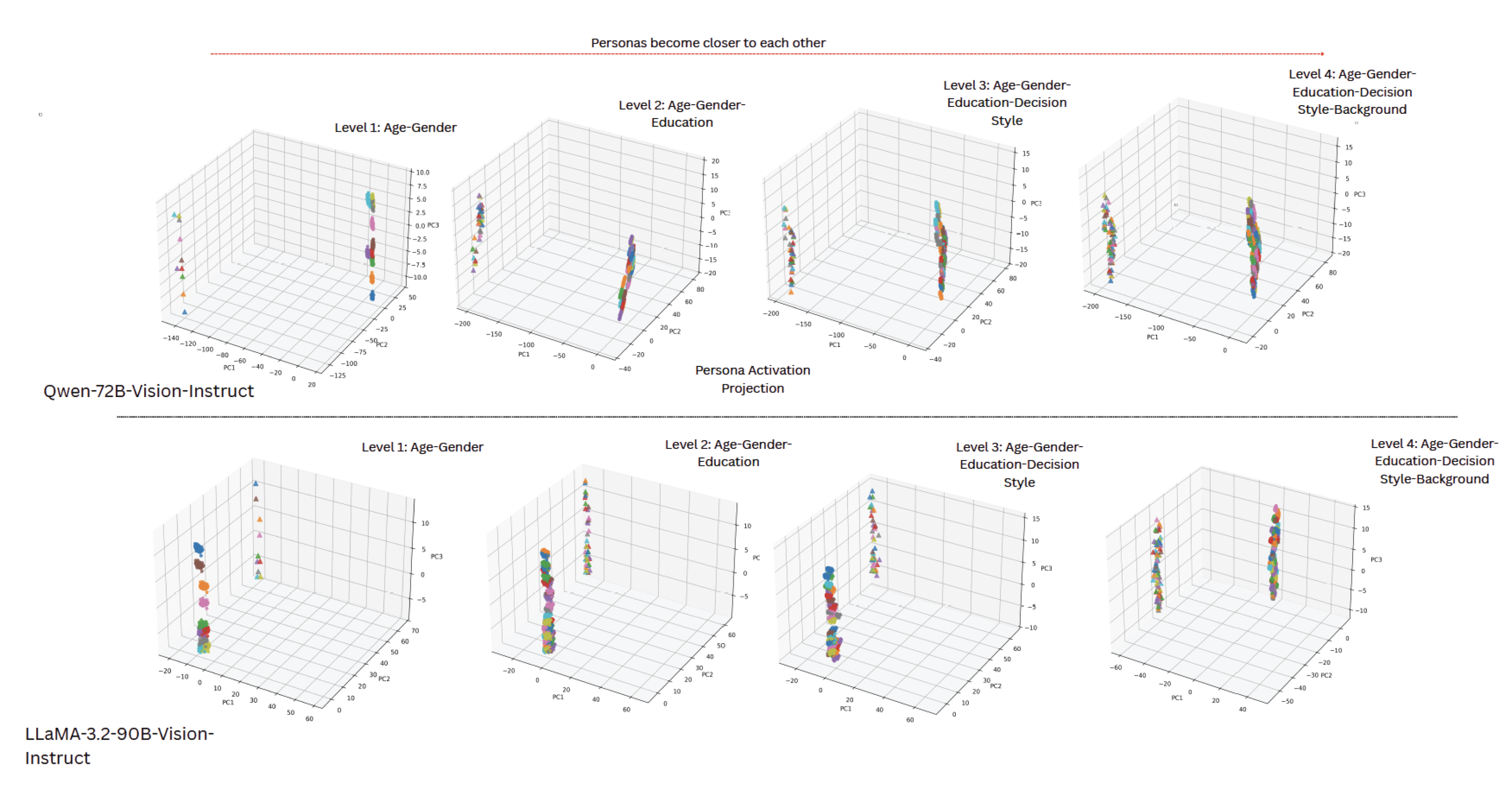
Disclaimer/Publisher’s Note: The statements, opinions and data contained in all publications are solely those of the individual author(s) and contributor(s) and not of MDPI and/or the editor(s). MDPI and/or the editor(s) disclaim responsibility for any injury to people or property resulting from any ideas, methods, instructions or products referred to in the content. |
© 2026 by the authors. Licensee MDPI, Basel, Switzerland. This article is an open access article distributed under the terms and conditions of the Creative Commons Attribution (CC BY) license.
Copyright: This open access article is published under a Creative Commons CC BY 4.0 license, which permit the free download, distribution, and reuse, provided that the author and preprint are cited in any reuse.


