

Submitted:
31 May 2026
Posted:
01 June 2026
You are already at the latest version
Abstract
In this work, truth is modeled as a continuous field variable rather than as a set of discrete symbolic values. The interactions between propositions are described by saturating nonlinear dynamics, and it is shown that, under sufficiently strong collective coupling, the system separates into bipolar stable truth phases. After this separation, the application of a threshold projection leads to the emergent appearance of classical Boolean logic. Within this framework, Boolean separation is not interpreted as an axiomatic structure imposed from the outset, but as the stabilized macroscopic limit of an underlying continuous truth field. Pitchfork bifurcation analysis and local Lyapunov stability are investigated through numerical simulations, showing that Boolean-like separation arises as a stable phase organization generated by collective nonlinear interactions among continuous truth variables. Numerical analyses are also performed for finite N-dimensional systems, demonstrating that Boolean-like separation persists beyond the one-dimensional reduction and appears in higher-dimensional collective regimes. The study further proposes that arithmetic and Gödel incompleteness should not be regarded as direct properties of continuous truth dynamics, but as conse quences of discretized recursive symbolic regimes. Finally, logic gates and digital computational structures are reinterpreted as stable threshold phases emerg ing from continuous truth dynamics, suggesting a conceptual framework for analog computation, neuromorphic systems, and emergent artificial intelligence architectures.
Keywords:
logic
; dynamics
; Gödel incompleteness
; Boolean
1. Introduction
In 1900, at the International Congress of Mathematicians in Paris, David Hilbert delivered his famous address on the future of mathematics. In this lecture, Hilbert presented some of the most important mathematical problems of his time, while also expressing a profound conviction concerning the foundations of mathematics. According to this view, mathematics had to be grounded upon secure axioms and exact logical rules. If the human mind could construct a sufficiently clear and consistent formal system, then mathematical truths could, in principle, be obtained in a systematic way.
Hilbert’s program may be understood, in broad terms, as the attempt to place the whole of mathematics upon a reliable formal foundation. Within this perspective, mathematics was not merely a technique of calculation, but the most fundamental language through which the order of nature and the structure of reason could be understood. If mathematics could be fully reduced to an axiomatic foundation, then the laws of nature themselves might also be understood within a logical and formal order.
However, in 1931, Kurt Gödel drew a profound boundary around this optimistic project through his incompleteness theorems. Gödel showed that if a formal system is consistent, effectively axiomatized, and sufficiently strong to express the arithmetic of the natural numbers, then there exist statements within that system which are true but not provable by the system’s own rules. Moreover, such a system cannot fully prove its own consistency from within itself.
This result constituted a major turning point in the history of mathematics. The issue was no longer merely that some problems were difficult to solve. Rather, the issue was that a formal system possesses intrinsic limitations in principle. In other words, a sufficiently powerful logical system cannot contain and prove all truths expressible within its own language by means of its own internal resources.
This limitation later appeared in a different form within digital systems and the theory of computation. Computers are fundamentally built upon symbolic rules, algorithms, and two-valued logic. Boolean algebra provides a clear example of this structure: in digital systems, information is often processed through discrete oppositions such as true/false, on/off, and . This structure is extremely powerful; nevertheless, it does not constitute an unlimited system capable of computing everything.
Standard Boolean models of computation [1,2] assume the state space to be discrete from the outset:
A broad theoretical framework extending from formal logic to digital computation theory is built upon the assumption that truth values are fundamentally binary and discrete. However, the question of why truth should necessarily be discrete is often treated axiomatically, while the possible dynamical origin of this discreteness remains largely unexamined.
By contrast, modern physics and complex systems theory show that sharp macroscopic structures are not always given at the fundamental level. Phase transitions, symmetry breaking, stable attractor structures, and the formation of order parameters provide fundamental examples of how discrete macroscopic regimes may arise from continuous variables. In this respect, the present work is also conceptually related to the literature on metric structures and continuous logical frameworks [3].
In this study, truth is modeled not initially as a discrete Boolean value, but as a bounded continuous variable:
The interactions between propositions are defined through nonlinear and saturating dynamics. When the collective coupling becomes sufficiently strong, the neutral truth regime loses stability and the system separates into bipolar stable phases. When a threshold projection is applied to these phases, effective Boolean-like regimes emerge. Thus, Boolean separation is interpreted not as a fundamental axiom, but as the symmetry-broken macroscopic limit of an underlying continuous truth dynamics.
The aim of this work is not to construct a complete theory of formal logic. Rather, it proposes a minimal dynamical framework showing how discrete logical structures may become stabilized through collective nonlinear interactions among continuous truth variables. In this framework, the nonlinearity parameter is not merely a technical saturation coefficient; it acts as an effective bifurcation parameter controlling the transition from a neutral regime to binary stable phases.
Existing approaches to many-valued logic, continuous logic, fuzzy logic, and dynamical neural networks have extensively studied continuous truth values and collective dynamics [4,5,6]. However, in many of these approaches, the Boolean structure is either assumed as a fundamental regime from the outset or treated as a static output layer imposed upon continuous variables. The present work differs by asking under which dynamical conditions the discrete symbolic regime itself may arise. Accordingly, the Boolean-like structure is treated not as an externally imposed assumption, but as the outcome of collective phase organization.
The proposed framework also shares mathematical and conceptual similarities with mean-field Ising systems, Landau-type symmetry breaking, and Hopfield-type collective network dynamics [6,7,8]. Concepts such as order parameters, stable phases, bifurcation, and the thermodynamic limit support the physical intuition of the model. Nevertheless, the present construction is not intended as a direct reproduction of these theories, but as a distinct interpretive framework focused on the dynamical origin of logical discreteness.
At this point, there is a deep conceptual affinity between Gödel’s incompleteness theorems and Turing’s halting problem. Turing showed that there can be no general algorithm capable of determining, for every possible program and input, whether that program will eventually halt. This result demonstrates that digital systems cannot answer certain questions about their own behavior in a completely general and definitive way.
Thus, the issue is not merely technical; it is also philosophical and ontological. When a system turns back upon itself, that is, when it asks questions about its own structure, truth, consistency, or behavior, it encounters certain intrinsic limits. Gödel made this boundary visible within mathematical formal systems, while Turing revealed an analogous boundary within systems of computation.
This perspective also motivates an alternative interpretation concerning the status of arithmetic and Gödel incompleteness. Gödel-type mechanisms require discrete symbolic representation, arithmetization, recursion, and self-reference. Modern formalizations of Gödel’s theorems in Isabelle/HOL, Coq, Lean 4, and related theorem-proving systems make these representational conditions explicit [9,10,11,12,13,14]. The present work does not claim that Gödel incompleteness is eliminated or invalidated. Rather, it suggests that the discrete-arithmetic conditions required for incompleteness may themselves arise within a particular symbolic regime generated from an underlying continuous truth dynamics.
In this sense, the study proposes an alternative perspective on the origin of logic: Boolean structures are treated not as primitive axioms, but as stable macroscopic outcomes of continuous nonlinear truth dynamics. This approach establishes conceptual connections with phase transitions, collective computation, analog information processing, neuromorphic systems, and emergent computation.
Therefore, modern logic and computation theory teach us not only the power of formal systems, but also their limits. Mathematics, logic, and digital systems remain among the sharpest tools available for understanding nature and thought. Yet these tools themselves operate within certain boundaries. Truth may not always be completely enclosed within a single formal system.
The remainder of the paper is organized as follows. Section II introduces the continuous truth phase space. Section III defines the nonlinear saturating interaction operator. Section IV presents the fundamental truth dynamics. Section V analyzes critical behavior, symmetry breaking, and bistable phase formation. Section VI provides numerical evidence in finite N-dimensional systems. Sections VII and VIII discuss the emergence of arithmetic and Gödel regimes. Finally, Section IX interprets logic gates and emergent computational structures as projections of stable attractor regimes.
2. Continuous Truth Phase Space
In contrast to classical Boolean models s [1,2] in this study each i-th proposition is represented by a continuous and bounded dynamical variable:
Here, denotes absolute truth, denotes absolute falsity, and denotes a symmetric unstable, or neutral, state. This bounded structure is compatible with the semantic limits of classical many-valued logics. Whether this structure satisfies the requirements of a t-norm will be analyzed in detail in the following sections. The total configuration of the system is given by the vector . The state space of the collective system is defined as
In this work, each proposition is therefore represented not by a discrete Boolean value, but by a continuous and bounded truth variable. Moreover, the system parameters are chosen so as to ensure that the truth variables remain within the bounded phase space, thereby allowing the system to develop stable bipolar phases.
3. Nonlinear Truth Interaction
3.1. On Nonlinear Structures and Continuity
In classical logic, truth operations are defined by discrete symbolic rules. Within this framework, truth is treated from the outset in terms of sharply separated and static symbolic values.
However, modern physics and complex systems theory show that many fundamental structures in nature do not, in fact, behave linearly, but rather evolve under nonlinear interactions. Especially in strong-interaction regimes, the behavior of systems may deviate significantly from simple additive rules.
For example, in special relativity, the composition of velocities is not given by classical Newtonian addition. Instead, a saturating composition law arises, naturally expressed in terms of rapidity. Similarly, in fluid dynamics, ideal linear behavior is only an approximate regime; many physical fluids exhibit nonlinear interactions in practice. In the case of non-Newtonian fluids, the effective behavior of the system changes depending on the magnitude of the applied interaction.
The same situation also appears in electromagnetic systems. In the weak-field regime, optical processes behave approximately linearly, whereas in strong-field regimes nonlinear optical effects emerge and the system deviates from the superposition principle.
These observations lead to a more general question: must truth structures necessarily be linear and discrete at the fundamental level?
It may be that classical Boolean logic is only a weakly interacting or stabilized limiting regime. At a more fundamental level, truth values may instead be continuous dynamical quantities interacting with one another in a nonlinear manner.
This is the basic point of departure of the present study. The interaction between propositions is defined by a nonlinear and saturating operator that keeps the truth values of the system within the interval :
Please see Appendix 1 for details. Here, the parameter is a control parameter that determines the degree of nonlinearity of the interaction and, consequently, the logical stability of the system.
3.2. Truth Assignment for Arithmetic Propositions
3.2.1. Discussion on Variables of and
In the present framework, the continuous truth variables may be interpreted in two related ways. First, when a proposition is considered individually, may represent the degree to which that proposition approaches truth. Second, when propositions are considered collectively, may also participate in relational structures describing how one proposition interacts with others. For this reason, two distinct parameters are introduced in the present study. These parameters will be denoted by and . The aim of this section is to clarify the conceptual roles of these two parameters.
The conceptual distinction between and may be clarified through a simple example.
Example 1.
Let
and
In this context, ε is not the parameter that determines whether a single proposition is true by itself. Rather, ε controls the sharpness of the nonlinear interaction between different truth variables. In other words, it determines how strongly and how sharply propositions such as P and Q influence one another within the truth dynamics.
For example, the proposition P, namely that Alice has left school, may support the proposition Q. If Alice has left school, then it becomes more plausible that she may have gone home and started listening to music. Therefore, a supportive relation may be established between P and Q. In the language of the model, this supportive relation is represented by the coupling structure between the corresponding truth variables, while ε controls how sharply this relation acts in a nonlinear manner.
By contrast, κ is associated with the assignment of a truth value to a single proposition. For instance, the proposition Q states that Alice has been listening to music at home for exactly 30 minutes. However, the actual duration may be 25 minutes, 28 minutes, or 30 minutes. The parameter κ controls how strongly such deviations affect the truth value assigned to Q. If κ is large, even a small deviation from 30 minutes rapidly drives the truth value away from the positive truth phase. If κ is small, the assignment is more tolerant, and durations close to 30 minutes may still be represented by intermediate truth values.
Thus, and play different conceptual roles. The parameter is related to the sharpness of the internal truth assignment of an individual proposition, whereas is related to the sharpness of the nonlinear interaction between different propositions. In this sense, corresponds to the internal evaluation of a proposition, while corresponds to relational consistency and collective dynamical interaction among propositions.
This distinction has ontological significance within the present framework. Truth is not assumed to be a fixed symbolic value given from the outset. Instead, a proposition first acquires a continuous truth phase through an assignment mechanism controlled by , and this truth phase then participates in a network of nonlinear interactions controlled by . Consequently, the emergence of Boolean-like regimes depends not only on the truth values of isolated propositions, but also on the collective organization of relations among propositions.
In the most general setting, need not be identical to the nonlinear interaction parameter . However, in this framework, the minimal one-parameter version of the model may be obtained by setting . The case may be investigated in future work, whereas in the present study we restrict attention to the minimal case . Now, let’s examine another example related to the definted identity 5.
Example 2.
The continuous truth variables do not represent numerical magnitudes themselves. Rather, they represent the truth phase of propositions. Therefore, an arithmetic expression such as is not represented by applying the nonlinear truth operator directly to the numbers 3 and 2. Instead, the whole statement is treated as a proposition with an associated continuous truth value.
For an arithmetic proposition of the form
we define its residual by
Then, a continuous truth assignment may be introduced as
Thus, if , then and
If , then , and in the sharp limit one obtains .
whereas
and
so that both false statements approach the negative truth phase as .
This distinction is important: arithmetic evaluation and truth-phase stabilization are different representational layers. The nonlinear operator introduced below acts on truth variables, not directly on arithmetical magnitudes.
3.3. Construction of the Operator and the Algebra
The basic properties of this operator are as follows:
- 1.
- Boundary Preservation: Due to the normalization of the system, for every , one has . Thus, Eq. 4 forms a closed phase space under this operator. Please see Appendix 1.1.
- 2.
-
Asymptotic Limits:
- Weak Coupling (): The operator reduces to the linear averaging operation . In this regime, the system exhibits a linear averaging behavior and loses nonlinear logical separation. Please see Appendix 1.6.
- Strong Coupling (): The operator converges to the function . This represents the transition of the system from a continuous truth regime to the binary limit of Boolean logic. Please see Appendix 1.7.
At this point, one may ask why a different nonlinear structure was not chosen. The normalized hyperbolic tangent form is not an arbitrary choice. It is selected as a minimal smooth saturating response that simultaneously satisfies boundedness, symmetry, monotonicity, odd symmetry, the linear averaging limit in the weak-coupling regime, and Boolean-like saturation conditions in the strong-coupling regime. Other sigmoid responses satisfying the same conditions may qualitatively belong to the same universality class; however, the tanh form is used because it provides the analytically simplest representative of this class.
This structure shows that the truth field constitutes a dynamical and nonlinear phase space governed by the control parameter . Therefore, should not be interpreted merely as a technical saturation parameter, but rather as a nonlinearity parameter controlling the transition of the system from a linear regime to bipolar stable behavior. The operator algebra used in this setting explicitly satisfies fundamental algebraic properties such as closure, commutativity, monotonicity, odd symmetry, smoothness, and saturation; however, it does not satisfy associativity or the existence of a unit element. This is an expected outcome for a nonlinear interaction algebra. For this reason, the present structure cannot be regarded as a t-norm in the strict sense. At this stage, the proposed framework differs from continuous-valued logical systems in the literature, such as fuzzy logic, as well as from dynamical neural network models [6].
4. Truth Dynamics
The truth-state variables of propositions are assumed to evolve in time:
The coupling structure between propositions is defined by an interaction matrix
Here, represents a supportive interaction, represents a suppressive interaction, and corresponds to the absence of direct coupling. Please see Appendix 3. The fundamental dynamical equation of the system is given by
In order to ensure that the hypercube is positively invariant under the flow, we impose the sufficient row-sum condition
Indeed, since
one has
Therefore, at the vector field satisfies , while at it satisfies . Hence the bounded phase space is preserved by the dynamics.
In Hopfield’s continuous neural network model, the leakage term functions as a dissipative mechanism that prevents unbounded growth of the activity and enables the system to relax toward stable attractor states [15]. In a similar manner, the term in the present work may be interpreted as a damping contribution that allows the continuous truth variables to settle into stable bipolar phases.
Here, denotes the linear relaxation coefficient, while is the control parameter determining the sharpness of the nonlinear coupling. Eq. 8 combines linear damping, collective coupling, and saturating nonlinear interaction within the same minimal dynamical structure. Therefore, the system can be interpreted not only as a logical model, but also as a dynamical field model.
4.1. Phase Transition and Bistable Regimes
In order to examine the transition of the system from the neutral truth regime to bistable phases, a symmetric two-variable reduced system is considered. Under symmetric initial conditions, , the dynamical equation reduces to
The fixed points are obtained from the condition . The trivial solution, which is always present, is . The stability of this solution can be determined by linearizing the system around .
Using the approximation
the system takes the form
Please see Appendix 3 for details. Thus, the critical coupling threshold is obtained as
For , the neutral solution remains stable, whereas for , the system undergoes a supercritical pitchfork bifurcation and separates into two symmetric stable phases. The phase space is preserved throughout this process; see Appendix 3.1.
4.2. Numerical Analysis
Two numerical analyses were performed in this section.
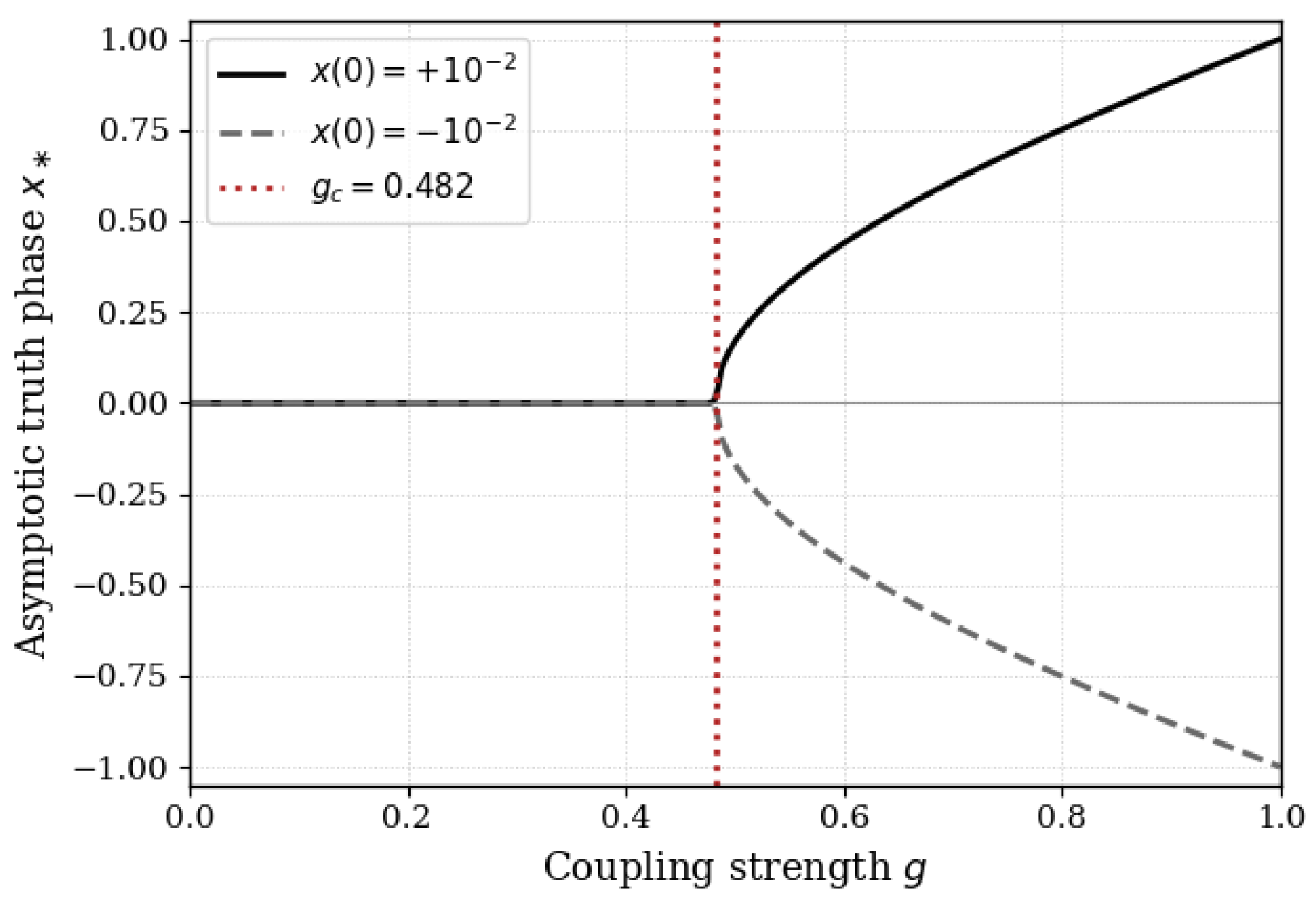
4.2.1. The Pitchfork Bifurcation
The first one is a numerical analysis of the pitchfork bifurcation. In this analysis, 300 distinct values of were considered, with and , and the corresponding fixed-point values of x were examined. The results show that the pitchfork bifurcation occurs at the theoretically predicted value . Since g is restricted to the specified interval and the dynamics preserve the bounded phase space, the resulting x-values remain within and, as expected, approach the Boolean regime as attractor states.
Figure 1.
Pitchfork bifurcation analysis of the reduced truth dynamics.
4.2.2. Critical Behavior, Landau Dynamics, and Local Stability
The behavior of the reduced dynamical system near the critical threshold can be described by a Landau-type normal form; see Appendix 2. In this regime, the dynamics locally take the form
Here, is the effective control parameter determining the stability of the neutral regime. This equation is the standard normal form of a supercritical pitchfork bifurcation and provides a local description of the symmetry-breaking transition near the critical threshold.
The fixed points are obtained from . For , only the neutral fixed point is stable. For , the neutral point loses stability and two symmetric nontrivial fixed points appear:
Thus, the system separates from the neutral truth regime into two Boolean-like stable phases.
The local stability is determined by the Lyapunov exponent
Hence, at the neutral point , one has , so the neutral phase is stable for , critical for , and unstable for . At the nontrivial fixed points , one obtains for , showing that these two branches are locally stable.
This stability exchange is the local dynamical signature of the transition from a continuous neutral truth regime to two Boolean-like attractor phases. Therefore, the Boolean regime is not imposed externally, but appears as the stable macroscopic outcome of the underlying Landau-type bifurcation structure.
This result shows that Boolean-like discrete regimes may be interpreted as stable phase organizations emerging from collective nonlinear interactions among continuous truth variables. Thus, the model provides a Landau-type phase transition mechanism connecting continuous truth dynamics with discrete binary regimes. However, while in standard Landau theory the phase transition is usually interpreted as the critical behavior of a physical order parameter, in the present framework the Boolean regime itself appears as a product of the bifurcation structure. Moreover, allowing the control parameter to vary in time makes the theory capable of supporting computational processes.
In this sense, the Landau-type normal form does not merely provide a formal analogy. It shows that the transition from continuous truth values to Boolean-like stable phases belongs to the same universal class of symmetry-breaking mechanisms that appear in many collective physical systems. The Boolean regime is therefore not imposed externally, but emerges as the stable macroscopic outcome of the underlying nonlinear truth dynamics.
Figure 2.
Local Lyapunov stability of the truth phases.
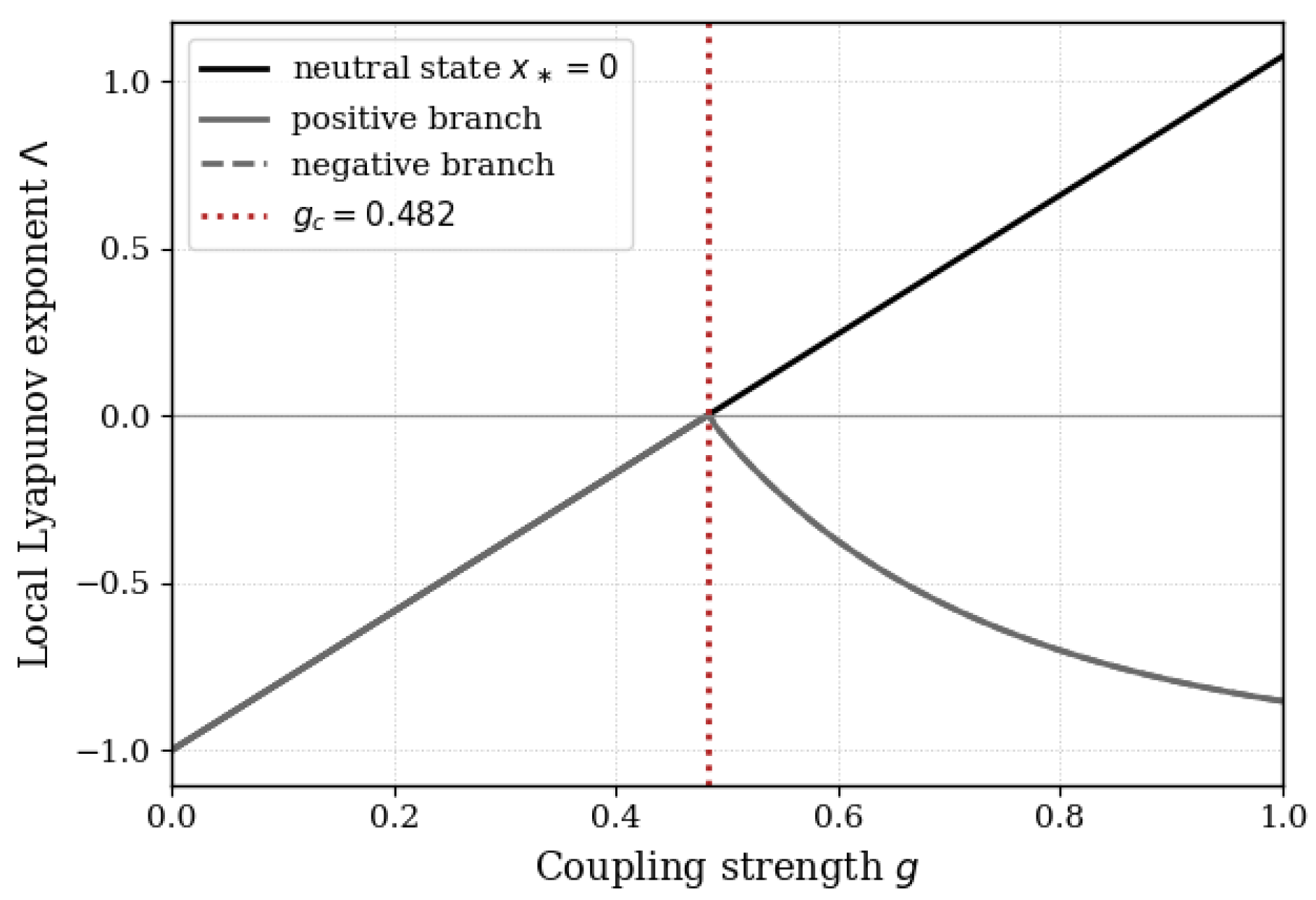
Following the numerical analysis, the expected results were obtained. In this part, a table and a graph are presented for the values of in the regimes , , and . According to the numerical results, the maximum value reached by x is bounded as . This saturation behavior may be interpreted as the limiting Boolean regime of the proposed continuous truth dynamics.

Table 1.
Local stability of the reduced truth dynamics near the pitchfork bifurcation. The sign of the Lyapunov exponent determines whether perturbations around a fixed point decay or grow.
Table 1.
Local stability of the reduced truth dynamics near the pitchfork bifurcation. The sign of the Lyapunov exponent determines whether perturbations around a fixed point decay or grow.
| Regime | Fixed point | Stability | |
|---|---|---|---|
| stable neutral phase | |||
| critical | |||
| unstable neutral phase | |||
| stable Boolean-like phases |
4.3. Phase Separation and Threshold Projection
For , the neutral solution remains stable. By contrast, for , the neutral fixed point loses stability and the system separates into two symmetric stable phases:
In the boolean-like limit of the theory, and as it is shown in the Figure 1. This structure shares the same qualitative behavior as classical symmetry-breaking mechanisms. Hence, under sufficiently strong collective interaction, the system undergoes a transition from a continuous truth regime to binary stable phases.
Once the stable phases have formed, the transition from continuous truth variables to discrete Boolean-like values is defined through the following threshold projection:
Under this projection, the continuous truth variables in Eq. 6 are mapped to discrete values as
The proposed dynamical structure shares certain mathematical features with mean-field Ising models and collective bifurcation systems. In particular, the symmetry breaking and phase separation emerging near the critical threshold show that continuous truth variables can organize into binary stable regimes under collective nonlinear interactions. Therefore, Boolean-like binary regimes are not fixed structures given from the outset, but rather stable phase organizations emerging from collective nonlinear interactions among continuous truth variables.
5. Analysis of Multidimensional Systems
The analyses carried out so far have been performed for a symmetric two-variable sector, not a N-dimensional systems. Therefore, it is necessary to determine whether the reduction to the Boolean regime is merely a consequence of the one-dimensional structure of the system. In this section, the system is considered for , in order to investigate whether similar behavior persists beyond an overly symmetric and one-dimensional setting.
In the general N-dimensional case, the instability threshold is not determined only by the scalar reduced coupling g, but by the linearized spectrum of the full interaction structure. Let the coupling matrix be written as
where A is a fixed interaction matrix. Linearizing Eq. 8 around the neutral state , one uses
Thus, the linearized dynamics become equivalently, in matrix form,
where is the diagonal matrix defined by and denotes the spectrum, i.e. the set of eigenvalues, of a matrix M.
Hence, if
the corresponding critical coupling is
For interaction structures in which this linearized collective mode reduces to the symmetric two-variable sector, one recovers the reduced threshold used in Eq. (13). It should be emphasized that, in the N-dimensional case, this condition represents a spectral loss of stability of the neutral state, not necessarily a simple pitchfork bifurcation in the full phase space.
In other words, the system is not necessarily forced to evolve toward a completely positive or completely negative phase. Partial phases, mixed states, metastable structures, and domain-like separations may also arise. For this reason, the N-dimensional test provides a more realistic setting for assessing the robustness of the proposed dynamical mechanism.
In the numerical analysis, the coupling parameter g is sampled at 81 distinct values, and the dynamics are evaluated for system sizes . The quantity is used as an effective order parameter measuring the degree of Boolean-like polarization in the asymptotic state. If this quantity remains nonzero as N increases, the observed phase separation cannot be attributed to a finite-size or one-dimensional artifact; rather, it indicates a robust collective emergence of Boolean-like order in the N-dimensional system.
Figure 3.
N-dimensional analysis of the collective truth dynamics.
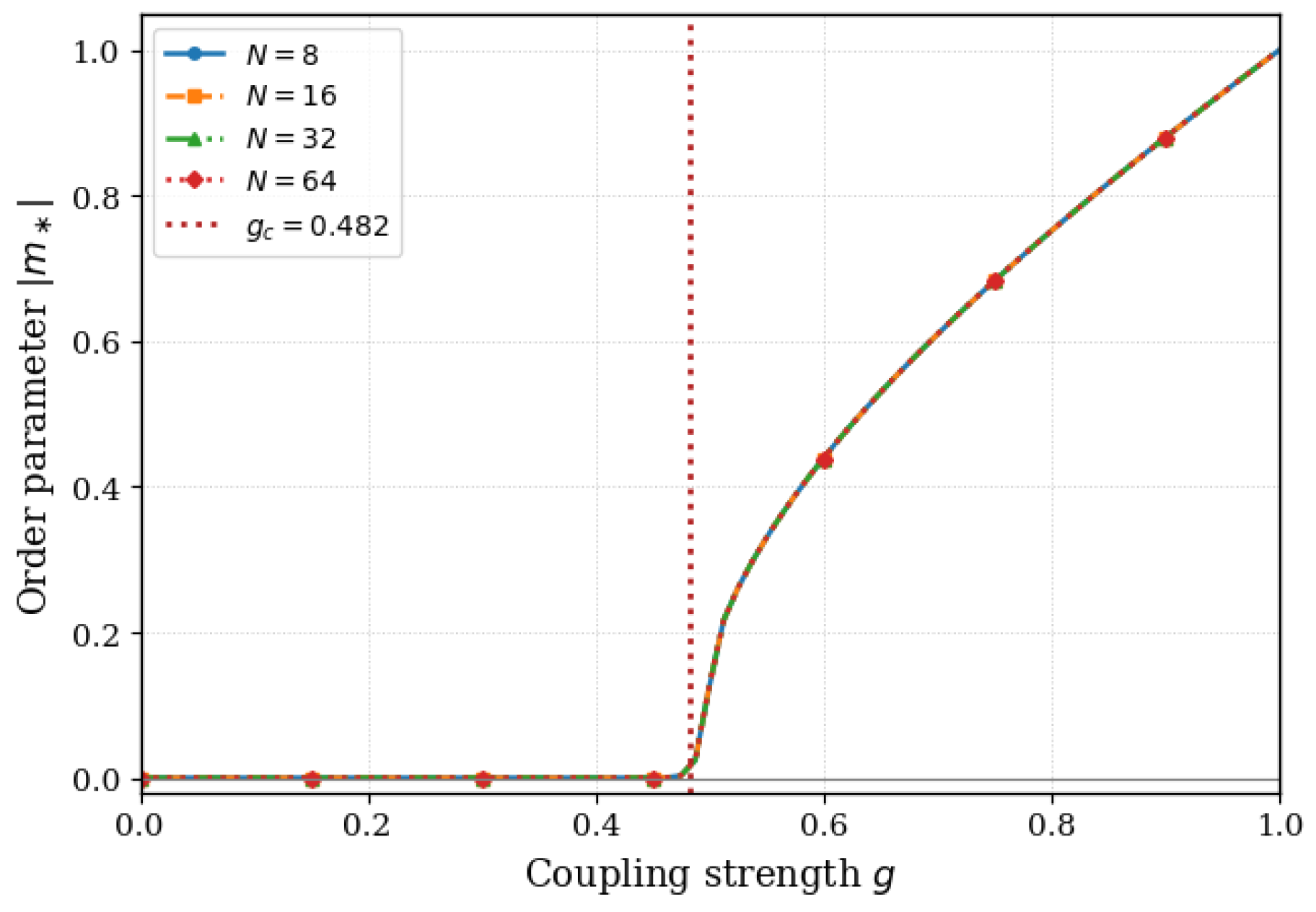
The results indicate that the bipolar truth phases are not merely artifacts of the one-dimensional reduction. Rather, they also emerge as collective attractors in finite N-dimensional systems. This provides further support for the proposed theoretical framework.
6. Emergence of the Arithmetic and Gödel Regime
Classical arithmetic and Gödel’s incompleteness theorem rely, by their very nature, on discrete, countable, and recursive structures of representation. In particular, for the Gödel mechanism to operate, symbolic expressions must be encodable by natural numbers, reproducible discrete states must be available, and formal proof relations must be definable in a recursive manner.
In the proposed model, however, truth is not treated initially as a collection of discrete symbols, but rather as a continuous dynamical phase variable. Therefore, discrete symbolic structures and arithmetical organization may be interpreted not as axiomatic objects given at the fundamental level, but as effective regimes emerging from continuous truth dynamics.
At the level of the continuous truth field in Eq. 3, the question “how many?” is not directly meaningful. Counting can only be defined over discrete and reproducible states. By contrast, after the threshold projection, the variables in Eq. 19 are obtained, and the system begins to generate discrete symbolic states.
Within this framework, the formation of the Boolean-like regime enables not only the separation of truth states, but also the emergence of discrete symbolic organization. Consequently, a regime arises in which structures such as natural numbers, recursion, and formal arithmetic can be effectively defined.
In this context, the ontological chain may be expressed as follows:
where, represents finite binary strings. The critical point in this chain is that the transition from continuity to discrete symbolic structure produces the countability and discrete representational conditions required for Gödel’s mechanism of self-reference to operate.
Gödel’s classical proof is based on Gödel numbering and self-referential arithmetical coding techniques. Although later developments introduced alternative frameworks, such as Rosser’s refinement, computability-theoretic proofs based on Turing’s Halting Problem, Kripke–Putnam model-theoretic perspectives, and modern formalizations in theorem provers, all of these approaches still rely on mechanisms of discrete encodability, recursion, and symbolic representation.
Thus, in the present framework, the Gödel regime is not interpreted as a direct property of the continuous truth field itself. Rather, it is understood as a higher-level regime that becomes meaningful only after the emergence of discrete, countable, and recursively organized symbolic structures. In this sense, incompleteness is not treated as an immediate feature of truth as a continuous dynamical field, but as a structural consequence of the arithmetized symbolic layer that emerges after threshold projection and recursive organization.
7. The Gödel Sentence and the Continuous Truth Regime
The classical Gödel incompleteness mechanism relies on discrete and recursive symbolic structures. In particular, the Gödel sentence
can only be defined within formal systems that are arithmetized and recursively representable. In classical two-valued logic, the Gödel sentence is defined in the form of Eq. 27, expressing its own unprovability. Assuming that the system F is consistent, if G were provable, it would simultaneously imply its own unprovability. Therefore, within the classical formal regime, G emerges as a proposition that is “true but unprovable.”
In the proposed model, however, truth is not initially treated as a discrete symbolic value, but as a continuous dynamical variable:
The classical Boolean truth value arises only after threshold projection:
Therefore, the emergence of the Gödel mechanism can be conceptually related to the chain in Eq. 26. Within this interpretation, the activation of structures such as self-reference and arithmetical coding appears to be connected to the transition from the continuous truth regime to discrete symbolic organization. This also motivates a new perspective on the Gödel sentence; see Appendix 4.
The approach proposed in this work does not aim to invalidate Gödel’s incompleteness theorem. Rather, its aim is to reinterpret, from a dynamical perspective, the representational regimes in which the Gödel mechanism arises. In this framework, Gödel incompleteness is not treated as a direct property of continuous truth dynamics, but as a structural mechanism that emerges within formal regimes that have been discretized, symbolically organized, and arithmetized.
8. Logic Gates and Emergent Computational Structures
8.1. AND and NAND Gates
In classical digital computation systems, logic gates are defined directly on discrete Boolean values. For example, the classical AND operation is given by the following truth table:
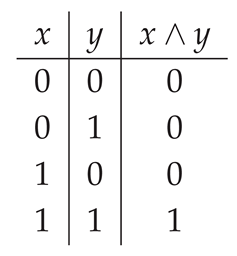
In this approach, logic gates are regarded as axiomatic structures given from the outset. In the model proposed in this work, however, the fundamental variables are not discrete Boolean values, but continuous truth variables as given in Eq. 3. Under sufficiently strong collective coupling, , the system separates into the bipolar stable phases described in Eq. 17. After threshold projection, the discrete states in Eq. 19 are obtained. Within this framework, Boolean logic gates are interpreted not as symbolic structures imposed from the outset, but as projections of stable attractor regimes formed within the continuous truth dynamics.
To make this projection explicit, let the positive stable phase represent the Boolean value 1, while the negative stable phase represents the Boolean value 0. The threshold projection is defined by
These gate expressions are not primitive operations on arbitrary continuous truth values; they reproduce Boolean gates after the variables have relaxed to the bipolar attractor phases.
Then an AND-like gate can be defined by
For ideal Boolean phase inputs , this expression gives
while
Thus, the output becomes one only when both inputs lie in the positive stable phase.
The corresponding NAND-like gate is most naturally defined as the Boolean complement of the projected AND-like phase organization:
Using Eq. 32, this can be written as
Hence, the NAND output vanishes only when both inputs belong to the positive stable phase, while all other ideal Boolean phase configurations are mapped to one. It should be emphasized that the NAND operation is defined here as the Boolean complement of the projected AND phase. This convention avoids boundary ambiguities associated with the threshold rule , while still reproducing the classical NAND truth table for ideal bipolar inputs.
8.2. OR and NOR Gates
In this subsection, the OR and NOR gates’ expressions will be discussed. The OR gate is given as
and the NOR gate follows as
It should be specifically emphasized that, in Boolean algebra, negated logic gates such as NAND and NOR are defined as the complements of the corresponding AND and OR gates, respectively. In the minimal construction adopted in the present work, the same Boolean convention is followed, and NAND and NOR are taken as the complements of the threshold-projected AND and OR phases. This choice is made in order to keep the gate construction minimal and directly connected to the threshold-projected Boolean regime.
Nevertheless, in the proposed model, this does not imply that NAND and NOR cannot possess more general continuous phase representations. In a more general formulation, negated gates may be defined separately, with their own boundary conventions, stability structures, and independent dynamical expressions. computation is therefore interpreted as a layered dynamical process: continuous truth variables first organize into stable phases under collective nonlinear interactions and are then reduced to discrete Boolean states through threshold projection. Hence, discrete logical structure is not taken as fundamental, but arises as an asymptotically stable limit of the continuous phase space. In this sense, logic gates may be viewed as effective symbolic projections of deeper continuous attractor dynamics. Future work may extend this analysis to other logical structures, such as quantum gates and more general computational architectures.
9. Discussion and Conclusion
In this work, it has been proposed that classical Boolean logic may not be a fundamental axiomatic structure given from the outset, but may instead arise as a stable phase regime emerging from collective nonlinear interactions among continuous truth variables. The interactions between propositions were modeled through saturating nonlinear coupling operators. The minimal dynamical structure constructed in this study shows that, under sufficiently strong collective coupling, the neutral truth regime loses stability and separates into bipolar stable phases. After the application of a threshold projection, effective Boolean-like regimes emerge:
The Landau-type effective dynamics obtained near the critical region shows that the proposed model shares the same mathematical behavior class as classical symmetry-breaking and phase-transition mechanisms. Within this framework, Boolean separation is interpreted not as a discrete logical structure given at the outset, but as a self-organized stable macroscopic phase of the continuous truth field.
It is important to emphasize that the continuous formulation does not merely reproduce the binary distinction between truth and falsity. Before the threshold projection is applied, the variables also encode the degree to which a proposition approaches truth or falsity. In this sense, the model retains graded semantic information that is lost in a purely discrete Boolean description. This feature is conceptually significant, since many real-world cognitive, physical, and informational processes do not operate through perfectly sharp binary distinctions, but rather through intermediate degrees.
The connection with mean-field Ising-type models and Landau-type effective dynamics is also central to the interpretation of the proposed framework. The mean-field Ising analogy shows that collective interactions can generate macroscopic order from microscopic degrees of freedom, while the Landau-type normal form captures the universal structure of the symmetry-breaking transition near the critical threshold [7,8]. Thus, the emergence of Boolean-like phases is not introduced as a merely formal assumption, but is embedded within a broader class of physical mechanisms in which stable macroscopic regimes arise through collective organization and bifurcation dynamics.
Continuous truth structures have long been studied in existing approaches to continuous logic, fuzzy logic, and dynamical neural networks. However, in much of this literature, the Boolean structure is either assumed as a fundamental regime from the outset or treated as an approximate output limit of continuous dynamics. By contrast, in the present work, discrete Boolean-like regimes are interpreted as stable phase organizations emerging from collective nonlinear interactions among continuous truth variables. In this respect, the proposed model offers a minimal perspective suggesting that logical discreteness may have a dynamical and phase-transitional origin rather than a directly axiomatic one.
The study also proposes an alternative conceptual interpretation of the status of arithmetic and Gödel incompleteness. In this approach, discrete symbolic structures emerge through thresholding and discretization processes acting on continuous truth dynamics; structures such as counting, recursion, and formal arithmetic become available only after the formation of this discrete regime. Therefore, Gödel incompleteness is reinterpreted not as a direct property of the continuous truth field itself, but as a consequence of discretized symbolic-arithmetical structures. Nevertheless, the present work does not claim to provide a complete formal theory that eliminates Gödel incompleteness. Its aim is rather to offer an alternative dynamical perspective on the origin of the representational conditions under which incompleteness arises.
Similarly, the study suggests that logic gates and digital computational structures may be interpreted as projections of stable attractor regimes formed on continuous truth dynamics. Within this framework, computation is reconsidered not merely as symbolic manipulation, but as a process involving stability formation, phase selection, attractor organization, and collective nonlinear dynamics. In this way, the proposed approach establishes direct conceptual connections with analog computation, continuous logic architectures, neuromorphic systems, and emergent artificial intelligence systems.
The proposed model is still a minimal theoretical framework and does not claim to construct a complete formal system of logic. Nevertheless, the bifurcation structures, stability regimes, and collective organization properties revealed by the model point toward a deeper structure from the perspective of statistical physics and thermodynamics. Similarly, incorporating stochastic truth flows and noise-driven bifurcation mechanisms appears important for understanding more realistic forms of collective behavior.
From the perspective of further mathematical formalization, several problems remain to be investigated. These include the detailed structure of the operator algebra, its relations to t-norms and MV-algebras, continuous semantic formalisms, continuous provability operators, and recursion structures defined over continuous truth spaces. In particular, a complete analysis of the algebraic properties of the proposed nonlinear operator may allow the model to be evaluated within a stronger mathematical framework.
A particularly important direction for future work concerns the possible relevance of this framework to the foundations of quantum theory. One of the central conceptual questions in quantum mechanics is whether nature is fundamentally probabilistic, discontinuous, and measurement-dependent at its deepest level, or whether the apparent discreteness and probabilistic structure of quantum phenomena may arise from a deeper continuous, objective, and dynamically organized substrate. This question is closely related, at the conceptual level, to the historical debates initiated by Einstein concerning the completeness and ontological interpretation of quantum mechanics. In particular, the Einstein–Podolsky–Rosen argument raised the question of whether the quantum-mechanical description should be regarded as complete, or whether there may exist a deeper level of physical reality not fully captured by the standard formalism [16]. Bohr’s response emphasized the contextual and operational structure of quantum measurement, thereby giving rise to one of the central interpretive tensions in the foundations of quantum theory [17].
The present work does not claim to resolve this debate, nor does it attempt to provide a replacement for the standard quantum formalism. Nevertheless, it suggests a possible conceptual route for reinterpreting discreteness as an emergent feature rather than as a primitive postulate. Since the Boolean regime in the present framework arises through nonlinear stabilization, symmetry breaking, and threshold projection from an underlying continuous truth dynamics, a similar line of thought may be explored in the quantum context. In particular, discrete measurement outcomes, effective symbolic states, and quantum computational gates may be investigated as possible projected regimes of a deeper continuous dynamical structure.
Such an investigation would not aim to deny the empirical success of quantum mechanics. Rather, it would ask whether the probabilistic and discrete features of quantum phenomena can be understood as macroscopic, effective, or regime-dependent manifestations of a more fundamental continuous dynamical order. In this sense, the present framework may provide a conceptual language for reconsidering the relation between continuous underlying dynamics and discrete observed outcomes, a relation that lies at the heart of both quantum measurement theory and the emergence of computational structures.
Accordingly, future work may explore whether the mechanisms developed here—nonlinear stabilization, phase selection, attractor formation, threshold projection, and symmetry breaking—can be extended toward quantum-theoretic settings. Possible directions include the study of quantum gates as projected stable regimes, the relation between continuous amplitudes and discrete measurement outcomes, the role of contextuality, and the emergence of effective symbolic structures in quantum computation. If such extensions can be formulated rigorously, they may offer a new perspective on the long-standing question of whether quantum indeterminacy is fundamental, or whether it reflects the observable manifestation of a deeper continuous dynamical organization.
In this sense, the present work may be regarded as an initial and minimal theoretical approach to the idea that discrete logical and computational regimes can emerge from more fundamental continuous truth dynamics. If this perspective can be supported by further mathematical formalization, thermodynamic analysis, theories of collective dynamics, and possible extensions toward quantum foundations, it may contribute to the future development of a more unified theoretical framework concerning the physical nature of logic, computation, information processing, and perhaps the emergence of discreteness itself.
Supplementary Materials
The supplementary file Appendices.pdf, which is referenced in the manuscript, is provided as accompanying supplementary material
Author Contributions
Melih Gümüş developed the theoretical framework, carried out the mathematical and numerical analyses, interpreted the results, and wrote the manuscript.
Funding
The author received no specific funding or financial support for this work.
Acknowledgments
The author would like to thank N. E. Tekin for valuable contributions to the philosophical problems discussed in this work and for assistance with the numerical analyses included in the manuscript.
Conflicts of Interest
The author declares that there are no competing interests.
Ethics approval and consent to participate
Not applicable.
Consent for publication
Not applicable.
Data Availability Statement
Not applicable.
Materials availability
Not applicable.
Code availability
The source code and numerical materials associated with this work are available in the GitHub repository: On the Emergence of Boolean Logic from Continuous Truth Dynamics.
References
- Sipser, M. Introduction to the Theory of Computation; Thomson Course Technology: Boston, 1997. [Google Scholar]
- Sikorski, R. Boolean Algebras, 2 ed.; Springer-Verlag: Berlin, 1964. [Google Scholar]
- Ben Yaacov, I.; Berenstein, A.; Henson, C.W.; Usvyatsov, A. Model theory for metric structures. In Model Theory with Applications to Algebra and Analysis; Chatzidakis, Z.; Macpherson, D.; Pillay, A.; Wilkie, A., Eds.; Cambridge University Press: Cambridge, 2008; Vol. 2, London Mathematical Society Lecture Note Series, pp. 315–427.
- Hájek, P. Metamathematics of Fuzzy Logic; Vol. 4, Trends in Logic, Springer: Dordrecht, 1998.
- Ben Yaacov, I.; Berenstein, A.; Henson, C.W.; Usvyatsov, A. Model theory for metric structures. In Model Theory with Applications to Algebra and Analysis; Chatzidakis, Z.; Macpherson, D.; Pillay, A.; Wilkie, A., Eds.; Cambridge University Press: Cambridge, 2008; Vol. 2, London Mathematical Society Lecture Note Series, pp. 315–427.
- Hopfield, J.J. Neural networks and physical systems with emergent collective computational abilities. Proc. Natl. Acad. Sci. 1982, 79, 2554–2558. [Google Scholar] [CrossRef] [PubMed]
- Landau, L.D.; Lifshitz, E.M. Statistical Physics, 3 ed.; Vol. 5, Course of Theoretical Physics, Pergamon Press: Oxford, 1980.
- Baxter, R.J. Exactly Solved Models in Statistical Mechanics; Academic Press: London, 1982. [Google Scholar]
- Paulson, L.C. A machine-assisted proof of Gödel’s incompleteness theorems for the theory of hereditarily finite sets, 2021. Preprint at https://arxiv.org/abs/2104.14260.
- Popescu, A.; Traytel, D. A formally verified abstract account of Gödel’s incompleteness theorems. In Proceedings of the Automated Deduction – CADE 27; Fontaine, P., Ed., Cham, 2019; Vol. 11716, Lecture Notes in Computer Science, pp. 442–461. [CrossRef]
- Paulson, L.C. A mechanised proof of Gödel’s incompleteness theorems using nominal Isabelle, 2021. Preprint at https://arxiv.org/abs/2104.13792.
- Saito, S. Formalizing Gödel’s incompleteness theorems in Lean 4, 2024. Paper presented at the Tohoku Logic Seminar.
- Diamond, A. Executable Gödel encodings: A verified runtime for logical syntax, 2026. Preprint.
- O’Connor, R. Essential incompleteness of arithmetic verified by Coq. In Proceedings of the Theorem Proving in Higher Order Logics; Schneider, K.; Brandt, J., Eds., Berlin, 2007; Vol. 4732, Lecture Notes in Computer Science, pp. 245–260.
- Hopfield, J.J. Neurons with graded response have collective computational properties like those of two-state neurons. Proc. Natl. Acad. Sci. 1984, 81, 3088–3092. [Google Scholar] [CrossRef] [PubMed]
- Einstein, A.; Podolsky, B.; Rosen, N. Can quantum-mechanical description of physical reality be considered complete? Phys. Rev. 1935, 47, 777–780. [Google Scholar] [CrossRef]
- Bohr, N. Can quantum-mechanical description of physical reality be considered complete? Phys. Rev. 1935, 48, 696–702. [Google Scholar] [CrossRef]
Disclaimer/Publisher’s Note: The statements, opinions and data contained in all publications are solely those of the individual author(s) and contributor(s) and not of MDPI and/or the editor(s). MDPI and/or the editor(s) disclaim responsibility for any injury to people or property resulting from any ideas, methods, instructions or products referred to in the content. |
© 2026 by the authors. Licensee MDPI, Basel, Switzerland. This article is an open access article distributed under the terms and conditions of the Creative Commons Attribution (CC BY) license (http://creativecommons.org/licenses/by/4.0/).
Copyright: This open access article is published under a Creative Commons CC BY 4.0 license, which permit the free download, distribution, and reuse, provided that the author and preprint are cited in any reuse.


