

Submitted:
31 May 2026
Posted:
01 June 2026
You are already at the latest version
Abstract
The accelerating influence of artificial intelligence in education raises urgent questions about how human dignity, cultural continuity, and ethical responsibility can be safeguarded in technologically saturated contexts. To respond to this concern, this study adopted a qualitative concept-generative design, drawing on narrative inquiry, focus groups, ethnographic observation, document analysis, and reflexive journaling to explore the role of liberal arts education at St. Michael’s College of Iligan, Inc., Philippines. Addressing a gap in scholarship that often sidelines Global South perspectives, the research foregrounded the voices of thirty (30) CAS students whose insights reached data saturation that produced ten significant themes. Guided by critical pedagogy, sociocultural theory, and Wellness and Resilience Theories, the findings affirmed that liberal arts education is not peripheral but foundational. This enables students to interrogate bias, foster ethical reflection, and resist algorithmic authority. Institutional frameworks such as CHED memoranda, PAASCU accreditation standards, ISO 21001:2018, and RVM EMC’s QTIME concepts reinforced the responsibility of higher education to embed liberal arts into curriculum design as safeguards for human futures. Results showed how liberal arts cultivate resilience, adaptability, and civic responsibility, aligning with Catholic Ignacian Marian values while contributing to Global South perspectives that challenge Eurocentric narratives of AI literacy. By integrating civilizational knowledge with technological literacy, liberal arts classrooms foreground dialogue, cultural archives, and reflexive engagement. This ensures that such Liberal Arts remain responsive to both heritage and innovation. The research underscores that only liberal arts education enables us to remain more human in the digital age. Mirroring UNESCO’s challenge, this paper demonstrates SDG compliant pathways that affirms the global relevance of liberal arts in shaping ethical futures for AI. It concludes with a challenge that institutions must move beyond rhetorical affirmation and embed liberal arts centrally in AI governance. Liberal Arts should never be placed at the periphery but be recognized as decisive infrastructures accountable to justice, human dignity, and cultural resilience.
Keywords:
AI literacy
; civilizational knowledge
; critical pedagogy
; cultural resilience
; digital age
; ethical infrastructure
; liberal arts imperative
I. Introduction
The rapid expansion of artificial intelligence in education and society has sharpened debates about the place of liberal arts education, revealing how easily they are overshadowed by the utilitarian emphasis on science, technology, engineering, and mathematics. Institutions often privilege technical disciplines for their immediate economic utility, yet this narrowing of priorities risks producing graduates who are proficient with machines but unprepared to confront the ethical dilemmas and cultural disruptions that accompany them. As Mattoo (2026) reminds us, liberal arts remain vital for nurturing reflective citizens capable of ethical judgment, while Roche (2010) insists that their enduring value lies in cultivating freedom and agency. Without this grounding, students may lack the capacity to question technological systems, interpret their social consequences, and safeguard human dignity in digital environments.
The growing influence of artificial intelligence (AI) in decision-making highlights the need for interpretive skills that extend beyond technical expertise. Liberal arts education provides this grounding by situating technological progress within historical, cultural, and ethical contexts, enabling learners to examine how technologies shape identity, justice, and collective memory. Penprase (2021) emphasizes that global liberal arts institutions must adapt to twenty-first century challenges by integrating interdisciplinary approaches that connect humanistic inquiry with technological literacy. At the same time, Urciuoli (2003) cautions against reducing liberal arts to marketable skills, warning that such reduction erodes their civic and ethical mission. These perspectives converge on the recognition that liberal arts are not simply academic traditions but living frameworks for ethical resistance and cultural resilience in the face of technological acceleration.
In the Philippines, this concept is backed by the Commission on Higher Education (CHED) Memorandum Order No. 20, series of 2013, which requires a general education that roots itself deeply in the liberal arts to build well rounded graduates. This policy reminds us that the liberal arts are not just old academic traditions; they are tools we need to raise a generation capable of handling both the breakthroughs and the dangers of artificial intelligence without losing their sense of identity or civic duty. By putting the humanities back at the center of learning, universities can make sure that our digital shift stays grounded in justice and culture. When it comes down to it, this study views the liberal arts not as an optional luxury, but as the very backbone of modern higher education. It is absolutely vital for teaching ethical AI literacy and keeping our human future intact.
The study set out to investigate how thirty (30) students from the College of Arts and Sciences at St. Michael’s College of Iligan, drawn from BA English Language, AB Philosophy, and BS Psychology programs, perceived and experienced liberal arts education as ethical infrastructure in the digital age. These participants, coded as SP-1 to SP-30, were engaged during the second semester of Academic Year 2024-2025. By foregrounding their lived perspectives, the research situated liberal arts not as supplementary skills but as decisive foundations for fostering AI literacy, safeguarding civilizational knowledge, and shaping pedagogical practices that responded to technological transformation.
To guide this inquiry, the following research questions were posed:
- How did CAS students perceive the role of liberal arts in fostering AI literacy and ethical awareness?
- In what ways did the SMCII curriculum integrate liberal arts with technological disciplines to address issues of AI governance?
- How could civilizational archives and indigenous knowledge systems be mobilized through liberal arts to resist digital homogenization?
- What pedagogical practices in liberal arts classrooms shaped students’ understanding of human–machine authority and interaction?
- How did institutional and cultural contexts at SMCII influence the positioning of liberal arts in relation to AI adoption?
These questions provided the framework for examining how liberal arts education functioned as ethical infrastructure in a rapidly digitizing environment, while also situating the discussion within the specific institutional and cultural setting of SMCII.
Existing scholarship affirmed the value of liberal arts in cultivating critical thinking, civic responsibility, and resilience. Freire’s critical pedagogy emphasized empowerment against oppressive structures, situating education as a practice of freedom. Vygotsky’s sociocultural theory highlighted cultural mediation in learning, showing how knowledge was shaped through interaction and context. Psychosocial models of resilience further underscored the role of liberal arts in nurturing empathy and human flourishing, pointing to their capacity to strengthen adaptability and moral imagination. Historical accounts such as Kimball (1995) traced the evolution of liberal education from classical traditions of oratory and philosophy, while Geiger et al. (2015) argued for a renewed social contract that positioned the humanities and liberal arts as essential to the future of public higher education. More recent scholarship reinforced this imperative: Kasturirangan and Kumar (2022) framed liberal education as a twenty-first century necessity, and Logan and Curry (2015) documented global trends and challenges that underscored the continuing relevance of liberal arts in diverse contexts.
Yet several gaps remained. Liberal arts were rarely linked explicitly to AI governance, leaving ethical formation disconnected from technological oversight. There was limited exploration of liberal arts as repositories of civilizational archives and indigenous knowledge, which could serve as counterweights to digital homogenization. Insufficient attention had been given to how liberal arts pedagogy framed human–machine interaction, particularly in classroom contexts where authority and dialogue were negotiated. Research in Global South institutions such as SMCII was also scarce, creating a need for localized studies that situated liberal arts within specific cultural and institutional frameworks. Villanueva and Ramirez (2025) highlighted the importance of integrating digital literacy with humanities in Philippine higher education, but their study did not extend to the ethical dimensions of AI governance. Similarly, Eslit (2023) examined language learning and cognitive depth in the post-pandemic era, offering insights into humanistic inquiry but leaving open questions about how such perspectives could inform liberal arts responses to technological transformation.
The study was conducted during the second semester of Academic Year 2025–2026, with thirty participants from BA English Language, AB Philosophy, and BS Psychology programs, coded SP 1 to SP 30. Their perspectives provided timely insights into how liberal arts education was experienced within a Global South institution at a moment when AI adoption was reshaping higher education worldwide. These considerations established the thesis that liberal arts must be understood as ethical infrastructure in the digital age, essential for fostering AI literacy, safeguarding civilizational knowledge, and shaping pedagogical practices attuned to human–machine interaction. In this regard, the findings resonate strongly with UNESCO’s SDG 4 on Quality Education, which emphasizes inclusive, equitable, and transformative learning (United Nations Educational, Scientific and Cultural Organization, 2015). They also align with SDG 16 on Peace, Justice, and Strong Institutions, underscoring the role of education in cultivating critical citizenship and ethical responsibility in the face of technological change (United Nations, 2015).
II. Literature Review
The literature on liberal arts education revealed a long trajectory of debates about its relevance, beginning with its historical role in civic and ethical formation. In classical traditions, liberal arts were considered essential for shaping citizens capable of moral reasoning and public participation. Rothblatt and Wittrock (1993) showed how European and American universities since the nineteenth century negotiated the balance between civic ideals and specialization, underscoring the persistent tension between holistic formation and utilitarian demands. Nussbaum (2010) warned that the erosion of the humanities undermined democracy itself, since imagination and empathy were indispensable for sustaining civic responsibility. In postcolonial contexts across the Global South, liberal arts were reinterpreted as instruments of cultural preservation and resistance, sustaining identity and civilizational knowledge against modernization pressures.
Recent discourse turned toward the intersection of liberal arts and artificial intelligence. AI was increasingly framed as both an opportunity and a threat in education. On one hand, it offered new modes of learning and access to information; on the other, it raised ethical concerns about bias, surveillance, and the authority of algorithms in shaping human decisions. Selwyn (2019) examined whether robots could replace teachers, highlighting both the promises and perils of AI in classrooms. Crawford (2021) extended this critique by exposing the planetary costs of AI, including its extractive infrastructures and political consequences. Bender, Gebru, McMillan-Major, and Shmitchell (2021) cautioned against the dangers of “stochastic parrots,” showing how large language models risked reproducing bias and undermining human judgment. Knox (2020) added comparative insights from China, demonstrating how AI adoption reshaped authority and pedagogy, raising questions about cultural contexts and governance. Collectively, these studies underscored the urgency of integrating humanities and liberal arts into AI governance, since ethical reasoning and cultural literacy were indispensable for responsible technological adoption.
Despite these insights, notable gaps remained. Liberal arts were often treated as supplementary rather than central to educational frameworks, which limited their potential impact. Few studies explicitly connected liberal arts pedagogy to AI literacy, leaving a disconnect between ethical formation and technological oversight. Empirical work in Global South institutions was particularly scarce, with limited attention to how liberal arts classrooms framed human–machine interaction or mobilized indigenous knowledge systems as counterweights to digital homogenization. While global scholarship illuminated broad challenges, localized studies were needed to situate liberal arts within specific cultural and institutional frameworks. This gap provided the rationale for the present study, which examined how liberal arts education functioned as ethical infrastructure in a Philippine institution at a moment when AI adoption was reshaping higher education worldwide.
This study addressed these gaps by situating liberal arts education within the specific institutional and cultural setting of St. Michael’s College of Iligan. By listening to the voices of thirty CAS students, it offered grounded insights into how liberal arts functioned as ethical infrastructure in the digital age. Their perspectives clarified the role of liberal arts in fostering AI literacy, safeguarding civilizational knowledge, and shaping pedagogical practices that remain sensitive to the realities of human–machine interaction.
The literature also pointed to the broader significance of liberal arts for safeguarding human futures. Rizvi (2019) noted how globalization and neoliberal reforms often pushed higher education toward market imperatives, narrowing its civic and ethical mission. Williamson and Piattoeva (2022) added that the datafication of education intensified this trend, embedding algorithmic forms of governance into everyday institutional practices. Against this backdrop, scholars argued that liberal arts should not be dismissed as “soft skills” but recognized as ethical infrastructure. They nurtured empathy, resilience, and civilizational knowledge — qualities essential for navigating societies increasingly mediated by artificial intelligence. Prinsloo and Slade (2017) reinforced this view by highlighting the ethical obligation to act in contexts of learning analytics, reminding educators that technological systems must be balanced by humanistic judgment. In this sense, liberal arts served as safeguards against digital homogenization and cultural erasure, ensuring that technological progress did not eclipse human values or diminish cultural diversity.
Equally important was the recognition of liberal arts as repositories of civilizational archives and indigenous knowledge. Battiste (2002) emphasized that indigenous knowledge systems embodied cultural wisdom and pedagogical practices that resisted assimilation. Dei (2012) argued that indigenous philosophies offered critical alternatives to dominant educational paradigms, sustaining identity and community in the face of homogenization. Smith (2012) advanced this perspective by framing decolonizing methodologies as essential for reclaiming knowledge production and resisting epistemic erasure. By preserving cultural wisdom, liberal arts provided continuity across generations and protected traditions that might otherwise have been marginalized in digital environments. Indigenous perspectives were particularly vital in resisting homogenization, offering alternative ways of understanding identity, community, and knowledge production that could counter algorithmic flattening and sustain pluralism in the digital age.
Furthermore, attention had been drawn to the pedagogy of human–machine interaction. Liberal arts classrooms provided spaces where authority, ethics, and dialogue with technology were critically examined. Through discussion and reflection, students learned to question the role of machines in shaping human decisions and relationships. Knox (2020) showed how AI adoption in China reshaped authority and pedagogy, raising questions about cultural governance and the ways classrooms mediated human–machine relations. Bender, Gebru, McMillan-Major, and Shmitchell (2021) warned that large language models risked reproducing bias and undermining human judgment, reinforcing the need for pedagogical spaces where students critically interrogated the influence of algorithms. Comparative insights from Western and Global South contexts revealed both shared concerns and distinct approaches, underscoring the importance of situating pedagogy within cultural and institutional realities.
Together, these strands of literature underscored the continuing relevance of liberal arts in the digital age, while also pointing to areas where further empirical research was needed.
Policy and curriculum studies offered another layer of context for understanding the positioning of liberal arts in higher education. Rizvi (2019) argued that globalization and neoliberal reforms reshaped higher education toward market imperatives, often narrowing its civic and ethical mission. Williamson and Piattoeva (2022) added that the datafication of education intensified these pressures, embedding algorithmic governance into institutional practices and raising questions about accountability and autonomy. Accreditation pressures had led to the reduction of general education units, reflecting global debates on how to balance employability with holistic formation. These debates highlighted the tension between preparing students for immediate labor market demands and sustaining broader educational goals that included ethical reasoning and civic responsibility.
In the Philippine setting, the Commission on Higher Education (CHED) Memoranda played a central role in shaping curriculum design and outcome-based education. These policies established the framework within which institutions operated, often prioritizing measurable competencies while leaving questions of cultural and ethical formation less defined. Alongside CHED directives, the Philippine Accrediting Association of Schools, Colleges and Universities (PAASCU) provided standards for quality assurance and continuous improvement in liberal arts programs. Battiste (2002) emphasized that indigenous knowledge systems embodied cultural wisdom and pedagogical practices that resisted assimilation, while Dei (2012) argued that indigenous philosophies offered critical alternatives to dominant paradigms. Accreditation processes reinforced accountability but also exerted pressure on institutions to streamline curricula in ways that risked marginalizing liberal arts, making the integration of indigenous and humanistic perspectives even more urgent.
At the international level, ISO 21001:2018 offered a framework for educational organizations that emphasized learner-centeredness, accountability, and institutional quality (International Organization for Standardization, 2018). This standard situated liberal arts within broader conversations about organizational effectiveness and global comparability, reminding institutions that quality assurance was not only about measurable outcomes but also about sustaining values that shaped human development. In the Philippine context, Commission on Higher Education (CHED) Memorandum Order No. 20 (2013) established the general education curriculum, mandating outcome-based approaches that prioritized competencies while leaving questions of cultural and ethical formation less defined. These directives reflected global debates on balancing employability with holistic formation, placing liberal arts under pressure to justify their relevance.
Alongside CHED policies, the Philippine Accrediting Association of Schools, Colleges and Universities (PAASCU) provided standards for quality assurance and continuous improvement in liberal arts programs (PAASCU, 2017). Accreditation processes reinforced accountability but also exerted pressure on institutions to streamline curricula in ways that risked marginalizing liberal arts. Complementing these external frameworks, the Religious of the Virgin Mary Education Mission Congregation (RVM EMC) advanced the Quality Transformative Ignacian Marian Education (QTIME) concepts (RVM EMC, (n.d.). QTIME functioned as a values-based framework that aligned pedagogy with ethical and spiritual dimensions of learning, ensuring that liberal arts remained integral to institutional identity and mission.
UNESCO’s Sustainable Development Goals (SDGs) have become a central reference point in global education discourse, particularly SDG 4 on Quality Education and SDG 16 on Peace, Justice, and Strong Institutions (United Nations, 2015; United Nations Educational, Scientific and Cultural Organization, 2015). SDG 4 emphasizes inclusive, equitable, and transformative learning, highlighting the importance of critical thinking, ethical reflection, and lifelong learning as foundations for human development, while SDG 16 underscores the civic responsibility and resilience that education must cultivate in the face of technological and cultural change. Recent UNESCO initiatives, such as the Beijing Consensus on Artificial Intelligence and Education and the AI Competency Frameworks for Teachers and Students, extend these priorities into the digital age, stressing that AI adoption must remain accountable to human dignity, cultural continuity, and ethical responsibility (UNESCO, 2019; UNESCO, 2024). Literature on the SDGs consistently demonstrates their relevance in contexts where higher education institutions confront globalization and technological homogenization, underscoring the need to position liberal arts education as ethical infrastructure that safeguards civilizational knowledge and prepares learners to navigate AI responsibly.
Together with these policy and curriculum frameworks, a complex picture emerged of the pressures and opportunities facing liberal arts education. Accreditation, international standards, and institutional philosophies intersected to shape the role of liberal arts in higher education. At the same time, these frameworks highlighted the challenges of sustaining ethical and cultural formation in contexts where technological adoption and global competitiveness were reshaping priorities. In this landscape, liberal arts were not simply curricular components but vital anchors of identity, resilience, and ethical responsibility.
III. Theoretical Framework
The theoretical framework of this study was grounded in three major perspectives that collectively anchored the analysis in empowerment, cultural mediation, and human flourishing. These perspectives were chosen because they directly addressed the ethical, cultural, and psychosocial dimensions of liberal arts education in the digital age, making them especially relevant for examining how students engaged with artificial intelligence and civilizational knowledge.
To begin, Paulo Freire’s Critical pedagogy treated liberal arts as a means of cultivating critical consciousness (Freire, 1970). This perspective was particularly suited to the study because it foregrounded empowerment, encouraging students to interrogate algorithmic bias and resist the uncritical adoption of technology. Liberal arts education functioned as a site of agency, enabling learners to question structures of authority and to engage technological systems with ethical awareness. Freire’s emphasis on dialogue and reflection provided a framework for understanding how liberal arts classrooms could nurture resistance to digital homogenization and foster ethical responsibility in AI-mediated contexts.
Moreover, Lev Vygotsky’s Sociocultural theory emphasized the role of cultural and linguistic mediation in learning (Vygotsky, 1978). This perspective was well suited to the study because it illuminated how liberal arts operated as mediators that shaped students’ interpretations of artificial intelligence and civilizational knowledge. By situating learning within cultural contexts, sociocultural theory highlighted the importance of dialogue, interpretation, and collective meaning-making in navigating digital environments. It provided a lens for analyzing how liberal arts classrooms in both Western and Global South contexts framed human–machine interaction, underscoring the significance of cultural realities in shaping pedagogy.
In addition, psychosocial models of wellness and resilience as rooted in Erik Erikson’s psychosocial stages and expanded by resilience research, underscored the capacity of liberal arts to safeguard human futures. Masten (2014) described resilience as “ordinary magic,” emphasizing that adaptive capacities were not exceptional but fundamental to human development. This perspective was suited to the study because it clarified how liberal arts nurtured empathy, ethical reasoning, and resilience, equipping students with tools to withstand digital homogenization and to adapt to rapid technological change. By linking intellectual formation with psychosocial development, these models explained how liberal arts education sustained human dignity and adaptability in the face of AI’s growing influence.
Together with these perspectives, the study was conceptually anchored in empowerment (Freire, 1970), cultural mediation (Vygotsky, 1978), and human flourishing (Masten, 2014). These frameworks were not only historically significant but also uniquely suited to the challenges posed by artificial intelligence in higher education. By integrating them, the research situated liberal arts as ethical infrastructure in the digital age, essential for fostering AI literacy, safeguarding civilizational knowledge, and shaping pedagogical practices attuned to human–machine interaction.
IV. Methodology
This study employed a qualitative concept-generative design framed within narrative inquiry to capture the lived experiences of students in the College of Arts and Sciences at St. Michael’s College of Iligan. Narrative inquiry was chosen because it emphasizes experience as story, allowing participants’ accounts to be interpreted as meaning-laden narratives rather than mere data points (Clandinin & Connelly, 2000). This design was particularly suited to the study’s aim of generating interpretive insights into how liberal arts education functioned as ethical infrastructure in the digital age, especially in relation to artificial intelligence, civilizational knowledge, and human–machine interaction.
Data were collected through narrative inquiry, focus groups, ethnographic observation, document analysis, and reflexive journaling. Focus groups were employed to stimulate dialogue and collective reflection, drawing on Krueger and Casey’s (2015) guidance for eliciting rich, interactive responses. Semi-structured interviews allowed for depth and flexibility, while institutional documents provided contextual grounding. These methods ensured that the study captured both individual and collective perspectives, aligning with the sociocultural emphasis on dialogue and mediation.
Participants were purposively selected to reflect the institutional and cultural realities of liberal arts education. Purposive sampling was necessary because the study sought information-rich cases rather than random representation (Lincoln & Guba, 1985). The selection focused on students officially enrolled in CAS liberal arts programs who had exposure to both general education and technology-related subjects. Only third- and fourth-year students during Academic Year 2024–2025 were included, as their academic maturity allowed them to critically reflect on liberal arts education and its role in fostering AI literacy. Preference was given to those actively engaged in classroom discussions, extension activities, or co-curricular programs, since their participation provided richer perspectives on the ethical and cultural dimensions of liberal arts. To preserve confidentiality and ensure systematic reference during analysis, participants were coded as “SP-1” to “SP-30”. This coding was important because it protected identities while allowing the researcher to trace contributions across transcripts, maintain analytic rigor, and demonstrate transparency in reporting the gathered data.
Data analysis followed thematic analysis, a flexible yet rigorous approach for identifying, analyzing, and reporting patterns within qualitative data (Braun & Clarke, 2006; Maguire & Delahunt, 2017). The process began with transcription and initial coding, then clustering codes into categories aligned with the study’s theoretical anchors: empowerment, cultural mediation, and human flourishing. Trustworthiness was ensured by applying Nowell et al.’s (2017) criteria for credibility, dependability, and confirmability, supported by triangulation of interviews, focus groups, and documents. Reflexivity was maintained throughout, with the researcher acknowledging positionality and ensuring interpretations were grounded in participants’ narratives. Peer debriefing and member checking further strengthened validity, consistent with naturalistic inquiry principles (Lincoln & Guba, 1985).
The methodological choices were reinforced by Philippine qualitative studies that demonstrated the value of thematic and narrative approaches in higher education contexts. Cahilog et al. (2025) and Arcila (2025) used phenomenological and narrative methods to explore student experiences, while Sumena et al. (2025) applied thematic analysis to examine instructional leadership in colleges. Dela Cruz and Santos (2024) highlighted how focus group narratives revealed student perspectives on liberal education, and Bansiong et al. (2025) showed how qualitative protocols could evaluate institutional initiatives. These studies validated the appropriateness of narrative and thematic approaches in Philippine higher education research, situating the present study within a credible methodological tradition.
This methodological design, therefore, provided the rigor and depth necessary to examine how liberal arts education mediated student engagement with artificial intelligence, safeguarded civilizational knowledge, and sustained human dignity and adaptability in technologically mediated societies. The emergence of the findings was anchored in data saturation, where recurring insights across narratives, focus groups, observations, and reflexive accounts confirmed that no new categories were surfacing, thereby ensuring the validity and comprehensiveness of the thematic analysis. Throughout the process, ethical considerations were highly regarded as central, guiding participant engagement, data handling, and interpretive practices to uphold integrity and respect in the research.
V. Findings and Thematic Analysis
The study employed narrative inquiry, focus groups, ethnographic observation, document analysis, and reflexive journaling to generate the findings. These procedures captured lived experiences, collective dialogues, observed practices, institutional texts, and reflexive accounts of thirty CAS students (SP 1 to SP 30) at St. Michael’s College of Iligan. Synthesized responses to the five guiding research questions revealed ten interrelated themes. The emergence of these themes was the result of saturated data, where recurring insights across narratives, focus groups, and observations confirmed that no new categories were surfacing. This saturation ensured that the findings were rigorous, comprehensive, and reflective of the collective voices of the participants.
RQ1. How do CAS students perceive the role of liberal arts in fostering AI literacy and ethical awareness? Through narrative inquiry, students recounted personal encounters with algorithmic bias, while focus groups stimulated collective reflection on ethical dilemmas. Reflexive journaling revealed how students processed these experiences, underscoring Freire’s (1970) conscientização. Liberal arts were consistently described as ethical infrastructure. As one participant put it: “Without philosophy and ethics, we would just accept what AI tells us without questioning it” (SP-7). This shows that liberal arts courses at SMCII are foundational in shaping ethical AI literacy, echoing Dela Cruz and Santos (2024) who found liberal education to be a safeguard against uncritical technological adoption. Viewed collectively, these accounts demonstrate that liberal arts function as the ethical compass of student formation in the digital age.
RQ2. In what ways does the SMCII curriculum integrate liberal arts with technological disciplines to address issues of AI governance? Insights emerged from document analysis of syllabi and accreditation reports, which showed uneven but meaningful integration, and from focus groups where students debated the adequacy of ethics in technology courses. Narrative inquiry highlighted individual progressions of navigating both liberal arts and technology subjects. Lincoln and Guba’s (1985) naturalistic complexity explains this negotiated integration. One student observed: “Our computer courses feel complete only because the general education subjects remind us of the human side of technology” (SP-12). This demonstrates that integration is not uniform but negotiated, with liberal arts acting as mediators to ensure ethical reflection accompanies technological literacy. In this way, curriculum design itself becomes a site of ethical governance, balancing institutional pressures with student needs.
RQ3. How can civilizational archives and indigenous knowledge systems be mobilized through liberal arts to resist digital homogenization? Themes were drawn from ethnographic observation of classroom practices where indigenous texts were discussed, and narrative inquiry where students recounted cultural repositories as sources of resilience. Document analysis of program reports confirmed institutional efforts to preserve local archives. Vygotsky’s (1978) sociocultural theory underscores that cultural mediation is central to resisting homogenization. A participant reflected: “When we study our own epics and traditions, we see how AI cannot erase who we are” (SP-19). This indicates that liberal arts education must actively mobilize cultural repositories to sustain pluralism in the face of global digital convergence, as Cahilog et al. (2025) and Arcila (2025) also emphasize. The findings show that civilizational archives are not peripheral but integral to resilience, positioning liberal arts as custodians of cultural identity.
RQ4. What pedagogical practices in liberal arts classrooms shape students’ understanding of human–machine authority and interaction? Findings were grounded in ethnographic observation of dialogical teaching and classroom debates, supported by reflexive journaling that revealed how students internalized authority negotiations. Narrative inquiry added depth by situating these practices in students’ personal learning journeys. These practices embody Freire’s dialogical method and resonate with Masten’s (2014) concept of resilience.
One student expressed confidence in the classroom’s authority framework: “Our teacher lets us argue with the machine outputs, and that makes me feel we still have authority” (SP 23). In contrast, another student voiced unease: “Sometimes the machine seems more convincing than us, and I feel our voices are weaker” (SP 11). This tension illustrates the contested space of human–machine interaction, where authority is negotiated rather than assumed.
Yet resolution emerged in another student’s reflection: “Debating with both the teacher and the machine makes me realize that being critical is what keeps us being more human” (SP 7). This demonstrates that liberal arts pedagogy equips students not only with ethical awareness but also with psychosocial resilience, enabling them to navigate human–machine relations with adaptability and dignity. The evidence confirms that pedagogy itself is a site of resilience, cultivating adaptive capacities essential for technologically mediated environments.
RQ5. How do institutional and cultural contexts at SMCII influence the positioning of liberal arts in relation to AI adoption? Evidence came from document analysis of policy frameworks and accreditation requirements, triangulated with focus groups where students voiced concerns about institutional pressures. Reflexive journaling revealed how students perceived liberal arts as identity markers within SMCII’s broader educational landscape. This reflects the tension between global technological imperatives and local institutional identities.
As one participant explained: “Accreditation pushes us to modernize, but liberal arts remind us of our values as a college students.” (SP 30). Another student highlighted the cultural dimension: “Our Marian values make liberal arts more than subjects; they are our way of resisting machines that erase culture” (SP 12). A contrasting view emerged: “Sometimes it feels like liberal arts slow us down when policies demand fast compliance with technology” (SP 18). Yet another student reframed this tension: “CHED and PAASCU standards are not just pressures; they can be opportunities to prove that liberal arts are essential” (SP 5). A further reflection underscored resilience: “Even when ISO talks about efficiency, our teachers show us that efficiency must serve dignity” (SP 21).
These quotations illustrate the contested positioning of liberal arts within institutional frameworks, where external pressures for modernization intersect with internal commitments to values and identity. The resolution is captured in one student’s synthesis: “Balancing accreditation and culture is hard, but liberal arts keep us being more human even when AI tries to dominate” (SP 9).
The study highlights that liberal arts at SMCII are not merely curricular components but institutional identity markers, mediating between external demands and internal values, as Nowell et al. (2017) emphasize in their discussion of contextual sensitivity. The findings show that institutional positioning of liberal arts is itself a form of cultural mediation, ensuring resilience against homogenizing pressures. In this sense, the role of liberal arts resonates with SDG 4 on Quality Education, which calls for inclusive and transformative learning (United Nations Educational, Scientific and Cultural Organization, 2015), and with SDG 16 on Peace, Justice, and Strong Institutions, highlighting education’s function in cultivating ethical responsibility and critical citizenship (United Nations, 2015).
Thematic analysis
In this part of the paper, the thematic analysis illuminated how thirty CAS students (SP 1 to SP 30) perceived and experienced liberal arts education in relation to artificial intelligence. Drawing from narratives, focus groups, ethnographic observation, document analysis, and reflexive journaling, ten (10) interrelated themes emerged. These themes not only addressed the five guiding research questions but also revealed the broader significance of liberal arts as ethical infrastructure in the digital age. The number of themes was determined by data saturation: recurring insights across participants and methods showed that no substantially new categories were surfacing beyond these ten, making them the most rigorous representation of the findings.
Theme 1: AI Literacy through Liberal Arts. Students recognized liberal arts as essential in cultivating critical awareness of AI. They emphasized that beyond technical skills, liberal arts enabled them to interrogate bias, ethics, and social implications, thereby fostering responsible engagement with technology. This resonates with Freire’s critical pedagogy, which insists that education must awaken consciousness to challenge systems of power. As one student noted: “Without philosophy and ethics, we would just accept what AI tells us without questioning it” (SP- 7).
Theme 2: Civilizational Archives as Counterweights. Liberal arts were viewed as repositories of indigenous knowledge and cultural heritage. Students highlighted their role as counterweights to digital homogenization and algorithmic erasure, ensuring continuity of cultural wisdom. Vygotsky’s sociocultural theory provides grounding here, showing that cultural tools mediate learning and identity. A participant reflected: “When we study our own epics and traditions, we see how AI cannot erase who we are” (SP-19).
Theme 3: Pedagogy of Human–Machine Interaction. Classroom practices underscored dialogue, ethics, and relationality. Students reported that liberal arts framed human–machine authority as a subject of reflection rather than passive acceptance, encouraging critical engagement with technology. This aligns with Freire’s dialogical method, where authority is negotiated through dialogue, and with Masten’s resilience theory, which views adaptive practices as ordinary magic. One student journaled: “Our teacher lets us argue with the machine outputs, and that makes me feel we still have authority” (SP-23).
Theme 4: Curriculum as Ethical Infrastructure. Liberal arts courses were perceived as scaffolding ethical reasoning, resilience, and civic responsibility. Students saw them as infrastructure for responsible AI adoption, grounding technological learning in ethical awareness. This reflects Lincoln and Guba’s emphasis on contextual complexity in curriculum design, where ethical scaffolding becomes part of institutional resilience. Curriculum here is not simply a set of courses but an ethical compass that repositions education as a safeguard against uncritical technological adoption.
Theme 5: Institutional Context and Cultural Positioning. The SMCII environment, shaped by Catholic Ignacian Marian values, accreditation standards, and local cultural contexts, influenced how liberal arts were positioned relative to technology. Students noted that institutional ethos reinforced the ethical dimension of liberal arts. This illustrates Nowell et al.’s principle of trustworthiness in qualitative inquiry, where institutional culture mediates educational meaning.
Theme 6: Integration with Policy and Accreditation Frameworks. Both students and faculty pointed to CHED memoranda, PAASCU standards, ISO 21001:2018, and RVM EMC’s QTIME concepts as shaping curriculum design and ensuring quality assurance. These frameworks were seen as aligning liberal arts with broader educational policies. Document analysis confirmed that policy integration provided legitimacy to liberal arts as ethical infrastructure.
Theme 7: Liberal Arts as Resilience and Wellness Formation. Narratives revealed that liberal arts fostered psychosocial resilience, empathy, and holistic wellness. Students valued these courses for countering the dehumanizing tendencies of purely technical training. This theme is grounded in Masten’s resilience framework, which emphasizes everyday practices that build adaptive capacities.
Theme 8: Global South Perspectives and Local Realities. Students emphasized situating liberal arts within Iligan’s cultural and historical context. They argued that Global South institutions contributed unique insights to AI literacy debates, offering perspectives often overlooked in Western discourse. This reflects decolonial approaches to curriculum studies, where local realities challenge global homogenization.
Theme 9: Student Agency and Critical Pedagogy. Guided by Freirean principles, students spoke about their role as active agents in resisting oppressive structures. They did not see themselves as passive recipients of technological change but as participants in shaping ethical engagement with AI. One student put it plainly: “We are not just waiting for AI to tell us what to do; we want to question it, challenge it, and make sure it serves people, not the other way around. Kinahanglan mi mahimong lig-on ug kritikal, dili lang musunod” (SP-26). The Bisaya phrase“We need to be strong and critical, not just follow”captures the urgency of their stance. This theme shows how critical pedagogy empowers learners to transform their educational environment, positioning them as co-creators of ethical and civic responsibility in the digital age.
Theme 10: Sociocultural Mediation of Learning. Vygotskian insights were evident in how students used cultural tools, language, and collective dialogue to interpret AI. Liberal arts mediated technological understanding through social and cultural lenses, reinforcing the importance of context in learning.
One student voiced concern about culture as a barrier: “Usahay mura’g makapugong ang kultura. Ang AI kusog kaayo, kinahanglan mi mosunod sa paspas nga dagan, dili pirmi molingi sa kagahapon” (SP-19). “Sometimes I feel culture holds us back. AI moves so fast, and we need to keep up, not always look back.”
Another student, however, emphasized culture as essential: “Kung walay kultura ug kasaysayan nga giapil, murag kulang ang pag-tuon sa AI. Ang liberal arts mao ang naghatag ug kahulugan sa teknolohiya” (SP-14). “Without culture and history included, learning about AI feels incomplete. Liberal arts give meaning to technology.”
Placed side by side, these perspectives show the tension students navigate: whether culture slows adaptation or provides the very meaning that makes technological literacy possible. This contrast underscores that cultural mediation is not optional but central to how learners interpret and engage with AI. It also reflects the broader commitments of SDG 4 on Quality Education, which emphasizes inclusive and transformative learning (United Nations Educational, Scientific and Cultural Organization, 2015), and SDG 16 on Peace, Justice, and Strong Institutions, which highlights education’s role in cultivating ethical responsibility and critical citizenship (United Nations, 2015).
Visual presentation of the themes:
| Theme | Framework | Student Quote |
| Theme 1: AI Literacy | Freire’s critical pedagogy | “Without philosophy and ethics…” (SP 7) |
| Theme 2: Civilizational Archives | Vygotsky’s sociocultural theory | “AI cannot erase who we are” (SP 19) |
| Theme 3: Human–Machine Pedagogy | Freire & Masten | “We still have authority” (SP 23) |
| Theme 4: Curriculum Infrastructure | Lincoln & Guba | Curriculum as ethical compass |
| Theme 5: Institutional Context | Nowell et al. | Institutional ethos reinforces ethics |
| Theme 6: Policy Integration | CHED, PAASCU, ISO | Policy legitimizes liberal arts |
| Theme 7: Resilience & Wellness | Masten’s resilience theory | Liberal arts foster psychosocial resilience |
| Theme 8: Global South Perspectives | Decolonial curriculum studies | Local realities challenge homogenization |
| Theme 9: Student Agency | Freirean pedagogy | “We are not just waiting for AI…”. Students as active agents |
| Theme 10: Sociocultural Mediation of Learning | Vygotsky | Cultural tools mediate AI literacy |
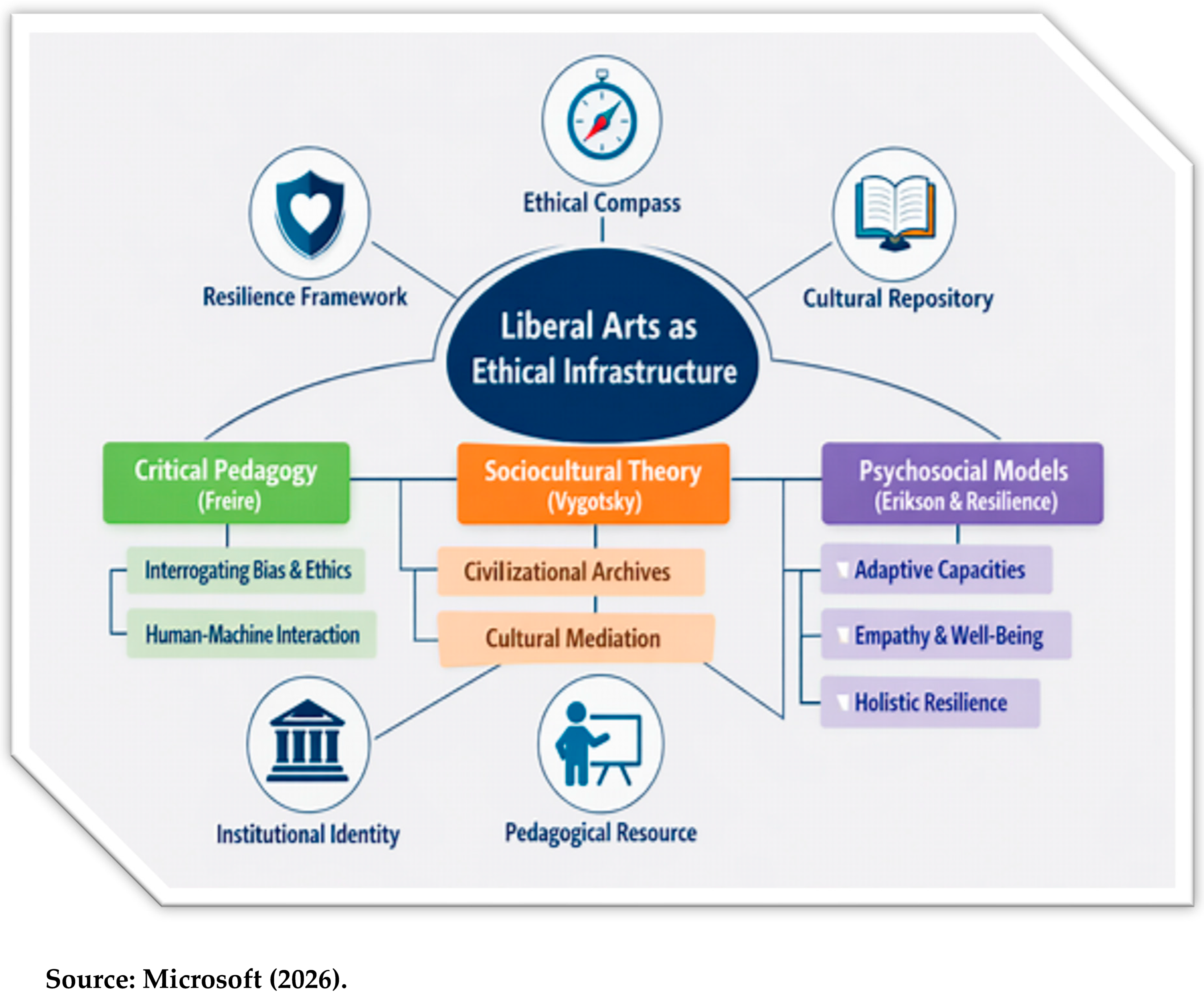
The ten themes above, position liberal arts education as an ethical foundation whose strength lies in theory and practice working together. Freire’s critical pedagogy illustrates how students challenged bias, ethics, and authority in human–machine interaction, framing the liberal arts as a compass for critical awareness. Vygotsky’s sociocultural lens underscores the importance of cultural archives and mediation, showing how identity and learning are sustained through shared tools and dialogue. Psychosocial models of wellness and resilience, rooted in Erikson’s stages and expanded by resilience research, highlight how liberal arts nurture adaptability, empathy, and holistic well-being—countering the reductionism of purely technical training. Viewed in this light, liberal arts emerge not as an add-on but as central: an ethical compass, a cultural repository, a pedagogical resource, an institutional identity marker, and a resilience framework for the digital age.
Here is a consolidated illustration of the themes in diagram form. This diagram organizes the ten themes into a clear structure that comes directly from the data-gathering procedures. At the center, liberal arts education is identified as ethical infrastructure. The branches show how recurring insights surfaced across narrative inquiry, focus groups, ethnographic observation, document analysis, and reflexive journaling. The outer layer translates those insights into five practical functions: ethical compass, cultural repository, pedagogical resource, institutional identity, and resilience framework. By arranging the themes this way, the diagram demonstrates how varied sources of evidence converge into one framework that highlights the central role of liberal arts in shaping education for the digital age. This framework also aligns with global priorities expressed in SDG 4 on Quality Education and SDG 16 on Peace, Justice, and Strong Institutions, underscoring the importance of inclusive learning, ethical responsibility, and critical citizenship in the context of technological change.
VI. Discussion
Liberal arts in this study were not marginal but positioned as decisive safeguards in the digital age. Students consistently described them as foundational, enabling interrogation of bias, ethical reflection, and resistance to algorithmic authority. This echoes Mattoo’s (2026) reminder that liberal arts remain vital for nurturing reflective citizens capable of ethical judgment, and Roche’s (2010) argument that their enduring value lies in cultivating human freedom and agency. The saturation of ten themes confirmed that these insights were not incidental but recurring, strengthening the claim that liberal arts function as ethical infrastructure.
The implications extended across pedagogy, employability, and civic responsibility. In classrooms, dialogical and reflexive practices foregrounded ethics and relationality, ensuring that AI was treated as a contested system requiring judgment. This aligns with Penprase’s (2021) call for global liberal arts institutions to adapt by integrating interdisciplinary approaches that connect humanistic inquiry with technological literacy. In workplaces, adaptability, communication, and ethical reasoning were recognized as competencies nurtured by liberal arts, echoing Urciuoli’s (2003) critique of reducing liberal arts to marketable skills and instead affirming their civic and ethical mission. In civic life, liberal arts prepared students to act as citizens capable of questioning technological power rather than passive consumers of digital systems, a point reinforced by Crawford’s (2021) warning that AI carries planetary costs and political consequences that demand ethical interrogation.
The interpretive depth of these findings was reinforced by theoretical anchors and contextual frameworks. Critical pedagogy illuminated empowerment, showing how students resisted oppressive structures and interrogated algorithmic bias. Sociocultural theory emphasized cultural mediation, highlighting how dialogue and collective meaning making shaped interpretations of AI. Wellness and resilience models underscored human flourishing, situating liberal arts as safeguards of empathy, resilience, and psychosocial wellness. Philippine scholarship further deepens this interpretation: Dela Cruz and Santos (2024) found that students viewed liberal education as essential for holistic formation, while Bansiong et al. (2025) and Arcila (2025) highlighted how institutional initiatives and lived experiences reveal the stakes of resilience and continuity in higher education. CHED Memorandum Order No. 44 (2026) institutionalizes this imperative by embedding liberal arts into general education, ensuring that AI adoption remains accountable to justice, culture, and human dignity. In this light, liberal arts stand as ethical infrastructure, indispensable in preparing learners to navigate technological change while sustaining cultural continuity, civic responsibility, and human flourishing. This positioning also resonates with global priorities expressed in SDG 4 on Quality Education and SDG 16 on Peace, Justice, and Strong Institutions, which emphasize inclusive learning, ethical responsibility, and the cultivation of critical citizenship in the digital age.
VII. Significance of this Study
This study establishes the intellectual weight of liberal arts in the age of artificial intelligence, positioning them as infrastructures for ethical literacy and cultural resilience. Drawing from the lived experiences of CAS students at St. Michael’s College of Iligan, the research shows that liberal arts are indispensable in interrogating bias, resisting algorithmic authority, and sustaining civic responsibility. Students consistently articulate the need for critical reflection and ethical reasoning as they confront the influence of AI. Mattoo (2026) affirms the role of liberal arts in cultivating reflective citizens, while Roche (2010) highlights their enduring importance in nurturing freedom and agency. The emergence of ten themes resulted from data saturation, where recurring insights across narratives, focus groups, and observations confirmed analytical rigor.
For SMCII, the findings provide a strong basis for curriculum development and reaffirm its mission of holistic education. Liberal arts cultivate resilience, adaptability, and ethical awareness, aligning with Catholic Ignacian Marian values. This institutional significance is reinforced by CHED Memorandum Order No. 44 (2026), PAASCU accreditation standards, and ISO 21001:2018 quality management systems, which ensure curriculum design is culturally grounded and globally benchmarked. The integration of RVM EMC’s QTIME concepts further validates liberal arts as ethical infrastructure within institutional practice. Philippine scholarship supports this imperative: Dela Cruz and Santos (2024) show how students view liberal education as essential for holistic formation, while Bansiong et al. (2025) demonstrate how qualitative protocols measure its impact on resilience and adaptability.
The study also contributes to Global South perspectives on liberal arts and AI. By situating the research in Iligan’s cultural and historical realities, it challenges Eurocentric narratives and demonstrates how institutions outside Western centers generate distinctive insights into AI literacy and civilizational knowledge. Penprase (2021) calls for global liberal arts institutions to adapt through interdisciplinary approaches, while Urciuoli (2003) critiques the reduction of liberal arts to marketable skills, reminding us of their civic and ethical mission. Arcila (2025) illustrates how lived experiences in Philippine higher education reveal the stakes of resilience and continuity, situating liberal arts as safeguards against dropout and disconnection. The findings underscore the pedagogical imperative of integrating civilizational knowledge with technological literacy. Liberal arts classrooms that foreground dialogue, cultural archives, and reflexive engagement ensure students approach AI critically, preserving indigenous wisdom while engaging with technological innovation. In this way, liberal arts education is positioned as decisive infrastructure for navigating the challenges of AI and sustaining the integrity of human civilization, while also resonating with global priorities expressed in SDG 4 on Quality Education and SDG 16 on Peace, Justice, and Strong Institutions, which emphasize inclusive learning, ethical responsibility, and the cultivation of critical citizenship in the digital age.
VIII. Conclusion and Recommendations
This study affirms that liberal arts education is indispensable in the digital age as higher education institutions confront ethical, cultural, and pedagogical challenges posed by artificial intelligence. Insights from thirty CAS students at St. Michael’s College of Iligan show that liberal arts are central to cultivating AI literacy, safeguarding civilizational archives, and framing human–machine interaction in ways that preserve dignity and agency. The integration of CHED memoranda, PAASCU accreditation standards, ISO 21001:2018, and RVM EMC’s QTIME concepts highlights the institutional responsibility to embed liberal arts as ethical infrastructure in curriculum design. The emergence of ten themes resulted from data saturation, where recurring insights across narratives, focus groups, and observations confirmed that no new categories were surfacing. This rigor strengthens the claim that liberal arts must be treated as the foundation for ethical discernment, cultural resilience, and civic responsibility in technologically saturated contexts. Their role in mediating civilizational knowledge and resisting digital homogenization positions them as essential to AI governance and the holistic formation of learners, while remaining compliant with UNESCO’s Sustainable Development Goals, particularly SDG 4 on Quality Education and SDG 16 on Peace, Justice, and Strong Institutions.
Building on these findings, the study recommends a comprehensive reimagining of liberal arts education as a safeguard for human futures. Policy integration should ensure that CHED mandates explicit liberal arts components in AI literacy programs and that PAASCU accreditation criteria expand to evaluate how institutions embed liberal arts in technology-related curricula. Curriculum development should design interdisciplinary modules linking liberal arts with data science, computer studies, and psychology, while incorporating civilizational archives and indigenous knowledge to resist cultural homogenization. Quality assurance requires adopting ISO 21001:2018 standards to guarantee learner-centered and globally benchmarked programs, alongside QTIME frameworks to sustain values-based pedagogy. Pedagogical innovation should empower faculty to use critical and sociocultural approaches that foreground dialogue and collective meaning making, ensuring students engage AI critically and ethically.
At the strategic level, institutions should position Liberal Arts as flagship programs in Global South contexts, establishing partnerships with international bodies to challenge Eurocentric narratives and contribute to ethical AI governance. By aligning student insights with national directives and international quality benchmarks, liberal arts become decisive infrastructures for higher education, ensuring that technological progress remains accountable to justice, culture, and human flourishing. In this way, the study reinforces the imperative of liberal arts as safeguards for human futures, embedding ethical, cultural, and civic frameworks into AI literacy so that education sustains dignity and continuity.
Declaration of AI Use
Artificial intelligence (AI) was employed in this study solely for language refinement purposes. The conceptualization, methodological design, data gathering, analysis, and interpretation are entirely the work of the author. AI did not contribute to the research process or findings; its role was limited to assisting in the refinement of wording and clarity of expression.
References
- Arcila, F. E., Jr. Lived experiences of student dropout: A phenomenological study in a free higher education institution in the Philippines. AIDE Interdisciplinary Research Journal 2025, 13(1), 22–44. [Google Scholar] [CrossRef]
- Bansiong, A. J.; Alawas, D. E.; Betudio, O. B.; Palaw-ay, S. M.; Bulalin, S. B.; Yango, D. M. Evaluating the Project Research and Extension (REx) initiative of a Philippine state university: Application of a simplified qualitative impact protocol (S-QuIP). International Journal of Science and Management Studies 2025, 8(4), 101–115. [Google Scholar] [CrossRef]
- Battiste, M. Indigenous knowledge and pedagogy in First Nations education: A literature review with recommendations. Ottawa: Indian and Northern Affairs Canada.
- Bender, E. M.; Gebru, T.; McMillan-Major, A.; Shmitchell, S. On the dangers of stochastic parrots: Can language models be too big? In Proceedings of the 2021 ACM Conference on Fairness, Accountability, and Transparency; New York, NY; Association for Computing Machinery, 2021; pp. 610–623. [Google Scholar] [CrossRef]
- Braun, V.; Clarke, V. Using thematic analysis in psychology. Qualitative Research in Psychology 2006, 3(2), 77–101. [Google Scholar] [CrossRef]
- Cahilog, D. T.; Sarong, J. S.; Melgo, M. D.; Tadlip, R. S.; Arcila, F. E., Jr. Lived experiences of student dropout: A phenomenological study in a free higher education institution in the Philippines. AIDE Interdisciplinary Research Journal 2025, 13(1), 45–68. [Google Scholar] [CrossRef]
- Clandinin, D. J.; Connelly, F. M. Narrative inquiry: Experience and story in qualitative research; San Francisco, CA; Jossey-Bass, 2000. [Google Scholar]
- Commission on Higher Education. General education curriculum: Holistic understandings, intellectual and civic competencies (CHED Memorandum Order No. 20, Series of 2013). 2013. ched.gov.ph.
- Crawford, K. Atlas of AI: Power, politics, and the planetary costs of artificial intelligence; New Haven, CT; Yale University Press, 2021. [Google Scholar]
- Dei, G. J. S. Indigenous philosophies and critical education: A reader; New York; Peter Lang, 2012. [Google Scholar]
- Dela Cruz, M. R.; Santos, J. P. Exploring student perspectives on liberal education in Philippine universities: A thematic analysis of focus group narratives. Philippine Journal of Education 2024, 98(2), 55–72. [Google Scholar]
- Eslit, E. R. Unveiling the cognitive depths: Delving into language learning and acquisition amidst the post-pandemic era; ERIC, 20 May 2023. [Google Scholar]
- Freire, P. Pedagogy of the oppressed; New York, Continuum., 1970. [Google Scholar]
- Geiger, R. L.; Rothblatt, S.; Melin, C.; Kleinman, D. L.; Moses, Y.; Woodward, K.; Williams, J. J. A new deal for the humanities: Liberal arts and the future of public higher education; Rutgers University Press, 2015. [Google Scholar]
- International Organization for Standardization (ISO). ISO 21001:2018 – Educational organizations management systems – Requirements with guidance for use; Geneva; ISO, 2018. [Google Scholar]
- Kasturirangan, K.; Kumar, V. Liberal Education: A 21st Century Imperative. Journal of Educational Planning and Administration 2022, 36(1), 5–13. [Google Scholar]
- Kimball, B. A. Orators and philosophers: A history of the idea of liberal education; New York, College Entrance Examination Board., 1995. [Google Scholar]
- Knox, J. Artificial intelligence and education in China. Learning, Media and Technology 2020, 45(3), 298–311. [Google Scholar] [CrossRef]
- Krueger, R. A.; Casey, M. A. Focus groups: A practical guide for applied research, 5th ed.; Thousand Oaks, CA; Sage, 2015. [Google Scholar]
- Lincoln, Y. S.; Guba, E. G. Naturalistic inquiry; Beverly Hills, CA; Sage, 1985. [Google Scholar]
- Logan, J.; Curry, J. A liberal arts education: Global trends and challenges. Christian Higher Education 2015, 14(1-2), 66–79. [Google Scholar] [CrossRef]
- Maguire, M.; Delahunt, B. Doing a thematic analysis: A practical, step-by-step guide for learning and teaching scholars. AISHE-J: The All Ireland Journal of Teaching and Learning in Higher Education 2017, 9(3), 3351–33514. [Google Scholar] [CrossRef]
- Masten, A. S. Ordinary magic: Resilience in development; New York; Guilford Press, 2014. [Google Scholar]
- Mattoo, A. The importance of Liberal Arts Education today [Facebook post]. Facebook. 27 May 2026. Available online: https://www.facebook.com/photo?fbid=27529669589970975&set=a.759018327462798.
- Microsoft Copilot. Response generated by an artificial intelligence model; Microsoft, 2026. [Google Scholar]
- Nowell, L. S.; Norris, J. M.; White, D. E.; Moules, N. J. Thematic analysis: Striving to meet the trustworthiness criteria. International Journal of Qualitative Methods 2017, 16(1), 1–13. [Google Scholar] [CrossRef]
- Nussbaum, M. C. Not for profit: Why democracy needs the humanities; Princeton, NJ; Princeton University Press, 2010. [Google Scholar]
- Penprase, B. Global Liberal Arts and New Institutions for 21st Century Higher Education. In Higher Education Forum; Research Institute for Higher Education, Hiroshima University; 1-2-2 Kagamiyama, Higashi-hiroshima, Hiroshima City, Japan, March 2021; Vol. 18, p. 157-172. [Google Scholar]
- Philippine Accrediting Association of Schools; Colleges and Universities (PAASCU). PAASCU accreditation framework for higher education institutions; Manila; PAASCU, 2017. [Google Scholar]
- Prinsloo, P.; Slade, S. An elephant in the learning analytics room: The obligation to act. In Proceedings of the 7th International Learning Analytics & Knowledge Conference; New York, NY; Association for Computing Machinery, 2017; pp. 46–55. [Google Scholar]
- Religious of the Virgin Mary – Education Mission Congregation (RVM EMC). Quality Transformative Ignacian Marian Education (QTIME) framework; Quezon City; RVM Education Mission Congregation, n.d.; Available online: https://www.rvm.org.ph/ministries/education-ministry.
- Rizvi, F. Globalization and the neoliberal imaginary of higher education. Higher Education Research & Development 2019, 38(1), 1–11. [Google Scholar]
- Roche, M. W. Why choose the liberal arts? University of Notre Dame Pess, 2010. [Google Scholar]
- Rothblatt, S.; Wittrock, B. (Eds.) The European and American university since 1800: Historical and comparative perspectives; Cambridge; Cambridge University Press, 1993. [Google Scholar]
- Selwyn, N. Should robots replace teachers? AI and the future of education; Cambridge, UK; Polity Press, 2019. [Google Scholar]
- Smith, L. T. Decolonizing methodologies: Research and indigenous peoples, 2nd ed.; London; Zed Books, 2012. [Google Scholar]
- Sumena, A. R.; Betache, A. B.; Oculares, S. J. P.; Alfeche, J. L. M. Navigating instructional leadership: Lived experiences of higher education administrators across selected colleges in Northwestern Mindanao, Philippines. International Journal of Research and Innovation in Social Science 2025, 9(7), 4405–4418. [Google Scholar] [CrossRef]
- United Nations. Transforming our world: The 2030 Agenda for Sustainable Development; United Nations, 2015; Available online: https://sdgs.un.org/2030agenda.
- United Nations Educational; Scientific and Cultural Organization. Education 2030: Incheon Declaration and Framework for Action for the implementation of Sustainable Development Goal 4; UNESCO, 2015; Available online: https://unesdoc.unesco.org/ark:/48223/pf0000245656.
- United Nations Educational; Scientific and Cultural Organization. Beijing Consensus on Artificial Intelligence and Education; UNESCO, 2019; Available online: https://unesdoc.unesco.org/ark.
- United Nations Educational; Scientific and Cultural Organization. AI competency framework for teachers and students; UNESCO, 2024; Available online: https://unesdoc.unesco.org/.
- Urciuoli, B. Excellence, leadership, skills, diversity: Marketing liberal arts education. Language & Communication 2003, 23(3-4), 385–408. [Google Scholar] [CrossRef]
- Villanueva, R. A.; Ramirez, L. G. Integrating digital literacy and humanities in Philippine higher education: A qualitative thematic study. Asia Pacific Journal of Multidisciplinary Research 2025, 13(1), 112–128. [Google Scholar]
- Vygotsky, L. S. Mind in society: The development of higher psychological processes; Cambridge, MA; Harvard University Press, 1978. [Google Scholar]
- Williamson, B.; Piattoeva, N. Education governance and datafication: Critical insights and future directions. European Educational Research Journal 2022, 21(1), 3–17. [Google Scholar]
Disclaimer/Publisher’s Note: The statements, opinions and data contained in all publications are solely those of the individual author(s) and contributor(s) and not of MDPI and/or the editor(s). MDPI and/or the editor(s) disclaim responsibility for any injury to people or property resulting from any ideas, methods, instructions or products referred to in the content. |
© 2026 by the authors. Licensee MDPI, Basel, Switzerland. This article is an open access article distributed under the terms and conditions of the Creative Commons Attribution (CC BY) license (http://creativecommons.org/licenses/by/4.0/).
Copyright: This open access article is published under a Creative Commons CC BY 4.0 license, which permit the free download, distribution, and reuse, provided that the author and preprint are cited in any reuse.


