

Submitted:
29 May 2026
Posted:
01 June 2026
You are already at the latest version
Abstract
Understanding the gene-level changes that occur during post-ischemic neurodegener-ation in the frontal cortex is crucial for the development of dementia. An ischemic model of Alzheimer's disease was used to evaluate changes in the expression of the receptor for advanced glycation end products (RAGE) and low-density lipoprotein receptor-related protein 1 (LRP1), which are associated with amyloid and tau protein, in the frontal cortex after 10 min of cerebral ischemia, with survival at 2, 7, and 30 days and 0.5, 1, 1.5, and 2 years. LRP1 and RAGE expression was assessed by reverse tran-scription-quantitative polymerase chain reaction. On the second day post-ischemia, a significant increase in LRP1 expression level was observed compared to the control group, while RAGE level was significantly decreased. Then, a significant decrease in LRP1 expression was observed at day 7 and 0.5 years, while at day 30 it fluctuated around the control value. The decrease in RAGE expression was statistically signifi-cant, compared to the control group, after 2 and 7 days and after 0.5 years, and after 30 days it oscillated around the control value. RAGE and LRP1 expression showed the same pattern of changes from day 7 to year 2, peaking at 1 and 1.5 years, respectively. Another peak of RAGE overexpression was noted 2 years after ischemia. After 1, 1.5 and 2 years, overexpression of RAGE and LRP1 was observed after ischemia, with the dynamics of LRP1 changes being lower. Overall, the data showed a predominance of RAGE activity over LRP1 activity at 1-, 1.5-, and 2-years post-ischemia. The modifica-tion of LRP1 and RAGE after ischemia is useful in studying the molecular ischemic pathways involved in the development of Alzheimer's disease.
Keywords:
brain ischemia
; Alzheimer’s disease
; frontal cortex
; LRP1
; RAGE
; genes
; amyloid
; tau protein
; transport
; model
1. Introduction
In recent years, brain ischemia in rats and mice has become one of the important models for studying the neuropathogenesis of Alzheimer’s disease [1,2,3,4,5,6,7]. These models mimic Alzheimer’s disease, showing amyloid accumulation in the form of diffuse and senile plaques [8,9], tau protein hyperphosphorylation [10,11,12,13], neuroinflammation [14,15], cerebral amyloid angiopathy [14,16], neuronal death and brain atrophy [9,17], decreased acetylcholine levels [1,3], and impairments in learning and memory with the development of full-blown dementia [5,6,18,19,20,21]. These observations indicate that ischemia drives the formation and accumulation of amyloid and tau protein, which are characteristic of Alzheimer’s disease. Studies also indicate the importance of ischemic blood-brain barrier dysfunction in the progression of post-ischemic neurodegeneration, such as in Alzheimer’s disease [16,22,23]. Thus, tau protein, amyloid, and recurrent hypoperfusion constitute mechanistic links between typical features of Alzheimer’s disease and the post-ischemic brain [2,3,4,5,7,22].
Alzheimer’s disease is characterized by the selective susceptibility of a specific population of neurons to pathological factors, starting from the hippocampus, similar to cerebral ischemia [9,24,25,26]. It is known that the neuropathological progression of Alzheimer’s disease does not proceed uniformly throughout the brain but shows significant regional specificity [24,26]. The neuropathological changes in Alzheimer’s disease are believed to begin in the hippocampus and entorhinal cortex and then gradually spread to the frontal, parietal, and temporal cortex of the brain [27]. Despite many years of research, the genes and molecular mechanisms underlying the neuropathological development of Alzheimer’s disease in different brain structures are still not well understood [25,26,28,29,30].
Amyloid and tau protein are characteristic of Alzheimer’s disease. It is important to note that amyloid and tau protein in the brain are regulated by transmembrane proteins, namely the receptor for advanced glycation end products (RAGE) and low-density lipoprotein receptor-related protein 1 (LRP1). LRP1 has been shown to exert neuroprotective effects in the neuropathology of Alzheimer’s disease by improving amyloid clearance across the blood-brain barrier and increasing tau protein proteolysis [23,31,32,33,34]. LRP1 reduces amyloid production by competing with amyloid precursor protein for metabolism by β- and γ-secretase in neuronal cell lines [33,35]. Moreover, LRP1 is a key regulator of tau protein metabolism through increased internalization, which facilitates its degradation by lysosomes [33,36]. LRP1 exerts neuroprotective effects in Alzheimer’s disease by activating platelet-derived growth factor signaling [33]. LRP1 is a key regulator of amyloid homeostasis and accumulation and tau protein uptake and spreading in Alzheimer’s disease [32,37]. Nevertheless, accumulating evidence indicates that LRP1 not only regulates the neuropathogenesis of Alzheimer’s disease but also maintains brain homeostasis in an amyloid-independent manner [32].
On the other hand, RAGE has the opposite effect [34]. RAGE plays a key role in Alzheimer’s disease by influencing amyloid production and accumulation, neurofibrillary tangle formation, impaired synaptic transmission, and neuronal degeneration [33,38]. RAGE is a significant contributor to amyloid production by increasing β- and γ-secretase activity and activating the neuroinflammatory response and oxidative stress [33,38]. In addition, RAGE acts as an important transporter, regulating the influx of amyloid from the circulatory system into the brain. RAGE causes dysfunction of neuronal circuits that constitute both the functional and structural basis of cognitive impairment. In addition, RAGE initiates amyloid-dependent tau protein hyperphosphorylation, which is also associated with cognitive impairment [33,38]. RAGE’s interaction with amyloid impairs the brain’s ability to clear it, leading to increased amyloid accumulation and increased neuronal damage [39]. This additionally increases neuroinflammatory responses and oxidative stress, ultimately leading to progressive neurodegeneration with age [39].
At different stages of Alzheimer’s disease, different brain structures are affected differently [27]. Selective vulnerability of specific brain structures is a fundamental feature of neurodegenerative diseases, including Alzheimer’s disease and brain ischemia. However, the common genomic and proteomic processes in Alzheimer’s disease and post-ischemic brain injury, which originate in the hippocampus and spread to other brain regions, are still not well understood. Various methods have been used to predict the course of Alzheimer’s disease, but they have never focused on examining different brain structures at different times. Understanding the changes occurring in different brain structures is essential to explaining the neuropathological mechanisms in the early and late stages of Alzheimer’s disease. The main aim of our research is to explore and compare Alzheimer’s disease-related proteins and their genes expression profiles in different structures, such as the hippocampus, different kinds of brain cortex, thalamus and cerebellum, at different survival times in a rat model of cerebral ischemia. In this article, we continue our research on genetic changes in the frontal cortex in the Alzheimer’s disease ischemia model.
It has been previously shown that an ischemic episode in the frontal cortex causes a series of harmful phenomena that can last from a few minutes to a lifetime [9,17,40,41,42,43]. It has been revealed that neuronal death in the frontal cortex after ischemia is associated not only with excitotoxicity but also with the neurotoxicity of amyloid and tau protein [41,42,43]. Alzheimer’s disease-associated amyloid and tau protein and their genes have been shown to play a significant role in progressive and irreversible neurodegeneration in the ischemic frontal cortex [41,42,43]. Furthermore, chronic dysfunction of the blood-brain barrier causes amyloid and tau protein to leak from the blood into the cortex [16,44]. Long-term monitoring of the ischemic frontal cortex revealed acute and chronic neuronal changes and progressive neuronal death [9,17,40]. Apoptosis, autophagy, and mitophagy genes have been shown to be associated with neurodegenerative changes in the frontal cortex post-ischemia [41,42,43]. Activated astrocytes and microglia in the frontal cortex induce neuroinflammation that progresses over 2 years of follow-up [14.15,40]. Immunohistochemical staining of the brain after ischemia, with survival up to 1 year, showed the presence of amyloid around blood vessels and in neurons [9].
For over a decade, we have been trying to precisely define the region-specific gene expression changes that occur following brain ischemia and are associated with Alzheimer’s disease. This approach potentially provides a basis for understanding the neuropathogenesis of Alzheimer’s disease and the subsequent development of targeted therapies. Our previous experimental studies on LRP1 and RAGE in the ischemic CA3 region of the hippocampus showed that both genes are involved in amyloid and tau protein pathology, which was manifested in the early post-ischemic period by RAGE overexpression and in the late period by LRP1 overexpression [45]. However, the exact role of LRP1 and RAGE involved in amyloid and tau protein pathology in the frontal cortex after ischemia in the Alzheimer’s disease ischemia model has not been fully elucidated. Therefore, this article presents and explains the role of LRP1 and RAGE in the frontal cortex in an ischemic model of Alzheimer’s disease. The aim of this work is to continue the study of the quantitative assessment of genes in the frontal cortex associated with Alzheimer’s disease using RT-PCR, i.e., RAGE and LRP1 involved in amyloid and tau protein pathology in rats that survived 2, 7, and 30 days and 0.5, 1, 1.5, and 2 years after experimental complete brain ischemia.
2. Results
2.1. LRP1 Changes Post-Ischemia
The LRP1 encodes the low-density lipoprotein receptor-related protein-1. LRP1 is considered a neuroprotective molecule in the brain following ischemic injury. Two days and 1-, 1.5- and 2-years post-ischemia, there was increased LRP1 expression, but in the remaining recirculation periods the expression was the opposite (Figure 1). Gene expression shown in the figures is depicted using a logarithmic formula. On the 2nd day after ischemia, the median was 0.641, the minimum was 0.413, the maximum was 1.195, and the mean was 0.686±0.248. On the 7th day post-ischemia, the median was -0.420, the minimum was -0.638, the maximum was -0.042, and the mean was -0.354±0.208. After 30 days, the median was -0.092-fold, the minimum was -1.010, the maximum was -0.061, and the mean was -0.231±0.293. Half a year following ischemic injury, the median was -0.551, the minimum was -0.860, the maximum was -0.353, and the mean was -0.546±0.156. One- and 1.5-years post-ischemia, the median was 0.100 and 0.943, respectively. The minimum was 0.066 and 0.127, the maximum was 0.460 and 1.817, and the mean was 0.187±0.153 and 0.940±0.720, respectively. After 2 years following ischemic injury, the median was 0.208, the minimum was 0.070, the maximum was 0.711, and the mean was 0.293±0.238. Figure 1 shows the mean data of LRP1 expression and statistically significant differences at various recirculation times after cerebral ischemia. Figure 1 also shows statistically significant differences in LRP1 expression values between the study and control groups at different times after brain injury caused by ischemia and reperfusion.
2.2. RAGE Changes Post-Ischemia
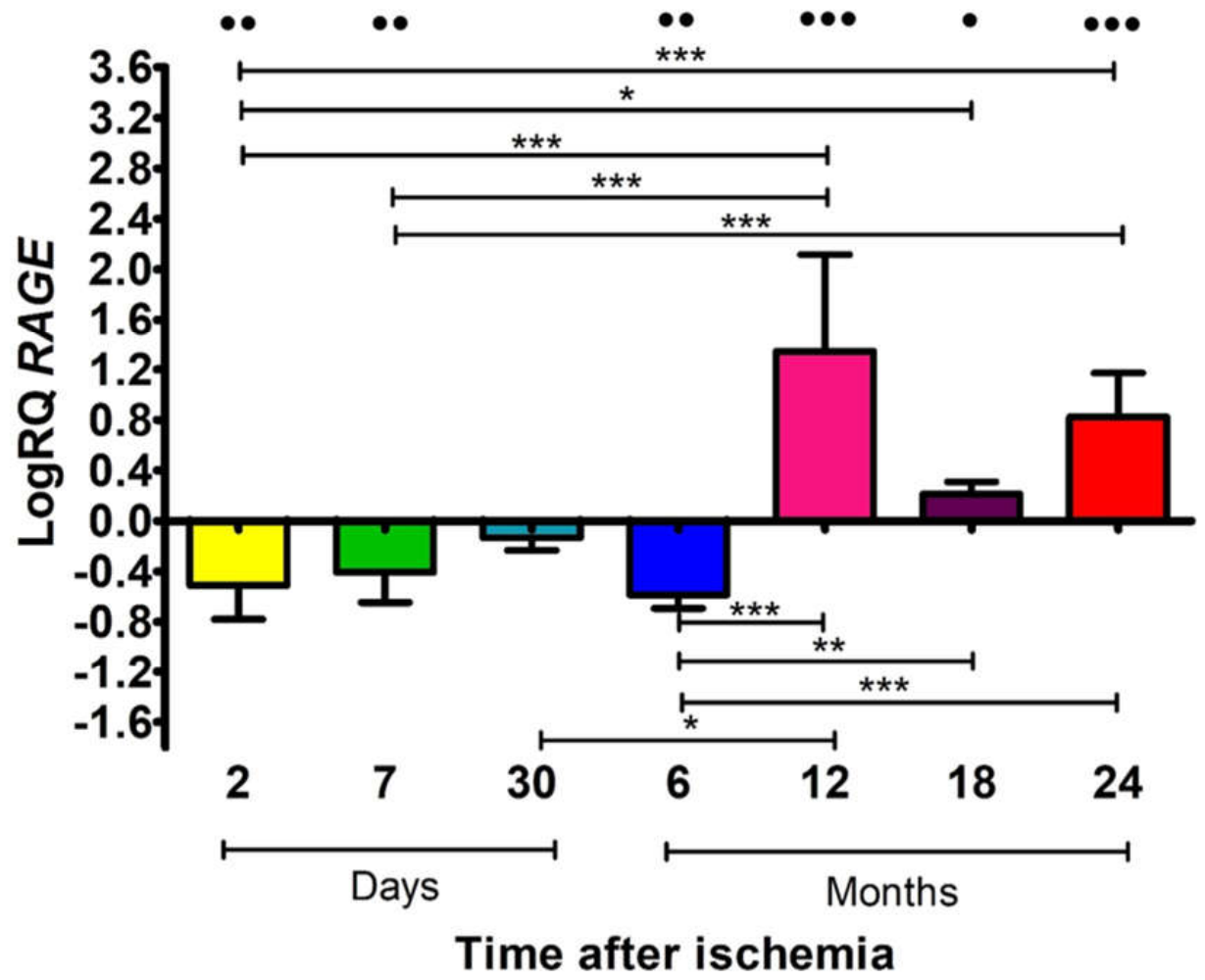
The RAGE encodes the receptor for advanced glycation end products. RAGE is believed to have harmful influence on the brain post-ischemia. On the 2nd day after ischemia, the median expression was -0.460-fold, the minimum -0.943, the maximum -0.181 and the mean -0.511± 0.268. Seven and 30 days and 0.5 years after ischemia, the median values were -0.416 (minimum -0.824 and maximum -0.080), -0.093 (minimum -0.314 and maximum -0.041), and -0.561 (minimum -0.735 and maximum -0.441), respectively. In the above post-ischemic survival times, the mean results were: -0.407±0.241, -0.135±0.098 and -0.586±0.107. The highest value of RAGE was noted 1-year post-ischemia, with a median 1.749, and the minimum 0.268 and maximum 2.178 with a mean change of 1.342±0.773. One and a half and 2 years after ischemia, RAGE was still overexpressed, but at lower values; medians were 0.210 and 0.762, minimum and maximum were 0.062/0.377 and 0.316/1.401 and mean values were 0.212±0.099 and 0.823±0.347, respectively. Figure 2 shows the mean data of RAGE expression and statistically significant differences at various recirculation times after cerebral ischemia. Figure 2 also shows statistically significant differences in RAGE expression values between the study and control groups at different times after brain injury caused by ischemia and reperfusion.
3. Discussion
Our study demonstrated for the first-time changes in LRP1 and RAGE expression associated with amyloid and tau protein pathology in the frontal cortex of an ischemic model of Alzheimer’s disease at follow-up periods of 2, 7, and 30 days, and 0.5, 1, 1.5, and 2 years. RAGE expression during early post-ischemic survival (from 2 days to 6 months) was lower than control values, but at later stages (from 12 to 24 months) it exceeded control values. In the case of LRP1, the pattern of changes was identical to that of RAGE, except for the 2nd day post-ischemia, where an increase in expression was observed. In other words, the pattern of changes in the expression of both genes post-ischemia from day 7 to 2 years was identical. Changes in LRP1 and RAGE expression resemble a slowly progressive age-related phenomenon.
Two days following ischemia, we found a statistically significant reduction in RAGE expression (Figure 2), which positively correlated with the reduction of RAGE in the brain and serum after focal cerebral ischemia in rats [46]. Significant overexpression of RAGE 1-2 years after ischemia indicates its possible role in neuronal death (Figure 2) [9,47,48,49]. This is indicated by RAGE-positive neuronal cells following temporary forebrain ischemia in gerbil [48].
RAGE overexpression following cerebral ischemia has been shown to be modulated by hypoxia-inducible factor 1α [50]. It has been noted that excessive expression of neuronal RAGE and increased levels of its protein increase the susceptibility of the brain to ischemic damage [51]. Another study showed that RAGE mRNA and protein levels were increased in neuronal cells in the mouse brain after local ischemia [50]. This study also showed that inhibition of RAGE signaling resulted in neuroprotection [50]. Additionally, RAGE has been shown to mediate post-ischemic brain injury by inducing neuroinflammation and synaptic dysfunction in an amyloid environment [51,52,53]. In light of the above facts, it is suggested that the neuroinflammatory pathway driven by the RAGE-amyloid interaction may be one of many mechanisms of the development of post-ischemic brain neurodegeneration of the Alzheimer’s disease type [53]. Furthermore, it is known that RAGE induces amyloid production and neurotoxicity in neuronal cells and the transport of amyloid across the blood–brain barrier to the brain tissue [38,54,55,56,57]. Taking into account the fact that significant overexpression of RAGE occurs 1-2 years post-ischemia (Figure 2), it can be assumed that it has a significant impact on the development of Alzheimer’s disease-type pathology [58,59]. Overexpression of RAGE increases amyloid deposition [56] and apoptosis in the brain, causing cognitive impairment in a mouse model of Alzheimer’s disease [60], suggesting that the same factors likely participate in the development of post-ischemic brain neurodegeneration.
It is now known that ischemia-induced brain neurodegeneration is a type of tauopathy [10,61,62,63,64,65,66,67]. Some data indicate that in neuronal and microglial cells, RAGE binds to tau protein, which facilitates the development of tau protein-related pathologies in cells and behavioral deficits [68]. RAGE also promotes tau protein hyperphosphorylation by activating GSK3 [69,70]. RAGE has also been shown to influence the propagation of transsynaptic tau protein in neurons and to trigger an inflammatory response in microglial cells [68]. Furthermore, it has been shown that overexpression of RAGE in neurons underlies the transmission/spreading of tau protein throughout the brain tissue [68]. It has also been shown that amyloid in the brain, the presence of which is guaranteed by RAGE, is a factor triggering the formation of tau protein oligomers [71]. It has been shown that amyloid accumulation in brain tissue can also increase the expression of RAGE, which serves as a key receptor in the development of Alzheimer’s disease-like brain neurodegeneration following ischemia [72,73]. Another study showed that RAGE mediates amyloid generation in a mouse model of Alzheimer’s disease by modulating β- and γ-secretase activity [74]. Blocking the AGE/RAGE signaling pathway in the brain has been shown to have a beneficial effect on post-ischemic alterations [75]. Therefore, RAGE represents a potential therapeutic target for reducing amyloid accumulation, which may inhibit the progression of post-ischemic neurodegeneration of Alzheimer’s disease type [74].
Furthermore, previous studies have revealed a crucial role of neuronal and microglial RAGE in ischemia-induced neuronal death and neuroinflammation in irreversible local cerebral ischemia [76,77,78]. On the other hand, RAGE has been shown to induce blood vessel damage, suggesting that RAGE may cause delayed neuronal death as a result of circulatory disruption [78,79]. Furthermore, the above suggestion is supported by a study showing that ischemia and hypoxia trigger endothelial cell pyroptosis via the HIF-1α-RAGE-NLRP3 signaling pathway, resulting in permanent microcirculation injury [80]. It is worth adding that RAGE KO mice showed significantly reduced neuronal death post-ischemia, as well as significantly reduced neuroinflammation and blood vessel injury [79]. Another paper described a direct role of neuronal RAGE in promoting ischemic brain pathology in mice [51]. In dominant negative RAGE mice, a reduced infarct volume was observed, confirming that RAGE signaling is directly linked to post-ischemic brain neurodegeneration [51]. Interestingly, RAGE was activated in hypoxic macrophages [81], suggesting that RAGE may also be involved in innate immunity. In this context, RAGE and its ligand HMGB1 have been found to cause brain damage due to ischemia induced by infiltrating macrophages [52]. The role of RAGE in promoting macrophage penetration in RAGE-deficient bone marrow animals was investigated and revealed that this combination decreases infarct volume following local cerebral ischemia [52]. Inhibition of RAGE activity also reduced neuroinflammation, oxidative stress, apoptosis, infarct size, and neurological deficits after local cerebral ischemia [82]. The presented studies indicate that RAGE may at least partially confirm the importance of the ischemic model in uncovering the phenomena of neurodegeneration in Alzheimer’s disease.
LRP1 is expressed in the brain in astrocytes, neuronal, microglial, and endothelial cells [36]. Previous studies have revealed intramembrane proteolysis of LRP1 following cerebral ischemia by γ-secretase, which results in neuronal death [83]. The above data coincide with significant reduction in LRP1 expression noted in our study 7 days and 0.5 years post-ischemia (Figure 1). LRP1 has been shown to bind amyloid and participate in its removal from brain tissue across the blood-brain barrier [84,85]. The above observations are consistent with significant increase in LRP1 expression in our studies 2 days and 1.5 and 2 years in post-ischemic brain injury (Figure 1). Furthermore, LRP1 is an endocytic receptor that transports ligands from the cell surface to the endosomal compartment, where these ligands are sorted into the lysosomal compartment and degraded. The above-mentioned LRP1 mechanism have been shown to regulate the internalization, degradation and spread of tau protein in brain tissue lysates from Alzheimer’s disease patients [36], suggesting that this phenomenon is likely to also occur in post-ischemic neurodegenerative processes. The obtained results indicate that LRP1 is an important regulator of the spread of tau protein and cytoplasmic seeding in brain tissue, and therefore it may be a potential target for treatment after cerebral ischemia [37]. This observation identifies LRP1 as an endocytic receptor that binds, transports and contributes to the processing of monomeric forms of tau protein, which consequently leads to its degradation and ultimately prevents its seeding [36]. The balance of these processes is likely crucial for the propagation of neuropathology in our ischemic model of Alzheimer’s disease [36]. LRP1 has also been shown to be a master regulator that interacts with heparan sulfate proteoglycans, thereby controlling tau protein entry into neurons [37].
LRP1 has been shown to attenuate oxidative stress, neuroinflammation, and apoptosis, and to reduce short- and long-term neurological deficits and mortality following brain ischemia in mice through inhibiting the TXNIP/NLRP3 signaling mechanism [86]. It was shown that the activity of the LRP1/TXNIP/NLRP3 mechanism was significantly increased within 2-5 days after ischemic brain injury [86]. This process coincided with a significant increase in LRP1 expression in our study 2 days post-ischemia. Furthermore, LRP1 has been shown to exert neuroprotective effects through interaction with apolipoprotein E [86], whose gene was overexpressed in our study before day 7 of survival after cerebral ischemia [42].
LRP1 has been shown to positively influence neuropathogenesis after local brain ischemia through its anti-apoptotic activity [87,88]. A protective effect of LRP1 after local cerebral ischemia has also been demonstrated, via mitochondrial interaction between astrocytes and neurons. Using cell culture and an animal model of regional cerebral ischemia, it was demonstrated that astrocytic LRP1 regulated the transfer of healthy mitochondria from astrocytes to neurons and protected neurons from ischemia-reperfusion injury [89]. Inhibition of astrocytic LRP1 activity reduced mitochondrial transfer to injured neurons and impaired post-ischemic recovery [89].
4. Materials and Methods
Female Wistar rats (n = 70, 130-150 g) were subjected to 10-minute global cerebral ischemia with survival at 2, 7, and 30 days and 0.5, 1, 1.5, and 2 years [90]. Sham-operated rats were used as control groups (n = 70) with the same survival times as the study group. In both groups, there were 10 rats for each survival time. The animals used in the study were kept in cages of two in a room with a temperature of 21±1 °C, air humidity of approximately 50% and a 12-hour light-dark cycle. During the study, the animals had free access to water and food. Rats in the studies were cherished in accordance with the NIH Guide for the Care and Use of Laboratory Animals (1985), European Communities Council Directive 142/86/609/EEC, and with the approval of the local Ethics Committee (No. 53/2014 of 16 January 2015).
After the studies were completed, the brains were perfused with cold 0.9% NaCl through the heart. Then, after removing the brains from the skull, samples of the frontal cortex with a volume of approximately 1 mm3 were taken and placed in RNALater solution (Life Technologies, Carlsbad, CA, USA) [90]. LRP1 and RAGE expression was assessed by reverse transcription-quantitative polymerase chain reaction (RT-qPCR) [90].
The frontal cortex samples were homogenized in 1 mL of TRI-Reagent buffer for RNA isolation (Ambion, Austin, TX, USA). The suspension was then incubated for 5 min at ambient temperature, after which 200 μL of chloroform (Sigma-Aldrich, St. Louis, MO, USA) was added and the samples were shaken for 15 s. In the next step, the sample was incubated for 15 min at ambient temperature, then centrifuged for 15 min at 14,000 rpm. Subsequently, 500 μL of 2-propanol (Sigma-Aldrich, St. Louis, MO, USA) was added to the aqueous fraction. The parts were then mixed and incubated for 20 min at ambient temperature. Samples were centrifuged again for 20 min at 14,000 rpm at 4 °C. The RNA part was then placed in 80% ethanol and stored at -20 °C. RNA qualitative and quantitative parameters were assessed using a NanoDrop 2000 spectrophotometer (Thermo Scientific, Waltham, MA, USA) [90]. For the study, 1 μg of RNA was used, which was reverse transcribed into cDNA using a high-capacity cDNA reverse transcription kit (Applied Biosystems, Foster City, CA, USA). cDNA synthesis was performed using Veriti Dx (Applied Biosystems, Foster City, CA, USA) in the following steps: step I 25 °C, 10 min; step II 37 °C, 120 min; step III 8 °C, 5 min; step IV 4 °C. The cDNA was then amplified by real-time gene expression analysis (qPCR) on a 7900HT Real-Time Fast system (Applied Biosystems, Foster City, CA, USA) [90].
The studied genes in the ischemic and sham groups were related to the control gene Rpl13a. The relative quantity (RQ) of the studied genes was estimated using the ΔCT method, and the values are presented as RQ = 2−ΔΔCT [90]. The final values are presented using logarithmic conversion of RQ values (LogRQ) [90]. LogRQ=0 means that the tested genes did not change with respect to the control. LogRQ<0 indicates decreased gene expression and LogRQ>0 indicates increased gene expression after ischemia compared to the control group.
Statistica v. 12 was used for statistical evaluation of the data, using the nonparametric Kruskal-Wallis test with the Z test for multiple analysis of differences between groups. Data are presented as mean±SD. P ≤ 0.05 was used to determine statistical variability.
5. Conclusions
Our study showed that LRP1 and RAGE exhibit differential expression in the frontal cortex after ischemia from 2 days to 2 years of follow-up. Changes in LRP1 and RAGE expression are clearly more pronounced with age after ischemia. On the second day after ischemia, we observed a significant increase in the expression level of LRP1 compared to the control group, while the level of RAGE decreased. Then, a significant decrease in LRP1 expression was observed at day 7 and 0.5 year, while at day 30 it fluctuated around the control value. The decrease in RAGE expression was statistically significant compared to the control group after 2 and 7 days and after 0.5 years, and after 30 days it oscillated around the control value. Based on the results, it can be concluded that changes in these two genes in the time interval from 2 days to 0.5 years of life after ischemia probably do not have a significant impact on the progression of pathological processes. RAGE and LRP1 expression followed the same pattern from day 7 to 2 years, peaking at 1 year and 1.5 years, respectively. Another peak of RAGE expression was noted 2 years after ischemia. Important differences in the degree of expression changes were found between RAGE and LRP1, with a predominance in favor of RAGE. At 1, 1.5 and 2 years, significantly increased RAGE expression was observed after ischemia compared to the control group. Significant overexpression of the LRP1 gene was observed after 1.5 and 2 years, and the dynamics of changes was lower. Overall, the data indicate a predominance of RAGE activity over LRP1 activity at 1-, 1.5-, and 2-years post-ischemia. Therefore, determining the expression patterns of these genes in different brain regions may help uncover new molecular mechanisms that drive amyloid and tau protein pathology in Alzheimer’s disease.
The precise role of LRP1 and RAGE in the development and progression of post-ischemic neurodegeneration, as well as the temporal and mechanistic conditions under which they exert protective or negative effects after ischemic brain injury, remains unclear. Despite the expanding knowledge base, further studies are necessary to elucidate the precise processes underlying the time-dependent and region-specific responses of LRP1 and RAGE. Therefore, future research should focus on developing region-specific and time-dependent interventions that promote LRP1 activity and inhibit RAGE function.
Our observations indicate that RAGE and LRP1 and their proteins are potential therapeutic targets affecting the functioning of amyloid and tau protein in the progression of Alzheimer’s disease-type neurodegeneration after ischemia. However, further studies are needed to fully understand the relationship between ischemia, amyloid, tau protein, RAGE, and LRP1, both early and late after cerebral ischemia. This requires elucidation of all mechanisms at the genome and proteome level in different brain structures and their duration at different stages after ischemia. We hope that the search for post-ischemic modulators will contribute to the discovery of new therapeutic drugs or complementary prophylactic compounds. Thus, a paradigm shift from amyloid and tau protein as the main culprits of Alzheimer’s disease to ischemic factors will enable a new approach to the etiology of Alzheimer’s disease.
Current studies have shown that LRP1 and RAGE play a significant role in amyloid and tau protein pathology, significantly influencing post-ischemic brain disease. Thus, LRP1 and RAGE play a key role in post-ischemic neurodegeneration and represent promising therapeutic targets. Treatment should therefore be tailored to the affected structure and the stage of neurodegenerative changes following ischemia, and in advanced stages a comprehensive therapeutic approach will be necessary, affecting multiple mechanisms simultaneously. However, challenges remain, such as their multifaceted functions and off-target effects. Therefore, further studies are necessary to confirm and extend our findings.
Author Contributions
R.P. Conceptualization, Investigation, Methodology, Project Administration, Supervision, Writing-Original Draft, and Writing-Review and Editing. M.U.-K. Investigation and Writing-Original Draft. J.K. Data Curation, Formal Analysis, and Methodology. A.B.-K. Formal Analysis, Investigation, and Resources. J.B. Formal Analysis, Software, and Visualization. S.J.C. Data Curation, Formal Analysis, Funding Acquisition, Supervision, and Writing-Review and Editing. All authors have read and agreed to the published version of the manuscript.
Funding
This research received no external funding.
Institutional Review Board Statement
This study was conducted in accordance with the principles of the Declaration of Helsinki and was approved by the local Ethical Committee (No. 53/2014 of 16 January 2015).
Informed Consent Statement
Not applicable.
Data Availability Statement
The data of this study can be made available on request from the corresponding author.
Acknowledgments
The authors acknowledge support from the Medical University of Lublin, Poland (DS 721/22-SJC) and John Paul II Catholic University of Lublin, Poland (JB). Furthermore, the authors are grateful to Sławomir Januszewski for his excellent technical assistance.
Conflicts of Interest
The authors declare no conflicts of interest.
References
- Yuan, Y.; Shan, X.; Men, W.; Zhai, H.; Qiao, X.; Geng, L.; Li, C. The effect of crocin on memory, hippocampal acetylcholine level, and apoptosis in a rat model of cerebral ischemia. Biomed. Pharmacother. 2020, 130, 110543. [Google Scholar] [CrossRef]
- Lecordier, S.; Pons, V.; Rivest, S.; ElAli, A. Multifocal Cerebral Microinfarcts Modulate Early Alzheimer’s Disease Pathology in a Sex-Dependent Manner. Front. Immunol. 2022, 12, 813536. [Google Scholar] [CrossRef]
- Li, B.; Liu, S.; Ren, T.; Yan, B.Y. Effects of curcumin on memory, hippocampal acetylcholine level and neuroapoptosis in repeated cerebral ischemia rat model. Pak. J. Pharm. Sci. 2023, 36, 849–856. [Google Scholar] [CrossRef]
- Pluta, R. A Look at the Etiology of Alzheimer’s Disease based on the Brain Ischemia Model. Curr. Alzheimer Res. 2024, 21, 166–182. [Google Scholar] [CrossRef] [PubMed]
- Zhang, M.; Huang, S.S.; He, W.Y.; Cao, W.J.; Sun, M.Y.; Zhu, N.W. Nasal Administration of bFGF-Loaded Nanoliposomes Attenuates Neuronal Injury and Cognitive Deficits in Mice with Vascular Dementia Induced by Repeated Cerebral Ischemia‒Reperfusion. Int. J. Nanomed. 2024, 19, 1431–1450. [Google Scholar] [CrossRef]
- Liu, Z.; Mccann, M.; Powell, B.; Landschoot-Ward, J.; Zhang, Z.G.; Chopp, M. A new microinfarcts model produces widespread bilateral infarcts and persistent cognitive deficits in middle-aged mice. Exp. Neurol. 2026, 397, 115598. [Google Scholar] [CrossRef] [PubMed]
- Pluta, R.; Ułamek-Kozioł, M. Genomic and proteomic conversion of brain ischemia to Alzheimer’s disease. Front. Cell Dev. Biol. 2026, 4, 1804251. [Google Scholar] [CrossRef]
- van Groen, T.; Puurunen, K.; Mäki, H.M.; Sivenius, J.; Jolkkonen, J. Transformation of diffuse beta-amyloid precursor protein and beta-amyloid deposits to plaques in the thalamus after transient occlusion of the middle cerebral artery in rats. Stroke 2005, 36, 1551–1556. [Google Scholar] [CrossRef]
- Pluta, R.; Ułamek, M.; Jabłoński, M. Alzheimer’s mechanisms in ischemic brain degeneration. Anat. Rec. 2009, 292, 1863–1881. [Google Scholar] [CrossRef]
- Wen, Y.; Yang, S.H.; Liu, R.; Perez, E.J.; Brun-Ziukemagel, A.M.; Koulen, P.; Simpkins, J.W. Cdk5 is involved in NFT-like tauopathy induced by transient cerebral ischemia in female rats. Biochim. Biophys. Acta 2007, 1772, 473–483. [Google Scholar] [CrossRef]
- Majd, S.; Power, J.H.; Koblar, S.A.; Grantham, H.J. Early glycogen synthase kinase-3beta and protein phosphatase 2A independent tau dephosphorylation during global brain ischaemia and reperfusion following cardiac arrest and the role of the adenosine monophosphate kinase pathway. Eur. J. Neurosci. 2016, 44, 1987–1997. [Google Scholar] [CrossRef]
- Fujii, H.; Takahashi, T.; Mukai, T.; Tanaka, S.; Hosomi, N.; Maruyama, H.; Sakai, N.; Matsumoto, M. Modifications of tau protein after cerebral ischemia and reperfusion in rats are similar to those occurring in Alzheimer’s disease - Hyperphosphorylation and cleavage of 4- and 3-repeat tau. J. Cereb. Blood Flow Metab. 2017, 37, 2441–2457. [Google Scholar] [CrossRef]
- Khan, S.; Yuldasheva, N.Y.; Batten, T.F.C.; Pickles, A.R.; Kellett, K.A.B.; Saha, S. Tau pathology and neurochemical changes associated with memory dysfunction in an optimised murine model of global cerebral ischaemia - A potential model for vascular dementia? Neurochem. Int. 2018, 118, 134–144. [Google Scholar] [CrossRef]
- Pluta, R. Neuroinflammation in the Post-Ischemic Brain in the Presence of Amyloid and Tau Protein. Discov. Med. 2025a, 37, 1–18. [Google Scholar] [CrossRef]
- Pluta, R. Direct and indirect role of non-coding RNAs in company with amyloid and tau protein in promoting neuroinflammation in post-ischemic brain neurodegeneration. Front. Cell Neurosci. 2025b, 19, 1670462. [Google Scholar] [CrossRef] [PubMed]
- Pluta, R.; Miziak, B.; Czuczwar, S.J. Post-Ischemic Permeability of the Blood-Brain Barrier to Amyloid and Platelets as a Factor in the Maturation of Alzheimer’s Disease-Type Brain Neurodegeneration. Int. J. Mol. Sci. 2023a, 24, 10739. [Google Scholar] [CrossRef]
- Jabłoński, M.; Maciejewski, R.; Januszewski, S.; Ułamek, M.; Pluta, R. One year follow up in ischemic brain injury and the role of Alzheimer factors. Physiol. Res. 2011, 60, S113–S119. [Google Scholar] [CrossRef] [PubMed]
- de la Tremblaye, P.B.; Plamondon, H. Impaired conditioned emotional response and object recognition are concomitant to neuronal damage in the amygdale and perirhinal cortex in middle-aged ischemic rats. Behav. Brain Res. 2011, 219, 227–233. [Google Scholar] [CrossRef]
- Kiryk, A.; Pluta, R.; Figiel, I.; Mikosz, M.; Ulamek, M.; Niewiadomska, G.; Jablonski, M.; Kaczmarek, L. Transient brain ischemia due to cardiac arrest causes irreversible long-lasting cognitive injury. Behav. Brain Res. 2011, 219, 1–7. [Google Scholar] [CrossRef] [PubMed]
- Li, J.; Wang, Y.J.; Zhang, M.; Fang, C.Q.; Zhou, H.D. Cerebral ischemia aggravates cognitive impairment in a rat model of Alzheimer’s disease. Life Sci. 2011, 89, 86–92. [Google Scholar] [CrossRef]
- Cohan, C.H.; Neumann, J.T.; Dave, K.R.; Alekseyenko, A.; Binkert, M.; Stransky, K.; Lin, H.W.; Barnes, C.A.; Wright, C.B.; Perez-Pinzon, M.A. Effect of cardiac arrest on cognitive impairment and hippocampal plasticity in middle-aged rats. PLoS ONE 2015, 10, e0124918. [Google Scholar] [CrossRef]
- He, J.T.; Zhao, X.; Xu, L.; Mao, C.Y. Vascular Risk Factors and Alzheimer’s Disease: Blood-Brain Barrier Disruption, Metabolic Syndromes, and Molecular Links. J. Alzheimers Dis. 2020, 73, 39–58. [Google Scholar] [CrossRef]
- Neyra Chauca, J.M.; Robles Martinez, G.G. Histological and Functional Breakdown of the Blood−Brain Barrier in Alzheimer’s Disease: A Multifactorial Intersection. Neurol. Int. 2025, 17, 166. [Google Scholar] [CrossRef]
- Leng, K.; Li, E.; Eser, R.; Piergies, A.; Sit, R.; Tan, M.; Neff, N.; Li, S.H.; Rodriguez, R.D.; Suemoto, C.K.; et al. Molecular characterization of selectively vulnerable neurons in Alzheimer’s disease. Nat. Neurosci. 2021, 24, 276–287. [Google Scholar] [CrossRef]
- Mathys, H.; Boix, C.A.; Akay, L.A.; Xia, Z.; Davila-Velderrain, J.; Ng, A.P.; Jiang, X.; Abdelhady, G.; Galani, K.; Mantero, J.; Band, N.; James, B.T.; Babu, S.; Galiana-Melendez, F.; Louderback, K.; Prokopenko, D.; Tanzi, R.E.; Bennett, D.A.; Tsai, L.H.; Kellis, M. Single-cell multi region dissection of Alzheimer’s disease. Nature 2024, 632, 858–868. [Google Scholar] [CrossRef]
- Yang, Z.; Zhang, M.; Zhi, W.; Ma, L.; Hu, X.; Zou, Y.; Wang, L. Altered Microglia-Neuron Crosstalk and Regional Heterogeneity in Alzheimer’s Disease Revealed by Single-Nucleus RNA Sequencing. Int. J. Mol. Sci. 2026, 27, 1492. [Google Scholar] [CrossRef]
- Wang, N.; Zhao, Z.; Wang, X.; Chen, X.; Jiang, F.; Tan, Y.; Chen, W.; Meng, Q. Brain regions differences in amyloid-β and gene expression in early APP/PS1 mice and identification of Npas4 as a key molecule in Alzheimer’s disease. Biomol. Biomed. 2024, 24, 1816–1826. [Google Scholar]
- Braak, H.; Braak, E. Staging of Alzheimer’s disease-related neurofibrillary changes. Neurobiol. Aging 1996, 16, 271–278. [Google Scholar] [CrossRef]
- Wilson, R.S.; Boyle, P.A.; Yu, L.; Barnes, L.L.; Sytsma, J.; Buchman, A.S.; Bennett, D.A.; Schneider, J.A. Temporal course and pathologic basis of unawareness of memory loss in dementia. Neurology 2015, 85, 984–991. [Google Scholar] [CrossRef]
- Stern, Y.; Arenaza-Urquijo, E.M.; Bartrés-Faz, D.; Belleville, S.; Cantilon, M.; Chetelat, G.; Ewers, M.; Franzmeier, N.; Kempermann, G.; Kremen, W.S.; Okonkwo, O.; Scarmeas, N.; Soldan, A.; Udeh-Momoh, C.; Valenzuela, M.; Vemuri, P.; Vuoksimaa, E. The Reserve, Resilience and Protective Factors PIA Empirical Definitions and Conceptual Frameworks Workgroup. Whitepaper: Defining and investigating cognitive reserve, brain reserve, and brain maintenance. Alzheimers Dement. 2020, 16, 1305–1311. [Google Scholar] [CrossRef]
- Ramanathan, A.; Nelson, A.R.; Sagare, A.P.; Zlokovic, B.V. Impaired vascular-mediated clearance of brain amyloid beta in Alzheimer’s disease: the role, regulation and restoration of LRP1. Front. Aging Neurosci. 2015, 7, 136. [Google Scholar] [CrossRef]
- Shinohara, M.; Tachibana, M.; Kanekiyo, T.; Bu, G. Role of LRP1 in the pathogenesis of Alzheimer’s disease: evidence from clinical and preclinical studies. J. Lipid. Res. 2017, 58, 1267–1281. [Google Scholar] [CrossRef]
- Alshahrani, S.M.; Al-Kuraishy, H.M.; Al-Gareeb, A.I.; Albuhadily, A.K.; Shokr, M.M.; Kadasah, S.F.; Alexiou, A.; Papadakis, M.; El-Saber Batiha, G. LRP1 at the crossroads of Parkinson’s and Alzheimer’s: Divergent roles in α-synuclein and amyloid pathology. Eur. J. Pharmacol. 2025, 1002, 177830. [Google Scholar] [CrossRef]
- Huang, L.; Liu, M.; Li, Z.; Li, B.; Wang, J.; Zhang, K. Systematic review of amyloid-beta clearance proteins from the brain to the periphery: implications for Alzheimer’s disease diagnosis and therapeutic targets. Neural. Regen. Res. 2025, 20, 3574–3590. [Google Scholar] [CrossRef]
- Gali, C.C.; Fanaee-Danesh, E.; Zandl-Lang, M.; Albrecher, N.M.; Tam-Amersdorfer, C.; Stracke, A.; Sachdev, V.; Reichmann, F.; Sun, Y.; Avdili, A.; Reiter, M.; Kratky, D.; Holzer, P.; Lass, A.; Kandimalla, K.K.; Panzenboeck, U. Amyloid-beta impairs insulin signaling by accelerating autophagy-lysosomal degradation of LRP-1 and IR-β in blood-brain barrier endothelial cells in vitro and in 3XTg-AD mice. Mol. Cell. Neurosci. 2019, 99, 103390. [Google Scholar] [CrossRef]
- Cooper, J.M.; Lathuiliere, A.; Migliorini, M.; Arai, A.L.; Wani, M.M.; Dujardin, S.; Muratoglu, S.C.; Hyman, B.T.; Strickland, D.K. Regulation of tau internalization, degradation, and seeding by LRP1 reveals multiple pathways for tau catabolism. J. Biol. Chem. 2021, 296, 100715. [Google Scholar] [CrossRef]
- Rauch, J.N.; Luna, G.; Guzman, E.; Audouard, M.; Challis, C.; Sibih, Y.E.; Leshuk, C.; Hernandez, I.; Wegmann, S.; Hyman, B.T.; et al. LRP1 is a master regulator of tau uptake and spread. Nature 2020, 580, 381–385. [Google Scholar] [CrossRef]
- Cai, Z.; Liu, N.; Wang, C.; Qin, B.; Zhou, Y.; Xiao, M.; Chang, L.; Yan, L.J.; Zhao, B. Role of RAGE in Alzheimer’s disease. Cell Mol. Neurobiol. 2016, 36, 483–495. [Google Scholar] [CrossRef]
- Li, W.; Chen, Q.; Peng, C.; Yang, D.; Liu, S.; Lv, Y.; Jiang, L.; Xu, S.; Huang, L. Roles of the Receptor for Advanced Glycation End Products and Its Ligands in the Pathogenesis of Alzheimer’s Disease. Int. J. Mol. Sci. 2025, 26, 403. [Google Scholar] [CrossRef]
- Radenovic, L.; Nenadic, M.; Ułamek-Kozioł, M.; Januszewski, S.; Czuczwar, S.J.; Andjus, P.R.; Pluta, R. Heterogeneity in brain distribution of activated microglia and astrocytes in a rat ischemic model of Alzheimer’s disease after 2 years of survival. Aging 2020, 12, 12251–12267. [Google Scholar] [CrossRef]
- Pluta, R.; Kocki, J.; Bogucka-Kocka, A.; Bogucki, J.; Czuczwar, S.J. Alterations of Mitophagy (BNIP3), Apoptosis (CASP3), and Autophagy (BECN1) Genes in the Frontal Cortex in an Ischemic Model of Alzheimer’s Disease with Long-Term Survival. Curr. Alzheimer Res. 2025, 22, 442–455. [Google Scholar]
- Pluta, R.; Ułamek-Kozioł, M.; Kocki, J.; Bogucka-Kocka, A.; Bogucki, J.; Czuczwar, S.J. Alterations of Apolipoprotein A1, E, and J Genes in the Frontal Cortex in an Ischemic Model of Alzheimer’s Disease with 2-Year Survival. Int. J. Mol. Sci. 2026a, 27, 326. [Google Scholar] [CrossRef]
- Pluta, R.; Bogucka-Kocka, A.; Kocki, J.; Bogucki, J.; Czuczwar, S.J. Tau Protein, α-synuclein, and Amyloid Precursor Protein Processing Genes in the Frontal Cortex of an Ischemic Alzheimer’s Disease Model. Curr. Alzheimer Res. 2026b. [Google Scholar] [CrossRef]
- Banks, W.A.; Kovac, A.; Majerova, P.; Bullock, K.M.; Shi, M.; Zhang, J. Tau proteins cross the blood-brain barrier. J. Alzheimers Dis. 2017, 55, 411–419. [Google Scholar] [CrossRef]
- Pluta, R.; Kocki, J.; Bogucki, J.; Bogucka-Kocka, A.; Czuczwar, S.J. LRP1 and RAGE Genes Transporting Amyloid and Tau Protein in the Hippocampal CA3 Area in an Ischemic Model of Alzheimer’s Disease with 2-Year Survival. Cells 2023b, 12, 2763. [Google Scholar] [CrossRef]
- Greco, R.; Amantea, D.; Mangione, A.S.; Petrelli, F.; Gentile, R.; Nappi, G.; Blandini, F.; Corasaniti, M.T.; Tassorelli, C. Modulation of RAGE isoforms expression in the brain and plasma of rats exposed to transient focal cerebral ischemia. Neurochem. Res. 2012, 37, 1508–1516. [Google Scholar] [CrossRef]
- Ma, L.; Carter, R.J.; Morton, A.J.; Nicholson, L.F. RAGE is expressed in pyramidal cells of the hippocampus following moderate hypoxic-ischemic brain injury in rats. Brain Res. 2003, 966, 167–174. [Google Scholar] [CrossRef]
- Lee, J.C.; Cho, J.H.; Cho, G.S.; Ahn, J.H.; Park, J.H.; Kim, I.H.; Cho, J.H.; Tae, H.J.; Cheon, S.H.; Ahn, J.Y.; et al. Effect of transient cerebral ischemia on the expression of receptor for advanced glycation end products (RAGE) in the gerbil hippocampus proper. Neurochem. Res. 2014, 39, 1553–1563. [Google Scholar] [CrossRef]
- Wang, C.; Deng, X.; Wang, Z.; Wang, S.; Tian, J.; Liu, Y.; Sun, Y.; Liu, B.; Wang, Y.; Su, C.; et al. PNS protects brain against ischemic injury by acting as an antagonist for AGE/RAGE signaling. Clin. Transl. Med. 2021, 11, e532. [Google Scholar] [CrossRef]
- Pichiule, P.; Chavez, J.C.; Schmidt, A.M.; Vannucci, S.J. Hypoxia-inducible factor-1 mediates neuronal expression of the receptor for advanced glycation end products following hypoxia/ischemia. J. Biol. Chem. 2007, 282, 36330–36340. [Google Scholar] [CrossRef]
- Hassid, B.G.; Nair, M.N.; Ducruet, A.F.; Otten, M.L.; Komotar, R.J.; Pinsky, D.J.; Schmidt, A.M.; Yan, S.F.; Connolly, E.S. Neuronal RAGE expression modulates severity of injury following transient focal cerebral ischemia. J. Clin. Neurosci. 2009, 16, 302–306. [Google Scholar] [CrossRef]
- Muhammad, S.; Barakat, W.; Stoyanov, S.; Murikinati, S.; Yang, H.; Tracey, K.J.; Bendszus, M.; Rossetti, G.; Nawroth, P.P.; Bierhaus, A.; et al. The HMGB1 receptor RAGE mediates ischemic brain damage. J. Neurosci. 2008, 28, 12023–12031. [Google Scholar] [CrossRef]
- Origlia, N.; Criscuolo, C.; Arancio, O.; Yan, S.S.; Domenici, L. RAGE inhibition in microglia prevents ischemia-dependent synaptic dysfunction in an amyloid-enriched environment. J. Neurosci. 2014, 34, 8749–8760. [Google Scholar] [CrossRef]
- Yan, S.D.; Chen, X.; Fu, J.; Chen, M.; Zhu, H.; Roher, A.; Slattery, T.; Zhao, L.; Nagashima, M.; Morser, J.; et al. RAGE and amyloid-β peptide neurotoxicity in Alzheimer’s disease. Nature 1996, 382, 685–691. [Google Scholar] [CrossRef]
- Deane, R.; Du Yan, S.; Submamaryan, R.K.; LaRue, B.; Jovanovic, S.; Hogg, E.; Welch, D.; Manness, L.; Lin, C.; Yu, J.; et al. RAGE mediates amyloid-β peptide transport across the blood-brain barrier and accumulation in brain. Nat. Med. 2003, 9, 907–913. [Google Scholar] [CrossRef]
- Fang, F.; Lue, L.F.; Yan, S.; Xu, H.; Luddy, J.S.; Chen, D.; Walker, D.G.; Stern, D.M.; Yan, S.; Schmidt, A.M.; et al. RAGE dependent signalling in microglia contributes to neuroinflammation, Aβ accumulation, and impaired learning/memory in a mouse model of Alzheimer’s disease. FASEB J. 2010, 24, 1043–1055. [Google Scholar] [CrossRef]
- Yan, S.S.; Chen, D.; Yan, S.; Guo, L.; Du, H.; Chen, J.X. RAGE is a key cellular target for Abeta-induced perturbation in Alzheimer’s disease. Front. Biosci. 2012, 4, 240–250. [Google Scholar] [CrossRef]
- Lue, L.F.; Walker, D.G.; Brachova, L.; Beach, T.G.; Rogers, J.; Schmidt, A.M.; Stern, D.M.; Yan, S.D. Involvement of microglial receptor for advanced glycation endproducts (RAGE) in Alzheimer’s disease: Identification of a cellular activation mechanism. Exp. Neurol. 2001, 171, 29–45. [Google Scholar] [CrossRef]
- Sasaki, N.; Toki, S.; Chowei, H.; Saito, T.; Nakano, N.; Hayashi, Y.; Takeuchi, M.; Makita, Z. Immunohistochemical distribution of the receptor for advanced glycation end products in neurons and astrocytes in Alzheimer’s disease. Brain Res. 2001, 888, 256–262. [Google Scholar] [CrossRef]
- Zhou, R.; Chen, L.L.; Yang, H.; Li, L.; Liu, J.; Chen, L.; Hong, W.J.; Wang, C.G.; Ma, J.J.; Huang, J.; et al. Effect of High Cholesterol Regulation of LRP1 and RAGE on Aβ Transport Across the Blood-Brain Barrier in Alzheimer’s Disease. Curr. Alzheimer Res. 2021, 18, 428–442. [Google Scholar] [CrossRef]
- Kato, T.; Hirano, A.; Katagiri, T.; Sasaki, H.; Yamada, S. Neurofibrillary tangle formation in the nucleus basalis of Meynert ipsilateral to a massive cerebral infarct. Ann. Neurol. 1988, 23, 620–623. [Google Scholar] [CrossRef]
- Wen, Y.; Yang, S.; Liu, R.; Brun-Zinkernagel, A.M.; Koulen, P.; Simpkins, J.W. Transient cerebral ischemia induces aberrant neuronal cell cycle re-entry and Alzheimer’s disease-like tauopathy in female rats. J. Biol. Chem. 2004, 279, 22684–22692. [Google Scholar] [CrossRef]
- Hatsuta, H.; Takao, M.; Nogami, A.; Uchino, A.; Sumikura, H.; Takata, T.; Morimoto, S.; Kanemaru, K.; Adachi, T.; Arai, T.; et al. Tau and TDP-43 accumulation of the basal nucleus of Meynert in individuals with cerebral lobar infarcts or hemorrhage. Acta Neuropathol. Commun. 2019, 7, 49. [Google Scholar] [CrossRef]
- Pluta, R.; Ułamek-Kozioł, M.; Kocki, J.; Bogucki, J.; Januszewski, S.; Bogucka-Kocka, A.; Czuczwar, S.J. Expression of the tau protein and amyloid protein precursor processing genes in the CA3 area of the hippocampus in the ischemic model of Alzheimer’s disease in the rat. Mol. Neurobiol. 2020, 57, 1281–1290. [Google Scholar] [CrossRef]
- Mehta, S.L.; Kim, T.; Chelluboina, B.; Vemuganti, R. Tau and GSK-3 are Critical Contributors to α-Synuclein-Mediated Post-Stroke Brain Damage. Neuromol. Med. 2023, 25, 94–101. [Google Scholar] [CrossRef] [PubMed]
- Michiels, L.; Thijs, L.; Mertens, N.; Sunaert, S.; Vandenbulcke, M.; Bormans, G.; Verheyden, G.; Koole, M.; Van Laere, K.; Lemmens, R. In Vivo Detection of Neurofibrillary Tangles by 18F-MK-6240 PET/MR in Patients with Ischemic Stroke. Neurology 2023, 100, e62–e71. [Google Scholar] [CrossRef]
- Parvatikar, P.P.; Patil, S.M.; Patil, B.S.; Reddy, R.C.; Bagoji, I.; Kotennavar, M.S.; Patil, S.; Patil, A.V.; Das, K.K.; Das, S.N.; et al. Effect of Mucuna pruriens on brain NMDA receptor and tau protein gene expression in cerebral ischemic rats. Front. Physiol. 2023, 14, 1092032. [Google Scholar] [CrossRef]
- Kim, Y.; Park, H.; Kim, Y.; Kim, S.H.; Lee, J.H.; Yang, H.; Kim, S.J.; Li, C.M.; Lee, H.; Na, D.H.; et al. Pathogenic Role of RAGE in Tau Transmission and Memory Deficits. Biol. Psychiatry 2023, 93, 829–841. [Google Scholar] [CrossRef]
- Esposito, G.; Scuderi, C.; Lu, J.; Savani, C.; De Filippis, D.; Iuvone, T.; Steardo, L., Jr.; Sheen, V.; Steardo, L. S100B induces Tau protein hyperphosphorylation via Dickopff-1 up-regulation and disrupts the Wnt pathway in human neural stem cells. J. Cell.Mol. Med. 2008, 12, 914–927. [Google Scholar] [CrossRef]
- Li, X.H.; Lv, B.L.; Xie, J.Z.; Liu, J.; Zhou, X.W.; Wang, J.Z. AGEs induce Alzheimer-like tau pathology and memory deficit via RAGE-mediated GSK-3 activation. Neurobiol. Aging 2012, 33, 1400–1410. [Google Scholar] [CrossRef]
- Lasagna-Reeves, C.A.; Castillo-Carranza, D.L.; Guerrero-Muoz, M.J.; Jackson, G.R.; Kayed, R. Preparation and characterization of neurotoxic tau oligomers. Biochemistry 2010, 49, 10039–10041. [Google Scholar] [CrossRef]
- Pooler, A.M.; Polydoro, M.; Maury, E.A.; Nicholls, S.B.; Reddy, S.M.; Wegmann, S.; William, C.; Saqran, L.; Cagsal-Getkin, O.; Pitstick, R.; et al. Amyloid accelerates tau propagation and toxicity in a model of early Alzheimer’s disease. Acta Neuropathol. Commun. 2015, 3, 14. [Google Scholar] [CrossRef]
- He, Z.; Guo, J.L.; McBride, J.D.; Narasimhan, S.; Kim, H.; Changolkar, L.; Zhang, B.; Gathagan, R.J.; Yue, C.; Dengler, C.; et al. Amyloid-β plaques enhance Alzheimer’s brain tau-seeded pathologies by facilitating neuritic plaque tau aggregation. Nat. Med. 2018, 24, 29–38. [Google Scholar] [CrossRef]
- Fang, F.; Yu, Q.; Arancio, O.; Chen, D.; Gore, S.S.; Yan, S.S.; Yan, S.F. RAGE mediates accumulation in a mouse model of Alzheimer’s disease via modulation of β- and γ-secretase activity. Hum. Mol. Genet. 2018, 27, 1002–1014. [Google Scholar] [CrossRef]
- Shao, Y.; Zhang, Y.; Wu, R.; Dou, L.; Cao, F.; Yan, Y.; Tang, Y.; Huang, C.; Zhao, Y.; Zhang, J. Network pharmacology approach to investigate the multitarget mechanisms of Zhishi Rhubarb Soup on acute cerebral infarction. Pharm. Biol. 2022, 60, 1394–1406. [Google Scholar] [CrossRef]
- Shichita, T.; Sugiyama, Y.; Ooboshi, H.; Sugimori, H.; Nakagawa, R.; Takada, I.; Iwaki, T.; Okada, Y.; Iida, M.; Cua, D.J.; et al. Pivotal role of cerebral interleukin-17-producing gammadelta T cells in the delayed phase of ischemic brain injury. Nat. Med. 2009, 15, 946–950. [Google Scholar] [CrossRef]
- Shichita, T.; Hasegawa, E.; Kimura, A.; Morita, R.; Sakaguchi, R.; Takada, I.; Sekiya, T.; Ooboshi, H.; Kitazono, T.; Yanagawa, T.; et al. Peroxiredoxin family proteins are key initiators of post-ischemic inflammation in the brain. Nat. Med. 2012, 18, 911–917. [Google Scholar] [CrossRef]
- Shimizu, Y.; Harashima, A.; Munesue, S.; Oishi, M.; Hattori, T.; Hori, O.; Kitao, Y.; Yamamoto, H.; Leerach, N.; Nakada, M.; et al. Neuroprotective Effects of Endogenous Secretory Receptor for Advanced Glycation End-products in Brain Ischemia. Aging Dis. 2020, 11, 547–558. [Google Scholar] [CrossRef]
- Kamide, T.; Kitao, Y.; Takeichi, T.; Okada, A.; Mohri, H.; Schmidt, A.M.; Kawano, T.; Munesue, S.; Yamamoto, Y.; Yamamoto, H.; et al. RAGE mediates vascular injury and inflammation after global cerebral ischemia. Neurochem. Int. 2012, 60, 220–228. [Google Scholar] [CrossRef]
- Han, C.; Zhai, L.; Shen, H.; Wang, J.; Guan, Q. Advanced Glycation End-Products (AGEs) Promote Endothelial Cell Pyroptosis under Cerebral Ischemia and Hypoxia via HIF-1α-RAGE-NLRP3. Mol. Neurobiol. 2023, 60, 2355–2366. [Google Scholar] [CrossRef]
- Xu, Y.; Toure, F.; Qu, W.; Lin, L.; Song, F.; Shen, X.; Rosario, R.; Garcia, J.; Schmidt, A.M.; Yan, S.F. Advanced glycation end product (AGE)-receptor for AGE (RAGE) signaling and up-regulation of Egr1 in hypoxic macrophages. J. Biol. Chem. 2010, 285, 23233–23240. [Google Scholar] [CrossRef]
- Lee, J.S.; Yoon, B.S.; Lee, S.J.; Park, S.Y.; Joe, E.H.; Oh, Y.J.; Choi, E.J. Azeliragon attenuates cerebral infarction aggravation in diabetic rats: Receptor for advanced glycation end-product as a novel therapeutic target. Exp. Neurol. 2026, 397, 115588. [Google Scholar] [CrossRef]
- Polavarapu, R.; An, J.; Zhang, C.; Yepes, M. Regulated intramembrane proteolysis of the low-density lipoprotein receptor related protein mediates ischemic cell death. Am. J. Pathol. 2008, 172, 1355–1362. [Google Scholar] [CrossRef]
- Sagare, A.; Deane, R.; Bell, R.D.; Johnson, B.; Hamm, K.; Pendu, R.; Marky, A.; Lenting, P.J.; Wu, Z.; Zarcone, T.; et al. Clearance of amyloid-β by circulating lipoprotein receptors. Nat. Med. 2007, 13, 1029–1031. [Google Scholar] [CrossRef]
- Storck, S.E.; Meister, S.; Nahrath, J.; Meißner, J.N.; Schubert, N.; Di Spiezio, A.; Baches, S.; Vandenbroucke, R.E.; Bouter, Y.; Prikulis, I.; et al. Endothelial LRP1 transports amyloid-β 1-42 across the blood-brain barrier. J. Clin. Investig. 2016, 126, 123–136. [Google Scholar] [CrossRef]
- Yang, C.J.; Li, X.; Feng, X.Q.; Chen, Y.; Feng, J.G.; Jia, J.; Wei, J.C.; Zhou, J. Activation of LRP1 Ameliorates Cerebral Ischemia/Reperfusion Injury and Cognitive Decline by Suppressing Neuroinflammation and Oxidative Stress through TXNIP/NLRP3 Signaling Pathway in Mice. Oxid. Med. Cell. Longev. 2022, 2022, 8729398. [Google Scholar] [CrossRef]
- Lok, K.Z.; Manzanero, S.; Arumugam, T.V. Neuronal low-density lipoprotein receptor-related protein 1 (LRP1) enhances the antiapoptotic effect of intravenous immunoglobulin (IVIg) in ischemic stroke. Brain Res. 2016, 1644, 192–202. [Google Scholar] [CrossRef]
- Wan, T.; Zhu, W.; Zhao, Y.; Zhang, X.; Ye, R.; Zuo, M.; Xu, P.; Huang, Z.; Zhang, C.; Xie, Y.; et al. Astrocytic phagocytosis contributes to demyelination after focal cortical ischemia in mice. Nat. Commun. 2022, 13, 1134. [Google Scholar] [CrossRef]
- Zhou, J.; Zhang, L.; Peng, J.; Zhang, X.; Zhang, F.; Wu, Y.; Huang, A.; Du, F.; Liao, Y.; He, Y.; Xie, Y.; Gu, L.; Kuang, C.; Ou, W.; Xie, M.; Tu, T.; Pang, J.; Zhang, D.; Guo, K.; Feng, Y.; Yin, S.; Cao, Y.; Li, T.; Jiang, Y. Astrocytic LRP1 enables mitochondria transfer to neurons and mitigates brain ischemic stroke by suppressing ARF1 actylation. Cell Metab. 2024, 36, 2054–2068.e14. [Google Scholar] [CrossRef]
- Kocki, J.; Ułamek-Kozioł, M.; Bogucka-Kocka, A.; Januszewski, S.; Jabłoński, M.; Gil-Kulik, P.; Brzozowska, J.; Petniak, A.; Furmaga-Jabłońska, W.; Bogucki, J.; Czuczwar, S.J.; Pluta, R. Dysregulation of Amyloid-β Protein Precursor, β-Secretase, Presenilin 1 and 2 Genes in the Rat Selectively Vulnerable CA1 Subfield of Hippocampus Following Transient Global Brain Ischemia. J. Alzheimers Dis. 2015, 47, 1047–1056. [Google Scholar] [CrossRef]
Figure 1.
The LRP1 changes in the frontal cortex at various recirculation times after cerebral ischemia. There were 10 samples per/time in each post-ischemia and control group. Mean values. Marked SD, standard deviation. Kruskal-Wallis test. *p≤0.05, **p≤0 .01, ***p≤0.001. The dots at the top of the graph show the significance of the change on a given day between the sham group and the ischemic group using the Z test. •p≤0.05, ••p≤0.01, •••p≤0.001.
Figure 1.
The LRP1 changes in the frontal cortex at various recirculation times after cerebral ischemia. There were 10 samples per/time in each post-ischemia and control group. Mean values. Marked SD, standard deviation. Kruskal-Wallis test. *p≤0.05, **p≤0 .01, ***p≤0.001. The dots at the top of the graph show the significance of the change on a given day between the sham group and the ischemic group using the Z test. •p≤0.05, ••p≤0.01, •••p≤0.001.
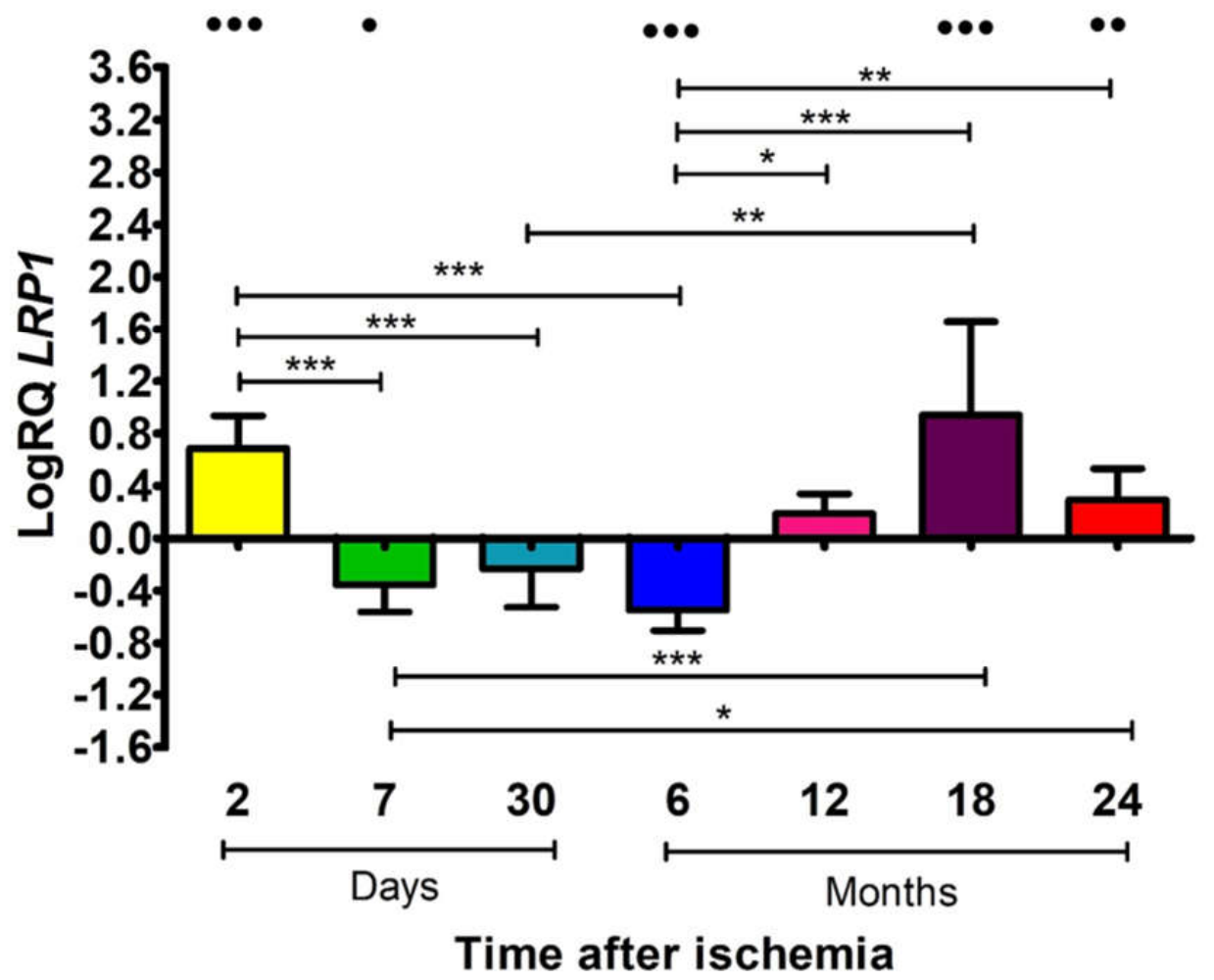
Figure 2.
The RAGE changes in the frontal cortex at various recirculation times after cerebral ischemia. There were 10 samples per/time in each post-ischemia and control group. Mean values. Marked SD, standard deviation. Kruskal-Wallis test. *p≤0.05, **p≤0 .01, ***p≤0.001. The dots at the top of the graph show the significance of the change on a given day between the sham group and the ischemic group using the Z test. •p≤0.05, ••p≤0.01, •••p≤0.001.
Figure 2.
The RAGE changes in the frontal cortex at various recirculation times after cerebral ischemia. There were 10 samples per/time in each post-ischemia and control group. Mean values. Marked SD, standard deviation. Kruskal-Wallis test. *p≤0.05, **p≤0 .01, ***p≤0.001. The dots at the top of the graph show the significance of the change on a given day between the sham group and the ischemic group using the Z test. •p≤0.05, ••p≤0.01, •••p≤0.001.
Disclaimer/Publisher’s Note: The statements, opinions and data contained in all publications are solely those of the individual author(s) and contributor(s) and not of MDPI and/or the editor(s). MDPI and/or the editor(s) disclaim responsibility for any injury to people or property resulting from any ideas, methods, instructions or products referred to in the content. |
© 2026 by the authors. Licensee MDPI, Basel, Switzerland. This article is an open access article distributed under the terms and conditions of the Creative Commons Attribution (CC BY) license (http://creativecommons.org/licenses/by/4.0/).
Copyright: This open access article is published under a Creative Commons CC BY 4.0 license, which permit the free download, distribution, and reuse, provided that the author and preprint are cited in any reuse.


