

Submitted:
29 May 2026
Posted:
01 June 2026
You are already at the latest version
Abstract
Neglected arboviruses dengue (DENV), Zika (ZIKV), yellow fever (YFV), Japanese encephalitis (JEV), and chikungunya collectively affect hundreds of millions of people annually, yet no specific antiviral drug has been approved for any of them. Alkaloids, nitrogen-containing specialized me-tabolites produced by diverse plant families, have emerged as a promising source of broad-spectrum antiviral scaffolds. This review compiles and critically analyzes ~100 alkaloid antiviral activities across several RNA virus families, providing a comparative mechanistic analysis. Lycorine, narciclasine, emetine, and berbamine, among others, exhibit potent activity against phylogenetically distant viruses, with the most potent interactions reported against fla-viviruses (narciclasine: EC₅₀ 0.02 µM against DENV, ZIKV, YFV, and JEV; pancratistatine: 0.0063 µM against ZIKV). Structure-activity analysis of multiple alkaloid classes identifies key pharma-cophoric features, including the phenanthridone nucleus (lycorine derivatives) and the bis-benzylisoquinoline scaffold (tetrandrine, berbamine), as determinants of antiviral potency, se-lectivity, and broad-spectrum activity. Genetic resistance data and replicon experiments challenge the widely accepted model of lycorine as a nucleoside inhibitor of flaviviruses, instead indicating that the membrane-associated NS4A-2K-NS4B replication complex is the actual functional target. Converging structural, biochemical, and transcriptomic evidence suggests that ribosome-mediated translational stress may represent an additional host-directed mechanism for isoquinoline-type alkaloids, though this hypothesis requires formal validation. The present analysis highlights that in vivo validation remains limited to a few compound-virus combinations. Unbiased target de-convolution and formal testing of the ribosome/integrated stress response hypothesis stand out as essential research priorities.
Keywords:
neglected tropical diseases
; flavivirus
; mechanism of action
; ribosome
; structure-activity relationships
; integrated stress response
; broad-spectrum antivirals
2. Viral Target of Alkaloids: Cross-Family Analysis
RNA viruses are a major contributor to the emergence of new infectious diseases [38]. Their rapid evolution and mutation rate make them challenging pathogens to eradicate, requiring specific vaccination and antiviral strategies [39]. The viruses covered in this review span a broad spectrum of replication strategies, tissue tropisms, and clinical impacts. Members of the Flaviviridae include neglected arboviruses transmitted by Aedes mosquitoes (DENV, ZIKV, YFV, JEV) and the blood-borne HCV (Figure 1). Coronaviridae range from endemic seasonal pathogens (e.g., Human coronavirus (HCoV)-OC43) to epidemic and pandemic viruses (e.g., severe acute respiratory syndrome (SARS)-CoV, Middle East respiratory syndrome (MERS)-CoV, and SARS-CoV-2) (Figure 2). Orthomyxoviridae (e.g., influenza virus) cause recurrent seasonal epidemics with pandemic potential. Additional viruses (CHIKV, Ebola virus (EBOV), human immunodeficiency virus (HIV-1), respiratory syncytial virus (RSV), hepatitis B virus (HBV), parainfluenza virus (HPIV)-3) are included where alkaloid data are available.
Despite their diversity, these viruses share common vulnerabilities that alkaloids may exploit, including dependence on host translational machinery, membrane-associated replication complexes, and the encoding of conserved enzymes, such as polymerases and viral proteases (Figure 1 and Figure 2). Antiviral alkaloids target several distinct molecular targets. Table 2, Table 3, Table 4, Table 5, Table 6 and Table 7 compile the antiviral activities of alkaloids reported against DENV and ZIKV (Table 2), other flaviviruses and CHIKV (Table 3), HCV (Table 4), coronaviruses (Table 5), influenza virus, HIV-1, and other relevant viruses (Table 6).
2.1. Viral Entry Inhibition
Entry inhibition is a pharmacologically diverse mechanism reported for antiviral alkaloids, spanning at least three distinct molecular steps. Bis-BIQ alkaloids are well-characterized entry inhibitors. Tetrandrine, fangchinoline, and cepharanthine inhibit HCoV-OC43 infection of human lung cells, likely by disrupting endolysosomes (Table 5) [40]. Berbamine acts at a different step, binding to the post-fusion core of the SARS-CoV-2 Spike S2 subunit and blocking membrane fusion [41]. Since acidification is also required for pH-triggered fusion of flaviviruses in late endosomes, recent studies have confirmed that all five bis-BIQ tested (berbamine, tetrandrine, iso-tetrandrine, fangchinoline, and cepharanthine) inhibit ZIKV, DENV (Table 2), and JEV (Table 3) infection by blocking both entry and replication [42]. The entry-inhibition mechanism involves blockade of Transient Receptor Potential-Mucolipin (TRPML) channels, lysosomal pH alkalization, and reduced expression of the ZIKV receptor, NCAM1 [43,44]. Bis-BIQ scaffold thus represents a validated cross-family entry inhibitor class active against both Coronaviridae and Flaviviridae, targeting multiple entry steps depending on the specific compound and virus. HIV-1 enters cells via fusion rather than endocytosis, yet this step can also be blocked by some alkaloids, such as aloperine, a quinolizidine-type alkaloid (Table 7) [45].
The IQ alkaloid berberine displays a less conserved antiviral mechanism. Against HCV, Hung et al. [46] demonstrated that berberine binds the E2 glycoprotein, blocking entry with a classical receptor-level mechanism (Table 4). However, during DENV and ZIKV infections, berberine does not affect entry (Table 2) [47]. Likewise, emetine exhibits a virus-dependent pattern, inhibiting MERS-CoV (Table 5) and EBOV (Table 6) entry [48], but targeting later steps of ZIKV replication (Table 2) [49]. This underscores that mechanistic data from one virus cannot directly be extrapolated to another. A dual-mechanism profile, entry blockade for one virus, replication inhibition for another, is potentially advantageous for a broad-spectrum antiviral, as it reduces the likelihood that resistance at a single target will abolish efficacy across viral families.
Voacangine monoterpenoid indole alkaloid (MIA) and its derivatives could inhibit the entry of some DENV serotypes (Table 2) [50]. Interestingly, to date, several Amaryllidaceae alkaloids tested in time-of-addition or entry-specific assays, including lycorine against influenza H5N1 (Table 6) [51], DENV (Table 2) [52], and CHIKV (Table 3); and seven alkaloids against HCoV-OC43 (Table 5)[53], have shown post-entry activity. While this does not exclude the possibility that untested compounds or virus-alkaloid combinations may involve entry inhibition, the consistency of these findings across multiple viral families and diverse alkaloid scaffolds supports a shared post-entry activity for this alkaloid class.
2.2. RNA-Dependent RNA Polymerase Inhibition
Most RNA virus replication requires the expression of an RNA-dependent RNA polymerase (RdRp) that can replicate its genome (Figure 1 and Figure 2). Retroviruses, such as HIV-1, use a reverse transcriptase that allows their genome to transition to a DNA provirus. As specifically encoded by the virus, these polymerases are a frequently reported target for antiviral alkaloids, but the strength of evidence varies dramatically across viral families and compounds. For lycorine (Table 5), the most compelling enzymatic evidence comes from the coronavirus field. Jin et al. [54] demonstrated that lycorine directly inhibits MERS-CoV RdRp activity with an IC50 of 1.4 µM in a cell-based reporter assay, a value concordant with its cellular EC50 and more potent than remdesivir (IC50 6.3 µM) in the same system.
Lycorine maintains submicromolar activity against all tested flaviviruses and has demonstrated significant in vivo efficacy, with an 83% improvement in survival in ZIKV-infected mice [55]. However, it’s possible activity as a direct NS5 RdRp inhibitor is considerably weaker than widely assumed. Using subgenomic replicons, our results demonstrated that lycorine and cherylline inhibit DENV RNA replication (Table 2) [52]. In addition, Agrawal et al. (2024) confirmed that lycorine reduces total and negative-strand RNA synthesis across all four DENV serotypes and CHIKV [56]. Molecular docking placed lycorine near the catalytic sites of both DENV and CHIKV RdRps (Table 2 and Table 3) [56], but these remain computational predictions. Indeed, while biochemical assays in the literature suggest an IC50 for the purified ZIKV NS5 protein in the high micromolar range, we recently confirmed that lycorine and its derivatives exhibit only weak DENV RdRp IC50 values (>100 µM), despite their potent antiviral EC50 (<1 µM) (manuscript under revision). This discrepancy represents an inhibitory concentration approximately 250 times higher than the cellular EC50 [55]. In contrast, for emetine, Yang et al. [49] clearly demonstrated direct inhibition of ZIKV NS5 RdRp with an IC50 of 0.121 µM, a concentration well within the pharmacologically relevant range, while cardiotoxicity was observed only at concentrations 400-600-fold higher [48].
Although numerous compounds are listed as replication inhibitors in Table 2, Table 3, Table 4, Table 5 and Table 6, this does not imply that they act at the level of the RdRp. Direct and convincing enzymatic evidence exists only for lycorine against MERS-CoV and for emetine against ZIKV. For the remainder, the inhibition of replication reflects the outcome of time-of-addition or replicon experiments and does not distinguish among RdRp inhibition, interference with replication complex assembly, or translational effects on viral protein production.
2.3. Viral Protease Inhibition and Protease-Dependent Processing
Arbovirus genomes are translated into a single polyprotein that requires processing by host and viral proteases (Figure 1). Some evidence supports direct protease inhibition by alkaloids. Li et al. [66] described lycorine as a main protease (Mpro) inhibitor of SARS-CoV, using cytopathic effect-based screening, and the target was later confirmed experimentally for SARS-CoV-2 by Narayanan et al. [67] in a cell-based protease assay. To our knowledge, no equivalent data exist for flaviviral proteases (NS2B-NS3). Lycorine, like cherylline, did not inhibit a replication-deficient DENV replicon (NS5 catalytic mutant), which measures only cap-dependent translation of the input RNA [52]. This result demonstrates that lycorine's anti-DENV activity requires active viral RNA replication and excludes a primary translational mechanism for this virus.
Zou et al. (2009) reported resistance data that provide a solid link between lycorine and protease-dependent processing in flaviviruses [57]. The V9M resistance mutation in the WNV viral genome, arising from continuous lycorine treatment, maps to the 2K peptide, a 23-amino-acid transmembrane segment between NS4A and NS4B. Critically, the cleavage at the NS4A-2K junction is performed by the viral NS2B-NS3 protease, and this cleavage is a prerequisite for the subsequent host signal peptidase (signalase) cleavage at the 2K-NS4B junction [68]. This sequential, protease-dependent processing of NS4A-2K-NS4B is essential for the membrane rearrangements that form the scaffold of the viral replication complex. The V9M mutation enhances viral RNA replication ~100-fold in the presence of lycorine (but only 2-4-fold in its absence), possibly by altering 2K-mediated membrane reorganization or the efficiency of NS2B-NS3 cleavage at the NS4A-2K site.
This resistance data suggests that the functional target of lycorine in flaviviruses is more likely the membrane-associated NS4A-2K-NS4B replication complex than the NS5 polymerase itself. This interpretation is consistent with the weak direct enzymatic inhibition of NS5. Interestingly, Fikatas et al. [27] identified a novel series of indole alkaloid derivatives, structurally related to the ervatamine-silicine family, with a piperidine ring, that interfere with the replication complex, through targeting NS4B (genetically validated resistance mutation). Together with the specific targeting of the most clinically advanced DENV antiviral JNJ-1802, which blocks the NS3-NS4B protein-protein interaction [69], the lines of evidence converge on the central role of NS4B and its interactions with NS3 in flavivirus replication. These findings position the NS4B-NS3 axis and the membrane-associated replication complex as a privileged therapeutic target in flaviviruses.
2.4. Other Viral Targets
Tylophorine and its derivatives exhibit nanomolar antiviral activity against coronaviruses by binding viral genomic/subgenomic RNAs and nucleocapsid proteins [72], but have not been tested against flaviviruses to our knowledge.
Overall, the most robust viral target assignments are currently that lycorine targets MERS-CoV RdRp but NS4A-2K-NS4B membrane complex for WNV; emetine against ZIKV RdRp; and ervatamine-silicine-type indole derivatives target NS4B for DENV/ZIKV (resistance mutation). Strikingly, the two genetically validated targets in flaviviruses both implicate the NS4A-NS4B axis rather than NS5.
3. Host Factors as Targets Across Virus Families
As obligate intracellular pathogens, viruses rely on the host cell machinery to successfully complete their replication cycle and proliferate. While endogenous, these factors can be temporarily targeted to prevent viral replication and protect the host.
3.1. Ribosome Binding and Translational Stress: Old Evidence for An Emerging Antiviral Mechanism
The interaction of Amaryllidaceae alkaloids with the ribosome has been characterized at increasing resolution over five decades. Jimenez et al. (1976) demonstrated dose-dependent inhibition of protein synthesis by lycorine in mammalian cells [75]. Kukhanova et al. (1983) localized the target to the donor site of the peptidyltransferase center (PTC) of wheat-germ ribosomes [76]. Garreau de Loubresse et al. (2014) confirmed lycorine and narciclasine binding near the tRNA/mRNA interface by crystallography [77], and Pellegrino et al. (2018) solved the 3.1 Å structure of haemanthamine at the 80S ribosomal PTC A-site [78]. Consistent with a translational target, Li et al. (2021) used two independent CHIKV replicon systems to demonstrate that lycorine inhibits primarily viral translation [71]. Time-of-drug addition and SARS-CoV-2 replicon assays also suggest a post-entry step consistent with translation as the target of AAs [53].
Nonetheless, the ribosome/translation target does not apply universally across viral families. For DENV, cherylline and lycorine failed to inhibit a translation-only replicon (NS5-deficient), demonstrating that active RNA replication is required for its antiviral effect [52]. This virus-specific variation suggests that the translational target identified for CHIKV [71] and the replication complex target for DENV/WNV represent distinct, family-dependent mechanisms. Such mechanistic versatility is analogous to that observed for berberine (Table 3). This also underscores that distinguishing translational from replicative effects remains technically challenging for compounds that may affect both processes [56].
Narciclasine EC₅₀ of 0.02 µM is remarkably consistent across all four neglected flaviviruses tested, DENV, ZIKV, YFV, and JEV (Table 2 and Table 3) [35,60], a uniformity that suggests a host-directed mechanism. Indeed, this compound binds the eukaryotic ribosome near the tRNA/mRNA interface [77]. Determining whether narciclasine inhibits a DENV translation-only replicon will help directly assess whether its anti-flaviviral activity operates through the ribosomal mechanism suggested by its structural data, or through a distinct pathway. If narciclasine does inhibit the translation-only replicon, this would confirm that a structurally distinct Amaryllidaceae alkaloids can target different steps of the viral cycle even within the same virus. Intriguingly, narciclasine has not been tested against influenza or CHIKV, leaving its cross-family breadth undefined. Compounds of the narciclasine-type scaffold (notably pancratistatine) were reported as cytotoxic and devoid of anti-SARS-CoV-2 activity in Vero-E6 cells [79], but as discussed in [59], cell-line-dependent results for structurally related compounds urge caution in generalizing these findings. Indeed, a synthetic derivative, 7-hydroxyl-dihydronarciclasine, displayed strong antiviral activity against SARS-CoV-2 (Table 5) [80].
3.2. The Integrated Stress Response Following Ribosome Stalling
In addition to impairing protein synthesis, ribosomal inhibition triggers an integrated stress response (ISR) and may modulate the immune response. Independent antiviral observations converge on the hypothesis that translational stress may contribute to antiviral activity, though they do not establish a causal chain. McNulty et al. (2023) reported ISR activation (PERK/eIF2α) by a truncated ring-A isocarbostyril [80] in HSV-1-infected brain organoids. PERK kinase upregulation leads to eIF2α phosphorylation and ATF4 induction, the canonical ISR effector axis. Although ISR activation has been reported to intersect with innate antiviral signaling in some contexts, the pathway linking eIF2α phosphorylation to type I interferon production remains mechanistically undefined and distinct from the canonical IRF3/IRF7-dependent induction routes. We also detected upregulation of ATF4 transcription, early after antiviral Amaryllidaceae alkaloids treatment in the context of HCoV-OC43 infection, as well as an increase in IFN-β transcript (Table 5) [53]. A preprint [61]suggests that narciclasine and montanine (Table 2 and Table 5) bind to ribosomal PTC, yielding ribosome collision and the ISR axis. This positions ISR activation as a potential bridge between the translational perturbation and the induction of an antiviral innate immune response. Although the alkaloid-dependent ribosome-mediated ISR effect on viral translation has yet to be formally established, this hypothesis is intriguing.
3.3. Host Innate Immune Signaling
Convergent lines of evidence suggest that alkaloids may modulate host innate immune signaling pathways. Cepharanthine was recently shown to reduce IL-6 production following DENV infection (Table 2) [44]. Giannoni et al demonstrated that berberine inhibits ZIKV-induced activation of both ERK1/2 and p38 MAPK in infected cells, and that the p38 inhibitor SB202190 phenocopied berberine's antiviral effect [47] (Table 2). Since p38 MAPK regulates inflammatory cytokines and modulates cap-dependent translation via MAPKAPK2-mediated phosphorylation of eIF4E, a pathway parallel to the eIF2α-centered ISR, berberine may engage the same translational-immune interface through a distinct upstream kinase. Berberine also impaired the formation of intracellular and extracellular infectious DENV particles (Table 2), thus involving late-stage assembly and host signaling. In a complementary observation, Huang et al. (2026) showed that lycorine restores the type I IFN response suppressed during infection with infectious bronchitis virus in chicken cells by upregulating MDA5 expression through the RIG-I-like receptor pathway rather than the ISR [87]. This suggests that some alkaloids may enhance innate antiviral immunity through multiple independent mechanisms, likely depending on the compound, virus, and cell type.
Of note, none of these observations demonstrates that immune modulation is the primary antiviral mechanism rather than a bystander effect. Translational inhibition alone, by reducing the burst of viral protein synthesis that positive-strand RNA viruses require, could account for much of the antiviral activity without requiring ISR signaling. Disentangling these possibilities will require experiments in which ISR or MAPK signaling is specifically blocked while monitoring viral replication in alkaloid-treated cells.
3.4. Additional Host-Targeting Mechanisms
At least three other host-directed antiviral pathways have been experimentally established for alkaloids. Lycorine derivatives downregulate the host chaperone Hsc70, destabilizing the HCV replication complex (Table 4) [73]. This represents a validated host-targeting pathway with potential transferability to DENV, where Hsc70 is also required for replication [88,89], though this has not been tested. Lycorine inhibits the synthesis of the nucleoporin Nup93, blocking nuclear export of influenza nucleoprotein [90], but there is no equivalent in flaviviruses (which replicate in the cytoplasm). Du et al. (2026) identified a novel mechanism for lycorine derivative compound 7, stabilization of ZAP-S (zinc-finger antiviral protein, short isoform), which disrupts -1PRF, validated by in vivo data in hamster models (Table 5) [83]. This mechanism is conserved across SARS-CoV, SARS-CoV-2, and MERS-CoV.
Castanospermine and other iminosugars inhibit DENV infection at the level of secretion and viral infectivity by targeting host α-glucosidases, disrupting N-glycan processing and viral glycoprotein folding [62], a mechanism active against DENV, HCV, HIV, and influenza that has progressed furthest toward clinical application. For most alkaloid-arbovirus pairs, including the most potent (narciclasine, pancratistatine, amarbellisine), the molecular target remains unconfirmed. Resolving this deficit is an important challenge facing this field.
It is worth noting that DNA intercalation by isoquinoline alkaloids such as berberine and emetine is well characterized in the context of DNA viruses and protozoa [91,92]. For RNA viruses, however, the relevance of this mechanism is less clear. Pépin et al. (2017) demonstrated that DNA intercalating agents can activate cGAS-STING signaling through low-level host DNA damage, providing an alternative route to type I IFN induction [93]. Whether the alkaloids discussed here engage this pathway in addition to the ribosome-mediated ISR remains to be determined.
4. Conclusions
This review compiled over 100 alkaloid-virus combinations across RNA virus families and identified four chemical scaffolds, isoquinoline (emetine, berberine), benzylisoquinoline, bis-benzylisoquinoline (tetrandrine, berbamine), and isocarbostyril (lycorine, narciclasine), as displaying cross-family antiviral activity. The most potent interactions were concentrated against neglected arboviruses for which no approved therapeutics currently exist. This analysis reveals both strengths and weaknesses in the field. The most robust mechanistic assignments come from well-characterized viral systems and are supported by enzymatic, structural, or genetic validation. In contrast, the widely cited lycorine-NS5 interaction for flaviviruses lacks enzymatic confirmation at pharmacologically relevant concentrations, and over half of all alkaloid-virus mechanisms remain entirely uncharacterized. Converging structural, biochemical, and transcriptomic evidence spanning five decades suggests that ribosome-mediated translational stress may constitute an additional, unifying mechanism for isoquinoline-derived alkaloids, including the Amaryllidaceae subgroup, but this hypothesis requires formal validation. Addressing the mechanistic deficit through unbiased target deconvolution, formal testing of the ribosome/ISR hypothesis, expanded taxonomic coverage, and in vivo validation will determine which plant-derived alkaloids can be translated into therapeutics for the neglected arboviruses that continue to threaten global health.
Author Contributions
Conceptualization, M.R., M.S.M., H.G., N.M., and I.D-P.; methodology, , M.R., M.S.M., N.M., and I.D-P.; validation, H.G., N.M. and I.D-P.; formal analysis, M.R., M.S.M., and N.M., investigation, M.R., M.S.M., and N.M.; resources, H.G. and I.D-P.; data curation, M.R., M.S.M., and N.M.; writing—original draft preparation, M.R., and M.S.M.; writing—review and editing, M.R., M.S.M., N.M., H.G. and I.D-P.; supervision, N.M., H.G. and I.D-P..=; project administration, H.G. and I.D-P.; funding acquisition, I.D-P.. All authors have read and agreed to the published version of the manuscript
Funding
This research was funded by Canada Research Chair on plant specialized metabolism, grant number CRC-2023 00353 to I.D-P.
Institutional Review Board Statement
Not applicable.
Informed Consent Statement
Not applicable.
Data Availability Statement
Not applicable.
Acknowledgments
We thank all members of the laboratories of Professors Isabel Desgagné-Penix and Hugo Germain. We would like to express our gratitude to Serge Basile Nouemssi and Aracely Maribel Diaz Garza for their valuable advice during the initial stages of writing of this review. The authors acknowledge the use of Claude AI (Anthropic) for language revision. Following the use of this tool, the authors reviewed and edited the content as needed and take full responsibility for the publication's content. Warm thanks are extended to the Canadian taxpayers and the Canadian government for their support of the Canada Research Chairs Program.
Conflicts of Interest
The authors declare no conflict of interest.
Sample Availability
Not applicable.
References
- Lim, A.; Shearer, F.M.; Sewalk, K.; Pigott, D.M.; Clarke, J.; Ghouse, A.; Judge, C.; Kang, H.; Messina, J.P.; Kraemer, M.U.G.; et al. The overlapping global distribution of dengue, chikungunya, Zika and yellow fever. Nat. Commun. 2025, 16, 3418. [Google Scholar] [CrossRef]
- World Health Organization - Dengue and severe dengue. Available online: https://www.who.int/fr/news-room/fact-sheets/detail/dengue-and-severe-dengue (accessed on 22 May 2026).
- Wang, P.; Li, L.F.; Wang, Q.Y.; Shang, L.Q.; Shi, P.Y.; Yin, Z. Anti-dengue-virus activity and structure-activity relationship studies of lycorine derivatives. ChemMedChem 2014, 9, 1522–1533. [Google Scholar] [CrossRef]
- Suhrbier, A. Rheumatic manifestations of chikungunya: emerging concepts and interventions. Nat. Rev. Rheumatol. 2019, 15, 597–611. [Google Scholar] [CrossRef] [PubMed]
- Bartholomeeusen, K.; Daniel, M.; LaBeaud, D.A.; Gasque, P.; Peeling, R.W.; Stephenson, K.E.; Ng, L.F.P.; Arien, K.K. Chikungunya fever. Nat. Rev. Dis. Prim. 2023, 9, 17. [Google Scholar] [CrossRef]
- World Health Organization- The history of zika virus. Available online: https://www.who.int/news-room/feature-stories/detail/the-history-of-zika-virus (accessed on 22 May 2026).
- Musso, D.; Gubler, D.J. Zika virus. Clin. Microbiol. Rev. 2016, 29, 487–524. [Google Scholar] [CrossRef] [PubMed]
- Durbin, A.P.; Van Wesenbeeck, L.; Pierce, K.K.; Herrera-Taracena, G.; Ebone, L.; Buelens, A.; Lutton, P.; Sabundayo, B.P.; Van Eygen, V.; De Clerck, K.; et al. Daily Mosnodenvir as Dengue Prophylaxis in a Controlled Human Infection Model. N Engl. J. Med. 2025, 393, 2107–2118. [Google Scholar] [CrossRef] [PubMed]
- Kiemel, D.; Kroell, A.H.; Denolly, S.; Haselmann, U.; Bonfanti, J.F.; Andres, J.I.; Ghosh, B.; Geluykens, P.; Kaptein, S.J.F.; Wilken, L.; et al. Pan-serotype dengue virus inhibitor JNJ-A07 targets NS4A-2K-NS4B interaction with NS2B/NS3 and blocks replication organelle formation. Nat. Commun. 2024, 15, 6080. [Google Scholar] [CrossRef]
- Tricou, V.; Yu, D.; Reynales, H.; Biswal, S.; Saez-Llorens, X.; Sirivichayakul, C.; Lopez, P.; Borja-Tabora, C.; Bravo, L.; Kosalaraksa, P.; et al. Long-term efficacy and safety of a tetravalent dengue vaccine (TAK-003): 4.5-year results from a phase 3, randomised, double-blind, placebo-controlled trial. Lancet Glob. Health 2024, 12, e257–e270. [Google Scholar] [CrossRef]
- Schneider, M.; Narciso-Abraham, M.; Hadl, S.; McMahon, R.; Toepfer, S.; Fuchs, U.; Hochreiter, R.; Bitzer, A.; Kosulin, K.; Larcher-Senn, J.; et al. Safety and immunogenicity of a single-shot live-attenuated chikungunya vaccine: a double-blind, multicentre, randomised, placebo-controlled, phase 3 trial. Lancet 2023, 401, 2138–2147. [Google Scholar] [CrossRef]
- Hatzakis, A. Hepatitis C: Care and Treatment; Springer, 2021. [Google Scholar]
- Ka, S.; Koirala, M.; Merindol, N.; Desgagne-Penix, I. Biosynthesis and Biological Activities of Newly Discovered Amaryllidaceae Alkaloids. Molecules 2020, 25, 4901. [Google Scholar] [CrossRef]
- Rupani, R.; Chavez, A. Medicinal plants with traditional use: Ethnobotany in the Indian subcontinent. Clin. Dermatol. 2018, 36, 306–309. [Google Scholar] [CrossRef]
- Faisal, S.; Badshah, S.L.; Kubra, B.; Emwas, A.-H.; Jaremko, M. Alkaloids as potential antivirals. A comprehensive review. Nat. Prod. Bioprospecting 2023, 13, 4. [Google Scholar] [CrossRef]
- Desgagné-Penix, I. Biosynthesis of alkaloids in Amaryllidaceae plants: A review. Phytochem. Rev. 2021, 20, 409–431. [Google Scholar] [CrossRef]
- Bézanger-Beauquesne, L. Les alcaloïdes dans les plantes. Bull. De La Société Bot. De Fr. 1958, 105, 266–291. [Google Scholar] [CrossRef]
- Covis, R. Les alcaloïdes, un moyen de défense chez les plantes et des vertus thérapeutiques chez l’homme. Lemag' 2023, 41–44. [Google Scholar]
- Facchini, P.J. Alkaloid Biosynthesis In Plants: Biochemistry, Cell Biology, Molecular Regulation, and Metabolic Engineering Applications. Annu Rev. Plant Physiol. Plant Mol. Biol. 2001, 52, 29–66. [Google Scholar] [CrossRef] [PubMed]
- Hesse, M. Alkaloids: Nature's curse or blessing? John Wiley & Sons, 2002. [Google Scholar]
- Dey, P.; Kundu, A.; Kumar, A.; Gupta, M.; Lee, B.M.; Bhakta, T.; Dash, S.; Kim, H.S. Analysis of alkaloids (indole alkaloids, isoquinoline alkaloids, tropane alkaloids). In Recent advances in natural products analysis; Elsevier, 2020; pp. 505–567. [Google Scholar]
- Yang, L.; Stockigt, J. Trends for diverse production strategies of plant medicinal alkaloids. Nat. Prod. Rep. 2010, 27, 1469–1479. [Google Scholar] [CrossRef]
- Amirkia, V.; Heinrich, M. Alkaloids as drug leads–A predictive structural and biodiversity-based analysis. Phytochem. Lett. 2014, 10, xlviii–liii. [Google Scholar] [CrossRef]
- Sung, C.; Wei, Y.; Watanabe, S.; Lee, H.S.; Khoo, Y.M.; Fan, L.; Rathore, A.P.; Chan, K.W.; Choy, M.M.; Kamaraj, U.S.; et al. Extended Evaluation of Virological, Immunological and Pharmacokinetic Endpoints of CELADEN: A Randomized, Placebo-Controlled Trial of Celgosivir in Dengue Fever Patients. PLoS Negl. Trop. Dis. 2016, 10, e0004851. [Google Scholar] [CrossRef]
- Girard, M.-P.; Merindol, N.; Berthoux, L.; Desgagné-Penix, I. Le pouvoir antiviral des alcaloïdes de végétaux contre les virus à ARN. Virologie 2022, 26, 431–450. [Google Scholar] [PubMed]
- Nazar, N.; Goyder, D.J.; Clarkson, J.J.; Mahmood, T.; Chase, M.W. The taxonomy and systematics of Apocynaceae: where we stand in 2012. Bot. J. Linn. Soc. 2013, 171, 482–490. [Google Scholar] [CrossRef]
- Fikatas, A.; Vervaeke, P.; Meyen, E.; Llor, N.; Ordeix, S.; Boonen, I.; Bletsa, M.; Kafetzopoulou, L.E.; Lemey, P.; Amat, M.; et al. A Novel Series of Indole Alkaloid Derivatives Inhibit Dengue and Zika Virus Infection by Interference with the Viral Replication Complex. Antimicrob. Agents Chemother. 2021, 65, e0234920. [Google Scholar] [CrossRef] [PubMed]
- Masagalli, J.N.; BasavanaGowda, M.K.; Chae, H.-S.; Choi, W.J. Synthesis of Moracin C and Its Derivatives with a 2-arylbenzofuran Motif and Evaluation of Their PCSK9 Inhibitory Effects in HepG2 Cells. Molecules 2021, 26, 1327. [Google Scholar] [CrossRef] [PubMed]
- Kaur, P.; Thiruchelvan, M.; Lee, R.C.H.; Chen, H.; Chen, K.C.; Ng, M.L.; Chu, J.J.H. Inhibition of chikungunya virus replication by harringtonine, a novel antiviral that suppresses viral protein expression. Antimicrob. Agents Chemother. 2013, 57, 155–167. [Google Scholar] [CrossRef]
- El Ouarti, A.; Hassi, M.; Sqalli, H.; Aarab, L.; Ennabili, A.; Houari, A.; Haggoud, A.; Ibnsouda, S.; Iraqui, M. Activité antimycobactérienne extra et intracellulaire de l’écorce des racines de Berberis hispanica. Bull. Soc. Pharm. Bordx. 2011, 149, 67–84. [Google Scholar]
- Cimmino, A.; Masi, M.; Evidente, M.; Superchi, S.; Evidente, A. Amaryllidaceae alkaloids: Absolute configuration and biological activity. Chirality 2017, 29, 486–499. [Google Scholar] [CrossRef]
- Revu, O.; Zepeda-Velázquez, C.; Nielsen, A.J.; McNulty, J.; Yolken, R.H.; Jones-Brando, L. Total Synthesis of the Natural Product (+)-trans-Dihydronarciclasine via an Asymmetric Organocatalytic [3+3]-Cycloaddition and discovery of its potent anti-Zika Virus (ZIKV) Activity. ChemistrySelect 2016, 1, 5895–5899. [Google Scholar] [CrossRef]
- He, M.; Qu, C.; Gao, O.; Hu, X.; Hong, X. Biological and pharmacological activities of Amaryllidaceae alkaloids. Rsc Adv. 2015, 5, 16562–16574. [Google Scholar] [CrossRef]
- Duri, Z.J.; Scovill, J.P.; Huggins, J.W. Activity of a methanolic extract of Zimbabwean Crinum macowanii against exotic RNA viruses in vitro. Phyther. Res. 1994, 8, 121–122. [Google Scholar] [CrossRef]
- Gabrielsen, B.; Monath, T.P.; Huggins, J.W.; Kefauver, D.F.; Pettit, G.R.; Groszek, G.; Hollingshead, M.; Kirsi, J.J.; Shannon, W.M.; Schubert, E.M.; et al. Antiviral (RNA) activity of selected Amaryllidaceae isoquinoline constituents and synthesis of related substances. J. Nat. Prod. 1992, 55, 1569–1581. [Google Scholar] [CrossRef] [PubMed]
- Nair, J.J.; van Staden, J. Antiviral alkaloid principles of the plant family Amaryllidaceae. Phytomedicine 2023, 108, 154480. [Google Scholar] [CrossRef]
- Abookleesh, F.L.; Al-Anzi, B.S.; Ullah, A. Potential Antiviral Action of Alkaloids. Molecules 2022, 27, 903. [Google Scholar] [CrossRef] [PubMed]
- Elena, S.F.; Sanjuan, R. Adaptive value of high mutation rates of RNA viruses: separating causes from consequences. J. Virol. 2005, 79, 11555–11558. [Google Scholar] [CrossRef] [PubMed]
- Sanjuan, R.; Domingo-Calap, P. Mechanisms of viral mutation. Cell Mol. Life Sci. 2016, 73, 4433–4448. [Google Scholar] [CrossRef]
- Kim, D.E.; Min, J.S.; Jang, M.S.; Lee, J.Y.; Shin, Y.S.; Song, J.H.; Kim, H.R.; Kim, S.; Jin, Y.H.; Kwon, S. Natural Bis-Benzylisoquinoline Alkaloids-Tetrandrine, Fangchinoline, and Cepharanthine, Inhibit Human Coronavirus OC43 Infection of MRC-5 Human Lung Cells. Biomolecules 2019, 9. [Google Scholar] [CrossRef] [PubMed]
- Sadhu, S.; Goswami, S.; Khatri, R.; Lohiya, B.; Singh, V.; Yadav, R.; Das, V.; Tripathy, M.R.; Dwivedi, P.; Srivastava, M.; et al. Berbamine prevents SARS-CoV-2 entry and transmission. iScience 2024, 27, 111347. [Google Scholar] [CrossRef]
- Huang, L.; Liu, L.; Zhu, J.; Chen, N.; Chen, J.; Chan, C.F.; Gao, F.; Yin, Y.; Sun, J.; Zhang, R.; et al. Bis-benzylisoquinoline alkaloids inhibit flavivirus entry and replication by compromising endolysosomal trafficking and autophagy. Virol. Sin. 2024, 39, 892–908. [Google Scholar] [CrossRef]
- Yang, S.; Yang, X.; Wang, Z.; Li, W.; Cao, R.; Zhong, W. Fangchinoline Inhibits Zika Virus by Disrupting Virus Internalization. ACS Infect. Dis. 2024, 10, 4066–4072. [Google Scholar] [CrossRef]
- Phumesin, P.; Panaampon, J.; Kariya, R.; Limjindaporn, T.; Yenchitsomanus, P.T.; Okada, S. Cepharanthine inhibits dengue virus production and cytokine secretion. Virus Res. 2023, 325, 199030. [Google Scholar] [CrossRef]
- Dang, Z.; Zhu, L.; Lai, W.; Bogerd, H.; Lee, K.-H.; Huang, L.; Chen, C.-H. Aloperine and its derivatives as a new class of HIV-1 entry inhibitors. ACS Med. Chem. Lett. 2016, 7, 240–244. [Google Scholar] [CrossRef]
- Hung, T.C.; Jassey, A.; Liu, C.H.; Lin, C.J.; Lin, C.C.; Wong, S.H.; Wang, J.Y.; Yen, M.H.; Lin, L.T. Berberine inhibits hepatitis C virus entry by targeting the viral E2 glycoprotein. Phytomedicine 2019, 53, 62–69. [Google Scholar] [CrossRef]
- Giannone, D.A.; Piccini, L.E.; Brunetti, J.E.; Quintana, V.M.; Damonte, E.B.; Castilla, V. Berberine inhibitory action against zika and dengue viruses in cell cultures. Acta Virol. 2023, 67. [Google Scholar] [CrossRef]
- Choy, K.T.; Wong, A.Y.; Kaewpreedee, P.; Sia, S.F.; Chen, D.; Hui, K.P.Y.; Chu, D.K.W.; Chan, M.C.W.; Cheung, P.P.; Huang, X.; et al. Remdesivir, lopinavir, emetine, and homoharringtonine inhibit SARS-CoV-2 replication in vitro. Antivir. Res. 2020, 178, 104786. [Google Scholar] [CrossRef]
- Yang, S.; Xu, M.; Lee, E.M.; Gorshkov, K.; Shiryaev, S.A.; He, S.; Sun, W.; Cheng, Y.-S.; Hu, X.; Tharappel, A.M. Emetine inhibits Zika and Ebola virus infections through two molecular mechanisms: inhibiting viral replication and decreasing viral entry. Cell Discov. 2018, 4, 31. [Google Scholar] [CrossRef]
- Monsalve-Escudero, L.M.; Loaiza-Cano, V.; Zapata-Cardona, M.I.; Quintero-Gil, D.C.; Hernandez-Mira, E.; Pajaro-Gonzalez, Y.; Oliveros-Diaz, A.F.; Diaz-Castillo, F.; Quinones, W.; Robledo, S.; Martinez-Gutierrez, M. The Antiviral and Virucidal Activities of Voacangine and Structural Analogs Extracted from Tabernaemontana cymosa Depend on the Dengue Virus Strain. Plants 2021, 10. [Google Scholar] [CrossRef]
- He, J.; Qi, W.B.; Wang, L.; Tian, J.; Jiao, P.R.; Liu, G.Q.; Ye, W.C.; Liao, M. Amaryllidaceae alkaloids inhibit nuclear-to-cytoplasmic export of ribonucleoprotein (RNP) complex of highly pathogenic avian influenza virus H5N1. Influenza Other Respir. Viruses 2013, 7, 922–931. [Google Scholar] [CrossRef]
- Ka, S.; Merindol, N.; Sow, A.A.; Singh, A.; Landelouci, K.; Plourde, M.B.; Pepin, G.; Masi, M.; Di Lecce, R.; Evidente, A.; et al. Amaryllidaceae Alkaloid Cherylline Inhibits the Replication of Dengue and Zika Viruses. Antimicrob. Agents Chemother. 2021, 65, e0039821. [Google Scholar] [CrossRef] [PubMed]
- Merindol, N.; Belem Martins, L.L.; Elfayres, G.; Custeau, A.; Berthoux, L.; Evidente, A.; Desgagne-Penix, I. Amaryllidaceae Alkaloids Screen Unveils Potent Anticoronaviral Compounds and Associated Structural Determinants. ACS Pharmacol. Transl. Sci. 2024, 7, 3527–3539. [Google Scholar] [CrossRef] [PubMed]
- Jin, Y.-H.; Min, J.S.; Jeon, S.; Lee, J.; Kim, S.; Park, T.; Park, D.; Jang, M.S.; Park, C.M.; Song, J.H. Lycorine, a non-nucleoside RNA dependent RNA polymerase inhibitor, as potential treatment for emerging coronavirus infections. Phytomedicine 2021, 86, 153440. [Google Scholar] [CrossRef]
- Chen, H.; Lao, Z.; Xu, J.; Li, Z.; Long, H.; Li, D.; Lin, L.; Liu, X.; Yu, L.; Liu, W.; et al. Antiviral activity of lycorine against Zika virus in vivo and in vitro. Virology 2020, 546, 88–97. [Google Scholar] [CrossRef] [PubMed]
- Agrawal, T.; Siddqui, G.; Dahiya, R.; Patidar, A.; Madan, U.; Das, S.; Asthana, S.; Samal, S.; Awasthi, A. Inhibition of early RNA replication in Chikungunya and Dengue virus by lycorine: In vitro and in silico studies. Biochem Biophys. Res. Commun. 2024, 730, 150393. [Google Scholar] [CrossRef]
- Zou, G.; Puig-Basagoiti, F.; Zhang, B.; Qing, M.; Chen, L.; Pankiewicz, K.W.; Felczak, K.; Yuan, Z.; Shi, P.-Y. A single-amino acid substitution in West Nile virus 2K peptide between NS4A and NS4B confers resistance to lycorine, a flavivirus inhibitor. Virology 2009, 384, 242–252. [Google Scholar] [CrossRef]
- Masi, M.; Di Lecce, R.; Merindol, N.; Girard, M.P.; Berthoux, L.; Desgagne-Penix, I.; Calabro, V.; Evidente, A. Cytotoxicity and Antiviral Properties of Alkaloids Isolated from Pancratium maritimum. Toxins 2022, 14, 262. [Google Scholar] [CrossRef]
- Jayawardena, T.U.; Merindol, N.; Liyanage, N.S.; Gelinas, S.E.; Lionel, B.; Seydou, K.; Seck, M.; Evidente, A.; Desgagne-Penix, I. Antiviral alkaloids from Crinum jagus: Extraction, synergistic effects, and activity against dengue virus and human coronavirus OC43. Heliyon 2025, 11, e42580. [Google Scholar] [CrossRef]
- de Castro Barbosa, E.; Alves, T.M.A.; Kohlhoff, M.; Jangola, S.T.G.; Pires, D.E.V.; Figueiredo, A.C.C.; Alves, E.A.R.; Calzavara-Silva, C.E.; Sobral, M.; Kroon, E.G.; et al. Searching for plant-derived antivirals against dengue virus and Zika virus. Virol. J. 2022, 19, 31. [Google Scholar] [CrossRef]
- Sakai, R.; Sato, K.; Tsugita, A.; Thaveepornkul, L.; Takada, A.; Miyamoto, H.; Kurokawa, R.; Yoshida, M.; Yokoyama, T.; Evidente, A.; et al. Modulation of translational elongation by montanine alkaloids preferentially inhibits RNA viruses. bioRxiv 2025(2025.2012), 2019.695327. [CrossRef]
- Whitby, K.; Pierson, T.C.; Geiss, B.; Lane, K.; Engle, M.; Zhou, Y.; Doms, R.W.; Diamond, M.S. Castanospermine, a potent inhibitor of dengue virus infection in vitro and in vivo. J. Virol. 2005, 79, 8698–8706. [Google Scholar] [CrossRef]
- Yin Low, J.; Chen, K.; Wu, K.; Mah-LeeNm, H.; Chu, H. Antiviral activity of emetine dihydrochloride against dengue virus infection. J. Antivir. Antiretrovir 2009, 1, 62–71. [Google Scholar] [CrossRef]
- Hishiki, T.; Kato, F.; Tajima, S.; Toume, K.; Umezaki, M.; Takasaki, T.; Miura, T. Hirsutine, an Indole Alkaloid of Uncaria rhynchophylla, Inhibits Late Step in Dengue Virus Lifecycle. Front Microbiol. 2017, 8, 1674. [Google Scholar] [CrossRef]
- Diosa-Toro, M.; Troost, B.; van de Pol, D.; Heberle, A.M.; Urcuqui-Inchima, S.; Thedieck, K.; Smit, J.M. Tomatidine, a novel antiviral compound towards dengue virus. Antivir. Res. 2019, 161, 90–99. [Google Scholar] [CrossRef]
- Li, S.Y.; Chen, C.; Zhang, H.Q.; Guo, H.Y.; Wang, H.; Wang, L.; Zhang, X.; Hua, S.N.; Yu, J.; Xiao, P.G.; et al. Identification of natural compounds with antiviral activities against SARS-associated coronavirus. Antivir. Res. 2005, 67, 18–23. [Google Scholar] [CrossRef]
- Narayanan, A.; Narwal, M.; Majowicz, S.A.; Varricchio, C.; Toner, S.A.; Ballatore, C.; Brancale, A.; Murakami, K.S.; Jose, J. Identification of SARS-CoV-2 inhibitors targeting Mpro and PLpro using in-cell-protease assay. Commun. Biol. 2022, 5, 169. [Google Scholar] [CrossRef]
- Lin, C.; Amberg, S.M.; Chambers, T.J.; Rice, C.M. Cleavage at a novel site in the NS4A region by the yellow fever virus NS2B-3 proteinase is a prerequisite for processing at the downstream 4A/4B signalase site. J. Virol. 1993, 67, 2327–2335. [Google Scholar] [CrossRef]
- Kaptein, S.J.F.; Goethals, O.; Kiemel, D.; Marchand, A.; Kesteleyn, B.; Bonfanti, J.F.; Bardiot, D.; Stoops, B.; Jonckers, T.H.M.; Dallmeier, K.; et al. A pan-serotype dengue virus inhibitor targeting the NS3-NS4B interaction. Nature 2021, 598, 504–509. [Google Scholar] [CrossRef]
- Varghese, F.S.; Kaukinen, P.; Gläsker, S.; Bespalov, M.; Hanski, L.; Wennerberg, K.; Kümmerer, B.M.; Ahola, T. Discovery of berberine, abamectin and ivermectin as antivirals against chikungunya and other alphaviruses. Antivir. Res. 2016, 126, 117–124. [Google Scholar] [CrossRef]
- Li, N.; Wang, Z.; Wang, R.; Zhang, Z.R.; Zhang, Y.N.; Deng, C.L.; Zhang, B.; Shang, L.Q.; Ye, H.Q. In Vitro Inhibition of Alphaviruses by Lycorine. Virol. Sin. 2021, 36, 1465–1474. [Google Scholar] [CrossRef]
- Yang, C.W.; Lee, Y.Z.; Kang, I.J.; Barnard, D.L.; Jan, J.T.; Lin, D.; Huang, C.W.; Yeh, T.K.; Chao, Y.S.; Lee, S.J. Identification of phenanthroindolizines and phenanthroquinolizidines as novel potent anti-coronaviral agents for porcine enteropathogenic coronavirus transmissible gastroenteritis virus and human severe acute respiratory syndrome coronavirus. Antivir. Res. 2010, 88, 160–168. [Google Scholar] [CrossRef]
- Chen, D.; Cai, J.; Yin, J.; Jiang, J.; Jing, C.; Zhu, Y.; Cheng, J.; Di, Y.; Zhang, Y.; Cao, M. Lycorine-derived phenanthridine downregulators of host Hsc70 as potential hepatitis C virus inhibitors. Future Med. Chem. 2015, 7, 561–570. [Google Scholar] [CrossRef]
- Saputro, A.H.; Amelia, T.; Mahardhika, A.B.; Widyawaruyanti, A.; Wahyuni, T.S.; Permanasari, A.A.; Artarini, A.A.; Tjahjono, D.H.; Damayanti, S. Alpha-mangostin, piperine and beta-sitosterol as hepatitis C antivirus (HCV): In silico and in vitro studies. Heliyon 2023, 9. [Google Scholar] [CrossRef]
- Jimenez, A.; Santos, A.; Alonso, G.; Vazquez, D. Inhibitors of protein synthesis in eukarytic cells. Comparative effects of some amaryllidaceae alkaloids. Biochim Biophys. Acta 1976, 425, 342–348. [Google Scholar] [CrossRef]
- Kukhanova, M.; Victorova, L.; Krayevsky, A. Peptidyltransferase center of ribosomes. On the mechanism of action of alkaloid lycorine. FEBS Lett. 1983, 160, 129–133. [Google Scholar] [CrossRef]
- Garreau de Loubresse, N.; Prokhorova, I.; Holtkamp, W.; Rodnina, M.V.; Yusupova, G.; Yusupov, M. Structural basis for the inhibition of the eukaryotic ribosome. Nature 2014, 513, 517–522. [Google Scholar] [CrossRef] [PubMed]
- Pellegrino, S.; Meyer, M.; Zorbas, C.; Bouchta, S.A.; Saraf, K.; Pelly, S.C.; Yusupova, G.; Evidente, A.; Mathieu, V.; Kornienko, A.; et al. The Amaryllidaceae Alkaloid Haemanthamine Binds the Eukaryotic Ribosome to Repress Cancer Cell Growth. Structure 2018, 26, 416–425 e414. [Google Scholar] [CrossRef]
- Le, N.T.; De Jonghe, S.; Erven, K.; Vermeyen, T.; Balde, A.M.; Herrebout, W.A.; Neyts, J.; Pannecouque, C.; Pieters, L.; Tuenter, E. Anti-SARS-CoV-2 Activity and Cytotoxicity of Amaryllidaceae Alkaloids from Hymenocallis littoralis. Molecules 2023, 28. [Google Scholar] [CrossRef]
- McNulty, J.; Babu-Dokuburra, C.; Scattolon, J.; Zepeda-Velazquez, C.; Wesesky, M.A.; Caldwell, J.K.; Zheng, W.; Milosevic, J.; Kinchington, P.R.; Bloom, D.C.; et al. Truncated ring-A amaryllidaceae alkaloid modulates the host cell integrated stress response, exhibiting antiviral activity to HSV-1 and SARSCoV-2. Sci. Rep. 2023, 13, 1639. [Google Scholar] [CrossRef]
- Yang, C.W.; Lee, Y.Z.; Hsu, H.Y.; Jan, J.T.; Lin, Y.L.; Chang, S.Y.; Peng, T.T.; Yang, R.B.; Liang, J.J.; Liao, C.C.; et al. Inhibition of SARS-CoV-2 by Highly Potent Broad-Spectrum Anti-Coronaviral Tylophorine-Based Derivatives. Front Pharmacol. 2020, 11, 606097. [Google Scholar] [CrossRef] [PubMed]
- Shen, L.; Niu, J.; Wang, C.; Huang, B.; Wang, W.; Zhu, N.; Deng, Y.; Wang, H.; Ye, F.; Cen, S.; Tan, W. High-Throughput Screening and Identification of Potent Broad-Spectrum Inhibitors of Coronaviruses. J. Virol. 2019, 93. [Google Scholar] [CrossRef] [PubMed]
- Du, T.; Liu, R.; Zhang, X.; Shen, L.; Tang, C.; Wang, J.; Cheng, Y.; Yu, W.; Yin, B.; Lu, S.; et al. Lycorine Derivative Inhibits SARS-CoV-2 Replication by Reducing -1 Programmed Ribosomal Frameshifting via Targeting ZAP. MedComm (2020) 2026, 7, e70715. [Google Scholar] [CrossRef]
- Zhang, Y.N.; Zhang, Q.Y.; Li, X.D.; Xiong, J.; Xiao, S.Q.; Wang, Z.; Zhang, Z.R.; Deng, C.L.; Yang, X.L.; Wei, H.P.; et al. Gemcitabine, lycorine and oxysophoridine inhibit novel coronavirus (SARS-CoV-2) in cell culture. Emerg. Microbes Infect. 2020, 9, 1170–1173. [Google Scholar] [CrossRef]
- Gendrot, M.; Andreani, J.; Boxberger, M.; Jardot, P.; Fonta, I.; Le Bideau, M.; Duflot, I.; Mosnier, J.; Rolland, C.; Bogreau, H.; et al. Antimalarial drugs inhibit the replication of SARS-CoV-2: An in vitro evaluation. Travel Med. Infect. Dis. 2020, 37, 101873. [Google Scholar] [CrossRef]
- Gunaratne, G.S.; Yang, Y.; Li, F.; Walseth, T.F.; Marchant, J.S. NAADP-dependent Ca2+ signaling regulates Middle East respiratory syndrome-coronavirus pseudovirus translocation through the endolysosomal system. Cell Calcium 2018, 75, 30–41. [Google Scholar] [CrossRef] [PubMed]
- Huang, M.; Zhang, Y.; Ning, S.; Wang, J.; Kim, B.; Ma, Y.; Li, X.; Chen, L.; Chen, Q. Lycorine from Lycoris radiata attenuates IBV-induced pathogenicity by boosting MDA5-dependent type I interferon response. J. Ethnopharmacol. 2026, 365, 121614. [Google Scholar] [CrossRef] [PubMed]
- Howe, M.K.; Speer, B.L.; Hughes, P.F.; Loiselle, D.R.; Vasudevan, S.; Haystead, T.A. An inducible heat shock protein 70 small molecule inhibitor demonstrates anti-dengue virus activity, validating Hsp70 as a host antiviral target. Antivir. Res. 2016, 130, 81–92. [Google Scholar] [CrossRef]
- Reyes-Del Valle, J.; Chavez-Salinas, S.; Medina, F.; Del Angel, R.M. Heat shock protein 90 and heat shock protein 70 are components of dengue virus receptor complex in human cells. J. Virol. 2005, 79, 4557–4567. [Google Scholar] [CrossRef] [PubMed]
- Yan, H.; Wang, H.; Wang, K.; Wu, S.; Jiang, J.; Li, Y. Lycorine Inhibits Influenza Virus Replication by Affecting Nascent Nucleoporin Nup93 Synthesis. Int. J. Mol. Sci. 2025, 26, 5358. [Google Scholar] [CrossRef]
- Krstin, S.; Mohamed, T.; Wang, X.; Wink, M. How do the alkaloids emetine and homoharringtonine kill trypanosomes? An insight into their molecular modes of action. Phytomedicine 2016, 23, 1771–1777. [Google Scholar] [CrossRef]
- Wink, M. Molecular modes of action of cytotoxic alkaloids: from DNA intercalation, spindle poisoning, topoisomerase inhibition to apoptosis and multiple drug resistance. Alkaloids Chem. Biol. 2007, 64, 1–47. [Google Scholar] [CrossRef]
- Pepin, G.; Nejad, C.; Thomas, B.J.; Ferrand, J.; McArthur, K.; Bardin, P.G.; Williams, B.R.; Gantier, M.P. Activation of cGAS-dependent antiviral responses by DNA intercalating agents. Nucleic Acids Res. 2017, 45, 198–205. [Google Scholar] [CrossRef]
- Zhang, Y.B.; Zhang, X.L.; Chen, N.H.; Wu, Z.N.; Ye, W.C.; Li, Y.L.; Wang, G.C. Four Matrine-Based Alkaloids with Antiviral Activities against HBV from the Seeds of Sophora alopecuroides. Org. Lett. 2017, 19, 424–427. [Google Scholar] [CrossRef]
- Zhang, Y.B.; Yang, L.; Luo, D.; Chen, N.H.; Wu, Z.N.; Ye, W.C.; Li, Y.L.; Wang, G.C. Sophalines E-I, Five Quinolizidine-Based Alkaloids with Antiviral Activities against the Hepatitis B Virus from the Seeds of Sophora alopecuroides. Org. Lett. 2018, 20, 5942–5946. [Google Scholar] [CrossRef] [PubMed]
- Yang, G.; Chen, D. Alkaloids from the roots of Zanthoxylum nitidum and their antiviral and antifungal effects. Chem. Biodivers. 2008, 5, 1718–1722. [Google Scholar] [CrossRef]
- Risso-Ballester, J.; Galloux, M.; Cao, J.; Le Goffic, R.; Hontonnou, F.; Jobart-Malfait, A.; Desquesnes, A.; Sake, S.M.; Haid, S.; Du, M.; et al. A condensate-hardening drug blocks RSV replication in vivo. Nature 2021, 595, 596–599. [Google Scholar] [CrossRef] [PubMed]
- Ozcelik, B.; Kartal, M.; Orhan, I. Cytotoxicity, antiviral and antimicrobial activities of alkaloids, flavonoids, and phenolic acids. Pharm. Biol. 2011, 49, 396–402. [Google Scholar] [CrossRef]
- Min, B.S.; Kim, Y.H.; Tomiyama, M.; Nakamura, N.; Miyashiro, H.; Otake, T.; Hattori, M. Inhibitory effects of Korean plants on HIV-1 activities. Phytother Res. 2001, 15, 481–486. [Google Scholar] [CrossRef]
- Hallock, Y.F.; Manfredi, K.P.; Dai, J.R.; Cardellina, J.H., 2nd; Gulakowski, R.J.; McMahon, J.B.; Schaffer, M.; Stahl, M.; Gulden, K.P.; Bringmann, G.; et al. Michellamines D-F, new HIV-inhibitory dimeric naphthylisoquinoline alkaloids, and korupensamine E, a new antimalarial monomer, from Ancistrocladus korupensis. J. Nat. Prod. 1997, 60, 677–683. [Google Scholar] [CrossRef] [PubMed]
- Silva, E.M.; Cirne-Santos, C.C.; Frugulhetti, I.C.; Galvao-Castro, B.; Saraiva, E.M.; Kuehne, M.E.; Bou-Habib, D.C. Anti-HIV-1 activity of the Iboga alkaloid congener 18-methoxycoronaridine. Planta Med. 2004, 70, 808–812. [Google Scholar] [CrossRef]
- Sunkara, P.S.; Kang, M.S.; Bowlin, T.L.; Liu, P.S.; Tyms, A.S.; Sjoerdsma, A. Inhibition of glycoprotein processing and HIV replication by castanospermine analogues. Ann. N Y Acad. Sci. 1990, 616, 90–96. [Google Scholar] [CrossRef] [PubMed]
- Zhang, C.-f.; Nakamura, N.; Tewtrakul, S.; Hattori, M.; Sun, Q.-s.; Wang, Z.-t.; Fujiwara, T. Sesquiterpenes and alkaloids from Lindera chunii and their inhibitory activities against HIV-1 integrase. Chem. Pharm. Bull. 2002, 50, 1195–1200. [Google Scholar] [CrossRef]
- Wan, Z.; Lu, Y.; Liao, Q.; Wu, Y.; Chen, X. Fangchinoline inhibits human immunodeficiency virus type 1 replication by interfering with gp160 proteolytic processing. PLoS ONE 2012, 7, e39225. [Google Scholar] [CrossRef]
- Chaves Valadao, A.L.; Abreu, C.M.; Dias, J.Z.; Arantes, P.; Verli, H.; Tanuri, A.; de Aguiar, R.S. Natural Plant Alkaloid (Emetine) Inhibits HIV-1 Replication by Interfering with Reverse Transcriptase Activity. Molecules 2015, 20, 11474–11489. [Google Scholar] [CrossRef]
- Ahmed, N.; Brahmbhatt, K.G.; Sabde, S.; Mitra, D.; Singh, I.P.; Bhutani, K.K. Synthesis and anti-HIV activity of alkylated quinoline 2,4-diols. Bioorg Med. Chem. 2010, 18, 2872–2879. [Google Scholar] [CrossRef] [PubMed]
Figure 1.
Replication cycle of the Flaviviridae family, with alkaloid targets indicated. (1-2) Attachment to specific receptors (e.g., DC-SIGN receptor (CD209) for DENV, AXL receptor for ZIKV; CD81/claudin-1 for HCV) and entry via endocytosis. (3-4) Endosomal fusion and release of the (+) RNA genome. (5-6) Translation of the polyprotein and assembly of the non-structural (NS) protein complex within specialized ER-derived organelles (vesicle packets or membranous web), where genomic replication and production of RNAs occur. (7-8) Viral assembly and maturation through the Golgi apparatus via cleavage by the host peptidase furin. (9) Egress of mature virions. Specific symbols in red are used to denote the antiviral activity and molecular targets of the discussed alkaloids. ● DENV, ▲ ZIKV, and ■ HCV. Berberine (Ber ■), Berbamine (Bem ●▲) and Voacangine (Voa ●) target the early stages of infection, specifically viral entry and endosomal trafficking. Montanine (Mon ●), Narciclasine (Nar ●) and tomatidine (Tom ●) are proposed to interfere with translation and polyprotein processing. Lycorine (Lyc ●▲), acetyllycorine (AcLyc ●), cherylline (Che●▲), piperine (Pip ■) and emetine (Eme ●), target the replication phase in most studies. Hirsutine (Hir●) has been identified as an inhibitor of viral assembly. Castanospermine (Csp●) targets the final maturation of viral particles by inhibiting the proper folding and processing of viral proteins, specifically the prM-E complex, as they pass through the Golgi apparatus. References are available in Table 2, Table 3 and Table 4. Although CHIKV(a) belongs to the Togaviridae (genus Alphavirus), its replication cycle shares key features with flaviviruses (b), including receptor-mediated endocytosis, cytoplasmic replication within membrane-associated complexes, and budding of enveloped particles; CHIKV alkaloid data are therefore compiled alongside flaviviruses in Table 3. Created with Biorender.
Figure 1.
Replication cycle of the Flaviviridae family, with alkaloid targets indicated. (1-2) Attachment to specific receptors (e.g., DC-SIGN receptor (CD209) for DENV, AXL receptor for ZIKV; CD81/claudin-1 for HCV) and entry via endocytosis. (3-4) Endosomal fusion and release of the (+) RNA genome. (5-6) Translation of the polyprotein and assembly of the non-structural (NS) protein complex within specialized ER-derived organelles (vesicle packets or membranous web), where genomic replication and production of RNAs occur. (7-8) Viral assembly and maturation through the Golgi apparatus via cleavage by the host peptidase furin. (9) Egress of mature virions. Specific symbols in red are used to denote the antiviral activity and molecular targets of the discussed alkaloids. ● DENV, ▲ ZIKV, and ■ HCV. Berberine (Ber ■), Berbamine (Bem ●▲) and Voacangine (Voa ●) target the early stages of infection, specifically viral entry and endosomal trafficking. Montanine (Mon ●), Narciclasine (Nar ●) and tomatidine (Tom ●) are proposed to interfere with translation and polyprotein processing. Lycorine (Lyc ●▲), acetyllycorine (AcLyc ●), cherylline (Che●▲), piperine (Pip ■) and emetine (Eme ●), target the replication phase in most studies. Hirsutine (Hir●) has been identified as an inhibitor of viral assembly. Castanospermine (Csp●) targets the final maturation of viral particles by inhibiting the proper folding and processing of viral proteins, specifically the prM-E complex, as they pass through the Golgi apparatus. References are available in Table 2, Table 3 and Table 4. Although CHIKV(a) belongs to the Togaviridae (genus Alphavirus), its replication cycle shares key features with flaviviruses (b), including receptor-mediated endocytosis, cytoplasmic replication within membrane-associated complexes, and budding of enveloped particles; CHIKV alkaloid data are therefore compiled alongside flaviviruses in Table 3. Created with Biorender.
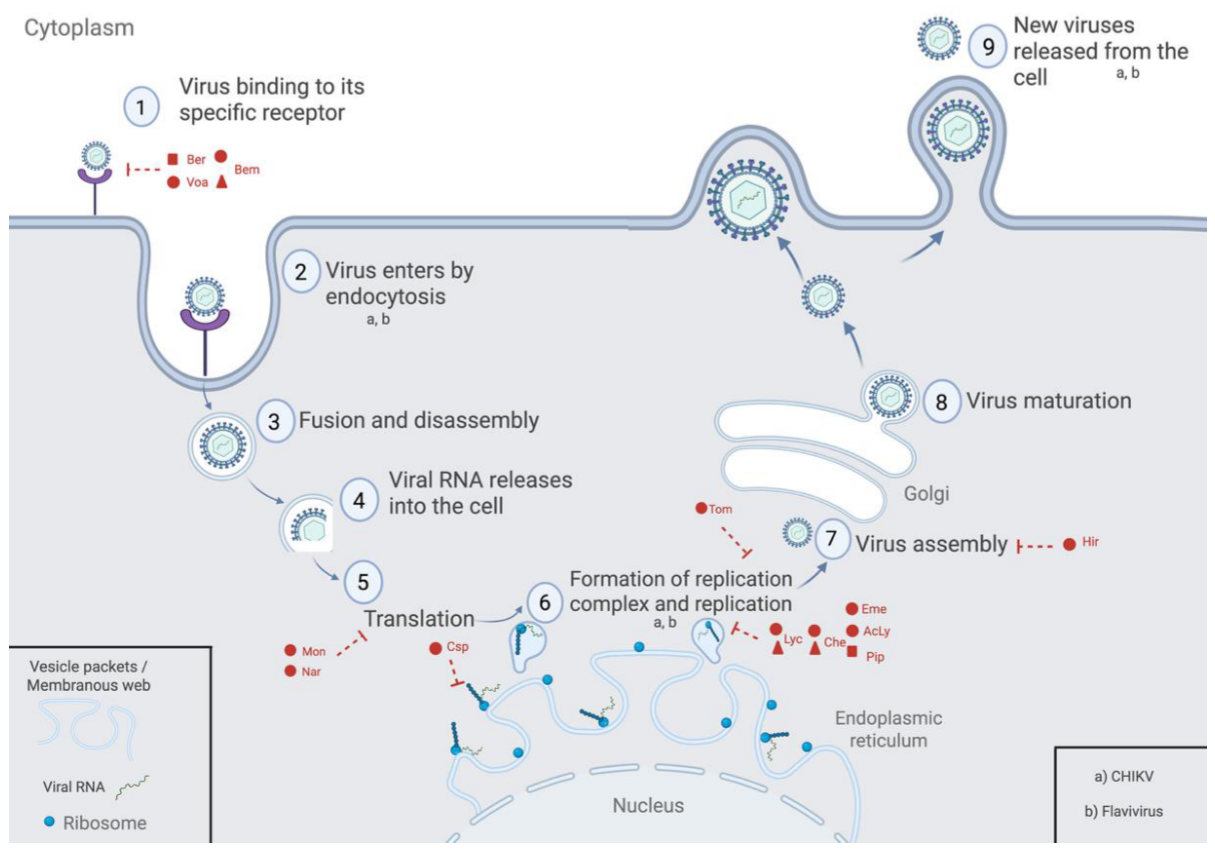
Figure 2.
Replication cycle of the Coronaviridae family. (1) Attachment to host receptors, such as angiotensin-converting enzyme 2 (ACE2) for SARS-CoV-2 or 9-O-acetylated sialic acids for HCoV-OC43, which involves the hemagglutinin-esterase (HE) protein. (2) Entry and release of the genomic RNA by endocytosis. (3) Polyprotein translation (pp1a/pp1ab) and autocleavage into Nsps. (4) Replication-transcription complex (RTC) assembly and RNA replication/transcription within double-membrane vesicles (DMVs). (5) Translation of subgenomic mRNAs into structural and accessory proteins. (6-7) Viral assembly in the endoplasmic reticulum-Golgi intermediate compartment (ERGIC) and maturation. (8) Release via exocytosis, where the HE protein facilitates HCoV-OC43 detachment Specific symbols in red are used to denote the antiviral activity and molecular targets of the discussed alkaloids. ✭ HCoV-OC43 and ✦ SARS-CoV-2. Bis-benzylisoquinolines such as tetrandrine (Tet ✭), fangchinoline (Fan ✭), and cepharanthine (Cep ✭) primarily block the early infection process. In the host cytosol, translational elongation is modulated at the ribosomal PTC by montanine (Mon ✦) to trigger ribosome collisions, while Lycorine derivative compound 7 (Lyc-7 ✦) stabilizes host ZAP-S to disrupt essential -1 programmed ribosomal frameshifting (-1PRF). Emetine (Eme ✭ ✦) and lycorine (Lyc ✭) are shown to inhibit replication or protease-dependent steps. A diverse group of Amaryllidaceae alkaloids, including amarbellisine (Ama ✭ ✦), haemanthamine (Hea ✭), and crinamine (Cri ✭), interfere with post-entry mechanisms within 4 to 8 hours post-infection. Adapted from BioRender.com. Detailed EC50 values and mechanistic evidence for each compound are provided in Table 5.
Figure 2.
Replication cycle of the Coronaviridae family. (1) Attachment to host receptors, such as angiotensin-converting enzyme 2 (ACE2) for SARS-CoV-2 or 9-O-acetylated sialic acids for HCoV-OC43, which involves the hemagglutinin-esterase (HE) protein. (2) Entry and release of the genomic RNA by endocytosis. (3) Polyprotein translation (pp1a/pp1ab) and autocleavage into Nsps. (4) Replication-transcription complex (RTC) assembly and RNA replication/transcription within double-membrane vesicles (DMVs). (5) Translation of subgenomic mRNAs into structural and accessory proteins. (6-7) Viral assembly in the endoplasmic reticulum-Golgi intermediate compartment (ERGIC) and maturation. (8) Release via exocytosis, where the HE protein facilitates HCoV-OC43 detachment Specific symbols in red are used to denote the antiviral activity and molecular targets of the discussed alkaloids. ✭ HCoV-OC43 and ✦ SARS-CoV-2. Bis-benzylisoquinolines such as tetrandrine (Tet ✭), fangchinoline (Fan ✭), and cepharanthine (Cep ✭) primarily block the early infection process. In the host cytosol, translational elongation is modulated at the ribosomal PTC by montanine (Mon ✦) to trigger ribosome collisions, while Lycorine derivative compound 7 (Lyc-7 ✦) stabilizes host ZAP-S to disrupt essential -1 programmed ribosomal frameshifting (-1PRF). Emetine (Eme ✭ ✦) and lycorine (Lyc ✭) are shown to inhibit replication or protease-dependent steps. A diverse group of Amaryllidaceae alkaloids, including amarbellisine (Ama ✭ ✦), haemanthamine (Hea ✭), and crinamine (Cri ✭), interfere with post-entry mechanisms within 4 to 8 hours post-infection. Adapted from BioRender.com. Detailed EC50 values and mechanistic evidence for each compound are provided in Table 5.
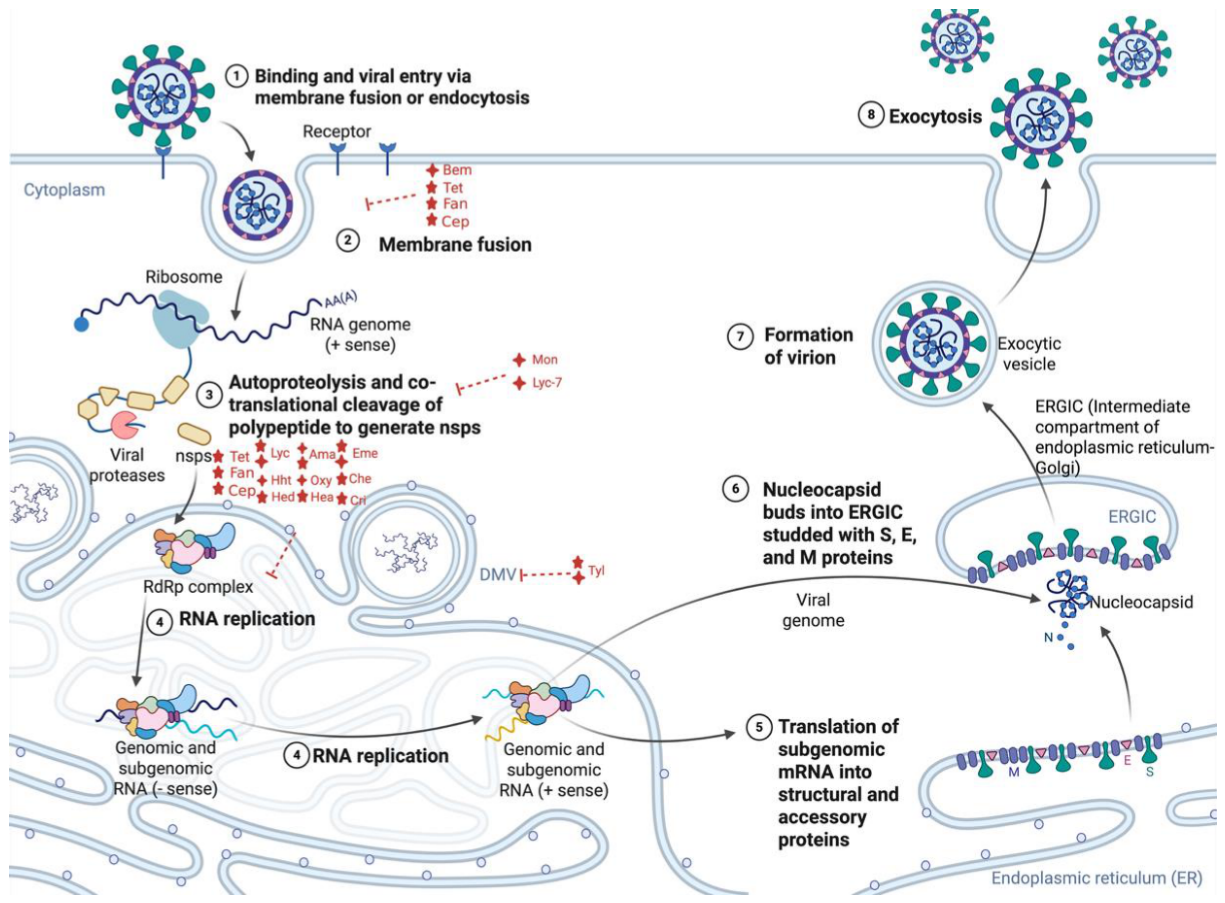

Table 1.
Medicinal plant families producing antiviral alkaloids.
| Plant family | Antiviral alkaloid | Geographical distribution | Domains of application | Ref. |
|---|---|---|---|---|
|
Solanaceae (Tropane) |
Atropine | Cosmopolitan, especially tropical America | Food, Medicinal, Ornamental | [15] |
|
Rutaceae (Isoquinoline / Benzo[c]phenanthridine) |
Octopamine, 5,6-Dihydro-6-methoxynitidine | Tropical and subtropical zones | Food, Medicinal Cosmetics, Ornamental | [25] |
|
Rubiaceae (Isoquinoline / Ipecac and Monoterpene indole) |
Emetine, hirsutine | Tropical and subtropical zones | Medicinal (antiviral) | [26,27] |
|
Piperaceae (Piperidine) |
Piperine | Tropical zones, Latin America | Medicinal (antiviral) | [15] |
|
Moraceae (Polyhydroxyalkaloid / Iminosugar) |
Homonojirimycin | Tropical and subtropical zones | Food, Ecological, Medicinal, Ornamental | [28] |
|
Menispermaceae (Bis-benzylisoquinoline / bis-BIQ) |
Cepharanthine, fangchinoline, tetrandrine | Warm temperate to tropical zones | Industrial, Medicinal (antiviral) | [27] |
|
Liliaceae (Steroidal) |
Cyclopamine | Cosmopolitan | Food, Medicinal, Ornamental | [22] |
|
Fabaceae (Indolizidine / Quinolizidine) |
Castanospermine, oxysophoridine | Cosmopolitan | Food, Medicinal, Ornamental | [19] |
|
Cephalotaxaceae (Cephalotaxine / Cephalotaxane) |
Homoharringtonine | Asia, North America | Medicinal (antiviral) | [29] |
|
Berberidaceae (Isoquinoline: protoberberine & bis-BIQ) |
Berberine, Berbamine |
Subtropical zones | Food, Medicinal (Antiviral, antimycobacterial, anti-inflammatory), Homeopathy | [30] |
| Apocynaceae(Monoterpene indole / Phenanthroindolizidine | Ajmalicine, vocangine, 18-Methoxycoronaridine, tylophorine | Tropical, subtropical zone | Medicinal, Ornamental | [26] |
|
Amaryllidaceae (Amaryllidoideae: Lycorine, Crinine, Haemanthamine, Narciclasine, Cherylline types) |
Cherylline, crinamine, haemanthamine, haemanthidine, lycorine, Narciclasine, pancracine, pancratistatine | Tropical, subtropical, temperate zones | Medicinal (antitumoral, antiviral, etc.), Ornamental | [16,31,32,33,34] |
Ref.: Reference.
Table 2.
Reported antiviral activity and mechanism of action of diverse alkaloid families against Dengue and Zika viruses.
Table 2.
Reported antiviral activity and mechanism of action of diverse alkaloid families against Dengue and Zika viruses.
| Alkaloid | EC50 (μM) | CC50 (μM) | SI | Target | Ref | |
|---|---|---|---|---|---|---|
| DENV | ||||||
| Amaryllidaceae | Acetyllycorine | 0.4 | > 300 | > 750 | Replication | [3] |
| Lycorine | 0.48-0.59 | > 10 | > 16.9 | Replication; RNA synthesis | [52,56] | |
| 1-O-acetyl-2-oxolycorine | 1.8 | > 300 | > 166.6 | n.e. | [57] | |
| 2-Oxolycorin | 0.5 | > 300 | > 600 | n.e. | [3] | |
| Lycoricidine monoacetate | 5.15 | > 143 | > 27 | n.e. | [35] | |
| Lycoricidine triacetate | > 17.17 | > 114 | > 6.6 | |||
| (+) -trans-dihydronarciclasine | 0.51 | > 159 | > 311 | |||
| 7-Deoxyisonarciclasine | 28.99 | > 181 | > 6.2 | |||
| 7-Deoxy-trans-dihydronarciclasine | 1.17 | > 170 | > 145 | |||
| cis-hydronarciclasine | 7.11 | > 159 | > 22 | |||
| 7-Deoxypancratistatin | 2.15 | > 170 | > 79 | |||
| Pseudolycorine | 1.35 | 25.26 | 18.7 | n.e. | [35] | |
| Pancracine | 0.36 | 25.93 | 72.02 | n.e. | [58] | |
| Haemanthamine | 0.34 | 2.19 | 65.26 | |||
| Haemanthidine | 0.48 | 16.80 | 35 | |||
| Pretazettine | 0.8 | 11.45 | 14.3 | |||
| Pancratistatin | 0.19 | 1.71 | 9.0 | |||
| Vittatine | 15.53 | n.d. | n.d. | |||
| 11-Hydroxyvittatine | 3.92 | 113.06 | 28.84 | |||
| Cherylline | 8.8 | > 100 | > 11.3 | Replication | [52,59] | |
| Narciclasine | 0.02 | 0.09 | 4.5 | n.e. | [60] | |
| Narciclasin-4-O-β-D-xylopyranoside | 7.9 | 39.3 | 5.0 | |||
| Montanine | 0.06-0.26 | 2.67 | 10.3-44.5 | Translation | [61]# | |
| Apocynaceae | Voacangine | 171.4 ±26 | 4.3 ± 1.3 | 39.8 | Entry | [50] |
| Voacangine-7-hydroxyindolenine | 145.5 ± 20.4 | 9.0 ± 1.4 | 16.1 | |||
| Rupicoline | 259 ± 1.8 | 8.8 ± 0.8 | 29.4 | |||
| 3-Oxo-voacangine | > 261.5 | n.d. | n.d. | |||
| Berberidaceae | Berbamine | 0.5422 | 76.35 | 140.8 | Entry and replication (host TRPML channels and endosomal trafficking) | [42] |
| Berberine | 0.7 | 205.1 | 293 | infectious particle formation ; host p38 MAPK | [47] | |
| Fabaceae | Castanospermine | 1 | > 5000 | > 5000 | Incorporation of viral protein (prM-E) and C. | [62] |
| Rubiaceae | Emetine | 0.12 | > 10 | > 83.3 | Replication | [63] |
| Rubiaceae | Hirsutine | 0.57 | > 50 | > 87.7 | Assembly | [64] |
| Solanaceae | Tomatidine | 0.82 | 80.2 | 97.7 | Synthesis of viral protein E | [65] |
| ZIKV | ||||||
| Amaryllidaceae | Cherylline | 20.30 | > 100 | > 4.9 | Replication | [52] |
| Lycorine | 0.41 | > 10 | > 24.4 | |||
| Narciclasine | 0.02 | 0.12 | 6.0 | n.e. | [60] | |
| Narciclasine-4-O-β-D-xylopyranoside | 7.90 | 51.58 | 6.5 | |||
| Pretazettine | 1.90 | > 100 | > 52.6 | |||
| (+) -trans-dihydronarciclasine | 0.031 | 0.18 | 5.8 | n.e. | [32] | |
| Pancratistatin | 0.0063 | > 150 | > 23 809 | n.e. | [35] | |
| Berberidaceae | Berbamine | 1.90 | 76.35 | 40.19 | Entry (host TRPML channels and endosomal trafficking) and replication | [42] |
| Berberine | 0.2 | 15.3 | 205 | Infectious particle formation, host p38 MAPK | [47] | |
| Menispermaceae | Cepharanthine | 0.37 | 18.60 | 50.26 | Replication (host cells) | [42] |
| Fangchinoline | 4.77 | 9.50 | 1.99 | |||
| Tetrandrine | 1.29 | 12.31 | 9.54 | |||
| Iso-tetrandrine | 2.11 | 51.83 | 24.57 | |||
| Rubiaceae | Emetine | ^IC50 0.121 | n.d. | n.d. | NS5 RdRp | [49] |
# This study is a preprint. Ref.: Reference. EC50: concentration of 50% inhibition of infection, CC50: concentration of 50% cytotoxicity. ^: represents biochemical IC50, measured through a cell-free assay directly evaluating an enzyme inhibition. SI: selectivity index (CC50/EC50 or IC50).). > indicates that the maximum nontoxic concentration tested did not reach the 50% cytotoxicity threshold, the corresponding SI values represent minimal calculated selectivity. ± standard deviation of the mean. n.d: Not determined. n.e.: not elucidated. TRPML: Transient Receptor Potential Mucolipin. MAPK: Mitogen-Activated Protein Kinase. RdRp: RNA-dependent RNA polymerase.
Table 3.
Reported antiviral activity and mechanism of action of diverse alkaloid families against various flaviviruses and CHIKV.
Table 3.
Reported antiviral activity and mechanism of action of diverse alkaloid families against various flaviviruses and CHIKV.
| Virus | Alkaloid | EC50 (μM) | CC50 (μM) | SI | Target | Ref |
|---|---|---|---|---|---|---|
| JEV | cis-dihydronarciclasine | 41.06 | 202.09 | 4.9 | n.e. | [35] |
| Lycorine | 1.04 | 9.40 | 8.2 | |||
| Narciclasine | *IC50 0.026 | 0.101 | 3.88 | |||
| 7-Deoxypancratistatin | 1.55 | 9.05 | 5.9 | |||
| Cepharanthine | 0.5063 | 18.60 | 36.73 | Replication (host cells) | [42] | |
| Fangchinoline | 3.870 | 9.50 | 2.45 | |||
| Tetrandrine | 5.172 | 12.31 | 2.38 | |||
| Iso-tetrandrine | 5.751 | 51.83 | 9.01 | |||
| YFV | cis-dihydronarciclasine | 31.04 | 206.94 | 6.6 | n.e. | [35] |
| Lycorine | 0.79 | 7.10 | 7.3 | |||
| Narciclasine | *IC50 0.0195 | 120 | 6.1 | |||
| 7-Deoxypancratistatin | 1.29 | 8.41 | 6.52 | |||
| Berbamine | 2.541 | 76.35 | 30.05 | Entry and replication (host TRPML channels and endosomal trafficking) | [42] | |
| AHFV | Lycorine | 1.7 | 16.2 | 9 | n.e. | [35] |
| WNV | Lycorine | 0.23 | 24 | 104.3 | Replication complex (peptide 2K) | [57] |
| CHIKV | Berberine | 1.8 ± 0.5 | > 100 | > 55.6 | Protein synthesis | [70] |
| Harringtonine | 0.24 | n.d. | n.d. | n.e. | [29] | |
| Lycorine | ~1 *IC50 0.319 |
n.d. >50 |
n.d. >156 |
Translation Post-entry and RNA synthesis |
[56,71] |
Ref.: Reference. EC50: concentration of 50% inhibition of infection. *: represents IC50 values determined using a cell-based phenotypic assay. CC50: concentration of 50% cytotoxicity. SI: selectivity index (CC50/EC50 or IC50). > indicates that the maximum nontoxic concentration tested did not reach the 50% cytotoxicity threshold, the corresponding SI values represent minimal calculated selectivity. ± standard deviation of the mean. n.d: Not determined. n.e.: Not elucidated. TRPML: Transient Receptor Potential Mucolipin. JEV: Japanese Encephalitis Virus. YFV: Yellow Fever Virus. AHFV: Alkhurma Hemorrhagic Fever Virus. WNV: West Nile Virus. CHIKV: Chikungunya Virus. TRPML: Transient Receptor Potential Mucolipin.
Table 4.
Reported antiviral activity and mechanism of action of diverse alkaloid families against Hepatitis C virus.
Table 4.
Reported antiviral activity and mechanism of action of diverse alkaloid families against Hepatitis C virus.
| Alkaloid | EC50 (μM) | CC50 (μM) | SI | Target | Ref | |
|---|---|---|---|---|---|---|
| Amaryllidaceae | Lycorine | 1.03 ± 0.12 | 9.9 ± 0.72 | 9.6 | HSP70 (host-target mechanism) | [73] |
| Berberidaceae | Berberine | 7.87 ± 1.10 | 82.75 ± 0.27 | 10.51 | Entry (E2 glycoprotein binding) | [47] |
| Piperaceae | Piperine | *IC50 52.18 ± 3.21 | n.d. | n.d. | NS5B polymerase | [74] |
Ref.: Reference. EC50: concentration of 50% inhibition of infection. *: represents IC50 values determined using a cell-based phenotypic assay. CC50: concentration of 50% cytotoxicity, SI: selectivity index (CC50/EC50 or IC50). ± standard deviation of the mean. n.d: Not determined.
Table 5.
Reported antiviral activity and mechanism of action of diverse alkaloid families against HCoV-OC43, SARS-CoV-2, and various coronaviruses.
Table 5.
Reported antiviral activity and mechanism of action of diverse alkaloid families against HCoV-OC43, SARS-CoV-2, and various coronaviruses.
| Alkaloid | EC50(μM) | CC50 (μM) | SI | Target | Ref | |
|---|---|---|---|---|---|---|
| HCoV-OC43 | ||||||
| Amaryllidaceae | Lycorine | 1.6 ± 0.4 | 34.9 ± 5.2 | 22 | Replication or translation | [53] |
| Haemanthamine | 1.6 ± 0.7 | 49.2 ± 4.8 | 32 | |||
| Haemanthidine | 1.7 ± 0.6 | 36.7 ± 1.8 | 22 | |||
| Crinamine | 0.5 ± 0.1 | 25.2 ± 1.2 | 51 | |||
| Amarbellisine | 0.2 ± 0.1 | 12.1 ± 2.4 | 60 | |||
| Cherylline | 8.0 ± 1 | > 100 | > 13 | |||
| Pancracine | 2.6 ± 1.3 | 81.4 ± 11.8 | 31 | |||
| Ungeremine | 1.6 ± 0.3 | 6.6 ± 2.4 | 4 | |||
| Clivimine | 18.7 ± 9.9 | > 100 | > 5 | |||
| Tazettine | 21.6 ± 3.6 | > 100 | > 5 | |||
| Obliquine | 23.0 ± 0.6 | > 100 | > 4 | |||
| 11-hydroxyvittatine | 23.3 ± 0.8 | > 100 | > 4 | |||
| Apocynaceae | Tylophorine | 16 ± 5 | > 10,000 | > 610 | Replication | [81] |
| Menispermaceae | Tetrandrine | 8.29 | 14.51 | > 40 | Entry; Replication | [40] |
| Fangchinoline | 0.92 | 12.40 | 13 | |||
| Cepharanthine | 0.73 | 10.54 | 11 | |||
| Rubiaceae | Emetine | 0.30 | 2.69 | 8.96 | Replication | [82] |
| SARS-CoV-2 | ||||||
| Amaryllidaceae | Montanine | *IC50 1.71 | 165 | > 96.49 | Translation | [61] |
| Amaryllidaceae (semi-synth.) | Lycorine derivative compound 7 | 0.73 | 79.81 | 109 | Translation (-1PRF) | [83] |
| Apocynaceae | Tylophorine | 0.013 | > 10 | > 769 | Replication: Transcription | [81] |
| Berberidaceae | Berbamine | IC50 43.4 | nd | nd | Entry; Postfusion core | [41] |
| Cephalotaxaceae | Homoharringtonine | 2.55 | 59.75 | 23.43 | Replication | [48] |
| Fabaceae | Oxysophoridine | 0.18 | > 40 | > 222 | Replication | [84] |
| Menispermaceae | Tylophorine | 0.0140 | 5.10 | 364 | Replication; transcription | [81] |
| Rubiaceae | Emetine | 0.46 | 56.46 | 122.7 | Replication | [48,85] |
| Other coronavirus | ||||||
| Virus | Alkaloid | EC50 (μM) | CC50 (μM) | SI | Target | Ref |
| Amaryllidaceae | Lycorine | 0.016 ± 0.001 | 14.98 ± 0,91 | > 936 | Replication (SARS-CoV) | [66] |
| *IC₅₀ 1.021 ± 0.025 | > 50 | 48.97 | Replication (RdRp) (SARS-CoV) | [54] | ||
| ^IC₅₀ 1.406 ± 0.260 | > 50 | 35.56 | Replication (RdRp) (MERS-CoV) | [54] | ||
| Berberidaceae | Berbamine | 29.2 ± 7 | n.d. | n.d. | Entry (MERS-CoV) | [86] |
| Menispermaceae | Tetrandrine | 7.0 ± 0.8 | n.d. | |||
| Fangchinoline | 1.7 ± 0.2 | n.d. | ||||
| Rubiaceae | Emetine | 1.43 | 3.63 | 2.54 | Replication (HCoV-NL63) | [82] |
Ref.: Reference. EC50: concentration of 50% inhibition of infection. *: represents IC50 values determined using a cell-based phenotypic assay. ^: represents biochemical IC50, measured through a cell-free assay directly evaluating an enzyme inhibition. CC50: concentration of 50% cytotoxicity, SI: selectivity index (CC50/EC50 or IC50). > indicates that the maximum nontoxic concentration tested did not reach the 50% cytotoxicity threshold, the corresponding SI values represent minimal calculated selectivity. ± standard deviation of the mean. -1PRF: -1 Programmed Ribosomal Frameshifting. RdRp: RNA-dependent RNA polymerase. n.d.: Not determined. HCoV-OC43: Human Coronavirus OC43. SARS-CoV: Severe Acute Respiratory Syndrome Coronavirus, SARS-CoV-2: Severe Acute Respiratory Syndrome Coronavirus-2. MERS-CoV: Middle East Respiratory Syndrome Coronavirus. HCoV-NL63: Human Coronavirus NL63.
Table 6.
Reported antiviral activity and mechanism of action of diverse alkaloid families against diverse RNA and DNA viruses.
Table 6.
Reported antiviral activity and mechanism of action of diverse alkaloid families against diverse RNA and DNA viruses.
| Alkaloid | EC50 (μM) |
CC50 (μM) |
SI | Target | Ref | |
|---|---|---|---|---|---|---|
| Hepadnavirus (HBV) | ||||||
| Fabaceae | Sophaline A-D | 160 - 400 | n.d. | n.d. | HBsAg and HBeAg secretion | [94] |
| Sophaline F-H/ E, I | 35 / 400 | n.d. | n.d. | [95] | ||
| Rutaceae | 5,6-Dihydro-6-methoxynitidine | 200 | n.d. | n.d. | [96] [96] [94,96] |
|
| Skimmianine | 200 | n.d. | n.d. | |||
| 5-methoxydictamine | 200 | n.d. | n.d. | |||
| Other RNA viruses (RSV/EBOV/HPIV-3) | ||||||
| Liliaceae | Cyclopamine | *IC50 0.46 to 0.82 in vitro | n.d. | n.d. | n.e. | [97] |
| Rubiaceae | Emetine | *IC₅₀ 10.2 | >100 | >9.8 | Entry | [49] |
| Solanaceae | Atropine | MNTC 5.53 | n.d. | n.d. | n.e. | [98] |
| Octopamine | MNTC 10.45 | n.d | n.d. | |||
| Lentivirus (HIV-1) | ||||||
| Amaryllidaceae | *Extract of Crinum asiaticum var. japanicum | ED50 12.5μg/mL | CD50 200μg/mL | 16 | Replication | [99] |
| Ancistrocladaceae | Michellamine D | 3 (against HIV-RF) | n.d. | n.d. | n.e. | [100] |
| Michellamine F | 2 (against HIV-RF) | n.d. | n.d. | |||
| Apocynaceae | 18-Methoxycoronaridine | 9.5 ± 3 - 12.8 ± 5 | 328 | 34.5 - 25.6 | RT | [101] |
| Fabaceae | 6-O-Butanoyl castanospermine (B-CAST) | *IC50 0.19–0.58 | n.d. | n.d. | Maturation | [102] |
| Aloperine | 1.75 ± 059 | > 86.2 | > 49.25 | Entry | [45] | |
| Aloperine N-(1-butyl)-4-trifluoromethoxy-benzamide | 0.69 ± 013 | > 42.1 | > 61.01 | |||
| Lauraceae | Hernandonine | ^IC50 16.3 | n.d. | n.d. | n.e. | [103] |
| Laurolitsine | ^IC50 7.7 | n.d. | n.d. | |||
| 7-oxohernangerine | ^IC50 18.2 | n.d. | n.d. | |||
| Lindechurine A | ^IC50 21.1 | n.d. | n.d. | |||
| Menispermaceae | Fangchinoline | 0.8 – 1.7 | 6.4-6.9 | 3.8-8.6 | Maturation | [104] |
| Rubiaceae | Emetine | 14,1 | 250 | 17.7 | Entry; RT | [105] |
| Rutaceae | Buchapine | 2.99 | 55.89 | 18.69 | n.e. | [106] |
| 3-(3-methyl-2-butenyl)-4-[(3-methyl-2-butenyl) oxy]-2(1H)-quinolinone | 3.8 | 71.17 | 18.72 | |||
| 4-(Isopentyloxy) quinolin-2-ol | 3.9 | 114.67 | 29.47 | |||
Ref.: Reference. EC50: concentration of 50% inhibition of infection. *: represents IC50 values determined using a cell-based phenotypic assay. ^: represents biochemical IC50, measured through a cell-free assay directly evaluating an enzyme inhibition. CC50: concentration of 50% cytotoxicity. ED50: Effective Dose 50%. CD50: Cytotoxic Dose 50 %. SI: selectivity index (CC50/EC50 or IC50) or (CD50/ED50). > indicates that the maximum nontoxic concentration tested did not reach the 50% cytotoxicity threshold, the corresponding SI values represent minimal calculated selectivity. ± standard deviation of the mean. n.d.: Not determined. n.e.: Not elucidated. MNTC: Maximum Non-Toxic Concentration, HBV: Hepatitis B Virus, HBsAg: Hepatitis B surface Antigen, HBeAg: Hepatitis B e Antigen, RSV: Respiratory Syncytial Virus, EBOV: Ebola Virus, HPIV-3: Human Parainfluenza Virus type 3, HIV-1: Human Immunodeficiency Virus type 1. RT: reverse transcriptase.
Disclaimer/Publisher’s Note: The statements, opinions and data contained in all publications are solely those of the individual author(s) and contributor(s) and not of MDPI and/or the editor(s). MDPI and/or the editor(s) disclaim responsibility for any injury to people or property resulting from any ideas, methods, instructions or products referred to in the content. |
© 2026 by the authors. Licensee MDPI, Basel, Switzerland. This article is an open access article distributed under the terms and conditions of the Creative Commons Attribution (CC BY) license (http://creativecommons.org/licenses/by/4.0/).
Copyright: This open access article is published under a Creative Commons CC BY 4.0 license, which permit the free download, distribution, and reuse, provided that the author and preprint are cited in any reuse.


