

Submitted:
28 May 2026
Posted:
01 June 2026
You are already at the latest version
Abstract
This study investigates the dynamics of white maize price transmission across six regional markets in Mozambique (Manica, Gorongosa, Mutarara, Montepuez, Ribáuè, and Lichinga) and examines their relationship with global energy prices (oil and gas) between 2003 and 2020. The analysis applies wavelet coherence techniques, the Augmented Dickey–Fuller (ADF) test, Johansen cointegration, Vector Error Correction Models (VECM), and Granger causality tests to evaluate both short- and long-run market integration. The results indicate that all series are integrated of order one (I(1)) and that significant long-run cointegration relationships exist among the variables, with three cointegration vectors identified according to the FPE and AIC criteria. Wavelet coherence analysis reveals strong long-run synchronization (1.2–8 years) among regional white maize markets, while short-run coherence (0.1–1.2 years) remains weak, suggesting limited short-term integration. The findings further show that global energy prices do not exert a persistent structural influence on maize price dynamics in Mozambique. The VECM results identify Gorongosa as the main transmission hub of short-run price shocks, exerting positive effects on the other regional markets, whereas oil prices negatively affect Gorongosa and Ribáuè. Granger causality analysis confirms that Gorongosa, Mutarara, and Ribáuè act as the primary price transmitters within the system, while oil prices are mainly driven by exogenous factors. Overall, the findings demonstrate that Mozambican white maize markets are more strongly integrated in the long run than in the short run, highlighting the strategic role of Gorongosa in regional price transmission and suggesting that energy shocks have limited long-term effects on the domestic maize market system.
Keywords:
white maize markets
; cointegration
; wavelet coherence
; VECM
; price transmission
; Mozambique
; energy prices
1. Introduction
Maize is one of the most important cereal crops globally and plays a central role in food security, particularly in developing economies where it constitutes a major staple food (Rani et al., 2017; Abidoye & Labuschagne, 2014). Beyond its role as a food crop, maize has increasingly become a strategic commodity linked to industrial production and energy markets, especially through its use in animal feed, starch processing, and biofuel production (Fosu & Wahl, 2020; Elmarzougui & Larue, 2011).
The increasing interdependence between agricultural and energy markets has fundamentally altered the global dynamics of maize price formation. The expansion of ethanol production, particularly in the United States, has strengthened the transmission of shocks from crude oil prices to agricultural commodities, intensifying the food–fuel competition debate (Zhang et al., 2009; Ma & Hou, 2019). As a result, maize prices have become more volatile and increasingly integrated into global energy-linked commodity systems.
At the same time, global maize markets are characterized by strong spatial heterogeneity, with major producers such as the United States, Brazil, Argentina, and Ukraine playing a dominant role in international supply and price transmission (Fosu & Wahl, 2020; Hamulczuk & Cherevyk, 2025). Shocks in these markets often propagate through international trade channels, affecting domestic price formation in importing and structurally dependent economies.
In Sub-Saharan Africa, maize remains the most important staple crop, and price stability is crucial for food security and welfare outcomes. In the Southern African Development Community (SADC), South Africa acts as the regional price leader due to its dominant production capacity, influencing neighbouring markets including Mozambique (Abidoye & Labuschagne, 2014). However, despite its importance, little empirical evidence exists on how Mozambican regional maize markets are integrated among themselves and how they respond to global energy price shocks.
Mozambique presents a particularly relevant case for analysis due to its spatially fragmented production systems and its dependence on regional trade flows. Understanding the degree of price transmission among domestic markets, as well as their linkage to international energy markets, is essential for designing effective agricultural and food security policies. This study addresses this gap by examining the dynamics of price transmission among six regional white maize markets in Mozambique (Manica, Gorongosa, Mutarara, Montepuez, Ribáuè, and Lichinga) and their relationship with global oil and gas prices. Using wavelet coherence analysis, Johansen cointegration, Vector Error Correction Models (VECM), and Granger causality tests, the study provides a comprehensive assessment of both short- and long-run market integration. The remainder of the paper is organized as follows: Section 2 presents the literature review; Section 3 describes the data; Section 4 outlines the methodology; Section 5 discusses the empirical results; and Section 6 concludes.
2. Literature Review
Maize is widely recognized as one of the most important cereal crops globally due to its high productivity potential and central role in food security, particularly in developing economies (Rani et al., 2017; Abidoye & Labuschagne, 2014). A key distinction in the literature is between white and yellow maize, where white maize is primarily a staple food in regions such as Southern Africa and Mexico, while yellow maize is predominantly traded internationally and used as feedstock for livestock and industrial processing (Fosu & Wahl, 2020).
2.1. Productivity, Technology, and Market Structure
Recent literature emphasizes that maize productivity is driven by technological progress, including biotechnology, precision agriculture, and improved input management systems. Innovations such as genetically improved varieties and CRISPR-based breeding have enhanced resilience to climate and pest shocks in key producing regions (Abidoye & Labuschagne, 2014). In addition, production systems such as Brazil’s “second-crop” (safrinha) model demonstrate how land-use intensification can significantly increase output without expanding cultivated area (Justus et al., 2024). Complementary evidence shows that precision agriculture and improved logistics infrastructure reduce production costs and post-harvest losses, thereby strengthening market competitiveness (Kuzman, 2023; Lestari et al., 2024).A further strand of the literature highlights that market efficiency itself can act as a productivity driver. When price signals are transmitted efficiently across regions, producers are better able to allocate resources and adjust production decisions, reinforcing long-term productivity gains (Rani et al., 2017).
2.2. Market Integration and Price Transmission
Market integration is generally defined as the degree to which prices across spatially separated markets move together in response to shocks. The literature distinguishes between spatial and vertical integration, with empirical evidence showing heterogeneous results across regions and commodities. In India, studies suggest strong long-run spatial integration of maize markets, although short-run adjustment speeds differ across regions. In Sub-Saharan Africa, Abidoye and Labuschagne (2014) document nonlinear price transmission between global and South African maize markets, characterized by regime-dependent behavior such as import parity, export parity, and autarky conditions. Similarly, evidence from Indonesia indicates weak vertical integration, where large intermediaries often dominate price formation. A common conclusion across studies is that maize markets may exhibit long-run cointegration even when short-run transmission is incomplete or delayed due to transaction costs and institutional frictions.
2.3. Energy Prices and Structural Changes in Maize Markets
A growing body of literature examines the linkage between agricultural commodities and energy markets. The expansion of biofuel production, particularly ethanol in the United States, has strengthened the connection between maize and oil prices, altering traditional price transmission mechanisms (Elmarzougui & Larue, 2011; Zhang et al., 2009). Empirical findings, however, are mixed. Some studies identify long-run relationships between energy and agricultural commodities driven by biofuel demand and input cost linkages, while others find only short-run interactions without stable cointegration (Zhang et al., 2009). Structural break analyses further show that the maize–oil relationship has evolved over time, particularly after the ethanol boom of the late 1990s and early 2000s. In addition, transportation costs often proxied by fuel prices play a crucial role in spatial market integration by increasing trade frictions and widening price deviation bands between regions (Choe & Goodwin, 2025).
2.4. White Maize Market Dynamics and Regime Dependence
For white maize, especially in Southern Africa, price integration is strongly regime-dependent. Abidoye and Labuschagne (2014) show that integration with international markets occurs only when price differentials exceed transaction costs, consistent with threshold cointegration models. Under import parity regimes, adjustment toward equilibrium is faster, while under export or autarky conditions, domestic prices are largely determined by local supply and demand conditions. Transaction costs, particularly transport and fuel costs, play a central role in determining the speed and strength of price transmission. High energy prices increase trade costs and weaken short-run integration, delaying convergence to long-run equilibrium (Choe & Goodwin, 2025). Additionally, market imperfections and information asymmetries can further slow adjustment processes, especially in fragmented rural markets (Lestari et al., 2024).
2.5. Research Gap
Despite extensive literature on global maize markets and the maize energy nexus, several gaps remain. First, most studies focus on international or national-level price transmission, with limited evidence on subnational market integration in developing countries, particularly in Southern Africa. Second, while the relationship between maize and energy prices has been widely studied, results remain inconsistent and rarely consider regional market heterogeneity within a single country. Third, few studies jointly analyze spatial market integration and energy price transmission within the same econometric framework combining cointegration, VECM, and wavelet methods.
Accordingly, this study contributes by: (i)Examining spatial integration among six regional white maize markets in Mozambique; (ii)Assessing the influence of global oil and gas prices on domestic maize price dynamics;(iii)Applying a combination of wavelet coherence, cointegration, VECM, and Granger causality to capture both short- and long-run dynamics.
3. Data Description
This article utilized monthly data from January 2003 to December 2020. White corn prices were obtained from the Agricultural Market Information System (SIMA)1, expressed in meticais (MT) per kilogram. The choice of wholesale prices is justified because they more accurately reflect spatial arbitrage conditions and large-scale market dynamics compared to retail prices (Tostão & Brorsen, 2005). Additionally, we extracted energy prices from the World Bank (The Pink Sheet). 2We consider the price of natural gas (measured in $/MMBtu) from the U.S. and crude oil prices (measured in $/bbl) from the Brent market because it serves as the benchmark for more than half of the oil traded worldwide (Aguiar-Conraria, Soares, and Conceição, 2023).
In the figures in this article, to aid understanding, we divided the average phase difference into two frequency bands (cycles of 0.1–1.1 and 1.1–8 years). The black conical line in Figure 1 identifies the region (commonly known as the cone of influence COI). Outside this line, the results should be interpreted with caution (for further details, see Aguiar-Conraria and Soares, 2014). Phase differences are indicated in the corresponding plots with a solid black line. The confidence interval limits for the phases of the media are summarized in the figures with a red dashed line. Figure 1 shows a set of results. On the left, we plot the time series of white corn prices in the districts of Manica, Gorongosa, Mutarara, Montepuez, Ribaué, and Lichinga in Mozambique, along with their wavelet power spectra. On the right, we plot the wavelet power spectrum, which indicates the intensity of the time series’ variance for each frequency and the duration of cyclic oscillations. The colors reflect the degree of volatility in the power spectra, where blue represents low variability and red represents high volatility. The black/gray outline represents the 5%/10% significance level against the null hypothesis of a flat power spectrum.
We can observe in Figure 1 that the power spectra of all white corn prices in Mozambique are similar. There is high volatility in the higher frequency range of 1.1–8 years (long term) between 2001 and 2020. The pattern of high variability during this period is similar across all white corn markets. However, in the short term (0.1–1.1 years), there is no price volatility.
3. Methodology
In this section, we describe the Continuous Wavelet Transform (CWT) tools and other econometric time-series analyses used to study the cointegration of regional corn markets in Mozambique from 2003 to 2020. In general, agricultural commodity prices, especially in developing countries, exhibit a high level of variability, including in Mozambique. Thus, the application of the Continuous Wavelet Transform (CWT) as an econometric analysis model can yield good results because it allows for the estimation of a time series simultaneously in both time and frequency domains. In this paper, we will use the following tools: wave power spectrum, wave cross-power and cross-coherence, and wave phase difference (Aguiar-Conraria, Azevedo, and Soares, 2008; Aguiar-Conraria and Soares, 2011, 2014; Aguiar-Conraria, Martins, and Soares, 2012, 2018; Aguiar-Conraria, Soares, and Sousa, 2018; Ojo, Aguiar-Conraria, and Soares, 2018; Da Conceição, 2024). Additionally, an analytical strategy will be applied that follows a rigorous sequence of tests to ensure the validity of the inferences, the price estimation procedure through lag selection to determine p based on AIC, BIC, and HQ (Kilian & Lütkepohl, 2017), the Johansen procedure to obtain β and the number of cointegrated vectors (Johansen & Juselius, 1990), followed by VECM estimation.
3.1. Continuous Wavelet Transform
For all practical purposes, a wavelet is simply a small wave: a wave in the sense that it is a function ψ(t) whose graph oscillates up and down along the t-axis (and integrates to zero), and “small” in the sense that it decays rapidly as t→±∞.
Time-scale wavelets are based on a mother wavelet, ψ(t), defined as a function of a real variable t. A function is said to be a mother wavelet if it satisfies a certain admissibility condition, which in practice amounts to requiring that the function integrate to zero and decay rapidly to zero. The fact that ψ rapidly tends to zero means that we can view it as a window function. On the other hand, requiring that ψ integrates to zero implies that ψ must be oscillatory, allowing us to associate a certain frequency with this function. The mother wave ψ provides a source function to generate a family of daughter waves ψ_(τ,s) which are obtained through scaling by s and translation by τ:
The scale parameter s controls the width of the wavelet, and the translation parameter τ controls the position of the wavelet along the t-axis. For |s|>1, the window ψ_(τ,s) becomes wide (and thus corresponds to functions with lower frequency), and for |s|<1, the windows become narrower (and thus correspond to functions with higher frequency). Given a time series x(t), its Continuous Wavelet Transform with respect to the wavelet ψ is a two-variable function W_x (τ,s), given by
In Equation (2) and throughout this paper, the overbar is used to denote complex conjugation.When the wavelet ψ is a complex-valued function, the wavelet transform W_x (τ,s) is also complex-valued and can therefore be expressed in polar form as The argument is known as the phase of the wavelet. For real-valued wavelet functions, the imaginary part is always zero, and the phase is therefore not very informative. Thus, to obtain phase information about time series which is essential for evaluating the lead/lag relationships between two series it is necessary to use complex wavelets. In this article, we use one of the most popular complex wavelets available, a member of the so-called Morlet family given by:
Note A. Regarding the wavelet transform, all the wavelet quantities we will introduce below are functions of two variables: time (τ) and scale (s). To simplify the notation, we will describe these quantities for a specific value (τ, s) of the argument, which will be omitted from the formula. This paper applies four wavelet tools, namely wavelet power spectrum, wavelet cross-power, wavelet coherence, and wavelet phase difference, which we describe below.
- a)
- Wavelet Power Spectrum
The wavelet power spectrum (sometimes called a wavelet scalogram or periodogram) indicates the distribution of the variance of the time series in the time-frequency domain. By analogy with the terminology used in the Fourier case, the (local) wavelet power spectrum of the series x(t), denoted by _x, is defined as:
- b)
- The wavelet power spectrum is used to assess the degree of price variability over time and across frequencies for white maize prices in the six regional markets of Mozambique.”
- c)
- Cross-Wavelet Power and Coherence
We define the cross-transform of two time series x(t) and y(t), denoted by:
where Wx and Wy are the wavelet transforms of x and y, respectively.
The absolute value of the wavelet cross-transform, |, will be referred to as the cross-wavelet power. We also define the complex wavelet coherence of x and y, , which is given by
where S denotes a smoothing operator in both time and scale. For more information on this, see (Rouyer et al., 2008).
The x-y wavelet coherence, denoted by R_xy, is the absolute value of the complex wavelet coherence:
- d) Wavelet Phase Difference
While wavelet coherence quantifies the relationship between two variables, the wavelet phase difference indicates the type of relationship (in-phase or out-of-phase) and identifies the leading and lagging variables. The (wavelet) phase difference between x and y, which we denote by , can also be calculated as the angle of the wavelet cross-correlation ) given by:
A phase difference of zero indicates that the time series move in unison at the specified time frequency; se , then the series move in phase, but the time series x y; se , then y is ahead; a phase difference of π (or -π) indicates an anti-phase relationship; ,, then y is ahead; the time series x is ahead if . You can find more on this in (Aguiar-Conraria, Martins, and Soares, 2012; Aguiar-Conraria and Soares, 2014). Note B. The wavelet phase difference is sometimes defined as the phase angle of the complex wavelet coherence; although this is not entirely consistent with the difference between individual phases because it is affected by smoothing the results obtained are not substantially different; this alternative definition has the advantage of being simpler to generalize to the multivariate case.
3.2. Estimation of Results Using Other Econometric Models
3.2.1. Econometric Pre-Estimation Procedures
The analytical strategy follows a rigorous sequence of tests to ensure the validity of the inferences. The price estimation procedure was conducted in three stages: first, we tested for unit roots, i.e., stationarity (ADF); next, we selected the lags to determine p based on AIC, BIC, and HQ (Kilian & Lütkepohl, 2017). For cointegration tests, the Johansen procedure is used to obtain β and the number of cointegrating vectors (Johansen & Juselius, 1990). This is followed by the estimation of the VECM to simultaneously estimate α and Γ_i. Diagnostic analysis includes checks for autocorrelation, heteroscedasticity, normality of the residuals, and model stability.
3.2.1. Stationarity Test (ADF)
Before estimating the VECM, it is necessary to check the stationarity of the time series of corn prices. Non-stationary series can lead to spurious regressions and misleading results. For this purpose, the Augmented Dickey-Fuller (ADF) test is used, which assesses whether a series has a unit root (Dickey & Fuller, 1979; Enders, 2015). Considering corn prices in the markets of Manica, Gorongosa, Ribáuè, Lichinga, Montepuez, Mutarara and their relationship with energy prices (oil and gas), the general form of the ADF test is:
Where:
is the price of corn in market i in period t−1.
denotes the first difference.
is the number of lags included to eliminate autocorrelation in the residuals.
is the coefficient indicating the presence of a unit root.
is the white noise error term.
3.2.1.1. ADF Test Hypotheses
• H₀: the series has a unit root (non-stationary)
• H₁: the series is stationary
The test is applied individually to each price series:
If the null hypothesis is not rejected at the significance level, the series is first differenced, and the ADF test is repeated. When the series becomes stationary after the first difference, it is said to be integrated of order one, I(1), a necessary condition for applying the VECM. I(0) series (stationary at level) can be included directly in the VAR model, and it is mandatory to perform the Johansen cointegration procedure to ensure that the coefficient results are not spurious. I(1) series (non-stationary at level but stationary at first difference) require VECM if cointegration exists. Series with integration order greater than 1 (I(2) or higher) are not compatible with traditional VECM. According to Enders (2015) and Lütkepohl (2005), proper verification of stationarity is a critical prerequisite for avoiding spurious regressions and ensuring that cointegration tests, Granger causality tests, and IRF/FEVD analysis are valid.
3.2.2. Selection of Lags (VARsoc)
Choosing the appropriate number of lags (p) is a critical step in estimating VAR and VECM models, as insufficient lags may omit important relationships, while excessive lags reduce model efficiency and consume degrees of freedom (Lütkepohl, 2005; Kilian & Lütkepohl, 2017). To determine p, an approach based on information criteria is used, which assesses the quality of the model fit and penalizes complexity:
Where:
- Σp = covariance matrix of the VAR residuals with p lags
- k = number of endogenous variables (6 markets: Manica, Gorongosa, Ribáuè, Lichinga, Montepuez, Mutarara) and its relationship with energy prices (oil and gas).
- T = number of observations
The AIC tends to suggest models with more lags, favoring a more complete fit of the short-run dynamics. Its implementation consists of: (1) estimating VAR for p = 0, 1, 2, ..., p_max; (2) calculating the AIC for each p; (3) selecting the p that minimizes the AIC. According to Enders (2015), the AIC is recommended when the goal is to capture short-term dynamics without a high risk of underestimation.
3.2.3. FPE (Final Prediction Error) Criterion
The FPE (Final Prediction Error) criterion was originally proposed by Akaike (1969; 1970) to select the optimal order of autoregressive models. Recent developments, such as the work by Dette & Kuhnert (2025), refine the inference for FPE and RFPE, allowing the minimum forecast order to be determined for a prespecified accuracy, without the need to estimate complex variances. The FPE balances the accuracy of the fit (represented by the MSE, which decreases with more variables) with the parsimony of the model (represented by the penalty factor , which penalizes the unnecessary addition of variables). The model with the lowest FPE value is considered the most suitable for forecasting, as it minimizes the expected out-of-sample mean squared error.
Formula:
In practice, the three criteria may suggest slightly different lags. It is recommended to compare the AIC, BIC, and HQ, selecting a lag that minimizes residual autocorrelation while preserving stability, thereby ensuring robustness in the analysis of ARCH, VEVA, and Granger causality.
3.3. Cointegration Analysis and Long-Run Equilibrium
3.3.1. Johansen’s Cointegration Procedure
Before estimating the VECM model, it is essential to verify whether a long-run equilibrium relationship exists between corn prices in the markets of Manica, Gorongosa, Ribáuè, Lichinga, Montepuez, and Mutarara and their relationship with energy prices (oil and gas). To this end, the Johansen cointegration method is applied (Johansen, 1988; Johansen & Juselius, 1990), which allows for determining the number of long-run relationships among series that are integrated of order I(1).
Cointegration occurs when two or more non-stationary series exhibit a linear combination that is stationary. In this context, if the prices of the markets under study move together over time, despite being non-stationary at the level, this suggests that there is a shared long-run equilibrium among them (Engle & Granger, 1987; Lütkepohl & Krätzig, 2004). The Johansen procedure is based on representing a level-transformed VAR as a Vector Error Correction Model (VECM):
Where:
- Y_t = (P_Manica,t, P_Gorongosa,t, P_Ribaue,t, P_Lichinga,t, P_Montepuez,t, P_Mutarara,t, P_oil, P_gas)’ is the price vector for the six markets and their relationship with energy prices (oil and gas)
- Δ = first difference operator
- Π = αβ’ is a matrix containing the long-run relationships (cointegration vectors)
- Γ_i = captures the short-run dynamics
- ε_t = random error vector
If the matrix Π has rank r (0 < r < number of variables), there are r cointegration vectors.
3.3.2. Estimation of the VECM Model and Short-Run Dynamics
After confirming the stationarity of the white maize price series and the presence of cointegration among the markets of Manica, Gorongosa, Ribáuè, Lichinga, Montepuez, Mutarara and their relationship with energy prices (oil and gas), the Vector Error Correction Model (VECM) is estimated. This model simultaneously captures the long-term relationships (stationary equilibrium) and the short-term dynamics among market prices and is widely used in time series econometrics when there is cointegration among multiple variables (Johansen, 1988; Johansen & Juselius, 1990; Lütkepohl, 2005).
The VECM can be written as:
The VECM can be written as:
Where:
- Y_t = (P_Manica,t, P_Gorongosa,t, P_Ribaue,t, P_Lichinga,t, P_Montepuez,t, P_Mutarara,t, P_Oil,t, P_gas,t)’ represents the corn prices in the six markets and their relationship with energy prices (oil and gas)
- β = cointegration vector matrix that describes long-run relationships
- α = adjustment coefficients (speed of return to equilibrium)
- Γ_i = lagged difference coefficients that capture short-term dynamics
- ε_t = error term vector (Kilian & Lütkepohl, 2017; Enders, 2015)
The α coefficients represent the speed at which each market adjusts to long-run equilibrium following a shock. Significant values of α suggest that a market quickly corrects price deviations, while values close to zero indicate slow adjustment or low sensitivity to imbalances (Enders, 2015; Lütkepohl & Krätzig, 2004).
The coefficients Γ_i capture the transmission of short-run shocks across markets. These coefficients allow us to identify the directions and magnitudes of short-term price transmissions and are essential for understanding the interdependence of the six markets (Hamilton, 1994; Kilian & Lütkepohl, 2017).
3.3.3. Granger Causality Test
The Granger causality test is widely used to investigate whether past variations in one time series help predict another series. In the context of the maize value chain in Mozambique, the test allows for an assessment of the direction of price transmission among the markets of Manica, Gorongosa, Ribáuè, Lichinga, Montepuez, Mutarara, oil, and gas. This test does not imply economic causality in the strict sense, but identifies temporal relationships of precedence between prices (Granger, 1969; Enders, 2015; Lütkepohl, 2005).
For two markets X_t (e.g., prices in Manica) and Y_t (prices in Gorongosa), Granger causality is tested using the following VAR regressions on differences:
Where:
- = number of lags selected (using AIC, BIC, or HQ criteria)
- = coefficients capturing the effect of on
- = coefficients capturing the effect of on
- and = white noise error terms
3.3.3.1. Hypotheses for Granger Causality Test
For each pair of markets:
- H₀: does not Granger-cause (i.e., for all )
- H₁: Granger-causes (i.e., at least one )
Similarly, we test whether Granger-causes :
- H₀: does not Granger-cause (i.e., for all )
- H₁: Granger-causes (i.e., at least one )
3.3.4. Stability of Eigenvalues
The stability of the Vector Error Correction Model (VECM) is verified by analyzing the system’s characteristic roots, or eigenvalues. These roots are obtained from the equivalent representation of the model in VAR (Vector Autoregressive) form and allow us to assess whether the dynamic system converges to equilibrium over time (Lütkepohl, 2005; Kilian & Lütkepohl, 2017).
Consider the general form of the VAR(p) model:
The characteristic equation is given by:
where (z) represents the eigenvalues of the system. The stability criterion states that:
for all eigenvalues z_i. This means that all eigenvalues must lie within the unit circle in the complex plane.
The test hypotheses are defined as:
- H0: the model is stable (all eigenvalues have a magnitude less than 1)
- H1: the model is unstable (at least one eigenvalue has a magnitude greater than or equal to 1)
In empirical practice, the verification can be performed in two ways: (1) numerical analysis of the eigenvalues’ magnitudes; and (2) graphical representation on the unit circle.
If all eigenvalues lie within the unit circle, the VECM model is considered stable. Otherwise, the system exhibits explosive behavior and the econometric results become invalid. In the context of this research, the stability test is applied to the model estimated for corn prices in the markets of Manica, Gorongosa, Ribáuè, Lichinga, Montepuez, and Mutarara. Confirmation of stability implies that temporary shocks in any of these markets tend to dissipate over time, allowing the system to return to long-term equilibrium. This condition is essential to ensure the validity of the interpretation of the Impulse Response Functions (IRF) and the Forecast Error Variance Decomposition (FEVD), which depend on the stability of the dynamic system (Sims, 1980; Lütkepohl, 2005; Kilian & Lütkepohl, 2017).
4. Results
4.1. Estimation of Results Using Wavelet Econometric Analysis
4.1.1. Synchronization of the White Corn Markets in Mozambique
Figure 1. Wavelet power spectrum of white maize prices in six regional markets of Mozambique (2003–2020)
Understanding the relationship between white corn prices across different market segments in Mozambique is essential. We estimated the simple wavelet coherence and phase difference to achieve this objective, as illustrated in Figure 1 below
Figure 2 presents the segmented markets for white maize prices in central Mozambique (Sofala Province – Gorongosa District, Manica Province – Manica District, and Tete Province – Mutarara District) and northern Mozambique (Nampula Province – Ribáuè District, Cabo Delgado Province – Montepuez District, and Niassa Province – Lichinga District). The figure reveals regions of high coherence at low frequencies (long term) between Manica and Gorongosa for the 1.2–8-year frequency range, especially from 2004 to 2020. During this period, the phase difference (where statistically significant) is exactly zero, indicating that the two markets are integrated with no clear leader. At high frequencies (short term, 0.1–1.2 years), coherence is low (close to zero) between Manica and Gorongosa.
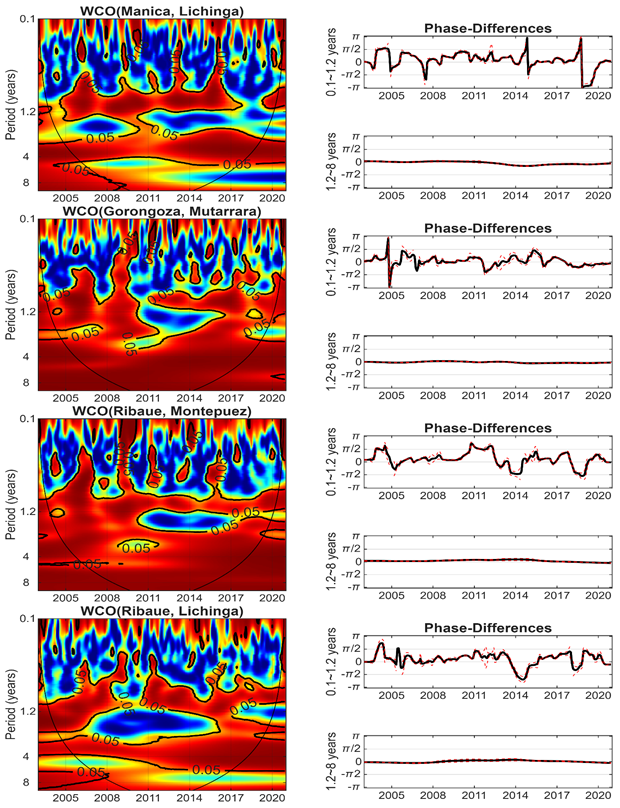
In the middle of Figure 2, there are small regions of high coherence (close to one) between the white corn prices in Manica and Gorongosa for the frequency range of 0.1–1.1 years, particularly between 2005–2007, 2008–2011, and 2015–2028. During these periods, the phase difference is consistently between 0 and -π/2, indicating that both variables are in phase, with the price in Mutarara leading the market. For frequencies between 1.1 and 8 years, there has been high coherence since 2003–2020, and the phase difference is zero in the periods between 2000–2011, meaning that neither variable is the market leader. From 2011 to 2020, the phase difference is consistently between 0 and -π/2, showing that both variables are in phase (positive relationship), with the price of Mutarara leading the market.
The Manica and Montepuez markets are less synchronized compared to the set of market pairs shown in Figure 2. There are small regions of high coherence in the frequency range between 0.1 and 1.2 years, particularly for the periods 2002–2007, 2010–2014, and 2017–2020. In the first two periods, the phase difference is consistently between 0 and π/2, indicating that both variables are in phase with the Manica market leading. In the last period (2017–2020), the phase difference is consistently between 0 and −π/2, indicating that both variables are in phase with the Montepuez market leading. At the lower frequencies of 1.2–8 years, there is high coherence from 2006–2014, and the phase difference is consistently between 0 and π/2, showing that both variables are in phase with the Manica market leading.
The evidence allows us to conclude that, among the set of segmented white corn market pairs presented in Figure 2 and Appendix A, there is greater synchronization between the Gorongosa and Mutarrara markets, and between Ribaué and Montepuez. The main reason for this is that these markets are geographically close to one another. It was also found that in all pairs of segmented markets in Mozambique, both in the short term (0.1–1.2 years) and in the long term (1.2–8 years), the phase difference is consistently between 0 and −π/2 or between 0 and π/2, meaning that both variables are in phase (positive relationship). Additionally, white corn prices in Mozambique are more synchronized in the long run than in the short run. In this context, we can conclude that the markets are cointegrated in the long run (1.2–8 years) because there is a degree of price synchronization (high consistency close to one). In the short run, the results suggest that the markets are not integrated.
The price of agricultural products is a key variable in management and risk decisions for grain investors in Mozambique, such as those involved in white corn. However, different key players in this market, such as governments and grain investors, have different time horizons. They may invest if the diversification of the agricultural product portfolio is high in the Mozambican market. For example, in Figure 1, the consistency among white corn prices is lower in the short term (high frequencies) and higher in the long term (low frequencies). In this situation, investors can more easily adjust their portfolio in the long term than in the short term.
In our study, we will consider only white corn because it is the most widely consumed cereal in Mozambique. Next, we will discuss the relationship between the price of white corn and energy prices (oil and gas).
4.1.2. Relationship Between White Corn Prices and Energy Prices (Oil and Gas) in Mozambique
Figure 3 summarizes the simple wavelet coherence and phase difference to illustrate the relationship between energy prices (oil and gas) and white corn prices in Mozambique. In the figure, there is high coherence in short-term regions for both frequencies (0.1–1.2 years and 1.2–8 years), especially for the years 2005–2008. The phase difference is consistently between π/2 and π, showing that both variables are out of phase (negative relationship) with the Manica price leading.
Figure 3 also shows the coherence between the gas price and the Manica and Gorongosa markets. There is high coherence in small regions for both frequencies (0.1–1.2 years and 1.2–8 years), especially for the years 2005–2008. The phase difference is consistently between 0 and π/2, showing that both variables are in phase (positive relationship) with the gas price leading.
For the remaining markets, as illustrated in Appendix 2, there are also small regions showing high correlation between energy prices (oil and gas) and white corn prices in the markets of Mutarrara and Montepuez, as well as Ribaué and Lichinga, especially between 2005 and 2008, for the frequency range of 0.1–1. 2 years (short term). In the long term, energy prices (oil and gas) have no effect on these white corn markets in Mozambique. As shown in Figure 3 and the attached Appendix B, in general, energy prices (oil and gas) have no effect on the various segmented white corn markets in Mozambique.
4.2. Estimation of Results Using Other Econometric Models
4.2.1. Stationarity Tests (ADF) for White Corn Market Prices and Energy Prices
Table 1 below presents the results of the Augmented Dickey-Fuller (ADF) test applied to the white corn market price series for Manica, Gorongosa, Mutarara, Montepuez, Ribáuè, and Lichinga, as well as to oil and gas prices, with the aim of verifying the presence of a unit root. The tests were conducted using a model with a level intercept and no intercept and trend in the first difference, employing a first-order lag for all series. The “Lag” column indicates the number of lags used in the test, while the “t-statistic” represents the ADF test value
The Augmented Dickey-Fuller (ADF) test rejected the null hypothesis of a unit root for all series at the 1% significance level, with the exception of energy prices (gas and oil). The results are consistent with the wavelet analysis. As shown in Figure 3 and Appendix B, energy prices (oil and gas) generally do not exert a significant influence on the different segmented white maize markets in Mozambique. These findings suggest that price dynamics in regional white maize markets are predominantly driven by domestic factors related to supply, demand, and spatial market integration, rather than by persistent shocks originating from the international energy market. Therefore, it was necessary to apply the first difference to ensure the significance of all series, as this eliminates the strong correlation observed in the model. Thus, applying the Augmented Dickey-Fuller (ADF) test at the first difference level rejected the null hypothesis of a unit root for all series at the 1% significance level, indicating that they are stationary at the first difference, i.e., integrated of order one, I(1). The fact that the series are first-order integrated, I(1), is a fundamental condition for conducting the Johansen Cointegration Test.
In this context, for a cointegration relationship to exist, the variables must share the same order of integration. If the series are I(1) at the level (stationary only after the first difference), this implies that they have a stochastic trend. The Johansen test seeks to verify whether there is a linear combination of these variables that is I(0) (stationary), that is, whether these trends cancel each other out in the long run.
4.2.2. Johansen Test
Table 2 below presents the results of the Johansen trace test for cointegration among the price series for the white corn markets in Manica, Gorongosa, Mutarara, Montepuez, Ribaué, and Lichinga, as well as oil and gas prices. The null hypothesis (r) indicates the number of cointegration vectors tested. The trace statistic is compared to the critical value at the 5% level. If the trace statistic is greater than the critical value, then there is cointegration (Yes), but otherwise not (No). The FPE and AIC tests are information criteria for selecting the optimal number of vectors (a lower value indicates a better model, marked with *).
The results of the trace test indicate the rejection of the null hypothesis of no cointegration up to the fourth vector, evidencing the existence of long-run equilibrium relationships among the model variables.Table 2 describes the statistics and maximum ranks of the Johansen cointegration tests. The results of the cointegration equations “CE1,” “CE2,” “CE3,” and “C4,” each with one variable, indicate that there is evidence of cointegration in the model. The p-value of 0.0000 suggests rejection of the null hypothesis of no cointegration. This suggests that two linear combinations of the variables have a stable long-term relationship with each other.
4.2.3. VECM Model Results for White Corn Prices Excluding Energy Variables
Table 3 presents the VECM model results for the actual average prices of white corn in the main markets namely Manica, Gorongosa, Mutarara, Montepuez, Ribáuè, and Lichinga excluding energy variables. For the markets under study, Panel A presents the long-run coefficients (MCE error correction terms), Panel B reports the short-run coefficients in first differences (LD), and Panel C shows the observed real model statistics.
As shown in Table 3 (Panel A), the error correction terms (ECTs) indicate the speed at which each market adjusts to deviations from the long-run cointegration relationships. The Manica market exhibits a negative and statistically significant adjustment coefficient for _ce1 (−0.4022; p < 0.01), suggesting that approximately 40% of disequilibria associated with the first cointegration relationship are corrected within each period. This finding indicates strong long-run integration within the market system. However, Manica also presents a positive and significant coefficient for _ce2 (0.2257; p < 0.05), implying that deviations associated with the second cointegration relationship lead to further divergence from equilibrium rather than convergence.
The Gorongosa market responds negatively and significantly to _ce2 (−0.5627; p < 0.01) and positively to _ce3 (0.2994; p < 0.01), indicating bilateral adjustment dynamics across multiple equilibrium paths. Specifically, Gorongosa actively corrects deviations from the second cointegration relationship while diverging from the third. Mutarara displays a positive and significant adjustment coefficient for _ce1 (0.3416; p < 0.05), which technically indicates divergence from equilibrium and suggests weak exogeneity of this market with respect to the first cointegration vector.
Ribáuè exhibits a positive and highly significant response to _ce4 (0.2236; p < 0.01), without any significant negative adjustment coefficient, suggesting that the market does not actively correct long-run disequilibria. Montepuez presents a positive and marginally significant adjustment coefficient for _ce3 (0.0890; p < 0.10), while Lichinga shows a positive and significant response to _ce3 (0.1657; p < 0.01). These results indicate adjustment dynamics that amplify disequilibrium rather than restore long-run equilibrium.
The existence of four cointegration vectors is confirmed by the Johansen trace test (trace statistic = 71.38 > critical value = 68.52), indicating multiple stable long-run relationships among the six regional maize markets during the study period. Regarding the role of markets in long-run disequilibrium adjustment, Gorongosa emerges as the only market exhibiting a significant negative adjustment coefficient, actively correcting deviations from the second cointegration relationship. In contrast, Manica, Mutarara, Montepuez, Ribáuè, and Lichinga display predominantly positive coefficients, suggesting a more peripheral or follower role within the long-run adjustment system.
These findings are consistent with the wavelet analysis, which also identified strong long-run coherence (1.2–8 years) among the regional white maize markets in Mozambique, indicating substantial price synchronization and market integration. By contrast, short-run coherence was weak, suggesting limited transmission of shocks between markets. Gorongosa emerged as the principal integration and transmission hub.
In the short run (Panel B), the lagged coefficients indicate that Gorongosa acts as the primary transmitter of price shocks, exerting positive and significant effects on Manica (0.37), Mutarara (0.45), Montepuez (0.18), Ribáuè (0.32), and Lichinga (0.27*), thereby reinforcing its central role in regional price formation. Mutarara also exerts significant influence on Lichinga (0.15**) and Manica (0.10*), while Ribáuè affects Mutarara (0.39*) and Montepuez (0.21). Manica mainly receives shocks from other markets, behaving as a follower market. Montepuez exhibits negative self-adjustment dynamics (−0.18**), whereas Lichinga does not significantly influence the remaining markets and therefore behaves predominantly as a price taker.
The overall quality of the model (Panels C and D) is satisfactory, with R² values ranging from 0.27 to 0.51 and globally significant equations (p < 0.001). Lichinga (R² = 0.51) and Manica (R² = 0.46) are the best-explained markets, whereas Gorongosa presents the lowest explanatory power (R² = 0.27), which is consistent with its role as the primary transmitter of exogenous shocks. In line with the wavelet analysis, the results suggest limited short-run integration across most regional markets, with Gorongosa representing the main exception.
4.2.4. Analysis of the Vector Error Correction Model (VECM) Including Energy Variables
Table 4 presents the VECM results for white maize prices in the six regional markets, including the energy variables (oil and gas). For the markets under study, Panel A presents the long-run coefficients (VEC correction terms). Panel B reports the short-run coefficients in first differences (LD). Panel C shows the model statistics and the variables for Manica, Gorongosa, Mutarara, Montepuez, Ribáuè, and Lichinga, and including energy variables (oil and gas), which represent the real prices observed in the respective markets included in the study.
Long-Run Analysis: As illustrated in Table 3 (Panel A), which reports the error correction terms (ECTs) for the analyzed period, the estimated coefficients indicate the speed at which each market adjusts to deviations from the four cointegration relationships (_ce1 to _ce4).
For the Manica market, a negative and highly significant adjustment coefficient is observed for _ce1 (−0.3671; p < 0.01), implying that approximately 37% of disequilibria in the first long-run relationship are corrected within each period. This finding indicates strong integration of Manica into the long-run equilibrium system.
Gorongosa responds negatively to _ce2 (−0.5817; p < 0.01) and positively to _ce3 (0.3344; p < 0.01), demonstrating adjustment to multiple equilibrium trajectories, with stronger correction occurring through the second cointegration relationship.
Mutarara exhibits a positive and significant coefficient for _ce1 (0.3679; p < 0.01), which technically implies divergence from equilibrium rather than convergence. This result suggests weak exogeneity of Mutarara with respect to the first cointegration relationship.
The Johansen cointegration test confirms the existence of four cointegration vectors (trace statistic = 71.38 > critical value = 68.52), indicating the presence of multiple stable long-run relationships among the eight markets analyzed over the study period. Overall, the findings suggest limited short-run adjustment in most markets, with the notable exception of Gorongosa. This reinforces the central role of Gorongosa in both long-run equilibrium adjustment and the transmission of short-term shocks across the market system.
Short-Run Analysis: Table 3 (Panel B) presents the short-run adjustment coefficients (LD) for the period under review, highlighting the magnitude and statistical significance of contemporaneous and lagged relationships among the markets.
For the Manica market (LD), none of the coefficients are statistically significant, suggesting that Manica does not respond to short-term shocks originating from other markets.
In contrast, Gorongosa (LD) exhibits positive and statistically significant coefficients for its own lag (0.3728; p < 0.01), Mutarara (0.5151; p < 0.01), Montepuez (0.2020; p < 0.05), Ribáuè (0.2495; p < 0.05), and Lichinga (0.3649; p < 0.01). These findings indicate strong short-term transmission of shocks from multiple markets into Gorongosa. Additionally, Gorongosa displays a negative and significant coefficient for oil prices (−0.1565; p < 0.05) and a positive coefficient for gas prices (0.1199; p < 0.05), suggesting opposing influences from the two energy markets.
Mutarara (LD) responds positively only to Lichinga (0.1401; p < 0.05), while all remaining coefficients are statistically insignificant. Montepuez (LD) presents a negative and significant coefficient for its own lagged term (−0.2432; p < 0.01), indicating short-run mean reversion or overshooting behavior.
Ribáuè (LD) exhibits positive and significant coefficients for Mutarara (0.3046; p < 0.05) and Montepuez (0.2592; p < 0.01), suggesting that shocks originating in these markets are positively transmitted to Ribáuè. Lichinga (LD), in turn, shows a negative and significant coefficient only for Mutarara (−0.2591; p < 0.05), indicating an inverse short-term relationship between the two markets.
The oil market (LD) responds negatively to Ribáuè (−0.2709; p < 0.05) and positively to its own lagged value (0.3440; p < 0.01) as well as to gas prices (0.1366; p < 0.05), revealing both market inertia and transmission effects from the gas market.
Similarly, the gas market (LD) exhibits positive and significant coefficients for Gorongosa (0.5950; p < 0.01), Mutarara (0.5493; p < 0.01), and its own lagged value (0.2822; p < 0.01), indicating a strong short-run influence from both Gorongosa and Mutarara.
Regarding the transmission of short-term shocks, Gorongosa emerges as the primary recipient and transmitter within the market network, responding to multiple markets while simultaneously exerting direct and indirect influence on others. Mutarara and the gas market also display significant short-run relationships, although with more limited transmission patterns. By contrast, Manica exhibits no significant short-run relationships, suggesting either market segmentation or slower transmission mechanisms.
These findings are also consistent with the wavelet analysis, which showed that the inclusion of oil and gas prices did not substantially alter long-run coherence among regional white maize markets. Strong synchronization remained concentrated in the long-run frequency bands (1.2–8 years), whereas coherence between energy and maize prices was weak and unstable. This suggests that energy price shocks exert only a limited influence on the dynamics of regional white maize markets.
4.2.5. Stability of the VECM Model
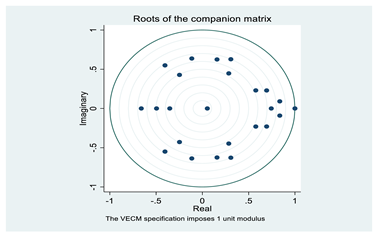
The figure shows the roots of the companion matrix of the VECM model to verify the stability of the system. The horizontal axis (Real) represents the real part of the roots, while the vertical axis (Imaginary) represents the imaginary part. The unit circle (radius = 1) is the stability boundary: all roots must lie inside or on it. Each point on the graph corresponds to an estimated root.
Figure 1: Unit Root Map
Source: Based on the results of the study, 2026
This is definitive visual evidence that the model is correctly specified. The dynamic stability of the VECM model was verified using the plot of the roots of the companion matrix (Figure 1). As observed, all roots (represented by the blue points) lie within the unit circle, with the exception of the unit roots imposed by the cointegration model specification. Visually, the fact that no point extends beyond the outer circumference confirms that the system is stable. This implies that random shocks to corn prices do not generate explosive or divergent behavior in the long run, allowing markets to gradually return to their common equilibrium. It shows that the inclusion of Lichinga and the other markets did not cause mathematical distortions in the system.
4.2.6. Granger Causality Tests
4.2.6.1. Granger Causality Tests for White Corn Markets Excluding Energy Variables
The table presents the results of the Granger (Wald) causality test among white corn markets, considering Manica, Gorongosa, Mutarara, Montepuez, Ribaué, and Lichinga as dependent variables in each equation. The explanatory variables correspond to the remaining white corn markets, allowing for the assessment of causal relationships in agricultural prices; the chi-square (χ²) statistic measures the strength of the causal relationship, while the degrees of freedom (df) correspond to the number of restrictions tested in each case. The value of Prob > χ² represents the statistical significance level of the test, indicating whether the null hypothesis of no causality can be rejected. The “ALL” indicator refers to the joint test of all explanatory variables on the dependent variable in each equation, assessing the overall significance of the model.

Table 5.
Granger (Wald) Causality Tests for the white corn market excluding energy variables.
| Granger causality Wald | ||||
| Equation | Excluded | chi2 | df | Prob > chi2 |
| Manica | Gorongosa | 41.411 | 4 | 0.000*** |
| Mutarara | 7.9405 | 4 | 0.094* | |
| Montepuez | 2.6853 | 4 | 0.612 | |
| Ribaué | 10.064 | 4 | 0.039** | |
| Lichinga | 6.2587 | 4 | 0.181 | |
| ALL | 154.05 | 20 | 0.000*** | |
| Gorongosa | Manica | 7.2164 | 4 | 0.125 |
| Mutarara | 19.927 | 4 | 0.001*** | |
| Montepuez | 3.2151 | 4 | 0.522 | |
| Ribaué | 15.064 | 4 | 0.005*** | |
| Lichinga | 6.6644 | 4 | 0.155 | |
| ALL | 69.385 | 20 | 0.000*** | |
| Mutarara | Manica | 7.8228 | 4 | 0.098* |
| Gorongosa | 23.333 | 4 | 0.000*** | |
| Montepuez | 11.842 | 4 | 0.019** | |
| Ribaué | 10.308 | 4 | 0.036** | |
| Lichinga | 6.8858 | 4 | 0.142 | |
| ALL | 71.083 | 20 | 0.000*** | |
| Montepuez | Manica | 9.4706 | 4 | 0.050** |
| Gorongosa | 5.9167 | 4 | 0.205 | |
| Mutarara | 13.994 | 4 | 0.007*** | |
| Ribaué | 25.212 | 4 | 0.000*** | |
| Lichinga | 12.365 | 4 | 0.015** | |
| ALL | 146.27 | 20 | 0.000*** | |
| Ribaué | Manica | 4.6199 | 4 | 0.329 |
| Gorongosa | 13.865 | 4 | 0.008*** | |
| Mutarara | 8.0297 | 4 | 0.090* | |
| Montepuez | 12.209 | 4 | 0.016** | |
| Lichinga | 11.573 | 4 | 0.021** | |
| ALL | 62.659 | 20 | 0.000*** | |
| Lichinga | Manica | 6.7861 | 4 | 0.148 |
| Gorongosa | 10.374 | 4 | 0.035** | |
| Mutarara | 30.049 | 4 | 0.000*** | |
| Montepuez | 4.7524 | 4 | 0.314 | |
| Ribaué | 11.088 | 4 | 0.026** | |
| ALL | 170.29 | 20 | 0.000*** | |
Source: The author, based on white corn price data obtained from SIMA. Note: Wald test based on the chi-square (χ²) distribution; significance levels: *** p<0.01, ** p<0.05, * p<0.10.
The results of the Granger (Wald) causality test make it possible to identify the directional relationships of influence among white maize markets by examining each explanatory variable individually within each equation (Manica, Gorongosa, Mutarara, Ribáuè, Montepuez, and Lichinga). In the Manica equation, the Gorongosa market exerts a statistically significant and strong Granger-causal influence on Manica (χ² = 41.411; p = 0.000), indicating a clear transmission of price shocks. Ribáuè also shows a statistically significant effect (χ² = 10.064; p = 0.039), although with lower intensity. Mutarara presents marginal significance (χ² = 7.9405; p = 0.094), suggesting a weak relationship, whereas Montepuez (χ² = 2.6853; p = 0.612) and Lichinga (χ² = 6.2587; p = 0.181) show no statistical evidence of causality with respect to Manica. The joint test (ALL = 154.05; p = 0.000) confirms the existence of strong overall interdependence within this equation.
In the Gorongosa equation, Mutarara exerts a strong and statistically significant Granger-causal influence (χ² = 19.927; p = 0.001), as does Ribáuè (χ² = 15.064; p = 0.005). By contrast, Manica (χ² = 7.2164; p = 0.125), Montepuez (χ² = 3.2151; p = 0.522), and Lichinga (χ² = 6.6644; p = 0.155) do not display statistical significance, suggesting the absence of relevant individual causality. The joint test (ALL = 69.385; p = 0.000) further confirms the robustness of the model.
For Mutarara, Gorongosa emerges as the primary source of Granger causality, exerting a highly significant effect (χ² = 23.333; p = 0.000) and acting as the main determinant of prices in this equation. Montepuez (χ² = 11.842; p = 0.019) and Ribáuè (χ² = 10.308; p = 0.036) also exhibit statistically significant causal effects, while Manica (χ² = 7.8228; p = 0.098) shows only marginal significance. Lichinga (χ² = 6.8858; p = 0.142) does not exhibit statistical significance. The global test (ALL = 71.083; p = 0.000) confirms the presence of strong market interdependence.
In the Montepuez equation, Ribáuè is identified as the variable with the strongest and most statistically significant Granger-causal effect (χ² = 25.212; p = 0.000), followed by Mutarara (χ² = 13.994; p = 0.007) and Lichinga (χ² = 12.365; p = 0.015). Manica is significant at the 5% level (χ² = 9.4706; p = 0.050), whereas Gorongosa shows no statistical evidence of causality (χ² = 5.9167; p = 0.205). The joint test (ALL = 146.27; p = 0.000) indicates a high degree of system integration. In Ribáuè’s equation, Gorongosa exerts a statistically significant Granger-causal influence (χ² = 13.865; p = 0.008), as do Montepuez (χ² = 12.209; p = 0.016) and Lichinga (χ² = 11.573; p = 0.021). Mutarara displays marginal significance (χ² = 8.0297; p = 0.090), while Manica does not appear statistically significant (χ² = 4.6199; p = 0.329). The joint test (ALL = 62.659; p = 0.000) confirms substantial interdependence among the markets.
Finally, in the Lichinga equation, Mutarara exerts the strongest and most highly significant Granger-causal effect (χ² = 30.049; p = 0.000), followed by Gorongosa (χ² = 10.374; p = 0.035) and Ribáuè (χ² = 11.088; p = 0.026). Manica (χ² = 6.7861; p = 0.148) and Montepuez (χ² = 4.7524; p = 0.314) do not show statistical significance. The joint test (ALL = 170.29; p = 0.000) confirms a high degree of integration within the market system.
The results show that price dynamics across markets are heavily dependent on specific variables, with Gorongosa, Mutarara, and Ribaué standing out as the main transmitters of shocks. Despite this, an asymmetric structure is observed, in which not all explanatory variables exert a statistically significant influence on all equations, although the joint test confirms the existence of a highly interconnected network of causality among the markets.
4.4.4. Granger Causality Tests for the White Corn Markets and Energy Variables
The table presents the results of the Granger (Wald) causality test between white corn markets and energy variables, considering Manica, Gorongosa, Mutarara, Montepuez, Ribaué, Lichinga, and the energy variables (oil and gas) as dependent variables in each equation. The explanatory variables correspond to the remaining white corn markets, as well as oil and gas, allowing for the assessment of causal relationships between agricultural and energy prices. The chi-square statistic (χ²) measures the strength of the causal relationship, while the degrees of freedom (df) correspond to the number of restrictions tested in each case. The value of Prob > chi² represents the statistical significance level of the test, indicating whether the null hypothesis of no causality can be rejected. The “ALL” indicator refers to the joint test of all explanatory variables on the dependent variable in each equation, assessing the overall significance of the model.
Table 6.
Granger (Wald) Causality Tests for the white corn markets using the energy variables.
| Dependent Equation) | Granger (Wald) Causality Tests | |||
| Excluded Variable (Independent) | χ² | df | Prob > chi² | |
| Manica | Gorongosa | 37.934 | 4 | 0.000*** |
| Mutarara | 6.7333 | 4 | 0.151 | |
| Montepuez | 2.6067 | 4 | 0.626 | |
| Ribaué | 10.002 | 4 | 0.040** | |
| Lichinga | 5.7124 | 4 | 0.222 | |
| Petróleo | 1.6924 | 4 | 0.792 | |
| ln_Gas | 1.2783 | 4 | 0.865 | |
| ALL | 159.57 | 28 | 0.000*** | |
| Gorongosa | Manica | 10.209 | 4 | 0.037** |
| Mutarara | 27.104 | 4 | 0.000*** | |
| Montepuez | 3.1548 | 4 | 0.532 | |
| Ribaué | 16.46 | 4 | 0.002*** | |
| Lichinga | 7.4336 | 4 | 0.115 | |
| Petróleo | 10.039 | 4 | 0.040** | |
| GAS | 18.233 | 4 | 0.001*** | |
| ALL | 101.32 | 28 | 0.000*** | |
| Mutarara | Manica | 8.2272 | 4 | 0.084* |
| Gorongosa | 21.815 | 4 | 0.000*** | |
| Montepuez | 13.283 | 4 | 0.010** | |
| Ribaué | 8.7602 | 4 | 0.067* | |
| Lichinga | 8.868 | 4 | 0.064* | |
| Oil | 6.0895 | 4 | 0.193 | |
| Gas | 8.7785 | 4 | 0.067* | |
| ALL | 90.067 | 28 | 0.000*** | |
| Montepuez | Manica | 8.591 | 4 | 0.072* |
| Gorongosa | 5.1009 | 4 | 0.277 | |
| Mutarara | 14.659 | 4 | 0.005*** | |
| Ribaué | 25.715 | 4 | 0.000*** | |
| Lichinga | 12.157 | 4 | 0.016** | |
| Oil | 3.3723 | 4 | 0.498 | |
| Gas | 2.6735 | 4 | 0.614 | |
| ALL | 153.62 | 28 | 0.000*** | |
| Ribaué | Manica | 4.4509 | 4 | 0.348 |
| Gorongosa | 10.558 | 4 | 0.032** | |
| Mutarara | 8.8733 | 4 | 0.064* | |
| Montepuez | 10.706 | 4 | 0.030** | |
| Lichinga | 10.572 | 4 | 0.032** | |
| Oil | 5.2886 | 4 | 0.259 | |
| Gas | 6.0918 | 4 | 0.192 | |
| ALL | 76.63 | 28 | 0.000*** | |
| Lichinga | Manica | 6.3447 | 4 | 0.175 |
| Gorongosa | 11.311 | 4 | 0.023** | |
| Mutarara | 29.116 | 4 | 0.000*** | |
| Montepuez | 4.1792 | 4 | 0.382 | |
| Ribaué | 10.186 | 4 | 0.037** | |
| Oil | 1.2985 | 4 | 0.862 | |
| Gas | 3.46 | 4 | 0.484 | |
| ALL | 178.3 | 28 | 0.000*** | |
| Oil | Manica | 3.4902 | 4 | 0.479 |
| Gorongosa | 11.132 | 4 | 0.025** | |
| Mutarara | 4.2957 | 4 | 0.367 | |
| Montepuez | 1.5177 | 4 | 0.824 | |
| Ribaué | 4.1942 | 4 | 0.405 | |
| Lichinga | 2.65 | 4 | 0.618 | |
| Gas | 10.139 | 4 | 0.038** | |
| ALL | 36.723 | 28 | 0.125 | |
| Gas | Manica | 4.1195 | 4 | 0.39 |
| Gorongosa | 6.61 | 4 | 0.158 | |
| Mutarara | 0.70241 | 4 | 0.951 | |
| Montepuez | 6.4388 | 4 | 0.169 | |
| Ribaué | 6.6094 | 4 | 0.158 | |
| Lichinga | 9.3626 | 4 | 0.053* | |
| Oil | 29.821 | 4 | 0.000*** | |
| ALL | 63.895 | 28 | 0.000*** | |
Source: Authors’ calculations based on white maize price data obtained from SIMA, 2026. Note: Wald test based on the Chi-square (χ²) distribution. ***, **, and * denote statistical significance at the 1%, 5%, and 10% levels, respectively.
The Granger causality test was conducted to assess whether prices from eight variables (Manica, Gorongosa, Mutarara, Montepuez, Ribáuè, Lichinga, oil, and natural gas) help predict one another. Four lags were included in the estimation. The null hypothesis states that the excluded variable does not Granger-cause the dependent variable. P-values below 0.05 indicate statistically significant evidence of causality.
For the Manica equation, the joint test of all excluded variables (ALL) is highly significant (p = 0.000), indicating that at least some variables contribute to predicting price movements in Manica. Individually, Gorongosa exerts the strongest causal influence on Manica (p = 0.000), followed by Ribáuè (p = 0.040). In contrast, Mutarara (p = 0.151), Montepuez (p = 0.626), Lichinga (p = 0.222), oil (p = 0.792), and gas (p = 0.865) do not exhibit significant predictive power over Manica prices. These findings suggest that price dynamics in Manica are primarily driven by Gorongosa and Ribáuè.
For Gorongosa, the joint test is likewise highly significant (p = 0.000). Several variables Granger-cause Gorongosa, including Manica (p = 0.037), Mutarara (p = 0.000), Ribáuè (p = 0.002), oil (p = 0.040), and gas (p = 0.001). However, no evidence of causality is found for Montepuez (p = 0.532) or Lichinga (p = 0.115). These results highlight Gorongosa as a central transmission hub strongly influenced by both regional maize markets and energy prices.
The ALL test for Mutarara is also statistically significant (p = 0.000). Gorongosa emerges as the main causal driver (p = 0.000), followed by Montepuez (p = 0.010). Weak evidence of causality is additionally observed for Manica (p = 0.084), Ribáuè (p = 0.067), Lichinga (p = 0.064), and gas (p = 0.067). Oil prices do not significantly influence Mutarara (p = 0.193). Overall, Mutarara appears to respond mainly to shocks originating from Gorongosa and Montepuez.
For Montepuez, the joint test is significant (p = 0.000). Montepuez is Granger-caused by Mutarara (p = 0.005), Ribáuè (p = 0.000), and Lichinga (p = 0.016), while weaker evidence is found for Manica (p = 0.072). No significant influence is detected from Gorongosa (p = 0.277), oil (p = 0.498), or gas (p = 0.614). These findings indicate that Montepuez primarily receives price signals from neighboring regional markets rather than from energy variables. For Ribáuè, the ALL test is significant (p = 0.000). Gorongosa (p = 0.032), Montepuez (p = 0.030), and Lichinga (p = 0.032) significantly Granger-cause Ribáuè, while Mutarara presents weak evidence of causality (p = 0.064). No significant effects are found for Manica (p = 0.348), oil (p = 0.259), or gas (p = 0.192). Thus, Ribáuè appears to be influenced mainly by regional maize markets rather than by international energy prices. The ALL test for Lichinga is likewise significant (p = 0.000). Gorongosa (p = 0.023), Mutarara (p = 0.000), and Ribáuè (p = 0.037) significantly influence Lichinga. No evidence of causality is detected for Manica (p = 0.175), Montepuez (p = 0.382), oil (p = 0.862), or gas (p = 0.484). Hence, Lichinga mainly responds to price shocks transmitted from Gorongosa, Mutarara, and Ribáuè.
For oil prices, the joint ALL test is not statistically significant (p = 0.125), indicating that regional maize markets collectively do not explain oil price movements. Individually, only Gorongosa (p = 0.025) and gas (p = 0.038) exhibit significant predictive power over oil prices. This finding suggests that oil prices are relatively exogenous to the regional maize market system and are largely determined by external global factors.
Finally, the ALL test for gas prices is statistically significant (p = 0.000). The only strongly significant causal determinant of gas prices is oil (p = 0.000), while Lichinga shows weak evidence of causality (p = 0.053). The remaining regional maize markets do not significantly influence gas prices. Therefore, gas prices appear to be driven primarily by oil market dynamics rather than by regional agricultural price movements.
Overall, the results identify Gorongosa as the principal regional price transmission center, significantly influencing five of the seven remaining variables (Manica, Mutarara, Ribáuè, Lichinga, and oil). Ribáuè also emerges as an important transmitter, affecting Manica, Gorongosa, Montepuez, and Lichinga. Mutarara and Montepuez exhibit moderate transmission roles, whereas Manica plays a more limited role, influencing only Gorongosa. The energy variables (oil and gas) mainly influence each other and affect Gorongosa, but do not exert direct effects on most regional maize prices. Furthermore, oil is the only variable whose overall equation is not jointly significant, reinforcing the view that it is largely determined by exogenous global factors not captured within the regional system. These findings are consistent with the wavelet analysis, which also indicated weak transmission of energy shocks to regional white maize markets in Mozambique.
5. Discussion
5.1. Cointegration and Long-Run Integration
The Johansen cointegration test identified three cointegration vectors (rank = 3), with all equations statistically significant at the 1% level. These findings provide robust evidence that white maize markets in Mozambique are integrated in the long run, supporting the Law of One Price (LOP), which predicts that prices in spatially separated markets converge once transaction costs are considered (Krugman & Obstfeld, 2005; Bazo & Tonin, 2024).
The wavelet coherence analysis reinforces this conclusion. In the long-term frequency band (1.2–8 years), the results reveal high levels of coherence among regional maize markets, with phase differences generally close to zero. This pattern indicates that prices move synchronously over time, suggesting the existence of stable long-run relationships across markets. Similar evidence was reported by Pal and Mitra (2017), who found stronger coherence between oil and food prices at lower frequencies, indicating that temporary shocks dissipate while structural relationships persist.
These results are consistent with previous studies on maize market integration in Mozambique and Southern Africa. Bazo and Tonin (2024) found evidence of cointegration among maize markets in Maputo, Manica, and Angónia, while Jones and Salazar (2020) showed that road connectivity along the Zambezi corridor significantly improved market integration and reduced price dispersion. At the regional level, Davids et al. (2016) documented substantial long-run integration among maize markets in Southern Africa, particularly between Mozambique, Malawi, Zambia, and South Africa. Overall, the presence of multiple cointegration vectors suggests that Mozambican maize markets share common long-run price dynamics despite short-term fluctuations. Consistent with Engle and Granger (1987), the results indicate that although individual price series are non-stationary, their linear combinations remain stable over time, confirming the existence of a long-run equilibrium relationship.
5.2. Gorongosa as a Regional Price Transmission Hub
The VECM estimates and Granger causality tests consistently identify Gorongosa as the main regional price transmission hub. In the short run, shocks originating in Gorongosa exert positive and statistically significant effects on Manica, Mutarara, Montepuez, Ribáuè, and Lichinga, highlighting its central role in regional price formation. The wavelet coherence analysis provides additional support for this result. At short-term frequencies (0.1–1.2 years), temporary periods of strong coherence were observed between Gorongosa and other regional markets, particularly during 2005–2007 and 2008–2011. During these intervals, the phase differences indicate that Gorongosa systematically led the price transmission process.
This finding is consistent with the literature on agricultural market integration in developing countries. Rashid (2004) identified Kampala and Jinja as dominant price-setting markets in Uganda, while Van Campenhout (2007) documented the emergence of central transmission hubs in Tanzanian maize markets. In Mozambique, Tostão and Brorsen (2005) similarly observed that markets located in the central region exert disproportionate influence on national maize price dynamics. The dominant position of Gorongosa can be explained by several structural factors, including its strategic geographic location along the North–South trade corridor, stronger transport connectivity, higher trading volumes, and relatively better storage and marketing infrastructure. These conditions reduce transaction costs and facilitate faster transmission of market information across regions.
5.3. Transmission Hierarchy and Peripheral Markets
The empirical results reveal a clear hierarchy in the maize price transmission system. While Gorongosa acts as the principal transmission center, Mutarara and Ribáuè function as secondary transmission markets. In contrast, Manica, Montepuez, and especially Lichinga behave predominantly as price-taking markets. Wavelet coherence results suggest that this hierarchy is not entirely fixed over time. In some subperiods, markets such as Montepuez temporarily assumed a leading role in the transmission process, indicating that regional leadership may shift depending on infrastructure conditions, trade flows, and localized shocks.
The evidence also suggests the presence of weak exogeneity among peripheral markets, particularly Lichinga and Montepuez, whose adjustment coefficients are generally insignificant in the long-run equilibrium relationships. Similar patterns were documented by Davids et al. (2016) for Southern African maize markets and by Zaqueu et al. (2021) for bean markets in Mozambique. These findings imply that regional maize markets are not equally integrated into the national price system. Central markets respond more rapidly to shocks and information flows, whereas peripheral markets adjust more slowly due to higher transaction costs, weaker infrastructure, and lower market connectivity.
5.4. The Limited Role of Energy Prices
One of the most important findings of this study is the limited influence of global energy prices on regional maize markets in Mozambique. Although the VECM results indicate that oil prices exert short-run effects on some markets, particularly Gorongosa and Ribáuè, the long-run relationship between energy and maize prices remains weak. The wavelet coherence analysis confirms this result. Figure 3 and Appendix B show that coherence between maize prices and energy prices (oil and gas) is generally low across both short- and long-term frequencies. Only limited periods of significant coherence are observed, mainly during the 2005–2008 global food and energy crisis. Outside this interval, energy shocks do not appear to generate persistent effects on regional maize markets.
These findings contrast with studies such as Pal and Mitra (2017), which reported stronger relationships between global food and oil prices, but they are consistent with Ma and Hou (2019), who found only limited transmission from oil prices to maize prices in China. Several structural factors may explain the weak transmission of energy shocks in Mozambique. First, maize production remains dominated by smallholder subsistence farming, where modern energy inputs represent a relatively small share of total production costs. Second, fragmented market structures and high transaction costs reduce the speed of external shock transmission. Third, fuel pricing policies and limited biofuel development may partially insulate domestic agricultural markets from international energy price fluctuations. Overall, the results suggest that regional maize prices in Mozambique are driven primarily by domestic market conditions rather than by persistent shocks originating from global energy markets.
5.5. Evidence from IRF and FEVD Analyses
The impulse response functions (IRF) and forecast error variance decomposition (FEVD) provide complementary evidence regarding the role of energy shocks in the maize market system. The IRF results indicate that natural gas shocks generate stronger responses than oil shocks, particularly in central markets such as Gorongosa and Manica. In addition, the effects of gas shocks emerge more rapidly, whereas oil price shocks display a slower transmission process, possibly reflecting transport delays, storage mechanisms, and rigidities in local distribution systems.
The FEVD analysis further shows that energy variables explain only a relatively small proportion of maize price variability. Nevertheless, natural gas contributes more to price fluctuations than oil, suggesting that indirect production costs, including fertilizers and industrial inputs, may play a more important role than transport fuel costs alone. Although the contribution of energy variables remains modest, the convergence between the IRF, FEVD, wavelet, and VECM results strengthens the robustness of the findings. Taken together, the evidence indicates that energy prices exert only limited and non-persistent effects on Mozambican maize markets.
5.6. Policy Implications and Market Stability
The stability tests confirm that all eigenvalues lie within the unit circle, indicating that the VECM system is dynamically stable. This implies that temporary shocks dissipate over time and that regional maize markets gradually return to long-run equilibrium.
From a policy perspective, the results highlight the importance of improving market connectivity and transport infrastructure, particularly in peripheral regions such as Lichinga and Montepuez. Investments in roads, storage facilities, and market information systems could accelerate price adjustment and strengthen national market integration. The findings also suggest that domestic maize markets are relatively insulated from international energy shocks. Consequently, policies aimed at improving internal market efficiency may have greater impacts on food price stabilization than policies focused exclusively on external energy price management.
6. Conclusion
The empirical evidence presented in this study shows that white maize markets in Mozambique operate as an integrated system in the long run, but exhibit segmentation in the short run. This temporal asymmetry has important implications for economic agents: while investors and traders can benefit from stable price signals over the long term, weak short-term synchronization limits arbitrage and rapid responses to cyclical shocks.
The central role of the Gorongosa market in transmitting shocks suggests that it functions as a reference point for price formation across the network. Consequently, market information policies that prioritize this hub can generate positive externalities for the remaining segments of the chain. On the other hand, the markets in Manica, Montepuez, and Lichinga, by exhibiting mostly reactive behavior, benefit less from strategies based on anticipating price movements.
With regard to the relationship with energy prices, the results point to an absence of structural and lasting pass-through. This finding is particularly relevant in the context of growing volatility in international energy markets, as it suggests that white maize in Mozambique is not significantly vulnerable to external shocks stemming from oil or gas. The implications for food security are significant: policymakers can focus their interventions on domestic and regional factors such as climate, transportation infrastructure, and storage policies rather than devoting excessive resources to mitigating imported energy shocks.
From a methodological standpoint, the combination of wavelets, cointegration, and VECM proved suitable for capturing multiscale dynamics, although the instability of some short-term relationships involving gas warrants caution in interpretation. Future studies could benefit from the inclusion of additional variables such as transportation costs, trade policies, or fertilizer prices, as well as from the application of nonlinear methods to capture potential asymmetries in price transmission.
Appendix A. Wavelet Coherence of Hite Maize Prices (Without Energy Variables)
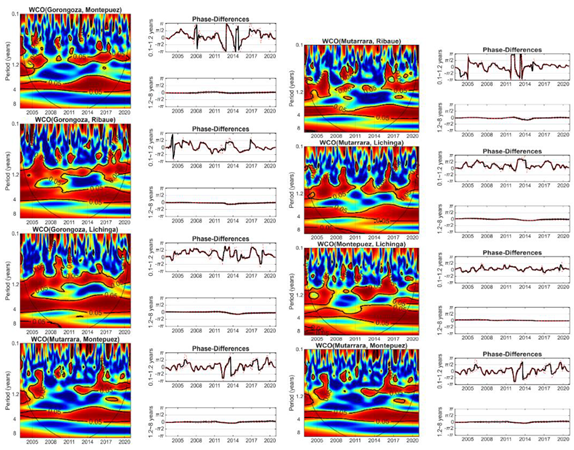
Note: White corn prices in Mozambique: wavelet coherence (left panel) and wavelet phase differences (right panel). The color code for coherence ranges from blue (low coherence close to zero) to red (high coherence close to one). The black/gray contours indicate a significance level of 10% (5%); phase differences are shown for the frequency bands 0.1–1.2 nd 1.2–8 years.
Appendix B. Wavelet Coherence of White Maize Prices with Oil and Gas (with Energy Variables)
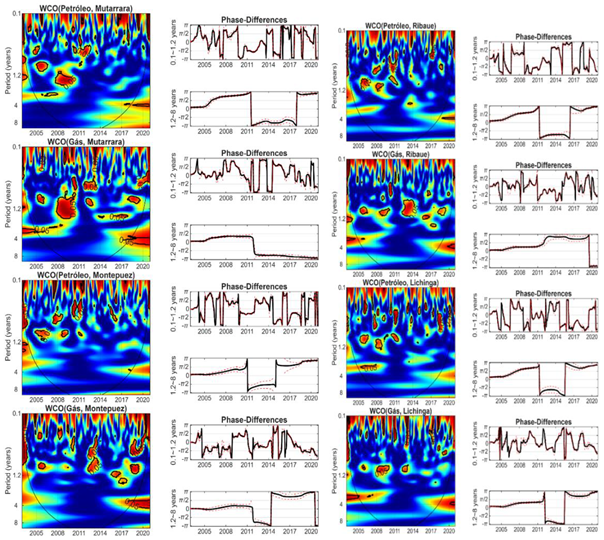
Appendix C. Impulse Response Functions (IRF)
Note: White corn prices in Mozambique and oil and gas prices: wavelet coherence (left panel) and wavelet phase differences (right panel). The color code for coherence ranges from blue (low coherence close to zero) to red (high coherence close to one). The black/gray contours indicate a significance level of 10% (5%); phase differences are shown for the frequency bands 0.1–1.2 and 1.2–8 years.
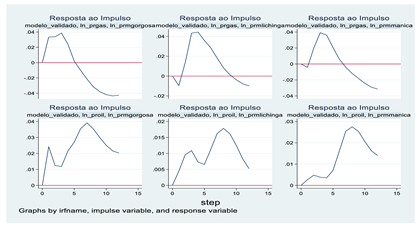
1. Magnitude of the Shock: The graph shows that natural gas (lnprgas) generates larger responses (up to 0.03) compared to oil (lnproil), which fluctuates around 0.01. This suggests that the cost structure of corn production is more sensitive to natural gas. 2. Time Lags: It is evident from the graphs that the impact of oil takes more months to reach its peak. This confirms that the pass-through of fuel prices to the final consumer in Mozambique’s districts experiences a “logistical delay.” 3. Convergence: Note that the curves do not return to zero after 15 months; they stabilize at a new positive level. This proves that energy shocks cause a permanent change in the level of corn prices, a characteristic of cointegrated markets. Because Montepuez responds less, the curve in the graph is flatter, indicating a relative isolation of this market from the global energy shocks affecting the central corridor.
Appendix D. Forecast Error Variance Decomposition (FEVD)
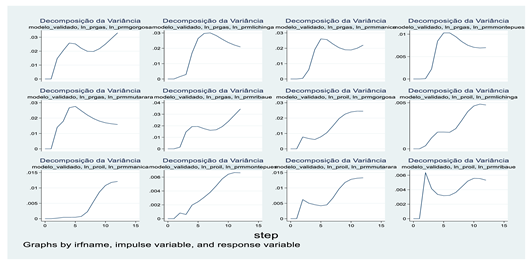
The results of the variance decomposition (Figure ) support the hypothesis that the corn market in Mozambique is intrinsically linked to the global energy sector. The predominance of natural gas (lnprgas) over oil (lnproil) suggests that price volatility stems not only from transportation costs, but primarily from the costs embedded in fertilizers and industrial processing. In districts such as Gorongosa and Manica, key hubs for commercialization, gas price volatility accounts for up to 3% of total price variation, a statistically significant figure for a commodity.
References
- Abidoye, B. O.; Labuschagne, M. The transmission of world maize price to South African maize market: A threshold cointegration approach. Agric. Econ. 2014, 45(4), 501–512. [Google Scholar] [CrossRef]
- Aguiar-Conraria, L.; Soares, M.J. The continuous wavelet transform: moving beyond uni- and bivariate analysis. J. Econ. Surv. 2014, 28(2), 344–375. [Google Scholar] [CrossRef]
- Aguiar-Conraria, L.; Soares, M. J. Business cycle synchronization and the Euro: a wavelet analysis (CEF.UP Working Paper No. 2011-05); Universidade do Porto, 2011. [Google Scholar]
- Aguiar-Conraria, L.; Azevedo, N.; Soares, M.J. Using wavelets to decompose the time-frequency effects of monetary policy. Phys. A Stat. Mech. Its Appl. 2008, 387(12), 2863–2878. [Google Scholar] [CrossRef]
- Aguiar-Conraria, L.; Conceiçao, G.; Soares, M.J. How far is gas from becoming a global commodity? Energy J. 2022, 43(4). [Google Scholar] [CrossRef]
- Aguiar-Conraria, L.; Martins, M.M.F.; Soares, M.J. The yield curve and the macro-economy across time and frequencies. J. Econ. Dyn. Control 2012, 36(12), 1950–1970. [Google Scholar] [CrossRef]
- Aguiar-Conraria, L.; Martins, M.M.F.; Soares, M.J. Estimating the Taylor rule in the time-frequency domain. J. Macroecon. Elsevier 2018, 57(May), 122–137. [Google Scholar] [CrossRef]
- Aguiar-Conraria, L.; Soares, M.J.; Sousa, R. California’s carbon market and energy prices: a wavelet analysis. Philos. Trans. R. Soc. A Math. Phys. Eng. Sci. 2018, 376(2126). [Google Scholar] [CrossRef]
- Aiuba, R. Factores determinantes de preços de produtos alimentares na cidade de Maputo. Observador Rural 148. OMR. 2024. [Google Scholar]
- Akaike, H. Fitting autoregressive models for prediction. Ann. Inst. Stat. Math. 1969, 21(1), 243–247. [Google Scholar] [CrossRef]
- Akaike, H. Statistical predictor identification. Ann. Inst. Stat. Math. 1970, 22(1), 203–217. [Google Scholar] [CrossRef]
- Alemu, Z. G.; Biacuana, G. R. Measuring maize market integration in Mozambique using threshold vector error correction models. In Proceedings of the IAAE Conference, 2006. [Google Scholar]
- Bazo, A. E.; Tonin, J. M. Cointegração e eficiência dos mercados de milho no Sul e Centro de Moçambique: Abordagem VECM. In Anais do X Encontro de Economia Aplicada; 2024. [Google Scholar]
- Bera, A. K.; Jarque, C. M. Efficient tests for normality, homoscedasticity and serial independence of regression residuals. Econ. Lett. 1980, 6(3), 255–259. [Google Scholar] [CrossRef]
- Campenhout, B. V. Market integration in Mozambique: A non-parametric extension to the threshold model; International Food Policy Research Institute, 2012. [Google Scholar]
- Campenhout, B.V. Modelling trends in food market integration: method and an application to Tanzanian maize markets. Food Policy 2007, 32(1), 112–127. [Google Scholar] [CrossRef]
- Choe, J.; Goodwin, B.K. Agricultural market integration and price transmission. 2025. Available online: https://scholar.google.com/scholar?q=Choe+Goodwin+2025+agricultural+market+integration.
- Conraria, L. A.; Azevedo, N.; Soares, M. J. Using wavelets to decompose the time–frequency effects of monetary policy. Phys. A Stat. Mech. Its Appl. 2008, 387(12), 2863–2878. [Google Scholar] [CrossRef]
- Da Conceição, G. F. D. The impact of energy prices on inflation and economic growth in Mozambique: A wavelet approach and OLS estimator. South Afr. J. Econ. 2024, 92(3), 354–385. [Google Scholar] [CrossRef]
- Davids, T.; Meyer, F.; Westhoff, P. Impact of trade controls on price transmission between southern African maize markets. Agrekon 2017, 56(3), 223–232. [Google Scholar] [CrossRef]
- Davids, T.; Schroeder, K.; Meyer, F. H.; Chisanga, B. Regional price transmission in Southern African maize markets. In Proceedings of the 5th International Conference of the African Association of Agricultural Economists, 2016. [Google Scholar]
- Dickey, D. A.; Fuller, W. A. Distribution of the estimators for autoregressive time series with a unit root. J. Am. Stat. Assoc. 1979, 74(366), 427–431. [Google Scholar] [PubMed]
- Doornik, J. A.; Hansen, H. An omnibus test for univariate and multivariate normality. Oxf. Bull. Econ. Stat. 2008, 70(s1), 927–939. [Google Scholar] [CrossRef]
- Elmarzougui, E.; Larue, B. On the price transmission of energy and agricultural commodities. 2011. Available online: https://scholar.google.com/scholar?q=Elmarzougui+Larue+2011.
- Enders, W. Applied econometric time series, 4th ed.; Wiley, 2015. [Google Scholar]
- Engle, R. F.; Granger, C. W. J. Co-integration and error correction: Representation, estimation, and testing. Econometrica 1987, 55(2), 251–276. [Google Scholar] [CrossRef]
- Engle, R. F.; Hendry, D. F.; Richard, J. F. Exogeneity. Econometrica 1983, 51(2), 277–304. [Google Scholar] [CrossRef]
- Fama, E. F. Efficient capital markets: A review of theory and empirical work. J. Financ. 1970, 25(2), 383–417. [Google Scholar] [CrossRef]
- Fosu, A.K.; Wahl, T. Food price transmission and market integration. 2020. Available online: https://scholar.google.com/scholar?q=Fosu+Wahl+2020+food+prices.
- Granger, C. W. J. Investigating causal relations by econometric models and cross-spectral methods. Econometrica 1969, 37(3), 424–438. [Google Scholar] [CrossRef]
- Hamilton, J. D. Time series analysis; Princeton University Press, 1994. [Google Scholar]
- Hamulczuk, M.; Cherevyk, D. Price Integration of the Ukrainian and EU Corn Markets in the Context of the Russian—Ukrainian War. Agriculture 2025, 15(16), 1777. [Google Scholar] [CrossRef]
- Johansen, S. Statistical analysis of cointegration vectors. J. Econ. Dyn. Control 1988, 12(2–3), 231–254. [Google Scholar] [CrossRef]
- Johansen, S.; Juselius, K. Maximum likelihood estimation and inference on cointegration—with applications to the demand for money. Oxf. Bull. Econ. Stat. 1990, 52(2), 169–210. [Google Scholar] [CrossRef]
- Jones, S.; Salazar, C. Improving infrastructure and maize market integration: Connecting the Zambezi in Mozambique. Am. J. Agric. Econ. 2020, 102(5), 1380–1401. [Google Scholar]
- Juselius, K. The cointegrated VAR model: Methodology and applications; Oxford University Press, 2006. [Google Scholar]
- Justus, M.; et al. Market integration and commodity price dynamics. 2024. Available online: https://scholar.google.com/scholar?q=Justus+2024+market+integration.
- Justus, M.; Bachion, L. C.; Arantes, S. M.; et al. Did the entry of the corn ethanol industry in Brazil affect the relationship between domestic and international corn prices?** *GCB Bioenergy*, 16. Semantic Scholar, 2024. Available online: https://www.semanticscholar.org/paper/Did-the-entry-of-the-corn-ethanol-industry-in-the-Justus-Bachion/a9e0129f3846f2b6bd90b5ee2a2f3d3ad7e95470.
- Kilian, L.; Lütkepohl, H. Structural vector autoregressive analysis; Cambridge University Press, 2017. [Google Scholar]
- Krugman, P. R.; Obstfeld, M. International Economics: Theory and Practice; Pearson Addison Wesley, 2005. [Google Scholar]
- Kuzman, B. Wavelet analysis of commodity prices. 2023. Available online: https://scholar.google.com/scholar?q=Kuzman+2023+wavelet+commodity+prices.
- Lestari, R.; et al. Wavelet analysis of food price dynamics. 2024. Available online: https://scholar.google.com/scholar?q=Lestari+2024+wavelet+food+prices.
- Linha, P. O Agronegócio no Desenvolvimento do Meio Rural em Moçambique (Tese de Doutoramento); ISEG-UL: Lisboa, 2017. [Google Scholar]
- Lütkepohl, H. New introduction to multiple time series analysis; Springer, 2005. [Google Scholar]
- Lütkepohl, H.; Krätzig, M. Applied time series econometrics; Cambridge University Press, 2004. [Google Scholar]
- Ma, Z.; Hou, W. The interactions between Chinese local corn and WTI crude oil prices: An empirical analysis. In Empirical Economics; 2019. [Google Scholar]
- Ojo, M. O.; Aguiar-Conraria, L.; Soares, M. J. A time–frequency analysis of the Canadian macroeconomy and the yield curve. Empir. Econ. 2020, 58(5), 2333–2351. Available online: https://ideas.repec.org/a/spr/empeco/v58y2020i5d10.1007_s00181-018-1604-2.html. [CrossRef]
- Pal, D.; Mitra, S. K. Time-frequency contained co-movement of crude oil and world food prices: A wavelet-based analysis. Energy Econ. 2017, 62, 230–239. [Google Scholar] [CrossRef]
- Paulo, A. M. Transmissão de preços de milho branco entre Moçambique, Malawi e Zâmbia. AgEconSearch. 2011. Available online: https://ideas.repec.org/p/ags/.
- Rani, P.; et al. Wavelet analysis in commodity price markets. 2017. Available online: https://scholar.google.com/scholar?q=Rani+2017+wavelet+commodity+prices.
- Rashid, S. Spatial integration of maize markets in post-liberalized Uganda; (MTID Discussion Paper No. 72); IFPRI, 2004. [Google Scholar]
- Rouyer, T.; Fromentin, J.M.; Stenseth, N.C.; Cazelles, B. Analysing multiple time series and extending significance testing in wavelet analysis. Mar. Ecol. Prog. Ser. 2008, 359, 11–23. [Google Scholar] [CrossRef]
- Sayed, A.; Auret, C. J. Volatility transmission in the South African white maize futures market. Eurasian Econ. Rev. 2020, 10(1), 71–88. [Google Scholar] [CrossRef]
- Sims, C. A. Macroeconomics and reality. Econometrica 1980, 48(1), 1–48. [Google Scholar] [CrossRef]
- Tostão, E.; Brorsen, B. W. Measuring spatial price efficiency in white maize markets in Mozambique. Agric. Econ. 2005, 33(3), 261–270. [Google Scholar] [CrossRef]
- Van Campenhout, B. Modelling trends in food market integration: Method and an application to Tanzanian maize markets. Food Policy 2007, 32(1), 112–127. [Google Scholar] [CrossRef]
- Zaqueu, M. G.; Kim, J. H.; Lee, J. Y. Market integration and price transmission in the common bean market in Mozambique. J. Agric. Life Environ. Sci. 2021. [Google Scholar]
- Zavale, H.; Macamo, R. Spatial price transmission between white maize grain markets in Mozambique and Malawi. J. Dev. Agric. Econ. 2020, 12(1), 37–49. [Google Scholar] [CrossRef]
- Zhang, Z.; Lohr, L.; Escalante, C.; Wetzstein, M. Ethanol, corn, and soybean price relations in a volatile vehicle-fuels market. Energies 2009, 2(2), 320–339. [Google Scholar] [CrossRef]
- Zidora, C. B. M.; Estratégias de gerenciamento do risco de preços na comercialização do milho em grão nas zonas rurais de Moçambique. Universidade Federal de Goiás; Goiânia; Aguiar-Conraria, L.; Soares, M.J. Oil and the macroeconomy: using wavelets to analyze old issues. Empir. Econ. 2015, 40(3), 645–655. [Google Scholar] [CrossRef]
Figure 1.
Wavelet power spectrum of white maize prices in six regional markets of Mozambique (2003–2020). Figure 1: White corn prices in Mozambique and their wavelet power spectra. The color spectrum represents the extent of variability and ranges from low power (blue) to high power (red). The white lines within the power spectra represent local maxima. The black contour indicates a 5% significance level, while the gray contour represents a 10% significance level. The cone of influence, represented by the black conical line, indicates that results outside this line are unreliable and should be interpreted with particular caution.
Figure 1.
Wavelet power spectrum of white maize prices in six regional markets of Mozambique (2003–2020). Figure 1: White corn prices in Mozambique and their wavelet power spectra. The color spectrum represents the extent of variability and ranges from low power (blue) to high power (red). The white lines within the power spectra represent local maxima. The black contour indicates a 5% significance level, while the gray contour represents a 10% significance level. The cone of influence, represented by the black conical line, indicates that results outside this line are unreliable and should be interpreted with particular caution.
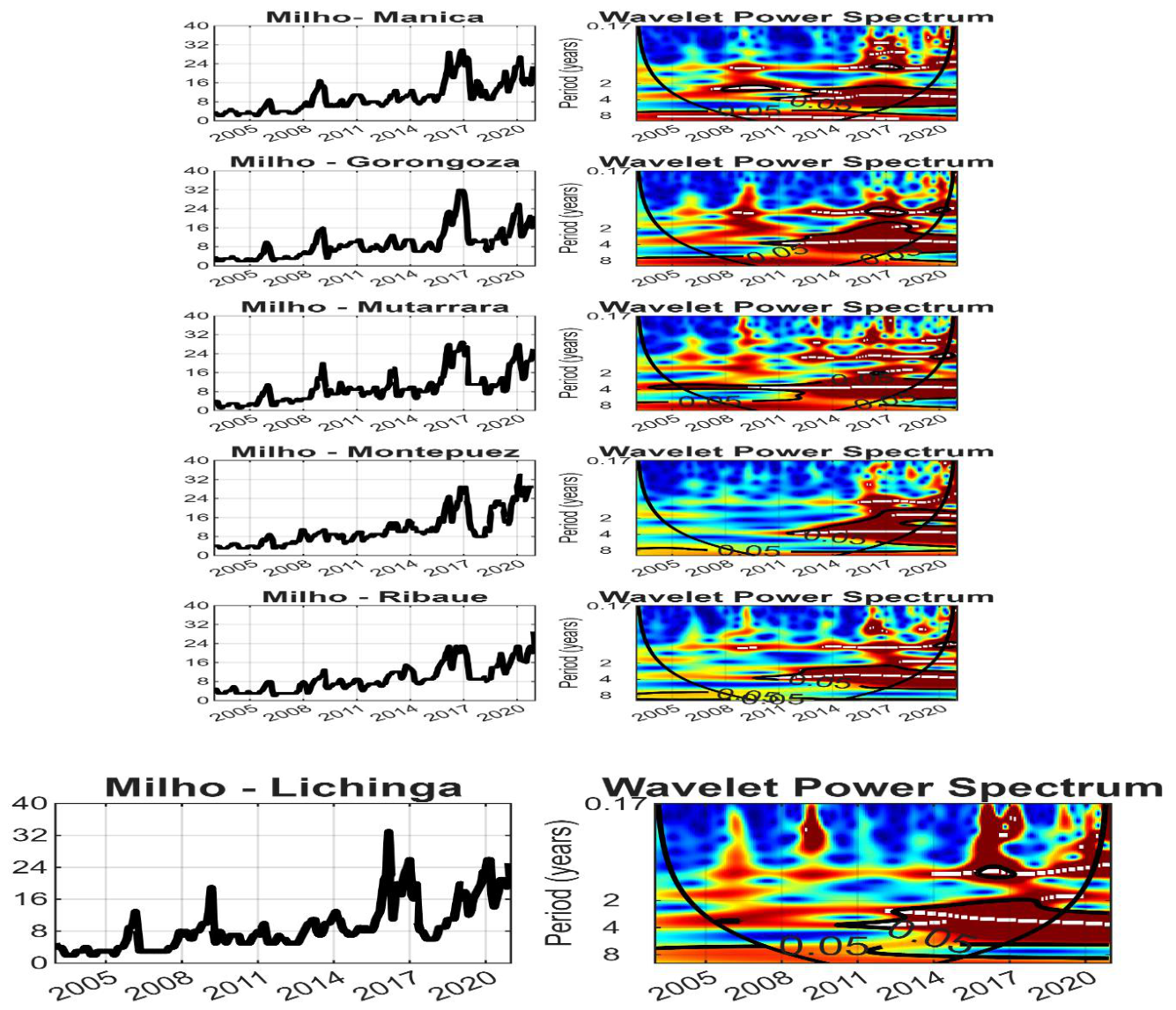
Figure 2.
White Corn Prices in Mozambique: wavelet coherence (left panel) and wavelet phase differences (right panel). The color code for coherence ranges from blue (low coherence close to zero) to red (high coherence close to one). The black/gray contours indicate a significance level of 10% (5%); phase differences are shown for the frequency bands 0.1–1.2 and 1.2–8 years.
Figure 2.
White Corn Prices in Mozambique: wavelet coherence (left panel) and wavelet phase differences (right panel). The color code for coherence ranges from blue (low coherence close to zero) to red (high coherence close to one). The black/gray contours indicate a significance level of 10% (5%); phase differences are shown for the frequency bands 0.1–1.2 and 1.2–8 years.
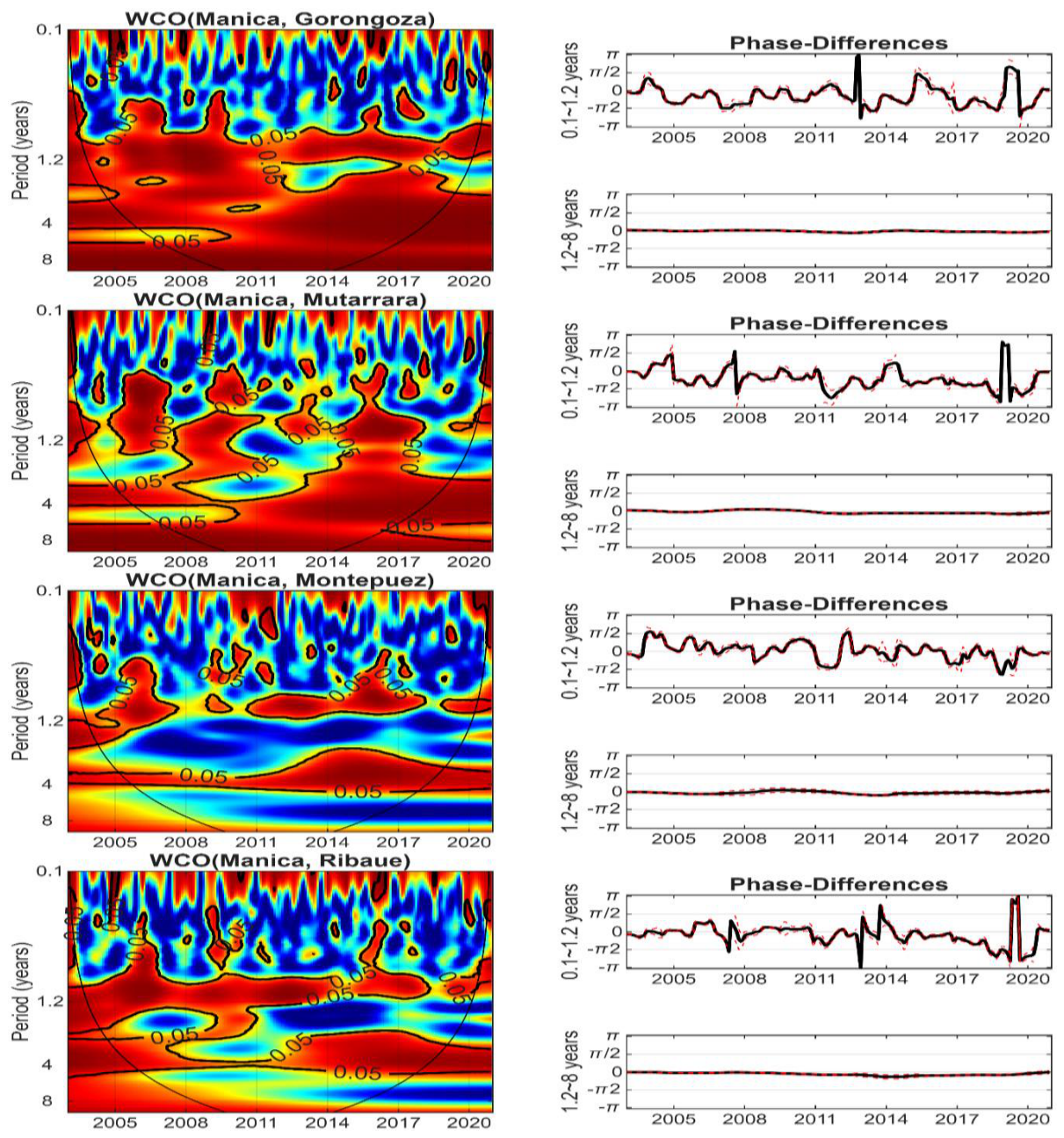
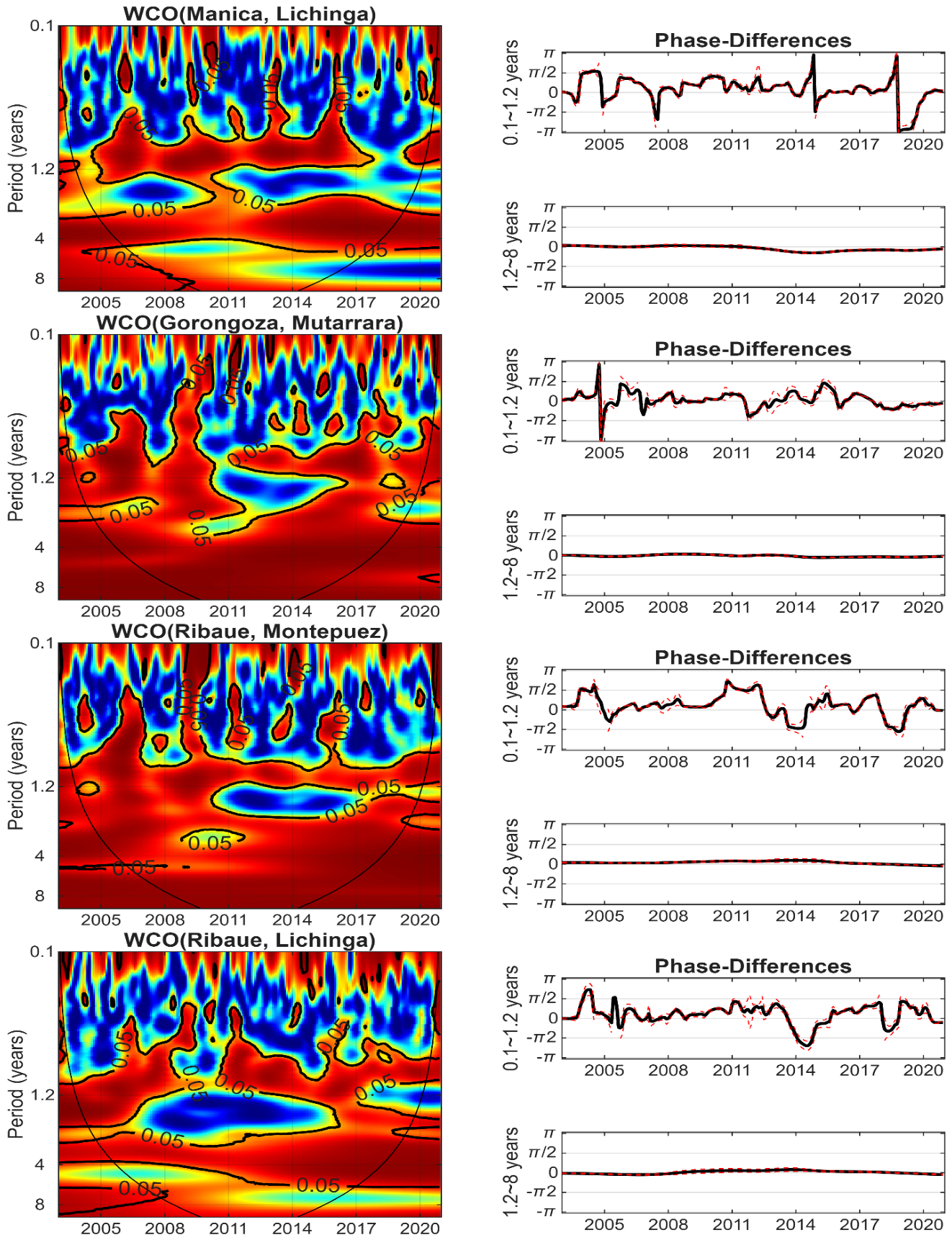
Figure 3.
Wavelet coherence of white maize prices with oil and gas prices in Mozambique. Figure 3: White Corn Prices in Mozambique and Oil and Gas Prices: wavelet coherence (left panel) and wavelet phase differences (right panel). The color code for coherence ranges from blue (low coherence close to zero) to red (high coherence close to one). The black/gray contours indicate a significance level of 10% (5%); phase differences are shown for the frequency bands 0.1–1.2 and 1.2–8 years.
Figure 3.
Wavelet coherence of white maize prices with oil and gas prices in Mozambique. Figure 3: White Corn Prices in Mozambique and Oil and Gas Prices: wavelet coherence (left panel) and wavelet phase differences (right panel). The color code for coherence ranges from blue (low coherence close to zero) to red (high coherence close to one). The black/gray contours indicate a significance level of 10% (5%); phase differences are shown for the frequency bands 0.1–1.2 and 1.2–8 years.
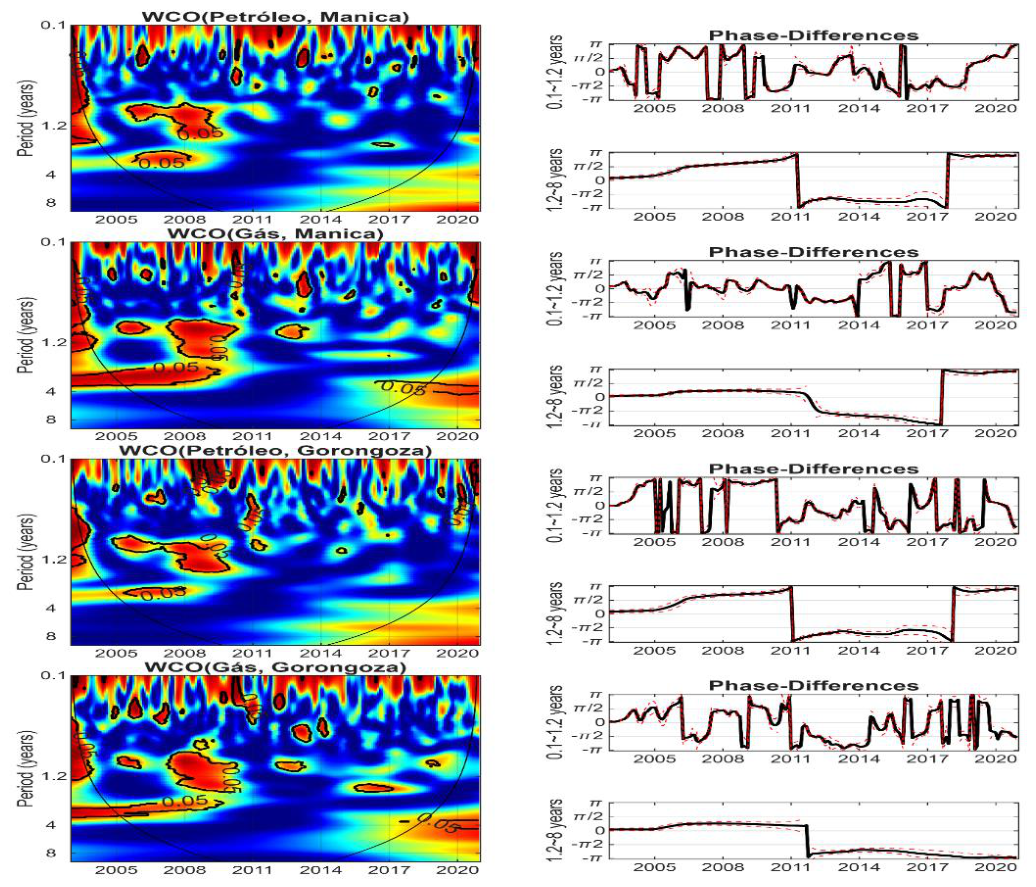
Table 1.
Results of the Augmented Dickey-Fuller Test for white corn prices.
|
Modelo |
At level | At first difference | ||
| With intercept | Without intercept and trend | |||
| Lag | t-statistic (level) | Lag | t-statistic (1st difference) | |
| Manica | 1 | -4.626*** | 1 | -9.449*** |
| Gorongosa | 1 | -4.309*** | 1 | -8.065*** |
| Mutarara | 1 | -4.758*** | 1 | -11.194*** |
| Montepuez | 1 | -4.402*** | 1 | -8.342*** |
| Ribáuè | 1 | -4.895*** | 1 | -9.944*** |
| Lichinga | 1 | -3.936** | 1 | -8.284*** |
| Oil | 1 | -2.568 | 1 | -8.899*** |
| Gas | 1 | -2.885 | 1 | -5.803*** |
Source: Research results adapted by the authors, 2026. Note: The symbols ***, **, * indicate statistical significance levels of 1%, 5%, and 10%, respectively.
Table 2.
Cointegration Results Johansen trace test and maximum eigenvalue test.
| Null Hypothesis | Trace Statistic | Critical Value (5%) | Cointegration | FPE | AIC | |
| r = 0 | 198.990 | 156.00 | Yes | 4.1e-10 | 1.08741 | |
| r ≤ 1 | 137.776 | 124.24 | Yes | 1.3e-14 | -9.27853 | |
| r ≤ 2 | 97.578 | 94.15 | Yes | 8.8e-15* | -9.65975* | |
| r ≤ 3 | 71.383 | 68.52 | Yes | |||
| r ≤ 4 | 45.843 | 47.21 | No | |||
| r ≤ 5 | 24.377 | 29.68 | No | |||
| r ≤ 6 | 9.685 | 15.41 | No | |||
| r ≤ 7 | 2.282 | 3.76 | No | |||
| r ≤ 8 | 0.000 | — | No | |||
| Equation | Parameters | p-value | ||||
| CE1 | 1 | 0.0000 | ||||
| CE2 | 1 | 0.0000 | ||||
| CE3 | 1 | 0.0000 | ||||
| CE4 | 1 | 0.0000 | ||||
Source: Survey results adapted by the authors, 2026. Note 1: * indicates a significance level of 10%, respectively. r = rank. Parms = model parameters or variables. P = p-value of the Johansen cointegration test statistics, as well as the respective maximum ranks.
Table 3.
VECM Model Results Excluding Energy Prices.
|
Variable/Coefficients |
VECM Models | |||||
| Manica | Gorongosa | Mutarara | Montepuez | Ribaué | Lichinga | |
| Panel A: Error Correction Term (Long Run) | ||||||
| _ce1 (L1) | 0.4022*** | 0.143 | 0.3416** | 0.0641 | 0.0589 | 0.0276 |
| _ce2 (L1) | 0.2257** | -0.5627*** | -0.1144 | -0.1217 | -0.1127 | -0.1327 |
| _ce3 (L1) | 0.032 | 0.2994*** | -0.0792 | 0.0890* | 0.0644 | 0.1657*** |
| _ce4 (L1) | 0.0429 | 0.0864 | 0.1182 | 0.1402* | 0.2236*** | 0.0913 |
| Panel B: Short-Run Adjustments (LD) | ||||||
| Manica (LD) | 0.0399 | 0.0991 | -0.1764 | 0.1118 | 0.0623 | 0.1223 |
| Gorongosa (LD) | 0.0679 | 0.3675*** | 0.4521*** | 0.1773* | 0.3223*** | 0.2718*** |
| Mutarara (LD) | 0.1063* | -0.0381 | -0.0604 | 0.0877 | 0.0842 | 0.1501** |
| Montepuez (LD) | -0.0789 | 0.0492 | 0.0049 | -0.1808** | 0.0261 | 0.0609 |
| Ribaué (LD) | 0.1138 | 0.1032 | 0.3901*** | 0.2082** | -0.0385 | 0.0116 |
| Lichinga (LD) | -0.1065 | -0.1151 | -0.2002 | 0.0236 | -0.058 | 0.0012 |
| Constante | 0.0082 | 0.0005 | 0.008 | 0.0083 | 0.0006 | -0.0034 |
| Panel C: Global Significance | ||||||
| P > chi² | 0.0000 | 0.0000 | 0.0000 | 0.0000 | 0.000 | 0.0000 |
| Panel D: Model Fit | ||||||
| R² | 0.458 | 0.2739 | 0.3162 | 0.4151 | 0.2856 | 0.5095 |
Source: Authors’ calculations based on VECM results (2003m5–2020m12, N = 212), 2026. Note: ***, **, and * denote statistical significance at the 1%, 5%, and 10% levels, respectively.
Table 4.
Results of the Vector Error-Correction Model for the real average prices of white corn and energy (oil and gas).
Table 4.
Results of the Vector Error-Correction Model for the real average prices of white corn and energy (oil and gas).
|
Variable/Coefficients |
VECM Models | |||||||
| D_Manica | D_Gorongosa | D_Mutarara | Montepuez | D_Rebaué | D Lichinga | D Oil | D Gas | |
| Panel A: Error Correction Term (Long Run) | ||||||||
| _ce1 (L1) | -0.3671*** | 0.1619 | 0.3679*** | 0.0569 | 0.0482 | 0.0784 | -0.1052* | 0.0564 |
| _ce2 (L1) | 0.1716* | -0.5817*** | -0.1731 | -0.1731* | -0.0983 | -0.2341** | 0.1117* | -0.0488 |
| _ce3 (L1) | 0.0632 | 0.3344*** | -0.0543 | 0.0854 | 0.1101* | 0.1765*** | -0.0108 | 0.0268 |
| _ce4 (L1) | -0.0038 | -0.0721 | 0.0276 | -0.0478 | 0.1883** | 0.1436** | 0.0595 | 0.0525 |
| Panel B: Short-Run Adjustments (LD) | ||||||||
| Manica (LD) | 0.0246 | 0.1153 | -0.1652 | 0.1111 | 0.0668 | 0.0873 | 0.0849 | 0 |
| Gorongosa (LD) | 0.102 | 0.3728*** | 0.5151*** | 0.2020** | 0.2495** | 0.3649*** | -0.1565** | 0.1199** |
| Mutarara (LD) | 0.0801 | -0.0263 | -0.0392 | 0.0904 | 0.0512 | 0.1401** | 0.0205 | -0.0313 |
| Montepuez (LD) | -0.0528 | 0.1704 | 0.0817 | -0.2432*** | 0.0443 | 0.0186 | -0.0454 | -0.0288 |
| Ribaué (LD) | 0.1138 | -0.006 | 0.3046** | 0.2592*** | -0.0059 | 0.0363 | 0.0535 | 0.012 |
| Lichinga (LD) | -0.1164 | -0.1445 | -0.2591** | 0.0089 | -0.0337 | -0.0205 | 0.0422 | 0.026 |
| Oil(LD) | 0.0457 | 0.0802 | 0.2043 | -0.0901 | -0.2709** | 0.1071 | 0.3440*** | 0.1366** |
| Gas (LD) | -0.0568 | 0.5950*** | 0.5493*** | 0.036 | 0.2003 | -0.1733 | -0.0722 | 0.2822*** |
| Panel C: Global Significance | ||||||||
| P>chi² | 0 | 0 | 0 | 0 | 0 | 0 | 0.0003 | 0 |
| Panel D: Model Fit | ||||||||
| R² | 0.4577 | 0.3426 | 0.3572 | 0.4017 | 0.3292 | 0.5116 | 0.2567 | 0.3815 |
Source: The author, based on the results of the VECM (May 2003 – December 2020, N=212), 2026. Note: The symbols ***, **, * indicate statistical significance levels at 1%, 5%, and 10%, respectively.
| 1 | |
| 2 | pubdocs.worldbank.org/en/561011486076393416/CMO-Historical-Data-Monthly.xlsx. |
Disclaimer/Publisher’s Note: The statements, opinions and data contained in all publications are solely those of the individual author(s) and contributor(s) and not of MDPI and/or the editor(s). MDPI and/or the editor(s) disclaim responsibility for any injury to people or property resulting from any ideas, methods, instructions or products referred to in the content. |
© 2026 by the authors. Licensee MDPI, Basel, Switzerland. This article is an open access article distributed under the terms and conditions of the Creative Commons Attribution (CC BY) license (http://creativecommons.org/licenses/by/4.0/).
Copyright: This open access article is published under a Creative Commons CC BY 4.0 license, which permit the free download, distribution, and reuse, provided that the author and preprint are cited in any reuse.


