
Submitted:
29 May 2026
Posted:
01 June 2026
You are already at the latest version
Abstract
The paper investigates the impacts of the 2008 Global Financial Crisis (GFC) on securities market supervision (SMS) architecture by identifying how securities regulators have adjusted their supervisory system to reflect the lessons learnt from the GFC, to adapt to the post-GFC market conditions, and ultimately to develop a resilient structure that endures financial crises. Both quantitative and qualitative techniques are employed to generalize the crisis impacts on SMS architecture and analyze the complex crisis-induced policy responses. Key findings include: (i) a worldwide SMS restructuring is undertaken by securities regulators; (ii) Self-regulatory organizations (SROs) faced diminishing roles in market supervision; (iii) Twin-peaks became the customized option for developed markets but not favorable by emerging markets; (iv) Integration was the choice of emerging markets’ SMS restructuring, which was accelerated by 1997 Asian financial crisis and further fueled by the GFC; and (v) It is a new era for central banks to become prudential regulators in the twin-peaks model and integrated supervisors of financial markets. Regulatory implications are drawn for emerging markets to solve the dilemma of supervisory restructuring and the role of SROs post-GFC to set up an architecture that endures financial crises. This study makes contribution to the investigation and explanation regarding the convergence by securities markets in their post-GFC SMS architecture policy reforms as well as the reasons for the convergence and different ways of policy making. It also provides recommendations for post-GFC SMS restructuring emerging markets in the context of current policy debates focused on the reforms in developed economies.
Keywords:
securities market supervision (SMS)
; 2008 GFC
; financial regulatory architecture
; central banks
; securities commissions
; self-regulatory organizations (SROs)
1. Introduction
The 2008 GFC led to dynamic regulatory changes in financial markets in general and the securities markets in particular. Vibrant changes in SMS architecture post-GFC have been a neglected topic of academic literature though post-GFC financial architecture reform was addressed (Crockett, 2009; Helleiner, 2011; Kawai, 2009, 2011) and the trendy integration of securities supervision was scrupulously discussed by Masciandaro and Quintyn (2010).
The research contributed in the contextual gaps of the existing literature about the GFC’s impacts by addressing the research gaps on what, how and why the changes in SMS architecture were made as a result from crisis impacts. This study is the first to investigate and explain the convergence and divergence between developed and emerging markets in their post-GFC SMS architecture policy reforms as well as the reasons for the alike and different ways of policy making by the two groups. It is also the first to develop recommendations on post-GFC SMS restructuring for emerging markets in the context that post-GFC policy debates focuses mainly on developed markets (IMF, et al., 2011; FSB, et al., 2012).
A mix-methodology employing both quantitative survey and qualitative research under the single paradigm of critical realism was used to generalize impacts of the GFC on SMS architecture and analyze the complex crisis-induced policy responses made by securities regulators. The study found that the GFC has not only changed the securities regulators’ ideology of market supervision, but also modified their perception about how the supervisory system should be constructed to perform effective supervision and enforcement.
Key research findings include: (i) There was a worldwide trend of restructuring of financial and securities regulators; (ii) SROs faced diminishing roles in market supervision post-GFC: (iii) Twin-peaks model became an optimum model for developed markets but not a convenient choice for emerging markets in post-GFC restructuring: (iv) Prevalence of integrated model was a continued progress since 1997 Asian Financial Crisis and further supervisory consolidation mandated by the 2008 GFC in emerging markets; and (iv) A new era of central banks emerged post-GFC. Regulatory implications are drawn out for emerging market given the context that most of post-GFC debates focuses on regulatory reforms for developed markets. Policy recommendations to solve the dilemma of post-GFC supervisory restructuring and the role of SROs to set up a supervisory architecture that endures a financial crisis are proposed to securities market regulators.
The paper is structured into six sections: section 2 outlines the concept of SMS architecture, reviews literature of SMS architecture and defines research questions. Section 3 describes the research methodology employed in this study. Section 4 discusses research findings. Section 5 provides regulatory implications for securities markets in solving the dilemma of post-GFC SMS architecture restructuring and role of SROs. Section 6 summarizes and concludes the paper.
2. Literature Review of SMS Architecture and Research Questions
SMS architecture is the institutional structure of securities market supervisory system, which is set up with involvement of different regulatory agencies and placed within a larger framework of financial regulation. SMS architecture is the structure where the securities regulator and SROs are put into relevant statutory positions so that they can perform their supervisory functions effectively in a hierarchy, which reflect the areas and functions of market supervision involved in and taken by different units of the regulator and SROs (Duong, 2016).
In the last decade, the theories of standard finance have been the most influential ideas to underpin the SMS philosophy. However, there is a trend to consider that the securities regulators should switch to adopt the policies derived from behavioral finance because behavioral finance is better in understanding normal investors and the not-always-efficient markets when developing and implementing realistic supervisory policies, which are not based on theoretical hypotheses but are based on the knowledge of the real behavior of markets and market participants. Krugman (2009) suggested that the significance of irrational and unpredictable behaviour of securities investors should be recognized by regulators and economists to deal with market imperfections because securities investors are rational and not well self-regulated. Erskine (2010b) recommended to establish a new conceptual framework of securities regulation, which include insights of behavioural finance and agents’ needs to deal with behavioural problems, such as conflicts of interest and agency costs. In addition, the securities markets are not efficient because it is proven that credit rating agencies, public companies, investment managers, stock exchanges and other self-regulatory organizations (SROs) often weighed their self-interests more than those of public investors.Furthermore, Herd philosophy has been used to explain the crashes or distortion of securities markets. Market plummet and market boom are often caused by the expectations of investors rather than changes in the fundamental values of the stocks. The use of standard finance theory to explain the financial market crisis was deficient according to Shiller (2010) as it had disregarded the importance of economy conduct and the ‘role of animal spirits’.
The financial supervision structure in a certain market may be set up according to one of four approaches of integrated, functional, institutional, or twin peaks. Each model has different arrangement of securities supervision. The integrated approach is the one in which a single universal regulator conducts both safety and soundness oversight and conduct-of-business regulation for all the sectors of financial services business (G30, 2008). The functional approach is the arrangement in which supervisory oversight is determined by the business that is being transacted by the entity, without regard to its legal status. Each type of business may have its own functional regulator. The institutional approach is the structure in which a firm’s legal status (for example, a bank, broker-dealer, or insurance company) determines which regulator is tasked with overseeing its activity from both a safety and soundness and a business conduct perspective. Finally, the twin peaks approach, a form of regulation by objective, is the one where there is a separation of regulatory functions between two regulators: one that performs the safety and soundness supervision function and the other that focuses on conduct-of-business regulation. Shavshukov and Zhuravleva (2023) identified global financial oversight into seven distinct models with a specific focus on the Conservative (Sectoral/Two-Tier), Twin Peaks, and Mega-Regulator frameworks. Chirulli (2025) traced the development of the framework for the Single Supervisory Mechanism (SSM) and the creation of the European Supervisory Authorities (ESAs) initiated sectoral legislative developments that have significantly broadened the supervisory scope of the ESAs.
However, the structure may imply: a regulatory monopoly where the concentration of power could harm the democratic policies (Reddy, 2001); excessive power of central bank may lead to the case where its regulatory failure potentially tarnish its reputation and credibility, especially monetary policies (Abrans & Taylor, 2000); pooling of resource with different skills and regulatory objectives of banking, securities and insurance may not yield the expected synergy (Reddy, 2001; Pellerin et al., 2009); potential moral hazards (Abrans & Taylor, 2000); lack of specialization (Pellerin et al., 2009); loss of scope economies between consumer protection and safety supervision; and adjustment and organizational costs (Pellerin et al., 2009).
The literature of financial supervisory architecture after the 2008-GFC reflects an urgent demand of regulatory reform towards a more consolidated supervisory structure that enable a crisis management framework and co-ordination between authorities during crises (Praet & Nguyen, 2008). Validity of the fragmented functional financial supervision was questioned as it was not proved efficient in response to the systemic risks (Acharya, 2009; Jawardj & Louhichi, 2016) and supervision of multi-discipline financial conglomerates (Cox, 2008; Paulson et al., 2008; Bernanke, 2009; Zingales, 2009). The twin peaks structure was claimed a superior structure (G30, 2008) that made Australia far less affected by the 2008-GFC (Erskine, 2010a, 2010b) and promises to overcome some of the problems in the current single regulator system (Weatherhead, 2010). However, Davis (2011, p. 38) observed that although the 2008-GFC indicated deficiencies in some regulatory structures and has led to changes in institutional arrangements and responsibilities in some markets, there is no clear answer to the optimal regulatory structure.
The SMS architecture cannot be analyzed in isolation from the whole financial supervision structure and the position of SROs. Self-regulation is a prominent concept in the securities market supervision. SROs can be defined as private sector organizations that share the same objectives of market integrity, market efficiency and investor protection with governmental regulators, having limited statutory authority to regulate the market participants and individuals under their jurisdiction. They may have limited extent of disciplinary power and must maintain the relevant framework to eliminate the conflicts of interests that may be caused by their commercial and regulatory activities (Richard, 2006). Though different markets relied on different approaches to structure their SMS architecture, a common feature is they all had SROs as co-regulators. Pre-GFC SROs were recognized by the securities regulatory community as a compulsory component of the securities supervision structure (IOSCO, 2003a). Many academics and practitioners (Austin, 2010; Pellerin, et al., 2009; Duong, 2016;) have the same observation that pre-GFC SROs were officially designated as one component of the securities co-regulation regime promulgated by the IOSCO.
Changing roles of SROs were observed as an outcome of re-thinking about the securities market architecture after the 2008-GFC (Carson, 2009, 2011; Rudd, 2009). The conventional values of self-regulation and SROs were doubted (Haldane, 2009; Larosière, 2009; Ford, 2010; Madhur, 2011). In 2011, Greenspan was still blamed for pursuing the idea of self-regulation among financial institutions in pre-GFC time (Frean, 2011) and the Securities and Exchange Commission of US has conceded that self-regulation of investment banks contributed to the crisis (Kumar, 2011). In spite of arguments that dismissed the values of self-regulation, there are milder views which still see the self-regulation is a necessary component of the securities market after the GFC (Paulson et al., 2008; Azuero, 2009; Carson, 2009, 2011). Bhattacharyay and Gupta (2025) examined the impact of self-regulation by testing the impact of U.S. Financial Industry Regulatory Authority (FINRA) 2241 Rules on quality of financial markets which concluded with mixed evidence on effectiveness of SROs in improving efficiency and information quality.
The emerging markets experienced principal capacity challenges that the regulators need to overcome, such as supervisory independence constraints, incomplete legal frameworks, inability to adequately regulate and supervise multi-sectoral conglomerates (IMF et al., 2011, p. 9); the too big to fail financial institutions that have become an unresolved public policy issue (Kaufman, 2014); adopting international standards that is consistent with the level financial development and supervisory capacity (FSB et al., 2012) etc. Vijayagopal et al. (2024) found that developing countries’ regulators struggle to keep pace with rapid technological change constraint due to lack of regulatory infrastructure and coordination. Alex-Omiogbemi, A. et al. (2024) identified that regulatory compliance in emerging markets was constrained by inadequate infrastructure, high implementation costs and limited technical capability.
In summary, the literature reflects the fact that the 2008-GFC has triggered a rising demand of SMS restructuring to respond to the crisis, an emerging favor of twin-peaks as a financial crisis resilient model and an increasing doubt of SROs’s role in securities supervision. However, a full picture of what, how and why the changes in SMS architecture were made as a result from crisis impacts is still absent and the vibrant SMS architecture restructuring after 2008 GFC is a neglected topic.
Addressing the literature gaps, the paper investigates whether GFC has generated important impacts on SMS architecture and led to vibrant SMS restructuring post-GFC. This paper established the following research questions (RQ)as below:
RQ1: What were the changes in SMS architecture undertaken by securities regulators as responses to the 2008 GFC?
RQ2: What roles would SROs play in post-GFC SMS architecture?
RQ3: What model was favored by financial regulators of securities markets in their post-GFC SMS restructuring?
RQ4: What were the roles of the central bank in SMS restructuring?
3. Research Methodology
Behavioral Finance considers critical realism as a single paradigm for mixed methodology. In this research, it combines with the ontology that “reality is real” and a social phenomenon to be studied is an external reality that exists independently of the researcher’s mind (Bhaskar, 1978; Harre & Madden, 1975; Magee, 1985). The research was designed in a way that allows triangulation in different stages of the study to enhance the precision of the representation of crisis impacts on SMS by examining it with different theories, methods and data sources (Denzin, 1978; Modell, 2007). The overall research design may be described as a sequential mixed methods design spanning into three-stage framework, where qualitative and quantitative methods are employed in a sequence with results from one feeding into the later one (Mingers, 2001).
In Stage One exploratory qualitative research, literature review was conducted to define the conceptual framework and pre-GFC landscape of SMS architecture, identify research gaps, formulate research questions and provide inputs for further research at Stage Two (Greene, et al., 1989; Malhotra, 1993; Creswell & Clark, 2011).
Stage Two was an empirical quantitative research, conducted through a cross-sectional structured survey questionnaire with 42 securities commission respondents that provides data for descriptive, comparative and correlational comparative research strategies for the period of 2008-2016. One of the key objectives of the survey is to identify various impacts of the GFC on SMS architecture, defining the trends of policy responses to the crisis by emerging and developed markets. In order to pursue the mentioned research objectives within the complexity of the SMS architecture post-GFC, statistical analysis and quantitative data are employed as they develop reliable descriptions and provide accurate comparisons (Gerhardt, 2004).
In Stage Three explanatory qualitative study, documentary research was undertaken with references of 463 policy papers published by IOSCO, 486 documents and an analysis of websites of 101 securities regulators and international organizations, such as World Bank, IMF, ADB, for confirmation, completeness and retroduction of the findings from qualitative and quantitative research in two previous stages. Because qualitative research is ‘valuable in its depth and its ability to uncover and interpret mechanisms behind behavior’ (Gerhardt, 2004, p. 10), it was used to study and explain the “behavior” and momentum behind the “behavior” of securities regulators to restructure their post-GFC SMS architecture. Duong (2016) reinforce that this stage is pivotal, which provide data to understand and explain the divergence of various securities markets in the SMS policy responses to the crisis impacts that were uncovered in quantitative research in Stage Two.
4. Research Findings
Five key research findings are discussed in this section: (i) A worldwide restructuring of SMS architecture was undertaken by securities regulators; (ii) SROs faced changing roles in market supervision after 2008 GFC; (iii) Twin-peaks became an optimum model for securities developed markets but not a convenient choice for emerging markets; (iv) Prevalence of integrated model was continued since 1997 Asian Financial Crisis and further securities markets supervisory consolidation became mandated after 2008-GFC in emerging markets; and (v) Central Banks in many countries emerged as macro-prudential supervision peak of twin-peaks model and mega-regulator in integrated model post-GFC.
4.1. Restructuring of SMS Architecture for RQ1
The hypothesis that the GFC has generated impacts on SMS architecture that led to vibrant SMS restructuring post-GFC was supported by the empirical analysis. The quantitative research with 42 securities regulators undertaken in 2013-2014 shows that the GFC led to changing in SMS architecture of 78.57 % of respondents from developed markets and approximately 39.3% of emerging market group (Duong, 2016). In the group of survey respondents reporting crisis impacts on SMS architecture, 77.3% had re-evaluated and re-constructed their SMS system post-GFC, 27.3% developed a new SMS structure to respond to crisis impacts and 59% reported other crisis impacts to their SMS structure.
Documentary research, using quasi-quantitative techniques verifies outcome of the descriptive survey research and gives a more specific picture of diversified policy responses undertaken by 101 securities regulators in terms of SMS restructuring for the period of 2008-2016 (Figure 1).
Findings are included:
- 16.83% of existing securities regulators have strengthened their powers by new legislation, such as supervision regarding the products, markets and institutions that were not under supervised during pre-GFC including OTC derivatives, hedge funds, and market gatekeepers (such as CRAs and auditors).
- About 28.71% regulators has transformed from one to another model of supervisory structure (either by realigning of responsibilities of existing regulators or setting up of new supervisory organizations and/or strengthening of supervisory powers by new legislations).
- 14.85% of the securities regulators have experienced reform or organizational restructuring.
- Some securities regulators (4.95%) have participated in a regional financial supervisory body or a national network of supervisory coordination was set up.
- Some securities regulator (14.85%) strengthened their powers by new legislation with organizational restructuring or establishing new supervisory organizations.
- Organizational restructure was combined with participating in regional supervisory body or setting up national supervisory coordination network (6.93%).
- Supervisory responsibilities were shifted from one to another organization (2.97%).
It should be noted that the securities supervisory structure is an inseparable part of the overall financial supervisory structure. Therefore, the reform depicted in Figure 1 has a broader scope that overcomes the borderline of national securities markets.
Figure 2 shows the financial supervisory structure of the selected 101 jurisdictions as of March 2016. Criteria for classifying the supervisory structure of the sample is essentially based on the definitions and classification of G30 (2008) on the structure of financial supervision. The current structure is an outcome of transformation of around 21 % of the research sample from one to another supervisory architecture during 8 years since the 2008 GFC. Integration of financial supervision is inherently a trend that became stronger after the crisis. The post-GFC trend of supervisory consolidation is highlighted by emergence of integrated structure under central bank.
The fully integrated model accounts for 30.7% of the research sample (19.8%+10.9%). The proportion of 21.8 % of research sample that have a partly integrated supervisory structure accordingly shows the fact that the supervisory consolidation toward integration was undertaken by 52.5% of the securities regulators. Twin-peaks model only accounts for approximately 6.93% of the research sample. The institutional model accounts for nearly 25% whereas functional model shrank to less than 12% of the research sample.
Both quantitative and qualitative research provide meaningful data showing the momentum behind the post-GFC SMS restructuring. Descriptive survey research shows that 68% of the respondents who identified reasons for changing their SMS structure post-GFC agreed that the 2008 GFC was the key reason leading to the changes in SMS system as it revealed the flaws of pre-GFC SMS structure. Only 16% of the respondents changed their SMS structure as their existing system was no longer relevant to adapt to new environment after the crisis. Twenty four percent reported other reasons for them to make changes in their SMS system in post-GFC time, including: (i) changes were made in a planned legislative reform or a capital market development roadmap; (ii) changes were made to implement IOSCO recommendations; and (iii) changes were made in a planned consolidation that allows better oversight of market members to enable timely detection and response to risks (see Figure 3).
The qualitative research also found that major momentum for the crisis-induced policies to restructure SMS architecture is the requisite of recovering financial stability, harmonization of macro and micro-prudential supervision, changing supervisory approach to risk-based methodology, building up a comprehensive supervisory information base, reducing of regulatory arbitrage risks, enhancing investor protection by adopting insights of behavioural finance and unifying of supervisory activities across interconnected sectors (see the rationale for the SMS architecture transformation of 24 selected jurisdictions in Appendix 1).
4.2. Diminishing Roles of SROs for RQ2
Both quantitative and qualitative research provide strong evidence to sustain that SROs have no longer maintained their position as a compulsory component of SMS architecture. Table 1 shows that 82.35% of the survey respondents reporting crisis impact on SROs have undertaken re-evaluation and improvement of the SROs’ roles during post-GFC.
Quantitative research also provides evidence showing that first time in history SROs have become regulated entities. As shown in Figure 4, over 91% of the research sample chose to undertake more supervision over market institutions (MIs) and SROs after the crisis. Policy responses of regulators are diversified, including: issuing new rules or regulations on supervision over MIs and SROs (64.7%), newly establishing regulators or regulatory structures to perform the function of MIs and SROs supervision (26.5%), shifting the role of MIs and SROs supervision from one to another regulator (5.9%) and putting selected types of MIs and SROs in more supervision (35.3%)
Self-regulation used to be considered by IOSCO a valuable complement to the regulator in achieving the objectives of securities regulation (IOSCO, 1998) and an effective model for regulation of financial services industry (IOSCO, 2000) during pre-GFC. However, during post-GFC IOSCO does not only eliminate the roles of SROs in its three-dimension supervision framework including information disclosure, regulation and self-regulation (IOSCO, 1990) but also clearly states that the SROs should be regulated (IOSCO, 2010, 2013). Recommendation of IOSCO on regulation of SROs was strongly supported by securities regulators. During the period 2008-2015, 78% of the securities regulators had undertaken policy reform with stock exchanges and other SROs, ranging from intensifying supervision over the institutions to restructuring or setting up some coordination to enhance market supervision ( See Table 2).
Data analysis of legal framework and policy papers of 89 jurisdictions where SROs are available in the research sample (101) found that 68 jurisdictions (76.4%) had undertaken policy reform to strengthen supervision over SROs in the period 2008-3/2016. In 22 developed markets, 19 or 90.5% issued new legal framework to fortify supervision over SROs. Whereas, 49 out of 67 emerging markets (73.1%) had the same policy response (See Figure 5). Typical examples are jurisdictions in EU, Japan, Malaysia, Slovenia, and United States, where there has been first time an SRO was charged an administrative penalty by the securities regulator. Appendix 2 provides detailed results.
4.3. Twin-Peaks Model-An Optimum Model for Developed Markets but Not a Convenient Choice for the Emerging Markets for RQ3
The twin-peaks model was recognized as the ‘optimal means’ of ensuring that issues of transparency, market integrity, and consumer protection receive sufficient priority (Alembakis, 2015; G30, 2008, p. 14). However, this study found that the model, despite the claimed superiority, has not obtained the expected significance in post-GFC trend of supervisory restructuring.
Twin-peaks and integration are the two alternatives for supervisory architecture redesigning. Among 24 regulators that had taken steps to restructure their supervisory architecture, twin-peaks model was the choice for seven regulators with more developed financial sectors (five from functional and one each from integrated and institutional models), accounting for 29.2 % total group (Table 3). However, an integrated model (partly or fully) was the choice for 15 other regulators to redesign their supervisory architecture, making a proportion of 62.5 % of total group. Two remaining regulators balanced between twin-peaks and integration and developed a partly integrated system with twin-peaks elements, accounting for 8.3% of the group.
Further documentary research helps to reveal that twin-peaks model seems to be a ‘customized’ setting for developed markets rather than emerging markets. Development of the twin-peaks model may require fundamental political-economic and institutional factors which makes the model viable in Australia but not available in the emerging markets. In other words, the twin-peaks model is not the one-size-fit-all that can be transferred to other financial markets without considerations. The paradox can be explained by the following reasons:
Firstly, one crucial factor to the success of twin-peaks model is the notion that both regulators in charge of prudential regulation and conduct supervision are equal in power and importance, and that neither should play second-fiddle to the other (Schmulow, 2016). The factor makes twin-peaks hardly applicable in emerging markets, where financial systems tend to be relatively smaller in size, more concentrated and less complex, with banks playing a large role while capital markets and other financial institutions remain relatively underdeveloped (IMF et al., 2011). Sectoral design, rival for regulatory powers and over dominance of bank regulators make the institutional restructure to establish two specialized regulators with balanced power and importance in the emerging markets impossible. Data collected from IMF’s country reports for financial system stability of the 24 jurisdictions that have their structure redesigned after 2008 GFC provides reliable evidence to support this observation. Seven (Belgium, New Zealand, Portugal, Spain, UK, France and Germany) among nine jurisdictions that constructed a pure model of twin-peaks or mixed it with integrated settings in the period 2008-3/2016 are the developed financial markets with more complex financial systems compared to the larger part of the group (see Table 4). Two other jurisdictions, South Africa and United Arab Emirates are still members of IOSCO Growth and Emerging Markets Committee. However, South Africa has large, sophisticated financial sectors (IMF, 2014g) and United Arab Emirates was ranked by World Economic Forum (Liu & Reinhardt, 2016) as one of 25 World’s strongest financial markets in 2015. Among the group of 15 jurisdictions that chose integration model rather than twin-peaks, 14 are the emerging and developing economies that share many of the characteristics as mentioned above by IMF et al. (2011). These characteristics may be the obstacles that contributed to them not choosing the twin-peaks model. An exception in this group is Switzerland. Although it is a developed economy by definition of IMF et al. (2011), Switzerland chose integration model for their new financial supervisory setting.
Secondly, coordinating the views of the different regulators and resolving conflicts is a challenge of twin-peaks model (Weatherhead, 2010; Restoy, 2016). For success, two peaks in the model need to rely upon effective and efficient inter-agency collaboration, which is free from rivalry and political interference. In Australia, Australian Prudential Regulation Authority and the Reserve Bank of Australia (RBA) in one peak of prudential regulation, and ASIC in the other peak of market conduct supervision, have demonstrated history of close cooperation (Schmulow, 2016). Furthermore, Australian public servants are highly skilled and largely free from corruption because of an independent judiciary and existing within a state based upon the rule of law. The same characteristics seem to be evident in group of seven mentioned developed economies that have taken steps to restructure into twin-peaks model within eight years post-GFC. However, the characteristics are not available in 14 of 15 jurisdictions that opted to integrate their supervisory agencies (except Switzerland). With weaker institutional frameworks and market infrastructures, emerging markets often lack an efficient mechanism for cooperation and sharing information among regulators. This fact might cause the twin-peaks model to become less attractive for them. In addition, in the context that there has been a general shift toward more politicization of financial policy making after the 2008 GFC (Véron, 2012), twin-peaks model that require technical regulators and political interference free environment may not be a convenient choice for emerging markets with a relatively greater involvement of the state in the financial system (IMF et al., 2011).
Thirdly, the costs of restructuring the supervisory system into twin-peaks may overcome the benefits. In addition, market participants may incur higher costs because more regulators means more resources should be allocated to compliance (Bryane, 2014). For the emerging markets with important capacity constraints (IMF et al., 2011) in term of both human and financial resources, twin-peaks may be an expensive option.
Finally, twin-peaks model is recommended as a resilient model to cope with financial crisis (Paulson et al., 2008; KPMG, 2012; Erskine, 2014; Schmulow, 2016). Documentary research found that jurisdictions that transformed to twin-peaks are the ones that were hurt more severely in the 2008 GFC. All the jurisdictions that chose twin-peaks highlighted the requisite of developing a supervisory architecture that is viable in financial crisis and provides effective investor protection (see Appendix 1). In addition, data from updated IMF’s country reports on financial stability of 101 securities regulators shows evidence to verify research finding that emerging markets are less affected from the 2008 GFC. Another report of IMF recently concluded that many emerging markets proved resilient during the crisis (IMF et al., 2011). This may be a factor that makes the requirement to set up a costly crisis-preventive structure like twin-peaks less urgent for the emerging markets. The case of Switzerland provides some further evidence to support this observation. Different from other developed markets that transformed their supervisory system post-GFC, Switzerland chose integration model rather than twin-peaks and claimed that their supervisory consolidation had ‘nothing to do’ with the 2008 GFC (FINMA, 2009).
Prevalence of Integrated Model
The trend of consolidation of supervisory powers is not newly emerged. Instead, it has been trending for nearly 20 years after the 1997 South East Asia Financial Crisis (Masciandaro & Quintyn, 2010). The momentum for supervisory consolidation after that crisis was identified by many researches (Jabotinsky, 2012; Masciandaro & Quintyn, 2009). The momentum behind supervisory consolidation after that crisis is the increasing need to adopt a mechanism that can address the changing industry structure with financial conglomerates, emergence of new financial products, especially derivatives products that overlapped conventional deposit, insurance, securities boundaries (Klein, 2009; Taylor, 2011). This research found that the reasons for transition to integration model of some jurisdictions in the years 2008-2009, including Korea (2008), Uruguay (2008), Bolivia (2009); Egypt (2009) and Switzerland (2009) did not originate with the current GFC. In fact, the consolidation was to respond to the changing landscape of financial market since the first crisis (1997). The second crisis (2008 GFC) just additionally fueled or accelerated the process.
However, the trend of supervisory integration in other jurisdictions after the 2008 GFC seems to be connected closely with the crisis (Melecky & Podpiera, 2013). Paradigm shifting in SMS philosophy possibly required regulators to redesign their current structure to accommodate new supervisory tasks. Two new supervisory functions emerged after 2008 GFC, including the management of the resolution of non-viable institutions and the adoption of macro-prudential policies to prevent potential macro-financial imbalances and mitigate their destabilizing effects (Taylor, 2011). Harmonization of macro-prudential and micro-prudential supervisory activities becomes indispensable. The choice of ten jurisdictions (El Salvador, Indonesia, Barbados, Romania, Georgia, Hungary, Ireland, Kazakhstan, Lithuania, and Russia) that transformed into partly or fully integration during the period 2010-2015 (see Appendix 1) was related to the new responsibilities and the requisite of harmonization of macro and micro-supervisory functions.
In the securities industry, integration in supervision means more information, less coordination costs for regulators and less chance of regulatory arbitrage risks, which may generate or amplify the potential systemic risk spin-offs from one sector to another. Compared to twin-peaks model, supervisory integration may be a more economic, institutionally suitable and practical choice to ensure macro-prudential supervision and equivalent regulation across different sectors of financial markets (see Appendix 1). In addition, eight of the ten jurisdictions are from Europe and have participated in the EU regional supervisory networks such as European Securities Regulator or Single Supervisory Mechanism. Transposition of EU new legislations to respond to 2008 GFC was found a key policy responsibility of the agencies post-GFC (See Appendix 1). For the cases, supervisory integration was considered a pre-requisite for implementation and application of a uniform set of policy recommendations (AFS, 2013) by regional and international supervisory bodies that were formed after the GFC.
4.4. Emerging Role of Central Banks: Macro-Prudential Peak in Twin-Peaks Model and Mega-Regulator in Integrated Model for RQ4
This study found a new era of central banks post-GFC that central banks are emerging as prudential regulators in the twin-peaks model and central banks as integrated supervisors of financial markets. Emerging trend of integration under central banks was found among SMS architecture reform by emerging markets. Involvement of the central banks in financial supervision was increasingly strengthened through the adoption of the twin-peaks model in developed markets and the adoption of integration under central banks in emerging markets.
Seven out of nine jurisdictions that transited to twin-peaks model and partly integrated with twin-peaks elements in the period 2008-3/2016, including Belgium, New Zealand, Portugal, South Africa, Spain, U.A.E, and Germany have the central bank in the peak of prudential regulation. France and UK established a subordinate organization under their central banks to conduct the prudential supervision responsibilities, namely Autorité de Contrôle Prudentiel (ACP) under Bank of France and Prudential Regulation Authority (PRA) under Bank of England respectively. Since, 2019, EU has developed the framework since the creation of the European Supervisory Authorities (ESAs) and the Single Supervisory Mechanism (SSM) accompanying with sectoral legislative developments that have significantly broadened the supervisory roles of the ESAs (Chirulli, 2025).
Seven (46.7%) of the 15 jurisdictions (see the list in Appendix 1 and Table (6) that restructured their financial system toward integration in the period from 2008-3/2016 had set up a partly or fully integrated structure under the umbrella of central bank. And even three of them transited from the fully integrated model outside central bank to integration under central bank. Among these three, one was separated from central bank before but re-integrated into central bank after the GFC (Kazakhstan). It was found that the crisis-induced mandate of strengthening macro-prudential (usually assumed by central banks) and controlling the risks generated by rapidly growing financial institutions in harmony is an impetus for their financial supervision systems to be integrated under central banks.
This research outcome was supported by the research of ECB (2010) that confirms a departure from functional (sectorial) setting and tendency toward further enhancing the role of national central banks in supervisory activities. The fact that the requirement of systemic risk control and the information-related synergies between the central banking and the prudential supervisory function was highlighted by the GFC (ECB, 2010) helps to explain this phenomenon.
5. Policy Implications for SMS Architecture
Following 2008 GFS, it is obvious that SMS policy making present a trend of an architecture shift from stand finance to behavioral finance. In the context that the securities need to be prepared for abnormal financial performance in a resilient and responsive way, this paper provide some recommendations for policy makers regarding SMS architecture reforms. Emerging markets were not well prepared for the shock of the post-GFC paradigm shift. It is not an exception for emerging markets to take mimic action regarding post-GFC SMS paradigm shift. However, the critical question for emerging markets is whether it is always a right thing to fully adopt those policies that has been developed by well-developed markets without re-thinking the current systems and recognizing the prevailing emerging market conditions and institutions. This paper also fills the gaps by providing following policy recommendations for emerging markets in particular focused on financial market reforms.
5.1. Separating of Macro-Prudential Supervision and Micro-Prudential Supervision in a Mini-Twin-Peaks Structure at Any Setting of Financial Supervisory Architecture
It is highly recommended that macro-prudential supervision to be conducted separately from micro-prudential supervision, ideally in the twin-peaks model (Masciandaro et al., 2013; Schmulow, 2016). However, in cases where twin-peaks model is not a feasible option for emerging markets, a mini twin-peaks structure within integrated model or the model of independent securities regulator may work as a more cost effective alternative. This structure requires separate units to be established to take responsibilities of macro-prudential supervision and micro-prudential supervision within any financial supervisory setting other than the original twin-peaks model. Specifically, one unit focuses on financial systemic stability and the other is charged with market conduct and investor protection. A mechanism of checks and balances between these units should be set up for harmonization of macro- and micro-prudential supervisory activities.
Involvement of securities regulator in macro-prudential to identify and encounter systemic risks which are caused by shadow banking (Acharya, et al., 2013; Gennaioli, et al., 2012; Gorton & Metrick, 2012) and operation of systemic risk important financial institutions (SIFIs) (Bartram, et al., 2007; Ibragimov, et al., 2011; Carey, et al., 2012) is an essential mandate of post-GFC financial regulation. Shavshukov and Zhuravleva (2023) emphasize the growing divide from Central Banks (handling macro-economic/monetary policy) to dedicated "mega-regulators" (handling micro-prudential supervision and consumer protection). Setting up a macro-prudential supervision unit at a securities regulator is therefore a natural post-GFC policy response in the financial architecture where separated regulators for banking, insurance and securities market are maintained. In this structure, clear lines of authority and a regime of freely and continuously sharing information, and effective coordination of regulatory actions between regulators in the financial markets are required. Early interaction and buffer build-up by money policy and macroprudential policy improve resilience and allows release during crises (Detken, 2025)
Further, that regime should ensure no administrative obstructions in performing prudential supervision and business conduct oversight (Duong, et al., 2013). In this mini twin-peaks structure, it is politically and economically easier to give ‘equal power and importance’ (Schmulow, 2016) to both of the mini peaks as well as to set up an efficient coordination between them at the micro level in comparison to the full twin-peaks model, which requires a mega-restructuring and time consuming political involvement in emerging markets.
5.2. Clearly Defining the Role of Securities Regulator as a Counter-Cyclical Regulator
The research findings implied that the role of securities regulators is no longer to ensure that market is provided with full, timely and accurate information as perceived before the crisis. As the 2008 GFC has proved that the traditional pro-cyclical regulatory policy magnifies financial turbulence, securities regulators need to be counter-cyclical regulators for effectively involvement in macro-prudential supervision and preventing financial crises (Ren, 2011; Aghion & Kharroubi, 2013; Dutt, 2013;). Kress and Turk (2022) revealed a blueprint for strengthening the United States’ countercyclical framework following with three principles—automaticity, portfolio strategy, and market wide coverage
The key concept of counter-cyclical financial regulation is that regulation would be more effective if financial regulation ‘clamped down during financial expansions and lightened up during economic slumps’, when financial institutions were in financial struggles and risk averse (McCoy, 2016, p. 1181). A typical counter-cyclical policy is to require financial firms to build up reserves during the booms as a risk buffer for market downturns (Hofmann, 2015; Vickers, 2016) with the regulatory tools such as capital adequacy requirement, liquidity regulation and provisioning. Counter-cyclical regulation helps to restrain market bubbles and prevent spill-over effects from troubled financial institutions into the financial system (McCoy, 2016). The counter-cyclical securities regulators should build up a new SMS philosophy that is a manifold theoretical framework with Keynesian Economics (Keynes, 1930, 1936) at the center and intertwines insights from behavioural finance, financial market instability, financial network theory and agency theory (Duong, 2016). In order to be an efficient counter-cyclical regulator, a securities regulator should perceive three essential facts:
- The more securities market develops with sophisticated innovative products, the likelier it performs with the booms and bursts cycles
Securities regulators should observe and efficiently response to the market booms and bursts cycles that were coined as Minsky moments and Minsky journeys. Minsky moment is the financial market phenomenon recognized by Minsky (1992, 2008). It is described as the time when a booming market and a prospering economy lead investors to being over optimistic and borrowing beyond their earnings. The market rise is followed by more speculation with accelerating debts and investors who have overly borrowed must sell their assets to disburse their loans or become insolvent if they have no assets available to pay out their debts. Mass selling out then causes sudden collapse of asset values. Minsky journey, forwardly or reversely travels through three debt units: hedge financing units, in which the buyer’s cash flows cover interest and principal payments; speculative finance units, in which cash flows cover only interest payments; and Ponzi unit, in which cash flows cover neither and depend on rising asset prices to keep the buyer floating (McCulley & Fuerbringer, 2007; Minsky, 1992, 2008; McCulley, 2009).
- 2.
- A securities market is a sophisticated network inside the networks of the national, regional financial system and global vitally interconnected markets
Properties of the connected networks are: (a) robust but fragile; (b) having feedback effects like disease contagion; (c) having dimensionality and complexity, amplified by asset price uncertainty cause financial market ‘seizures’; (d) having financial innovation by SFPs increase further network dimensionality, complexity and uncertainty; (e) where the diversity is gradually eroded by institutions’ business and risk management strategies, making the whole system less resistant to disturbance (Haldane, 2009). Furthermore, multiplex networks of financial institutions may couple with financial market networks and remove modularity, which in turns amplifies financial instability because the network then fails to isolate feedbacks and limit cascades while it retains its robust-yet-fragile features (Berndsen, et al., 2016).
- 3.
- Risk-based approach is vital for defining potential risks of financial institutions at micro level and systemic risks at macro level and designing suitable counter-cyclical tools.
Three aspects of risk-based approach in securities micro-prudential supervision include (a) minimum entry requirements for licensing and capital requirements; (b) risk assessment frameworks; and (c) risk-focused inspection methodologies (IOSCO, 2009, p. 3). In terms of macro-prudential supervision, securities regulators should bear in mind that systemic risks have multi-layer network nature that is particularly harmful due to the possibility of cascading failure, where the collapse of a financial institution can led to defaults of others (Battiston, et al., 2012; Poledna, et al., 2015, Donald, et al., 2016).
5.3. Capacity Building Should Be in Place Before Any Effort to Restructure the SMS System
There are other special challenges to emerging market regulators in the current post-GFC reform. To overcome the principal capacity challenges, the emerging market regulators need to improve the independence of supervisory bodies and regulators, to establish complete legal frameworks, and to supervise multi-sectoral conglomerates. To adopt international standards is a way to establish an environment to nature and protect financial and economic development at a pace consistent with resources. The above-mentioned capacity constraints prevention help the emerging market regulators from executing their supervisory functions on one hand to discipline the breaches, such as insider trading, illegal stock promotion, market manipulations, financial frauds etc., and on the other hand to control systemic risks and fight financial crises (IOSCO, 2024). It is recommended that the capacity constraints need to be addressed by emerging market regulators before any SMS architecture reform is undertaken.
5.4. Any Reform Toward Consolidation of SMS Powers into Central Banks Should Be Considered with Pros and Cons of This Model
Assigning supervisory powers to central banks is considered a natural choice for policy makers after 2008 GFC (Dalla Pellegrina, et al., 2013). The study found that the information-related synergies between the central banking and the prudential supervisory function has put central banks at the center of the post-GFC supervisory restructure: central banks as prudential regulators in the twin-peaks model and central banks as integrated supervisors of financial markets in the integration model. In the context that consolidated supervision is critical weakness of emerging markets (World Bank, 2013); supervisory integration under the central banks in emerging markets may be a responsive and cost-effective approach to effectively supervise cross-sectoral financial institutions and to harmonize macro and micro-prudential supervision.
The structure eliminates regulatory arbitrages, reduces the regulatory transaction costs, generates the economies of scale, enhances accountability due to regulatory concentration, responds more effectively to financial innovation and cross-sectoral problem, produces regulatory flexibility and facilitates extensive and dynamic cross-border regulatory cooperation by acting as a single point of contact (Abrans & Taylor, 2000; Reddy, 2001;Pellerin et al., 2009). Supervisory architectures have evolved in response to increasing market integration and crises, moving from purely sectoral models towards Twin-peaks models and more integrated supervisory arrangements across all objectives and comprehensive ranges of responsibilities (IOSCO, 2024). The pros and cons should be observed for any further plan of integration under central banks and during the course of functioning of this model by securities markets.
5.5. Efficacy of SROs Should Be Facilitated Depending on Existing Market Conditions
The research findings also indicated that SROs are no longer privileged co-regulators in the SMS architecture and they now are subject to stringent supervision than before (IOSCO, 2013). Its means that the post-GFC supervisory burden of the securities regulators is heavier due to the adding up of responsibility. In addition, the ‘quietness’ of most emerging securities regulators about the role of SROs in the post-GFC securities supervisory reform plan might indicate that they are still in the post-GFC shock of paradigm shift. The lack of attention to self-regulation was also recognized as ‘an important omission in the debate on regulatory reform in the financial services sector’ in other research (Omarova, 2011, p. 2). It is possible that the securities market regulators might not know where to fit the current SROs, many of which were established as regulatory tools recommended by IOSCO, now proved inefficient by the 2008 GFC and strongly recommended as subject to critical supervision (IOSCO, 2013), into their post-GFC supervisory systems. Jansen (2025) investigated that the SROs in the Dutch securities industry can function through fortifying how Hollowing actions. The results also suggest a difference among stakeholders in their effectiveness to affect self-regulatory institutions.
Ignoring the role of SROs in the post-GFC SMS reform may not be a smart choice for some markets, given the complexity and global interconnected nature of the markets, any government unilateral attempt to undertake the SMS policy reform without involvement of private sector may encounter regulatory arbitrage. It means that there will be a never ended cycle of rule-making and rule evading supported by Omarova (2010).
Therefore, it is recommended that the efficacy of self-regulation in a particular market should be facilitated in consideration of specific market circumstances and characteristics (Carson, 2009). The securities markets with long tradition of self-regulation should enjoy the market expertise of and regulatory burden sharing with SROs as far as regulators bear in mind that the co-regulatory mechanism can only work if there are: (i) a clear line of responsibilities between statutory regulators and the SROs; (ii) conflict of interests are comprehensively identified by legal framework and efficiently enforced; (iii) corporate governance and management of the SROs are reasonably constructed and performed; and (iv) adequate oversight operation is in place.
In newly established securities markets, where the size of markets does not justify establishing an SRO and role of formal SROs is not achievable, self-regulation may not be an option because the statutory regulator is still weak in capacity and the SROs may be manipulated by moral hazards rather than operated under self-discipline and adequate supervision according to behavioural finance. Van Koten, S. (2021) used a theoretical model to show that SROs require parallel public oversight due to incentive problems. The experimental findings revealed that SROs often struggle to commit to strict enforcement or fraud disclosure, which creates an environment for "cover-ups". Therefore, supplementary governmental oversight of both the SRO members and the SRO itself is typically required to ensure better compliance.
In some emerging markets where SRO stock exchanges are traditionally powerful while the statutory regulators are weak, self-regulation is not sustainable (Carson, 2011). In this case, capacity building of statutory regulator and stronger supervision over SROs is recommended. In the meantime, reassessing the rules and performance of existing SROs and revaluation of SMS structure in emerging markets are relevant steps before deciding on the future role of SROs.
5. Conclusions
To summarize, this paper has discussed four key GFC impacts on SMS architecture, including: (i) the crisis has triggered a worldwide restructuring SMS architecture and diminishing roles of SROs post-GFC. Among the reforms, transformation from other models of SMS architecture to twin-peaks and integrated models is noticeable; (ii) SROs become a key subject of regulation rather than a compulsory component of securities supervision; (iii) Twin-peaks is an optimum model for financial stability but it may not be a convenient choice for the emerging markets with less urgent demand of restructuring, less developed financial sector, lower inter-agency coordination, restrained capacity and tradition of politicization of financial policy making, which was amplified by the 2008 GFC; (iv) The trend of supervisory integration, which got its momentum from the previous Asian Financial Crisis in 1997, was additionally fueled and accelerated by the current 2008 GFC. Lessons learnt from the 2008 GFC led to the awareness of indispensable harmonization of both macro and micro-prudential supervision to achieve two objectives: financial system stability and protection of investors in a new light of SMS philosophy. The requisite of comprehensive supervisory information base, reducing of regulatory arbitrage risks, and unifying of supervisory activities across interconnected sectors for harmonization of macro and micro-prudential supervision put regulators before two alternatives: twin-peaks model and integration model. Because of different level of market infrastructure and institution, developed markets chose twin-peaks and emerging markets chose integration; and (v) The information-related synergies between the central banking and the prudential supervisory function have put central banks at the centre of the post-GFC supervisory restructure.
Upon deliberation of the research finding, policy recommendations to solve the dilemma of post-GFC supervisory restructuring and the role of SROs to set up a supervisory architecture that endures a financial crisis are proposed to emerging market regulators: (i) separating macro-prudential supervision and micro-prudential supervision in a mini twin-peaks structure that can fit into any setting of financial supervisory architecture; (ii) clearly defining the role of securities regulator as a counter-cyclical regulator; (iii) undertaking capacity building before any effort to redesign SMS architecture; (iv) taking into consideration the pros and cons of the supervisory integration under central banks; and (v) facilitating the efficacy of self-regulation in consideration of specific market conditions.
Funding
This research was funded by Endeavor Scholarship sponsored by the Australian Government to support the research project of securities market supervision undertaken at the Southern Cross University in Australia. Phuong Duong was awarded a PhD in 2017. The title of the PhD thesis is Impacts of the 2008 global financial crisis on securities market supervision and implications for emerging markets: regulatory perspectives. This paper extends research in the relevant area – the architecture of securities market supervision.
Appendix 1. Post-Crisis Financial Supervisory Restructuring from One to Another Model by 24 Selected Jurisdictions in the Period from 2008-2016
|
1. Belgium:Institutional structure was transformed to twin-peaks (2011); Responsibilities of NBB and FSMA were redesigned in 2011. NBB is in charge of financial stability and prudential supervision of institutions and FSMA is in charge of market conduct supervision and prudential regulation of companies which are not regulated by NBB. Financial system structure: The Belgian financial system is relatively large, concentrated, and interconnected with the rest of the world Central Bank is prudential regulator. Source: IMF (2013a): Belgium: Financial System Stability Assessment (IMF Country Report No. 13/124). Avaialble at https://www.imf.org/external/pubs/ft/scr/2013/cr13124.pdf Rationale for transformation: “In the wake of the financial crisis, a process has been under way at both the national and the international levels to rethink the shape of the supervisory architecture for the financial sector. In various countries of the EU, in particular, there was a rapidly growing convergence on the need for a rapprochement between the micro- and the macro-prudential components of the supervision of financial institutions. Parallel to these European developments, in Belgium too the main lines were drawn for a new organization of supervision. We wish hereby to inform you of recent developments in this regard. In line with international developments, and building on the recommendations formulated by a national working group\ the Belgian government opted, in the Law of 2 July 2010, to develop the supervision of the financial sector toward a bipartite model known as the ‘Twin-Peaks’ model”. Cited from NBB (2013, P.1): New supervisory architecture for the Belgian financial sector [Press release of Financial Services and Markets Authority of Belgium and National Banks of Belgium]. Retrieved from http://www.fsma.be/en/About%20FSMA/Organisatie.aspx |
|
2. New Zealand:Functional structure was transformed to twin-peaks (2011). The FMA is New Zealand’s financial conduct regulator. FMA was established on 1 May 2011 by the Financial Markets Authority Act 2011, in response to the need to address failures in New Zealand’s financial markets, which were exacerbated by the GFC. FMA proactively monitors and enforces securities legislation and works with the prudential regulator – the Reserve Bank of New Zealand (RBNZ) – as well as other regulatory and public sector enforcement bodies. Financial Markets Conduct Act 2013 (FMC Act) and the Financial Supervisors Act 2011, brought the majority of financial service providers into a supervisory relationship with the FMA (FMA, 2015). Financial system structure: Previously dominated by publicly-owned banks, the sector is now almost fully in private, foreign ownership, Non-bank Financial Institutions (NBFIs) and securities markets have declined in importance and are now secondary players, as banks have expanded their range of activities. Central Bank is the prudential regulator (FMA, 2015). Rationale for transformation: “The FMA is New Zealand’s financial conduct regulator. FMA was established on 1 May 2011 by the Financial Markets Authority Act 2011 (FMA Act), in response to the need to address failures in New Zealand’s financial markets, which were exacerbated by the GFC. The Government recognized that New Zealand required a single conduct regulator to proactively monitor and enforce securities legislation, as well as work with the RBNZ, the prudential regulator, and other regulatory and public sector enforcement bodies”. Cited from 2012. Retrieved from https://fma.govt.nz/fmas-role/corporate-publications/annual-reports/, p. 12). |
|
3. Portugal: Functional structure with plan of transformation to twin-peaks model (2011). CMVM is the securities regulator. Via National Council of Financial Supervisors, CMVM took part in the operation of ESRB. National Committee for Financial Stability was set up in 2007. The Committee of Financial Innovation (CIF) was established at early 2011. The Committee centralizes and coordinates the involvement of the CMVM in matters related to financial innovation, notably within the complex financial products context (APB, 2015). Financial system structure: Portugal has a developed finance system. Financial intermediation in Portugal is dominated by the banking sector (IMF, 2006a). Central Bank is in charge of banking supervision, will take the responsibility of prudential regulator in twin-peaks. Rationale for transformation: Question: From your perspective, what are the most urgent reforms that need to be made to the system of financial regulation? Answer: “Create a more effective regulation and supervision system in Europe. In Portugal, just to improve the current model, transforming it in a "twin-peaks" model based in two authorities: one in charge of prudential regulation; the other one in charge of what we call "behavioural" supervision covering relations between financial institutions and consumers”. Cited from Pina, C. (2011). Interview with Portuguese Secretary of State for Treasury and Finance. Economic Observer. Retrieved from http://www.eeo.com.cn/ens/2010/0811/177990.shtml. |
|
4. South Africa: Functional transformed to twin-peaks (2014, transition is still in progress in 3/2016). The twin-peaks model of financial sector regulation will see the creation of a prudential regulator – the Prudential Authority – housed in the SARB, while the FSB will be transformed into a dedicated market conduct regulator – the Financial Sector Conduct Authority. The Financial Sector Regulation Bill (FSR Bill, December 2014) is the first in a series of bills toward the implementation of the twin-peaks model and it follows two policy papers that respond to lessons learnt from the 2008 GFC: A Safer Financial Sector to Serve South Africa Better (National Treasury, February 2011) and implementing a twin-peaks model of financial regulation in South Africa (Financial Regulatory Reform Steering Committee, February 2013). Financial system structure: South Africa’s financial sector is large and sophisticated. NBFIs hold about two-thirds of financial assets (IMF, 2014f). Central Bank (SARB) will be in charge of prudential supervision. Rationale for transformation: “The new model will create a prudential regulator housed in the SARB, while the FSB will be transformed into a dedicated market conduct regulator. It is designed to streamline interaction between regulators and the financial services industry, with a more functional approach to regulation and supervision replacing the current industry silo-based approach. The implementation of the twin-peaks model in South Africa has two fundamental objectives: (i) Strengthen South Africa’s approach to consumer protection and market conduct in financial services and (ii) Create a more resilient and stable financial system. The prudential regulator’s objective will be to maintain and enhance the safety and soundness (or financial health) of regulated financial institutions, while the market conduct regulator will be tasked with protecting consumers of financial services, and promoting confidence in the South African financial system”. Cited from FSBSA (2014, p. 19). Integrated annual report 2014 of Financial Services Board of South Africa. Retrieved from https://www.fsb.co.za/departments/.../fsb%20annual%20report%202014.pdf. |
|
5. Spain: Functional structure with plan to transform to Twin-peaks model (2008) (CNMV, 2008). Financial system structure: Overall Spain’s financial sector is vibrant, resilient, highly competitive, and well supervised and regulated (IMF, 2006b). Central Bank is in charge of banking supervision and planned to take the responsibility of prudential supervision under twin-peaks models (CNMV, 2008). Rationale of transformation: “Supervisory architecture reform is one of five key reforms to response to lessons learnt from 2008 GFC. The choice of twin-peaks model most suited to Spain situation because of both the simplicity of its institutional design and the fact that a single institution retains responsibilities of micro-prudential supervision and aggregate stability, which has a long tradition and major synergy in Spain. Cited from Introduction and Opening Remark by CNMV Chairman Julio Segura in Perspective on the Securities Market Supervision and Regulation-CNMV 20th Anniversary Commemorative Book-2010-ISBN:978-84-87876-88-0 which represents the main challenge of adaption of the CNMV fact in the short-term to respond to the GFC” CNMV (2008, p. 11) Perspectives on Securities Markets: Supervision and Regulation: CNMV 20th Anniversary Commemomeratve Book. Retrieved from http://www.cnmv.es/docportal/publicaciones/informes/xxaniversariocnmv_een.pdf. |
|
6. United Kingdom: integrated structure was transformed to twin-peaks (2013). The Purdential Regulatory Authority (PRA) was created within Bank of England responsible for prudential regulation. FCA (Financial Conduct Authority), which is in charge of conduct regulation of all financial services firms took over FSC from 1 April 2013(FCA, 2013). Financial system structure: The United Kingdom is both home and host to large domestic and international financial institutions (IMF, 2011d). Central Bank is in charge of prudential supervision (PRA) Rationale for transformation: “Why change the FSA to the FCA? In the wake of the financial crisis, the Financial Services Act of 2012set out a new system for regulating financial services in order to protect and improve the UK’s economy. Our purpose is to make sure markets work well so that consumers get a fair deal. We: (i) maintain and ensure the integrity of the market (ii) regulate financial services firms so that they give consumers a fair deal (iii) ensure the financial services market is competitive”. Cited from FCA (2013). History of Financial Conduct Authority of UK. Retrieved from http://www.fca.org.uk/about/history). |
|
7. United of Arab Emirates:functional structure with plan to transform to twin-peaks model (2012, transition is still in progress in 3/2016). A framework that brings about the implementation of a "twin-peaks" approach toward financial sector regulation by placing business conduct and investor protection functions with the SCA and prudential, safety and soundness functions with the U.A.E. Central Bank was initiated in 2012. New legal documents were issued to set up ground for twin-peaks supervision. The U.A.E. Securities and Commodities Authority (SCA) has issued its regulations for investment funds pursuant to Board Decision No. (37) of 2012 Concerning the Regulations as to Mutual Funds (Regulations). The legal document is significant as it marked the transformation to twin-peaks model in supervision of the jurisdiction(Arnold, 2012). Financial system structure: Financial Sector is dominated by banks. Central bank is in charge of prudential supervision (IMF, 2013b). Rationale for transformation: “A new agency will have daily oversight of financial services in the biggest shake-up of banking and finance in three decades. The change is part of a new banking law that aims to bolster regulation of the industry and reduce the risk of future banking crises… ….The Government has decided to move to a twin-peaks regulation model. It will mean you have two regulators for the financial sector - a prudential regulator and a conduct-of-business regulator," said Mazen Boustany, head of banking and finance at Habib Al Mulla, the law firm advising the Ministry of Finance as sponsor of the law. It is the central part of a broader tightening of bank lending practices in response to lessons learnt during the GFC, said Ismail Al Bloushi, chief manager at the general secretariat and legal affairs division of the central bank. Many banks faced trouble and we are addressing that.” Cited from Arnold, T. (2012). New financial services watchdog for UAE. The National. Retrieved from http://www.thenational.ae/business/industry-insights/economics/new-financial-services-watchdog-for-uae. |
|
8. France: Functional structure was transofrmed to partly integrated model with twin-peaks elements (2010). Law n°2010-1249 of 22 October 2010 on banking and financial regulation provided the chairman of the French Financial Market Authority (AMF) with the authority to implement emergency measures to restrict the negotiations in the financial markets in the event of exceptional circumstances. The Law extends the competence of the AMF with respect to market abuse sanction and reporting of suspicious transactions to, in particular, certain derivative markets. The Law also creates Council in Charge of Regulating the Financial Sector and Monitoring Systemic Risk. Supervising authorities for the banking and insurance sectors merged into a new single supervisory authority, the French Prudential Supervisory Authority (ACPR) which was granted enhanced powers, including new powers to issue recommendations and take positions (AMF & ACPR, 2015). Financial system structure: France’s financial system is large, sophisticated, and integrated both vertically and internationally. It is dominated by five banking groups that are regionally and globally systemic and among the largest in the world. Central Bank is in charge of prudential supervision (IMF, 2012). Rationale for transformation: “The ACPR, established in 2010, is an independent administrative authority attached to the Banquet de France. It is responsible for authorising and supervising banks and insurers with a view to upholding customers' interests and maintaining the stability of the financial system. The ACPR which is an independent administrative authority, is charged with preserving the stability of the financial system and protecting the customers, insurance policyholders, members and beneficiaries of the persons that it supervises. The AMF and ACPR also collaborate within their respective areas of jurisdiction to coordinate the regulation and oversight of investment services providers. The AMF Chairman sits on the ACPR Board. Improving investor protection through a Joint Unit: In view of the increasing overlap between different types of savings media (particularly life insurance and investment funds) and the emergence of market participants capable of distributing a comprehensive range of insurance and banking products, the AMF and the ACP set up a Joint Unit in 2010. This close collaboration allows the two authorities to enhance oversight of financial product marketing in France to improve investor protection. Improving investor protection through a Joint Unit”. Cited from AMF & ACPR (2015). AMF, duties and powers, who we are and institutional relation. Retrieved from http://www.amf-france.org/en_US/L-AMF/Missions-et-competences/Presentation.html and https://acpr.banque-france.fr/en/acpr/about-the-acpr.html |
|
9. Germany: Fully integrated structure was transformed to partly integrated model with twin-peaks elements (2013). BaFin was the integrated regulator of financial market, including banking. However, in the new mechanism, Bundesbank took over the responsibility of banking regulation. With the entry into force of the Financial Stability Act on 1 January 2013,The Financial Stability Committee was established, consisting of three representatives from the Federal Ministry of Finance (BMF), three from BaFin, three from the Bundesbank, and one representative (in advisory capacity) from the Federal Agency for Financial Market Stabilization (FMSA). The Bundesbank was given the task of macro-prudential supervision of the German financial market. BaFin continues to be responsible for micro-prudential supervision. The Financial Stability Act obliges BaFin and the Bundesbank to inform each other of observations, conclusions and assessments necessary to fulfil their respective oversight duties (BaFin, 2013, p. 13). Financial system structure: Germany’s financial system is complex and dispersed. The banking sector accounts for the majority of total financial sector assets, serving as a backbone to the German industry, which is more reliant on bank financing than that in many other advanced economies (IMF, 2011a). Central Bank is in charge of prudential supervision Rationale for transformation: The German government’s Coalition Agreement proposes to significantly extend BaFin’s role in the area of consumer protection. Is this the right thing to do? Answer: “To be precise: the aim is to further strengthen our existing consumer protection role. Collective consumer protection and public interest activities have always been part of our mandate, even though a different impression is often given in the media. Solvency supervision and consumer protection are not necessarily mutually incompatible. In fact, efficient solvency supervision is one of our most effective consumer protection weapons. We also have a number of other efficient consumer protection tools at our disposal, such as in the areas of securities and insurance supervision. Nevertheless, it is true that we need to look closely at more than whether and how we wish to regulate the unregulated capital market. We need to ask ourselves at a fundamental level if and how we want to introduce additional regulations governing product development, the suitability of certain products for certain investors, and how financial investments are marketed. We will contribute to this debate – both here in Germany and in the relevant European bodies. Banking, insurance and securities supervision are currently undergoing radical change. Large scale reforms – some of them resulting from the lessons learnt during the financial crisis –have been adopted or are in the pipeline”. Cited from BaFin (2013, p.13). Interview with BaFin’s President-Dr Elke König takes a stand. Annual report of Federal Financial Supervisory Authority of Germany (BaFin). Retrieved from https://www.bafin.de/.../fa_bj_1409_abwicklungsregime_interview_koenig_en.html |
|
10. Barbados:functional structure was transformed to partly integrated modek (2011. The Financial Services Commission (FSCB) is an integrated regulatory body, established on April 1, 2011 by virtue of the Financial Services Commission Act, 2011. It represents a consolidation of the regulatory and supervisory functions previously conducted by the Supervisor of Insurance and Pensions, the Securities Commission and the Cooperatives Department, insofar as it relates to credit unions. The BFSC is therefore responsible for supervising and regulating entities in the insurance, occupational pensions, credit unions and securities sectors (FSCB, 2011). Financial system structure: Relatively well developed financial system, including a large offshore sector. The onshore system is dominated by large, regionally active banks (IMF, 2014a). Central Bank is in charge of banking supervision Rationale for transformation: “In the years immediately following the crisis, many of the structures set up in the wake of the crash were mainly involved in identifying and minimizing further potential shocks to the system and developing policy and legislation. Significant amounts ol’ new legislation have been crafted both globally and across the region, and have been delegated to national regulators. National regulators like the FSCB have typically retained or enhanced all their existing powers and areas of discretion and flexibility, hut now have additional responsibility to ensure that the new global requirements set by standard setting bodies are introduced and complied with by registrants. The FSCB’s obligation is to ensure that Barbados is compliant with these new standards. New legislation and regulations will, particularly in the early years, put very considerable demands on stakeholders and the resources of the FSCB. New systems always take time to he introduced and, in the complex world of financial services, the FSCB, industry representative bodies and individual firms will have to digest a range of issues, meanings, interpretation and purpose. With the introduction of a risk-based framework, the FSCB aims to place the highest level of scrutiny on those entities that pose the greatest level of risk to the system. In doing so the FSCB is able to efficiently use its resources and does not place undue or unreasonable demands on those entities less able to deal with them”. Cited from FSCB (2014, pp.1,9). Annual report 2013-2014 of Financial Supervisory Commission of Barbados. Retrieved from www.fsc.gov.bb/attachments/article/157/FSC%202014%20Annual%20Report.pdf |
|
11. Bolivia: Institutional structure was transformed to fully integrated and then partly integrated (2009). The Financial System Supervisory Authority (ASFI) was put in charge of the consolidated supervision of all financial intermediaries (banks and non-banks), as well as the insurance and securities market. Since its creation in early 2009, ASFI has continued expanding the supervisory and regulatory perimeter to include cooperatives and other financial institutions. In the area of prudential regulation, ASFI introduced counter-cyclical provisioning requirements in addition to specific and generic provisioning requirements (IMF, 2010a) However, in 2012, APS the Insurance and Pension Funds Authority was separated from SAFI. Financial system structure: Main players in the financial system are the commercial banks. About 50% of the financial system’s assets are held by commercial banks; 28 percent by the new public pension fund; and 18 percent by other deposit taking institutions. Central Bank does not involved in supervision. Source: IMF (2010). Bolivia: 2009 Article IV Consultation—Staff Report; Staff Supplement; Staff Statement; Public Information Notice on the Executive Board Discussion; and Statement by the Executive Director for Bolivia (IMF Country Report No. 10/27). Retrieved from https://www.imf.org/external/pubs/cat/longres.aspx?sk=23582.0 |
|
12. Egypt: Institutional was transfromed to partly integrated model (2009). The Egyptian Financial Supervisory Authority was established in accordance to law 10 of the year 2009.The Authority is responsible for supervising and regulating non-banking financial markets and instruments, including the Capital Market, the Exchange, all activities related to Insurance Services, Mortgage Finance, Financial Leasing, Factoring and Securitization. Institute of Financial Service and the Egyptian Institute of Directors are to be set up (ESFA, 2009). Financial system structure: Financial system is dominated by bank. Central bank is in charge of banking supervision (USAID, 2007) Rationale for transformation: “(i) Stability and Integrity of non-banking financial markets (ii) Regulation and development of non-banking financial markets (iii) Protecting investors & participants rights (iv) Issuing various means, systems, rules and regulations which ensure efficiency and transparency of these markets”. Cited from ESFA (2009). About Egyptian Financial Supervisory Authority. Retrieved 17 April 2016, from http://www.efsa.gov.eg/content/efsa_en/efsa_pages_en/main_efsa_page_en.htm |
|
13. Romania: Institutional structure was transformed to partly integrated model (2012). Emergency Ordinance No. 93/2012 on the establishment, organization and operation of the Financial Supervisory Authority was promulgated in 2012 to set up FSA by taking over responsibilities and powers of the National Securities Commission (CNVM), the Insurance Supervisory Commission (CSA) and the Private Pension System Supervisory Commission (CSSPP) (AFS website). Financial system structure: The Romanian financial system is dominated by foreign-owned commercial banks. Banks account for 83 percent of total assets of the financial system. Central banks is in charge of banking supervision (IMF, 2010c) Rationale for transformation: “The financial crisis of recent years highlighted the vulnerabilities of both the institutional and organizational architecture of markets and of the regulatory and supervisory activity thereof. Reform of business models and of regulatory and supervisory practices is done slowly and over time. The Financial Supervisory Authority (FSA) was established in Romania in this dynamic of re-construction of the architecture and consolidation of the regulatory and supervisory mechanisms of markets at the European level. One of the main reasons that led to the amalgamation of the three supervisory authorities into one was the formation of a better and more unitary supervisory framework of markets, institutions, non-banking financial instruments and activities. The purpose of the new framework was to make all participants in the national non-banking financial system responsible, individually and collectively, to better allocate resources and to achieve a fair competitive environment for the participants in the financial markets. Also, through the establishment of FSA, the prerequisites for the implementation and application of a uniform set of supervisory rules for non-banking financial markets are created, favouring the implementation of the European supervisory authorities’ recommendations and the improvement of the participation of Romania in the activities of such bodies”. Cited from AFS (2014, p.9). Annual Report 2014 of Authority of Financial Services, Romania. Retrieved from http://www.asfromania.ro/en/publications/annual-report/asf-annual-report/2323-asf-annual-report-2014 |
|
14. El Salvador: Institutional structure was transformed to integrated model (2011). The transformation was approved by Legislative Decree No.592 dated 14 January 2011, the new Law on Supervision and Regulation of the financial system, legal framework governing the Superintendence of the Financial System as a single supervisory body, which integrates the functions of the Superintendence of the Financial System, pensions and securities (SSF, 2015). Financial system structure: El Salvador’s bank-centred financial sector is growing more slowly. Capital markets in El Salvador remain small and relatively underdeveloped. Central Bank does not involve in supervision (IMF, 2015) Rationale for transformation: “Monitoring the financial system under an integrated approach to help preserve stability and ensure the efficiency and transparency of it, cooperating with the protection of the user population and economic and social development approach." The Superintendency is responsible for overseeing the individual activity and consolidated financial system members and others, operations or entities that send laws; for the exercise of such powers counted operational independence, transparent processes and resources for plunged their duties” (art. 3 of the Law on Supervision and Regulation of the Financial System, first paragraph). Cited from SSF. (2015). Philosophy and mission of The Superintendency of the Financial System of Sanvador. Retrieved 20 November 2015, from http://www.ssf.gob.sv/index.php/institucion/marco-institucional/filosofia |
|
15. Indonesia: Functional structure was transformed to fully integrated model (2013). Indonesian Financial Services Authority (OJK) took over regulatory and supervisory functions in capital markets and non-bank financial institutions from Bapepam-LK at the end of 2012, followed by the transfer of Bank Indonesia’s responsibilities for the supervision and regulation of the banking sector at the end of 2013 (OJK, 2014, p. 1). Financial system structure: Indonesia’s financial sector is small relative to peer countries and is dominated by banks, accounting for 50 percent of GDP and 80 percent of the financial system. Central Bank does not involve in supervision (IMF, 2010b). Rationale for transformation: “Financial Services Authority (OJK) has begun to operate since early 2013. The establishment of OJK extends broader horizons for the financial services industry by uniting the regulation and supervision of the Capital Market and Non-Bank Financial Industry (previously under the Capital Market and Financial Institution Supervisory Agency, Ministry of Finance) along with the Banking Industry (from Bank Indonesia) under a single authority. The OJK has a great responsibility toward the economy of Indonesia because of the two overarching mandates, namely the integrated regulation and supervision of all activity in the financial services sector, as well as Education and Consumer Protection. We are also grateful that amidst global economic conditions shrouded in ubiquitous uncertainty that undermined the domestic economy, OJK is still able to implement its function and duties effectively”. Cited from OJK (2014, p.1). Indonesian Financial Services Authority Annual Report 2013. Retrieve from. www.ojk.go.id/en/data-dan.../ojk/.../ojk-annual-report-2013.aspx |
|
16. Korea: Functional structure was transformed to partly integrated model in 1999, then further fully integrated in 2008. The Financial Services Commission was established in 2008 by integrating of Financial Supervisory Commission and the Financial Policy Bureau of the then Ministry of Finance and Economy system to respond to 2008 GFC. Integrated structure is now under reforming. A new structure of twin-peaks is recommended in a regulatory reform FSCK (2013). Annual report of Financial Services Commission of Korea FSC 2012. Busan, Korea: Financial Services Commission of Korea. Financial system structure: Korea’s financial sector is large and diversified. Central Bank is not involved in supervision (IMF, 2014e). Rationale for transformation: “The Financial Services Commission was established in 2008 after a series of changes in Korea’s financial supervisory system. In the wake of the 1997 Asian Financial Crisis, there was a growing need for an integrated supervisory authority to oversee the financial industry. The Financial Supervisory Commission, the predecessor to the current Financial Services Commission, was founded in April 1998 as a single supervisory authority integrating financial supervisory functions of the former Ministry of Finance and Economy - currently Ministry of Strategy and Finance, MOSF - and the Bank of Korea. In January 1999, the Financial Supervisory Service (FSS) was founded under the guidance and supervision of the FSCK to carry out examination of financial institutions along with enforcement and other oversight activities as directed or charged by the FSCK. The Act for the Establishment of Financial Services Commission Under the Amendment of the Act for the Establishment of Financial Services Commission which was enacted on Feb. 29, 2008, the Financial Services Commission was established by integrating the Ministry of Finance and Economy's financial policy function and the Financial Supervisory Commission's supervisory policy function to proactively deal with rapidly changing financial environment characterized by conglomeration, financial convergence, and globalization while separating policy making and execution functions so as to enhance the responsibility of financial administration, thereby laying the groundwork for the advancement of the Korean financial Supervisory industry”. Cited from FSCK (2008). The Act for the establishment of Financial Services Commission Republic of Korea. Retrieved from https://www.imolin.org/doc/amlid/Republic_of_Korea/Republic_of_Korea_Act_on_the_Establishment_Etc.of_Financial_Supervisory_organization.pdf |
|
17. Switzerland: functional structure was transformed to fully integrated model (2009). The Swiss Federal Banking Commission (SFBC), the Federal Office of Private Insurance (FOPI) and the Anti-Money Laundering Control Authority were merged into the Swiss Financial Market Supervisory Authority FINMA on 1 January 2009. FINMA commenced its activities on 1 January 2009, the Swiss Parliament granted it a greater degree of independence than its three predecessor institutions. FINMA's power of enforcement was extended by the revised Stock Exchange Act in 1 May 2013 (Annual report of Swiss Financial Market Supervisory Authority (FINMA) 2013. Retrieved from https://www.finma.ch/FinmaArchiv/gb2013/download/en/Downloads/FINMA_Annual-Report_2013_EN.pdf.) Financial system structure: Switzerland has a diverse financial sector that is systemically important to global markets. It is home for two largest banks in the world. Central Bank of Switzerland is not involved in supervision (IMF, 2014b). Rationale for transformation: “Since 1 January 2009, the SFBC has been integrated in the Swiss FINMA. The reason why FINMA was set up as an integrated financial market regulator had nothing to do with the 2008 GFC. Nonetheless, the present structure of FINMA is an advantage when it comes to the demanding job of dealing with dynamic and increasingly complex financial markets. As a direct consequence of the financial market crisis FINMA is currently developing the supervisory approach further in concrete projects and is expanding its supervisory expertise in specific areas. Practical experience gained in senior finance and risk management positions is increasingly in demand”. Cited from FINMA (2009). Swiss Financial Market Supervisory Authority (FINMA) presents report on the financial market crisis [Press release]. Retrieved from https://www.finma.ch/en/news/2009/09/mm-bericht-finanzmarktkrise-20090914. |
|
18. Georgia: Integrated structure under FSA was transformed to fully integrated under central bank (2009) and then partly integrated under central bank (2013). In 2008 Georgian Financial Supervisory Agency (GFSA) was set up as the supervisor of the whole financial sector- commercial banks, microfinance institutions, credit unions, foreign exchange bureaus, money transfer entities, insurance companies and the securities market. However, in December 2009, the Parliament of Georgia has changed the financial sector legislation – the supervisory function over entire financial sector was transferred to the National Bank of Georgia (NBG) and the GFSA was abolished. In 2013, Georgia legislation was changed again to separate Insurance State Supervision Service of Georgia and turned it from the subdivision (department) of National Bank of Georgia to Insurance State Supervision Service of Georgia (LLPL) and become an independent national regulatory body NBG (2014): Annual Report 2013 of National Bank of Georgia. Retrieved from https://www.nbg.gov.ge/index.php?m=348&lng=eng Financial system structure: Banking system is small relative to the size of the economy, the two largest banks have an outsized role in the economy. Banking system is growing fast. The size of the capital market is negligible. Central Bank is in charge of supervision of securities and banking sectors (IMF, 2014c) Rationale of transformation: “The new edition of the Organic Law of Georgia “On the National Bank of Georgia” clearly defines goals and objectives of the NBG with respect to financial supervision. Ongoing processes in the country showed the necessity of joining the regulatory body of the financial sector with the central bank: in case of possible conflict of interests between monetary policy and financial stability a single system will determine social interests in a more efficient way”. Cited from NBG (2010). Annual Report 2009 of National Bank of Georgia (p. 10). Retrieved from https://www.nbg.gov.ge/index.php?m=348&lng=eng. |
|
19. Hungary: Integrated structure under FSA was transformed to integrated model under central bank (2013). The Hungarian Financial Supervisory Authority (HFSA) has been no longer exists since the 1st October, 2013. Central Bank of Hungary is the financial supervisory authority in Hungary (NBH (2015). About National Bank of Hungary. Retrieved 23 June, 2015, from https://www.mnb.hu/en/supervision). Financial system structure: Banks represent two-thirds of all institutional assets in the financial system and have substantial presence in all markets of financial intermediation but they also own major stakes in the capital market, insurance and fund sectors (Kálmán, 2015). Central bank is in charge of supervision of all three sectors. Rationale for transformation: “At its session on 16 September 2013, the Parliament adopted the draft legislation on the Magyar Nemzeti Bank1 which decided to integrate the financial market supervision function into the central bank. Having drawn conclusions from the financial crisis, with this Act the legislator created a central bank which, within the framework of a single institution, guarantees the stability of the financial system and the functioning of individual financial institutions. The negative repercussions of the financial crisis in Hungary and the best practices of several EU Member States have both demonstrated that the harmony between macro and micro level supervision is indispensable for the prevention and resolution of individual or systemic financial crises. As a result of this integration, the MNB acquired a comprehensive information base pertaining to individual institutions, which improved the conditions for macro-level decision-preparation and resolved the previous contradictions surrounding regulatory actions taken vis-à-vis the financial intermediary system. With the comprehensive set of instruments available to the MNB, the identification, prevention, monitoring and control of the systemic risk factors threatening the stability of the financial system and the individual risks of specific institutions have become more harmonized and thus more efficient”. Cited from MNB (2013, p.9): Annual Report 2013: Business Report and Financial Statements of the Magyar Nemzeti Bank. Retrieved from https://www.mnb.hu/letoltes/mnb-annualreport-2013-eng-final.pdf. |
|
20. Ireland: Institutional structure was transformed to integrated model under central bank (2010). The Central Bank Reform Act 2010 created the new single unitary body, the Central Bank of Ireland, which replaced the previous related entities, the Central Bank and the Financial Services Authority of Ireland and the Financial Regulator. The Act commenced on 1 October 2010. Central Bank Supervision and Enforcement Act 2013 has significantly strengthened and standardized its regulatory powers (CBI, 2014: Annual Report 2013 of Central Bank of Ireland. Retrieved from https://www.centralbank.ie/publications/Documents/Central%20Bank%20of%20Ireland%20Annual%20Report%202013.pdf). Financial system structure: The Irish financial system can be described as bank-based as against being market-based. Central Bank is in charge of all three financial sectors (Ononugbo, 2015) Rationale for transformation: “The Central Bank will be responsible for both the supervision of individual firms and the stability of the financial system generally. The purpose of the new organization and the proposed statutory objectives are: (i) The stability of the financial system overall; (ii) The proper and effective regulation of financial institutions and markets, while ensuring that the best interests of consumers of financial services are protected; (iii) The efficient and effective operation of payment and settlement systems; (iv) The provision of analysis and comment to support national economic policy development; and (vi) The discharge of such other functions and powers as are conferred on it by law. The changes to the regulatory structure are being brought about to help address deficiencies in the regulatory system that became apparent during the financial crisis. There are parallels with the new arrangements proposed at EU level designed to ensure greater cohesion between overall financial stability policy and the prudential supervision of individual institutions. The reforms will be supported by a significant expansion of regulatory capacity within the new Central Bank”. Cited from CBI (2010, p. 2). Introduction by Patrick Honohan-Governor - Central Bank of Ireland Strategic Plan 2010 – 2012. Available at https://www.centralbank.ie/publication/corporate-reports/strategic-plan |
|
21. Kazakhstan:Integrated structure under FSA was transformed to integrated model under central Bank (2011). In 2004 FSA was separated from National Bank of Kazakhstan. However, in accordance with the Decree № 25 of the President of the Republic of Kazakhstan as of April 12, 2011 functions and powers of the Financial Supervisory Agency were transferred to the National Bank of the Republic of Kazakhstan. Later, by virtue of the Decree № 61 dated April 18, 2011 it was formed Committee for the control and supervision of financial market and financial organizations of the National Bank of Kazakhstan (NBK, 2012): Annual Report of National Bank of Kazakhstan 2011. Retrieved from http://nationalbank.kz/?docid=28&switch=english). Financial system structure: Banks dominate the financial system in Kazakhstan. The banking sector consists of 38 commercial banks, which account for 77 percent of total financial system assets and 44 percent of GDP. Central Bank supervise all three financial sectors (IMF, 2014d). Rationale for transformation: “In order to develop macro-prudential approach in Kazakhstan, it would be required to increase coordination of efforts of monetary, fiscal and supervision bodies to work out macro-prudential financial policy, directed at prevention of negative influence on the financial system of internal systemic risks and macroeconomic risks…. Current crisis and many previous breakdowns showed that it is not possible to avoid them in deregulated financial systems. It was realized the necessity of more integrity and effective regulation…….regulation shall be oriented on types of activities, rather than on an organization. In order to prevent systemic crisis in future, it is supposed to revise mechanisms of regulation of separate financial institutes according to sources of funding and types of activities, and to increase monitoring of risks. Besides, for the purpose of ensuring financial stability in the country it is envisaged to rationalize legislation through including additional mechanisms of prevention of risk concentration beyond control of the supervision authority”. Cited from NBK (2010). The FSA vision for Republic of Kazakhstan financial services sector and refining of approaches for its regulation within the framework of the concept of RK financial services sector development in the post-crisis period (pp. 3,4). Retrieved from http://www.nationalbank.kz/cont/kfn/cont/publish406397_8843.pdf |
|
22. Lithuania: Institutional structure was transformed to integrated model under central bank (2012). By the decision of the Seimas, since the beginning of 2012 the supervision of financial institutions has been concentrated in the Bank of Lithuania. In order to make this function of particular importance to the state more effective and less expensive for the budget, the Securities Commission and the Insurance Supervision Commission have been wound up and their functions have been transferred to the central bank. Since 1 January 2015 Lithuania has been part of the European banking union which is being created and has joined the Single Supervisory Mechanism (Lithuania Bank, 2013). The central bank of the Republic of Lithuania counts its 25th anniversary. History of Lithuania Bank. Retrieved 23 March 2016, from http://www.lb.lt/en_about_history) Financial system structure: Financial system is dominated by bank. Central bank is involved in supervision of intermediaries in all three sectors (Lithuania Bank, 2013. The central bank of the Republic of Lithuania counts its 25th anniversary. History of Lithuania Bank). Rationale for transformation: “In recent years, particular attention has been paid to the strengthening of the supervision of the entire credit unions sector, as not every credit union managed to curb the risk related to its strong development. For five credit unions the authorisations have been revoked due to the too risky nature of their activities. By the decision of the Seimas, since the beginning of 2012 the supervision of financial institutions has been concentrated in the Bank of Lithuania. In order to make this function of particular importance to the state more effective and less expensive for the budget, the Securities Commission and the Insurance Supervision Commission have been wound up and their functions have been transferred to the central bank. It now supervises commercial banks and other credit and payment institutions, the securities and insurance markets, gives a sharper focus on the prevention of issues, their identification at an early stage”. Cited from Bank of Lithuania website (Lithuania Bank, 2013:. The central bank of the Republic of Lithuania counts its 25th anniversary. History of Lithuania Bank.) |
|
23. Russia:Hybrid, partly functional and partly institutional structure was transformed to integrated model under central bank (2013). FSFM was sole regulator of securities market professionals and has certain company law responsibilities and regulates certain securities functions performed within banks, but not regulators of pooled investment funds of banks. Central Bank of Russia was in charge of government bonds and Ministry of Finance (MOF) was in charge of auditing and accounting standards. As of 4 March 2011, FSFM assumed the functions of insurance regulation. In Sep 2013 FSFM was merged to Central Bank of Russia (BOR) and operates as an independent agency under CBR until 1/2015. Bank of Russia became a mega-regulator since 2013 (BOR, 2013: Annual report of Bank of Russia 2013. Retrieved from https://www.cbr.ru/eng/publ/God/ar_2013_e.pdf , p. 2). Financial system structure: All three sectors of financial market are small (IMF, 2011c). Central Bank is financial mega-regulator. Rationale for transformation: “In relation to the amendments introduced in 2013 to a number of federal laws, the Bank of Russia has been granted the authority to regulate, control and oversee the financial markets. The objectives of the Financial Markets Service set up within the Bank of Russia included the development of the financial market and the fostering of a competitive environment, protecting the rights and legal interests of shareholders, investors, insurers and insured parties, and monitoring compliance with the Russian Federation legislation to counter the illegal use of insider information and market manipulation”. Cited from (BOR, 2013: Annual report of Bank of Russia 2013, p. 13). |
|
24. Uruguay: Functional structure was transformed into integrated model under central bank (11/2008). All financial supervisors were integrated into a single agency inside the Central Bank of Uruguay (BCU)—the SSF, responsible for regulating and supervising 486 heterogeneous institutions covering all sectors of financial intermediation. New Financial Stability Council (CEF)-established in 2011, is designated as both safety net and macro-prudential coordinator. It brings together all institutions that play a principal role in crisis management: the Minister of Economy and Finance, the President of the BCU, the Superintendent of Financial Services, and the President of the Deposit Guarantee Corporation (COPAB), which acts as secretariat to the CEF, and has a Technical Committee to prepare analysis and reports in which each of the bodies is represented (BCU, 2012: Annual report 2011 of Central Bank of Uruguay. Retrieved from http://www.bcu.gub.uy/Servicios-Financieros-SSF/Reportes%20del%20Sistema%20Financiero/ref_iv-12_1.pdf). Financial system structure: Uruguay’s financial system is characterized by an unusual set of structural factors. All three sectors are small, but liquid, highly dollarized. State-owned financial institutions dominate the financial system. Central Bank is in charge of supervision of all three sectors (IMF, 2013c). Rationale for transformation: Objective of integration of financial supervision into BCU: (i) improve the BCU’s autonomy, (ii) create an agency to protect bank savings deposits, and (iii) improve the effectiveness of the supervision of the different agents that operate in the financial market. Cited from BCU (2010). Annual report 2009 of Central Bank of Uruguay. Retrieved from http://www.bcu.gub.uy/Servicios-Financieros-SSF/Reportes%20del%20Sistema%20Financiero/ref_iv-10.pdf Source: data covers the period 2008-3/2016, developed in qualitative research conducted by Duong (2016) |
Appendix 2. SMS Policy Reform of 101 Researched Securities Regulators in 2008-2016
| Jurisdiction | CA | PAR | IM | MA | MC | SP | MI | DC | SRO | IE | PS | IOSCO |
| 1. Albania | 3 | 2 | Yes | Yes | Yes | Yes | Yes | Yes | No | No | Yes | Yes |
| 2. Argentina | 1 | 1 | Yes | Yes | Yes | Yes | Yes | Yes | No | Yes | No | Yes |
| 3. Australia | 6 | 2 | Yes | Yes | Yes | Yes | Yes | Yes | No | Yes | Yes | Yes |
| 4. Austria | 4 | 2 | Yes | Yes | Yes | Yes | Yes | Yes | Yes | Yes | Yes | Yes |
| 5. Bahamas | 2 | 2 | Yes | Yes | Yes | No | No | No | No | Yes | Yes | Yes |
| 6. Bahrain | 5 | 6 | Yes | Yes | No | Yes | No | Yes | Yes | No | Yes | Yes |
| 7. Bangladesh | 1 | 3 | No | No | Yes | Yes | Yes | Yes | Yes | Yes | Yes | Yes |
| 8. Barbados | 3 | 7 | Yes | No | No | Yes | No | Yes | No | Yes | Yes | Yes |
| 9. Belarus | 1 | 1 | No | No | No | No | No | No | Yes | No | Yes | Yes |
| 10. Belgium | 6 | 4 | Yes | Yes | Yes | Yes | Yes | Yes | Yes | Yes | Yes | Yes |
| 11. Bolivia | 3 | 4 | Yes | Yes | No | Yes | Yes | Yes | No | Yes | Yes | Yes |
| 12. Bosnia | 1 | 1 | Yes | Yes | Yes | Yes | Yes | Yes | No | No | No | Yes |
| 13. Brazil | 2 | 1 | Yes | Yes | No | Yes | Yes | Yes | Yes | Yes | Yes | Yes |
| 14. Brunei | 5 | 12 | No | Yes | No | Yes | No | Yes | NA | No | Yes | Yes |
| 15. Bulgaria | 3 | 1 | Yes | Yes | Yes | Yes | Yes | Yes | Yes | Yes | Yes | Yes |
| 16. Canada | 1 | 6 | Yes | Yes | Yes | Yes | Yes | Yes | Yes | Yes | Yes | Yes |
| 17. Chile | 2 | 5 | Yes | Yes | Yes | Yes | Yes | Yes | Yes | Yes | Yes | Yes |
| 18. China | 1 | 1 | Yes | Yes | Yes | Yes | No | Yes | Yes | Yes | Yes | Yes |
| 19. Colombia | 4 | 1 | Yes | Yes | Yes | Yes | No | Yes | No | Yes | Yes | Yes |
| 20. Costa Rica | 3 | 1 | Yes | Yes | No | No | Yes | No | Yes | Yes | No | Yes |
| 21. Croatia | 3 | 6 | Yes | Yes | Yes | Yes | Yes | Yes | Yes | Yes | Yes | Yes |
| 22. Cyprus | 1 | 2 | Yes | Yes | Yes | Yes | Yes | Yes | Yes | Yes | Yes | Yes |
| 23. Czech | 5 | 10 | Yes | Yes | Yes | Yes | Yes | Yes | No | Yes | Yes | Yes |
| 24. Denmark | 4 | 5 | Yes | Yes | Yes | Yes | Yes | Yes | Yes | Yes | Yes | Yes |
| 25. Egypt | 3 | 7 | Yes | Yes | Yes | Yes | Yes | Yes | Yes | Yes | Yes | Yes |
| 26. El Salvador | 4 | 4 | Yes | Yes | Yes | Yes | Yes | Yes | NA | Yes | Yes | Yes |
| 27. Estonia | 4 | 9 | Yes | Yes | Yes | Yes | No | Yes | Yes | Yes | Yes | Yes |
| 28. Finland | 4 | 9 | Yes | Yes | No | Yes | Yes | Yes | Yes | Yes | Yes | Yes |
| 29. France | 7 | 7 | Yes | Yes | Yes | Yes | Yes | Yes | Yes | Yes | Yes | Yes |
| 30. Georgia | 3 | 4 | Yes | Yes | Yes | Yes | No | Yes | NA | Yes | Yes | Yes |
| 31. Germany | 7 | 7 | Yes | Yes | Yes | Yes | Yes | Yes | Yes | Yes | Yes | Yes |
| 32. Ghana | 1 | 8 | Yes | No | No | Yes | Yes | Yes | Yes | Yes | Yes | Yes |
| 33. Gibraltar | 4 | 3 | Yes | Yes | Yes | Yes | Yes | Yes | NA | Yes | Yes | Yes |
| 34. Greece | 1 | 3 | Yes | Yes | Yes | Yes | Yes | Yes | Yes | Yes | Yes | Yes |
| 35. Guernsey | 4 | 8 | Yes | Yes | Yes | Yes | Yes | Yes | NA | Yes | Yes | Yes |
| 36. Hong Kong | 1 | 8 | Yes | Yes | Yes | Yes | Yes | Yes | Yes | Yes | Yes | Yes |
| 37. Hungary | 5 | 4 | Yes | Yes | Yes | Yes | Yes | Yes | Yes | Yes | Yes | Yes |
| 38. Iceland | 4 | 5 | Yes | Yes | Yes | Yes | Yes | Yes | Yes | Yes | Yes | Yes |
| 39. India | 2 | 10 | Yes | Yes | Yes | Yes | Yes | Yes | No | Yes | Yes | Yes |
| 40. Indonesia | 4 | 7 | Yes | Yes | Yes | Yes | No | Yes | No | Yes | Yes | Yes |
| 41. Iran | 1 | 2 | Yes | No | Yes | Yes | No | Yes | Yes | Yes | Yes | Yes |
| 42. Ireland | 5 | 7 | Yes | Yes | Yes | Yes | Yes | Yes | Yes | Yes | Yes | Yes |
| 43. Israel | 1 | 8 | Yes | No | Yes | Yes | Yes | Yes | Yes | Yes | Yes | Yes |
| 44. Italy | 7 | 8 | Yes | Yes | Yes | Yes | Yes | Yes | Yes | Yes | Yes | Yes |
| 45. Jamaica | 3 | 2 | Yes | Yes | No | Yes | Yes | Yes | No | Yes | Yes | Yes |
| 46. Japan | 4 | 8 | Yes | Yes | Yes | Yes | Yes | Yes | Yes | Yes | Yes | Yes |
| 47. Jordan | 1 | 2 | Yes | Yes | Yes | Yes | No | Yes | No | Yes | Yes | Yes |
| 48. Kazakhstan | 5 | 4 | Yes | Yes | No | Yes | Yes | Yes | Yes | Yes | Yes | Yes |
| 49. Kenya | 1 | 8 | Yes | No | No | No | Yes | No | Yes | Yes | Yes | Yes |
| 50. Korea | 4 | 11 | Yes | Yes | Yes | Yes | No | Yes | Yes | Yes | Yes | Yes |
| 51. Kirghizstan | 3 | 7 | Yes | No | Yes | Yes | No | Yes | Yes | Yes | Yes | Yes |
| 52. Latvia | 4 | 8 | Yes | Yes | Yes | Yes | Yes | Yes | Yes | Yes | Yes | Yes |
| 53. Lithuania | 5 | 7 | Yes | Yes | Yes | Yes | Yes | Yes | Yes | Yes | Yes | Yes |
| 54. Luxembourg | 4 | 8 | Yes | Yes | Yes | Yes | Yes | Yes | Yes | Yes | Yes | Yes |
| 55. Malaysia | 2 | 8 | Yes | No | No | Yes | Yes | Yes | Yes | Yes | Yes | Yes |
| 56. Malta | 4 | 9 | Yes | Yes | Yes | Yes | Yes | Yes | Yes | Yes | Yes | Yes |
| 57. Mauritius | 3 | 9 | Yes | No | Yes | Yes | No | Yes | NA | Yes | Yes | Yes |
| 58. Mexico | 1 | 8 | Yes | Yes | Yes | Yes | Yes | Yes | Yes | Yes | Yes | Yes |
| 59. Moldova | 3 | 6 | Yes | Yes | Yes | Yes | Yes | Yes | Yes | Yes | Yes | Yes |
| 60. Mongolia | 3 | 9 | Yes | No | No | Yes | No | Yes | No | Yes | Yes | Yes |
| 61. Montenegro | 1 | 3 | Yes | Yes | Yes | Yes | Yes | Yes | No | Yes | Yes | Yes |
| 62. Morocco | 2 | 8 | Yes | No | Yes | Yes | No | Yes | Yes | Yes | Yes | Yes |
| 63. Netherland | 6 | 5 | Yes | Yes | Yes | Yes | Yes | Yes | Yes | Yes | Yes | Yes |
| 64. New Zealand | 6 | 7 | Yes | Yes | Yes | Yes | Yes | Yes | Yes | Yes | Yes | Yes |
| 65. Nigeria | 1 | 3 | Yes | Yes | Yes | Yes | Yes | Yes | Yes | Yes | Yes | Yes |
| 66. Norway | 4 | 2 | Yes | Yes | Yes | Yes | Yes | Yes | Yes | Yes | Yes | Yes |
| 67. Oman | 3 | 9 | Yes | Yes | No | Yes | Yes | Yes | NA | Yes | Yes | Yes |
| 68. Pakistan | 3 | 5 | Yes | Yes | Yes | Yes | Yes | Yes | No | Yes | Yes | Yes |
| 69. Palestine | 3 | 6 | Yes | No | No | Yes | No | Yes | Yes | Yes | No | Yes |
| 70. Papua New Guinea | 3 | 12 | No | No | No | Yes | No | Yes | Yes | No | No | Yes |
| 71. Philippines | 1 | 8 | Yes | No | Yes | Yes | Yes | Yes | Yes | Yes | Yes | Yes |
| 72. Poland | 4 | 9 | Yes | Yes | Yes | Yes | Yes | Yes | Yes | No | Yes | Yes |
| 73. Portugal | 2 | 11 | Yes | Yes | Yes | Yes | Yes | Yes | Yes | Yes | Yes | Yes |
| 74. Qatar | 1 | 2 | Yes | Yes | Yes | Yes | Yes | Yes | Yes | Yes | Yes | Yes |
| 75. Romania | 3 | 4 | Yes | Yes | Yes | Yes | Yes | Yes | Yes | Yes | Yes | Yes |
| 76. Russia | 5 | 4 | Yes | Yes | Yes | Yes | Yes | Yes | No | Yes | Yes | Yes |
| 77. Rwanda | 3 | 10 | Yes | No | No | Yes | No | Yes | NA | Yes | Yes | Yes |
| 78. Saudi Arabia | 3 | 1 | Yes | Yes | Yes | Yes | Yes | Yes | Yes | Yes | Yes | Yes |
| 79. Serbia | 3 | 1 | Yes | Yes | Yes | Yes | Yes | Yes | NA | Yes | No | Yes |
| 80. Singapore | 5 | 2 | Yes | Yes | Yes | Yes | Yes | Yes | No | Yes | Yes | Yes |
| 81. Slovakia | 5 | 2 | Yes | Yes | Yes | Yes | Yes | Yes | Yes | Yes | Yes | Yes |
| 82. Slovenia | 1 | 11 | Yes | Yes | Yes | Yes | Yes | Yes | Yes | Yes | Yes | Yes |
| 83. South Africa | 6 | 7 | Yes | Yes | Yes | Yes | Yes | Yes | Yes | Yes | Yes | Yes |
| 84. Spain | 2 | 11 | Yes | Yes | Yes | Yes | Yes | Yes | Yes | Yes | Yes | Yes |
| 85. Sri Lanka | 1 | 2 | Yes | No | No | Yes | No | Yes | No | Yes | Yes | Yes |
| 86. Sweden | 4 | 5 | Yes | Yes | Yes | Yes | Yes | Yes | Yes | Yes | Yes | Yes |
| 87. Switzerland | 4 | 7 | Yes | Yes | Yes | Yes | Yes | Yes | Yes | No | Yes | Yes |
| 88. Taiwan | 4 | 1 | Yes | Yes | Yes | Yes | Yes | Yes | Yes | Yes | Yes | Yes |
| 89. Tanzania | 1 | 2 | Yes | No | No | Yes | Yes | Yes | No | Yes | Yes | Yes |
| 90. Thailand | 1 | 3 | No | No | Yes | No | Yes | No | Yes | Yes | Yes | Yes |
| 91. Trinidad and Tobago | 3 | 3 | Yes | Yes | Yes | Yes | No | Yes | Yes | Yes | Yes | Yes |
| 92. Turkey | 2 | 8 | Yes | Yes | Yes | Yes | Yes | Yes | Yes | No | Yes | Yes |
| 93. United Arab Emirates | 6 | 4 | Yes | Yes | No | No | Yes | No | NA | Yes | Yes | Yes |
| 94. Uganda | 2 | 2 | Yes | No | Yes | Yes | No | Yes | No | Yes | Yes | Yes |
| 95. Ukraine | 2 | 8 | Yes | Yes | Yes | Yes | Yes | Yes | NA | No | Yes | Yes |
| 96. United Kingdom | 6 | 4 | Yes | Yes | Yes | Yes | Yes | Yes | Yes | Yes | Yes | Yes |
| 97. Uruguay | 5 | 7 | Yes | Yes | No | No | No | No | NA | No | Yes | Yes |
| 98. United States | 7 | 5 | Yes | Yes | Yes | Yes | Yes | Yes | Yes | Yes | Yes | Yes |
| 99. Uzbekistan | 1 | 2 | Yes | No | Yes | Yes | No | Yes | Yes | No | Yes | Yes |
| 100. Vietnam | 2 | 3 | Yes | No | Yes | Yes | No | Yes | Yes | No | Yes | Yes |
| 101. Zimbabwe | 1 | 2 | No | No | No | Yes | Yes | Yes | Yes | Yes | Yes | Yes |
| CA: current supervisory architecture: 1=institution, 2= functional, 3=partly integrated, 4=fully integrated, 5=fully integrated under Central Bank, 6=Twin-Peaks, 7=Hybrid/other with Twin-peaks element | ||||||||||||
| PAR: post-crisis architecture reform:1=no changes, 2=Strengthened power of regulator by new legislation, 3=Restructuring of regulator by realigning of responsibilities among department or setting up new departments, 4=Transformation from one to another structure by realigning responsibilities of current supervisory bodies, 5=New organizations were set up to participate in supervision, 6=Participating into regional supervisory body or set up national coordination network for supervision, 7=Transformation from one to another structure by setting up new supervisory body & strengthened powers by new legislation, 8=Strengthened power by new legislation+ restructuring/establishing new organization to participate into supervision, 9=Restructuring +participating into regional supervisory body/setting up coordination network for supervision, 10=Supervisory functions were moved from one to the other regulator, 11=New structure was proposed, 12= Non-applicable because the securities regulators were set up after the crisis. | ||||||||||||
| IM: new/amendment legal document issued to strengthen supervision over market intermediaries | ||||||||||||
| MA: new/amendment legal document issued to strengthen macro-prudential supervision | ||||||||||||
| MC: new/amendment legal document issued to strengthen market conduct oversight | ||||||||||||
| SP: new/amendment legal document issued to strengthen supervision of securities products | ||||||||||||
| MI: new/amendment legal document issued to strengthen supervision of market institutions such as CRAs, auditors, CCP, stock exchanges | ||||||||||||
| DC: new/amendment legal document issued to strengthen transparency and disclosure | ||||||||||||
| SRO: new/amendment legal document issued to strengthen supervision over self-regulatory organizations | ||||||||||||
| IE: availability of investor education programs | ||||||||||||
| PS: paradigm shift in SMS philosophy was mentioned as impacts of the 2008 GFC in policy papers, annual reports | ||||||||||||
| IOSCO: Plan to implement of IOSCO policy recommendations | ||||||||||||
| Source: data covers the period 2008-3/2016, developed in qualitative research conducted by Duong (2016) | ||||||||||||
References
- Abrans, K.; Taylor, M. Issues in the unification of financial sector supervision; 2000; Available online: http://EconPapers.repec.org/RePEc:imf:imfwpa:00/213(IMF Working Papers No 00/213).
- Acharya, V. A theory of systemic risk and design of prudential bank regulation. Journal of Financial Stability 2009, 5(3), 224–255. [Google Scholar] [CrossRef]
- Acharya, V. V.; Schnabl, P.; Suarez, G. Securitization without risk transfer. Journal of Financial Economics 2013, 107(3), 515–536. [Google Scholar] [CrossRef]
- Acharya, V.; Richardson, M. Restoring Financial Stability: How to Repair a Failed System. In New York University Stern School of Business; New York, USA; Wiley and Son, 2009. [Google Scholar]
- AFS. Annual Report 2013 of Authority of Financial Services, Romania. 2013. Available online: http://www.asfromania.ro/en/publications/annual-report/asf-annual-report/2323-asf-annual-report-2013.
- Aghion, P.; Kharroubi, E. Cyclical macroeconomic policy, financial regulation and economic growth (BIS Working Papers): Bank for International Settlements. 2013. [Google Scholar]
- Alembakis, 2015; Alembakis, R. Australia’s twin peaks regulatory model optimal. Market Infrastructure 2015. Available online: http://www.globalcustodian.com/au/news/news_article.aspx.
- Alex-Omiogbemi, A. Regulatory Compliance and Risk Management in Emerging Markets through Digital Innovation. World Journal of Advanced Research and Reviews 2024, 23(03), 1155–1162. [Google Scholar] [CrossRef]
- Austin, J. Government to the rescue:ASIC takes the reins of the stock markets. Company and Securities Law Journal 2010, 28, 444–459. [Google Scholar]
- Azuero, S. R. Self-regulation in securities markets. International Law Office 2009. Available online: http://www.internationallawoffice.com/Newsletters/Capital-Markets/Colombia/Rodrguez-Azuero-Abogados/Self-Regulation-in-Securities-Markets.
- Bartram, S. M.; Brown, G. W.; Hund, J. E. Estimating systemic risk in the international financial system. Journal of Financial Economics 2007, 86(3), 835–869. [Google Scholar] [CrossRef]
- Battiston, S.; Gatti, D. D.; Gallegati, M.; Greenwald, B.; Stiglitz, J. E. Default cascades: When does risk diversification increase stability? Journal of Financial Stability 2012, 8(3), 138–149. [Google Scholar] [CrossRef]
- Bernanke, B. Semiannual monetary policy report to the Congress. (Testimony before the Committee on Financial Services, US House of Representatives, Washington, DC). 2009. Available online: https://www.federalreserve.gov/newsevents/testimony/bernanke20090224a.htm.
- Berndsen, R. J.; León, C.; Renneboog, L. Financial stability in networks of financial institutions and market infrastructures. Journal of Financial Stability 2016. [Google Scholar] [CrossRef]
- Bhaskar, R. Realist Theory of Science; New York, United States; Routledge, 1978. [Google Scholar]
- Bhattacharya, Rajeev; Gupta, Mahendra R. Impact of Self-Regulation on Financial Markets. Journal of Accounting Literature 2025. [Google Scholar] [CrossRef]
- Bryane, M. The“Twin Peaks” Regulatory Model: The Future of Financial Regulation? Banking Today, March-April 2014 3.
- Carey, M.; Kashyap, A. K.; Rajan, R.; Stulz, R. M. Market institutions, financial market risks, and the financial crisis. Journal of Financial Economics 2012, 104(3), 421–424. [Google Scholar] [CrossRef]
- Carmassi, J. Dumora Lemaire, O. Evrard, J. Gati, Z. Milea, C. Parisi, L. Rouveyrol, C. Spolaore, A. 2026, the supervisory landscape for a truly integrated capital market in Europe, Available: ISBN 978-92-899-7634-3, ISSN 1725-6534, doi:10.2866/7590787, QB-01-26-023-EN-N.
- Carson, J. Self-regulation in securities markets-international trends and new directions after the financial crisis. Presented at ANDIMA / CETIP, São Paulo, Brazil; 2009. Available online: http://compliax.com/app/download/1791228504/Self-Regulation+in+Securities+Markets.pdf.
- Carson, J. Self-regulation in securities markets. 2011. Available online: http://www-wds.worldbank.org/servlet/WDSContentServer/WDSP/IB/2011/01/24/000158349_20110124091038/Rendered/PDF/WPS5542.pdf.
- Cox, C. Testimony concerning reform of the financial regulatory system before Committee on Financial Services, U.S. House of Representatives, Washington. 2008. Available online: https://www.sec.gov/news/testimony/2008/ts072408cc.htm.
- Creswell, J.; Clark, V. Designing and Conducting Mixed Methods Research, 2nd ed.; London, United Kingdom; Sage Publishing, 2011. [Google Scholar]
- Crockett, A. Rebuilding the Financial Architecture: What needs to be done to strengthen financial regulation and supervision? Journal of Finance & Development 2009, 18–19. [Google Scholar]
- D’Aloisio, T. Responding to the global financial crisis: the ASIC story; Paper presented at the Trans-Tasman Business Circle, Tasmania, Australia, 2010; Available online: http://www.asic.gov.au/asic/pdflib.nsf/LookupByFileName/speech-responding-global-crisis-nov-2011.pdf/$file/speech-responding-global-crisis-nov-2011.pdf.
- Dalla Pellegrina, L.; Masciandaro, D.; Pansini, R. V. The central banker as prudential supervisor: Does independence matter? Journal of Financial Stability 2013, 9(3), 415–427. [Google Scholar] [CrossRef]
- Davis, K. Regulatory reform post the Global Financial Crisis: An overview (Report prepared for Melbourne APEC Finance Center, Australian APEC Study Center at RMIT University). 2011. Available online: http://www.apec.org.au/docs/11_CON_GFC/Regulatory%20Reform%20Post%20GFC-%20Overview%20Paper.pdf.
- Denzin, N. K. The Research Act. A Theoretical Introduction to Sociological Methods, 2nd ed.; New York, United States; McGraw-Hill, 1978. [Google Scholar]
- Detken, C.; Hempell, H.; Pirovano, M. Macroprudential Policy and Early Activation of the Countercyclical Capital BufferECB Macroprudential Bulletin, August. 2025. Available online: https://www.ecb.europa.eu/press/pubbydate/html/index.en.html?name_of_publication=Macroprudential%20Bulletin%7CMacroprudential%20Bulletin%20-%20Article%7CMacroprudential%20Bulletin%20-%20Focus.
- Donald, S.; Bateman, H.; Buckley, R.; Liu, K.; Nicholls, R. Too Connected to Fail: The Regulation of Systemic Risk within Australia's Superannuation System. Journal of Financial Regulation 2016, 2(1), 56–78. [Google Scholar] [CrossRef]
- Duong, P. Impacts of the 2008 global financial crisis on securities market supervision and implications for emerging markets: regulatory perspectives. (PhD), Southern Cross University, Lismore, NSW, 2016. [Google Scholar]
- Duong, P.; Eddie, I.; Liu, J. Development of the regulatory framework of securities market supervision post-GFC. Chapter 14. In Globalization of Financial Institutions: A Competitive Approach to Finance and Banking; Dincer, H., Hacioglu, Ü., Eds.; New York, United States; Springer International Publishing, 2013; pp. 185–199. [Google Scholar]
- Dutt, D. Counter Cyclical Financial Regulation: Potential for Engendering Greater Stability in the Financial System: Ekonomik Yaklasim Association; 2013. [Google Scholar]
- ECB. Recent developments in supervisory structures in the EU member states (2007-10). 2010. Available online: https://www.ecb.europa.eu/pub/pdf/other/report_on_supervisory_structures2010en.pdf.
- Erskine, A. Framework for securities regulation post-GFC. Paper presented at Money and Finance Conference, Melbourne, Australia; 2010a. Available online: http://www.melbournecentre.com.au/Erskine%2020100602.pdf.
- Erskine, A. Rethinking securities regulation after the crisis-An economics perspective: Response to“Rethinking macroeconomic policy” by IMF Chief Economist Olivier Blanchard. 2010b. Available online: http://nla.gov.au/nla.arc-121851.
- Erskine, A. Regulating the Australian financial system. Australian Centre for Financial Studies. 2014. Available online: http://australiancentre.com.au/publication/regulating-the-australian-financial-system/.
- FINMA. Swiss Financial Market Supervisory Authority (FINMA) presents report on the financial market crisis [Press release]. 2009. Available online: https://www.finma.ch/en/news/2009/09/mm-bericht-finanzmarktkrise-20090914.
- FSB; World Bank; IMF. Identifying the effects of regulatory reforms on emerging market and developing economies: A review of potential unintended consequences. 2012. Available online: www.fsb.org/wp-content/uploads/r130912.pdf?page_moved=1b.
- G30 The structure of Financial Supervision: Approaches and Challenges in a Global Marketplace. 2008. Available online: http://www.economicpopulist.org/files/us_fsi_banking_G30%20Final%20Report%2010-3-08.pdf.
- Gennaioli, N.; Shleifer, A.; Vishny, R. Neglected risks, financial innovation, and financial fragility. Journal of Financial Economics 2012, 104(3), 452–468. [Google Scholar] [CrossRef]
- Gerhardt, P. Research methodology explained for everyday people. 2004. Available online: http://www.paulgerhardt.com/homework/RESEARCH_METHODOLOGY_EXPLAINED_FOR_EVERDAY_PEOPLE.pdf.
- Gorton, G.; Metrick, A. Securitized banking and the run on repo. Journal of Financial Economics 2012, 104(3), 425–451. [Google Scholar] [CrossRef]
- Greene, J. C.; Caracelli, V. J.; Graham, W. F. Toward a Conceptual Framework for Mixed-Method Evaluation Designs. Educational Evaluation and Policy Analysis 1989, 11(3), 255–274. [Google Scholar] [CrossRef]
- Harre, R.; Madden, E. Causal Powers; Oxford, United Kingdom; Basil Blackwell Publishing, 1975. [Google Scholar]
- Helleiner, E. Reforming the global financial architecture. Socio-economic Review 2011, 9(3), 567–596. [Google Scholar] [CrossRef]
- Hofmann, C. Bank Regulation in Singapore. Journal of Financial Regulation 2015, 1(2), 306–324. [Google Scholar] [CrossRef]
- Ibragimov, R.; Jaffee, D.; Walden, J. Diversification disasters. Journal of Financial Economics 2011, 99(2), 333–348. [Google Scholar] [CrossRef]
- IMF, 2014g.
- IMF; World Bank; FSB. Financial Stability Issues in Emerging Market and Developing Economies; (Report to the G-20 Finance Ministers and Central Bank Governors-Prepared by A Task Force of the Financial Stability Board and Staff of the International Monetary Fund and the World Bank), 2011; Available online: www.imf.org/external/np/g20/pdf/110211.pdf.
- IOSCO. The role of securities commissions; (Report of Development Committee, IOSCOPD9), 1990; Available online: http://www.iosco.org/library/pubdocs/pdf/IOSCOPD9.pdf.
- IOSCO. IOSCO Objectives and Principles of Securities Regulation (Public Document No. IOSCOPD82). 1998. Available online: http://www.iosco.org/library/pubdocs/pdf/IOSCOPD82.pdf.
- IOSCO. Model for effective regulation (Report of the SRO Consultative Committee No. IOSCOPD110). 2000. Available online: http://www.iosco.org/library/pubdocs/pdf/IOSCOPD110.pdf.
- IOSCO. Objectives and Principles of Securities Regulation; (Report No. IOSCOPD154), 2003a; Available online: http://www.iosco.org/library/pubdocs/pdf/IOSCOPD154.pdf.
- IOSCO. Guidelines to emerging market regulators regarding requirements for minimum entry and continuous risk-based supervision of market intermediaries (Report No. IOSCOPD314). 2009. Available online: http://www.iosco.org/library/pubdocs/pdf/IOSCOPD314.pdf.
- IOSCO. Objectives and principles of securities regulation (Report No. IOSCOPD 329). 2010. Available online: http://www.iosco.org/library/pubdocs/pdf/IOSCOPD329.pdf.
- IOSCO. Methodology for assessing implementation of the IOSCO objectives and principles of securities regulation; (Public Document No. IOSCOPD 155), 2013; Available online: https://www.iosco.org/library/pubdocs/pdf/IOSCOPD155.pdf.
- IOSCO. For assessing inmplementation of the IOSCO objectives and principles of securities regulation. 2017. Available online: https://www.iosco.org/library/pubdocs/pdf/IOSCOPD562.pdf.
- IOSCO. Evolution in the Operation, Governance and Business Models of Exchanges: Regulatory Implications and Good Practices. Retrieved from. Public Document No. IOSCOPD 779, 2024. [Google Scholar]
- Jabotinsky, H. Y. The structure of financial supervision: Consolidation or fragmentation for financial regulators? A Game Theoretical perspective. SSRN Electronic Journal. 2012. Available online: https://www.researchgate.net/publication/228202697_The_Structure_of_Financial_Supervision_Consolidation_or_Fragmentation_for_Financial_Regulators_A_Game_Theoretical_Perspective.
- Jansen, J.W.M.; van Kranenburg, H.; van den Oever, K. Does Self-regulation Work? Learning from the Private Regulatory Institution in the Dutch Securities Industry. De Economist 2025, 173, 581–607. [Google Scholar] [CrossRef]
- Jawardj, F.; Louhichi, W. Overview on the recent developments of banking and risk management. Research in International Business and Fiannce. 2016, 39 (B), 896–898. [Google Scholar] [CrossRef]
- Kaufman, G. G. Too big to fail in banking: What does it mean? Journal of Financial Stability 2014, 13, 214–223. [Google Scholar] [CrossRef]
- Kawai, M. Reform of the International Financial Architecture: An Asian Perspective (ADBI Working Paper 167). Tokyo: Asian Development Bank. 2009. [Google Scholar]
- Keynes, J. M. A Treatise on Money: The Applied Theory of Money; Reprint, published June 1st 2011 ed.; Eastford, United States; Martino Fine Books, 1930; Vol. 2. [Google Scholar]
- Keynes, J. M. The General Theory of Employment, Interest, and Money; Basingstoke, United Kingdom; Palgrave Macmillan, 1936. [Google Scholar]
- Klein, M. Regulation after the Crisis: Six perspectives. 2009. Available online: http://www.irr-network.org/document/1490/Klein-Michael_(2009a)_Regulation_after_the_Crisis-_Six_perspectives.html.
- KPMG. Twin-peaks regulation: key changes and challenges. 2012. Available online: http://hb.betterregulation.com/external/Twin%20Peaks%20Regulation%20Key%20Changes%20and%20Challenges%20-%2019%20Oct%2012.pdf.
- Kress, Jeremy C.; Turk, Matthew C. Rethinking Countercyclical Financial Regulation. Georgia Law Review 2022, Vol. 56(No. 2, Article 2). Available online: https://digitalcommons.law.uga.edu/glr/vol56/iss2/2. [CrossRef]
- Krugman, P. How Economists Get It So Wrong, September 6. Centre for Researches on Globalization. 2009. Available online: http://www.globalresearch.ca/index.php?context=va&aid=15083.
- Liu, L.; Reinhardt, A. World's Strongest Financial Markets. Financial Development Report. 2016. Available online: http://www.bloomberg.com/ss/09/10/1030_worlds_strongest_financial_markets/1.htm.
- Magee, B. Popper, 3rd ed.; London, United Kingdom; Fontana, 1985. [Google Scholar]
- Malhotra, N. Marketing Research (Vol. I); Englewood Cliffs, New Jersey; Prentice Hall, 1993. [Google Scholar]
- Masciandaro, D.; Quintyn, M. Regulating the regulators: The changing face of financial supervision architectures before and after the Crisis. European Company Law 2009, 6(5), 87–196. Available online: http://www.cepr.org/meets/wkcn/1/1724/papers/masciandarofinal.pdf. [CrossRef]
- Masciandaro, D.; Quintyn, M. Institutions matter: Financial supervision architecture, central bank and path-dependence. General trends and the South Eastern European countries. South-Eastern Europe Journal of Economics 2010, 1, 7–53. [Google Scholar] [CrossRef]
- Masciandaro, D.; Pansini, R. V.; Quintyn, M. The economic crisis: Did supervision architecture and governance matter? Journal of Financial Stability 2013, 9(4), 578–596. [Google Scholar] [CrossRef]
- Massoud, N.; Ullah, S.; Scholnick, B. Does it help firms to secretly pay for stock promoters? Journal of Financial Stability 2016, 26, 45–61. [Google Scholar] [CrossRef]
- McCoy, P. Countercyclical Regulation and Its Challenges. Arizona State Law Journal 2016, 47((5), 1181–1237. [Google Scholar] [CrossRef]
- McCulley, P. The shadow banking system and Hyman Minsky’s Economic Journey. 2009. Available online: https://www.pimco.com/en-us/insights/economic-and-market-commentary/global-central-bank-focus/the-shadow-banking-system-and-hyman-minskys-economic-journey.
- McCulley, P. A.; Fuerbringer, J. Your financial edge: How to take the curves in shifting financial markets and keep your portfolio on track; Hoboken, New Jersey; Wiley, 2007. [Google Scholar]
- Melecky, M.; Podpiera, A. M. Institutional structures of financial sector supervision, their drivers and historical benchmarks. Journal of Financial Stability 2013, 9(3), 428–444. [Google Scholar] [CrossRef]
- Mingers, J. Combining IS research methods: towards a pluralist methodology. Journal of Information systems research 2001, 12(3), 240–259. [Google Scholar] [CrossRef]
- Minsky, H. The Financial Instability Hypothesis (Working Paper No. 74); Jerome Levy Economics Institute, Bard College, 1992; Available online: http://www.levyinstitute.org/pubs/wp74.pdf.
- Minsky, H. Stabilizing an Unstable Economy; New York, United States; McGraw Hill Education, 2008. [Google Scholar]
- Modell, S. Integrating qualitative and quantitative methods in management accounting research: A critical realist approach. 29 June 2007. Available online: http://ssrn.com/abstract=997194. [CrossRef]
- Omarova, S. T. Rethinking the Future of Self-Regulation in the Financial Industry. Brooklyn Journal of International Law 2010, 35(3). [Google Scholar]
- Omarova, S. T. Wall Street as Community of Fate: Toward Financial Indusry Self-regulation. University of Pennsylvania Law Review 2011, 159(411), 411–492. [Google Scholar]
- Chirulli, Paola. 'The (R) Evolution of the EU Financial Supervisory Framework: Architecture in Search of an Architect?', 36; European Business Law Review, 2025; Volume Issue 2, pp. 259–286. Available online: https://kluwerlawonline.com/journalarticle/European+Business+Law+Review/36.2/EULR2025011.
- Paulson, H.; Steel, R.; Nason, D. Blue Print for a modernized financial regulatory structure (Report to The US Department of The Treasury). 2008. Available online: http://fic.wharton.upenn.edu/fic/Policy%20page/Blueprint.pdf.
- Pellerin, S.; Walter, J.; Wescott, P. The consolidation of financial market regulation: Pros, cons and implications for United States. 2009. Available online: https://www.richmondfed.org/~/media/richmondfedorg/...papers/2009/.../wp09-8.pdf.
- Poledna, S.; Molina-Borboa, J. L.; Martínez-Jaramillo, S.; van der Leij, M.; Thurner, S. The multi-layer network nature of systemic risk and its implications for the costs of financial crises. Journal of Financial Stability 2015, 20, 70–81. [Google Scholar] [CrossRef]
- Praet, P.; Nguyen, G. Overview of recent policy initiatives in response to the crisis. Journal of Financial Stability 2008, 4(4), 368–375. [Google Scholar] [CrossRef]
- Reddy, Y. Issues in choosing between single and multiple regulators of financial system. Paper presented at the Public Policy Workshop, ICRIER, New Delhi; 2001. Available online: http://www.bis.org/review/r010524c.pdf.
- Ren, H. Countercyclical Financial Regulation; (World Bank Policy Research Working Paper No. 5823); World Bank, 2011. [Google Scholar]
- Restoy, F. The organisation of financial supervision. Paper presented at the Guide to the Spanish Financial System Conference, Madrid, Spain; 2016. Available online: https://www.bis.org/review/r160126b.htm.
- Richard, P. Public comment on regulatory issues arising from exchange evolution (Public comment of ICSA Working Group). 2006. Available online: http://www.icsa.bz/pdf/RegulatoryIssuesIOSCO.pdf.
- Schmulow, A. Financial regulation: Is Australia’s ‘twin peaks’ model a successful export? 2016. Available online: http://www.lowyinterpreter.org/post/2016/03/01/Financial-regulation-Is-Australias-twin-peaks-model-a-successful-export.aspx.
- Shavshukov, V. M.; Zhuravleva, N. A. National and International Financial Market Regulation and Supervision Systems: Challenges and Solutions. Journal of Risk & Financial Management 2023, 16(6), 1–25. [Google Scholar]
- Shiller, R. How should the Financial Crisis change how we teach economics. The Journal of Economic Education 2010, 41(4), 403–409. [Google Scholar] [CrossRef]
- Taylor, M. W. Regulatory Reform After Financial Crisis: Twin-peaks Revisited. Paper presented at the Law and Finance Senior Practitioner Lectures, SAID Business School; 2011. Available online: https://www.law.ox.ac.uk/events/regulatory-reform-after-financial-crisis-twin-peaks-revisited.
- van Koten, S. Self-regulation and governmental oversight: a theoretical and experimental study. Journal of Regulatory Economics 2021, 59, 161–174. [Google Scholar] [CrossRef]
- Véron, N. Financial Reform after crisis: An Early Assessment (Bruegel Working paper 2012/01). 2012. Available online: www.bruegel.org/download/parent/680...after-the-crisis-an.../1544/.
- Vickers, J. The Systemic Risk Buffer for UK Banks: A Response to the Bank of England’s Consultation Paper. Journal of Financial Regulation 2016, 2(2), 264–282. [Google Scholar] [CrossRef]
- Vijayagopal, P.; Jain, B.; Ayinippully Viswanathan, S. Regulations and Fintech: A Comparative Study of the Developed and Developing Countries. Journal of Risk and Financial Management 2024, 17(8), 324. [Google Scholar] [CrossRef]
- Weatherhead, L. A new approach to financial regulation: judgement, focus and stability (Paper for Comusmer Focus). 2010. Available online: http://www.consumerfocus.org.uk/files/2009/06/Consumer-Focus-response-to-Treasury-inquiry-A-new-approach-to-financial-regulation-final.pdf.
- World Bank. Implimenting post-GFC financial regulatry reforms-What does it mean for emerging market and developing economies and how the World Bank Group can help. 2013. Available online: http://siteresources.worldbank.org/FINANCIALSECTOR/Resources/EMDEs_note.pdf.
- Zingales, L. A new regulatory framework - Three agencies, based on the three main goals of financial regulation. City Journal 2009. Available online: http://www.city-journal.org/2009/eon0331lz.html.
Figure 1.
Supervisory structure reform of 101 researched securities regulators post-2008 GFC.
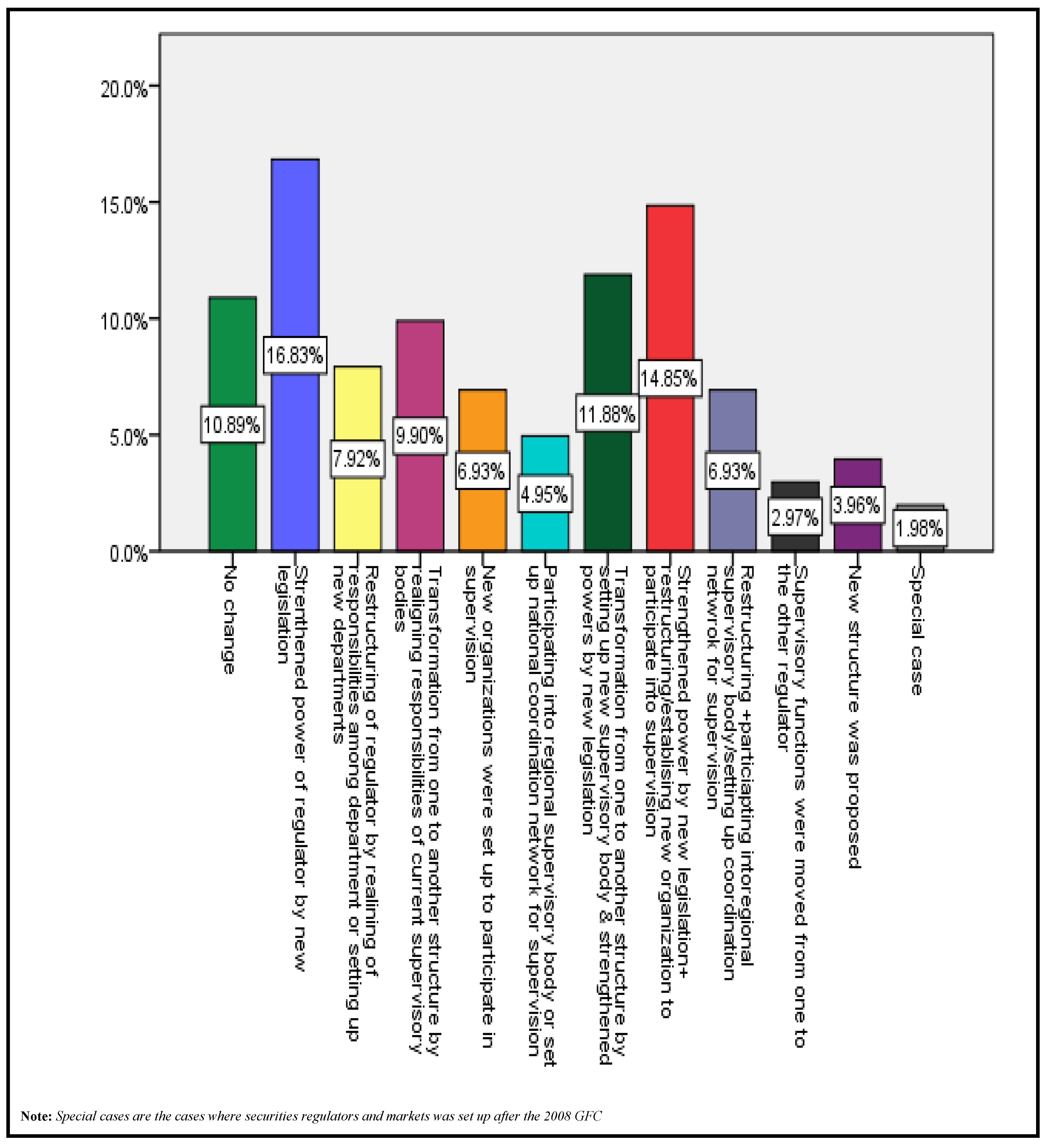
Figure 2.
Financial supervisory structure of 101 researched jurisdictions.
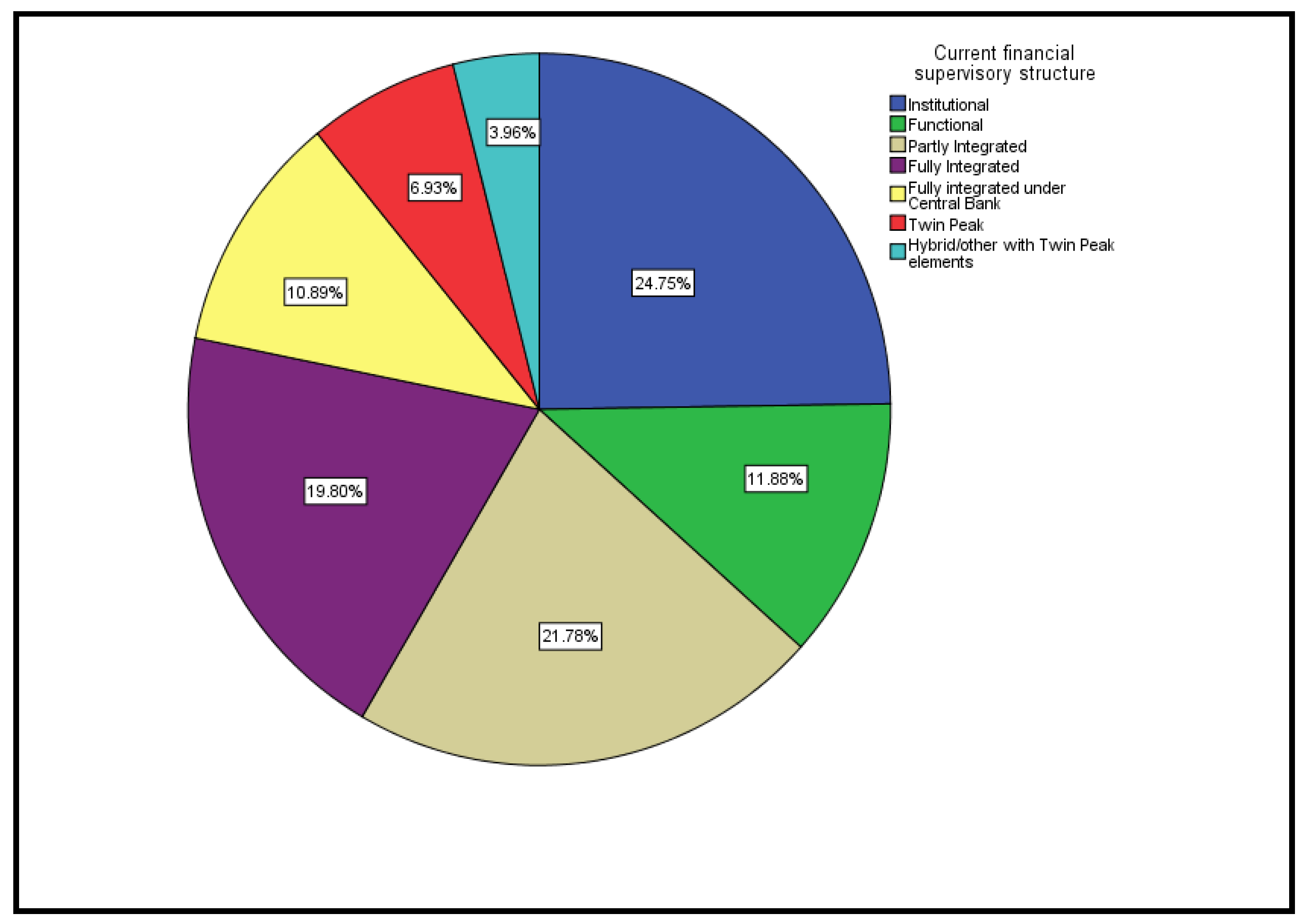
Figure 3.
Reasons for changing SMS structure after the crisis.
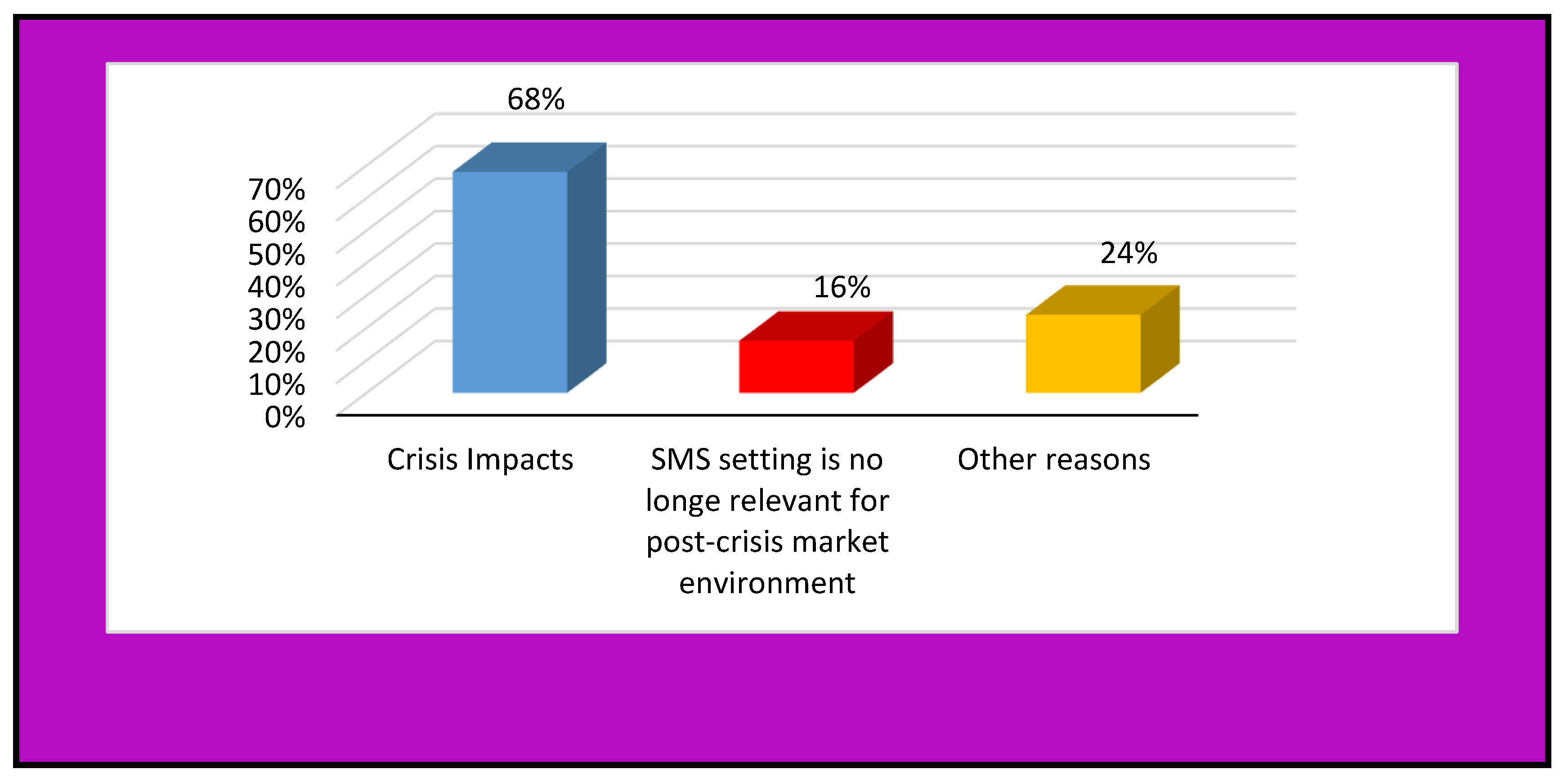
Figure 4.
Impacts of the 2008 GFC on supervision over MIs and SROs.
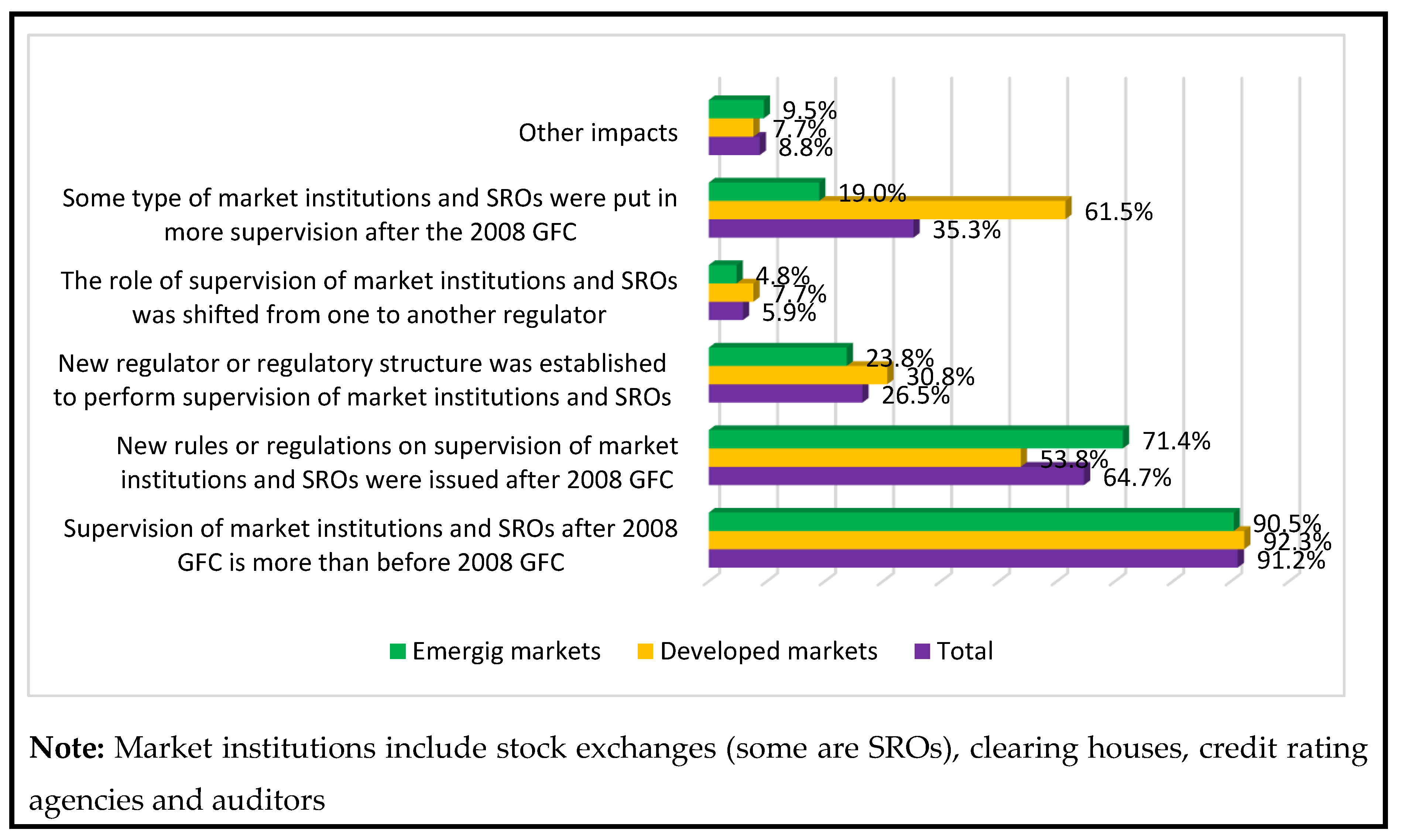
Figure 5.
Legislation to strengthen SMS post-GFC of 101 researched securities regulators.
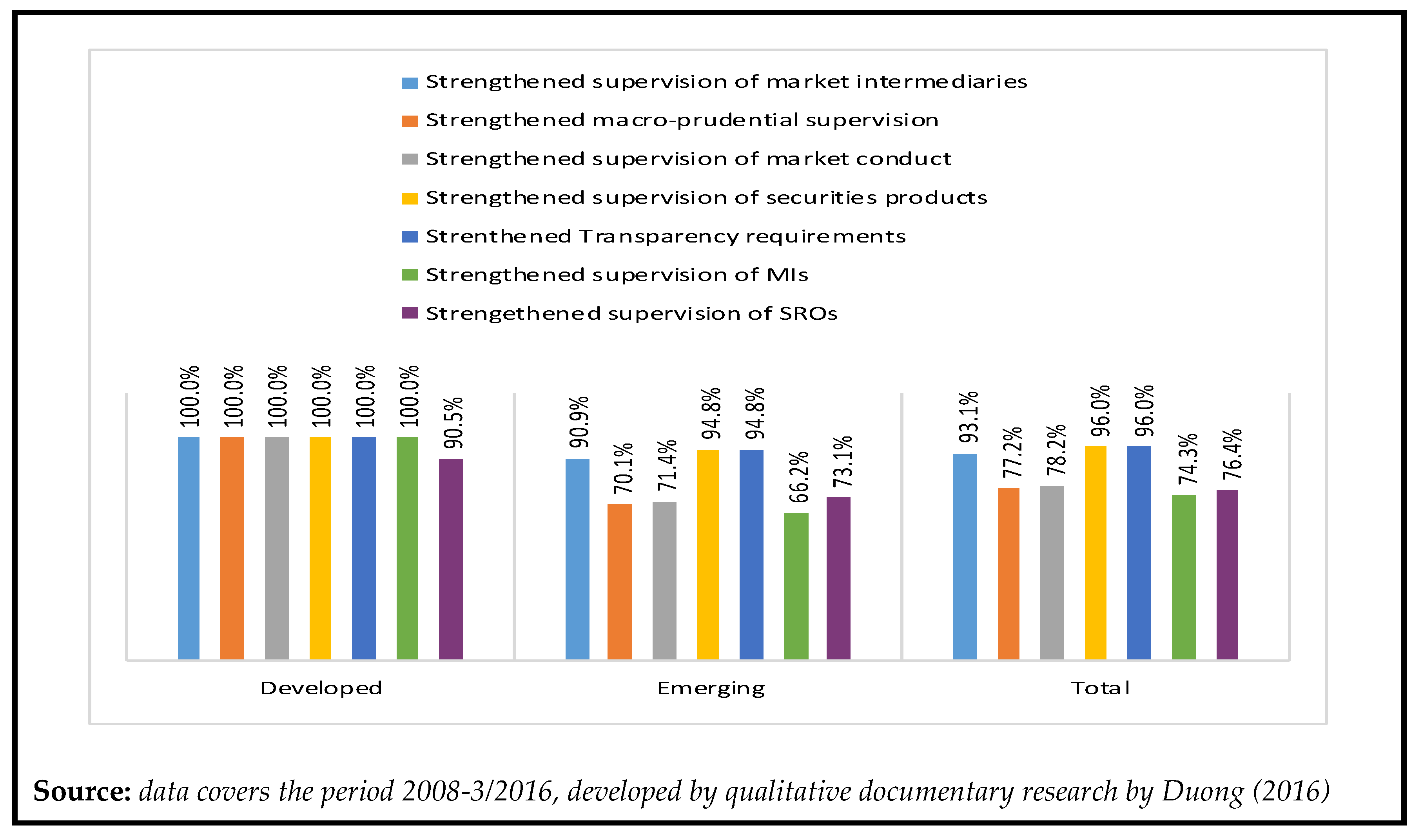

Table 1.
Impacts of the 2008 GFC on the roles of SROs.
| Crisis Impacts | Developed markets | Emerging markets | Total | %* |
|---|---|---|---|---|
| Roles of SROs in market supervision were re-evaluated for further improvement after the 2008 GFC | 6 | 8 | 14 | 82.35 |
| SROs take more important roles in market supervision after the 2008 GFC | 1 | 3 | 4 | 23.52 |
| SROs are less important in SMS than before 2008 GFC but they still perform the function of market /market member supervision | 3 | 3 | 6 | 35.29 |
| SROs do not hold any function of market supervision after the 2008 GFC | 0 | 1 | 1 | 5.88 |
| Self-regulation does not exist any longer in our market supervision system after the 2008 GFC | 0 | 0 | 0 | 0 |
| Other impact (SROs continue to play a role with re-evaluated framework to ensure that regulator plays a more intrusive role) | 0 | 1 | 1 | 5.88 |
| *Percentage of total 17 respondents who reported crisis impacts on roles of SROs in SMS | ||||
Table 2.
Advocating of 101 researched securities regulators to IOSCO’s paradigm shift.
| Policies | Number | Percentage |
|---|---|---|
| Plans to implement IOSCO policy recommendations | 101 | 100 |
| Paradigm shift in SMS mentioned in official report or policy papers of regulators | 94 | 93 |
| Enhancement of regulation or policy reform of stock exchanges and SROs* | 79 | 78 |
| Policies to strengthen disclosure and transparency | 97 | 96 |
| Customer protection and investor education programs conducted with new perception of ‘behavioural’ investors | 87 | 86 |
| Adoption of risk-based supervisory approach | 90 | 89 |
| * the policy item is not applicable to 05 (4.95%) researched securities regulators | ||
Table 3.
Matrix of financial supervisory restructuring of 24 selected jurisdictions.
| Abandoned Model | Adopted Model | |||||||
|---|---|---|---|---|---|---|---|---|
| Fully Integrated | Fully Integrated Under CB | Partly Integrated Under CB | Partly Integrated | Partly Integrated With Twin-peaks Elements | Twin-peaks | Total* | % of total sample (101) |
|
| Functional | 3 | 1 | 1 | 1 | 5 | 11 | 10.9 | |
| Institutional | 2 | 1 | 3 | 1 | 7 | 6.93 | ||
| Fully Integrated | 2 | 1 | 1 | 1 | 5 | 4.95 | ||
| Hybrid | 1 | 1 | 0.99 | |||||
| Total | 5 | 5 | 1 | 4 | 2 | 7 | 24 | 23.8 |
| % of total markets with restructure | 20.83 | 20.83 | 4.2 | 16.7 | 8.33 | 29.2 | ||
| 62.5 | ||||||||
| *Including 20 cases of completed transformation and five cases of work-in-progress plans of transformation | ||||||||
Table 4.
Financial architecture restructuring of 24 selected jurisdictions.
| Model adopted | Jurisdictions | Number |
|---|---|---|
| Twin-peaks and other setting with twin-peaks elements | Belgium (2011); France (2010); Germany (2013) New Zealand (2011); United of Kingdom (2012), United of Arab Emirates (2012), Spain (2010, plan in progress); South Africa (2014, transition in progress); Portugal (2011, plan in progress); | 9 |
| Fully or partly integrated outside central bank | El Salvador (2011); Indonesia (2013); Korea (2008); Switzerland (2009); Barbados (2011); Bolivia (2009); Egypt (2009); Romania (2012); | 8 |
| Fully or partly integrated under central bank | Georgia (fully integrated in 2009; partly integrated in 2013); Hungary (2013); Ireland (2010); Kazakhstan (2011); Lithuania (2012); Russia (2013); Uruguay (11/2008) | 7 |
| Total | 24 |
Disclaimer/Publisher’s Note: The statements, opinions and data contained in all publications are solely those of the individual author(s) and contributor(s) and not of MDPI and/or the editor(s). MDPI and/or the editor(s) disclaim responsibility for any injury to people or property resulting from any ideas, methods, instructions or products referred to in the content. |
© 2026 by the authors. Licensee MDPI, Basel, Switzerland. This article is an open access article distributed under the terms and conditions of the Creative Commons Attribution (CC BY) license (http://creativecommons.org/licenses/by/4.0/).
Copyright: This open access article is published under a Creative Commons CC BY 4.0 license, which permit the free download, distribution, and reuse, provided that the author and preprint are cited in any reuse.


