

Submitted:
06 July 2026
Posted:
08 July 2026
You are already at the latest version
Abstract
FOREST is thus not only a research-through-design prototype for organizing courtyard-scale heat experience into public evidence, but a hazard-governance interface framework as well. Working with a small set of anonymized resident- contributed prototype materials, supplemented by illustrative scenario materials where needed, FOREST specifies how courtyard-scale heat experience can be organized into evidence cards with time windows, location anchors, trigger conditions, experienced consequences, and uncertainty tags. FOREST is the prototype figure in this paper through which courtyard heat experience can be taken seriously as public evidence. I do not claim that the paper reports a completed long-term deployment, much less that it proves improved community-scale heat adaptation outcomes. Its contribution lies in formalizing an evidentiary grammar that combines small-scale anonymized prototype materials with a Freiburg/Vauban-related contextual design scenario derived from public and secondary sources, while specifying a deployment-and-evaluation pathway for future community testing. The prototype keeps everyday exposure, microclimate difference, care labor, and disagreement available for screening, review, citation, and feedback, while avoiding the claim that these materials already demonstrate completed community deployment, governance uptake, or improved adaptation outcomes.
Keywords:
urban heat risk
; heat-wave adaptation
; community governance
; participatory design
; microclimate
; hazard governance
; public evidence
; research through design
1. The Courtyard of Extreme Heat, Care and Restlessness
The heat at stake in a shared courtyard is not reducible to air temperature. Residents often react to mean radiant load from paving and walls, failed night flushing, still-air corners, short-lived cooling after watering, and the way heat reorganizes care labor: moving chairs, watering earlier or later, changing children's play times, or deciding which windows can be opened without triggering conflict.
Heat waves reveal urban difference not only through rising average temperatures, but through uneven exposure, uneven recovery, and unequal access to comfort. At courtyard scale, residents face recurring questions about shade, night cooling, ventilation, and everyday care.
Shared courtyards are important because they join microclimate, maintenance, and collective decision-making in a single local setting. They are small enough for everyday negotiation to matter, yet consequential enough for differences in labor, access, and vulnerability to become visible. (see Appendix Figure 1)
Much community knowledge about heat remains fragile: scattered across memory, oral warnings, improvised routines, and seasonal adjustments that disappear after summer. The hazard is therefore not only thermal. It is also evidentiary. Without a shared format for recording and revisiting experience, communities struggle to connect exposure, response, and fairness over time.
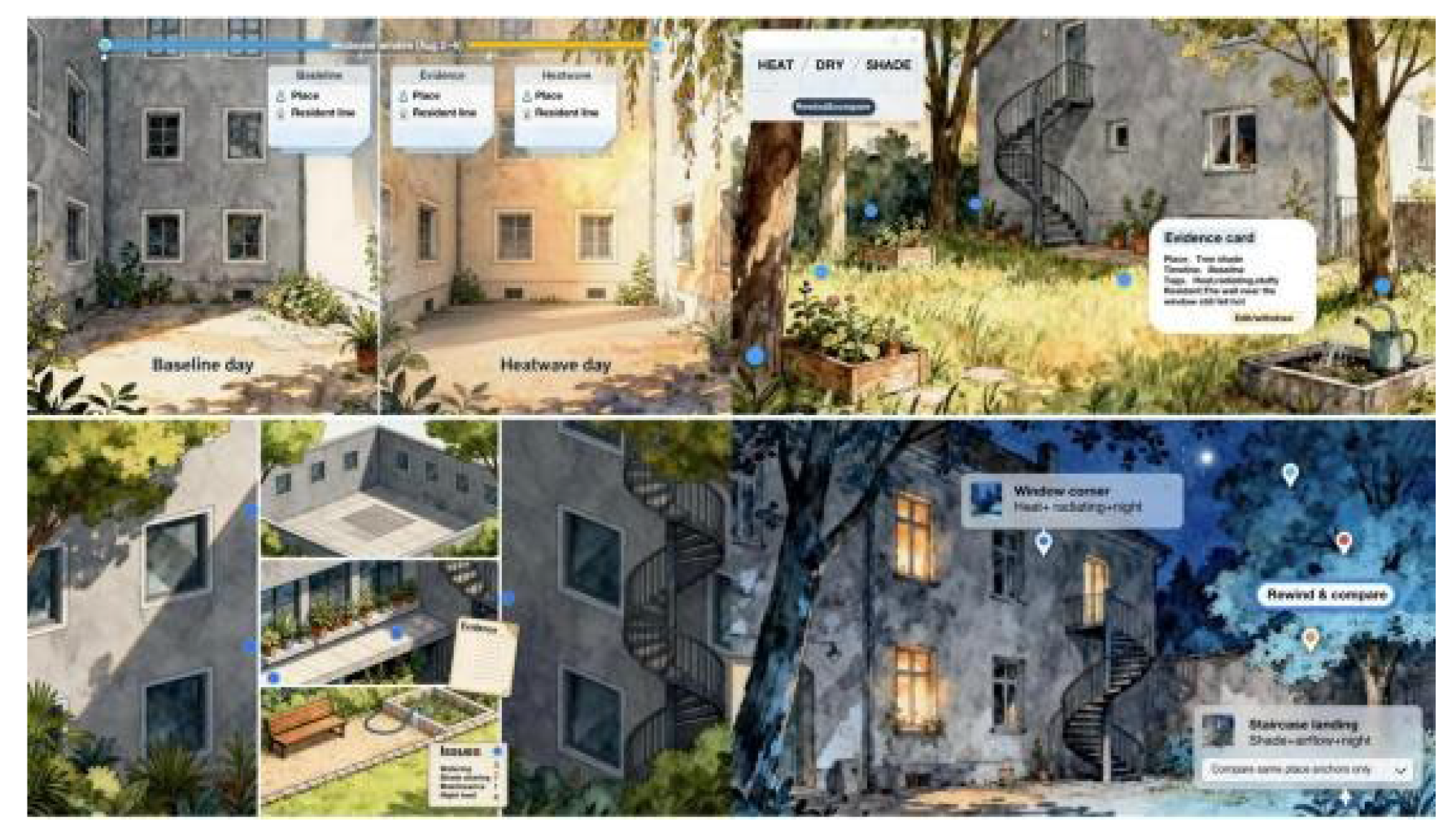
FOREST is proposed in response to that evidentiary gap. It treats the courtyard not as a setting to be illustrated, but as a local system in which heat perception, care work, and spatial choice can be written into comparable public records. "Playability" here does not mean adding a light game layer to a serious issue. It means organizing understanding through small actions, so that residents can review, compare, and qualify everyday experience rather than merely report that it happened (Meya and Eisenack, 2018; Rooney-Varga et al., 2018). (see Figure 1).
The interface centers on a community memory map. In the prototype grammar, resident-contributed and scenario-based drawings, short texts, sounds, and path records are arranged on a scrollable timeline so that different time windows and viewpoints can be compared. (see Figure 2).
Narrative-visualization research begins from the fact that display is a framing device through which cause, condition, and background are learned. While organizing residents’ heat experiences, it does not promise a single authoritative answer, settle disagreement, or turn evidence into one line ofpolicy certainty. When framing enters the interface, it changes what readers take to be causal, conditional, or merely contextual (Hullman and Diakopoulos, 2011; Drucker, 2014). Its main interest is public reasoning, but it is interested in difference as well. The aim of FOREST is to let different experiences coexist on one interface and to make difference itself available as a public object, so that communities can ask which practices are sustainable, which burdens are unevenly distributed, and which cooling measures shift labor onto others (Di Salvo, 2009).
We will reintroduce this prototype into two interrelated analytical frameworks. One framework examines the micro-level inequality and community governance associated with the risk of the urban heat island effect, and the other framework explores how the participatory interface can turn "experience" into a shared public object. The key is not to prove that the courtyard can represent the city, but to explain how small-scale interfaces can still make microclimate clues, nursing practices and consultation processes visible to each other, and to leave a solid methodological entry point for subsequent in-depth residential implementation and community cooperation (Harlan et al., 2006; Zimmerman et al., 2007). (see Appendix Figure 2)
The focus here is a gap that often slips past heat-risk research. There is plenty of data on heat stress, but much less in the way of a shared format that can turn daily perception and care-related effort into evidence people can actually negotiate around. At courtyard scale, how can scattered thermal experiences be organized into micro-evidence that can be compared, traced, cited, extracted, and reinterpreted over time? And what kind of interaction model can support a public cycle of review, comparison, argument, and revision without rushing differences into consensus or flattening them into averages?
Article type and evidence status:
Its methodological premise, in this paper, is FOREST as a prototype-based contribution. Its first major object is the interface logic by which situated heat experience can be recorded as conditional micro-evidence, kept open to reinterpretation, and connected to community review and feedback. The paper combines a small set of anonymized resident-contributed prototype materials with a Freiburg/Vauban contextual design scenario derived from public and secondary sources. The resident-contributed materials are used to test and illustrate the evidence-card grammar at a formative level, while the Freiburg/Vauban scenario defines a plausible governance setting and future deployment pathway. the paper does not present a completed long-term deployment, a full ethnographic study, or proof of actual meeting outcomes. Claims about care labor, conflict, deployment entry points, and meeting citation should therefore be read as design requirements and plausible governance frictions to be tested through later community research.
What the article adds is not a finer heat map. It offers a set of transferrable interface mechanisms instead: a "playable community memory map" as a public-interface hypothesis for heat-wave adaptation, a minimum structure for evidence cards plus ethical controls such as visibility, withdrawal, and reinterpretation rights, and a governance path through which prototypes can be deployed and tested as consultative infrastructure.
Shortly after thermal adaptation enters shared living environments, it becomes clear that the difficulty lies less in residents’ indifference than in the absence of a shared model to which they can keep returning. Using a small set of anonymized prototype materials, FOREST demonstrates how images, short texts, sounds, and walking traces can be translated into micro-evidence with time windows, place anchors, trigger conditions, experienced consequences, and action anchors. After these records are marked, reinterpreted, or withdrawn in debate, thermal risk can move from personal statement to negotiable public object. The most important structure for this proposition is the now central `memory map + evidence card` arrangement, the part of FOREST that lets situated experience remain available for disagreement. After being exposed to competing interpretations, care claims, and practical objections, the record is not treated as settled; it remains open to revision. But throughout this process FOREST does not draw conclusions for the community. It provides reasoning rules that let differences be reviewed, coordinated, and revised (Star and Griesemer, 1989; Norström et al., 2020).
The urban heat island effect is not a simple "temperature rise" problem; it is a complex problem determined by space, materials and institutions. Under the condition of the same daily maximum temperature, the differences in radiation, ventilation, shading, humidity and night heat dissipation capacity in different blocks will lead to an extremely uneven distribution of heat risks, especially when heat accumulation at night and heat waves last longer, and this difference is more significant (Oke, 1982; Stewart and Oke, 2012; Santamouris, 2015). So, governance faces a typical mismatch: policies and models tend to communicate through aggregate indicators, but the public perceives background clues such as "a certain intersection is more stuffy", "a certain street cannot dissipate heat at night", and "a certain building is like a hot box". The trouble is the lack of an expression and alignment mechanism that can transform the situational clues into the object of discussion.
Then, in this view, heat becomes a means of governance, after long being treated either as scientific explanation or as a problem of resolution. What happens, collectively, when different entities generate and recognize evidence is not something that can be assumed in advance. The fact is that science and policy do not come out of thin air: through classification, scale, and thresholds, they transform the world into manageable objects, and these choices decide which experiences become visible and which are excluded (Jasanoff, 2004). Nevertheless, unlike a higher-resolution display, a public- oriented heat interface survives only if it can organize those choices into a shared evidentiary structure. The study of common management and adaptive governance belongs to this problem, emphasizing that social learning depends on coordinating, debating, and modifying different forms of knowledge around the same object, so that consultation can persist (Berkes, 2009; Norström et al., 2020). The contrast between showing heat and making heat governable is therefore central here. For a public-oriented heat interface to enter a governance environment, it must transform experience into the infrastructure of boundary objects, so that differences can fall into the same set of evidence structures (Star and Griesemer, 1989).
FOREST's proposal is a public interface hypothesis. Through the structure of "memory map + evidence card", it organizes personal exposure into a comparable, traceable and verifiable micro-evidence unit, thus shifting the focus of the discussion from "I feel very hot" to "under what conditions, in what spatial relationship, and what kind of exposure occurs under these conditions". The role of this interface in governance is provide a set of reasoning grammar that can be refuted and corrected, so that the public, managers and experts can negotiate around the same set of conditions (Di Salvo, 2009; Reed, 2008). (see Appendix Table A1)
If the difficulty of dealing with the heat wave is that "there is enough evidence, but not all evidence is consistent", then the problem that FOREST needs to solve is how to turn the scattered sensory experience and fragmented clues into what the governance system is willing to accept. The key is to establish an auditable chain of evidence to transform personal experiences from "emotional statements" into "conditional records with boundary restrictions". From the perspective of boundary objects, the interface must meet two types of constraints at the same time: it must be close enough to the daily language of residents, and it must have a classified, retrievable and aggregateable structured form so that management institutions can classify, retrieve and aggregate the same object, so that different entities can collaborate around the same object without sharing the same worldview first (Bowker and Star, 1999; Star and Griesemer, 1989).
At the operational level, FOREST can be regarded as a "lightweight hot event recording and reinterpretation framework". Each evidence card does not state "who is right and who is wrong", but binds four types of minimum fields: position anchor point (such as "kitchen entrance", "shady boundary"), time period (normal day/heat window/night/afternoon peak), trigger conditions (no wind, no shade, high reflectivity material, humidity, etc.) to And experience the consequences (sleep disorders, detours, shortening the stay time, quarrels, etc.). These provisions work together with visibility, modification and withdrawal mechanisms to ensure that each statement is accompanied by applicable boundaries, so that disputes are more likely to be based on conditions and mechanisms than on opposition.
When such structured evidence is incorporated into governance practice, there should be three clear "transition points". The first transition point is screening and triage: prioritise frequent micro-exposure scenarios (such as "high temperature and low-lying places on the street at night" and "unshady waiting points") as a priority list for inspection and small-scale transformation, rather than only taking action when macro indicators are triggered. Next is the proofreading and review stage: managers or research teams will cooperate to randomly check some projects (such as on-site temperature measurement, materials and shade records, wind duct and sky visibility factors, etc.), and record the verification results back on the evidence card to form a public record that can be refuted and modified, so as to advance social learning from oral discussion to the accumulation of knowledge update (Berkes, 2009; Norström et al., 2020). Finally, this is about decision-making and feedback: when a smaller modification (shading, spraying point, water-permeable road surface, reflectance improvement, open cooling space) is implemented, the interface should be able to display "which evidence cards this measure responds to", and allow the public to continue to submit perceived differences after implementation, forming a minimum but closed feedback loop to avoid public participation staying in the "opinion collection" stage instead of "modification action" stage (Reed, 2008).
Still, this public interface must also be prevented from being abused by the system and become a performance indicator of "we have carried out public education". In order to avoid it becoming a cover for governance, the mechanism of the interface needs to reflect two forms of constraints. The first step is to clearly distinguish between "evidence contribution" and "policy commitment": the public submits verifiable clues instead of automatic commitments that trigger resource allocation to avoid misleading the public into the process of immediate fulfilment of commitments. The second point is to disclose the source of uncertainty and deviation: which areas have insufficient samples, which items have not been verified, which projects are more susceptible to the impact of tourist traffic and the distribution of mobile devices, and incorporating these limitations into the output format instead of hiding them in the method appendix (Rowe and Frewer, 2000; Reed, 2008). This does not weaken persuasiveness; instead, it positions the interface as a negotiating infrastructure rather than a machine that draws conclusions, so as to build credibility in the governance environment.
2. Site and Governance Scenario: Freiburg/Vauban as a Contextual Design Case
This section makes a second and deliberately bounded use of Freiburg/Vauban: it treats the area as a contextual design scenario, supported by public and secondary sources, for asking whether the FOREST evidence-card logic has a plausible governance entry point. Built from publicly available information on participatory planning, co-housing practices, and Upper Rhine heat-risk literature, the scenario is used to define design requirements rather than to report fieldwork findings. It should not be mistaken for a completed ethnographic study, a full resident-interview dataset, or proof of actual meeting outcomes. The paper does not claim that one specific courtyard has already used FOREST. Instead, the scenario identifies the institutional, spatial, and social conditions under which a courtyard heat-evidence interface would need to operate, while the small set of anonymized resident-contributed prototype materials is used only to illustrate and test the evidence-card grammar at a formative level (Fromm, 1991; Jarvis, 2015; Tummers, 2016; Winklmayr et al., 2023).
Immediately after the scenario is defined, it should be written as an auditable set of design assumptions, and brought forward as the first part of what future prototype testing must examine. It continues to be limited by its status as assumption, though much more in relation to empirical claims than to design requirements. Statements about resident assemblies, shared maintenance, watering routines, conflicts over shade or ventilation, and meeting citation should therefore be read in the light of what the interface must be able to record, compare, export, and revise; while for later community research, interviews, meeting records, and deployment logs would be the touchstones for treating them as empirical observations. Obviously, the scenario has a useful talent for being many things to the prototype: a planning context, a stress test, and a requirements list. It has, in effect, accomplished the difficult feat of being both close to governance practice and outside empirical field evidence. To do this, however, it has to remain openly conditional. Of the external boundary, the paper has already spoken. But there is also an internal boundary: these statements should not be cited as empirical observations unless later supported by interviews, meeting records, or deployment logs.

Table 1.
Contextual design scenario and prototype requirements for a Freiburg/Vauban. style shared courtyard.
Table 1.
Contextual design scenario and prototype requirements for a Freiburg/Vauban. style shared courtyard.
| Element | Snapshot (auditable description) | Correspondence with the prototype mechanism | |
|---|---|---|---|
| Community scale / shared | An enclosed shared inner | Provides clear references for | |
| semi-public space | courtyard serving approximately 20–40 households (semi-public; access can be controlled). Typical shared facilities include a courtyard notice board, shared tool room, bicycle storage, and a common activity room. Use density increases markedly in summer and during heatwave periods. | “place anchors / stop points / path logs” . The notice board can serve as a QR entry point and as an offline– online connection node. | |
| Decision-making mechanism (proposal / execution) | Governance typically proceeds via a monthly residents ’ assembly (Hausversammlung) and working groups. Common ownership structures include cooperatives (Genossenschaft) or condominium owners’ associations (WEG/HOA). Minor maintenance decisions can be made quickly; items involving budgets and retrofits require voting and/or board sign-off, and may be outsourced for execution. | Embed “cards” into the meeting agenda: Card → agenda reference → resolution item → version / responsibility record, forming a traceable deliberation chain. | |
| How maintenance labor is allocated | Routine upkeep (watering, cleaning, deploying/retracting shade cloths, temporary cooling measures) is often organised via rota schedules or volunteer hours. During heatwaves, “care debt” can accumulate (a small number ofpeople end up carrying more work, which is hard to see). | Make “responsibility / rota / maintenance burden” explicit as card fields to prevent care work from being romanticised or erased. Supports withdrawal, re- interpretation, and redistribution of responsibilities. | |
| Courtyard key components (anchors) | Tree canopy and shade boundaries; thermal hotspots on wall/ground materials; water access points (courtyard tap / rain barrel); benches, children’s areas, and other micro- infrastructure are the spatial elements most frequently | Supplies identifiable material–exposure objects for the “causal-sentence template” (e.g., missing shade / reflective wall / water-point rules → changes in thermal comfort and behaviour). | |
| referenced when thermal comfort differences and conflicts arise. | |||
| Typical heatwave conflicts | Disputes over watering priorities under water restrictions; shading devices affecting circulation, sightlines, or usage rights; night-time window ventilation triggering noise conflicts; and fairness debates about prioritising vulnerable groups (e.g., older adults, infants). | Provides plausible conflict contexts for “comparison / look-back / conditional sentences”, and helps validate misreading controls (avoid catastrophising; avoid moralising responsibility). | |
| Deployment entry points (go-live / management / meeting citation) | Management permissions are typically held by the board and/or a property manager. Go-live can rely on a lightweight community website or a hosted page; residents enter via the notice-board QR code and the monthly newsletter. Meeting citation uses an exported “card pack”: Card ID + time window + place anchor + causal sentence + evidence/uncertainty tags; it can be pasted into meeting minutes and linked back to the version history. | Clarifies the handoff point “from cards to governance action”: exportable, citable, and link-back capable— supporting auditability and cross-year reuse. | |
The materials supporting this table are mainly public and secondary sources concerning Freiburg/Vauban-related participatory planning, co-housing practices, and regional heat-risk literature. The small set of anonymized resident-contributed prototype materials used elsewhere in the paper illustrates how evidence cards may work, but it does not convert this scenario into a completed field study. The contextual force of the table lies in defining a plausible design scenario; it does not report fieldwork findings from a specific community.
3. Turning Fragments Into a Public Map
It is converting situated complaints into conditional records that can survive disagreement. A card that says "west wall, 22: 00-23: 00, masonry still releasing heat, lower-floor resident avoids opening window because courtyard noise rises" is governance-ready in a way that "it's unbearable here" is not. Still, the paper is right to preserve withdrawal and reinterpretation rights, because these records sit close to neighbor relations and can easily become overexposed if the interface treats them as fixed truth.
By concentrating on what has been repeatedly discussed but not properly preserved, `The Forest We Can Live` continues to propose the courtyard as a lived and governable setting. Needless to say, this knowledge is long overdue. It is perhaps easy to miss, though, because the materials that matter here are not spectacular: differences in bodily feeling during heat waves, the predictability of shadow movement, debates about watering and water saving, unclaimed corners, and uneven care labor among households. These rarely appear in statistics, yet they often become evidence in governance contexts, because they help determine whether later adaptation measures can be accepted, maintained, and made effective over time in the community (Mol, 2008; Jackson, 2014).
For a future deployment, the process of joint creation and collection is designed as a low-threshold but repeatable workflow. The present paper uses a small set of anonymized
resident-contributed prototype materials, supplemented by illustrative scenario materials where needed, to show how this workflow would operate. The basic unit is not a completed interview record, but a piece of micro-evidence: for example, an image, a short description, a brief audio trace, or a walking stopover. Each material must contain a comparable anchor, including time window, place anchor, triggering condition, experienced consequence, and where possible a describable sensory vocabulary such as stuffy, burning, damp, exposed, noisy, or difficult to breathe. (see Appendix Figure 3)
Drawings can mark the spatial relation between shade, wind, heat, plants, walls, paths, and bodies. Short written descriptions can preserve details that often disappear from meeting minutes, such as a room staying hot at night, a courtyard entrance becoming stuffy, or a shaded chair becoming a point of conflict. Brief sound traces can also register how heat changes the acoustic environment, including fans, motors, window movements, insects, or short rain events. In this paper, these examples are used as prototype materials and scenario illustrations; they are not presented as a complete archive of community testimony (Kester, 2004; Bishop, 2012).
If such materials are not converted into interface-ready structures, they risk remaining a loose archive of impressions rather than becoming reviewable evidence for governance discussion. The prototype therefore adopts the mapping logic of the evidence card: each submitted or illustrative material is translated into a card containing a place anchor, time window, medium type, sensory keywords, trigger condition, experienced consequence, and a reviewable question. Here, we deliberately use interrogative sentences instead of concluding sentences to avoid the interface drawing conclusions for residents prematurely, while maintaining the openness of the materials. For example, "Why does the shade here always disappear in the afternoon? " Who is responsible for watering during the heat wave? " If the water consumption is reduced, how can this tree canopy survive? " In this way, the card can be used as both a narrative node and a trigger point for negotiation. Keywords are not designed as "emotional emojis". Instead, they are more like indexes, allowing different residents to use different words to refer to the same spatial conditions and form comparable clusters in the interface, thus avoiding simplifying complex experiences into simple labels (Bowker and Star, 1999; Star and Griesemer, 1989).
The interface narrative structure is naturally formed from this. It is not a linear narrative, but more like a memory map for walking, allowing users to switch between three modes: timeline mode, space mode and theme mode. The timeline shows the process of the heat wave, but does not describe it as an emergency. Instead, it allows users to observe the cumulative process of continuous high temperature and night temperature drop, as well as various prevention and control measures that occur and then disappear during heat waves. The spatial perspective divides the courtyard into several microclimate rooms. Rather than relying on professional heat maps to claim authority, the prototype shows how resident-contributed and scenario-based evidence cards could be layered to reveal where discomfort, shade loss, night heat, ventilation problems, or care labor repeatedly appear within the same courtyard. The topic view directly presents the governance problem. Each topic is associated with a series of evidence cards. Users can view and compare these cards to understand the "root cause of the argument", not just judge who is right and who is wrong (Drucker, 2014; Hullman and Diakopoulos, 2011). (see Appendix Figure 4)
I say this definition of “operable” matters because, while the task is quite simple and easy to enter as public micro-labor, we should not be forced to treat public issues as incentive mechanisms alone. What is its value as an interface operation? One participant finds a hot place and marks it at the most uncomfortable time of day; another uses two cards to form a causal sentence, such as “reducing shadows - reducing stay time - reducing publicity - reducing willingness to maintain” ; another chooses an action under “saving water” and explains the reason. But do gold coins or points support this logic when they are treated as measures of personal performance? I think not. Indeed, their better definition is as an indicator of “visible input and output,” recording “our common achievements” rather than rewarding “you are awesome” : how many repeatable evidence chains the community has completed in a given week, or how many different and scrutifiable positions have formed around a specific issue. It is easy to see why this matters: gamification here should lead away from individual competition and toward the accumulation of shared resources, avoiding the movement of collective life into the field of anxiety (Meya and Eisenack, 2018; Whitson, 2013).
I, too, would give the prototype its academic shine, if only to resist the sterile habit of treating community participation as finished once it looks convincing in a paper. But we can praise it as a participation project only at the price of not taking it seriously enough as community infrastructure, of treating its public life as display rather than as maintenance. My own inclination is to take continuity as the real test.
Then, what about the fact that the content module is built to be replaceable: location and time as fixed fields, media and text as fields that can be rewritten, and topic tags as elements that can shift with the stage of the community? It is scarcely adequate to say that the interface presents a complete “climate story” at once; that kind of tidy description domesticates the project and gives up the more difficult judgment. It may be appealing to call it a good participation project only if one begins with the cliché that participation is mainly a matter of visible engagement.
The point is: the interface is designed to cultivate a capacity for continuous writing, so that the community can gradually record its own microclimatic politics. Is this structure durable enough to support long-term consultation? Does it allow the shared courtyard to become more than a lifestyle symbol, a small climate-governance field able to produce public knowledge over time? I, for one, would locate the stronger contribution there: in providing a memory basis for repeated consultation, maintenance, disagreement, and revision (Ostrom, 1990; Di Salvo, 2009).
Reusable modules and interpretation units
In order to make the research results of this article portable, we decompose the core mechanism of Forest into a series of reusable interpretation units. Each unit defines its purpose, trigger conditions, minimum input field, output format, and common failure patterns and ethical risks. (see Appendix Table 1)
4. Method: Research Through Design and Prototype Stress-Testing
Any research-through-design study is entitled to provisional construction, of course. But to present this prototype as a mature community system would indicate a failure of the whole methodological sensibility. And a prototype which, as this one does, records everyday heat experience through evidence cards with time windows, place anchors, trigger conditions, consequences, and uncertainty tags, proposing the conditions under which such records may become durable objects for review. Nor should the study be read as saying that, where community deployment remains untested, the system is already complete. Valuable as future community use may be, the standard of judgment here is deliberately narrower. For everything depends on the structured proposition that if heat experience is made conditional, situated, consequential, and uncertainty-marked, then residents and managers may have something more durable to review than scattered complaint or consultation fragments (Gaver, 2012; Zimmerman et al., 2007).
An evidence card is a “comparison object” ; it fixes a time window, anchors a place, names a trigger condition; the resident’s heat experience is no longer an average
temperature score. Courtyard heat experience does not need to be made comparable in those terms. All three components of the method, though deliberately modest, carry the work of the argument. Of the three, the minimum evidence-card structure is by far the most basic. The contextual design scenario in particular, drawn from publicly available Freiburg/Vauban-related materials, is a useful, in many ways necessary, stress test. Its task is to specify the governance frictions that the prototype must be able to meet: maintenance labor, watering responsibility, shade conflicts, window-opening disputes, vulnerability claims, and meeting citation. The future deployment protocol, finally, tests from the point of view of a short community review cycle whether the prototype can change discussion quality, evidence citation, and uncertainty handling.
But even this method would mislead in important ways if it were read as proof that FOREST has already produced measurable cooling, behavioral change, or consensus. The claim about the prototype is based instead on making its interface logic explicit, and the evidence-card fields, uncertainty tags, and review procedures should stand out as the elements through which the system can be criticized, deployed, and audited.
Ironically, “participation,” which many human-computer interaction papers place in the user-research phase, is here the very object that FOREST works on. But, irony aside, the point is that knowledge in a community environment is generated through interaction, care, and maintenance labor in daily life. FOREST shows what a hazard-governance interface might become when participation is treated as a process of making evidence, responsibility, and maintenance visible.
Work in participatory design, together with theories of care and maintenance whose central concerns include everyday repair, shared responsibility, and the politics of upkeep, has developed participation as a mode ofpublic and material analysis capable, among other things, of doing justice to how community knowledge is made in practice (Bjögvinsson et al., 2012; Jackson, 2014; Puig de la Bellacasa, 2017). It is against this background that the method should be read. I am sympathetic to the practical reasons that make “joint collection” look like a user-research stage, and respectful even of the convenience that such a stage offers. But since the method cannot accept either the hierarchy implied by that framing or its consequences, it cannot pretend that residents may simply be fixed in the position of research subjects.
For the prototype, the better account of joint collection is that each submission does two things at once. Each picture, sentence, or voice note transforms sensory experience into shareable evidence, and at the same time exposes the question of who provides care, who defines the problem, and who is responsible for maintenance.
Besides this, the best service to the durability and scope inherent in climate adaptation within co-living communities would be to connect it to the mechanisms already named by co-living research: long-term governance, labor distribution, and conflict resolution (Fromm, 1991; Jarvis, 2015; Tummers, 2016). Only when care, resource allocation, and public consultation are taken together can climate adaptation be properly evaluated as a topic of the community itself (Ostrom, 1990; Berkes, 2009).
So, the role of the interface in this method needs to be redefined. It is a tool that makes differences visible and easy to review. The reason many disputes related to high temperatures in the community continue to repert is less about someone lacks knowledge, and more about the evidence is scattered in personal perception and memory and cannot be compiled into common and reference materials. The interface "evidence card" structure here plays the role of a boundary object, allowing people from different positions to debate the interpretation of the same card instead of arguing about each other's personality (Star and Griesemer, 1989). This structure also echos the reminder of the framework effect in narrative visualization research: the presentation determines which experiences are regarded as the core and which are regarded as irrelevant information. So, the interface must structurally allow multiple paths to coexist, instead of replacing the only truth with a single narrative (Hullman and Diakopoulos, 2011; Drucker, 2014).
Here, “playability” may be described as an attempt to organize public climate learning from the point of view of action. Putting aside judgments of style, such a direction is clearly a methodological one. More precisely, both the strength and the danger of a playable interface arise from its commitment to making understanding actionable. There is no question here of forcing public issues into a reward system for its own sake. The mechanism decomposes understanding into choice, combination, comparison, and reflection, so that participants build causal relations themselves; it is closer to an open reasoning exercise than to reward-oriented entertainment (Flood et al., 2018; Mol, 2008).
But no such mechanism, even at its best, is free of assumptions that may in the end perpetuate performance-based governance, however attractive it looks as a catalogue of friendly community actions. I mean “gamified performance.” If integration or unlocking is necessary, the record should concern collectively accumulated materials and negotiation progress. Otherwise, the co-living community may be pushed, almost without noticing it, into another model of performance-based governance.
In the context of urban climate governance, this is especially sensitive. In its uneven distribution of heat risk, in its hidden care labor, in its tendency to treat some forms of comfort as simply given, the problem reveals itself as very different from a story about who is more proactive. It is odd, and disquieting, when a warm community narrative gets a better hold on the appearance of participation than on the structural conditions that make participation difficult. The variety of small playable tasks may seem to indicate a lighter and more open method than this argument suggests. But when one notes the recurrence of the same questions throughout, the differences become less important: who can participate, whose labor is ignored, whose comfort is presumed, and which spatial arrangements make public life sustainable. For this reason, the method has to join aesthetics to political meaning. Care labor and spatial comfort are not merely private pleasures; they are conditions for the continuation of public life (Puig de la Bellacasa, 2017).
One of the most common ethical problems in participatory projects is to regard "participation" as a decorative procedure: on the surface, residents appear in the video, but in fact, researchers monopolise the right to interpret the content (Arnstein, 1969; Sanders and Stappers, 2008). In order to avoid this situation, the right of withdrawal and the right of reinterpretation clauses have been added to the prototype design. The right of withdrawal means that any content can be deleted or rewritten, especially when it involves family privacy, conflict details or may cause pressure within the community; the right to reinterpretation means that these cards are not "the final version of the residents' experience", the residents can supplement, refute or re-mark the content of the note over time. Text and interface also need to maintain a humble tone at the language level. They should avoid using grand expressions such as "voices representing the community" as much as possible, but present "reproducible differences and traces of consultation", presenting consensus as a result of work, rather than a pre-set state of harmony (Reed, 2008; Di Salvo, 2009).
True, the method can be transferred, but not in the name of “copying the same web page.” For reproducing the layout, for moving the same interface elements from one site to another, an analogous case could be made for any template. However, what travels here is the set of relationships: norms for collecting evidence, procedures for turning evidence into structured discussion, and the use ofplayable mechanisms as norms for public reasoning. But I imagine that the same webpage, unchanged in form and detached from local maintenance politics, could, if the discussion were set up differently, be called transferable. That is precisely the weaker claim.
In the one case, transferability is identified with replication; in the other, with the re- establishment of relations. Using the first standard, the prototype would remain obtuse about what urban climate governance actually requires. Mostly, a copied webpage gets no nearer to governance than it has to. The courtyard is only the entrance. Even this small microspace, which may first appear domestic or local, materializes some of the least tangible aspects of urban climate governance: daily maintenance, public consultation, and the question of who bears the cost of heat. If these relationships can also be established elsewhere, the prototype is no longer only a community work, but a climate public- interface method from which other microspaces can learn. (see Appendix Figure 5)
5. Research Boundaries and Deployment Path
And social representativeness, the most difficult condition for a community evidence system to secure, to which FOREST devotes much ofits interface care, may still be misunderstood if the limitation is treated as merely technical. What a purely technical account is unwilling to admit is the social force of non-participation: the residents most willing to contribute cards, revise them, and cite them in meetings may not be those most exposed to heat or care burden. And since participation is shaped by conflict fatigue, time scarcity, digital discomfort, tenancy insecurity, and fear of making neighbor relations more difficult, the prototype is poorly situated to guarantee representation except through a clearer evidentiary format. This is very clear in the card workflow, where willingness to submit, revise, and cite records can too easily be mistaken for exposure or burden itself. A similar bias is less explicit, but equally pervasive, in many community-interface projects. There is certainly much that is valuable in improving the evidentiary format of participation. But if format may be understood as a support for participation, it is equally true, and more important here, that participation cannot be treated as socially representative simply because the format has improved. FOREST should therefore be read as a device for improving how participation becomes evidence (Arnstein, 1969; Reed, 2008).
FOREST is not presented as the result of a completed long-term deployment. It is presented as a hazard-governance prototype supported by a small set of anonymized resident-contributed prototype materials and a contextual design scenario. Its value lies in whether the evidence-card grammar can keep everyday heat exposure, care labor, and disagreement available for review. The article therefore treats the prototype as a method framework to be stress-tested, not as proof that adaptation has already been achieved.
Mechanism verification: proposed deployment protocol
The proposed evaluation sets aside the usual decorum of adaptation assessment; this is a test of mechanism performance. It should not plunge into claims about measurable cooling or behavioral change; the organization of the test must remain clear, and nothing should be made falsely simple or final. FOREST is not proof of cooling or behavioralchange; it is too early and too bounded for that. But it can test whether the evidence-card format helps a community move from personal attribution to conditional discussion: where exposure occurred, during which time window, under which trigger condition, with what consequence, and with what uncertainty.
What makes the minimum deployment unit deliberately small is that the prototype, however open to later expansion, must not overtake the community review it is meant to support. What begins as a two-week pilot window followed by one topic meeting becomes something more specific: a test of whether limited evidence cards can move from submission to revision, reinterpretation, withdrawal, export, and discussion. The deployment is really to examine this chain while keeping the heat issue concrete. In this instance, the objects whose details are made to carry the value of the review process are the evidence cards. During the pilot window, participants would be invited to submit at least two cards using a limited template, and they would also be able to modify, reinterpret, or withdraw their own cards. The following topic meeting is more governance-facing because it uses exported card packs to discuss one selected heat- related issue, such as shade timing, watering responsibility, night ventilation, or the use of a shared cooling area. It would seem that such a meeting needs something more than general conversation. It merits a structured card-based review.
The evaluation should report three mechanism indicators:
A methodological dilemma accounts for the three measures and for the pressure they place on the evaluation.
M 1. Evidence citation: Discussion, once it enters a meeting, tends to generalize. This measure wants to keep it concrete. It asks whether participants refer to card ID, time window, place anchor, or trigger condition.
M2. Uncertainty handling: The evaluation has to follow whether uncertainty survives discussion: whether participants preserve uncertainty tags, avoid overclaiming unverified cards, and distinguish evidence contribution from policy commitment.
M3. Reinterpretation and withdrawal: This measure asks whether participants understand and use the right to modify, qualify, or withdraw cards when the record becomes socially sensitive or contextually incomplete.
Descriptive pilot evidence, the key evidentiary category here, should appear in the manuscript as coded meeting excerpts, card-use counts, and short participant reflections. According to this evaluation logic, to report an inferential effect size is to change the status of the claim. A table, haunted by the authority of inference, acts. It acts in order to move the paper toward an end, an apparent proof. An effect-size estimate is therefore intentional, not decorative, and a number is not to be counted as harmless if the pilot has not actually been conducted, the sample documented, the measures pre-specified, and the analysis script made available. Neither confidence-interval tables nor pre/post comparisons should simply be experienced as signs of rigor. They must be understood as commitments that modify the evidentiary position of the manuscript. Thus, unless these conditions are met, they should be removed.
Table 2.
Planned mechanism.verification indicators for a short FOREST pilot.
| Indicator | Data source |
Observ able signal |
Claim supported |
Claim not supported |
|
|---|---|---|---|---|---|
| Evidence citation | Meeting transcript/min utes + card export log | Referen ces to card ID, time window, place anchor, trigger condition | Cards can be cited as public evidence. | Communit y consensus or adaptation effectiveness. | |
| Uncertainty handling | Coded discussion and exported cards | Uncertai nty tags retained; unverified cards not used as definitive proof | The interface can make evidence limits visible. |
Full representative ness. |
|
| Reinterpretation/with | Card | Cards | The | Conflict | |
| drawal | revision log | revised, qualified, or withdrawn when needed | prototype can protect provisional ity. |
resolution or social equality. | |
6. Discussion as an Ending: Memory as Commons Infrastructure
If participatory art can bring us an important revelation, it is that public practice is not necessarily aimed at reaching consensus. For problems like the heat wave, consensus is often an overly perfect arrangement, which erases conflict and inequality from the surface and replaces it with the seemingly united "let's work together". The value of dialogue and collaborative practices lies in whether they can tolerate differences and whether different experiences can be retained in the same public space without being immediately purified (Kester, 2004; Bishop, 2012). The interface structure of FOREST is not so much to pursue "community stories" as to realise the "rewatchability of community debate". When disputes are recorded as materials, they may become more mature when the next heat wave hits and evolve from repetitive consumption to learnable institutional evolution. This is the key to the sustainability of public resources (Berkes, 2009). (see Supplementary Figure S2 and Appendix Table C1, which reports anonymized formative prototype rows for mechanism-verification reporting)
This method inevitably encounters the aesthetic contradiction of the courtyard. And since courtyards are easily treated as symbols of an ideal lifestyle, and since discussions of the urban heat island effect often turn greening and harmonious coexistence into images of “a better life,” the article need not separate the visual appeal of comfort from the politics that produce it. Although it occasionally draws on the attractive figure of the shared courtyard, it is almost entirely the made and maintained public condition of comfort of which the article speaks. It is a double figure, intimate and political at the same time, all of whose effects depend on maintenance, allocation, negotiation, and debate.
This is what gives the interface its restrained visual character. The phrase “a better life,” repeated too easily in climate and greening discourse, never quite names a natural condition. It is the name given to a complex process of public production. Given these aesthetic temptations, it matters that the narrative proceeds through short sentences, parallel evidence, and visual restraint. This is because comfort itself, in the article’s account, is explicitly involved in the work of maintenance and political distribution. Care labor, spatial comfort, shade, ventilation, and shared cooling are understood here as occasions for governance . If comfort is treated as a natural gift, governance and labor disappear; if community is described as a therapeutic ideal, inequality and conflict disappear with it. The interface therefore keeps aesthetics under political control, so that looking does not replace understanding and beauty does not replace responsibility (Nixon, 2011; Mol, 2008).
What is transferable in FOREST is a evidentiary grammar: how to write experience as conditional micro-evidence, how to keep withdrawal and reinterpretation possible, and how to connect local records to screening, review, and feedback. In that sense, the paper contributes a hazard-communication method for community-scale adaptation rather than a fixed design template. (see Supplementary Figure S3)
Supplementary Materials
The following supporting information can be downloaded at: Prepprints.org.
Competing Interests
The author have no relevant financial or non-financial interests to disclose.
Ethics and Data Availability
No completed long-term deployment is reported in this article. The manuscript uses a research-through-design prototype, a Freiburg/Vauban-related contextual design scenario, and a small set of anonymized resident-contributed prototype materials, supplemented by illustrative scenario materials where needed. These materials are used only to develop and illustrate the evidence-card grammar; they are not presented as evidence of a completed community deployment, actual governance uptake, or improved adaptation outcomes. A future community pilot should be conducted with informed consent, minimum necessary data collection, withdrawal and reinterpretation rights, and clear separation between evidence contribution and policy commitment. Where ethically appropriate, future versions should make anonymized card metadata, coding guidelines, and non-identifying evaluation materials available.
Appendix A. Evidence Status
The appendix materials belong to a research-through-design prototype package. They combine a small set of anonymized resident-contributed prototype materials with Freiburg/Vauban-related contextual scenario materials derived from public and secondary sources. Their role is to specify the FOREST evidence-card grammar, interface logic, and future deployment pathway.
Figure A1.
FOREST interface mechanism diagram. The figure summarizes the relationship between courtyard heat experience, evidence cards, community memory map, review procedures, and governance feedback.
Figure A1.
FOREST interface mechanism diagram. The figure summarizes the relationship between courtyard heat experience, evidence cards, community memory map, review procedures, and governance feedback.
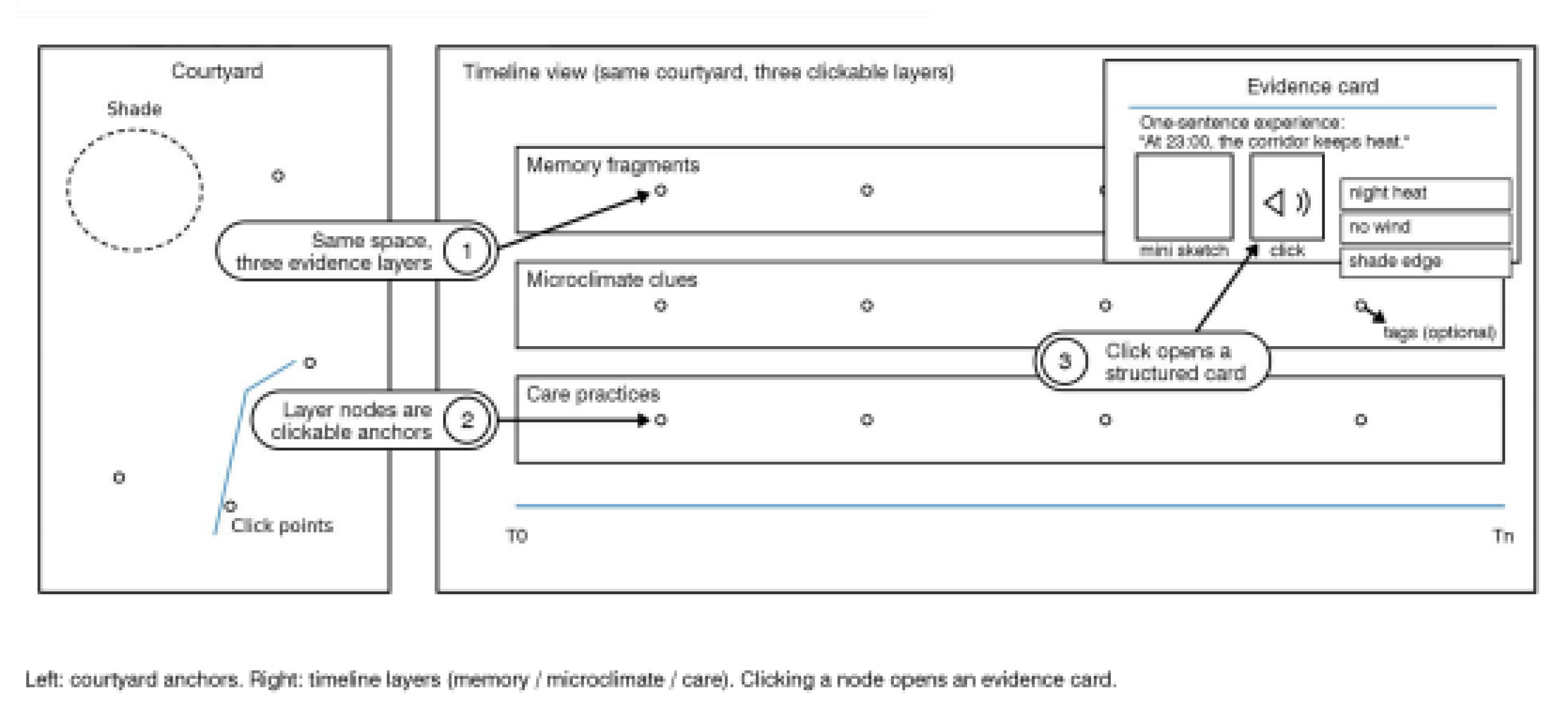
Figure A2.
Conceptual framework. The figure situates FOREST within courtyard-scale heat exposure, care labor, microclimate difference, public evidence, and hazard-governance review.
Figure A2.
Conceptual framework. The figure situates FOREST within courtyard-scale heat exposure, care labor, microclimate difference, public evidence, and hazard-governance review.
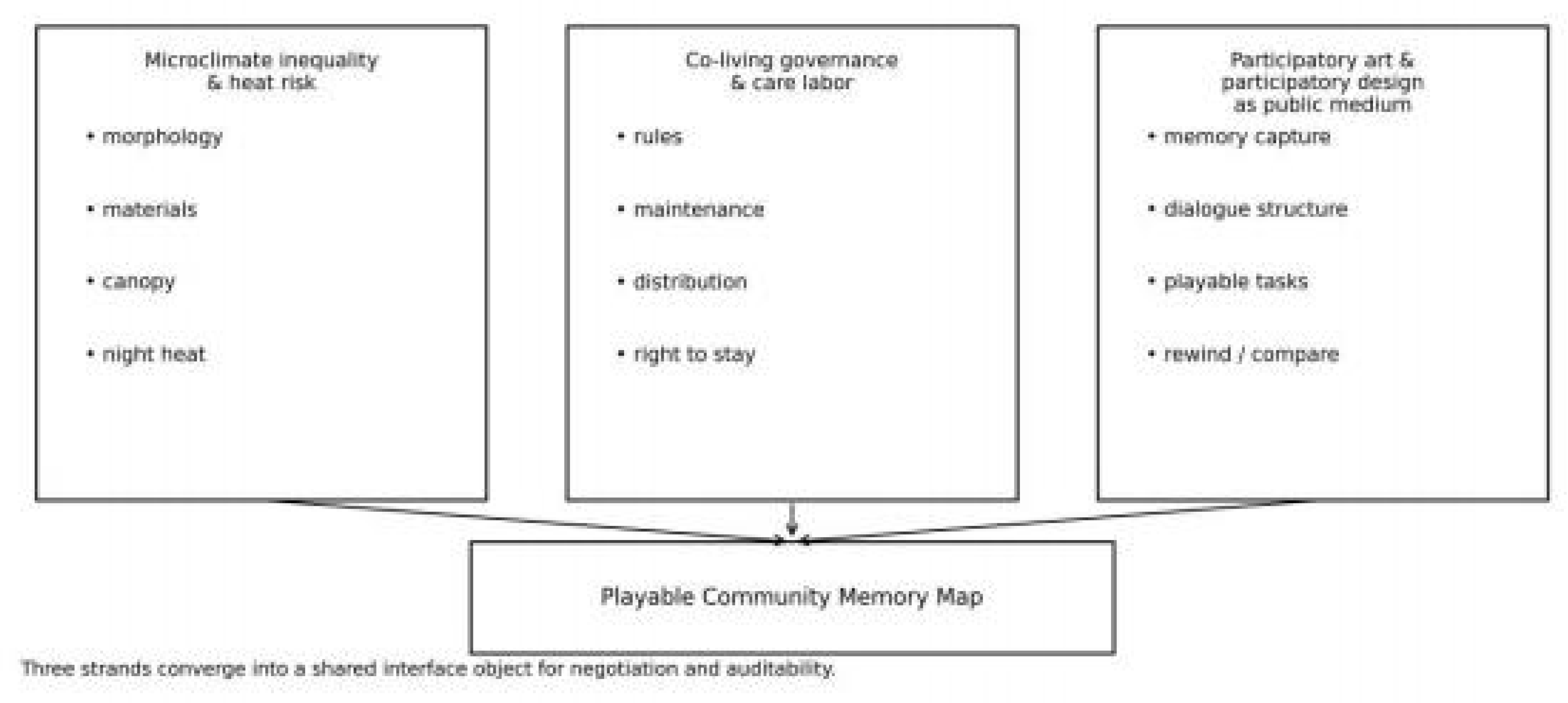
Table A1.
Evidence-card field schema. The evidence-card schema defines a minimum structure for future community deployment. Each card records place anchor, time window, trigger condition, experienced consequence, uncertainty tag, visibility setting, and revision status.
Table A1.
Evidence-card field schema. The evidence-card schema defines a minimum structure for future community deployment. Each card records place anchor, time window, trigger condition, experienced consequence, uncertainty tag, visibility setting, and revision status.
| Field | Type | Required | Content | Notes / Constraints | |
|---|---|---|---|---|---|
| card id | string | √ | C047 | Unique ID, convenient for reference/meeting discussion | |
| where | enum / string | √ | “Kitchen door”, “Compost ” corner |
Use the community to customise the landmark word list and do not force GIS | |
| when window | enum | √ | baseline / heatwave / night |
Use "time window" instead of specific temperature to lower the threshold | |
| date range | string | “Aug 2–6, 2025” | Optional, used for looking back and comparing | ||
| modality | enum | √ | drawing / text / audio / walkpoint | f a card can be multi- modal, change it to a list | |
| snippet | text | √ | “22:00 still radiating heat … ” |
Residents' short sentences, keep the spoken language, do not do academic purification | |
| sensation tags | list[string] | √ | [“stuffy”, “burning”, “no breeze”] | The tag is an index, not a rating; synonyms are allowed to coexist | |
| practice tags | list[string] | [“watering”, “shade sharing”, “maintenance”] | Directly align the governance topic page |
||
| prompt question | text | √ | “Why does shade vanish after 15:00 here?” | It must be a question sentence to avoid the system making conclusions for the community | |
| evidence link | file/url | audio 10s.mp3 / img.png | Lightweight evidence layer, allowed to be empty | ||
| visibility | enum | √ | public / community / private | It is very important in small communities: not all materials should be made public | |
| revision log | list[stamp] | [edit, retag, retract] | Reflect the "right of reinterpretation/withdrawal", |
||
| even if only the simplified version is recorded | |||||
Figure A3.
Material-to-interface conversion chain. The diagram shows how anonymized prototype materials and scenario materials are translated into evidence cards with place anchors, time windows, trigger conditions, experienced consequences, and reviewable questions.
Figure A3.
Material-to-interface conversion chain. The diagram shows how anonymized prototype materials and scenario materials are translated into evidence cards with place anchors, time windows, trigger conditions, experienced consequences, and reviewable questions.
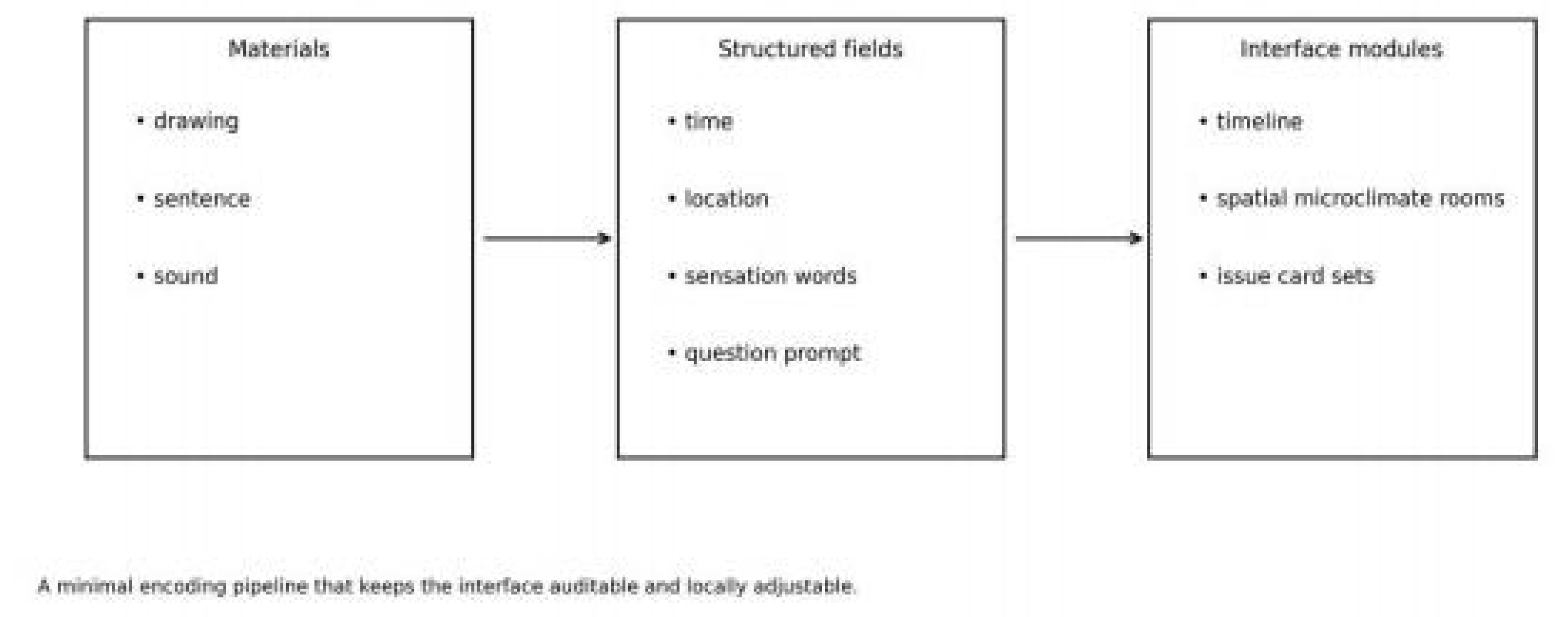
Figure A4.
FOREST interface wireframe. The wireframe illustrates the organization of evidence cards, time windows, place anchors, sensory keywords, trigger conditions, and review prompts in a future community-facing prototype.
Figure A4.
FOREST interface wireframe. The wireframe illustrates the organization of evidence cards, time windows, place anchors, sensory keywords, trigger conditions, and review prompts in a future community-facing prototype.
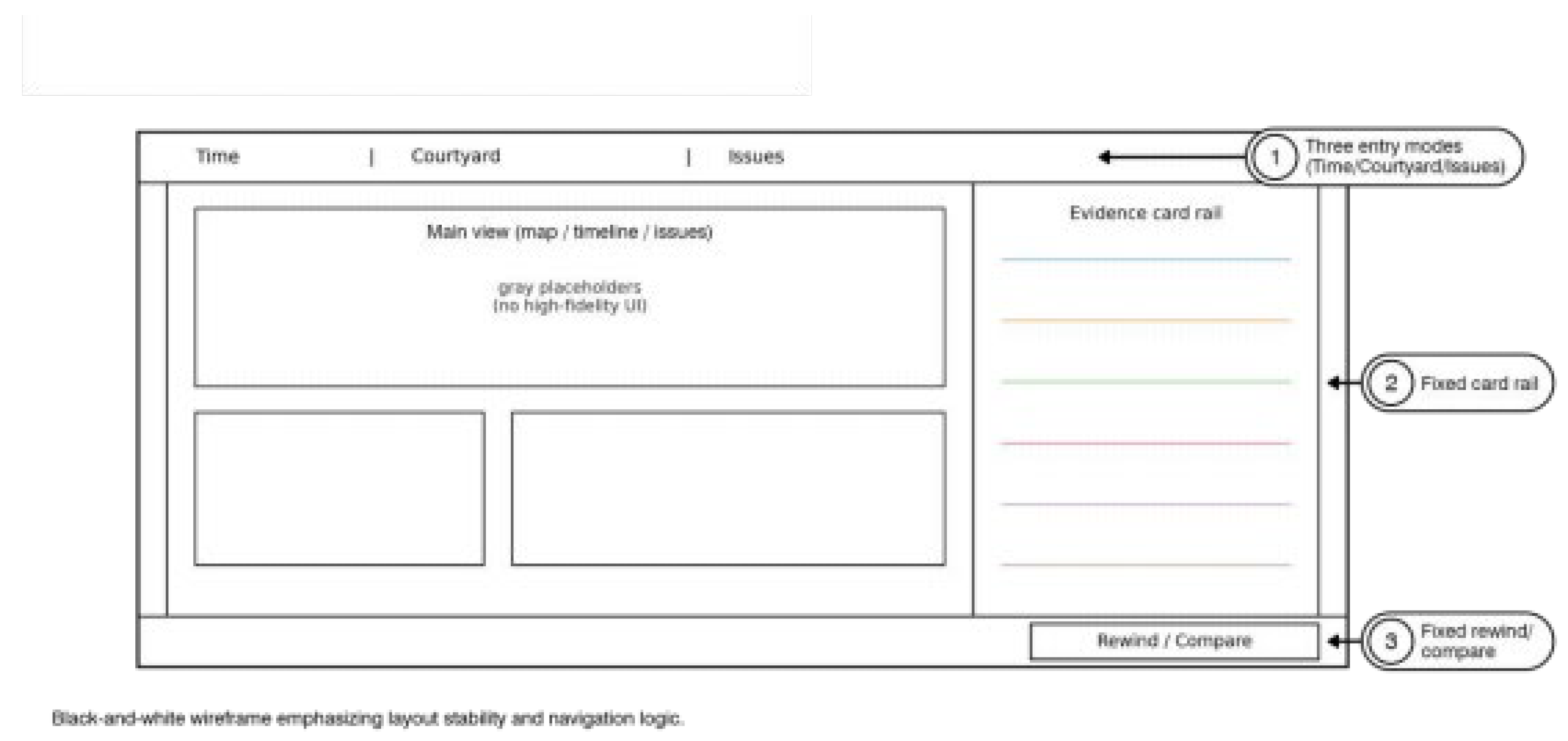
Table A2.
Modules / Units — Field Definitions.
| Module / Unit | Field definition (Purpose / Trigger / Inputs / Outputs / Failure modes / Ethical risks) |
|---|---|
| EU1 Evidence card | Purpose: Compress fragmented lived experience into a citable boundary object; allow coexistence and withdrawal. Trigger: Submitting / backfilling materials; when a dispute arises and an identifiable referent is needed. Inputs (minimum): Place anchor; time slice; modality; resident line; tags; status; visibility. Outputs: Card (with ID) + one-line statement; exportable as a meeting-quote snippet. Failure modes: Emotions treated as evidence, or evidence treated as a verdict; tag collapse. Ethical risks: Re-identification / retaliation; requires visibility thresholds and a right to withdraw; emphasize “evidence ≠ commitment. ” |
| EU2 Baseline vs heatwave compare | Purpose: Pull discussion back to conditional differences and boundaries. Trigger: Entering a heatwave window / switching time slices; disputes about “what exactly changed. ” Inputs (minimum): Baseline slice; event slice; selected anchors; diff range setting. Outputs: Before/after compare view + switchable difference range (range). Failure modes: Precision illusion; difference mistaken for causality; averages treated as individuals. Ethical risks: Misattribution leading to blame; requires uncertainty cues and conditional-sentence scaffolds. |
Figure A5.
FOREST method framework and transferability logic. The figure summarizes transferable prototype components, including evidence-card fields, visibility settings,reinterpretation and withdrawal rights, review procedures, and exportable card packs.
Figure A5.
FOREST method framework and transferability logic. The figure summarizes transferable prototype components, including evidence-card fields, visibility settings,reinterpretation and withdrawal rights, review procedures, and exportable card packs.
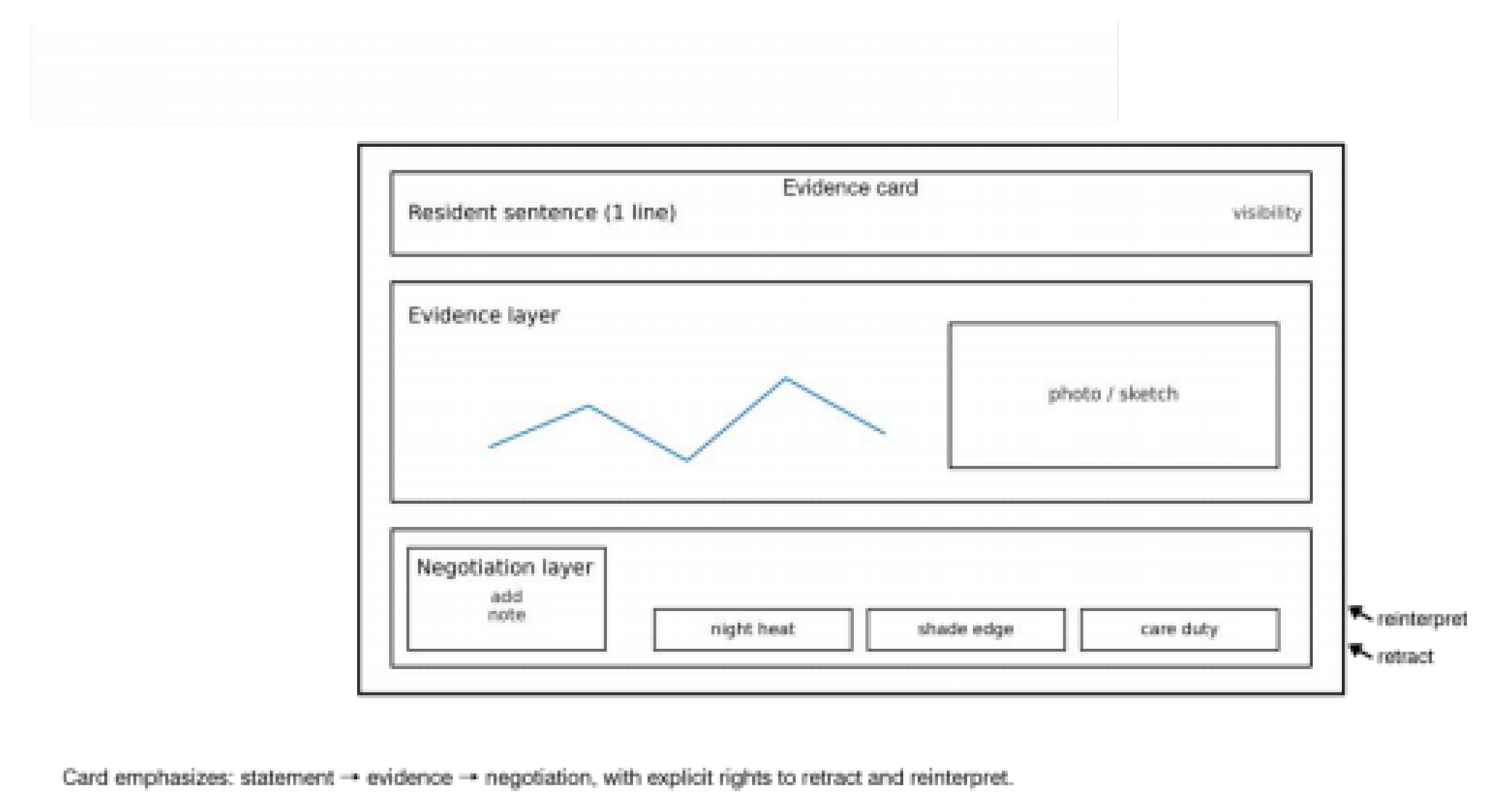
Table A3.
Anonymized formative prototype rows for mechanism-verification reporting Table note: The rows report anonymized formative prototype data collected to test the mechanism-verification reporting format. They show how card creation, meeting references, and pre/post perception indicators can be documented at a small prototype stage. GE refers to governance evidence, EU refers to evidence usability, and FA refers to future actionability. These indicators should be interpreted as formative signals of reporting structure and interface use, with broader deployment, governance uptake, and adaptation outcomes reserved for future community testing.
Table A3.
Anonymized formative prototype rows for mechanism-verification reporting Table note: The rows report anonymized formative prototype data collected to test the mechanism-verification reporting format. They show how card creation, meeting references, and pre/post perception indicators can be documented at a small prototype stage. GE refers to governance evidence, EU refers to evidence usability, and FA refers to future actionability. These indicators should be interpreted as formative signals of reporting structure and interface use, with broader deployment, governance uptake, and adaptation outcomes reserved for future community testing.
| id | role | tenure | cards created | meeting refs | GE (pre→post) |
EU (pre→post) |
FA (pre→post) |
|---|---|---|---|---|---|---|---|
| P01 | resident | 4-7y | 2 | 0 | 4.0→5.5 | 5.1→7.0 | 3.2→3.7 |
| P02 | committee | 4-7y | 3 | 3 | 4.2→4.7 | 2.9→3.5 | 3.9→5.5 |
| P03 | resident | 4-7y | 2 | 1 | 3.3→3.0 | 3.1→5.9 | 2.7→3.2 |
| P04 | caretaker | 1-3y | 1 | 2 | 2.6→4.0 | 3.5→4.6 | 4.0→4.6 |
| P05 | resident | <1y | 0 | 1 | 2.2→3.1 | 3.7→4.3 | 2.9→3.0 |
| P06 | resident | 8y+ | 5 | 1 | 4.9→6.6 | 3.7→6.1 | 2.1→2.0 |
| P07 | resident | 4-7y | 3 | 1 | 3.6→4.3 | 2.8→4.5 | 3.0→3.1 |
| P08 | resident | 1-3y | 5 | 1 | 4.1→5.0 | 4.0→4.7 | 2.9→3.3 |
| P09 | resident | 1-3y | 5 | 1 | 2.7→3.7 | 4.2→4.8 | 2.6→2.9 |
| P10 | resident | 1-3y | 3 | 1 | 3.7→4.1 | 2.9→3.8 | 2.6→2.8 |
References
- Arnstein, S R. A ladder of citizen participation. Journal of the American Institute of Planners 1969, 35(4), 216–224. [Google Scholar] [CrossRef]
- Berkes, F. Evolution of co-management: Role of knowledge generation, bridging organizations and social learning. Journal of Environmental Management 2009, 90(5), 1692–1702. [Google Scholar] [CrossRef] [PubMed]
- Bishop, C. Artificial hells: Participatory art and the politics of spectatorship. London: Verso, 2012.
- Bjögvinsson, E; Ehn, P; Hillgren, P-A. Design things and design thinking: Contemporary participatory design challenges. Design Issues 2012, 28(3), 101–116. [Google Scholar] [CrossRef]
- Bowker, G C; Star, S L. Sorting things out: Classification and its consequences. Cambridge: MIT Press, 1999.
- Bulkeley, H; Newell, P. Governing climate change. London: Routledge, 2010. [CrossRef]
- Corner, A; Shaw, C; Clarke, J. Talking climate: From research to practice in public engagement. Oxford: Climate Outreach, 2015.
- Di Salvo, C. Design and the construction of publics. Design Issues 2009, 25(1), 48–63. [Google Scholar] [CrossRef]
- Drucker, J. Graphesis: Visual forms of knowledge production. Cambridge: Harvard University Press, 2014.
- Flood, S; Cradock-Henry, N A; Blackett, P; et al. Adaptive and interactive climate futures Systematic review of 'serious games' for engagement and decision-making. Environmental Research Letters 2018, 13(6), 063005. [Google Scholar] [CrossRef]
- Fromm, D. Collaborative communities: Cohousing, central living, and other new forms o housing with shared facilities. New York: Van Nostrand Reinhold, 1991.
- Gaver, W. What should we expect from research through design? In: Proceedings of the SIGCHI Conference on Human Factors in Computing Systems (CHI ' 12). New York: Association for Computing Machinery, 2012: 937-946. [CrossRef]
- Harlan, S L; Brazel, A J; Prashad, L; et al. Neighborhood microclimates and vulnerability to heat stress. Social Science & Medicine 2006, 63(11), 2847–2863. [Google Scholar] [CrossRef] [PubMed]
- Hullman, J; Diakopoulos, N. Visualization rhetoric: Framing effects in narrative visualization. IEEE Transactions on Visualization and Computer Graphics 2011, 17(12), 2231–2240. [Google Scholar] [CrossRef] [PubMed]
- Intergovernmental Panel on Climate Change. Climate change 2022: Impacts, adaptation and vulnerability. Cambridge: Cambridge University Press, 2022.
- Jackson, S J. Rethinking repair. In: Gillespie T, Boczkowski P J, Foot K A, eds. Media technologies: Essays on communication, materiality, and society. Cambridge: MIT Press, 2014: 221-239.
- Jarvis, H. Towards a deeper understanding of the social architecture of co-housing: Evidence from the UK, USA and Australia. Urban Research & Practice 2015, 8(1), 93–105. [Google Scholar] [CrossRef]
- Kester, G H. Conversation pieces: Community and communication in modern art. Berkeley: University of California Press, 2004.
- Koskinen, I; Zimmerman, J; Binder, T; et al. Design research through practice: From the lab, field, and showroom. Waltham: Morgan Kaufmann, 2011.
- Meya, J N; Eisenack, K. Effectiveness of gaming for communicating and teaching climate change. Climatic Change 2018, 149(3-4), 319–333. [Google Scholar] [CrossRef]
- Mol, A. The logic of care: Health and the problem ofpatient choice. London: Routledge, 2008.
- Moser, S C. Communicating climate change: History, challenges, process and future directions. WIREs Climate Change 2010, 1(1), 31–53. [Google Scholar] [CrossRef]
- Nixon, R. Slow violence and the environmentalism of the poor. Cambridge: Harvard University Press, 2011.
- Norström, A V; Cvitanovic, C; LöfM, F; et al. Principles for knowledge co-production in sustainability research. Nature Sustainability 2020, 3(3), 182–190. [Google Scholar] [CrossRef]
- Oke, T R. The energetic basis of the urban heat island. Quarterly Journal of the Royal Meteorological Society 1982, 108(455), 1–24. [Google Scholar] [CrossRef]
- Ostrom, E. Governing the commons: The evolution of institutions for collective action. Cambridge: Cambridge University Press, 1990.
- Puig de la Bellacasa, M. Matters of care: Speculative ethics in more than human worlds. Minneapolis: University of Minnesota Press, 2017.
- Reed, M S. Stakeholder participation for environmental management: A literature review. Biological Conservation 2008, 141(10), 2417–2431. [Google Scholar] [CrossRef]
- Rooney-Varga, J N; Sterman, J D; Fracassi, E; et al. Combining role-play with interactive simulation to motivate informed climate action: Evidence from the World Climat simulation. PLoS ONE 2018, 13(8), e0202877. [Google Scholar] [CrossRef] [PubMed]
- Rowe, G; Frewer, L J. Public participation methods: A framework for evaluation. Science, Technology, & Human Values 2000, 25(1), 3–29. [Google Scholar] [CrossRef]
- Sanders, E B-N; Stappers, P J. Co-creation and the new landscapes of design. CoDesign 2008, 4(1), 5–18. [Google Scholar] [CrossRef]
- Santamouris, M. Regulating the damaged thermostat of the cities: Status, impacts and mitigation challenges. Energy and Buildings 2015, 91, 43–56. [Google Scholar] [CrossRef]
- Simonsen J, Robertson T, eds. Routledge international handbook of participatory design. London: Routledge, 2013.
- Star, S L; Griesemer, J R. Institutional ecology, 'translations,' and boundary objects: Amateurs and professionals in Berkeley's Museum of Vertebrate Zoology, 1907- 39. Social Studies of Science 1989, 19(3), 387–420. [Google Scholar] [CrossRef]
- Stewart, I D; Oke, T R. Local climate zones for urban temperature studies. Bulletin of the American Meteorological Society 2012, 93(12), 1879–1900. [Google Scholar] [CrossRef]
- Tummers, L. The re-emergence of self-managed co-housing in Europe: A critical review of co-housing research. Urban Studies 2016, 53(10), 2023–2040. [Google Scholar]
- Whitson, J R. Gaming the quantified self. Surveillance & Society 2013, 11(1/2), 163–176. [Google Scholar] [CrossRef]
- Winklmayr, C; Matthies-Wiesler, F; Muthers, S; et al. Heat in Germany: Health risks and preventive measures. Journal of Health Monitoring 2023, 8 (Suppl 4), 3–32. [Google Scholar] [CrossRef] [PubMed]
- Zimmerman, J; Forlizzi, J; Evenson, S. Evenson S. Research through design as a method for interaction design research in HCI. In: Proceedings of the SIGCHI Conference on Human Factors in Computing Systems (CHI '07). New York: Association for Computing Machinery, 2007: 493-502. [CrossRef]
Figure 1.
Prototype overview.
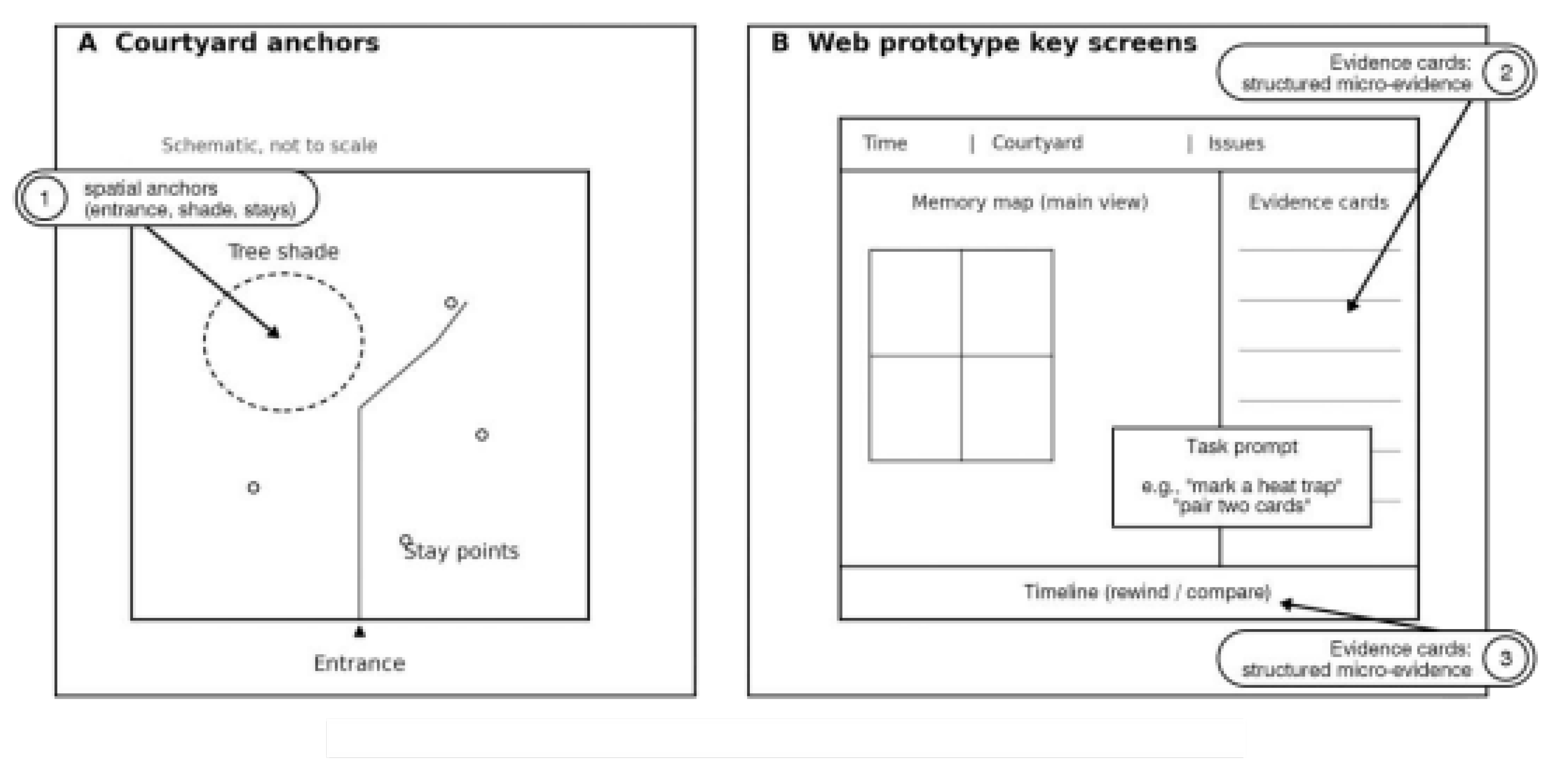
Figure 2.
Main prototype screen: baseline/heatwave compare + courtyard map + evidence cards + replay view.
Figure 2.
Main prototype screen: baseline/heatwave compare + courtyard map + evidence cards + replay view.
Disclaimer/Publisher’s Note: The statements, opinions and data contained in all publications are solely those of the individual author(s) and contributor(s) and not of MDPI and/or the editor(s). MDPI and/or the editor(s) disclaim responsibility for any injury to people or property resulting from any ideas, methods, instructions or products referred to in the content. |
© 2026 by the authors. Licensee MDPI, Basel, Switzerland. This article is an open access article distributed under the terms and conditions of the Creative Commons Attribution (CC BY) license (http://creativecommons.org/licenses/by/4.0/).
Copyright: This open access article is published under a Creative Commons CC BY 4.0 license, which permit the free download, distribution, and reuse, provided that the author and preprint are cited in any reuse.