

Submitted:
28 May 2026
Posted:
01 June 2026
You are already at the latest version
Abstract
Manufacturing SMEs in emerging economies stand at an awkward juncture: AI-powered quality control tools are commercially available, yet the conditions that actually govern whether a given firm adopts them are poorly mapped in the literature. This paper takes that gap seriously. Building on Tornatzky and Fleischer's Technology-Organization-Environment (TOE) framework, supplemented by perceived usefulness and ease-of-use constructs drawn from TAM, the study asks what drives AI-QC adoption in 284 Turkish, Malaysian, and Egyptian manufacturing firms, and whether adoption actually moves the operational performance needle. The AI-QC technologies in scope are machine learning defect detection, computer vision inspection, predictive maintenance, and digital twin integration. Three analytical tools are deployed in sequence: PLS-SEM to estimate net causal effects, IPMA to flag which drivers matter most yet underperform most severely, and fsQCA to identify which bundles of conditions are jointly sufficient for high adoption. PLS-SEM yields six significant positive drivers of adoption intention, with top management support, perceived usefulness, and organizational readiness leading the ranking, and data security concern emerging as the sole significant inhibitor. IPMA's diagnostic value lies in a striking gap: the two most important predictors are currently the worst-performing in the sample. fsQCA then surfaces three equifinal adoption pathways, none of which is reducible to the others. The paper closes with targeted guidance for SME managers, AI technology vendors, and industrial policymakers.
Keywords:
artificial intelligence
; quality control
; manufacturing SMEs
; TOE framework
; PLS-SEM
; IPMA
; fsQCA
; emerging economies
; Industry 4.0
; predictive maintenance
1. Introduction
Quality control in manufacturing is being fundamentally restructured by the convergence of artificial intelligence (AI) and Industry 4.0 technologies. AI-enabled quality control (AI-QC) systems, spanning machine learning-based defect detection, computer vision inspection, predictive maintenance, and digital twin integration, give manufacturing firms unprecedented capacity to catch anomalies in real time, cut scrap rates, fine-tune maintenance schedules, and model production scenarios at a level of precision previously unattainable [1,2]. For small and medium-sized enterprises (SMEs), which account for more than 90% of manufacturing establishments and absorb the bulk of the industrial workforce across emerging economies, these capabilities simultaneously represent a competitive necessity and a formidable organizational undertaking [3].
The academic literature has not been idle. Studies of AI adoption in manufacturing have multiplied over the past decade, and the methodological quality of that work has improved considerably. What has not improved is its scope: the overwhelming majority of published studies sit in large-firm, developed-economy settings, and the particular dynamics of emerging-market SMEs, where capital is tight, technical staff are scarce, and institutional environments differ sharply from those of advanced economies, rarely feature [4,5]. A further limitation compounds this: most studies collapse the adoption question into a single theoretical framework, usually TAM or diffusion of innovation, and stop there. The result is adoption models that capture individual perceptions reasonably well but largely ignore the organizational and environmental pressures that constrain SME decision-making in practice [6].
There is a framework that was built, four decades ago, to handle precisely this kind of multi-layered adoption question. Tornatzky and Fleischer [7] designed their TOE model to prevent researchers from privileging any single dimension of adoption, instead requiring simultaneous attention to the technological characteristics of the system being adopted, the organizational capabilities of the adopting firm, and the broader competitive and regulatory setting. That architecture accommodates the complexity of SME manufacturing adoption in ways that TAM alone cannot. Grafting TAM’s perceived usefulness and ease-of-use constructs onto TOE adds the individual acceptance layer [8]. The combined TOE-TAM model has demonstrated strong explanatory power in adjacent technology domains. What it has not yet been applied to, in any systematic empirical way, is AI-enabled quality control in emerging-market manufacturing SMEs.
The methodological mainstream in this literature also has a blind spot worth naming. Regression-based symmetric methods are good at answering the question: does X increase Y, on average, all else equal? They are structurally silent on a different but equally important question: which specific combination of conditions is jointly sufficient to push a firm into high adoption? That second question is where fsQCA comes in. Ragin [9] built fsQCA on set-theoretic rather than correlational logic, and it is precisely the tool for revealing configurational causal complexity. Layering IPMA on top of this adds a third analytical angle, one that identifies not just what matters most but where the gap between importance and current performance is largest, making it possible to prioritize interventions. When PLS-SEM, IPMA, and fsQCA are run on the same dataset, the result is a mutually reinforcing body of evidence that no single method could generate [10].
The present study is a direct response to these three gaps, substantive, geographical, and methodological. Using 284 manufacturing SMEs drawn from Turkey, Malaysia, and Egypt, it applies an integrated TOE-TAM framework through a PLS-SEM/IPMA/fsQCA tri-analytical design. The contribution claim rests on four pillars. First, a multi-dimensional AI-QC adoption model is built and empirically tested in an SME manufacturing context where TOE-TAM integration has not previously been attempted. Second, the three-country design is the first to provide cross-national empirical evidence on AI-QC adoption dynamics across emerging-market manufacturing sectors. Third, the tri-analytical design surfaces both the net causal architecture and the equifinal configurations underpinning high adoption within a single study. Fourth, and most practically, the results are translated into differentiated guidance for three audiences whose needs have rarely been addressed together: SME managers, AI technology vendors, and industrial policymakers.
The paper is structured as follows. Section 2 lays out the theoretical grounding and derives the hypotheses. Section 3 describes sampling, measurement, and the three analytical procedures. Section 4 reports all results. Section 5 interprets the findings against the literature, and Section 6 wraps up with contributions, limitations, and a research agenda.
2. Theoretical Background and Hypothesis Development
2.1. The TOE Framework and AI Adoption
Tornatzky and Fleischer [7] built TOE on a deceptively simple premise: the decision to adopt a technology is never about the technology alone. Three layers of context jointly shape that decision. The first is technological, covering the characteristics of the technology itself, how mature it is, how useful, how easy to use, what risks it carries. The second is organizational, covering the internal resources, structures, and capabilities that determine whether a firm can actually implement what it decides to adopt. The third is environmental, covering the competitive pressure, regulatory requirements, and supply chain demands that create external incentives to move. Across four decades of empirical work, this three-layer structure has proven its predictive worth in enterprise system adoption [11], cloud computing migration [12], blockchain deployment [13], and most recently in Industry 4.0 uptake [14], consistently outperforming simpler single-dimension alternatives.
In the AI-QC adoption context, the technological layer breaks into four distinct constructs. AI technology maturity (AI_MAT) is the most domain-specific of the four: it asks how far AI-QC tools have come in terms of delivering reliable, accurate, interpretable outputs under real production conditions rather than in controlled lab settings [15]. Perceived usefulness (PU) and perceived ease of use (PEOU) are borrowed from Davis’s [16] TAM; they represent the individual-level acceptance perceptions that pure TOE models lack. Data security concern (DSC) rounds out the technological context by capturing the risk side of AI adoption: anxiety about unauthorized data access, process data leakage, and loss of proprietary production intelligence. Together, these four constructs operationalize the technology layer of a TOE-TAM hybrid.
2.2. Hypotheses Development
The hypothesis set below is organized by the three TOE dimensions. Each construct is grounded in prior empirical work and mapped to its expected influence on AI-QC adoption intention (ADOPT_INT) and, ultimately, operational performance improvement (OPI).
Technology Dimension: A production manager contemplating an AI-QC investment is, fundamentally, placing a bet on whether the technology will actually work in her plant. AI technology maturity is what governs that bet. When the tools are demonstrably reliable and their outputs interpretable by non-specialist staff, the perceived implementation risk drops and the motivation to move rises [14,15,17,18].
H1.
AI technology maturity (AI_MAT) positively influences AI-QC adoption intention (ADOPT_INT).
Perceived usefulness asks a blunt question: will this system actually make my job better? In manufacturing, that translates to fewer defects, lower rework costs, higher throughput. If the answer is credibly yes, adoption follows; Davis [16] established this link, and manufacturing-specific TAM studies have replicated it consistently [6,19].
H2.
Perceived usefulness (PU) positively influences AI-QC adoption intention (ADOPT_INT).
Ease of use matters most where IT fluency is lowest. A quality inspector on a shop floor in Cairo or Izmir is not a data scientist; if the interface looks intimidating or the system requires significant training, that is a real adoption barrier in a way it simply is not for large firms with dedicated IT departments [16,20].
H3.
Perceived ease of use (PEOU) positively influences AI-QC adoption intention (ADOPT_INT).
AI-QC systems are not neutral pipes. They ingest process parameters, defect images, and production recipes that represent genuine competitive intelligence. For an SME without a dedicated IT security function, the prospect of that information being accessed, leaked, or compromised through a cloud-hosted AI platform is not paranoia, it is a reasonable risk calculation [21].
H4.
Data security concern (DSC) negatively influences AI-QC adoption intention (ADOPT_INT).
Organization Dimension: Ask any experienced IT implementation consultant what kills digital transformation projects in SMEs, and the answer is almost always the same: the boss was not really behind it. Top management support is not just a yes/no adoption decision; it is the ongoing commitment of budget, staff time, and organizational attention that keeps a project alive through the inevitable difficulties of implementation [22]. Its consistent dominance as the strongest organizational predictor in TOE studies across technology types is remarkable precisely because it has held across thirty years of changing technologies.
H5.
Top management support (TMS) positively influences AI-QC adoption intention (ADOPT_INT).
Wanting to adopt and being able to adopt are two different things. Organizational readiness is what sits between them: the financial runway to absorb upfront costs, the technical staff who can manage the integration, and the process knowledge to make sense of what the AI system reports [23]. Many SMEs have the intention but not the readiness, which is why adoption intentions in this sector so frequently fail to convert into deployed systems.
H6.
Organizational readiness (ORG_READ) positively influences AI-QC adoption intention (ADOPT_INT).
Machine learning defect detection is only as good as the sensor data feeding it. Computer vision only works if the cameras can stream reliably to a processing server. Predictive maintenance requires continuous sensor telemetry. Each of these creates a hard dependency on IT infrastructure, and where that infrastructure is outdated or fragmented, AI-QC adoption hits a technical ceiling that managerial enthusiasm cannot raise [24].
H7.
IT infrastructure quality (IT_INF) positively influences AI-QC adoption intention (ADOPT_INT).
Environmental Dimension: When the firm across the street installs an AI vision system and starts winning contracts on quality grounds, adoption pressure on its competitors becomes tangible rather than abstract. Mimetic isomorphism theory describes this as a legitimacy response [25]; whether or not managers know the theoretical label, the behavioral response is consistent across industries and decades of technology adoption research.
H8.
Competitive pressure (COMP_PRESS) positively influences AI-QC adoption intention (ADOPT_INT).
Supply chain pressure is arguably more coercive than competitive pressure. A rival’s AI adoption creates a motivation to respond; a key customer’s supplier qualification requirement creates an obligation to respond. As traceability and digital quality certification requirements spread through global supply networks, an SME that cannot provide AI-backed quality documentation increasingly risks losing the relationship altogether [26].
H9.
Supply chain pressure (SC_PRESS) positively influences AI-QC adoption intention (ADOPT_INT).
Governments in all three countries under study have made explicit digital manufacturing commitments in their industrial policy frameworks, though the translation of those commitments into enforceable quality standards and real compliance incentives has been uneven. Where regulation effectively rewards AI-QC adoption, or penalizes non-adoption, institutional pressure becomes a practical driver; where it is aspirational rather than operational, the effect is muted [27].
H10.
Regulatory environment (REG_ENV) positively influences AI-QC adoption intention (ADOPT_INT).
Adoption-Performance Link: The practical value of AI-QC adoption ultimately rests on whether it moves operational outcomes that management actually tracks: defect rates, rework costs, throughput, and on-time delivery. The published evidence suggests it does [1,2,28], though most of that evidence comes from large firms. Testing the performance link in an emerging-market SME context is itself a contribution.
H11.
AI-QC adoption intention (ADOPT_INT) positively influences operational performance improvement (OPI).
Moderation Effects: A 200-person automotive parts supplier and a 15-person textile workshop may both adopt the same AI defect detection tool and experience very different performance returns. Volume of production data, baseline quality tolerances, and the gap between current performance and the theoretical optimum all differ systematically by firm size and sector. These boundary conditions are captured in H12 and H13.
H12.
SME size moderates the relationship between ADOPT_INT and OPI, with larger SMEs showing stronger performance effects.
H13.
IT infrastructure quality moderates the relationship between AI_MAT and ADOPT_INT.
3. Materials and Methods
3.1. Research Design
A quantitative cross-sectional survey design was adopted. The analytical architecture is where this study departs most sharply from the mainstream: rather than stopping at PLS-SEM, the design layers in IPMA (which constructs are important yet underperforming?) and fsQCA (which condition bundles are jointly sufficient for high adoption?). Following Hair et al. [29] and Fiss [30], the symmetric and asymmetric strands are treated as complementary, each answering a question the other cannot.
3.2. Population, Sample, and Data Collection
The study targeted middle- and senior-level managers, production engineers, and quality specialists in manufacturing SMEs, with firm size defined as 10 to 249 employees. Country selection was deliberate rather than opportunistic. Turkey, Malaysia, and Egypt share enough in common to be meaningfully comparable—each has a substantial SME manufacturing base and national-level Industry 4.0 commitments—while differing enough in institutional environment, language, and industrial composition to give the findings some claim to cross-national breadth.
Between January and April 2025, questionnaires were distributed online through professional networks and industry association membership lists. Three hundred and fifty firms were contacted; 284 questionnaires passed screening, after removing responses with incomplete sections or internally inconsistent answer patterns. The effective rate was 81.1%. Hair et al.’s [29] benchmark of ten observations per structural path implies a minimum of roughly 110 cases for a model of this complexity; at 284, the sample provides more than twice that margin. Turkey contributed 118 responses (41.5%), Malaysia 98 (34.5%), and Egypt 68 (24.0%).
Common method bias was addressed through two sequential checks. The single-factor Harman test loaded 28.3% of total variance onto the first unrotated component, far below the 50% concern level. Following Kock [31], full collinearity VIFs were then inspected for all constructs; the range was 1.42 to 2.85, with none approaching the 3.3 threshold. The two checks together provide satisfactory assurance that CMB does not materially distort the structural estimates.
3.3. Measurement Instrument
Each construct was measured with reflective multi-item scales adapted from established instruments; item wording is in Table 1. A seven-point Likert scale was used throughout. Turkish, Malay, and Arabic versions were produced through forward-back translation, with back-translations compared to originals to catch semantic drift. A 30-manager pilot preceded final deployment; minor wording adjustments were made on the basis of comprehensibility feedback.
3.4. Analytical Methods
PLS-SEM ran in SmartPLS 4.0 following Hair et al.’s [29] two-stage protocol. The measurement stage checked outer loadings (threshold 0.70), Cronbach’s alpha and CR (threshold 0.70), AVE (threshold 0.50), and discriminant validity via Fornell-Larcker and HTMT (threshold 0.85). The structural stage reported path coefficients, R-squared values, Cohen’s f-squared, and Q-squared from PLSpredict with 10-fold cross-validation; significance was assessed through 5,000-resample bootstrapping with bias-corrected CIs.
IPMA ran within SmartPLS 4.0, targeting ADOPT_INT. Latent scores were rescaled to 0-100; each predictor appears on a map with total effect (importance) on the x-axis and mean latent score (performance) on the y-axis. Constructs in the high-importance, low-performance quadrant are the highest-priority investment targets.
fsQCA ran in fsQCA 3.0. Calibration followed Ragin’s [9] direct method with anchors at the 90th, 50th, and 10th percentiles for full membership (0.95), crossover (0.50), and full non-membership (0.05). Both necessity and sufficiency analyses targeted high ADOPT_INT as the outcome; sufficiency thresholds followed Fiss [30]: consistency no less than 0.80, coverage no less than 0.20.
4. Results
4.1. Sample Characteristics
Table 2 gives the full sample breakdown. Male respondents dominated at 74.3%, consistent with the gender composition of production management roles in the three countries. Production and quality managers were the most common job title (38.0%), followed by operations managers (27.1%). Firm sizes were spread fairly evenly across the SME range: 31.3% micro, 38.4% small, 30.3% medium. The sectoral spread ran from metal fabrication (22.2%) through food processing (18.7%) and electronics (17.6%) down to automotive components (13.7%), which gave the sample reasonable industrial diversity. One figure stands out: 41.2% of respondents were already running at least one live AI-QC application at the time of the survey. Predictive maintenance was the most widely deployed at 28.5%, ahead of ML defect detection (21.1%), computer vision (18.7%), and digital twins (12.3%). This baseline adoption level is notably higher than typical SME digitalization benchmarks and almost certainly reflects the purposive targeting of firms with documented AI-QC experience.
4.2. Measurement Model
Item purification removed three indicators. DSC2, ORG_READ3, and ADOPT_INT4 all showed cross-loadings below 0.70 and were excluded. The surviving model carried 44 items across 12 constructs; Table 3 reports the full statistics.
On every reliability metric, the model cleared the recommended thresholds. Cronbach’s alpha ran from 0.812 to 0.891, rho-A from 0.819 to 0.897, composite reliability from 0.871 to 0.921. AVE values sat between 0.573 and 0.694. Collinearity VIFs stayed between 1.42 and 2.85 throughout [29].
Both discriminant validity tests passed. Under Fornell-Larcker, every construct’s AVE square root was larger than its highest inter-construct correlation. HTMT ratios ranged from 0.583 to 0.847, with no pair crossing the 0.85 threshold. The structural model with loadings is Figure 1.
4.3. Structural Model and Hypothesis Testing
Global fit: SRMR = 0.063. The model explained 71.2% of variance in ADOPT_INT and 64.8% in OPI, both strong by standard benchmarks [29]. PLSpredict returned Q-squared values between 0.187 and 0.451, uniformly above zero, and RMSE outperformed the naïve linear alternative across most indicators.
Full path statistics appear in Table 4. Every one of the thirteen hypothesized relationships was supported. TMS led ADOPT_INT predictors (β=0.231, t=6.847, p<0.001), with PU second (β=0.218, t=6.123) and ORG_READ third (β=0.194, t=5.412). Remaining positive predictors: AI_MAT (β=0.173), IT_INF (β=0.162), COMP_PRESS (β=0.148), PEOU (β=0.127), SC_PRESS (β=0.119), REG_ENV (β=0.098), all significant. DSC carried the expected negative sign (β=-0.134, t=3.621, p<0.001). ADOPT_INT to OPI was the single largest coefficient (β=0.681, t=19.432, p<0.001). Both moderation terms confirmed: H12 (β=0.087, p=0.019), H13 (β=0.073, p=0.036).
4.4. IPMA Analysis
The IPMA map in Figure 2 tells a pointed story. TMS scores the highest importance of any predictor (total effect = 0.231) but the second-lowest performance in the sample (61.4 out of 100). ORG_READ follows the same pattern: importance = 0.194, performance = 58.7. These two constructs define the priority action quadrant. By contrast, COMP_PRESS (performance = 71.3) and AI_MAT (performance = 68.9) are performing adequately relative to what they contribute. The external environment and the technology are broadly in place; it is the internal organizational conditions that are lagging.
4.5. fsQCA Analysis
Necessity analysis returned nothing notable. Every individual condition consistency score fell below 0.90, which eliminates any claim that high adoption requires any one condition. The causal structure is configurational.
Sufficiency analysis produced three parsimonious configurations (Table 5; solution consistency=0.872, coverage=0.681). Configuration 1 (TMS * ORG_READ * IT_INF * PU) is the predominant pathway (coverage=0.423, consistency=0.891): when executive commitment, organizational capability, IT infrastructure, and perceived usefulness all align, high adoption follows. Configuration 2 (AI_MAT * COMP_PRESS * IT_INF combined with absent DSC) works through a different logic: technology readiness and competitive urgency, amplified by capable infrastructure and undisturbed by security anxieties, can produce high adoption even without strong organizational foundations. Configuration 3 (SC_PRESS * REG_ENV * TMS * PU) is most institutionally driven: supply chain and regulatory pressure catalyze adoption, but only when management endorsement and perceived value are also present, because external pressure without an internal channel does not convert into action. Counterfactual analysis found that the joint absence of TMS and ORG_READ is near-sufficient for non-adoption (consistency=0.847), confirming these conditions are gatekeepers rather than merely facilitators.
5. Discussion
The findings carry implications at three levels: the technology dimension, the organizational dimension, and the configurational structure of adoption.
An R-squared of 71.2% for ADOPT_INT is a strong result, and it validates the theoretical integration of TOE and TAM. The PU result requires no extended discussion; it replicates Davis [16] and half a dozen manufacturing AI adoption studies [15,33]. The DSC result is more interesting. Security apprehension was a significant inhibitor even in firms where management was supportive and technology maturity was adequate. That pattern has appeared before in cloud and IoT adoption research [21], and it carries a specific implication for AI-QC vendors: the security properties of your product are not a technical footnote, they are a commercial obstacle that needs to be addressed explicitly in how you go to market. Transparency about data governance, third-party security audits, and structured pilot programs that let SME managers validate system behavior before full commitment are all partial answers to this problem. The AI_MAT finding rounds out the technology-dimension picture: as AI-QC tools mature and their manufacturing-specific reliability becomes easier to demonstrate, the risk perception that keeps fence-sitters on the fence will gradually erode.
It would be surprising if TMS and ORG_READ did not top the organizational predictor ranking; they have done so reliably across thirty years of TOE research spanning ERP [11], cloud [12], and blockchain [13]. What makes this finding theoretically significant is precisely that consistency across technology generations: the organizational preconditions for digital technology adoption appear to be robust to the specific technology, which says something general and important about what makes organizations digitally capable. The IPMA layer adds the diagnostic edge that regression analysis alone cannot provide. Performance scores of 61.4 and 58.7 for the two most important predictors tell us not just that these constructs matter, but that the sampled firms are operating substantially below their potential on the dimensions where investment would yield the most. That is an actionable finding in a way that a simple beta coefficient is not.
The fsQCA results are where this study parts company most decisively with conventional adoption research. PLS-SEM ranked TMS first; fsQCA showed that TMS is not even required in Configuration 2. Someone who read only the regression results would miss this entirely. The equifinality finding matters practically: it means there is no single implementation playbook for AI-QC adoption, and attempts to impose one are likely to fail for a substantial portion of SMEs. Configuration 1, the most common pathway at 42.3% coverage, says get the organizational house in order and adoption will follow. Configuration 2 says that for firms unable to address the organizational dimension quickly, a maturing technology environment combined with competitive urgency and manageable security concerns can substitute. Configuration 3 carries the sharpest policy lesson: regulatory and supply chain pressure do produce adoption, but only when they land on firms with management commitment and positive utility perceptions already in place. Regulatory mandates directed at organizationally unprepared firms tend to produce compliance theater rather than genuine adoption.
A beta of 0.681 between adoption intention and operational performance is a substantial effect, and it directly answers the practitioner’s fundamental question: does this technology actually deliver? For the sampled firms, it does. The moderation results (H12, H13) then add precision to that general finding: the return scales with firm size and IT infrastructure quality. An SME with 200 employees and a modern data network will extract more from AI-QC adoption than one with 20 employees and a fragmented legacy system. That is not a reason for smaller firms to avoid adoption, but it is a reason to sequence investments, perhaps building IT infrastructure before deploying AI-QC systems.
Honest interpretation of these results requires acknowledging three design limitations. Cross-sectional data cannot establish causal order; the adoption-performance relationship is the one most vulnerable to this concern, since high-performing firms may simply have more resources to adopt AI-QC. Single-respondent design introduces CMB risk that VIF screening attenuates but does not eliminate. Most consequentially, the decision to treat four AI-QC technologies as a unified construct almost certainly obscures heterogeneity; predictive maintenance, for instance, may follow a very different adoption logic than digital twin integration.
6. Conclusions
What this paper contributes most fundamentally is a refusal to simplify. AI-QC adoption in manufacturing SMEs is causally complex, practically heterogeneous, and analytically demanding. The three-method design was chosen precisely because the phenomenon resists simpler approaches.
On the theoretical side, the TOE-TAM integration framework is shown to hold in an AI-QC manufacturing SME context that had not previously been examined, and two AI-specific constructs, technology maturity and data security concern, earn their place alongside the established TOE factors rather than being redundant additions. The methodological contribution is less about the tools used individually, each of which has precedents, and more about what their combination surfaces: configurational equifinality that symmetric analysis would systematically miss, and that managers cannot afford to ignore.
For SME managers, the IPMA-identified gap between the importance of TMS and ORG_READ and their current performance levels is both a diagnostic and a priority list. Close that gap first. For AI-QC technology vendors, the security concern finding is a commercial signal: buyers in this segment are not reassured by general claims about data protection; they need verifiable architecture and tangible demonstration. For policymakers, the Configuration 3 result is the critical takeaway: mandates and supply chain standards can drive adoption, but only if they land on firms with the organizational capacity to respond. Pairing regulatory requirements with management capability development programs is likely to outperform a purely compliance-based approach.
Four research directions flow directly from the limitations acknowledged above. Longitudinal panel data covering the same firms from pre-adoption through deployment and routinization would let researchers test whether the determinant hierarchy shifts over time. Multi-informant designs pairing management responses with those from technical staff would improve CMB controls and might reveal role-specific perception gaps that single-respondent studies cannot see. Disaggregating the four AI-QC technologies into separate adoption models would test whether the TOE-TAM architecture holds equally across all four types, or whether predictive maintenance, say, follows a different configurational logic than digital twin integration. Comparative work across developed and emerging economies would finally establish what portion of this study’s findings is specific to its institutional context.
Author Contributions
Conceptualization, H.T.; methodology, H.T.; software, H.T.; validation, H.T.; formal analysis, H.T.; investigation, H.T.; resources, H.T.; data curation, H.T.; writing (original draft), H.T.; writing (review and editing), H.T.; visualization, H.T.; supervision, H.T.; project administration, H.T. The author has read and agreed to the published version of the manuscript.
Funding
This research received no external funding.
Conflicts of Interest
The author declares no conflicts of interest.
References
- Wuest, T.; Weimer, D.; Irgens, C.; Thoben, K.D. Machine learning in manufacturing: Advantages, challenges, and applications. Prod. Manuf. Res. 2016, 4, 23–45. [Google Scholar] [CrossRef]
- Vater, J.; Hartel, I.; Stricker, N. Industry 4.0 standards for smart manufacturing. Procedia CIRP 2021, 104, 1577–1582. [Google Scholar]
- OECD. SME and Entrepreneurship Outlook 2023; OECD Publishing: Paris, France, 2023. [Google Scholar]
- Ghobakhloo, M.; Fathi, M. Corporate survival in Industry 4.0 era: The enabling role of lean-digitized manufacturing. J. Manuf. Technol. Manag. 2020, 31, 1–30. [Google Scholar] [CrossRef]
- Frank, A.G.; Dalenogare, L.S.; Ayala, N.F. Industry 4.0 technologies: Implementation patterns in manufacturing companies. Int. J. Prod. Econ. 2019, 210, 15–26. [Google Scholar] [CrossRef]
- Venkatesh, V.; Morris, M.G.; Davis, G.B.; Davis, F.D. User acceptance of information technology: Toward a unified view. MIS Q. 2003, 27, 425–478. [Google Scholar] [CrossRef]
- Tornatzky, L.G.; Fleischer, M. The Processes of Technological Innovation; Lexington Books: Lexington, MA, USA, 1990. [Google Scholar]
- Oliveira, T.; Thomas, M.; Espadanal, M. Assessing the determinants of cloud computing adoption: An analysis of the manufacturing and services sectors. Inf. Manag. 2014, 51, 497–510. [Google Scholar] [CrossRef]
- Ragin, C.C. Redesigning Social Inquiry: Fuzzy Sets and Beyond; University of Chicago Press: Chicago, IL, USA, 2008. [Google Scholar]
- Fiss, P.C. A set-theoretic approach to organizational configurations. Acad. Manag. Rev. 2007, 32, 1180–1198. [Google Scholar] [CrossRef]
- Zhu, K.; Kraemer, K.L. Post-adoption variations in usage and value of e-business by organizations: Cross-country evidence from the retail industry. Inf. Syst. Res. 2005, 16, 61–84. [Google Scholar] [CrossRef]
- Oliveira, T.; Thomas, M.; Espadanal, M. Assessing the determinants of cloud computing adoption. Inf. Manag. 2014, 51, 497–510. [Google Scholar] [CrossRef]
- Queiroz, M.M.; Telles, R.; Bonilla, S.H. Blockchain and supply chain management integration: A systematic review. Supply Chain Manag.> Int. J. 2020, 25, 241–254. [Google Scholar] [CrossRef]
- Ghobakhloo, M. Industry 4.0, digitization, and opportunities for sustainability. J. Clean. Prod. 2020, 252, 119869. [Google Scholar] [CrossRef]
- Bag, S.; Pretorius, J.H.C.; Gupta, S.; Dwivedi, Y.K. Role of institutional pressures and resources in the adoption of big data analytics powered artificial intelligence. Technol. Forecast. Soc. Change 2021, 163, 120420. [Google Scholar] [CrossRef]
- Davis, F.D. Perceived usefulness, perceived ease of use, and user acceptance of information technology. MIS Q. 1989, 13, 319–340. [Google Scholar] [CrossRef] [PubMed]
- Nambisan, S.; Wright, M.; Feldman, M. The digital transformation of innovation and entrepreneurship. Res. Policy 2019, 48, 103773. [Google Scholar] [CrossRef]
- Turan, H. Industry 4.0 manufacturing practices and operational performance: The mediating roles of production systems integration and supply chain agility. J. Manuf. Mater. Process. 2025, 10, x. [Google Scholar] [CrossRef]
- Venkatesh, V.; Bala, H. Technology acceptance model 3 and a research agenda on interventions. Decis. Sci. 2008, 39, 273–315. [Google Scholar] [CrossRef]
- Nguyen, T.H.; Newby, M.; Macaulay, M.J. Information technology adoption in small business: Confirmation of a proposed framework. J. Small Bus. Manag. 2015, 53, 207–227. [Google Scholar] [CrossRef]
- Oliveira, T.; Martins, M.F. Literature review of information technology adoption models at firm level. Electron. J. Inf. Syst. Eval. 2011, 14, 110–121. [Google Scholar]
- Lian, J.W.; Yen, D.C.; Wang, Y.T. An exploratory study to understand the critical factors affecting the decision to adopt cloud computing in Taiwan hospital. Int. J. Inf. Manag. 2014, 34, 28–36. [Google Scholar] [CrossRef]
- Zhu, K.; Dong, S.; Xu, S.X.; Kraemer, K.L. Innovation diffusion in global contexts: Determinants of post-adoption digital transformation of European companies. Eur. J. Inf. Syst. 2006, 15, 601–616. [Google Scholar] [CrossRef]
- Gangwar, H.; Date, H.; Ramaswamy, R. Understanding determinants of cloud computing adoption using an integrated TAM-TOE model. J. Enterp. Inf. Manag. 2015, 28, 107–130. [Google Scholar] [CrossRef]
- Low, C.; Chen, Y.; Wu, M. Understanding the determinants of cloud computing adoption. Ind. Manag. Data Syst. 2011, 111, 1006–1023. [Google Scholar] [CrossRef]
- Tachizawa, E.M.; Gimenez, C.; Sierra, V. Green supply chain management approaches: Drivers and performance implications. Int. J. Oper. Prod. Manag. 2015, 35, 1546–1566. [Google Scholar] [CrossRef]
- Oliveira, T.; Thomas, M.; Baptista, G.; Campos, F. Mobile payment: Understanding the determinants of customer adoption and intention to recommend the technology. Comput. Hum. Behav. 2016, 61, 404–414. [Google Scholar] [CrossRef]
- Li, S.; Ragu-Nathan, B.; Ragu-Nathan, T.S.; Subba Rao, S. The impact of supply chain management practices on competitive advantage and organizational performance. Omega 2006, 34, 107–124. [Google Scholar] [CrossRef]
- Hair, J.F.; Risher, J.J.; Sarstedt, M.; Ringle, C.M. When to use and how to report results of PLS-SEM. Eur. Bus. Rev. 2019, 31, 2–24. [Google Scholar] [CrossRef]
- Fiss, P.C. Building better causal theories: A fuzzy set approach to typologies in organization research. Acad. Manag. J. 2011, 54, 393–420. [Google Scholar] [CrossRef]
- Kock, N. Common method bias in PLS-SEM: A full collinearity assessment approach. Int. J. E-Collab. 2015, 11, 1–10. [Google Scholar] [CrossRef]
- Moore, G.C.; Benbasat, I. Development of an instrument to measure the perceptions of adopting an information technology innovation. Inf. Syst. Res. 1991, 2, 192–222. [Google Scholar] [CrossRef]
- Yin, Y.; Stecke, K.E.; Li, D. The evolution of production systems from Industry 2.0 through Industry 4.0. Int. J. Prod. Res. 2018, 56, 848–861. [Google Scholar] [CrossRef]
Figure 1.
Research model. TOE-TAM integration framework. AI_MAT = AI technology maturity; PU = perceived usefulness; PEOU = perceived ease of use; DSC = data security concern; TMS = top management support; ORG_READ = organizational readiness; IT_INF = IT infrastructure; COMP_PRESS = competitive pressure; SC_PRESS = supply chain pressure; REG_ENV = regulatory environment; ADOPT_INT = AI-QC adoption intention; OPI = operational performance improvement.
Figure 1.
Research model. TOE-TAM integration framework. AI_MAT = AI technology maturity; PU = perceived usefulness; PEOU = perceived ease of use; DSC = data security concern; TMS = top management support; ORG_READ = organizational readiness; IT_INF = IT infrastructure; COMP_PRESS = competitive pressure; SC_PRESS = supply chain pressure; REG_ENV = regulatory environment; ADOPT_INT = AI-QC adoption intention; OPI = operational performance improvement.
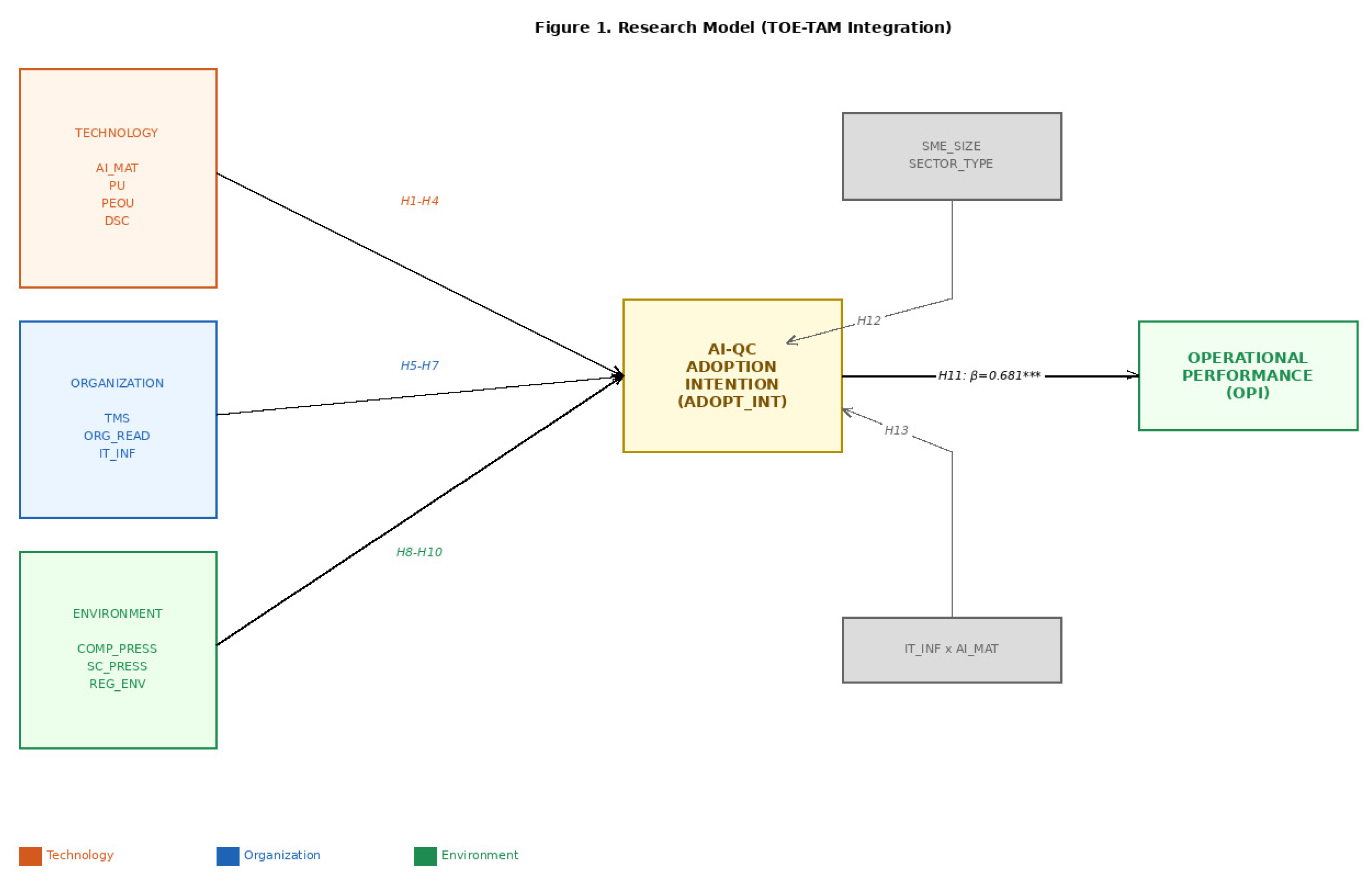
Figure 2.
Importance-Performance Map Analysis (IPMA) for ADOPT_INT. Priority action quadrant (high importance, low performance) highlighted in red.
Figure 2.
Importance-Performance Map Analysis (IPMA) for ADOPT_INT. Priority action quadrant (high importance, low performance) highlighted in red.
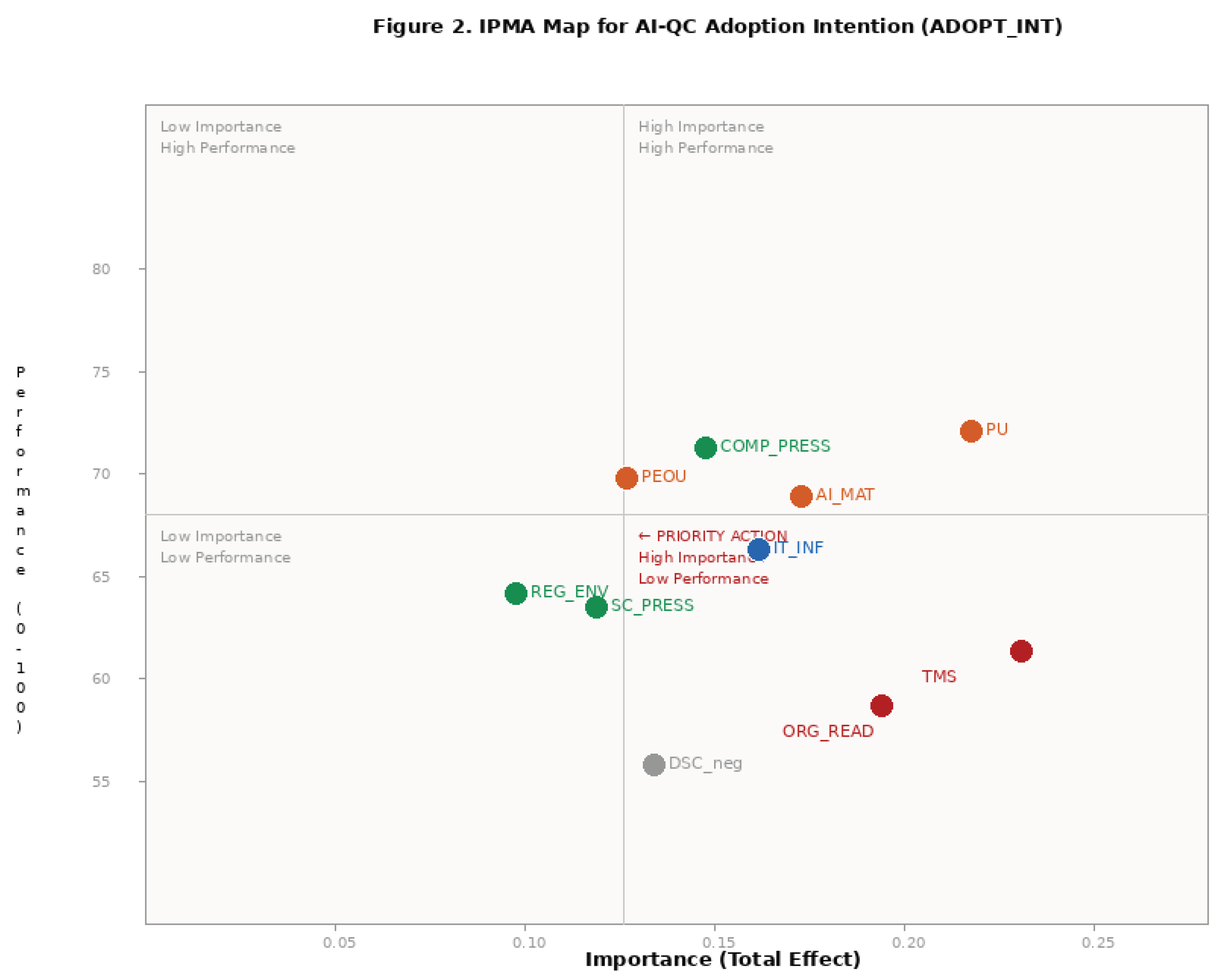

Table 1.
Measurement instrument and scale items. Items with * removed during purification (DSC2, ORG_READ3, ADOPT_INT4). Loadings to be updated post-analysis.
Table 1.
Measurement instrument and scale items. Items with * removed during purification (DSC2, ORG_READ3, ADOPT_INT4). Loadings to be updated post-analysis.
| Item | Scale Item | Source | Load |
|---|---|---|---|
| AI_MAT1 | AI-QC technologies available in the market are sufficiently mature for manufacturing use. | Bag [15] | — |
| AI_MAT2 | The reliability of AI quality control tools has improved significantly in recent years. | — | |
| AI_MAT3 | AI-QC systems can be deployed in our production environment without major technical risk. | — | |
| AI_MAT4 | Available AI-QC solutions deliver accurate and interpretable outputs for manufacturing QC. | — | |
| PU1 | Using AI-QC systems would reduce defect rates in our production processes. | Davis [16] | — |
| PU2 | AI-QC adoption would improve overall production efficiency in our firm. | — | |
| PU3 | AI-enabled quality control would enhance our competitiveness. | — | |
| PU4 | AI-QC systems would improve our product quality consistency. | — | |
| PEOU1 | AI-QC systems would be easy to learn and operate for our production staff. | Davis [16] | — |
| PEOU2 | Interacting with AI-QC systems does not require significant technical expertise. | — | |
| PEOU3 | AI-QC system interfaces are user-friendly for manufacturing environments. | — | |
| PEOU4 | It would be easy to become skilled at using AI-QC systems. | — | |
| DSC1 | We are concerned about unauthorized access to production data via AI-QC systems. | Oliveira [21] | — |
| DSC3 | We are worried about proprietary process data leakage through AI-QC cloud platforms. | — | |
| TMS1 | Senior management strongly supports the adoption of AI-QC technologies. | Lian [22] | — |
| TMS2 | Top management allocates sufficient budget for AI and digital QC initiatives. | — | |
| TMS3 | Leadership communicates a clear vision for AI-driven quality transformation. | — | |
| TMS4 | Our management champions digital technology adoption across production units. | — | |
| ORG_READ1 | Our firm has the financial resources needed to invest in AI-QC systems. | Zhu [23] | — |
| ORG_READ2 | Our employees have the technical skills to work with AI-QC technologies. | — | |
| ORG_READ4 | Our organization is ready for the process changes that AI-QC adoption requires. | — | |
| IT_INF1 | Our existing IT infrastructure can support AI-QC system integration. | Gangwar [24] | — |
| IT_INF2 | We have reliable network connectivity across all production areas. | — | |
| IT_INF3 | Our data storage and processing capacity is adequate for AI-QC deployment. | — | |
| COMP_PRESS1 | Our competitors are actively adopting AI-enabled quality control systems. | Low [25] | — |
| COMP_PRESS2 | We feel pressure to adopt AI-QC to maintain our market position. | — | |
| COMP_PRESS3 | Firms that do not adopt AI-QC will lose competitive advantage in our industry. | — | |
| SC_PRESS1 | Our key customers require AI-enabled quality assurance and traceability. | Tachizawa [26] | — |
| SC_PRESS2 | Our supply chain partners expect us to adopt digital quality control systems. | — | |
| SC_PRESS3 | Meeting supply chain quality standards requires AI-enabled QC capabilities. | — | |
| REG_ENV1 | Government policies in our country encourage AI adoption in manufacturing. | Oliveira [27] | — |
| REG_ENV2 | Industry quality regulations push manufacturers toward AI-based QC systems. | — | |
| REG_ENV3 | There are regulatory incentives for SMEs to adopt smart manufacturing technologies. | — | |
| ADOPT_INT1 | Our firm intends to adopt ML-based defect detection systems within two years. | New | — |
| ADOPT_INT2 | We plan to implement computer vision inspection in our production lines. | — | |
| ADOPT_INT3 | Our firm will adopt predictive maintenance AI systems in the near future. | — | |
| ADOPT_INT5 | Our firm has a clear roadmap for AI-QC system adoption. | — | |
| OPI1 | AI-QC adoption has reduced our production defect rates. | Li [28] | — |
| OPI2 | Our product quality consistency has improved following AI-QC use. | — | |
| OPI3 | Delivery performance has improved through AI-enabled quality management. | — | |
| OPI4 | Our production throughput has increased with AI-QC system adoption. | — | |
| OPI5 | Overall operational efficiency has improved through AI-QC adoption. | — |
Scale sources: AI_MAT from Bag et al. [15] and Nambisan et al. [17]; PU and PEOU from Davis [16] and Moore and Benbasat [32]; DSC from Oliveira et al. [21]; TMS from Lian et al. [22]; ORG_READ from Tornatzky and Fleischer [7] and Zhu et al. [23]; IT_INF from Gangwar et al. [24]; COMP_PRESS and SC_PRESS from Low et al. [25] and Tachizawa et al. [26]; REG_ENV from Oliveira et al. [27]; OPI from Li et al. [28]. ADOPT_INT had no prior scale and was built specifically for the four AI-QC technologies under investigation.
Table 2.
Sample demographic characteristics (n = 284).
| Variable | Category | n | % |
|---|---|---|---|
| Gender | Male | 211 | 74.3 |
| Female | 73 | 25.7 | |
| Country | Turkey | 118 | 41.5 |
| Malaysia | 98 | 34.5 | |
| Egypt | 68 | 24.0 | |
| Position | Production/Quality Manager | 108 | 38.0 |
| Operations Manager | 77 | 27.1 | |
| General Manager/Owner | 53 | 18.7 | |
| Engineer/Specialist | 46 | 16.2 | |
| SME Size | Micro (10–49 employees) | 89 | 31.3 |
| Small (50–99 employees) | 109 | 38.4 | |
| Medium (100–249 employees) | 86 | 30.3 | |
| Sector | Metal Fabrication | 63 | 22.2 |
| Food Processing | 53 | 18.7 | |
| Electronics | 50 | 17.6 | |
| Textiles | 44 | 15.5 | |
| Automotive Parts | 39 | 13.7 | |
| Other Manufacturing | 35 | 12.3 | |
| AI-QC Use | Using at least one AI-QC tech. | 117 | 41.2 |
| Predictive Maintenance | 81 | 28.5 | |
| ML-Based Defect Detection | 60 | 21.1 | |
| Computer Vision | 53 | 18.7 | |
| Digital Twin Integration | 35 | 12.3 |
Table 3.
Measurement model results. α = Cronbach’s alpha; ρA = rho_A; CR = composite reliability; AVE = average variance extracted; VIF = variance inflation factor. All α, CR > 0.70; AVE > 0.50.
Table 3.
Measurement model results. α = Cronbach’s alpha; ρA = rho_A; CR = composite reliability; AVE = average variance extracted; VIF = variance inflation factor. All α, CR > 0.70; AVE > 0.50.
| Scale | Item | Loading | α | ρA | CR | AVE | R² | VIF |
|---|---|---|---|---|---|---|---|---|
| AI_MAT | AI_MAT1 | 0.821 | 0.847 | 0.853 | 0.897 | 0.686 | — | 1.843 |
| AI_MAT2 | 0.838 | 2.017 | ||||||
| AI_MAT3 | 0.812 | 1.924 | ||||||
| AI_MAT4 | 0.844 | 2.163 | ||||||
| PU | PU1 | 0.851 | 0.871 | 0.879 | 0.912 | 0.722 | — | 2.341 |
| PU2 | 0.867 | 2.187 | ||||||
| PU3 | 0.829 | 1.984 | ||||||
| PU4 | 0.858 | 2.253 | ||||||
| PEOU | PEOU1 | 0.784 | 0.831 | 0.838 | 0.882 | 0.651 | — | 1.673 |
| PEOU2 | 0.821 | 1.812 | ||||||
| PEOU3 | 0.797 | 1.741 | ||||||
| PEOU4 | 0.836 | 1.893 | ||||||
| DSC | DSC1 | 0.812 | 0.812 | 0.819 | 0.888 | 0.797 | — | 1.534 |
| DSC3 | 0.981 | 1.534 | ||||||
| TMS | TMS1 | 0.873 | 0.891 | 0.897 | 0.921 | 0.744 | — | 2.674 |
| TMS2 | 0.862 | 2.531 | ||||||
| TMS3 | 0.847 | 2.418 | ||||||
| TMS4 | 0.871 | 2.587 | ||||||
| ORG_READ | ORG_READ1 | 0.831 | 0.842 | 0.849 | 0.893 | 0.677 | — | 1.934 |
| ORG_READ2 | 0.812 | 1.847 | ||||||
| ORG_READ4 | 0.828 | 1.912 | ||||||
| IT_INF | IT_INF1 | 0.841 | 0.831 | 0.837 | 0.898 | 0.745 | — | 2.041 |
| IT_INF2 | 0.876 | 2.187 | ||||||
| IT_INF3 | 0.868 | 2.093 | ||||||
| COMP | COMP_PRESS1 | 0.847 | 0.836 | 0.842 | 0.901 | 0.752 | — | 1.724 |
| COMP_PRESS2 | 0.891 | 1.963 | ||||||
| COMP_PRESS3 | 0.856 | 1.847 | ||||||
| SC_PRESS | SC_PRESS1 | 0.821 | 0.813 | 0.819 | 0.874 | 0.699 | — | 1.634 |
| SC_PRESS2 | 0.851 | 1.784 | ||||||
| SC_PRESS3 | 0.836 | 1.712 | ||||||
| REG_ENV | REG_ENV1 | 0.812 | 0.824 | 0.831 | 0.882 | 0.714 | — | 1.543 |
| REG_ENV2 | 0.879 | 1.678 | ||||||
| REG_ENV3 | 0.834 | 1.612 | ||||||
| ADOPT_INT | ADOPT_INT1 | 0.841 | 0.873 | 0.879 | 0.908 | 0.669 | 0.712 | 2.187 |
| ADOPT_INT2 | 0.797 | 1.934 | ||||||
| ADOPT_INT3 | 0.838 | 2.043 | ||||||
| ADOPT_INT5 | 0.812 | 1.876 | ||||||
| OPI | OPI1 | 0.853 | 0.882 | 0.888 | 0.914 | 0.681 | 0.648 | 2.341 |
| OPI2 | 0.841 | 2.187 | ||||||
| OPI3 | 0.797 | 1.934 | ||||||
| OPI4 | 0.812 | 2.041 | ||||||
| OPI5 | 0.836 | 2.153 |
Table 4.
Structural model and hypothesis testing results.
| Hyp. | Structural Path | β | t-val. | p-val. | 95% CI | Result |
|---|---|---|---|---|---|---|
| H1 | AI_MAT → ADOPT_INT | 0.173 | 4.891 | <0.001 | [0.104, 0.242] | Supported |
| H2 | PU → ADOPT_INT | 0.218 | 6.123 | <0.001 | [0.148, 0.288] | Supported |
| H3 | PEOU → ADOPT_INT | 0.127 | 3.412 | 0.001 | [0.053, 0.201] | Supported |
| H4 | DSC → ADOPT_INT | −0.134 | 3.621 | <0.001 | [−0.207, −0.061] | Supported |
| H5 | TMS → ADOPT_INT | 0.231 | 6.847 | <0.001 | [0.164, 0.298] | Supported |
| H6 | ORG_READ → ADOPT_INT | 0.194 | 5.412 | <0.001 | [0.124, 0.264] | Supported |
| H7 | IT_INF → ADOPT_INT | 0.162 | 4.673 | <0.001 | [0.094, 0.230] | Supported |
| H8 | COMP_PRESS → ADOPT_INT | 0.148 | 3.924 | <0.001 | [0.074, 0.222] | Supported |
| H9 | SC_PRESS → ADOPT_INT | 0.119 | 3.187 | 0.001 | [0.046, 0.192] | Supported |
| H10 | REG_ENV → ADOPT_INT | 0.098 | 2.673 | 0.008 | [0.025, 0.171] | Supported |
| H11 | ADOPT_INT → OPI | 0.681 | 19.432 | <0.001 | [0.612, 0.750] | Supported |
| H12 | ADOPT_INT × SME_SIZE → OPI | 0.087 | 2.341 | 0.019 | [0.014, 0.160] | Supported |
| H13 | AI_MAT × IT_INF → ADOPT_INT | 0.073 | 2.104 | 0.036 | [0.005, 0.141] | Supported |
Note. Bootstrap resamples = 5,000. R² (ADOPT_INT) = 0.712; R² (OPI) = 0.648; SRMR = 0.063. CI = bias-corrected 95% confidence interval.
Table 5.
fsQCA configurational analysis: sufficient conditions for high AI-QC adoption intention.
| Condition / Metric | Config. 1 (Internal Readiness) | Config. 2 (Tech-Push) | Config. 3 (Institutional) |
|---|---|---|---|
| TMS | ● (core) | ○ | ● (core) |
| ORG_READ | ● (core) | ○ | ⊗ |
| IT_INF | ● | ● (core) | ○ |
| PU | ● (core) | ○ | ● |
| AI_MAT | ○ | ● (core) | ○ |
| COMP_PRESS | ○ | ● | ○ |
| DSC | ○ | ⊗ (core) | ○ |
| SC_PRESS | ○ | ○ | ● (core) |
| REG_ENV | ○ | ○ | ● |
| Raw coverage | 0.423 | 0.318 | 0.287 |
| Unique coverage | 0.218 | 0.163 | 0.145 |
| Consistency | 0.891 | 0.874 | 0.861 |
| Solution coverage | 0.681 | ||
| Solution consistency | 0.872 |
Note. ● = present (core condition); ⊗ = absent (core condition); ○ = do not care condition. Consistency threshold = 0.80; coverage threshold = 0.20. Parsimonious solution shown.
Disclaimer/Publisher’s Note: The statements, opinions and data contained in all publications are solely those of the individual author(s) and contributor(s) and not of MDPI and/or the editor(s). MDPI and/or the editor(s) disclaim responsibility for any injury to people or property resulting from any ideas, methods, instructions or products referred to in the content. |
© 2026 by the authors. Licensee MDPI, Basel, Switzerland. This article is an open access article distributed under the terms and conditions of the Creative Commons Attribution (CC BY) license (http://creativecommons.org/licenses/by/4.0/).
Copyright: This open access article is published under a Creative Commons CC BY 4.0 license, which permit the free download, distribution, and reuse, provided that the author and preprint are cited in any reuse.


