

Submitted:
28 May 2026
Posted:
29 May 2026
You are already at the latest version
Abstract
Light-converting polymer coatings and films are emerging passive photonic materials for spectral engineering in sustainable and protected agriculture. By absorbing ultraviolet or weakly used spectral components and re-emitting in visible bands that overlap with photosynthetic pigments and plant photoreceptor action regions, these materials can modify the radiation environment without additional electrical energy input. This critical review analyses light-converting polymer films and coatings from a materials and coatings perspective, with emphasis on photophysical mechanisms, polymer matrices, luminophore families, coating fabrication routes, optical transparency, photoluminescence, aggregation phenomena, photostability and scalability. The photobiological background is included as a concise framework that justifies the spectral targets of the conversion process. Rare-earth complexes, inorganic phosphors, quantum dots, aggregation-induced-emission systems and organic dyes are compared as candidate luminophores. Particular attention is paid to an author-developed perylene diimide (PDI)-modified poly(methyl methacrylate) (PMMA) solution-cast coating system, used here as a representative case study to discuss dispersion, optical homogeneity and aggregation-related losses. Extrusion, solution casting, spin-coating, dip-coating and sol–gel processing are evaluated as fabrication strategies for laboratory and large-area greenhouse applications. The work concludes by identifying the main gaps that must be addressed before practical deployment: quantitative UV–Vis and photoluminescence characterization, absolute quantum yield, haze and scattering, thickness and morphology mapping, accelerated UV ageing, weathering resistance, toxicity assessment and crop-specific validation.
Keywords:
light-converting coatings
; polymer coatings
; PMMA
; perylene diimide
; photoluminescence
; UV-to-red conversion
; spectral engineering
; greenhouse coatings
; photostability
; aggregation-induced quenching
; sustainable agriculture
1. Introduction and Scope of the Review
Spectral engineering is becoming an increasingly important strategy in controlled-environment and protected agriculture. Light is both an energy source for photosynthetic carbon fixation and a signal that regulates plant architecture, pigment biosynthesis, flowering and stress adaptation. The spectral distribution reaching a crop therefore affects not only biomass formation, but also quality parameters such as coloration, phenolic compounds, antioxidant capacity and fruit or leaf composition [1,2,3,4,5].
Plant responses to ultraviolet (UV), visible and infrared radiation provide the biological motivation for spectral conversion technologies. However, this background is treated here in a concise form, since the main focus of the review is the design of polymer films and coatings capable of modifying incident radiation through optical absorption, emission, scattering and transmission control [6,7,8,9].
Light-converting films are particularly attractive because they operate passively: they absorb photons in spectral regions that are poorly used or potentially damaging and re-emit photons in more useful visible bands. In greenhouse applications, this idea translates into the possibility of converting UV radiation or part of the green-yellow spectral region into blue, red or red-orange light, where photosynthetic pigments and photoreceptors show strong responses [1,6,7,8].
An author-developed PMMA/PDI solution-cast coating system is used as a representative case study to illustrate how organic luminophores can be incorporated into transparent polymer matrices while controlling aggregation and photodegradation [9,10,11,12]. A conceptual illustration of the spectral conversion mechanism in PMMA/PDI light-converting coatings and its influence on the radiation reaching the plant canopy is shown in Figure 1.
In addition to material selection, particular emphasis must be placed on coating-related aspects, including film architecture, thickness control, interfacial phenomena, adhesion to substrates, and surface-induced optical effects [13,14,15]. These parameters are critical for the translation of light-converting materials from laboratory-scale demonstrations to functional greenhouse coatings, where uniformity, durability, and large-area performance become decisive factors.
2. Photobiological Motivation for Agricultural Spectral Conversion
The biologically relevant solar spectrum extends approximately from the UV region to the far-red, with visible radiation forming the photosynthetically active radiation (PAR) window. Chlorophyll a and b show strong absorption in the blue and red spectral regions. Carotenoids assist light harvesting and protect photosystems by dissipating excess energy. This explains why red and blue wavelengths are frequently targeted in artificial lighting and spectral conversion technologies [1,6].
In addition to photosynthetic pigments, plants possess specialized photoreceptors that detect light quality and regulate development. Phytochromes respond mainly to red and far-red light, cryptochromes and phototropins respond primarily to blue/UV-A radiation, and UVR8 acts as a UV-B receptor involved in protective responses [2,3,4,5]. This network allows plants to interpret spectral composition, intensity, direction and photoperiod.
Anthocyanins and flavonoids represent a functionally important class of secondary metabolites whose biosynthesis is strongly modulated by spectral composition and thermal conditions. Anthocyanins contribute not only to pigmentation but also to photoprotection through light attenuation and reactive oxygen species (ROS) scavenging. Flavonoids play a complementary role in UV screening, antioxidant defense, and the regulation of quality-related attributes in horticultural products. Numerous studies indicate that blue and UV radiation stimulate phenolic metabolism, whereas red light predominantly enhances photosynthetic efficiency and carbohydrate accumulation, thereby demonstrating the spectral selectivity of plant metabolic responses [16,17,18].
For a coatings-focused review, the key point is that the biological response is crop-specific and depends on the emitted spectrum, light intensity, season, plant developmental stage and target organ. Therefore, the performance of a light-converting film cannot be inferred solely from its emission color; it must be evaluated through quantitative spectral overlap, transmitted PAR, photoluminescence efficiency and biological response under defined environmental conditions [16,19,20].
3. Photophysical Principles of Light-Converting Coatings
The fundamental mechanism of wavelength-converting coatings is photoluminescence (Figure 2). A luminophore absorbs a photon of relatively high energy and re-emits at a longer wavelength after non-radiative vibrational relaxation. The energy difference between the absorption and emission maxima is the Stokes shift. A large Stokes shift is advantageous because it reduces self-absorption and improves the probability that emitted photons escape from the film and reach the plant canopy [11,12,13].
For agricultural coatings, photophysical performance cannot be reduced to the emission maximum alone. The relevant parameters include the absorption spectrum, transmission spectrum, excitation spectrum, emission spectrum, absolute photoluminescence quantum yield, fluorescence lifetime, angular emission distribution, haze, scattering and photobleaching under solar exposure. Optical losses by reflection, scattering, self-absorption and parasitic absorption in the matrix must be minimized [21].
A useful material should combine high transparency in the visible range with selective absorption in UV or weakly useful spectral regions. It should also maintain the thermal and mechanical behavior required for greenhouse films. In practice, this creates a trade-off between luminophore concentration, film thickness, converted-light intensity and optical clarity. Too little luminophore yields weak conversion, whereas too much luminophore can generate aggregation, quenching, color saturation and loss of transparency [22].
For a rigorous materials and coatings analysis, these requirements must be expressed through measurable and comparable descriptors. Key performance parameters include average visible transmittance, UV shielding efficiency, photoluminescence quantum yield, haze factor, emission stability under accelerated aging, and retention of mechanical integrity after environmental exposure. The use of such quantitative metrics enables objective comparison between different material systems and supports the rational design of light-converting coatings for practical greenhouse applications [23].
4. Luminescent Materials for Agricultural Photoconversion
Several families of photoluminescent materials have been proposed for agricultural spectral conversion. Rare-earth complexes, inorganic phosphors, quantum dots, aggregation-induced emission (AIE) luminogens and organic fluorescent dyes each offer specific advantages and limitations [24]. A comparative overview of luminophore families used in agricultural light-converting coatings, including their advantages, limitations, and recommended characterization methods, is summarized in Table 1.
Rare-earth complexes, particularly Eu3+-based systems, are attractive because Eu3+ emits narrow red bands, the most intense one being the 5D0→7F2 transition centred near 612–615 nm, which overlaps with the red region relevant to photosynthesis [14,15]. Organic ligands can act as antennae by absorbing UV light and transferring energy to the rare-earth ion. These systems can show high colour purity and good thermal stability, but they may require complex synthesis and careful compatibility control within polymer matrices [25].
Inorganic phosphors can provide high thermal and photochemical stability, but particle dispersion, scattering and haze are critical issues in transparent greenhouse films. Nanoparticle size, refractive-index mismatch and surface functionalization strongly influence whether a phosphor-containing coating remains optically useful [26].
Quantum dots offer tunable emission and high absorption coefficients, but many high-performance systems contain Cd, Pb or other heavy metals. Their use in agriculture raises environmental safety concerns, particularly if polymer degradation, abrasion or end-of-life disposal could release nanomaterials into soil or water [27].
Organic dyes offer low-temperature processability and compatibility with solution-based coating methods. Among them, perylene diimide (PDI) derivatives are especially relevant because of their strong absorption, high fluorescence efficiency, chemical robustness and ability to generate red or orange emission [16,17]. However, PDI molecules tend to form π–π stacking aggregates, which reduce fluorescence efficiency and increase optical heterogeneity.
AIE materials address one of the central problems of conventional organic dyes by maintaining or increasing emission in the aggregated state [18]. This makes them promising for solid-state polymer coatings, although their agricultural use remains less mature than more conventional dye or rare-earth systems.
5. Polymer Matrices and Coating Requirements
The polymer matrix is not a passive container. It determines transparency, mechanical integrity, water and oxygen permeability, UV resistance, processability, weathering durability and the local environment of the luminophore. The interaction between matrix and luminophore directly affects aggregation, phase separation, non-radiative decay and long-term stability [28]. A comparison of polymer matrices commonly applied in light-converting coatings and their corresponding functional properties is presented in Table 2.
Polyethylene (PE) and polypropylene (PP) remain dominant in agricultural covering materials because of their low cost, flexibility and industrial scalability. They can be modified with UV stabilizers, antioxidants and photoconversion additives. However, both materials are susceptible to photooxidative degradation under prolonged UV exposure, leading to embrittlement, discoloration and changes in optical performance [29].
PMMA is an attractive matrix for advanced photonic films because of its high visible transparency, good optical quality and compatibility with organic dyes and rare-earth complexes. PMMA is known to provide visible transmittance values above 90%, facilitate film-thickness control and enable solution processing. These properties are relevant for PMMA/PDI systems, where molecular dispersion and optical clarity are crucial [30].
Biopolymers such as PLA, cellulose derivatives, chitosan and starch-based materials are increasingly relevant for sustainability. Their advantages include renewable origin and potential biodegradability. Their limitations include moisture sensitivity, reduced mechanical performance, lower thermal stability and less predictable compatibility with hydrophobic luminophores. Hybrid strategies may be necessary to combine sustainability with optical performance [31].
Particular emphasis is placed on coating architecture as much as bulk film composition. Functional greenhouse materials can be designed as single-layer luminescent films, coated commercial films, multilayer structures combining optical and mechanical functions, or multifunctional photonic coatings that integrate spectral conversion, anti-reflection, thermal insulation and self-cleaning behavior [32].
6. Fabrication Routes: From Laboratory Films to Scalable Coatings
6.1. Fabrication Techniques
The main fabrication routes for light-converting coatings include extrusion, solution casting, spin-coating, dip-coating, and sol–gel processing. From a coatings perspective, these methods should be evaluated not only in terms of laboratory feasibility, but also with respect to scalability, coating uniformity, thickness control, and compatibility with industrial greenhouse film production. Particular attention must be given to the ability of each method to ensure homogeneous luminophore dispersion, minimize aggregation, and maintain optical clarity over large areas [33].
Extrusion and blown-film processing are the most relevant industrial routes for agricultural films. They are compatible with PE and PP production lines, but high processing temperatures may degrade organic luminophores or promote phase separation. Achieving homogeneous dispersion during melt processing remains a key challenge [34].
Solution casting is particularly useful for laboratory-scale films and for systems requiring molecular-level dispersion. The PMMA/PDI system discussed in this review belongs to this category. The polymer and luminophore are dissolved or dispersed in a suitable solvent, deposited on a substrate and dried under controlled conditions. This route allows careful control of solvent evaporation, thickness and additive distribution [35]. A summary of fabrication methods used for the preparation of light-converting films and coatings, together with their advantages and limitations, is provided in Table 3.
Spin-coating produces thin, smooth and highly uniform films with thicknesses from tens of nanometers to a few micrometers. It is ideal for fundamental optical characterization on glass or quartz substrates, but is poorly suited to large-area greenhouse films because of limited scalability and high material loss [36].
Dip-coating is a scalable method for applying functional layers to pre-existing films. The coating thickness is controlled by solution viscosity, withdrawal speed, number of cycles and drying conditions. Recent multifunctional greenhouse coatings use sequential dip-coating to combine luminescent and anti-reflective layers [37].
Sol-gel processing is valuable for hybrid organic-inorganic coatings and rare-earth or silica-based systems. It enables control of porosity, network structure and luminophore encapsulation. However, cracking, brittleness and processing complexity must be considered for flexible agricultural films [38].
6.2. Coating Architectures and Layer Design
The performance of light-converting systems in greenhouse applications is not solely determined by material composition, but also by coating architecture and layer design. Several structural configurations can be distinguished, including single-layer luminescent films, coated commercial substrates, and multilayer architectures integrating distinct optical and protective functions [39].
Single-layer systems offer simplicity but often suffer from trade-offs between optical conversion efficiency and transparency. Coated systems, where a functional luminescent layer is deposited onto a commercial polymer film (e.g., PE or PP), provide a more flexible approach by decoupling mechanical and optical functions [40].
Multilayer architectures represent the most advanced strategy, typically combining a UV-filtering layer, a luminescent conversion layer, and an anti-reflective or protective top layer. Such configurations enable optimization of spectral conversion while maintaining high total transmittance and environmental stability.
However, these systems introduce additional challenges, including interfacial adhesion, refractive index mismatch, layer compatibility, and mechanical integrity under bending and environmental stress. Furthermore, thickness uniformity and surface roughness play a critical role in minimizing scattering losses and ensuring reproducible optical performance over large areas [41].
Therefore, coating architecture must be considered a central design parameter rather than a secondary aspect of material development.
7. PMMA/PDI Solution-Cast Coatings as an Author-Developed Case Study
To illustrate the design and processing challenges associated with organic light-converting polymer coatings, this section presents a PMMA/PDI solution-cast coating system developed by the authors as a representative case study. This case study is not intended to constitute a complete experimental article, but rather to provide a practical example of how luminophore dispersion, aggregation control, optical transparency and photostability can be addressed within the broader framework of light-converting coatings for agricultural spectral engineering.
In the case study considered here, PMMA was dissolved in ethyl acetate (analytical grade) at concentrations typically in the range 5–15 wt% under continuous stirring for 2–4 h at ambient temperature until a clear solution is obtained.
PDI was dissolved separately at low concentrations (typically 0.01–0.5 wt%) and subjected to ultrasonication (15–30 min) to reduce pre-existing aggregates and promote molecular dispersion. The PDI solution was then gradually introduced into the PMMA solution under stirring.
To improve photostability, a stabilizer package consisting of a hindered amine light stabilizer (HALS, 0.2–0.5 wt%) and a UV absorber (0.1–0.3 wt%) is commonly incorporated. Degassing prior to casting was applied to eliminate dissolved gases and prevent bubble formation.
Coatings with thicknesses of approximately 80–120 μm were obtained by the doctor-blade method on glass substrates, adjusting the blade gap to control film thickness. Drying is generally performed in two stages: initial solvent evaporation at room temperature followed by a mild thermal treatment at 40–60 °C to reduce internal stress and limit phase separation. This procedure yielded optically homogeneous coatings suitable for subsequent photophysical characterization.
Optical-grade PMMA is selected as the matrix due to its high transparency, low intrinsic absorption in the visible region, and compatibility with organic luminophores such as PDI. The selected solvent system and processing conditions are optimized to minimize aggregation, ensure uniform film formation, and maintain the optical clarity required for photonic coating applications. An example of the optical appearance and concentration-dependent luminescent behavior of PMMA/PDI coatings under ambient and UV illumination is presented in Figure 3.
Degassing prior to film formation is essential to remove dissolved gases and prevent microbubble formation, which can otherwise introduce scattering centers and reduce optical uniformity.
8. Optical Characterization Protocols
UV–Vis transmittance and absorbance spectra should be recorded over the 190–1100 nm range for the polymer matrix, substrate, PMMA/PDI coatings and reference agricultural films. From these spectra, key optical parameters – average visible transmittance, UV-blocking efficiency and photosynthetically active radiation (PAR) transmittance – can be derived. Spectral features such as shifts in absorption bands and changes in intensity provide insight into the interaction between the polymer matrix and the luminophore. In the PMMA/PDI case study, representative UV-Vis transmission spectra and chromophore-based interpretation are shown in Figure 4.
Steady-state photoluminescence emission spectra are commonly acquired under 365 nm excitation, while excitation spectra are recorded by monitoring the main emission wavelength. These measurements verify the ability of the films to convert ultraviolet radiation into visible emission and provide insight into the efficiency of spectral conversion within the targeted absorption range.
The absolute photoluminescence quantum yield is best determined using an integrating sphere, which provides a reliable evaluation of conversion efficiency independent of measurement geometry and film thickness.
Haze and total/diffuse transmittance should also be measured, since controlled light scattering can enhance light distribution in greenhouse environments, whereas excessive scattering reduces optical clarity and limits spectral control.
CIE chromaticity coordinates and color-conversion efficiency are useful descriptors to compare PDI-based systems with alternative luminophore systems such as Eu3+ complexes. The use of such descriptors improves comparability with existing photonic materials and allows a more rigorous evaluation of structure–property relationships.
Overall, the combination of spectroscopic and optical measurements summarised above provides a comprehensive assessment of the performance of light-converting coatings and supports the correlation between material composition, optical behaviour and potential applicability in greenhouse conditions, as illustrated in Figure 5. Reported results typically highlight the influence of luminophore type and concentration on emission characteristics, optical transparency and overall spectral conversion efficiency.
The key performance metrics and characterization methods relevant to light-converting coatings are summarized in Table 4.
Without the implementation of standardized and quantitative characterization protocols, comparison between different material systems remains ambiguous. This significantly limits the reproducibility of results and their transferability to real greenhouse applications, where optical performance must be maintained over large areas and extended operational periods.
9. Morphology, Thickness and Surface Characterization
For coatings-oriented agricultural photonic materials, morphology and surface quality must be considered fundamental parameters governing transparency, spectral conversion efficiency, scattering behavior, and long-term operational stability. Therefore, rigorous morphological characterization is essential for establishing reliable structure–property relationships in light-converting polymer coatings. Particular attention should be paid to coating homogeneity, thickness distribution, surface roughness, interfacial quality, and the presence of microstructural defects, since these factors directly influence light propagation, photoluminescence performance, and environmental durability under greenhouse operating conditions [42].
Thickness should be measured at multiple positions using profilometry, micrometry, or cross-sectional microscopy. Optical profilometry is particularly useful for these coatings because it enables non-contact mapping of thickness variations, surface waviness and local defects over relatively large areas. In solution-cast films, thickness variations are expected to influence absorption behavior, emission intensity, and mechanical integrity. Therefore, reporting only nominal thickness values is insufficient for rigorous comparison between different coating systems [43].
Scanning electron microscopy (SEM) analyses of the surface and the cross-section can reveal cracks, pores, phase-separated domains and luminophore aggregates. Complementary atomic force microscopy (AFM) or optical profilometry measurements can be used to quantify roughness, waviness and local surface defects. These analyses are particularly important because optical losses in transparent coatings frequently originate from microstructural imperfections rather than from intrinsic molecular absorption alone [44].
Fourier-transform infrared (FTIR) spectroscopy is recommended to confirm the presence of PMMA, stabilizers and dye-related functional groups, as well as to detect possible intermolecular interactions or degradation after UV exposure. In addition, differential scanning calorimetry (DSC) and thermogravimetric analysis (TGA) provide complementary information on thermal stability and resistance to the temperature fluctuations expected inside a greenhouse [45].
Overall, these characterization methods are especially important for functional coating systems, where surface morphology and interfacial properties often determine photonic performance, environmental stability, and long-term durability.
10. Photostability, Weathering and Degradation Mechanisms
Photostability represents a critical limitation for light-converting coatings intended for agricultural applications. Degradation processes such as luminophore photobleaching, polymer photooxidation, and loss of emission intensity significantly affect long-term performance. These mechanisms must be systematically investigated using controlled aging protocols in order to ensure the reliability of coatings under prolonged environmental exposure.
Organic luminophores may undergo photobleaching under prolonged UV irradiation. In polymer matrices, oxygen diffusion, moisture, radical formation and local heating can accelerate degradation [46]. PDI derivatives are often more stable than many conventional dyes, but their stability must still be demonstrated under realistic or accelerated aging conditions.
A minimum aging protocol should include controlled UV-A irradiation, periodic UV-Vis and photoluminescence measurements, visual inspection, color coordinates, haze, and mechanical integrity. Results should be expressed as retention of emission intensity, retention of visible transparency and changes in absorption bands as a function of exposure time [47].
For greenhouse use, weathering tests should also consider humidity, temperature cycling, water condensation and abrasion. The stabilizer package - HALS plus UV absorber - is a promising approach, but its effect should be quantified by comparing stabilized and unstabilized films.
However, most reported studies remain limited to short-term observations under controlled laboratory conditions. Long-term degradation under combined UV radiation, humidity, temperature cycling, condensation and mechanical stress remains insufficiently understood. This lack of comprehensive weathering data is one of the main barriers to the large-scale implementation of light-converting agricultural coatings [48].
11. Multifunctional Photonic Coatings for Greenhouse Coverings
Recent work has moved beyond single-function light-converting films toward multifunctional photonic coatings. These systems combine spectral conversion with anti-reflective behaviour, thermal insulation, dust resistance or self-cleaning properties. From a coatings-engineering perspective, this direction is particularly significant because it links material composition, surface engineering and real operating conditions in a unified design framework.
A representative approach uses a light-converting layer containing blue and red luminophores and an anti-reflective layer based on hollow silica nanoparticles. Such architectures can improve visible transmittance, reduce reflection losses and modify greenhouse microclimate. The important lesson for the present review is that spectral conversion should not be considered in isolation: a coating that emits useful light but reduces total transmitted PAR may not improve crop performance.
The future of agricultural photonic films will likely involve multilayer structures in which each layer performs a specific function: mechanical support, UV filtering, spectral conversion, anti-reflection, anti-fogging, self-cleaning or thermal regulation. Compatibility between layers, adhesion, flexibility and durability must therefore be included in the design criteria [49,50,51].
12. Reported Plant Responses and Interpretation Limits
Although this review is primarily focused on materials and coating design, it is essential to retain a concise discussion of plant responses, as the ultimate application of light-converting films is agricultural. Reported studies indicate that such films can influence biomass accumulation, leaf area development, chlorophyll content, and the synthesis of secondary metabolites including soluble sugars, vitamin C, lycopene, phenolics, and flavonoids, depending on spectral properties and crop type [52].
However, these biological responses are highly context-dependent and cannot be generalized. Films that demonstrate positive effects under low-light or winter conditions may exhibit negligible or inconsistent performance under high irradiance environments. Furthermore, spectral selectivity plays a decisive role: red-emitting systems tend to enhance photosynthetic efficiency and carbohydrate accumulation, whereas blue-emitting systems more strongly affect plant morphology, stomatal regulation, and secondary metabolism.
Therefore, conclusions regarding the agricultural performance of light-converting coatings must remain conservative. These materials should be considered as spectral management tools whose effectiveness depends on crop species, growth stage, seasonal conditions, greenhouse configuration, baseline solar spectrum, and long-term material stability. Consequently, it is not appropriate to assume that UV-to-red or UV-to-blue conversion universally leads to yield improvement without crop-specific validation [53,54,55,56]. An illustrative example of the practical implementation of light-converting films in greenhouse conditions and their influence on plant growth is presented in Figure 6.
13. Key Challenges and Research Gaps
The state of the art suggests several unresolved challenges. First, compatibility between luminophore and polymer matrix remains a central issue. Poor compatibility generates aggregation, quenching, scattering and unstable optical performance.
Second, long-term photostability under realistic greenhouse exposure is still insufficiently documented. Many studies report initial spectra and short-term plant response, but fewer quantify emission retention after months of irradiation, weathering or cleaning cycles.
Third, cost and scalability are not always addressed. A material with excellent photoluminescence may be impractical if it requires expensive rare-earth complexes, toxic quantum dots, complex synthesis or non-scalable deposition methods.
Fourth, there is no standardized performance metric for agricultural photoconversion coatings. Future studies should report common descriptors such as average PAR transmittance, UV-to-visible conversion efficiency, quantum yield, haze, emission retention after aging, and crop-response data normalized to incident photon flux.
Finally, environmental safety and end-of-life management need more attention. For large-area agricultural coatings and greenhouse films, additives may eventually enter waste streams. Metal-containing or nanoparticle-based systems require particular caution [57,58].
To improve comparability between studies and accelerate the translation of laboratory coatings into greenhouse applications, future reports should include a minimum set of optical, morphological, stability and biological descriptors. Table 5 summarizes a proposed reporting checklist for light-converting agricultural coatings.
The adoption of such reporting criteria would help distinguish intrinsically efficient photoconversion materials from coatings that merely show visually attractive luminescence but lack sufficient transparency, stability, scalability or agronomic relevance.
14. Conclusions
Light-converting polymer coatings represent a promising route for passive spectral management in sustainable agriculture. The main scientific contribution of this review is the connection between photophysical material design, coating fabrication, polymer–luminophore compatibility and greenhouse application requirements.
The PMMA/PDI solution-cast system considered in this review is a useful case study because it addresses several key issues: organic UV-to-red conversion, transparent polymer matrices, ultrasonic dispersion, stabilizer addition, degassing and controlled drying. These elements can be positioned as practical strategies to improve optical homogeneity and reduce aggregation-related losses.
Future research should prioritize the integration of material development with real greenhouse validation, including seasonal variability, solar spectrum dynamics, and long-term environmental exposure. Only through such combined material–application studies can light-converting coatings transition from laboratory concepts to reliable agricultural technologies.
At the current stage, moving from laboratory-scale demonstrations to industrial greenhouse applications requires not only improved material performance, but also standardised evaluation protocols and long-term validation under realistic operating conditions. Future work should therefore bridge the gap between laboratory-scale optical performance and real greenhouse implementation by integrating coating design, material stability and crop-specific validation in a single, coherent framework.
Author Contributions
Conceptualization, A.Zh.; methodology, A.M. and D.K.; investigation, A.S., M.A. and A.B.; writing—original draft preparation, D.K. and A.S.; writing—review and editing, J.M. and A.Zh.; visualization, A.S.; supervision, A.Zh. All authors have read and agreed to the published version of the manuscript.
Funding
This research was funded by the Committee of Science of the Ministry of Science and Higher Education of the Republic of Kazakhstan (Grant No. AP26195823).
Institutional Review Board Statement
Not applicable.
Informed Consent Statement
Not applicable.
Data Availability Statement
The original contributions presented in this study are included in the article. Further inquiries can be directed to the corresponding authors.
Conflicts of Interest
The authors declare that they have no known competing financial interests or personal relationships that could have appeared to influence the work reported in this paper.
References
- McCree, K.J. The action spectrum, absorptance and quantum yield of photosynthesis in crop plants. Agric. Meteorol. 1972, 9, 191–216. [Google Scholar] [CrossRef]
- Chen, M.; Chory, J.; Fankhauser, C. Light signal transduction in higher plants. Annu. Rev. Genet. 2004, 38, 87–117. [Google Scholar] [CrossRef] [PubMed]
- Christie, J.M. Phototropin blue-light receptors. Annu. Rev. Plant Biol. 2007, 58, 21–45. [Google Scholar] [CrossRef] [PubMed]
- Franklin, K.A.; Quail, P.H. Phytochrome functions in Arabidopsis development. J. Exp. Bot. 2010, 61, 11–24. [Google Scholar] [CrossRef] [PubMed]
- Kami, C.; Lorrain, S.; Hornitschek, P.; Fankhauser, C. Light-regulated plant growth and development. Curr. Top. Dev. Biol. 2010, 91, 29–66. [Google Scholar] [CrossRef] [PubMed]
- Hogewoning, S.W.; Trouwborst, G.; Maljaars, H.; Poorter, H.; van Ieperen, W.; Harbinson, J. Blue light dose-responses of leaf photosynthesis, morphology, and chemical composition of Cucumis sativus. J. Exp. Bot. 2010, 61, 3107–3117. [Google Scholar] [CrossRef] [PubMed]
- Ouzounis, T.; Rosenqvist, E.; Ottosen, C.O. Spectral effects of artificial light on plant physiology and secondary metabolism: a review. HortScience 2015, 50, 1128–1135. [Google Scholar] [CrossRef]
- Kotilainen, T.; Robson, T.M.; Hernandez, R. Light quality characterization under climate screens and shade nets for controlled-environment agriculture. Environ. Exp. Bot. 2018, 154, 49–62. [Google Scholar] [CrossRef]
- Gould, K.S. Nature’s Swiss Army Knife: the diverse protective roles of anthocyanins in leaves. J. Biomed. Biotechnol. 2004, 314–320. [Google Scholar] [CrossRef] [PubMed]
- Chalker-Scott, L. Environmental significance of anthocyanins in plant stress responses. Photochem. Photobiol. 1999, 70, 1–9. [Google Scholar] [CrossRef]
- Meinardi, F.; Bruni, F.; Brovelli, S. Luminescent solar concentrators for building-integrated photovoltaics. Nat. Rev. Mater. 2017, 2, 17072. [Google Scholar] [CrossRef]
- Parrado, C.; et al. Photoluminescent materials for greenhouse spectral management. Mater. Today Energy 2020, 17, 100405. [Google Scholar] [CrossRef]
- Casieri, C.; et al. Blue luminescent greenhouse films for agriculture. J. Lumin. 2008, 128, 1806–1811. [Google Scholar] [CrossRef]
- Eliseeva, S.V.; Bunzli, J.C.G. Lanthanide luminescence for functional materials and bio-sciences. Chem. Soc. Rev. 2010, 39, 189–227. [Google Scholar] [CrossRef] [PubMed]
- Bunzli, J.C.G. Lanthanide luminescence for biomedical analyses and imaging. Chem. Rev. 2010, 110, 2729–2755. [Google Scholar] [CrossRef] [PubMed]
- Wurthner, F. Perylene bisimide dyes as versatile building blocks for functional supramolecular architectures. Chem. Commun. 2004, 1564–1579. [Google Scholar] [CrossRef] [PubMed]
- Wurthner, F.; et al. Perylene bisimide dye assemblies as archetype functional supramolecular materials. Chem. Rev. 2016, 116, 962–1052. [Google Scholar] [CrossRef] [PubMed]
- Mei, J.; Leung, N.L.C.; Kwok, R.T.K.; Lam, J.W.Y.; Tang, B.Z. Aggregation-induced emission: together we shine, united we soar. Chem. Rev. 2015, 115, 11718–11940. [Google Scholar] [CrossRef] [PubMed]
- Hemming, S.; Dueck, T.; Janse, J.; van Noort, F. The effect of diffuse light on crops. Acta Hortic. 2006, 711, 129–134. [Google Scholar] [CrossRef]
- He, J.; et al. Multifunctional photonic films for greenhouse coverings. Prog. Org. Coat. 2025. [Google Scholar] [CrossRef]
- Shoji, S.; Saito, H.; Jitsuyama, Y.; Tomita, K.; Haoyang, Q.; Sakurai, Y.; Okazaki, Y.; Aikawa, K.; Konishi, Y.; Sasaki, K.; Fushimi, K.; Kitagawa, Y.; Suzuki, T.; Hasegawa, Y. Plant growth acceleration using a transparent Eu3+-painted UV-to-red conversion film. Sci. Rep. 2021, 11, 1–10. [Google Scholar] [CrossRef]
- Jansen, M.A.K.; Gaba, V.; Greenberg, B.M. Higher plants and UV-B radiation: balancing damage, repair and acclimation. Trends Plant Sci. 1998, 3, 131–135. [Google Scholar] [CrossRef]
- Hideg, E.; Jansen, M.A.K.; Strid, A. UV-B exposure, ROS, and stress: inseparable companions or loosely linked associates? Trends Plant Sci. 2013, 18, 107–115. [Google Scholar] [CrossRef] [PubMed]
- Caldwell, M.M.; Bornman, J.F.; Ballare, C.L.; Flint, S.D.; Kulandaivelu, G. Terrestrial ecosystems, increased solar ultraviolet radiation, and interactions with other climate change factors. Photochem. Photobiol. Sci. 2007, 6, 252–266. [Google Scholar] [CrossRef] [PubMed]
- Ni, Y.; Tao, J.; Jin, J.; Liu, Y.; Wang, J.; Xu, Z. An investigation of the effect of ligands on thermal stability of luminescent samarium complexes. J. Alloys Compd. 2014, 612, 349–354. [Google Scholar] [CrossRef]
- Yen, W.M.; Weber, M.J. Inorganic Phosphors: Compositions, Preparation and Optical Properties; CRC Press: Boca Raton, FL, USA, 2004; p. 496 p. [Google Scholar] [CrossRef]
- Agarwal, K.; Rai, H.; Mondal, S. Quantum dots: An overview of synthesis, properties, and applications. Mater. Res. Express 2023, 10(6), 062001. [Google Scholar] [CrossRef]
- Haskal, E.I.; Buechel, M.; Duineveld, P.; Sempel, A.; et al. Passive-Matrix Polymer Light-Emitting Displays. MRS Bull. 2002, 27(11), 864–869. [Google Scholar] [CrossRef]
- Graziano, A.; Jaffer, S.; Sain, M. Review on modification strategies of polyethylene/polypropylene immiscible thermoplastic polymer blends for enhancing their mechanical behavior. J. Elastomers Plast. 2018, 51(4), 009524431878380. [Google Scholar] [CrossRef]
- Al-Kadhemy, M.F.H.; Abaas, W.H. Optical properties of crystal violet doped polymethyl methacrylate (PMMA) films. Res. Rev. Polym. 2013, 4(2), 45–51. [Google Scholar] [CrossRef]
- Hossain, M.T.; Shahid, M.A.; Akter, S.; Ferdous, J.; Afroz, K.; Refat, K.R.I.; Faruk, O.; Jamal, M.S.I.; Uddin, M.N.; Samad, M.A.B. Cellulose and starch-based bioplastics: A review of advances and challenges for sustainability. Polym.-Plast. Technol. Mater. 2024, 63, 1329–1349. [Google Scholar] [CrossRef]
- Piegari, A.; Flory, F. Optical Thin Films and Coatings: From Materials to Applications; Woodhead Publishing (Elsevier): Cambridge, UK, 2013. [Google Scholar] [CrossRef]
- Krebs, F.C. Fabrication and processing of polymer solar cells: A review of printing and coating techniques. Sol. Energy Mater. Sol. Cells 2009, 93(4), 394–412. [Google Scholar] [CrossRef]
- Billham, M.; Clarke, A.; Garrett, G.; McNally, G.M.; Murphy, W.R. The effect of extrusion processing conditions on the properties of blown and cast polyolefin packaging films. Asia-Pac. J. Chem. Eng. 2008, 11(1–2), 137–146. [Google Scholar] [CrossRef]
- Abdelhamed, A.H.E.; Thien, G.S.H.; Lee, C.-L.; Au, B.W.-C.; Tan, K.B.; Murthy, H.C.A.; Chan, K.-Y. Solution casting effect of PMMA-based polymer electrolyte on the performances of solid-state electrochromic devices. Polymers 2025, 17, 99. [Google Scholar] [CrossRef] [PubMed]
- Mustafa, H.A.M.; Jameel, D.A. Modeling and the main stages of spin coating process: A review. J. Appl. Sci. Technol. Trends 2021, 2(2), 119–123. [Google Scholar] [CrossRef]
- Patil, S.L.; Sankapal, S.R.; Almuntaser, F.M.A. Dip coating: simple way of coating thin films. In Simple Chemical Methods for Thin Film Deposition; Springer Nature Singapore: Singapore, 2023; pp. 425–447. [Google Scholar] [CrossRef]
- Loy, D.A. Sol–gel processing of hybrid organic–inorganic materials based on polysilsesquioxanes. In Hybrid Materials: Synthesis, Characterization, and Applications; Wiley-VCH: Weinheim, Germany, 2007; pp. 225–254. [Google Scholar] [CrossRef]
- Hammam, A.M.; Sonneveld, P.J.; Swinkels, G.L.A.M.; van Tuijl, B.A.J.; Janssen, H.J.J.; Gieling, T.H. Performance evaluation of thin-film solar concentrators for greenhouse applications. Desalination 2007, 209(1–3), 244–250. [Google Scholar] [CrossRef]
- He, J.; et al. Multifunctional photonic films for greenhouse coverings. Prog. Org. Coat. 2025. [Google Scholar] [CrossRef]
- Vieira, M.; Vieira, M.A.; Louro, P.; Costa, J.; Fernandes, M.; Fantoni, A.; Barata, M. Multilayer architectures based on a-SiC:H material: tunable wavelength filters in optical processing devices. J. Nanosci. Nanotechnol. 2011, 11(6), 5299–5304. [Google Scholar] [CrossRef] [PubMed]
- Montemor, M.F. Environmentally-Friendly Smart Coatings for Materials Protection: State of the Art and Future Perspectives. In Handbook of Smart Coatings for Materials Protection; Makhlouf, Abdel Salam Hamdy, Ed.; Woodhead Publishing: Cambridge, UK, 2014; pp. 233–261. [Google Scholar] [CrossRef]
- Sacher, S.; Peter, A.; Khinast, J.G. Feasibility of In-line Monitoring of Critical Coating Quality Attributes via OCT: Thickness, Variability, Film Homogeneity and Roughness. Int. J. Pharm. X 2021, 3, 100067. [Google Scholar] [CrossRef] [PubMed]
- Ohlídal, I.; Vohánka, J.; Dvořák, J.; Buršíková, V.; Klapetek, P. Determination of Optical and Structural Parameters of Thin Films with Differently Rough Boundaries. Coatings 2024, 14, 1439. [Google Scholar] [CrossRef]
- Yousif, E.; Haddad, R. Photodegradation and Photostabilization of Polymers, Especially Polystyrene: Review. SpringerPlus 2013, 2, 398. [Google Scholar] [CrossRef] [PubMed]
- Demchenko, A.P. Photobleaching of Organic Fluorophores: Quantitative Characterization, Mechanisms, Protection. Methods Appl. Fluoresc. 2020, 8, 022001. [Google Scholar] [CrossRef] [PubMed]
- Kumar, C.S.S.R. (Ed.) UV-VIS and Photoluminescence Spectroscopy for Nanomaterials Characterization; Springer: Berlin/Heidelberg, Germany, 2013; ISBN 978-3-642-27594-4. [Google Scholar] [CrossRef] [PubMed]
- Rabek, J.F. Polymer Photodegradation: Mechanisms and Experimental Methods; Springer: Dordrecht, 1995. [Google Scholar] [CrossRef]
- Loh, J.Y.Y.; Puzzo, D.P.; O’Brien, P.G.; Ozin, G.A.; Kherani, N.P. Enhancing photovoltaics with broadband high-transparency glass using porosity-tuned multilayer silica nanoparticle anti-reflective coatings. RSC Adv. 2014, 4, 31188–31195. [Google Scholar] [CrossRef]
- Multilayer thin film structures for multifunctional glass: Self-cleaning, antireflective and energy-saving properties. Appl. Energy 2020, 264, 114697. [CrossRef]
- Vorotnikov, Y.A.; et al. Silica-Based Materials Containing Inorganic Red/NIR Emitters and Their Application in Biomedicine. Materials 2023, 16, 5869. [Google Scholar] [CrossRef] [PubMed]
- Park, Y.; Runkle, E.S. Spectral-conversion film potential for greenhouses: Utility of green-to-red photons conversion and far-red filtration for plant growth. PLoS ONE 2023, 18, e0281996. [Google Scholar] [CrossRef] [PubMed]
- Kaiser, E.; et al. Light quality effects on plant growth, morphology and photosynthesis. Front. Plant Sci. 2019, 10, 1248. [Google Scholar] [CrossRef]
- Davis, P.A.; et al. Plant responses to light quality are highly environment-dependent. J. Exp. Bot. 2018, 69, 5209–5221. [Google Scholar] [CrossRef]
- Zoratti, L.; et al. Light-controlled flavonoid biosynthesis in plants. Front. Plant Sci. 2014, 5, 568. [Google Scholar] [CrossRef] [PubMed]
- Hemming, S.; et al. Greenhouse covering materials and spectral modification effects on crops. Biosyst. Eng. 2020, 197, 36–54. [Google Scholar] [CrossRef]
- Congrave, D.G.; et al. Suppressing aggregation induced quenching in anthracene based conjugated polymers. Polym. Chem. 2021, 12, 1830–1836. [Google Scholar] [CrossRef]
- Tang, B.Z.; Hong, Y.; Lam, J.W.Y. Aggregation-induced emission. Chem. Soc. Rev. 2011, 40, 5361–5388. [Google Scholar] [CrossRef] [PubMed]
Figure 1.
Conceptual scheme of a PMMA/PDI light-converting coating illustrating UV absorption, photoluminescence emission, and modified spectral distribution reaching the plant canopy.
Figure 1.
Conceptual scheme of a PMMA/PDI light-converting coating illustrating UV absorption, photoluminescence emission, and modified spectral distribution reaching the plant canopy.
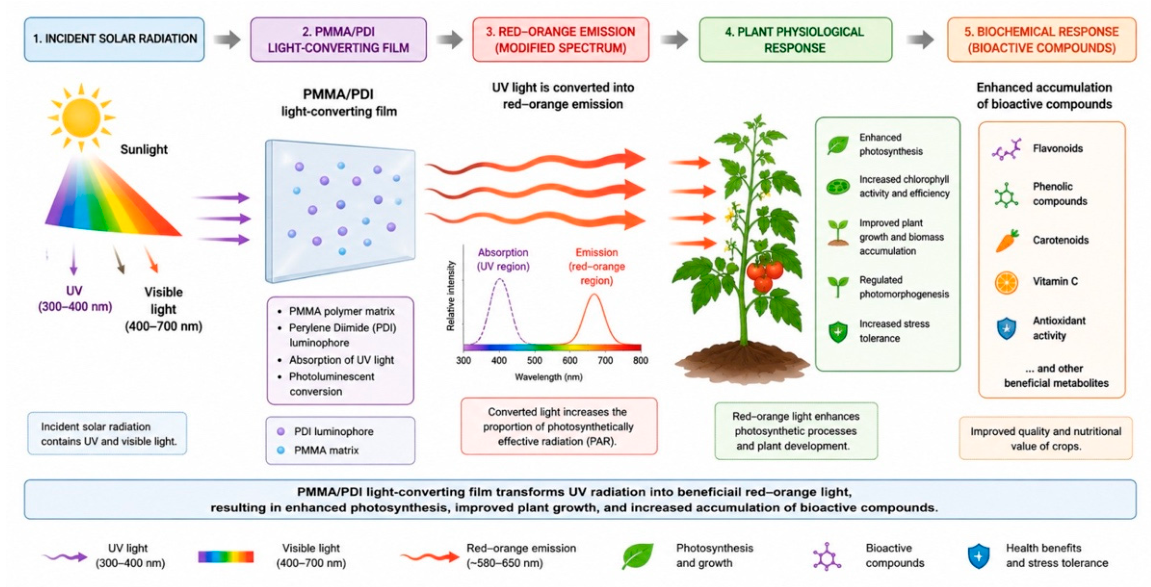
Figure 2.
Schematic representation of spectral conversion and photoluminescence processes in light-converting coatings under UV irradiation.
Figure 2.
Schematic representation of spectral conversion and photoluminescence processes in light-converting coatings under UV irradiation.
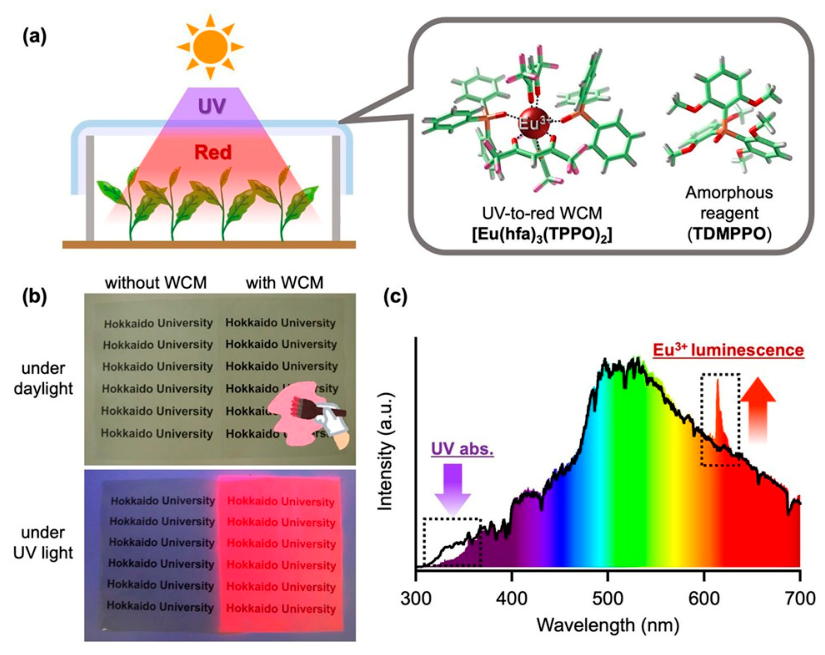
Figure 3.
Optical appearance and luminescent response of PMMA/PDI solution-cast coatings with varying luminophore concentrations under ambient conditions and UV illumination (365 nm), illustrating concentration-dependent emission behavior and transparency.
Figure 3.
Optical appearance and luminescent response of PMMA/PDI solution-cast coatings with varying luminophore concentrations under ambient conditions and UV illumination (365 nm), illustrating concentration-dependent emission behavior and transparency.
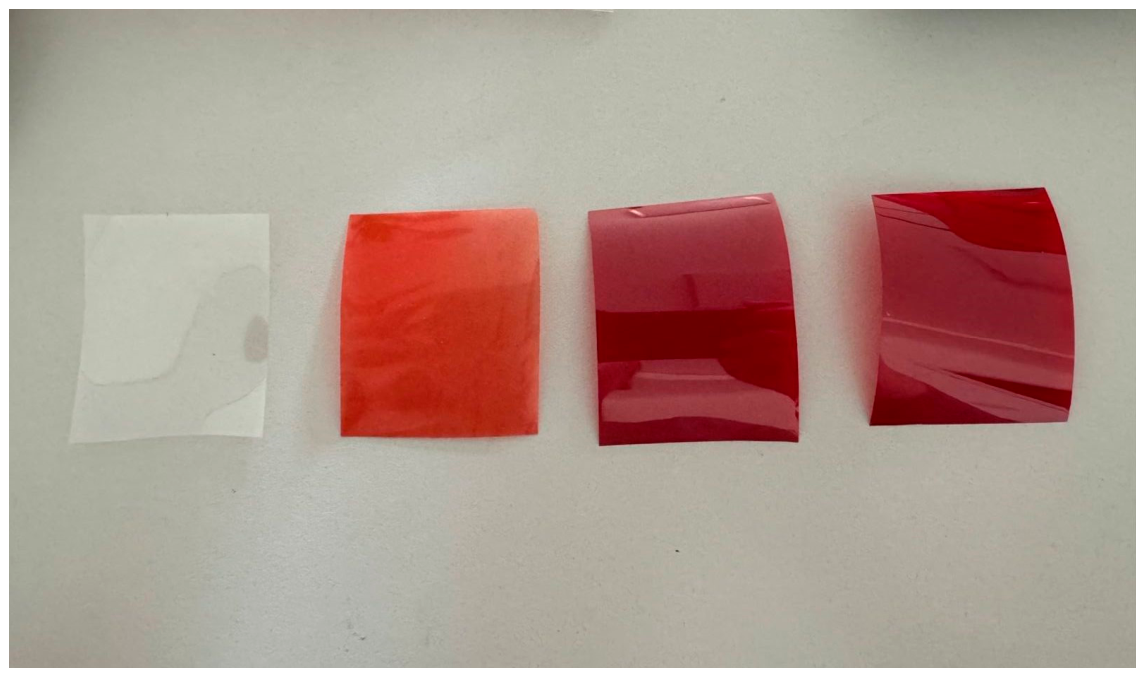
Figure 4.
UV–Vis transmission spectra and chromophore-based interpretation of the PMMA/PDI light-converting coatings developed in this study. The figure summarizes the spectral shifts, transmission-edge displacement, comparative optical response and colour evolution of the investigated coatings, highlighting the influence of chromophore structure and polymer–luminophore interactions on the bathochromic shift and visible-region transparency.
Figure 4.
UV–Vis transmission spectra and chromophore-based interpretation of the PMMA/PDI light-converting coatings developed in this study. The figure summarizes the spectral shifts, transmission-edge displacement, comparative optical response and colour evolution of the investigated coatings, highlighting the influence of chromophore structure and polymer–luminophore interactions on the bathochromic shift and visible-region transparency.
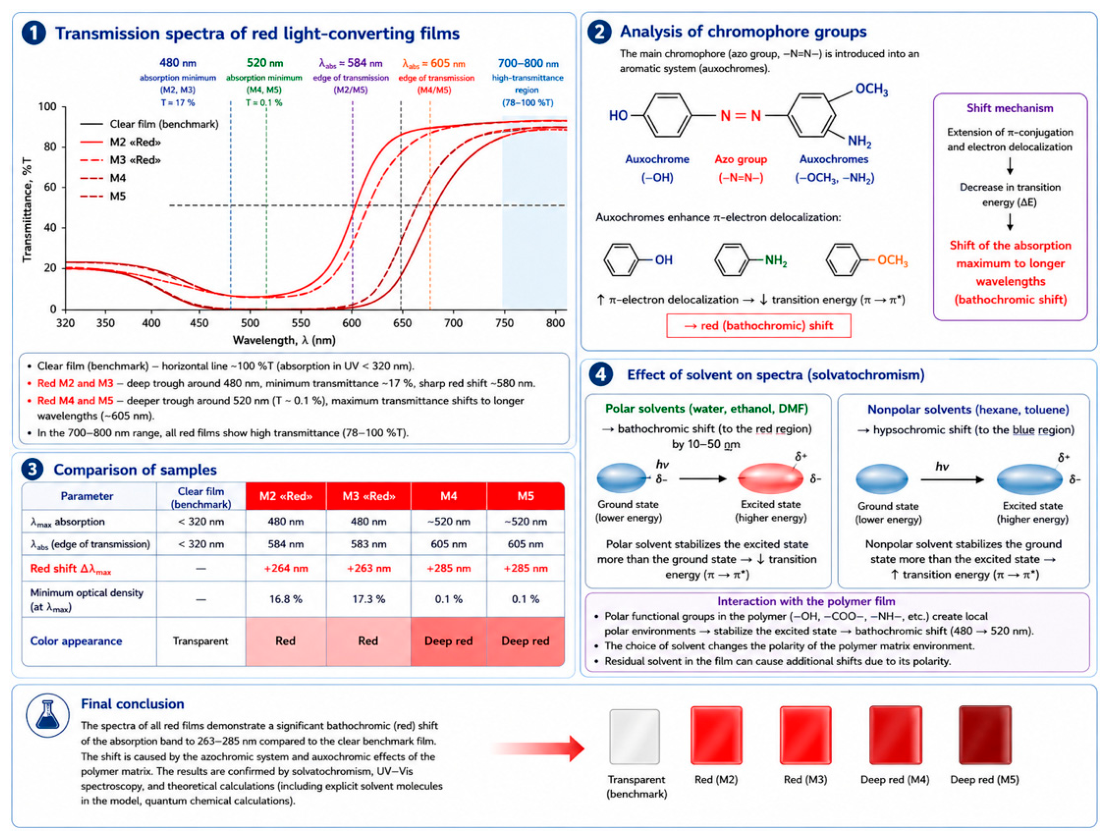
Figure 5.
Comparative analysis of the optical properties and molecular structure–property relationships of the PMMA/PDI light-converting coatings. The figure includes transmission spectra, sample-to-sample comparison, chromophore-group analysis and solvatochromic interpretation, illustrating how auxochrome effects, local polymer polarity and luminophore environment contribute to red-shifted absorption and concentration-dependent optical behaviour.
Figure 5.
Comparative analysis of the optical properties and molecular structure–property relationships of the PMMA/PDI light-converting coatings. The figure includes transmission spectra, sample-to-sample comparison, chromophore-group analysis and solvatochromic interpretation, illustrating how auxochrome effects, local polymer polarity and luminophore environment contribute to red-shifted absorption and concentration-dependent optical behaviour.
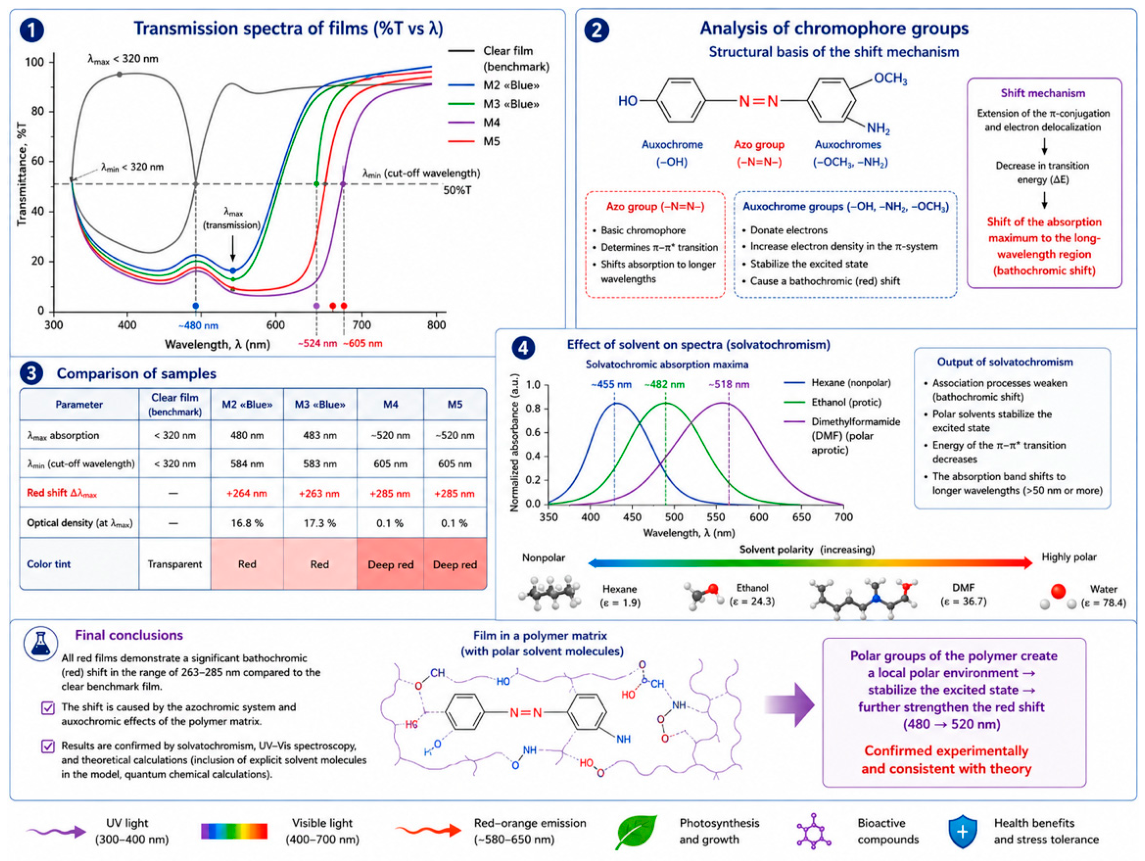
Figure 6.
Demonstration of greenhouse application of light-converting coating and its effect on plant growth conditions.
Figure 6.
Demonstration of greenhouse application of light-converting coating and its effect on plant growth conditions.
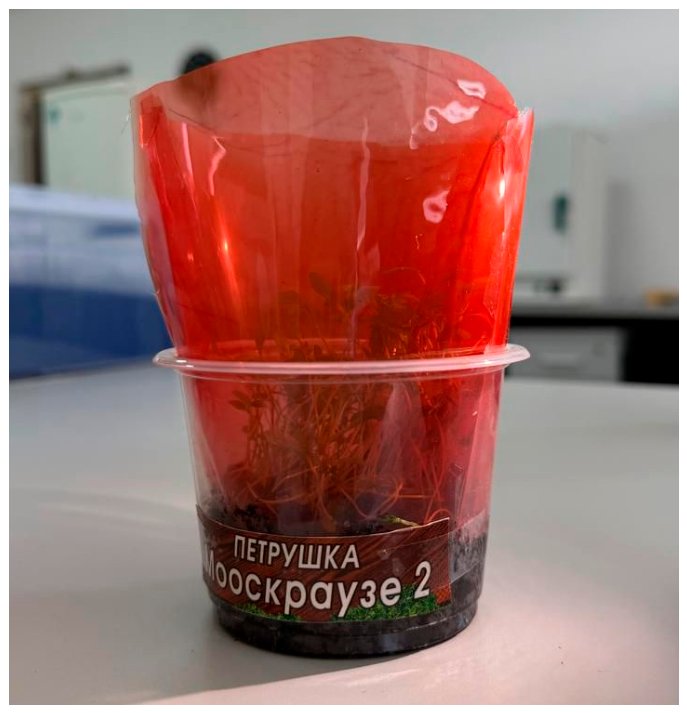

Table 1.
Luminophore families for agricultural light-converting coatings.
| Family | Advantages | Main limitations | Recommended characterization |
|---|---|---|---|
| PDI and organic dyes | Strong visible fluorescence; solution processability; compatibility with PMMA; low-temperature fabrication | Aggregation-induced quenching; photobleaching; concentration-dependent optical losses | UV-Vis, PL spectra, quantum yield, lifetime, aging tests |
| Eu3+ and rare-earth complexes | Narrow red emission; high color purity; good thermal stability | Complex synthesis; cost; ligand stability; matrix compatibility | Excitation/emission spectra, quantum yield, TGA, FTIR, aging |
| Inorganic phosphors | High thermal stability; broad formulation range | Scattering, haze, particle aggregation, refractive-index mismatch | Particle size, haze, total/diffuse transmittance, SEM |
| Quantum dots | Tunable emission; high absorption coefficients | Toxicity concerns for Cd/Pb systems; environmental risk; encapsulation requirements | Toxicity assessment, leaching tests, PL quantum yield |
| AIE luminogens | Emission retained in aggregated state; promising solid-film behavior | Less mature for greenhouse films; cost and availability | Solid-state PL, aging, matrix compatibility |
Table 2.
Polymer matrices and coating requirements.
| Matrix | Strengths | Weaknesses | Best use |
|---|---|---|---|
| PE | Low cost; flexible; industrial greenhouse standard | UV photooxidation; limited compatibility with some dyes | Commercial greenhouse films and extrusion routes |
| PP | Good mechanical and thermal properties | UV degradation; possible haze and dispersion issues | Durable thermoplastic coatings |
| PMMA | High transparency; good optical quality; compatible with PDI dyes | Brittleness compared with polyolefins; solvent processing considerations | Optical-quality photoconversion films and coatings |
| PLA/cellulose/chitosan | Sustainability and potential biodegradability | Moisture sensitivity; lower durability; compatibility challenges | Future eco-design and biodegradable coatings |
Table 3.
Fabrication routes for light-converting coatings relevant to greenhouse applications.
| Method | Main advantages | Main limitations | Relevance to this review |
|---|---|---|---|
| Extrusion/blown film | Industrial scalability; compatible with PE/PP | Thermal degradation; dispersion challenges | Key route for commercialization |
| Solution casting | Good optical quality; molecular dispersion; simple equipment | Solvent use; drying control; scale-up needed | Most relevant for PMMA/PDI case study |
| Spin-coating | Very uniform thin films; excellent for spectroscopy | Low scalability; high material loss | Reference method for model films |
| Dip-coating | Scalable coating of existing films; simple equipment | Thickness depends on withdrawal and viscosity | Promising for functional greenhouse coatings |
| Sol-gel | Hybrid inorganic-organic coatings; rare-earth encapsulation | Brittleness, cracking, processing complexity | Useful for inorganic and rare-earth systems |
Table 4.
Key optical, photophysical, morphological and stability metrics required for the standardized evaluation of light-converting polymer coatings for greenhouse spectral engineering.
Table 4.
Key optical, photophysical, morphological and stability metrics required for the standardized evaluation of light-converting polymer coatings for greenhouse spectral engineering.
| Parameter | Relevance | Recommended method |
|---|---|---|
| Average visible transmittance | Determines the amount of visible light available for plant growth and photosynthesis. | UV–Vis spectroscopy; integrating sphere when diffuse transmission is relevant. |
| UV-blocking / UV-absorption efficiency | Quantifies the fraction of UV radiation absorbed by the coating and potentially available for spectral conversion. | UV–Vis spectroscopy in the 190–400 nm range. |
| PAR transmittance | Measures the fraction of photosynthetically active radiation transmitted through the coating. | Spectral integration of transmission data over the 400–700 nm range. |
| Emission spectrum | Determines the spectral overlap between the coating emission and chlorophyll absorption or photoreceptor response bands. | Steady-state photoluminescence spectroscopy. |
| Excitation spectrum | Identifies the spectral regions that efficiently activate the luminophore emission. | Photoluminescence excitation spectroscopy. |
| Photoluminescence quantum yield | Quantifies the efficiency of photon conversion independently of measurement geometry. | Integrating sphere coupled to a fluorimeter or spectroradiometer. |
| Haze and diffuse transmittance | Evaluates light scattering, optical clarity and potential light redistribution inside the greenhouse. | Haze meter or UV–Vis spectrophotometry with integrating sphere. |
| CIE chromaticity coordinates | Provides a standardized description of perceived emission colour and enables comparison between luminophore systems. | Emission spectrum converted to CIE 1931 coordinates. |
| Thickness uniformity | Affects absorption, emission intensity, scattering and mechanical reliability. | Optical profilometry, micrometry or cross-sectional microscopy. |
| Surface roughness | Influences scattering losses, wetting, adhesion and coating durability. | AFM, optical profilometry or SEM. |
| Photostability | Determines the retention of emission intensity and optical transparency under prolonged irradiation. | Accelerated UV-aging tests combined with periodic UV–Vis and PL measurements. |
| Weathering resistance | Assesses coating durability under combined humidity, temperature cycling, condensation and mechanical stress. | Accelerated weathering chamber; outdoor exposure tests. |
Table 5.
Minimum reporting checklist for future studies on light-converting agricultural coatings.
| Item to report | Why it matters | Recommended descriptor |
|---|---|---|
| Coating composition | Determines optical response, stability, toxicity and reproducibility. | Polymer matrix, luminophore type, additives, stabilizers and solvent system. |
| Luminophore concentration | Controls absorption, emission intensity, aggregation and transparency. | wt%, mol%, or mass ratio relative to polymer matrix. |
| Coating thickness | Affects UV absorption, emitted intensity, scattering and mechanical reliability. | Mean thickness ± standard deviation; measurement method and number of points. |
| Fabrication route | Strongly influences morphology, dispersion, scalability and defect formation. | Extrusion, solution casting, spin-coating, dip-coating, sol–gel or multilayer route; key process parameters. |
| Substrate type | Determines adhesion, transparency, flexibility and practical greenhouse compatibility. | Glass, PMMA, PE, PP, LDPE, LLDPE or commercial greenhouse film. |
| Average visible transmittance | Quantifies the amount of visible light reaching the crop. | Spectral average over 400–700 nm or 400–750 nm. |
| PAR transmittance | Directly relates coating performance to photosynthetically active radiation. | Integrated transmittance over 400–700 nm, preferably weighted by incident photon flux. |
| UV absorption / blocking efficiency | Indicates the fraction of UV radiation absorbed, blocked or available for conversion. | Integrated absorption or blocking efficiency over UV-B and UV-A ranges. |
| Emission spectrum | Defines the useful converted-light output and spectral overlap with plant responses. | Normalized and absolute PL spectra; peak wavelength; FWHM. |
| Excitation spectrum | Identifies which incident wavelengths effectively activate the luminophore. | PL excitation spectrum monitored at the main emission wavelength. |
| Absolute photoluminescence quantum yield | Quantifies the intrinsic photon-conversion efficiency of the coating. | Absolute PLQY measured with an integrating sphere. |
| Haze and diffuse transmittance | Determines optical clarity and light redistribution inside greenhouse environments. | Haze factor, total transmittance and diffuse transmittance. |
| Surface morphology | Controls scattering, wetting, adhesion, defect density and durability. | SEM, AFM or optical profilometry; roughness parameters such as Sa, Sq or Ra. |
| Thickness uniformity | Determines large-area reproducibility and optical homogeneity. | Thickness maps or multi-point measurements over representative coating areas. |
| Photostability | Evaluates retention of emission and transparency under UV exposure. | PL intensity retention, transmittance retention and colour change after defined UV dose. |
| Weathering resistance | Assesses durability under realistic greenhouse stress factors. | Combined UV, humidity, temperature cycling, condensation and abrasion tests. |
| Mechanical integrity | Determines handling, installation and operational durability. | Tensile properties, flexibility, adhesion, cracking or delamination tests. |
| Environmental safety | Essential for large-area agricultural deployment and end-of-life management. | Toxicity, leaching, heavy-metal content, nanoparticle release and disposal route. |
| Crop-test conditions | Required to interpret biological response and compare studies. | Crop species, growth stage, photoperiod, irradiance, temperature, humidity and control treatment. |
| Biological response metrics | Connects optical performance with agronomic relevance. |
Biomass, leaf area, chlorophylls, carotenoids, flavonoids, phenolics, yield and statistical analysis. |
Disclaimer/Publisher’s Note: The statements, opinions and data contained in all publications are solely those of the individual author(s) and contributor(s) and not of MDPI and/or the editor(s). MDPI and/or the editor(s) disclaim responsibility for any injury to people or property resulting from any ideas, methods, instructions or products referred to in the content. |
© 2026 by the authors. Licensee MDPI, Basel, Switzerland. This article is an open access article distributed under the terms and conditions of the Creative Commons Attribution (CC BY) license (http://creativecommons.org/licenses/by/4.0/).
Copyright: This open access article is published under a Creative Commons CC BY 4.0 license, which permit the free download, distribution, and reuse, provided that the author and preprint are cited in any reuse.