

Submitted:
28 May 2026
Posted:
29 May 2026
You are already at the latest version
Abstract
The bilateral deficit (BLD) is traditionally defined as the reduced capacity to produce force during simultaneous bilateral contractions compared with the summed output of unilateral actions. However, in applied sport settings, BLD is frequently estimated from countermovement jump (CMJ) height, representing a functional rather than a direct mechanical measure of force production. Therefore, this study aimed to analyze the association between a CMJ-derived functional BLD index and multidirectional performance in soccer players. Forty male university soccer players (age: 23 ± 1 years) performed unilateral and bilateral CMJs using a contact platform system, followed by the 505 change-of-direction (CoD) test analyzed through two-dimensional video-based motion analysis. Participants were classified into low, moderate, and high BLD groups according to deficit magnitude. Group differences were analyzed using the Kruskal–Walli’s test with Bonferroni-adjusted post hoc comparisons. Significant between-group differences were observed across all temporal phases of the 505 test (ε² = 0.34–0.59; p < 0.001), with the largest effects found for total CoD time and CoD deficit (ε² = 0.74–0.75; p < 0.001). Players with lower BLD values demonstrated superior acceleration, deceleration, reacceleration, and overall multidirectional performance. These findings suggest that CMJ-derived functional BLD may represent a practical indicator of movement efficiency and neuromuscular performance in soccer players.
Keywords:
change-of-direction
; movement efficiency
; multidirectional performance
; biomechanical analysis
1. Introduction
Soccer is an intermittent high-intensity sport characterized by explosive actions such as accelerations, decelerations, jumps, and change-of-direction (CoD), all of which are considered key determinants of competitive performance [1,2]. From a biomechanical perspective, the ability to accelerate and rapidly change direction largely depends on the effective production and application of force relative to body mass, as well as the capacity to generate, absorb, and redirect momentum within very short time intervals [3].
Change-of-direction performance is influenced by multiple neuromuscular factors, including force production capacity, eccentric strength, and intermuscular coordination [4]. In addition, inter-limb asymmetries have been associated with both physical performance and injury risk, although their interpretation depends on asymmetry magnitude and the athlete’s strength level [5,6]. In this context, it is important to distinguish inter-limb asymmetries, understood as functional differences between limbs, from other neuromuscular indicators emerging during bilateral tasks.
Among these indicators, the bilateral deficit (BLD) has received increasing attention in the scientific literature. BLD is defined as the reduced capacity to produce force during simultaneous bilateral contractions compared with the summed output of unilateral actions performed independently [7]. From a neuromechanical perspective, this phenomenon has been attributed to neural inhibition mechanisms, limitations in motor unit recruitment, and restrictions in inter-limb coordination during bilateral actions [7,8]. However, current evidence suggests that BLD is a multifactorial phenomenon influenced by both neuromuscular factors and the specific characteristics of the evaluated task [9].
Despite its theoretical relevance, the assessment of BLD presents important limitations in applied sport settings. Although its reference measurement is based on direct mechanical variables such as force, impulse, or torque, in practice it is frequently estimated using performance-based variables derived from countermovement jump (CMJ) performance, particularly jump height calculated from flight time [4,10]. However, this approach does not represent a direct mechanical measure of force production, but rather an outcome influenced by biomechanical and neuromuscular factors such as movement strategy, intermuscular coordination, and stretch–shortening cycle characteristics [11]. Therefore, CMJ-derived BLD should be interpreted as a functional neuromuscular performance index rather than a direct representation of the classical bilateral deficit phenomenon.
The available evidence regarding the relationship between BLD and sports performance remains inconsistent. Some studies have reported that greater BLD values are associated with superior performance in unilateral tasks such as CoD [4], whereas others have found no significant associations between BLD and sprint or CoD performance [9]. In contrast, investigations based on mechanical variables have demonstrated that lower BLD values are associated with greater force and impulse production, both considered key determinants of explosive actions [12]. Furthermore, recent studies in sports characterized by a predominance of unilateral actions have reported positive associations between BLD and CoD performance, although with moderate magnitudes and task-dependent effects [13].
In line with these findings, recent reviews have highlighted that the relationship between BLD and performance is highly dependent on the task, the variable used for its calculation, and the specific demands of the sport [14]. In soccer, the available evidence remains limited and inconclusive, emphasizing the need for studies examining this phenomenon using more contextualized and sport-specific approaches.
Additionally, unilateral training interventions have been shown to improve CoD performance while modifying BLD magnitude, suggesting that this index demonstrates considerable plasticity and may reflect specific neuromuscular adaptations to training [15]. In sports such as soccer, where unilateral actions predominate, performance may be more closely associated with the ability to efficiently apply force under dynamic unilateral conditions rather than with maximal bilateral force production.
Therefore, it is necessary to further explore the interpretation of BLD not as a direct marker of force production capacity, but as a functional indicator influenced by coordination and task-specific factors. To date, no study has simultaneously analyzed how different magnitudes of a CMJ-derived functional BLD index are associated with acceleration, CoD performance, and inter-limb asymmetry in soccer players.
Accordingly, the aim of the present study was to analyze the association between a functional BLD index derived from CMJ height and multidirectional performance in soccer players. It was hypothesized that greater values of this functional index would be associated with lower multidirectional performance, reflecting reduced efficiency in force application and coordination during high-intensity actions.
2. Materials and Methods
2.1. Participants
Forty male university soccer players (age: 23 ± 1 years; height: 178.6 ± 0.6 cm; body mass: 78.5 ± 7.9 kg; body fat: 10.8 ± 1.0%) voluntarily participated in this study. All participants competed at the national level and participated in five weekly training sessions including technical, tactical, and physical components. To be included, participants were required to be free from lower-limb injuries within the six months preceding data collection. Additionally, they were instructed to avoid strenuous physical activity for at least 24 h before testing.
Sample size was estimated a priori using G*Power software (version 3.1, Heinrich Heine University, Düsseldorf, Germany) based on a one-way ANOVA with three independent groups. Assuming a moderate effect size (f = 0.30), a significance level of α = 0.05, and a statistical power (1 − β) of 0.80, the minimum required sample size was calculated to be 36 participants [16]. All procedures were conducted in accordance with the Declaration of Helsinki and approved by the Ethics Committee of the Universitat de València (UV-INV_ETICA-1995574). Written informed consent was obtained from all participants prior to participation.
2.2. Study Protocol
All assessments were completed during a single experimental session conducted under controlled environmental conditions. Upon arrival, participants first underwent anthropometric measurements, including body mass and body height assessment. Subsequently, standardized instructions regarding the testing procedures were provided by the investigators.
Before data collection, participants completed a standardized warm-up lasting approximately 10 min, consisting of low-intensity running, dynamic mobility exercises, and progressive sport-specific actions, including accelerations and submaximal jumps. Following the warm-up, participants performed unilateral CMJ, bilateral CMJ, and the 505 CoD test, respectively. A recovery period of 2–3 min was provided between attempts to minimize the influence of fatigue.
For each test, two valid trials were completed, and the best performance was retained for subsequent analysis. Trials considered technically incorrect were discarded and repeated. Standardized verbal encouragement was provided throughout all assessments to ensure maximal effort. The temporal sequence of the experimental protocol is illustrated in Figure 1.
- Countermovement Jump
The CMJ assessment consisted of two trials performed under bilateral and unilateral conditions (single-leg CMJ), with the highest jump height retained for subsequent analysis. A 60 s recovery interval was provided between attempts [17]. Jump performance was assessed using a contact platform system (Chronojump, Barcelona, Spain) used in combination with Boscosystem software (version 1.6.2), previously validated for the evaluation of vertical jump performance [18].
During the bilateral CMJ, participants adopted an upright standing position with their gaze directed forward and their hands placed on their hips to minimize the influence of arm swing. Participants then performed a rapid downward movement through hip and knee flexion to a self-selected depth, immediately followed by an explosive extension of the lower limbs until take-off, while maintaining full body extension during the flight phase.
For the unilateral CMJ, the same procedure was performed independently with the dominant and non-dominant limbs. The contralateral limb remained flexed and off the ground throughout the movement. Participants were instructed to maintain trunk stability and minimize lateral compensations to ensure that force production was generated exclusively by the tested limb.
Jump height was estimated from flight time (FT) according to the equation proposed by Bosco et al. [19]:
where h represents jump height, FT corresponds to flight time, and g represents gravitational acceleration.
- Bilateral Deficit Calculation and Classification
The BLD index was calculated according to the equation proposed by Howard and Enoka [20]:
Negative values indicated the presence of bilateral deficit, whereas positive values reflected bilateral facilitation (BLF).
According to the literature, athletes may be classified based on the presence of bilateral deficit or bilateral facilitation [10]. However, all participants in the present study exhibited negative BLD values. Therefore, participants were categorized according to deficit magnitude into low BLD (0 to −9.9%; n = 10), moderate BLD (−10 to −19.9%; n = 18), and high BLD (−20 to −30%; n = 12).
Although previous studies have proposed classification systems based on tertiles [21], the present categorization was adopted to facilitate the identification of distinct neuromuscular performance profiles within the analyzed sample. Consequently, these cut-off values should be interpreted as sample-specific and exploratory in nature.
Importantly, BLD in the present study was estimated from CMJ height derived from flight time, which does not represent a direct mechanical measure of bilateral force production. Since jump height is influenced by multiple biomechanical and neuromuscular factors, including intermuscular coordination, movement strategy, and stretch–shortening cycle characteristics, the obtained values should be interpreted as a functional index of neuromuscular performance rather than a direct measure of bilateral force deficit.
- 505 Change-of-Direction Test and Asymmetry Assessment
The 505 change-of-direction (CoD) test consisted of a maximal 10 m acceleration phase, followed by a controlled deceleration over the subsequent 5 m, the execution of a 180° turn, and a final 5 m reacceleration in the opposite direction [22].
All trials were recorded using a smartphone camera (iPhone 11; Apple Inc., Cupertino, CA, USA) operating at 60 fps and 1080p resolution. The camera was positioned perpendicular to the plane of motion to ensure a consistent sagittal view throughout testing. Video recordings were subsequently analyzed frame-by-frame using Kinovea® software (version 0.9.5), which has demonstrated acceptable validity and reliability for the temporal analysis of sprinting and change-of-direction actions [23].
The purpose of the video analysis was not to determine absolute sprint times with millisecond precision, but rather to consistently identify the key mechanical events delimiting each phase of the movement under identical recording conditions for all participants. This approach enabled relative comparisons between groups while assuming that any measurement error remained systematic across observations.
To standardize the analysis, operational definitions were established for each event structuring the test. Movement onset was defined as the first observable displacement of the center of mass following the visual signal. The end of the acceleration phase was identified when the center of mass reached the 10 m mark. The onset of deceleration corresponded to the first foot contact after this point. The turning phase was determined by foot contact on the 15 m line, whereas reacceleration onset was defined as the first ground contact immediately after completing the turn. Finally, test completion was established when participants crossed the 5 m line during the return phase (Figure 2).
2.3. Inter-Limb Asymmetry Calculation
Inter-limb asymmetry was determined using CoD performance time when turning off each limb. Bilateral asymmetry was subsequently calculated according to the following equation [24,25]:
Asymmetry was expressed as a percentage, where 0% represented perfect symmetry between limbs, whereas higher values indicated greater inter-limb asymmetry.
2.4. Statistical Analysis
Statistical analyses were performed using SPSS software (version 25.0; IBM Corp., Armonk, NY, USA). Data normality was assessed using the Kolmogorov–Smirnov test, together with visual inspection of histograms and skewness and kurtosis values. Since normality assumptions were not satisfied, data were descriptively reported as median and interquartile range (IQR; Q1–Q3) [26].
Differences among groups according to bilateral deficit magnitude (low, moderate, and high BLD) were analyzed using the Kruskal–Wallis test for independent samples. When significant overall differences were identified, pairwise comparisons were performed using Bonferroni-adjusted post hoc analyses.
Effect size for overall comparisons was estimated using epsilon squared (ε²), whereas pairwise effect size was calculated using the r coefficient derived from the z statistic. Additionally, Spearman’s rank correlation coefficient (rho) was used to examine the associations between functional BLD and multidirectional performance variables. Correlation magnitudes were interpreted as trivial (<0.10), small (0.10–0.29), moderate (0.30–0.49), large (0.50–0.69), very large (0.70–0.89), and nearly perfect (≥0.90) [27]. Statistical significance was established at p < 0.05.
3. Results
All data exhibited a non-normal distribution (p < 0.05). Descriptive statistics for bilateral and unilateral CMJ performance are presented in Table 1.
The coefficient of variation (CV) was higher in unilateral jumps (8.7–9.5%) compared to the bilateral condition (4.65%), indicating greater relative variability when force production was performed unilaterally. Additionally, the standard error of measurement (SEM) and the narrow confidence intervals indicated an adequate level of measurement precision. Overall, although bilateral CMJ demonstrated greater absolute performance (38.43 cm), unilateral CMJ showed higher variability, which is a relevant factor for interpreting the BLD index.
3.1. Influence of BLD on 505 Test Performance
Significant differences were observed between groups defined according to BLD level across all variables of the 505 test, with moderate to large overall effect sizes (ε2 = 0.34–0.59) (Figure 3).
In the reaction time (RT) phase, the low BLD group exhibited shorter times compared to both the moderate (z = −2.89, p < 0.01, r = 0.61) and high BLD groups (z = −3.55, p < 0.01, r = 0.68). Similarly, during the acceleration phase (ACC), the low BLD group demonstrated higher performance compared to the moderate (z = −2.77, p < 0.01, r = 0.62) and high BLD groups (z = −3.53, p < 0.001, r = 0.82).
A consistent pattern was observed in the deceleration (DACC) and reacceleration (RACC) phases, where the low BLD group outperformed both the moderate (z = −3.61 to −3.45; p < 0.01– 0.001; r = 0.70–0.85) and high BLD groups (z = −4.61 to −4.71; p < 0.001; r = 0.79–0.81).
No significant differences were found between the moderate and high BLD groups in any of the analyzed variables (p > 0.23; r = 0.19).
3.2. Change-of-Direction Performance
A clear progression between groups was observed for total CoD time (Figure 4). The low BLD group exhibited the shortest times (0.33 s), followed by the moderate (0.52 s) and high BLD groups (0.76 s), with significant differences between all groups (ε² = 0.74; p < 0.001).
From an applied perspective, the low BLD group showed substantially lower CoD time compared to the high BLD group.
Pairwise comparisons indicated that the low BLD group was significantly faster than both the moderate (z = −2.89, p < 0.01, r = 0.74) and high BLD groups (z = −5.35, p < 0.001, r = 0.82). In addition, the moderate BLD group demonstrated better performance than the high BLD group (z = −3.10, p < 0.01, r = 0.84).
Regarding the change-of-direction deficit (CoDDEF), the largest effect sizes were observed (ε² = 0.75; p < 0.001). The low BLD group showed significantly lower values compared to both the moderate (z = −3.31, p < 0.01, r = 0.76) and high BLD groups (z = −5.42, p < 0.001, r = 0.69). Similarly, the moderate BLD group exhibited a lower deficit than the high BLD group (z = −2.73, p < 0.05, r = 0.65).
3.3. Inter-Limb Asymmetry
Inter-limb asymmetry during the CoD tasks also showed significant differences between groups. As illustrated in Figure 5, the low BLD group exhibited greater asymmetry values (Mdn = 11.01%) compared to the moderate BLD group (Mdn = 0.58%; z = 3.99, p < 0.001, r = 0.73).
Similarly, the high BLD group (Mdn = 7.36%) also differed significantly from the moderate BLD group (z = −3.43, p < 0.01, r = 0.81). No significant differences were observed between the low and high BLD groups (z = 0.69, p = 0.49, r = 0.20).
4. Discussion
The main finding of the present study was that lower magnitudes of a functional bilateral deficit (BLD) index, derived from CMJ height, were associated with superior performance across all phases of the 505 test, as well as with greater levels of functional asymmetry during CoD tasks. Specifically, players with low BLD demonstrated greater acceleration values (+7% vs. the moderate BLD group and +13% vs. the high BLD group), whereas the differences were even more pronounced during deceleration and reacceleration phases, where performance was up to 25% higher. Furthermore, the low BLD group exhibited lower CoD execution times and lower CoD deficits (0.33 s and 0.20 s) compared with the moderate BLD group (0.52 s and 0.58 s; ES = 0.74–0.76) and the high BLD group (0.76 s and 0.76 s; ES = 0.69–0.82), indicating a consistent relationship between lower functional BLD magnitudes and greater efficiency during complex multidirectional tasks.
From a biomechanical perspective, these findings may be explained by the ability to generate, absorb, and reorient horizontal forces during acceleration and CoD actions. Acceleration performance primarily depends on the rapid application of net horizontal force relative to body mass, particularly during the initial sprint steps [28,29]. In contrast, CoD performance involves a complex mechanical sequence composed of eccentric deceleration, center-of-mass reorientation, and subsequent concentric reacceleration [3,30]. Within this framework, the present findings suggest that players with lower BLD possess a greater capacity to modulate mechanical impulse and efficiently redistribute horizontal forces during rapid movement transitions.
The larger between-group differences observed during deceleration and reacceleration phases suggest that BLD may be closely associated with the capacity to absorb and reutilize mechanical energy during high-demand multidirectional actions. Deceleration represents one of the most demanding phases from a neuromuscular standpoint, as it requires high eccentric force production to dissipate the body’s linear momentum within very short time intervals before movement reorientation [3]. Subsequently, reacceleration requires a rapid transition toward high-power concentric actions to restore velocity in the new direction. Consequently, players with lower BLD may exhibit greater stretch-shortening cycle efficiency and improved neuromuscular coordination during dynamic sequences involving force absorption and production.
From a neuromuscular perspective, lower BLD magnitudes may reflect more efficient intermuscular coordination and reduced bilateral inhibition during explosive actions. Previous studies have demonstrated that lower BLD values are associated with greater peak force and mechanical impulse production, [7,12], which could favor both initial acceleration and mechanical stability during unilateral support phases characteristic of CoD tasks. This interpretation supports the notion that multidirectional performance depends not only on maximal force production capacity, but also on the efficiency of force orientation and transfer during dynamic football-specific actions.
However, the literature remains inconsistent regarding the relationship between BLD and linear sprint or CoD performance. Some studies have reported no significant associations between BLD and sprint or CoD performance in soccer players [9], whereas others have suggested that greater BLD magnitudes may be associated with superior CoD performance [4,10]. These discrepancies may be explained by methodological differences in BLD quantification and by the specific nature of the tasks evaluated. In the present study, BLD was estimated from CMJ height, meaning that the obtained index represents a functional indicator of neuromuscular performance rather than a direct measure of bilateral force production. Unlike approaches based on direct mechanical variables such as force, torque, or impulse, jump height integrates coordinative, technical, and movement-efficiency components. [11,31,32]. Therefore, CMJ derived BLD should be interpreted as a task and context dependent phenomenon rather than a universal marker of neuromuscular performance.
Another particularly interesting finding was that players with lower BLD simultaneously demonstrated greater levels of functional asymmetry during CoD tasks. Specifically, the low BLD group showed significantly greater CoD-time asymmetry (Mdn = 11.0%) compared with the moderate BLD group (Mdn = 0.5%; z = 3.99; p = 0.001; ES = 0.83), whereas the high BLD group also demonstrated greater asymmetry values compared with the moderate group (Mdn = 7.3%; z = −3.43; p = 0.002; ES = 0.81). The magnitude of these effect sizes indicates functionally meaningful differences from a sports performance perspective.
Traditionally, inter-limb asymmetries have been associated with impaired physical performance and increased injury risk [5,6]. Nevertheless, recent evidence suggests that certain asymmetries may represent sport-specific functional adaptations rather than dysfunctional movement patterns [4]. In sports such as soccer, characterized by a high predominance of unilateral actions, the repetitive execution of specific tasks such as kicking, dominant leg support, and preferential CoD movements may promote motor specialization and functional lateralization.
From this perspective, the coexistence of lower BLD and greater functional asymmetry observed in the present study may represent a sport-specific neuromuscular adaptation aimed at optimizing multidirectional performance. Certain asymmetry levels may facilitate more efficient mechanical strategies during CoD tasks, particularly during actions requiring rapid force transfer between limbs and high levels of unilateral dynamic stability. This interpretation partially agrees with previous studies showing that unilateral training can modify both BLD magnitude and inter-limb asymmetries while simultaneously improving CoD performance [15].
Biomechanically, CoD performance requires high levels of unilateral postural control and eccentric force production during the braking phase, followed by rapid concentric force generation during reacceleration [3]. Consequently, soccer players may develop preferential motor patterns that enhance the mechanical efficiency of a dominant limb during sport specific tasks. This may explain why greater levels of functional asymmetry were not necessarily associated with poorer performance in the present study.
Nevertheless, this interpretation partially contrasts with previous investigations reporting negative associations between inter-limb asymmetry and sprint, acceleration, or CoD performance [33,34]. These discrepancies may be attributed to methodological differences in asymmetry quantification, as well as to the specificity of the functional tasks evaluated. As highlighted by Dos’Santos et al.,17 different CoD protocols may induce distinct neuromuscular demands, thereby modifying both the magnitude and functional meaning of the observed asymmetries.
Overall, the present findings reinforce the idea that BLD and inter-limb asymmetry represent distinct neuromuscular constructs. Whereas BLD reflects the simultaneous force-production capacity between limbs, functional asymmetries appear to be more closely related to task-specific motor control strategies and unilateral specialization during dynamic movements. Therefore, in soccer players, certain asymmetries may coexist with superior multidirectional performance and should not necessarily be interpreted as negative from a functional standpoint.
From an applied perspective, these findings suggest that asymmetry interpretation should consider the sporting context, the specific task evaluated, and the functional profile of the athlete. In soccer, where high-intensity unilateral actions predominate, performance appears to depend more on the capacity to efficiently apply force under dynamic conditions than on perfectly symmetrical maximal bilateral force production. Consequently, training programs should not only focus on bilateral force development, but also on eccentric control, force orientation, and mechanical efficiency during deceleration and reacceleration phases.
5. Conclusions
Lower values of a functional BLD index derived from countermovement jump height were associated with superior performance across all phases of the 505 change-of-direction test in soccer players. Specifically, athletes with lower BLD values demonstrated enhanced acceleration, deceleration, and reacceleration capacities, resulting in better multidirectional performance.
However, given that BLD was estimated from a performance-based variable, these findings should not be interpreted as reflecting differences in bilateral force production, but rather as indicators of neuromuscular coordination and movement efficiency. Therefore, the functional BLD index appears to be a useful applied metric for profiling multidirectional performance, provided that its interpretation is contextualized within the method of assessment and the specific demands of the sport.
Author Contributions
Conceptualization, M.M.O., I.A.A., and P.P.-S.; methodology, M.M.0., I.A.A., J-AG and P.P.-S.; software, M.M.O and P.P.-S.; formal analysis, M.M.O., J-AG., and P.P.-S.; investigation, M.M.O., A.E.-M., J.I.P-Q., and P.P.-S; resources, M.M.O., A.E-M., and P.P.-S.; data curation, M.M.O., I.A.A., A.E-M., J.I.P-Q., and P.P.-S.; writing—original draft preparation, M.M.O.; writing—review and editing, M.M.O., I.A.A., A.E-M., J.I.P-Q; and P.P.-S.; visualization, M.M.O., I.A.A., and P.P.-S. All authors have read and agreed to the published version of the manuscript.
Funding
This research received no external funding.
Institutional Review Board Statement
This study was conducted in accordance with the Declaration of Helsinki and approved by the Ethics Committee of the University of Valencia on 5 May 2022 (registry number: 1995574).
Informed Consent Statement
Informed consent was obtained from all subjects involved in the study.
Data Availability Statement
The raw data supporting the conclusions of this article will be made available by the authors on request.
Conflicts of Interest
The authors declare no conflicts of interest.
References
- Faude O, Koch T, Meyer T. Straight sprinting is the most frequent action in goal situations in professional football. J Sports Sci. 2012;30(7):625-631. [CrossRef]
- Bauer P, Anzer G, Shaw L. Putting team formations in association football into context. J Sports Anal. 2023;9(1):39-59. [CrossRef]
- Dos’Santos T, Thomas C, Jones PA, Comfort P. Mechanical determinants of faster change of direction speed performance in male athletes. J Strength Cond Res. 2017;31(3):696-705. [CrossRef]
- Bishop C, Berney J, Lake J, Loturco I, Blagrove R, Turner A, et al. Bilateral deficit during jumping tasks: relationship with speed and change of direction speed performance. J Strength Cond Res. 2021;35(7):1833-1840. [CrossRef]
- Maloney SJ, Richards J, Nixon DG, Harvey LJ, Fletcher IM. Do stiffness and asymmetries predict change of direction performance? J Sports Sci. 2017;35(6):547-556. [CrossRef]
- Madruga-Parera M, Bishop C, Beato M, Fort-Vanmeerhaeghe A, Gonzalo-Skok O, Romero-Rodríguez D. Relationship between interlimb asymmetries and speed and change of direction speed in youth handball players. J Strength Cond Res. 2021;35(12):3482–3490. [CrossRef]
- Skarabot J, Cronin N, Strojnik V, Avela J. Bilateral deficit in maximal force production. Eur J Appl Physiol. 2016;116(11-12):2057-2084. [CrossRef]
- Jakobi JM, Chilibeck PD. Bilateral and unilateral contractions. Can J Appl Physiol. 2001;26(1):12-33. [CrossRef]
- Ascenzi G, Ruscello B, Filetti C, et al. Bilateral deficit and bilateral performance in elite youth soccer players. Sports (Basel). 2020;8(6):82. [CrossRef]
- Pleša J, Kozinc Ž, Šarabon N. Bilateral deficit in countermovement jump and its influence on performance. Front Physiol. 2022;13:768906. [CrossRef]
- Xu J, Turner A, Comfort P, Harry JR, McMahon JJ, Chavda S, Bishop C. Methods for measuring jump height. Sports Med. 2023;53(5):1055–1072. [CrossRef]
- Bračič M, Supej M, Peharec S, Bačič P, Čoh M. Influence of bilateral deficit on countermovement jump performance. Kinesiology. 2010;42(1):73-81.
- Shu L, Zhang J, Chen T, Dong H, Wang Z, Chen J, Hu M, Liao J. Associations of bilateral deficit during jumping with physical performance in tennis players. J Hum Kinet. 2025;99:29–42. [CrossRef]
- Železnik P, Slak V, Kozinc Ž, Šarabon N. The association between bilateral deficit and athletic performance: A brief review. Sports (Basel). 2022;10(8):112. [CrossRef]
- Gonzalo-Skok O, Tous-Fajardo J, Suarez-Arrones L, Arjol-Serrano JL, Casajús JA, Mendez-Villanueva A. Single-leg power output and between-limbs imbalances in team-sport players: Unilateral versus bilateral combined resistance training. Int J Sports Physiol Perform. 2017;12(1):106–114. [CrossRef]
- Faul F, Erdfelder E, Buchner A, Lang AG. Statistical power analyses using G*Power 3.1: Tests for correlation and regression analyses. Behav Res Methods. 2009;41(4):1149–1160. [CrossRef]
- Pain MT. Considerations for single and double leg drop jumps. J Appl Biomech. 2014;30(6):722-727. [CrossRef]
- Pueo B, Penichet-Tomás A, Jiménez-Olmedo JM. Reliability of Chronojump system. Biol Sport. 2020;37(3):255-259.https://doi.org/10.5114/biolsport.2020.95636.
- Bosco C, Luhtanen P, Komi PV. A simple method for measurement of mechanical power in jumping. Eur J Appl Physiol. 1983;50(2):273-282. [CrossRef]
- Howard JD, Enoka RM. Maximum bilateral contractions are modified by neurally mediated interlimb effects. J Appl Physiol. 1991;70(1):306-316. [CrossRef]
- Moya Ortega M, Aparicio Aparicio I, Arenas-Granada J, Priego-Quesada JI, Encarnación-Martínez A, Pérez-Soriano P. Effects of the bilateral deficit on jumping performance and back squat in university soccer players. Sportis Sci J Sch Sport Phys Educ Psychomotricity. 2025;11(2):1-19. [CrossRef]
- Gabbett TJ, Kelly JN, Sheppard JM. Speed, change of direction speed, and reactive agility of rugby league players. J Strength Cond Res. 2008;22(1):174-181.https://doi.org/10.1519/JSC.0b013e31815ef700.
- Fernández-González P, Koutsou A, Cuesta-Gómez A, et al. Reliability of Kinovea® for gait analysis. Sensors (Basel). 2020;20(11):3154. [CrossRef]
- Karamanidis K, Arampatzis A, Brüggemann GP. Symmetry and reproducibility of kinematic parameters during running. Med Sci Sports Exerc. 2003;35(6):1009-1016.https://doi.org/10.1249/01.MSS.0000069337.49567.F0.
- Zifchock RA, Davis I, Higginson J, Royer T. The symmetry angle: a novel method for quantifying asymmetry. Gait Posture. 2008;27(4):622-627. [CrossRef]
- Ato M, López J, Benavente A. A classification system for research designs in psychology. An Psicol. 2013;29(3):1038-1059. [CrossRef]
- Hopkins WG. A scale of magnitudes for effect statistics [Internet]. A New View of Statistics; 2002 [cited 2026 May 20]. Available from: A New View of Statistics.
- Morin JB, Edouard P, Samozino P. Technical ability of force application as a determinant factor of sprint performance. Med Sci Sports Exerc. 2011;43(9):1680-1688. [CrossRef]
- Morin JB, Bourdin M, Edouard P, Peyrot N, Samozino P, Lacour JR. Mechanical determinants of 100-m sprint running performance. Eur J Appl Physiol. 2012;112(11):3921-3930. [CrossRef]
- Brughelli M, Cronin J, Levin G, Chaouachi A. Understanding change of direction ability in sport: a review of resistance training studies. Sports Med. 2008;38(12):1045-1063. [CrossRef]
- Linthorne NP. The correlation between jump height and mechanical power in a countermovement jump is artificially inflated. Sports Biomech. 2021;20(1):3-21. [CrossRef]
- Pérez-Castilla A, García-Ramos A, Padial P, Feriche B. Load-velocity relationship in countermovement jump exercises. Sports Biomech. 2021;20(6):1-15. [CrossRef]
- Fox KT, Pearson LT, Hicks KM. The effect of lower inter-limb asymmetries on athletic performance: A systematic review and meta-analysis. PLoS One. 2023;18(6):e0286942. [CrossRef]
- Loturco I, Jeffreys I, Abad CCC, Kobal R, Zanetti V, Pereira LA, Nimphius S. Change-of-direction, speed and jump performance in soccer players: a comparison across different age-categories. J Sports Sci. 2020;38(11-12):1279-1285. [CrossRef]
Figure 1.
Schematic representation of the experimental protocol.
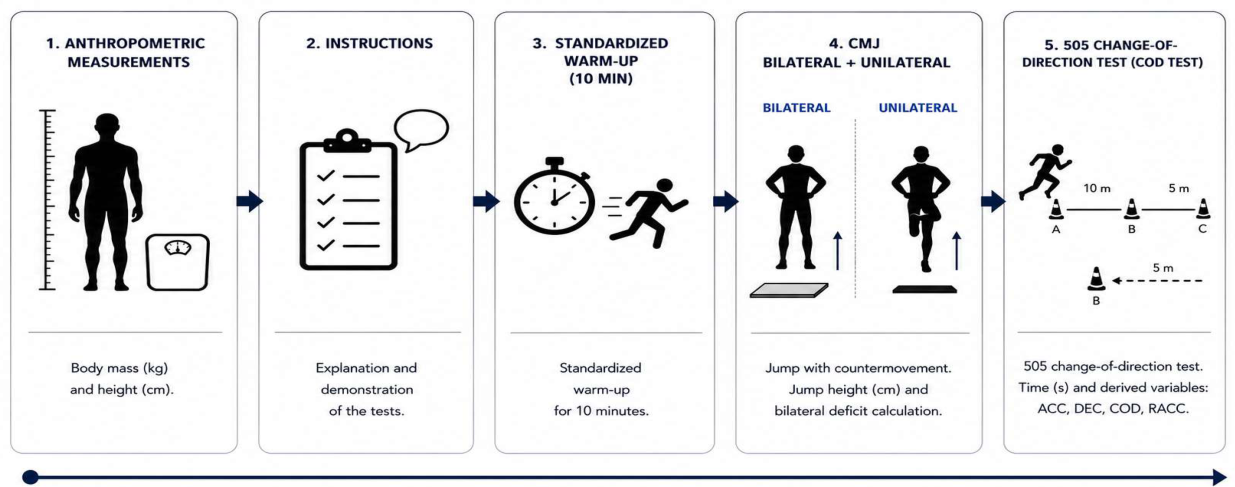
Figure 2.
Schematic representation of the 505 change-of-direction test.
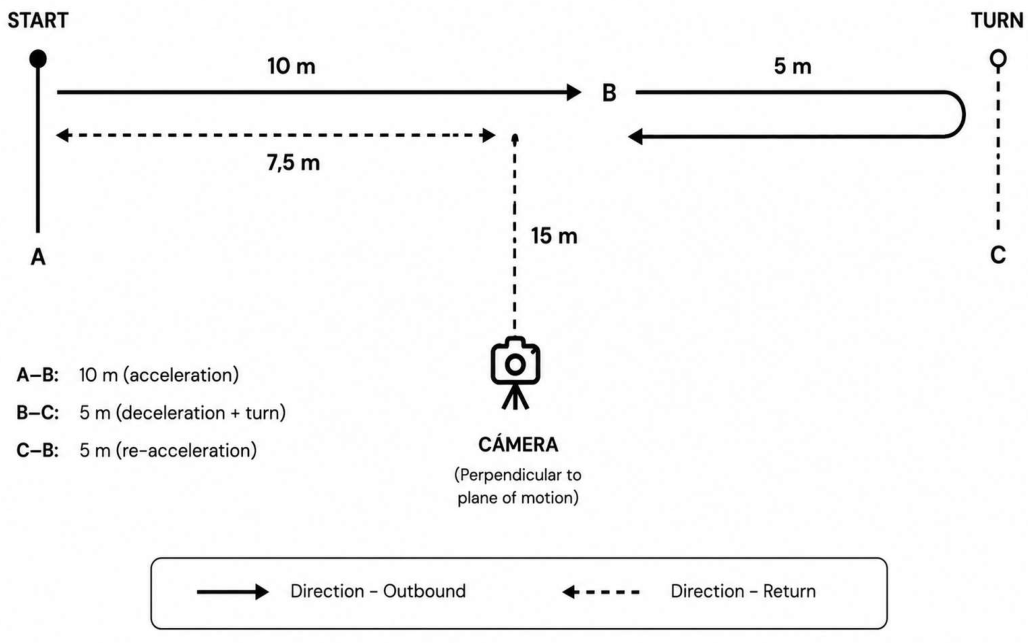
Figure 3.
Influence of bilateral deficit on acceleration-related variables during the 505 test. Data are presented as median interquartile range. Different letters indicate significant differences between groups (p < 0.05).
Figure 3.
Influence of bilateral deficit on acceleration-related variables during the 505 test. Data are presented as median interquartile range. Different letters indicate significant differences between groups (p < 0.05).
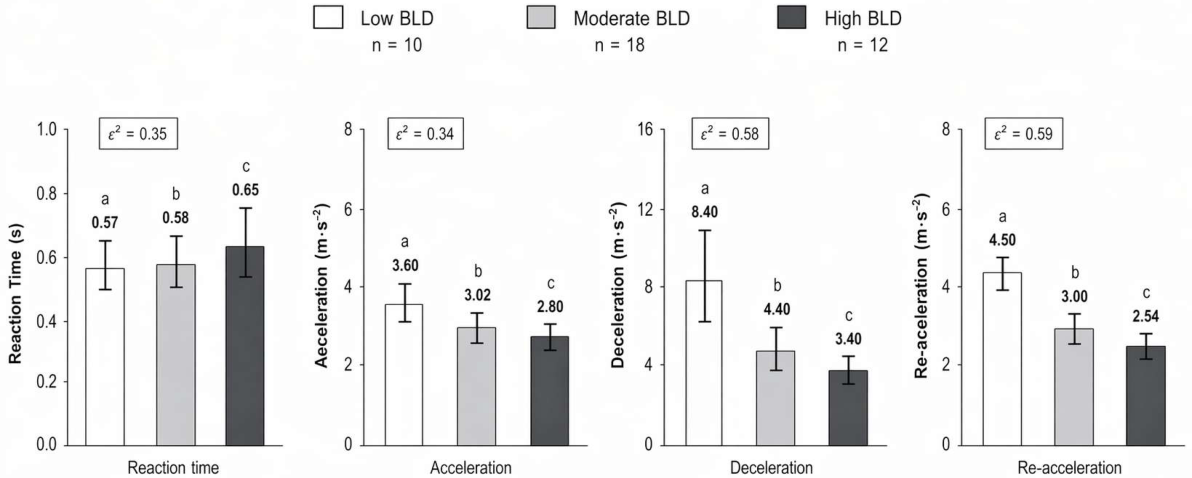
Figure 4.
Influence of bilateral deficit on change-of-direction variables during the 505 test. Data are presented as median interquartile range. Different letters indicate significant differences between groups (p < 0.05).
Figure 4.
Influence of bilateral deficit on change-of-direction variables during the 505 test. Data are presented as median interquartile range. Different letters indicate significant differences between groups (p < 0.05).
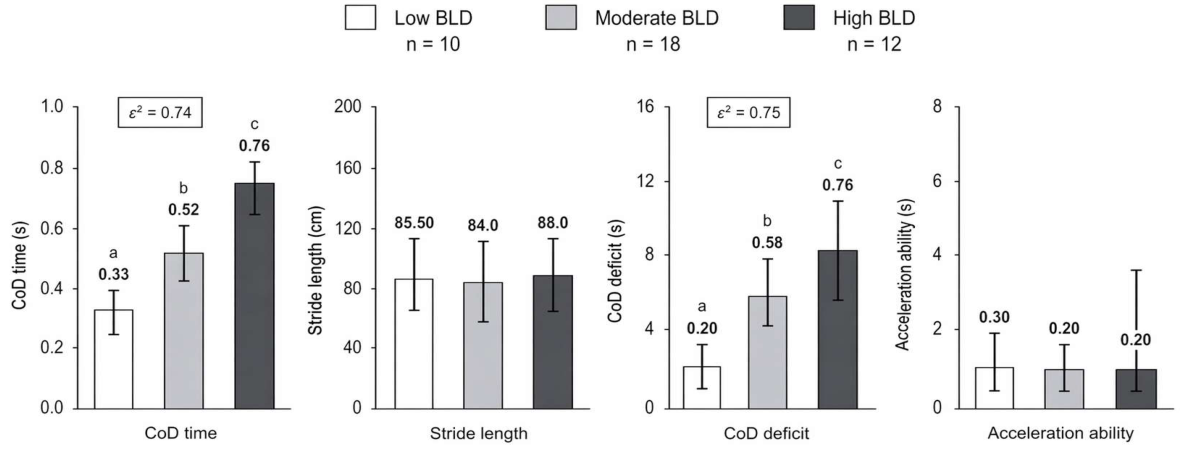
Figure 5.
Influence of bilateral deficit on inter-limb asymmetry during the change-of-direction task. Significance levels are indicated as follows: p < 0.05 (*), p < 0.01 (**), p < 0.001 (***).
Figure 5.
Influence of bilateral deficit on inter-limb asymmetry during the change-of-direction task. Significance levels are indicated as follows: p < 0.05 (*), p < 0.01 (**), p < 0.001 (***).
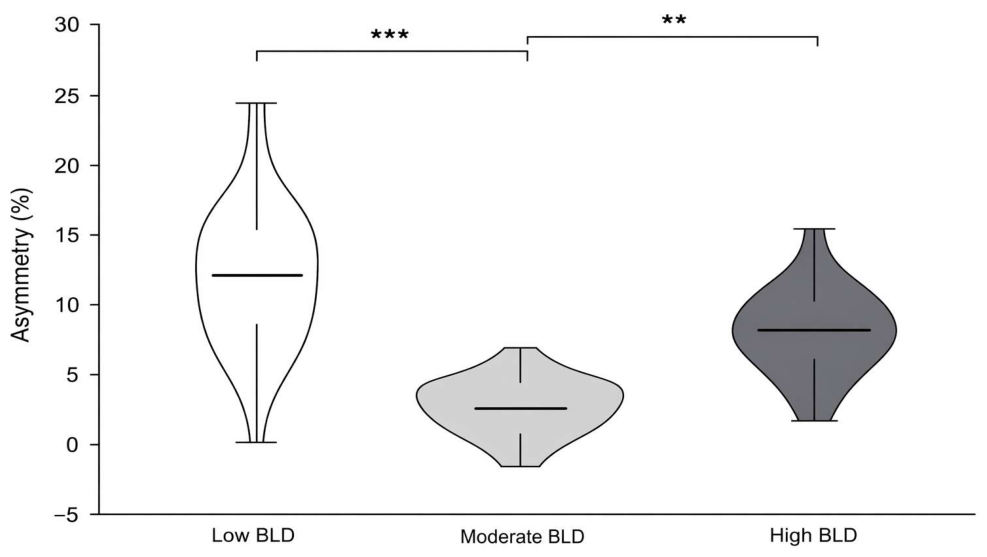

Table 1.
Descriptive statistics of countermovement jump performance in unilateral and bilateral conditions (n = 40).
Table 1.
Descriptive statistics of countermovement jump performance in unilateral and bilateral conditions (n = 40).
| Variable | Jump height (cm) (Mdn [IQR]) | Take off velocity (m·s⁻¹) (Mdn [IQR]) | Power relative (W·kg⁻¹) (Mdn [IQR]) | SEM | CV (%) |
|---|---|---|---|---|---|
| CMJ Right (cm) | 20.45 [3.01] | 2.00 [0.15] | 34.93 [5.12] | 0.49 | 8.73 |
| CMJ Left (cm) | 20.81 [3.22] | 2.02 [0.16] | 35.21 [5.19] | 0.52 | 9.49 |
| CMJ Bilateral (cm) | 38.43 [5.24] | 2.75 [0.19] | 48.84 [6.10] | 0.85 | 4.65 |
Mdn: median; IQR: interquartile range; SEM = standard error of the mean; CV = coefficient of variation.
Disclaimer/Publisher’s Note: The statements, opinions and data contained in all publications are solely those of the individual author(s) and contributor(s) and not of MDPI and/or the editor(s). MDPI and/or the editor(s) disclaim responsibility for any injury to people or property resulting from any ideas, methods, instructions or products referred to in the content. |
© 2026 by the authors. Licensee MDPI, Basel, Switzerland. This article is an open access article distributed under the terms and conditions of the Creative Commons Attribution (CC BY) license (http://creativecommons.org/licenses/by/4.0/).
Copyright: This open access article is published under a Creative Commons CC BY 4.0 license, which permit the free download, distribution, and reuse, provided that the author and preprint are cited in any reuse.


