

Submitted:
28 May 2026
Posted:
29 May 2026
You are already at the latest version
Abstract
Objective: To evaluate the pharmacologic effect of inclisiran on circulating Lp(a) levels compared with placebo through a meta-analysis of randomized controlled trials.
Methods: A systematic search of PubMed, Google Scholar, the Cochrane Library,
ClinicalTrials.gov, and the EU Clinical Trials Register identified randomized controlled trials comparing a 284-mg subcutaneous dose of inclisiran with placebo. Absolute and relative changes in Lp(a) from baseline to the end of follow-up were assessed. When necessary, medians and interquartile ranges were converted to means and standard deviations using validated statistical methods. Pooled estimates were calculated using a random-effects model.
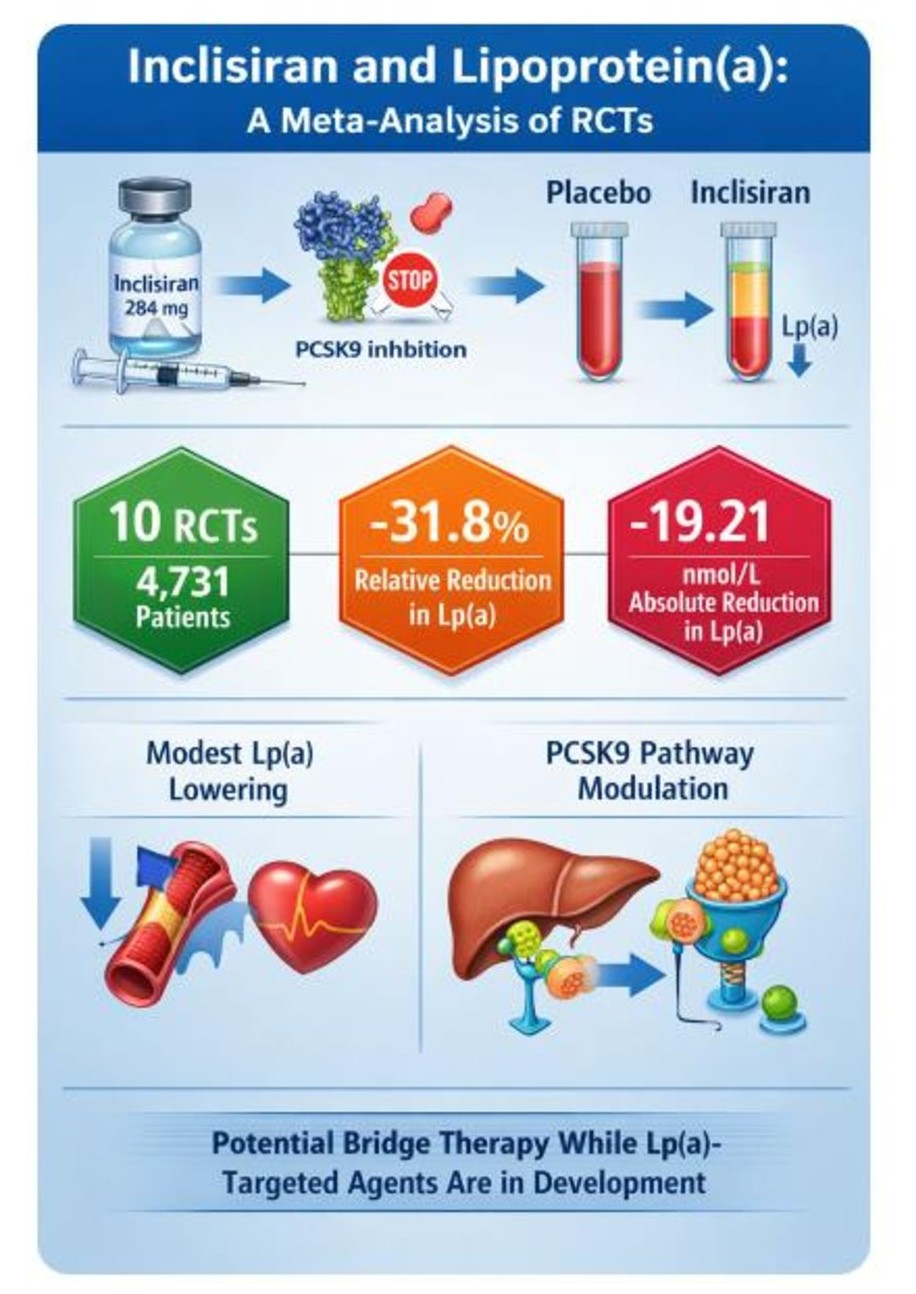
Results: Eight publications comprising ten studies and 4,731 participants met the inclusion criteria. Inclisiran was associated with a weighted mean relative reduction in Lp(a) of −31.8% compared with placebo-treated participants. At the end of follow-up, inclisiran was associated with a statistically significant reduction in Lp(a), with a pooled weighted mean difference of
−19.21 nmol/L (95% CI: −16.00 to -22.42; p < 0.00001); percentage of heterogeneity I2=38% (p=0.13) . Overall, the included studies demonstrated high methodological quality and a low risk of bias
Conclusions: Pharmacologic inhibition of PCSK9 synthesis with inclisiran results in a modest but statistically significant reduction in circulating Lp(a), supporting a contributory role of the PCSK9 pathway in Lp(a) metabolism.
Keywords:
inclisiran
; randomized controlled trials
; lipoprotein a
; meta-analysis
1. Introduction
Lipoprotein(a) [Lp(a)] is a distinct plasma lipoprotein consisting of a low-density lipoprotein (LDL)-like particle containing apolipoprotein B-100 covalently bound to apolipoprotein(a), a glycoprotein structurally related to plasminogen. This composition confers both proatherogenic and prothrombotic properties and links Lp(a) to vascular inflammation and thrombosis [1]. Genetic, epidemiologic, and Mendelian randomization studies have established elevated Lp(a) as an independent and causal risk factor for atherosclerotic cardiovascular disease (ASCVD) and calcific aortic valve stenosis. Lp(a) levels are largely genetically determined, remain relatively stable over time, and are minimally affected by lifestyle measures or conventional lipid-lowering agents, including statins and ezetimibe [2]. These features make Lp(a) a challenging therapeutic target but a relevant candidate for novel lipid-modifying strategies in translational cardiovascular medicine.
Inclisiran is a chemically synthesized, double-stranded small interfering RNA (siRNA) conjugated to N-acetylgalactosamine (GalNAc) for targeted delivery to hepatocytes. Following subcutaneous administration, inclisiran is internalized via the asialoglycoprotein receptor, incorporates into the RNA-induced silencing complex, and induces site-specific degradation of hepatic proprotein convertase subtilisin/kexin type 9 (PCSK9) mRNA. The resulting sustained suppression of circulating PCSK9 increases hepatic low-density lipoprotein receptor (LDLR) recycling and surface expression, enhances LDL particle clearance, and produces durable reductions in LDL-cholesterol (LDL-C) of approximately 50–60% with twice-yearly maintenance dosing [3].
While the LDL-C–lowering efficacy and safety of inclisiran are well described, its impact on Lp(a) remains less clearly characterized. Data from PCSK9 monoclonal antibody trials indicate that pharmacologic PCSK9 inhibition can lower Lp(a) modestly, suggesting that the PCSK9–LDLR axis contributes to Lp(a) handling, but the magnitude and consistency of this effect with siRNA-based PCSK9 suppression have not been systematically quantified. Given the paucity of effective Lp(a)-lowering therapies and the translational relevance of RNA-based lipid drugs, clarifying inclisiran’s effect on Lp(a) has potential implications for risk stratification and treatment algorithms.
This meta-analysis therefore aims to quantitatively evaluate the effects of inclisiran on circulating Lp(a) concentrations compared with placebo in randomized controlled trials. Particular attention is paid to the magnitude of Lp(a) lowering, pharmacologic plausibility of the observed effects, and the potential positioning of inclisiran within emerging multi-target lipid-lowering strategies.
2. Method
This systematic review and meta-analysis were conducted in accordance with Cochrane Collaboration methodology and the Preferred Reporting Items for Systematic Reviews and Meta-Analyses (PRISMA) statement [4]. The protocol was not prospectively registered in PROSPERO or any other registry; this deviation from PRISMA recommendations is acknowledged as a limitation, although the predefined objectives, eligibility criteria, and analysis plan were agreed upon by all authors before study selection commenced.
2.1. Search Strategy and Study Selection
A comprehensive literature search was undertaken in PubMed, Google Scholar, the Cochrane Library, ClinicalTrials.gov, and the EU Clinical Trials Register from database inception to January 2026. The search strategy combined controlled vocabulary and free-text terms related to the intervention, lipid target, and study design, including “inclisiran,” “lipoprotein(a),” “Lp(a),” “PCSK9,” “randomized controlled trial,” “clinical trial,” and “adult.” Search terms were adapted to the syntax of each database, and Boolean operators (AND, OR) were used to maximize sensitivity. No language restrictions were applied at the search stage; non-English full texts, when identified, were assessed if an English abstract and adequate data tables were available.
All retrieved records were imported into a reference manager, where duplicates were identified and removed. Screening and selection proceeded in two stages. First, two reviewers independently screened titles and abstracts to exclude clearly ineligible records (e.g., preclinical studies, non-randomized designs, reviews, editorials, conference abstracts without extractable data). Second, the same reviewers assessed the full text of potentially relevant articles against prespecified inclusion and exclusion criteria. Eligible studies were randomized controlled trials in adults (≥18 years) that: (1) compared a 300-mg dose of sodium inclisiran (equivalent to 284 mg inclisiran) administered subcutaneously with placebo; and (2) reported baseline and follow-up Lp(a) concentrations or sufficient information to derive changes in Lp(a). Trials evaluating other inclisiran doses were considered if a 300-mg arm was present and analyzable.
Observational studies, case series, case reports, pediatric trials, non-randomized interventional studies, modeling studies, and publications lacking extractable Lp(a) data were excluded. When multiple publications reported overlapping populations, the most complete or recent dataset was retained, and supplementary publications were used to clarify or complement outcome data. Disagreements at any stage were resolved by discussion; when consensus could not be reached, a third reviewer adjudicated. Reasons for full-text exclusion were documented to facilitate transparent reporting in the PRISMA flow diagram.
2.2. Data Extraction and Risk of Bias Assessment
Data were extracted independently by two reviewers using a standardized, pilot-tested extraction form. Extracted variables included: study characteristics (first author, year of publication, trial name, country or region, setting), design features (phase, randomization ratio, blinding), details of the intervention and control (inclisiran dose, dosing schedule, route of administration, concomitant background lipid-lowering therapy), and participant characteristics (sample size per arm, age, sex distribution, baseline cardiovascular risk category, presence of familial hypercholesterolemia, baseline Lp(a) and LDL-cholesterol levels). Lp(a) outcomes included baseline values, absolute and/or relative changes at the prespecified primary time point, and measurement units (nmol/L, mg/dL). Where studies reported multiple follow-up time points, the time point corresponding to the primary lipid endpoint or the longest available follow-up within the randomized comparison was preferentially used.
If numerical data were not directly reported in the text but were presented graphically, values were approximated from figures when feasible. When important data were missing or unclear, attempts were made to contact the corresponding authors. Any discrepancies in extracted data were resolved by consensus, with recourse to a third reviewer when necessary.
Risk of bias for each included trial was assessed using the Cochrane Risk of Bias 2 (RoB 2) tool, which evaluates bias arising from the randomization process, deviations from intended interventions, missing outcome data, outcome measurement, and selective reporting. Each domain was rated as low risk, some concerns, or high risk, and an overall risk-of-bias judgment was assigned accordingly. Assessments were performed independently by two reviewers, with disagreements resolved by discussion.
2.3. Outcomes
The primary outcome was the change in Lp(a) from baseline to the end of follow-up, comparing inclisiran with placebo. This was expressed both as an absolute difference in Lp(a) levels (nmol/L) and as a relative percentage change. When trials reported results in mg/dL only, conversions to nmol/L were undertaken using accepted approximate conversion factors when necessary, and analyses were conducted on a common unit to the extent possible. Secondary outcomes relevant to the translational lipid-lowering profile of inclisiran, such as changes in LDL-cholesterol or other lipoprotein fractions, were collected descriptively when available but were not the focus of the pooled quantitative analysis.
Relative changes in Lp(a) were summarized descriptively across trials to provide an overview of proportional effects. Quantitative meta-analysis was restricted to absolute differences when sufficient, commensurable data were available from at least two trials.
2.4. Statistical Analysis
For continuous outcomes, mean changes in Lp(a) and their standard deviations were extracted or derived. When Lp(a) was reported as medians with interquartile ranges, these were converted to approximate means and standard deviations using validated methods described in the quantitative literature. If only change-from-baseline and baseline standard deviations were reported separately, change standard deviations were calculated using established formulas when correlation coefficients could reasonably be assumed or derived.
Pooled effects were estimated using weighted mean differences (WMDs) with corresponding 95% confidence intervals (CIs), treating Lp(a) as a continuous variable. A fixed-effects model was prespecified as the primary analytic approach, conditional on the absence of substantial between-study heterogeneity. Statistical heterogeneity was quantified using the I² statistic and Cochran’s Q test; I² values >50% were interpreted as indicating substantial heterogeneity, in which case the robustness of findings under a random-effects model was explored in sensitivity analyses. Where the number of contributing studies was small, heterogeneity estimates were interpreted cautiously.
A two-sided p value <0.05 was considered statistically significant for the primary analysis. Potential small-study effects and publication bias were evaluated visually using funnel plots and, where at least ten studies were available, analytically using the Egger regression test. All statistical analyses were performed with Review Manager (RevMan) version 5.3 (Cochrane Collaboration).
3. Results
3.1. Study Selection
The search yielded 3,236 records. The number of records retrieved from each database was as follows: PubMed (n = 11), Google Scholar (n = 3,160), the Cochrane Library (n = 50), the EU Clinical Trials Register (n = 9), and ClinicalTrials.gov (n = 6). After removal of duplicates and application of the predefined inclusion and exclusion criteria, seven publications comprising nine randomized clinical trials of inclisiran versus placebo were included in the meta-analysis (Table 1).
3.2. Characteristics of Included Studies
Table 1 summarizes the main characteristics of the included trials. The studies were conducted across multiple geographic regions and clinical settings and evaluated inclisiran in different cardiovascular risk populations.
- The phase 1 trial by Fitzgerald et al. [6], enrolled healthy volunteers in the United Kingdom and evaluated single-dose and two-dose inclisiran regimens versus placebo. The mean age was 46 years, and 79% of participants were male. Follow-up was 84 days. The relative reduction in Lp(a) was 48.1% with a single dose and 13.2% with two doses.
- ORION-1 [7], was a multicenter study conducted across several world regions. Participants had established cardiovascular disease or a risk-equivalent condition, with a mean age of 62 years and 65% men. The trial compared one-dose and two-dose inclisiran regimens with placebo and followed patients for 180 days. The relative reductions in Lp(a) were 30.1% with a single dose and 44.4% with two doses.
- ORION-9 [8] enrolled patients with heterozygous familial hypercholesterolemia from several world regions. The trial compared inclisiran (n = 241) with placebo (n = 240) over 540 days. The relative reduction in Lp(a) with inclisiran was 17.2%.
- ORION-10 [9], was conducted in the United States in patients with established cardiovascular disease or a risk-equivalent condition. The mean age was 66 years, and 69% were men. Inclisiran (n = 781) was compared with placebo (n = 780) over 540 days, yielding a 43.1% reduction in Lp(a).
- ORION-11 [10] included participants from the United States and South Africa with established cardiovascular disease or risk-equivalent conditions. The mean age was 66 years, and 72% were men. Inclisiran (n = 810) was compared with placebo (n = 807) over 540 days, with a 27.8% reduction in Lp(a).
- ORION-15 [11] was conducted in Japan and enrolled patients with established cardiovascular disease or risk-equivalent conditions. The mean age was 63.6 years, and 74.4% were men. Inclisiran (n = 99) was compared with placebo (n = 57) over 360 days, resulting in a 40% reduction in Lp(a).
- VICTORION-INITIATE [12], performed in the United States, enrolled patients with established cardiovascular disease, with a mean age of 67 years and 69.1% men. Inclisiran (n = 225) was compared with placebo (n = 225) over 330 days, with a 21.9% reduction in Lp(a).
- VICTORION-MONO [13]; not fully shown in the excerpt) evaluated inclisiran in a lower-risk primary prevention cohort with no established cardiovascular disease and a predicted 10-year cardiovascular risk below 7.5%. Participants were younger (mean age 45 years), and 40.2% were men. Follow-up was 150 days, and the relative reduction in Lp(a) was 25.2%.
Across all trials, inclisiran was evaluated as an adjunct to standard-of-care lipid-lowering therapy in randomized, placebo-controlled designs. No major methodological limitations that would invalidate the Lp(a) comparisons were identified.
3.3. Patient Populations
Overall, 4,789 participants were included in the analysis. Of these, 4,249 (89.8%) had established cardiovascular disease or a risk-equivalent condition, 482 (10.2%) had heterozygous familial hypercholesterolemia, 261 (5.44%) belonged to a lower-risk primary prevention cohort with a predicted 10-year cardiovascular risk below 7.5%, and 18 (0.37%) were healthy volunteers. Thus, the evidence base is dominated by high-risk secondary prevention populations, with smaller but informative contributions from familial hypercholesterolemia, primary prevention, and phase 1 studies.
3.4. Effects of Inclisiran on Lp(a)
Across the nine randomized comparisons, the weighted mean relative reduction in Lp(a) at the end of follow-up with inclisiran versus placebo was −31.8%. One trial reported only relative percentage changes in Lp(a) and did not provide sufficient data to estimate absolute weighted mean differences, so it was included in the descriptive relative analysis but not in the pooled absolute effect.
A total of 4,570 participants from seven trials contributed data suitable for quantitative pooling of absolute Lp(a) changes. In the meta-analysis, inclisiran was associated with a statistically significant reduction in Lp(a) compared with placebo, with a pooled weighted mean difference of −19.21 nmol/L (95% confidence interval: −22.42 to −16.00; p < 0.00001). This effect was directionally consistent across studies, indicating a reproducible Lp(a)-lowering effect of inclisiran in diverse patient populations and clinical settings.
Between-study heterogeneity was modest (I² = 38%; p = 0.13), suggesting that most of the variability in effect sizes can be attributed to sampling error rather than systematic differences in study design or populations. Visual inspection of funnel plots and results of the Egger test did not reveal substantial small-study effects or publication bias. Overall, the methodological quality of the included trials and the risk-of-bias assessments were favorable, supporting the robustness of the pooled estimates (Figure 1). In all trials, inclisiran also produced the expected substantial reductions in LDL-cholesterol compared with placebo, consistent with its established lipid-lowering profile, while the present analysis specifically quantified its effect on Lp(a)
4. Discussion
This meta-analysis demonstrates that inclisiran produces a modest but statistically significant reduction in Lp(a), with an average relative decrease of approximately 32% and an absolute reduction of about 19 nmol/L (≈8.9 mg/dL) compared with placebo. Although smaller in magnitude than the 50–60% reductions typically achieved in LDL-C, this Lp(a) effect is clinically relevant in view of the strong causal link between elevated Lp(a) and ASCVD and the lack of approved, high-efficacy Lp(a)-targeted therapies.
The observed Lp(a) reduction with inclisiran is consistent with data from PCSK9 monoclonal antibody trials, where alirocumab and evolocumab typically lower Lp(a) by 20–30%, corresponding to absolute reductions of about 5–10 mg/dL [14,15]. Together, these findings support a mechanistically plausible role of PCSK9–LDLR modulation in Lp(a) metabolism. Proposed mechanisms include increased hepatic LDLR expression with reduced LDL particle burden, resulting in less competition between LDL and Lp(a) for LDLR binding and facilitating greater Lp(a) uptake and catabolism [16,17,18]. However, because Lp(a) production is driven by apolipoprotein(a) synthesis, which is not directly targeted by PCSK9-directed therapies, the capacity of this pathway to lower Lp(a) is inherently limited.
From a translational pharmacology perspective, inclisiran offers a distinct modality of PCSK9 inhibition—RNA interference—providing sustained target suppression and a twice-yearly maintenance schedule after the initial loading doses. This long-acting profile may be advantageous for real-world implementation, particularly in patients with suboptimal adherence to more frequent injectable therapies. Nevertheless, the magnitude of Lp(a) lowering observed with inclisiran suggests that its contribution to Lp(a)-mediated risk reduction will be incremental and mainly relevant when Lp(a) elevation coexists with markedly elevated LDL-C.
In contrast, emerging Lp(a)-specific therapies, including antisense oligonucleotides and siRNA agents directed against apolipoprotein(a), have achieved Lp(a) reductions exceeding 70–90% in phase 2 studies, heralding a potential shift in the management of Lp(a)-driven residual risk [19]. Within this evolving landscape, inclisiran is unlikely to serve as a primary Lp(a)-lowering agent. Instead, it may be integrated into combination regimens, in which robust LDL-C reduction from PCSK9 silencing is complemented by potent, production-targeted Lp(a) inhibition. Such multi-target approaches align with the translational goal of addressing overlapping lipid and lipoprotein pathways that contribute to residual cardiovascular risk.
The strengths of this analysis include restriction to randomized, placebo-controlled trials, relatively large pooled sample size, and low risk of bias. Heterogeneity was modest, suggesting that the Lp(a) effect of inclisiran is consistent across different clinical scenarios. Important limitations should be acknowledged: Lp(a) was a secondary endpoint in all trials; assays and units were not fully standardized; and the available data do not allow separation of Lp(a)-mediated benefits from those attributable to LDL-C reduction alone. Prospective outcome studies incorporating standardized Lp(a) measurement and stratification by baseline and achieved Lp(a) levels will be required to clarify the clinical impact of the observed Lp(a) reduction with inclisiran.
In conclusion, inclisiran confers a modest but statistically significant reduction in Lp(a), supporting a contributory role of PCSK9–LDLR modulation in Lp(a) metabolism. While unlikely to provide sufficient Lp(a) lowering as monotherapy in patients with markedly elevated Lp(a), inclisiran represents a rational pharmacologic component of comprehensive, multi-target lipid-lowering strategies that will be increasingly relevant as Lp(a)-specific agents enter clinical practice.
Author Contributions
This manuscript is co-authored by JE and VV (conception and design, analysis and interpretation of data, and writing of manuscript). All authors read and approved the final manuscript.
Funding
The authors did not receive any specific grant for this research from funding agencies in the public, commercial, or not-for-profit sectors.
Informed Consent Statement
Ethics approval and consent waived. All the data presented in this review is from previously published studies.
Data Availability Statement
Not applicable.
Conflicts of Interest
The authors declare that they have no competing interests.
References
- Doherty S, Hernandez S, Rikhi R, Mirzai S, De Los Reyes C, McIntosh S, Block RC, Shapiro MD. Lipoprotein(a) as a Causal Risk Factor for Cardiovascular Disease. Curr Cardiovasc Risk Rep. 2025;19(1):8. Epub 2025 Feb 18. PMID: 39980866; PMCID: PMC11836235. [CrossRef]
- Reyes-Soffer G, Ginsberg HN, Berglund L, Duell PB, Heffron SP, Kamstrup PR, Lloyd-Jones DM, Marcovina SM, Yeang C, Koschinsky ML; American Heart Association Council on Arteriosclerosis, Thrombosis and Vascular Biology; Council on Cardiovascular Radiology and Intervention; and Council on Peripheral Vascular Disease. Lipoprotein(a): A Genetically Determined, Causal, and Prevalent Risk Factor for Atherosclerotic Cardiovascular Disease: A Scientific Statement From the American Heart Association. Arterioscler Thromb Vasc Biol. 2022 Jan;42(1):e48-e60. Epub 2021 Oct 14. PMID: 34647487; PMCID: PMC9989949. [CrossRef]
- Di Giacomo-Barbagallo F, Andreychuk N, Scicali R, Gonzalez-Lleó A, Piro S, Masana L, Ibarretxe D. Inclisiran, Reasons for a Novel Agent in a Crowded Therapeutic Field. Curr Atheroscler Rep. 2025 Jan 9;27(1):25. PMID: 39786678; PMCID: PMC11717820. [CrossRef]
- Page MJ, McKenzie JE, Bossuyt PM, Boutron I, Hoffmann TC, Mulrow CD, Shamseer L, Tetzlaff JM, Akl EA, Brennan SE, Chou R, Glanville J, Grimshaw JM, Hróbjartsson A, Lalu MM, Li T, Loder EW, Mayo-Wilson E, McDonald S, McGuinness LA, Stewart LA, Thomas J, Tricco AC, Welch VA, Whiting P, Moher D. The PRISMA 2020 statement: An updated guideline for reporting systematic reviews. J Clin Epidemiol. 2021 Jun;134:178-189. Epub 2021 Mar 29. PMID: 33789819. [CrossRef]
- Hozo SP, Djulbegovic B, Hozo I. Estimating the mean and variance from the median, range, and the size of a sample. BMC Med Res Methodol. 2005 Apr 20;5:13. PMID: 15840177; PMCID: PMC1097734. [CrossRef]
- Fitzgerald K, White S, Borodovsky A, Bettencourt BR, Strahs A, Clausen V, Wijngaard P, Horton JD, Taubel J, Brooks A, Fernando C, Kauffman RS, Kallend D, Vaishnaw A, Simon A. A Highly Durable RNAi Therapeutic Inhibitor of PCSK9. N Engl J Med. 2017 Jan 5;376(1):41-51. Epub 2016 Nov 13. PMID: 27959715; PMCID: PMC5778873. [CrossRef]
- Ray KK, Stoekenbroek RM, Kallend D, Leiter LA, Landmesser U, Wright RS, Wijngaard P, Kastelein JJP. Effect of an siRNA Therapeutic Targeting PCSK9 on Atherogenic Lipoproteins: Prespecified Secondary End Points in ORION 1. Circulation. 2018 Sep 25;138(13):1304-1316. PMID: 29735484. [CrossRef]
- Raal FJ, Kallend D, Ray KK, Turner T, Koenig W, Wright RS, Wijngaard PLJ, Curcio D, Jaros MJ, Leiter LA, Kastelein JJP; ORION-9 Investigators. Inclisiran for the Treatment of Heterozygous Familial Hypercholesterolemia. N Engl J Med. 2020 Apr 16;382(16):1520-1530. Epub 2020 Mar 18. PMID: 32197277. [CrossRef]
- Ray KK, Landmesser U, Leiter LA, Kallend D, Dufour R, Karakas M, Hall T, Troquay RP, Turner T, Visseren FL, Wijngaard P, Wright RS, Kastelein JJ. Inclisiran in Patients at High Cardiovascular Risk with Elevated LDL Cholesterol. N Engl J Med. 2017 Apr 13;376(15):1430-1440. Epub 2017 Mar 17. PMID: 28306389. [CrossRef]
- Ray KK, Wright RS, Kallend D, Koenig W, Leiter LA, Raal FJ, Bisch JA, Richardson T, Jaros M, Wijngaard PLJ, Kastelein JJP; ORION-10 and ORION-11 Investigators. Two Phase 3 Trials of Inclisiran in Patients with Elevated LDL Cholesterol. N Engl J Med. 2020 Apr 16;382(16):1507-1519. Epub 2020 Mar 18. PMID: 32187462. [CrossRef]
- Yamashita S, Kiyosue A, Maheux P, Mena-Madrazo J, Lesogor A, Shao Q, Tamaki Y, Nakamura H, Akahori M, Kajinami K. Efficacy, Safety, and Pharmacokinetics of Inclisiran in Japanese Patients: Results from ORION-15. J Atheroscler Thromb. 2024 Jun 1;31(6):876-903. Epub 2024 Jan 14. PMID: 38220186; PMCID: PMC11150722. [CrossRef]
- Koren MJ, Rodriguez F, East C, Toth PP, Watwe V, Abbas CA, Sarwat S, Kleeman K, Kumar B, Ali Y, Jaffrani N. An "Inclisiran First" Strategy vs Usual Care in Patients With Atherosclerotic Cardiovascular Disease. J Am Coll Cardiol. 2024 May 21;83(20):1939-1952. Epub 2024 Apr 7. PMID: 38593947. [CrossRef]
- Taub PR, Gutierrez A, Wewers D, Garcia Cantu E, Cao H, Deck C, Lesogor A, Ott D, Mena-Madrazo J, Zang X, Wright RS. Safety and Lipid-Lowering Efficacy of Inclisiran Monotherapy in Patients Without ASCVD: The VICTORION-Mono Randomized Clinical Trial. J Am Coll Cardiol. 2025 Jul 22;86(3):196-208. Epub 2025 May 5. PMID: 40392667. [CrossRef]
- Bittner VA, Szarek M, Aylward PE, Bhatt DL, Diaz R, Edelberg JM, Fras Z, Goodman SG, Halvorsen S, Hanotin C, Harrington RA, Jukema JW, Loizeau V, Moriarty PM, Moryusef A, Pordy R, Roe MT, Sinnaeve P, Tsimikas S, Vogel R, White HD, Zahger D, Zeiher AM, Steg PG, Schwartz GG; ODYSSEY OUTCOMES Committees and Investigators. Effect of Alirocumab on Lipoprotein(a) and Cardiovascular Risk After Acute Coronary Syndrome. J Am Coll Cardiol. 2020 Jan 21;75(2):133-144. PMID: 31948641. [CrossRef]
- Okada T, Miyoshi T, Doi M, Nosaka K, Tsushima R, Ugawa S, Takagi W, Sogo M, Takahashi M, Ito H. Effect of Early Initiation of Evolocumab on Lipoprotein(a) in Patients with Acute Myocardial Infarction: Sub-Analysis of a Randomized Controlled Trial. J Cardiovasc Dev Dis. 2022 May 12;9(5):153. PMID: 35621864; PMCID: PMC9144976. [CrossRef]
- Reyes-Soffer G, Pavlyha M, Ngai C, Thomas T, Holleran S, Ramakrishnan R, Karmally W, Nandakumar R, Fontanez N, Obunike J, Marcovina SM, Lichtenstein AH, Matthan NR, Matta J, Maroccia M, Becue F, Poitiers F, Swanson B, Cowan L, Sasiela WJ, Surks HK, Ginsberg HN. Effects of PCSK9 Inhibition With Alirocumab on Lipoprotein Metabolism in Healthy Humans. Circulation. 2017 Jan 24;135(4):352-362. Epub 2016 Dec 16. PMID: 27986651; PMCID: PMC5262523. [CrossRef]
- Watts GF, Chan DC, Pang J, Ma L, Ying Q, Aggarwal S, Marcovina SM, Barrett PHR. PCSK9 Inhibition with alirocumab increases the catabolism of lipoprotein(a) particles in statin-treated patients with elevated lipoprotein(a). Metabolism. 2020 Jun;107:154221. Epub 2020 Mar 30. PMID: 32240727. [CrossRef]
- Raal FJ, Giugliano RP, Sabatine MS, Koren MJ, Blom D, Seidah NG, Honarpour N, Lira A, Xue A, Chiruvolu P, Jackson S, Di M, Peach M, Somaratne R, Wasserman SM, Scott R, Stein EA. PCSK9 inhibition-mediated reduction in Lp(a) with evolocumab: an analysis of 10 clinical trials and the LDL receptor's role. J Lipid Res. 2016 Jun;57(6):1086-96. Epub 2016 Apr 21. PMID: 27102113; PMCID: PMC4878192. [CrossRef]
- Pirillo A, Catapano AL. Lipoprotein (a): A new target for pharmacological research and an option for treatment. Eur J Intern Med. 2025 Sep;139:106425. Epub 2025 Jul 24. PMID: 40713253. [CrossRef]
Figure 1.
meta-analysis showing weighted mean difference in the reduction of LDL cholesterol and risk of bias for each study.
Figure 1.
meta-analysis showing weighted mean difference in the reduction of LDL cholesterol and risk of bias for each study.
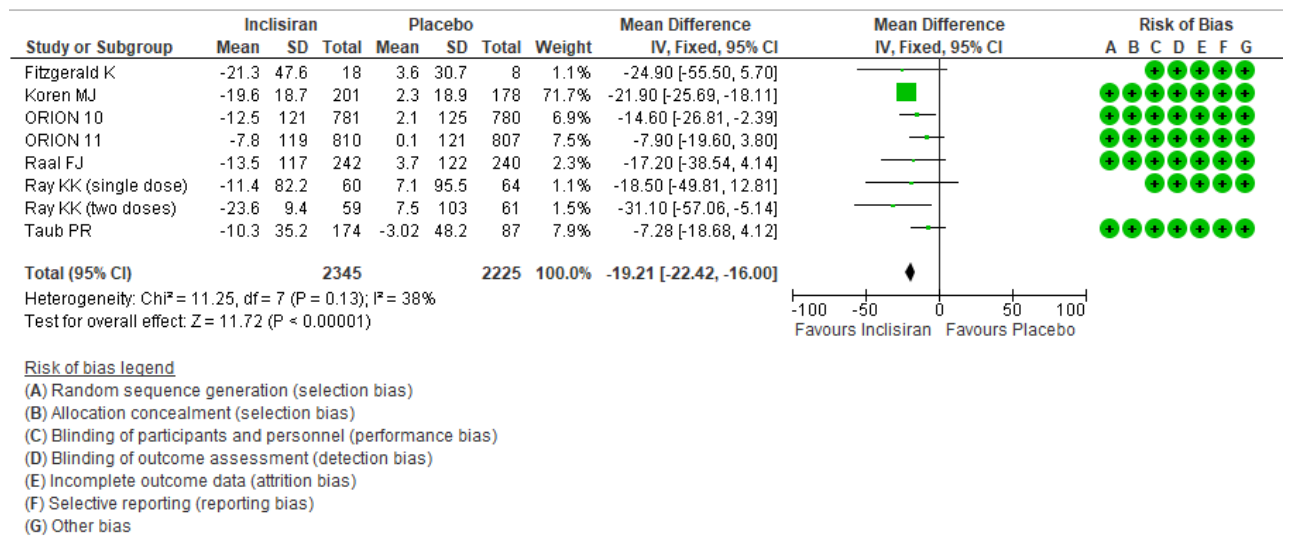

Table 1.
Characteristics of randomized clinical trials included in the study.
| Author, year, [reference] | Study name | Country | No of patients analyzed | Population | Follow-up | Lp(a)Relative reduction |
| Fitzgerald, 2017 [6] |
PHASE 1 TRIAL | UK | Inclisiran single dose (n=3), placebo (n=6). Inclisiran 2 doses (n=3), placebo (n=6) | Mean age 46 years. Male (79%). Healthy volunteers | 84 days | Single dose: 48.1% Two doses: 13.2% |
| Ray KK, 2018 [7] | ORION 1 | Several world regions | Inclisiran 1 dose (n=60), placebo (n=64). Inclisiran 2 doses (n=59), placebo (n=61) | Mean age 62 years. Men (65%). Established CV disease or risk equivalent | 180 days | Single dose: 30.1% Two doses: 44.4% |
| Raal FJ, 2020 [8] | ORION 9 | Several world regions | Inclisiran (n=241), placebo (n=240) | Heterozygous familiar hypercholesterolemia | 540 days | 17.2% |
| Ray KK, 2020 [9] | ORION 10 | US | Inclisiran (n=781), placebo (n=780) | Mean age 66 years. Men (69%). Established CV disease or risk equivalent | 540 days | 43.1% |
| Ray KK, 2020 [10] | ORION 11 | US and South Africa | Inclisiran (n=810), placebo (n=807) | Mean age 66 years. Men (72%). Established CV disease or risk equivalent | 540 days | 27.8% |
| Yamashita S, 2024 [11] |
ORION 15 | Japan | Inclisiran (n=99), placebo (n=57) | Mean age 63.6 years. Men 74.4%). Patients with established CV disease o risk equivalent | 360 days | 40% |
| Koren MJ, 2024 [12] |
VICTORION INITIATE |
US | Inclisiran (n=225), placebo (n=225) | Mean age 67 years. Men (69.1%). Established CV disease. | 330 days | 21.9% |
| Taub PR 2025 [12] |
VICTORION MONO | Several world regions | Inclisiran (n=174), placebo (n=87) | Mean age 45 years, Men (40.2%). No CV disease and a predicted risk < 7.5% | 150 days | 25.2% |
Disclaimer/Publisher’s Note: The statements, opinions and data contained in all publications are solely those of the individual author(s) and contributor(s) and not of MDPI and/or the editor(s). MDPI and/or the editor(s) disclaim responsibility for any injury to people or property resulting from any ideas, methods, instructions or products referred to in the content. |
© 2026 by the authors. Licensee MDPI, Basel, Switzerland. This article is an open access article distributed under the terms and conditions of the Creative Commons Attribution (CC BY) license (http://creativecommons.org/licenses/by/4.0/).
Copyright: This open access article is published under a Creative Commons CC BY 4.0 license, which permit the free download, distribution, and reuse, provided that the author and preprint are cited in any reuse.


