

Submitted:
27 May 2026
Posted:
28 May 2026
You are already at the latest version
Abstract
Objectives: Psoriasis is a chronic systemic inflammatory disease associated with an increased risk of cardiovascular disease (CVD). Although this association is well established in moderate-to-severe psoriasis, data on cardiovascular risk in patients with mild psoriasis without metabolic or cardiovascular comorbidities are limited. This study aimed to assess cardiovascular risk and its determinants in patients with mild plaque psoriasis without comorbidities.
Methods: This case-control study included 31 adults with mild plaque psoriasis and 17 healthy controls. Patients with metabolic disorders or other inflammatory conditions, cardiovascular disease, malignancies, or heart, kidney, or liver failure were excluded. Clinical assessment included anthropometric measurements, blood pressure, and biochemical blood tests. Ten-year cardiovascular risk was estimated using the Framingham Risk Score (FRS). Group comparisons were performed using nonparametric tests, and correlations were analyzed using Spearman’s correlation coefficient.
Results: Patients with mild psoriasis had significantly higher total cholesterol (205.09 vs. 185.07 mg/dL, p = 0.047), non-HDL cholesterol (144.75 vs. 117.50 mg/dL, p = 0.005), LDL cholesterol (124.71 vs. 102.04 mg/dL, p = 0.011), and HbA1c (284.00 vs. 127.77 ng/mL, p = 0.016) than controls. Mean FRS was approximately threefold higher in patients with psoriasis than in controls (2.24% vs. 0.67%, p = 0.013). Male patients had significantly higher FRS than female patients (3.46% vs. 0.71%, p < 0.05). FRS correlated strongly with alanine aminotransferase (ALT; r = 0.63) and moderately with body weight, non-HDL cholesterol, waist circumference, triglycerides, LDL cholesterol, and insulin.
Conclusions: Mild psoriasis is associated with increased cardiovascular risk even in the absence of overt metabolic or cardiovascular comorbidities. Early cardiometabolic screening and preventive interventions should be considered in all patients with psoriasis, regardless of disease severity.
Keywords:
psoriasis
; cardiovascular risk
; framingham risk score
; metabolic syndrome
; comorbidities
1. Introduction
Psoriasis is a systemic autoimmune inflammatory disease affecting approximately 2% of the global population. In nearly half of patients, skin lesions involve less than 3% of the body surface area (BSA), while in approximately 78% of patients they affect less than 10% of the BSA [1]. The prevalence of psoriasis is similar in both sexes, and the disease occurs more frequently in adults than in children. The most common form of psoriasis is plaque psoriasis, accounting for more than 80% of all cases. Plaque psoriasis is associated with an increased prevalence of comorbidities such as psoriatic arthritis, cardiovascular diseases (CVD), and depressive disorders [2].
Psoriasis has been shown to increase the relative risk of developing CVD by approximately 25%, independently of classical risk factors such as smoking, hyperlipidemia, or obesity [3]. Metabolic syndrome (MetS), comprising metabolic disturbances associated with increased cardiovascular risk (CVR), occurs in 20-50% of patients with psoriasis, making it the most common comorbidity in this patient population. Patients with psoriasis have at least a twofold higher risk of developing MetS compared with healthy individuals [4]. The risk of MetS increases with the severity of skin involvement [5]. Severe psoriasis is also associated with an increased absolute risk of major adverse cardiovascular events (MACE), estimated at 6.2% within 10 years after diagnosis compared with the healthy population [3]. Consequently, in 2012 psoriasis was recognized by the European Society of Cardiology in the guidelines on cardiovascular disease prevention in clinical practice as an independent cardiovascular risk factor [6].
The pathogenesis of psoriasis is associated with increased activation of T lymphocytes, myeloid cells, and platelets, as well as enhanced secretion of interferons, tumor necrosis factor alpha (TNF-α), and cytokines of the IL-23/Th17 axis, including interleukins 17 and 6. This systemic inflammatory state leads not only to the development of skin lesions but also to vascular inflammation and the progression of atherosclerosis [7].
Th17 lymphocytes are the principal mediators of the inflammatory response in psoriasis, and inflammatory reactions induced by IL-17A - the key effector cytokine of the Th17 axis - are considered one of the major pathogenic mechanisms linking psoriasis with cardiovascular diseases [8,9]. Increased expression of IL-17A has been observed both in psoriatic lesions and in atherosclerotic plaques, confirming the presence of shared inflammatory mechanisms underlying both conditions [8]. IL-17 has also been shown to contribute more directly than IL-23 to endothelial dysfunction, atherosclerosis development, and insulin resistance [9].
Chemokines secreted by Th17 lymphocytes initiate monocyte migration and further recruitment of inflammatory cells through the endothelium, leading to macrophage activation and their differentiation into foam cells. The accumulation of foam cells within the vascular wall constitutes the basis for atherosclerotic plaque formation [10]. Elevated IL-17 levels have been demonstrated in patients with unstable angina, acute myocardial infarction, and obesity [11,12]. Even in mild forms of psoriasis, chronic activation of the Th17/IL-17 axis may lead to persistent subclinical inflammation, contributing to the gradual increase in cardiovascular risk (CVR) [13].
Another important mediator involved in the pathogenic processes of psoriasis is vascular endothelial growth factor (VEGF), produced, among others, by keratinocytes, which regulates angiogenesis and epidermal proliferation. VEGF concentrations are significantly elevated in psoriatic plaques, and its serum levels correlate with disease severity [14]. VEGF is also produced by adipocytes, and elevated concentrations have been observed in obesity and insulin resistance, and consequently also in metabolic syndrome [15]. Furthermore, levels of Th1 cytokines, adhesion molecules (ICAM-1, E-selectin), and angiogenic factors, including VEGF, have been shown to be elevated both in psoriasis and in obesity as well as in acute coronary syndromes [16,17].
The increased cardiovascular risk in patients with psoriasis is also influenced by genetic factors. Psoriasis susceptibility loci such as PSORS2, PSORS3, and PSORS4, as well as the CDKAL1 and ApoE4 genes, are associated with an increased risk of metabolic syndrome, type 2 diabetes mellitus, and CVD [18]. Recently, a study identifying 58 pleiotropic loci shared between psoriasis and seven major cardiovascular diseases, including arterial hypertension, coronary artery disease, and acute myocardial infarction, was published. Among these loci, four genes (SLC22A5, LMAN2, HSD3B7, and ZNF668) were identified as potential therapeutic targets [19].
According to Jeffrey Garshick et al., patients with psoriasis have up to a 50% higher risk of CVD, which increases with the severity of skin lesions [7]. In a prospective study involving approximately 130,000 patients with psoriasis, with a mean follow-up period of 5.4 years, psoriasis was demonstrated to be an independent risk factor for myocardial infarction [20]. A meta-analysis of 14 cohort studies showed a 37% higher risk of cardiovascular death, a 59% higher risk of stroke, and a threefold higher risk of myocardial infarction in patients with severe psoriasis compared with the general population [21]. The highest relative risk of CVD was observed among young patients with severe psoriasis — in 30-year-old patients, the risk of myocardial infarction was three times higher than in age-matched controls [20,21]. Furthermore, patients with psoriasis were found to have an increased risk of ischemic heart disease (50%), arterial hypertension (80%), diabetes mellitus (90%), dyslipidemia (50%), obesity assessed by body mass index (BMI; 80%), and abdominal obesity (60%) [22].
It has been suggested that treatment of skin lesions reduces systemic inflammation and thereby lowers cardiovascular risk; however, this has not yet been confirmed in randomized studies. Given the increased risk of CVD in patients with psoriasis and the inclusion of psoriasis in the guidelines of major cardiology scientific societies as an independent risk factor for CVD, further studies are needed to determine the therapeutic value of managing classical CVR factors, as well as the impact of lipid-lowering therapy, antiplatelet treatment, and psoriasis therapy on CVD risk [7]. In particular, the development of preventive recommendations for patients with mild psoriasis is of major importance, as they constitute the largest subgroup of patients with psoriasis. A milder disease course is associated with less frequent follow-up visits, which may contribute to lower compliance, whereas early implementation of preventive measures may effectively reduce the risk of CVD in subsequent years.
Many published studies evaluating CVD risk in psoriasis describe associations between comorbidities, demonstrating a higher prevalence of concomitant diseases with increasing severity of psoriasis [23]. Most studies investigating the coexistence of CVD and psoriasis concern patients with moderate-to-severe psoriasis. However, studies assessing cardiovascular risk with consideration of specific demographic, anthropometric, and metabolic parameters in patients with mild psoriasis are lacking. To the best of our knowledge, no previous study has evaluated cardiovascular risk exclusively in patients with mild psoriasis without concomitant metabolic diseases. We also did not identify any publication analyzing individual components of cardiovascular risk assessment in this strictly defined population. Considering that patients with mild psoriasis constitute the largest proportion of the psoriatic population, determining cardiovascular risk in this group is of substantial clinical importance. Therefore, our aim was to assess cardiovascular risk and identify its predictors in a strictly defined population of patients exclusively with mild psoriasis and without comorbidities, which remains an insufficiently investigated patient group [16].
2. Materials and Methods
2.1. Study Population
The study group included 31 patients (42% females, age 40.8 ± 2.5 years; 58% males, age 41.2 ± 1.5 years) diagnosed with mild psoriasis at the Clinic and Department of Dermatology, Sexually Transmitted Diseases, and Clinical Immunology in Olsztyn, Poland (Table 1). The study was approved by the Bioethics Committee of the University of Warmia and Mazury in Olsztyn, Poland (1/2023). Informed consent was obtained from each patient enrolled in the study. Due to variability in the definitions of mild psoriasis, this study adopted the criteria for mild disease as BSA < 10% and PASI < 10 according to the European consensus published in 2011 [24,25]. Patients with metabolic disorders (including obesity, diabetes mellitus, and hyperlipidemia), other inflammatory diseases, previous cardiovascular disorders, heart, kidney, or liver failure, as well as neoplasms, were excluded.
The control group consisted of healthy volunteers (n = 17; 47% females, age 38.1 ± 2.3 years; 53% males, age 38.7 ± 1.9 years) with no personal history of inflammatory or autoimmune diseases (Table 1).
2.2. Clinical Characteristics
Venous blood samples (6 mL) were collected using Vacuette tubes (Greiner Bio-One GmbH, Austria) and subjected to biochemical blood testing, including complete blood count (CBC) (Mindray BC-760CS, Cormay Diagnostics), C-reactive protein (CRP), alanine aminotransferase (ALT), aspartate aminotransferase (AST), glucose, creatinine (Cobas Pure, Roche Diagnostics), and lipid profile assessment (Cobas 6000, Roche Diagnostics). The above-mentioned parameters were analyzed in the Laboratory of the Municipal Hospital in Olsztyn.
Serum levels of apolipoprotein A-I (apoA-I), apolipoprotein B (apoB), glycated hemoglobin A1c (HbA1c), and insulin were determined using commercially available ELISA kits (Biorbyt, China; Demeditec, Germany) with the widest available measurement ranges (apoA-I: 25–1600 ng/mL, sensitivity 9 ng/mL; apoB: 78.125–5000 ng/mL, sensitivity 46.875 ng/mL; HbA1c: 3.13–200 ng/mL, sensitivity 1.36 ng/mL; insulin: 6.25–100 µIU/mL, sensitivity 3.13 µIU/mL). Absorbance values were measured at 450 nm using a Multiskan FC spectrophotometer (Thermo Fisher Scientific, Waltham, MA, USA).
The assay used for glycated hemoglobin A1c (HbA1c) determination in this study was intended exclusively for research purposes and not for diagnostic use. Patient sera were diluted according to the manufacturer’s recommendations to ensure that all measurements fell within the dynamic range of the assay. Final HbA1c concentrations were calculated using the appropriate dilution factors, which resulted in higher absolute values in the patient group.
2.3. Cardiovascular Risk Assessment
Cardiovascular risk was assessed using the Framingham Risk Score (FRS), which estimates the 10-year risk of cardiovascular diseases, such as myocardial infarction or stroke, in patients aged 30–79 years without a previous history of cardiovascular disease or diabetes mellitus. The scale is based on the assessment of parameters including age, sex, total cholesterol and HDL cholesterol levels, systolic blood pressure, use of antihypertensive medication, and smoking status. One limitation of cardiovascular risk assessment in patients with psoriasis using the Framingham scale is the lack of consideration of inflammation associated with autoimmune disease, which may result in underestimation of the actual cardiovascular risk in this patient population [3]. In the present study, the recommended Systematic Coronary Risk Evaluation 2 (SCORE2) scale was not used due to the age of the participants. The SCORE2 scale is intended for individuals aged 40–69 years, whereas the mean age in the control group was 38.41 years, and only four participants were older than 40 years.
Due to inconsistent data regarding the association between psoriasis severity and cardiovascular risk (CVR), our study focused on the largest subgroup of patients, namely individuals with mild psoriasis. Patients without comorbidities were recruited in order to objectively assess CVR in comparison with a control group consisting of healthy individuals. Furthermore, we decided to evaluate correlations between additional factors, including apolipoproteins A-I and B, because of their atherogenic potential, in order to determine their influence on CVR and enable earlier and more effective intervention in these patients.
2.4. Statistical Analysis
Statistical analyses were performed using Statistica software (version 13.1; StatSoft Poland). Mean values and standard error of the mean (± SEM) were used to describe the levels of variables and the demographic characteristics of the studied groups. The distributions of all analyzed continuous variables were compared with normal distribution, and homogeneity of variance was assessed. As the assumptions for parametric testing were not fulfilled, the Mann–Whitney U test was used to evaluate differences in variable levels between the two groups. Differences between sexes in both groups were assessed using the Kruskal–Wallis ANOVA test. Correlations were analyzed using Spearman’s rank correlation coefficient. Differences and correlations were considered statistically significant at p < 0.05.
3. Results
The analysis included 31 patients with a mean age of 41 ± 1.33 years and a control group (n = 17) with a mean age of 38.41 ± 1.43 years (Table 2). PASI and BSA values confirmed mild psoriasis severity. No elevated BMI values or increased waist circumference were observed.

Table 2.
Clinical Characteristic of the Study Groups.
| patients | control | p value | |||
| n | 31 | 17 | - | ||
| mean±SEM | median | mean±SEM | median | ||
| total cholesterol (mg/dl) | 205.09±5.93 | 202 | 185.07±6.72 | 185.1 | 0.047 |
| HDL (mg/dl) | 60.33±2.84 | 56.7 | 67.57±3.51 | 66.4 | 0.217 |
| non-HDL (mg/dl) | 144.75±5.78 | 134.5 | 117.50±6.90 | 116.4 | 0.005 |
| BP (mmHg) | 132.45±2.16 | 132 | 126.41±3.11 | 123 | 0.121 |
| LDL (mg/dl) | 124.71±5.54 | 116.38 | 102.04±6.29 | 100.36 | 0.011 |
| ALT (U/L) | 24.83±2.12 | 22.2 | 20.94±2.64 | 17.4 | 0.274 |
| AST (U/L) | 22.57±1.04 | 21.5 | 20.27±1.39 | 19.5 | 0.358 |
| CRP (mg/L) | 3.66±1.61 | 0.8 | 0.88±1.11 | 0.64 | 0.924 |
| glucose (mg/dl) | 87.12±2.00 | 85 | 81.82±2.23 | 81 | 0.940 |
| insulin (uIU/mL) | 11.43±1.22 | 9.9 | 10.42±0.83 | 9.648 | 0.872 |
| triglycerides (mg/dl) | 100.22±7.18 | 92.3 | 77.29±7.91 | 69.5 | 0.236 |
| HbA1c (ng/mL) | 284.00±42.56 | 193.1 | 127.77±13.14 | 107.3 | 0.016 |
| apoA-I A (ng/mL) | 101.78±6.64 | 97.1 | 130.16±7.42 | 129.6 | 0.872 |
| apoB (ng/mL) | 63.95±5.47 | 55.7 | 69.41±7.14 | 57.0 | 0.258 |
| apoB/apoA-I ratio | 0.70±0.07 | 0.6 | 0.55±0.05 | 0.55 | 1.000 |
| Framingham score (%) | 2.24±0.49 | 1.5 | 0.67±0.22 | 0.3 | 0.013 |
The study group showed higher levels of total cholesterol (205.09 ± 5.93 mg/dL), non-HDL cholesterol (144.75 ± 5.78 mg/dL), LDL cholesterol (124.71 ± 5.54 mg/dL), and HbA1c (284.00 ± 42.56 ng/mL) compared with the control group (185.07 ± 6.72; 117.50 ± 6.90; 102.04 ± 6.29; and 127.77 ± 13.14, respectively). Moreover, the mean value and median of the apoB/apoA-I ratio were higher in the study group compared with the control group (0.70 vs. 0.55 and 0.60 vs. 0.55, respectively); however, these differences were not statistically significant (p = 1.000). Patients with psoriasis had approximately threefold higher Framingham risk scores than healthy controls (2.24 ± 0.49% vs. 0.67 ± 0.22%). Variables that differed from the control group were further analyzed according to sex. Within the study group, higher Framingham scores were observed in men compared with women (3.46 ± 0.68 vs. 0.71 ± 0.17; p < 0.05) (Figure 1).
Figure 1.
Levels of total cholesterol (mg/dL), non-HDL cholesterol (mg/dL), LDL cholesterol (mg/dL), glycated hemoglobin (ng/mL), and Framingham Risk Score (%) in the study and control groups, stratified by sex.
Figure 1.
Levels of total cholesterol (mg/dL), non-HDL cholesterol (mg/dL), LDL cholesterol (mg/dL), glycated hemoglobin (ng/mL), and Framingham Risk Score (%) in the study and control groups, stratified by sex.
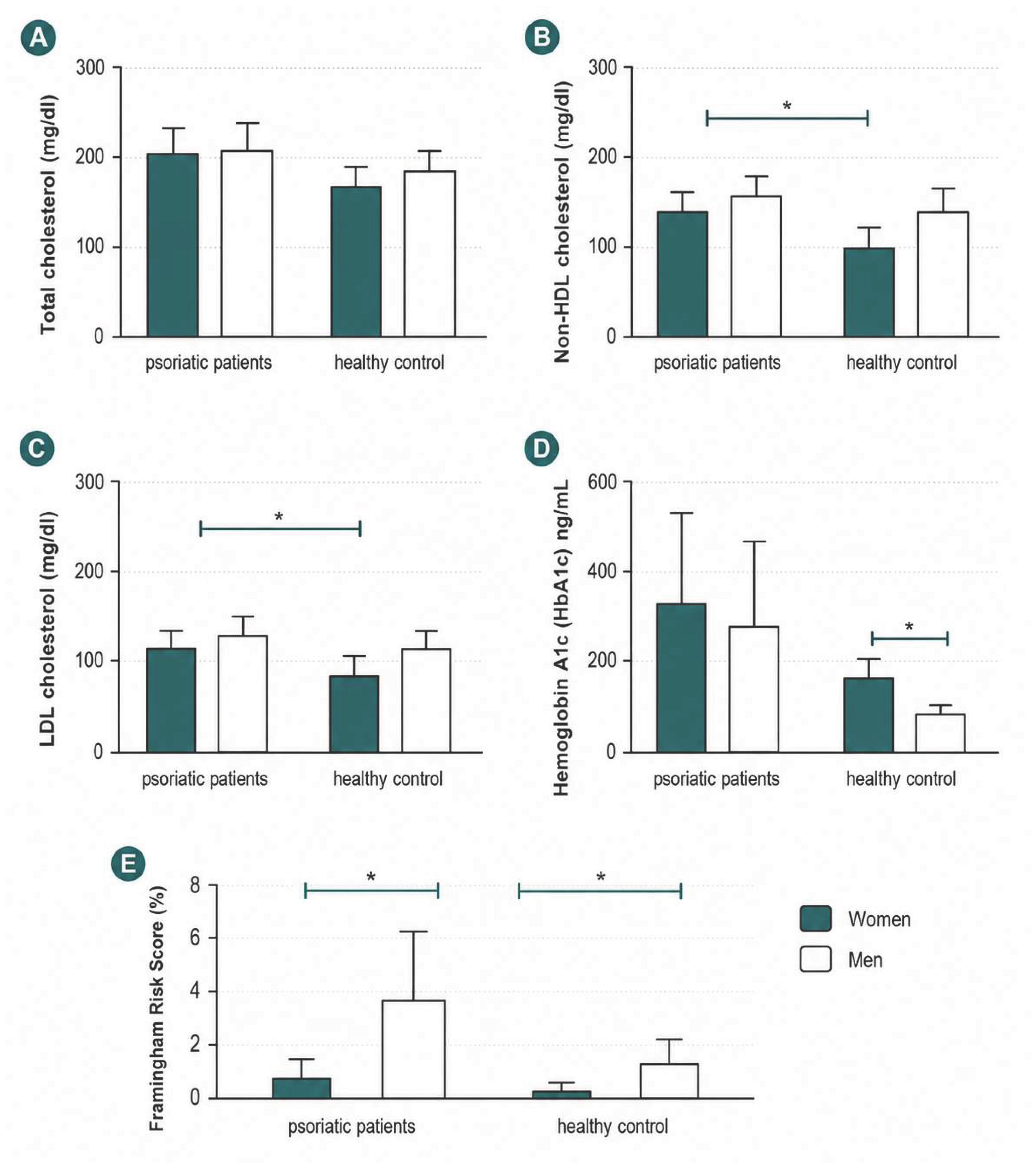
In the study group, correlations between the Framingham Risk Score and other parameters, including demographic and anthropometric factors as well as laboratory results, were also assessed (Table 3).
A strong positive correlation with the Framingham Risk Score was observed for alanine aminotransferase (ALT) activity (r = 0.63), while moderate positive correlations were found for body weight, non-HDL cholesterol, waist circumference, triglycerides, LDL cholesterol, and insulin (r = 0.59, 0.53, 0.50, 0.45, 0.43, and 0.40, respectively). Despite a moderate positive correlation with body weight, a weak positive correlation was observed with BMI (r = 0.39), which accounts for both body weight and height and therefore represents a more objective measure of obesity. However, a moderate positive correlation was demonstrated with waist circumference, suggesting that abdominal obesity may play an important role in increasing cardiovascular risk in patients with psoriasis. The strong positive correlation between ALT activity and cardiovascular risk may reflect a significant contribution of non-alcoholic fatty liver disease (NAFLD), and consequently abdominal obesity, to CVR. ALT levels may therefore serve as an early marker of metabolic risk and increased cardiovascular disease risk. An increase in ALT activity alongside increasing waist circumference may indicate a predisposition to metabolic syndrome, which is itself a factor increasing cardiovascular risk.
4. Discussion
Current guidelines from major cardiology scientific societies recommend including the diagnosis of psoriasis in strategies for predicting and preventing cardiovascular risk. Registry data suggest that treatment targeting skin lesions may reduce vascular inflammation and atherosclerotic risk, thereby lowering cardiovascular risk; however, placebo-controlled randomized trials remain inconclusive. Further studies are needed to define optimal targets for traditional cardiovascular risk factors, the role of lipid-lowering and antiplatelet therapy, and the impact of psoriasis-targeted treatments on cardiovascular risk [7]. Regular screening for metabolic disorders and cardiovascular risk factors, as well as early preventive interventions, is recommended; however, these recommendations have so far primarily concerned patients with severe psoriasis [16,28]
According to the joint statement of the International Diabetes Federation (IDF), National Heart, Lung, and Blood Institute (NHLBI), American Heart Association (AHA), World Heart Federation (WHF), International Atherosclerosis Society (IAS), and International Association for the Study of Obesity (IASO) from 2009, the diagnosis of metabolic syndrome is based on the presence of at least three of five criteria: increased waist circumference (population- and ethnicity-specific values; in European Caucasian populations according to IDF ≥80 cm in women and ≥94 cm in men), fasting triglycerides ≥150 mg/dL (1.7 mmol/L) or treatment for hypertriglyceridemia, fasting HDL-C <40 mg/dL (1.0 mmol/L) in men and <50 mg/dL (1.3 mmol/L) in women or treatment for reduced HDL-C, systolic blood pressure ≥130 mm Hg or diastolic blood pressure ≥85 mm Hg or antihypertensive treatment, and fasting plasma glucose ≥100 mg/dL (5.6 mmol/L) or treatment for hyperglycemia [29].
In 2022, new criteria for metabolic syndrome were proposed, with abdominal obesity as the primary diagnostic criterion (waist circumference ≥88 cm in women and ≥102 cm in men, or BMI ≥30 kg/m2). For diagnosis, the presence of two of three additional criteria is required: fasting glucose ≥100 mg/dL or ≥140 mg/dL at 120 minutes during an oral glucose tolerance test or HbA1c ≥5.7% or use of hypoglycemic treatment; non-HDL cholesterol ≥130 mg/dL (atherogenic dyslipidemia) or lipid-lowering therapy; and blood pressure ≥130/85 mm Hg in office measurements or ≥130/80 mm Hg in home measurements or antihypertensive treatment [30].
In our study, we demonstrated a significantly increased cardiovascular risk (CVR) in patients with psoriasis compared with the control group, despite recruiting only patients with mild psoriasis and without comorbidities. We found an almost threefold higher CVR in patients with psoriasis compared with controls, with Framingham Risk Scores of 2.24 ± 0.49% vs. 0.67 ± 0.22%, respectively. Higher CVR was observed in male patients compared with females (3.46 ± 0.68 vs. 0.71 ± 0.17; p < 0.05).
A study conducted in a Brazilian center including 190 patients with psoriasis, with a mean PASI score of 3.4 ± 3.03, similarly demonstrated a high prevalence of cardiovascular disease and elevated CVR according to the Framingham scale compared with the healthy population. Nearly half of the patients were classified as having moderate or high risk of coronary events within 10 years. The authors reported an increased prevalence of arterial hypertension, type 2 diabetes mellitus, metabolic syndrome, and obesity in patients with psoriasis compared with healthy individuals, as well as a higher frequency of smoking and regular alcohol consumption, which is consistent with our findings indicating a substantial burden of cardiovascular risk factors in this population. As in our study, frequent co-occurrence of increased waist circumference was highlighted, emphasizing the role of abdominal obesity as a cardiovascular risk factor in this population [31].
In an observational and cross-sectional population study including over 6,000 patients with psoriasis, of whom 92.7% had mild disease, a significantly higher prevalence of metabolic syndrome and its components was demonstrated in patients with psoriasis compared with controls. A higher frequency of abdominal obesity, type 2 diabetes mellitus, arterial hypertension, impaired fasting glucose, reduced HDL-C levels, and hypertriglyceridemia was observed. Patients with psoriasis had a higher likelihood of ischemic heart disease and a slightly increased risk of stroke. These findings support our observations of increased CVR in patients with psoriasis. The authors did not demonstrate a clear relationship between psoriasis severity and CVR [32].
A meta-analysis of 63 observational studies showed more than a twofold increased risk of metabolic syndrome in patients with psoriasis; the prevalence of MetS was 30.29% in the psoriasis group compared with 21.70% in controls (odds ratio 2.077). These data are consistent with our findings and indicate a significantly increased CVR in patients with psoriasis, supporting the need for regular monitoring of metabolic parameters and early implementation of cardiovascular prevention strategies [33].
According to Paschoal et al., psoriasis, metabolic syndrome, arterial hypertension, and age lead to increased levels of C-reactive protein (CRP), and the positive correlation between systemic inflammation measured by CRP and the Framingham Risk Score, as well as components of metabolic syndrome, suggests shared inflammatory pathways contributing to increased cardiovascular risk (CVR). The authors also reported that with increasing psoriasis severity assessed by the Psoriasis Area and Severity Index (PASI), the risk of metabolic syndrome increased; however, the absolute 10-year cardiovascular risk remained similar regardless of psoriasis severity [34].
Similarly to our study, the absolute 10-year cardiovascular risk according to the Framingham scale was higher in men. However, after validation using global risk assessment according to the National Cholesterol Education Program – Adult Treatment Panel III (NCEP-ATP III), cardiovascular risk was classified as intermediate-to-high, with no differences between sexes. The authors concluded a high prevalence of metabolic syndrome, obesity, arterial hypertension, and intermediate-to-high CVR in patients with plaque psoriasis, particularly among women. This represents an important difference compared with our analysis, in which we demonstrated an almost threefold higher CVR in patients with psoriasis, with higher risk observed in men.
In a cross-sectional study of a Turkish population, 300 patients with psoriasis were assessed for the prevalence of metabolic syndrome (MetS) and cardiovascular risk (CVR) according to the Framingham Risk Score (FRS), compared with a control group, with additional evaluation of demographic factors. A higher prevalence of MetS, obesity, and dyslipidemia was observed in women with psoriasis compared with women in the control group. As in our study, FRS values were higher in men than in women in the psoriasis population. No statistically significant association was found between psoriasis severity and the prevalence of MetS or FRS. This indicates a significant influence of demographic factors, including sex, on metabolic syndrome risk and cardiovascular risk in patients with psoriasis [35].
In a case-control study including 338 adult patients with plaque psoriasis and 334 patients with other dermatoses, MetS was significantly more frequent in patients with psoriasis over the age of 40 years. Patients with psoriasis and MetS were older and had a longer disease duration compared with psoriasis patients without MetS. A higher proportion of smokers was observed among patients with psoriasis; however, smoking did not influence the association between psoriasis and MetS. In the psoriasis group, a higher prevalence of abdominal obesity and hypertriglyceridemia was observed, whereas the frequency of hyperglycemia, arterial hypertension, and HDL-C levels were similar between groups. No correlation was found between psoriasis severity and the prevalence of MetS [36].
In a study of a Polish cohort of 62 patients with psoriasis ranging from mild to severe, a positive correlation between CVR and waist circumference and arterial hypertension, as well as a negative correlation with HDL-C levels, was demonstrated in patients with severe psoriasis, confirming an association between severe psoriasis and significantly higher CVR. However, no correlations between CVR factors were observed in patients with mild psoriasis. A positive correlation between psoriasis severity and waist circumference, as well as a negative correlation with HDL-C, was observed in moderate and severe psoriasis, but not in mild disease. Abdominal obesity was reported to be more frequent in patients with psoriasis, and hypertension occurred more often in men with psoriasis. In contrast to previous studies, the prevalence of MetS in patients with psoriasis was comparable to that of the general population [37].
The cited publications differ in the diagnostic criteria for metabolic syndrome, reflecting changes over time and updates in its definition. Most studies used general waist circumference thresholds of ≥102 cm in men and ≥88 cm in women. In the studies by Paschoal et al. [34] and Gisondi et al. [36], the NCEP-ATP III 2001 criteria were applied, which used a fasting glucose threshold of ≥110 mg/dL instead of ≥100 mg/dL [38,39]
The study by Paschoal et al. also highlighted the important role of systemic inflammation measured by CRP levels [34]. In our study, no significant differences in CRP levels were observed between patients with psoriasis and controls. Paschoal et al. demonstrated a positive correlation between CRP levels and FRS, absolute 10-year cardiovascular risk, and age, but no significant correlation with psoriasis severity assessed by PASI. Higher CRP levels were observed in patients with concomitant metabolic syndrome, and higher HDL-C levels were found in patients with normal CRP values. A key limitation of that study was the relatively small sample size (90 patients with plaque psoriasis) and the lack of stratification for concomitant psoriatic arthritis, which may have influenced CRP results [34]. These findings are consistent with the concept of a shared inflammatory basis of psoriasis, MetS, and CVD, also supported by Mallbris et al. [40].
In our study, we observed higher concentrations of total cholesterol (205.06 ± 5.93 mg/dL), non-HDL cholesterol (144.75 ± 5.78 mg/dL), and LDL-C (124.71 ± 5.54 mg/dL) in patients with psoriasis compared with the control group (185.07 ± 6.72; 117.5 ± 6.90; and 102.01 ± 6.29, respectively), with no significant differences in triglycerides, HDL-C, apoA-I, apoB, or the apoB/apoA-I ratio. Similar findings have been reported in population-based and case-control studies, where lipid abnormalities were more frequently observed in patients with psoriasis; however, lipid profiles varied depending on population characteristics, sex, and inclusion criteria [30,41].
According to Koku Aksu et al., higher levels of total cholesterol, non-HDL cholesterol, and LDL-C were more frequently observed in women with psoriasis compared with women in the control group [35]. In our study, we also observed higher non-HDL cholesterol and LDL-C levels in women with psoriasis compared with female controls.
In contrast, Fernández-Armenteros et al. reported a different lipid profile compared with our findings, showing higher triglyceride levels and reduced HDL-C levels in patients with psoriasis [32]. These results appear to be more robust due to the observational and cross-sectional population study design and the large cohort of over 6,000 patients with psoriasis, including 92.7% with mild disease. Gisondi et al., comparing patients with plaque psoriasis and patients with other dermatoses, also observed a higher prevalence of hypertriglyceridemia in the psoriasis group, while HDL-C levels were similar between groups [36].
According to Owczarczyk-Saczonek et al., the prevalence of dyslipidemia (excluding HDL-C-related changes; triglycerides, apoA-I, apoB) in patients with psoriasis was comparable to that of the general population. An opposing finding was higher HDL-C levels in patients with psoriasis compared with controls. The study was based on a cohort of 62 patients with psoriasis ranging from mild to severe disease. A similar observation regarding HDL-C was reported by Mallbris et al., who demonstrated 15% higher HDL-C levels in patients with psoriasis compared with controls [40].
In the study by Mallbris et al., apoA-I levels were also approximately 11% higher in patients with psoriasis, which corresponded with higher HDL-C levels in this group. Differences in apoB were significant only in the initial analysis and disappeared after adjustment for confounding factors. In the overall analysis without adjustment, significantly higher total cholesterol and very-low-density lipoprotein cholesterol (VLDL-C) levels were observed; however, these differences also lost significance after adjustment. No differences were observed in LDL-C or triglyceride levels. The study primarily included patients with mild psoriasis, and no association was found between disease severity and lipid parameters [40].
However, a positive correlation between CRP levels and total cholesterol concentration was observed, which is consistent with findings by Paschoal et al. showing a positive correlation between CRP and FRS as well as absolute 10-year cardiovascular risk [34,40]. The study included 200 patients with newly diagnosed psoriasis within the previous 12 months, which may have influenced lipid profiles.
In our study, we also did not observe statistically significant differences in triglycerides or apoB levels. However, we found significantly higher levels of total cholesterol, non-HDL cholesterol, and LDL-C, with no significant differences in apoA-I or HDL-C concentrations.
Contrary to our findings, Pietrzak et al. reported lipid abnormalities in patients with psoriasis and psoriatic arthritis (PsA), demonstrating higher apoB levels and increased oxidized LDL/MDA adducts, indicating oxidative status, in patients with psoriasis compared with controls. The apoB/apoA ratio was not statistically significant (p = 0.0534) [42]. In contrast to Owczarczyk-Saczonek et al. and Mallbris et al., lower HDL-C levels were observed in healthy individuals in that study [37,40,42].
A meta-analysis including 2,467 patients with psoriasis found significantly lower apoA-I levels and higher apoB levels compared with the healthy population. These differences persisted in subgroup analyses stratified by BMI, suggesting that apolipoprotein profile abnormalities are associated with psoriasis itself rather than obesity alone. Moreover, the observed differences were independent of concomitant psoriatic arthritis. However, the study did not include a separate subgroup of patients with mild psoriasis [43].
In our study, impaired glucose tolerance was an exclusion criterion; however, we observed higher HbA1c levels in patients with psoriasis compared with controls (284.00 ± 42.56 ng/mL vs. 127.11 ± 13.14 ng/mL), with no significant differences in glucose or insulin levels. According to Koku Aksu et al., the risk of diabetes did not differ significantly between patients with psoriasis and controls [35]. Gisondi et al., comparing patients with plaque psoriasis and those with other dermatoses, also did not observe a higher prevalence of hyperglycemia in the psoriasis group [36]. According to Owczarczyk-Saczonek et al., the prevalence of insulin resistance in patients with psoriasis was comparable to that in the general population [37]. In contrast, a study including over 6,000 patients with psoriasis, predominantly with mild disease, reported a higher prevalence of type 2 diabetes mellitus and impaired fasting glucose compared with controls [32].
A notable finding in our study is the strong positive correlation between alanine aminotransferase (ALT) activity and the Framingham Risk Score (r = 0.63). This association may reflect the significant role of non-alcoholic fatty liver disease (NAFLD), as a consequence of metabolic disturbances, in shaping cardiovascular risk. The observed correlation may indicate the existence of a hepato-metabolic axis as an early subclinical mechanism contributing to cardiovascular disease development. This suggests that metabolic liver disease may contribute to increased early cardiovascular risk in patients with psoriasis. Consequently, elevated ALT activity may serve as an accessible early marker of metabolic risk and increased cardiovascular disease risk. Nevertheless, these findings require confirmation in studies involving larger patient populations.
A literature review on metabolic syndrome and its components in relation to cardiovascular disease in patients with psoriasis highlighted the important role of dermatologists in the early identification of concomitant metabolic disorders. The need for preventive strategies and, when necessary, referral to other specialists was emphasized [44]. Particular attention was given to the necessity of treating comorbid metabolic diseases. Numerous studies have shown that appropriate management of comorbid conditions significantly improves psoriasis control, reflecting the shared pathophysiological basis of psoriatic inflammation and metabolic disorders [41,45,46]. Moreover, metabolic comorbidities may complicate and limit therapeutic options in psoriasis management [45]. In addition, effective treatment of psoriasis and psoriatic arthritis (PsA) may reduce cardiovascular risk in this patient population [42].
5. Conclusions
Our study clearly confirms an increased risk of cardiovascular disease (CVD) in patients with psoriasis, even in its mild form. Psoriasis, as a systemic disease, is not limited to the skin and its appendages. The association between psoriasis and comorbidities is multifactorial and results from chronic systemic inflammation, genetic predisposition, lifestyle-related environmental factors, as well as adverse effects of conventional systemic therapies for psoriasis.
In the studied group, nearly a threefold higher Framingham Risk Score was observed, with higher risk seen in men than in women.
Regardless of age, regular cardiometabolic assessment in patients with psoriasis is warranted, including laboratory testing, blood pressure measurements, BMI and waist circumference assessment, as well as education on a healthy lifestyle, including a low-calorie diet, regular physical activity, and avoidance of harmful habits. Comorbidities increase both morbidity and mortality in these patients. Early therapeutic interventions, including biologic treatments targeting IL-23/Th17 immunological pathways common to psoriasis and metabolic diseases, may contribute not only to a reduction in psoriasis severity but also to a decreased risk of CVD and its complications. A comprehensive approach to the patient, including prevention, early diagnosis, and management of comorbidities, may significantly improve prognosis and survival outcomes.
Author Contributions
Conceptualization, Urszula Krupa-Kozak and Agnieszka Owczarczyk-Saczonek; Methodology, Urszula Krupa-Kozak and Agnieszka Owczarczyk-Saczonek; Validation, Joanna Czerwińska; Formal analysis, Joanna Czerwińska; Resources, Maja Kleniewska; Data curation, Maja Kleniewska and Joanna Czerwińska; Writing – original draft, Maja Kleniewska; Writing – review & editing, Maja Kleniewska; Visualization, Maja Kleniewska and Joanna Czerwińska; Supervision, Agnieszka Owczarczyk-Saczonek; Project administration, Urszula Krupa-Kozak; Funding acquisition, Urszula Krupa-Kozak.
Funding
The research was supported by the National Science Centre, Poland, under the OPUS project No. 2022/45/B/NZ9/03004, awarded to Urszula Krupa-Kozak.
Institutional Review Board Statement
This study is approved by the Bioethics Committee of the Faculty of Medical Sciences at the University of Warmia and Mazury in Olsztyn (Resolution no. 1/2023 of 19 January 2023).
Informed Consent Statement
All participants provided written consent. The trial has been registered at ClinicalTrials.gov (NCT05971992) on August 1, 2023.
Data Availability Statement
The data presented in this study are available on request from the corresponding author. The data are not publicly available due to privacy and ethical restrictions.
Conflicts of Interest
The authors declare no conflict of interest.
References
- Papp, K.A.; Gniadecki, R.; Beecker, J.; Dutz, J.; Gooderham, M.J.; Hong, C.H.; et al. Psoriasis Prevalence and Severity by Expert Elicitation. Dermatol. Ther. (Heidelb) 2021, 11(3), 1053–64. [Google Scholar] [CrossRef] [PubMed]
- Armstrong, A.W.; Read, C. Pathophysiology, Clinical Presentation, and Treatment of Psoriasis. JAMA 2020, 323(19), 1945. [Google Scholar] [CrossRef] [PubMed]
- Martinez-Moreno, A.; Ocampo-Candiani, J.; Garza-Rodriguez, V. Psoriasis and Cardiovascular Disease: A Narrative Review. Korean J. Fam. Med. 2021, 42(5), 345–55. [Google Scholar] [CrossRef]
- Gisondi, P.; Fostini, A.C.; Fossà, I.; Girolomoni, G.; Targher, G. Psoriasis and the metabolic syndrome. Clin. Dermatol. 2018, 36(1), 21–8. [Google Scholar] [CrossRef]
- Wu, J.J.; Kavanaugh, A.; Lebwohl, M.G.; Gniadecki, R.; Merola, J.F. Psoriasis and metabolic syndrome: implications for the management and treatment of psoriasis. J. Eur. Acad. Dermatol. Venereol. 2022, 36(6), 797–806. [Google Scholar] [CrossRef] [PubMed]
- Perk, J.; De Backer, G.; Gohlke, H.; Graham, I.; Reiner, Z.; Verschuren, M.; et al. European Guidelines on cardiovascular disease prevention in clinical practice (version 2012): The Fifth Joint Task Force of the European Society of Cardiology and Other Societies on Cardiovascular Disease Prevention in Clinical Practice (constituted by representatives of nine societies and by invited experts) * Developed with the special contribution of the European Association for Cardiovascular Prevention & Rehabilitation (EACPR). Eur. Heart J. 2012, 33(13), 1635–701. [Google Scholar]
- Garshick, M.S.; Ward, N.L.; Krueger, J.G.; Berger, J.S. Cardiovascular Risk in Patients With Psoriasis. J. Am. Coll. Cardiol. 2021, 77(13), 1670–80. [Google Scholar] [CrossRef]
- Wang, Y.; Zang, J.; Liu, C.; Yan, Z.; Shi, D. Interleukin-17 Links Inflammatory Cross-Talks Between Comorbid Psoriasis and Atherosclerosis. Front Immunol. 2022, 13. [Google Scholar] [CrossRef]
- Campanati, A.; Marani, A.; Martina, E.; Diotallevi, F.; Radi, G.; Offidani, A. Psoriasis as an Immune-Mediated and Inflammatory Systemic Disease: From Pathophysiology to Novel Therapeutic Approaches. Biomedicines 2021, 9(11), 1511. [Google Scholar] [CrossRef]
- von Stebut, E.; Boehncke, W.H.; Ghoreschi, K.; Gori, T.; Kaya, Z.; Thaci, D.; et al. IL-17A in Psoriasis and Beyond: Cardiovascular and Metabolic Implications. Front Immunol. 2020, 10. [Google Scholar] [CrossRef] [PubMed]
- Hashmi, S.; Zeng, Q.T. Role of interleukin-17 and interleukin-17-induced cytokines interleukin-6 and interleukin-8 in unstable coronary artery disease. Coron. Artery Dis. 2006, 17(8), 699–706. [Google Scholar] [CrossRef] [PubMed]
- Sumarac-Dumanovic, M.; Stevanovic, D.; Ljubic, A.; Jorga, J.; Simic, M.; Stamenkovic-Pejkovic, D.; et al. Increased activity of interleukin-23/interleukin-17 proinflammatory axis in obese women. Int. J. Obes. 2009, 33(1), 151–6. [Google Scholar] [CrossRef] [PubMed]
- Tsiogka, A.; Gregoriou, S.; Stratigos, A.; Soulaidopoulos, S.; Rompoti, N.; Panagakis, P.; et al. The Impact of Treatment with IL-17/IL-23 Inhibitors on Subclinical Atherosclerosis in Patients with Plaque Psoriasis and/or Psoriatic Arthritis: A Systematic Review. Biomedicines 2023, 11(2). [Google Scholar] [CrossRef] [PubMed]
- Griffiths, C.E.; Barker, J.N. Pathogenesis and clinical features of psoriasis. The Lancet 2007, 370(9583), 263–71. [Google Scholar] [CrossRef] [PubMed]
- Cao, Y. Angiogenesis modulates adipogenesis and obesity. J. Clin. Investig. 2007, 117(9), 2362–8. [Google Scholar] [CrossRef]
- Azfar, R.S.; Gelfand, J.M. Psoriasis and metabolic disease: epidemiology and pathophysiology. Curr. Opin. Rheumatol. 2008, 20(4), 416–22. [Google Scholar] [CrossRef] [PubMed]
- O’malley, T. Early increase in levels of soluble inter-cellular adhesion molecule-1 (sICAM-1). Potential risk factor for the acute coronary syndromes. Eur. Heart J. 2001, 22(14), 1226–34. [Google Scholar] [CrossRef]
- Owczarczyk-Saczonek, A.; Nowicki, R. Patofizjologia związków łuszczycy z zaburzeniami metabolicznymi Pathophysiology of the relationship of psoriasis and metabolic disorders.
- Zhou, P.; Jiang, X.; Wang, W.; Wang, D. Dissection of shared genetic architecture and biological association between psoriasis and cardiovascular disease based on genome-wide association studies. Hum. Immunol. 2025, 86(5), 111565. [Google Scholar] [CrossRef]
- Gelfand, J.M.; Neimann, A.L.; Shin, D.B.; Wang, X.; Margolis, D.J.; Troxel, A.B. Risk of Myocardial Infarction in Patients With Psoriasis. JAMA 2006, 296(14), 1735. [Google Scholar] [CrossRef]
- Samarasekera, E.J.; Neilson, J.M.; Warren, R.B.; Parnham, J.; Smith, C.H. Incidence of Cardiovascular Disease in Individuals with Psoriasis: A Systematic Review and Meta-Analysis. J. Investig. Dermatol. 2013, 133(10), 2340–6. [Google Scholar] [CrossRef]
- Miller, I.M.; Ellervik, C.; Yazdanyar, S.; Jemec, G.B.E. Meta-analysis of psoriasis, cardiovascular disease, and associated risk factors. J. Am. Acad. Dermatol. 2013, 69(6), 1014–24. [Google Scholar] [CrossRef] [PubMed]
- Yeung, H.; Takeshita, J.; Mehta, N.N.; Kimmel, S.E.; Ogdie, A.; Margolis, D.J.; et al. Psoriasis Severity and the Prevalence of Major Medical Comorbidity. JAMA Dermatol. 2013, 149(10), 1173. [Google Scholar] [CrossRef]
- Mrowietz, U.; Kragballe, K.; Reich, K.; Spuls, P.; Griffiths, C.E.M.; Nast, A.; et al. Definition of treatment goals for moderate to severe psoriasis: a European consensus. Arch. Dermatol. Res. 2011, 303(1), 1–10. [Google Scholar] [CrossRef] [PubMed]
- Reich, A.; Adamski, Z.; Chodorowska, G.; Kaszuba, A.; Krasowska, D.; Lesiak, A.; et al. Psoriasis. Diagnostic and therapeutic recommendations of the Polish Dermatological Society. Part 1. Dermatol. Rev. 2020, 107(2), 92–108. [Google Scholar] [CrossRef]
- Carnevale Schianca, G.P.; Pedrazzoli, R.; Onolfo, S.; Colli, E.; Cornetti, E.; Bergamasco, L.; et al. ApoB/apoA-I ratio is better than LDL-C in detecting cardiovascular risk. Nutr. Metab. Cardiovasc. Dis. 2011, 21(6), 406–11. [Google Scholar] [CrossRef]
- Kaneva, A.M.; Potolitsyna, N.N.; Bojko, E.R.; Odland, J.Ø. The Apolipoprotein B/Apolipoprotein A-I Ratio as a Potential Marker of Plasma Atherogenicity. Dis. Markers 2015, 2015, 1–7. [Google Scholar] [CrossRef]
- Kimball, A.B.; Gladman, D.; Gelfand, J.M.; Gordon, K.; Horn, E.J.; Korman, N.J.; et al. National Psoriasis Foundation clinical consensus on psoriasis comorbidities and recommendations for screening. J. Am. Acad. Dermatol. 2008, 58(6), 1031–42. [Google Scholar] [CrossRef]
- Alberti, K.G.M.M.; Eckel, R.H.; Grundy, S.M.; Zimmet, P.Z.; Cleeman, J.I.; Donato, K.A.; et al. Harmonizing the Metabolic Syndrome. Circulation 2009, 120(16), 1640–5. [Google Scholar] [CrossRef] [PubMed]
- Dobrowolski, P.; Prejbisz, A.; Kuryłowicz, A.; Baska, A.; Burchardt, P.; Chlebus, K.; et al. Metabolic syndrome – a new definition and management guidelines A joint position paper by the Polish Society of Hypertension, Polish Society for the Treatment of Obesity, Polish Lipid Association, Polish Association for Study of Liver, Polish Society of Family Medicine, Polish Society of Lifestyle Medicine, Division of Prevention and Epidemiology Polish Cardiac Society, “Club 30” Polish Cardiac Society, and Division of Metabolic and Bariatric Surgery Society of Polish Surgeons. Arch. Med. Sci. 2022, 18(5), 1133–56. [Google Scholar]
- Baeta, I.G.R.; Bittencourt, F.V.; Gontijo, B.; Goulart, E.M.A. Comorbidities and cardiovascular risk factors in patients with psoriasis. An. Bras. Dermatol. 2014, 89(5), 735–44. [Google Scholar] [CrossRef]
- Fernández-Armenteros, J.M.; Gómez-Arbonés, X.; Buti-Soler, M.; Betriu-Bars, A.; Sanmartin-Novell, V.; Ortega-Bravo, M.; et al. Psoriasis, metabolic syndrome and cardiovascular risk factors. A population-based study. J. Eur. Acad. Dermatol. Venereol. 2019, 33(1), 128–35. [Google Scholar] [CrossRef]
- Choudhary, S.; Pradhan, D.; Pandey, A.; Khan, MohdK; Lall, R.; Ramesh, V.; et al. The Association of Metabolic Syndrome and Psoriasis: A Systematic Review and Meta-Analysis of Observational Study. Endocr. Metab. Immune Disord. Drug Targets 2020, 20(5), 703–17. [Google Scholar] [CrossRef] [PubMed]
- Paschoal, R.S.; Silva, D.A.; Cardili, R.N.; Souza, C da S. Metabolic syndrome, C-reactive protein and cardiovascular risk in psoriasis patients: a cross-sectional study. An. Bras. Dermatol. 2018, 93(2), 222–8. [Google Scholar] [CrossRef] [PubMed]
- Koku Aksu, A.E.; Saraçoğlu, Z.N.; Metintaş, S.; Sabuncu, İ.; Çetin, Y. Age and gender differences in Framingham risk score and metabolic syndrome in psoriasis patients: A cross-sectional study in the Turkish population. Anatol. J. Cardiol. 2017, 17(1), 66–72. [Google Scholar] [PubMed]
- Gisondi, P.; Tessari, G.; Conti, A.; Piaserico, S.; Schianchi, S.; Peserico, A.; et al. Prevalence of metabolic syndrome in patients with psoriasis: a hospital-based case?control study. Br. J. Dermatol. 2007, 157(1), 68–73. [Google Scholar] [CrossRef] [PubMed]
- Owczarczyk-Saczonek, A.B.; Nowicki, R.J. Prevalence of cardiovascular disease risk factors, and metabolic syndrome and its components in patients with psoriasis aged 30 to 49 years. Postep. Dermatol. Alergol. 2015, 32(4), 290–5. [Google Scholar] [CrossRef] [PubMed]
- National Cholesterol Education Program (NCEP) Expert Panel on Detection E and T of HBC in A (Adult TPI. Third Report of the National Cholesterol Education Program (NCEP) Expert Panel on Detection, Evaluation, and Treatment of High Blood Cholesterol in Adults (Adult Treatment Panel III) final report. Circulation 2002, 106(25), 3143–421.
- Expert Panel on Detection E and T of HBC in A. Executive Summary of the Third Report of the National Cholesterol Education Program (NCEP) Expert Panel on Detection, Evaluation, and Treatment of High Blood Cholesterol in Adults (Adult Treatment Panel III); The Journal of the American Medical Association: JAMA, 16 May 2001; Volume 285, 19, pp. 2486–97.
- Mallbris, L.; Granath, F.; Hamsten, A.; Ståhle, M. Psoriasis is associated with lipid abnormalities at the onset of skin disease. J. Am. Acad. Dermatol. 2006, 54(4), 614–21. [Google Scholar] [CrossRef]
- Gottlieb, A.B.; Chao, C.; Dann, F. Psoriasis comorbidities. J. Dermatol. Treat. 2008, 19(1), 5–21. [Google Scholar] [CrossRef]
- Pietrzak, A.; Chabros, P.; Grywalska, E.; Kiciński, P.; Pietrzak-Franciszkiewicz, K.; Krasowska, D.; et al. Serum lipid metabolism in psoriasis and psoriatic arthritis - an update. Arch. Med. Sci. 2019, 15(2), 369–75. [Google Scholar] [CrossRef]
- Wang, F.; Wang, Y.; Kong, X.; Mu, J.; Wang, Z.; Yang, X.; et al. Association between psoriasis and serum apolipoprotein A1 and B: A systematic review and meta-analysis. Heliyon 2023, 9(10), e21168. [Google Scholar] [CrossRef] [PubMed]
- Branisteanu, D.E.; Pirvulescu, R.A.; Spinu, A.E.; Porumb, E.A.; Cojocaru, M.; Nicolescu, A.C.; et al. Metabolic comorbidities of psoriasis (Review). Exp. Ther. Med. 2022, 23(2), 179. [Google Scholar] [CrossRef] [PubMed]
- Jensen, P.; Skov, L. Psoriasis and Obesity. Dermatology 2016, 232(6), 633–9. [Google Scholar] [CrossRef]
- Korman, N.J. Management of psoriasis as a systemic disease: what is the evidence? Br. J. Dermatol. 2020, 182(4), 840–8. [Google Scholar] [CrossRef]
Table 1.
Baseline Characteristics of the Study Population.
| study group | control group | |
| sex (F/M) | n = 13 / n = 18 | n = 8 / n = 9 |
| smokers included (F/M) | n = 3 / n = 4 | n = 2 / n = 0 |
| age (years) | 41.00 ± 1.33 | 38.41 ± 1.43 |
| BSA (%)1 | 3.18 ± 0.45 | - |
| PASI2 | 4.02 ± 0.38 | - |
| BMI (kg/m2)3 | 25.87 ± 0.53 | 22.09 ± 1.58 |
| weight (kg) | 77.95 ± 2.28 | 72.88 ± 3.02 |
| waist circumference (cm) | 89.40 ± 2.93 | - |
1BSA – Body Surface Area; 2PASI – Psoriasis Area and Severity Index; 3BMI – Body Mass Index; 4CRP – C-reactive protein.
Table 3.
Correlation (r) of the Framingham Risk Score (%) with examined factors in patients with psoriasis (strong and moderate correlations are highlighted in bold).
Table 3.
Correlation (r) of the Framingham Risk Score (%) with examined factors in patients with psoriasis (strong and moderate correlations are highlighted in bold).
| correlation (r) | |
| non-HDL (mg/dl) | 0.53 |
| LDL (mg/dl) | 0.43 |
| ALT (U/L) | 0.63 |
| weight (kg) | 0.59 |
| BMI (kg/cm2) | 0.39 |
| insulin (ulU/mL) | 0.40 |
| triglycerides (mg/dl) | 0.45 |
| waist circumference (cm) | 0.50 |
Disclaimer/Publisher’s Note: The statements, opinions and data contained in all publications are solely those of the individual author(s) and contributor(s) and not of MDPI and/or the editor(s). MDPI and/or the editor(s) disclaim responsibility for any injury to people or property resulting from any ideas, methods, instructions or products referred to in the content. |
© 2026 by the authors. Licensee MDPI, Basel, Switzerland. This article is an open access article distributed under the terms and conditions of the Creative Commons Attribution (CC BY) license (http://creativecommons.org/licenses/by/4.0/).
Copyright: This open access article is published under a Creative Commons CC BY 4.0 license, which permit the free download, distribution, and reuse, provided that the author and preprint are cited in any reuse.


