
Submitted:
27 May 2026
Posted:
28 May 2026
You are already at the latest version
Abstract
We report a rare case of simultaneous well-differentiated papillary mesothelial tumor (WDPMT) and multicystic mesothelioma. The concurrent occurrence of these entities is exceptionally uncommon and may pose challenges during surgical intervention. Both tumors are variants of epithelioid mesothelioma and are most frequently identified incidentally during surgical procedures. A 41-year-old patient was admitted for laparoscopic surgery due to a left adnexal mass. Ultrasound examination revealed a 5 cm lesion adjacent to the left ovary, exhibiting central vascularization. Intraoperatively, the mass appeared as a solid, soft, and nodular tumor. Frozen section analysis confirmed the diagnosis of WDPMT involving the left adnexa. Recognition of well-differentiated papillary mesothelial tumor and multicystic mesothelioma is critical for accurate differential diagnosis from malignant mesothelioma. Awareness of these entities informs appropriate surgical management and follow-up protocols.
Keywords:
well-differentiated papillary mesothelial tumor (WDPMT)
; multicystic mesothelioma
; adnexal tumor
Figure 1.
A 41-year-old gravida 1, para 1, female patient was admitted to our Department in order to perform laparoscopy because of left adnexal mass diagnosed 18 months before admission during routine gynecological examination. Regular transvaginal ultrasound examinations were performed, which showed slow but steady increase in size of left adnexal mass. During the last ultrasound examination tumor measured five cm in size, was positioned near the left ovary [Figure 1], with central vascularization. Pulsatility index (PI) was 0.69 and resistance index (RI) was 0.48. Tumor marker levels were not elevated (CEA 1.08 µg/L, CA19-9 <2 kIU/L, CA125 26.8 kIU/L) and patient was not experiencing any symptoms.
Figure 1.
A 41-year-old gravida 1, para 1, female patient was admitted to our Department in order to perform laparoscopy because of left adnexal mass diagnosed 18 months before admission during routine gynecological examination. Regular transvaginal ultrasound examinations were performed, which showed slow but steady increase in size of left adnexal mass. During the last ultrasound examination tumor measured five cm in size, was positioned near the left ovary [Figure 1], with central vascularization. Pulsatility index (PI) was 0.69 and resistance index (RI) was 0.48. Tumor marker levels were not elevated (CEA 1.08 µg/L, CA19-9 <2 kIU/L, CA125 26.8 kIU/L) and patient was not experiencing any symptoms.
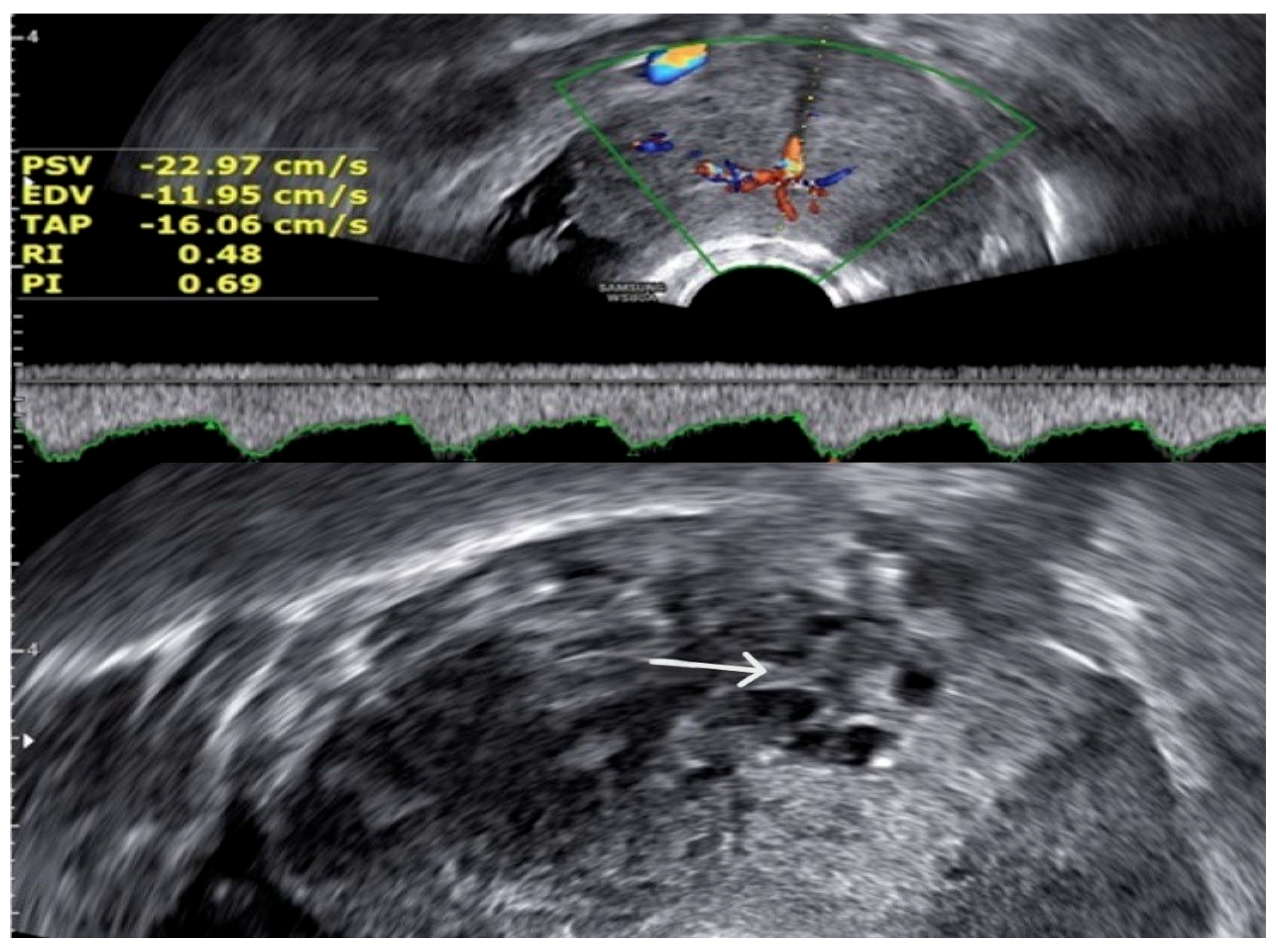
Figure 2.
Laparoscopy was performed and tumor mass with nodular appearance was found adherent to the left ovary and left fallopian tube [Figure 2A]. Tumor mass had soft consistency and was prone to bleeding during manipulation. During the procedure another finding were multiple white nodules dispersed on both ovaries, pelvic peritoneum, uterus, vesicouterine fold, medial umbilical folds and abdominal peritoneum [Figure 2B and 2C]. Nodules were less then one cm in size. Histological analysis of peritoneal nodules presented as cystical spaces separated by connective tissue and lined with mesothelium without atypia. They were diagnosed as multicystic mesothelioma, also known as peritoneal inclusional cysts [Figure 2C]. Extirpation of left adnexal tumor mass was done. Multiple peritoneal biopsies of white nodules were acquired. Intra-operative pathology consultation determined left adnexal tumor was well-differentiated papillary mesothelial tumor (WDPMT) [Figure 2A]. Well-differentiated papillary mesothelial tumor and multicystic mesothelioma are rare clinical entities. These tumors possess low malignant potential, however long-term surveillance is warranted. They are usually found in women of reproductive age [2]. Hoekstra et al. reported median age of patients in their research was 41 years [2]. Patient presented in our case report was 41 years old. Kim et. al. reported 12 clinical cases of WDPMT in their institution with median age of patients being 64 years. 10 cases of WDPMT in that study were also incidental findings during surgery as it was with our case [5]. Sun et. al. reported 75 cases of WDPMT during 17 year period. Median age of patients in their research was 40 years and majority of cases were incidental findings during operative procedures done for other reasons [6]. Chen et al. also reported that WDPMT and multicystic mesothelioma were usually incidental findings [8]. What is more, size of the lesion greater than two cm has been reported to be associated with histological findings of WDPMT with adenomatoid tumor or multicystic mesothelioma [6], as it was with our case. There is no definitive treatment guidelines regarding patients who present with WDPMT and multicystic mesothelioma. Resection with long term follow up is usually suggested approach [1,2,3]. Treatment strategy depends on patients comorbidities, symptoms, extent of the tumor and progression of the disease [3,10]. Lee et al. reported that additional treatment besides cytoreduction should be considered if patient has abdominal distension, pain or large volume of ascites as these symptoms are associated with poor outcome [10]. Supposed risk factors associated with developing WDPMT are smoking or history of smoking, asbestos exposure, previous abdominal surgeries, family history, endometriosis, trauma [1,5]. Our patient had only one of these factors and that is previous abdominal surgery (caesarean section). Also, she was asymptomatic during the period before surgery. Given that the clinical course of WDPMT and multicystic mesothelioma is usually indolent and that our patient had no symptoms associated with poor outcome we have opted for the resection of main tumor mass adhaerent to the left adnexa and we have performed multiple biopsies of the peritoneum covered with miliary nodules. Complete debulking due to the extent of the lesions was not possible. Also Lee et. al. reported that efficacy of radical surgery beyond simple excision is questionable [10]. Furthermore it is reported that adjuvant therapy is not without potential side effect and ought to be used cautiously [4]. Almost three years after the procedure our patient is still without symptoms. Regular clinical and ultrasound examinations show no evidence of tumor recurrence or dissemination.
Figure 2.
Laparoscopy was performed and tumor mass with nodular appearance was found adherent to the left ovary and left fallopian tube [Figure 2A]. Tumor mass had soft consistency and was prone to bleeding during manipulation. During the procedure another finding were multiple white nodules dispersed on both ovaries, pelvic peritoneum, uterus, vesicouterine fold, medial umbilical folds and abdominal peritoneum [Figure 2B and 2C]. Nodules were less then one cm in size. Histological analysis of peritoneal nodules presented as cystical spaces separated by connective tissue and lined with mesothelium without atypia. They were diagnosed as multicystic mesothelioma, also known as peritoneal inclusional cysts [Figure 2C]. Extirpation of left adnexal tumor mass was done. Multiple peritoneal biopsies of white nodules were acquired. Intra-operative pathology consultation determined left adnexal tumor was well-differentiated papillary mesothelial tumor (WDPMT) [Figure 2A]. Well-differentiated papillary mesothelial tumor and multicystic mesothelioma are rare clinical entities. These tumors possess low malignant potential, however long-term surveillance is warranted. They are usually found in women of reproductive age [2]. Hoekstra et al. reported median age of patients in their research was 41 years [2]. Patient presented in our case report was 41 years old. Kim et. al. reported 12 clinical cases of WDPMT in their institution with median age of patients being 64 years. 10 cases of WDPMT in that study were also incidental findings during surgery as it was with our case [5]. Sun et. al. reported 75 cases of WDPMT during 17 year period. Median age of patients in their research was 40 years and majority of cases were incidental findings during operative procedures done for other reasons [6]. Chen et al. also reported that WDPMT and multicystic mesothelioma were usually incidental findings [8]. What is more, size of the lesion greater than two cm has been reported to be associated with histological findings of WDPMT with adenomatoid tumor or multicystic mesothelioma [6], as it was with our case. There is no definitive treatment guidelines regarding patients who present with WDPMT and multicystic mesothelioma. Resection with long term follow up is usually suggested approach [1,2,3]. Treatment strategy depends on patients comorbidities, symptoms, extent of the tumor and progression of the disease [3,10]. Lee et al. reported that additional treatment besides cytoreduction should be considered if patient has abdominal distension, pain or large volume of ascites as these symptoms are associated with poor outcome [10]. Supposed risk factors associated with developing WDPMT are smoking or history of smoking, asbestos exposure, previous abdominal surgeries, family history, endometriosis, trauma [1,5]. Our patient had only one of these factors and that is previous abdominal surgery (caesarean section). Also, she was asymptomatic during the period before surgery. Given that the clinical course of WDPMT and multicystic mesothelioma is usually indolent and that our patient had no symptoms associated with poor outcome we have opted for the resection of main tumor mass adhaerent to the left adnexa and we have performed multiple biopsies of the peritoneum covered with miliary nodules. Complete debulking due to the extent of the lesions was not possible. Also Lee et. al. reported that efficacy of radical surgery beyond simple excision is questionable [10]. Furthermore it is reported that adjuvant therapy is not without potential side effect and ought to be used cautiously [4]. Almost three years after the procedure our patient is still without symptoms. Regular clinical and ultrasound examinations show no evidence of tumor recurrence or dissemination.
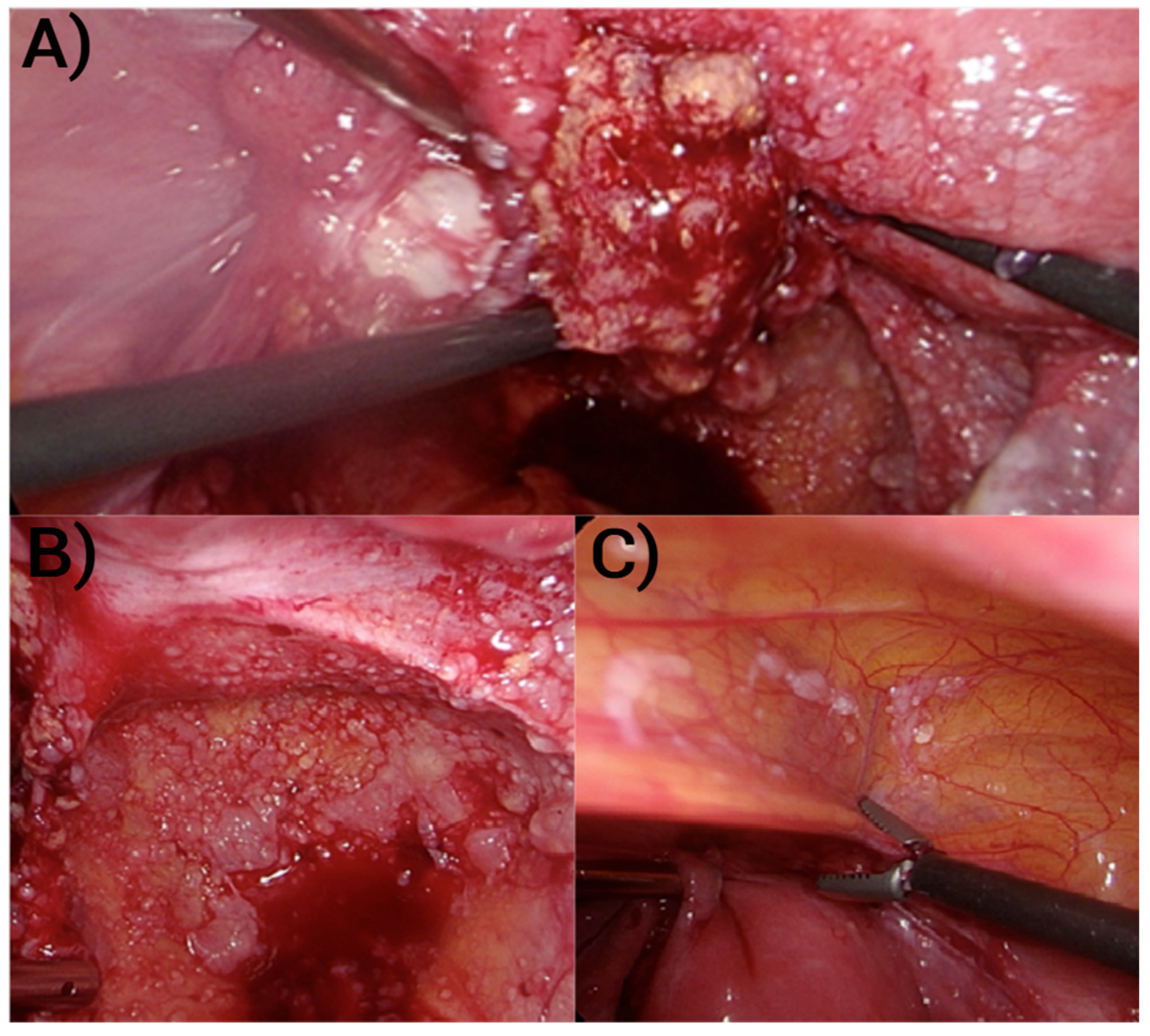
Figure 3.
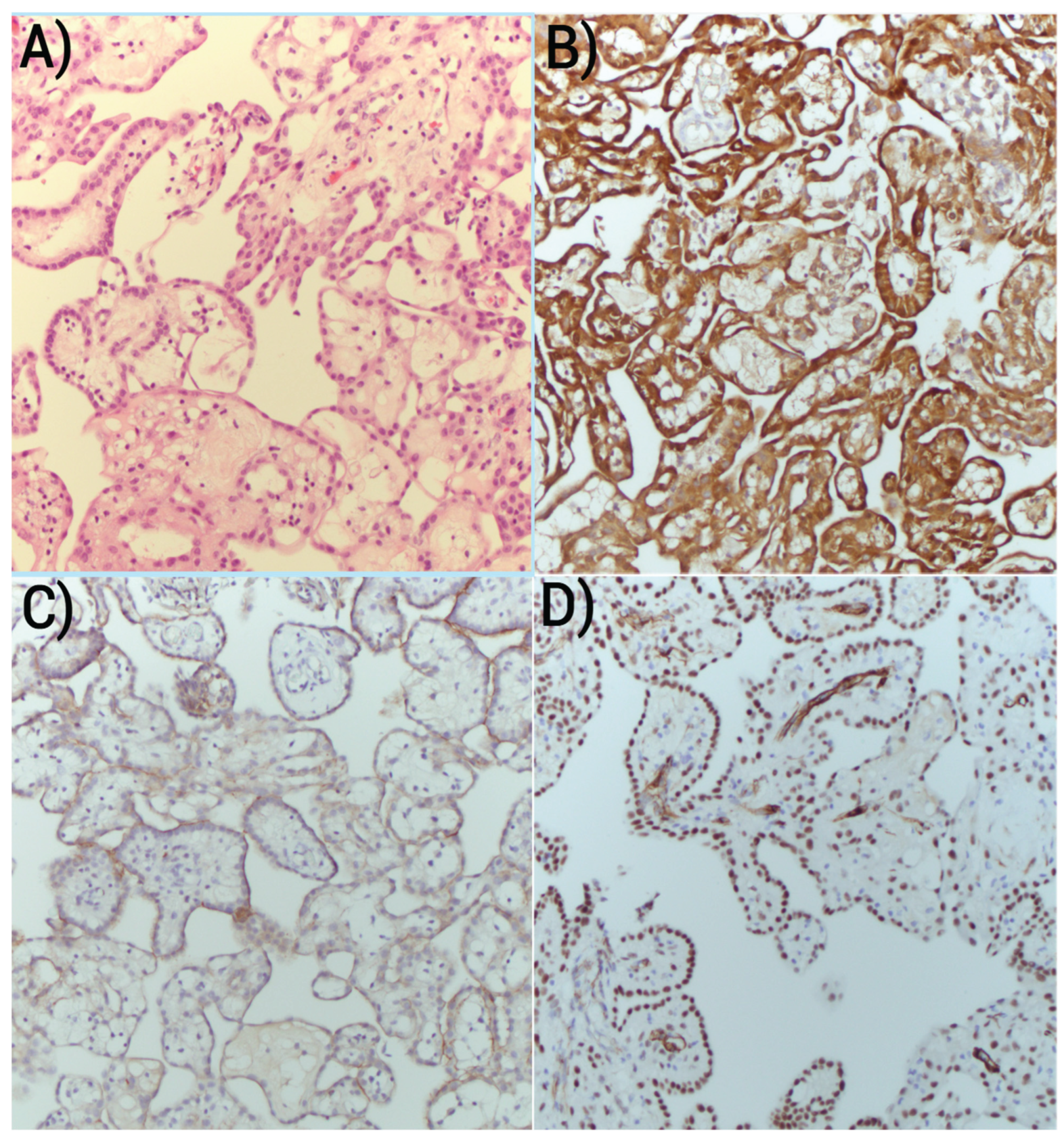
(A-H&E stain, B-calretinine positive cells, C- podoplanine positive cells and D-WT1 positive cells). Histological findings of tumor mass presented as oedematous papillae lined with cuboid cells whose stroma was partly oedematous and partly hyalinized. There was no cell atypia or mitotic activity [Figure 3A]. Immunohistochemical analysis showed that cells have positive staining for calretinine [Figure 3B], WT1 [Figure 3D] and podoplanin [Figure 3C] and negative for CK5/6. These results are in concordance with other studies [2,5,6,7,8]. No stromal invasion was detected. Other studies have also presented with similar histological findings of WDPMT [1,2,4,5,6,7,8,9].
Figure 3.
(A-H&E stain, B-calretinine positive cells, C- podoplanine positive cells and D-WT1 positive cells). Histological findings of tumor mass presented as oedematous papillae lined with cuboid cells whose stroma was partly oedematous and partly hyalinized. There was no cell atypia or mitotic activity [Figure 3A]. Immunohistochemical analysis showed that cells have positive staining for calretinine [Figure 3B], WT1 [Figure 3D] and podoplanin [Figure 3C] and negative for CK5/6. These results are in concordance with other studies [2,5,6,7,8]. No stromal invasion was detected. Other studies have also presented with similar histological findings of WDPMT [1,2,4,5,6,7,8,9].
Author Contributions
Conceptualization, M.D.M and D.M.; writing—original draft preparation, M.D.M., D.M. and S.T.; visualization and data curation, M.D.M., D.M. and S.T., supervision, M.D.M., writing—review and editing, M.D.M., D.M., B.D. and S.T. All authors have read and agreed to the published version of the manuscript.
Funding
This research received no external funding.
Institutional Review Board Statement
The study was conducted in accordance with the Declaration of Helsinki and approved by the Ethics Committee of the University Hospital of Split (protocol code 2181-147/01-06/LJ.Z.-25-02, approval date December 19, 2025).
Informed Consent Statement
Written informed consent has been obtained from the patient to publish this paper.
Data Availability Statement
All data concerning the case are presented in this manuscript and are available upon request from the corresponding author.
Conflicts of Interest
The authors declare no conflict of interest.
References
- Chen, Y.Y.; Li, P.C.; Hsu, Y.H.; Ding, D.C. Peritoneal well-differentiated papillary mesothelioma coexisting with endometrial adenocarcinoma mimicking peritoneal carcinomatosis: A case report. Taiwan J. Obstet. Gynecol. 2020, 59, 968–971. [Google Scholar] [CrossRef] [PubMed]
- Hoekstra, A.V.; Riben, M.W.; Frumovitz, M.; Liu, J.; Ramirez, P.T. Well-differentiated papillary mesothelioma of the peritoneum: A pathological analysis and review of the literature. Gynecol. Oncol. 2005, 98, 161–167. [Google Scholar] [CrossRef] [PubMed]
- Alexander, H.R.; Kindler, H.L.; Novak, A.K. Malignant peritoneal mesothelioma: Treatment. UpToDate. Available online: https://www.uptodate.com/contents/malignant-peritoneal-mesothelioma-treatment (accessed on 26 May 2023).
- Malpica, A.; Sant’Ambrogio, S.; Deavers, M.T.; Silva, E.G. Well-differentiated papillary mesothelioma of the female peritoneum. Am. J. Surg. Pathol. 2012, 36, 117–127. [Google Scholar] [CrossRef] [PubMed]
- Kim, M.; Kim, H.S. Clinicopathological characteristics of well-differentiated papillary mesothelioma of the peritoneum: A single-institutional experience of 12 cases. In Vivo. 2019, 33, 633–642. [Google Scholar] [CrossRef] [PubMed]
- Sun, M.; Zhao, L.; Weng Lao, I.; Yu, L.; Wang, J. Well-differentiated papillary mesothelioma: A 17-year single-institution experience with a series of 75 cases. Ann. Diagn. Pathol. 2019, 38, 43–50. [Google Scholar] [CrossRef] [PubMed]
- Pang, B.; et al. Peritoneal well-differentiated papillary mesothelioma associated with infertility in a 37-year-old woman. J. Int. Med. Res. 2021, 49, 030006052098668. [Google Scholar] [CrossRef] [PubMed]
- Chen, X.; Sheng, W.; Wang, J. Well-differentiated papillary mesothelioma: A clinicopathological and immunohistochemical study of 18 cases with additional observation. Histopathology. 2013, 62, 805–813. [Google Scholar] [CrossRef] [PubMed]
- Saha, A.; Mandal, P.K.; Manna, A.; Khan, K.; Pal, S. Well-differentiated papillary mesothelioma of abdomen: A rare case with diagnostic dilemma. J. Lab Physicians. 2018, 10, 248–250. [Google Scholar] [CrossRef] [PubMed]
- Lee, Y.K.; et al. Therapeutic strategies for well-differentiated papillary mesothelioma of the peritoneum. Jpn. J. Clin. Oncol. 2013, 43, 996–1003. [Google Scholar] [CrossRef] [PubMed]
Disclaimer/Publisher’s Note: The statements, opinions and data contained in all publications are solely those of the individual author(s) and contributor(s) and not of MDPI and/or the editor(s). MDPI and/or the editor(s) disclaim responsibility for any injury to people or property resulting from any ideas, methods, instructions or products referred to in the content. |
© 2026 by the authors. Licensee MDPI, Basel, Switzerland. This article is an open access article distributed under the terms and conditions of the Creative Commons Attribution (CC BY) license (http://creativecommons.org/licenses/by/4.0/).
Copyright: This open access article is published under a Creative Commons CC BY 4.0 license, which permit the free download, distribution, and reuse, provided that the author and preprint are cited in any reuse.


