

Submitted:
26 May 2026
Posted:
28 May 2026
You are already at the latest version
Abstract
The Dynamic Energy–Stability Model (DESM) theory of psychological functioning includes the concept of 'stability', which is a self-regulating process that takes place hierarchically in five domains of functioning: Environmental, Physical, Relational, Intelligence, and Belief. In this paper, the iterative psychometric development and validation of a new assessment tool that is based on this framework are presented, which was completed over three successive studies (N1 = 197, N2 = 297, N3 = 206). Early versions of the item pool did not fully conform to the hypothesized five-factor structure, but the final 15-item model had very good internal consistency (global α = .912) and stable test-retest reliability (r = .69, 14 days later, p < .001). Confirmatory factor analysis confirmed the hypothesized five-factor structure with good model fit (χ²/df = 1.88, CFI = .968, TLI = .958, SRMR = .045, RMSEA = .066). Concurrent validity was demonstrated with significant negative correlations between DESM stability scores and depression (PHQ-9: r = −.586, p < .001) and anxiety (GAD-7: r = −.560, p < .001). The results support the scientific validity, brevity, and clinical utility of the DESM as a psychological risk-rating instrument.
Keywords:
depression
; anxiety
; psychological assessment
; psychometric validation
; confirmatory factor analysis
; stability
; resilience
Introduction
This section provides the background and conceptual rationale for the views, principles, and strategies presented in this paper. Traditional systems of clinical understanding of psychological distress have been based on diagnostic nomenclature with symptoms-based categories. Mental disorders become categorical and static in dominant classification systems like the DSM-5, based on the presence of symptom clusters, which omits taking into account the socio-cultural context. Such systems have been shown to have a high level of diagnostic accuracy and used across the globe, but have also been the subject of ongoing criticism regarding their ability to capture within person variability, mechanisms that lead people to decompensate, and the potential subjectivity of experiences of psychological distress during decompensation (Hemphill, 2003). Patients with the same diagnosis are often seen by clinicians functioning in very different ways, indicating that fitting into diagnostic categories is not enough to inform provision of individual care and counseling.
This gap was addressed by the Dynamic Energy–Stability Model (DESM), which was developed for this purpose. The DESM assumes that human functioning is a dynamic process with self regulation, with limited psychological and physiological resources allocated in five key areas of functioning: Material/Environmental, Physical/Somatic, Relational/Social, Cognitive/Intelligence and Belief/Existential. The DESM is meant to identify a point of energy depletion that may signal a clinical onset of distress, as well as to quantify the level of functional stability of all the domains in a person—rather than calling the phenomenon pathology.
The Clinical Gap and Its Significance
Although the precision psychiatry approach and psychometric sciences are moving forward, there are no short transdiagnostic metrics that are able to more broadly capture the degree of functional stability across multiple life domains over time. The currently used scales, like the PHQ-9 (Kroenke et al., 2001) and GAD-7 (Spitzer et al., 2006), are symptom-severity scales, and have only been unidimensionally and domain-specifically validated. Other measures of quality of life tend to be more extensive, sacrificing levels of psychometric precision. To summarize, the DESM falls into a unique conceptual area, namely a many-dimensional assessment of the stability, based on an explicit theory and model of energy diversion and entropy resistance. Successful validation of the DESM would enable clinicians to identify areas of vulnerability and shift from reactive to proactive intervention. The Stability Block framework classifies individuals into three levels Green (Stable), Yellow (At-Risk), or Red (Critical) giving it strong potential as a straightforward triage tool for clinical and non-clinical settings.
Research Objectives
The primary aim of the present research programme was to evaluate the psychometric characteristics of the DESM in adult community samples. Specifically, the hypothesized five domain factor structure was tested using Confirmatory Factor Analysis (CFA), while internal consistency, test-retest reliability, and concurrent validity with established measures of depression (PHQ-9) and anxiety (GAD-7) were also assessed. Following an iterative instrument development process, it was hypothesized that the final version of the DESM would demonstrate the expected five-factor structure, high internal reliability (α ≥ .70), acceptable test-retest reliability (r ≈ .70), and significant negative correlations with the PHQ-9 and GAD-7 (Hemphill, 2003; Hu & Bentler, 1999).

Table 1.
Three Validation Studies Summary.
| Feature | Study 1 (N=197) | Study 2 (N=297) | Study 3 (N=206) | Note |
|---|---|---|---|---|
| Items | 30 items | 45 items | 15 items (final) | Iterative refinement |
| Analysis | CFA | EFA + CFA | CFA | ML estimation |
| Cronbach's α | .913 | .947 | .912 | Excellent consistency |
| CFI | < .95 (fail) | – | .968 | Exceeds threshold |
| RMSEA | > .06 (fail) | .068 (marginal) | .0655 | Acceptable fit |
| Test-Retest r | .845 | – | .69*** | Stable over 15 days |
| PHQ-9 r | – | – | −.586*** | Concurrent validity |
| GAD-7 r | – | – | −.560*** | Concurrent validity |
Literature Review
Energy Based Models of Psychological Functioning
Even though they are not widely used in psychology, there is a rich history of the theoretical approaches that conceptualize psychological functioning in terms of 'energy' and 'resources'. Extending theories of conservation of resources (COR) and ego-depletion (Petrow, Singer, & Sasse, 2003), the literature has shown that humans have limited cognitive and emotional resources which, when depleted, place individuals at increased risk for psychopathology. However, current energy-based frameworks have not yet been successfully translated into validated, multi-domain clinical assessment tools. One way of addressing this gap is to develop an empirically testable model that evaluates the specific life domains in which energy is directed and the quantity of resources allocated to each domain. Such a model would directly connect stress exposure to clinical outcomes through quantifiable changes in domain-specific stability.
Psychometric Development Standards
Developing valid and reliable psychological assessment instruments requires rigorous adherence to established methodological standards. El-Den et al. (2020) provided a comprehensive overview of the principles involved in constructing and testing measurement instruments, emphasizing the need to clearly define constructs, generate appropriate items, and continuously evaluate their structure. Drawing on these principles, the DESM was developed sequentially, beginning with construct specification and proceeding through item generation, exploratory factor analysis, and confirmatory factor analysis. Items were required to demonstrate both content validity (i.e., adequately representing the target construct) and structural validity (i.e., supported by factor analytic procedures). Numerous guidelines for Confirmatory Factor Analysis (CFA) point to good model fit with a CFI of > .95 (Hu & Bentler, 1999) and an RMSEA of <.06 and an SRMR < .08. In addition, Ramirez et al. (2025) outlined best practices guidelines for reporting scale validation with a CFA, which include several fit indices, factor loadings and checking the modification indices. All studies reported here followed these guidelines. Concurrent validity was evaluated using two widely used and well-validated clinical screening tools: the PHQ-9 and the GAD-7.
The Degree of Trust That Can Be Placed in Psychological Assessment
The utility of any psychometric instrument depends first and foremost on its reliability. Cronbach’s alpha is the most common index of internal consistency, with values of .70 or higher considered acceptable and .90 or higher considered excellent (Post, 2016). For psychological constructs expected to show moderate change over short time periods, test-retest reliability coefficients in the range of .70 to .80 are generally regarded as ideal (Akoglu, 2018; Her & Wong, 2019). Pearson’s correlations are typically used to evaluate test-retest stability when the investigator anticipates moderate temporal consistency in the measured domain, as is the case with domain-level functional stability in the present studies.
Methodology
Research Design and Ethical Issues
This research employed a cross-sectional, sequential validation design in which the findings from each study informed the subsequent phase. Data were collected via an anonymous online questionnaire administered through Google Forms. Participants provided informed consent by confirming that they were at least 18 years of age and agreed to voluntary participation. No personally identifying information (name, email address, or IP address) was collected. A self-generated unique identification number was used solely to enable anonymous pairing of test-retest responses. Given the anonymous and voluntary nature of the study, it posed only minimal risk to participants; therefore, formal Institutional Review Board (IRB) review was not required. Ethical responsibility for the research rests entirely with the investigator.
Participants
Participants for all three studies were recruited via the online research platform Prolific (www.prolific.com). The studies used a convenience sampling strategy with Prolific’s prescreening features to target English-speaking adults aged 18 years and older who were able to complete an online questionnaire. Participation was voluntary, and compensation followed Prolific’s standard rates. Individuals who submitted incomplete responses or duplicate entries were excluded from the final analyses.
In Study 1, 200 adults accessed the survey, of whom 197 provided complete data. Of these, 99 were non-symptomatic and 98 reported experiencing symptoms. A sub-sample of 95 participants completed the test-retest assessment 10–18 days later.
Study 2 included 297 participants, the majority of whom were White women aged 25–34 years with a Bachelor’s degree and annual household income below $50,000.
Study 3 comprised 206 participants (51.9% male, 46.6% female). The largest age group was 25–34 years (45.6%), and 69.9% held a Bachelor’s or Master’s degree. The sample was predominantly White/Caucasian, with 21.4% identifying as Black/African American and 10.2% as Asian or Hispanic/Latino. A sub-sample of 77 participants completed an identical version of the DESM 15 days later for test-retest reliability.
Instruments
The primary instrument in this research was the Dynamic Energy–Stability Model (DESM) assessment. The original item pool consisted of 30 items organized across five functional domains: Material/Environmental, Physical/Somatic, Relational/Social, Cognitive/Intelligence, and Belief/Existential. Based on the results of Studies 1 and 2, the final validated version comprises 15 items rated on a 7-point Likert scale ranging from 1 (Strongly Disagree) to 7 (Strongly Agree). Items are presented in ascending order according to each domain’s intrinsic stability (from lowest to highest), which also corresponds to a shift from external to internal locus of control. A proprietary scoring algorithm generates domain-specific stability scores, a global stability index, and Stability Block classifications (Green = Stable, Yellow = At-Risk, Red = Critical) for clinical triage purposes. To protect intellectual property during the current phase of development, the full item wording and proprietary scoring algorithm are withheld from this preprint. Researchers interested in collaborative validation or use of the DESM may contact the corresponding author. In Study 3, the PHQ-9 and GAD-7 were administered concurrently to assess concurrent validity.
Statistical Analyses
The data set underwent screening to remove incomplete responses and duplicate entries prior to analysis. Statistical analyses were conducted using jamovi (Version 2.6) and R (Version 4.4), with the lavaan and psych packages used for structural equation modelling and reliability estimation, respectively. In Study 1, the initial 30-item pool was evaluated using Confirmatory Factor Analysis (CFA). Study 2 employed Exploratory Factor Analysis (EFA) with principal axis factoring and oblimin rotation (Schmitt, 2011; Rogers, 2021), followed by preliminary CFA. In Study 3, the final 15-item version was subjected to full confirmatory testing. Model fit was evaluated against established criteria: CFI > .95, TLI > .95, RMSEA < .06, and SRMR < .08 (Hu & Bentler, 1999; Ramirez et al., 2025).
Cronbach’s alpha was used to assess internal consistency for both the global scale and each of the five domains. Test-retest reliability was evaluated using Pearson’s r, with coefficients around .70 considered optimal for psychological measures expected to show moderate change over short time intervals (Akoglu, 2018; Her & Wong, 2019). Concurrent validity was examined through Pearson correlations between the DESM total score and the total scores on the PHQ-9 and GAD-7. Effect sizes were interpreted using Hemphill’s (2003) empirical guidelines and, in part, Funder and Ozer’s (2019) classification, which considers correlations greater than .40 as very large in psychological research.
Results
Initial Pilot
In Study 1, the original 30-item version of the DESM was evaluated using Confirmatory Factor Analysis (CFA) in a sample of 197 adults. Although a condensed 18-item version demonstrated good internal consistency (α = .913) and strong test-retest reliability (r = .845) over a 10–18 day interval, neither the hypothesized five-factor model nor several alternative models (including optimized four- and six-factor solutions) met established fit criteria (CFI > .95, RMSEA < .06). Significant chi-square values (p < .001) indicated systematic misfit between the proposed structure and the observed data (Hu & Bentler, 1999). While the 30-item prototype showed promising reliability, it lacked sufficient structural validity for clinical use. A substantial revision of the item pool was therefore required before further evaluation of the proposed five-factor model.
Exploratory Refinement
In Study 2, additional item generation focused on the Cognitive and Belief domains, expanding the pool to 45 items. This version demonstrated excellent global reliability (α = .947). The data were appropriate for exploratory factor analysis, as evidenced by a significant Bartlett’s Test of Sphericity (p < .001) and a KMO measure of sampling adequacy of .922. The five-factor solution accounted for 54.7% of the cumulative variance. A shorter 15-item version was then tested, which explained 69.3% of the total variance while retaining very good internal consistency (α = .906). Preliminary CFA indicated moderate fit (TLI = .944). Although the RMSEA of .068 did not meet the threshold for exact fit (χ²(50) = 120, p < .001), it represented a clear improvement over Study 1. These findings provided sufficient evidence of a convergent five-domain structure to proceed with confirmatory testing in Study 3 (Rogers, 2021; Schmitt, 2011).
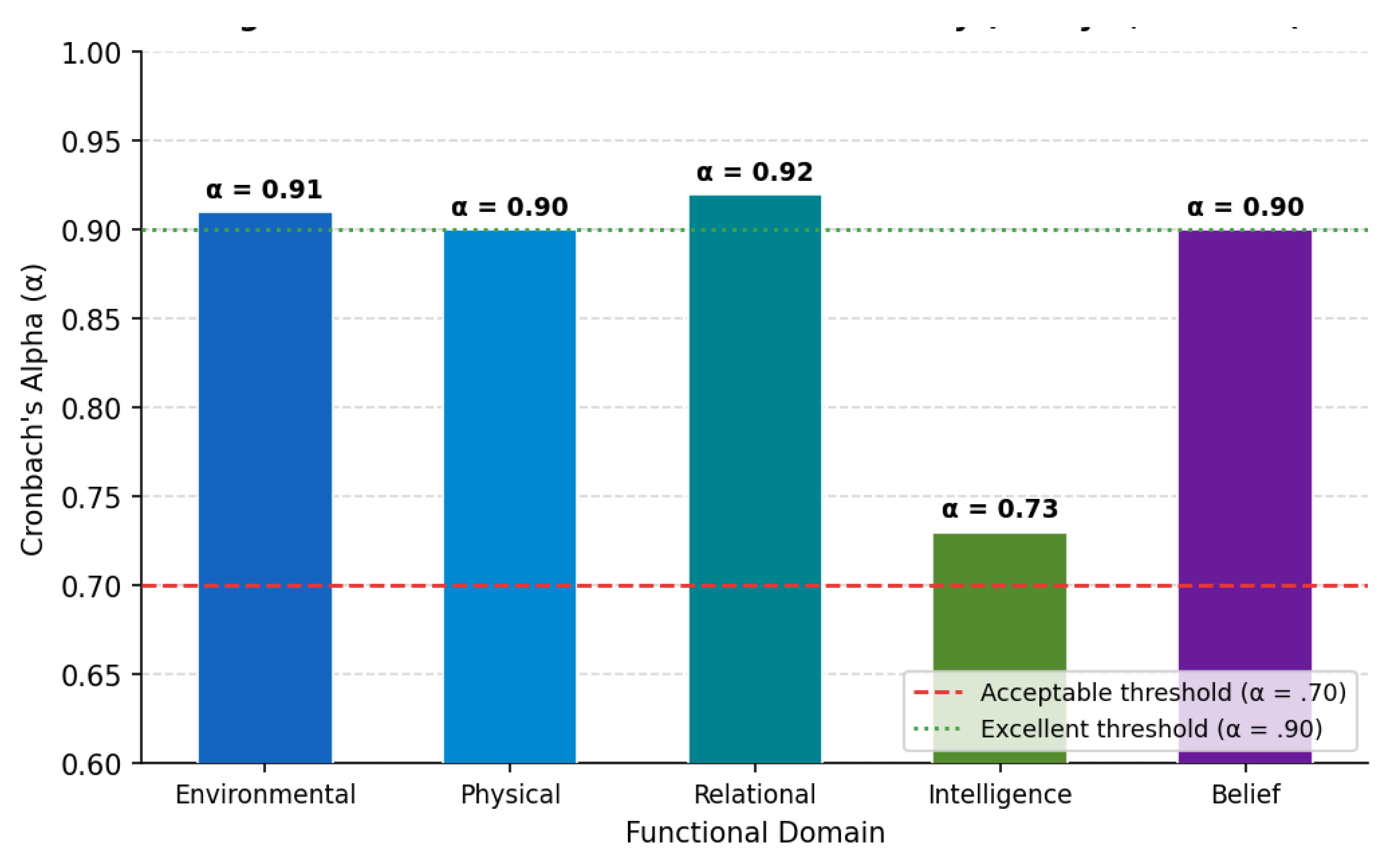
The primary objective of Study 3 was to validate the final form and reliability of the instrument. Confirmatory Factor Analysis was conducted on the 15-item DESM in a sample of 206 adults. As is common with samples of this size (Hu & Bentler, 1999), the test of exact model fit was significant (χ² = 151, df = 80, p < .001). However, all practical fit indices met or exceeded established thresholds (see Table 2): χ²/df = 1.88 (recommended range 1.0–3.0), CFI = .968, TLI = .958 (both > .95), SRMR = .0447 (< .08), and RMSEA = .0655 (acceptable approximation error; Ramirez et al., 2025). The five-factor structure was robust, with all 15 standardized factor loadings statistically significant (p < .001) and ranging from .624 to .960. The global scale demonstrated very good internal consistency (α = .912). Item-rest correlations ranged from .520 (I2) to .714 (B3), and alpha-if-item-deleted values (range .903–.910) indicated strong item homogeneity. Domain-level reliabilities were uniformly high: Environmental (α = .91), Physical (α = .90), Relational (α = .92), Intelligence (α = .73), and Belief (α = .90) (Post, 2016). Test-retest reliability was examined in a sub-sample of 77 participants over 15 days, yielding r = .69 (p < .001, 95% CI). Mean scores were comparable across administrations (T1: M = 4.07, SD = 2.45; T2: M = 3.91, SD = 2.85), with no evidence of systematic temporal drift.
Concurrent Validity
The DESM global stability score demonstrated strong concurrent validity with established clinical measures. Specifically, higher DESM stability scores were strongly negatively correlated with depression symptom severity on the PHQ-9 (r = −.586, p < .001) and with anxiety symptom severity on the GAD-7 (r = −.560, p < .001). Both correlations fall in the upper tercile of effect sizes reported in psychological research (Hemphill, 2003) and qualify as very large effects according to Funder and Ozer’s (2019) guidelines. These findings indicate that lower functional stability, as measured by the DESM, is a robust predictor of elevated psychiatric distress.
Stability Block Classification
Application of the Stability Block classification system to the global DESM scores in Study 3 showed that the majority of participants (77.2%, n = 159) were categorised as Green (Stable), indicating high functional stability across the five domains. A substantial proportion (18.0%, n = 37) fell into the Yellow (At-Risk) category, while a small minority (4.9%, n = 10) were classified as Red (Critical), reflecting critical depletion of functional resources. These distributions align closely with expected base rates of mental health vulnerability in community adult samples and provide preliminary evidence for the ecological validity of the Stability Block framework as a practical clinical triage tool.
Figure 1.
Stability Block Classification Distribution (Study 3, N = 206). Green = Stable (77.2%); Yellow = At-Risk (18.0%); Red = Critical (4.9%).
Figure 1.
Stability Block Classification Distribution (Study 3, N = 206). Green = Stable (77.2%); Yellow = At-Risk (18.0%); Red = Critical (4.9%).
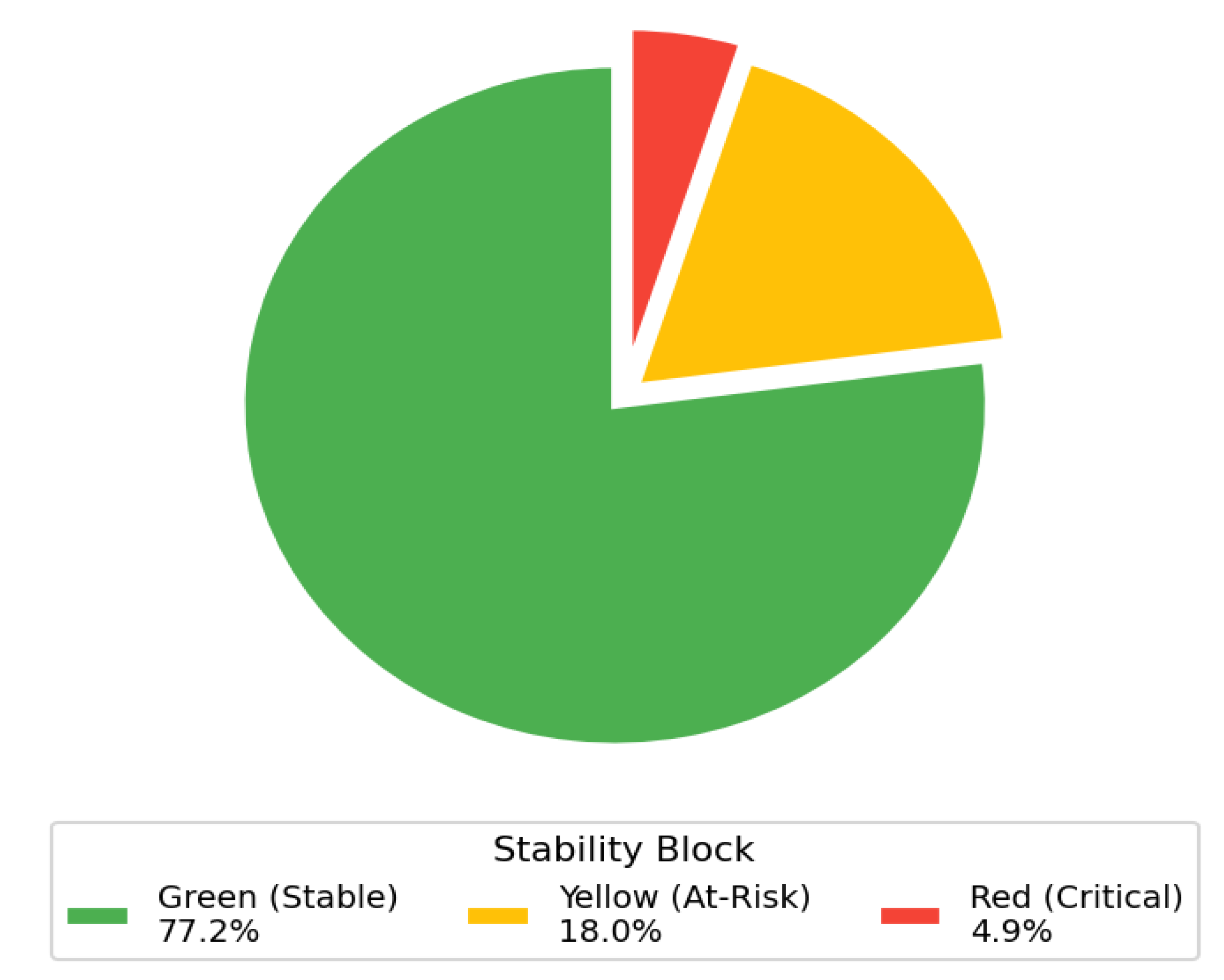
Figure 2.
Domain-Level Internal Consistency (Cronbach's Alpha) Across Five DESM Domains (Study 3, N = 206). Dashed red line indicates acceptable threshold (α = .70); dotted green line indicates excellent threshold (α = .90).
Figure 2.
Domain-Level Internal Consistency (Cronbach's Alpha) Across Five DESM Domains (Study 3, N = 206). Dashed red line indicates acceptable threshold (α = .70); dotted green line indicates excellent threshold (α = .90).
Discussion
Principal Findings Overview
The three-study programme successfully developed and validated the 15-item Dynamic Energy–Stability Model (DESM). The final instrument demonstrated excellent internal consistency at the global level (α = .912) and strong domain-level reliability (ranging from .73 to .92). Test-retest reliability over 15 days was acceptable (r = .69, p < .001). Confirmatory factor analysis supported the hypothesized five-factor structure, with excellent model fit (χ²/df = 1.88, CFI = .968, TLI = .958, SRMR = .0447, RMSEA = .0655). In addition, the global stability score showed strong concurrent validity, with significant negative correlations to depression (PHQ-9: r = −.586, p < .001) and anxiety (GAD-7: r = −.560, p < .001). These correlations represent very large effect sizes in psychological research (Hemphill, 2003; Funder & Ozer, 2019). Overall, the results support the DESM as a brief, reliable, and structurally sound measure of functional stability.
Theoretical Implications
Validation of the five-domain model has important theoretical implications. The DESM architecture (visualized as a general higher-order factor with five specific domains: Environmental, Physical, Relational, Intelligence, and Belief) aligns closely with biopsychosocial and ecological models of wellbeing, which view human functioning as an interconnected system (El-Den et al., 2020). All five factors showed uniformly high and statistically significant loadings (.624–.960, all p < .001), supporting the theoretical premise that they represent five independently yet interrelated facets of a superordinate stability construct. Moderate inter-factor correlations (observed in Study 2) and the second-order structure tested in Study 3 further validate the dual level interpretation of the DESM: domain-specific profiles for precision intervention and a global index for overall triage. The inverse relationship between DESM stability scores and both depression and anxiety is consistent with energy-depletion theories. When energy reserves in any functional domain are depleted, the individual has reduced capacity to resist entropic forces, which can manifest clinically as depressive or anxious symptoms. This framework offers a mechanistic explanation for why stability — rather than a generic wellbeing score — is a stronger predictor of psychological distress (Hemphill, 2003).
Recommendations of the Stability Block Framework
The Stability Block framework translates the continuous global DESM score into a simple, actionable triage system: Green (Stable), Yellow (At-Risk), or Red (Critical). In Study 3, 77.2% of participants were classified as Green, 18.0% as Yellow, and 4.9% as Red. These proportions are consistent with expected base rates of mental health vulnerability in community adult samples and support the ecological validity of the framework as a practical clinical triage tool. The Yellow category can signal the need for short-term preventive intervention, while a Red classification warrants immediate in-depth assessment and resource mobilization. This proactive, tiered approach represents a meaningful improvement over traditional symptom-threshold-based referral pathway (Post, 2016). Moreover, the domain-specific profiles generated by the DESM allow clinicians to identify which functional domains are driving instability and to tailor interventions accordingly (e.g., targeting relational support versus existential meaning). Unlike brief symptom screens such as the PHQ-9 and GAD-7, the DESM provides both overall risk level and actionable domain-level information.
Limitations
Several limitations should be noted. First, all data were collected through online convenience samples, which may introduce self-selection bias and limit generalizability. Second, the samples were skewed toward younger, highly educated adults (nearly 70% of the Study 3 sample held a Bachelor’s or Master’s degree), potentially restricting the applicability of findings to more diverse socioeconomic, educational, or cultural groups. Third, the test-retest interval of 15 days was appropriate for this construct but longer intervals would provide stronger evidence of temporal stability. Finally, significant non-normality was observed across domains (Shapiro-Wilk p < .001), suggesting that parametric scoring may need to be supplemented with non-parametric approaches in populations with more extreme clinical profiles.
Conclusions
Summary of Contributions
The Dynamic Energy–Stability Model (DESM) assessment is a theoretically grounded, empirically validated tool for measuring functional stability across five key domains of human functioning. Following an iterative three-study validation process, the final 15-item version demonstrated strong psychometric properties: internal consistency (global α = .912), acceptable test-retest reliability over 15 days (r = .69, p < .001), and a robust five-factor structure confirmed by confirmatory factor analysis (CFI = .968, TLI = .958, RMSEA = .0655, SRMR = .0447). The global stability score also showed strong concurrent validity with depression (PHQ-9: r = −.586) and anxiety (GAD-7: r = −.560), representing very large effect sizes. The integration of the Stability Block triage system (Green, Yellow, Red) further enhances the instrument’s clinical utility, providing a brief, user-friendly, and actionable tool for identifying vulnerability and guiding timely intervention.
Directions for Future Research
Several important extensions are warranted. First, measurement invariance testing across gender, age, ethnicity, education, and socioeconomic status is needed to ensure the DESM performs equivalently across diverse populations. Second, prospective longitudinal studies with repeated DESM assessments are essential to establish the model’s predictive validity. In particular, such studies would test whether declines in domain-specific stability prospectively predict the onset or worsening of clinical distress and decompensation, thereby providing critical evidence that energy depletion temporally precedes symptom escalation. Third, validation in specific clinical populations (e.g., mood disorders, anxiety disorders, and personality disorders) would clarify the instrument’s sensitivity, specificity, and clinical utility in high-risk groups. Finally, establishing population-specific norms and cut-off points would increase the applicability and equity of the Stability Block framework in real-world settings.
Concluding Statement
In summary, the DESM represents a meaningful shift in psychological assessment—from static diagnostic labelling to a dynamic, domain-specific mapping of functional stability and energy resources. By identifying where individuals are most vulnerable before symptoms reach clinical thresholds, the DESM offers clinicians a proactive, mechanism-informed approach to prevention and intervention. The robust empirical support presented here provides a strong foundation for wider adoption of the DESM in clinical triage, research, and preventive mental health programmes.
Funding
This research received no specific grant from any funding agency in the public, commercial, or not-for-profit sectors.
Institutional Review Board Statement
This study was conducted using anonymous online survey data collected with informed consent from adult participants. Given the minimal risk involved and the de-identified nature of the data, formal Institutional Review Board (IRB) review was not required. Ethical responsibility for the research rests entirely with the investigator.
Informed Consent Statement
Not applicable.
Data Availability Statement
The anonymized dataset supporting the findings of this study is available from the corresponding author upon reasonable request for purposes of collaborative validation or replication.
Conflicts of Interest
The author declares that they have no competing interests.
Appendix A. Sociodemographic profile of sample for study 1
| Global | Non-Symptomatic | Symptomatic | ||||
| Gender | ||||||
| Gender | Counts | % of Total | Counts | % of Total | Counts | % of Total |
| Male | 100 | 50.80% | 59 | 29.90% | 41 | 20.80% |
| Female | 92 | 46.70% | 37 | 18.80% | 55 | 27.90% |
| Non-binary / Other | 5 | 2.50% | 3 | 1.50% | 2 | 1% |
| Age | ||||||
| Age | Counts | % of Total | Counts | % of Total | Counts | % of Total |
| 18–24 | 64 | 32.50% | 41 | 20.80% | 23 | 11.70% |
| 45–54 | 18 | 9.10% | 9 | 4.60% | 9 | 4.60% |
| 25–34 | 79 | 40.10% | 34 | 17.30% | 45 | 22.80% |
| 55–64 | 8 | 4.10% | 5 | 2.50% | 3 | 1.50% |
| 35–44 | 26 | 13.20% | 8 | 4.10% | 18 | 9.10% |
| 65+ | 2 | 1% | 2 | 1% | 0 | 0% |
| Education | ||||||
| Education | Counts | % of Total | Counts | % of Total | Counts | % of Total |
| Some college | 38 | 19.30% | 18 | 9.10% | 20 | 10.20% |
| Master's degree | 26 | 13.20% | 12 | 6.10% | 14 | 7.10% |
| Associate degree | 8 | 4.10% | 5 | 2.50% | 3 | 1.50% |
| Bachelor's degree | 89 | 45.20% | 53 | 26.90% | 36 | 18.30% |
| Doctoral / Professional degree | 6 | 3% | 3 | 1.50% | 3 | 1.50% |
| High school / GED | 27 | 13.70% | 7 | 3.60% | 20 | 10.20% |
| Less than high school | 3 | 1.50% | 1 | 0.50% | 2% | 1% |
| Annual Income | ||||||
| Income | Counts | % of Total | Counts | % of Total | Counts | % of Total |
| $75,000 – $99,999 | 14 | 7.10% | 7 | 3.60% | 7 | 3.60% |
| $25,000 – $49,999 | 56 | 28.40% | 27 | 13.70% | 29 | 14.70% |
| Under $25,000 | 65 | 33% | 36 | 18.30% | 29 | 14.70% |
| $100,000 – $149,999 | 18 | 9.10% | 8 | 4.10% | 10 | 5.10% |
| $50,000 – $74,999 | 25 | 12.70% | 10 | 5.10% | 15 | 7.60% |
| $150,000 or more | 7 | 3.60% | 2 | 1% | 5 | 2.50% |
| Prefer not to say | 12 | 6.10% | 9 | 4.60% | 3 | 1.50% |
| Living Arrangement | ||||||
| Living Arrangement | Counts | % of Total | Counts | % of Total | Counts | % of Total |
| With parents/family | 80 | 40.60% | 49 | 24.90% | 31 | 15.70% |
| With roommates | 10 | 5.10% | 5 | 2.50% | 5 | 2.50% |
| With partner/spouse | 33 | 16.80% | 18 | 9.10% | 15 | 7.60% |
| With partner and children | 33 | 16.80% | 17 | 8.60% | 16 | 8.10% |
| Living alone | 28 | 14.20% | 8 | 4.10% | 20 | 10.20% |
| Prefer not to say | 2 | 1% | 1 | 0.50% | 1 | 0.50% |
| With children | 9 | 4.60% | 1 | 0.50% | 8 | 4.10% |
| Other | 2 | 1% | 0 | 0% | 2% | 1% |
| Race/Ethnicity | ||||||
| Race/Ethnicity | Counts | % of Total | Counts | % of Total | Counts | % of Total |
| Hispanic/Latino | 26 | 13.20% | 9 | 4.60% | 17 | 8.60% |
| Black/African American | 30 | 15.20% | 16 | 8.10% | 14 | 7.10% |
| Two or more races | 10 | 5.10% | 4 | 2% | 6 | 3% |
| White/Caucasian | 104 | 52.80% | 51 | 25.90% | 53 | 26.90% |
| Prefer not to say | 10 | 5.10% | 9 | 4.6 | 1 | 0.5 |
| Asian | 16 | 8.10% | 10 | 5.10% | 6 | 3% |
| Native Hawaiian / Pacific Islander | 1 | 0.50% | 0 | 0% | 1 | 0.50% |
| Note. Global sample = 197. Non-symptomatic sample = 99. Symptomatic sample = 98. | ||||||
Appendix B. Sociodemographic profile of sample for study 2
| Gender | |||
| Gender | Counts | % of Total | Cumulative % |
| Male | 170 | 57.20% | 57.20% |
| Female | 124 | 41.80% | 99% |
| Prefer not to say | 2 | 0.70% | 99.70% |
| Non-binary / Other | 1 | 0.30% | 100% |
| Age | |||
| Age | Counts | % of Total | Cumulative % |
| 18–24 | 79 | 26.60% | 26.60% |
| 25–34 | 121 | 40.70% | 67.30% |
| 35–44 | 59 | 19.90% | 87.20% |
| 45–54 | 25 | 8.40% | 95.60% |
| 55–64 | 9 | 3% | 98.70% |
| 65+ | 4 | 1.30% | 100% |
| Education | |||
| Education | Counts | % of Total | Cumulative % |
| Less than high school | 3 | 1% | 1% |
| High school / GED | 44 | 14.80% | 15.80% |
| Some college | 48 | 16.20% | 32% |
| Bachelor's degree | 136 | 45.80% | 77.80% |
| Master's degree | 47 | 15.80% | 93.60% |
| Associate degree | 10 | 3.40% | 97% |
| Doctoral / Professional degree | 8 | 2.70% | 99.70% |
| Prefer not to say | 1 | 0.30% | 100% |
| Employment | |||
| Employment | Counts | % of Total | Cumulative % |
| Unemployed | 33 | 11.10% | 11.10% |
| Employed part-time | 46 | 15.50% | 26.60% |
| Employed full-time | 123 | 41.40% | 68% |
| Self-employed | 38 | 12.80% | 80.80% |
| Homemaker | 11 | 3.70% | 84.50% |
| Student | 37 | 12.50% | 97% |
| Retired | 3 | 1% | 98% |
| Disabled / Unable to work | 4 | 1.30% | 99.30% |
| Other / Prefer not to say | 2 | 0.70% | 100% |
| Income | |||
| Income | Counts | % of Total | Cumulative % |
| Under $25,000 | 94 | 31.60% | 31.60% |
| $25,000 – $49,999 | 93 | 31.30% | 63% |
| $50,000 – $74,999 | 34 | 11.40% | 74.40% |
| $75,000 – $99,999 | 30 | 10.10% | 84.50% |
| $100,000 – $149,999 | 23 | 7.70% | 92.30% |
| $150,000 or more | 11 | 3.70% | 96% |
| Prefer not to say | 12 | 4% | 100% |
| Living Arrangement | |||
| Living Arrangement | Counts | % of Total | Cumulative % |
| With partner and children | 64 | 21.50% | 21.50% |
| With parents/family | 119 | 40.10% | 61.60% |
| With partner/spouse | 42 | 14.10% | 75.80% |
| Living alone | 46 | 15.50% | 91.20% |
| With children | 9 | 3% | 94.30% |
| With roommates | 13 | 4.40% | 98.70% |
| Prefer not to say | 2 | 0.70% | 99.30% |
| Other | 2 | 0.70% | 100% |
| Race / Ethnicity | |||
| Race/Ethnicity | Counts | % of Total | Cumulative % |
| White/Caucasian | 146 | 49.20% | 49.20% |
| Two or more races | 20 | 6.70% | 55.90% |
| Asian | 37 | 12.50% | 68.40% |
| Hispanic/Latino | 45 | 15.20% | 83.50% |
| Prefer not to say | 12 | 4% | 87.50% |
| Black/African American | 37 | 12.50% | 100% |
| Note. N = 297. | |||
Appendix C. Sociodemographic profile of sample for study 3
| Gender | |||
| Gender | Counts | % of Total | Cumulative % |
| Male | 107 | 51.90% | 51.90% |
| Female | 96 | 46.60% | 98.50% |
| Non-binary / Other | 2 | 1% | 99.50% |
| Prefer not to say | 1 | 0.50% | 100% |
| Age | |||
| Age | Counts | % of Total | Cumulative % |
| 18–24 | 47 | 22.80% | 22.80% |
| 25–34 | 94 | 45.60% | 68.40% |
| 35–44 | 31 | 15% | 83.50% |
| 45–54 | 23 | 11.20% | 94.70% |
| 55–64 | 7 | 3.40% | 98.10% |
| 65+ | 4 | 1.90% | 100% |
| Education | |||
| Education | Counts | % of Total | Cumulative % |
| Some college | 23 | 11.20% | 11.20% |
| High school / GED | 26 | 12.60% | 23.80% |
| Bachelor's degree | 92 | 44.70% | 68.40% |
| Associate degree | 10 | 4.90% | 73.30% |
| Master's degree | 52 | 25.20% | 98.50% |
| Doctoral / Professional degree | 3 | 1.50% | 100% |
| Employment | |||
| Employment | Counts | % of Total | Cumulative % |
| Employed part-time | 33 | 16% | 16% |
| Employed full-time | 100 | 48.50% | 64.60% |
| Student | 27 | 13.10% | 77.70% |
| Self-employed | 23 | 11.20% | 88.80% |
| Retired | 2 | 1% | 89.80% |
| Unemployed | 18 | 8.70% | 98.50% |
| Other / Prefer not to say | 1 | 0.50% | 99% |
| Homemaker | 2 | 1% | 100% |
| Annual Income | |||
| Annual Income | Counts | % of Total | Cumulative % |
| Under $25,000 | 69 | 33.50% | 33.50% |
| $25,000 – $49,999 | 68 | 33% | 66.50% |
| $50,000 – $74,999 | 23 | 11.20% | 77.70% |
| $75,000 – $99,999 | 21 | 10.20% | 87.90% |
| $100,000 – $149,999 | 11 | 5.30% | 93.20% |
| $150,000 or more | 3 | 1.50% | 94.70% |
| Prefer not to say | 11 | 5.30% | 100% |
| Living Arrangement | |||
| Living Arrangement | Counts | % of Total | Cumulative % |
| With parents/family | 72 | 35% | 35% |
| Prefer not to say | 2 | 1% | 35.90% |
| With partner/spouse | 43 | 20.90% | 56.80% |
| With roommates | 9 | 4.40% | 61.20% |
| Living alone | 39 | 18.90% | 80.10% |
| With children | 8 | 3.90% | 84% |
| With partner and children | 33 | 16% | 100% |
| Race / Ethnicity | |||
| Race/Ethnicity | Counts | % of Total | Cumulative % |
| White/Caucasian | 103 | 50% | 50% |
| Hispanic/Latino | 21 | 10.20% | 60.20% |
| Asian | 28 | 13.60% | 73.80% |
| Black/African American | 44 | 21.40% | 95.10% |
| Two or more races | 6 | 2.90% | 98.10% |
| Prefer not to say | 4 | 1.90% | 100% |
| Note. N = 206. | |||
References
- Akoglu, H. User's guide to correlation coefficients. Turk. J. Emerg. Med. 2018, 18(3), 91–93. [Google Scholar] [CrossRef] [PubMed]
- El-Den, S.; Schneider, C.; Mirzaei, A.; Carter, S. How to measure a latent construct: Psychometric principles for the development and validation of measurement instruments. Int. J. Pharm. Pract. 2020, 28(4), 326–336. [Google Scholar] [CrossRef] [PubMed]
- Funder, D. C.; Ozer, D. J. Evaluating effect size in psychological research: Sense and nonsense. Adv. Methods Pract. Psychol. Sci. 2019, 2(2), 156–168. [Google Scholar] [CrossRef]
- Hemphill, J. F. Interpreting the magnitudes of correlation coefficients. Am. Psychol. 2003, 58(1), 78–80. [Google Scholar] [CrossRef] [PubMed]
- Her, Q. L.; Wong, J. Significant correlation versus strength of correlation. Am. J. Health-Syst. Pharm. 2019, 77(3), 166–167. [Google Scholar] [CrossRef] [PubMed]
- Hu, L. T.; Bentler, P. M. Cutoff criteria for fit indexes in covariance structure analysis: Conventional criteria versus new alternatives. Struct. Equ. Model. A Multidiscip. J. 1999, 6(1), 1–55. [Google Scholar] [CrossRef]
- Kroenke, K.; Spitzer, R. L.; Williams, J. B. The PHQ-9: Validity of a brief depression severity measure. J. General. Intern. Med. 2001, 16(9), 606–613. [Google Scholar] [CrossRef] [PubMed]
- Post, M. W. What to do with 'moderate' reliability and validity coefficients? Arch. Phys. Med. Rehabil. 2016, 97(7), 1051–1052. [Google Scholar] [CrossRef] [PubMed]
- Ramirez, A.; Burgos-Benavides, L.; Sinchi, H.; Quito-Calle, J. V.; Herrero Diez, F.; Rodriguez-Diaz, F. J. Adaptation and validation of psychological assessment questionnaires using confirmatory factor analysis: A tutorial for planning and reporting analysis. Preprints.org. 2025. [Google Scholar] [CrossRef]
- Rogers, P. Best practices for your exploratory factor analysis: A factor tutorial. Rev. De Adm. Contemp. 2021, 26(4). [Google Scholar] [CrossRef]
- Schmitt, T. A. Current methodological considerations in exploratory and confirmatory factor analysis. J. Psychoeduc. Assess. 2011, 29(4), 304–321. [Google Scholar] [CrossRef]
- Spitzer, R. L.; Kroenke, K.; Williams, J. B.; Lowe, B. A brief measure for assessing generalized anxiety disorder: The GAD-7. Arch. Intern. Med. 2006, 166(10), 1092–1097. [Google Scholar] [CrossRef] [PubMed]
Table 2.
Confirmatory Factor Analysis and Reliability Summary by Domain (Study 3, N = 206).
| Domain | Items | Standardized Loading Range | Cronbach's α | Model Fit Index |
|---|---|---|---|---|
| Environmental | E1, E2, E3 | .624 – .871 | .91 | CFI = .968 |
| Physical | P1, P2, P3 | .651 – .960 | .90 | TLI = .958 |
| Relational | R1, R2, R3 | .638 – .915 | .92 | SRMR = .045 |
| Intelligence | I1, I2, I3 | .631 – .782 | .73 | RMSEA = .066 |
| Belief | B1, B2, B3 | .665 – .874 | .90 | χ²/df = 1.88 |
| Global Scale | 15 items | .520 – .714* | .912 | p < .001 |
Disclaimer/Publisher’s Note: The statements, opinions and data contained in all publications are solely those of the individual author(s) and contributor(s) and not of MDPI and/or the editor(s). MDPI and/or the editor(s) disclaim responsibility for any injury to people or property resulting from any ideas, methods, instructions or products referred to in the content. |
© 2026 by the authors. Licensee MDPI, Basel, Switzerland. This article is an open access article distributed under the terms and conditions of the Creative Commons Attribution (CC BY) license (http://creativecommons.org/licenses/by/4.0/).
Copyright: This open access article is published under a Creative Commons CC BY 4.0 license, which permit the free download, distribution, and reuse, provided that the author and preprint are cited in any reuse.