

Submitted:
27 May 2026
Posted:
28 May 2026
You are already at the latest version
Abstract
Marine low clouds (MLCs) strongly affect Earth’s radiation budget due to their extensive coverage and strong reflection of incoming solar radiation. Despite their important role in the Earth system, the extent and mechanisms of MLC response to climate oscillations are not well understood. In this study, the effect of the El Niño–Southern Oscillation (ENSO) on cloud and meteorological properties across the Pacific Ocean is investigated by integrating various satellite observations and reanalysis datasets. The results reveal a pronounced hemispheric asymmetry in the response of subtropical MLCs to ENSO. During El Niño events, the Northeast Pacific exhibits reduced cloud cover and weaker shortwave radiative cooling, while an opposite response is observed over the Southeast Pacific, where cloudiness and radiative cooling are enhanced. These contrasting responses are linked to distinct ENSO-driven meteorological changes between the two hemispheres. Over the Northeast Pacific, El Niño conditions weaken inversion strength and the subtropical high, suppressing MLCs. In contrast, the Southeast Pacific experiences enhanced inversion strength and lower-tropospheric geopotential height during El Niño, which favor MLC development. It is suggested that hemispheric asymmetries in the climatological positions and ENSO-induced responses of the Pacific subtropical highs contribute to the opposite MLC responses between the two hemispheres. These findings highlight the importance of large-scale controls in shaping regional cloud responses to climate variability and provide insights for improving cloud representation in global climate models.
Keywords:
marine low clouds
; ENSO
; El Niño
; satellite
; remote sensing
; stability
; subtropical high
1. Introduction
Clouds play a crucial role in weather and climate by regulating the radiation budget, hydrological cycle, and atmospheric circulation [1,2]. However, despite decades of progress in observations and numerical modeling, clouds remain one of the largest sources of uncertainty in weather prediction and climate projections [3,4], and global climate models (GCMs) struggle to accurately simulate cloud properties [5,6,7,8]. This uncertainty arises partly because cloud evolution is controlled by a wide range of interacting processes spanning multiple spatial and temporal scales, from microphysical processes such as the effect of cloud particle size and concentration on cloud radiative properties [9,10,11,12,13] to large-scale controls like convection, jet streams, and atmospheric stability [14,15,16,17].
Among different cloud types, marine low clouds (MLCs), including solid stratus, stratocumulus, and shallow cumulus clouds, are particularly important because of their extensive spatial coverage and strong radiative effect. These clouds cover large portions of the subtropical eastern oceans and strongly reflect incoming solar radiation to space because of their high optical thickness, thereby exerting a substantial cooling effect on the climate system [18,19,20]. The development of MLCs are strongly controlled by environmental conditions such as sea surface temperature (SST), lower-tropospheric stability, large-scale subsidence, free-tropospheric humidity, and surface wind speed [21,22]. In particular, cool SSTs and subtropical highs over the oceans result in strong temperature inversions and subsidence that favor the formation of MLCs. Despite their considerable effect on radiation and climate, MLCs representation in GCMs is still challenging, and errors in simulating their properties contribute the most to uncertainty in estimates of anthropogenic climate forcing [4,23].
One of the most important modes of interannual climate variability is the El Niño–Southern Oscillation (ENSO), which strongly affects SST, convection patterns, atmospheric circulation, and precipitation across the Pacific Ocean and beyond [24,25]. ENSO consists of warm (El Niño), cold (La Niña), and neutral phases that are characterized by changes in SST anomalies in the equatorial Pacific Ocean [26]. During El Niño conditions, anomalously warm SSTs develop in the central and eastern equatorial Pacific, leading to enhanced air temperature, deep convection, and rainfall in that region [27]. In contrast, La Niña conditions are associated with anomalously cool SSTs in the central and eastern equatorial Pacific. These anomalies perturb the large-scale tropical circulations (e.g., Hadley and Walker), initiating teleconnections that change the patterns of temperature and precipitation in regions far from the equatorial Pacific [28].
Understanding how large-scale climate variability modulates MLCs is important for improving the representation of cloud–climate interactions in GCMs. ENSO changes atmospheric circulation, stability, and humidity patterns across the Pacific Ocean, all of which are known to affect MLC development. Previous studies suggested strong variability in MLCs on seasonal to interannual timescales [29,30,31]. However, despite the importance of climate oscillations, the extent to which Pacific MLCs respond to ENSO is poorly understood.
In this study, various satellite observations and reanalysis datasets are used to investigate the relationship between ENSO and MLCs over the Pacific Ocean. Cloud and meteorological properties are separated into El Niño and La Niña phases of ENSO using the Oceanic Niño Index (ONI). The analysis focuses on identifying the spatial patterns of ENSO-induced cloud changes, quantifying regional differences in cloud responses, and examining the associated large-scale meteorological controls. Particular attention is given to the contrasting responses of MLCs between the Northeast and Southeast Pacific subtropical regions. The rest of this paper is organized as follows: Section 2 describes the satellite and reanalysis data and methods of data analysis used in the study. In Section 3, the results are presented, and the conclusions are provided in Section 4.
2. Methodology
Table 1 summarizes the satellite, reanalysis, and ENSO datasets used in this study. The quantification of ENSO and classification of data into different ENSO phases is based on ONI, derived from SST anomalies in the Niño 3.4 region (120°W–170°W) of the equatorial central Pacific [32]. Version 2 of the ONI dataset is obtained from the National Oceanic and Atmospheric Administration (NOAA) Physical Sciences Laboratory. Statistical computations are performed to detect patterns in cloud and meteorological distributions and properties during different ENSO phases. Variables are divided into two groups: positive ENSO phase (ONI ≥ 0.5) and negative ENSO phase (ONI ≤ -0.5). The Multivariate ENSO Index (MEI) is also used as a secondary metric for quantifying ENSO phases. Figure 1 shows the time series of ONI and MEI, which are in good agreement throughout the study period, supporting the use of ONI as the primary classification tool for distinguishing ENSO phases.
In this study, NASA Modern-Era Retrospective Analysis for Research and Applications, version two (MERRA-2) [33], with a spatial resolution of 0.5×0.625° and 72 vertical levels, is used to investigate meteorological variables (Table 1) including surface pressure (P), geopotential height (H), horizontal wind speed (WS), SST, total water vapor mixing ratio (qt), and subsidence or vertical velocity in pressure coordinates (ω). Inversion strength (IS) is used as a measure of low-level stability associated with the temperature inversion capping the marine boundary layer. IS is defined as: , where LTS is lower-tropospheric stability (defined as , where and are the potential temperatures at 700 hPa and surface, respectively), LCL is the lifting condensation level, is height at 700 hPa, and is the moist adiabatic lapse rate of at 850 hPa. Larger IS values indicate stronger stability, which generally favors the formation of marine low clouds [22].
Also, satellite retrievals are used for extracting cloud and radiation variables, as described in Table 1. Clouds and the Earth's Radiant Energy System (CERES)—Single Scanner Footprint (SSF)—level 3 product [34] from 2003 to 2024 with a horizontal resolution of 1° is used as the main source of cloud and radiation properties. As an alternative source, International Satellite Cloud Climatology Project (ISCCP) data [35], ranging from 1983 to 2017, with a horizontal resolution of 1° is also used. Variables include cloud fraction (CF), liquid water path (LWP), total water path (TWP), cloud optical depth (), cloud effective radius (re), and cloud phase. The data domain covers Eastern Asia, the Pacific Ocean, and parts of the American continent. The use of multiple satellite datasets allows assessment of the robustness and consistency of the identified cloud responses.
Additional variables were derived to quantify radiative and microphysical impacts of clouds. Cloud radiative effect (CRE) is computed following a method explained in previous studies [36,37]:
where SW is shortwave radiation flux, arrows indicate upward or downward fluxes, “all” and “clear” refer to all-sky and clear-sky conditions, respectively, and “TOA” denotes top of the atmosphere. Each term is in units of W m-2. A similar equation is used to calculate longwave (LW) CRE. Also, cloud droplet number concentration () can be calculated following the derivation from previous studies [38]:
where and are in units of and , respectively.
Prior to the ENSO analysis, anomalies were computed by subtracting the climatological monthly mean from each monthly variable in order to remove the seasonality. “ENSO-induced differences” were calculated by averaging a variable during El Niño events and subtracting the corresponding average during La Niña events. In addition to spatial maps, probability distribution functions (PDFs) were calculated for selected variables within three regions of interest over the Pacific Ocean, described in Table 2. These regions are chosen to capture the major regimes relevant to ENSO–cloud interactions across the Pacific Ocean. The Tropical Western and Central Pacific region represents the primary ENSO convective response, whereas the Northeast and Southeast Pacific domains correspond to the dominant MLC regions in each hemisphere. The PDF analysis provides additional insight into how the full distribution of cloud and meteorological properties changes between ENSO phases beyond the mean-state differences.
3. Results
3.1. General Characteristics of Clouds over the Pacific Ocean
Figure 2 shows the long-term mean spatial distribution of cloud and radiation variables from CERES data. Over the subtropical eastern Pacific, the cloud fields show strongly negative SW CRE due to effective reflection of incoming SW radiation, along with enhanced CF, , LWP, and . This is consistent with previous studies showing the characteristics of MLCs over the subtropical eastern ocean basins [39,40,41]. Cloud phase values in these regions are generally close to 1, indicating predominantly liquid clouds with negligible ice content. This is further supported by weak LW CRE, small IWP, and extensive low-level CF (Figure S1), confirming that these regions are dominated by low-level liquid clouds.
In contrast, the equatorial band and tropical western Pacific exhibit large CF, enhanced IWP, strong LW CRE, and cloud phase values approaching 2, features associated with deep convection and upper-level ice clouds (e.g., cirrus) [42,43]. These clouds efficiently absorb outgoing LW radiation emitted from the surface and re-emit LW at colder cloud-top temperatures, resulting in enhanced LW CRE [36]. In addition, the spatial patterns of CF, TWP, and from ISCCP data (Figure S2) are generally consistent with those from CERES, confirming the robustness of the identified MLC features over the eastern Pacific and convective clouds over the tropical western and central Pacific.
The meteorological patterns shown in Figure 3 provide insights into the meteorology–cloud relationships. Regions with extensive MLC coverage over the subtropical eastern Pacific exhibit strong inversion strength, enhanced subsidence, high surface P and lower-tropospheric H, and moderate surface wind speed, all of which favor maintaining shallow marine boundary layers. The persistence of subtropical highs over the ocean basins, together with relatively cool surface temperatures, facilitates strong lower-tropospheric stability and enhanced subsidence, which ultimately lead to the development of MLCs [20,21]. Comparing the two major MLC regions, slightly stronger inversion strength and surface WS are observed over the Southeast Pacific than over the Northeast Pacific (Figure 3). This may partly explain the stronger SW CRE and larger CF over the Southeast Pacific (Figure 2).
In contrast to the MLC regions, the tropical western Pacific exhibits weaker stability, negative ω values (indicative of upward motion), enhanced humidity, and relatively low surface pressure, all of which are characteristic of deep tropical convection and favor the formation of upper-level ice clouds [44,45]. Overall, the consistency between cloud and meteorological fields highlights the important role of large-scale controls in regulating cloud distributions and properties across the Pacific Ocean.
3.2. ENSO-Induced Variability in Cloud and Meteorological Properties
To study the response of clouds to ENSO variability across the Pacific Ocean, the spatial distributions of “ENSO-induced differences” are calculated and shown in the left panels of Figure 4. These differences are spatially coherent and consistent across multiple cloud variables and reveal strong contrasts between the tropical Pacific and the subtropical eastern Pacific regions. The strongly positive SW CRE differences over the maritime continent and strongly negative SW CRE differences over the tropical western/central Pacific are consistent with shifts in Walker circulation and enhanced deep convection over the tropical western/central Pacific due to stronger SST anomalies during El Niño than La Niña conditions [46]. The SW CRE differences are also consistent with enhanced CF, , and differences over the western/central Pacific and vice versa over the maritime continent.
The subtropical eastern Pacific exhibits opposite cloud responses between the two hemispheres. Over the Northeast Pacific, El Niño events are associated with increased SW CRE, reduced CF, smaller , and lower , indicating suppression of MLCs and weaker reflection of incoming SW radiation. In contrast, the Southeast Pacific experiences increased SW CRE, larger CF, enhanced , and higher during El Niño, indicating enhanced MLCs and stronger radiative cooling. These results reveal a clear hemispheric asymmetry in the response of subtropical MLCs to ENSO. Also, they suggest that El Niño conditions not only change the spatial coverage of MLCs but also modulate their optical thickness and radiative cooling effect. In addition to the sign of the differences, the magnitudes of the differences are generally stronger over the Southeast Pacific than over the Northeast Pacific, implying that cloud responses to ENSO are stronger in this region, consistent with the climatologically persistent MLCs over the Southeast Pacific.
The PDF analysis further illustrates the regional dependence of cloud variability on ENSO. In the Tropical Western & Central Pacific, the PDFs exhibit substantial shifts between El Niño and La Niña conditions, reflecting strong ENSO modulation of high ice clouds. El Niño conditions generally shift the variable distributions toward larger CF, stronger (more negative) SW CRE, higher , and larger values, consistent with enhanced convective activity over this region during El Niño conditions.
In the Northeast Pacific, the PDFs shift toward lower CF, weaker (more positive) SW CRE, smaller , and lower during El Niño conditions, indicating weakening of MLCs. In contrast, the Southeast Pacific exhibits an opposite response, with PDFs shifted toward enhanced cloudiness, stronger SW CRE, larger , and higher during El Niño events. These PDF shifts demonstrate that ENSO modifies not only the mean state but also the full distribution and variability of cloud properties across different Pacific cloud regimes. However, the shifts are weaker over the eastern Pacific regions than over the Tropical Western & Central Pacific, likely because of their distance to the primary region of ENSO-driven anomalies.
The ENSO-induced differences derived from ISCCP data (Figure S3) are generally consistent with those from CERES, showing enhanced high ice cloud CF and over the tropical western/central Pacific during El Niño conditions, along with opposing MLC responses between the Northeast and Southeast Pacific. This consistency between two different satellite datasets further supports the robustness of the identified ENSO–cloud relationships across the Pacific Ocean.
The meteorological changes shown in Figure 5 provide insight into the mechanisms responsible for the observed cloud responses. Over the Northeast Pacific, El Niño conditions are associated with decreases in inversion strength and reductions in 700-hPa H, both of which reduce the persistence of MLCs. Weaker stability enhances boundary-layer mixing and entrainment of warmer and drier free-tropospheric air into the marine boundary layer, thereby suppressing MLCs [47]. ENSO-induced warming over the equatorial Pacific extends poleward toward the subtropical eastern Pacific and reduces lower-tropospheric stability in the Northeast Pacific [48,49]. In addition, the eastward shift in Walker circulation during El Niño conditions weakens the subtropical high-pressure system over the eastern Pacific [50,51], which could reduce large-scale subsidence and suppress MLC development.
In contrast, the Southeast Pacific exhibits enhanced inversion strength and positive H anomalies during El Niño conditions, associated with enhanced MLCs over this region (Figure 5). Several factors may contribute to this opposite response relative to the Northeast Pacific. Climatologically, the South Pacific subtropical high is located farther offshore from the South American coast than the North Pacific subtropical high relative to North America (Figure 3c), consistent with previous studies describing hemispheric asymmetries in the positions and structures of the two Pacific subtropical highs [52]. The weakening of the subtropical high during El Niño conditions over the South Pacific is smaller and occurs further west and south of the MLC region (Figure 5a), making it less effective in reducing inversion strength and subsidence over the Southeast Pacific. This spatially displaced and weaker response of South Pacific subtropical high to ENSO was also reported in previous studies [52]. Instead, the enhanced H differences associated with El Niño over Australia and the maritime continent appear to extend eastward over the equatorial Pacific and Southeast Pacific, producing a hemispheric asymmetry. Such conditions could help maintain and enhance MLCs over the Southeast Pacific.
Changes in humidity also contribute to the observed cloud responses. The tropical western/central Pacific exhibits enhanced 700-hPa qt during El Niño conditions, consistent with previous studies showing increased moisture transport associated with warm SST anomalies that intensify convection [53]. The qt changes are generally positive over the Southeast Pacific and negative over the Northeast Pacific, although these changes are relatively weak and secondary compared with the dominant influence of inversion strength and H anomalies. Furthermore, variations in WS and ω exist over the eastern Pacific, but their ENSO-induced differences are generally weaker and less spatially coherent than those associated with inversion strength and H (figures not shown).
4. Conclusions
This study investigates the effect of ENSO on cloud and meteorological properties across the Pacific Ocean using CERES and ISCCP satellite observations together with MERRA2 reanalysis data. The climatological analysis shows distinct cloud regimes across the Pacific, including extensive MLC decks over the subtropical eastern Pacific and deep convective clouds over the tropical western/central Pacific. The MLC regions are characterized by strong inversion strength, enhanced subsidence, and proximity to persistent subtropical highs, in agreement with previous studies [20,21]. The tropical western Pacific exhibits enhanced humidity, weaker stability, and strong updraft associated with upper-level ice clouds, as also reported by others [44,45].
The results demonstrate a pronounced hemispheric asymmetry in the response of subtropical MLCs to ENSO variability. During El Niño conditions, the Northeast Pacific exhibits reduced CF, weaker SW CRE, smaller , and lower , indicating suppression of MLCs and reduced SW cooling. This response appears to be the consequence of weaker stability and weaker subtropical high during El Niño conditions. Enhanced SSTs over the equatorial Pacific during El Niño propagate poleward toward the subtropical eastern Pacific and reduce stability [48,49]. In addition, the eastward shift in Walker circulation weakens the subtropical highs [50,51]. Together, these changes explain MLC suppression over the Northeast Pacific.
In contrast, the Southeast Pacific exhibits enhanced MLCs during El Niño conditions, associated with stronger SW CRE, larger CF, enhanced , and higher . This opposite response appears to be linked to hemispheric asymmetries in the positions of the Pacific subtropical highs and their responses to ENSO. Previous studies noted these asymmetries [52]. Specifically, we observe that the South Pacific subtropical high is located farther offshore from the South American coast than the North Pacific subtropical high relative to North America, and its weakening during El Niño conditions is smaller and displaced further west and south of the main MLC region. As a result, the influence of the South Pacific subtropical high on inversion strength and subsidence over the Southeast Pacific is reduced. These conditions likely help maintain and enhance MLCs over the Southeast Pacific during El Niño.
The strongest ENSO-induced shifts occur over the Tropical Western & Central Pacific, consistent with the primary region of ENSO-driven SST anomalies and convective activity [53], whereas weaker but opposite responses occur between the two subtropical eastern Pacific MLC regions. In addition, these contrasting hemispheric asymmetries over the eastern Pacific are consistently observed across multiple cloud variables and are supported by both CERES and ISCCP datasets, highlighting the robustness of the identified ENSO–cloud relationships. The outcome of this study emphasizes the role of large-scale forcings in determining regional cloud responses to climate oscillations and may help guide future efforts to better represent cloud processes and cloud–climate interactions in GCMs. Future work should further investigate this topic by examining the role of seasonal dependence, aerosols, and coupled ocean–atmosphere interactions in modulating ENSO-induced variability in Pacific cloud regimes.
Supplementary Materials
The following supporting information can be downloaded at the website of this paper posted on Preprints.org.
Data Availability Statement
The ENSO indices (ONI and MEI) are publicly accessible from NOAA’s website at https://www.weather.gov/fwd/indices. The CERES satellite data is provided on the NASA website at https://ceres.larc.nasa.gov/data/. MERRA2 datasets are available from the NASA website at https://disc.gsfc.nasa.gov/datasets. ISCCP data can be downloaded from https://isccp.giss.nasa.gov/. Numerical codes for data analysis and visualization are available from the author upon reasonable request, due to ongoing development. The data analysis in this study was performed using Python (an open-source programming language available at: https://www.python.org/).
Acknowledgments
This study was supported by the Institute Project Assignment and the New Faculty Fund from the Desert Research Institute.
Conflicts of Interest
The author declares no conflicts of interest.
References
- Boucher, O.; Randall, D.; Artaxo, P.; Bretherton, C.; Feingold, G.; Forster, P.; Kerminen, V.-M.; Kondo, Y.; Liao, H.; Lohmann, U.; et al. Clouds and Aerosols. In Climate Change 2013: The Physical Science Basis. Contribution of Working Group I to the Fifth Assessment Report of the Intergovernmental Panel on Climate Change; Stocker, T.F., Qin, D., Plattner, G.-K., Tignor, M., Allen, S.K., Boschung, J., Nauels, A., Xia, Y., Bex, V., Midgley, P.M., Eds.; Cambridge University Press: Cambridge, United Kingdom and New York, NY, USA., 2013.
- Stephens, G.L. Cloud Feedbacks in the Climate System: A Critical Review. 2005. [CrossRef]
- Bellouin, N.; Quaas, J.; Gryspeerdt, E.; Kinne, S.; Stier, P.; Watson-Parris, D.; Boucher, O.; Carslaw, K.S.; Christensen, M.; Daniau, A.-L.; et al. Bounding Global Aerosol Radiative Forcing of Climate Change. Reviews of Geophysics 2020, 58, e2019RG000660. [CrossRef]
- Forster, P.; Storelvmo, T.; Armour, K.; Collins, W.; Dufresne, J.-L.; Frame, D.; Lunt, D.; Mauritsen, T.; Palmer, M.; Watanabe, M. The Earth’s Energy Budget, Climate Feedbacks, and Climate Sensitivity. In Climate Change 2021: The Physical Science Basis. Contribution of Working Group I to the Sixth Assessment Report of the Intergovernmental Panel on Climate Change [Masson-Delmotte, V., P. Zhai, A. Pirani, S. L. Connors, C. Péan, S. Berger, N. Caud, Y. Chen, L. Goldfarb, M. I. Gomis, M. Huang, K. Leitzell, E. Lonnoy, J.B.R. Matthews, T. K. Maycock, T. Waterfield, O. Yelekçi, R. Yu and B. Zhou (eds.)]; Cambridge University Press: Cambridge, United Kingdom, 2021.
- Eidhammer, T.; Morrison, H.; Mitchell, D.; Gettelman, A.; Erfani, E. Improvements in Global Climate Model Microphysics Using a Consistent Representation of Ice Particle Properties. 2017. [CrossRef]
- Erfani, E.; Burls, N.J. The Strength of Low-Cloud Feedbacks and Tropical Climate: A CESM Sensitivity Study. Journal of Climate 2019, 32, 2497–2516. [CrossRef]
- Lee, H.-H.; Bogenschutz, P.; Yamaguchi, T. Resolving Away Stratocumulus Biases in Modern Global Climate Models. Geophysical Research Letters 2022, 49, e2022GL099422. [CrossRef]
- Zelinka, M.D.; Randall, D.A.; Webb, M.J.; Klein, S.A. Clearing Clouds of Uncertainty. Nature Clim. Change 2017, 7, 674–678.
- Barthlott, C.; Zarboo, A.; Matsunobu, T.; Keil, C. Importance of Aerosols and Shape of the Cloud Droplet Size Distribution for Convective Clouds and Precipitation. Atmospheric Chemistry and Physics 2022, 22, 2153–2172. [CrossRef]
- Erfani, E.; Mitchell, D.L. Developing and Bounding Ice Particle Mass- and Area-Dimension Expressions for Use in Atmospheric Models and Remote Sensing. Atmos. Chem. Phys. 2016, 16, 4379–4400. [CrossRef]
- Erfani, E.; Mitchell, D.L. Growth of Ice Particle Mass and Projected Area during Riming. Atmospheric Chemistry and Physics 2017, 17, 1241–1257. [CrossRef]
- Lawson, R.P.; Woods, S.; Jensen, E.; Erfani, E.; Gurganus, C.; Gallagher, M.; Connolly, P.; Whiteway, J.; Baran, A.J.; May, P.; et al. A Review of Ice Particle Shapes in Cirrus Formed In Situ and in Anvils. Journal of Geophysical Research: Atmospheres 2019, 124, 10049–10090. [CrossRef]
- Twomey, S. The Influence of Pollution on the Shortwave Albedo of Clouds. Journal of the atmospheric sciences 1977, 34, 1149–1152. [CrossRef]
- Berry, E.; Mace, G.G. Cirrus Cloud Properties and the Large-Scale Meteorological Environment: Relationships Derived from A-Train and NCEP–NCAR Reanalysis Data. 2013. [CrossRef]
- Blanco, J.E.; Caballero, R.; Datseris, G.; Stevens, B.; Bony, S.; Hadas, O.; Kaspi, Y. A Cloud-Controlling Factor Perspective on the Hemispheric Asymmetry of Extratropical Cloud Albedo. 2023. [CrossRef]
- Erfani, E.; Hosseinpour, F. A Novel Approach for Reliable Classification of Marine Low Cloud Morphologies with Vision–Language Models. Atmosphere 2025, 16. [CrossRef]
- Shin, H.H.; Xue, L.; Li, W.; Firl, G.; D’Amico, D.F.; Muñoz-Esparza, D.; Ek, M.B.; Chu, Y.; Wang, Z.; Gustafson Jr., W.I.; et al. Large-Scale Forcing Impact on the Development of Shallow Convective Clouds Revealed From LASSO Large-Eddy Simulations. Journal of Geophysical Research: Atmospheres 2021, 126, e2021JD035208. [CrossRef]
- Carslaw, K. Aerosols and Climate; Elsevier, 2022; ISBN 978-0-12-819766-0.
- Painemal, D. Global Estimates of Changes in Shortwave Low-Cloud Albedo and Fluxes Due to Variations in Cloud Droplet Number Concentration Derived From CERES-MODIS Satellite Sensors. Geophysical Research Letters 2018, 45, 9288–9296. [CrossRef]
- Wood, R. Stratocumulus Clouds. Monthly Weather Review 2012, 140, 2373–2423. [CrossRef]
- Klein, S.A.; Hall, A.; Norris, J.R.; Pincus, R. Low-Cloud Feedbacks from Cloud-Controlling Factors: A Review. Surveys in Geophysics 2017, 38, 1307–1329. [CrossRef]
- Wood, R.; Bretherton, C.S. On the Relationship between Stratiform Low Cloud Cover and Lower-Tropospheric Stability. Journal of climate 2006, 19, 6425–6432. [CrossRef]
- Bony, S.; Dufresne, J.L. Marine Boundary Layer Clouds at the Heart of Tropical Cloud Feedback Uncertainties in Climate Models. Geophys. Res. Lett. 2005, 32. [CrossRef]
- Latif, M.; Keenlyside, N.S. El Niño/Southern Oscillation Response to Global Warming. Proceedings of the National Academy of Sciences 2009, 106, 20578–20583. [CrossRef]
- Lopez, H.; Lee, S.-K.; Kim, D.; Wittenberg, A.T.; Yeh, S.-W. Projections of Faster Onset and Slower Decay of El Niño in the 21st Century. Nat Commun 2022, 13, 1915. [CrossRef]
- Chen, N.; Thual, S.; Hu, S. El Niño and the Southern Oscillation: Observation. In Reference Module in Earth Systems and Environmental Sciences; Elsevier, 2019; pp. 91–96.
- Philander, S.G.H. El Niño and La Niña. 1985.
- McPhaden, M.J.; Zebiak, S.E.; Glantz, M.H. ENSO as an Integrating Concept in Earth Science. Science 2006, 314, 1740–1745. [CrossRef]
- Klein, S.A.; Hartmann, D.L. The Seasonal Cycle Of Low Stratiform Clouds. J. Clim. 1993, 6, 1587–1606. [CrossRef]
- Norris, J.R.; Allen, R.J.; Evan, A.T.; Zelinka, M.D.; O’Dell, C.W.; Klein, S.A. Evidence for Climate Change in the Satellite Cloud Record. Nature 2016, 536, 72-+. [CrossRef]
- Park, S.; Leovy, C.B. Marine Low-Cloud Anomalies Associated with ENSO. 2004.
- Glantz, M.H.; Ramirez, I.J. Reviewing the Oceanic Niño Index (ONI) to Enhance Societal Readiness for El Niño’s Impacts. Int J Disaster Risk Sci 2020, 11, 394–403. [CrossRef]
- Gelaro, R.; McCarty, W.; Suárez, M.J.; Todling, R.; Molod, A.; Takacs, L.; Randles, C.A.; Darmenov, A.; Bosilovich, M.G.; Reichle, R.; et al. The Modern-Era Retrospective Analysis for Research and Applications, Version 2 (MERRA-2). J. Climate 2017, 30, 5419–5454. [CrossRef]
- Doelling, D.R.; Sun, M.; Nguyen, L.T.; Nordeen, M.L.; Haney, C.O.; Keyes, D.F.; Mlynczak, P.E. Advances in Geostationary-Derived Longwave Fluxes for the CERES Synoptic (SYN1deg) Product. Journal of Atmospheric and Oceanic Technology 2016, 33, 503–521. [CrossRef]
- Rossow, W.B.; Schiffer, R.A. Advances in Understanding Clouds from ISCCP. 1999.
- Erfani, E.; Mitchell, D.L. Constraining a Radiative Transfer Model with Satellite Retrievals: Contrasts between Cirrus Formed via Homogeneous and Heterogeneous Freezing and Their Implications for Cirrus Cloud Thinning. Atmospheric Chemistry and Physics 2026, 26, 523–546. [CrossRef]
- Loeb, N.G.; Wielicki, B.A.; Doelling, D.R.; Smith, G.L.; Keyes, D.F.; Kato, S.; Manalo-Smith, N.; Wong, T. Toward Optimal Closure of the Earth’s Top-of-Atmosphere Radiation Budget. Journal of Climate 2009, 22, 748–766. [CrossRef]
- Painemal, D.; Zuidema, P. Assessment of MODIS Cloud Effective Radius and Optical Thickness Retrievals over the Southeast Pacific with VOCALS-REx in Situ Measurements. Journal of Geophysical Research: Atmospheres 2011, 116. [CrossRef]
- Muhlbauer, A.; McCoy, I.L.; Wood, R. Climatology of Stratocumulus Cloud Morphologies: Microphysical Properties and Radiative Effects. Atmospheric Chemistry and Physics 2014, 14, 6695–6716. [CrossRef]
- Kawai, H.; Shige, S. Marine Low Clouds and Their Parameterization in Climate Models. Journal of the Meteorological Society of Japan. Ser. II 2020, 98, 1097–1127. [CrossRef]
- Erfani, E.; Wood, R.; Blossey, P.; Doherty, S.J.; Eastman, R. Building a Comprehensive Library of Observed Lagrangian Trajectories for Testing Modeled Cloud Evolution, Aerosol–Cloud Interactions, and Marine Cloud Brightening. Atmospheric Chemistry and Physics 2025, 25, 8743–8768. [CrossRef]
- Guignard, A.; Stubenrauch, C.J.; Baran, A.J.; Armante, R. Bulk Microphysical Properties of Semi-Transparent Cirrus from AIRS: A Six Year Global Climatology and Statistical Analysis in Synergy with Geometrical Profiling Data from CloudSat-CALIPSO. Atmos. Chem. Phys. 2012, 12, 503–525. [CrossRef]
- Stubenrauch, C.J.; Chédin, A.; Rädel, G.; Scott, N.A.; Serrar, S. Cloud Properties and Their Seasonal and Diurnal Variability from TOVS Path-B. Journal of Climate 2006, 19, 5531–5553. [CrossRef]
- Gehlot, S.; Quaas, J. Convection–Climate Feedbacks in the ECHAM5 General Circulation Model: Evaluation of Cirrus Cloud Life Cycles with ISCCP Satellite Data from a Lagrangian Trajectory Perspective. 2012. [CrossRef]
- Luo, Z.; Rossow, W.B. Characterizing Tropical Cirrus Life Cycle, Evolution, and Interaction with Upper-Tropospheric Water Vapor Using Lagrangian Trajectory Analysis of Satellite Observations. 2004. [CrossRef]
- Chen, N.; Majda, A.J. Simple Dynamical Models Capturing the Key Features of the Central Pacific El Niño. Proceedings of the National Academy of Sciences 2016, 113, 11732–11737. [CrossRef]
- Bretherton, C.S.; Wyant, M.C. Moisture Transport, Lower-Tropospheric Stability, and Decoupling of Cloud-Topped Boundary Layers. Journal of the Atmospheric Sciences 1997, 54, 148–167. [CrossRef]
- Enfield, D.B.; Allen, J.S. On the Structure and Dynamics of Monthly Mean Sea Level Anomalies along the Pacific Coast of North and South America. 1980.
- Chelton, D.B.; Davis, R.E. Monthly Mean Sea-Level Variability Along the West Coast of North America. 1982.
- Liu, S.; Jiang, D.; Lang, X. The Weakening and Eastward Movement of ENSO Impacts during the Last Glacial Maximum. 2020. [CrossRef]
- Graf, H.-F.; Zanchettin, D. Central Pacific El Niño, the “Subtropical Bridge,” and Eurasian Climate. Journal of Geophysical Research: Atmospheres 2012, 117. [CrossRef]
- Wang, Y. The Role of Pacific Subtropical High Belts in the ENSO Cycle. Tellus A: Dynamic Meteorology and Oceanography 2019, 71, 1656514. [CrossRef]
- Du, M.; Huang, K.; Zhang, S.; Huang, C.; Gong, Y.; Yi, F. Water Vapor Anomaly over the Tropical Western Pacific in El Niño Winters from Radiosonde and Satellite Observations and ERA5 Reanalysis Data. Atmospheric Chemistry and Physics 2021, 21, 13553–13569. [CrossRef]
Figure 1.
Time series of two ENSO indices: Oceanic Niño Index (ONI) and Multivariate ENSO Index (MEI). The warm color shades show positive phases of ENSO and the cold color shades present negative phases.
Figure 1.
Time series of two ENSO indices: Oceanic Niño Index (ONI) and Multivariate ENSO Index (MEI). The warm color shades show positive phases of ENSO and the cold color shades present negative phases.
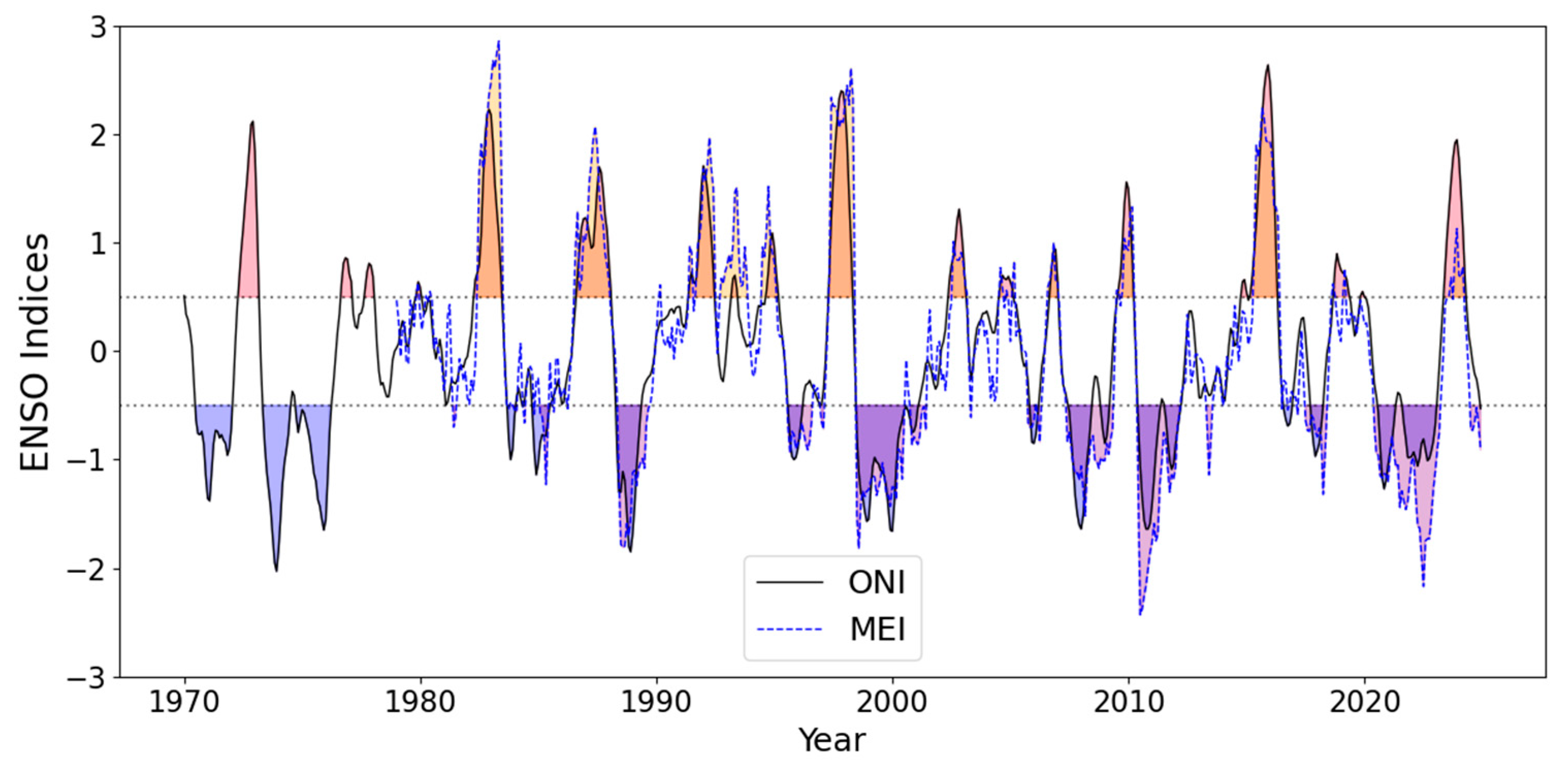
Figure 2.
Long-term mean spatial distribution of cloud and radiation properties from CERES observations for the 2000–2024 period. Variables include a) top-of-atmosphere (TOA) shortwave cloud radiative effect (SW CRE), b) cloud fraction (CF), c) cloud optical depth (), d) liquid water path (LWP), e) cloud droplet number concentration (Nd), and f) cloud phase.
Figure 2.
Long-term mean spatial distribution of cloud and radiation properties from CERES observations for the 2000–2024 period. Variables include a) top-of-atmosphere (TOA) shortwave cloud radiative effect (SW CRE), b) cloud fraction (CF), c) cloud optical depth (), d) liquid water path (LWP), e) cloud droplet number concentration (Nd), and f) cloud phase.
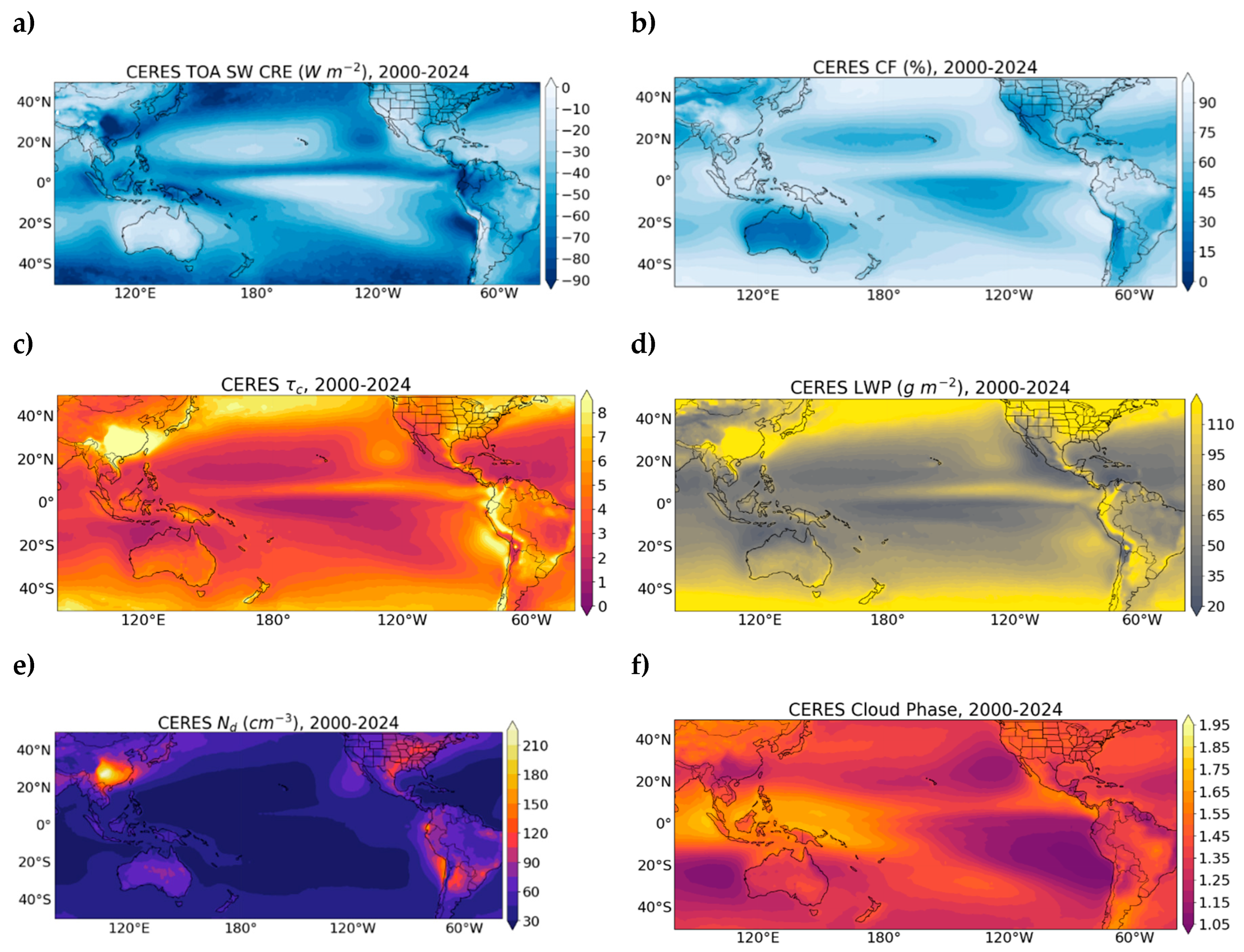
Figure 3.
As in Figure 2, but for meteorological variables from MERRA2 reanalysis: a) inversion strength, b) total water vapor mixing ratio (qt), c) 700-hPa geopotential height (H), d) surface pressure, e) surface horizontal wind speed (WS), and f) 700-hPa vertical velocity in pressure coordinates (ω).
Figure 3.
As in Figure 2, but for meteorological variables from MERRA2 reanalysis: a) inversion strength, b) total water vapor mixing ratio (qt), c) 700-hPa geopotential height (H), d) surface pressure, e) surface horizontal wind speed (WS), and f) 700-hPa vertical velocity in pressure coordinates (ω).
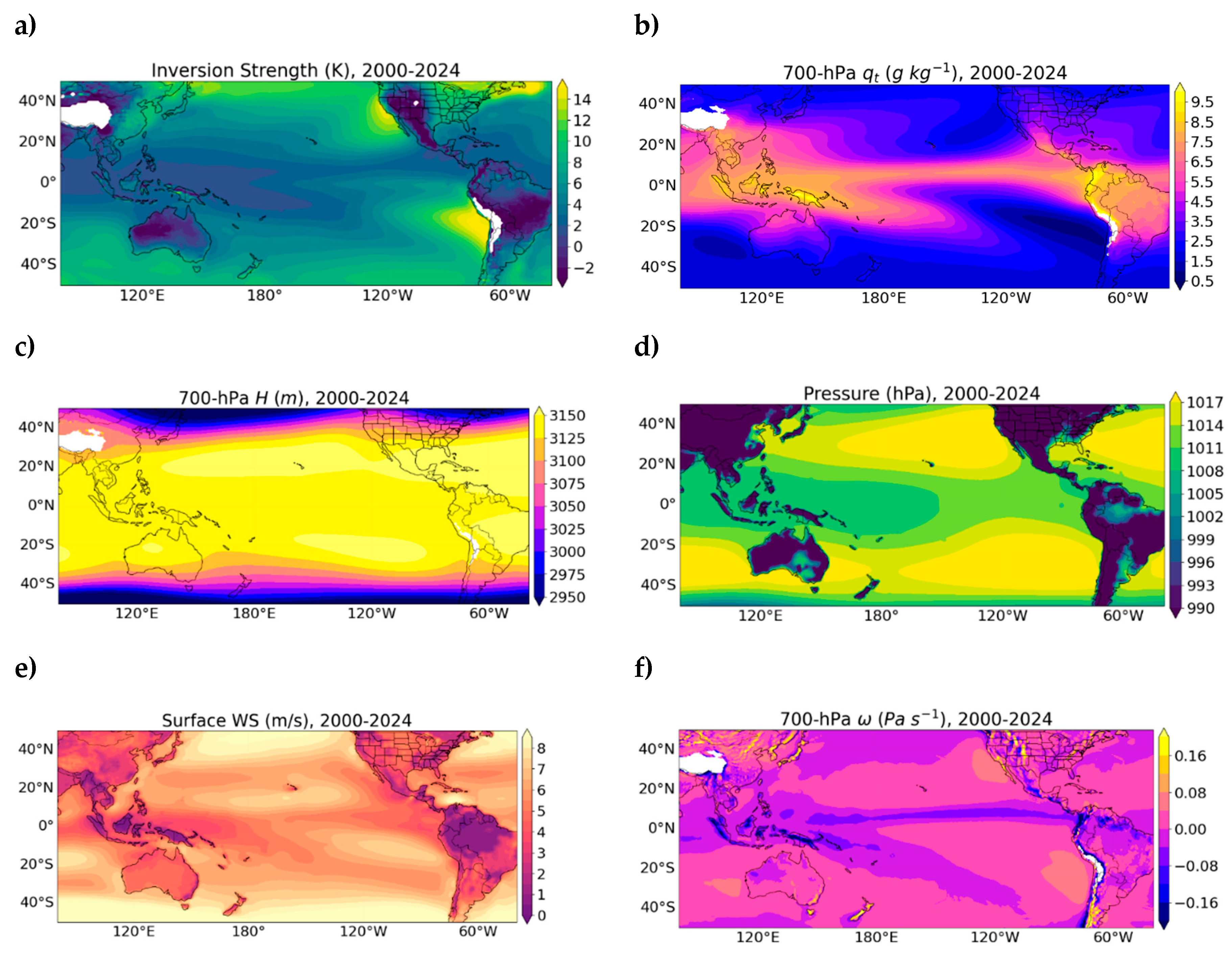
Figure 4.
Figure 4. Left panels: Spatial distribution of “ENSO-induced differences” in cloud and radiative properties based on CERES data for the 2000–2024 period, calculated as the El Niño composite minus the La Niña composite. Variables include a) TOA SW CRE, e) CF, i) , and m) Nd. b, f, j, n) probability distribution functions (PDFs) during the periods of El Niño and La Niña for all grid points in the Tropical Western and Central Pacific region. c, g, k, o) PDFs for the Northeast Pacific region. d, h, l, p) PDFs for the Southeast Pacific region.
Figure 4.
Figure 4. Left panels: Spatial distribution of “ENSO-induced differences” in cloud and radiative properties based on CERES data for the 2000–2024 period, calculated as the El Niño composite minus the La Niña composite. Variables include a) TOA SW CRE, e) CF, i) , and m) Nd. b, f, j, n) probability distribution functions (PDFs) during the periods of El Niño and La Niña for all grid points in the Tropical Western and Central Pacific region. c, g, k, o) PDFs for the Northeast Pacific region. d, h, l, p) PDFs for the Southeast Pacific region.
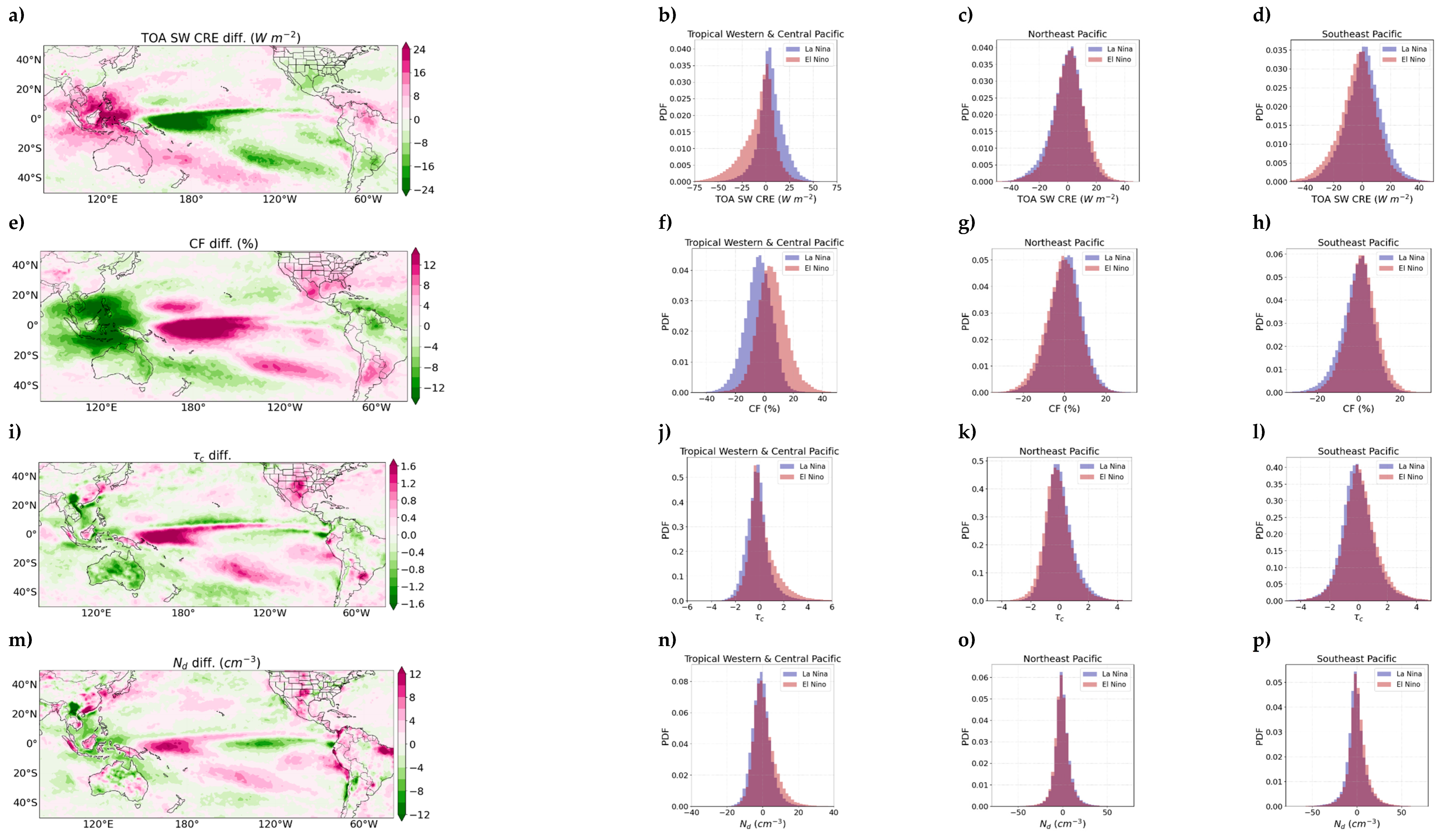
Figure 5.
As in Figure 4, but for meteorological variables from MERRA2 reanalysis: 700-hPa H, inversion strength, and 700-hPa qt.
Figure 5.
As in Figure 4, but for meteorological variables from MERRA2 reanalysis: 700-hPa H, inversion strength, and 700-hPa qt.
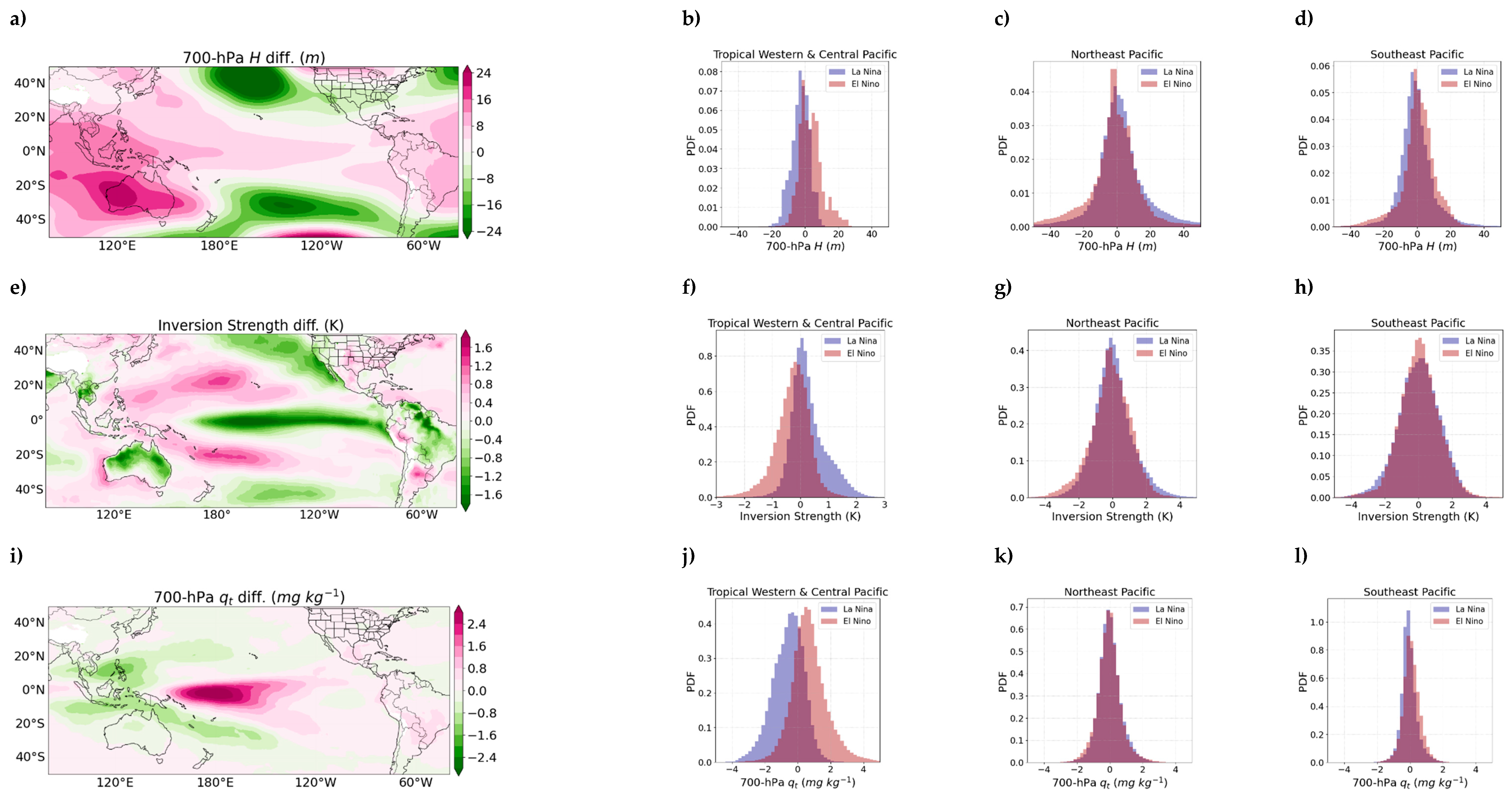

Table 1.
A description of datasets used in this study, consisting of the National Aeronautics and Space Administration (NASA) Modern-Era Retrospective analysis for Research and Applications, Version 2 (MERRA2), NASA level 3 Clouds and the Earth's Radiant Energy System (CERES)—Single Scanner Footprint (SSF), NASA International Satellite Cloud Climatology Project (ISCCP), and National Oceanic and Atmospheric Administration (NOAA) Physical Sciences Laboratory (PSL) ENSO indices. Variables are geopotential height (H), pressure (P), total water vapor mixing ratio (qt), horizontal wind speed (WS), vertical velocity in pressure coordinates (ω) (also called subsidence), inversion strength (IS), cloud fraction (CF), liquid water path (LWP), ice water path (IWP), total water path (TWP), cloud optical depth (), shortwave cloud radiative effect (SW CRE), longwave (LW) CRE, cloud droplet number concentration (Nd), cloud effective radius (re), cloud phase (CP), Oceanic Niño Index (ONI), and Multivariate ENSO Index (MEI).
Table 1.
A description of datasets used in this study, consisting of the National Aeronautics and Space Administration (NASA) Modern-Era Retrospective analysis for Research and Applications, Version 2 (MERRA2), NASA level 3 Clouds and the Earth's Radiant Energy System (CERES)—Single Scanner Footprint (SSF), NASA International Satellite Cloud Climatology Project (ISCCP), and National Oceanic and Atmospheric Administration (NOAA) Physical Sciences Laboratory (PSL) ENSO indices. Variables are geopotential height (H), pressure (P), total water vapor mixing ratio (qt), horizontal wind speed (WS), vertical velocity in pressure coordinates (ω) (also called subsidence), inversion strength (IS), cloud fraction (CF), liquid water path (LWP), ice water path (IWP), total water path (TWP), cloud optical depth (), shortwave cloud radiative effect (SW CRE), longwave (LW) CRE, cloud droplet number concentration (Nd), cloud effective radius (re), cloud phase (CP), Oceanic Niño Index (ONI), and Multivariate ENSO Index (MEI).
| Dataset | Important Variables | Spatial Resolution | Temporal Resolution | Reference |
|
MERRA2 (meteorology) |
H, P, IS, WS, ω, qt |
0.5×0.625° | Monthly | Gelaro et al. (2017) |
| CERES SSF (radiation/cloud) | CF, LWP, , Nd, re, CP, SW CRE, LW CRE, IWP | 1×1° | Monthly | Doelling et al. (2016) |
|
ISCCP (cloud) |
CF, TWP, | 1×1° | Monthly | Rossow & Schiffer (1999) |
| ENSO indices | ONI, MEI | --- | Monthly | Glantz and Ramirez (2020) |
Table 2.
A description of the domains of interest over the Pacific Ocean used in this study.
| Domain name | Latitude range | Longitude range |
| Tropical Western & Central Pacific | 12° S to 8° N | 150° E to 130° W |
| Northeast Pacific | 8° N to 40° N | 160° W to 115° W |
| Southeast Pacific | 35° S to 5° S | 105° W to 70° W |
Disclaimer/Publisher’s Note: The statements, opinions and data contained in all publications are solely those of the individual author(s) and contributor(s) and not of MDPI and/or the editor(s). MDPI and/or the editor(s) disclaim responsibility for any injury to people or property resulting from any ideas, methods, instructions or products referred to in the content. |
© 2026 by the authors. Licensee MDPI, Basel, Switzerland. This article is an open access article distributed under the terms and conditions of the Creative Commons Attribution (CC BY) license (http://creativecommons.org/licenses/by/4.0/).
Copyright: This open access article is published under a Creative Commons CC BY 4.0 license, which permit the free download, distribution, and reuse, provided that the author and preprint are cited in any reuse.


