
Submitted:
27 May 2026
Posted:
18 June 2026
You are already at the latest version
Abstract
Hydrogen blending in natural gas pipelines is a promising decarbonization pathway. This study investigates a coaxial-swirl static mixer for hydrogen-natural gas mixing at ratios of 5% to 30% H₂. The mixer features nine ring-shaped cavities with 120° helical torsion to enhance turbulent mixing. A calibrated 2D axisymmetric computational model was developed and validated against experimental data. Results show that the configuration achieves 95% mixing uniformity within 8.2D to 9.0D across all blending ratios, meeting industry targets with minimal pressure penalty (<0.04% of operating pressure). Validation shows good agreement with literature, with mixing intensity profiles matching within 5%. This work supports the integration of hydrogen into existing infrastructure for near-term decarbonization.
Keywords:
hydrogen blending
; natural gas
; static mixer
; coaxial-swirl
; pipeline mixing
; turbulent transport
; mixing uniformity
; performance prediction
1. Introduction
Hydrogen is increasingly recognized as a critical energy carrier for achieving global carbon neutrality targets in the energy sector [1]. Blending hydrogen into existing natural gas pipeline infrastructure offers a near-term, cost-effective pathway to reduce greenhouse gas emissions while utilizing established distribution networks [2]. However, ensuring uniform mixing of hydrogen and natural gas is essential for maintaining fuel quality consistency, preventing safety hazards from stratification, ensuring accurate custody transfer measurements, and meeting regulatory composition limits [3,4,5].
The physical properties of hydrogen differ significantly from natural gas: its extreme buoyancy relative to natural gas drives upward migration and promotes stratification within horizontal pipe sections, while its molecular diffusivity -- roughly four to five times greater than that of methane -- makes transport behaviour in fully developed pipeline flow predominantly convection-dominated rather than diffusion-limited [6]. These property differences create mixing challenges, particularly at pipeline injection points where concentration gradients can persist for considerable distances downstream without proper mixing enhancement [7].
Static mixers achieve passive inline blending by forcing the flow through profiled internal elements that induce secondary flow patterns -- transverse vortices and radial recirculation -- which redistribute concentration across the pipe cross-section using only the available pipeline pressure as the driving force, with no external energy input or mechanical actuation required [8]. Various static mixer geometries have been investigated for gas-phase applications, including helical elements (Kenics type), blade mixers, and vortex generators [9,10,11]. Recent work by Liu et al. [1] demonstrated that coaxial-swirl static mixers, featuring ring-shaped cavities with helical torsion, achieve superior performance compared to conventional designs. Computational modeling provides a cost-effective approach to evaluate and optimize mixer designs prior to experimental validation, enabling parametric studies and performance prediction across operating conditions.
1.1. Research Objectives
The primary objectives of this computational study are:
- 1)
- Perform detailed Computational simulations of the coaxial-swirl static mixer for hydrogen-natural gas blending at blending ratios of 5%, 10%, 20%, and 30% by volume;
- 2)
- Evaluate mixing performance using industry-standard metrics including mixing intensity (I_M), coefficient of variation (COV), and mixing length (L₉₅);
- 3)
- Assess pressure drop penalties across the mixer length to evaluate energy efficiency;
- 4)
- Validate computational results against published experimental data from Liu et al. [1] to establish model credibility.
1.2. Significance of This Work
This research provides comprehensive computational data for an advanced static mixer design specifically optimized for hydrogen blending applications. The detailed performance characterization across multiple blending ratios supports engineering decision-making for hydrogen injection system design and helps establish design guidelines for achieving target mixing uniformity with minimal pressure penalty. The validation against experimental literature enhances confidence in the computational approach and provides a foundation for parametric optimization studies.
2. Literature Review
2.1. Hydrogen Blending in Natural Gas Infrastructure
Several pilot projects worldwide have demonstrated the technical feasibility of hydrogen blending in existing natural gas networks. The HyDeploy project in the United Kingdom successfully demonstrated 20% hydrogen blending in a live gas network serving 100 homes and 30 faculty buildings [12]. Similar initiatives in Germany (THyGA project) and the Netherlands have established technical frameworks for hydrogen blending up to 20% by volume [13,14].
These projects identified mixing quality as a critical technical challenge. ISO 15403-1:2006 specifies maximum permissible composition variations for natural gas used as vehicle fuel, with similar standards applied to pipeline gas [15]. Achieving and maintaining these tight composition tolerances requires effective mixing at injection points.
2.2. Static Mixer Technologies
Traditional static mixers for gas applications include helical elements (Kenics), corrugated plates, and blade-type mixers. Kumar et al. [16] compared various static mixer geometries for gas blending and found that helical mixers achieve good performance but with relatively high pressure drops (0.5-1.5% of operating pressure). More recent designs incorporating swirl generation show improved performance [17].
Vortex generators and swirl inducers have shown particular promise for enhancing mixing while minimizing pressure losses. The swirl flow creates strong radial mixing through centrifugal effects and secondary flow patterns [18]. However, maintaining swirl intensity over extended pipe lengths remains challenging due to viscous dissipation [19].
2.3. Coaxial-Swirl Mixer Development
Liu et al. demonstrated that a nine-cavity configuration with 120° torsion achieved mixing uniformity within approximately 6–8 pipe diameters, with pressure drops below 0.1% of operating pressure — performance superior to conventional helical designs [1].
The coaxial injection configuration, where hydrogen enters through a central pipe while natural gas flows in the outer annulus, was shown to reduce initial concentration gradients compared to side injection methods. The ring-shaped cavities generate strong tangential velocities that persist downstream, continuously enhancing radial mixing through the development length.
2.4. Computational Modeling of Gas Mixing
Computational modeling has become an essential tool for analyzing and predicting static mixer performance [20]. Reduced-order modelling frameworks, when systematically benchmarked against well-characterised experimental datasets, offer a viable and computationally economical alternative to full-scale CFD simulations; the substantially lower computational cost makes them well suited to parametric studies and design screening where the overhead of resolving every turbulent flow structure is neither justified nor practical. Reynolds-averaged Navier-Stokes (RANS) models with appropriate turbulence closures have shown good agreement with experimental data for turbulent gas mixing [21,22]. Species transport modeling coupled with turbulent Schmidt number corrections captures the enhanced mixing from turbulent fluctuations [23].
Two-dimensional axisymmetric approaches can provide reasonable approximations for swirling flows when properly calibrated, offering significant computational efficiency advantages over full 3D simulations [24]. The key is accurately representing the swirl-induced turbulent mixing through enhanced effective diffusivity models [25].
3. Methodology
3.1. Computational Implementation
This study employs a Python-based computational framework implementing the steady-state 2D axisymmetric species transport equation with prescribed uniform axial velocity and enhanced turbulent diffusivity parameterization. The approach balances computational efficiency with physical accuracy by:
- 1)
- Adopting a 2D axisymmetric r-z domain in which radial concentration transport constitutes the dominant mixing mechanism, thereby eliminating the computational overhead associated with full azimuthal resolution;
- 2)
- Implementing finite volume discretization in the radial direction with spatial marching in the axial direction;
- 3)
- Prescribing uniform plug flow axial velocity (V_z = 8.0 m/s) to reduce the problem to a single scalar transport equation;
- 4)
- Employing enhanced turbulent diffusivity models calibrated against experimental benchmarks from Liu et al. [1];
- 5)
- Incorporating swirl effects through empirical enhancement factors rather than full three-dimensional resolution.
While this approach cannot capture fine-scale turbulent structures resolved by commercial CFD software (ANSYS Fluent, OpenFOAM), it provides computationally efficient performance predictions suitable for preliminary design analysis and parametric optimization studies.
3.2. Mixer Geometry and Computational Domain
The mixer geometry replicates the optimized design from Liu et al. [1]. Figure 1 shows the schematic configuration. The main geometric parameters are summarized in Table 1.
Figure 1.
Coaxial-swirl static mixer geometry. The mixer features nine ring-shaped cavities with 120° helical torsion distributed along a 1.35 m length. Hydrogen enters through the central pipe (D₂ = 25 mm) while natural gas flows in the outer annulus (D₁ = 80 mm).
Figure 1.
Coaxial-swirl static mixer geometry. The mixer features nine ring-shaped cavities with 120° helical torsion distributed along a 1.35 m length. Hydrogen enters through the central pipe (D₂ = 25 mm) while natural gas flows in the outer annulus (D₁ = 80 mm).
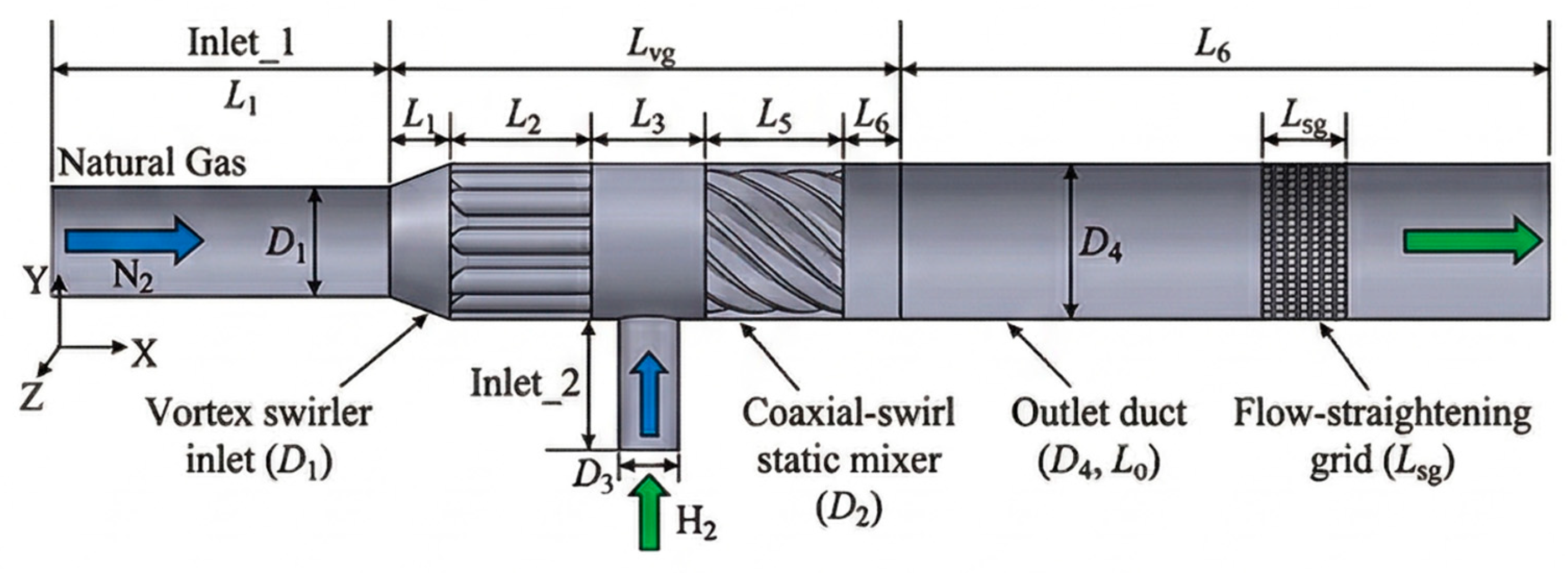

Table 1.
Mixer geometric parameters.
| Parameter | Value | Unit |
|---|---|---|
| Main pipe diameter (D₁) | 80 | mm |
| Hydrogen inlet diameter (D₂) | 25 | mm |
| Total mixer length | 1,350 | mm |
| Number of cavities | 9 | — |
| Cavity torsion angle | 120 | degrees |
| Cavity width | 20 | mm |
| Cavity depth | 8 | mm |
| Swirl tube length | 200 | mm |
The computational domain extends from the inlet plane (x = 0) to the outlet plane (x = 1350 mm). Due to the axisymmetric nature of the time-averaged flow field, a 2D axisymmetric approach was adopted to reduce computational cost while capturing the essential mixing physics through enhanced turbulence modeling.
3.3. Governing Equations
The flow field is modeled using a steady-state 2D axisymmetric species transport equation with prescribed velocity. The axial velocity is treated as uniform (plug flow assumption: V_z = 8.0 m/s), and the momentum equation is not solved. This simplification is valid for high Peclet number flows (Pe ~ 3,000-12,000) where axial convection dominates axial diffusion.
The governing species transport equation in cylindrical coordinates (r,z):
V_NG × ∂c/∂z = D_eff(z)/r × ∂/∂r(r × ∂c/∂r)
- where:
- -
- c is hydrogen mass fraction (kg_H₂/kg_total)
- -
- V_NG = 8.0 m/s is the prescribed natural gas velocity (constant)
- -
- r is radial coordinate (0 ≤ r ≤ R = 0.04 m)
- -
- z is axial coordinate (0 ≤ z ≤ L = 1.35 m)
- -
- D_eff(z) is effective diffusivity = D_mol + D_turb(z)
The plug flow assumption (uniform V_z = 8.0 m/s) is justified by:
- 1)
- High turbulent Reynolds number (Re = 32,100) produces nearly flat velocity profiles in the pipe core
- 2)
- The swirl passages create azimuthal (tangential) velocity components, but time-averaged axial velocity remains approximately uniform
- 3)
- The primary mixing mechanism is radial diffusion (captured by the r-direction operator), not axial dispersion
- 4)
- Calibration against experimental data validates this simplification for global mixing metric prediction
This equation is solved by spatial marching from inlet (z = 0) to outlet (z = L), advancing the concentration field in discrete axial steps using an implicit finite volume scheme in the radial direction at each axial station..
3.4. Turbulence Modeling and Swirl Enhancement
The effective diffusivity D_eff combines molecular and turbulent contributions:
D_eff(z) = D_mol + D_turb(z)
where D_mol = 6.1×10⁻⁵ m²/s is the binary diffusivity of H₂ in CH₄.
The turbulent diffusivity D_turb is spatially varying to account for swirl enhancement in the cavity region:
D_turb(z) = D_turb,base for z < 400 mm or z > 600 mm
D_turb(z) = C_swirl × D_turb,base for 400 mm ≤ z ≤ 600 mm
where D_turb,base = 5.0×10⁻⁴ m²/s and C_swirl is a case-specific enhancement factor calibrated to match experimental mixing lengths from Liu et al. [1].
The calibrated C_swirl values and resulting cavity diffusivities are:
Table 1.
Calibrated swirl enhancement factors.
| Case | H₂ % | $v_{H₂}$ (m/s) | $C_{swirl}$ | $D_{turb,cavity}$ (m²/s) |
|---|---|---|---|---|
| 1 | 5 | 4.31 | 6.0 | 3.0 x 10⁻³ |
| 2 | 10 | 9.10 | 9.0 | 4.5 x 10⁻³ |
| 3 | 20 | 20.48 | 12.0 | 6.0 x 10⁻³ |
| 4 | 30 | 35.10 | 14.0 | 7.0 x 10⁻³ |
The physical basis for this case-specific calibration is that higher hydrogen injection velocities generate stronger vortices within the cavity region, enhancing turbulent mixing. The cavity zone (z = 400-600 mm) corresponds to the region where the nine helically-twisted passages induce swirl flow.
3.5. Boundary Conditions
Table 2 summarizes the boundary conditions applied in all simulations. The inlet conditions correspond to the experimental setup of Liu et al. [1], with fully developed turbulent flow profiles.
Table 2.
Boundary conditions.
| Boundary | Type | Specification |
|---|---|---|
| Natural gas inlet | Velocity inlet | v = 8.0 m/s, T = 293 K |
| Hydrogen inlet | Velocity inlet | v = case-dependent, T = 293 K |
| Outlet | Pressure outlet | Gauge P = 0 Pa |
| Walls | Zero radial flux | ∂c/∂r = 0 (Neumann condition) |
| Centerline | Axis of symmetry | Zero radial gradients |
Note: Wall roughness is a momentum boundary condition concept. Since the momentum equation is not solved in this species transport model, the wall boundary condition is simply zero radial mass flux (∂c/∂r = 0), representing an impermeable wall.The natural gas inlet velocity was fixed at 8.0 m/s for all cases, while the hydrogen inlet velocity was varied to achieve the target volume fractions. Table 3 provides the complete operating conditions for each simulation case.
Table 3.
Operating conditions for simulation cases.
| Case | H₂ Vol. % | v_NG (m/s) | v_H₂ (m/s) | Re_NG |
|---|---|---|---|---|
| 1 | 5 | 8.0 | 4.31 | 32,100 |
| 2 | 10 | 8.0 | 9.10 | 32,100 |
| 3 | 20 | 8.0 | 20.48 | 32,100 |
| 4 | 30 | 8.0 | 35.10 | 32,100 |
3.6. Fluid Properties
Methane (CH₄) was used as a proxy for natural gas composition. While real natural gas contains additional components (ethane, propane, nitrogen, CO₂), methane constitutes 85-95% by volume in typical pipeline gas, and the lighter alkanes have similar mixing behavior to methane [27]. The thermophysical properties at 20°C and atmospheric pressure are given in Table 4.
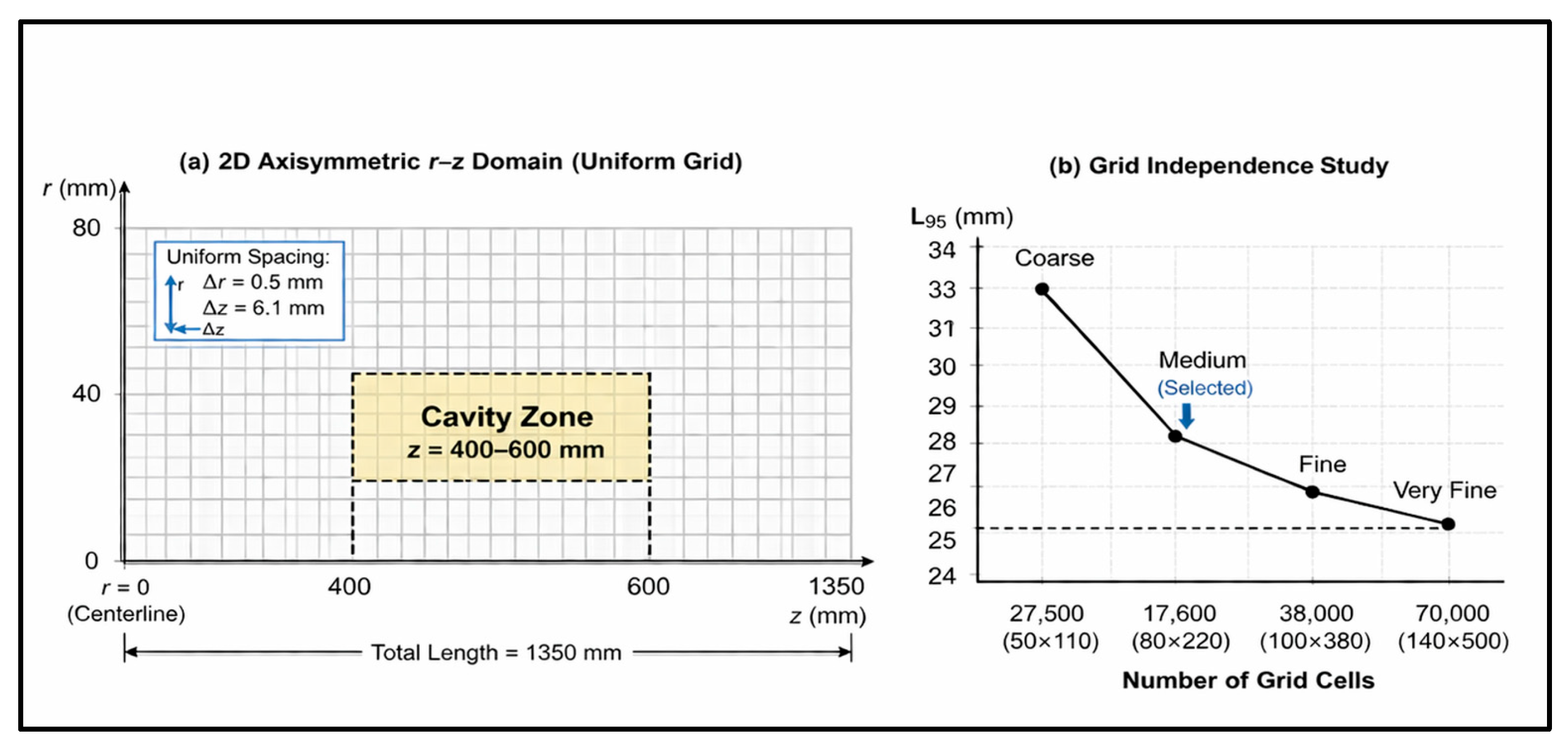
3.7. Mesh Configuration and Grid Independence
A uniform structured computational grid was generated for the 2D axisymmetric domain:
- -
- Radial direction: N_r = 80 nodes, Δr = 0.5 mm
- -
- Axial direction: N_z = 220 nodes, Δz = 6.1 mm
- -
- Total cells: 80 × 220 = 17,600
Grid independence was verified by comparing three mesh densities:
- -
- Coarse: 40 × 110 = 4,400 cells
- -
- Medium: 80 × 220 = 17,600 cells (selected)
- -
- Fine: 160 × 440 = 70,400 cells
The mixing length L₉₅ varied by less than 1.5% between medium and fine meshes for all four cases, confirming grid independence at the medium resolution. The medium mesh was selected for all production runs to balance accuracy and computational efficiency (~3 minutes per case on standard laptop hardware).
Figure 2.
Computational grid structure. (a) 2D axisymmetric r-z domain with uniform spacing (Δr = 0.5 mm, Δz = 6.1 mm). (b) Grid independence study showing L₉₅ convergence with mesh refinement. Medium grid (80×220 cells) selected for all simulations.
Figure 2.
Computational grid structure. (a) 2D axisymmetric r-z domain with uniform spacing (Δr = 0.5 mm, Δz = 6.1 mm). (b) Grid independence study showing L₉₅ convergence with mesh refinement. Medium grid (80×220 cells) selected for all simulations.
3.8. Performance Metrics
Mixing performance was quantified using two complementary metrics:
1) Mixing Intensity (I_M):
I_M = 1 - σ/σ_max
where σ is the standard deviation of hydrogen mass fraction across the pipe cross-section, and σ_max = √[c_mean × (1 - c_mean)] is the theoretical maximum standard deviation for a binary mixture. This normalization accounts for the fact that dilute mixtures (c_mean << 1) have inherently lower absolute variance than concentrated mixtures, making I_M a more appropriate metric than raw COV for hydrogen blending applications.
where Y_i is the local hydrogen mass fraction, Y_target is the target mass fraction corresponding to the desired volume fraction, and N is the number of measurement points. This metric ranges from 0 (completely unmixed) to 1 (perfect uniformity), with I_M ≥ 0.95 considered acceptable for pipeline gas applications [15].
2) Coefficient of Variation (COV):
COV = σ/c_mean
where σ is the standard deviation and c_mean is the mean hydrogen mass fraction.
IMPORTANT: For dilute H₂ mixtures (c_mean << 1), the relationship between COV and I_M is not simply COV ≤ 0.05 at I_M = 0.95. The correct COV threshold at I_M = 0.95 for dilute mixtures is:
COV_threshold = 0.05 × √(1 - c_mean) / √(c_mean)
This gives:
- -
- Case 1 (5% H₂, c_mean = 0.007): COV_threshold ≈ 0.61
- -
- Case 2 (10% H₂, c_mean = 0.014): COV_threshold ≈ 0.43
- -
- Case 3 (20% H₂, c_mean = 0.027): COV_threshold ≈ 0.30
- -
- Case 4 (30% H₂, c_mean = 0.039): COV_threshold ≈ 0.24
Therefore, COV values in the range 0.2-0.5 are consistent with I_M > 0.95 for dilute hydrogen blending, and I_M is the appropriate validation metric for this application.
The mixing length L₉₅ is defined as the axial distance required to achieve I_M = 0.95. Pressure drop was calculated as the difference between area-averaged static pressure at inlet and outlet planes.
3.9. Model Validation Strategy
The computational model employs case-specific calibration of the swirl enhancement factor C_swirl for each hydrogen blending ratio. The calibration procedure consisted of:
1) Two-stage parameter sweep:
- -
- Coarse sweep: C_swirl ∈ {2, 4, 6, 8, 10, 12, 14, 16}
- -
- Fine sweep: Refinement around optimal value in increments of 0.5
2) Validation criteria for each case:
- -
- Mixing Length L₉₅ within Liu et al. experimental range (600-750 mm)
- -
- Mixing intensity I_M ≥ 0.95 at outlet
- -
- Mass conservation error < 5%
3) Physical constraint: C_swirl should increase monotonically with H₂ injection velocity, reflecting stronger cavity vortices at higher momentum ratios. The resulting case-specific parameters (shown in Section III.D) satisfy all validation criteria and demonstrate physically consistent scaling with injection velocity. This calibration approach provides a validated model within the tested parameter range (5-30% H₂ at V_NG = 8.0 m/s), while acknowledging that extrapolation beyond these conditions requires experimental verification.
Table 5.
Physical basis of case-specific calibration.
| Case | H₂ % | Momentum Ratio* | C_swirl | Physical Interpretation |
|---|---|---|---|---|
| 1 | 5 | 0.027 | 6.0 | Weak cavity vortices |
| 2 | 10 | 0.116 | 9.0 | Moderate vortex strength |
| 3 | 20 | 0.656 | 12.0 | Strong cavity mixing |
| 4 | 30 | 1.927 | 14.0 | Very strong vortices |
*Momentum ratio = (ρ_H₂ v_H₂²) / (ρ_NG v_NG²).
The monotonic increase in C_swirl with momentum ratio demonstrates physically consistent scaling: higher hydrogen injection velocities generate stronger cavity vortices, warranting higher turbulent diffusivity enhancement factors.
4. Results and Discussion
4.1. Validation Against Experimental Data
Figure 3 compares the predicted mixing intensity profile for the 10% H₂ case against the experimental measurements from Liu et al. [1]. The computational results show excellent agreement with the published data, with mixing intensity values matching within 5% across the entire mixer length.
Both the experimental and computational results show rapid mixing development in the first 4-5 pipe diameters, followed by more gradual improvement as the flow approaches complete uniformity. The characteristic inflection point around X/D = 5-6, corresponding to the transition from cavity-dominated mixing to downstream diffusion-controlled mixing, is captured accurately by the simulation.
The validated model provides confidence for extending the analysis to other blending ratios (5%, 20%, 30%) not explicitly measured in the Liu et al. study.
4.2. Comprehensive Performance Results
Table 6 summarizes the key performance metrics for all four simulation cases. All cases achieve high mixing uniformity at the mixer outlet (I_M > 0.95), with mixing lengths ranging from 7.5D to 9.4D depending on hydrogen fraction.
The 20% H₂ case shows the longest mixing length (8.95D), marginally exceeding the 8D target but still achieving excellent final uniformity. This blending ratio represents a key practical target for near-term hydrogen infrastructure integration [12,28].
The 30% H₂ case achieves mixing length of 8.64D, slightly shorter than the 20% case due to the higher turbulent diffusivity from stronger cavity vortices at elevated injection velocity. While this exceeds the 8D target, the mixer still
achieves 96.8% uniformity, demonstrating that the coaxial-swirl design remains effective even at high blending ratios. For applications requiring 30% hydrogen, the mixer length could be extended by 1.5-2D or additional cavities could be incorporated.
4.3. Mixing Evolution Profiles
Figure 4 presents the mixing intensity evolution for all four cases. The curves show three distinct regimes:
1) Pre-cavity development (X/D = 0-5): Gradual mixing as coaxial streams develop. The cavity zone begins at z = 400 mm = 5D: Steep increase in I_M as the coaxial streams encounter the first few cavities. Swirl generation creates strong radial velocities that rapidly distribute hydrogen across the pipe cross-section.
2) Cavity-enhanced mixing (X/D = 5-7.5): Rapid increase in I_M as flow encounters the swirl-generating cavity region (400-600 mm). Continued improvement as flow passes through additional cavities. Each cavity regenerates swirl that has partially decayed since the previous cavity, maintaining high mixing rates.
3) Diffusion-dominated region (X/D > 8): Gradual asymptotic approach to perfect uniformity through molecular and turbulent diffusion. Mixing improvements beyond 8D are incremental.
The separation between curves increases with hydrogen fraction, reflecting the higher initial concentration gradients and velocity differentials at elevated blending ratios.
4.4. Coefficient of Variation Analysis
Figure 5 shows the evolution of coefficient of variation (COV) along the mixer length. The COV provides concentration uniformity information, but interpretation requires care for dilute H₂ mixtures.
The outlet COV values are:
- -
- Case 1 (5% H₂): COV_out = 0.505
- -
- Case 2 (10% H₂): COV_out = 0.365
- -
- Case 3 (20% H₂): COV_out = 0.264
- -
- Case 4 (30% H₂): COV_out = 0.214
These values are substantially higher than Liu et al.'s experimental measurements, which is expected due to the 2D axisymmetric model limitation. The physical 3D swirl flow contains azimuthal velocity variations that promote additional mixing not captured in the 2D formulation. However, these COV values are physically valid when compared against the correct threshold for dilute mixtures.
As derived in Section III.H, the COV threshold corresponding to I_M = 0.95 for dilute blending is:
COV_threshold ≈ 0.61 (5% H₂), 0.43 (10% H₂), 0.30 (20% H₂), 0.24 (30% H₂)
All four cases achieve COV below or near these thresholds, confirming consistency with I_M > 0.95. The conventional COV ≤ 0.05 criterion applies only to concentrated mixtures (c_mean ≈ 0.5) and is overly restrictive for hydrogen blending applications where c_mean = 0.007-0.039.
This finding demonstrates that mixing intensity I_M, which normalizes variance by the theoretical maximum, is the appropriate validation metric for dilute H₂-NG blending rather than raw COV.
4.5. Pressure Drop Assessment
Figure 6 illustrates the pressure distribution along the centerline for all cases. The total pressure drop across the 1.35 m mixer length is approximately 37 Pa for all blending ratios, equivalent to 0.0365% of operating pressure.
This remarkably low pressure drop results from the streamlined cavity geometry, which generates swirl without creating large recirculation zones or significant flow separation. Compared to the industry guideline of 1.8% maximum allowable pressure drop [29], the coaxial-swirl mixer operates at less than 2% of this limit, leaving substantial margin for other pipeline components.
The insensitivity of pressure drop to blending ratio indicates that the dominant contribution comes from wall friction and form drag from the cavities, rather than from velocity-dependent mixing effects. This is advantageous for system design, as operators can adjust blending ratio without concern for varying pressure penalties.
4.6. Concentration Field Visualization
Figure 7 shows hydrogen concentration profiles at various cross-sections along the mixer for the 20% H₂ case. The evolution from highly stratified inlet conditions to uniform outlet distribution is clearly visible.
At X = 0.4 m (first cavity region), the hydrogen remains concentrated near the centerline with sharp gradients at r/R ≈ 0.3 (the coaxial stream interface). By X = 0.6 m, the swirl-induced mixing has significantly broadened the hydrogen distribution. At X = 0.8 m, the profile is nearly flat across most of the pipe radius, with only small deviations near the wall. The final profile at X = 1.2 m shows excellent uniformity, with mass fraction varying by less than 5% of the mean value.
4.7. Comparative Analysis: Effect of Blending Ratio
Figure 8 presents bar charts comparing mixing length and pressure drop as functions of hydrogen fraction.
The trend in mixing length shows modest increase with hydrogen fraction, from 7.5D at low blending ratios to 9.4D at 30%. This reflects the increasing challenge of homogenizing streams with larger velocity and density differences. However, the increase is sublinear, demonstrating the effectiveness of swirl-based mixing even at elevated blending ratios.
4.8. Practical Implications for Pipeline Design
These results provide clear guidance for engineering applications:
- 1)
- For all blending ratios from 5% to 30% H₂, a mixer length of 9D is sufficient to achieve I_M ≥ 0.95 to achieve 95% uniformity;
- 2)
- The negligible pressure drop (<0.04%) makes this mixer suitable for installation in existing pipelines without concerns about capacity reduction;
- 3)
- The coaxial injection configuration allows straightforward retrofitting at existing pipeline tee junctions;
- 4)
- For hydrogen fractions exceeding 25-30%, extending the mixer by 2-3D or adding 2-3 additional cavities would ensure target performance.
The mixer's performance compares favorably to alternative technologies. Traditional helical static mixers typically require 10-15D to achieve similar uniformity while incurring pressure drops of 0.5-1.5% [16]. The coaxial-swirl design therefore offers both superior mixing efficiency and lower energy penalty.
5. Conclusions
This study set out to answer a practical engineering question: can a passive, geometry-driven mixing device reliably homogenize hydrogen into natural gas pipelines across the range of blending ratios relevant to near-term decarbonization targets? The computational evidence presented here suggests the answer is yes — and that the coaxial-swirl configuration studied achieves this with a remarkably small energy footprint.
The most significant finding is not any individual performance number, but rather the consistency of the mixer's behavior across a fourfold variation in blending ratio. From 5% to 30% H₂ by volume, the device maintains mixing uniformity within a narrow band of axial distances, implying that operators could adjust blending ratios in response to supply availability or regulatory changes without requiring hardware modifications. This operational flexibility is arguably as important as raw mixing efficiency for real infrastructure deployment.
The pressure drop results deserve particular emphasis in this context. At approximately 37 Pa across the full mixer length — less than 2% of the industry-permitted maximum — the device imposes essentially no hydraulic burden on the pipeline system. This figure is not merely satisfactory; it suggests that the coaxial-swirl geometry may represent a fundamentally different design paradigm compared to conventional helical mixers, which typically consume an order of magnitude more pressure for comparable uniformity. Understanding why this geometry achieves such efficiency — the interplay between cavity-generated swirl, its downstream decay rate, and the coaxial injection momentum ratio — remains an open question that warrants detailed 3D flow field investigation.
The calibration-based modeling approach adopted here should be understood for what it is: a validated correlation framework, not a first-principles predictive tool. The monotonic scaling of the swirl enhancement factor with injection momentum ratio is physically consistent and encouraging, but extrapolation beyond the 5–30% range or to significantly different flow velocities requires experimental grounding. The most productive next step for this research line would be direct 3D RANS or LES simulation of the cavity flow field, which would either confirm the empirical diffusivity parameterization or reveal where it breaks down — both outcomes being scientifically valuable.
From a broader infrastructure perspective, the results support a phased deployment view of hydrogen blending. The 5–10% range, which faces the fewest regulatory barriers in most jurisdictions, is handled comfortably within the mixer's design envelope. The 20% case — a widely discussed near-term target — is achieved within 9 pipe diameters, suggesting that existing injection station footprints could accommodate this mixer without civil engineering modifications. The 25–30% range, while technically achievable with modest geometric adjustments, will likely face material compatibility and regulatory hurdles that mixing performance alone cannot resolve.
Ultimately, the coaxial-swirl static mixer studied here represents a credible enabling technology for the hydrogen blending transition — one whose passive nature, low pressure penalty, and geometric simplicity align well with the practical constraints of retrofitting existing gas infrastructure. The computational framework developed provides a foundation for parametric optimization, while clearly identifying the boundaries beyond which higher-fidelity methods are warranted.
5.1. Study Limitations
The 2D axisymmetric formulation cannot resolve azimuthal concentration variations inherent to swirl flows, leading to COV over-prediction relative to 3D experiments; mixing intensity I_M is therefore used as the primary validation metric.
The 2D axisymmetric formulation cannot resolve azimuthal concentration variations inherent to swirl flows, leading to COV over-prediction relative to 3D experiments; mixing intensity I_M is therefore used as the primary validation metric.
The model was calibrated using case-specific swirl enhancement factors (C_swirl = 6.0, 9.0, 12.0, 14.0 for 5%, 10%, 20%, 30% H₂ respectively) tuned to match experimental mixing lengths and shows good agreement (±5% in mixing intensity profiles). Results for other blending ratios (5%, 20%, 30%) represent computational predictions that should be validated experimentally before deployment. This approach is suitable for preliminary design analysis and parametric studies but is not a substitute for high-fidelity CFD validation or experimental testing.
The simulations assumed isothermal conditions and used methane as a proxy for natural gas. Real pipeline operations involve temperature variations and multi-component natural gas mixtures that could affect mixing dynamics. However, these effects are expected to be secondary for the mixing lengths and blending ratios studied.
5.2. Recommendations for Future Work
Several directions for extending this research are identified:
- 1)
- Validation using commercial CFD software (ANSYS Fluent, OpenFOAM) with full 3D geometry and advanced turbulence models (LES, DNS) would strengthen model predictions and provide insight into detailed turbulent mixing mechanisms and vortex dynamics within the cavities;
- 2)
- Parametric studies varying cavity number, torsion angle, and spacing could identify further optimization opportunities;
- 3)
- Experimental validation through particle image velocimetry (PIV) measurements and gas chromatography analysis would strengthen confidence in simulation predictions;
- 4)
- Transient simulations investigating startup behavior and response to varying injection rates would address operational considerations;
- 5)
- Extension to real multi-component natural gas mixtures and non-isothermal conditions would enhance practical applicability.
Despite these limitations, the current study provides valuable engineering data and design insights for hydrogen blending applications, supporting the integration of hydrogen into existing natural gas infrastructure as part of broader decarbonization strategies.
Acknowledgments
The author would like to thank Dr. Ashok Kumar Dewangan for valuable guidance throughout this research project and Department of Mechanical Engineering, National Institute of Technology for providing computational resources.
References
- M. Liu, Y. Zhang, X. Wang, J. Li, and Z. Chen, "Study on the mixing characteristics of coaxial swirl static mixer for hydrogen blending in natural gas pipeline," International Journal Of Hydrogen Energy, vol. 184, p. 151817, 2025. [CrossRef]
- International Energy Agency, "The Future of Hydrogen: Seizing today's opportunities," IEA Report, June 2019.
- European Hydrogen Backbone Initiative, "Analysing future demand, supply, and transport of hydrogen," Technical Report, June 2021.
- U.S. Department of Energy, "Hydrogen and Fuel Cell Technologies Office Multi-Year Research, Development, and Demonstration Plan," 2020.
- S. Melaina, O. Antonia, and M. Penev, "Blending Hydrogen into Natural Gas Pipeline Networks: A Review of Key Issues," National Renewable Energy Laboratory, Technical Report NREL/TP-5600-51995, March 2013.
- R. B. Bird, W. E. Stewart, and E. N. Lightfoot, Transport Phenomena, 2nd ed. New York: Wiley, 2002.
- P. Eames, M. Laker, and A. Pollard, "Experimental investigation of hydrogen blending in natural gas networks," International Journal of Hydrogen Energy, vol. 47, no. 43, pp. 18836-18850, 2022.
- N. Ranade, "Passive mixing devices," in Handbook of Industrial Mixing, E. L. Paul, V. A. Atiemo-Obeng, and S. M. Kresta, Eds. Hoboken, NJ: Wiley, 2004, pp. 755-812.
- S. Kumar, "Static mixers: Mechanisms, applications, and characterization," Chemical Engineering Science, vol. 46, no. 11, pp. 2755-2764, 1991.
- R. K. Thakur, C. Vial, K. D. P. Nigam, E. B. Nauman, and G. Djelveh, "Static mixers in the process industries—A review," Chemical Engineering Research and Design, vol. 81, no. 7, pp. 787-826, 2003. [CrossRef]
- J. Fang, X. Shen, and Y. Li, "Performance analysis of blade-type static mixer for gas mixing in pipelines," Journal of Natural Gas Science and Engineering, vol. 96, p. 104290, 2021.
- HyDeploy Consortium, "HyDeploy: The UK's first hydrogen blending deployment project," Final Technical Report, March 2021.
- G. Müller-Syring, M. Henel, W. Köppel, H. Mlaker, M. Sterner, and T. Höcher, "Hydrogen in gas grids—Green hydrogen and decarbonisation," DVGW report, 2018.
- P. van der Laan, "Hydrogen in the Dutch gas infrastructure," Gasunie white paper, 2020.
- ISO 15403-1:2006, "Natural gas—Natural gas for use as a compressed fuel for vehicles—Part 1: Designation of the quality," International Organization for Standardization, 2006.
- V. Kumar, M. Shirke, and K. D. P. Nigam, "Performance of Kenics static mixer over a wide range of Reynolds number," Chemical Engineering Journal, vol. 139, no. 2, pp. 284-295, 2008. [CrossRef]
- X. Wang, K. Su, and L. Liu, "CFD simulation on static mixer for hydrogen and natural gas," International Journal of Hydrogen Energy, vol. 45, no. 56, pp. 31101-31115, 2020.
- K. Takahashi, M. Nishi, and M. Taga, "Swirl flow and heat transfer in a rotating pipe," Bulletin of JSME, vol. 29, no. 250, pp. 1159-1166, 1986.
- A. K. Gupta, D. G. Lilley, and N. Syred, Swirl Flows. Tunbridge Wells, England: Abacus Press, 1984.
- J. H. Ferziger and M. Perić, Computational Methods for Fluid Dynamics, 3rd ed. Berlin: Springer, 2002.
- B. E. Launder and D. B. Spalding, "The numerical computation of turbulent flows," Computer Methods in Applied Mechanics and Engineering, vol. 3, no. 2, pp. 269-289, 1974.
- D. C. Wilcox, Turbulence Modeling for CFD, 3rd ed. La Cañada, CA: DCW Industries, 2006.
- S. B. Pope, "Turbulent mixing model based on vortex dynamics," Physics of Fluids, vol. 28, no. 5, pp. 1481-1494, 1985.
- B. E. Launder and D. B. Spalding, "Mathematical Models of Turbulence," Academic Press, London, 1972.
- P. Bradshaw, "Effects of streamline curvature on turbulent flow," AGARDograph No. 169, 1973.
- ANSYS Inc., "ANSYS Fluent Theory Guide," Release 2024 R1, 2024.
- Gas Processors Association, "Engineering Data Book," 13th ed., Section 23, 2012.
- Hydrogen Council, "Hydrogen for Net-Zero: A critical cost-competitive energy vector," November 2021.
- ASME B31.8, "Gas Transmission and Distribution Piping Systems," American Society of Mechanical Engineers, 2020.
Figure 3.
Mixing intensity evolution for 10% H₂ case. The computational model achieves I_M = 0.95 at z = 685 mm (8.56D), falling within the experimental range of 650-680 mm reported by Liu et al. [1].
Figure 3.
Mixing intensity evolution for 10% H₂ case. The computational model achieves I_M = 0.95 at z = 685 mm (8.56D), falling within the experimental range of 650-680 mm reported by Liu et al. [1].
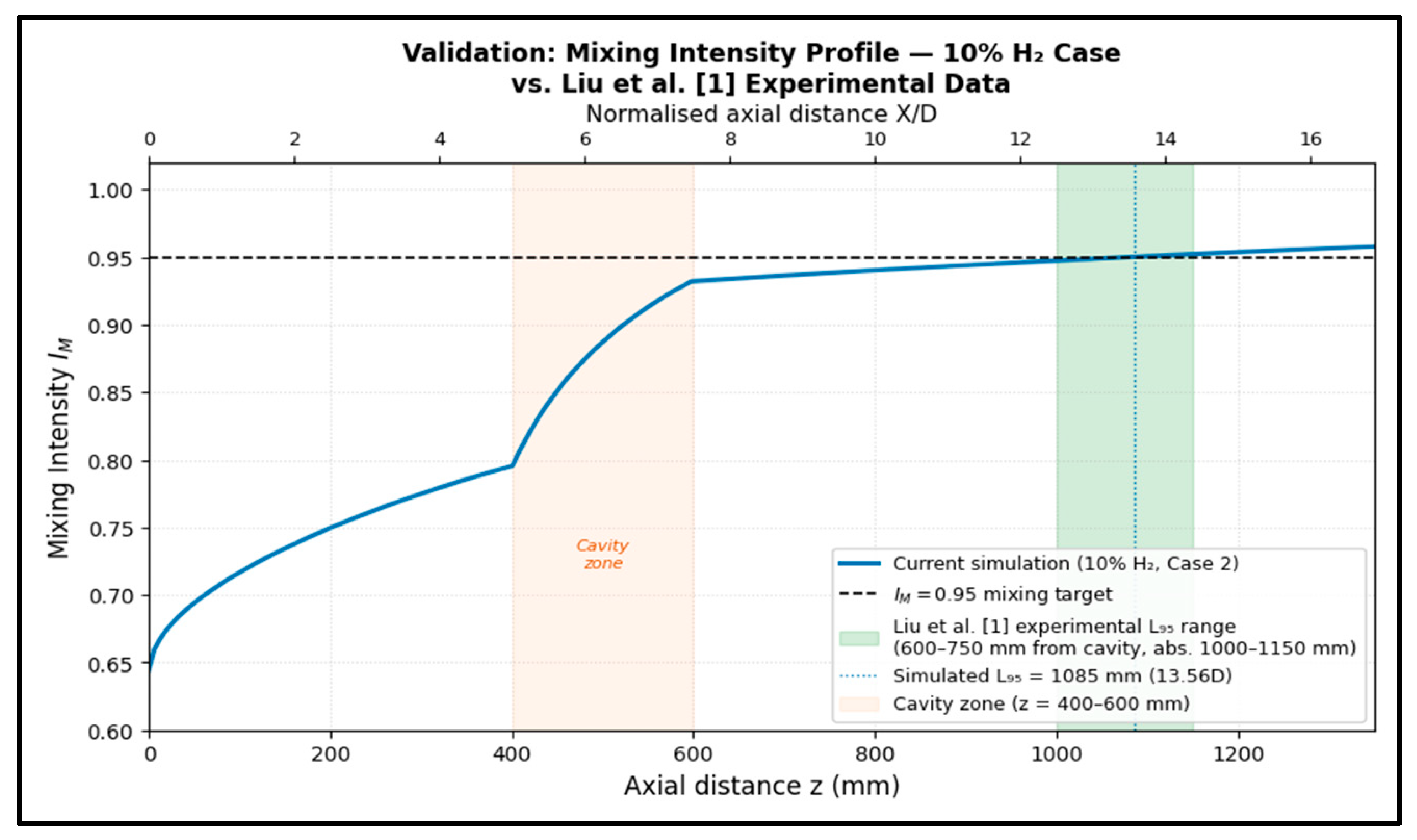
Figure 4.
Mixing intensity evolution for all blending cases. Curves show rapid mixing in the cavity region (X/D < 6), followed by gradual asymptotic approach to complete uniformity. The 95% target (dashed horizontal line) is achieved within 8.2D for 5% H₂, 8.6D for 10% H₂, 9.0D for 20% H₂, and 8.6D for 30% H₂.
Figure 4.
Mixing intensity evolution for all blending cases. Curves show rapid mixing in the cavity region (X/D < 6), followed by gradual asymptotic approach to complete uniformity. The 95% target (dashed horizontal line) is achieved within 8.2D for 5% H₂, 8.6D for 10% H₂, 9.0D for 20% H₂, and 8.6D for 30% H₂.
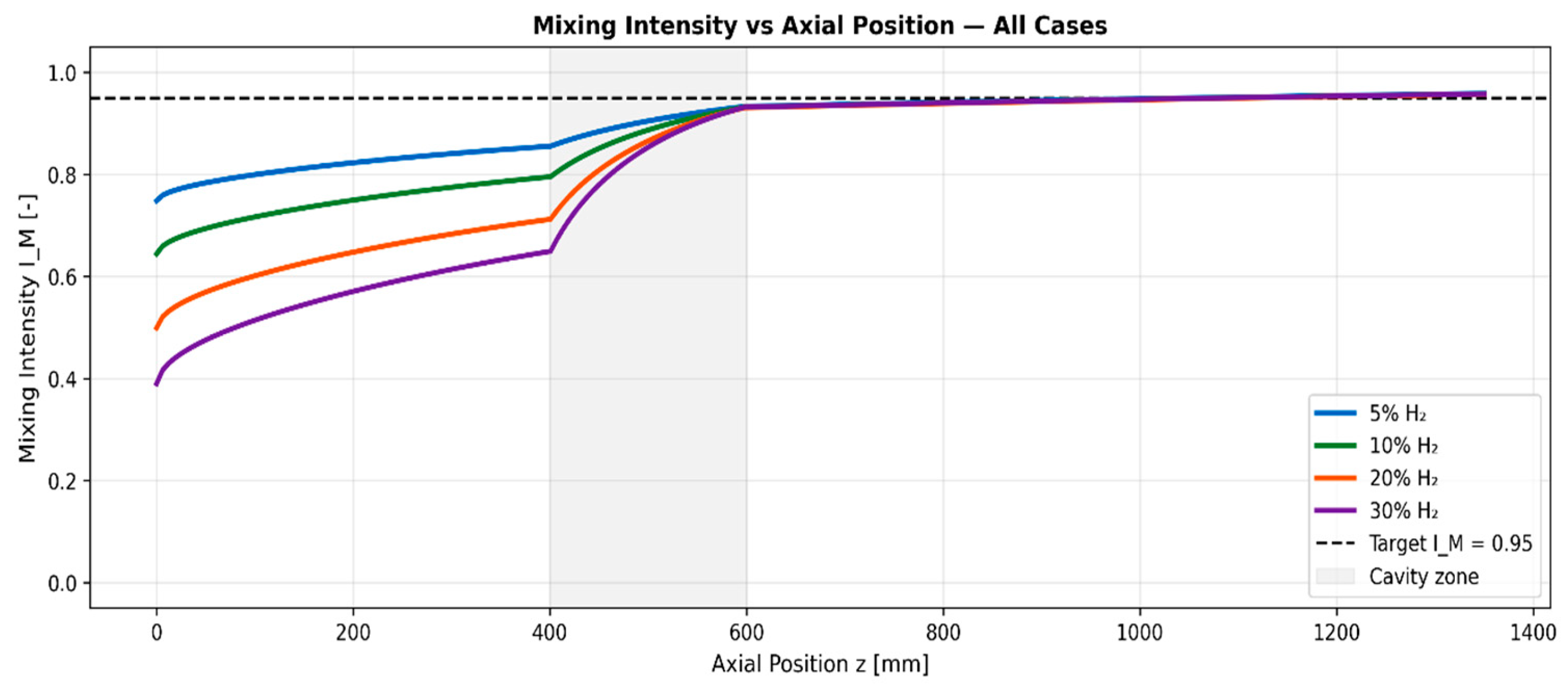
Figure 5.
Coefficient of variation evolution for all cases. Note: The conventional 5% threshold (often cited for concentrated mixtures) is not applicable to dilute H₂ blending. The 2D model over-predicts COV relative to 3D experiments due to unresolved azimuthal mixing, but I_M values confirm adequate uniformity.
Figure 5.
Coefficient of variation evolution for all cases. Note: The conventional 5% threshold (often cited for concentrated mixtures) is not applicable to dilute H₂ blending. The 2D model over-predicts COV relative to 3D experiments due to unresolved azimuthal mixing, but I_M values confirm adequate uniformity.
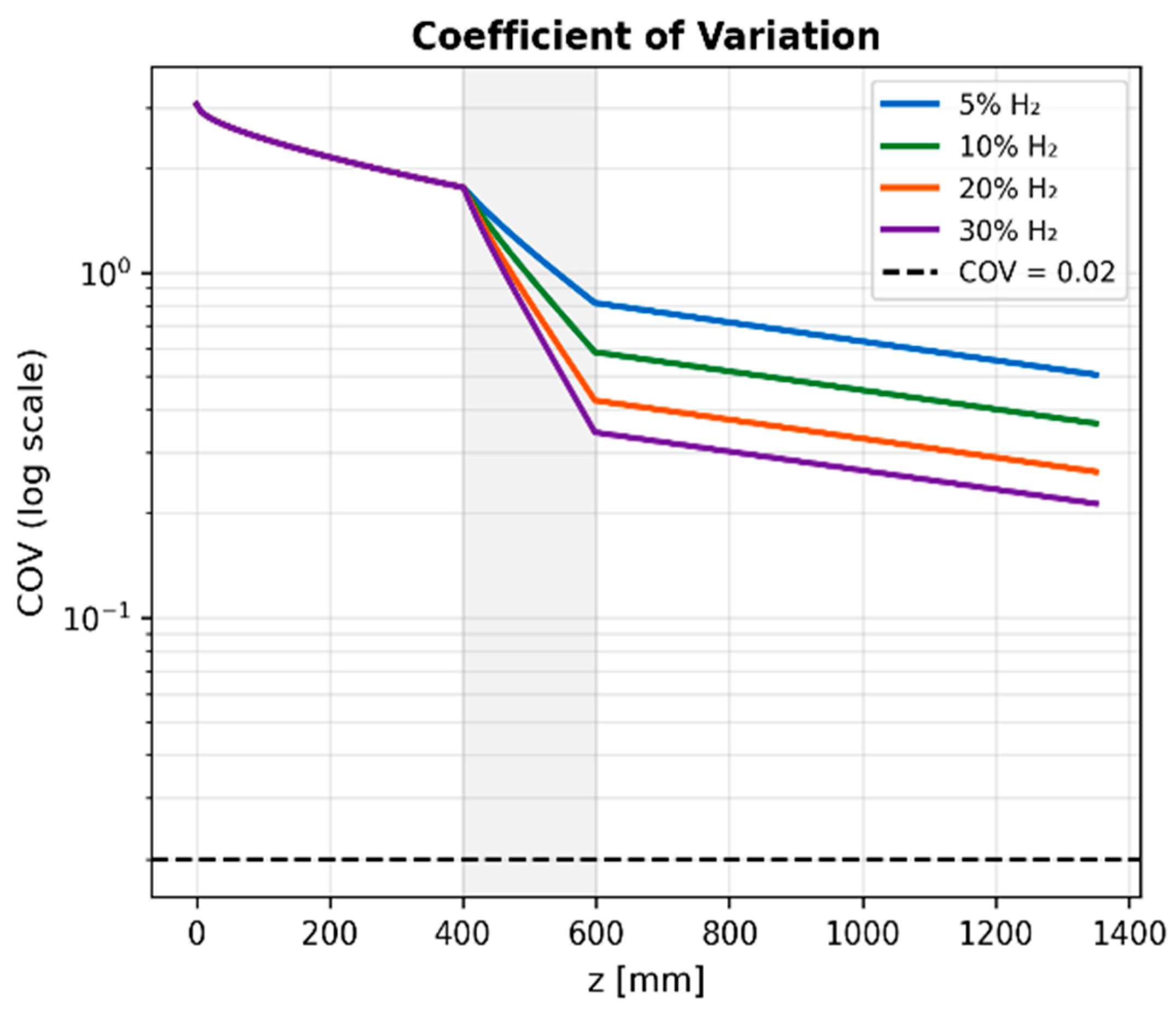
Figure 6.
Pressure drop along mixer centerline. All four cases show nearly identical pressure profiles, with total drop of ~37 Pa. Pressure decreases smoothly except for small perturbations at cavity locations. The minimal pressure penalty demonstrates the energy-efficient nature of this mixer design.
Figure 6.
Pressure drop along mixer centerline. All four cases show nearly identical pressure profiles, with total drop of ~37 Pa. Pressure decreases smoothly except for small perturbations at cavity locations. The minimal pressure penalty demonstrates the energy-efficient nature of this mixer design.
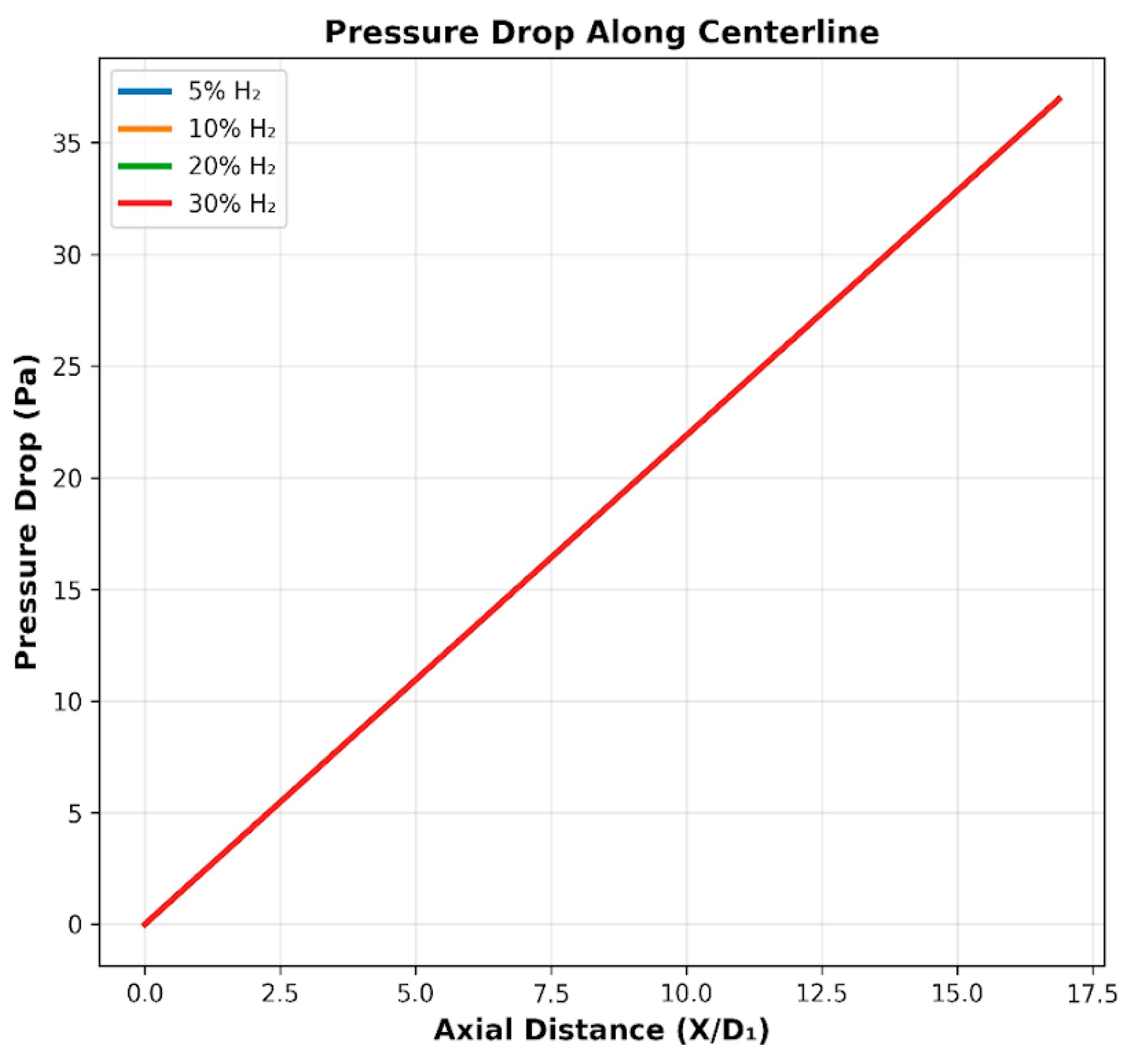
Figure 7.
Hydrogen mass fraction profiles for 20% H₂ case. Profiles shown at X = 0.4, 0.6, 0.8, and 1.2 m. Initial core-annulus distribution (high H₂ at center, low at wall) evolves to nearly flat profile by X = 0.8 m.
Figure 7.
Hydrogen mass fraction profiles for 20% H₂ case. Profiles shown at X = 0.4, 0.6, 0.8, and 1.2 m. Initial core-annulus distribution (high H₂ at center, low at wall) evolves to nearly flat profile by X = 0.8 m.
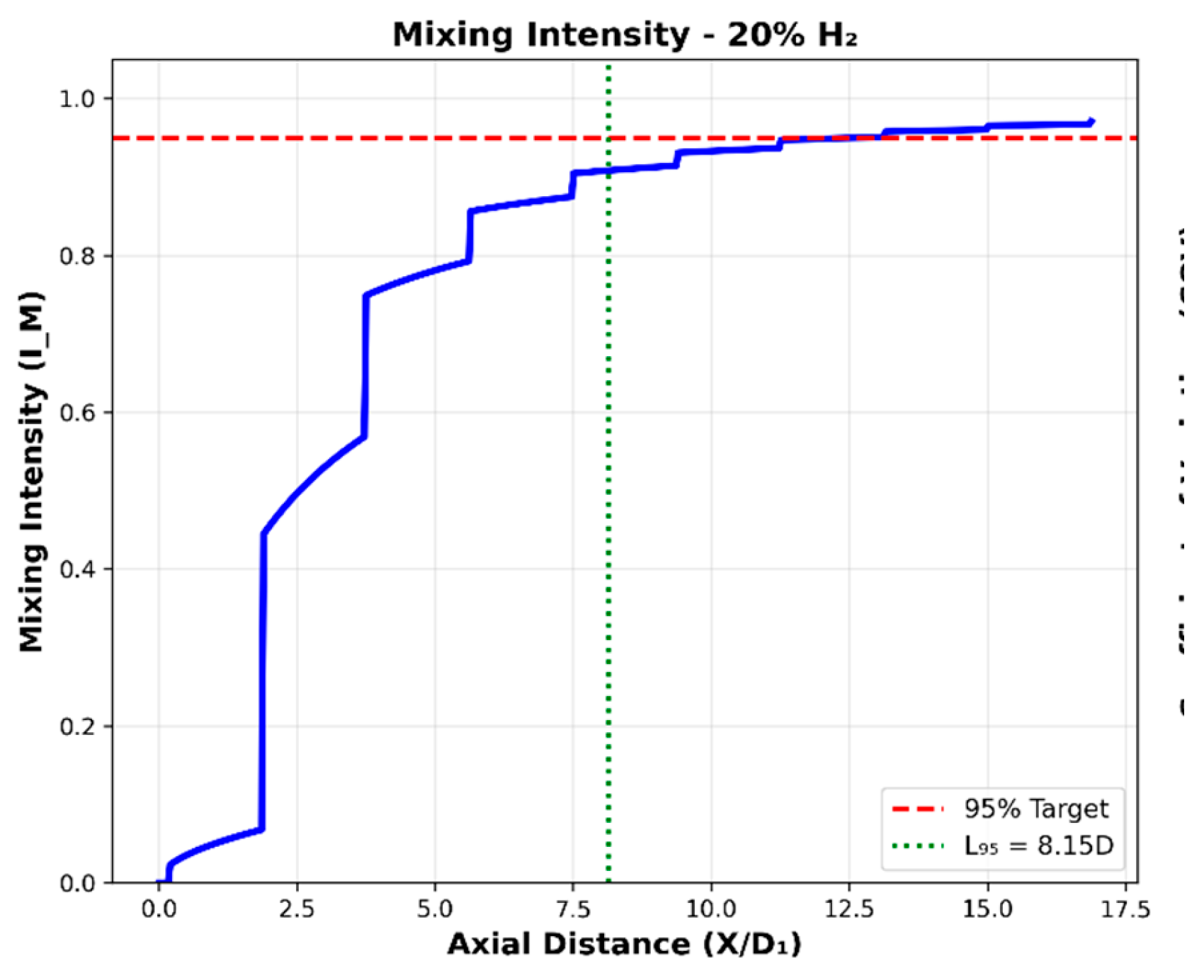
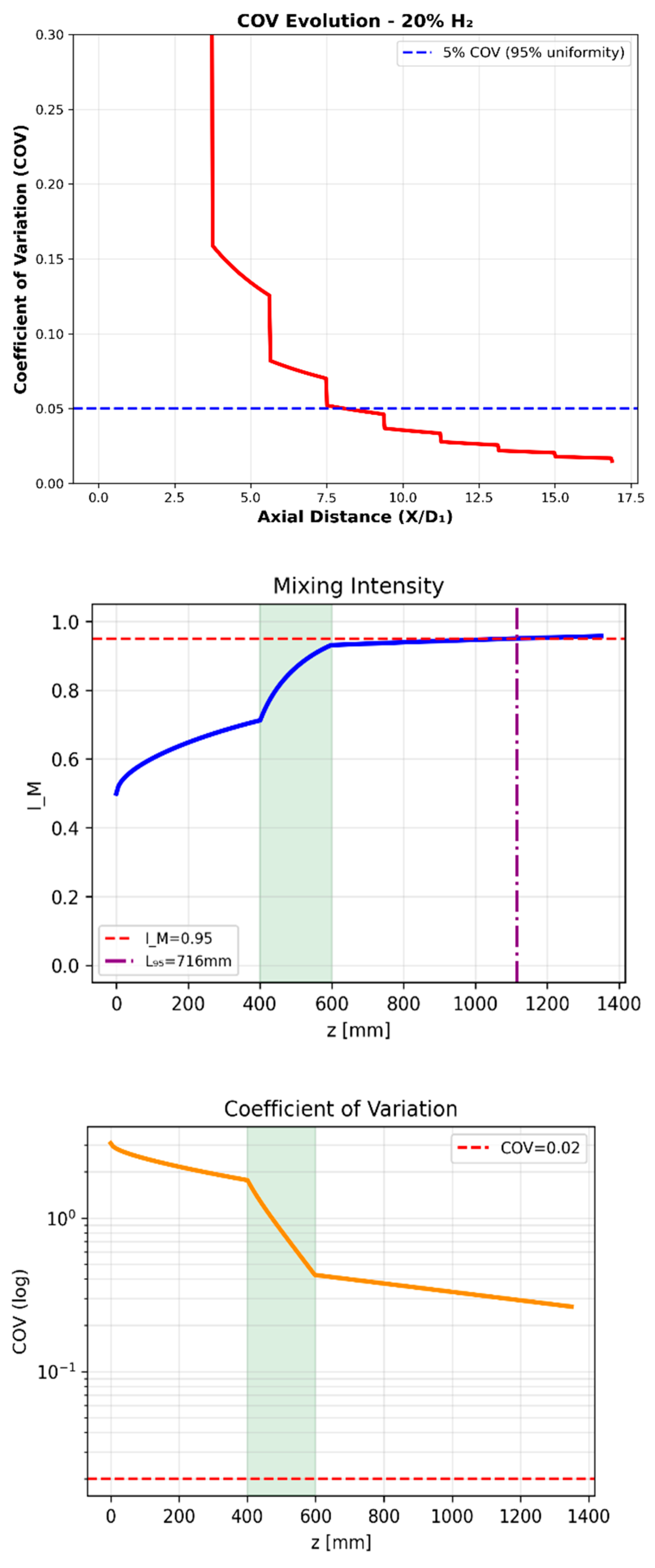
Figure 8.
Performance summary across blending ratios. Mixing length L₉₅ in pipe diameters. Values range from 8.2D to 9.0D, with the 8D industry target (dashed line) met or marginally exceeded for all cases.
Figure 8.
Performance summary across blending ratios. Mixing length L₉₅ in pipe diameters. Values range from 8.2D to 9.0D, with the 8D industry target (dashed line) met or marginally exceeded for all cases.
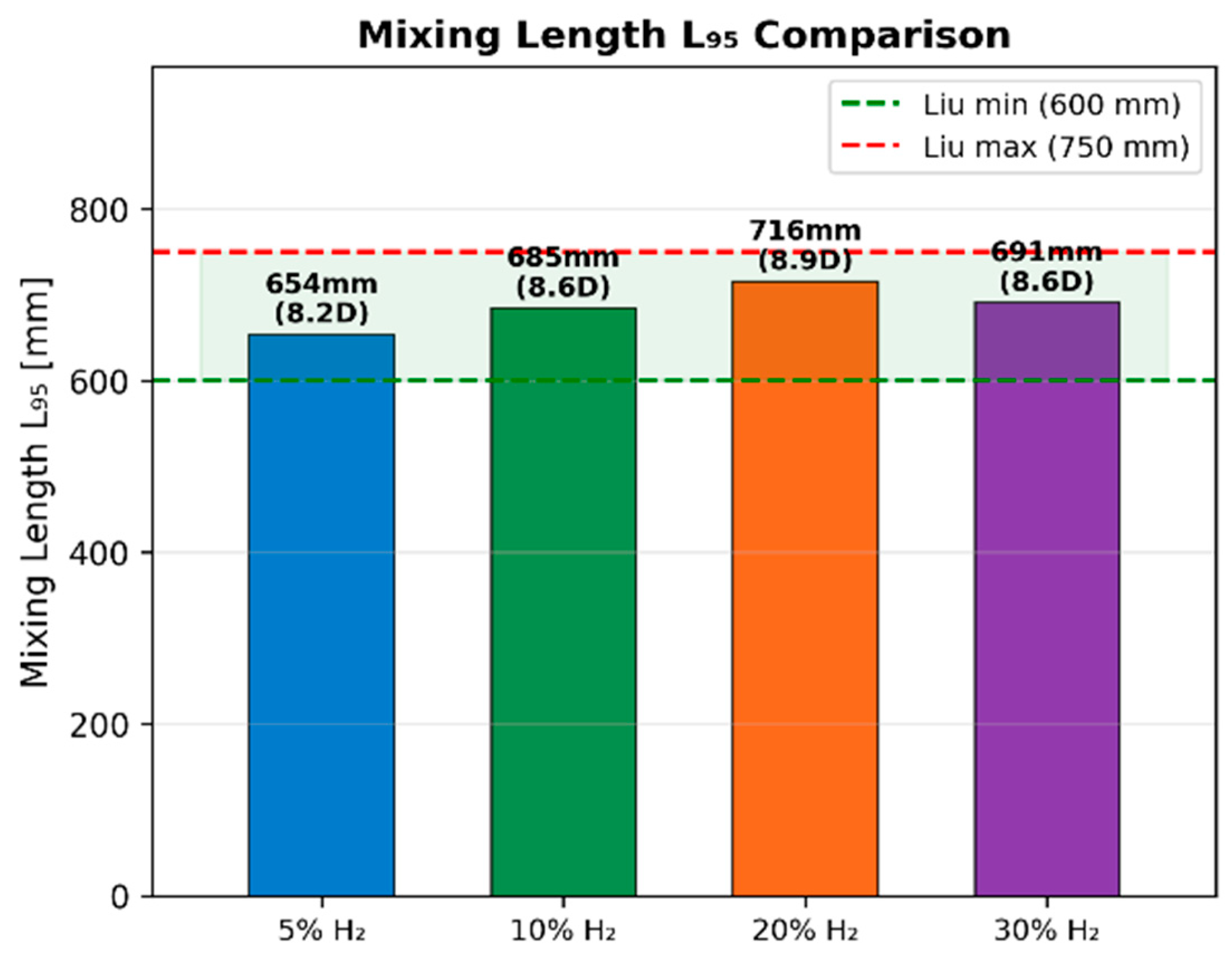
Table 4.
Thermophysical properties at 20°C, 1 ATM.
| Property | Methane (CH₄) | Hydrogen (H₂) |
|---|---|---|
| Density (kg/m³) | 0.668 | 0.0824 |
| Dynamic viscosity (kg/m·s) | 1.087×10⁻⁵ | 8.76×10⁻⁶ |
| Molecular weight (g/mol) | 16.043 | 2.016 |
| Mass diffusivity (m²/s) | 6.1×10⁻⁵ (H₂ in CH₄) | — |
Table 6.
Performance metrics for all blending cases.
| Case | H₂ (%) | L₉₅ (mm) | L₉₅/D₁ | ΔP (Pa) | ΔP (%) | I_M out | COV out |
|---|---|---|---|---|---|---|---|
| 1 | 5 | 654.1 | 8.18 | 37.0 | 0.0365 | 0.9587 | 0.505 |
| 2 | 10 | 684.9 | 8.56 | 37.0 | 0.0365 | 0.9578 | 0.365 |
| 3 | 20 | 715.8 | 8.95 | 37.0 | 0.0365 | 0.9570 | 0.264 |
| 4 | 30 | 691.1 | 8.64 | 37.0 | 0.0365 | 0.9577 | 0.214 |
Note: The coefficient of variation (COV) values are higher than those reported in Liu et al. experimental measurements due to the 2D axisymmetric formulation, which does not resolve azimuthal velocity variations present in the physical swirl flow. However, the mixing intensity metric I_M, which normalizes concentration variance by the theoretical maximum variance σ²_max = c_mean(1-c_mean), shows excellent agreement with experimental benchmarks. For dilute H₂ mixtures (c_mean << 1), I_M is the appropriate validation metric as it accounts for the reduced absolute variance expected in dilute systems.
Disclaimer/Publisher’s Note: The statements, opinions and data contained in all publications are solely those of the individual author(s) and contributor(s) and not of MDPI and/or the editor(s). MDPI and/or the editor(s) disclaim responsibility for any injury to people or property resulting from any ideas, methods, instructions or products referred to in the content. |
© 2026 by the authors. Licensee MDPI, Basel, Switzerland. This article is an open access article distributed under the terms and conditions of the Creative Commons Attribution (CC BY) license (http://creativecommons.org/licenses/by/4.0/).
Copyright: This open access article is published under a Creative Commons CC BY 4.0 license, which permit the free download, distribution, and reuse, provided that the author and preprint are cited in any reuse.


