

Submitted:
27 May 2026
Posted:
28 May 2026
You are already at the latest version
Abstract
Dementia represents one of the fastest-growing global public health challenges, with increasing prevalence placing significant pressure on individuals, families, and healthcare systems. In response, dementia education initiatives have expanded rapidly across digital platforms, community-based programs, caregiver interventions, and public health campaigns. Despite these developments, evidence suggests that improved access to information alone does not consistently lead to sustained behavioural change or meaningful real-world outcomes. This paper critically reviews contemporary literature relating to dementia education, health literacy, behaviour change, and implementation science. The review identifies a persistent gap between knowledge acquisition and behavioural enactment, highlighting the limitations of traditional information-transfer models. Drawing on health literacy theory, the Capability–Opportunity–Motivation Behaviour (COM-B) model, implementation science, and interpretative engagement theory, the paper argues, dementia education should be viewed as a dynamic, context-sensitive process that is influenced by emotional factors, engagement, interpretation, and environmental conditions (LoBue & Ogren, 2022). Particular attention is given to interpretative engagement as a mechanism through which individuals construct personal meaning from dementia-related information. The review further identifies significant methodological limitations within current research, including overreliance on short-term knowledge outcomes, limited real-world evaluation, and insufficient consideration of contextual influences. In response, the paper proposes an integrated conceptual framework that shifts evaluation from simple resource availability toward effectiveness, usability, behavioural readiness, and sustained impact. The proposed study is methodologically based on a sequential four-phase mixed-methods design informed by critical realism and a pragmatic orientation to explore how dementia education functions across different real-world contexts (Glover et al., 2020). The framework contributes to emerging interdisciplinary approaches to dementia education by integrating behavioural science, health literacy, implementation theory, and contextual interpretation into a unified model capable of informing future research, intervention design, and policy development.
Keywords:
Introduction
Methodology
Expansion and Diversification of Dementia Education
The Knowledge-Behaviour Gap
Health Literacy and Interpretative Engagement
Health Literacy Framework
Behaviour Change Theory: The COM-B Model
Implementation Science
Emotional, Social, and Contextual Influences
Digital Innovation and the Real-World Implementation Gap
Evaluation Limitations and Methodological Gaps
Conceptual Shift: From Availability to Impact
Research Gap and Study Contribution
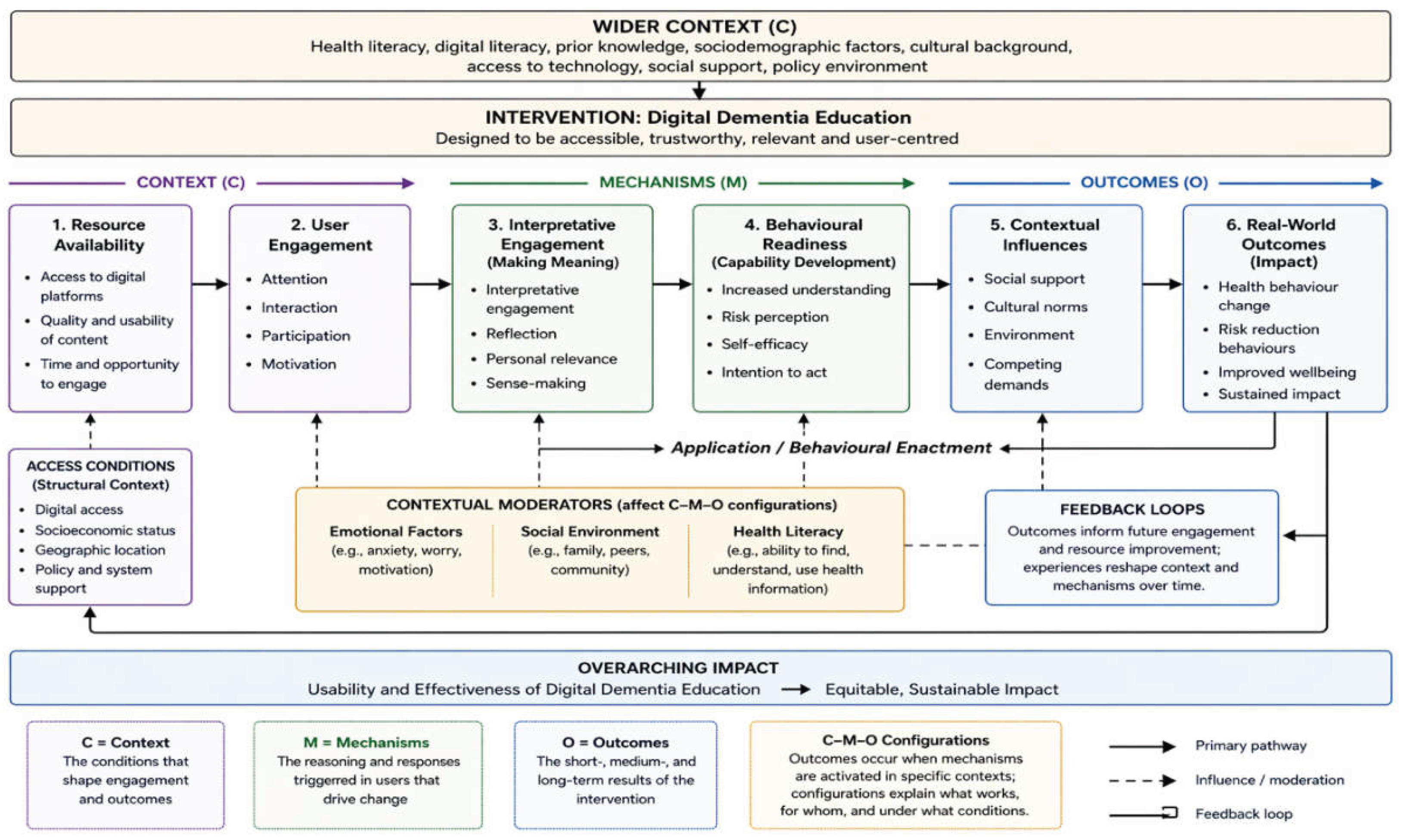
Conceptual Framework
- Resource Availability – Exposure to and access to dementia education resources, including digital tools, community programs, and online materials.
- User Engagement – Active interaction with educational resources shaped by usability, relevance, motivation, and accessibility.
- Interpretative Engagement – The process through which individuals actively construct meaning from information according to prior knowledge, lived experience, and health literacy.
- Behavioural Readiness – Development of self-efficacy, risk awareness, understanding, and behavioural intention.
- Contextual Influences – Social, emotional, cultural, and environmental factors that shape individuals’ capacity to engage with and act upon dementia-related information (Bronfenbrenner, 1979; Skivington et al., 2021).
- Real-World Outcomes – Changes in knowledge, attitudes, behavioural intentions, and sustained behaviours.
Conclusion
References
- Agner, J., Bau, K. E., & Bruland, D. (2024). An Introduction to Health Literacy and Social Contexts with Recommendations for Health Professionals and Researchers. International Journal of Environmental Research and Public Health, 21(2), 240. [CrossRef]
- Archer, M., Decoteau, C., Gorski, P., Little, D., Porpora, D., Rutzou, T., Smith, C., Steinmetz, G., & Vandenberghe, F. (2016). What is critical realism? Perspectives, 38(2), 4–9.
- Australian Institute of Health and Welfare. (2025). Dementia in Australia: Summary. Australian Government. https://www.aihw.gov.au/reports/dementia/dementia-in-aus/contents/summary.
- Bhaskar, R. (1978). A realist theory of science (2nd ed.). Harvester Press.
- Bryan, C. J., Tipton, E., & Yeager, D. S. (2021). Behavioural science is unlikely to change the world without a heterogeneity revolution. Nature Human Behaviour, 5(8), 980–989. [CrossRef]
- Bronfenbrenner, U. (1979). The Ecology of Human Development: Experiments by Nature and Design. Harvard University Press.
- Bushell, D., Jones, C., & Moro, C. (2023). The effectiveness of educational interventions in the community that aim to improve informal carers knowledge of dementia anatomy, physiology, progression, and impact on behavior: a systematic review. Front. Dement. 2:1156863. [CrossRef]
- Craig, P., Dieppe, P., Macintyre, S., Michie, S., Nazareth, I., Petticrew, M., & Medical Research Council Guidance (2008). Developing and evaluating complex interventions: the new Medical Research Council guidance. BMJ (Clinical research ed.), 337, a1655. [CrossRef]
- Coles, E., Anderson, J., Maxwell, M., Harris, F. M., Gray, N. M., Milner, G., & MacGillivray, S. (2020). The influence of contextual factors on healthcare quality improvement initiatives: a realist review. Systematic reviews, 9(1), 94. [CrossRef]
- Creswell, J. W., & Plano Clark, V. L. (2018). Designing and conducting mixed methods research (3rd ed.). SAGE Publications.
- Davis, R., Campbell, R., Hildon, Z., Hobbs, L., & Michie, S. (2015). Theories of behaviour and behaviour change across the social and behavioural sciences: a scoping review. Health Psychology Review, 9(3), 323–344. [CrossRef]
- Dewey, J. (1938). Logic: The theory of inquiry. Henry Holt and Company.
- Dorame, B., Donnellan, K., Babbel, B., Eppes, R., Benson, B., Kuehn, K., Dicken, M., & Hoskins, C. (2025). Culturally responsive approaches to brain health and dementia education for American Indian, Alaska Native, and Native Hawaiian communities. The Gerontologist, 65(SUPPL 2), S53–S59. [CrossRef]
- Eenadu, C., Amaechi, D. C., Okatta, A. U., Amaechi, E. C., Elendu, T. C., Ezeh, C. P., & Elendu, I. D. (2024). The impact of simulation-based training in medical education: A review. Medicine, 103(27), e38813. [CrossRef]
- Fetters, M. D., Curry, L. A., & Creswell, J. W. (2013). Achieving integration in mixed methods designs: Principles and practices. Health Services Research, 48(6 Pt 2), 2134–2156. [CrossRef]
- Gkioka, M., Schneider, J., Kruse, A., Tsolaki, M., & Moraitou, D. (2020). Evaluation and effectiveness of dementia staff training programs in general hospital settings: A narrative synthesis with Holton’s three-level model applied. Journal of Alzheimer’s Disease, 78(3), 1089–1108. [CrossRef]
- Glover, C. M., Shah, R. C., Bennett, D. A., Wilson, R. S., & Barnes, L. L. (2020). The Health Equity Through Aging Research And Discussion (HEARD) Study: A Proposed Two-Phase Sequential Mixed-Methods Research Design To Understand Barriers And Facilitators Of Brain Donation Among Diverse Older Adults. Experimental aging research, 46(4), 311–322. [CrossRef]
- Greenhalgh, T., Wherton, J., Papoutsi, C., Lynch, J., Hughes, G., A’Court, C., Hinder, S., Fahy, N., Procter, R., & Shaw, S. (2017). Beyond adoption: A new framework for theorizing and evaluating nonadoption, abandonment, scale-up, spread, and sustainability of health and care technologies. Journal of Medical Internet Research, 19(11), e367. [CrossRef]
- Hagger, M. S., Cameron, L. D., Hamilton, K., Hankonen, N., & Lintunen, T. (Eds.). (2020). The handbook of behavior change. Cambridge University Press.
- Hamilton, J., Cooper, S., Ngune, I., Cole, A., Bostwick, R., & Massey, D. L. (2026). A case for qualitatively driven mixed methods in nursing research: a methodological discussion. Journal of Research in Nursing: JRN, 17449871261421123. Advance online publication. [CrossRef]
- Kwasnicka, D., Dombrowski, S. U., White, M., & Sniehotta, F. (2016). Theoretical explanations for maintenance of behaviour change: A systematic review of behaviour theories. Health Psychology Review, 10(3), 277–296. [CrossRef]
- Lustria, M. L. A., Cortese, J., Noar, S. M., & Glueckauf, R. L. (2013). Computer-tailored health interventions delivered over the web: Review and analysis of key components. Patient Education and Counselling, 74(2), 156–173. [CrossRef]
- Livingston, G., Huntley, J., Sommerlad, A., Ames, D., Ballard, C., Banerjee, S., Brayne, C., Burns, A., Cohen-Mansfield, J., Cooper, C., Costafreda, S. G., Dias, A., Fox, N., Gitlin, L. N., Howard, R., Kales, H. C., Larson, E. B., Ogunniyi, A., Orgeta, V.,... Mukadam, N. (2020). Dementia prevention, intervention, and care: 2020 report of the Lancet Commission. The Lancet, 396(10248), 413–446. [CrossRef]
- LoBue, V., & Ogren, M. (2022). How the Emotional Environment Shapes the Emotional Life of the Child. Policy Insights from the Behavioural and Brain Sciences, 9(1), 137–144. [CrossRef]
- Lu, X., Balakrishnan, K., Chan, T. J., & Na, M. (2025). The Role of Real-Time Engagement in Shaping Social Media Check-In Behavior: Moderating Effects of Trust and Peer Influence. Brain and Behaviour, 15(9), e70887. [CrossRef]
- Matthews, J. A., Matthews, S., Faries, M. D., & Wolever, R. Q. (2024). Supporting Sustainable Health Behavior Change: The Whole is Greater Than the Sum of Its Parts. Mayo Clinic Proceedings. Innovations, Quality & Outcomes, 8(3), 263–275. [CrossRef]
- Michie, S., van Stralen, M. M., & West, R. (2011). The behaviour change wheel: a new method for characterising and designing behaviour change interventions. Implementation Science: IS, 6, 42. [CrossRef]
- Michie, S., Atkins, L., & West, R. (2014). The Behaviour Change Wheel: A Guide to Designing Interventions. Silverback Publishing.
- Mielke, J., De Geest, S., Zúñiga, F., Brunkert, T., Zullig, L. L., Pfadenhauer, L. M., & Staudacher, S. (2022). Understanding dynamic complexity in context-Enriching contextual analysis in implementation science from a constructivist perspective. Frontiers in Health Services, 2, 953731. [CrossRef]
- Moore, G. F., Audrey, S., Barker, M., Bond, L., Bonell, C., Hardeman, W., Moore, L., O’Cathain, A., Tinati, T., Wight, D., & Baird, J. (2015). Process evaluation of complex interventions: Medical Research Council guidance. BMJ, 350, h1258. [CrossRef]
- Morgan, D. L. (2014). Integrating qualitative and quantitative methods: A pragmatic approach. SAGE Publications.
- Moore, G. F., Audrey, S., Barker, M., Bond, L., Bonell, C., Hardeman, W., Moore, L., O’Cathain, A., Tinati, T., Wight, D., & Baird, J. (2015). Process evaluation of complex interventions: Medical Research Council guidance. BMJ, 350, h1258. [CrossRef]
- Muirhead, K., Macaden, L., Smyth, K., Chandler, C., Clarke, C., Polson, R., & O’Malley, C. (2022). The characteristics of effective technology-enabled dementia education: Murphy, J., Oliver, T., & McCleary, R. (2015). The use of accessible information with people with dementia. Dementia, 14(4), 495–512.
- Murray, E., Hekler, E. B., Andersson, G., Collins, L. M., Doherty, A., Hollis, C., Rivera, D. E., West, R., & Wyatt, J. C. (2016). Evaluating digital health interventions: Key questions and approaches. American Journal of Preventive Medicine, 51(5), 843–851. [CrossRef]
- Nahum-Shani, I., Shaw, S. D., Carpenter, S. M., Murphy, S. A., & Yoon, C. (2022). Engagement in digital interventions. The American Psychologist, 77(7), 836–852. [CrossRef]
- National Academies of Sciences, Engineering, and Medicine, Health and Medicine Division, Board on Health Care Services, Board on Health Sciences Policy, Committee on Care Interventions for Individuals with Dementia and Their Caregivers, Stroud, C., & Larson, E. B. (Eds.). (2021). Meeting the challenge of caring for persons living with dementia and their care partners and caregivers: A way forward. National Academies Press. [CrossRef]
- Nutbeam, D., & Lloyd, J. E. (2021). Understanding and responding to health literacy as a social determinant of health. Annual Review of Public Health, 42, 159–173. [CrossRef]
- Organisation for Economic Co-operation and Development. (2022). Health at a glance 2022: OECD indicators. OECD Publishing. [CrossRef]
- Pawson, R., & Tilley, N. (1997). Realistic evaluation. SAGE Publications.
- Polack, C. W., & Miller, R. R. (2022). Testing improves performance as well as assesses learning: A review of the testing effect with implications for models of learning. Journal of Experimental Psychology. Animal learning and cognition, 48(3), 222–241. [CrossRef]
- Poureslami, I., Nimmon, L., Rootman, I., & Fitzgerald, M. J. (2017). Health literacy and chronic disease management: drawing from expert knowledge to set an agenda. Health promotion international, 32(4), 743–754. [CrossRef]
- Proctor, E., Silmere, H., Raghavan, R., Hovmand, P., Aarons, G., Bunger, A., Griffey, R., & Hensley, M. (2011). Outcomes for implementation research: Conceptual distinctions, measurement challenges, and research agenda. Administration and Policy in Mental Health and Mental Health Services Research, 38(2), 65–76. [CrossRef]
- Glasgow, R. E., Harden, S. M., Gaglio, B., Rabin, B., Smith, M. L., Porter, G. C., Ory, M. G., & Estabrooks, P. A. (2019). RE-AIM planning and evaluation framework: Adapting to new science and practice with a 20-year review. Frontiers in Public Health, 7, 64. [CrossRef]
- Rasmussen, B. M., Andersen, P. T., Waldorff, F. B., & Berg-Beckhoff, G. (2023). Effectiveness of dementia education for professional care staff and factors influencing staff-related outcomes: An overview of systematic reviews. International Journal of Nursing Studies, 142, 104469. [CrossRef]
- Salter, K. L., & Kothari, A. (2014). Using realist evaluation to open the black box of knowledge translation: a state-of-the-art review. Implementation science : IS, 9, 115. [CrossRef]
- Skivington, K., Matthews, L., Simpson, S. A., Craig, P., Baird, J., Blazeby, J. M., Boyd, K. A., Craig, N., French, D. P., McIntosh, E., Petticrew, M., Rycroft-Malone, J., White, M., & Moore, L. (2021). A new framework for developing and evaluating complex interventions: Update of Medical Research Council guidance. BMJ, 374, n2061. [CrossRef]
- Snyder, H. (2019). Literature review as a research methodology: An overview and guidelines. Journal of Business Research, 104, 333–339. [CrossRef]
- Sørensen, K., Van den Broucke, S., Fullam, J., Doyle, G., Pelikan, J., Slonska, Z., Brand, H., & (HLS-EU) Consortium Health Literacy Project European. (2012). Health literacy and public health: A systematic review and integration of definitions and models. BMC Public Health, 12, 80. [CrossRef]
- Surr, C. A., Gates, C., Irving, D., Oyebode, J., Smith, S. J., Parveen, S., Drury, M., Dennison, A., & Bradburn, M. (2017). Effective dementia education and training for the health and social care workforce: A systematic review of the literature. Review of Educational Research, 87(5), 966–1002. [CrossRef]
- Surr, C., Kelley, R., Griffiths, A., Ashley, L., Cowdell, F., Henry, A., Collinson, M., Mason, E., & Farrin, A. (2020). Enabling people with dementia to access and receive cancer treatment and care: The crucial role of supportive networks. Journal of Geriatric Oncology. [CrossRef]
- Testad, I., Kajander, M., Gjestsen, M. T., & Dalen, I. (2020). Health promotion intervention for people with early-stage dementia: A quasi-experimental study. Brain and behavior, 10(12), e01888. [CrossRef]
- Toomey, A. (2023). Why facts don’t change minds: Insights from cognitive science for the improved communication of conservation research, Biological Conservation, 278. [CrossRef]
- Topol, E. (2019). High-performance medicine: The convergence of human and artificial intelligence. Nature Medicine, 25(1), 44–56. [CrossRef]
- Torraco, R. J. (2016). Writing integrative literature reviews: Using the past and present to explore the future. Human Resource Development Review, 15(4), 404–428. [CrossRef]
- Vernooij-Dassen, M., Moniz-Cook, E., Woods, B., De Lepeleire, J., Leuschner, A., Zanetti, O., De Rotrou, J., Kenny, G., Franco, M., Peters, V., & Iliffe, S. (2021). Factors affecting timely recognition and diagnosis of dementia across Europe: From awareness to stigma. International Journal of Geriatric Psychiatry, 36(6), 807–817. [CrossRef]
- Webb, T. L., & Sheeran, P. (2006). Does changing behavioural intentions engender behavior change? A meta-analysis of the experimental evidence. Psychological Bulletin, 132(2), 249–268. [CrossRef]
- West, R., & Michie, S. (2020). A brief introduction to the COM-B model of behaviour and the PRIME theory of motivation. Silverback Publishing.
- Whittemore, R., & Knafl, K. (2005). The integrative review: Updated methodology. Journal of Advanced Nursing, 52(5), 546–553. [CrossRef]
- Wicher, A., Radziwon, M., Borowski, K., Pastuszek, O., Bolesta-Okuniewska, E., Michalak, P., & Ceryn, J. (2026). Why Health Knowledge Does Not Translate into Health Behavior: Educational and Psychological Perspectives. Journal of Education, Health and Sport, 88, 68589. [CrossRef]
- Willmott, T. J., Pang, B., & Rundle-Thiele, S. (2021). Capability, opportunity, and motivation: an across contexts empirical examination of the COM-B model. BMC public health, 21(1), 1014. [CrossRef]
- World Health Organization. [WHO]. (2023). Global status report on the public health response to dementia. World Health Organization. https://www.who.int/publications/i/item/9789240077902.
- Yardley, L., Morrison, L., Bradbury, K., & Muller, I. (2016). The person-based approach to intervention development: Application to digital health-related behavior change interventions. Journal of Medical Internet Research, 17(1), e30. [CrossRef]
Disclaimer/Publisher’s Note: The statements, opinions and data contained in all publications are solely those of the individual author(s) and contributor(s) and not of MDPI and/or the editor(s). MDPI and/or the editor(s) disclaim responsibility for any injury to people or property resulting from any ideas, methods, instructions or products referred to in the content. |
© 2026 by the author. Licensee MDPI, Basel, Switzerland. This article is an open access article distributed under the terms and conditions of the Creative Commons Attribution (CC BY) license.


