

Submitted:
26 May 2026
Posted:
27 May 2026
Read the latest preprint version here
Abstract
This paper introduces a ladder-based traversal framework for representing repeated symbolic structures within symbolic and numerical sequences. Repeated structures are interpreted as ordered traversal paths between hierarchical rung states, for example permitting repetition to be analysed as directed traversal behaviour rather than solely as static substring occurrence.The framework defines traversal states using traversal direction, rung progression between adjacent repetition orders, traversal-gap structure, and climb behaviour. Valid traversal is restricted to transitions between neighbouring rung states only. The model additionally permits chained traversal paths spanning multiple repetition orders, overlapping embeddings in which symbolic occurrences participate in multiple traversals, and recursive overlap between rung states.Unlike conventional repetition frameworks that primarily characterise repeated substrings through periodicity or maximal interval structure, the proposed framework provides a traversal-oriented and geometric interpretation of symbolic repetition in which repeated structures may be analysed as interconnected traversal systems rather than purely linear strings. Potential applications include symbolic sequence fingerprinting, traversal-density analysis, overlap statistics, traversal entropy measures, and Monte-Carlo comparison of traversal behaviour within random and non-random symbolic systems.
Keywords:
symbolic sequences
; repetition analysis
; traversal-based representation
; stringology
; hierarchical repetition
; overlap structures
; symbolic traversal
; repetition structures
1. Introduction
Repeated structures arise throughout symbolic systems, including language, genomic data, compressed sequences, and numerical expansions. Existing approaches to repetition analysis include runs and maximal repetitions [4], grammar-based compression systems such as SEQUITUR and Re-Pair [5,6], factor automata and compact directed acyclic word graphs [1], overlap statistics [3], and hidden subsequence pattern analysis [2]. These frameworks primarily represent repetition through intervals, factors, graphs, or recursive substitutions. In contrast, the present framework represents repeated symbolic structures as traversal systems defined by ordered progression between repetition states.
The present work introduces a preliminary traversal-based formalism for repeated symbolic structures. Repetitions are represented as layered traversal states (“rungs”), where each rung corresponds to a progressively larger contiguous repetition block within a symbolic sequence. These rungs are connected through incremental traversal transitions and prohibited skipped-rung transitions, permitting repeated structures to be interpreted as directed symbolic traversals rather than solely as static substrings or grammatical substitutions. The framework further proposes descriptive quantities including ladder density, overlap density, traversal asymmetry, and traversal entropy.
Existing repetition frameworks typically characterise repeated symbolic structure through maximal periodic intervals [4], recursive grammatical substitutions [5,6], factor-transition graphs [1], or overlap statistics [3]. In contrast, the present framework represents repeated symbolic structures as traversal systems defined by ordered progression between adjacent rung states. Rather than compressing, factorising, or replacing repeated substrings, the ladder framework preserves the original symbolic sequence while introducing a traversal-oriented representation of hierarchical repetition organisation.
The work is exploratory and primarily conceptual. Its aim is not to replace established methods in stringology, compression, or symbolic sequence analysis, but to provide a unified traversal-oriented representation that may operate alongside existing repetition structures. Future work will determine whether the proposed traversal measures provide useful structural information beyond conventional repetition and overlap statistics.
2. Ladder Interpretation
The ladder framework models repeated symbolic structures as ordered traversal systems embedded within a finite symbolic sequence. Table 1 summarises the notation used throughout the ladder traversal framework.
Let
(1)
denote a sequence over an alphabet .
For a chosen target symbol , a ladder rung (or rung state) of order is defined as a contiguous repetition block
(2)
consisting of consecutive occurrences of . The integer denotes the rung order of rung state
Traversal within the framework occurs horizontally through the sequence and vertically between repetition orders. A traversal path is therefore interpreted as an ordered progression between ladder rungs of varying repetition size.
Ascending traversal corresponds to incremental expansion through successive repetition states:
while descending traversal corresponds to incremental contraction:
A valid ladder traversal is constrained to adjacent repetition orders only. Consequently, direct transitions between non-adjacent rung states are excluded. Valid ascent paths therefore satisfy
(3)
while valid descending paths satisfy
(4)
for consecutive repetition orders .
Traversal paths may consist of pairwise transitions such as
or chained traversals such as
where each successive rung satisfies the incremental traversal constraint.
Within a sequence, traversal between rungs occurs across intermediary subsequences termed traversal gaps. If rung terminates at position and rung begins at position , then the associated traversal-gap distance is defined as
(5)
A traversal path containing multiple rung transitions therefore possesses an ordered gap vector
(6)
describing the spacing between consecutive rung states.
The framework additionally permits overlapping traversal windows. Individual symbolic occurrences may therefore participate simultaneously in multiple traversal paths. For example, within the binary sequence
10110111
The symbol 1 participates in multiple ascending traversals, including traversal embeddings such as
[1]0[11]
10[1]10[11]
101[1]01[11]
and chained traversal
[1]0[11]0[111]
Consequently, ladder traversal is not interpreted as a unique decomposition of a sequence, but rather as the complete set of valid incremental traversal paths satisfying the rung-transition constraints.
Traversal direction additionally introduces directional asymmetry. Reading a sequence left-to-right and right-to-left may generate distinct ascent and descent structures because traversal relationships depend upon ordered positional arrangement within the sequence. The framework therefore treats traversal direction as an intrinsic component of rung-state definition rather than a purely representational convention. Figure 1 provides a visual representation of ladder traversal behaviour within the binary sequence 10110111
3. Core Concepts
Traversal states within the ladder framework are represented by the tuple
where:
- denotes the repeated target symbol,
- denotes traversal direction,
- denotes the ordered traversal-gap vector between consecutive ladder rungs,
- denotes climb behaviour, where represents ascending traversal and represents descending traversal,
- denotes the ordered traversal path through rung states
Ascending traversal satisfies
while descending traversal satisfies
The ladder length is defined as
(10)
where denotes the number of rung states within the traversal path.
Consecutive rung states must satisfy the adjacency constraint
for all consecutive rung states within the traversal sequence . Consequently, traversal paths may consist of pairwise transitions such as
Provided that each successive rung transition satisfies the incremental traversal constraint. The framework additionally permits overlapping embeddings in which lower-order rungs may participate in multiple traversal paths. Traversal states therefore need not form unique sequence decompositions.
4. Traversal Notation
The traversal-state notation may be illustrated through simple and chained traversal examples extracted from binary symbolic sequences. The following examples demonstrate how traversal direction, rung progression, traversal gaps, and climb state are represented within the ladder framework.
4.1. Simple Traversal Example
Consider the binary sequence
with repeated symbol
Reading the sequence from left to right gives traversal direction
Within the sequence, the traversal
progresses from repetition rung state to rung state , corresponding to the repeated structures
The intermediary traversal gap consists of a single symbol , yielding traversal-gap vector
Since traversal proceeds through increasing repetition order, the climb state is ascending:
The associated rung-order sequence is therefore
Corresponding to the traversal path
Hence the traversal state is represented by
4.2. Chained Traversal Example
For a more complex example, consider the binary sequence
With repeated target symbol
One valid chained traversal within the sequence is
Corresponding to the rung progression
or equivalently the rung-order sequence
In this traversal, the intermediary traversal gaps consist of one symbol between and , and the one symbol between and , yielding traversal-gap vector
Since traversal proceeds through increasing repetition order, the climb state is ascending:
Reading the sequence from left to right therefore yields the traversal-state tuple
(13)
5. Rung-Jump and Skipped-Repetition Rule
The ladder framework restricts valid traversal to incremental transitions between adjacent rung orders only. Valid ascending traversal therefore satisfies
(14)
while valid descending traversal satisfies
(15)
Consequently, direct traversal between non-adjacent rung orders is excluded. For example,
Does not constitute a valid single-step traversal because the intermediary rung state
is absent from the traversal chain. A valid ascent traversal must instead proceed incrementally:
while valid descending traversal satisfies
This constraint defines the skipped-repetition rule and prevents arbitrary rung-jump transitions between non-adjacent rung states.
Although non-adjacent repetition jumps are excluded, the framework permits overlapping and context-preserving traversal embeddings. An rung state may therefore occupy multiple embedding positions within a larger repetition structure while preserving the same climb progression. For example, within the repeated structure
the rung state
may appear as:
and similarly for the lower-order rung
may appear as
These embedded traversal positions do not represent skipped-repetition transitions, but rather alternative contextual embeddings of the same valid rung order within a larger repeated structure.
More generally, repeated symbolic structures may contain recursively overlapping lower-order ladder states. For example,
indicates that the repetition structure contains overlapping embedded occurrences of , which themselves contain embedded occurrences of . Consequently, higher-order rung states may recursively embed multiple lower-order traversal configurations, generating nested and overlapping traversal paths within the same symbolic sequence.
The ladder framework therefore distinguishes between:
- valid incremental traversal between adjacent rung orders, and
- invalid skipped-repetition transitions between non-adjacent rung orders.
This distinction ensures that ladder traversal represents continuous hierarchical progression through repetition space rather than arbitrary transitions between repeated symbolic structures.
6. Potential Applications
The ladder traversal framework provides a traversal-oriented method for analysing repeated symbolic structures within symbolic and numerical sequences. Rather than representing repetition solely through substring occurrence or frequency, the framework interprets repeated structures as collections of measurable traversal paths characterised by traversal direction, rung progression, traversal gaps, climb behaviour, and overlapping embeddings.
One potential application of the framework is symbolic sequence fingerprinting. Under this interpretation, symbolic sequences such as binary streams, genomic strings, compressed symbolic data, or numerical expansions may be analysed through their traversal distributions. Traversal organisation may therefore function as a structural descriptor of repeated symbolic behaviour within a sequence.
The framework permits measurement of traversal-related quantities including ladder density, traversal length, traversal-gap structure, climb-state transitions, overlap density, chained traversal behaviour, and directional asymmetry between left-to-right and right-to-left traversal organisation.
Unlike conventional substring-frequency analysis, the framework represents repeated symbolic structures as interconnected traversal systems containing measurable hierarchical and positional relationships between rung states. This interpretation naturally suggests statistical extensions in which symbolic sequences are transformed into traversal distributions rather than analysed solely through local repetition counts.
A natural extension of the framework is Monte-Carlo simulation over randomly generated symbolic sequences. Traversal profiles extracted from observed symbolic systems may then be compared against random baselines in order to investigate whether traversal organisation exhibits statistically detectable structural regularities.
Potential exploratory applications additionally include traversal analysis of irrational-number expansions such as , where traversal distributions and overlap structure may function as comparative structural fingerprints between symbolic and numerical systems.
More broadly, the framework suggests that repeated symbolic systems may admit alternative traversal-based and geometric interpretations capable of revealing hierarchical organisation, recursive overlap behaviour, and directional asymmetries not directly captured through conventional linear sequence analysis.
7. Discussion
The ladder traversal framework provides a traversal-oriented interpretation of repeated symbolic structures. Rather than analysing repetition solely through substring occurrence or local frequency, the framework represents repeated structures as interconnected traversal paths characterised by rung progression, traversal direction, traversal gaps, climb behaviour, and overlapping embeddings.
A central feature of the framework is the restriction of valid traversal to adjacent rung orders. This adjacency constraint distinguishes valid ladder progression from arbitrary rung-jump transitions and introduces a hierarchical interpretation of repetition structure within symbolic sequences.
The framework additionally permits recursive overlap and nested traversal embeddings, allowing lower-order rung states to participate simultaneously in multiple traversal paths. Consequently, symbolic sequences may exhibit layered traversal organisation extending beyond ordinary linear repetition analysis.
The proposed framework also suggests measurable traversal properties including traversal-gap distributions, overlap density, chained traversal frequencies, climb-state asymmetry, and traversal entropy. Such quantities may provide structural information not directly captured through conventional substring-frequency methods.
At present, the framework should be regarded as a preliminary symbolic and computational model rather than a complete mathematical theory. Future work may include traversal-extraction algorithms, probabilistic traversal models, entropy-based measures, graph-theoretic representations, and statistical comparison of traversal behaviour within random and non-random symbolic systems.
The framework presently provides a descriptive traversal formalism rather than a predictive or algorithmically optimised repetition theory. Its practical utility, computational properties, and statistical behaviour remain subjects for future investigation.
8. Conclusion
This paper introduces a ladder-based traversal framework for representing repeated symbolic structures within symbolic and numerical sequences. The framework interprets repeated structures as interconnected traversal paths characterised by rung progression, traversal direction, traversal gaps, climb behaviour, and overlapping embeddings.
By restricting valid traversal to adjacent rung orders, the framework defines an incremental hierarchical interpretation of repetition structure while excluding invalid skipped-repetition transitions. The model additionally permits chained traversal paths, overlapping embeddings and recursive overlap between rung states.
The framework further suggests measurable traversal properties including traversal-gap distributions, overlap density, directional asymmetry, traversal length, and traversal entropy. These quantities may provide alternative structural descriptions of symbolic organisation beyond conventional substring-frequency analysis.
Although preliminary, the framework establishes a foundation for further investigation of traversal-based symbolic analysis, including traversal-extraction algorithms, probabilistic traversal models, graph-theoretic representations, entropy-based measures, and Monte-Carlo comparison of traversal behaviour within random and non-random symbolic systems.
Author Contributions
Chris Page developed the ladder traversal framework, traversal formalism, mathematical notation, traversal definitions, conceptual structure, and primary manuscript draft. Chris O’Neill contributed to conceptual validation, traversal interpretation, framework refinement, critical discussion, and manuscript review.
References
- Crochemore, M.; Vérin, R. Direct construction of compact directed acyclic word graphs. In Combinatorial Pattern Matching (CPM 1997). Lecture Notes in Computer Science; Apostolico, A., Hein, J., Eds.; Springer: Berlin, 1997; pp. 116–129. [Google Scholar]
- Flajolet, P.; Guivarc’h, Y.; Szpankowski, W.; Vallée, B. Hidden pattern statistics. In Automata, Languages and Programming. Lecture Notes in Computer Science.; Orejas, F., Spirakis, P.G., van Leeuwen, J., Eds.; Springer: Berlin, 2001; pp. 152–165. [Google Scholar]
- Guibas, L.J.; Odlyzko, A.M. String overlaps, pattern matching, and nontransitive games. J. Comb. Theory Ser. A 1981, 30(2), 183–208. [Google Scholar] [CrossRef]
- Bannai, Hideo; Tomohiro, I.; Inenaga, Shunsuke; Nakashima, Y.; Takeda, M.; Tsuruta, K. The “Runs” Theorem. SIAM J. Comput. 2017, 46(5), 1501–14. [Google Scholar] [CrossRef]
- Larsson, N.J.; Moffat, A. Off-line dictionary-based compression. Proc. IEEE 2000, 88(11), 1722–1732. [Google Scholar] [CrossRef]
- Nevill-Manning, C.G.; Witten, I.H. Identifying hierarchical structure in sequences: a linear-time algorithm. J. Artif. Intell. Res. 1997, 7, 67–82. [Google Scholar] [CrossRef]
Figure 1.
Illustration of ladder traversal structure within the binary sequence 10110111. This figures illustrates ascending () and descending () traversal paths, traversal gaps, overlapping traversal embeddings, and chained ladder progressions between repetition states .
Figure 1.
Illustration of ladder traversal structure within the binary sequence 10110111. This figures illustrates ascending () and descending () traversal paths, traversal gaps, overlapping traversal embeddings, and chained ladder progressions between repetition states .
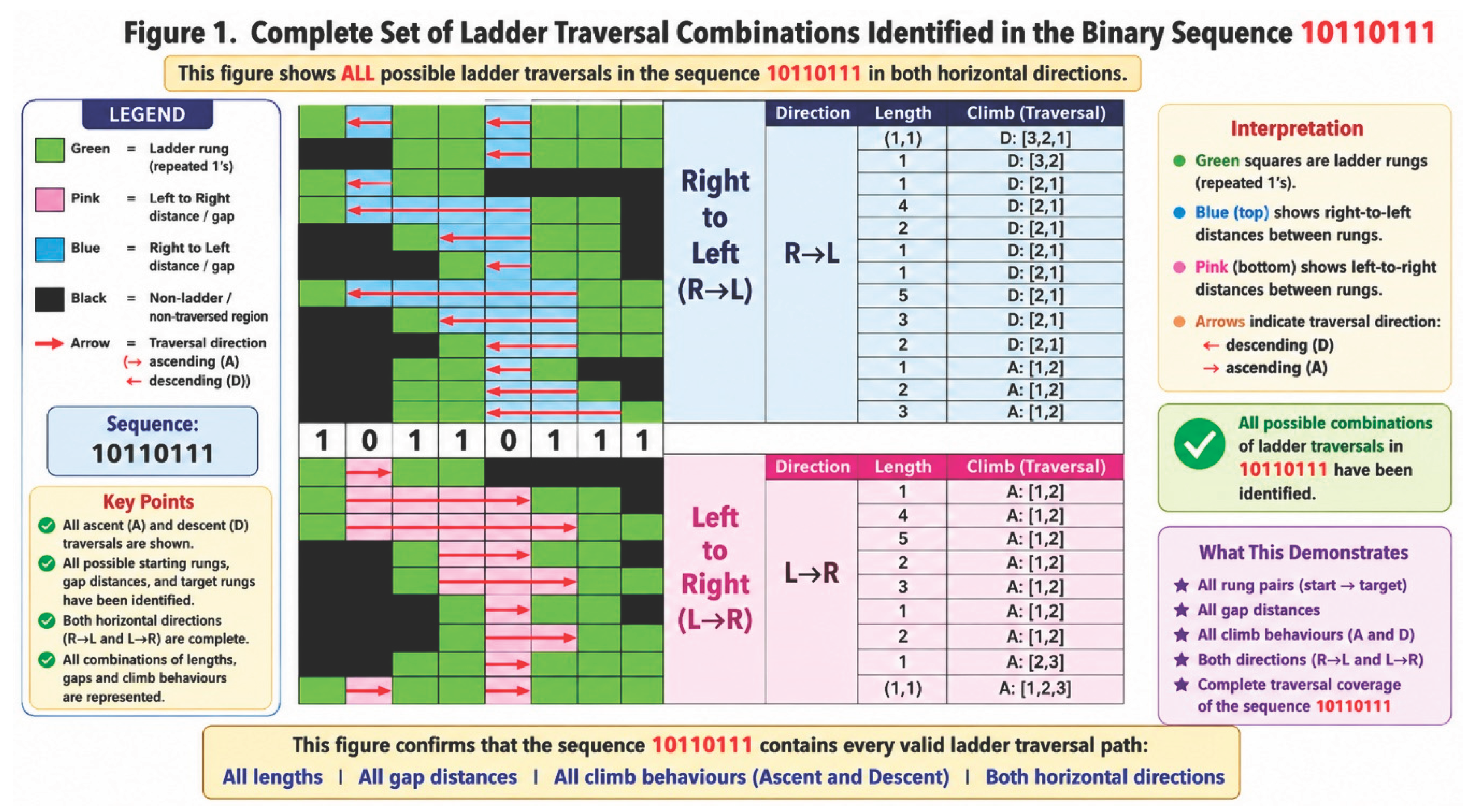

Table 1.
Summary of framework notation and core traversal terminology.
| Symbol | Term | Definition |
|---|---|---|
| Symbolic sequence | Finite ordered sequence over an alphabet | |
| Alphabet | Set of symbols forming the sequence | |
| Target symbol | Selected symbol used to construct ladder rungs | |
| Rung order | Number of consecutive occurrences of the target symbol | |
| Ladder rung of order | Contiguous repetition block of order defined as | |
| Traversal path | Ordered progression through rung states | |
| Traversal length | Number of repetition rungs in a traversal path | |
| Traversal-gap vector | Ordered distances between consecutive rung states | |
| Climb state | Indicates ascending or descending traversal | |
| Traversal direction | Direction of traversal through the sequence | |
| Traversal-state tuple | Complete traversal representation T=(σ,d,G,C,r) |
Disclaimer/Publisher’s Note: The statements, opinions and data contained in all publications are solely those of the individual author(s) and contributor(s) and not of MDPI and/or the editor(s). MDPI and/or the editor(s) disclaim responsibility for any injury to people or property resulting from any ideas, methods, instructions or products referred to in the content. |
© 2026 by the authors. Licensee MDPI, Basel, Switzerland. This article is an open access article distributed under the terms and conditions of the Creative Commons Attribution (CC BY) license (http://creativecommons.org/licenses/by/4.0/).
Copyright: This open access article is published under a Creative Commons CC BY 4.0 license, which permit the free download, distribution, and reuse, provided that the author and preprint are cited in any reuse.