

Submitted:
26 May 2026
Posted:
27 May 2026
You are already at the latest version
Abstract
BackgroundIn May 2026, Ebola disease caused by Bundibugyo ebolavirus (BDBV) was confirmed in Ituri Province, Democratic Republic of the Congo (DRC), with imported cases detected in Uganda, and the event has been described by international health authorities as of major public-health concern. Unlike Zaire ebolavirus outbreaks, official communications from WHO and CDC indicate that no widely deployed licensed vaccine or virus-specific therapeutics are currently available for BDBV, placing substantial operational weight on early detection, infection prevention and control (IPC), contact tracing, and safe burials. The hypothesisWe propose that the 2026 BDBV outbreak will follow constrained evolutionary routes shaped by (i) strong purifying selection across replication/structural functions and (ii) comparatively higher tolerance of change in immune-interacting or surface-exposed regions, resulting in predictable short-horizon mutational patterns and measurable diagnostic fragility points. We further hypothesize that early outbreak dynamics over the next three months will fit one of three testable short-horizon trajectories (rapid containment with residual flare-ups; smoldering transmission with episodic seeding; or acceleration with cross-border amplification), each associated with distinct epidemiologic and phylogenetic signatures.Evaluation of the hypothesisInitial maximum-likelihood phylogenies built from near-complete 2026 genomes (DRC and Uganda) place the 2026 sequences in a distinct cluster relative to prior BDBV outbreaks (2007 Uganda; 2012 DRC), compatible with, but not sufficient to conclude, a new spillover event, while the limited number of genomes constrains inference about broader transmission structure. WHO also reports a detection gap and operational constraints, which can expand cryptic transmission and alter observed genomic diversity over time. Consequences of the hypothesisIf correct, near-real-time sequencing integrated with surveillance should (a) identify whether the outbreak is dominated by a single introduction versus multiple introductions, (b) detect emerging clusters consistent with specific short-horizon scenarios, and (c) proactively monitor genomic positions most likely to impact PCR assay performance, including those targeted by currently deployed diagnostic platforms.
Keywords:
Bundibugyo ebolavirus
; constrained evolution
; phylogenetics
; genomic surveillance
; diagnostic fragility
; PCR robustness
; outbreak scenarios
1. Introduction
The 2026 outbreak is explicitly attributed to Bundibugyo virus disease following PCR confirmation and genomic sequencing from Ituri (DRC), with imported confirmations in Uganda. WHO situation reports highlight uncertainty in the true scale of transmission, potential detection gaps, and operational constraints (including insecurity, population mobility, and movement restrictions) that may weaken contact tracing and facilitate undetected transmission, a clinically meaningful detection gap, and field constraints (insecurity, high mobility, movement restrictions) that can weaken contact tracing and accelerate silent spread. In addition, WHO, Africa CDC and CDC communications stress that BDBV currently lacks a widely deployed licensed vaccine or virus-specific therapeutics, making containment heavily dependent on classical public-health levers that benefit from genomic intelligence (chain-of-transmission reconstruction, outbreak seeding vs continuation, and diagnostic target monitoring [1,2,3].
2. The Hypothesis
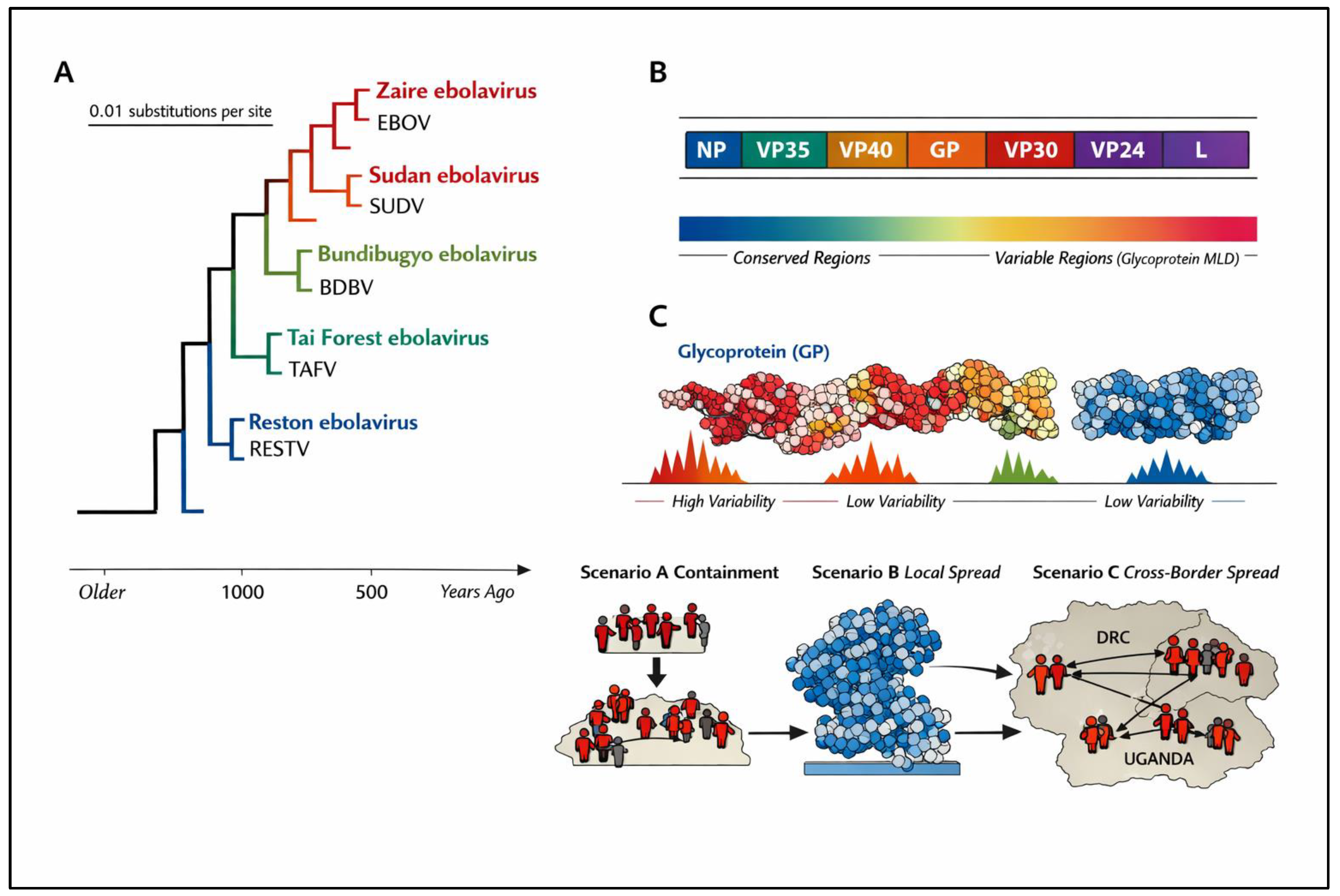
To conceptualize the interplay between evolutionary constraints, genomic variability, and outbreak dynamics, we propose a constrained-evolution framework for ebolaviruses integrating phylogenetic structure, genome organization, and epidemiological patterns (Figure 1).
Hypothesis 1 — Spillover-dominant seeding with testable phylogenetic structure
The 2026 outbreak will show genomic patterns compatible with one or more spillover introductions into humans, followed by transmission chains whose apparent diversity is modulated by surveillance intensity and access. This is motivated by early phylogenetic placement of 2026 genomes as distinct from prior 2007/2012 BDBV genomes and the authors’ interpretation consistent with a possible new spillover signal [4,5].
Test: As genomes accumulate, the outbreak will resolve into either a single tight cluster (consistent with one introduction) or multiple basal clusters (consistent with multiple introductions), under standard phylogenetic reconstruction frameworks, acknowledging sampling limitations [5].
Hypothesis 2 — Constrained evolution yields predictable short-horizon mutational probability
Over short horizons, most tolerated substitutions will concentrate in comparatively flexible viral regions, while strongly constrained enzymatic/structural motifs are expected to remain highly conserved due to strong purifying selection [7,8,9].
The evolutionary dynamics of ebolaviruses are characterized by strong functional constraints across essential replication and structural genes, coupled with more flexible evolution in surface-exposed regions, as consistently reported in comparative genomics and molecular evolution studies [10].
This proposition aligns with published analyses indicating strong conservation across many Ebola protein residues and reports emphasizing structural/epistatic dynamics in specific GP regions including the mucin-like domain [7,10].
Previous analyses of Ebola virus evolution indicate that while purifying selection dominates across most of the genome, localized signals of diversifying selection and epistatic interactions are concentrated in immune-relevant regions such as the glycoprotein mucin-like domain, supporting a model of structured and partially predictable short-term evolution.
Test: Sliding-window entropy, amino-acid variability, and gene-level selection proxies (e.g., dN/dS, interpreted cautiously in outbreaks) will reveal a stable ranking of variable vs conserved regions as the 2026 dataset grows [7].
Hypothesis 3 — Three short-horizon outbreak trajectories map to distinct genomic signatures
Within the next three months, the outbreak will tend toward one of three trajectory classes primarily shaped by operational constraints documented in prior outbreak settings documented by WHO (detection delays, IPC breaches, insecurity limiting deployment, and mobility/cross-border connectivity), as previously observed in Ebola virus outbreak settings [11,12].
Test: Each scenario predicts a different pattern of phylogenetic branching and geographic structuring in the genomic data, as well as different surveillance “missingness” signatures.
3. Evaluation of the Hypothesis
3.1. Early Phylogenetic Signal
Initial near-complete genomes from DRC and Uganda have been analyzed against historical BDBV genomes (2007 Uganda; 2012 DRC) [4,5] using alignment and maximum-likelihood phylogenetics [6], yielding a 2026 cluster separated from earlier outbreaks and interpreted as compatible with a new spillover event, although this interpretation remains preliminary given the limited number of available genomes. The same release stresses its preliminary nature and limited genomes, meaning conclusions about fine-scale transmission structure remain provisional.
3.2. Operational Context that Shapes Both Epidemiology and Observed Viral Diversity
WHO highlights operational challenges including possible detection gaps and constrained follow-up driven by insecurity and movement restrictions, conditions that can increase cryptic transmission and distort inference from sparse sequence sampling [1]. This environment makes the 2026 outbreak an unusually informative setting to test whether constrained viral evolution plus surveillance limitations can yield predictable short-horizon mutational and phylogenetic patterns [12].
3.3. Primer/Probe Mapping and 2026 Diagnostic Context
To operationalize “diagnostic fragility,” we distinguish between two mechanisms [15]:
- -
- Assay–strain mismatch (e.g., species-specific assays failing to detect a non-target Ebola species),
- -
- Oligonucleotide-binding erosion caused by nucleotide substitutions within primer/probe binding regions.
We therefore implement a two-level analytical framework:
- -
- (i) Oligonucleotide-level mapping using published primer/probe sequences from pan-filovirus RT-PCR assays [15] (see Supplementary Table S1A);
- -
- (ii) Kit-level mapping for diagnostic assays deployed during the May 2026 outbreak, including GeneXpert Ebola (Zaire-specific) [16,17], RADIONE Ebola RNA detection, and RealStar Filovirus RT-PCR assays [18] (see Supplementary Table S1B).
At the oligonucleotide level, publicly available primers and probes targeting conserved regions such as the L gene are aligned to the Bundibugyo reference genome (NC_014373.1), and substitutions observed in early 2026 genomes are mapped onto these binding regions [15]. Particular attention is given to mismatches:
- -
- in the 3′ terminal region of primers, which can impair amplification,
- -
- within probe-binding regions, potentially affecting fluorescence detection.
At the kit level, when primer/probe sequences are proprietary, mapping is restricted to:
- -
- target gene or genomic region (when known),
- -
- species coverage (species-specific vs pan-filovirus),
- -
- and expected robustness based on assay design principles.
In the 2026 outbreak context, diagnostic fragility is expected to be driven primarily by assay–strain mismatch (e.g., Zaire-specific platforms) rather than rapid escape mutations within strongly constrained genomic regions [12,17,18].
Detailed oligonucleotide mappings and diagnostic kit characteristics, including the distinction between sequence-level and kit-level fragility, are provided in Supplementary Tables S1A and S1B.
4. Consequences and Predictions
Prediction set A — Seeding pattern
Single-introduction expectation: persistent monophyly with shallow branching early.
Multiple-introduction expectation: multiple early clusters with distinct basal placements, consistent with repeated zoonotic introductions [5].
Prediction set B — Conservation vs variability map
Conserved residues will remain stable across genes essential for replication/assembly, consistent with conservation analyses across Ebola proteins [6,8].
Variable residues will be enriched in comparatively flexible or immune-exposed regions, consistent with published evidence of structural/epistatic dynamics in GP mucin-like domain evolution [10].
Prediction set C — Diagnostic fragility mapping
The performance of RT-PCR–based diagnostics for filoviruses is strongly influenced by both assay design and target genomic conservation [14,18], with pan-filovirus assays targeting conserved regions such as the L gene - an approach established in early broadly reactive filovirus RT-PCR systems [15] - demonstrating broader robustness compared with species-specific platforms [16,17].
Under the constrained-evolution hypothesis:
- -
- Core replication targets (e.g., L gene) should remain highly conserved, limiting the likelihood of rapid primer-binding disruption.
- -
-
Diagnostic fragility will preferentially arise from:
- o
- use of species-restricted assays,
- o
- or targeting of relatively more variable genomic regions.
We therefore predict:
- -
- GeneXpert Zaire-specific assays are expected to have limited sensitivity for BDBV due to intrinsic species mismatch rather than primer failure.
- -
- Pan-filovirus RT-PCR assays (e.g., RealStar) are expected to demonstrate greater robustness.
- -
- Any observed sensitivity loss will be attributable to accumulated point mutations in binding regions, not widespread genomic drift.
Supporting evidence for these interpretations is detailed in Supplementary Tables S1A and S1B.
Prediction set D — Scenario-linked outbreak dynamics (3 months)
Scenario A: Rapid containment with localized flare-ups. Expect shallow diversity and limited geographic structure, compatible with shorter chains and fewer undetected intermediates [12,13].
Scenario B: Smoldering transmission with episodic seeding. Expect “bursty” local clusters separated by gaps consistent with under-detection and mobility [6,12].
Scenario C: Acceleration with cross-border amplification. Expect multiple concurrent expanding sub-clusters and clearer phylogeographic structuring consistent with documented cross-border risk and imported cases [12,19].
These scenario-dependent patterns are consistent with previously observed links between transmission intensity, genomic diversification, and phylogenetic structure during Ebola virus outbreaks [12]. While previous studies are retrospective, they provide a conceptual framework for prospective scenario definition
5. Practical Implications
WHO guidance emphasizes that outbreak response relies primarily on supportive care, IPC, contact tracing, safe burials, and community engagement.
Under these constraints, an operationally useful consequence of our hypothesis is the implementation of an integrated: diagnostics ↔ sequencing ↔ phylogenetics ↔ response loop [20].
This framework should enable:
- Identification of spillover versus sustained transmission,
- Early detection of shifts in outbreak trajectory,
- Continuous monitoring of diagnostic target stability across circulating genomes,
- Strategic selection or adaptation of diagnostic platforms (e.g., preference for pan-filovirus assays).
This approach is particularly critical in a context where diagnostic performance directly shapes outbreak visibility and therefore intervention success.
6. Limitations
This hypothesis has several limitations:
- The number of publicly available 2026 genomes remains limited,
- Some genomic datasets are subject to restricted-use agreements,
- For several commercial diagnostic assays, primer and probe sequences are proprietary, preventing direct oligonucleotide-level evaluation,
- Diagnostic performance inference at the kit level is therefore based on publicly available information on assay scope and targets.
7. Conclusion
The 2026 BDBV outbreak—confirmed in Ituri with imported cases in Uganda—provides a unique setting to test how constrained viral evolution, surveillance gaps, and diagnostic design interact.
We propose that:
- short-horizon viral evolution may be partially predictable and spatially structured,
- diagnostic fragility will be driven predominantly by assay design rather than rapid genetic drift,
- and real-time genomic surveillance can be operationalized to proactively monitor both transmission dynamics and diagnostic robustness.
Supplementary Materials
The following supporting information can be downloaded at the website of this paper posted on Preprints.org.
AI tool disclosure
During the preparation of this work, the author used Microsoft 365 Copilot to assist with structuring, the generation of Figure 1, and the retrieval of sequence data. After using this tool, the author reviewed and edited the content as needed and took full responsibility for the content of the submitted manuscript.
References
- World Health Organization. Epidemic of Ebola disease caused by Bundibugyo virus in the Democratic Republic of the Congo and Uganda determined a public health emergency of international concern. 17 May 2026. Available from: https://www.who.int/news/item/17-05-2026-epidemic-of-ebola-disease-in-the-democratic-republic-of-the-congo-and-uganda-determined-a-public-health-emergency-of-international-concern Accessed May 19, 2026.
- Africa Centres for Disease Control and Prevention. Africa CDC declares the ongoing Bundibugyo Ebola outbreak a Public Health Emergency of Continental Security. 18 May 2026. Available from: https://africacdc.org/news-item/africa-cdc-declares-the-ongoing-bundibugyo-ebola-outbreak-a-public-health-emergency-of-continental-security/ Accessed May 19, 2026.
- Centers for Disease Control and Prevention. CDC mobilizes international response following Ebola disease outbreak in the Democratic Republic of the Congo and Uganda. 17 May 2026. Available from: https://www.cdc.gov/media/releases/2026/cdc-mobilizes-international-ebola-response.html Accessed May 19, 2026.
- Wamala JF, Lukwago L, Malimbo M, et al. Ebola hemorrhagic fever associated with novel virus strain, Uganda, 2007–2008. Emerg Infect Dis. 2010;16(7):1087–1092. [CrossRef]
- Kratz T, Roddy P, Tshomba OL, et al. Ebola virus disease outbreak in Isiro, Democratic Republic of the Congo, 2012: signs and symptoms, management and outcomes. PLoS One. 2015;10(6):e0129333. [CrossRef]
- Hulseberg CE, Kumar R, Di Paola N, Larson P, Nagle ER, Richardson J, Hanson J, Wauquier N, Fair JN, Makuwa M, Mulembakani P, Muyembe-Tamfum JJ, Schoepp RJ, Sanchez-Lockhart M, Palacios GF, Kuhn JH, Kugelman JR. Molecular analysis of the 2012 Bundibugyo virus disease outbreak. Cell Rep Med. 2021 Jul 27;2(8):100351. [CrossRef]
- Jun S-R, Hall AB, McMullen MD, Buck GA. Ebolavirus comparative genomics. FEMS Microbiol Rev. 2015;39(5):764–778.
- Levine CB, Mire CE, Geisbert TW. Comparison of Zaire and Bundibugyo Ebolavirus Polymerase Complexes and Susceptibility to Antivirals through a Newly Developed Bundibugyo Minigenome System. J Virol. 2021 Sep 27;95(20):e0064321. [CrossRef]
- Deflubé LR, Cressey TN, Hume AJ, Olejnik J, Haddock E, Feldmann F, Ebihara H, Fearns R, Mühlberger E. Ebolavirus polymerase uses an unconventional genome replication mechanism. Proc Natl Acad Sci U S A. 2019 Apr 23;116(17):8535-8543. [CrossRef]
- Urbanowicz RA, et al. Both epistasis and diversifying selection drive the structural evolution of the Ebola virus glycoprotein mucin-like domain. J Virol. 2016 May 12;90(11):5475-5484.
- MacNeil A, Farnon EC, Morgan OW, Goulding L. Filovirus outbreak detection and surveillance: lessons from Bundibugyo. J Infect Dis. 2011;204(Suppl 3):S761–S767. [CrossRef]
- Holmes EC, Dudas G, Rambaut A, Andersen KG. The evolution of Ebola virus: Insights from the 2013-2016 epidemic. Nature. 2016 Oct 13;538(7624):193-200. [CrossRef]
- Brown CJ, Quates CJ, Mirabzadeh CA, Miller CR, Wichman HA, Miura TA, Ytreberg FM. New Perspectives on Ebola Virus Evolution. PLoS One. 2016 Aug 1;11(8):e0160410. [CrossRef]
- Zhai J, Palacios G, Towner JS, Jabado O, Kapoor V, Venter M, et al. Rapid molecular strategy for filovirus detection and characterization. J Clin Microbiol. 2007;45(1):224–226. [CrossRef]
- Panning M, Laue T, Ölschläger S, Eickmann M, Becker S, Raith S, et al. Diagnostic reverse-transcription polymerase chain reaction kit for filoviruses based on the strain collections of all European biosafety level 4 laboratories. J Infect Dis. 2007;196 (Suppl 2):S199–S204. [CrossRef]
- Pinsky BA, Sahoo MK, Sandlund J, Kleman M, Kulkarni M. Analytical performance characteristics of the Cepheid GeneXpert Ebola assay for the detection of Ebola virus. PLoS One. 2015;10(11):e0142216. [CrossRef]
- Semper AE, Broadhurst MJ, Richards J, Foster GM, Simpson AJ, Logue CH. Performance of the GeneXpert Ebola assay for diagnosis of Ebola virus disease in Sierra Leone: a field evaluation study. PLoS Med. 2016;13(3):e1001980. [CrossRef]
- Rieger T, Kerber R, El Halas H, Panning M, Drosten C, Nitsche A. Evaluation of RealStar reverse transcription–polymerase chain reaction kits for filovirus detection in the laboratory and field. J Infect Dis. 2016;214(Suppl 3):S243–S249.
- Carroll MW, Matthews DA, Hiscox JA, et al. Temporal and spatial analysis of the 2014–2015 Ebola virus outbreak. Nature. 2015;524(7563):97–101. [CrossRef]
- Kinganda-Lusamaki E, Black A, Mukadi DB, Hadfield J, Mbala-Kingebeni P, Pratt CB, et al. Integration of genomic sequencing into the response to the Ebola virus outbreak in Nord Kivu, Democratic Republic of the Congo. Nat Med. 2021;27(4):710–716. [CrossRef]
Disclaimer/Publisher’s Note: The statements, opinions and data contained in all publications are solely those of the individual author(s) and contributor(s) and not of MDPI and/or the editor(s). MDPI and/or the editor(s) disclaim responsibility for any injury to people or property resulting from any ideas, methods, instructions or products referred to in the content. |
© 2026 by the authors. Licensee MDPI, Basel, Switzerland. This article is an open access article distributed under the terms and conditions of the Creative Commons Attribution (CC BY) license (http://creativecommons.org/licenses/by/4.0/).
Copyright: This open access article is published under a Creative Commons CC BY 4.0 license, which permit the free download, distribution, and reuse, provided that the author and preprint are cited in any reuse.


