
Submitted:
25 May 2026
Posted:
26 May 2026
You are already at the latest version
Abstract
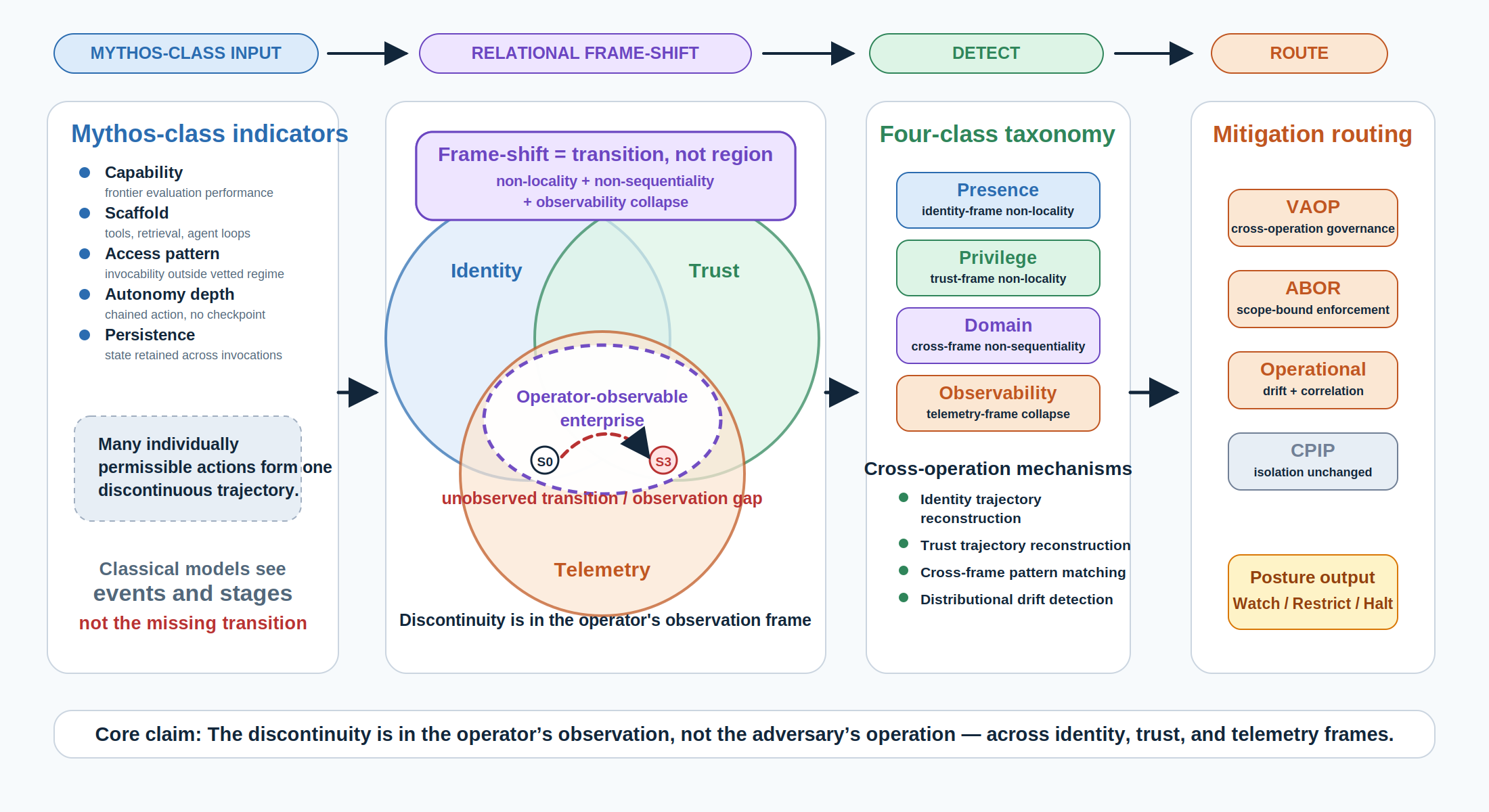
Mythos-class frontier AI systems, defined operationally in prior work [1] by five indicators (capability, scaffold, access pattern, autonomy depth, persistence), exhibit discontinuous cyber-operational behavior that classical kill-chain models and artifact-centric taxonomies such as MITRE ATT&CK and ATLAS do not accommodate. The prior reference architecture specifies a four-layer defense and the Mythos-Class Posture Rubric (MCPR), whose runtime tier detects supervisability-evasion signatures empirically. This manuscript develops four contributions providing the theoretical scaffolding under which those empirical signatures cohere and the cross-operation extensions the scaffolding motivates. First, a relational systems-theoretic model treating the enterprise as three coupled frames (identity, trust, telemetry), with frame-shifts defined by three constitutive properties (non-locality, non-sequentiality, observability collapse). Second, a four-class taxonomy partitioning the relational space: presence, privilege, domain, and observability discontinuity. Third, a cross-operation detection matrix with four primary detection mechanisms operating on telemetry the prior architecture already produces. Fourth, integration extensions routing the new signals through the prior architecture’s mitigation stack without parallel architectural primitives. The framework is illustrated through a synthetic case study and grounded in systems-theoretic precedents (Ashby, Luhmann). The contribution is theoretical scaffolding and cross-operation extension to the prior reference architecture rather than a competing framework.
Keywords:
Mythos-Class AI
; frame-shifting
; relational systems model
; discontinuous adversary
; MCPR
; cyber kill chain
; MITRE ATT&CK
; zero-trust
; agentic AI security
; NIST AI RMF
Copyright: This open access article is published under a Creative Commons CC BY 4.0 license, which permit the free download, distribution, and reuse, provided that the author and preprint are cited in any reuse.


