

Submitted:
22 May 2026
Posted:
25 May 2026
You are already at the latest version
Preprints on COVID-19 and SARS-CoV-2
Abstract
Background/Objective: This study investigated the longitudinal association between early fine motor skills and subsequent expressive vocabulary development within Bronfenbrenner’s ecological systems theory. We examined how an abrupt shift in the macrosystem and chronosystem, specifically the COVID-19 pandemic and its associated social restrictions, affected children’s developmental processes within the microsystem of the home and childcare settings. Method: The participants included 1,199 children (pre-pandemic: n = 731; pandemic: n = 468) who attended licensed childcare centers in Japan. Using hierarchical multiple regression analyses adjusted for baseline demographic characteristics and home-rearing environment (HRE), we examined whether fine motor skills at Time 1 (T1) predicted expressive vocabulary outcomes at a two-year follow-up Time 2 (T2), and whether this association differed by cohort. Result: The primary analysis revealed a significant interaction between cohort and fine motor skills at T1 was observed (b = −0.09, p < .001), indicating that the association between early motor skills and later expressive vocabulary differed between the pre-pandemic and pandemic cohorts. These findings suggest that environmental constraints during the pandemic may have disrupted the typical developmental pathways linking motor and linguistic skills. Conclusion: Reduced social interaction and communication opportunities may limit children’s ability to translate motor exploration into language development. This study highlights the sensitivity of developmental processes to broader ecological disruptions.
Keywords:
early child development
; ecological theory
; motor development
; language development
; COVID-19
1. Introduction
The COVID-19 pandemic profoundly altered the daily lives of children, constraining opportunities for physical movement and social engagement while institutionalizing preventive measures such as masking and social distancing. Early childhood is a particularly sensitive period of development, during which both motor and language skills undergo rapid consolidation [1,2,3,4]. From the perspective of ecological systems theory, development does not occur in isolation but is shaped by continuous interactions within a child’s immediate environment, including family members, childcare professionals, and peers [5,6,7]. In this regard, home and childcare settings, as core microsystems, play a central and formative role in shaping a child’s developmental trajectory.
Unlike many other countries, where preschools were closed for prolonged periods, Japan adopted a distinct policy response. While the government closed primary and secondary schools during the 2020 State of Emergency, early childhood centers were, in principle, encouraged to remain operational to sustain essential societal functions [8]. However, this does not imply that the activities continued uninterrupted or unchanged. Most local municipalities strongly recommended that parents keep their children at home whenever feasible. This created a paradoxical context in Japan: although childcare facilities were technically accessible, many children, in practice, spent substantially more time within the domestic microsystem than they did in the pre-pandemic period [9].
To sustain this continuity, the classroom environment was transformed into a highly regulated and precautionary space for students. The school day was restructured around stringent protective routines, including frequent hand hygiene practices, continuous disinfection of shared materials by staff, and the implementation of “eating in silent” (moku-shoku) behind acrylic partitions [10]. Even the vibrant auditory expressions of childhood, such as singing together or cheering during play, have been systematically attenuated to ensure community safety.
Disruptions to these routines extend beyond isolated developmental delays; they may fundamentally alter developmental cascades [4], which dynamically interlink multiple domains of functioning. It is well established in the literature that motor proficiency often acts as a precursor to later language success (e.g., [9,11,12,13,14]). Existing studies examining the association between motor and language development have largely focused on atypical or at-risk populations, including children with developmental vulnerabilities or clinical conditions [15,16,17,18,19]. In contrast, relatively little is known about how these developmental linkages operate in naturally observed settings during the COVID-19 pandemic. In contexts where social interaction is restricted and physical exploration is curtailed, the association between these domains may become attenuated or re-organized. While existing research has documented the immediate and transitional shock of the pandemic’s onset [20,21,22], far less is known about the enduring alterations in these developmental linkages, particularly when the home environment remains stable. Preliminary analyses of our data indicate that although the quality of the home-rearing environment (HRE) remained statistically unchanged throughout the pandemic, children’s linguistic outcomes exhibited measurable divergence. This suggests that the home environment, while stable, may be insufficient to compensate for disruptions [23,24,25] in a broader ecological system.
Therefore, this study investigated whether the association between fine motor skills and expressive vocabulary development was moderated by the experience of the COVID-19 pandemic in children. Specifically, we examined the interaction between cohort (pre-pandemic vs. pandemic) and motor proficiency to determine whether the strength and nature of this developmental association underwent systematic reconfiguration under pandemic-related constraints. Based on these ecological disruptions, we hypothesized that in the pandemic cohort, the association between early fine motor skills and later expressive vocabulary would be significantly reduced.
This study offers several substantive contributions to the field by elucidating the complex interplay between internal developmental capacities and external environmental constraints during early childhood. First, it rigorously examines the longitudinal association between fine motor skills and expressive vocabulary under the unique stressors imposed by the COVID-19 pandemic, thereby advancing our theoretical understanding of environmentally contingent developmental processes. Second, this study provides a rare longitudinal perspective, extending beyond the limitations of early cross-sectional pandemic studies, and enabling a more nuanced interpretation of developmental trajectories over time.
Furthermore, our findings reveal critical nuances in the post-pandemic development landscape. While the domestic microsystem remained a stable refuge, this study uncovered partial decoupling of traditionally integrated developmental pathways. We demonstrate that the protective buffering capacity of a stable home environment reaches its structural limit when the broader social ecosystem is constrained. In this context, a highly regulated social environment and reduced interpersonal interactions appear to disrupt the synergistic coupling between motor exploration and language acquisition.
2. Method
2.1. Study Design
To ensure a robust examination of our hypotheses, we employed a comparative longitudinal framework based on data from two distinct developmental windows: a pre-pandemic cohort (2017–2019; n = 731) and a pandemic cohort (2021–2023; n = 468). This methodological choice facilitates a quasi-experimental investigation into how disparate social and environmental contexts, specifically the constrained social engagement synonymous with the COVID-19 period, reconfigured the developmental interplay between the motor and linguistic domains. By benchmarking the pandemic cohort against pre-pandemic norms, we aimed to identify the internal developmental assets that serve as resilient buffers against this environmental suppression. Ultimately, this comparative approach seeks to clarify the underlying mechanisms of developmental agency as children navigate fluctuating early life environments.
2.2. Data Source and Measures
The data for this analysis were drawn from the ongoing Child Care Cohort Study (CCC), a comprehensive nationwide longitudinal initiative that has monitored children in licensed childcare settings across Japan for more than 25 years. Developmental progress was captured using the Child Development Scale (CD) [26], which was implemented through systematic naturalistic observation in routine childcare environments. This multidimensional scale assesses various domains, including fine motor skills and expressive vocabulary, and can convert raw results into developmental age. To safeguard the reliability of these assessments and mitigate observer bias, each child was independently evaluated by at least two childcare professionals familiar with the child’s daily behavioral patterns. Furthermore, HRE was quantified using the Index of Child Care Environment (ICCE) questionnaire, as reported by the children’s primary caregivers.
2.3. Cohort Comparison and Study Context
To isolate the effects of the pandemic’s social and environmental disruptions, we compared two cohorts. The pre-pandemic cohort (n = 731) was tracked from 2017 to 2019 to establish a normative baseline for the developmental trajectories. In contrast, the pandemic cohort (n = 468), tracked from 2021 to 2023, represented a unique developmental context. By the start of the observation period, these children had already lived through a full year of the COVID-19 crisis and its associated challenges. This means that they were subjected to chronic social restrictions and stringent infection control measures in Japanese childcare settings from the beginning, embodying a period of sustained environmental suppression.
2.4. Participants and Analytical Sample
Participants in both cohorts underwent longitudinal assessments at two time points. Our final analytical sample of 1,199 children provided sufficient statistical power to identify small-to-moderate effect sizes using the hierarchical regression framework. The study included children aged 12–59 months at baseline. To ensure the integrity of the developmental data, we applied rigorous exclusion criteria: children were excluded if they had diagnosed mental or physical disabilities, missing data on primary measures, or baseline developmental scores more than three levels below their chronological age, a threshold used to filter pre-existing developmental delays.
2.5. Measurements
2.5.1. Motor and Language Development
Fine motor skills and language abilities were assessed using the CDS [26]. Although the original CDS subdomains are labeled as “vocabulary,” we have adopted the term “expressive vocabulary” throughout this study to specifically reflect this aspect. This decision was informed by the conceptual alignment of the assessment items, such as the ability to utilize words and sentences for communication, with established measures of expressive language.
The CDS structure provides age-specific developmental checkpoints at 2-month intervals for children aged 12–18 months, 3-month intervals between 18 and 48 months, and 6-month intervals thereafter. At the baseline stage, we applied a strict screening process: participants whose developmental age was three or more levels below their chronological age were excluded from the primary analyses [27]. By adhering to these standardized CDS assessment guidelines, we aimed to safeguard the validity of the observed developmental trajectories, effectively filtering out children at high risk of significant pre-existing delays at the study’s inception.
2.5.2. Home-Rearing Environment (HRE)
To evaluate HRE quality, we used the ICCE, a 13-item parental questionnaire developed by Anme et al. [28]. The ICCE assesses daily proximal processes, such as reading to the child, social interactions with peers or relatives, and access to caregiving consultations, all of which are important for healthy child development.
Following the original scoring procedure described by Anme et al. [28,29,30], each item was dichotomized into two. Responses indicating developmentally supportive conditions were coded as 1, while those indicating less supportive or potentially adverse environments were coded as 0. Under this coding scheme, higher total scores indicate a more supportive and nurturing environment.
For example, frequent social visits with families of similarly aged children (1–3 times per month or more) and regular access to childcare professionals were coded as 1, whereas a lower frequency or absence of such experiences was coded as 0. For the Avoidance of physical discipline item, a response of “never” was coded as 1, considering it a protective factor. The scores for all items were summed to obtain the total ICCE score for each participant in the study.
2.5.3. Covariates
Drawing on the established literature [9,30,31,32], we identified several key demographic and environmental factors to be included as covariates in the model. These variables; age group, gender, family structure, parental status, and sibling presence, were dichotomized to streamline the analysis: age group (0 = 1–2-year-olds, 1 = 3–4-year-olds), gender (0 = boy, 1 = girl), family structure (0 = nuclear family, 1 = extended family), Parent (0 = two-parent, 1 = single-parent), sibling presence (0 = no, 1 = yes), and cohort (0 = pre-pandemic, 1 = pandemic). The overall HRE (total ICCE score) was included in the models as a continuous variable.
2.5.4. Ethical Considerations
This study was conducted in accordance with established ethical guidelines and was approved by the Ethics Committee of the Institute of Medicine, University of Tsukuba, Japan (Approval No. 1657-2). Participating childcare centers and caregivers received detailed information about the study, and all data were handled with strict attention to confidentiality and privacy.
2.5.5. Statistical Analysis
The study compared two developmental periods to examine the impact of the pandemic: the pre-pandemic cohort represented children whose development occurred before the onset of COVID-19-related social restrictions, and the pandemic cohort included children whose early developmental experiences unfolded during the pandemic. Notably, children in the pandemic cohort had already experienced approximately one year of social restrictions at the time of the baseline assessment (T1) in the study. For both cohorts, T1 represented the baseline year (2017 for pre-pandemic; 2021 for pandemic), and T2 represented the follow-up assessment conducted two years later (2019 for pre-pandemic; 2023 for pandemic).
Descriptive statistics were used to summarize the participants’ characteristics and developmental profiles across the cohorts. Inferential analyses included Mann-Whitney U tests for continuous variables to compare group differences between cohorts.
Hierarchical regression analyses were conducted separately for each cohort to identify the independent predictors of expressive-vocabulary development at T2. In these models, we hierarchically entered multifaceted environmental factors that could influence children’s language development, guided by Bronfenbrenner’s [5] ecological systems theory. In the first step, T1 expressive vocabulary scores and gender were entered to adjust for initial developmental levels (personal level). The second step of our model accounts for the multi-layered nature of the ecological system, specifically focusing on the microsystems. We first entered demographic covariates, including family structure, single parent, and presence of siblings, followed by HRE (total ICCE score) to capture primary environmental influences at the microsystemic level. In the third step, T1 fine motor skills and cohorts were introduced to evaluate their independent contributions as proximal processes and macrosystemic contexts. The final stage of the model involved entering the interaction term between fine motor skills and cohort. This approach enabled us to discern whether the macrosystemic shift triggered by the pandemic moderated the developmental link between motor and language skills, thereby identifying structural reconfigurations in these processes across both cohorts.
To examine how the pandemic environment reshaped developmental trajectories, we employed the Johnson–Neyman (JN) technique instead of the conventional “pick-a-point” approaches (e.g., probing effects at ±1 SD). Whereas traditional methods provide estimates at arbitrarily selected values of the moderator, the JN technique enables the identification of specific regions along the continuum of motor proficiency where the effect becomes statistically significant [33,34,35].
To handle missing data, we employed multiple imputations by pooling 30 imputed datasets for the final analysis. All statistical procedures were conducted using IBM SPSS Statistics (Version 30) and PROCESS macro version 5.0 for SPSS [35], with the threshold for statistical significance set at p < .05.
3. Results
The participant selection process is illustrated in the flow chart (Figure 1). Our final analysis included 1,199 children, comprising 731 participants from the pre-pandemic cohort and 468 from the pandemic cohort. The demographic characteristics of both groups are presented in Table 1.
To ensure a robust baseline comparison, Mann-Whitney U tests were conducted for the demographic and environmental factors (Table 2). The chronological age distribution differed significantly between the cohorts at both T1 (z = 3.99, p < .001) and T2 (z = 2.97, p = .003). The quality of the HRE, as measured by the ICCE total score, remained remarkably consistent across both cohorts (z = -0.09, p = .927).
Hierarchical Regression Analysis
A three-step hierarchical regression analysis was conducted to predict T2’s expressive vocabulary (Table 3). In Model 1, baseline T1 expressive vocabulary, gender, and age group were included in the model. The analysis accounted for 64.5% of the total variance (R2 = .645, p < .001). Among these variables, baseline vocabulary (B = 0.80, SE = 0.04, 95% CI [0.72, 0.87]. p < .001), gender (B = 2.32, SE = 0.59, 95% CI [1.17, 3.48], p < .001) and age group (B = 6.11, SE = 1.01, 95% CI [4.14, 8.10], p < .001).
In Model2, parent, family structure, presence of siblings, and HRE (ICCE) were entered and did not reach the conventional threshold for an increase in explained variance (ΔR2 = .003, p = .056). The cumulative R2 was .048.
In the final step of Model3, the T1 fine motor cohort and the interaction between fine motor and cohort were entered. This step provided an additional 2.5% of explained variance (ΔR2 = .025, p < .001), and the total R2 was .673. In this model, fine motor and cohort maintained a positive association with the outcome (B = 0.50, SE = 0.06, 95% CI [0.39, 0.61], p < .001), (B = -1.83, SE = 0.59, 95% CI [-2.98, -0.67], p = .002), respectively. Furthermore, an interaction between fine motor and cohort was observed (B = -0.09, SE = 0.05, 95%CI [-0.18, -0.04], p = .041).
To evaluate the impact of the pandemic context on the developmental relationship between motor and language skills, a moderation analysis (Figure 2) was performed using a multiple-imputation dataset. The model regressed expressive vocabulary at T2 on the cohort (Cohort 0 = pre-pandemic, 1 = pandemic) and fine motor skills at T1, while adjusting for baseline expressive vocabulary, gender, family structure, presence of siblings, parent, age group, and HRE.
The regression model (Table 4) accounted for a substantial proportion of the variance in expressive vocabulary (R2 = .67, F (10, 36659) = 7514.02, p < .001). An interaction effect between fine motor and cohort was observed (coeff = -0.092, SE = 0.008, t = -11.56, p < .001), indicating that the association between T1 fine motor and T2 expressive vocabulary differed depending on the cohort’s pandemic experience. The Johnson-Neyman technique identified two distinct regions of significance for cohort effects. For the majority of the sample (98.7%; T1 fine motor > 10.66), being in the pandemic cohort was associated with lower T2 expressive vocabulary scores than those in the pre-pandemic cohort at equivalent levels of T1 fine motor. This negative conditional effect became more pronounced as fine motor proficiency increased, ranging from an effect of -0.783 (SE= .143, p < .001) at T1 fine motor = 24.0 to -3.371 (SE = .163, p < .001) at T1 fine motor = 52.0. Conversely, for a small subset of children with lower motor scores (T1 fine motor < 10.66), a positive association was observed between the pandemic cohort and T2 expressive vocabulary scores (effect = .511, SE= .235, p = .029 at T1 fine motor = 10.0).
A multiple regression analysis was conducted to examine the main and interactive effects of the pandemic cohort, fine motor skills at T1, and age group on expressive vocabulary development. The model was adjusted for baseline expressive vocabulary, gender, family structure (nuclear or extended family, parent, presence of siblings, and the index of childcare environment). The overall model accounted for 67.6% of the variance in expressive vocabulary (R2 = .676, F(13, 36656) = 5868.80, p < .001). Regarding the interaction terms, the analysis provided for two-way interactions were observed between Cohort and Fine Motor T1 (b = 0.10, p = .031, 95% CI [0.01, 0.20]), Cohort and Age Group (b = -3.19, p < .001, 95% CI [-5.06, -1.33]), and Fine Motor T1 and Age Group (b = 0.22, p < .001, 95% CI [0.19, 0.26]), with all 95% confidence intervals excluding zero. However, the three-way interaction between Cohort, Fine Motor T1, and Age Group, as the estimated effect was small and its confidence interval included zero (b = -0.04, p = .157, 95% CI [-0.09, 0.02]).
4. Discussion
The present study longitudinally examined whether the developmental association between early fine motor skills and later expressive vocabulary was attenuated during the COVID-19 pandemic among children aged 1–4 years in Japanese childcare. The findings indicate that the traditional developmental pathway, in which fine motor abilities facilitate later language acquisition [9,11,12,13,14], was significantly weakened during the pandemic. Notably, the attenuation was more pronounced in children with relatively advanced baseline fine motor skills.
Previous studies have reported language delays in children exposed to the COVID-19 pandemic [21,22,36,37]. Extending this literature, the present findings suggest that the pandemic may have altered not only developmental outcomes but also the developmental processes linking the motor and language domains. In other words, the findings indicate a disruption in the developmental coupling between motor exploration and the acquisition of expressive language.
One possible explanation is that pandemic-related changes in childcare environments reduced children’s opportunities to connect motor experiences with communicative interactions. Language learning in early childhood is inherently embedded within everyday social exchanges, including play, imitation, joint attention [38], and caregiver–child interaction [39,40]. During the pandemic, infection control measures such as childcare professionals mask use, reduced peer interaction, and “mokushoku” altered everyday communication in childcare settings [8]. These environmental constraints may have limited opportunities for spontaneous verbal interaction [41,42,43,44,45] and socially embedded learning experiences that normally support the integration of action and language development [46].
Importantly, the findings suggest that the observed attenuation was not simply due to reduced motor competence but rather to fewer opportunities for children to translate their motor abilities into meaningful, communicative experiences. Children with relatively advanced fine motor skills may typically derive greater developmental benefits from socially interactive environments [47,48,49]; however, pandemic-related restrictions may have disproportionately reduced opportunities to utilize these resources. This interpretation is consistent with Johnson–Neyman analyses, which indicate stronger attenuation among children with higher baseline fine motor skills.
Collectively, the present findings suggest that the COVID-19 pandemic disrupted the developmental linkage between fine motor skills and expressive vocabulary acquisition during early childhood. Given the fundamentally social nature of language learning, the results highlight the importance of restoring rich interactive childcare environments [50] that support the integration of motor skills and verbal language acquisitions.
5. Limitations and Future Directions
While these findings offer significant insights, it is important to acknowledge the limitations of the current analytical perspective. First, our reliance on hierarchical regression analysis provides a valuable population-level overview; however, it inherently limits our ability to infer the absolute causality. For instance, while we see shared reading as a catalyst for expressive vocabulary, we must consider the “reciprocal dance” between parent and child: it is entirely possible that children with an early natural aptitude for language simply invite more frequent reading interactions from their caregivers. Furthermore, because this method captures differences between children rather than following the subtle day-to-day fluctuations within a single child, we cannot yet fully map how an individual’s fine motor progress might spark their unique language developmental trajectory over time. Second, the cultural and institutional contexts of the sample warrant careful consideration. These children were part of the Japanese childcare system, in which many licensed facilities remained open even during the peak of the pandemic. This stands in contrast to the total lockdowns and profound familial isolation observed in other parts of the world. Consequently, the protective “buffer” provided by the home environment might take on different forms in societies that experienced more extreme social disruption.
We also recognize that our data were based on parental reports, which introduced the possibility of selection bias in the study. Participants were recruited through specific licensed childcare facilities; therefore, our sample may represent families that already have access to structured institutional support and prioritize such environments for their children’s early development. Despite these constraints, this study serves as a testament to developmental resilience. This demonstrates that even when a global crisis disrupts traditional milestones, responsive proximal processes within the home, further supported by stable childcare environments, can help maintain a child’s developmental trajectory on a stable course despite the crisis.
Author Contributions
Conceptualization, M.S. and A. T.; methodology, M. S.; investigation, M. S. and Y. W.; data curation, M. S., Y. W., H. M., and A. A.; writing-original draft preparation, M. S.; writing-review and editing, M. S., S. S., M. M., Y.N., A. K., and Y. S.; supervision, T.A. All authors have read and agreed to the published version of this manuscript.
Funding
This study was supported by JST SPRING (Grant Number JPMJSP2124) and JSPS KAKENHI (Grant Number JP24K00337).
Institutional Review Board Statement
The study was conducted in accordance with Declaration of Helsinki and approved by the Ethics Committee of the Institute of Medicine, University of Tsukuba, Japan (Approval No. 1657-2) and date of approval 28th November 2024.
Informed Consent Statement
Informed consent for participation was obtained from the parents or legal guardians of all participating children through the childcare centers, in accordance with the approved study protocol.
Data Availability Statement
The data presented in this study are not publicly available because of privacy and ethical restrictions.
Acknowledgments
The authors would like to express their sincere gratitude to the children, their families, and the staff at the childcare centers participating in the Childcare Cohort Study for their generous cooperation and support throughout this longitudinal study. We also thank the members of the Empowerment Science Laboratory at the University of Tsukuba and the “Hoiku Powerup” study group (a collaborative network of childcare professionals and researchers) for their insightful discussions and technical assistance during the data collection and analysis process. Gemini 3 Flash was used to improve the flow and clarity of English writing.
Conflicts of Interest
The authors declare no conflicts of interest.
References
- Handbook of Child Psychology and Developmental Science; 2015. [CrossRef]
- Bornstein, M. H.; Jager, J.; Putnick, D. L. Sampling in Developmental Science: Situations, Shortcomings, Solutions, and Standards. Dev. Rev. 2013, 33(4), 357–370. [Google Scholar] [CrossRef] [PubMed]
- Escolano-Pérez, E.; Herrero-Nivela, M. L.; Losada, J. L. Association between Preschoolers’ Specific Fine (but Not Gross) Motor Skills and Later Academic Competencies: Educational Implications. Front. Psychol. 2020, 11. [Google Scholar] [CrossRef]
- Iverson, J. M. Developmental Variability and Developmental Cascades: Lessons from Motor and Language Development in Infancy. Curr. Dir. Psychol. Sci. 2021, 30(3), 228–235. [Google Scholar] [CrossRef]
- Bronfenbrenner, U. The Ecology of Human Development — Harvard University Press; Harvard University Press; Available online: https://www.hup.harvard.edu/books/9780674224575.
- Nasiopoulou, P.; Mellgren, E.; Sheridan, S.; Williams, P. Conditions for Children’s Language and Literacy Learning in Swedish Preschools: Exploring Quality Variations with ECERS-3. Early Child. Educ. J. 2022. [Google Scholar] [CrossRef]
- Kiran, V. Kavitha; Tiwari, G. Determinants of Language Development during Early Years: Systematic Review. World J. Biol. Pharm. Health Sci. 2023, 15(1), 221–225. [Google Scholar] [CrossRef]
- Cabinet Office (Japan). 2021 White Paper on Persons with Disabilities (Reiwa 3-nen ban Shogaisha Hakusho). Available online: https://www8.cao.go.jp/shougai/whitepaper/r03hakusho/zenbun/h2_01_02.html (accessed on 9 May 2026).
- Alcock, K.; Connor, S. Oral Motor and Gesture Abilities Independently Associated with Preschool Language Skill: Longitudinal and Concurrent Relationships at 21 Months and 3–4 Years. J. Speech Lang. Hear. Res. 2021, 64(6), 1944–1963. [Google Scholar] [CrossRef]
- Oba, M. Current Status and Responses of Nursery Schools during the COVID-19 Pandemic (Koronakani okeru hoikuno genjo). Child Sci. 2020, 20, 15–18. (In Japanese) [Google Scholar]
- Choi, B.; Leech, K. A.; Tager-Flusberg, H.; Nelson, C. A. Development of Fine Motor Skills Is Associated with Expressive Language Outcomes in Infants at High and Low Risk for Autism Spectrum Disorder. J. Neurodev. Disord. 2018, 10(1). [Google Scholar] [CrossRef]
- Iverson, J. M. Developing Language in a Developing Body: The Relationship between Motor Development and Language Development. J. Child Lang. 2010, 37(2), 229–261. [Google Scholar] [CrossRef] [PubMed]
- Valla, L.; Slinning, K.; Kalleson, R.; Wentzel-Larsen, T.; Riiser, K. Motor Skills and Later Communication Development in Early Childhood: Results from a Population-Based Study. Child Care Health Dev. 2020, 46(4). [Google Scholar] [CrossRef] [PubMed]
- Wang, M. V.; Lekhal, R.; Aaro, L. E.; Holte, A.; Schjolberg, S. The Developmental Relationship between Language and Motor Performance from 3 to 5 Years of Age: A Prospective Longitudinal Population Study. BMC Psychol. 2014, 2(1). [Google Scholar] [CrossRef]
- Leonard, H. C.; Hill, E. L. Review: The Impact of Motor Development on Typical and Atypical Social Cognition and Language: A Systematic Review. Child Adolesc. Ment. Health 2014, 19(3), n/a–n/a. [Google Scholar] [CrossRef]
- Libertus, K.; Violi, D. A. Sit to Talk: Relation between Motor Skills and Language Development in Infancy. Front. Psychol. 2016, 7. [Google Scholar] [CrossRef]
- Oudgenoeg-Paz, O.; Volman, M(Chiel). J. M.; Leseman, P. P. M. First Steps into Language? Examining the Specific Longitudinal Relations between Walking, Exploration and Linguistic Skills. Front. Psychol. 2016, 7. [Google Scholar] [CrossRef]
- Walle, E. A.; Campos, J. J. Infant Language Development Is Related to the Acquisition of Walking. Dev. Psychol. 2014, 50(2), 336–348. [Google Scholar] [CrossRef]
- Winter, R. E.; Stoeger, H.; Suggate, S. P. Fine Motor Skills and Their Link to Receptive Vocabulary, Expressive Vocabulary, and Narrative Language Skills. First Lang. 2024, 44(3). [Google Scholar] [CrossRef]
- Abe, T.; Kitayuguchi, J.; Fukushima, N.; Kamada, M.; Okada, S.; Ueta, K.; Tanaka, C.; Mutoh, Y. Fundamental Movement Skills in Preschoolers before and during the COVID-19 Pandemic in Japan: A Serial Cross-Sectional Study. Environ. Health Prev. Med. 2022, 27(0), 26–26. [Google Scholar] [CrossRef] [PubMed]
- Otani, T.; Kato, M.; Haraguchi, H.; Goma, Hideyo. Effect of the COVID-19 Pandemic on Infants’ Development: Analyzing the Results of Developmental Assessments at Ages 10–11 and 18–24 Months. Front. Psychol. 2024, 15. [Google Scholar] [CrossRef]
- Sato, K.; Fukai, T.; Fujisawa, K. K.; Nakamuro, M. Association between the COVID-19 Pandemic and Early Childhood Development. JAMA Pediatr. 2023, 177(9), 930–938. [Google Scholar] [CrossRef] [PubMed]
- Claridge, A. M. Pregnancy Intentions of First-Time Mothers and Their Children’s Outcomes: Unraveling Reciprocal Pathways. J. Marriage Fam. 2021, 83(4), 942–960. [Google Scholar] [CrossRef]
- Lecheile, B. M.; Spinrad, T. L.; Xu, X.; Lopez, J.; Eisenberg, N. Longitudinal Relations among Household Chaos, SES, and Effortful Control in the Prediction of Language Skills in Early Childhood. Dev. Psychol. 2020, 56(4), 727–738. [Google Scholar] [CrossRef] [PubMed]
- Lovčević, I. Early Home Learning Environment and Children’s Concurrent and Longitudinal Language Development. J. Child Lang. 2025, 1–15. [Google Scholar] [CrossRef] [PubMed]
- Anme, T.; Segal, U. A. Child Development and Childcare in Japan. J. Early Child. Res. 2010, 8(2), 193–210. [Google Scholar] [CrossRef]
- Attell, J. E.; Rose, C.; Bertolli, J.; Kotzky, K.; Squires, J.; Krishna, N. K.; Satterfield-Nash, A.; Peacock, G.; Ornelas Pereira, I.; Faria E. Silva Santelli, A. C.; Smith, C. Adapting the Ages and Stages Questionnaire to Identify and Quantify Development among Children with Evidence of Zika Infection. Infants Young Child. 2020, 33(2), 95–107. [Google Scholar] [CrossRef]
- Anme, T.; Tanaka, E.; Watanabe, T.; Tomisaki, E.; Mochizuki, Y.; Tokutake, K. Validity and Reliability of the Index of Child Care Environment (ICCE). In Public Health Frontier; 2013. [Google Scholar] [CrossRef]
- Anme, T. Hoiku Power-up course: Application volume (Hoiku pawa-appu koza katsuyo-hen); Ishiyaku Publishers, 2013. [Google Scholar]
- Anme, T.; Tanaka, H.; Shinohara, R.; Sugisawa, Y.; Tanaka, E.; Tong, L.; Watanabe, T.; Onda, Y.; Kawashima, Y.; Tomisaki, E.; Mochizuki, H.; Hirano, M.; Morita, K.; Gan-Yadam, A.; Segal, U. Effectiveness of Japan’s Extended/Night Child Care: A Five-Year Follow Up. Procedia-Soc. Behav. Sci. 2010, 2(2), 5573–5580. [Google Scholar] [CrossRef]
- Bronfenbrenner, U.; Morris, P. A. The Bioecological Model of Human Development. Handb. Child Psychol. 2007, 1(1). [Google Scholar] [CrossRef]
- Shrestha, S.; Li, X.; Zhu, Z.; Meriyandah, H.; Nurdiantami, Y.; Banu, A. A.; Shigeeda, M.; Anme, T. The Relationship of Home-Rearing Environment with Early Childhood Social Competence and Behavioral Difficulties: Insights from Nepalese Children. Early Child. Res. Q. 2026, 75, 46–59. [Google Scholar] [CrossRef]
- Wang, Y.; Li, X.; Zhu, Z.; Wang, M.; Huang, Y.; Shigeeda, M.; Sawada, Y.; Kakuda, A.; Anme, T. Identifying Latent Profiles of the Home-Rearing Environment and Their Associations with Young Children’s Gross Motor Development in Japan. Child Youth Care Forum 2026. [Google Scholar] [CrossRef]
- Bauer, D. J.; Curran, P. J. Probing Interactions in Fixed and Multilevel Regression: Inferential and Graphical Techniques. Multivar. Behav. Res. 2005, 40(3), 373–400. [Google Scholar] [CrossRef]
- Girardi, P.; Mastromatteo, L. Y.; Scrimin, S. An Extension to the Johnson-Neyman Test for Generalized Linear Models with Curvilinear Effects. In Quality & Quantity; 2026. [Google Scholar] [CrossRef]
- Hayes, A. F. Introduction to Mediation, Moderation, and Conditional Process Analysis: A Regression-Based Approach, 3rd ed.; Guilford Publications, 2022. [Google Scholar]
- Matsuo, R.; Matsumoto, N.; Mitsuhashi, Toshiharu; Yorifuji, Takashi. COVID-19 Pandemic and Language Development in Children at 18 Months: A Repeated Cross-Sectional Study over a 6-Year Period in Japan. Arch. Dis. Child. 2023, archdischild–325926. [Google Scholar] [CrossRef]
- Suemune, K.; Yamaguchi, H.; Nishiyama, M.; Kyono, Y.; Kawamura, A.; Oikawa, S.; Imai, T.; Murakami, S.; Mishina, H.; Nozu, K.; Nagase, H. Impact of the COVID-19 Pandemic on Child Development and Caregiving: A 7-Year Repeated Cross-Sectional Study of 3-Year-Old Children in Kobe City, Japan. Brain Behav. 2026, 16(4). [Google Scholar] [CrossRef] [PubMed]
- Kissine, M.; Saint-Denis, A.; Mottron, L. Language Acquisition Can Be Truly Atypical in Autism: Beyond Joint Attention. Neurosci. Biobehav. Rev. 2023, 153, 105384. [Google Scholar] [CrossRef] [PubMed]
- Seftiani, Helmi; Khumaeroh, Arni. Development and Language Acquisition of 3-Year-Old Children. Int. J. Sci. Appl. Sci. Conf. Ser. 2023, 7(1), 49–49. [Google Scholar] [CrossRef]
- Yang, J.; Lawrence, J. F.; Grøver, Vibeke. What Else Will I Do When I Start School? Preschoolers’ Wh-Questions in Dinnertime Conversations and Their Language Development. First Lang. 2024. [Google Scholar] [CrossRef]
- Crimon, C.; Barbir, M.; Hagihara, H.; de Araujo, E.; Nozawa, S.; Shinya, Y.; Abboub, N.; Tsuji, S. Mask Wearing in Japanese and French Nursery Schools: The Perceived Impact of Masks on Communication. Front. Psychol. 2022, 13. [Google Scholar] [CrossRef]
- Domek, G.; Spahic, H.; Cole, A.; Silveira, L.; Igoe, T.; Reyes, A.; Freeman, B. Longitudinal Effects of the COVID-19 Pandemic on Infant and Toddler Development: A Retrospective Cohort Study. BMJ Paediatr. Open 2026, 10(1), e003353. [Google Scholar] [CrossRef]
- Fukuda, K. Relationship between Behavior and Emotional States of Young Children: From a Family Systems Theory Perspective (Kodo to yoji no jodo jotai to no kanren: Kazoku shisutemu-ronteki shiten kara). Hattatsu Shinrigaku Kenkyu 2003, 14(2), 161–171. [Google Scholar]
- Iwahashi, M. Research on Childcare for Children under Three Years Old during the COVID-19 Pandemic: Insights from a Fact-Finding Survey (Koronaka ni okeru 3-sai mimanji hoiku ni kansuru kenkyu: Jittai chosa kara miete kuru mono). Res. Early Child. Care Educ. 2022, 12, 16–38. [Google Scholar]
- Toyama, N. Impact of the Spread of COVID-19 Infection on Daycare Meals (Hoikuen no shokuji ni okeru shingata koronauirusu kansensho no eikyo). J. Child Heal. 2024, 83(3), 223–231. [Google Scholar]
- Deding, Jesper; Minnaert, A. Improving Child Outcomes and Quality in Early Childhood Education and Care Through Implementation of Professional Development: A Meta-Systematic Literature Review of Pre- and In-Service Approaches. Adv. Soc. Sci. Res. J. 2024, 11(12), 33–65. [Google Scholar] [CrossRef]
- Fathirezaie, Z.; Abbaspour, K.; Badicu, G.; Zamani Sani, S. H.; Nobari, H. The Effect of Environmental Contexts on Motor Proficiency and Social Maturity of Children: An Ecological Perspective. Children 2021, 8(2), 157. [Google Scholar] [CrossRef] [PubMed]
- Li, X.; Jiao, D.; Matsumoto, M.; Zhu, Y.; Zhang, J.; Zhu, Z.; Liu, Y.; Cui, M.; Wang, Y.; Qian, M.; Ajmal, A.; Afsari Banu, A.; Graça, Y.; Tanaka, E.; Watanabe, T.; Sawada, Y.; Tomisaki, E.; Anme, T. Home Environment and Social Skills of Japanese Preschool Children Pre- and Post-COVID-19. Early Child Dev. Care 2022, 192(15), 1–12. [Google Scholar] [CrossRef]
- Armstrong-Carter, E.; Sulik, M. J.; Siyal, S.; Yousafzai, A. K.; Obradović, J. Early and Concurrent Home Stimulation: Unique and Indirect Links with Fine Motor Skills among 4-Year-Old Children in Rural Pakistan. Dev. Psychol. 2021, 57(6), 888–899. [Google Scholar] [CrossRef] [PubMed]
- OECD. Building Strong Foundations for Life: Results from the 2025 Early Learning and Child Well-being Study; OECD Publishing: Paris, France, 2026. [Google Scholar] [CrossRef]
Figure 1.
Participant Flow Chart.
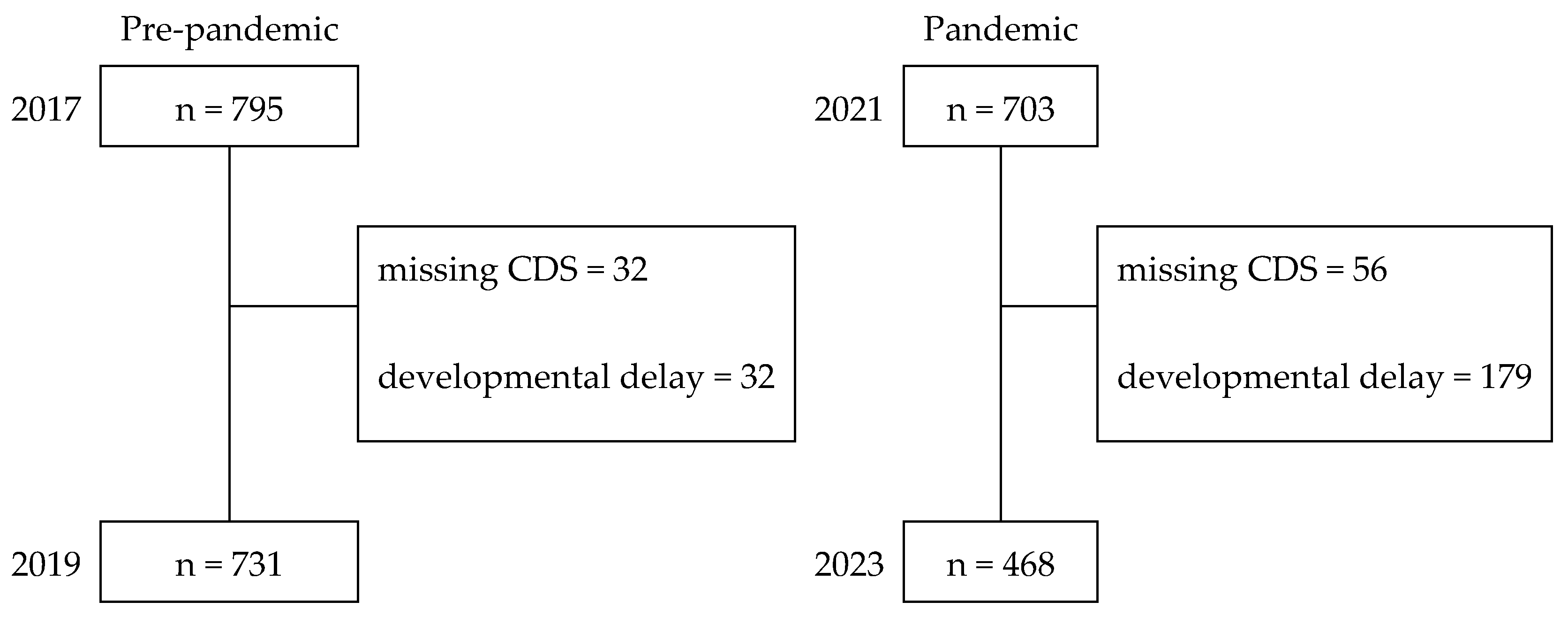
Figure 2.
Conditional Effect of the COVID-19 Cohort on Expressive Vocabulary as a Function of Fine Motor. Note. T1 (pre-pandemic: 2017, pandemic: 2021) CI: Confidence Interval. LL: Lower Limit. UL: Upper Limit.
Figure 2.
Conditional Effect of the COVID-19 Cohort on Expressive Vocabulary as a Function of Fine Motor. Note. T1 (pre-pandemic: 2017, pandemic: 2021) CI: Confidence Interval. LL: Lower Limit. UL: Upper Limit.
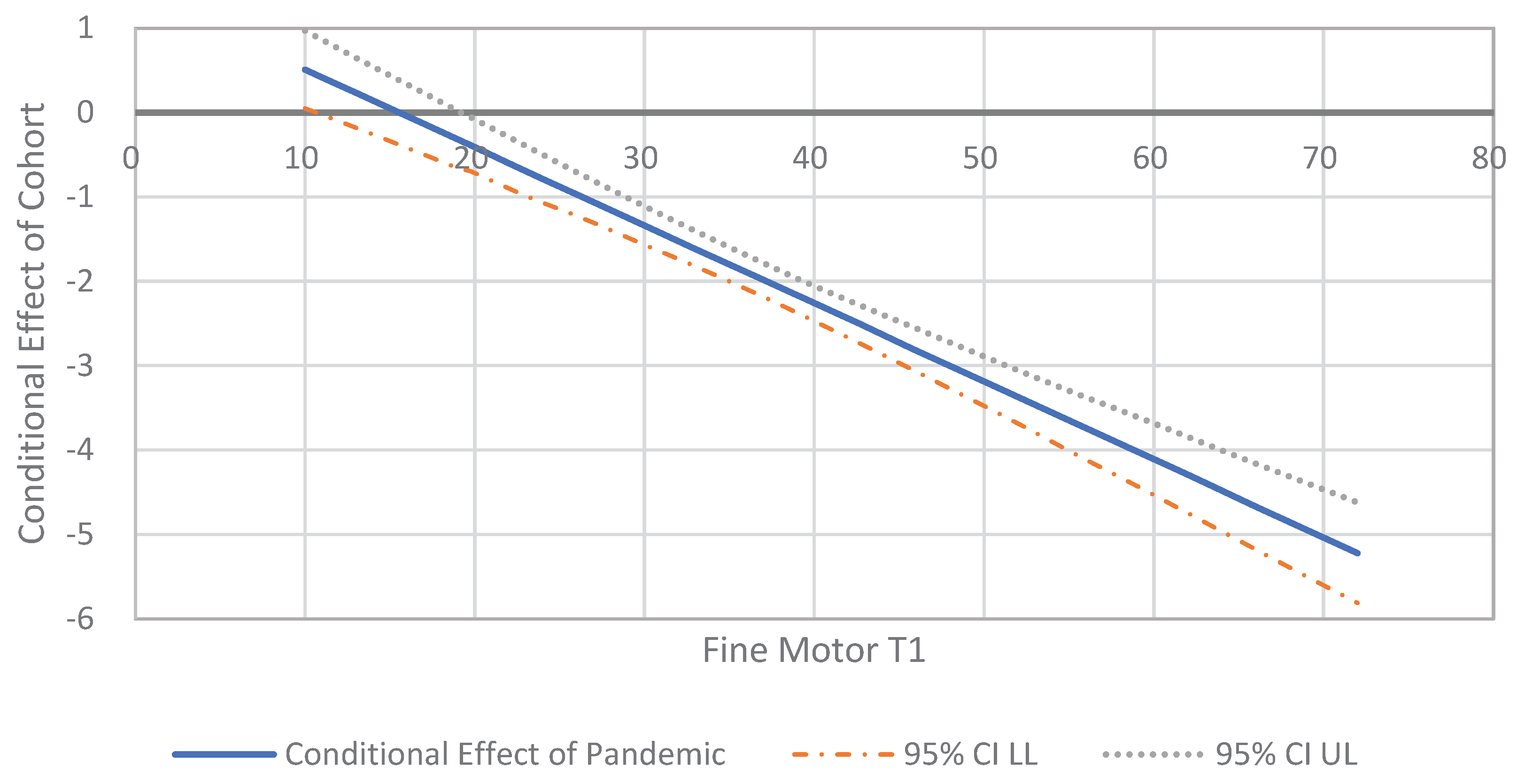

Table 1.
Demographic Information.
| Full Sample | Pre-pandemic | Pandemic | |||||
| n | % | n | % | n | % | ||
| Gender | Boy | 607 | 50.6 | 379 | 51.8 | 228 | 48.7 |
| Girl | 592 | 49.4 | 352 | 48.2 | 240 | 51.3 | |
| Parent | Two-parent | 1018 | 84.9 | 635 | 86.9 | 383 | 81.8 |
| Single-parent | 167 | 13.9 | 95 | 13.0 | 72 | 15.4 | |
| missing | 14 | 1.2 | 1 | 0.1 | 13 | 2.8 | |
| Family Structure | Nuclear | 1045 | 87.2 | 637 | 87.1 | 408 | 87.2 |
| Extended | 140 | 11.7 | 93 | 12.7 | 47 | 10.0 | |
| missing | 14 | 1.2 | 1 | 0.1 | 13 | 2.8 | |
| Sibling Presence | No | 498 | 41.5 | 274 | 37.5 | 224 | 47.9 |
| Yes | 686 | 57.2 | 455 | 62.2 | 231 | 49.4 | |
| missing | 15 | 1.3 | 2 | 0.3 | 13 | 2.8 | |
| Note. M: Mean, SD: Standard Deviation. Vocabulary: Expressive Vocabulary. T1 (pre-pandemic: 2017, pandemic: 2021), T2 (pre-pandemic:2019, pandemic:2023). | |||||||
Table 2.
Mann Whitney U Test Results for Fine Motor and Expressive Language by Cohort.
| Variables | M | SD | z | p |
| Age T1 | 33.84 | 12.26 | 3.99 | <.001 |
| Age T2 | 58.42 | 12.34 | 2.97 | .003 |
| Vocabulary T1 | 35.45 | 13.42 | -1.00 | .319 |
| Vocabulary T2 | 61.85 | 16.66 | -3.88 | <.001 |
| Fine Motor T1 | 35.75 | 13.07 | -2.39 | .017 |
| Fine Motor T2 | 61.10 | 14.49 | -4.01 | <.001 |
| ICCE | 11.74 | 1.20 | -0.09 | .927 |
| Note. T1 (pre-pandemic: 2017, pandemic: 2021), T2 (pre-pandemic:2019, pandemic:2023). ICCE: the Index of Child Care Environment | ||||
Table 3.
Hierarchical Regression Analysis Predicting T2 Expressive Vocabulary.
| Model 1 | Model 2 | Model 3 | ||||
| B (SE) | 95% CI | B (SE) | 95% CI | B (SE) | 95% CI | |
| (Constant) | 22.97 (1.00)*** | [21.00, 24.94] | 21.79 (3.09)*** | [15.73, 27.84] | 18.50 (3.08)*** | [12.45, 24.54] |
| Vocabulary (T1) | 0.80 (0.04)*** | [0.72, 0.87] | 0.80 (0.04)*** | [0.73, 0.87] | 0.46 (0.06)*** | [0.35, 0.56] |
| Gender | 2.32 (0.59)*** | [1.17, 3.48] | 2.34 (0.59)*** | [1.19, 3.50] | 2.44 (0.57)*** | [1.33, 3.56] |
| Age Group | 6.11 (1.01)*** | [4.14, 8.10] | 5.98 (1.01)*** | [4.01, 7.96] | 3.87 (1.00)*** | [1.90, 5.83] |
| Parent | -0.82 (0.88) | [-2.48, 0.94] | -0.54 (0.85) | [-2.19, 1.12] | ||
| Family Structure | -0.39 (0.91) | [-2.18, 1.40] | -0.57 (0.88) | [-2.30, 1.16] | ||
| Presence of Siblings | 1.51 (0.60)* | [0.33, 2.68] | 1.02 (0.58) | [-0.12, 2.17] | ||
| ICCE | 0.05 (0.25) | [-0.44, 0.53] | 0.21 (0.24) | [-0.26, 0.68] | ||
| Fine Motor (T1) | 0.50 (0.06)*** | [0.39, 0.61] | ||||
| Cohort | -1.83 (0.59)** | [-2.98, -0.67] | ||||
| Fine Motor(T1) x Cohort | -0.09 (0.05)* | [-0.18, -0.00] | ||||
| R2 | 0.645*** | 0.648 | 0.673*** | |||
| ΔR2 | 0.645 | 0.003 | 0.025 | |||
| Note. B: Unstandardized regression coefficients. SE: Standard Error. CI: Confidence Interval. Vocabulary: Expressive Vocabulary. T1 (pre-pandemic: 2017, pandemic: 2021) ICCE: the Index of Child Care Environment. *p<.05, **p<.001, ***p<.0001 | ||||||
Table 4.
Predicting Expressive Vocabulary Growth: Conditional Effect of the Pandemic Cohort.
| b | SE | p | 95%CI | |
| Cohort | 1.44 | 0.31 | <.001 | [.82, 2.04] |
| Fine Motor T1 | 0.50 | 0.01 | <.001 | [.48, .52] |
| Cohort x FM T1 | -0.09 | 0.01 | <.001 | [-.11, -.08] |
| Note. b: unstandardized coefficient; Effects represent the conditional effects of the pandemic cohort. SE: Standard Error. T1 (Pre-pandemic 2017, Pandemic 2021). FM: Fine Motor. R2 = .67, p <.001. Model was adjusted by Vocabulary, Gender, Two-parent household, Presence of Siblings, Age Group, and the Index of Child Care Environment. | ||||
Disclaimer/Publisher’s Note: The statements, opinions and data contained in all publications are solely those of the individual author(s) and contributor(s) and not of MDPI and/or the editor(s). MDPI and/or the editor(s) disclaim responsibility for any injury to people or property resulting from any ideas, methods, instructions or products referred to in the content. |
© 2026 by the authors. Licensee MDPI, Basel, Switzerland. This article is an open access article distributed under the terms and conditions of the Creative Commons Attribution (CC BY) license (http://creativecommons.org/licenses/by/4.0/).
Copyright: This open access article is published under a Creative Commons CC BY 4.0 license, which permit the free download, distribution, and reuse, provided that the author and preprint are cited in any reuse.