

Submitted:
22 May 2026
Posted:
25 May 2026
You are already at the latest version
Abstract
Telomeres and the extracellular matrix (ECM) are often studied as distinct contributors to aging and chronic diseases, yet growing evidence suggests they are deeply interconnected. This review explores the relationship between these two systems in both directions. Telomere shortening, shelterin defects, and loss of telomerase activity can promote senescence, stress responses, myofibroblast transition, and progressive matrix deposition. In turn, stiffness of the ECM, collagen-rich environments, and hyaluronan-linked signaling can shape telomerase activity, proliferative capacity, and telomere-associated damage responses. We bring together evidence from genetic mouse models, mechanistic cell-based studies, and human tissue analyses across the lung, kidney, vasculature, and heart to examine how telomere dysfunction and ECM remodeling influence one another during aging and disease progression. We focus on epithelial cells, fibroblasts, smooth muscle cells, and tubular cells, and discuss key pathways linking telomere biology and ECM regulation, including TRF1, TERT, TGF-β, cGAS–STING, VCAM-1, and mechanotransduction signaling. Taken together, the current findings suggest that telomere dysfunction is not only a marker of tissue aging but it is also an active driver of persistent ECM remodeling and fibrosis, while signals from the ECM can in turn influence telomere maintenance and cellular senescence. This bidirectional relationship provides a clearer framework for understanding how age-related cellular damage progresses into chronic tissue scarring.
Keywords:
telomere dysfunction
; extracellular matrix
; fibrosis
; cellular senescence
; matrix remodeling
; telomerase
; mechanotransduction
1. Introduction
Telomeres are specialized nucleoprotein structures located at the ends of chromosomes, where the shelterin complex protects chromosome integrity, and in select cell populations, telomerase counteracts repeat loss to maintain telomere length and genomic stability. When telomeres become critically short or structurally uncapped, a persistent DNA-damage response can be engaged, and cell fate can be shifted toward senescence, apoptosis, or loss of regenerative capacity. Telomere dysfunction is thus viewed not merely as a record of a cell’s replicative history but also as an active driver of age-related tissue damage and functional decline [1,2,3].
Fibrosis, in contrast, is characterized by maladaptive tissue repair in which excessive ECM deposition disrupts normal architecture, ultimately driving progressive functional impairment. The ECM is no longer considered a passive scaffold alone, because its composition, organization, crosslinking, and stiffness have all been shown to influence epithelial repair, fibroblast behaviour, immune-cell retention, and tissue mechanics in chronic diseases. Ageing has also been associated with ECM changes that favor a pro-fibrotic microenvironment, while senescent cells further alter ECM turnover through proteases, other ECM-associated proteins, and secreted mediators [4,5] Although telomere dysfunction and fibrosis have traditionally been studied independently, accumulating evidence increasingly highlights their interconnection, making such a separation difficult to maintain. In the lung, disorders of telomere biology represent one of the most well-defined genetic contexts in which fibrotic remodeling occurs, with mutations in telomerase-related genes accounting for a significant proportion of familial pulmonary fibrosis cases [6]. In experimental systems, pulmonary fibrosis has been reproduced either by critically short telomeres or by directly disrupting telomere protection in alveolar type II epithelial cells, suggesting that telomere dysfunction can be sufficient to initiate lung scarring rather than simply accompany it [7,8]. A similar shift has taken place in the kidney. Short and dysfunctional telomeres have been shown to sensitize renal tissue to fibrotic injury, and this link has later been extended by cell-specific models in which telomere dysfunction in renal fibroblasts or tubular epithelial cells has promoted fibrogenic change and kidney fibrosis [9,10,11].
Evidence in the opposite direction has also emerged, although it remains limited. Collagen-dependent signaling has been shown to activate hTERT-associated proliferative responses in vascular smooth muscle cells, while changes in ECM stiffness or compliance have been demonstrated to modulate telomerase-linked senescence programs and influence the pathways through which cells enter proliferative arrest [12,13]. A bidirectional relationship between telomere biology and ECM dynamics therefore needs to be taken into account. In this review, we evaluate the available evidence with particular emphasis on when telomere dysfunction acts upstream of ECM remodeling, when ECM-derived cues are positioned upstream of telomere biology, and which tissues and cell types currently provide the strongest support for each direction of this interaction.
Figure 1.
Bidirectional crosstalk between telomere dysfunction and ECM remodeling in tissue degeneration and fibrosis. This schematic illustrates the reciprocal relationship between telomere instability and ECM remodeling, highlighting a self-reinforcing cycle that contributes to impaired tissue regeneration and fibrotic progression. On the left, telomere dysfunction is represented by telomere shortening, shelterin complex loss, telomere uncapping, reduced telomerase activity (TERT), and accumulation of telomere-associated DNA damage, including disruption of protective proteins such as TRF1. These molecular alterations initiate cellular stress responses and genomic instability. Central cellular consequences include cellular senescence, impaired regenerative capacity, inflammatory signaling, and stress pathway activation. Key mediators involved in these shared responses include transforming growth factor-β (TGF-β), cGAS–STING signaling, and adhesion-related inflammatory pathways such as VCAM-1 expression. On the right, downstream extracellular matrix remodeling is characterized by increased collagen deposition (particularly collagen I), fibronectin accumulation, α-smooth muscle actin (α-SMA)–mediated myofibroblast differentiation, matrix stiffening, and progressive tissue scarring. A feedback pathway from ECM remodeling to telomere regulation is illustrated beneath the main flow, demonstrating how matrix stiffness, collagen-rich microenvironments, hyaluronan–RHAMM signaling, and altered mechanotransduction pathways influence cellular proliferation, telomerase activity, and telomere maintenance mechanisms. These feedback signals further promote proliferative arrest and telomere-associated DNA damage, reinforcing telomere dysfunction. Solid arrows indicate well-established mechanistic pathways, whereas dashed arrows represent emerging or partially characterized interactions. Together, this bidirectional model highlights how telomere dysfunction and ECM remodeling function as interconnected drivers of chronic tissue injury, fibrosis, and premature cellular aging. Created in BioRender. https://BioRender.com/ajjcl41.
Figure 1.
Bidirectional crosstalk between telomere dysfunction and ECM remodeling in tissue degeneration and fibrosis. This schematic illustrates the reciprocal relationship between telomere instability and ECM remodeling, highlighting a self-reinforcing cycle that contributes to impaired tissue regeneration and fibrotic progression. On the left, telomere dysfunction is represented by telomere shortening, shelterin complex loss, telomere uncapping, reduced telomerase activity (TERT), and accumulation of telomere-associated DNA damage, including disruption of protective proteins such as TRF1. These molecular alterations initiate cellular stress responses and genomic instability. Central cellular consequences include cellular senescence, impaired regenerative capacity, inflammatory signaling, and stress pathway activation. Key mediators involved in these shared responses include transforming growth factor-β (TGF-β), cGAS–STING signaling, and adhesion-related inflammatory pathways such as VCAM-1 expression. On the right, downstream extracellular matrix remodeling is characterized by increased collagen deposition (particularly collagen I), fibronectin accumulation, α-smooth muscle actin (α-SMA)–mediated myofibroblast differentiation, matrix stiffening, and progressive tissue scarring. A feedback pathway from ECM remodeling to telomere regulation is illustrated beneath the main flow, demonstrating how matrix stiffness, collagen-rich microenvironments, hyaluronan–RHAMM signaling, and altered mechanotransduction pathways influence cellular proliferation, telomerase activity, and telomere maintenance mechanisms. These feedback signals further promote proliferative arrest and telomere-associated DNA damage, reinforcing telomere dysfunction. Solid arrows indicate well-established mechanistic pathways, whereas dashed arrows represent emerging or partially characterized interactions. Together, this bidirectional model highlights how telomere dysfunction and ECM remodeling function as interconnected drivers of chronic tissue injury, fibrosis, and premature cellular aging. Created in BioRender. https://BioRender.com/ajjcl41.
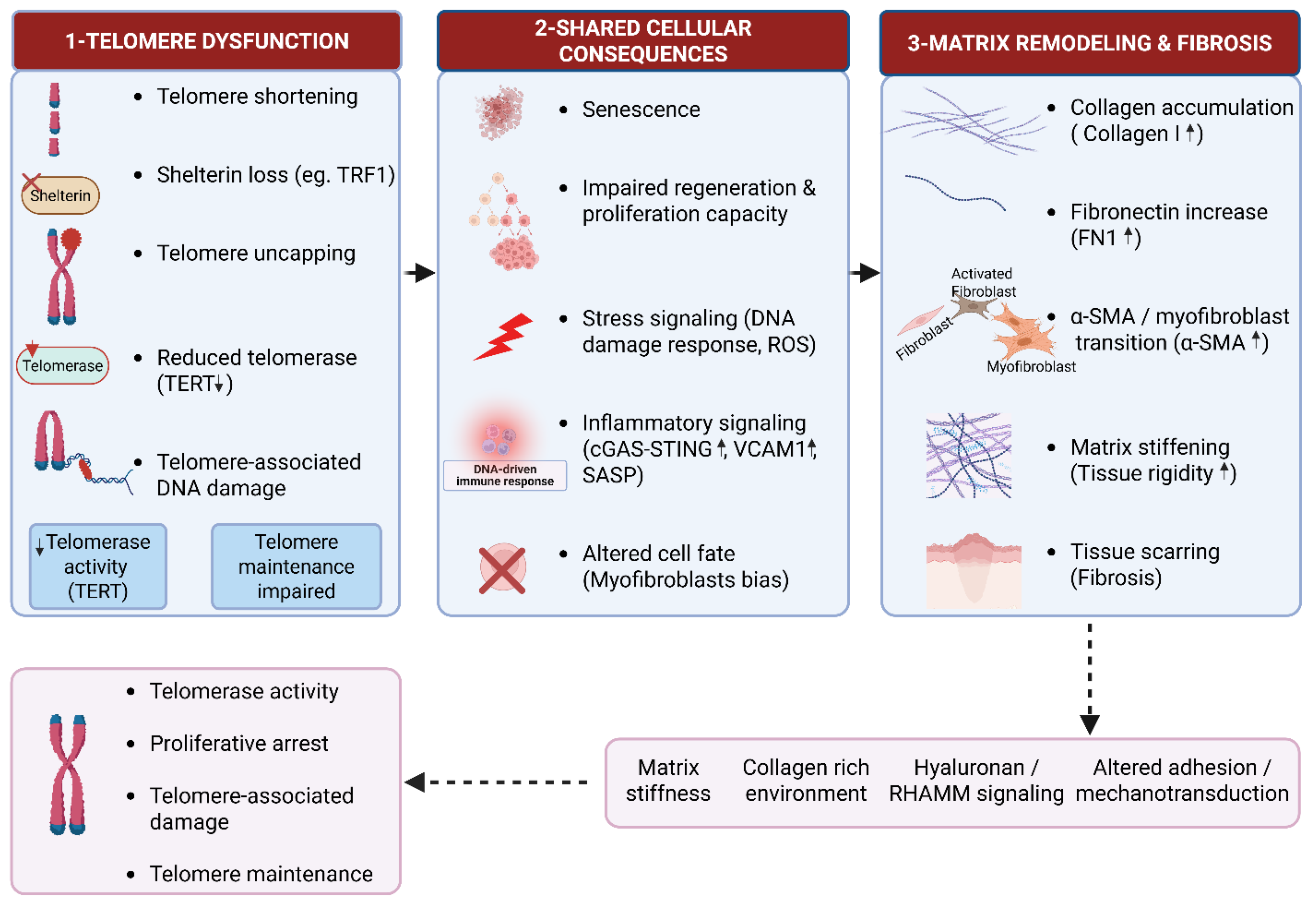
Figure 2.
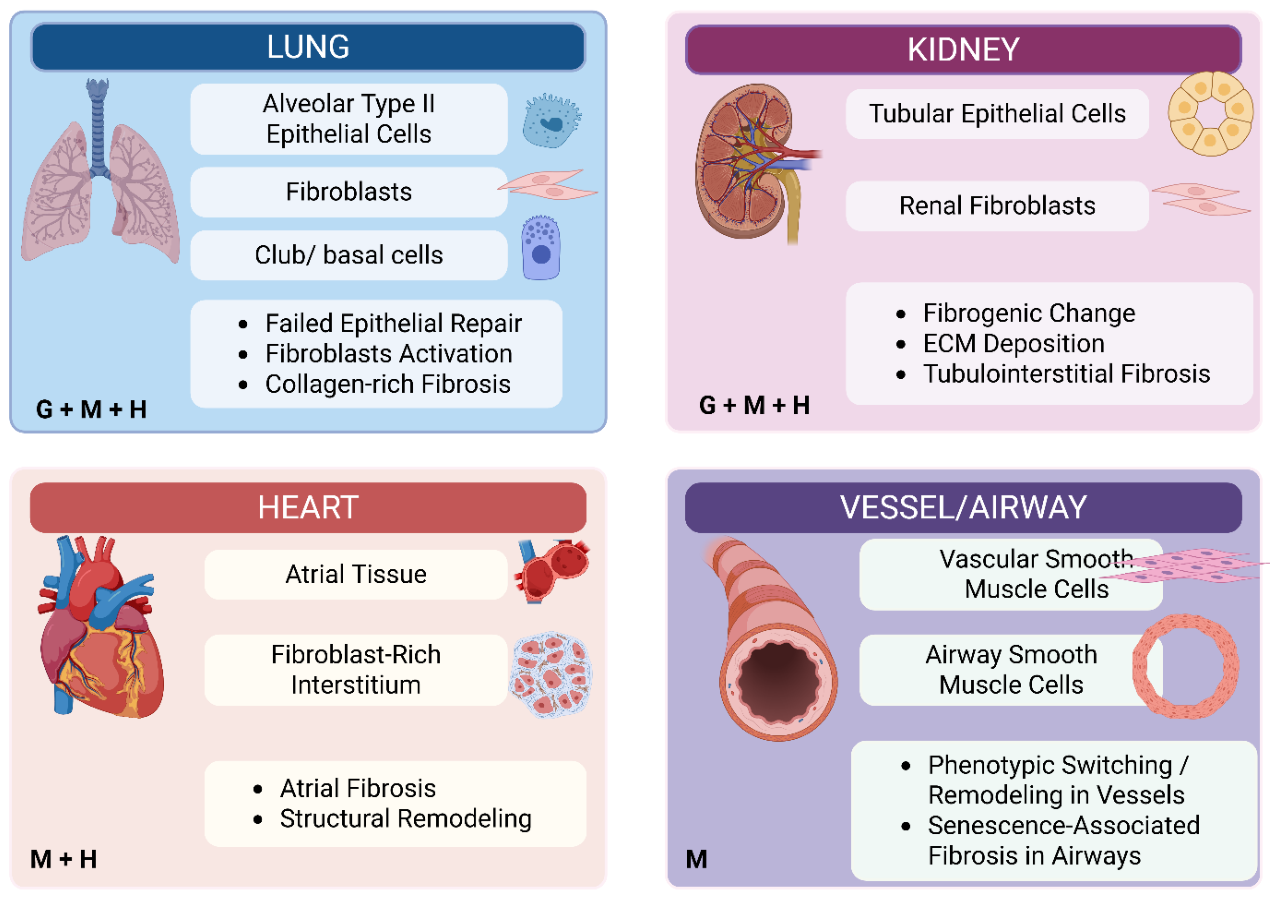
Tissue and cell-type map highlighting the strongest evidence across organ systems. This schematic illustrates the distribution of evidence for ECM dysregulation across four representative organ panels: lung, kidney, heart, and vessel/airway. Each panel contains a simplified organ sketch with key cell types and outputs. The lung panel, given the strongest evidence base, emphasizes alveolar type II epithelial cells, fibroblasts, and club/basal cells, with outputs including failed epithelial repair, fibroblast activation, and collagen-rich fibrosis. The kidney panel highlights tubular epithelial cells and renal fibroblasts, associated with fibrogenic change, ECM deposition, and tubulointerstitial fibrosis. The heart panel focuses on atrial tissue and fibroblast-rich interstitium, demonstrating atrial fibrosis and structural remodeling. The vessel/airway panel depicts vascular and airway smooth muscle cells, with phenotypic switching, remodeling, and senescence-associated fibrosis. Evidence markers (G = genetic, M = mechanistic, H = human/translational) are included within each panel to indicate the type and strength of the supporting data. Created in BioRender. https://BioRender.com/h2xvltl.
Figure 2.
Tissue and cell-type map highlighting the strongest evidence across organ systems. This schematic illustrates the distribution of evidence for ECM dysregulation across four representative organ panels: lung, kidney, heart, and vessel/airway. Each panel contains a simplified organ sketch with key cell types and outputs. The lung panel, given the strongest evidence base, emphasizes alveolar type II epithelial cells, fibroblasts, and club/basal cells, with outputs including failed epithelial repair, fibroblast activation, and collagen-rich fibrosis. The kidney panel highlights tubular epithelial cells and renal fibroblasts, associated with fibrogenic change, ECM deposition, and tubulointerstitial fibrosis. The heart panel focuses on atrial tissue and fibroblast-rich interstitium, demonstrating atrial fibrosis and structural remodeling. The vessel/airway panel depicts vascular and airway smooth muscle cells, with phenotypic switching, remodeling, and senescence-associated fibrosis. Evidence markers (G = genetic, M = mechanistic, H = human/translational) are included within each panel to indicate the type and strength of the supporting data. Created in BioRender. https://BioRender.com/h2xvltl.
2. Telomere Biology and ECM Biology
Telomere integrity is maintained by a specialized protein complex assembled at chromosome ends, where shelterin components prevent telomeres from being recognized as DNA damage and thereby preserve chromosome stability. Telomere length is shaped by incomplete end replication, nucleolytic processing, oxidative injury, and replication stress, whereas telomerase can compensate for repeat loss in selected stem, progenitor, germline, and activated cell populations. For that reason, telomere dysfunction cannot be reduced to telomere shortening alone, as structurally compromised telomeres may also occur despite preserved length and can still activate a persistent DNA damage response [1,2].
Once telomere protection is lost, checkpoint signaling is engaged and cell fate is often redirected toward senescence, apoptosis, or impaired self-renewal rather than productive tissue repair [1,2]. Among these outcomes, cellular senescence is particularly relevant to tissue remodeling because senescent cells, despite their long-lived arrest, remain metabolically active and can reshape their microenvironment through the secretion of inflammatory mediators, growth factors, ECM components, and matrix-modifying enzymes. Telomere dysfunction therefore occupies a position in which cell-intrinsic mechanisms of genome protection are translated into tissue-level alterations in repair processes and fibrotic scarring [2,5].
ECM, in turn, is a dynamic, tissue-specific network rather than a static structural scaffold. Its major constituents are collagens, elastin and microfibrillar proteins, proteoglycans including hyaluronan, glycoproteins, and associated regulatory proteins, which together define both the biochemical identity and the physical properties of a tissue [14,15]. The architecture of the ECM is continuously reshaped by secretion, assembly, proteolysis, crosslinking, and post-translational modification, so that the composition and mechanics of the ECM are both under active biological control [15]. In disease, these processes can become uncoupled from normal repair and produce an ECM that is denser, stiffer, compositionally altered, and more permissive for persistent fibrogenic signaling [5,15].
Cellular responses to the ECM are mediated primarily through integrins and associated adhesion complexes, which physically and biochemically link extracellular ligands to the actin cytoskeleton, intracellular signaling cascades, and ultimately the nucleus [16]. Through these adhesions, matrix stiffness, ligand density, topography, and force transmission can influence proliferation, differentiation, migration, and survival, while broader tissue-scale mechanical transitions can alter genome activity and cell state [16,17].
Taken together, these fundamental principles render a functional interaction between telomere biology and ECM biology biologically plausible, even prior to consideration of disease-specific evidence. Telomeres regulate a cell’s capacity to sustain division and tolerate genomic stress, whereas the ECM defines the structural and mechanical context in which tissue repair and regeneration occur. A durable repair response would therefore be expected to depend on both systems remaining intact, and persistent remodeling is expected when either one is chronically disturbed [1,15,17].
3. Telomere Dysfunction at Upstream of ECM Remodeling
Direct evidence that primary perturbation of the telomere axis can precede ECM remodeling has been obtained mainly from lung and kidney models, with more recent studies extending this principle to cardiac remodeling. The lung literature is the most well-developed, but it has also made it clear that the biological outcome depends on the cell type in which the telomere pathway is disturbed. In lung fibroblasts, telomerase activity has been shown to limit α-smooth muscle actin expression and inhibit myofibroblast differentiation in vitro [18]. In vivo, however, whole-body or mesenchymal-specific TERT deficiency has been shown to attenuate bleomycin-induced hydroxyproline accumulation, collagen deposition, and fibrotic remodeling, indicating that the telomere axis can actively support ECM remodeling in mesenchymal compartments, even while telomere dysfunction in epithelial compartments drives tissue injury and scarring [19,20].
The strongest pro-fibrotic evidence has emerged from epithelial models. Critically short telomeres, direct telomere uncapping, or loss of telomere protection in alveolar type II cells have each been shown to precede the development of collagen-rich pulmonary fibrosis, rather than merely occurring as a consequence of it [7,8,21]. This principle has further been reinforced by subsequent studies showing that alveolar epithelial type II cell-specific TERT loss heightened susceptibility to bleomycin-induced injury, airway epithelial TRF1 deletion triggered airway-centered remodeling, and telomerase restoration mitigated age-associated pro-fibrotic changes in lung tissue [22,23,24]. Telomere dysfunction in fibroblasts, club cells, or basal cells can alter the fibrotic response to lung injury, although the specific pattern of remodeling still depends on the affected cell compartment and the nature of the injurious stimulus [25]. Comparable causal evidence has now emerged in the kidney, where short or dysfunctional telomeres have been shown to increase susceptibility to folic-acid-induced renal fibrosis in vivo [9]. That observation has been further refined by cell-specific models showing that TRF1 loss in renal fibroblasts or tubular epithelial cells can promote fibrogenic changes, ECM accumulation, and kidney fibrosis [10,11]. Beyond the lungs and kidneys, literature is still more limited, but it has grown enough that evidence can no longer be considered negligible. In silica-associated pulmonary fibrosis, TERF1 deficien [26]. In atrial fibrillation, telomere shortening—observed both in human tissue and in telomerase-deficient mice—has been linked to structural remodeling via VCAM [27] (representative studies are listed in Table 1).
4. Non-Telomeric Upstream Factors Acting Through Telomere Pathways
Evidence supporting the reverse causal direction—where ECM changes influence telomere biology—remains limited, but it is becoming increasingly coherent. In these studies, the initiating signal arises from ECM-derived cues rather than from a primary telomere lesion. Specifically, an extracellular cue, ECM property, paracrine factor, or pharmacologic agent is positioned upstream, and a telomere-associated component has been shown to mediate or modulate the resulting alterations in cell state or tissue remodeling. This pattern has first been demonstrated in lung fibroblasts, where telomerase activity was upregulated by basic fibroblast growth factor and downregulated by interleukin 4 [28]. Under the same conditions, α-smooth muscle actin expression and myofibroblast differentiation have been found to shift in the opposite direction suggesting that telomerase can function as a relay between soluble signaling and fibrogenic cell-state change [18,28]. A related principle has later been reported in vascular smooth muscle cells, where fibrillar collagen-supported proliferation has been shown to depend on hTERT and c-Myc, indicating that a structural ECM ligand can influence growth behavior through telomerase-linked mechanisms [12].
Subsequently, both the composition and mechanical properties of the ECM have been implicated in modulating telomere biology. On hyaluronan-coated surfaces, mesenchymal stem cells are maintained in a slower-cycling state with higher telomerase activity and preserved replicative potential [29]. In nucleus pulposus cells, substrate stiffness can alter senescence together with telomerase activity, and this phenotype is partly alleviated by lysyl oxidase treatment [30]. In WI-38 fibroblasts, ECM softening alters the pathway by which cells enter proliferative arrest, and many of these effects are mitigated by hTERT expression, positioning telomerase-sensitive regulation within a mechanobiological context rather than a purely replicative framework [13].
Non-matrix extracellular signals have also been linked to telomere factors in disease models. In tubular epithelial cells, macrophage-derived exosomal miR-155 has been shown to target TRF1, causing telomere fragility, senescence, fibronectin induction, and α-smooth muscle actin upregulation in a renal injury setting [31]. In vascular smooth muscle cells exposed to oleic acid, metformin increases TERT expression, telomerase activity, and telomere stability while reducing collagen type I, MMP-2, and other markers of phenotypic switching; these effects are attenuated by TERT knockdown [32]. A more direct ECM receptor link has been reported in mouse embryonic fibroblasts, where a truncated RHAMM isoform increases TERT expression, telomerase activity, and selective shelterin transcripts, thereby connecting hyaluronan signaling to telomere maintenance machinery [33]. (representative studies are listed in Table 2).
5. Mechanisms Connecting Telomere Dysfunction to ECM Change
Several routes have been proposed by which telomere dysfunction is converted into ECM change. The broadest route passes through a persistent DNA-damage response and senescence. Telomeric lesions are known to trigger persistent checkpoint activation and a senescence-associated secretory phenotype, and senescent cells, in turn, have been shown to modulate ECM turnover through the secretion of cytokines, growth factors, proteases, and matrix proteins [2,5]. In this way, ECM remodeling can be perpetuated even when the initially damaged cells remain present and are not immediately cleared.
A second route is the failure of epithelial renewal. In the alveolar compartment, telomerase deficiency or telomere dysfunction has been shown to induce progenitor senescence, impair regenerative capacity, and increase susceptibility to bleomycin injury, thereby favoring fibroproliferative repair over effective re-epithelialization [34]. This mechanism is important because fibrosis does not arise solely from ECM-producing cells but also from a persistent failure to restore a functional epithelial barrier.
More direct pro-fibrotic signaling has also been described. In lungs with short telomeres, increased TGF-β1, Smad activation, α-smooth muscle actin, collagen type I, and hydroxyproline have been detected after injurious challenge, placing canonical TGF-β signaling downstream of telomere shortening [35]. In parallel, FBW7-dependent degradation of TPP1 has been shown to trigger telomere uncapping, DNA-damage signaling, cellular senescence, and pulmonary fibrosis under radiation, oxidative stress, or bleomycin exposure [21].
Inflammatory and innate immune routes are now being added to this picture. In kidney tubular cells, macrophage-derived exosomal miR-155 can directly target TRF1 and produce telomere fragility, senescence, fibronectin induction, and α-smooth muscle actin upregulation [31]. In silica-associated pulmonary fibrosis, telomere dysfunction has been linked to cGAS-STING activation together with collagen accumulation and α-smooth muscle actin expression [26]. In aged atrial tissue, a telomere shortening–VCAM-1 axis has been reported, and VCAM-1 inhibition reduces fibrosis and normalizes ECM-related genes such as the gene encoding the α1 chain of type I collagen and the α-smooth muscle actin gene [27] (examples are summarized in Table 3).
6. Tissue Specific and Translational Evidence
The most compelling tissue-level evidence comes from the lung. Integrating human genetics, family-based studies, and tissue analyses have established telomere dysfunction as one of the clearest predisposing factors for fibrotic lung disease, particularly in familial pulmonary fibrosis and related interstitial lung disorders. A central role has been assigned to alveolar type II cells, in which short or dysfunctional telomeres have been linked to defective epithelial maintenance and fibrotic remodeling rather than to a purely incidental ageing signal [6,7,8]. This translational link has been extended by human biopsy material, where short telomeres in alveolar type II cells have been associated with fibrotic parenchymal remodeling in post-COVID lungs [36]. A related, yet more spatially restricted, pattern has been observed in airway disease, where telomere dysfunction in specific epithelial compartments contributes to localized remodeling and fibrosis. In elderly patients with asthma, increased airway fibrosis has been accompanied by elevated telomere-associated foci and other senescence markers in airway smooth muscle cells, indicating that the link between telomere dysfunction and tissue remodeling extends beyond the distal lung parenchyma [37]. However, evidence in the airways remains largely correlative, and causal relationships between telomere dysfunction and localized remodeling have yet to be firmly established.
In the kidney, the evidence has until recently been driven mainly by experimental models, but its tissue resolution has improved substantially. Short or dysfunctional telomeres have been shown to sensitize renal tissue to fibrotic injury, and that signal has since been localized to both renal fibroblasts and tubular epithelial cells by cell-specific TRF1 deletion models [9,10,11]. Human translational evidence is beginning to emerge in the kidney as well. Shorter telomere length in renal tissue has recently been linked to nephrosclerosis and structural decline, whereas leukocyte telomere length has been less predictive of these tissue-level changes [38].
Cardiac evidence has also become more convincing. In patients with atrial fibrillation, shorter telomeres have been associated with adverse left atrial remodeling, an effect further supported by studies in a telomerase-deficient mouse model, where VCAM-1–dependent fibrosis and structural remodeling are increased [27,39]. By contrast, the vascular literature has remained more mechanistic than clinical, with most studies centered on smooth muscle phenotype and atherosclerosis-related remodeling rather than on direct human fibrosis phenotypes [12,32]. Overall, the translational weight is currently highest in lung diseases, increasingly strong in kidney diseases, and emerging in the heart (examples summarized in Table 4).
7. Conclusions
A growing and consistent body of evidence now supports the view that telomere dysfunction can act upstream of ECM remodeling, rather than functioning solely as a passive marker of aging. This conclusion is best supported in the lung and kidney, where short telomeres, telomerase deficiency, or disruption of telomere protection have been shown in cell-specific experimental systems to promote epithelial failure, ECM accumulation, fibrogenic change, and tissue scarring [6,7,8,9,10,11]. In the heart, a comparable connection is beginning to emerge, although the supporting evidence remains more limited [27,39].
At the same time, this relationship cannot be considered strictly unidirectional. ECM composition, stiffness, and matrix-associated signaling have been shown to influence telomerase activity, telomere-linked senescence programs, and the route taken toward proliferative arrest, which indicates that telomere maintenance is responsive to the local extracellular environment [12,13,30,33]. However, evidence for this reverse direction remains limited to fewer systems and disease models, and it has not yet been characterized with the same depth as telomere-driven fibrosis.
Several points appear settled; first, telomere dysfunction should not be understood only as telomere shortening, because uncapping, shelterin loss, and telomere-associated DNA damage can also drive pathological outcomes [1,2]. Second, the biological effect is cell-type dependent. Epithelial telomere dysfunction has generally been linked to failed tissue maintenance and secondary fibrosis, whereas mesenchymal and vascular studies have shown that telomerase-related programs can also directly influence proliferation, phenotype switching, and ECM production [20,32]. Third, the most plausible connecting routes include senescence, defective regeneration, TGF-β signaling, innate immune sensing, and adhesion-related inflammatory signaling [5,26,27,31].
The field continues to exhibit notable gaps: direct causal evidence is concentrated in a few tissues, studies in which ECM-derived cues act upstream of telomere biology remain relatively sparse, and human data are unevenly distributed across organ systems. Thus, further studies are needed in which telomere status, ECM composition and mechanical properties, and cell identity are assessed concurrently within the same experimental model. If such studies are conducted with higher cell-type resolution, it should become possible to distinguish when telomere damage acts as a primary driver of remodeling, when it functions as a secondary amplifier, and when ECM-derived signals feedback to influence telomere maintenance.
References
- Jones-Weinert, C.; Mainz, L.; Karlseder, J. Telomere function and regulation from mouse models to human ageing and disease. Nat. Rev. Mol. Cell Biol. 2025, 26, 297–313. [Google Scholar] [CrossRef]
- Rossiello, F. Telomere dysfunction in ageing and age-related diseases. Nat. Cell Biol. 2022, 24, 135–147. [Google Scholar] [CrossRef]
- Ahi, E.P.; Ghasemishahrestani, Z. Epitranscriptomic control of telomere maintenance. Mol. Biol. Rep. 2026, 53(1). [Google Scholar] [CrossRef]
- Burgess, J.K. Extracellular Matrix as a Driver of Chronic Lung Diseases. Am. J. Respir. Cell Mol. Biol. 2024, 70, 239–246. [Google Scholar] [CrossRef]
- Mebratu, Y.A. The aged extracellular matrix and the profibrotic role of senescence-associated secretory phenotype. Am. J. Physiol.-Cell Physiol. 2023, 325, C565–C579. [Google Scholar] [CrossRef]
- Alder, J.K.; Armanios, M. Telomere-Mediated Lung Disease. Physiol. Rev. 2022, 102, 1703–1720. [Google Scholar] [CrossRef]
- Povedano, J.M. Mice with Pulmonary Fibrosis Driven by Telomere Dysfunction. Cell Rep. 2015, 12, 286–299. [Google Scholar] [CrossRef]
- Naikawadi, R.P. Telomere dysfunction in alveolar epithelial cells causes lung remodeling and fibrosis. Jci Insight 2016, 1(14). [Google Scholar] [CrossRef]
- Saraswati, S. Short and dysfunctional telomeres sensitize the kidneys to develop fibrosis. Nat. Aging 2021, 1, 269–+. [Google Scholar] [CrossRef]
- Saraswati, S. Renal fibroblasts are involved in fibrogenic changes in kidney fibrosis associated with dysfunctional telomeres. Exp. Mol. Med. 2024, 56, 2216–2230. [Google Scholar] [CrossRef] [PubMed]
- Saraswati, S. Telomere Dysfunction in Renal Tubular Epithelial Cells Leads to Kidney Fibrosis. J. Am. Soc. Nephrol. 2025, 36, 2348–2363. [Google Scholar] [CrossRef]
- Wang, W.L. Regulation of fibrillar collagen-mediated smooth muscle cell proliferation in response to chemical stimuli by telomere reverse transcriptase through c-Myc. Biomaterials 2014, 35, 3829–3839. [Google Scholar] [CrossRef]
- Kaiser, A.M. Substrate stiffness dictates unique paths towards proliferative arrest in WI-38 cells. Geroscience 2025. [Google Scholar] [CrossRef]
- Karamanos, N.K. A guide to the composition and functions of the extracellular matrix. Febs J. 2021, 288, 6850–6912. [Google Scholar] [CrossRef]
- Naba, A. Mechanisms of assembly and remodelling of the extracellular matrix. Nat. Rev. Mol. Cell Biol. 2024, 25, 865–885. [Google Scholar] [CrossRef]
- Kanchanawong, P.; Calderwood, D.A. Organization, dynamics and mechanoregulation of integrin-mediated cell-ECM adhesions. Nat. Rev. Mol. Cell Biol. 2023, 24, 142–161. [Google Scholar] [CrossRef]
- Mao, Y.L.; Wickström, S.A. Mechanical state transitions in the regulation of tissue form and function. Nat. Rev. Mol. Cell Biol. 2024, 25, 654–670. [Google Scholar] [CrossRef]
- Liu, T. Telomerase regulation of myofibroblast differentiation. Am. J. Respir. Cell Mol. Biol. 2006, 34, 625–633. [Google Scholar] [CrossRef]
- Liu, T.J. Telomerase activity is required for bleomycin-induced pulmonary fibrosis in mice. J. Clin. Investig. 2007, 117, 3800–3809. [Google Scholar] [CrossRef]
- Liu, T.J. Conditional Knockout of Telomerase Reverse Transcriptase in Mesenchymal Cells Impairs Mouse Pulmonary Fibrosis. PLoS ONE 2015, 10(11). [Google Scholar] [CrossRef]
- Wang, L.H. FBW7 Mediates Senescence and Pulmonary Fibrosis through Telomere Uncapping. Cell Metab. 2020, 32, 860–+. [Google Scholar] [CrossRef]
- Liu, T.J. Telomerase reverse transcriptase ameliorates lung fibrosis by protecting alveolar epithelial cells against senescence. J. Biol. Chem. 2019, 294, 8861–8871. [Google Scholar] [CrossRef]
- Naikawadi, R.P. Airway Epithelial Telomere Dysfunction Drives Remodeling Similar to Chronic Lung Allograft Dysfunction. Am. J. Respir. Cell Mol. Biol. 2020, 63, 490–501. [Google Scholar] [CrossRef]
- Piñeiro-Hermida, S. Telomerase treatment prevents lung profibrotic pathologies associated with physiological aging. J. Cell Biol. 2020, 219(10). [Google Scholar] [CrossRef]
- Piñeiro-Hermida, S. Consequences of telomere dysfunction in fibroblasts, club and basal cells for lung fibrosis development. Nat. Commun. 2022, 13(1). [Google Scholar] [CrossRef]
- Qian, Q.Q. Silica-induced telomere dysfunction promotes pulmonary fibrosis through the activation of the cGAS-STING pathway. Toxicology 2026, 523. [Google Scholar] [CrossRef]
- Wang, Z.J. Telomere Shortening Drives Atrial Fibrillation Through VCAM-1 Mediated Atrial Electrical and Structural Remodeling. Aging Cell 2026, 25(2). [Google Scholar] [CrossRef]
- Liu, T.J.; Nozaki, Y.; Phan, S.H. Regulation of telomerase activity in rat lung fibroblasts. Am. J. Respir. Cell Mol. Biol. 2002, 26, 534–540. [Google Scholar] [CrossRef]
- Wong, T.Y. Hyaluronan keeps mesenchymal stem cells quiescent and maintains the differentiation potential over time. Aging Cell 2017, 16, 451–460. [Google Scholar] [CrossRef]
- Zhao, R.Z. Nucleus pulposus cell senescence is regulated by substrate stiffness and is alleviated by LOX possibly through the integrin β1-p38 MAPK signaling pathway. Exp. Cell Res. 2022, 417(2). [Google Scholar] [CrossRef]
- Yin, Q. Macrophage-derived exosomes promote telomere fragility and senescence in tubular epithelial cells by delivering miR-155. Cell Commun. Signal. 2024, 22(1). [Google Scholar] [CrossRef] [PubMed]
- Sung, J.Y. Telomere stabilization by metformin mitigates the progression of atherosclerosis via the AMPK-dependent p-PGC-1α pathway. Exp. Mol. Med. 2024, 56, 1967–1979. [Google Scholar] [CrossRef] [PubMed]
- Basu, K. The truncated isoform of the receptor for hyaluronan mediated motility (RHAMM) modulates shelterin and telomerase reverse transcriptase transcription affecting telomerase activity. Front. Aging 2025, 6. [Google Scholar] [CrossRef]
- Alder, J.K. Telomere dysfunction causes alveolar stem cell failure. Proceedings of the National Academy of Sciences of the United States of America 2015, 112, 5099–5104. [Google Scholar] [CrossRef]
- Liu, Y.Y. Telomere shortening activates TGF-β/Smads signaling in lungs and enhances both lipopolysaccharide and bleomycin-induced pulmonary fibrosis. Acta Pharmacol. Sin. 2018, 39, 1735–1745. [Google Scholar] [CrossRef]
- Martínez, P. Short telomeres in alveolar type II cells associate with lung fibrosis in post COVID-19 patients with cancer. Aging-Us 2023, 15, 4625–4641. [Google Scholar] [CrossRef]
- Aghali, A. Cellular senescence is increased in airway smooth muscle cells of elderly persons with asthma. Am. J. Physiol.-Lung Cell. Mol. Physiol. 2022, 323, L558–L568. [Google Scholar] [CrossRef]
- Akinnibosun, O.A. Shorter kidney telomeres are associated with nephrosclerosis by an epigenetic signature. Cardiovasc. Res. 2026, 122, 607–620. [Google Scholar] [CrossRef]
- Pradhan, K. Telomere Length Is Associated With Adverse Atrial Remodeling in Patients With Atrial Fibrillation. J. Am. Heart Assoc. 2025, 14(3). [Google Scholar] [CrossRef] [PubMed]
- Pérez-Rivero, G. Telomerase deficiency promotes oxidative stress by reducing catalase activity. Free Radic. Biol. Med. 2008, 45, 1243–1251. [Google Scholar] [CrossRef]

Table 1.
Primary telomere perturbation studies showing telomere-axis control of ECM remodeling or fibrosis. Studies in which the initiating lesion or intervention is in telomere biology itself, with ECM remodeling read out downstream. Directness indicates the level of causal support provided by the study design, with direct mechanism referring to perturbation-based mechanistic evidence, direct genetic to gene-targeted causal models, and direct mechanistic / translational to studies combining mechanistic models with human disease relevance.
Table 1.
Primary telomere perturbation studies showing telomere-axis control of ECM remodeling or fibrosis. Studies in which the initiating lesion or intervention is in telomere biology itself, with ECM remodeling read out downstream. Directness indicates the level of causal support provided by the study design, with direct mechanism referring to perturbation-based mechanistic evidence, direct genetic to gene-targeted causal models, and direct mechanistic / translational to studies combining mechanistic models with human disease relevance.
| Telomere perturbation | ECM / remodeling readout | System / model | Directness | Reference |
|---|---|---|---|---|
| Telomerase inhibition by AZT / antisense | α-SMA induction & myofibroblast shift | Rat lung fibroblasts | Direct mechanistic | [18] |
| TERT deficiency | Lung fibrosis, α-SMA & hydroxyproline | Bleomycin mouse lung fibrosis; BM chimera rescue | Direct genetic | [19] |
| Terc−/− / telomerase deficiency | TGF-β1, fibronectin & ECM proteins | Mouse renal cortex | Direct genetic / mechanistic | [40] |
| Critically short telomeres or ATII-cell Trf1 deletion | Pulmonary fibrosis | Telomerase-deficient mice + low-dose bleomycin; ATII-specific Trf1 deletion | Direct genetic | [7] |
| Mesenchymal-cell TERT deletion | Type I collagen, α-SMA & hydroxyproline | Mesenchymal-specific TERT knockout; bleomycin mouse | Direct genetic | [20] |
| ATII-cell TRF1 deletion | Collagen deposition & mesenchymal expansion | Type II alveolar epithelial cell-specific Trf1 deletion | Direct genetic | [8] |
| Short telomeres (G3 Terc−/−) | TGF-β1, pSmad3, α-SMA, collagen I & hydroxyproline | LPS + low-dose bleomycin lung fibrosis | Direct genetic / mechanistic | [35] |
| AECII-specific TERT deletion | Increased bleomycin-induced fibrosis | AECII-specific TERT knockout | Direct genetic | [22] |
| FBW7 → TPP1 loss; telomere uncapping | Pulmonary fibrosis & senescence | Radiation, oxidative stress & bleomycin models | Direct mechanistic | [21] |
| Club-cell TRF1 deletion | Peribronchiolar collagen & airway fibrosis | SCGB1a1-cre Trf1 mouse | Direct genetic | [23] |
| AAV9-Tert gene therapy | Reduced fibroblast activation & collagen deposition | Aged WT + telomerase-deficient mice | Direct pharmacologic / genetic rescue | [24] |
| Short telomeres or kidney Trf1 deletion | Kidney fibrosis & EMT-like program | Telomerase-deficient mice + folic acid; kidney Trf1 deletion | Direct genetic | [9] |
| TRF1 loss in fibroblasts / club / basal cells | Injury-enhanced collagen / fibrotic gene response | Conditional lung cell-specific Trf1 deletion | Direct genetic | [25] |
| Fibroblast-specific TRF1 deletion | ECM deposition & fibrogenesis | Renal fibroblast-specific Trf1 deletion | Direct genetic | [10] |
| Tubular epithelial TRF1 deletion | Tubulointerstitial fibrosis & ECM accumulation | Renal tubular epithelial-specific Trf1 deletion | Direct genetic | [11] |
| TERF1 deficiency; telomere instability | Collagen accumulation & α-SMA induction | Silica-associated pulmonary fibrosis | Direct mechanistic | [26] |
| Telomerase deficiency / telomere shortening; VCAM-1 axis | Atrial fibrosis & structural remodeling | Human AF + telomerase-deficient mouse model | Direct mechanistic / translational | [27] |
Table 2.
Representative studies in which non-telomeric upstream factors acted through telomere pathways.
Table 2.
Representative studies in which non-telomeric upstream factors acted through telomere pathways.
| Upstream factor | Telomere readout | ECM / cell-state output | System / model | Reference |
|---|---|---|---|---|
| bFGF & IL-4 | Telomerase activity | Myofibroblast precursor state | Rat lung fibroblasts | [28] |
| Telomerase-modulating cytokine setting | Telomerase inhibition or induction | α-SMA & myofibroblast differentiation | Rat lung fibroblasts | [18] |
| Fibrillar collagen | hTERT & c-Myc dependence | Collagen-driven SMC proliferation | Human VSMCs | [12] |
| Hyaluronan-coated surface | Telomerase activity | Quiescence & preserved replicative capacity | Human placenta-derived MSCs | [29] |
| Matrix stiffness & LOX | Telomerase activity | Senescence-associated cell-state change | Rat nucleus pulposus cells | [30] |
| Macrophage exosomal miR-155 | TRF1, telomere fragility & shortening | Fibronectin, α-SMA & tubular senescence | Tubular epithelial cells + AngII injury | [31] |
| Metformin | TERT, telomerase activity & telomere length | Collagen I, elastin, α-SMA & MMP-2 | VSMCs + ApoE KO mice | [32] |
| RHAMM / hyaluronan signaling | Tert, telomerase, Tpp1 & Pot1a | Telomere-linked cell-state regulation | Mouse embryonic fibroblasts | [33] |
| Matrix softening | hTERT-sensitive arrest trajectory | Proliferative arrest state | WI-38 fibroblasts | [13] |
Table 3.
Mechanistic routes linking telomere dysfunction to ECM change.
| Mechanistic route | Telomere lesion or node | Main downstream ECM effect | Representative system | Reference(s) |
|---|---|---|---|---|
| Senescence & SASP | Telomere shortening / damage | Matrix proteins, proteases & profibrotic mediators | General ageing & fibrosis context | [2] |
| Epithelial renewal failure | Telomerase deficiency / telomere dysfunction | Failed repair preceding fibrosis | Alveolar progenitor / AECII systems | [22,34] |
| TGF-β / Smad signaling | Short telomeres | α-SMA, collagen I, hydroxyproline | Lung injury models | [35] |
| Telomere uncapping | FBW7-dependent TPP1 loss | Senescence & pulmonary fibrosis | Radiation, oxidative stress & bleomycin models | [21] |
| Paracrine inflammatory relay | miR-155 targeting TRF1 | Fibronectin, α-SMA & tubular senescence | Tubular epithelial cells + AngII injury | [31] |
| Innate immune sensing | Telomere dysfunction with cGAS-STING activation | Collagen accumulation & α-SMA induction | Silica-associated pulmonary fibrosis | [26] |
| Adhesion / inflammatory remodeling | Telomere shortening with VCAM-1 induction | Atrial fibrosis & ECM gene activation | Human AF tissue + telomerase-deficient mice | [27] |
Table 4.
Tissue specific and translational evidence.
| Tissue / disease context | Telomere evidence | Main remodeling feature | Evidence type | Reference(s) |
|---|---|---|---|---|
| Lung parenchyma / familial & fibrotic ILD | Short telomeres, telomerase-pathway defects, ATII telomere dysfunction | Interstitial fibrosis & failed epithelial maintenance | Human genetics + mouse causality | [6,7,8] |
| Post-COVID lung | Short telomeres in ATII cells | Fibrotic parenchymal remodeling | Human biopsy study | [36] |
| Airway disease / elderly asthma | Telomere-associated foci in ASM cells | Airway fibrosis, collagen & fibronectin increase | Human correlative | [37] |
| Kidney fibrosis | Short / dysfunctional telomeres; fibroblast & tubular TRF1 loss | Fibrogenesis, ECM deposition & tubulointerstitial fibrosis | Mouse causality | [9,10,11] |
| Human kidney ageing / nephrosclerosis | Shorter kidney telomere length | Nephrosclerosis, structural decline & interstitial fibrosis-related change | Human tissue association | [38] |
| Atrial fibrillation | Shorter telomeres; telomerase-deficient remodeling | Atrial fibrosis & structural remodeling | Human + mouse translational | [27,39] |
| Vasculature / atherosclerosis | TERT-linked phenotype switching | Collagen I, elastin, α-SMA & MMP-2 changes | Mostly mechanistic / preclinical | [12,32] |
Disclaimer/Publisher’s Note: The statements, opinions and data contained in all publications are solely those of the individual author(s) and contributor(s) and not of MDPI and/or the editor(s). MDPI and/or the editor(s) disclaim responsibility for any injury to people or property resulting from any ideas, methods, instructions or products referred to in the content. |
© 2026 by the authors. Licensee MDPI, Basel, Switzerland. This article is an open access article distributed under the terms and conditions of the Creative Commons Attribution (CC BY) license (http://creativecommons.org/licenses/by/4.0/).
Copyright: This open access article is published under a Creative Commons CC BY 4.0 license, which permit the free download, distribution, and reuse, provided that the author and preprint are cited in any reuse.


