

Submitted:
19 May 2026
Posted:
25 May 2026
You are already at the latest version
Abstract
Improving job quality for frontline workers is widely recognized as both a moral imperative and a potential source of competitive advantage, yet most organizations continue to underinvest in working conditions. A central reason is the absence of tools capable of translating job quality improvement into measurable and context-specific financial outcomes that decision-makers can act on. This paper reviews evidence linking job quality to firm-level financial performance and identifies limitations of conventional analytical tools that prevent organizations from making informed investment decisions. We argue that agent-based simulation (ABS) can address these limitations by modeling heterogeneous agents whose behaviors and interactions allow organizational dynamics to emerge from the bottom up. We illustrate this approach through the Job-Quality Impact Explorer (JQIE), a proof-of-concept simulation focused on frontline workers in a retail environment that traces the causal chain from four job quality inputs (pay level, guaranteed minimum hours, advance scheduling notice and shift-swap ability) through worker satisfaction and behavior to company financial outcomes. With the current version, results show that a company providing none of these benefits earns approximately 35% less annual profit than an otherwise identical company providing all four. We discuss JQIE’s potential as a decision-support framework, its limitations, and ongoing efforts to expand this work to improve the working conditions of millions of workers in global supply chains.
Keywords:
agent-based simulation
; job quality
; frontline workers
; retail
; service-profit chain
; decent work
; decision support
; living wages
1. Introduction
Decent work, as defined by the International Labour Organization (ILO), encompasses fair income, security in employment, social protection, and the freedom to participate in decisions that affect one’s working life [1]. For the hundreds of millions of frontline workers who stock shelves, staff counters, assemble products, and serve customers around the world, these conditions remain aspirational rather than actual. In the United States alone, tens of millions of frontline workers in retail, hospitality, food service, and logistics face chronic income instability, unpredictable scheduling, and wages that fall short of a living standard [2,3,4]. Globally, the picture is starker still: approximately one third of the world’s working population earns below what is needed to live with basic dignity [5], a figure that is especially concentrated in the global supply chains that connect brands in wealthy countries to factories and farms in lower-income ones.
The moral case for improving these conditions is well established. The business case is considerably harder to make—and that difficulty, we argue, is itself a central part of the problem.
Organizations that invest in their frontline workforce through higher wages, more predictable scheduling, and greater employment security, tend to outperform those that do not [6,7,8,9]. Yet most organizations continue to underinvest in working conditions, treating labor as a cost to be minimized rather than as a source of competitive advantage [10]. The reason is not indifference so much as a lack of tools. Advocates for better jobs typically rely on qualitative arguments or retrospective correlations drawn from population-level data—both of which are easy for skeptical executives to dismiss. What organizational decision-makers need, and currently lack, is a way to translate specific job quality improvements into firm-specific financial projections: a credible, forward-looking business case that speaks the language of operations and finance.
This gap is not merely a failure of advocacy. It reflects a genuine methodological challenge. The causal pathway from working conditions to financial outcomes runs through a complex system of interacting behaviors, from scheduling stability to absenteeism to productivity to customer interactions to revenue, and that revenue feeds back into the organizational decisions that shape working conditions in the first place. Each of these links is empirically supported, yet no single analytical tool currently integrates them into a coherent, organization-specific prediction.
Agent-based simulation (ABS) is a computational methodology originally developed for social science research, with a strong track record across a wide range of business applications, from supply chain optimization and financial risk management to marketing and workforce planning [11,12,13]. ABS models individual actors, such as workers, managers, and customers, as autonomous agents whose interactions generate organizational outcomes that emerge from the bottom up, rather than being assumed or imposed from the top down [11].
In this paper, we show that ABS can be applied to the problem of decent work by quantifying the business value of improving job quality for frontline workers. While prior ABS applications have predominantly addressed narrowly defined operational or strategic problems for specific organizations, we propose that the same methodology can be brought to bear on broad societal challenges—such as job quality, decent work, and worker wellbeing—where the potential for impact is large, the causal mechanisms are complex, and conventional analytical tools fall short.
To illustrate this potential, we introduce the Job-Quality Impact Explorer (JQIE, pronounced “Jackie”), a proof-of-concept agent-based simulation that models the minute-by-minute behaviors of frontline workers in a retail environment. JQIE traces the causal chain from four job quality inputs—pay level, guaranteed minimum hours, advance notice of scheduling, and the ability to swap shifts—through individual worker satisfaction, to day-to-day behavioral outcomes such as absenteeism and task efficiency, and ultimately to the financial key performance indicators (KPIs) that organizational decision-makers care about.
JQIE is not intended to produce definitive predictions. Rather, it is a decision-support framework that allows organizational leaders, policymakers, and advocates to test and explore how specific job quality interventions are likely to affect financial performance under their particular circumstances. In this respect, JQIE demonstrates a broader vision for ABS as a methodology that combines the domain expertise of managers and practitioners with the analytical rigor of computational modeling, capturing the non-linear dynamics, feedback loops, and firm-specific heterogeneity that conventional tools cannot accommodate [14].
The paper is organized as follows. Section 2 reviews the empirical literature on the relationship between job quality and firm-level financial outcomes. Section 3 explains why conventional analytical tools cannot adequately capture this relationship and makes the case for ABS as the appropriate methodology. Section 4 and Section 5 describe the design and results of JQIE. Section 6 discusses the implications and limitations of JQIE, and directions for future development. Section 7 outlines the extension of JQIE to address living wage challenges in global supply chains.
2. Job Quality, Worker Satisfaction, and Firm Performance
2.1. The Empirical Link Between Job Satisfaction and Business Outcomes
The relationship between employee job satisfaction and organizational performance is one of the most consistently replicated findings in the management literature. Large-scale meta-analyses have found that higher job satisfaction is reliably associated with better business outcomes at the unit level, including customer satisfaction, productivity, and profitability [15,16]. While much of this research examines individual business units such as stores, branches, or outlets, evidence at the firm level points in the same direction. Edmans (2012) examined firms listed among Fortune’s “100 Best Companies to Work For” over a 28-year period and found that they generated consistently higher stock returns than their peers [6]. Critically, by using future stock returns rather than contemporaneous performance metrics, this study substantially reduces concerns about reverse causality—the possibility that profitable firms simply attract happier employees—and supports the interpretation that employee satisfaction is a genuine driver of financial value rather than a reflection of it.
In the retail sector, the relationship between employee satisfaction and firm performance is particularly pronounced and well-documented. A practitioner study of a large North American clothing retailer found that employees reporting the highest levels of workplace satisfaction achieved sales per hour roughly 25% higher than their low-satisfaction counterparts across multiple years, and that even a one-percentage-point increase in the share of satisfied employees translated into a meaningful lift in total annual revenue [17]. Research on operational performance points in the same direction: a study of 41 stores in a large retail chain found that systematic understaffing during peak hours resulted in substantial lost sales, and that eliminating this understaffing would improve profitability by nearly 6% [18].
2.2. The Service-Profit Chain as a Theoretical Map
A useful theoretical framework for understanding how these effects arise is the Service-Profit Chain (SPC), originally proposed by Heskett et al. (1994) and subsequently developed and tested by a large body of empirical work [7,19]. The SPC describes a causal sequence linking investments in the workforce to financial performance. Internal service quality—the degree to which employees are well-equipped, fairly compensated, and supported in their work—is posited as the primary driver of employee satisfaction. Satisfied employees, in turn, are less likely to leave, and they are more productive on the job. Their productivity and engagement translate into higher service value for customers, which generates greater customer satisfaction and loyalty, and ultimately drives revenue and profit growth.
Although JQIE was not originally designed with the SPC as its explicit theoretical foundation, the logic of the simulation aligns closely with this framework. The SPC provides a useful conceptual map for the causal chain that JQIE models computationally: job quality conditions shape worker satisfaction; satisfaction shapes behavior; behavior shapes customer and financial outcomes. In short, both the SPC and JQIE reflect an underlying reality about how service organizations generate value through their people. Empirical support for these links has been established at both the business-unit level [19] and the firm level [6].
2.3. Job Quality Drivers of Satisfaction in Retail
Job satisfaction among frontline retail workers is shaped by a range of financial, psychological, and operational factors. Understanding which factors matter most, and through which mechanisms they influence worker behavior, is essential for designing effective interventions and for grounding the parameters of a simulation like JQIE.
Compensation is a foundational driver. Hourly wages are among the most significant predictors of worker wellbeing and job satisfaction, and perceptions of pay fairness independently predict satisfaction even after controlling for absolute wage levels [20,21]. However, the pathway from wages to organizational outcomes is neither simple nor linear. Research on a large US retailer found that government-mandated wage increases improved worker productivity only under conditions of intensive monitoring, and actually depressed productivity when monitoring was loose [22]. This context-dependence underscores a broader point: the financial impact of any single job quality intervention cannot be determined directly from aggregate data, but depends on the specific operational and managerial environment of a given organization.
Scheduling practices are at least as important as wages, and in some respects more so. Schedule instability—including unpredictable hours, insufficient advance notice, and the absence of guaranteed minimum hours—undermines workers’ ability to manage their lives outside of work and is a significant source of work-life conflict, psychological stress, and job dissatisfaction among retail workers [4,23]. It is also among the primary reasons employees voluntarily leave their jobs in the sector [24]. Schneider and Harknett (2019) found that workers receiving zero to three days of advance notice had a predicted turnover rate of 37%, compared to 24% for those receiving at least two weeks of notice, and that exposure to canceled shifts nearly doubled the odds of departure [4]. Notably, the same study found that schedule stability matters more to many retail workers than hourly wages—a finding with direct implications for where organizations should direct their job quality investments.
The ability to exercise some control over one’s schedule adds a further dimension. Workers who can swap shifts with colleagues or otherwise adjust their schedules to meet personal needs report higher satisfaction and lower rates of burnout, stress, and psychological distress [16]. Managers who accommodate worker scheduling preferences see meaningful reductions in turnover [25], and workers who have some input into their schedules are considerably more likely to report job satisfaction than those whose schedules are determined entirely by their employer [4]. However, research also suggests an asymmetry: scheduling flexibility functions more as a benefit than an entitlement in workers’ minds, meaning its presence raises satisfaction but its absence does not generate equivalent dissatisfaction [20].
Beyond compensation and scheduling, factors such as staffing levels [8], positive customer interactions [17], supervisor support, and recognition [15,20] also contribute to frontline worker satisfaction. These factors are not modeled in the current version but could be incorporated in future extensions of JQIE.
2.4. The Complexity Gap
Taken together, this body of evidence supports the claim that improving job quality generates real financial value for organizations. For each of the factors we have summarized, empirical results support the causal chain from job quality conditions to satisfaction, from satisfaction to worker behavior, and from behavior to financial outcomes. Yet most organizations continue to underinvest in working conditions.
We believe that a primary reason is the difficulty of grasping the complexity of this system, which limits the value of trying to isolate any single job-quality factor without considering its interplay with other factors.
A recent study by Emanuel and Harrington (2026) offers an illustrative example [26]. When the financial team of a firm calculated the return on investment of a proposed wage increase, they included only the most visible cost reduction—the savings from lower turnover—and concluded the investment was not justified. When the full causal chain was incorporated, including reduced absenteeism and increased worker productivity, the return on investment turned positive. The firm had access to relevant data but lacked a model capable of integrating the multiple pathways through which the wage increase would affect financial outcomes. The omitted pathways were consequential enough to reverse the investment decision entirely.
This example points to a structural problem that goes beyond any single firm’s analytical choices. The causal mechanism linking job quality to financial performance is inherently multi-step, non-linear, and context-dependent. What is needed is a tool capable of converting individual worker reactions to job-quality changes into firm-specific, forward-looking financial projections that decision-makers can act on. Developing and demonstrating such a tool is the central contribution of this paper.
3. Why Conventional Tools Fall Short, and What Agent-Based Simulation Offers
3.1. The Limitations of Conventional Analytical Tools
The evidence reviewed in the previous section establishes that improving job quality can generate real financial value for organizations. However, translating that evidence into actionable, organization-specific projections is not something that conventional analytical tools are well-suited to do, because the causal mechanisms linking job quality to financial performance operate within a complex system that is difficult to understand, predict, or control [27].
Three specific limitations of conventional tools are worth highlighting, because they map directly onto the requirements that motivate our approach.
First, statistical tools and meta-analyses assume a homogeneous population. Both approaches estimate average effects across workers and organizations, treating the workforce as an aggregate. In reality, retail employees differ considerably in age, work experience, caregiving responsibilities, and other characteristics, and they respond differently to the same policies [28]. Aggregating to average satisfaction or turnover rates can be misleading, because a policy change may disproportionately affect certain subgroups of employees in ways that the average obscures. Moreover, understanding the impact of an intervention requires individual-level data; using aggregate data makes it impossible to trace how a policy change affects each worker differently [29] and how those effects compound into collective outcomes that may diverge substantially from what the average would predict.
Second, the majority of statistical applications in the Service-Profit Chain literature assume linear causality between job quality, worker behavior, and financial outcomes. As Hogreve et al. (2022) noted, only about 7% of studies on the Service-Profit Chain attempt to model non-linear relationships, despite evidence that many of the actual relationships are non-linear [19]. Siebert and Zubanov (2009), for instance, find an inverted U-shaped relationship between turnover and labor productivity for part-time workers, meaning that some turnover actually enhances productivity rather than simply being costly [30]. Hancock et al. (2013), in a meta-analysis of 48 studies, provide broader evidence of curvilinearity across industries and find that the turnover-performance relationship is significantly moderated by industry, firm size, and geographical location [31]. Even when the direction of a relationship is consistent, its magnitude and mechanism vary across organizational contexts. Ton and Huckman (2008) demonstrate that the effect of turnover on profit margin depends on the degree of process conformance at the store level [32], while Kuhn and Yu (2021) show that the channels through which turnover affects profitability vary substantially depending on store size, staffing model, and operational busyness [33]. Because the direction, magnitude, and mechanism of these relationships depend on firm-specific characteristics, a statistical coefficient estimated across multiple organizations offers limited guidance for predicting the impact of a particular intervention in a particular store, with a particular workforce.
Third, statistical tools cannot adequately model feedback loops and multi-directional relationships. In a retail organization, a worker’s job satisfaction shapes how they perform, changes as working conditions change, and is itself the target of intervention. It is simultaneously an input, a process variable, and an output in the same system. Standard statistical models, which require unidirectional causation, cannot capture this kind of circular causality. Hogreve et al. (2022) identify feedback loops as a systematic gap in the Service-Profit Chain literature where satisfied customers increase employee motivation, which loops back to improve service quality, creating a reinforcing cycle [19]. Furthermore, contextual factors such as monitoring intensity and staffing levels may respond dynamically to the very intervention being studied, so statistical models that treat these variables as fixed conditions misrepresent the system and can yield unreliable estimates [6].
The issue is not that statistical tools are inadequate in general. As Wall (2016) demonstrates through a direct comparison of the principal-agent model, empirical analysis, and agent-based simulation applied to the same managerial accounting question, each approach provides distinct insights into different aspects of a problem [34]. The choice of method should be determined by the question being asked. The question that confronts organizational decision-makers considering investments in job quality is inherently forward-looking, firm-specific, and dependent on the interplay of multiple factors over time. For that question, a different kind of tool is needed.
3.2. Agent-Based Simulation: A Methodology for Complex Systems
Agent-based simulation (ABS) is a computational methodology developed specifically to study complex systems composed of interacting individuals [11,35]. The core idea is straightforward: rather than describing a system from the top down using aggregate equations or statistical averages, ABS describes it from the bottom up, from the perspective of the individuals who make up the system. Each individual is represented as an autonomous “agent” in the simulation, with its own characteristics, behaviors, and decision rules. Agents interact with one another and with their environment according to these rules, and the overall behavior of the system then emerges from these interactions as the simulation runs forward through time. This bottom-up structure gives ABS several properties that are directly relevant to the problem at hand.
ABS captures emergent phenomena. Organizational outcomes such as revenue, customer satisfaction, and overall workforce stability are not properties of any individual worker but emerge from the compound interactions of many workers, customers, and managers over time. As Bonabeau (2002a) notes, emergent phenomena result from the interactions of individual entities and cannot be reduced to the properties of the system’s parts [11]. In an organizational context, the financial impact of a scheduling policy change is similarly emergent: it depends on how individual workers respond, how their responses affect one another, and how the cumulative effect plays out over weeks and months. ABS is, by its nature, the canonical approach to capturing such phenomena, because it simulates the behavior of individual agents and allows the system-level outcomes to arise organically from the simulation.
ABS provides a natural and intuitive description of a system. One of the most powerful aspects of ABS is that it captures how real-world systems work in a human-centric fashion [36]. A domain expert can look at the simulation, recognize the behaviors it represents, and assess whether those behaviors reflect the reality of their organization. This contrasts with typical data-driven analytics where a manager engages a team to collect and process data, then hands data to a data science team that applies algorithms the manager may not understand, in a business context the data scientists may not know well [14]. ABS addresses this dichotomy directly. The domain expertise of managers and practitioners is used to define the structure of the simulation, capturing the day-to-day behaviors and interactions unique to each organizational context, while data refines the details of the simulation and ensures that, as the simulation runs, the resulting outcomes align with real-world observations. Building the simulation is itself a collaborative process in which practitioners and modelers work together, and the results can be analyzed by the manager and the modeler since both understand how the simulation works.
ABS can model interventions that have never been implemented. Because agents follow behavioral rules and causal links, rather than statistical equations derived from historical data, ABS can simulate scenarios for which no precedent exists. A statistical model can only extrapolate from observed variation in the data it was trained on. An ABS, by contrast, can alter the conditions under which agents operate and trace the consequences forward, even when those conditions have never been implemented in the real world. This is essential for the problem of job quality investment, where decision-makers need to evaluate the likely impact of policy changes they are considering, not policies they have already tried.
Originally created as a tool for social science research approximately four decades ago, ABS has since gained widespread adoption across business domains, including documented early applications in flows and logistics, market dynamics, organizational design, and innovation diffusion [12]. Notable applications include Southwest Airlines’ use of ABS to revamp cargo handling rules, Eli Lilly’s model of early-phase drug development, and the NASDAQ stock exchange’s anticipation of the counterintuitive dynamics resulting from reduced tick sizes [12]. Subsequent applications have extended to supply chain management, financial risk assessment, workforce planning, and epidemiology, among others [13,14]. In the organizational behavior domain specifically, Siebers et al. (2009) built an agent-based simulation to examine the effects of staff empowerment and employee development on customer satisfaction and sales in a UK department store [37], demonstrating both the credibility and applicability of ABS in the retail HRM context on which JQIE builds.
3.3. Bridging the Gap with ABS
Smith and Conrey (2007), as summarized by Hughes et al. (2012), specify the conditions under which ABS is the most appropriate methodological choice: when the research question requires modeling a dynamic, generative process; when the model needs to capture non-linear, conditional, or threshold effects; when individual-level rather than aggregate predictions are needed; and when multi-directional causal assumptions cannot be avoided [38,39]. These are precisely the conditions that characterize the relationship between job quality and organizational performance in the retail sector.
Rather than estimating a static relationship between aggregate variables such as average turnover rate and average revenue, ABS simulates individual workers as heterogeneous agents, each with distinct characteristics, satisfaction states, and productivity levels. Over time, their behaviors change in response to job quality conditions according to rules grounded in empirical findings. Organizational outcomes then emerge bottom-up from these individual-level interactions, rather than being assumed in advance. This structure directly addresses each of the limitations identified in Section 3.1. Because the simulation runs forward through time, it captures the compounding and time-lagged dynamics that cross-sectional studies cannot. Because agents follow behavioral rules rather than linear equations, the model can reproduce the threshold effects and non-linear patterns documented in the literature. Because feedback loops are built into the model’s structure, they become features of the analysis rather than violations of its assumptions. And because agents can be given any combination of policy conditions, the model can evaluate interventions that have no historical precedent.
When the model is calibrated with organization-specific operational data, such as baseline staffing levels, wage rates, turnover patterns, and customer traffic, ABS produces a firm-specific projection under a specific policy configuration, not a population-level average. What decision-makers want to know is what is likely to happen to their revenue, starting from their current workforce composition and working conditions. ABS is uniquely suited to this task because it captures the complex interactions, non-linear dynamics, feedback loops, and firm-specific heterogeneity that conventional analytical tools cannot accommodate [14]. This is the question that JQIE is designed to address.
4. The Job-Quality Impact Explorer (JQIE)
4.1. Overview
JQIE is a proof-of-concept agent-based simulation designed to quantify the impact of improving job quality for frontline workers. Developed using NetLogo [40], an open-source simulation platform widely used in academic and applied research, JQIE simulates the minute-by-minute activities of frontline employees in a retail environment, tracking how changes in working conditions ripple through individual worker behavior to produce measurable effects on company-level financial performance.
4.2. The Simulated Environment
JQIE models a fashion retail environment in which two companies, Fashion1 and Fashion2, operate side by side under identical market conditions. The two companies are structurally identical in every respect except for their job quality configurations. Fashion1 always operates with all job quality factors turned on, serving as a reference case. Fashion2’s job quality factors are controlled by the user, allowing direct comparison of financial outcomes under different configurations. This paired-company design is central to JQIE’s analytical strategy. Because Fashion1 and Fashion2 operate under identical market conditions within the same simulation run, any difference in their financial outcomes can be attributed to the difference in their job quality configurations. This within-run comparison ensures that any inaccuracies or simplifications in the simulation will not have a significant impact on the observed emergent phenomena and also controls for the stochastic variation inherent in any simulation driven by random processes.
Each company employs five salespeople. Each simulated day, employees are assigned a shift with a start time and a number of hours drawn from a range between a minimum and maximum number of hours, as specified by each company. The simulation runs for one year (365 days), and the two companies experience identical customer arrival patterns throughout.
Customers arrive at each store independently, following an exponential distribution [41]. Each company’s customer stream is generated separately; the two stores do not compete for the same customers. When a customer arrives, they may be helped by an available employee or browse unassisted. In both cases the customer may or may not make a purchase, but the probability of purchase and the average transaction value are substantially higher when the customer is helped by an employee. In the current parameterization, based on industry benchmarks for fashion retail, the purchase probability is approximately 45% for helped customers and 14% for unassisted ones, and the average transaction value for unassisted purchases is roughly 55% lower than for employee-assisted sales [42].
Virtually every aspect of the simulation contains some randomness, which is meant to reflect the inherent variability of the corresponding real-life situations. For instance, the amount of time that each employee is scheduled to work is drawn from a uniform random distribution between minimum and maximum hours, while the arrival time of customers is drawn from an exponential distribution. Randomness is also applied to how long it takes employees to complete each task and break, how likely a customer is to make a purchase, and the average size of each purchase.
4.3. Employee Behavior and the Role of Satisfaction
At the core of JQIE is the simulation of individual employee behavior. Each simulated workday, every employee goes through a realistic sequence of activities:
- Attendance: The employee first determines whether they will be absent for the day. If not absent, they determine whether they will arrive late, and if so, by how much. Both probabilities are influenced by the employee’s satisfaction level.
- Task execution: Once at work, the employee cycles through available tasks. When a customer is present, the employee helps them. When no customers need assistance, the employee performs other tasks drawn from a queue (restocking, inventory, cashier duties, miscellaneous tasks). Between tasks, the employee has a brief idle period before looking for the next task.
- Breaks: Employees scheduled for at least four hours take a break near the midpoint of their shift. Break duration is influenced by satisfaction.
- End of day: The employee stops working at the end of their scheduled shift.
Each task has a characteristic duration drawn from a distribution, and the actual duration for a given employee is influenced by their satisfaction level: more satisfied employees complete tasks somewhat more quickly. Satisfaction also affects the quality of customer interactions. Specifically, for employee-assisted sales, the average transaction size (sale) is modestly higher when the employee is more satisfied.
Satisfaction itself is determined by four job-quality (JQ) factors, each of which can be independently toggled on or off for Fashion2:
- Advance notice of scheduling: Whether employees receive their schedules with sufficient lead time to plan their lives outside of work.
- Guaranteed minimum hours: Whether employees are guaranteed a minimum number of hours per week, providing income stability.
- Schedule swap flexibility: Whether employees can swap shifts with colleagues to accommodate personal needs.
- Better pay: Whether employees receive a higher hourly wage.
In the current proof-of-concept version, each JQ factor has an identical effect on employee satisfaction: turning off each JQ decreases average employee satisfaction by a fixed, small amount. This is a deliberate simplification that allows the simulation to isolate the impact of adding successive JQ factors without confounding the results with differential weighting.
Two of these JQ factors also impact labor costs:
- When Better pay is turned off, Fashion2 pays 10% less than Fashion1.
- When minimum hours are guaranteed, at the start of each day employees are randomly scheduled for a working period between 4 and 8 hours. When this JQ is turned off, the range becomes 3–8 hours. Hence over the course of the year this results in employees for Fashion2 working an average of 0.5 fewer hours per day, which translates into lower annual labor costs.
The other two factors affect satisfaction and therefore behavior, but do not directly affect labor costs.
This design choice is deliberately conservative. The empirical literature reviewed in Section 2 suggests that the true relationships between job quality factors and satisfaction are non-linear, asymmetric, and interactive. For instance, schedule stability may matter more than wages [4]. By treating all four factors as identical, the current version establishes a lower bound and likely underestimates the true profit difference. Therefore, a version that captures differential weighting and interaction effects would likely produce larger and more differentiated impacts. The architecture of JQIE allows it to accommodate differential weighting and non-linear interactions without structural modification.
4.4. Customer Behavior
Customers arrive at each store at random intervals drawn from an exponential distribution [41]. When a customer arrives, the simulation sets an “expiration time.” If a salesperson approaches the customer within that expiration time, the simulation determines whether or not the interaction resulted in a sale, and, if so, what was the size of the transaction. If the customer is not approached within the expiration time, the simulation determines whether or not the customer has made a purchase on their own, and if so, what is the transaction size. Here, too, we made use of publicly available data to set reasonable ranges for all of these parameters.
In this version of the simulation, the transaction size is influenced by the level of satisfaction of the salespeople, with more satisfied salespeople generating slightly larger transaction sizes. However, customers are represented as a “stateless” agent: they do not have a level of satisfaction, and the frequency of arrival, expiration time, probabilities of making a purchase, and transaction size are all consistent throughout each simulation run. In a future version of JQIE it would be straightforward to endow customers with satisfaction and memory, and show how shopping experiences can lead to changes in all of these behaviors.
4.5. Emergent Outcomes and Measurable KPIs
A defining characteristic of JQIE is that company-level financial outcomes are not specified by equations or statistical functions. Instead, they emerge from the accumulated individual-level behaviors of employees and customers over the simulated year, just as they would in a real organization.
JQIE tracks a comprehensive set of company-level key performance indicators (KPIs) and employee-level performance indicators (EPIs) throughout the simulation. The system is designed so that virtually any metric that a real retail organization might track can be monitored in the simulation, from total customer visits and revenue to per-employee earnings and hours worked.
For the analyses reported in Section 5, we focus on a subset of these metrics that most directly capture the causal chain from job quality to financial performance. At the company level, these include total customers helped (the primary operational driver of performance differences between the two companies), total revenues from employee-assisted and unassisted sales, total labor costs, and total annual profits (the main outcome variable). At the employee level, key metrics include total hours scheduled, total hours worked, total tardy time (capturing the behavioral effects of satisfaction on attendance), and per-employee revenue contribution.
4.6. The NetLogo User Interface
Figure 1 shows the NetLogo user interface we have developed for JQIE. On the left side, controls allow the user to toggle each of the four job-quality factors on or off. Below them, a drop-down selector can be used to determine which EPI is displayed during the simulation run. At the bottom of the left side, there are buttons to initialize the simulation.
In the middle, the Display Area contains two views: the upper area tracks the overall KPIs (Customers helped, Total revenues, Cost of Goods Sold—or COGS, Labor costs, and Profits) for both companies in real time. The lower view shows two “person icons,” which also move left-to-right as time progresses. The vertical position of each icon tracks the value of the EPI selected in the pull-down (in the figure, total-hours-worked).
All the bar charts, numbers, and person icons are color-coded, with Fashion1 always being white, and Fashion 2 changing color to reflect the number of job-quality factors it has chosen to activate. Together, the two Display Area views provide a real-time visualization of progress during each simulation run.
To the right, a Monitoring Area provides detailed reporting of a more complete set of KPIs for the two companies, updated on a user-selected regular basis, calculated just as they would be in a real company. Below the text area, the two buttons on the left allow the user to switch between daily and year-to-date values for the KPIs. The two buttons on the right display the minute-by-minute daily activities of individual employee, making it possible to follow the chain of events that lead to the measured KPIs and EPIs, and is a vivid reminder of the powerful way in which this agent-based simulation captures the dynamics of a typical fashion retail environment.
4.7. Calibration and Validation
JQIE’s structural parameters, such as customer arrival rates, wage levels, task durations, purchase probabilities, and scheduling rules, are grounded in published industry data and the empirical literature reviewed in Section 2.
As a proof-of-concept, JQIE has not yet been validated systematically against data from any specific organization. However, we conducted a qualitative calibration by ensuring that JQIE’s outputs are consistent with the direction and approximate magnitude of effects reported in the literature. For example, JQIE’s annual revenues range between roughly $1.1M and $1.7M depending on the job-quality factors. Given that our simulated companies each have five employees, this corresponds to average revenues per employee between $220,000 and $320,000. This aligns well with industry benchmarks, suggesting that apparel retail stores typically generate on the order of $200,000–$400,000 in annual revenue per employee, based on analyses of U.S. Census retail data, academic industry datasets, and public filings from major apparel retailers.
JQIE’s parameters, such as staffing levels, customer arrival rates, purchase probabilities, and transaction values, are drawn from published industry data. Validation against a specific organization’s operational data is an important next step; supplying firm-specific inputs would allow decision-makers to generate the kind of tailored financial projections that no population-level estimate can achieve. We discuss validation further in Section 6.
5. Results
5.1. Experimental Design
To systematically assess the impact of job quality on financial performance, we ran JQIE under five conditions, each progressively adding one JQ factor for Fashion2. The conditions are labeled using a four-character notation in which each position represents one of the four JQ factors (advance notice, minimum hours, schedule swaps, better pay), and T or F indicates whether that factor is active for Fashion2. Fashion1 always has all four factors active (TTTT). The five conditions are therefore: FFFF, TFFF, TTFF, TTTF, and TTTT.
Note that when the second (minimum hours) and fourth (better pay) JQ factors are set to T, the profitability of Fashion2 will be impacted by the additional labor costs, as we explained earlier. However, as will be evident from the results, the incremental labor costs prove to be small relative to the gains resulting from the increased satisfaction.
Each condition was replicated ten times, with each run simulating one full year (365 days). Results are reported as mean ± one standard deviation across the ten replications. Preliminary analysis confirmed that variance in the profit gap stabilizes after approximately eight replications, while standard deviations remain substantially unchanged when increased to fifteen runs. Therefore, ten replications provide a reliable characterization of both the expected magnitude and variability of effects while maintaining computational efficiency. Statistical significance of the profit gap between Fashion1 and Fashion2 was assessed using one-tailed paired t-tests (H₁: Fashion1 > Fashion2), with pairing at the run level.
5.2. The Impact of Job Quality on Profitability
Figure 2 presents the main results. Figure 2(a) shows mean annual profit for each company across the five conditions. Fashion1’s profit is stable at approximately $856,000 across all conditions (one-way ANOVA: F = 0.210, p = 0.931), confirming that the reference company is unaffected by changes to Fashion2’s configuration, as expected from the independent-company design.
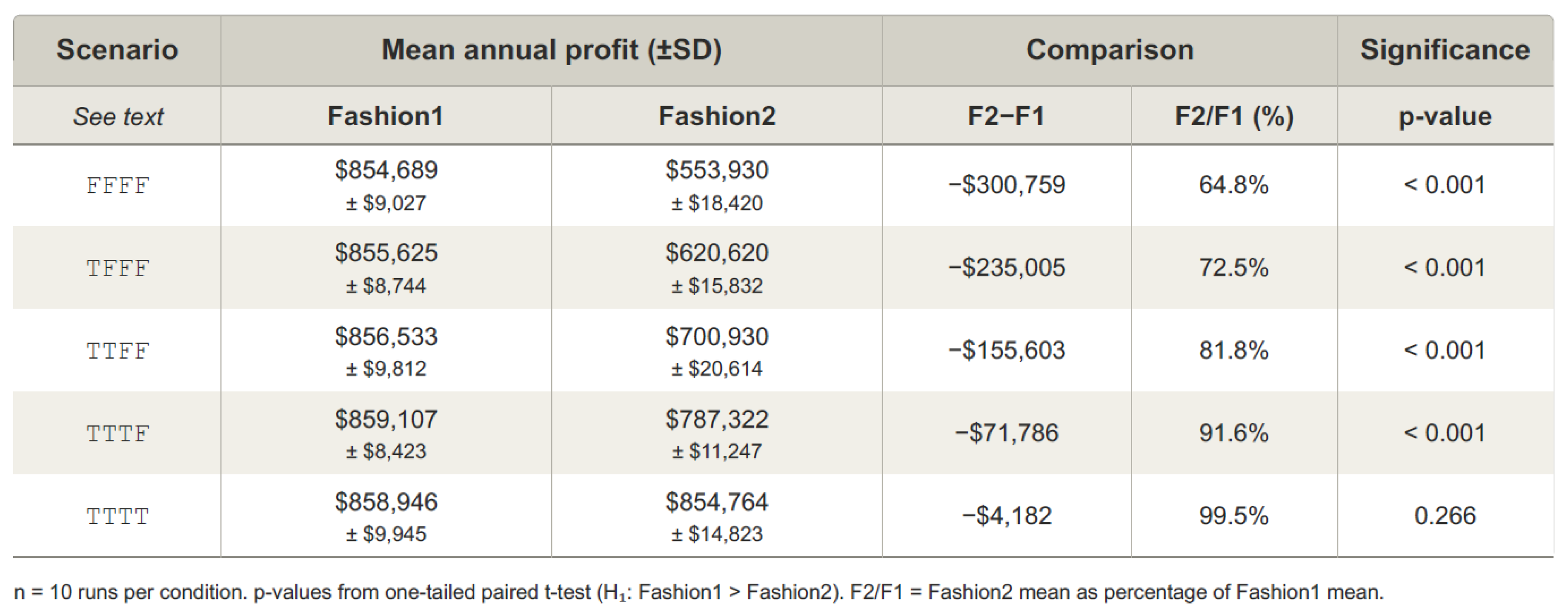
Fashion2’s profit rises steadily as JQ factors are added, from $553,930 (± $18,420) under FFFF to $854,764 (± $14,823) under TTTT. In the worst-case condition (FFFF), Fashion2 earns only about 65% of Fashion1’s profit. Each additional JQ factor closes this gap substantially: to 73% at TFFF, 82% at TTFF, and 92% at TTTF. Under TTTT, when both companies have identical configurations, the gap is negligible ($4,182, or 99.5% of Fashion1), confirming that the simulation does not introduce systematic bias between the two companies.
Figure 2(b) shows the profit gap (Fashion1 minus Fashion2) directly. The gap decreases monotonically from $301,000 under FFFF to $4,000 under TTTT. The difference is highly significant (p < 0.001) for all conditions except TTTT, where it is not significant (p = 0.266). Error bars representing ± one standard deviation of the paired difference are small relative to the gap in all significant conditions, indicating that the effects are robust across replications.

Table 1.
Mean annual profit (± SD) for Fashion1 and Fashion2 under each JQ condition, with the profit difference, Fashion2 as a percentage of Fashion1, and p-values from one-tailed paired t-tests. n = 10 runs per condition.
Table 1.
Mean annual profit (± SD) for Fashion1 and Fashion2 under each JQ condition, with the profit difference, Fashion2 as a percentage of Fashion1, and p-values from one-tailed paired t-tests. n = 10 runs per condition.
 |
5.3. Validation Checks
Several features of the results serve as internal validation of the simulation’s behavior.
First, Fashion1’s profit is statistically indistinguishable across the five conditions, confirming that the two companies are genuinely independent within each run.
Second, under TTTT, when both companies have identical configurations, their profits converge to within 0.5% of each other (p = 0.266), confirming the absence of systematic bias between the two companies.
Third, total customer visits and unassisted purchase values (ATS for non-employee sales) are statistically identical across all companies and conditions, as expected given that these are drawn from fixed distributions that do not depend on employee satisfaction.
Fourth, the monotonic relationship between the number of active JQ factors and Fashion2’s profit is consistent with the symmetric design of the satisfaction function, in which each additional factor produces an equal increment in satisfaction.
JQIE can accommodate a far wider range of scenarios than those reported here. However, the purpose of this paper is to introduce the methodology and show its capacity to address the central question, which is that creating decent working conditions for frontline workers is not just good for the workers, it can clearly yield tangible and significant financial benefits.
6. Discussion
6.1. What the Results Demonstrate
The results presented in Section 5 show that JQIE can translate qualitative arguments about job quality into quantitative, organization-specific financial projections. A company that does not provide any of the four job quality benefits to its frontline workers could see approximately 35% lower annual profits than an otherwise identical company that provides all four. This gap narrows systematically as JQ factors are added, demonstrating that each incremental improvement in working conditions yields a measurable financial return.
The profit gap between the two companies could, in principle, arise through several mechanisms: differences in customer coverage (that is, the proportion of customer visiting the store who are helped by a salesperson), differences in per-interaction sales quality, differences in labor costs, or some combination of these. Figure 3 decomposes the gap by tracking three key metrics for Fashion2 as a percentage of Fashion1 across the five conditions: customers helped, revenue from employee-assisted sales, and total profits.
The decomposition reveals that customer coverage is the primary driver. Under FFFF, Fashion2 helps only 71% as many customers as Fashion1. This coverage gap cascades into a revenue gap: Fashion2’s employee-assisted revenue is 62% of Fashion1’s, a steeper drop than the coverage gap alone would explain, because each missed customer interaction also represents a missed sale at the higher per-interaction value that employee assistance generates. Total profits fall to 65% of Fashion1’s, which is slightly less depressed than the revenue gap because Fashion2’s labor costs are also lower under FFFF, where both better pay and minimum hours are turned off.
Figure 3 shows that as JQ factors are added, all three metrics converge toward 100%. The convergence pattern confirms that the primary mechanism through which job quality affects profitability in JQIE is employee availability: more satisfied employees are present more reliably and work more efficiently, so a larger share of arriving customers receive assistance. The per-interaction conversion rate (the probability that a helped customer makes a purchase) remains stable at approximately 45% across all conditions, indicating that the profit impact of job quality thus operates primarily through coverage rather than conversion. The resulting revenue advantage more than offsets the incremental labor costs of providing better working conditions. This finding aligns with the Service-Profit Chain framework [7] and with Ton’s (2014) argument that investing in workers generates operational excellence [8], but it goes further by quantifying the mechanism in a specific organizational context rather than reporting a population-level average.
It is worth noting that the current version of JQIE does not simulate employee turnover. The five employees in each company remain employed throughout the simulated year. This is a significant omission given that turnover is among the most costly consequences of poor job quality in retail [4,8]. The profit gap reported here therefore understates the likely real-world impact of differences in job quality. The model captures how dissatisfaction affects day-to-day behavior but excludes the direct costs of hiring and training new workers. Adding a turnover mechanism is a priority for future development (Section 7.1).
6.2. ABS as a Decision-Support Tool
The results illustrate a deeper point about what ABS offers as a methodology, one that goes beyond the specific findings about job quality. To appreciate this, it is useful to distinguish between the two fundamentally different kinds of information that go into the construction and evaluation of an agent-based simulation:
Structural parameters define how the simulated world works. These include operational parameters such as the number of employees, the frequency and timing of customer arrivals, the range of tasks employees perform, how long each task takes, the probability that a customer will make a purchase, and the rules governing scheduling. Some of these parameters are drawn from industry data or published research, but many simply represent domain expertise. We “know” that less-satisfied employees are more likely to be absent. We “know” that customers who are not helped within a reasonable time will leave. We “know” that stores have opening and closing hours. None of this constitutes “data” in the conventional sense, yet it is essential to the structure of the simulation.
Emergent outputs are the metrics that can only be observed once the simulation runs, such as total annual revenue, profit, number of customers helped, revenue per employee, employee annual earnings. None of these are coded into JQIE. They arise from the accumulated interactions of agents over the simulated year, just as their real-world counterparts arise from the accumulated activities of real employees and customers. Conventional statistical models routinely conflate these two categories, treating them as if they existed independently and had a direct, fixed relationship. An ABS, by contrast, forces the modeler to recognize the distinction between “how the world works” (the structure, which is what you see when you read the code) and “what happens in the world” (the emergent outcomes, which you can only see when you run the simulation).
This distinction makes ABS uniquely transparent as a decision-support tool. JQIE’s purpose is not to produce point predictions with decimal-place precision, but to help decision-makers understand the likely consequences of their choices under a wide range of plausible scenarios. Because every parameter in the simulation has a concrete, intuitive meaning, organizational leaders can engage directly with the model. They can inspect the assumptions, challenge the values, and ask: What if we raised wages by 10% but kept the same scheduling? What if we guaranteed minimum hours but could not afford better pay? When Fashion2’s profits are 35% lower than Fashion1’s under the FFFF scenario, we can trace that gap precisely: less satisfied employees are more likely to be tardy or absent, they work more slowly, and therefore help fewer customers, each of whom might have made a larger purchase with employee assistance. There is no opaque coefficient to take on faith; every step in the causal chain is visible and interpretable.
6.3. About Model Calibration and Validation
Calibration and validation work differently in ABS than in conventional models. In a statistical model, calibration means fitting model parameters to observed data, and validation means testing whether the fitted model predicts new observations accurately. Both steps depend on having sufficient historical data, and the model’s credibility rests on the size and representativeness of the dataset. If the data comes from many companies, the model captures an average relationship that may or may not apply to any specific company. If the data comes from a single company, the model may be overfit to that company’s idiosyncratic history.
In an ABS, calibration is the process of adjusting structural parameters until the emergent behaviors of the simulation match the corresponding statistics observed in the real world. The data used for this purpose includes not only quantitative inputs such as customer arrival rates, wage levels, purchase probabilities, but also domain knowledge such as the sequence of tasks an employee performs, the rules governing when a customer leaves, the fact that a break occurs near the midpoint of a shift.
Validation, similarly, involves comparing emergent outputs to real-world benchmarks, not testing whether a fitted coefficient generalizes to a holdout sample. As stated in Section 4.7, JQIE has been calibrated at the structural level using published industry data and domain knowledge, and its emergent outputs have been validated directionally against multiple industry benchmarks. Systematic validation against data from a specific organization is an important next step. The simulation is designed so that supplying firm-specific inputs, such as staffing levels, wage rates, scheduling rules, customer traffic, would replace the generic industry parameters currently used, producing projections tailored to that organization’s actual circumstances. Critically, because the causal chains have already been validated at the structural level, the firm-specific version would inherit that validation.
6.4. Productivity Paradox
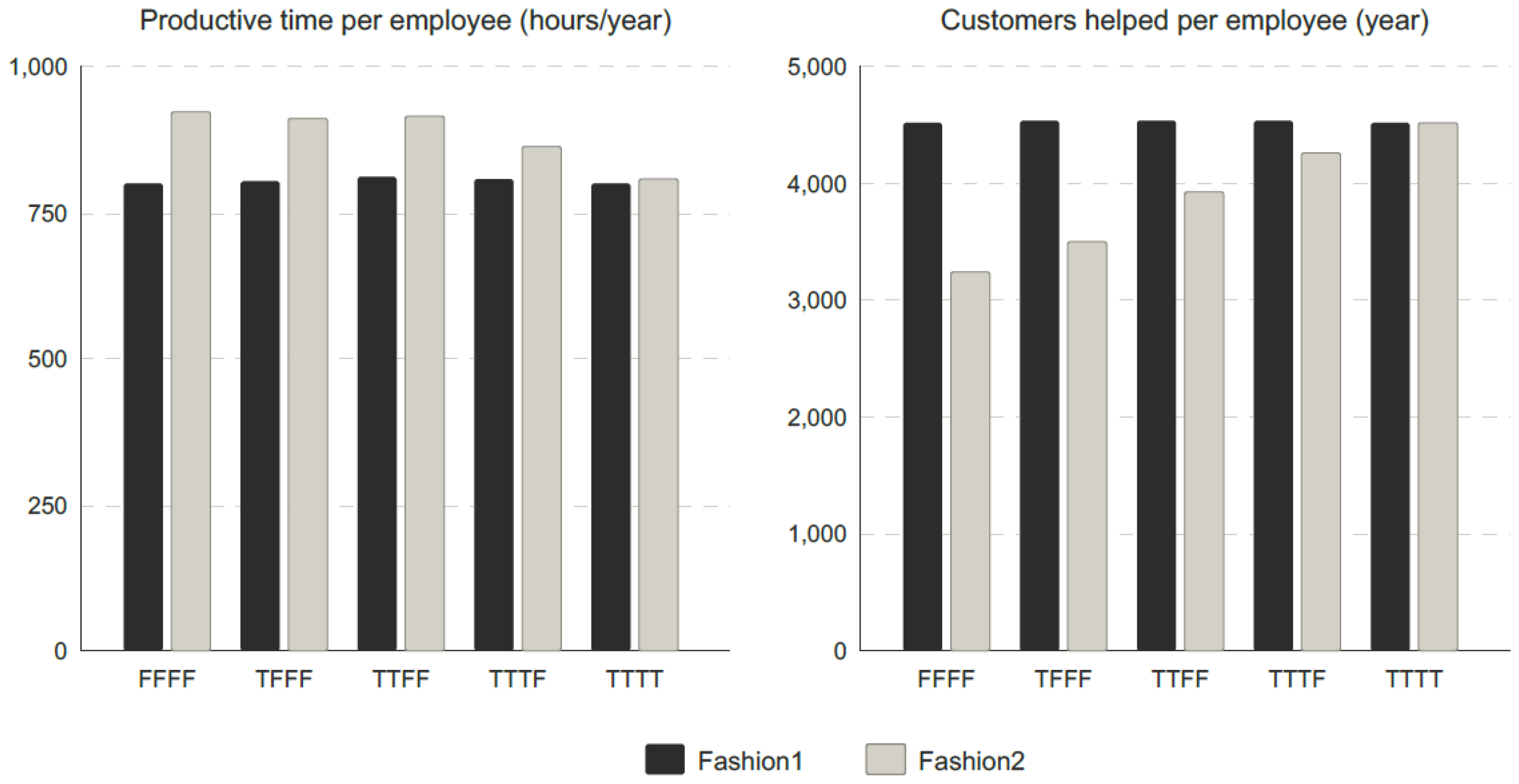
The ABS also reveals dynamics that are genuinely difficult to anticipate or explain without simulation. One example is a result we noticed in our simulations, that we call the “productivity paradox,” as shown in Figure 4. During each simulation, JQIE tracks every moment of activity, and classifies as “productive time” any time spent actively working on any task other than idle time or breaks.
When we first started analyzing the results, we noticed that, as long as Fashion2 is not offering all four job-quality improvements, its employees actually register more time classified as productive time than Fashion1 employees (Figure 4, left side), even though they are helping fewer customers than Fashion1 employees (Figure 4, right side).
This occurs because employees with lower satisfaction tend to complete each task more slowly. That dissatisfied workers are less productive is well established [43]. What the simulation reveals is a paradox: unhappy workers serve fewer customers not because they spend more time being idle, but because they spend more time helping customers and on non-customer-facing tasks, such as inventory and staffing the cash register, and therefore are less likely to be available when new customers arrive.
By conventional metrics, the less satisfied employees appear busier. But in practice, they serve fewer customers and generate less revenue. This is precisely the kind of counterintuitive finding that emerges from complex systems and that static metrics would not only miss but actively misrepresent. It also shows the power of being able to analyze the entire causal chain behind any emergent result you observe.
These examples underscore a broader point: ABS is not merely a more sophisticated statistical tool. It is a different way of engaging with complex organizational problems. Rather than asking “what does the data say?” and hoping the answer generalizes, ABS allows decision-makers to ask “how does the system work?” and to test the robustness of that understanding under a range of conditions. For organizational leaders considering investments in creating more decent working conditions, this is the kind of tool that can turn a qualitative intuition into a rigorous, scenario-tested business case.
7. Future Directions and Closing Thoughts
7.1. Extending JQIE
Because JQIE’s core architecture captures the fundamental logic of how a service organization operates, it provides a stable foundation for a range of extensions, none of which would require dramatic changes to the existing simulation structure.
A natural extension would be to introduce differential weighting, so that, for instance, schedule stability has a stronger effect on satisfaction than pay level, as Schneider and Harknett (2019) report [4]. Non-linear interactions between factors could also be introduced, allowing the model to capture the possibility that certain combinations of interventions are synergistic.
Customers in the current version are stateless: they arrive, are either helped or not, and leave. A straightforward extension would endow customers with satisfaction and memory, so that positive or negative shopping experiences influence their likelihood of returning. This would introduce the customer loyalty loop that the Service-Profit Chain posits but that the current version of JQIE does not yet model.
Employee retention is another important dimension. Adding an intent-to-leave mechanism, in which dissatisfied employees eventually quit and are replaced by new hires who require training, would capture the substantial costs of turnover that the literature documents and that many organizations cite as the single most expensive consequence of poor job quality.
Finally, JQIE’s architecture was designed so that it could be adapted relatively easily to model other frontline environments, such as hospitality, food service, logistics, or healthcare, by adjusting the task structure, customer interaction model, and relevant JQ factors. The core causal chain, from working conditions to satisfaction to behavior to financial outcomes, applies across all of these contexts.
In practice, a calibrated version of JQIE could serve as a strategic planning tool. A retail operations team considering whether to guarantee minimum weekly hours could use the simulation to project the likely impact on staffing coverage, revenue, and profitability under their current workforce composition and customer traffic patterns, then compare that projection against the incremental labor cost. By making these tradeoffs visible and quantifiable, the simulation provides decision-makers with the kind of evidence required before approving workforce investments.
7.2. From JQIE to LWIS: The Impact of Living Wages in Global Supply Chains
Our original motivation for JQIE was to provide a quantitative link between working conditions and financial outcomes for frontline workers. In collaboration with SocialSide, we are developing the Living Wage Impact Simulator (LWIS), an adaptation of JQIE for global supply chains, where approximately one third of all workers worldwide earn below a living wage.
The challenge of making the business case for living wages in supply chains is, in many respects, a more acute version of the same problem JQIE addresses in retail. The financial consequences of a factory’s working conditions are borne not only by the factory itself but also by the brand that sources from it, and the link between the two is too long and intricate to trace with conventional analytical tools. Moon et al. (2022) found that turnover rates in consumer electronics assembly, which are directly associated with low job satisfaction, are a major predictor of product field failures, resulting in substantial replacement and repair costs borne by downstream buyers [44].
LWIS retains the core architecture of JQIE while replacing the retail-specific structural parameters with those appropriate to a manufacturing environment. The satisfaction inputs would incorporate factors such as physical safety, workload intensity, and housing security, while the outcome parameters would shift from sales growth and customer conversion to defect rates, delivery reliability, and workforce stability. A key goal of LWIS is to provide a transparent, scenario-based platform through which brands, suppliers, investors, and advocates can explore the likely consequences of wage and working-condition interventions before committing resources.
Extending this work to global supply chains will require recalibration using locally sourced evidence, since the relationship between job satisfaction and business outcomes is shaped by local labor markets and regulatory environments [45]. This underscores the importance of the participatory, stakeholder-driven approach to calibration that ABS enables: the structural knowledge needed to adapt the simulation to a new context is precisely the kind of knowledge that local managers, workers, and labor experts possess and that no external dataset can substitute for.
7.3. Decent Work as a Systems Problem
This paper began with the observation that decent work, as defined by the ILO, remains aspirational for hundreds of millions of frontline workers worldwide. We have argued that one reason for the persistent gap between aspiration and practice is the absence of tools capable of translating job quality improvements into credible, context-specific financial projections for organizational decision-makers.
The contribution of this paper is to demonstrate that agent-based simulation can serve as such a tool. JQIE shows, in a specific and quantified way, that improving working conditions for frontline retail workers generates substantial financial returns, and that the mechanisms through which these returns arise can be traced, decomposed, and understood. The approach does not depend on convincing decision-makers to accept a general principle on faith; it gives them a structured way to test that principle against their own organizational circumstances, under their own assumptions, and to see the results for themselves.
But decent work is not only an organizational problem. It is a systems problem, one that spans firms, industries, supply chains, and national boundaries. The workers most affected by poor job quality are often the least visible to decision-makers whose choices determine their working conditions. A garment worker in Bangladesh, a warehouse employee in the American Midwest, a food processing worker in Morocco: each of them is embedded in a system of interacting economic forces that conventional analytical tools struggle to capture.
Agent-based simulation is, by its nature, a systems methodology. It models how individual behaviors and interactions give rise to collective outcomes that no single actor intended or controls. It is transparent, participatory, and grounded in domain knowledge rather than opaque algorithms. And it is extensible: the same core architecture that models a five-person retail store can be adapted to model a factory floor, a logistics hub, or an entire supply chain network.
We do not claim that simulation alone will solve the problem of decent work. But we do believe that better tools can accelerate progress by making visible what is currently invisible: the financial value that organizations forfeit when they underinvest in their people. We hope that this paper will contribute to a broader recognition that the gap between decent work research and decent work practice is, at its core, a translation problem, and that agent-based simulation is well suited to close that gap.
Acknowledgments
The authors gratefully acknowledge.
Conflicts of Interest
The authors declare no conflicts of interest.
Abbreviations
The following abbreviations are used in this manuscript:
| ABS | Agent-Based Simulation |
| EPI | Employee Performance Indicator |
| ILO | International Labour Organization |
| JQ | Job Quality |
| JQIE | Job-Quality Impact Explorer |
| KPI | Key Performance Indicator |
| LWIS | Living Wage Impact Simulator |
| SPC | Service-Profit Chain |
References
- International Labour Organization. Decent Work: Report of the Director-General. International Labour Conference, 87th Session, Geneva, 1999. [Google Scholar]
- U.S. Bureau of Labor Statistics. Occupational Employment and Wage Statistics. May 2024. Released April 2, 2025. [Google Scholar]
- Rho, H.J.; Brown, H.; Fremstad, S. A Basic Demographic Profile of Workers in Frontline Industries; Center for Economic and Policy Research, 2020. [Google Scholar]
- Schneider, D.; Harknett, K. Consequences of Routine Work-Schedule Instability for Worker Health and Well-Being. Am. Sociol. Rev. 2019, 84, 82–114. [Google Scholar] [CrossRef] [PubMed]
- International Labour Organization. Global Wage Report 2024.; ILO: Geneva, 2024. [Google Scholar]
- Edmans, A. The Link Between Job Satisfaction and Firm Value, With Implications for Corporate Social Responsibility. Acad. Manag. Perspect. 2012, 26, 1–19. [Google Scholar] [CrossRef]
- Heskett, J.L.; Jones, T.O.; Loveman, G.W.; Sasser, W.E.; Schlesinger, L.A. Putting the Service-Profit Chain to Work. Harv. Bus. Rev. 1994, 72, 164–170. [Google Scholar]
- Ton, Z. The Good Jobs Strategy; Amazon Publishing: New York, NY, USA, 2014. [Google Scholar]
- Ton, Z. The Case for Good Jobs; Harvard Business Review Press: Boston, MA, USA, 2023. [Google Scholar]
- Cappelli, P. Our Least Important Asset; Oxford University Press: New York, NY, USA, 2023. [Google Scholar]
- Bonabeau, E. Agent-Based Modeling: Methods and Techniques for Simulating Human Systems. Proc. Natl. Acad. Sci. USA 2002, 99, 7280–7287. [Google Scholar] [CrossRef]
- Bonabeau, E. Predicting the Unpredictable. Harv. Bus. Rev. 2002, 80, 109–116. [Google Scholar]
- Bonabeau, E. Don’t Trust Your Gut. Harv. Bus. Rev. 2003, 81, 116–123. [Google Scholar]
- Gaudiano, P. The Best Approach to Decision Making Combines Data and Managers’ Expertise. Harv. Bus. Rev. 2017. [Google Scholar]
- Harter, J.K.; Schmidt, F.L.; Hayes, T.L. Business-Unit-Level Relationship between Employee Satisfaction, Employee Engagement, and Business Outcomes: A Meta-Analysis. J. Appl. Psychol. 2002, 87, 268–279. [Google Scholar] [CrossRef]
- Krekel, C.; Ward, G.; De Neve, J.-E. Employee Wellbeing, Productivity, and Firm Performance. SSRN Electron. J. 2019; ahead of print. [Google Scholar] [CrossRef]
- Lovich, D.; Joly, H.; Taylor, C. Leaders Underestimate the Value of Employee Joy. Harv. Bus. Rev., March 24, 2026. [Google Scholar]
- Mani, V.; Kesavan, S.; Swaminathan, J.M. Estimating the Impact of Understaffing on Sales and Profitability in Retail Stores. Prod. Oper. Manag. 2015, 24, 201–218. [Google Scholar] [CrossRef]
- Hogreve, J.; Iseke, A.; Derfuss, K. The Service-Profit Chain: Reflections, Revisions, and Reimaginations. J. Serv. Res. 2022, 25, 460–477. [Google Scholar] [CrossRef]
- Lee, J.-S.; Back, K.-J.; Chan, E.S.W. Quality of Work Life and Job Satisfaction among Frontline Hotel Employees. Int. J. Contemp. Hosp. Manag. 2015, 27, 768–789. [Google Scholar] [CrossRef]
- Duffy, R.D.; Blustein, D.L.; Diemer, M.A.; Autin, K.L. The Psychology of Working Theory. J. Couns. Psychol. 2016, 63, 127–148. [Google Scholar] [CrossRef]
- Coviello, D.; Deserranno, E.; Persico, N. Minimum Wage and Individual Worker Productivity: Evidence from a Large US Retailer. J. Polit. Econ. 2022, 130, 2315–2360. [Google Scholar] [CrossRef]
- Pienaar, J.; Falkenberg, H.; Ström, P.; Sverke, M. How Do Job Demands and Job Resources Relate to Well-Being, Turnover Intention and Performance in Retail? Int. Rev. Retail Distrib. Consum. Res. 2025, 1–25. [Google Scholar]
- Choper, J.; Schneider, D.; Harknett, K. Uncertain Time: Precarious Schedules and Job Turnover in the US Service Sector. ILR Rev. 2022, 75, 1099–1132. [Google Scholar] [CrossRef]
- Henly, J.R.; Lambert, S.J. Unpredictable Work Timing in Retail Jobs: Implications for Employee Work–Life Conflict. ILR Rev. 2014, 67, 986–1016. [Google Scholar] [CrossRef]
- Emanuel, N.; Harrington, E. The Payoffs of Higher Pay: Labor Supply and Productivity Responses to a Voluntary Firm Minimum Wage. Staff Reports; Federal Reserve Bank of New York, 2026. [Google Scholar]
- Gómez-Cruz, N.A.; Loaiza Saa, I.; Ortega Hurtado, F.F. Agent-Based Simulation in Management and Organizational Studies: A Survey. Eur. J. Manag. Bus. Econ. 2017, 26, 313–328. [Google Scholar] [CrossRef]
- Somarathna, K.U.S. An Agent-Based Approach for Modeling and Simulation of Human Resource Management as a Complex System. Simul. Model. Pract. Theory 2020, 104, 102118. [Google Scholar] [CrossRef]
- Gilbert, N.; Ahrweiler, P.; Barbrook-Johnson, P.; Narasimhan, K.P.; Wilkinson, H. Computational Modelling of Public Policy: Reflections on Practice. J. Artif. Soc. Soc. Simul. 2018, 21, 14. [Google Scholar] [CrossRef]
- Siebert, W.S.; Zubanov, N. Searching for The Optimal Level of Employee Turnover: A Study of a Large U.K. Retail Organization. Acad. Manag. J. 2009, 52, 294–313. [Google Scholar] [CrossRef]
- Hancock, J.I.; Allen, D.G.; Bosco, F.A.; McDaniel, K.R.; Pierce, C.A. Meta-Analytic Review of Employee Turnover as a Predictor of Firm Performance. J. Manag. 2013, 39, 573–603. [Google Scholar] [CrossRef]
- Ton, Z.; Huckman, R.S. Managing the Impact of Employee Turnover on Performance: The Role of Process Conformance. Organ. Sci. 2008, 19, 56–68. [Google Scholar] [CrossRef]
- Kuhn, P.; Yu, L. How Costly Is Turnover? Evidence from Retail. J. Labor Econ. 2021, 39, 461–496. [Google Scholar] [CrossRef] [PubMed]
- Wall, F. Agent-Based Modeling in Managerial Science: An Illustrative Survey and Study. Rev. Manag. Sci. 2016, 10, 135–193. [Google Scholar] [CrossRef]
- Waldrop, M.M. Complexity: The Emerging Science at the Edge of Order and Chaos; Simon and Schuster: New York, NY, USA, 1992. [Google Scholar]
- Zhang, C.; Gaudiano, P. An Agent-Based Simulation of How Promotion Biases Impact Corporate Gender Diversity. Appl. Sci. 2023, 13, 2457. [Google Scholar] [CrossRef]
- Siebers, P.-O.; Aickelin, U.; Battisti, G.; Celia, H.; Clegg, C.; Fu, X.; De Hoog, R.; Iona, A.; Petrescu, A. Enhancing Productivity: The Role of Management Practices. AIM Working Paper Series, 2009. [Google Scholar]
- Smith, E.R.; Conrey, F.R. Agent-Based Modeling: A New Approach for Theory Building in Social Psychology. Personal. Soc. Psychol. Rev. 2007, 11, 87–104. [Google Scholar] [CrossRef]
- Hughes, H.P.N.; Clegg, C.W.; Robinson, M.A.; Crowder, R.M. Agent-Based Modelling and Simulation: The Potential Contribution to Organizational Psychology. J. Occup. Organ. Psychol. 2012, 85, 487–502. [Google Scholar] [CrossRef]
- Wilensky, U.; NetLogo. Center for Connected Learning and Computer-Based Modeling; Northwestern University: Evanston, IL, USA, 1999. [Google Scholar]
- Law, A.M. Simulation Modeling and Analysis, 5th ed.; McGraw-Hill: New York, NY, USA, 2015. [Google Scholar]
- Mindtree. Sales Associates Play Pivotal Role in the Shopper Purchase Journey. 2016. Available online: https://a.storyblok.com/f/67269/a67959dd16/mindtree-20shopper-20survey-20report.pdf (accessed on 3 March 2024).
- Oswald, A.J.; Proto, E.; Sgroi, D. Happiness and Productivity. J. Labor Econ. 2015, 33, 789–822. [Google Scholar] [CrossRef]
- Moon, K.; Loyalka, P.; Bergemann, P.; Cohen, J. The Hidden Cost of Worker Turnover: Attributing Product Reliability to the Turnover of Factory Workers. Manag. Sci. 2022, 68, 3755–3767. [Google Scholar] [CrossRef]
- Edmans, A.; Pu, D.; Zhang, C.; Li, L. Employee Satisfaction, Labor Market Flexibility, and Stock Returns Around the World. Manag. Sci. 2023, 70, 4357–4380. [Google Scholar] [CrossRef]
Figure 1.
Screenshot of the JQIE user interface developed with NetLogo.
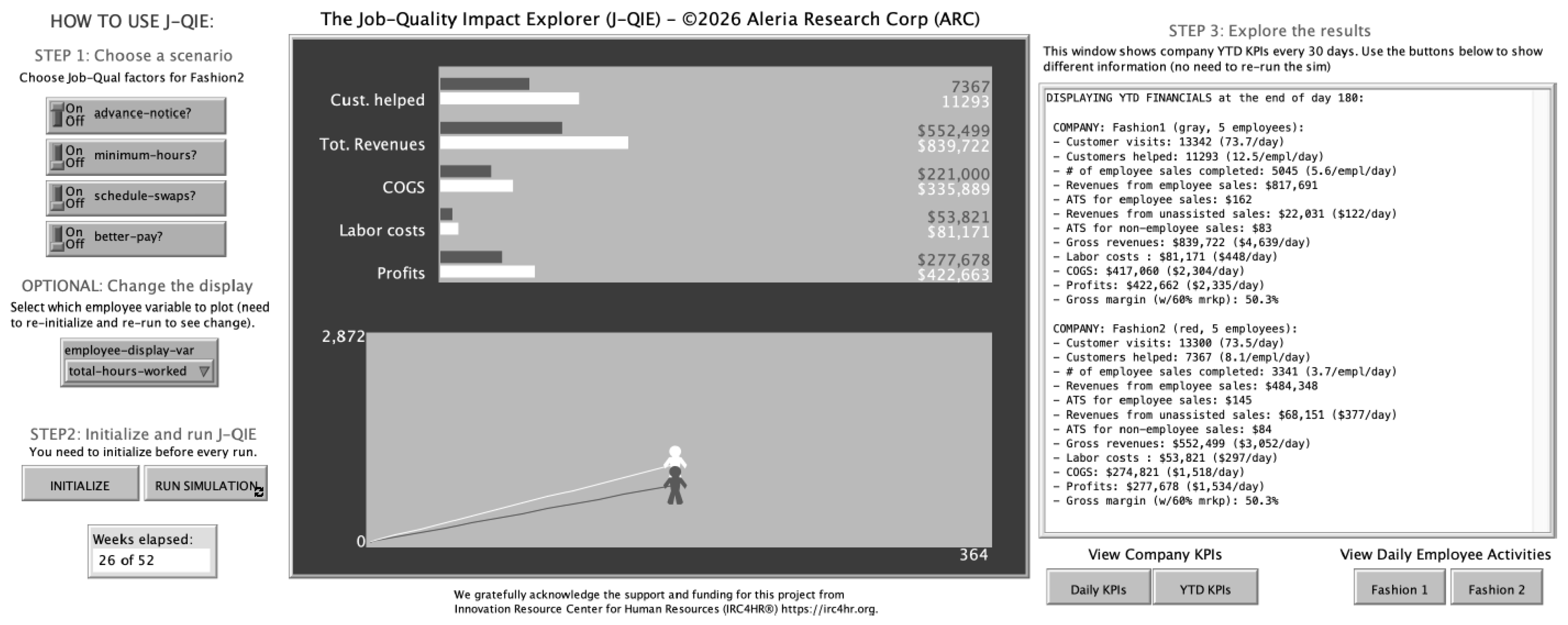
Figure 2.
Impact of job quality on annual profitability. (a) Mean annual profit for Fashion1 (solid line, filled circles) and Fashion2 (dashed line, open circles) across five JQ conditions. Fashion1 operates with all four JQ factors active in every condition; Fashion2 gains one additional factor at each step from left to right. (b) Profit gap (Fashion1 minus Fashion2) for each condition, with dollar values shown inside bars. *** indicates p < 0.001 (one-tailed paired t-test); ns = not significant. For both charts, error bars show ± 1 standard deviation (SD), based on n = 10 runs per condition.
Figure 2.
Impact of job quality on annual profitability. (a) Mean annual profit for Fashion1 (solid line, filled circles) and Fashion2 (dashed line, open circles) across five JQ conditions. Fashion1 operates with all four JQ factors active in every condition; Fashion2 gains one additional factor at each step from left to right. (b) Profit gap (Fashion1 minus Fashion2) for each condition, with dollar values shown inside bars. *** indicates p < 0.001 (one-tailed paired t-test); ns = not significant. For both charts, error bars show ± 1 standard deviation (SD), based on n = 10 runs per condition.
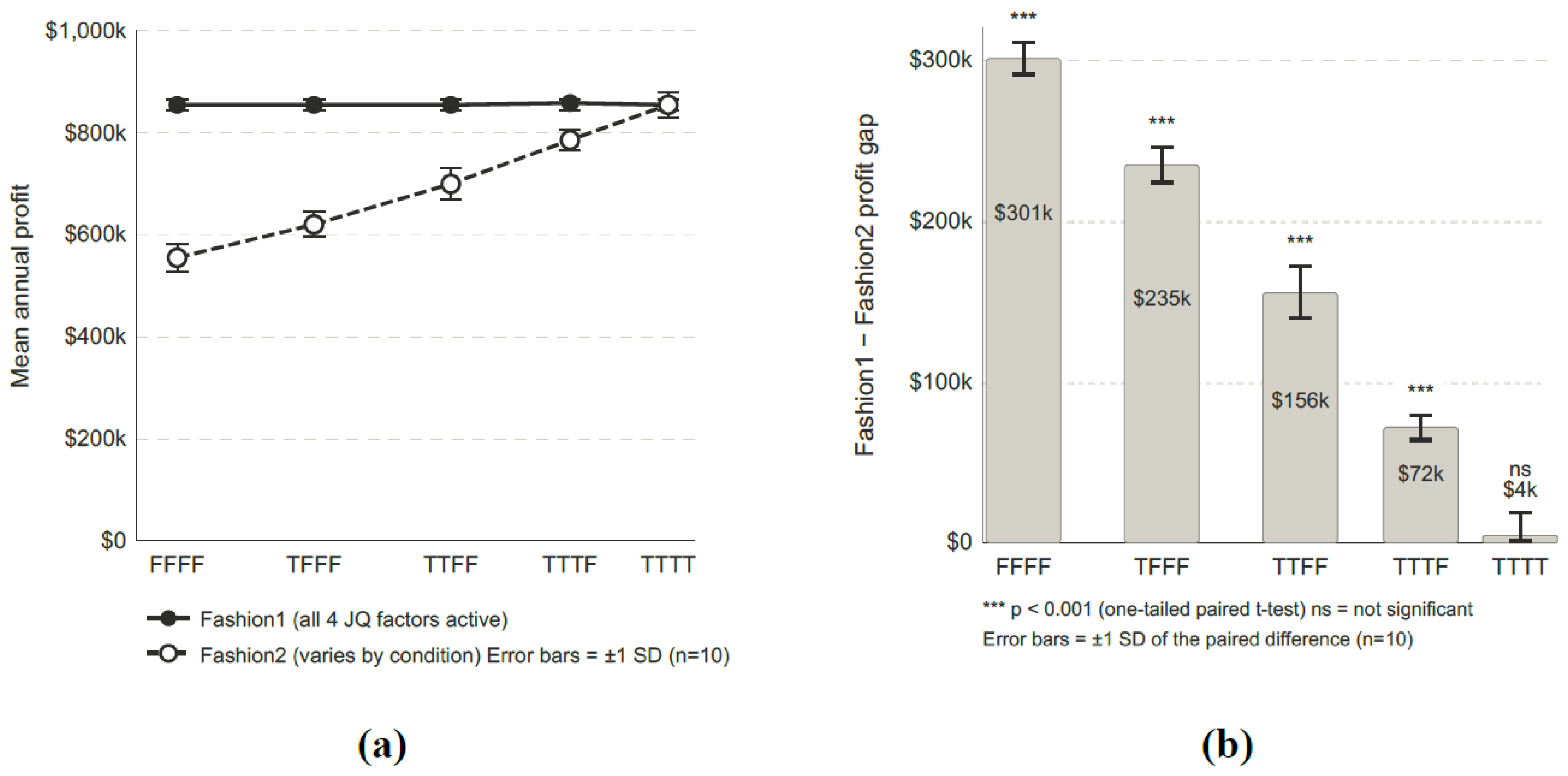
Figure 3.
Decomposing the profit gap: Fashion2 as a percentage of Fashion1 across five conditions for three metrics. Solid line with filled circles: customers helped. Long-dashed line with open circles: revenue from employee-assisted sales. Short-dashed line with open squares: total profits. The 100% reference line (dashed) indicates parity. Percentage labels at FFFF show the initial gap for each metric.
Figure 3.
Decomposing the profit gap: Fashion2 as a percentage of Fashion1 across five conditions for three metrics. Solid line with filled circles: customers helped. Long-dashed line with open circles: revenue from employee-assisted sales. Short-dashed line with open squares: total profits. The 100% reference line (dashed) indicates parity. Percentage labels at FFFF show the initial gap for each metric.
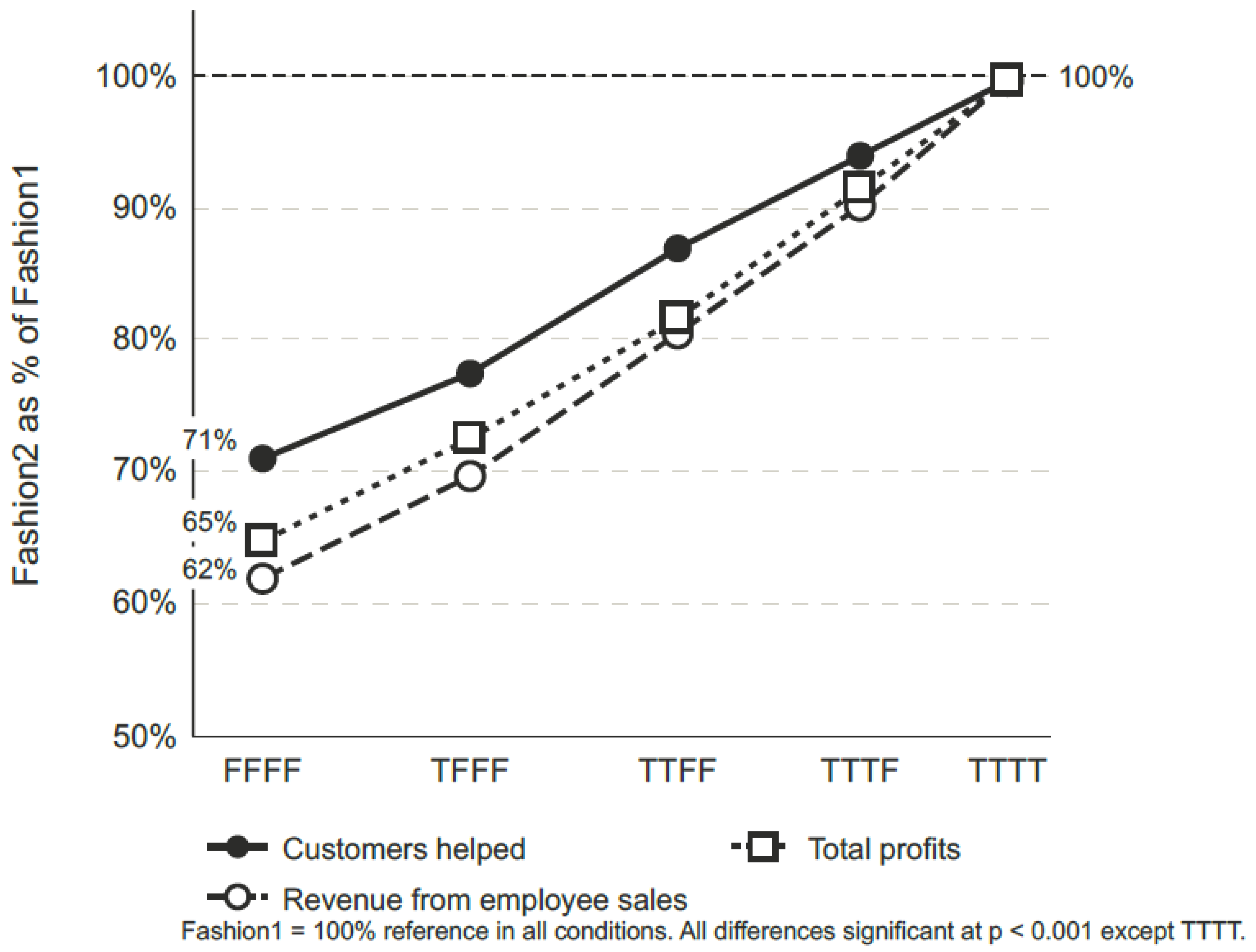
Figure 4.
The “productivity paradox”: as long as Fashion1 is offering better job quality (scenarios FFFF through TTTF), Fashion2 employees, on average, spend more productive time during the course of the year than Fashion1 employees (left), even though Fashion1 employees help a greater number of customers per year than Fashion2 employees.
Figure 4.
The “productivity paradox”: as long as Fashion1 is offering better job quality (scenarios FFFF through TTTF), Fashion2 employees, on average, spend more productive time during the course of the year than Fashion1 employees (left), even though Fashion1 employees help a greater number of customers per year than Fashion2 employees.
Disclaimer/Publisher’s Note: The statements, opinions and data contained in all publications are solely those of the individual author(s) and contributor(s) and not of MDPI and/or the editor(s). MDPI and/or the editor(s) disclaim responsibility for any injury to people or property resulting from any ideas, methods, instructions or products referred to in the content. |
© 2026 by the authors. Licensee MDPI, Basel, Switzerland. This article is an open access article distributed under the terms and conditions of the Creative Commons Attribution (CC BY) license (http://creativecommons.org/licenses/by/4.0/).
Copyright: This open access article is published under a Creative Commons CC BY 4.0 license, which permit the free download, distribution, and reuse, provided that the author and preprint are cited in any reuse.