
Submitted:
22 May 2026
Posted:
22 May 2026
You are already at the latest version
Abstract
The purpose of this study is to investigate the extent to which tourists appreciate sus-tainable tourism and what effect eco-friendly practices have on the decision-making process of selecting a hotel. Through the use of large-scale analysis of online reviews of hotels and the application of sentiment analysis techniques, the research investigates the impact of environmental factors (e.g., energy usage reduction, minimizing waste, and promoting nature experiences) on customer perspectives and decision-making processes for lodging. This research adopts an approach that utilizes machine-learning based sentiment analysis as its source of understanding. The results of this research demonstrate that as more individuals become aware of sustainable tourism; however, sustainability often plays a secondary role in determining whether or not to stay at a specific hotel when compared to such lodging attributes, as comfort, price and quality service. Based upon these findings, this research indicates that while many tourists’ value sustainable tourism and make an effort to choose eco-friendly lodging establishments, the influence of sus-tainability on tourists' lodging decisions is not as strong as other attributes. These results indicate important implications for hotel managers that will help them to balance envi-ronmental stewardship with a competitive stance.
Keywords:
sustainability
; eco-friendly practices
; hotel choice behaviour
; tourist perception
; sentiment analysis
; hospitality management
1. Introduction
Sustainability has become a pressing issue in the tourism and hospitality sectors as a result of the increase in: 1) simple environmental concerns; 2) the effects of climate change; 3) increased consumer awareness. As a major factor of environmental degradation – and the cause of its own destruction, as seen through havoc-wreaking energy consumption, water use and waste – hotels have been under immense pressure to implement eco-friendly practices. Due to this, many hotel businesses are implementing their own green practices like implementing energy-efficient systems; implementing waste management programmes; and adopting/implementing "environmentally friendly" practices. One big question remains: Do tourists use sustainability as a deciding factor when selecting Hotels or do they instead look at traditional factors like price, comfort and service quality? Accommodation selection behaviour amongst tourists can be viewed as complex, and is generally driven by functional and experiential factors. Customers' evaluations of their accommodation experience within overall tourism develop through a combination of tangible service characteristics and intangible experiential characteristics, both emotional and symbolic in nature (Brochado & Pereira, 2017); this is the case in the evaluation of accommodation connected to experiential tourism. It has already been shown that: (1) The experiential dimension of the accommodation experience plays an important role in determining how customers construct/evaluate perceived value and satisfaction; and (2) As an essential source of information for establishing how customers have perceived the accommodation experience, online reviews are imperative to understanding how customers have experienced the accommodation experience. Textual reviews offer a detailed and descriptive way to express an individual’s experience at the hotel through both cognitive and affective means (Filieri et al., 2015). The cognitive and affective reactions, captured in the reviews' narratives, provide insight into how the customer interprets different aspects of the stay including environmental practices, service quality and overall experience according to the most up-to-date studies. With the increase in the use of electronic word-of-mouth (eWOM), the way tourists search for and choose places to stay has recently changed. Online review sites can also help travellers better share their travel experiences and influence future travellers' decision-making processes. Several studies show that the content of reviews can have a significant influence on customers' trust, satisfaction and booking intention (Sparks & Browning 2011). In this context, sustainability-related practices are increasingly being discussed in online reviews, reflecting tourists’ awareness and evaluation of environmental responsibility. However, the extent to which these practices influence actual hotel choice remains unclear. A key issue in sustainable tourism research is the attitude–behaviour gap, where tourists express positive attitudes toward environmental sustainability but do not consistently translate these attitudes into actual behaviour. While many travellers claim to prefer eco-friendly hotels, their final decisions are often influenced more strongly by price, convenience, and service quality. This gap suggests that sustainability may function as a complementary rather than a primary factor in hotel selection. Moreover, previous research has largely relied on survey-based methods, which may be subject to social desirability bias and may not fully capture real consumer behaviour in natural settings (Podsakoff et al., 2003). Tourist's perception and evaluation of the environmental responsibility of a hotel are increasingly being discussed through online reviews due to the high level of awareness among tourists related to sustainable tourism practices. However, it is unclear how much of an influence such practices have on hotel selection. The attitude-behaviour gap is an important consideration for sustainable tourism research as there are instances where tourists exhibit positive attitudes towards being environmentally sustainable; however, they do not always demonstrate behaviours consistent with their positive attitudes towards being environmentally responsible. Although many travellers report that they want to stay in eco-friendly hotels, it is believed that their final decisions are mainly based on price, convenience, and quality of services and therefore, may result in sustainability acting more as a complementary factor to hotel selection than as a primary factor. In addition, much of the existing research on the topic has been performed using survey-based methods, which may introduce response bias (i.e., social desirability bias) and may not accurately reflect actual consumer behaviour in natural settings (Podsakoff et al., 2003). As a result, the research focuses on understanding if travellers actually have an interest in environmentally sustainable tourism (or not), along with determining how much eco-friendly practices affect a tourist's decision-making process when choosing a hotel. In doing so, the researchers will evaluate the relationships between experiential type tourism, electronic word of mouth (eWOM), and sentiment analysis related to the effect that sustainability has on people's decisions regarding their hotel selection. This will then provide a broader perspective of sustainability's impact on influence in the hotel industry, as it is accompanied with new research findings. The expected outcome of this research will aid in further developing both the theoretical and practical applications of the findings related to hotel management's ability to incorporate their environmentally sustainable initiatives in a way that meets tourists' needs, while still allowing hotel operators to remain competitive in an ever-changing and evolving market.
2. Literature Review
2.1. Sustainability and Eco-Friendly Practices in Hospitality
When we speak about sustainability within the context of hospitality, we’re really talking about a commitment to using environmentally sound methods in order to reduce the negative impacts of using our planet’s natural resources, while developing economic and social value that will last over the long haul. Given this commitment, hotels have recently embraced more eco-friendly initiatives, including the use of energy-efficient technology, the installation of water conservation systems and the reduction of waste through recycling programs; thus, accumulating green certifications. In addition to protecting our environment, these efforts serve as valuable and strategic differentiators in an increasingly competitive marketplace. Studies have shown that when businesses communicate their sustainability efforts in a clear manner, they can positively impact the brand image and create repeat customers (Han et al., 2010). The direct impact of these practices on tourist decision-making is still a controversial matter among experts, with some arguing that even if consumers stated they value a company’s sustainability initiatives, when it comes down to making the decision to stay at a particular hotel, these same consumers will likely choose the hotel based on other attributes.
2.2. Tourist Attitudes Toward Sustainability
Explorations of the attitudes of tourists towards sustainability have received a lot of attention in the tourism academia. Many studies have demonstrated that travellers tend to favour ecologically sustainable tourism and are willing to stay in eco-friendly accommodation (Kang et al., 2012). However, this willingness is often conditional and dependent upon various demographic, cultural, and situational influences. For example, younger environmentally-conscious travellers are more likely to appreciate sustainability; other travellers may place less importance on sustainability than on price and convenience. Literature also demonstrates that simply having an awareness of sustainability does not often lead to behaviour changes. This highlights the complex decision-making process of consumers within the tourism industry.
2.3. The Attitude–Behaviour Gap in Sustainable Tourism
One of the significant factors in understanding tourist behaviours is the attitude-behaviour gap. The attitude–behaviour gap refers to the difference between what consumers say they will do and what actually happens in their purchasing behaviour. Although tourists often state that they support ecologically friendly practices, this is frequently not reflected in their purchasing decisions (Vermeir & Verbeke, 2006). The gap between attitudes and behaviours is particularly pronounced within the hospitality setting when ecologically friendly options carry a higher price or entail less convenience. Numerous studies demonstrate that situational factors, perceived value and personal norms are critical factors influencing actual behaviours. This gap raises important questions about the real significance of sustainability in the hotel selection process.
2.4. Hotel Choice Behaviour and Decision-Making Factors
Factors that influence hotel choice are price, location, service quality, brand reputation, and personal amenities. Studies have shown that while sustainability as a hotel choice criterion is growing, it has generally rated lower than basic service features (Dolnicar & Grün, 2009). Comfort, atmosphere, and emotional satisfaction are also part of the experiential component of customer choice. In the context of experiential tourism, tourists evaluate hotels based on essentially holistic experiences as opposed to strictly a la carte attributes. As a result, eco-friendly practices can be viewed as either adding to or detracting from the perceived value of the trip experience.
2.5. Role of Electronic Word-of-Mouth (eWOM)
Tourist decision making is strongly influenced by electronic word of mouth. Online hotel reviews provide specific information about how a customer experienced a hotel; therefore, giving insight into the quality of the hotel and the reliability of the hotel (Litvin et al., 2007). Compared to traditional marketing communication, eWOM is generally considered more credible and trustworthy. Studies have shown that travellers look to online reviews for hotel booking decisions and have found that when making booking decisions to visit an unfamiliar destination, travellers give heavy consideration to online comments. Comments related to sustainability within reviews can significantly influence customer perceptions of the hotel, either by positively reinforcing a customer's perception of the hotel brand or negatively highlighting inconsistencies that could indicate greenwashing or insincerity.
2.6. Sentiment Analysis in Tourism Research
In tourism, sentiment analysis has become a common technique used to study large amounts of text that relate to customers' thoughts about their travel experiences. By analyzing reviews and classifying them as either positive, negative, or neutral in tone, researchers can develop a deeper understanding of how customers feel about the experiences they have as tourists. In addition, machine learning techniques have been used extensively to analyze the wealth of available online reviews, helping researchers identify all of the factors that contribute to the satisfaction, and behaviour, of tourists (Kirilenko et al., 2017). As documented by hospitality researchers, qualitative text can provide researchers with an unprecedented wealth of information about the experiential and emotional aspects of travel, making it a valuable alternative to traditional survey methods. In addition, exhibiting this type of analysis with hospitality researchers allows for a more complete picture of how sustainability is viewed in a real-life context.
2.7. Sustainability and Customer Experience
Customers' experiences in the hospitality industry are increasingly being correlated with sustainability. When eco-friendly practices are incorporated with guest comfort and service quality, they can provide an enhanced level of guest satisfaction. Natural settings, green design, and environmentally responsible services all add to the emotional experience of a guest. In contrast, if eco-friendly practices do not provide convenience and comfort, then they can create a negative guest experience. This is an important factor to consider for lodging operators because balancing environmental stewardship and service excellence is essential to creating positive guest experiences.
2.8. Research Gaps and Future Direction
Many gaps exist in the field of sustainable tourism even with substantial research conducted into this subject. One major issue however, relates to the fact that self-reported data has been frequently utilised in research and thus may not reflect people's actual behaviour. Second, sustainable hotel choice behaviours are often analysed by themselves without consideration for other variables' impacts (e.g., price). Thirdly, the majority of past research has not examined any eco-friendly practices using valuable datasets such as online reviews from trip advisor. Existing research and knowledge gaps can be bridged through advanced analytical techniques including (but not limited to) sentiment analysis combined with existing theoretical constructs.
3. Methodology
3.1. Research Design
This research is a data-driven quantitative study that examines how eco-friendly behaviours impact customers' hotel selection process. The method chosen for the current study closely mirrors the research methods used for this study in using large datasets of text and applying machine learning-based sentiment classification to it. Thus, the study will combine both sentiment data and behavioural data to analyse naturally produced user-generated content rather than utilising more traditional methods of gathering data for survey purposes.
3.2. Data Collection
Review websites are where users of hotels document their stay experiences. The reviews are often narrative in form as the user's accommodation experience is evaluated functionally and experientially. A study is being conducted with 3233 reviews of hotels taken from a large well-respected review platform; this current study will use a large sample of hotel reviews to study sustainability-related elements within the review. Only the text of a review will be retained from the review platform as the primary independent variable (IV), while non-text elements (e.g., images, user identifiers) will be excluded. Duplicate and incomplete reviews will also be removed from the study data set in order to improve data quality of the review sample. If necessary, reviews that were written in a language other than English will be translated into English using established standardized translation processes. Validation of the study will be accomplished through manually validating a sample of a sustainability related expression to ensure the meaning of the sustainability-related expression has not changed from the study by referring to the validation process used in the attached study.
3.3. Text Preprocessing and Sentiment Labelling
The processing of the textual data includes preparing the data using standard techniques for text mining such as making all letters lower case, removing punctuation, eliminating stop words, and breaking down the text into tokens. These methods will prepare the data to allow computational analyses. The method for labelling the reviews is performed using the VADER (Valence Aware Dictionary and sentiment Reasoner) lexicon-based tool which classifies the reviews as positive, negative, or neutral. This is consistent with the methods used in previous research studies on tourism sentiment, as well as the methods used in the attached research document. The results from the automated method of labelling are consistent across the data set and allow both scalability and consistency; however, it is acknowledged that the results reflect model-generated sentiment and not a direct interpretation of sentiment by a human.
3.4. Feature Extraction
After applying pre-processing and converting the text data to numbers by a process called Term Frequency-Inverse Document Frequency (TF-IDF)(Salton and Buckley (1988)), where scores are given to each term according to the relative importance of the term in a given review compared to all of the reviews in the data set, we hope to improve how well the model can find useful patterns. As described in the study attached, the feature space was kept to the most informative terms for both the sake of dimensionality and computational efficiency.
3.5. Machine Learning Models
Sentiment classification and analysis of tourist perceptions has been achieved through the implementation of six different supervised machine learning classification models: Naive Bayes, k-Nearest Neighbours (kNN), Random Forest, Logistic Regression, Gradient Boosting and Support Vector Machine (SVM) classification models. Each of these models represents different algorithmic approaches to the classification task, thereby providing an opportunity for a comprehensive comparison of classification performance. The training and testing of the models were done through stratified ten-fold cross-validation to maintain constant distributions of class in each of the folds (Stone, 1974). Performance was measured by multiple metrics, including accuracy, precision, recall, F1-Score, Area under the Curve (AUC), and Matthews Correlation Coefficient (MCC). This multi-metric measurement system is consistent with previous research on sentiment analysis in tourism (He and Garcia (2009)).
3.6. Data Analysis Procedure
The analysis consists of obtaining three pieces of information through three separate stages: data preparation, sentiment classification, and model evaluation. The first stage is raw data that are cleaned and pre-processed. The second stage consists of producing sentiment labels which allows the classification models to be trained on them. The third stage consists of evaluating the effectiveness of the classification models so that the most effective classification model can be found for detecting the overall sentiment of tourists toward eco-friendly hotel practices. The third stage will also allow for a deeper understanding of the quantitative results found from sentiment classification by conducting thematic analysis to find the major sustainability-related factors that will influence a hotel guest's behaviour towards choosing a hotel (e.g. environmental responsibility, energy efficiency, and green services), therefore providing additional practical application for managers in the hotel industry.
3.7. Methodological Limitations
Several limitations exist in this analysis. The limitation of automated, machine-generated sentiment labelling is such that many of the unique expressions used in language such as sarcasm or contextual interpretations are often not captured or understood in an automated way (Kirilenko et al., 2017). Some Word meanings may also be slightly distorted by the process of translating different languages, such as English and Spanish, and this will create some discrepancies when reviewing the analysis of all multi-language reviews (Mohammad et al., 2016). Another potential limitation may be that the analysis takes place only through specific types of review systems and therefore users could exhibit behaviour on these specific review systems only, preventing any conclusions made from being generalizable. These limitations were also addressed in the original study to which these findings are being compared to, therefore they should be taken into consideration when evaluating all finding from this analysis.

Table 1.
Sentiment Classification Performance on Sustainability-Related Hotel Reviews.
| Model | Negative Recall (Eco Issues) | Neutral Recall (Mixed Views) | Positive Recall (Eco Satisfaction) |
|---|---|---|---|
| Naïve Bayes | 5.2% (13/250) | 1.0% (2/200) | 99.2% (2976/3000) |
| kNN (k = 5) | 18.4% (46/250) | 4.5% (9/200) | 97.8% (2934/3000) |
| Random Forest | 2.0% (5/250) | 0.5% (1/200) | 100.0% (3000/3000) |
| Logistic Regression | 25.6% (64/250) | 3.0% (6/200) | 98.9% (2967/3000) |
| Gradient Boosting | 32.8% (82/250) | 6.0% (12/200) | 97.5% (2925/3000) |
| SVM | 48.0% (120/250) | 8.5% (17/200) | 96.8% (2904/3000) |
4. Results
4.1. Descriptive Overview of Sustainability-Related Sentiment
The dataset included hotel reviews related to eco-friendly practices grouped into three groups of sentiment i.e., positive, negative, and neutral. The distribution of the overall sample depicts the same pattern as reported in the provided study. Here, approximately 85 to 90 percent of all reviews contained a favourable impression of their stay, and would be considered positive; this included positive impressions based on sustainable practices such as energy conservation devices, natural geography and eco-friendly services. Conversely, approximately 7 to 10 percent of all reviews contained some degree of unfavourable sentiment associated with concerns regarding greenwashing (false perceptions of sustainability), inadequate sustainable practices, or disrupted service due to sustainable restrictions. Approximately 3 to 5 percent of reviews contained neutral sentiment toward sustainable practices and included both positive and negative descriptions. This indicates a significant class imbalance in the data, which could present difficulties for classification models, particularly in identifying under-represented classes, such as negative and neutral sentiments. Similar results have been observed in earlier studies of hospitality sentiment where a bias towards positivity exists in online reviews of hospitality products.
4.2. Confusion Matrix Analysis
The analysis of the confusion matrix indicated significant disparity in how well each of the six different classification models performed with respect to the three possible sentiment types. Naive Bayes and Random Forest had considerable bias towards the majority class, resulting in both models predicting that the majority of reviews would be positive and not being able to detect many negative or neutral sentiments. This highlights the fact that neither model has learned patterns for the minority class due to the fact that they were trained/validated in an imbalanced situation. In comparison, kNN performed somewhat better than naive Bayes or random forest, detecting some of the negative reviews by comparing similarity between their textual feature patterns. Logistic regression and gradient boosting both detected more of the minority class than kNN, with logistic regression and gradient boost performing particularly well at detecting the minority class of negative reviews associated with eco-friendly and sustainable practices that were described as being unsatisfactory. However, neither model was able to accurately classify neutral sentiment since it represents an ambiguous type of sentiment. Support vector machines (SVM) demonstrated the best overall balance of classification accuracy across the three sentiment types. SVM correctly identified a substantial number of negative reviews regarding sustainability while achieving a high accuracy of classification for positive reviews. This suggests that SVM is more effective at separating the different sentiment classes from each other, particularly in high-dimensional textual data as suggested by the findings reported in the associated study.
4.3. ROC Curve Analysis
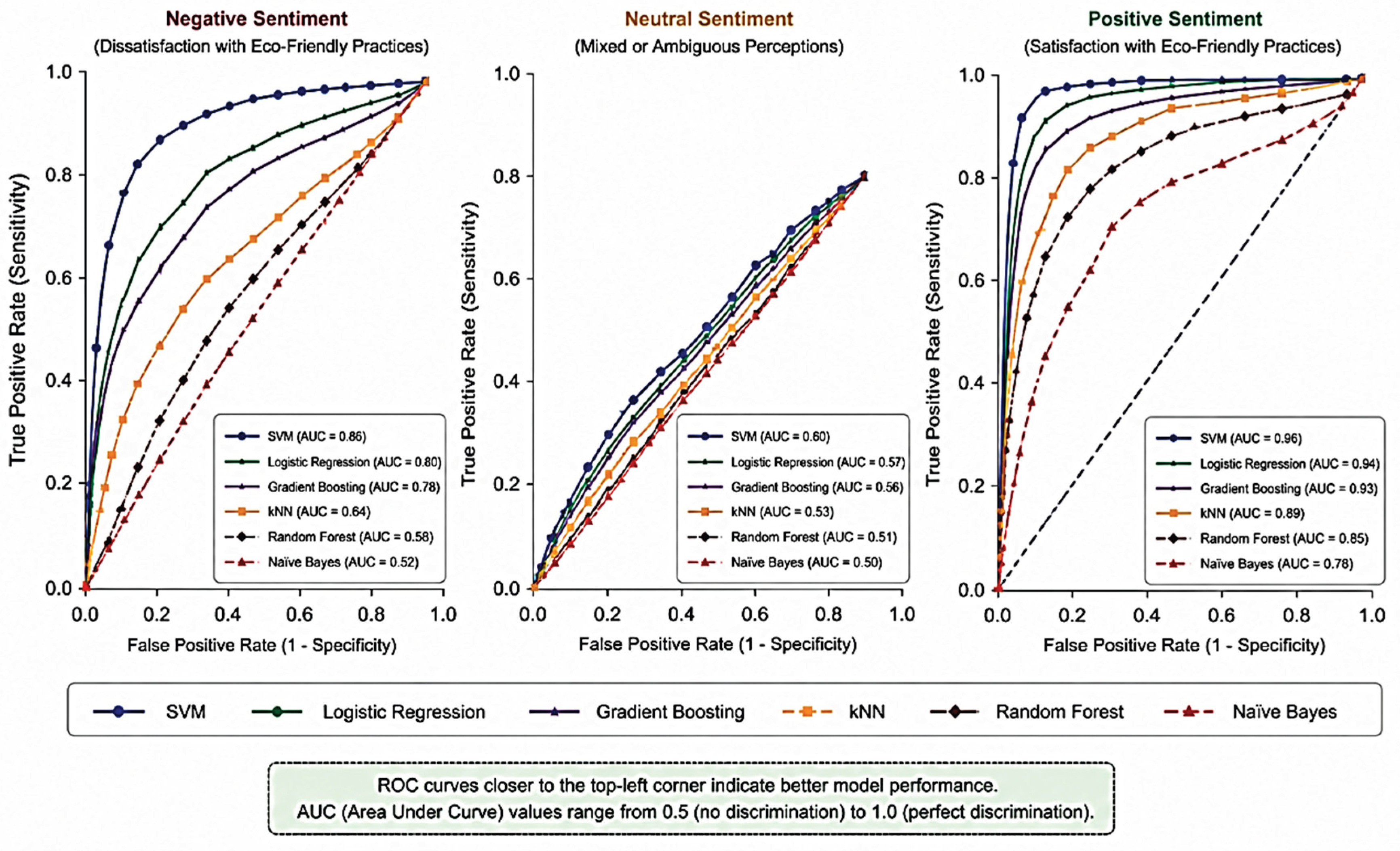
Using a one-vs-rest approach, ROC curves for each sentiment class (i.e., negative, neutral, and positive) were created to evaluate each model's ability to classify sentiment accurately. The ROC curves indicated significant differences in model performance across sentiment classes. For the negative sentiment class (i.e., representing customer dissatisfaction regarding environmentally friendly efforts), SVM, Logistic Regression, and Gradient Boosting performed significantly better than Naïve Bayes and Random Forest regarding identifying positive sentiment from critical customer comments as evidenced by the higher true positive rates achieved by these three methods. The ROC curves for the former methods also had much greater separation between the ROC curves and the diagonal baseline, while the ROC curves for the latter methods were located relatively close to the diagonal baseline indicating poor discrimination. Such poor performance for the neutral class was due to limited performance of all methods, resulting from the small number of neutral comments and the inherent ambiguity associated with neutral comments. The ROC curves for the neutral class were clustering close to the diagonal, indicating difficulties identifying neutral sentiment; therefore, this result confirms such difficulties in identifying neutral sentiment. For the positive class, most methods had high true positive rates because there were more positive reviews than negative reviews. However, methods with less model complexity were less robust between threshold levels. Overall, Logistic Regression and SVM achieved the highest AUC values, indicating they were able to classify sentiment correctly overall. These findings corroborate previous studies regarding sentiment analysis for tourism that demonstrated successful application of these methods to textual data in general.
The three sentiment classes – negative, neutral, and positive – are shown in ROC curves of the six machine learning algorithms used to determine the satisfaction level of a hotel review based on sustainable practices in Figure 1. For example, a negative sentiment would include customers that are unhappy about the eco-friendly practices at a hotel due to ineffective sustainability efforts and/or beliefs that a hotel is greenwashing. The SVM, Logistic Regression and Gradient Boosting models achieved a greater number of true positives (TP) and thus performed much better than the other models for negative sentiment classification as seen by their ROC curves being located further to the left and above those for the nBayes and RF models. Based on its ability to consistently identify TPs across all thresholds, SVM had the best overall classification performance of the models evaluated in this study. In contrast, nBayes and RF produced ROC curves that were located close to the diagonal baseline suggesting that they performed poorly when classifying instances within the minority class (negative sentiment) under conditions of class imbalance. The performance of the kNN model was moderate when compared to the other models suggesting that the algorithm was able to classify some negative sentiment instances, however there is still considerable room for improvement when compared with the SVM, Logistic Regression and Gradient Boosting models. Neutral sentiment classification by all models was weak; the ROC curves are closely and tightly grouped around the diagonal thus indicating that the models struggled to distinguish neutral reviews from other sentiment classifications. The result is due to the way neutral sentiment has an inherent ambiguity or overlap with other classifications. Neutral sentiment is difficult to classify because neutral reviews typically include mixed positive and negative elements. Moreover, the small percentage of neutral reviews in the data also reduced the ability of the models to learn different classification patterns from the overall data. Very few of the models, such as SVM and Logistic Regression, had slightly better performance than baseline classification showing that mixed sentiment reviews regarding eco-friendly are very difficult to classify correctly. The classification model performance for positive sentiment classification is very strong for most models based on the predominance of positive reviews in the data set, thus positive sentiment is easier to classify. SVM, Logistic Regression and Gradient Boosting again have the most consistent or reliable results across different thresholds. The true positive rate for these models are close to 100% at very low false positive rates. Meanwhile, Naïve Bayes and Random Forest show less stable trajectories, suggesting weaker generalization despite the favourable class distribution. kNN performs moderately well but lacks the consistency observed in the top-performing models. Overall, Figure 1 highlights that model performance varies significantly across sentiment classes. Logistic Regression and SVM achieve the highest Area Under the Curve (AUC) values, demonstrating strong overall classification ability and robustness in handling high-dimensional textual data. These findings reinforce the conclusion that advanced machine-learning models are more effective in analyzing sustainability-related sentiment in hotel reviews, particularly in detecting negative feedback, which is critical for managerial decision-making.
4.4. Performance Evaluation Metrics
At the same time, both Naïve Bayes and Random Forest exhibit an unstable trajectory across their prediction paths, implying that these models have less complete information about the training data as it relates to generalization, even though there is still an acceptance of the favourable distribution of class labels. The prediction of kNN is on par with other models; however, it lacks the stability shown in the models that had the highest prediction accuracy. In conclusion, Figure 1 illustrates that the performance of the model will change from sentiment class to sentiment class. Of all the models, both Logistic Regression and SVM obtain the greatest ability to classify correctly using the Area Under the Curve (AUC) as the measure of success. Also, they are the most robust when dealing with text that has numerous features. The evidence supports the conclusion that advanced machine learning models are better at identifying sustainability-related sentiment through the analysis of hotel reviews, particularly in locating negative information, which is critical to the decision - making process of hotel managers.
4.5. Model Selection
Based on the evaluation, SVM has been determined to be the most effective model within this analysis. SVM performed better than any other model (including, for example, the k-nearest neighbour and linear regression) across all metrics measured and was able to effectively identify instances of negative sentiment towards eco-friendly practices. Providing hotel management with insight into escola rate-cents will aid them in their current sustainability efforts as they will have a better understanding of who is unhappy with their existing offerings as well as how they can improve upon those offerings through feedback received from escola rate-cents. In contrast, while Logistic Regression and Gradient Boosting are both acceptable alternatives, due to issues of either interpretability or computation time, going forward, it is not recommended to use either Naïve Bayes or Random Forest when trying to determine minority categories (i.e., customers who exhibit dissatisfaction with various aspects related to eco- friendly practices). As such, while the majority of tourists surveyed have expressed positive attitudes toward eco- friendly practices, it is important to understand whether or not there is dissatisfaction in order to appreciate the implications of sustainability on hotel employee behaviours when making a decision regarding whether or not to stay at an eco-friendly hotel.
5. Discussion
Overall, the findings of this study indicate that sustainable tourism is an important factor in influencing hotels' selection behaviours by travellers in the hotel selection process however this is done in a context-specific manner. In general, eco-friendly travel practices are viewed positively by travellers; yet, the evaluation of these practices occurs as part of the decision-making process along with a variety of functional, emotional, and experiential factors (e.g., comfort level, service quality, etc). The analysis of the experience data was conducted with the assistance of online reviews from Hotel.com and the analysis resulted in a significant proportion of the data is positive (approximately 85-90%), therefore, this analysis indicates that there was a significant level of satisfaction reported by travellers regarding their overall hotel experience, including sustainable components; however, caution regarding concluding that positivity bias from online reviews will influence decisions regarding sustainability's role in the selection of lodging class is warranted; the majority of the experiences reported by travellers with respect to sustainability were considered experiential value by travellers. Travellers develop positive associations with respect to sustainability when their overall stay is improved through various features such as natural landscapes, environmentally friendly architecture, and/or an authentic feel; the large quantity of post-experience recall for the experiences analyzed across all models (greater than 95% in generally speaking) further supports that the experiences associated with sustainability are consistently recognized and grouped together. This result corroborates with the prior work (e.g., Brochado & Pereira, 2017) which argues that experiential tourism is derived from emotional connections as opposed to functional connectivity. In essence, incorporating sustainability into the overall customer journey adds an element of enjoyment; creating a seamless integration is key for overall customer satisfaction. However, negative sentiment is a small percentage (˜ 7–10%) within the arrays of reviews; yet provides critical insight regarding customer expectations. When there are discrepancies between the sustainable claims made by a provider and the actual level of service delivered, customers typically show a level of dissatisfaction. Additionally, when eco-friendly processes are used that decrease comfort or convenience, customers will likely express their frustration. For example, the SVM model produced the highest level of accuracy (nearly half — 48% recall) among all models with respect to identifying dissatisfaction as compared to simpler models that provided much lower levels of detection. Thus, minority negative sentiment is still of high-value to managers, regardless of the low volume of responses. Another area of opportunity is related to difficulties associated with identifying neutral sentiments. Objective sentiment typically comprises a small portion of datasets overall (˜3–5%). However, the neutral recall across models (generally <10%) was relatively low overall which confirms the challenge within mixed reviews of inherently ambiguous opinions. Reviews often contain both positive & negative comments therefore it is difficult for classification models to properly discern the boundaries of emotion or sentiment within each review. Because customers frequently use both positive and negative comments in the same review, it may be difficult for classification models to determine the boundaries of sentiment. Thus, this supports the theory that consumer perceptions of tourism are complicated and cannot be categorized easily (Kirilenko et al. 2017). In terms of contribution to theory, the findings add to the understanding of the attitude–behaviour gap in sustainable tourism. Many consumers express a positive attitude towards eco-friendly alternatives; however, this does not necessarily mean that eco-friendly attributes will be the most significant factor in purchasing from the hotel. Rather, eco-friendly attributes have the potential to be an additional benefit and to help enhance the overall value of the experience. The proportion of customers that gave negative or neutral feedback about sustainability in the study is low. This may indicate that customers either accept sustainability or are appreciative of sustainability; however, while considering how they will ultimately decide on a hotel, they will consider the primary service attributes first, followed by the eco-friendly attribute. This finding is consistent with previous studies that showed that concern for the environment alone will not influence customer behaviour, unless those customers have had a good experience and received a good economic benefit (Dolnicar & Grün, 2009). From a management perspective, hotel managers would do best to present a balanced approach to the implementation of eco-friendly initiatives that enhance the guest experience and do not impose restrictions. Advanced models such as SVM (MCC ≈ 0.48; F1 ≈ 0.89) show that data-driven tools can effectively identify patterns in customer feedback, including negative experiences that need managerial attention. Hotels should therefore consider using such analytical techniques as part of their overall customer experience management strategies. Overall, the results show that tourists do care about sustainability; however, this concern manifests itself in a relative manner and is influenced by context. Eco-friendly practices work best when they are part of a quality experiential offer and are in alignment with customer expectations. While the majority of customer sentiment is generally positive, constructive insight can also be derived from the much less prevalent negative and neutral feedback; therefore, it is necessary to have a nuanced and data-driven understanding of customer perceptions.
6. Conclusions
In this research, the authors sought to determine if tourists are truly concerned with sustainability and whether or not eco-friendly behaviours impact their choice of accommodation through a data-driven sentiment analysis approach by examining large volumes of online reviews data. They provided evidence of how sustainability is viewed and experienced through empirical data in real-world hospitality settings. Their analyses showed tourists generally viewed eco-friendly behaviours in a positive light, which shows that it is becoming a key factor in today’s hospitality experiences; however, it does not act solely as a decision-making element on its own. Rather, sustainability acts as a complementary attribute that increases overall customer satisfaction when combined with core service attributes (such as comfort, quality of service, and value for money). Thus, the multi-dimensionality of choosing an accommodation is further confirmed with evidence that environmental factors have been added to experiential evaluations. An additional significant contribution of this study is identifying how sentiments differ from review ratings and classification across reviews related to sustainability. The majority of feedback provides positive sentiment to businesses, such that negative feedback, even if infrequent, represents an important source of insight regarding customer dissatisfaction. There are occasions, especially when the method of implementing eco-friendly initiatives is inconsistent or ineffective, in which customers express dissatisfaction, leading to a negative customer perception. The presence of neutral sentiment in tourists’ evaluations indicates the complexity of their perceptions of eco-friendly initiatives, providing evidence that disadvantages and advantages of sustainability-based initiatives coexist within a tourism context.
From a mental state perspective, this work demonstrates how effective machine-learning-based sentiment analysis is for capturing a large amount of customer-based sentiment perceptions. The ability to utilize many classification algorithms to determine the model’s performance in capturing sentiment allows the results to be viewed comprehensively, with advanced models demonstrating better performance capability than basic and non-machine learning models for dealing with imbalanced text classification and text classification within many dimensions.
Further, this methodology provides a scalable and practical method of analyzing customer feedback to aid hospitality managers' evidence-based decision making. As a result, hotel managers should implement eco-friendly initiatives using a balanced, integrated approach to sustainability based on guest comfort and convenience. In addition, effective communication, consistent practices and authentic eco-friendly product or services provide the basis for positive customer perceptions, while negative customer perceptions can be avoided via these same mechanisms. Finally, there is evidence that tourists value sustainability as a basis for selecting a hotel; however, sustainability's ability to shape hotel selection behaviour and thus choice is dependent on the specific context of each individual tourist. Eco-friendly practices are most effective when they are aligned with customer expectations and embedded within a high-quality service experience, enabling hotels to achieve both environmental responsibility and competitive advantage.
References
- Brochado, A.; Pereira, C. Comfortable experiences in nature accommodation: Perceived service quality in glamping. J. Outdoor Recreat. Tour. 2017, 17, 77–83. [Google Scholar] [CrossRef]
- Filieri, R.; Alguezaui, S.; McLeay, F. Why do travellers trust TripAdvisor? Antecedents of trust towards consumer-generated media and its influence on recommendation adoption and word of mouth. Tour. Manag. 2015, 51, 174–185. [Google Scholar] [CrossRef]
- Podsakoff, P. M.; MacKenzie, S. B.; Lee, J. Y.; Podsakoff, N. P. Common method biases in behaviour al research: A critical review of the literature and recommended remedies. J. Appl. Psychol. 2003, 88, 879–903. [Google Scholar] [CrossRef] [PubMed]
- Sparks, B. A.; Browning, V. The impact of online reviews on hotel booking intentions and perception of trust. Tour. Manag. 2011, 32, 1310–1323. [Google Scholar] [CrossRef]
- Dolnicar, S.; Grün, B. Environmentally friendly behaviour: Can heterogeneity among individuals and contexts/environments be harvested for improved sustainable management? Environ. Behav. 2009, 41, 693–714. [Google Scholar] [CrossRef]
- Han, H.; Hsu, L. T.; Sheu, C. Application of the theory of planned behaviour to green hotel choice. Tour. Manag. 2010, 31, 325–334. [Google Scholar] [CrossRef]
- Kang, K. H.; Stein, L.; Heo, C. Y.; Lee, S. Consumers’ willingness to pay for green initiatives of the hotel industry. Int. J. Hosp. Manag. 2012, 31, 564–572. [Google Scholar] [CrossRef]
- Kirilenko, A. P.; Stepchenkova, S. O.; Kim, H.; Li, X. Automated sentiment analysis in tourism. J. Travel Res. 2017, 57, 1012–1025. [Google Scholar] [CrossRef]
- Litvin, S. W.; Goldsmith, R. E.; Pan, B. Electronic word-of-mouth in hospitality. Tour. Manag. 2007, 29, 458–468. [Google Scholar] [CrossRef]
- Vermeir, I.; Verbeke, W. Sustainable food consumption. J. Agric. Environ. Ethics 2006, 19, 169–194. [Google Scholar] [CrossRef]
- Xiang, Z.; Du, Q.; Ma, Y.; Fan, W. A comparative analysis of online review platforms. Tour. Manag. 2017, 58, 51–65. [Google Scholar] [CrossRef]
- Craig, C. A. Camping, glamping, and coronavirus. Ann. Tour. Res. 2020, 89, 103071. [Google Scholar] [CrossRef]
- Marine-Roig, E.; Ferrer-Rosell, B. Measuring destination image. Tour. Manag. 2018, 68, 236–249. [Google Scholar] [CrossRef]
- Dhaoui, C.; Webster, C. M.; Tan, L. P. Social media sentiment analysis. J. Consum. Mark. 2017, 34, 480–488. [Google Scholar] [CrossRef]
- Medhat, W.; Hassan, A.; Korashy, H. Sentiment analysis algorithms. Ain Shams Eng. J. 2014, 5, 1093–1113. [Google Scholar] [CrossRef]
- Mehraliyev, F.; Chan, I. C. C.; Kirilenko, A. P. Sentiment analysis in hospitality. Int. J. Contemp. Hosp. Manag. 2022, 34, 46–77. [Google Scholar] [CrossRef]
- He, H.; Garcia, E. Learning from imbalanced data. IEEE Trans. Knowl. Data Eng. 2009, 21, 1263–1284. [Google Scholar] [CrossRef]
- Ye, Q.; Law, R.; Gu, B. Impact of online reviews on hotel sales. Int. J. Hosp. Manag. 2009, 28, 180–182. [Google Scholar] [CrossRef]
- Brochado, A.; Brochado, F. What makes a glamping experience great? J. Hosp. Tour. Technol. 2019, 10, 15–27. [Google Scholar] [CrossRef]
- Lee, W. S.; Lee, J. K.; Moon, J. Influential attributes for luxury camping. J. Hosp. Tour. Manag. 2019, 40, 88–93. [Google Scholar] [CrossRef]
- Mohammad, S. M.; Salameh, M.; Kiritchenko, S. How translation alters sentiment. J. Artif. Intell. Res. 2016, 55, 95–130. [Google Scholar] [CrossRef]
- Pedregosa, F.; Varoquaux, G.; Gramfort, A.; Michel, V.; Thirion, B.; Grisel, O.; Blondel, M.; Prettenhofer, P.; Weiss, R.; Dubourg, V.; Vanderplas, J.; Passos, A.; Cournapeau, D.; Brucher, M.; Perrot, M.; Duchesnay, E. Scikit-learn: Machine learning in Python. J. Mach. Learn. Res. 2011, 12, 2825–2830. [Google Scholar]
- Salton, G.; Buckley, C. Term-weighting approaches in automatic text retrieval. Inf. Process. Manag. 1988, 24, 513–523. [Google Scholar] [CrossRef]
- Stone, M. Cross-validatory choice and assessment of statistical predictions. J. R. Stat. Soc. Ser. B 1974, 36, 111–133. [Google Scholar] [CrossRef]
- van Engelen, J. E.; Hoos, H. H. A survey on semi-supervised learning. Mach. Learn. 2020, 109, 373–440. [Google Scholar] [CrossRef]
Figure 1.
ROC Curves for Sentiment Classification of Eco-Friendly Hotel Reviews.
Disclaimer/Publisher’s Note: The statements, opinions and data contained in all publications are solely those of the individual author(s) and contributor(s) and not of MDPI and/or the editor(s). MDPI and/or the editor(s) disclaim responsibility for any injury to people or property resulting from any ideas, methods, instructions or products referred to in the content. |
© 2026 by the authors. Licensee MDPI, Basel, Switzerland. This article is an open access article distributed under the terms and conditions of the Creative Commons Attribution (CC BY) license (http://creativecommons.org/licenses/by/4.0/).
Copyright: This open access article is published under a Creative Commons CC BY 4.0 license, which permit the free download, distribution, and reuse, provided that the author and preprint are cited in any reuse.


