

Submitted:
22 May 2026
Posted:
22 May 2026
You are already at the latest version
Abstract
Aim: To describe and propose the implementation of a 1:1 coaching model.
Background: The nursing faculty shortage has become a significant factor in maintaining qualified educators, but little is known about specific strategies to retain them. A Coach/Player model can this relationship, creating zones where the experienced and novice faculty can share in each other's successes equally.
Innovation: The coach and player worked together, assigned to teach multiple sections of a nursing course. The coach and player met 1-2 times per week virtually to prepare material and debrief on the previous week's course lecture, promoting confidence and ensuring continuity between the course sections.
Implications: The player reported high satisfaction with their work environment and felt supported and valued, while the coach perceived satisfaction in passing their knowledge on to the player.
Conclusion: Implementing the coach/player model is a promising strategy to promote retention, confidence, and success in novice nurse educators.
Keywords:
new faculty
; coaching
; player
; balance
; success
1. Introduction
Institutions of higher education have a pressing need to retain nurse educators. The nursing faculty shortage has become a significant factor in maintaining qualified educators and meeting enrollment demands in nursing programs. Despite increased nursing school enrollment, the nursing shortage continues to grow, falling short of the needs for the nursing workforce or increasing the number of nursing faculty (Ephraim, 2021). With a faculty shortage and retention concerns compounding an ever-growing problem in nursing education, devising strategies to maintain a stable nurse faculty workforce is essential. One such strategy is coaching.
Coaching has been used in nursing education, but primarily to build an educator-student or nurse-patient relationship (Mau et al., 2020; Petty & Lingham, 2019). Mentoring programs exist for nurse educators but may focus more on research initiatives or publication development (Mokel et al., 2022; Rivera et al., 2016). Faculty members may be experts in a particular field, but understanding what constitutes effective teaching may sometimes be elusive when first beginning teaching (Sezer & Sahin, 2021). Understanding how to organize a course, plan a topical outline, coordinate other faculty involved, and successfully deliver a lecture takes time, practice, and patience. Coaching may benefit a new faculty member teaching a course for the first time.
Coaching has been defined as empowering others to form goals and find their own answers (Kowalski, 2019). This definition differs from mentoring, in which a professional relationship develops as an experienced person assists an inexperienced person in their development (Kowalski, 2019). Experience is needed for coaching, but there is less of an authoritarian approach to the relationship, as seen more in mentoring. Open conversations, collaborations, and building on the new faculty member’s natural creativity and resourcefulness in a coaching relationship are essential concepts to make (Kowalski, 2019). The object is to grow the faculty through support, allowing both the coach and the new faculty member to learn from one another. This interaction can be seen as a caring behavior (Mau et al., 2020). Being supported with compassion and treated humanely makes for a safe and comfortable experience (Mau et al., 2020). Allowing a new faculty member to have these experiences builds their confidence. In this sense, the new faculty member becomes a player being coached.
Creating a Coach/Player relationship can produce a positive individual and organizational dynamic (Patterson et al., 2022). The coach-player relationship also builds teamwork. The Institute of Medicine (1999) (IOM) has suggested the concept of teamwork can improve patient outcomes, which has been supported and encouraged by the Agency for Healthcare Research and Quality (AHRQ), leading to the creation of TeamSTEPPS by the Department of Defense to help improve communication and teamwork skills for healthcare professionals (AHRQ, 2006; Petty & Lingham, 2019). Support is a primary methodology in coaching and has been shown to fall into four categories of action: context, relationships, helping, and technical support (Petty & Lingham, 2019). Both parties serve one another through these four categories in the coach-player relationship. This interaction can allow team building to commence and enable the transfer of knowledge to other interactions. A goal of the coach-player relationship is to create a continuous learning environment (Sezer & Sahin, 2021).
2. Literature Search
A literature search was conducted using the Scite_ artificial intelligence (AI) search platform (Scite, 2026). After the search was conducted, a summary was generated, and the author can analyze the literature cited. All articles produced in the summary were reviewed by the author to confirm authenticity, and the summary was adjusted to reflect the program’s output. The search terms used were coaching new nurse educators in higher education. From there, the program created a search strategy based on the following keywords and phrases: “nurse educator” OR “nursing educator” AND mentoring OR mentorship OR coaching AND “nurse faculty” OR “nurse faculty development” OR “faculty development” AND higher education OR university OR college; “nurse educator” OR “nursing educator” AND onboarding OR induction AND purpose OR outcome OR effectiveness OR evaluation AND education OR teaching OR pedagogy AND higher education OR university; “nursing education” OR “nurse education” AND mentoring OR mentorship OR “coaching” OR “faculty development” OR “new educator” OR “new nurse educator” OR onboarding OR induction AND higher education OR university OR college OR academia AND resilience OR professionalism OR teaching effectiveness OR “teaching strategies” OR “educational strategies.”
The search strategy yielded 55 articles for review, of which the summary was generated from 9. The inclusion of these articles related to successes in mentoring, the use of mentoring models to retain nurse educators, how mentoring affects career advancement and satisfaction, the development of theoretical frameworks to support novice nurse educators, ways to improve new faculty satisfaction, and barriers to the recruitment of nurse faculty. Coaching was a search term, but the literature showed limited use of the term in reference to new nurse educators or faculty. Mentoring has been a primary term in the literature to date, with coaching a newer term. To understand the development of the author’s coaching model, the literature review will focus on mentorship as a basis for the model that follows.
3. Literature Review
The transition from clinical practice to academia represents a critical phase for new nurse educators. This transition often poses significant challenges, including adjusting to the unique demands of the academic environment, maintaining job satisfaction, and cultivating professional competence. Mentorship has been established as a vital mechanism for supporting novice faculty, providing them with the guidance and resources they need to thrive in their new roles. This synthesis draws on recent literature to underline the importance of mentoring programs, highlight various mentorship strategies, address the challenges associated with these initiatives, and help the author formulate their coaching plan model.
4. The Importance of Mentorship in Nurse Education
Research shows that effective mentoring is crucial for the retention and development of new nurse educators. Slimmer (2012) describes a Teaching Mentorship Program implemented in a nursing department that demonstrated significant positive outcomes, including increased faculty retention and improved student satisfaction. Similarly, Jacobson and Sherrod (2012) argue that mentoring not only aids the transition for new educators but also serves to ensure a steady supply of qualified faculty, which is essential in light of the growing nursing shortage.
Further, Costa and Smith (2023) investigated the mentorship experiences of underrepresented nursing faculty, identifying themes such as personal and professional growth, which align with findings from other studies. Their qualitative phenomenological study highlighted that mentoring experiences directly contribute to job satisfaction and career advancement, supporting the argument that mentorship plays an invaluable role in the overall development of nurse educators.
5. Models of Mentoring
Various mentoring models have been proposed to address the specific challenges novice nurse educators face. For instance, Busby et al. (2023), and Busby et al. (2022) developed a theoretical framework outlining the mentoring process from the perspectives of novice faculty. Their grounded theory analysis indicated that understanding the mentorship process is crucial for successful transitions into academia. Additionally, Bergeron et al. (2025) introduced two unique programs, “Mentor the Mentors” and “Mentorship Academy,” designed to equip both seasoned and new faculty with the necessary resources to enhance faculty success and retention.
These models emphasize the need for structured support systems that encompass both mentoring and continuous professional development. For example, an 8-week structured onboarding mentorship demonstrated improved job satisfaction and feelings of competence among novice nursing faculty (Lambert et al., 2024). This structured approach not only eases the transition but also fosters a culture of collaboration and support within academic settings.
6. Challenges and Barriers in Implementing Mentorship Programs
Despite the acknowledged benefits of mentorship, several barriers hinder the successful implementation of mentorship programs. For starters, the existing literature highlights significant challenges, including a lack of understanding of mentoring’s nuances among faculty and the demands of academic roles (Busby et al., 2023; Raymond et al., 2022). Moreover, Kroning and Northrup (2023) highlighted low faculty salaries as another major barrier that can deter experienced clinicians from pursuing academic roles, thereby exacerbating the shortage of effective mentors.
The variability in how mentorship is perceived and experienced can also impede the establishment of meaningful mentorship relationships (Busby et al., 2023). Many newer faculty members express feelings of isolation and inadequacy, indicating that a one-size-fits-all model may not be effective (Costa & Smith, 2023; Busby et al., 2022). Hence, it is crucial for institutions to tailor mentorship programs to address specific faculty needs and institutional contexts.
In summary, effective mentorship programs are critical to the success of new nurse educators in higher education. The evidence suggests that mentorship enhances job satisfaction, professional growth, and faculty retention while addressing the urgent nursing shortage. Moving forward, institutions must actively develop tailored mentorship models that recognize the unique challenges novice educators face, thereby fostering a supportive academic climate that nurtures the next generation of nursing faculty.
7. Theoretical Framework
“Effective mentorship typically occurs in the context of reciprocal and dynamic dyadic relationships (Busby & Draucker, 2024; Kram, 1988, p. 214).” This statement embodies the essence of the Coach/Player Relationship we are proposing in this article. Busby and Draucker (2024) developed the “Growing Together: Mentors’ Perspectives on Mentoring” theoretical framework to illustrate how the mentoring process develops between an experienced nursing faculty member and a new nurse educator (p. 215). There are four main phases to the framework: getting together, where the coach and player are paired to work together; getting going, where rapport develops and the two parties are settled into their working relationship; going together, where a mutually beneficial relationship unfolds as the player learns how to work in academia; and going beyond, as the mentoring relationship begins to close as the two parties now have established a personal relationship as the pair become more collegial going above and beyond to support one another (Busby & Draucker, 2024).
We used the terms coach and player to describe the relationship based on the theory, as the steps in the theoretical framework align with the facets of the model design. The progression of the Coach/Player Model is to provide a new nurse educator with the means to be independent and to rely on others. Through the theory Growing Together, a coach and player can establish a new nurse educator with a successful transition into academia and provide the experienced nurse educator with a fulfilling and desirable working relationship with a colleague they can work with for many years to come.
8. Innovation
From the outset, this paper is a theoretical analysis of how a coach-player relationship between nurse educators can be crafted. Therefore, this analysis is exempt from the internal review board (IRB) approval requirement, as no human or animal subjects participated. The model was developed from the shared experiences of two faculty members as they taught a nursing course for the first time.
9. Attributes of an Experienced Educator
When experienced faculty members become coaches, they engage in an empowering relationship (Kowalski, 2019). Experienced faculty members have the knowledge, skills, and decision-making capacity through years of academic experience. The experienced faculty fulfills many of the coach’s attributes by developing these skills. Those attributes of a coach include being a role model, offering support and advice, being understanding, and providing critical appraisal as a friend (Huggins, 2015). These are all qualities necessary for a good coach or mentor. However, a coach may be in place over a shorter period than a mentor (Huggins, 2015). Mentors usually span a longer timeframe, encompassing years, whereas a coach may span a much shorter timeframe, such as a semester (Huggins, 2015). These timeframes offer part of the first piece of “The Victory Formation” with clear expectations.
10. Clear Expectations
When coaching, the experienced nurse educator needs to achieve clear expectations. This means the coach will engage with the player on an agreed-upon basis to understand what is required for success as a new nurse educator. The coach sets the meeting times. They make themselves available routinely. The coach offers all the resources needed. They engage in ongoing discussions throughout the semester. The coach is an active listener. The coach provides advice when appropriate. The coach also accepts recommendations when appropriate. There is no form of control with the coach, but an understanding of what is expected to navigate a course or program. Huggins (2015) suggested that factors acting as barriers to effective coaching include believing they are the expert and thus dominating the situation. The experienced nurse educator, as a coach, avoids authoritarian control and allows for back-and-forth reasoning in interactions with the player. When an experienced nurse faculty member achieves these expectations, the next step in “The Victory Formation” becomes a willingness to serve.
11. Willingness to Serve
Serving others is a profound aspect of the nursing profession. Thus, it is necessary to serve colleagues similarly, especially new faculty. One method of serving involves establishing trust. A trusting relationship between the coach and the player is needed to achieve meaningful outcomes (Huggins, 2015). The expectations of the Coach/Player relationship will evolve, requiring changes throughout the interaction (Huggins, 2015). The coach will adapt their stance, providing opportunities for the player to share how they feel about the situation. Through adaptation, the coach shows that, despite being an expert, they understand circumstances must be individualized. What works for one faculty member may not work for others. It may be necessary to adjust schedules, timeframes, and availability to accommodate a situation. For instance, disciplinary issues with a student may warrant the coach being present with the player to help the player understand how to implement specific policies. Working through policies needed to maintain the program’s integrity is essential, and the coach must work closely with the player on those concerns as they arise.
12. Balance
Dealing with the negatives is vital in coaching (Huggins, 2015). In this case, the coach identifies barriers that could interfere with the relationship and works to minimize them. Being realistic is essential; however, there is a way to approach things more positively. For instance, with the coach having the most experience, it can be easy to talk more than is needed about topics (Huggins, 2015). Assumptions and biases enter the discussion because the coach may already have teaching strategies that have shown effectiveness. The coach, however, is in a position to see the larger picture. The coach can see the player’s abilities and should want to encourage them rather than subdue them. Therefore, the coach must balance their knowledge and skill with the player’s to allow for a successful transition for both the player and the relationship.
13. Attributes of a New Educator
When looking at the player’s attributes, there are similarities with what is expected of the coach in this relationship. But the player, or new educator, has to recognize their abilities and willingness to achieve the goal of establishing the Coach/Player relationship. A trusting relationship with a coach allows learning (Huggins, 2015). If the player believes the relationship with the coach is trustworthy, this will enable the player to feel at ease, work through processes, and learn what is needed to be successful as an educator. But first, we must identify the clear expectations for the player in “The Victory Formation.”
14. Clear Expectations
Establishing clear expectations for the player begins with questioning and listening. Huggins (2015) suggests that effective questioning and listening skills are essential for both the coach and the player. In the case of the player, they need to ask pertinent questions about the position they aspire to. They need to be asking why questions about policies, the course’s formatting and structure, and other college or university initiatives. The coach can provide all this information to assist, but can also guide the player to where to find it. Beyond questioning, active listening is critical. Hearing the coach for what they have to offer is necessary, allowing the player to formulate good questions. Sometimes the player can suggest things, but initially, asking questions and listening are the clearest expectations a player must meet when beginning the Coach/Player relationship. That will progress them on to the next piece with a willingness to serve in “The Victory Formation.”
15. Willingness to Serve
For the player, when willing to serve, communication will be critical across all aspects of the experience, from the start as a new educator. The player’s willingness to serve comes through effective communication with their coach, students, leadership, and other departments. They have to be willing to ask questions, listen, and learn. The coach and others will challenge the player to help them develop and offer support (Huggins, 2015). Those challenges will only help the player understand expectations and how to provide the response needed to become effective. Being willing to serve also means learning through sources beyond the coach. The coach may suggest attending educational training sessions to assist the player. Being open to suggestions like this shows the player’s willingness to serve; in some cases, the coach and player may attend these together to help grow the relationship.
16. Balance
Humility is a keyword for balance for the player in the Coach/Player relationship. The coach and player in this relationship must be humble about what is needed to make the interaction work. For the player, humility is even more essential. Some individuals come from backgrounds in which they have established a track record at other institutions or workplaces. But just as the coach must understand that what has worked may not work for everyone, the player must also recognize this distinction. The player recognizes their new situation and adapts their thinking to the circumstances presented. This type of thinking can help reduce negative barriers that could prevent the Coach/Player relationship from forming and allow for a fluid transition into a working relationship that could span years of service for both parties. The full process of “The Victory Formation” is illustrated in Figure 1.
To achieve “The Victory Formation,” the experienced and new faculty members must set clear expectations for one another. Through these expectations, the pair will demonstrate a willingness to serve one another to reach a common goal. This delicate framework can only be reinforced through a balance in which experienced and new faculty members mutually respect one another and work toward the best possible outcome for both parties. Once these attributes have been achieved, the pair becomes intertwined in the Coach/Player relationship.
17. Implications for Use
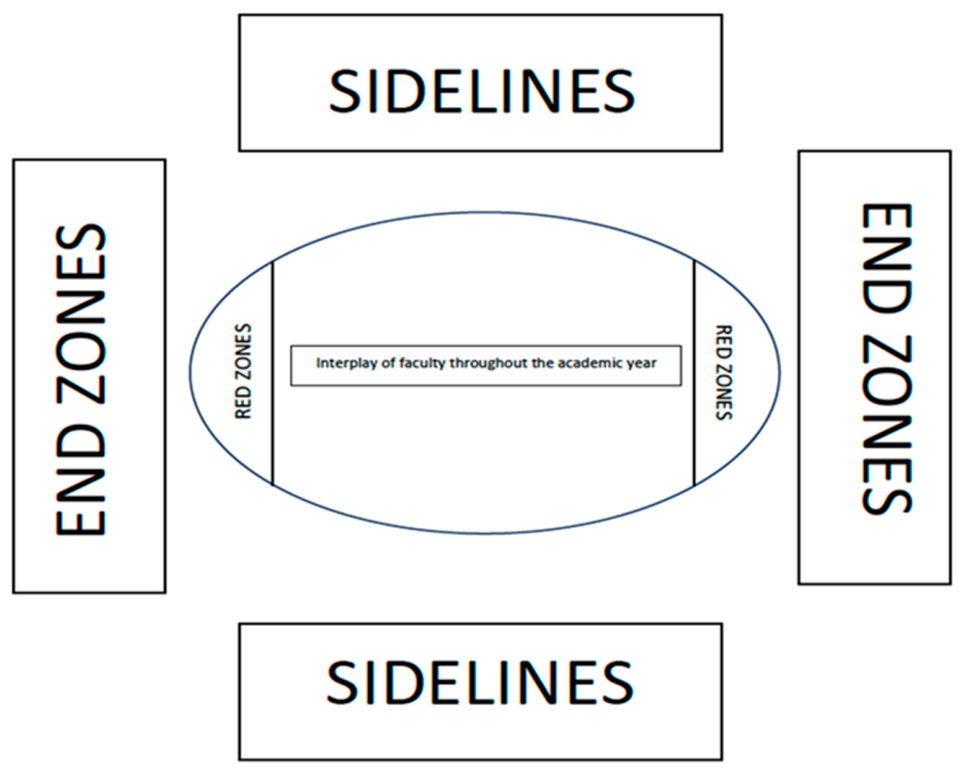
Once the Coach and Player have established “The Victory Formation,” they can progress to the Coach/Player Relationship Model illustrated in Figure 2. The model above shows the specific zones where the coach and player reside as a working field of play. The field of play is then broken down into separate parts to provide areas for the coach and player to navigate, reside in, and avoid. We will explore each component of the model below based on past experiences as both the coach and the player.
18. The Field of Play
The field of play is where the coach and player will spend most of their time. In this case, for the experienced and new educators, it would be the classroom and offices. The field of play includes the coach and player, as well as other faculty, students, administrators, support personnel, and anyone the coach or player could interact with daily. Students would be the most common interactions beyond the coach and player, as the skills developed in the relationship would be for teaching. Interplay will commonly occur as questions arise, concerns surface, and celebrations unfold. Positive and negative things will happen in the classroom, warranting routine discussions between the coach and the player. This interaction is where the zones come into play. Using this model, we discuss the ramifications of engaging in this relationship during a player’s first semester of teaching and how that interaction with the coach succeeded.
19. End Zones
End Zones are the areas where the player achieves success. The player may deliver an excellent lecture, effectively lead a lab, or show great success on exams presented to the students they teach. All of these things show that the player effectively presents materials and educational practices that benefit the cohorts or the course they are assigned to teach. These achievements go weekly and are not the culmination of the semester. Each week, the coach and player can celebrate successes. No success is more minor or more significant than another. Success is essential to helping the player feel they are progressing towards a goal, and the achievements allow the coach to feel their efforts are being heard, understood, and used. But success will not always be what happens week by week. When concerns arise, the Sidelines will become a prominent place for the coach and player to reside.
20. Sidelines
When you watch a football game, most players reside on the sidelines. The players go back and forth from the field to the sidelines to recharge, recover, and refocus. The coach and player residing on the sidelines most of the time in the Coach/Player relationship is essential because it allows continued learning. Being on the sidelines allows for communication to flow. The coach and player share each other’s feelings, concerns, and ecstasies, fostering openness. These interactions may take the form of virtual and in-person meetings, email communications, texting, and other forms of communication available. Being in this zone means meeting weekly, even multiple times a week, to discuss lectures, labs, resources, upcoming tests, and other topics necessary for the player to understand. The purpose of these meetings is to foster consistency. With the coach already having established a teaching strategy that works, the player must use it initially. As time passes and the player develops, changes to the strategy the coach and player agree upon can begin. From this point, the player can use improvisation, instincts, and logic to determine courses of action, allowing them the freedom to perform at a chosen level. The coach would then be relegated to an observational role, but would still be present on the sidelines should the need arise.
21. Red Zones
Red Zones are a questionable aspect of the model. The red zones become uncertain because of barriers and concerns that arise, which could negatively impact the Coach/Player relationship. Even in a football game, the red zone is an area to avoid. One team is on the offensive, while the other is on heightened defense. That creates a problem for the Coach/Player relationship. You do not want a coach or player on either the offensive or defensive side. If either party enters the red zone, judgmentalness can ensue. Judgmentalness manifests as refraining from communication, withholding materials that could benefit either party, and passive-aggressive tendencies that derail the entire relationship. The “eat your young mentality” is pervasive in nursing literature about the treatment of peers in the profession. This mentality does not promote collegiality. Avoiding the red zones ensures a negative mentality does not develop, and openness remains a positive influence on the relationship, allowing them to work as colleagues.
22. Achieving Victory
By bringing all the zones together, the coach and player established a semester-long relationship that fosters learning, understanding, and collegiality. With the implementation of this model during the Spring of 2022, the coach and player worked diligently to address what does and does not work towards success. From the beginning of the interaction, the coach provided all available resources to the player before the semester began. All documents, powerpoints, notes, tests, test banks, study guides, practice questions, lab resources, and any other materials pertinent to the course were shared through direct interaction or online folders such as Box or Google Drive.
Upon receiving all necessary resources, the coach and player agreed to meet at least once a week to review lecture slides from the previous week. Meeting each week allowed the player to review the slides and practice ahead of the lecture, so the coach could see how they were developing an understanding of the course content. Most of these weekly meetings required at least an hour, carried out virtually. These meetings also allowed the coach and player to discuss any semester-related concerns. The coach and player also spoke via text daily. The daily texts helped players remember key lecture points and suggestions that benefited them. The player and coach would exchange emails regularly about questions students asked, other instructors the player was leading, and any other thoughts to share. Essentially, the coach and player spoke every day. This consistent communication ensured the material was delivered effectively, and the player felt supported in their teaching throughout the course. The coach was receptive to this interaction and adapted materials to assist the player when necessary.
As the semester continued, the player and coach maintained consistent communication, but the sessions might be shorter. For instance, practicing the lectures was not always completely necessary. As the player’s confidence increased, they did not feel they needed to practice as much with the coach. The coach agreed with this, allowing the player to develop more independently. The coach and player continued to communicate daily because it helped build collegiality. The coach and player were very receptive to working together and began to predict each other’s comments and thoughts as they worked closely. This interaction led the player to feel comfortable enough to start suggesting what they believed could benefit the course. The coach was receptive to these suggestions, and they began working to modify aspects of the course to make it more effective.
These interactions and efforts between the coach and player highlight the importance of the Coach/Player relationship and the model’s effectiveness. The player was satisfied with the experience and decided to continue in the course with the coach for future semesters. The coach was also happy and wanted the player to continue on the course. Based on student evaluations for the semester, students taught by both the coach and the player rated both educators highly for teaching effectiveness, with scores above 4.0 in both sections of the course. The other instructors teaching in the lab component of the course were satisfied working with either the coach and player, calling them an effective team. Other ancillary support staff, such as simulation personnel, felt the course improved over previous semesters with the coach and player working together. Overall, the coach and player performed well as a team, and the entire course benefited from their efforts using the Coach/Player Model.
23. Future Implications
Currently, the Coach/Player Model has been theoretical, based on faculty members’ shared experiences. Further development of the model is necessary to apply it to a general population of higher education faculty. With continued refinement, the Coach/Player Model can be developed to assist educators across disciplines in learning effective teaching.
24. Testing the Coach/Player Model
The Coach/Player Model requires further testing. It would be necessary for other experienced faculty and new faculty to attempt the experience. Plans to present this model to the faculty are being considered. Providing evaluation methods to other instructors and ancillary personnel would be a beneficial way to assess how the Coach/Player Model works for other faculty. An instrument to measure the model’s effectiveness can be developed to allow observational or self-report performance ratings for users of the model. Branching out the model to other disciplines would be another way to assess its effectiveness. Using a discipline similar to the initial profession focus at the university could be beneficial. Still, it would be intriguing to see the effects of a discipline different from the initial profession.
25. Considerations for Additions to the Model
Additions to the Coach/Player Model would make it more robust. Currently, clear expectations and a willingness to serve with balance provide a base. These elements of the model could be further broken down into more specific measures, particularly for instrument development, if needed. For instance, adding branches on willingness to serve, showing communication as another element, could help clarify what is expected of the coach and player. Having an instrument developed to evaluate the performance of the coach and player could be compared to other effectiveness instruments and allow for inter-rater reliability and validity to be established. Progressing the model will be essential for this initial effort. Still, the satisfaction of the player and coach, along with student evaluations showing greater effectiveness for both individuals, provides a solid foundation for retaining educators in higher education.
26. Conclusion
With a looming nursing faculty shortage, finding ways to develop and retain nurse educators is essential. The Coach/Player relationship is one model that could nurture a comprehensive, respectful, and successful journey for both new nurse faculty and established nurse educators. Using the Growing Together framework as a guide, the Coach/Player Model provides a way for an established nurse educator and a new nurse educator to build a working relationship shaped by clear expectations, a willingness to serve, and balance. The Coach/Player Model provides a field of play where the coach and player routinely visit the sidelines for discussions, limit red-zone activity, and aim for the end zones where victory can be achieved. The model needs to be tested, but it offers a strong foundation for building collegial relationships within nursing education.
27. Declaration of Generative AI and AI-Assisted Technologies in the Manuscript Preparation Process
During the preparation of this work, the author used Scite_ to refine the literature review and create a summary of the articles used. After using this tool/service, the author reviewed and edited the content as needed and took full responsibility for the content of the published article.
Author Contributions
Jason R. Thrift: writing-original draft preparation, writing-reviewing and editing, conception, supervision, research, visualization, investigation.
Acknowledgments
I would like to recognize the faculty colleagues that I have worked with who inspired me to develop this model to benefit new faculty entering higher education: Megan Pate, Lena Burgess, Michelle Onley, and Mary Kaeppler, as well as my graduate teaching assistants whom I had the privilege of working with and helping them learn functions of faculty in higher education: Heidi Walsh, Nicole Ellis, Timothy Malinoski, Cynthia Shaw, Ruby Contreras, Matthew Belenchia, Bailey Vevon, Erika Handley, Erica Woods, Margaret Christy, Taylor Myers, Andrea Addington, Hope Justus, and Hope Hooker.
Conflicts of Interest
The author declares no conflict of interest.
References
- Ephraim, N. Mentoring in nursing education: An essential element in the retention of new nurse faculty. Journal of Professional Nursing 2021, 37, 306–319. [Google Scholar] [CrossRef] [PubMed]
- Mau, A.; Limbong, K.; Yetti, K. The effect of coaching and mentoring towards nurse’s caring and patient satisfaction. Enfermería Clínica 2020, 30, 18–22. [Google Scholar] [CrossRef]
- Petty, G.M.; Lingham, T. Coaching teamwork in the classroom using an innovative team-coaching process. Nursing Education Perspectives 2019, 40(2), 118–120. [Google Scholar] [CrossRef] [PubMed]
- Mokel, M.J.; Behnke, L.M.; Gatewood, E.; Mihaly, L.K.; Newberry, E.B.; Lovence, K.; Ro, K.; Bellflower, B.B.; Tabi, M.; Kuster, A. Mentoring and support for underrepresented nursing faculty: An integrative research review. Nurse Educator 2022, 47(2), 81–85. [Google Scholar] [CrossRef] [PubMed]
- Rivera, R.R.; Gallagher, K.A.; Fitzpatrick, J.J.; Carter, E.J.; Manzano, W.M. Leadership through scholarly dissemination: The NYP nursing experience. Nurse Leader 2016, 14(2), 142–143. [Google Scholar] [CrossRef]
- Kowalski, K. Differentiating mentoring from coaching and precepting. Journal of Continuing Education in Nursing 2019, 50(11), 493–494. [Google Scholar] [CrossRef] [PubMed]
- Patterson, B.J.; Brewington, J.; Krouse, A.; Hall, M. Building academic leadership capacity through coaching. Nursing Education Perspectives 2022, 43(4), 222–227. [Google Scholar] [CrossRef] [PubMed]
- Agency for Healthcare Research and Quality. TeamSTEPPS: Team strategies and tools to enhance performance and patient safety. 2006. Available online: https://www.ahrq.gov/teamstepps-program/index.html.
- Sezer, H.; Sahin, H. Faculty development program for coaching in nursing education: A curriculum development process study. Nurse Education in Practice 2021, 55, 103165. [Google Scholar] [CrossRef] [PubMed]
- Scite, *!!! REPLACE !!!*. AI research grounded in evidence. 2026. Available online: https://scite.ai/.
- Slimmer, L. A teaching mentorship program to facilitate excellence in teaching and learning. Journal of Professional Nursing 2012, 28(3), 182–185. [Google Scholar] [CrossRef] [PubMed]
- Jacobson, S.; Sherrod, D. Transformational mentorship models for nurse educators. Nursing Science Quarterly 2012, 25(3), 279–284. [Google Scholar] [CrossRef] [PubMed]
- Costa, C.; Smith, J. Career satisfaction and advancement related to mentorship experiences of underrepresented nursing faculty. Nursing Education Perspectives 2023, 44(5), 291–294. [Google Scholar] [CrossRef] [PubMed]
- Busby, K.; Draucker, C.; Reising, D. Mentoring-as-partnership: The meaning of mentoring among novice nurse faculty. Journal of Nursing Education 2023, 62(2), 83–88. [Google Scholar] [CrossRef] [PubMed]
- Busby, K.; Draucker, C.; Reising, D. Exploring mentoring relationships among novice nurse faculty: A grounded theory. Nursing Education Perspectives 2022, 44(1), 36–42. [Google Scholar] [CrossRef] [PubMed]
- Bergeron, P.; Irons, A.; Hall, C. Collaborative mentorship: Two innovative approaches for new faculty success. Journal of Nursing Education 2025, 64(2), 125–127. [Google Scholar] [CrossRef] [PubMed]
- Lambert, K.; Dorris, D.; Williams, A. The effects of structured mentorship and onboarding of novice nursing faculty. Journal of Nursing Education 2024, 63(6), 405–408. [Google Scholar] [CrossRef] [PubMed]
- Raymond, C.; Penconek, T.; Dahlke, S. Nurse educators’ experiences with a faculty navigator program: A mixed-methods study. Journal of Nursing Education 2022, 61(10), 587–590. [Google Scholar] [CrossRef] [PubMed]
- Kroning, M.; Northrup, A. Increase nurse faculty salaries to reduce the nursing shortage. Nursing 2023, 53(12), 48–51. [Google Scholar] [CrossRef]
- Busby, K.R.; Draucker, C.B. Mentoring in academic nursing from the perspectives of faculty mentors. Nursing Education Perspectives 2024, 45(4), 213–218. [Google Scholar] [CrossRef] [PubMed]
- Kram, K.E. (1988). Mentoring at work: Developmental relationships in organizational life. University Press of America.
- Huggins, D. Enhancing nursing students’ education by coaching mentors. Nurs Manag (Harrow) 2016, 23(1), 30–2. [Google Scholar] [CrossRef] [PubMed]
Figure 1.
Diagram of Attributes Building Toward Coach/Player Relationship.
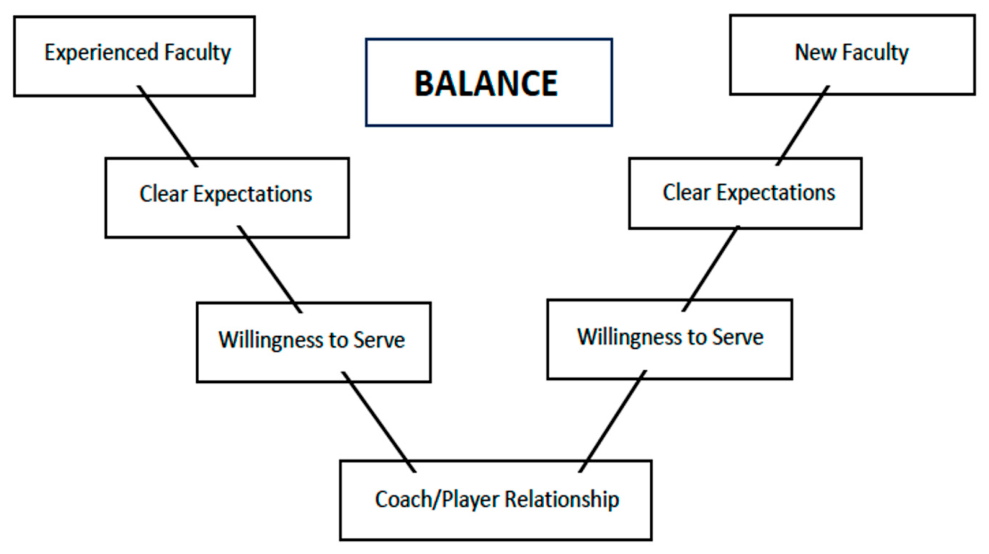
Figure 2.
Model of the Coach/Player Relationship.
Disclaimer/Publisher’s Note: The statements, opinions and data contained in all publications are solely those of the individual author(s) and contributor(s) and not of MDPI and/or the editor(s). MDPI and/or the editor(s) disclaim responsibility for any injury to people or property resulting from any ideas, methods, instructions or products referred to in the content. |
© 2026 by the authors. Licensee MDPI, Basel, Switzerland. This article is an open access article distributed under the terms and conditions of the Creative Commons Attribution (CC BY) license (http://creativecommons.org/licenses/by/4.0/).
Copyright: This open access article is published under a Creative Commons CC BY 4.0 license, which permit the free download, distribution, and reuse, provided that the author and preprint are cited in any reuse.


