

Submitted:
21 May 2026
Posted:
22 May 2026
You are already at the latest version
Abstract
Background: During the racial justice protests of 2020 and 2021, crowd control chemical irritants (referred to as “tear gas”) were deployed against protesters, after which there were anecdotal reports of altered menstrual cycles. Methods: Data from 82 women (ages 18-45) who attended protests/demonstrations in 2020-2021 were collected through an online questionnaire. The associations between proxy measurements of tear gas exposure (number of protests attended, number of acute symptoms of exposure, and number of tear gas exposures) and menstrual cycle outcomes were determined through linear regression, adjusted for potential confounders. Menstrual cycle outcomes were light bleeding, heavy bleeding, period pains, irregular cycles, long bleeding, short bleeding, short cycles, or long cycles. Results: High protest attendance (> 9 times) (β: 2.60, 95% CI: 1.41, 3.80), and exposure to tear gas at least three times (β: 2.18, 95% CI: 0.63, 3.72) were significantly associated with a greater number of menstrual cycle outcomes. The strongest association was observed for irregular cycles. The number of acute symptoms was not significantly associated with menstrual cycle outcomes. Conclusions: Our findings support the hypothesis that tear gas exposure causes menstrual cycle disturbances. Additional research is needed to determine whether there are longer-term menstrual cycle disturbances or other adverse effects on reproductive health.
Keywords:
tear gas
; protests
; menstrual function
; fertility
; crowd control chemicals
1. Introduction
During the racial justice protests that took place in 2020 and 2021, the use of tear gas against demonstrators was documented in at least one hundred instances [1]. Exposure to tear gas was not limited to individuals who participated in protests; demonstrators and law enforcement agents potentially exposed household members through contaminated clothing, and tear gas deployed during protests also infiltrated neighboring homes and businesses. As a result, a large number of individuals were potentially exposed. Tear gas is a group of crowd control chemical irritants that are deployed to temporarily incapacitate targets [2,3]. Active compounds in tear gas include 2-chlorobenzylidene malononitrile (CS), 1-chloroacetophenone (CN), dibenz [Ƅ,ƒ]-1,4-oxazepine (CR), and oleoresin capsicum (OC) [2,3]. Tear gas incapacitates individuals by inducing transient uncontrollable tearing, coughing, and sneezing [2,3]. Potential longer-term effects of tear gas, such as reproductive and menstrual effects, are not well characterized.
Two peer-reviewed studies on tear gas and menstrual function have recently been published [4,5]. Both studies reported an association between more frequent tear gas exposure and altered menstrual function. Torgrimson-Ojerio et al. analyzed 1,650 women using a cross-sectional questionnaire and found the number of days of tear gas exposures to be significantly associated with cycle outcomes, but did not include any covariates in the analyses [4]. Hassan et al. also conducted an online questionnaire and found that among 1276 participants across the U.S., those with more days of exposure had a higher odds of menstrual cycle outcomes, adjusting for demographic and reproductive covariates including menstrual history.
This study attempted to further characterize the link between tear gas exposure and altered menstrual function with a detailed online questionnaire regarding protests attendance, symptoms of tear gas exposure, specific menstrual dysfunctions, and medical care post-exposure. Specifically, we hypothesized that tear gas exposure would be associated with an increase in symptoms of altered menstrual function. We furthermore we assessed the effect of attending protests, which may increase stress, separately from being exposed to tear gas; and we examined specific acute symptoms of tear gas exposure in relation to menstrual function. Finally, we were able to examine specific alterations of menstrual function. We found that both high protest attendance and more tear gas exposure events were associated with altered menstrual function, and that the strongest association was observed with irregular cycles, indicating a disruption of normal reproductive function.
2. Methods
2.1. Study Design and Population
The data were drawn from the University of Louisville Tear Gas Study. This was a cross-sectional study designed to determine whether self-reported exposures to tear gas resulting from protests in 2020 and 2021 were associated with short-term and longer-term health outcomes. This study was approved by the Institutional Review Board of University of Louisville, KY (IRB 20.0802).
The online questionnaire inquired about demographic characteristics, prior health conditions, number of protests attended, type of acute symptoms of tear gas exposure, female and male reproductive health outcomes, and open-ended questions related to other possible health outcomes. Initial questions were drafted by researchers and community members directly involved with this study. A committee of epidemiologists, environmental researchers, and physicians reviewed and edited the questionnaire.
The target population of the study was individuals aged 18 years and older who believed that they were exposed to tear gas in 2020 or 2021. The study originally targeted residents of Louisville, Kentucky, but was later expanded to residents of the United States. Participants were recruited through social media posts and advertisements, as well as flyers and emails distributed to community partners.
The electronic questionnaire was created and maintained on Research Electronic Data Capture (REDCap), a secure, online platform for entering and storing data [6,7]. The platform is compliant with the Health Insurance Portability and Accountability Act of 1996 (HIPAA). The questionnaire included a preamble that explained the purpose of this study and gave contact information. The preamble was followed by two screening questions: whether the participant was 18 years of age or older and whether the participant was exposed to tear gas. A “no” answer to either question ended the questionnaire.
2.2. Exposure Assessment
The exposure of interest for this project was intensity of crowd control chemical irritants, under the umbrella term “tear gas.” The exposure was assessed several ways, with each serving as an estimate of the extent of tear gas exposure. The first was the number of protests attended. Protest number options on the questionnaire included each integer between 1 and 20, and a “>20” option. The second method was a composite score of acute health effects of tear gas. These health effects include eye (watering, burning/stinging, other), lung (coughing, burning, shortness of breath, other), skin (burning, blistering, other), and heart-related effects (increased heart rate, irregular heartbeat, chest pain, other). Participants were instructed to select any that applied. A composite score was computed by summing the number of “yes” responses for the 14 health effects (from 0 - 14) and was treated as a continuous variable. The questionnaire was revised after a pilot period, and a question was added about the number of times the participant was exposed to tear gas; this was used as the exposure in an additional model. We also determined whether seeking medical treatment for acute symptoms of tear gas was associated with menstrual cycle outcomes.
2.3. Outcome Assessment
The outcome of interest was disruption of menstrual health. The outcome was assessed using a composite score of all 8 menstrual cycle outcomes on the questionnaire (light bleeding, heavy bleeding, period pains, irregular cycles, long bleeding, short bleeding, short cycle, and long cycle) after exposure to tear gas. Participants were instructed to select any that applied. The composite score ranged from 0 to 8 and was treated as a continuous variable.
2.4. Statistical Analyses
Three hundred one questionnaires were collected. If records were submitted with timestamps within one minute of one another with identical or nearly identical data, only one of the records was included in the analyses. This was a quality control measure intended to eliminate serial submissions by the same participant. The full survey collected data from male, female, and transgender/non-binary participants, but only female-identified records were included in this analysis. The analyses were also restricted to participants 18-45 years of age, to avoid menstrual changes associated with perimenopause. Eighty-two records were eligible for analysis based on these criteria (Figure 1).
Descriptive statistics for covariates were calculated for each exposure and each outcome. Protest number (1 – 9, > 9), number of acute symptoms of tear gas (0 – 7, 8 – 14), number of times being exposed to tear gas (1-2, 3 or more), and seeking medical care (yes, no), were treated as binary. Chi-square tests were conducted to evaluate the association between each exposure and covariates. Two-sided p-values were considered statistically significant when less than 0.05. All statistical analyses were conducted using Statistical Analysis Software (SAS) Version 9.4 [8].
Potential covariates were identified through published literature and directed acyclic graphs (DAGs) (Supplementary Figure S1). Identified confounders were age, race, ethnicity, socio-economic status (SES) indicators (education and income), trying to conceive, and hormonal birth control. Missing data on covariates were imputed for eligible records (protest number: n=15, acute symptom score: n=16, seeking medical care: n=14; exposure number: n=11). Twenty imputations were performed using PROC MI in SAS.
Using linear regression models, beta coefficients and 95% confidence intervals were calculated for the effects of protest number, acute symptom score, exposure number, and seeking medical care on number of menstrual cycle outcomes. Each model was run with data from the multiple imputation. Additionally, logistic regression models were conducted to examine the association of protest number with each menstrual cycle outcome. The main analyses were also conducted with unimputed data as a sensitivity analysis.
3. Results
3.1. Descriptive Statistics
Between March 15 and September 23, 2021, 301 records (questionnaires) were logged on REDCap. Of these, 82 were eligible to be included in the analysis based on the previously outlined criteria (Figure 1).
Descriptive statistics were performed for the 82 eligible participants, and by protest number, acute symptom composite score, and exposure number (Table 1). Fifty percent were aged 18 to 32; 61% were white; 52% had graduated from college; and 40% reported an income of $50,000 or higher. Twenty-one percent reported that they were trying to conceive. The majority of respondents either attended 1 to 2 protests (38%) or greater than 20 protests (38%). The median acute tear gas symptom score was 6 (IQR = 4 - 9).
Younger individuals [18–32] attended more protests, on average, than older individuals (Table 1). Individuals who were not white and were less educated experienced more acute symptoms of tear gas exposure. Individuals who were trying to conceive were less likely to experience acute symptoms of tear gas exposure. College educated individuals reported more exposures to tear gas than those who were not college educated.
The most common menstrual cycle outcome in women between the aged 18 to 45 years was irregular cycles (35 women), followed by heavy bleed (28 women) and period pain (27 women) (Table 2). The median menstrual cycle outcome score was 1 (IQR = 0 - 4). Twenty-nine participants (35%) reported no menstrual cycle outcomes; 21 participants (26%) reported one outcome; 17 (21%) reported 2-4 outcomes; and 15 (18%) reported 5-8 outcomes.
3.2. Multivariable Models
Relative to attending 1-2 protests, attending greater than 20 protests was significantly associated with approximately 3 additional menstrual cycle outcomes (β=2.60, 95% CI: 1.41, 3.80, p<0.0001). The model was adjusted for age, race, ethnicity, education, income, trying to conceive, and hormonal birth control (Table 3).
Acute symptom scores of 5-8 and 9-14 were positively associated with menstrual cycle outcome scores, compared to an acute symptom score of 0-4, but the associations were not statistically significant (Table 3). When handled as a continuous variable, the number of acute symptoms was non-significantly positively associated with menstrual cycle outcomes.
Analyses of the 58 eligible participants who provided data on exposure number produced results consistent with those for protest number. Compared to 1 to 2 exposures, 3 or more exposure was significantly associated with approximately 2 additional menstrual cycle outcomes (β=2.18, 95% CI: 0.63, 3.72, p=0.0058). The model was adjusted for age, race, ethnicity, education, income, trying to conceive, hormonal birth control, and the number of protests attended (Table 3). Protest number was no longer significantly associated with menstrual cycle outcomes in this model.
Seeking medical treatment was inversely associated with the number of menstrual cycle outcomes, but the association was not statistically significant (Table 3).
Logistic models for each menstrual cycle outcome were also run using protest attendance as the primary exposure (Supplementary Table S1). Compared to 1-2 protests, attending 3-20 protests had significant direct associations with heavy bleed and irregular cycles, and attending >20 protests had significant direct associations with heavy bleed, irregular cycles, short bleed, long cycle, and period pain. After accounting for multiple testing using a Bonferroni correction (adjusted α=0.00625), heavy bleed, long bleed, and irregular cycles remained statistically significant.
The primary models were run again with the original, unimputed dataset, excluding participants with any missing covariates (Supplementary Table S2). Results were similar to the models that used the imputed data.
4. Discussion
4.1. Main Finding of This Study
The purpose of this study was to investigate whether exposure to tear gas during the racial justice protests was associated with menstrual cycle characteristics or abnormalities. The number of protests attended, but not the other proxies of tear gas exposure, was significantly and directly associated with the number of menstrual cycle outcomes. For a subset of participants who reported the number of times they were exposed to tear gas, there was also a significant direct association with menstrual cycle outcomes. We also examined associations with specific menstrual cycle outcomes and found strong associations between protest number and heavy bleeding, long bleed, and irregular cycles.
The number of acute symptoms of tear gas exposure was directly associated with the number of menstrual cycle outcomes, when considered both continuously and categorically, but the associations were not statistically significant at the 0.05 level. It was not determined how frequently the acute symptoms were experienced; therefore, protest number may be capturing additional information in terms of frequency of exposure. It is possible that repeated exposure to tear gas is more important from a menstrual health standpoint than the intensity of individual exposures. Seeking medical care for symptoms of tear gas exposure was associated with fewer of menstrual cycle outcomes, but the association was not statistically significant.
Three or more exposure to tear gas was associated with approximately two additional menstrual cycle outcomes. The model controlled for protest number to tease apart the effects protest frequency and tear gas exposure frequency. Protest number no longer had a significant association with menstrual cycle outcomes in this model, suggesting that the association observed between protest number and menstrual outcomes in the first model may have been driven by the association between protest number and cumulative tear gas exposure.
4.2. What Is Already Known on This Topic
Our results are consistent with two previously published studies concerning tear gas exposure and menstrual cycle outcomes. Torgrimson-Ojerio et al. analyzed 1,650 women using a cross-sectional questionnaire and found the number of days of tear gas exposures to be significantly associated with cycle outcomes such as clots, cramping, changes in bleed length and color, and a lack of bleeding. This study had a large sample size (n=1,650), accounted for multiple days of exposure, and examined different menstrual cycle outcomes, but did not include any covariates in the analyses [4]. Hassan et al. also conducted an online questionnaire and found that among 1276 participants across the U.S., those with 2-4 days of exposure had 2.1 times the odds (95% CI: 1.27, 3.69), and those with 5 or more days of tear gas exposure had 2.6 times the odds of experiencing adverse menstrual cycle outcomes (95% CI: 1.61, 4.22), adjusting for demographic and reproductive covariates including menstrual history.
We hypothesized that tear gas can result in altered menstrual cycle characteristics. Menstrual function encompasses characteristics of the menstrual cycle, such as cycle length; frequency, duration, and intensity of bleeding; and menstrual pain. The menstrual cycle is orchestrated by the hypothalamus-pituitary-ovarian axis, disturbance of which can lead to altered menstrual function. In the proposed mechanism, changes in menstrual function result from interactions between tear gas compounds and transient receptor potential (TRP) channels that are present throughout the body. In rodents, transient receptor potential channel vanilloid 1 (TRPV1) has specifically been found in the caudal hypothalamus [9]. Transient receptor potential channel ankyrin 1 (TRPA1) has been found in the anterior pituitary, in areas that stimulate the release of gonadotropin-releasing hormone (GnRH) and luteinizing hormone (LH), respectively, and is essential for ovulation [10,11]. CS, CN, and CR interact with TRPA1, while OC interacts with TRPVI [2]. Excessive levels of GnRH and LH are believed to be the basis for anovulation and abnormal menstrual cycle outcomes that are associated with polycystic ovary syndrome [12]. Stimulation of the release of GnRH and LH by tear gas may have similar outcomes.
4.3. What This Study Adds
Our results are consistent with the two previously published surveys on tear gas and menstrual function, but adds additional information in that we found that exposure to tear gas on 3 or more occasions was associated with approximately two additional menstrual cycle outcomes. In addition, our study is unique because we collected data on a list of possible menstrual cycle outcomes and examined associations of tear gas exposure with each type of disturbance. Protest number was associated with increased odds of having irregular cycles and period pain; it was also associated with heavy bleeding and prolonged bleeding, conditions which have been previously associated with hypothyroidism [13]. In addition, this is the only study examining the use of medical care, post-exposure.
Tear gas exposure was estimated using different proxy variables (protest number and acute symptoms); the results from these models were compared to a model which used exposure number (on a subset of the data). This process demonstrated that protest number may be a good proxy for cumulative tear gas exposure, but that the number of acute symptoms may not, possibly because it reflects a single exposure incident.
4.4. Limitations
This study may be subject to selection bias inherent to studies in which participants are self-selected. Individuals who experienced more severe tear gas exposure symptoms may have been more motivated to participate in the study. This could result in bias if these same individuals were also more likely to experience menstrual cycle disturbances, apart from those being caused by tear gas exposure. The data are retrospective, which introduces the possibility of recall bias; participants who experienced more menstrual cycle disturbances may be more likely to recall more severe consequences of tear gas exposure.
There is the possibility that the association between protest number and menstrual cycle scores was not a result of the tear gas exposure, but of factors related to attending protests, such as stress. Previous research has provided evidence for an association between stress and menstrual cycle disturbance. For example, Gordley et al. demonstrated a link between acute stress from life events and menstrual cycle outcomes, such as period pain, long or heavy bleeding, and altered cycle length [14]. Anovulation has also been linked to stress and can present as a long menstrual cycle [15]. It has been hypothesized that the glucocorticoids released as part of the stress response may disrupt hormone release by the pituitary and ovaries, thus altering the menstrual cycle [16]. Conversely, acute stress has also been shown to stimulate ovulation [17]. Data on stress were only collected for 21 of the 82 eligible participants and therefore were not included in these analyses.
Tear gas exposure was not measured directly in this study. Wristbands that pick up environmental chemicals have been developed, but they are not currently designed to capture tear gas and pepper spray [18]. Laboratory tests to identify crowd control irritants post exposure are also generally unavailable [19].
This study investigated numerous aspects of menstrual cycle function, but did not assess the duration of these symptoms, and did not assess menstrual function prior to tear gas exposure. Longer-term adverse menstrual changes or impacts on fertility could impact quality of life and financial stability of affected individuals [20]. There has not yet been a study examining fertility and pregnancy in individuals exposed to tear gas.
Finally, sample sizes were small for some categories of the exposure variables and specific menstrual cycle outcomes, and results should be interpreted with caution.
5. Conclusions
This study adds to the body of research that indicates that crowd control irritants are not benign and can have short-term and longer-term health effects. Educating the public regarding the results of this and other studies could increase awareness of the possible effects of tear gas exposure on reproductive health. These results emphasize the importance of mitigation measures for tear gas exposure, including decontamination immediately following the exposure, and promptly seeking medical care. Future research is needed to examine the duration of menstrual cycle disturbances post-exposure and evaluate the potential for longer-term fertility and pregnancy complications.
Supplementary Materials
The following supporting information can be downloaded at: Preprints.org, Supplementary Table S1. Multivariable logistic regression models for protest number and specific menstrual cycle outcomes in women aged 18 to 45 years (n=80). Supplementary Table S2. Unimputed multivariable linear regression models for proxies of tear gas exposure and menstrual cycle outcomes in women aged 18 to 45 years. Supplementary Figure S1. Directed acyclic graph, representing the associations between protest number, tear gas exposure, acute effects of tear gas exposure, seeking medical care, and menstrual cycle outcomes. Identified confounders were socioeconomic status (SES) (represented by education and income in the models), race/ethnicity, age, trying to conceive, and hormonal birth control.
Author Contributions
M.U. conceived of the study and directed the dissemination of the survey to community partners. K.T., E.R., M.T., C.C., A.K., M.U., A.B., T.S. designed the survey. E.R., A.K. and K.T. administered the survey and compiled responses. E.R. analyzed the data for this study and drafted the manuscript. J.G., K.T., T.A. advised the analysis. All co-authors (K.T., A.K., J.G., N.P., A.W., R.N., T.A., A.B., M.T., M.U., T.S and C.C.) provided feedback on the manuscript to the first author (E.R.) and approved the final version.
Funding
This work was supported by the National Institute of Environmental Health Sciences (NIEHS)--P30ES030283 (PI: Christopher States).
Institutional Review Board Statement
This study was approved by the Institutional Review Board of University of Louisville, KY (IRB 20.0802, 10 November 2020).
Data Availability Statement
The data presented in this study are available on request from the corresponding author due to the small sample size, and free-response portions of the dataset that may indirectly reveal identity of participants.
References
- Lai KKR, Marsh B, Singhvi A. Here are the 100 U.S. cities where protesters were tear-gassed. New York Times [Internet]. [updated 2020 Jun 18; cited 2021 Sep 16]. Available from https://www.nytimes.com/interactive/2020/06/16/us/george-floyd-protests-police-tear-gas.html.
- Rothenberg C, Achanta S, Svendsen ER, Jordt SE. Tear gas: an epidemiological and mechanistic reassessment. Annal N Y Acad Sci. 2016;1378(1):96-107. [CrossRef]
- Haar RJ, Iacopino V, Ranadive N, Weiser SD, Dandu M. Health impacts of chemical irritants used for crowd control: a systematic review of the injuries and deaths caused by tear gas and pepper spray. BMC Public Health. 2017;17(1):831. [CrossRef]
- Torgrimson-Ojerio BN, Mularski KS, Peyton MR, Keast EM, Hassan A, Ivlev I. Health issues and healthcare utilization among adults who reported exposure to tear gas during 2020 Portland (OR) protests: a cross-sectional survey. BMC Public Health. 2021;21(1):803. [CrossRef]
- Hassan A, Ojanen-Goldsmith A, Hing AK, Mahoney M, Traxler S, Borass CM. More than tears: associations between exposure to chemical agents used by law enforcement and adverse reproductive health outcomes. Front Epidemiol. 2023;3:1177874. [CrossRef]
- Harris PA, Taylor R, Thielke R, Payne J, Gonzalez N, Conde JG. Research electronic data capture (REDCap)--a metadata-driven methodology and workflow process for providing translational research informatics support. J Biomed Inform. 2009;42(2):377-81. [CrossRef]
- Harris PA, Taylor R, Minor BL, Elliott V, Fernandez M, O’Neal L, et al. The REDCap consortium: building an international community of software platform partners. J Biomed Inform. 2019;95:103208. [CrossRef]
- Statistical Analysis Software. Version 9.4. Cary (N.C): SAS Institute Inc. c2002-2012.
- Cavanaugh DJ, Chesler AT, Jackson AC, Sigal YM, Yamanaka H, Grant R, et al. Trpv1 reporter mice reveal highly restricted brain distribution and functional expression in arteriolar smooth muscle cells. Journal Neurosci. 2011;31(13):5067-77. [CrossRef]
- Surkin PN, Dmytrenko G, Di Giorgio NP, Bizzozzero M, De Laurentiis A, Fernández-Solari J. Participation of TRPV1 in the activity of the GnRH system in male rats. Eur J Neurosci. 2020;52(3):2995-3001. [CrossRef]
- Götz V, Qiao S, Das D, Wartenberg P, Wyatt A, Wahl V, et al. Ovulation is triggered by a cyclical modulation of gonadotropes into a hyperexcitable state. Cell Rep. 2023;42(6):112543. [CrossRef]
- McCartney CR, Campbell RE, Marshall JC, Moenter SM. The role of gonadotropin-releasing hormone neurons in polycystic ovary syndrome. J Neuroendocrin. 2022:e13093. [CrossRef]
- Koutras DA. Disturbances of menstruation in thyroid disease. Annals of the New York Academy of Sciences. 1997;816:280-4. [CrossRef]
- Gordley LB, Lemasters G, Simpson SR, Yiin JH. Menstrual disorders and occupational, stress, and racial factors among military personnel. J Occup Environ Med. 2000;42(9):871-81. [CrossRef]
- Schliep KC, Mumford SL, Vladutiu CJ, Ahrens KA, Perkins NJ, Sjaarda LA, et al. Perceived stress, reproductive hormones, and ovulatory function: a prospective cohort study. Epidemiology. 2015;26(2):177-84. [CrossRef]
- Fenster L, Waller K, Chen J, Hubbard AE, Windham GC, Elkin E, et al. Psychological stress in the workplace and menstrual function. Am J Epidemiol. 1999;149(2):127-34. [CrossRef]
- Tarín JJ, Hamatani T, Cano A. Acute stress may induce ovulation in women. Reprod Biol Endocrinol. 2010;8:53. [CrossRef]
- Full Screen (Quantitative): List of Tested Compounds for Quantitative (1500+) Screen (Version 4) [Internet]. Corvallis (OR): MyExposome; [cited 2022 Apr 5]. Available from: https://www.myexposome.com/fullscreen.
- Tidwell RD, Wills BK. Tear gas and pepper spray toxicity. 2022 Jan 10. In: StatPearls [Internet]. Treasure Island (FL): StatPearls Publishing; [updated 2022 Jan 10; cited 2022 Mar 25]. Available from: Available from: https://www.ncbi.nlm.nih.gov/books/NBK544263/.
- Matteson KA, Zaluski KM. Menstrual health as a part of preventive health care. Obstet Gynecol Clin North Am. 2019;46(3):441-53. [CrossRef]
Figure 1.
Flow diagram showing inclusion and exclusion criteria for the multivariable models used in the analysis.
Figure 1.
Flow diagram showing inclusion and exclusion criteria for the multivariable models used in the analysis.
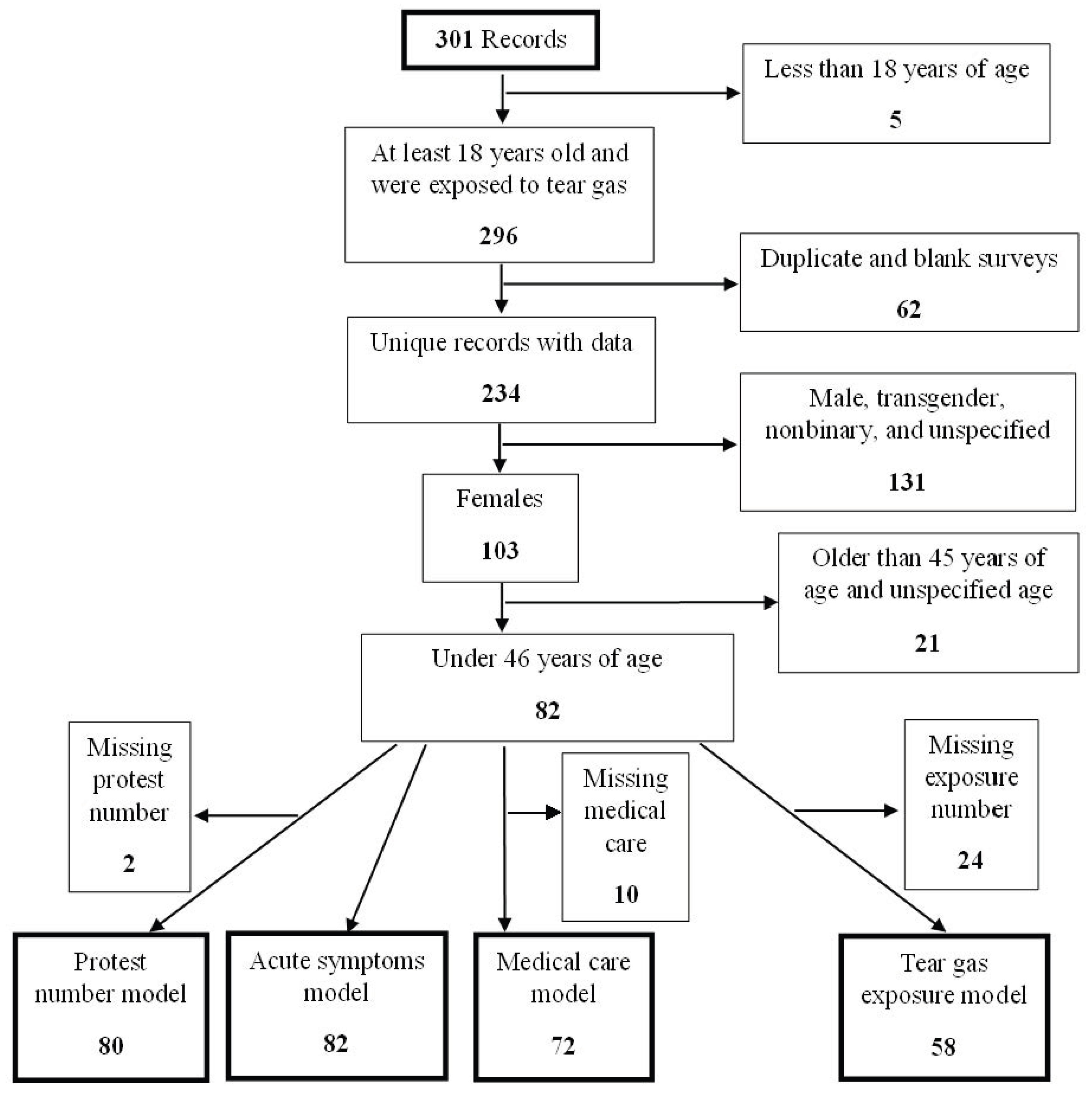

Table 1.
Participant characteristics by number of protests attended, number of acute symptoms experienced, number of times exposed to tear gas, and whether they sought medical care.
Table 1.
Participant characteristics by number of protests attended, number of acute symptoms experienced, number of times exposed to tear gas, and whether they sought medical care.
| Number of Protests (N=80) | Number of Acute Symptoms (N=82) |
Number of Tear Gas Exposures (N=58) |
Sought Medical Care (N=72) | |||||||
|---|---|---|---|---|---|---|---|---|---|---|
| 1 - 2 N=30 n (%) | 3 - 20 N=20 n (%) | > 20 N=30 n (%) | 0 - 4 N=24 n (%) | 5 - 8 N=36 n (%) | 9 - 14 N=22 n (%) | 1 - 2 N=27 n (%) |
> 2 N=31 n (%) |
No N=52 n (%) | Yes N=20 n (%) | |
| Age (years) | p=0.043 | p=0.014 | p=0.38 | p=0.33 | ||||||
| 18 - 32 | 10 (33) | 13 (65) | 18 (60) | 6 (25) | 22 (61) | 13 (59) | 17 (63) | 16 (52) | 30 (58) | 9 (45) |
| 33 - 45 | 20 (67) | 7 (35) | 12 (40) | 18 (75) | 14 (39) | 9 (41) | 10 (37) | 15 (48) | 22 (42) | 11 (55) |
| Race | p=0.70 | p=0.0015 | p=0.85 | p=0.33 | ||||||
| White | 18 (60) | 11 (55) | 20 (67) | 20 (83) | 23 (64) | 7 (32) | 15 (56) | 18 (58) | 35 (67) | 11 (55) |
| Other | 12 (40) | 9 (45) | 10 (33) | 4 (17) | 13 (36) | 15 (68) | 12 (44) | 13 (42) | 17 (33) | 9 (45) |
| Ethnicity | p=0.19 | p=0.015 | p=0.89 | p=0.0041 | ||||||
| Hispanic | 9 (30) | 2 (12) | 4 (14) | 9 (39) | 4 (12) | 2 (9) | 3 (11) | 3 (10) | 5 (10) | 8 (40) |
| Non-Hispanic | 21 (70) | 15 (88) | 25 (86) | 14 (61) | 29 (88) | 20 (91) | 24 (89) | 27 (90) | 44 (90) | 12 (60) |
| Missing | 0 | 3 | 1 | 1 | 3 | 0 | 0 | 1 | 3 | 0 |
| Highest education | p=0.18 | p=0.0039 | p=0.037 | p=0.082 | ||||||
| No undergrad degree | 18 (60) | 8 (40) | 11 (38) | 12 (50) | 11 (31) | 16 (76) | 17 (63) | 11 (35) | 19 (37) | 12 (60) |
| Undergrad degree | 12 (40) | 12 (60) | 18 (62) | 12 (50) | 25 (69) | 5 (23) | 10 (37) | 20 (65) | 32 (63) | 8 (40) |
| Missing | 0 | 0 | 1 | 0 | 0 | 1 | 0 | 0 | 1 | 0 |
| Income | p=0.072 | p=0.014 | p=0.84 | p=0.90 | ||||||
| ≤$49,999 | 13 (43) | 12 (67) | 20 (71) | 8 (35) | 24 (71) | 14 (70) | 18 (69) | 18 (67) | 29 (62) | 12 (60) |
| ≥$50,000 | 17 (57) | 6 (33) | 8 (29) | 15 (65) | 10 (29) | 6 (30) | 8 (31) | 9 (33) | 18 (38) | 8 (40) |
| Missing | 0 | 2 | 2 | 1 | 2 | 2 | 1 | 4 | 5 | 0 |
| Trying to conceive | p=0.14 | p=0.019 | p=0.27 | p=0.025 | ||||||
| No | 21 (70) | 17 (89) | 26 (87) | 15 (63) | 32 (89) | 18 (90) | 25 (93) | 24 (83) | 44 (88) | 13 (65) |
| Yes | 9 (30) | 3 (11) | 4 (13) | 9 (38) | 4 (11) | 2 (10) | 2 (7) | 5 (17) | 6 (12) | 7 (35) |
| Missing | 0 | 1 | 0 | 0 | 0 | 2 | 0 | 2 | 2 | 0 |
| Hormonal birth control | p=0.088 | p=0.060 | p=0.28 | p=0.0018 | ||||||
| No | 26 (90) | 13 (68) | 18 (67) | 17 (74) | 22 (67) | 19 (95) | 21 (81) | 19 (68) | 30 (64) | 20 (100) |
| Yes | 3 (10) | 6 (32) | 9 (33) | 6 (26) | 11 (33) | 1 (5) | 5 (19) | 9 (32) | 17 (36) | 0 (0) |
| Missing | 1 | 1 | 3 | 1 | 3 | 2 | 1 | 3 | 5 | 0 |
Table 2.
Menstrual cycle outcomes in women (age 18-45) who were exposed to tear gas in 2020 and 2021 (n=82).
Table 2.
Menstrual cycle outcomes in women (age 18-45) who were exposed to tear gas in 2020 and 2021 (n=82).
| Outcome | N(%) |
|---|---|
| Irregular Cycles | 35 (43) |
| Heavy Bleed | 28 (34) |
| Period Pain | 27 (33) |
| Long Bleed | 20 (24) |
| Light Bleed | 19 (23) |
| Long Cycle | 14 (17) |
| Short Bleed | 13 (16) |
| Short Cycle | 13 (16) |
Table 3.
Multivariable linear regression models for proxies of tear gas exposure and menstrual cycle outcomes in women aged 18 to 45 years.
Table 3.
Multivariable linear regression models for proxies of tear gas exposure and menstrual cycle outcomes in women aged 18 to 45 years.
| Category | n (%) | β | (95% CI) | p-value |
|---|---|---|---|---|
| Number of Protests Attended (n=80)a | ||||
| 1 - 2 | 30 (38) | Reference | ||
| 3 - 20 | 20 (25) | 1.01 | (-0.27, 2.30) | 0.12 |
| > 20 | 30 (38) | 2.60 | (1.41, 3.80) | <0.0001 |
| Acute Symptoms of Tear Gas Exposure (n=82) a | ||||
| 0 - 4 | 24 (29) | Reference | ||
| 5 - 8 | 36 (44) | 0.57 | (-0.97, 2.11) | 0.47 |
| 9 - 14 | 22 (27) | 1.00 | (-0.73, 2.73) | 0.26 |
| Continuous | 82 | 0.14 | (-0.05, 0.33) | 0.15 |
| Number of Tear Gas Exposure Events (n=58) b | ||||
| 1-2 | 27 (47) | Reference | ||
| ≥3 | 31 (53) | 2.18 | (0.63, 3.72) | 0.0058 |
| Medical Care for Acute Symptoms (n=72)a | ||||
| No | 52 (72) | Reference | ||
| Yes | 20 (28) | -1.61 | (-3.33, 0.11) | 0.066 |
a Adjusted for age, race, ethnicity, education, income, trying to conceive, and hormonal birth control. b Adjusted for the variables above, and the number of protests attended.
Disclaimer/Publisher’s Note: The statements, opinions and data contained in all publications are solely those of the individual author(s) and contributor(s) and not of MDPI and/or the editor(s). MDPI and/or the editor(s) disclaim responsibility for any injury to people or property resulting from any ideas, methods, instructions or products referred to in the content. |
© 2026 by the authors. Licensee MDPI, Basel, Switzerland. This article is an open access article distributed under the terms and conditions of the Creative Commons Attribution (CC BY) license (http://creativecommons.org/licenses/by/4.0/).
Copyright: This open access article is published under a Creative Commons CC BY 4.0 license, which permit the free download, distribution, and reuse, provided that the author and preprint are cited in any reuse.