

Submitted:
21 May 2026
Posted:
22 May 2026
You are already at the latest version
Abstract
Background: Early identification of balance impairments is critical for detecting fall risk in older adults. Force plates are the standard for measuring postural sway but are restricted in practice because they are cumbersome and expensive. The Balance Mat is a portable device that requires comprehensive validation against force plates and clinical benchmarks in older adult populations. Objective: To evaluate the technical validity and clinical discriminative ability of the Balance Mat against a laboratory-grade force plate, clinical tests, and falls history in an older adult cohort. Methods: Fifty-six community-dwelling older adults performed static balance assessments across six stance conditions. Postural sway data were recorded simultaneously using the Balance Mat and a force plate. Technical validity was assessed using Spearman’s rank correlation and Intraclass Correlation Coefficients. Linear regression models were applied to calibrate Balance Mat outputs against the force plate. Diagnostic accuracy for classifying fall risk against the Timed Up and Go test, Falls Efficacy Scale-International, and retrospective falls history was evaluated using Area Under the Curve analysis. Results: The Balance Mat demonstrated strong associations with force plate measurements, particularly for sway path and sway velocity (r=0.851). Following calibration, absolute agreement for these parameters reached excellent levels (ICC=0.93), whereas mean sway demonstrated poor agreement and was excluded. For fall-risk classification, the calibrated Balance Mat achieved fair accuracy for retrospective falls history and high Falls Efficacy Scale-International concern (Area Under the Curve 0.74-0.78) and moderate accuracy for Timed Up and Go thresholds (Area Under the Curve 0.70). Conclusion: The calibrated Balance Mat provides valid measurements of postural sway that align with force plate parameters, particularly for sway path and velocity. Given its fair diagnostic accuracy, the device is best utilised as a portable screening tool in combination with standard clinical assessments and falls history rather than as a standalone diagnostic test.
Keywords:
technical validity
; clinical validity
; discriminative validity
; force plate
; postural sway
1. Introduction
Falls among older adults represent a major global public health concern, contributing substantially to morbidity, mortality, and healthcare costs [1,2,3]. In Australia, falls were the leading cause of both injury-related hospitalisations and deaths in 2023–2024, accounting for 43% of all injury cases and costing the healthcare system more than $5 billion (AUD) annually [1]. Individuals aged 65 years and older experience the highest rates of fall-related injuries and fatalities, which creates a major physical, psychosocial, and economic burden [1,3,4,5]. Early identification of balance impairments is essential for detecting fall risk before an incident occurs [1,2,6].
There are different methods of assessing the risk of falls, which include clinical or instrumented tests. Clinical tests, such as the Berg Balance Scale [7], Timed Up and Go Test [8], and Tinetti Balance Test [9], are commonly used because they are simple and familiar to clinicians. However, they rely on observer scoring and show ceiling effects in higher functioning adults [3,10]. To address the limitations of clinical tests, the instrumented tests provide an alternative by measuring postural sway which has been reported to be indicative of risk of falls [2,3].
Among instrumented tests, the Force Plate (FP) is considered the gold standard for postural sway assessment and measures centre of pressure (CoP) displacement [3,11,12]. However, it is limited in practice because it is expensive, mostly non-portable, requires dedicated space and power, and usually need expert personnel to operate and interpret [3,12]. There has been an increase in the use of portable alternatives such as the Nintendo Wii Balance Board and wearable inertial measurement units (IMUs), which has been tested against the FP [3,13]. However, there are limitations on how they have been validated, as they do not report on association, agreement and discriminative validity against the clinical tools in a single protocol.
In response to the limitations of current devices, Balance Mat (BM) has been introduced. In a study by Ghahramani et al. [14], the BM has been compared against the IMU in older adults and found a strong correlation. In another study by Raj et al. [15], the reliability and validity have been compared against the FP in older adults as a pilot study and found good relative reliability and comparable sway to FP. In our previous study, we compared the BM with a laboratory-grade FP in healthy younger adults and found a strong correlation [16]. However, it has not been fully validated against the FP in older adults nor has its discriminative validity been established against clinical tests and retrospective falls history.
Therefore, this study undertakes a comprehensive validation of the BM within an older adult population against the FP, clinical benchmarks and the falls history. We hypothesise that: (1) the BM will demonstrate strong association with the FP; (2) agreement with FP will need calibration; and (3) the BM will have discriminative ability to distinguish high falls risk participants as identified by clinical benchmarks. The main contributions of this study are: (1) to assess the technical validity of the BM against a gold-standard FP for postural sway measurements in older adults; (2) to determine the BM’s accuracy in quantifying sway magnitude following linear regression calibration; and (3) to evaluate the BM’s clinical discriminative ability to classify participants based on TUG performance, FES-I scores, and falls history. Establishing these properties, the BM can serve as a valid, low-cost, and portable device for objective balance assessment and fall-risk screening.
2. Methods
2.1. Instrumentation
The Balance Mat (Balance Mat Pty Ltd, Canberra, Australia) is an Australian-manufactured, Therapeutic Goods Administration (TGA) approved portable balance assessment device designed to quantify standing postural sway. The device utilises optical fibres arranged in a grid configuration, with 32–40 crossover points acting as individual pressure-sensing nodes beneath the feet. When pressure is applied to the mat, the resultant compression of the optical fibres alters the intensity of transmitted light. These light intensity variations are detected by an embedded microcontroller and converted into one-dimensional unitless pressure signals representing plantar pressure distribution. The BM records real-time postural sway data at a sampling frequency of 40 Hz. Data are transmitted to a computer via USB connection, and the device operates without the need for an external power supply. The mat measures 600 mm × 700 mm × 6 mm and weighs approximately 2.5 kg, enabling easy portability for clinical and community-based assessments [14,16].
A laboratory-grade force plate (Kistler, Model 9260AA6, Kistler Group, Winterthur, Switzerland) was used as the gold-standard reference for postural sway measurements. The FP recorded CoP displacement in both the anterior-posterior (AP) and medial-lateral (ML) directions. To enable simultaneous data acquisition, the BM was positioned directly on top of the FP as shown in Figure 1. Both devices recorded data at a synchronised sampling frequency of 40 Hz to facilitate direct comparison of sway parameters.
2.2. Participants
Based on our prior study in younger adults [16] that observed a medium Cohen’s q effect size of 0.35, we determined that 46 participants would provide 80% power at . After allowing 15% dropout, the target was 55. To account for potential data loss or exclusion, the recruitment target was set slightly higher, resulting in a slightly higher final sample size. The study cohort consisted of 56 community-dwelling older adults (43 females [76.8%], 13 males [23.2%]) with a mean age of SD years (range: 65–88 years). Participants had a mean height of SD cm and a mean body mass of SD kg. Based on self-reported fall history within the previous 12 months, 44 participants (78.6%) were classified as non-fallers, while 12 participants (21.4%) were classified as fallers. Participants were excluded if they had diagnosed neurological disorders, musculoskeletal impairments, lower limb injuries, neuromuscular disorders, or vestibular conditions such as vertigo that could influence balance performance. All study procedures were approved by the University of Canberra Human Research Ethics Committee (Approval No: 20249208), and written informed consent was obtained from all participants before testing.
2.3. Clinical Assessments
Prior to the experimental protocol, participants underwent two clinical assessments to evaluate functional mobility and fear of falling: the Timed Up and Go (TUG) test and the Falls Efficacy Scale-International (FES-I). These assessments were conducted by a trained assessor following standardised protocols [8,17].
2.3.1. Timed Up and Go (TUG) Test
The TUG test was administered to assess functional mobility and dynamic balance [8]. Participants were instructed to stand up from a standard armchair (approximately 46 cm seat height), walk a distance of 3 meters as fast as they could safely, turn around, walk back to the chair, and sit down. The time taken to complete the task was recorded in seconds using a stopwatch. A single practice trial was permitted, followed by two recorded trials, with the average of the two trials used for analysis. Established cut-off thresholds of s, s, and s were applied to categorise fall risk [18,19].
2.3.2. Falls Efficacy Scale-International (FES-I)
The FES-I was used to quantify participants’ self-reported fear of falling during 16 daily activities [17]. Participants rated their concern about falling for each activity on a 4-point Likert scale, ranging from 1 (not at all concerned) to 4 (very concerned). The cut-off scores used were FES-I concern categories: Low concern (<20) vs. Moderate/High concern (), and Low+Moderate concern (≤27) vs. High concern (>27) [20]. The thresholds used to classify participants according to their level of concern about falling were: low concern (), moderate concern (20–27), and high concern ().
2.4. Experimental Protocol
Participants performed static balance assessments across six stance conditions (Figure 2):
- 1.
- Normal stance, feet shoulder-width apart, eyes open
- 2.
- Normal stance, feet shoulder-width apart, eyes closed
- 3.
- Semi-tandem stance, right foot forward, eyes open
- 4.
- Semi-tandem stance, right foot forward, eyes closed
- 5.
- Single-leg stance (left foot), eyes open
- 6.
- Single-leg stance (right foot), eyes open
These six conditions were selected with a presumed range of postural difficulty by manipulating base of support (normal, semi-tandem, single-leg) and visual input (eyes open versus eyes closed), factors known to systematically influence CoP sway in older adults [21,22]. Each stance was performed once for 20 seconds to avoid any learning effect and reduce fatigue [22]. A 3-second adjustment period at the start of each trial was excluded to allow participants to stabilise. Participants were instructed to stand as still as possible with arms relaxed at their sides while focusing on a fixed point during eyes-open conditions. A 30-second rest period was provided between trials to minimise fatigue. An assessor remained nearby to ensure participant safety, particularly during single-leg stance conditions. All participants completed trials in the same testing environment under consistent lighting and flooring conditions [14]. The BM was placed on top of the FP for simultaneous recording using a 3-second countdown on the BM desktop application as a trigger for synchronisation.
2.5. Data Processing and Feature Extraction
Postural sway signals were extracted from both the BM and FP in accordance with previous literatures [21,22]. CoP trajectories along the anterior-posterior (AP) and medial-lateral (ML) axes were used to calculate the resultant distance (). For a direct comparison, the one-dimensional BM sway data were evaluated against the FP-derived . The was calculated to quantify the overall sway magnitude, as defined by the following equation:
The following sway parameters were extracted:
Sway Mean
Sway RMS
Sway Path
Sway Range
Sway Velocity
where represents the sway signal at sample i, and T represents trial duration.
These parameters are commonly used in postural stability analysis and fall-risk assessment [21,22]. Sway Velocity and Sway Path are widely regarded as the most reliable and sensitive indicators of age-related changes in postural steadiness [21]. RMS Sway provides a robust measure of the variability of CoP displacement and is sensitive to ageing [23,24]. Sway Range identifies the distance between the maximum and minimum. Higher values across these sway parameters indicate increased postural instability and a significantly elevated risk of falls [21,22].
2.6. Statistical Analysis
All statistical analyses were conducted using Python (v3.12.0, https://www.python.org/) and IBM SPSS Statistics (IBM Corp., Armonk, NY, USA). Data normality was assessed using the Shapiro–Wilk test. As most sway variables were non-normally distributed, non-parametric statistical methods were employed. Association between the BM and FP was evaluated using Spearman’s rank correlation coefficient (). Correlation strength was interpreted as: Very Weak < 0.20, Weak: 0.20–0.39, Moderate: 0.40–0.59, Strong: 0.60–0.79, and Very Strong > 0.80 [25].
Absolute agreement between devices was assessed using two-way mixed-effects, single-measure intraclass correlation coefficients (). ICC values were interpreted as: Poor: < 0.50, Moderate: 0.50–0.75, Good: 0.75–0.90 and Excellent: > 0.90 [26]. Agreement was further evaluated using Root Mean Square Error (RMSE), Standard Error of Measurement (SEM) and Minimal Detectable Change (MDC). Bland–Altman plots were generated to visually assess systematic and proportional bias. Where proportional bias was identified, simple linear regression models were applied to calibrate BM outputs against FP measurements. Calibration equations were derived using a training dataset (70%) and evaluated on a held-out test dataset (30%) to minimise overfitting.
To evaluate whether the BM can discriminate between participants classified as high vs. low fall risk, ROC curves were constructed. Risk classifications were based on cut-off scores from the TUG score, FES-I score and falls history. ROC curves graphically represent the trade-off between a test’s true positive rate (Sensitivity) and false positive rate (1 - Specificity) across all possible decision thresholds. Specifically, Sensitivity reflects the device’s ability to correctly identify individuals with a true underlying balance deficit or fall risk, whereas Specificity reflects its ability to correctly designate healthy, non-risk individuals [27,28]. The overall discriminative capacity of each sway parameter was evaluated using the AUC, which estimates the probability that the device will correctly rank a randomly selected high-risk subject higher than a randomly selected low-risk subject. Following standard clinical thresholds, AUC values were interpreted as: Poor (-), Fair (-), Considerable (-) and Excellent () [28]. To identify the optimal diagnostic cut-point (threshold) for classifying participants into binary clinical risk categories, the Youden Index () was calculated. This index mathematically determines the threshold that maximises the difference between the true positive rate and the false positive rate, giving equal weight to both metrics [28]. To further evaluate diagnostic performance, confusion matrices were generated for each clinical classification. These matrices illustrate the absolute frequencies of true positive, true negative, false positive, and false negative classifications at the selected optimal cutpoints. These diagnostic metrics were computed to determine if the continuous BM sensor data could accurately classify participants according to retrospective falls history, specific TUG completion time thresholds, and FES-I concern levels.
3. Results
3.1. Participant Characteristics
A total of 56 community-dwelling older adults participated in the study. Participant demographic characteristics, anthropometric data, and baseline clinical measures are presented in Table 1. Based on retrospective fall history within the previous 12 months, participants were classified into fallers and non-fallers. TUG performance and FES-I scores were also recorded for clinical classification into high and low risk based on TUG time and high, moderate and low concern based on FES-I scores. Overall, the cohort had a mean age of years and was predominantly female (76.8%). Participants classified retrospectively as fallers () generally exhibited higher mean TUG times ( s) and FES-I scores () compared to non-fallers (, TUG: s, FES-I: ).
3.2. Descriptive Analysis of Postural Sway
Postural sway features were extracted from the BM across the pooled stance conditions. Due to the high degree of inter-individual variability and the presence of positive skewness in the sway data (indicating a subset of highly unstable trials), both the mean and median values are reported to provide a comprehensive representation of central tendency. The descriptive statistics for the extracted sway parameters are detailed in Table 2.
3.3. Technical Validity Between BM and FP
3.3.1. Association Analysis
Spearman correlation coefficients between BM sway parameters and corresponding FP CoP measurements across all stance conditions are presented in Table 3. Sway path and sway velocity demonstrated the strongest association (, ). However, mean sway showed the weakest correlation (, ).
3.3.2. Agreement Analysis
Absolute agreement between the calibrated BM and FP varied from poor to excellent depending on the extracted feature. Sway path and sway velocity demonstrated the highest absolute agreement, achieving excellent ICC values of 0.93 alongside the lowest relative measurement errors (Table 3). Mean sway demonstrated poor agreement (). To correct for systematic scaling differences, linear regression calibration equations were derived specifically for the valid resultant distance () sway parameters (Table 4).
3.4. Clinical Discriminative Validity
Table 5 details the diagnostic accuracy of the BM and FP for identifying clinical fall risk thresholds using ROC analysis. For the BM, overall diagnostic accuracy ranged from poor for predicting low FES-I concern () to acceptable for predicting high FES-I concern (). Across all clinical benchmarks, the reference FP achieved a higher diagnostic ceiling, peaking at excellent classification accuracy for the secondary TUG s threshold (). Figure 3 visually plots the ROC curves and AUC values for the raw BM variables across four distinct clinical outcomes.
Figure 4 and Figure 5 present the confusion matrices for the best and worst performing sway features, respectively. For the best features, such as sway range and sway path, the Balance Mat correctly identified most high-risk individuals, though a notable number of false positives remained. The worst performing feature, sway variance, produced substantially more false positives across all clinical thresholds and reduced overall classification accuracy.
4. Discussion
This study assessed the BM for measuring postural sway in older adults by comparing it with the reference FP, TUG, FES-I, and falls history. On comparison with the FP, the BM performed differently depending on the sway parameter. It showed weak to very strong correlation, from r = 0.39 for mean sway to r = 0.85 for sway path and velocity. After calibration, agreement was excellent for sway path and velocity (ICC = 0.93) but poor for mean sway (ICC = 0.30), so mean sway was excluded from further analysis. For fall-risk classification, the calibrated BM showed fair accuracy for retrospective falls history and high FES-I concern (AUC 0.74–0.78), moderate accuracy for TUG thresholds (AUC 0.70), and poor accuracy for the FES-I low-concern threshold (AUC = 0.66). Overall, our findings partly support the hypothesis. The BM is not a direct FP substitute or a standalone diagnostic tool. Instead, it is best used as a screening tool. Sway parameters should be combined with falls history and standard clinical tests to identify older adults needing a full falls assessment.
The BM performed better for sway features that reflect total movement over time. Sway path, sway velocity, Area95, RMS, and variance correlated more strongly with the FP than mean sway. Mean CoP position is less informative as a sway descriptor, because it reflects where the subject stands rather than how much the CoP moves. Most sway assessments instead rely on sway parameters such as sway path, range, velocity, and area [14,29,30]. This is consistent with our earlier evaluation in younger adults [16], which showed a similar pattern and strength of correlations, together with proportional bias that improved following calibration. Ghahramani et al. [14] reported similar strong associations between the BM and inertial sensors for sway path, range, RMS, and velocity in older adults, supporting the BM’s use as a practical tool for quantifying sway magnitude. However, correlation reflects proportional tracking rather than strict measurement equivalence. Therefore, the BM is better viewed as a relative measure of sway than as a direct FP substitute.
Despite strong relative correlations, systematic scaling differences were observed between BM and FP sway measures. To address this bias, linear calibration models were applied to align the BM outputs with the FP reference standard. Applying these linear models improved measurement comparability, as reflected in the agreement analysis shown in Table 3. Similar calibration needs have been reported when portable balance tools are compared with reference FP. Leach et al. [31] found that a linear correction was necessary to align Wii Balance Board measures with the FP. Sturnieks et al. [30] also observed systematic bias between a portable balance platform (Swaymeter) and the FP and recommended calibration equations to improve interchangeability. Our analysis demonstrated that AUC, sensitivity, and specificity remained identical for both raw and calibrated BM data, with only the clinical cutoff points shifting (Table 5). This indicates that calibration is only strictly necessary when direct interchangeability with FP data is required. Once these population norms have been established, clinicians will be able to interpret raw BM scores directly, without the need for calibration equations [30].
The BM demonstrated fair diagnostic accuracy for identifying fall risk. These results must be interpreted within the context of the clinical benchmarks used to evaluate it. Across the primary clinical references, AUC values ranged from 0.70 to 0.78 for FES-I, TUG, and falls history, dropping to 0.66 for the FES-I low-concern category. Additionally, confusion matrices showed that even the best sway features produced a notable number of false positives. This moderate classification performance is expected, as the reference clinical tests themselves have limited predictive accuracy. When used alone, both FES-I and TUG typically produce AUCs between 0.5 and 0.7 and show highly variable sensitivity and specificity [32,33]. Because individual clinical measures are often insufficient, guidelines suggest combining falls history, self-report scales, and performance-based tests [34,35,36]. Therefore, the primary clinical value of the BM is not as a standalone diagnostic test, but as a rapid screening tool to flag older adults who require a more comprehensive falls assessment.
The diagnostic performance of the BM is similar to that of other portable balance devices. For example, Howcroft et al. [37] evaluated the Wii Balance Board in older adults and reported comparable classification accuracies (62–67%), with 67–82% sensitivity and 57–60% specificity. Furthermore, Ghahramani et al. [38] demonstrated that the accuracy of wearable sensors depends heavily on the specific standing task, finding AUCs that ranged from 0.62 during eyes-closed standing to 0.90 during tandem standing. Prospective studies also report moderate predictive accuracy (AUC around 0.70) when using isolated postural sway measures [39]. A systematic review and meta-analysis found that several CoP variables can help distinguish fallers from non-fallers [40]. Another study by Edginton et al. [41] showed that performance is strongest when multiple variables are considered together rather than when a single measure is used. In this context, the BM offers an immediate and objective measure of postural sway that performs comparably to other portable systems. While portable tools provide valuable objective data, isolated single measures rarely offer a complete clinical picture. Therefore, BM assessments should be integrated with falls history and other clinical tests.
The older adult sample also showed wide variability in sway as observed in descriptive statistics. Some participants showed much larger sway than others, which is common in aging cohorts and is exactly why continuous sway parameters are useful. Mancini et al. [42] demonstrated that postural sway increases with age but also varies widely according to functional ability and fall history. Delmas et al. [43] similarly reported broad sway distributions in healthy ageing, with some individuals showing disproportionately high values. Given this wide variability, clinical interpretation should prioritise continuous sway parameters, as binary categorisation risks the loss of valuable individual data.
4.1. Limitations and Future Directions
Although the BM performed reasonably well, these limitations should be taken into consideration. First, the study used retrospective fall history and current clinical tests as the reference standard, and both have known limits for predicting future falls. Second, the sample size was modest, which makes the classification estimates more sensitive to imbalance across groups. Third, the device was tested only under quiet-standing conditions, so its performance during more demanding sensory or dual-task conditions remains unknown. Fourth, the study was completed in one setting with one device, so generalisability is still uncertain.
Future studies should use prospective fall follow-up, larger and more balanced samples, and more challenging standing tasks. They should also test whether combining BM sway variables with age, fall history, mobility, and cognitive measures improves prediction. That would show whether the BM is best used as a screening device, a monitoring tool, or part of a broader fall-risk model.
5. Conclusions
The BM showed useful potential, but it is not yet a full replacement for the FP. It measured sway well for most parameters, especially sway path and velocity, and calibration improved its agreement with the FP values. However, mean sway remained weak, and the device showed fair accuracy for fall-risk classification, so it should not be used as a standalone clinical test. Overall, the BM is best used as a portable tool for sway and should be used in combination with falls history and clinical tests.
Funding
This research was supported by the Commonwealth through an Australian Government Research Training Program Scholarship [DOI: https://doi.org/10.82133/C42F-K220]. The First Author was co-funded by Industry partner Balance Mat Pty. Ltd. and the University of Canberra.
Informed Consent Statement
Informed consent was obtained from all subjects involved in the study.
Data Availability Statement
All extracted datasets, coding frameworks, and statistical analysis scripts are publicly available at https://github.com/ShresthaAvi.
Abbreviations
The following abbreviations are used in this manuscript:
| BM | Balance Mat |
| FP | Force Plate |
| CoP | Centre of Pressure |
| AP | Anterior-Posterior |
| ML | Medial-Lateral |
| RD | Resultant Distance |
| FES-I | Falls Efficacy Scale-International |
| TUG | Timed up and Go |
| ROC | Receiver Operating Characteristic |
| AUC | Area Under the Curve |
References
- AIHW. Falls. https://doi.org/https://www.aihw.gov.au/reports/injury/falls.; 2023.
- Noohu, M.M.; Dey, A.B.; Hussain, M.E. Relevance of balance measurement tools and balance training for fall prevention in older adults. J. Clin. Gerontol. Geriatr. 2014, 5, 31–35. [Google Scholar] [CrossRef]
- Levy, S.S.; Thralls, K.J.; Kviatkovsky, S.A. Validity and reliability of a portable balance tracking system, BTrackS, in older adults. J. Geriatr. Phys. Ther. 2018, 41, 102–107. [Google Scholar] [CrossRef] [PubMed]
- Greene, B.R.; McGrath, D.; Walsh, L.; Doheny, E.P.; McKeown, D.; Garattini, C.; Cunningham, C.; Crosby, L.; Caulfield, B.; Kenny, R.A. Quantitative falls risk estimation through multi-sensor assessment of standing balance. Physiol. Meas. 2012, 33, 2049. [Google Scholar] [CrossRef]
- McManus, K.; Greene, B.R.; Ader, L.G.M.; Caulfield, B. Development of Data-Driven Metrics for Balance Impairment and Fall Risk Assessment in Older Adults. IEEE Trans. Biomed. Eng. 2022, 69, 2324–2332. [Google Scholar] [CrossRef] [PubMed]
- Guskiewicz, K.M.; Perrin, D.H.; Guskiewicz, K.M.; Perrin, D.H. Research and Clinical Applications of Assessing Balance. balance 1996, 5, 45–63. [Google Scholar] [CrossRef]
- Berg, K.; Wood-Dauphine, S.; Williams, J.; Gayton, D. Measuring balance in the elderly: preliminary development of an instrument. Physiother. Can. 1989, 41, 304–311. [Google Scholar] [CrossRef]
- Podsiadlo, D.; Richardson, S. The timed “Up & Go”: a test of basic functional mobility for frail elderly persons. J. Am. Geriatr. Soc. 1991, 39, 142–148. [Google Scholar] [CrossRef]
- Tinetti, M.E. Performance-oriented assessment of mobility problems in elderly patients. J. Am. Geriatr. Soc. 1986. [Google Scholar] [CrossRef] [PubMed]
- Thorbahn, L.D.B.; Newton, R.A. Use of the Berg Balance Test to Predict Falls in Elderly Persons. Phys. Ther. 1996, 76, 576–583. [Google Scholar] [CrossRef]
- Chen, B.; Liu, P.; Xiao, F.; Liu, Z.; Wang, Y. Review of the Upright Balance Assessment Based on the Force Plate. Int. J. Environ. Res. Public Health 2021, 18, 2696. [Google Scholar] [CrossRef]
- Richmond, S.B.; Dames, K.D.; Goble, D.J.; Fling, B.W. Leveling the playing field: Evaluation of a portable instrument for quantifying balance performance. J. Biomech. 2018, 75, 102–107. [Google Scholar] [CrossRef]
- Kelly, D.; Esquivel, K.M.; Gillespie, J.; Condell, J.; Davies, R.; Karim, S.; Nevala, E.; Alamäki, A.; Jalovaara, J.; Barton, J. Feasibility of sensor technology for balance assessment in home rehabilitation settings. Sensors 2021, 21, 4438. [Google Scholar] [CrossRef]
- Ghahramani, M.; Hosseini, I.; Herath, D. Performance analysis of a postural balance assessment mat prototype using inertial sensor. In Proceedings of the 2022 IEEE Sensors. IEEE, 2022; pp. 1–4. [Google Scholar]
- Raj, I.S.; Lim, Y.P.; Nosaka, K. Evaluating the test-retest reliability and comparability of postural sway measures from the Balance Mat and a force plate. Intell. Sports Health 2025, 1, 79–85. [Google Scholar]
- Shrestha, A.; Herath, D.; Fearon, A.; Ghahramani, M. Assessing the Reliability and Validity of a Balance Mat for Measuring Postural Stability: A Combined Robot-Human Approach. In Proceedings of the 2025 IEEE Medical Measurements & Applications (MeMeA); IEEE, 2025; pp. 1–6. [Google Scholar]
- Yardley, L.; Beyer, N.; Hauer, K.; Kempen, G.; Piot-Ziegler, C.; Todd, C. Development and initial validation of the Falls Efficacy Scale-International (FES-I). Age Ageing 2005, 34, 614–619. [Google Scholar] [CrossRef]
- Beauchet, O.; Fantino, B.; Allali, G.; Muir, S.; Montero-Odasso, M.; Annweiler, C. Timed Up and Go test and risk of falls in older adults: a systematic review. J. Nutr. Health Aging 2011, 15, 933–938. [Google Scholar] [CrossRef]
- Bischoff, H.A.; Stähelin, H.B.; Monsch, A.U.; Iversen, M.D.; Weyh, A.; Von Dechend, M.; Akos, R.; Conzelmann, M.; Dick, W.; Theiler, R. Identifying a cut-off point for normal mobility: a comparison of the timed ‘up and go’test in community-dwelling and institutionalised elderly women. Age Ageing 2003, 32, 315–320. [Google Scholar] [CrossRef]
- Delbaere, K.; Close, J.C.; Mikolaizak, A.S.; Sachdev, P.S.; Brodaty, H.; Lord, S.R. The falls efficacy scale international (FES-I). A comprehensive longitudinal validation study. Age Ageing 2010, 39, 210–216. [Google Scholar] [CrossRef] [PubMed]
- Prieto, T.E.; Myklebust, J.B.; Hoffmann, R.G.; Lovett, E.G.; Myklebust, B.M. Measures of postural steadiness: differences between healthy young and elderly adults. IEEE Trans. Biomed. Eng. 1996, 43, 956–966. [Google Scholar] [CrossRef]
- Paillard, T.; Noé, F. Techniques and methods for testing the postural function in healthy and pathological subjects. BioMed Res. Int. 2015, 2015, 891390. [Google Scholar] [CrossRef] [PubMed]
- McGough, E.L.; Hsu, L.Y.; Thompson, H.J.; Teri, L. Concurrent validity of postural sway measures in older adults with cognitive impairment. Phys. Occup. Ther. Geriatr. 2018, 36, 399–410. [Google Scholar] [CrossRef] [PubMed]
- Mancini, M.; Salarian, A.; Carlson-Kuhta, P.; Zampieri, C.; King, L.; Chiari, L.; Horak, F.B. ISway: a sensitive, valid and reliable measure of postural control. J. Neuroeng. Rehabil. 2012, 9, 59. [Google Scholar] [CrossRef] [PubMed]
- Evans, J.D. Straightforward statistics for the behavioral sciences.; Thomson Brooks/Cole Publishing Co, 1996. [Google Scholar]
- Koo, T.K.; Li, M.Y. A guideline of selecting and reporting intraclass correlation coefficients for reliability research. J. Chiropr. Med. 2016, 15, 155–163. [Google Scholar] [CrossRef]
- Akobeng, A.K. Understanding diagnostic tests 1: sensitivity, specificity and predictive values. Acta Paediatr. 2007, 96, 338–341. [Google Scholar] [CrossRef]
- Çorbacıoğlu, Ş.K.; Aksel, G. Receiver operating characteristic curve analysis in diagnostic accuracy studies: A guide to interpreting the area under the curve value. Turk. J. Emerg. Med. 2023, 23, 195–198. [Google Scholar] [CrossRef]
- Raymakers, J.; Samson, M.; Verhaar, H. The assessment of body sway and the choice of the stability parameter (s). Gait Posture 2005, 21, 48–58. [Google Scholar] [CrossRef]
- Sturnieks, D.L.; Arnold, R.; Lord, S.R. Validity and reliability of the Swaymeter device for measuring postural sway. BMC Geriatr. 2011, 11, 63. [Google Scholar] [CrossRef] [PubMed]
- Leach, J.M.; Mancini, M.; Peterka, R.J.; Hayes, T.L.; Horak, F.B. Validating and calibrating the Nintendo Wii balance board to derive reliable center of pressure measures. Sensors 2014, 14, 18244–18267. [Google Scholar] [CrossRef] [PubMed]
- Meekes, W.M.; Korevaar, J.C.; Leemrijse, C.J.; Van de Goor, I.A. Practical and validated tool to assess falls risk in the primary care setting: a systematic review. BMJ Open 2021, 11, e045431. [Google Scholar] [CrossRef]
- Barry, E.; Galvin, R.; Keogh, C.; Horgan, F.; Fahey, T. Is the Timed Up and Go test a useful predictor of risk of falls in community dwelling older adults: a systematic review and meta-analysis. BMC Geriatr. 2014, 14, 14. [Google Scholar] [CrossRef]
- Lusardi, M.M.; Fritz, S.; Middleton, A.; Allison, L.; Wingood, M.; Phillips, E.; Criss, M.; Verma, S.; Osborne, J.; Chui, K.K. Determining risk of falls in community dwelling older adults: a systematic review and meta-analysis using posttest probability. J. Geriatr. Phys. Ther. 2017, 40, 1–36. [Google Scholar] [CrossRef]
- Deandrea, S.; Lucenteforte, E.; Bravi, F.; Foschi, R.; La Vecchia, C.; Negri, E. Risk factors for falls in community-dwelling older people: a systematic review and meta-analysis. Epidemiology 2010, 21, 658–668. [Google Scholar] [CrossRef] [PubMed]
- Li, Y.; Hou, L.; Zhao, H.; Xie, R.; Yi, Y.; Ding, X. Risk factors for falls among community-dwelling older adults: A systematic review and meta-analysis. Front. Med. 2023, 9, 1019094. [Google Scholar] [CrossRef] [PubMed]
- Howcroft, J.; Lemaire, E.D.; Kofman, J.; McIlroy, W.E. Elderly fall risk prediction using static posturography. PLoS ONE 2017, 12, e0172398. [Google Scholar] [CrossRef]
- Ghahramani, M.; Stirling, D.; Naghdy, F.; Naghdy, G.; Potter, J. Body postural sway analysis in older people with different fall histories. Med. Biol. Eng. Comput. 2019, 57, 533–542. [Google Scholar] [CrossRef] [PubMed]
- Zhou, J.; Liu, B.; Ye, H.; Duan, J.P. A prospective cohort study on the association between new falls and balancing ability among older adults over 80 years who are independent. Exp. Gerontol. 2023, 180, 112259. [Google Scholar] [CrossRef]
- Kozinc, Ž.; Löfler, S.; Hofer, C.; Carraro, U.; Šarabon, N. Diagnostic balance tests for assessing risk of falls and distinguishing older adult fallers and non-fallers: a systematic review with meta-analysis. Diagnostics 2020, 10, 667. [Google Scholar] [CrossRef] [PubMed]
- Edginton Bigelow, K.; Berme, N. Development of a protocol for improving the clinical utility of posturography as a fall-risk screening tool. J. Gerontol. Ser. A Biomed. Sci. Med. Sci. 2011, 66, 228–233. [Google Scholar] [CrossRef]
- Mancini, M.; Horak, F.B. The relevance of clinical balance assessment tools to differentiate balance deficits. Eur. J. Phys. Rehabil. Med. 2010, 46, 239. [Google Scholar]
- Delmas, S.; Watanabe, T.; Yacoubi, B.; Christou, E.A. Age-associated increase in postural variability relate to greater low-frequency center of pressure oscillations. Gait Posture 2021, 85, 103–109. [Google Scholar] [CrossRef]
Figure 1.
Experimental setup showing the portable Balance Mat positioned on top of the reference laboratory force plate.
Figure 1.
Experimental setup showing the portable Balance Mat positioned on top of the reference laboratory force plate.
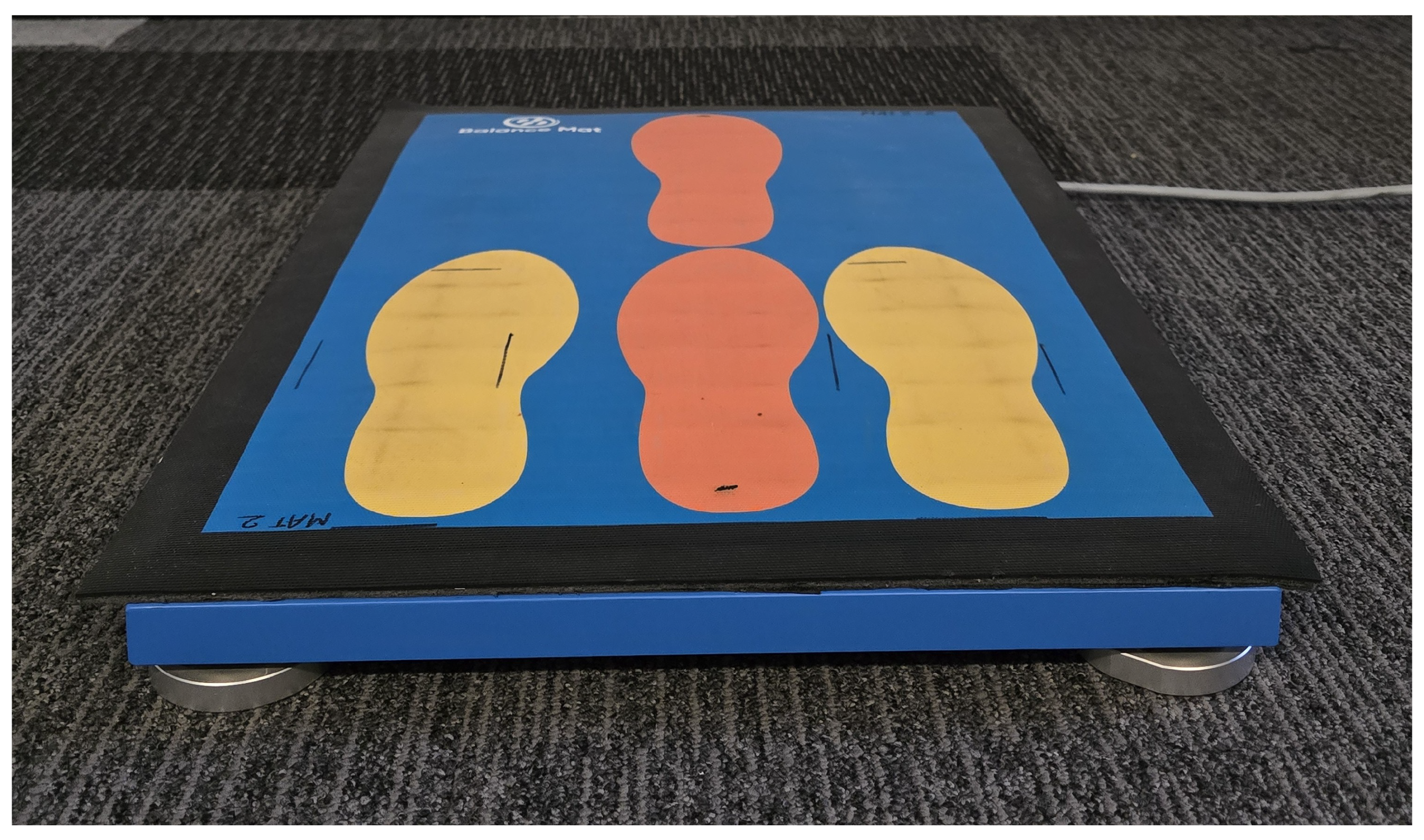
Figure 2.
Schematic representation of the foot placements utilised during the balance testing protocol: Normal Stance (feet apart), Semi-Tandem Stance, and Single-Leg Stances on the left and right foot.
Figure 2.
Schematic representation of the foot placements utilised during the balance testing protocol: Normal Stance (feet apart), Semi-Tandem Stance, and Single-Leg Stances on the left and right foot.
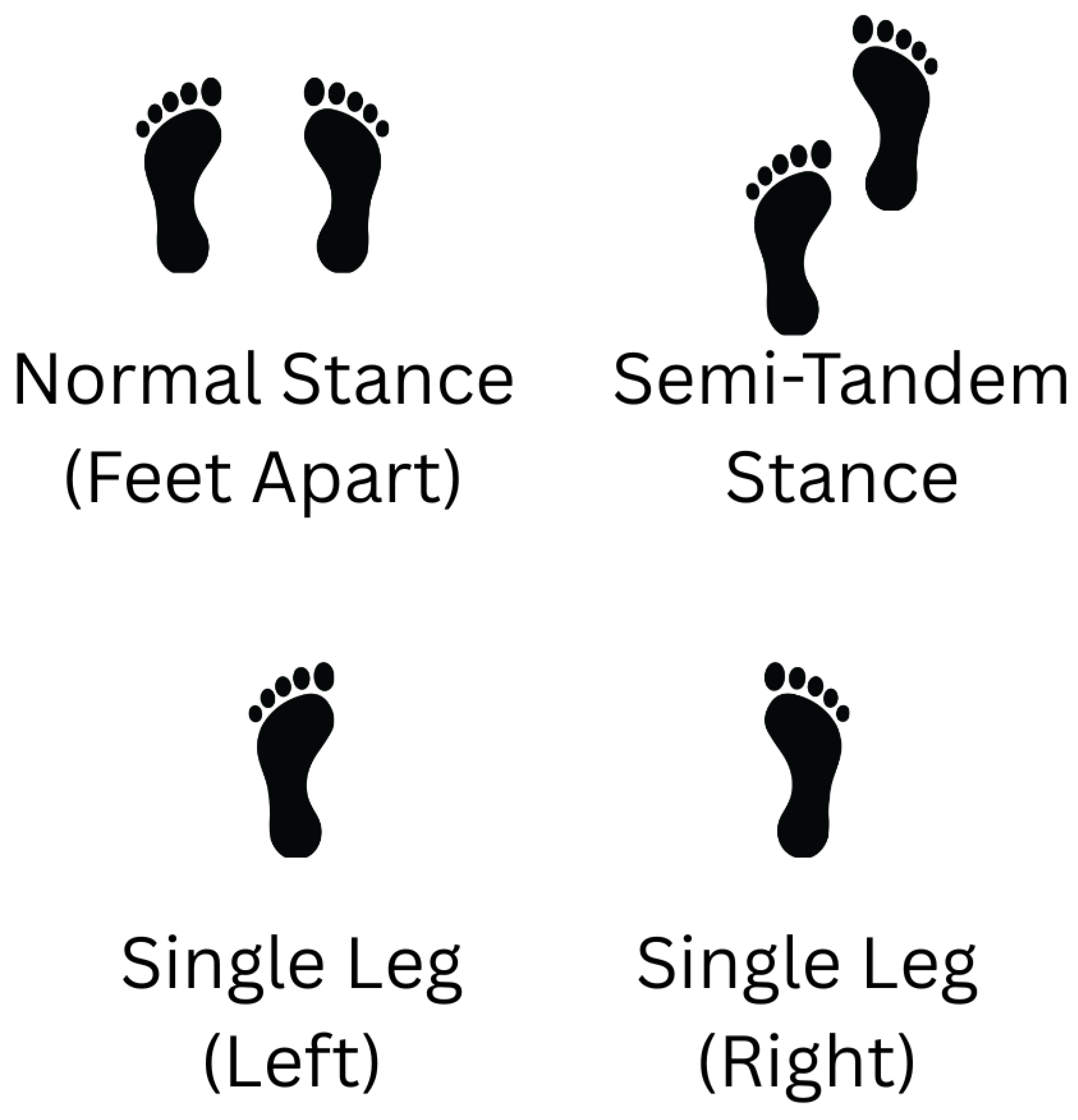
Figure 3.
ROC curves demonstrating the diagnostic accuracy of the BM across four distinct clinical risk classifications.
Figure 3.
ROC curves demonstrating the diagnostic accuracy of the BM across four distinct clinical risk classifications.
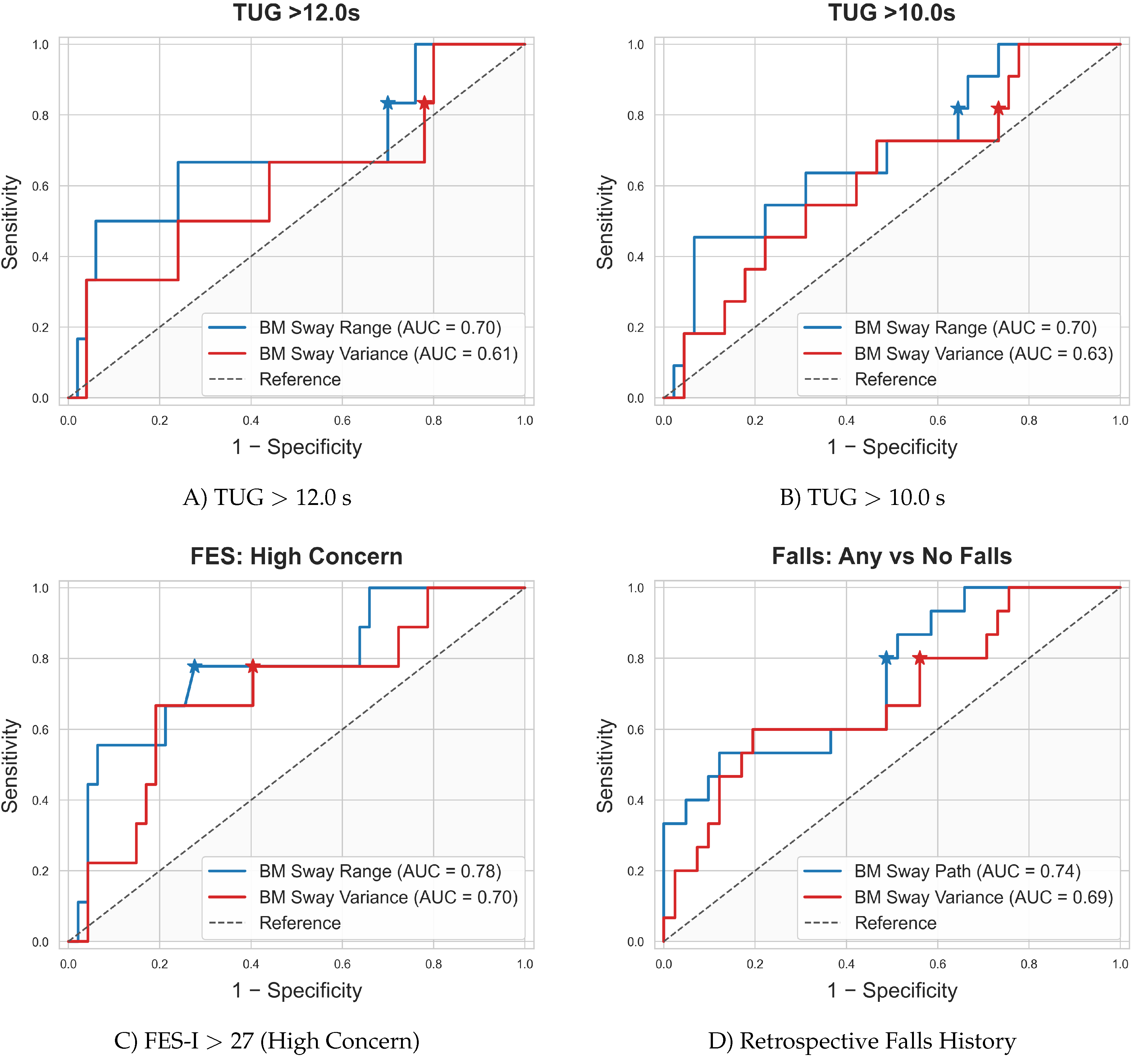
Figure 4.
Confusion matrices demonstrating the classification performance of the best-performing Balance Mat sway features across four clinical risk thresholds.
Figure 4.
Confusion matrices demonstrating the classification performance of the best-performing Balance Mat sway features across four clinical risk thresholds.
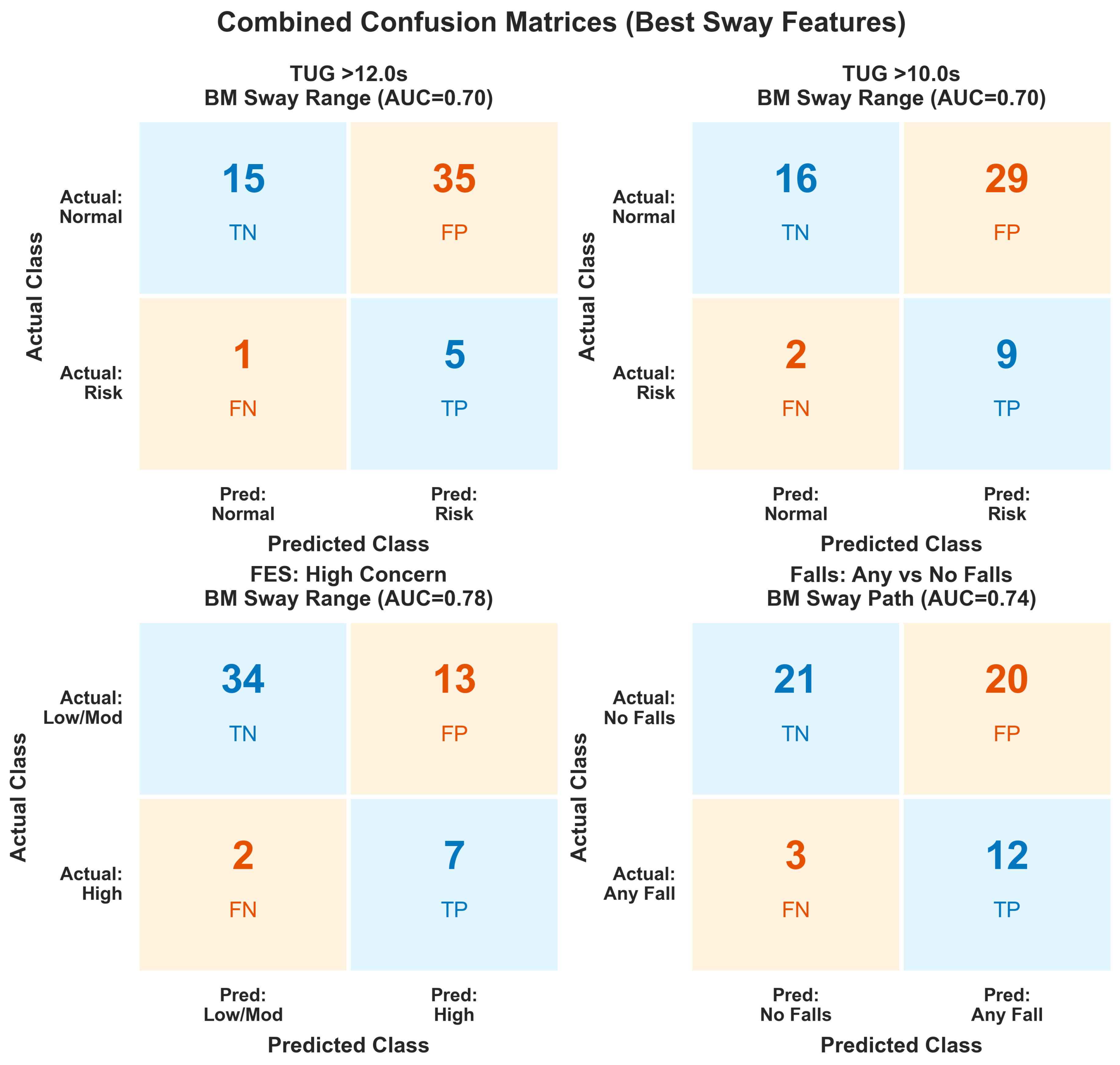
Figure 5.
Confusion matrices demonstrating the classification performance of the worst-performing Balance Mat sway feature (Sway Variance) across four clinical risk thresholds.
Figure 5.
Confusion matrices demonstrating the classification performance of the worst-performing Balance Mat sway feature (Sway Variance) across four clinical risk thresholds.
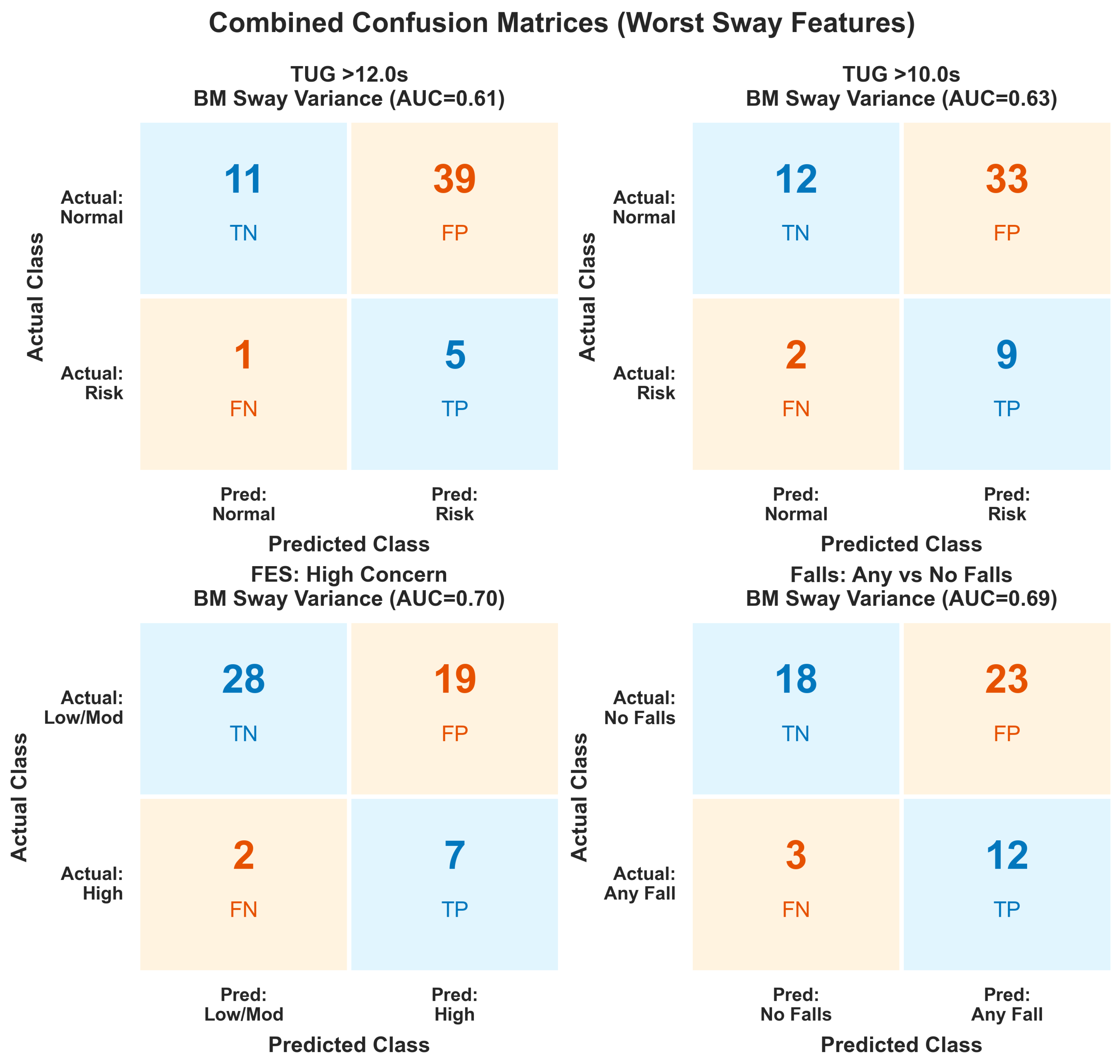

Table 1.
Demographic and clinical characteristics of the older adult cohort, grouped by retrospective fall history.
Table 1.
Demographic and clinical characteristics of the older adult cohort, grouped by retrospective fall history.
| Variable | Category / Metric | Overall () | Non-Fallers () | Fallers () |
|---|---|---|---|---|
| Continuous Variables (Mean ± SD [Range]) | ||||
| Age (years) | [65.0-88.0] | [65.0-88.0] | [65.0-88.0] | |
| Height (cm) | [142.0-183.0] | [142.0-183.0] | [149.9-183.0] | |
| Weight (kg) | [44.0-104.0] | [44.0-104.0] | [54.0-100.0] | |
| TUG Time (s) | [4.2-21.7] | [4.2-14.3] | [5.7-21.7] | |
| FES-I Score | [16.0-42.0] | [16.0-39.0] | [19.0-42.0] | |
| Categorical Variables (n [%]) | ||||
| Gender | Female | 43 (76.8%) | 35 (79.5%) | 8 (66.7%) |
| Male | 13 (23.2%) | 9 (20.5%) | 4 (33.3%) | |
| Falls History | 0 Falls | 44 (78.6%) | 44 (100.0%) | - |
| 1 Fall | 8 (14.3%) | - | 8 (66.7%) | |
| 2 Falls | 4 (7.1%) | - | 4 (33.3%) | |
Table 2.
Descriptive statistics of postural sway features for the older adult cohort, comparing the Balance Mat and Force Plate across pooled stance conditions.
Table 2.
Descriptive statistics of postural sway features for the older adult cohort, comparing the Balance Mat and Force Plate across pooled stance conditions.
| Sway Feature | Cohort | Mean ± SD | Median | Range |
|---|---|---|---|---|
| Balance Mat | ||||
| Sway Mean | Overall () | 0.38 | 0.24 - 0.53 | |
| Non-Fallers () | 0.36 | 0.24 - 0.53 | ||
| Fallers () | 0.42 | 0.32 - 0.51 | ||
| RMS | Overall | 4.83 | 1.38 - 16.20 | |
| Non-Fallers | 4.75 | 1.38 - 11.70 | ||
| Fallers | 8.08 | 3.36 - 16.20 | ||
| Sway Path | Overall | 506.42 | 122.83 - 1603.60 | |
| Non-Fallers | 484.67 | 122.83 - 846.83 | ||
| Fallers | 749.00 | 370.60 - 1603.60 | ||
| Sway Range | Overall | 32.17 | 11.50 - 100.20 | |
| Non-Fallers | 30.67 | 11.50 - 88.33 | ||
| Fallers | 57.83 | 21.40 - 100.20 | ||
| Sway Velocity | Overall | 25.32 | 6.14 - 80.18 | |
| Non-Fallers | 24.23 | 6.14 - 42.34 | ||
| Fallers | 37.45 | 18.53 - 80.18 | ||
| Sway Variance | Overall | 47.81 | 3.71 - 758.11 | |
| Non-Fallers | 45.01 | 3.71 - 341.99 | ||
| Fallers | 128.40 | 17.50 - 758.11 | ||
| Area95 | Overall | 29.59 | 8.30 - 99.65 | |
| Non-Fallers | 29.09 | 8.30 - 71.92 | ||
| Fallers | 49.63 | 20.47 - 99.65 | ||
| Force Plate () | ||||
| Sway Mean | Overall | 0.012 | 0.007 - 0.024 | |
| Non-Fallers | 0.011 | 0.007 - 0.023 | ||
| Fallers | 0.013 | 0.008 - 0.024 | ||
| RMS | Overall | 0.013 | 0.007 - 0.029 | |
| Non-Fallers | 0.013 | 0.007 - 0.027 | ||
| Fallers | 0.016 | 0.009 - 0.029 | ||
| Sway Path | Overall | 0.746 | 0.443 - 3.439 | |
| Non-Fallers | 0.728 | 0.443 - 1.064 | ||
| Fallers | 0.935 | 0.671 - 3.439 | ||
| Sway Range | Overall | 0.036 | 0.014 - 0.283 | |
| Non-Fallers | 0.034 | 0.014 - 0.083 | ||
| Fallers | 0.045 | 0.022 - 0.283 | ||
| Sway Velocity | Overall | 0.037 | 0.022 - 0.172 | |
| Non-Fallers | 0.036 | 0.022 - 0.053 | ||
| Fallers | 0.047 | 0.034 - 0.172 | ||
| Sway Variance | Overall | 0.000 | 0.000 - 0.002 | |
| Non-Fallers | 0.000 | 0.000 - 0.000 | ||
| Fallers | 0.000 | 0.000 - 0.002 | ||
| Area95 | Overall | 0.037 | 0.015 - 0.138 | |
| Non-Fallers | 0.036 | 0.015 - 0.087 | ||
| Fallers | 0.053 | 0.026 - 0.138 | ||
Table 3.
Association (Spearman correlation) and absolute agreement (ICC, RMSE, SEM, MDC) between the calibrated BM and FP for Resultant Distance () sway parameters.
Table 3.
Association (Spearman correlation) and absolute agreement (ICC, RMSE, SEM, MDC) between the calibrated BM and FP for Resultant Distance () sway parameters.
| Sway Parameter | Spearman r | ICC (2,1) | RMSE | SEM | MDC | Agreement Grade |
|---|---|---|---|---|---|---|
| Mean | 0.39** | 0.30 | 0.0085 | 0.0078 | 0.0217 | Poor |
| RMS | 0.79** | 0.80 | 0.0073 | 0.0052 | 0.0145 | Good |
| Sway Path | 0.85** | 0.93 | 0.2485 | 0.1412 | 0.3912 | Excellent |
| Sway Range | 0.68** | 0.72 | 0.0407 | 0.0224 | 0.0622 | Moderate |
| Sway Velocity | 0.85** | 0.93 | 0.0124 | 0.0071 | 0.0196 | Excellent |
| Area95 | 0.81** | 0.80 | 0.0286 | 0.0194 | 0.0537 | Good |
| Sway Variance | 0.83** | 0.70 | 0.0003 | 0.0001 | 0.0004 | Moderate |
** Correlation is significant at the level. ICC Agreement Grade Interpretation: Poor; - Moderate; - Good; Excellent.
Table 4.
Simple linear regression calibration parameters applied to BM measurements.
| Sway Parameter | ||
|---|---|---|
| Slope | Intercept | |
| Mean | 0.0185 | 0.0060 |
| RMS | 0.0016 | 0.0064 |
| Sway Path | 0.0011 | 0.1902 |
| Sway Range | 0.0014 | -0.0064 |
| Sway Velocity | 0.0011 | 0.0095 |
| Area95 | 0.0011 | 0.0084 |
| Sway Variance | 0.0000 | 0.0000 |
Calibration equation format: .
Table 5.
Diagnostic accuracy, 95% confidence intervals, and likelihood ratios of the best-performing variables for identifying clinical fall risk thresholds. Balance Mat sway parameters are compared to the validated Resultant Distance ().
Table 5.
Diagnostic accuracy, 95% confidence intervals, and likelihood ratios of the best-performing variables for identifying clinical fall risk thresholds. Balance Mat sway parameters are compared to the validated Resultant Distance ().
| Clinical Reference (Sample Sizes) | Best Valid Variable | AUC [95% CI] | Cutpointa | Sens | Spec | LR+ | LR- |
|---|---|---|---|---|---|---|---|
| Balance Mat (BM) - Resultant Distance Only | |||||||
| FES-I: Low Concern ( Mod/High, Low) | BM RD Sway Velocity | 0.66 [0.51-0.80] | 22.17 / 0.04 | 0.77 | 0.58 | 1.81 | 0.40 |
| FES-I: High Concern ( High, Low+Mod) | BM RD Sway Range | 0.78 [0.60-0.96] | 39.00 / 0.05 | 0.78 | 0.72 | 2.81 | 0.31 |
| TUG s ( High falls risk, Low falls risk) | BM RD Sway Range | 0.70 [0.42-0.98] | 62.83 / 0.03 | 0.83 | 0.30 | 1.19 | 0.56 |
| TUG s ( High falls risk, Low falls risk) | BM RD Sway Range | 0.70 [0.52-0.88] | 60.83 / 0.03 | 0.82 | 0.36 | 1.27 | 0.51 |
| Falls History ( Fallers, Non-fallers) | BM RD Sway Path | 0.74 [0.59-0.89] | 708.33 / 0.72 | 0.80 | 0.51 | 1.64 | 0.39 |
| Force Plate - Reference Standard | |||||||
| FES-I: Low Concern ( Mod/High, Low) | RMS | 0.78 [0.66-0.91] | 0.01 | 0.80 | 0.77 | 3.47 | 0.26 |
| FES-I: High Concern ( High, Low+Mod) | Area95 | 0.79 [0.62-0.95] | 0.05 | 0.78 | 0.64 | 2.15 | 0.35 |
| TUG s ( High falls risk, Low falls risk) | RMS | 0.93 [0.85-1.00] | 0.02 | 0.83 | 0.86 | 5.95 | 0.19 |
| TUG s ( High falls risk, Low falls risk) | Sway Range | 0.90 [0.81-0.98] | 0.05 | 0.91 | 0.87 | 6.82 | 0.11 |
| Falls History ( Fallers, Non-fallers) | Sway Path | 0.84 [0.70-0.98] | 0.83 | 0.80 | 0.76 | 3.28 | 0.27 |
Disclaimer/Publisher’s Note: The statements, opinions and data contained in all publications are solely those of the individual author(s) and contributor(s) and not of MDPI and/or the editor(s). MDPI and/or the editor(s) disclaim responsibility for any injury to people or property resulting from any ideas, methods, instructions or products referred to in the content. |
© 2026 by the authors. Licensee MDPI, Basel, Switzerland. This article is an open access article distributed under the terms and conditions of the Creative Commons Attribution (CC BY) license.
Copyright: This open access article is published under a Creative Commons CC BY 4.0 license, which permit the free download, distribution, and reuse, provided that the author and preprint are cited in any reuse.


