

Submitted:
21 May 2026
Posted:
22 May 2026
You are already at the latest version
Abstract
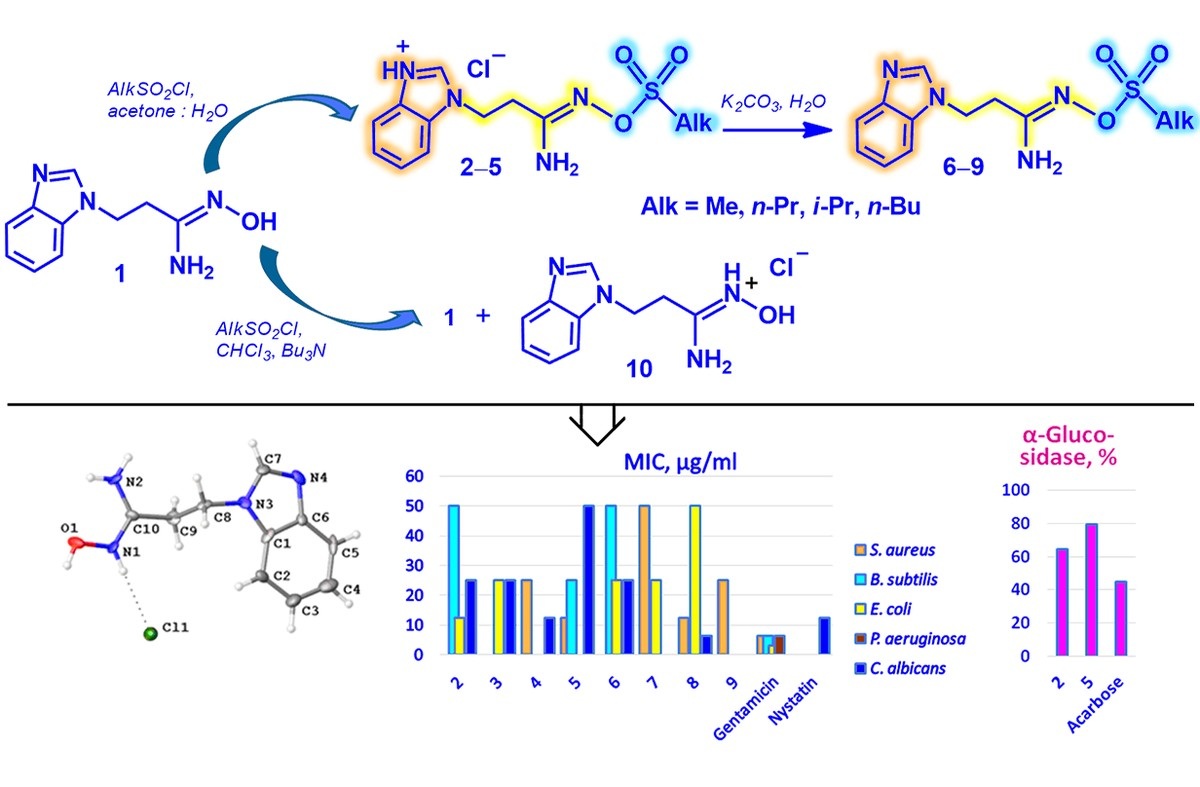
The continuous search for new chemical structures more active, less toxic than those currently in practice is justified on the basis of the use of proven pharmacophoric building blocks (benzimidazole heterocycle, sulfonyl group and amidoxime framework in our case). The aim of the work was to synthesize new O-alkylsulfonyl--(benzimidazol-1-yl)propioamidoximes and to test them for in vitro biological activities to identify potential effective agents. Novel O-alkylsulfonylamidoximes were synthesized by the reaction of -(benzimidazol-1-yl)propioamidoxime with alkylsulfonyl chlorides AlkSO2Cl (Alk = CH3, n-C3H7, i-C3H7, n-С4H9) in a mixture of water : acetone in hydrochloride and base forms. Obtained derivatives were tested for antimicrobial, antifungal and antidiabetic activity. Hydrochlorides and bases of the O-alkylsulfonyl--(benzimidazol-1-yl)propioamidoximes were obtained in moderate to high yields. The structures of the synthesized compounds were established by physicochemical and spectral (FT-IR, NMR and X-ray diffraction) methods. Biological screening found effective samples of amidoximes with antimicrobial and antifungal activities which were near or exceeded the activity of the reference drugs gentamicin and nystatin; in addition, two samples with antidiabetic activity higher than acarbose were found. Results of the present study open new possibilities for the novel -aminopropioamidoxime class as active antimicrobial and antifungal agents, as well as antidiabetics ones.
Keywords:
benzimidazole core
; an amidoxime group
; O-alkylsulfonyl moiety
; hybridization
; X-ray diffraction
; in vitro antimicrobial
; antifungal and antidiabetic activities
1. Introduction
1.1. Hybridization Direction in Medicinal Chemistry
The search for new drugs increaseingly employs hybridization ‒ the covalent combination of two or more pharmacophoric units into a single molecule [1]. This strategy addresses limitations of single-target therapies, such as drug resistance, and challenges of combination therapies, including unpredictable pharmacokinetics and toxicity [2]. Hybridization creates multi-target-directed ligands (MTDLs), which offer simplified dosing, improved pharmacokinetic profiles, and potential cost benefits [3]. Consequently, many MTDLs have entered clinical practice [4].
Our research focuses on synthesizing hybrid molecules – O-alkylsulfonyl-β-(benzimidazol-1-yl)propioamidoximes, comprising three established pharmacophores: amidoxime, alkylsulfonyl, and benzimidazole fragments.
1.2. The Strategic Value of the Amidoxime Moiety in Drug Development
Amidoximes exhibit a broad spectrum of activity against various microorganisms and complex eukaryotic organisms. As such, they are intensively studied as potential drugs, prodrugs, fungicides, or bactericides [5,6,7], and as exogenous sources of nitric oxide (NO) [8].
Amidoximes exhibit broad bioactivity and are studied as potential drugs, prodrugs, and antimicrobials. Their utility as prodrugs stems from good oral absorption and subsequent enzymatic conversion via the mitochondrial amidoxime reducing complex (mARC) to the active amidine form [9]. Depending on the reduction steps required the transition to the amidine form, secondary and tertiary prodrugs are distinguished [10]. The amidoxime group is a prominent prodrug moiety. Drugs containing such prodrug groups accounted for over 13% of all FDA-approved small-molecule entities between 2012 and 2022 [11].
This amidine group is a component of L-arginine, a vital amino acid with numerous pharmacological roles [12]. While amidine-based drugs (e.g., pentamidine) show potent antiparasitic, antimicrobial, and anticancer activity [13,14,15], their clinical use is hampered by poor bioavailability due to hydrophobicity and protonation [16]. The amidoxime prodrug strategy effectively circumvents these limitations, improving pharmacokinetics without compromising activity [17].
1.3. Benzimidazole: A Privileged Scaffold in Pharmaceutical and Agrochemical Discovery
The benzimidazole moiety is a privileged structure with enormous therapeutic potential, primarily because its core structure closely resembles that of purine, a vital biological heterocycle. The ability of all living organisms ‒ eukaryotes, bacteria, and archaea ‒ to perform de novo purine biosynthesis underscores the fundamental role of purines in life [18]. Due to this similarity with natural nucleotides, benzimidazole derivatives can readily interact with diverse biomacromolecules and target proteins. This interaction underpins their wide spectrum of pharmacological activities, which includes antibacterial, antifungal, antidiabetic, anticancer, antiparasitic, analgesic, antiviral, and antihistamine effects. Consequently, they have found clinical application in treating cardiovascular diseases, neurological and endocrine disorders, and in ophthalmology [19].
Beyond human medicine, the utility of benzimidazole-based compounds extends to the agricultural sector, where they are effectively employed as fungicides and pesticides [20].
1.4. The Therapeutic and Agrochemical Impact of Sulfonyl-Containing Compounds
To improve the pharmacological properties of new drugs, sulfurcontaining groups are included as an essential element in drug structures. This is evidenced by reviews of FDA-approved drugs up to 2018, 2019, and for the period 2020‒2024. Organosulfur compounds constitute almost 25% of all small-molecule medications in use from 2017 to 2020 [21,22].
Important classes of agents extensively used as both pharmaceuticals and agrochemicals are those featuring sulfonyl or sulfonamide functional groups [23,24]. Sulfonamides, originating from the antibacterial sulfanilamide, now include agents like acetazolamide, glibenclamide, and anticancer compounds [25,26]. Sulfonylureas are cornerstone treatments for type 2 diabetes [27].
In agrochemistry, organosulfur compounds are vital, with sulfur present in over 30% of modern pesticides, chiefly fungicides, herbicides, and insecticides [28]. Sulfonylureas and sulfonamides are among the most prominent classes [28]. Key sulfonylurea herbicides, such as bensulfuron-methyl, nicosulfuron, and thifensulfuron-methyl, are applied widely to cereals, fruits, and vegetables [29,30]. The herbicidal action of both sulfonylureas and sulfonamides is based on the inhibition of the enzyme acetolactate synthase (ALS). This enzyme is essential for the biosynthesis of branched-chain amino acids; its inhibition disrupts weed growth [31].
The motivation for this work lies in the development of the sulfochlorination chemistry of β-aminopropioamidoximes, revealing a key mechanistic aspect of alkylsulfochlorination and its differences from arylsulfochlorination. Furthermore, establishing the fine structural features of the products using modern spectral methods, the main one being X-ray crystallography, was of interest. Combining of pharmacophoric building blocks in the novel hybrid O-alkylsulfonyl-β-(benzimidazol-1-yl)propioamidoximes and their in vitro antimicrobial, antifungal, and antidiabetic screening suggested the discovery of promising drug candidates. The objectives of this work were: 1) to synthesize novel alkylsulfonyl derivatives of β-(benzimidazol-1-yl)propioamidoxime by combining known pharmacophoric fragments; 2) to unequivocally characterize the structures of the resulting sulfochlorination products using a comprehensive suite of physicochemical methods, including FT-IR, 1H/13C NMR, and X-ray crystallography; and 3) to evaluate their potential as drug candidates through in vitro screening, assessing activity against common bacterial and fungal pathogens, as well as for relevance to socially significant diseases such as diabetes mellitus.
2. Results and Discussion
2.1. Synthesis of O-Alkylsulfonyl-β-(benzimidazole-1-yl)propioamidoximes in a Water: Acetone Mixture Without Base
Given the presence of internal basic centers in the β-(benzimidazol-1-yl)propioamidoxime (1) its alkylsulfochlorination was performed without an external base, utilizing its internal benzimidazole nitrogen to bind the released HCl, as confirmed by X-ray analysis. This base-free reaction in a water/acetone mixture at r.t. produced hydrochlorides 2–5 in 40–83% yields [Scheme 1 (i), Table 1].
Hydrochloride 2 is caramel-like masses for which it is impossible to determine the melting point; at the same time O-n-propylsulfonyl-, O-i-propylsulfonyl- and O-n-butylsulfonyl-β-(benzimidazol-1-yl)propioamidoxime hydrochlorides (3,4,5) were isolated as a crystalline substances with a melting points of 89–91, 163 and 84 °C. Hydrochlorides 2‒5 were converted into bases 6–9 by the action of aqueous potash [Scheme 1(ii), Table 1].
Compounds 1‒9 were characterized by physicochemical (Table 1) and spectral data (FT-IR spectroscopy, 1H- and 13C-NMR spectroscopy) (see Supplementary data, pages 1S-30S; X-ray diffraction data (Figure 1 and Figure 2; Table 2 and Table 3).
The most characteristic FT-IR bands and the most representative 1H- and 13C-NMR signals for alkylsulfochlorination products 2–9 are described below.
In the FT-IR spectra, the most convincing evidence for the formation of compounds 2–9 was the presence of asymmetric and symmetric S=O stretching vibrations in the regions of 1347–1361 cm−1 and 1160–1194 cm−1, respectively. Furthermore, the spectra of hydrochlorides 2–5 exhibited a broad band in the 2700 cm−1 region, which is characteristic of N(+)–H stretching vibrations.
The 1H-NMR spectra of hydrochlorides 2–5 displayed signals for the alkylsulfonyl group protons as follows: 2: 2.75 (s, 3H, CH₃); 3: 0.99 (t, J = 7.0 Hz, 3H, CH₂CH₂CH₃), 1.51 (m, 2H, CH₂CH₂CH₃), 3.15 (t, J = 7.0 Hz, 2H, CH₂CH₂CH₃); 4: 1.04 (d, J = 7.0 Hz, 6H, CH(CH₃)₂), 3.00 (m, 1H, CH(CH₃)₂); 5: 0.89 (t, J = 7.0 Hz, 3H, CH₂CH₂CH₂CH₃), 1.23 (m, 4H, CH₂CH₂CH₂CH₃), 3.08 (t, J = 7.0 Hz, 2H, CH₂CH₂CH₂CH₃).
In the 13C-NMR spectra the signals for the alkylsulfonyl carbon atoms of hydrochlorides 2–5 were observed at: 2: 39.7 (CH3); 3: 12.5, 18.5, 53.5 (n-Pr); 4: 15.8, 48.7 (i-Pr); 5: 13.3, 20.5, 25.4, 47.1 (n-Bu). For the corresponding free bases 6–9, the signals for these alkylsulfonyl groups in both the 1H- and 13C-NMR spectra were consistently shifted up the field compared to their hydrochloride salts.
Single crystals of all O-alkylsulfonyl-β-(benzimidazol-1-yl)propioamidoximes (2–9), grown by recrystallization from isopropyl alcohol, were subjected to X-ray diffraction analysis. However, only the crystals of compounds 3,5 and 7 were of sufficient quality for data collection (Figure 1, Table 2).
All synthesized compounds are novel and their structures were previously uncharacterized. Compounds 3 and 5 are isostructural, differing solely in the nature of the alkyl chain.
Their crystal structures each comprise a cation (protonated at the heterocyclic nitrogen atom), a chloride counterion, and a molecule of isopropyl alcohol from the recrystallization solvent. A comparison of the solid-state molecular structures of 3 and 7 reveals significant conformational flexibility, which is manifested in their extended and folded conformations, respectively.
Thus, the presence of an internal basic center ‒ the Nsp² atom of the imidazole heterocycle in the β-(benzimidazol-1-yl)propioamidoxime molecule ‒ enables its alkylsulfochlorination in a water-acetone solvent system without requiring an external base. This approach successfully afforded a series of O-alkylsulfonyl-β-(benzimidazol-1-yl)propioamidoxime hydrochlorides (2–5). These salts were subsequently converted into the corresponding free bases (6–9) by treatment with aqueous potassium carbonate (Table 1).
2.2. Reaction of β-(Benzimidazole-1-yl)propioamidoxime with Alkylsulfonyl Chlorides in CHCl3 in the Presence of Bu3N (iii)
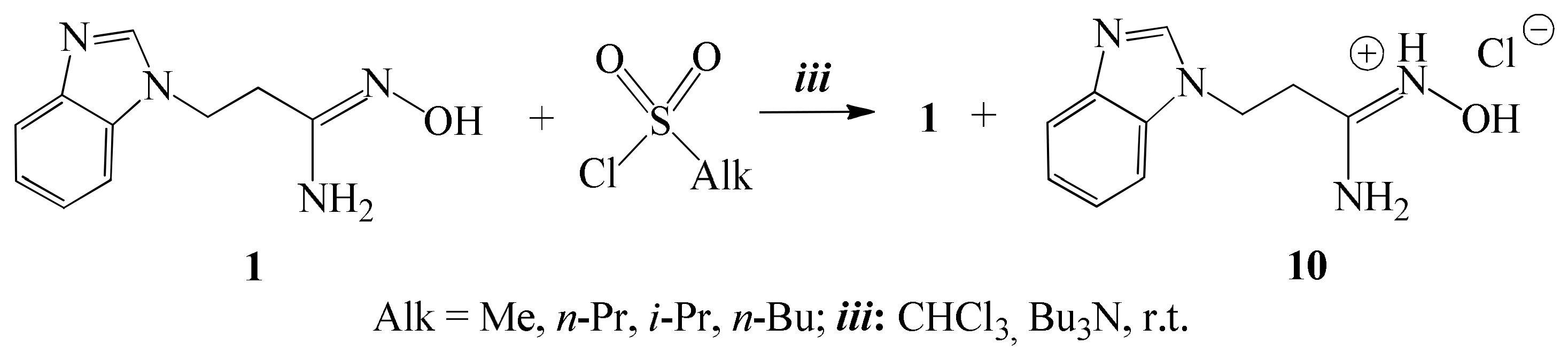
To obtain the target O-alkylsulfonylation products of β-(benzimidazol-1-yl)propioamidoxime (1), we also used a standard base-mediated (chloroform, Bu3N) alkylsulfochlorination strategy. This approach considers the oxygen atom of the amidoxime group as ‘a priori’ the most likely nucleophilic center. The reactions were performed in chloroform using Bu₃N as a base to scavenge the released HCl (Scheme 2, conditions iii). A series of alkylsulfonyl chlorides (AlkSO2Cl) were used, where Alk = Me, n-Pr, i-Pr, n-Bu.
This strategy was chosen based on our prior success in synthesizing analogous O-arylsulfonyl derivatives from compound 1 using arylsulfonyl chlorides (XC6H4SO2Cl, where X = p-CH3, o-NO2, p-NO2) in chloroform with DIPEA as a base [32,33].
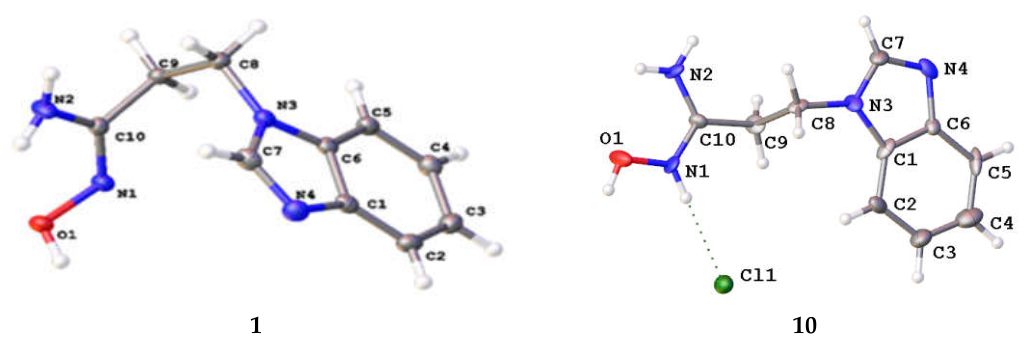
However, upon completion of the reactions under conditions (iii), as monitored by TLC, the crystalline products isolated in approximately 50% yield were not the anticipated O-alkylsulfonyl derivatives. Comprehensive analysis by FT-IR, ¹H- and ¹³C-NMR spectroscopy, and X-ray crystallography revealed that the isolated compounds were, instead, the starting amidoxime 1 and its hydrochloride salt 10 (Scheme 2, Table 1, Figure 2). A representative procedure for the reaction of 1 with isopropylsulfonyl chloride in chloroform in the presence of Bu₃N is provided in the “Materials and Methods” section.
X-ray structural data of amidoxime 1 are presented here for the first time. Similarly, a comprehensive physicochemical and spectral characterization (including FT-IR, ¹H-NMR, ¹³C-NMR, and X-ray diffraction) of hydrochloride 10 is also reported for the first time.
The FT-IR spectrum of amidoxime 1, as a distinctive feature of the unsubstituted –NOH group, shows a stretching vibration band for the O–H bond at ν = 3420 cm–1. In contrast, the spectrum of hydrochloride 10 shows a band at ν = 2300 cm-1, characteristic of the N(+)–H ammonium bond, confirming its formation.
Furthermore, the 1H-NMR spectra of both compound 1 and hydrochloride 10 contain signals for all functional groups. As expected, all proton signals in hydrochloride 10 are shifted downfield compared to those of the original amidoxime 1. The 13C-NMR spectra revealed a consistent trend: all carbon atom signals of amidoxime 1 appeared at higher fields compared to those of its hydrochloride salt 10.
Most significantly, that the X-ray structural data establish that protonation occurs specifically at the nitrogen atom of the oxime group (Figure 2, Table 3).
A plausible mechanism for the formation of the observed products during the attempted alkylsulfochlorination of amidoxime 1 in the presence of Bu₃N involves the disproportionation of alkylsulfonyl chlorides (Scheme 3, I). This reaction, which consumes two molecules of the sulfonyl chloride and two molecules of tributylamine, primarily yields tributylamine hydrochloride.
It is known that alkylsulfonyl chlorides possessing at least one α-hydrogen atom can react via a mechanism involving the highly reactive sulfene intermediate A. This sulfene species can then participate in subsequent transformations, leading to zwitterionic, episulfone, and stilbene products [34,35]. Subsequently, a competing reaction occurs where Bu₃N, instead of the nucleophilic centers of amidoxime 1, binds the alkylsulfonyl chlorides to form alkylsulfonyltributylammonium chlorides (B). As a result, no sulfochlorination products of 1 were detected. Instead, hydrochloride 10 is formed via reaction between β-(benzimidazol-1-yl)propioamidoxime (1) and the tributylamine hydrochloride generated in the preceding step (I) (Scheme 3, II).
2.3. In Vitro Screening of O-Alkylsulfonyl-β-(benzimidazole-1-yl)propioamidoximes (2‒9) for Antimicrobial, Antifungal and α-Glucosidase Antidiabetic Activity
Compounds 2–9 were screened for antimicrobial, antifungal, and α-glucosidase inhibitory activity; results are presented in Table 4.
Antimicrobial and Antifungal Activity: Five of the eight tested compounds demonstrated pronounced antimicrobial activity (12.5–50 µg/mL) against S. aureus: hydrochlorides 4 (Alk = i-Pr) and 5 (Alk = n-Bu) and free bases 7 (Alk= n-Pr), 8 (Alk = i-Pr), and 9 (Alk= n-Bu), with 5 and 8 (MIC = 12.5 µg/mL) being most potent.
Activity was also noted for hydrochlorides 2 (Alk = Me) and 5 (Alk = n-Bu) and free base 6 (Alk = Me) against B. subtilis with MIC 25‒50 µg/mL and for hydrochlorides 2 (Alk = Me) and 3 (Alk = n-Pr) and free bases 6 (Alk = Me) and 7 (Alk = n-Pr) with MIC 12.5‒25 µg/mL against E. coli. In contrast, none of the tested compounds showed activity against P. aeruginosa.
The synthesized O-alkylsulfonyl derivatives (2–9) exhibited more pronounced in vitro antifungal activity against C. albicans than antibacterial activity. Six of the eight tested compounds showed notable efficacy, with MICs ranging from 6.3 to 50 μg/mL. Free base 8 (Alk = i-Pr, MIC = 6.3 µg/mL) was twice as active as nystatin, while its hydrochloride counterpart 4 (Alk = i-Pr, MIC = 12.5 µg/mL) matched the standard. Compound 8 became the subject of the RK utility model patent [36].
Antidiabetic (α-Glucosidase) Activity: Hydrochlorides 2 (Alk = Me) and 5 (Alk = n-Bu) exhibited significant inhibition (64.7% and 79.5%, respectively), exceeding the activity of acarbose (44.7%). These facts served as the basis for their protection by the for RK utility model patents [37,38].
The pronounced antimicrobial and high antifungal properties observed for the target O-alkylsulfonyl-β-(benzimidazol-1-yl)propioamidoximes can be rationalized through a Structure-Activity Relationship (SAR) analysis of their constituent pharmacophores.
The molecular framework integrates three distinct bioactive motifs. Firstly, the amidoxime functional group, which contributes to biological efficacy through its ability to chelate metal ions critical for microbial enzyme function, as documented in previous studies [5‒7,9].
Secondly, this intrinsic activity is complemented by the benzimidazole core as a well-established privileged structure in pharmaceuticals and agrochemistry, known for its potent and broad-spectrum antimicrobial and antifungal activities [19,20,21]. The synergy between these two fragments creates a robust foundation for the observed bioactivity.
Furthermore, the presence of the O-alkylsulfonyl moiety significantly augments this activity profile. The inclusion of a sulfur atom, particularly within a sulfonyl group, is a strategic design element. This is strongly supported by the fact that 25% pharmaceuticals with sulfonyl or sulfonamide functional groups are known [22,23] and over 30% of modern agrochemicals (including fungicides, herbicides, and insecticides) contain at least one sulfur atom [29,30,31].
Our findings align with this, as the studied alkylsulfonyl derivatives (2–9) exhibited pronounced in vitro antifungal activity against the yeast C. albicans and somewhat less pronounced antibacterial activity. This potent antifungal profile underscores the promise of the most effective candidates, specifically compounds 4 and base 8, for further development and testing against a broader panel of fungal pathogens.
Antidiabetic activity via α-glucosidase inhibition was noted for the hydrochlorides 2 and 5 in which alkyl substituents Alk = methyl and Alk = n-butyl, respectively, linked to the sulfonylurea-like moiety carrying antidiabetic potential [28]. The lack of activity for other O-alkylsulfonyl-β-(benzimidazol-1-yl)propioamidoxime analogs suggests that alkyl chain sterics and chemical form influence target binding.
Compound 2 showed potent antimicrobial (12.5–50 µg/mL) and antifungal (25 µg/mL) effects and antidiabetic activity 1.4×greater than acarbose. Compound 5 demonstrated similar antimicrobial (12.5–25 µg/mL) and antifungal (50 µg/mL) potency and besides antidiabetic inhibition 1.8×higher than acarbose. Such multitarget profiles highlight 2 and 5 as promising candidates for further development.
Тhus the biological activity of these hybrid molecules is not merely coincidental but is a direct and logical consequence of the integration of synergistic pharmacophoric elements, each contributing to the overall potent antifungal, antimicrobial and antidiabetic effects.
3. Materials and Methods
3.1. Materials and Instruments
The reagents and solvents were purchased from Merck, Fluka, and Aldrich Chemical Companies. The solvents for the synthesis, recrystallization, and TLC analysis (ethanol, i-PrOH, benzene, CHCl3, and acetone) were purified according to the standard techniques. The reported yields refer to the recrystallized samples. Products purity and reaction progress were assessed using thin-layer chromatography (TLC). Characterization of the recrystallized products involved obtaining their physicochemical data (m.p., Rf), establishing the elemental composition, as well as analysis of FT-IR and NMR spectroscopies data and X-ray structural studies.
FT-IR spectra of the studied compounds were obtained on a FSM 2201 spectrometer (OOO Infraspek, St. Petersburg, Russia) in KBr tablets. 1H- and 13C-NMR spectra were recorded on a Bruker Avance III NMR spectrometer (500 MHz) (Bruker, BioSpin GMBH, Rheinstetten, Germany) and NMReady-60PRO, (60 MHz) (Magnet: Permanent, no cryogens, Altamira Instruments, Taiwan) in the deuterated solvent DMSO-d6. Signals of residual non-deuterated solvent DMSO were used as a standard for 1H-NMR (2.50 ppm) and 13C-NMR (39.5 ppm) spectra. All X-ray structural studies of single crystals were carried out on a Bruker Quest diffractometer using a Photon-III coordinate detector. Elemental analysis was performed on a Flash Smart elemental analyzer (ThermoFisher Scientific Inc., Waltham, Massachusetts, US). The melting points were determined in glass capillaries on a Stuart Melting Point Apparatus SMP30 0SA (Keison Products, Cole-Parmer group, Chelmsford, England). The reaction progress and the purity of the products obtained were monitored using TLC Sorbfifil plates (Sorbpolymer, Krasnodar, Russia) coated with CTX-1A silica gel, grain size 5–17 μm, containing the UV-254 indicator. The eluent for TLC analysis was benzene:EtOH, 1:3. Distilled water was obtained using a medical electric water distiller AE-10 (360 V, 50 Hz, 7.2 kVA) (Livam, Belgorod, Russia).
3.1.1. Synthesis of β-(Benzimidazole-1-yl)propioamidoxime (1)
To 11 g (0.09 mol) of benzimidazole in 30 ml of ethanol dropwise was added 9.55 g (0.10 mol) of acrylonitrile at 0‒5 °C. The reaction mixture was stirred for 1 h at r.t. and then heated at reflux of ethanol for 3 h. After 24 h, 0.09 mol of a solution of hydroxylamine base in 10 ml of absolute ethanol, obtained separately from 6.25 g (0.09 mol) of hydroxylamine hydrochloride and 5.05 g (0.09 mol) of KOH after filtering off 6.71 g (0.09 mol) of KCl, was added to the reaction mixture. The reaction mixture was stirred at reflux of ethanol for 5 h under TLC monitoring. Then after cooling to r.t., filtering from reaction mixture and recrystallization from i-PrOH β-(benzimidazole-1-yl)propioamidoxime (1) was obtained in an amount of 10.71 g (56%): m.p. 183 °C; Rf 0.45. FT-IR (KBr, cm−1): 1652 (C=N), 1644 (C=C), 3462 [NO‒H], 3308 [N(‒H)2], 3157, 3152 (Csp2−H), 2773 and 2986 (Csp3−H). 1H-NMR (500 MHz, DMSO-d6, δ, ppm): 2.97 (t, J = 7.0 Hz, 2H, α-CH2), 4.68 (t, J = 7.0 Hz, 2H, β-CH2), 8.58 (s, 2H, NH2), 7.28‒7.78 (m, 4H, Csp2H) and 8.40 (s, 1H, Csp2H). 13C-NMR (126 MHz, DMSO-d6, δ, ppm): 30.1, 41.9, 111.3, 119.4, 122.7, 123.4, 133.7, 142.8, 143.9, 158.5. Anal. Calcd for C10H12N4O (204,23): C, 58.81; H, 5.92. Found: C, 58.53; H, 5.74. (Figure 1S, 11S, 12S).
3.1.2. Obtaining of O-Alkylsulfonyl-β-(benzimidazole-1-yl)propioamidoximes Hydrochlorides (2‒5) Without Base Bu3N (i)
To a solution of 0.5 g (0.0024 mol) of compound 1 in 3 mL of distilled water and 15 mL of acetone 0.0024 mol of alkylsulfonyl chloride in 3 mL of acetone was added dropwise at cooling of the reaction mixture to 0‒5 °C and stirring; then the reaction mixture was kept at r.t. at stirring. The progress of the reaction was monitored by TLC. The solvent was evaporated under reduced pressure and alkylsufochlorination products were obtained as an amorphous powders, which then were recrystallized from i-PrOH and characterized using FT-IR, 1H-NMR, and 13C-NMR spectroscopy (Figures 2S-5S, 13S-20S).
O-Methylsulfonyl-β-(benzimidazole-1-yl)propioamidoxime Hydrochloride (2). To a solution of 0.5 g (0.0024 mol) of compound 1 in 3 mL of distilled water and 15 mL of acetone, 0.27 g (0.0024 mol) of methanesulfonyl chloride in 3 mL of acetone was added at cooling of the reaction mixture to 0‒5 °C and stirring; then the reaction mixture was kept at r.t. and at stirring for 20 h. The progress of the reaction was monitored by TLC. The solvent was evaporated and then after recrystallization from i-PrOH 0.5 g (62%) of amorphous solid was obtained; Rf 0.73. FT-IR (KBr, cm−1): 1690 (C=N), 1655 (C=C), 1351 (SO2 as) and 1194 (SO2 sy), 3404 [N(‒H)2], 3131 (Csp2−H), 2852 and 2934 (Csp3−H), 2700 [N(+)–H]. 1H-NMR (60 MHz, DMSO-d6, δ, ppm): 2.75 (s, 3H, СH3), 3.02 (t, J = 7.0 Hz, 2H, α-CH2), 4.90 (t, J = 7.0 Hz, 2H, β-CH2), 6.82 (s, 2H, NH2), 7.21‒9.45 (m, 4H, Csp2H) and 9.57 (s, 1H, Csp2H). 13C-NMR (15.1 MHz, DMSO-d6, δ, ppm): 32.3, 39.7, 43.3, 113.0, 115.4, 126.1, 131.2, 131.8, 142.1, 167.9. Anal. Calcd for C11H15ClN4O3S (318.78): C, 41.45; H, 4.74. Found: C, 41.78; H, 5.13.
O-n-Propylsulfonyl-β-(benzimidazole-1-yl)propioamidoxime Hydrochloride (3). To a solution of 0.5 g (0.0024 mol) of compound 1 in 3 mL of distilled water and 15 mL of acetone, 0.34 g (0.0024 mol) of n-propanesulfonyl chloride in 3 mL of acetone was added dropwise at cooling of the reaction mixture to 0‒5 °C and stirring; then the reaction mixture was kept at r.t. and at stirring for 16 h. The progress of the reaction was monitored by TLC. The solvent was evaporated and the amorphous precipitate was filtered and recrystalized from i-PrOH; then 0.58 g (67%) of 3 was obtained in crystalline form; m.p. 89‒91 °C; Rf 0.74. FT-IR (KBr, cm⁻¹): 1689 (C=N), 1655 (C=C), 1357 (SO₂ as), 1167 (SO₂ sym), 3410 [N(-H)2], 3038 and 3068 (Csp²−H), 2934 and 2968 (Csp³−H), 2700 [N(+)–H]. ¹H-NMR (60 MHz, DMSO-d₆, δ, ppm): 0.99 (t, J = 7.0 Hz, 3H, CH2CH2CH₃), 1.51 (m, 2H, CH2CH2CH₃), 3.15 (t, 2H, CH2CH2CH₃), 3.15 (t, J = 6.0 Hz, 2H, α-CH₂), 4.75 (t, J = 6.0 Hz, 2H, β-CH₂), 6.93 (s, 2H, NH₂), 7.32‒8.17 (m, 4H, Csp²-H), 9.64 (s, 1H, Csp²-H). ¹³C-NMR (15.1 MHz, DMSO-d₆, δ, ppm): 12.5, 13.5, 16.6, 30.7, 58.8, 110.7, 115.7, 124.5, 145.0, 160.8. Anal. Calcd for C₁₃H₁₉ClN₄O₃S (346.83): C, 45.02; H, 5.52. Found: C, 45.50; H, 5.13.
O-Isopropylsulfonyl-β-(benzimidazole-1-yl)propioamidoxime Hydrochloride (4). To a solution of 0.5 g (0.0024 mol) of compound 1 in 3 mL of distilled water and 15 mL of acetone, 0.34 g (0.0024 mol) of isopropanesulfonyl chloride in 3 mL of acetone was added dropwise with stirring while cooling the reaction mixture to 0–5 °C. The reaction mixture was then stirred at r.t. for 20 h. The progress of the reaction was monitored by TLC. The solvent was evaporated, and the amorphous precipitate was filtered. Recrystallization from i-PrOH yielded 0.5 g (58%) of the title compound as an amorphous solid; Rf 0.75. FT-IR (KBr, cm⁻¹): 3415 [N(-H)₂], 3043 (Csp²−H), 2938, 2875 (Csp³−H), 2700 [N(+)–H], 1690 (C=N), 1654 (C=C), 1347 (SO₂ as), 1179 (SO₂ sym). ¹H-NMR (60 MHz, DMSO-d₆, δ, ppm): δ 1.04 (d, J = 7.0 Hz, 6H, CH(CH₃)₂), 3.00 (m, 1H, CH(CH₃)₂), 3.07 (t, J = 7.0 Hz, 2H, α-CH₂), 4.78 (t, J = 7.0 Hz, 2H, β-CH₂), 6.94 (s, 2H, NH₂), 7.34–8.20 (m, 4H, Csp²H), 9.68 (s, 1H, Csp²H), 10.82 [s br, 1H, N(+)H]. ¹³C-NMR (15.1 MHz, DMSO-d₆, δ, ppm): δ 15.8, 18.0, 29.9, 48.7, 111.3, 119.4, 122.7, 123.4, 133.7, 142.2, 144.0, 158.5. Anal. Calcd for C₁₃H₁₉ClN₄O₃S (346.83): C, 45.02; H, 5.52. Found: C, 45.42; H, 5.91.
O-n-Butylsulfonyl-β-(benzimidazole-1-yl)propioamidoxime Hydrochloride (5). To a solution of 0.5 g (0.0024 mol) of compound 1 in 3 mL of distilled water and 15 mL of acetone, 0.38 g (0.0024 mol) of n-butanesulfonyl chloride in 3 mL of acetone was added dropwise with stirring while cooling the reaction mixture to 0–5 °C. The reaction mixture was then stirred at r.t. for 20 h. The progress of the reaction was monitored by TLC. The solvent was evaporated, the amorphous precipitate was filtered and recrystallized from i-PrOH to yield 0.36 g (40%) of the title compound as a crystalline powder; m.p. 84 °C; Rf 0.74. FT-IR (KBr, cm⁻¹): 3460 [N(-H)₂], 3060 (Csp²−H), 2962, 2871 (Csp³−H), 2750 [N(+)–H], 1691 (C=N), 1655 (C=C), 1355 (SO₂ as), 1165 (SO₂ sym). ¹H-NMR (60 MHz, DMSO-d₆, δ, ppm): δ 0.89 (t, J = 7.0 Hz, 3H, CH₂CH₂CH₂CH₃), 1.23 (m, 4H, CH₂CH₂CH₂CH₃), 2.86 (t, J = 7.0 Hz, 2H, α-CH₂), 3.08 (t, J = 7.0 Hz, 2H, CH₂CH₂CH₂CH₃), 4.77 (t, J = 7.0 Hz, 2H, β-CH₂), 6.98 (s, 2H, NH₂), 7.40–8.14 (m, 4H, Csp²H), 9.63 (s, 1H, Csp²H), 10.50 [s br, 1H, N(+)H]. ¹³C-NMR (15.1 MHz, DMSO-d₆, δ, ppm): δ 13.3, 20.5, 25.4, 31.6, 43.5, 47.1, 113.3, 114.9, 125.8, 126.2, 131.0, 141.8, 156.8. Anal. Calcd for C₁₄H₂₁ClN₄O₃S (360.86): C, 46.60; H, 5.87. Found: C, 46.78; H, 5.69.
3.1.3. Obtaining of O-Alkylsulfonyl-β-(benzimidazole-1-yl)propioamidoximes Bases (6‒9) (ii)
To a solution of 0.5 g O-alkylsulfonyl-β-(benzimidazole-1-yl)propioamidoxime hydrochlorides (2–5) in 5 mL of distilled water an equivalent amount of potash was added at r.t. with stirring. The reaction mixture was stirred for 1 h under TLC monitoring and then the amorphous technical precipitates of the bases 6–9 were filtered and recrystallized from i-PrOH and characterized using FT-IR, 1H-NMR, and 13C-NMR spectroscopy (Figures 6S‒9S, 21S‒28S).
O-Methylsulfonyl-β-(benzimidazole-1-yl)propioamidoxime (6). To a solution of 0.5 g (0.0015 mol) of compound 2 in 5 mL of distilled water, 0.11 g (0.0008 mol) of K₂CO₃ was added. The mixture was stirred at r.t. for 1 h. The progress of the reaction was monitored by TLC. The technical amorphous precipitate was filtered and recrystallized from i-PrOH to yield 0.37 g (83%) of the title compound as a white solid; m.p. 144–146 °C; Rf 0.79. FT-IR (KBr, cm⁻¹): 3431 [N(-H)₂], 3128 (Csp²−H), 2976, 2943 (Csp³−H), 1664 (C=N), 1499 (C=C), 1347 (SO₂ as), 1191 (SO₂ sym). ¹H-NMR (60 MHz, DMSO-d₆, δ, ppm): δ 2.29 (s, 3H, SO₂CH₃), 2.44 (t, J = 7.0 Hz, 2H, α-CH₂), 4.21 (t, J = 7.0 Hz, 2H, β-CH₂), 6.58 (s, 2H, NH₂), 6.82–7.48 (m, 4H, Csp²H), 7.87 (s, 1H, Csp²H). ¹³C-NMR (15.1 MHz, DMSO-d₆, δ, ppm): δ 31.4, 41.7, 110.1, 119.8, 122.0, 122.7, 134.1, 143.6, 144.5, 157.9. Anal. Calcd for C₁₁H₁₄N₄O₃S (282.32): C, 46.80; H, 5.00. Found: C, 47.15; H, 5.37.
O-n-Propylsulfonyl-β-(benzimidazole-1-yl)propioamidoxime (7). To a solution of 0.5 g (0.0014 mol) of compound 3 in 5 mL of distilled water, 0.11 g (0.0008 mol) of K₂CO₃ was added. The mixture was stirred at r.t. for 1 h. The progress of the reaction was monitored by TLC. The technical amorphous precipitate was filtered and recrystallized from i-PrOH to yield 0.35 g (77%) of the title compound as a white solid; m.p. 139–141 °C; Rf 0.78. FT-IR (KBr, cm⁻¹): 3431 [N(-H)₂], 3126, 3032 (Csp²−H), 2976 (Csp³−H), 1664 (C=N), 1498 (C=C), 1347 (SO₂ as), 1192 (SO₂ sym). ¹H-NMR (60 MHz, DMSO-d₆, δ, ppm): δ 0.88 (t, J = 7.0 Hz, 3H, CH₂CH₂CH₃), 1.51 (m, 2H, CH₂CH₂CH₃), 2.50 (t, J = 7.0 Hz, 2H, α-CH₂), 2.83 (t, J = 7.0 Hz, 2H, CH₂CH₂CH₃), 4.52 (t, J = 7.0 Hz, 2H, β-CH₂), 6.85 (s, 2H, NH₂), 7.15–7.74 (m, 4H, Csp²H), 8.16 (s, 1H, Csp²H). ¹³C-NMR (15.1 MHz, DMSO-d₆, δ, ppm): δ 12.5, 16.6, 30.0, 49.1, 53.5, 113.3, 115.0, 126.0, 126.3, 130.9, 141.8, 156.8 (C=NOH). Anal. Calcd for C₁₃H₁₈N₄O₃S (310.37): C, 50.31; H, 5.85. Found: C, 50.67; H, 5.46.
O-Isopropylsulfonyl-β-(benzimidazole-1-yl)propioamidoxime (8). To a solution of 0.5 g (0.0014 mol) of compound 4 in 5 mL of distilled water, 0.11 g (0.0008 mol) of K₂CO₃ was added. The mixture was stirred at r.t. for 1 h. The progress of the reaction was monitored by TLC. The technical amorphous precipitate was filtered and recrystallized from i-PrOH to yield 0.30 g (66%) of the title compound as white crystals; m.p. 158–160 °C; Rf 0.79. FT-IR (KBr, cm⁻¹): 3452 [N(‒H)₂], 3153, 3110 (Csp²−H), 2993, 2973 (Csp³−H), 1655 (C=N), 1503 (C=C), 1341 (SO₂ as), 1178 (SO₂ sym). ¹H-NMR (60 MHz, DMSO-d₆, δ, ppm): δ 0.91 (d, J = 7.0 Hz, 6H, CH(CH₃)₂) for the two equivalent methyl groups, 2.61 (t, J = 7.0 Hz, 2H, α-CH₂), 2.98 (m, 1H, CH(CH₃)₂), 4.35 (t, J = 7.0 Hz, 2H, β-CH₂), 6.69 (s, 2H, NH₂), 7.13–7.57 (m, 4H, Csp²H), 8.01 (s, 1H, Csp²H). ¹³C-NMR (15.1 MHz, DMSO-d₆, δ, ppm): δ 16.3, 31.2, 44.6, 49.0, 110.9, 119.8, 121.9, 122.7, 134.1, 143.6, 144.4, 157.4. Anal. Calcd for C₁₃H₁₈N₄O₃S (310.37): C, 50.31; H, 5.85. Found: C, 50.77; H, 5.45.
O-n-Butylsulfonyl-β-(benzimidazole-1-yl)propioamidoxime (9). To a solution of 0.5 g (0.0013 mol) of compound 5 in 5 mL of distilled water, 0.10 g (0.0007 mol) of K₂CO₃ was added. The mixture was stirred at r.t. for 1 h. The progress of the reaction was monitored by TLC. The technical amorphous precipitate was filtered and recrystallized from i-PrOH to yield 0.30 g (68%) of the title compound as a white solid; m.p. 130–132 °C; Rf 0.75. FT-IR (KBr, cm⁻¹): 3408 [N(-H)₂], 3057 (Csp²−H), 2958, 2874 (Csp³−H), 1662 (C=N), 1499 (C=C), 1347 (SO₂ as), 1159 (SO₂ sym). ¹H-NMR (60 MHz, DMSO-d₆, δ, ppm): δ 1.23 (t, J = 7.0 Hz, 3H, CH₂CH₂CH₂CH₃), 1.38 (m, 4H, CH₂CH₂CH₂CH₃), 2.72 (t, J = 7.0 Hz, 2H, α-CH₂), 3.06 (t, J = 7.0 Hz, 2H, CH₂CH₂CH₂CH₃), 4.46 (t, J = 7.0 Hz, 2H, β-CH₂), 6.80 (s, 2H, NH₂), 7.10–7.68 (m, 4H, Csp²H), 8.12 (s, 1H, Csp²H). ¹³C-NMR (15.1 MHz, DMSO-d₆, δ, ppm): δ 11.7, 18.9, 23.2, 29.2, 39.4, 45.5, 109.8, 117.7, 119.8, 120.6, 142.4 (3C), 155.5. Anal. Calcd for C₁₄H₂₀N₄O₃S (324.40): C, 51.83; H, 6.21. Found: C, 51.65; H, 6.63.
3.1.4. Interaction of Alkyl Sulfochlorides with β-(Benzimidazol-1-yl)propioamidoxime (1) Using the Base Bu3N (iii)
The alkyl substituents in the series of alkylsulfonyl chlorides AlkSO2Cl were: methyl, n-propyl, i-propyl, n-butyl. The reaction was carried out in CHCl3 at r.t.; Bu3N was used as a base to bind the HCl released in the reaction. Under these reaction conditions, amidoxime hydrochloride (10) and amidoxime (1) were obtained as the products in all cases in a ratio of approximately 60% and 20%. The obtained products 1 and 10 were characterized using FT-IR, 1H-NMR, and 13C-NMR spectroscopy (Figures 1S, 10S‒12S, 29S, 30S).
Interaction of Isopropylsulfonyl Chloride with β-(Benzimidazol-1-yl)propioamidoxime (1) in the presence of Bu3N. To a solution of 0.5 g (0.0024 mol) of β-(benzimidazole-1-yl)propioamidoxime (1) in 20 ml of CHCl3 a solution of 0.44 g (0.0024 mol) of Bu3N in 3 ml of CHCl3 was added. Cooling of the reaction mixture with an ice bath to 0‒5 °C was used during the dropwise addition of a solution of 0.34 g (0.0024 mol) of isopropylsulfonyl chloride in 3 ml of CHCl3; then the reaction mixture was kept at r.t. The reaction progress was monitored by TLC. The reaction time was 20 h. After completion of the reaction, 0.35 g (61%) of β-(benzimidazol-1-yl)propioamidoxime hydrochloride (10) with a m.p. of 173 °C and Rf 0.66 was obtained after recrystallization from i-PrOH. FT-IR (KBr, cm−1): 1690 (C=N), 1637 (C=C), 3277 [N(–H)2], 2370 [N(+)‒H]. 1H-NMR (500 MHz, DMSO-d6, δ, ppm): 2.87 (t, J = 7.0 Hz, 2H, α-CH2), 4.68 (t, J = 7.0 Hz, 2H, β-CH2), 7.26‒7.78 (m, 4H, Csp2H), 8.40 (s, 1H, Csp2H), 8.58 (s, 2H, NH2), 10.82 [br. s, exchangeable protons of the groups N(+)H and NOH]. 13C-NMR (126 MHz, DMSO-d6, δ, ppm): 30.1, 41.9, 111.3, 119.4, 122.7, 123.4, 133.7, 142.2, 144.0, 158.5. Anal. Calcd for C10H13ClN4O (240.69): C, 49.90; H, 5.44. Found: C, 50.28; H, 5.23.
The starting amidoxime 1 was isolated from the filtrate by evaporation of reaction mixture after recrystallisation from i-PrOH with a yield of 0.1 g (21%), m.p. 183 °C and Rf 0.45. FT-IR (KBr, cm−1): 1695 (C=N), 1655 (C=C), 3400 [N(–H)2], 3420 (NO‒H). 1H-NMR (500 MHz, DMSO-d6, δ, ppm): 2.54 (t, J = 7.0 Hz, 2H, α-CH2), 3.86 (s br., H2O and NOH), 4.48 (t, J = 7.0 Hz, 2H, β-CH2), 6.02 (s, 2H, NH2), 7.21‒7.64 (m, 4H, Csp2H)and 8.16 (s, 1H, Csp2H). 13C-NMR (126 MHz, DMSO-d6, δ, ppm): 31.7, 41.9, 111.0, 119.8, 122.0, 122.8, 134.1, 143.6, 144.4, 151.6. Anal. Calcd for C10H12N4O (204.23): C, 58.81; H, 5.92. Found: C, 58.38; H, 5.63.
3.2. Single-Crystal X-Ray Diffraction
All X-ray diffraction studies of single crystals were carried out on a Bruker Apex II diffractometer using a two-coordinate CCD detector. The structures were solved using the dual-space method and the Patterson minimum superposition function (SHELXT program [39]). The structures were refined in the full-matrix least-squares anisotropic approximation for all non-hydrogen atoms. The n-propyl and n-butyl groups in the structures of 3 and 5 are disordered over two positions with equal probability. The positions of the H(N) and H(O) atoms were located from difference Fourier maps, and those of the H(C) atoms were placed in calculated positions. All hydrogen atoms were refined isotropically using a riding model with restraints on bond lengths. All calculations for structure refinement were performed using the SHELXL [40] and OLEX2 [41] programs.
3.3. The In Vitro Biological Screening
3.3.1. In Vitro Antimicrobial and Antifungal Screening
Antimicrobial and antifungal activities were evaluated using a broth microdilution method to determine the minimum inhibitory concentration (MIC, µg/mL). Testing was performed against Staphylococcus aureus ATCC 6538, Bacillus subtilis ATCC 6633, Escherichia coli ATCC 25922, Pseudomonas aeruginosa ATCC 27853, and Candida albicans ATCC 10231, with gentamicin and nystatin as reference standards.
Compounds were tested in a range of 1.56 to 100 µg/mL. Microbial suspensions (~10⁶ CFU/mL) were incubated with the compounds at 37 °C for 24–48 h. The MIC was defined as the lowest concentration with no visible growth. Controls confirmed the solvent (≤1% ethanol) did not affect growth. Results are the average of three independent experiments [42].
3.3.2. In Vitro α-Glucosidase Inhibition Assay
α-Glucosidase inhibitory activity was assessed using a modified literature method [42]. Test compounds and the acarbose standard were dissolved in DMSO. The assay, performed in phosphate buffer (pH 6.8), involved pre-incubating the enzyme with the compound at 37°C, followed by initiation with the substrate p-nitrophenyl-α-D-glucopyranoside (pNPG). The reaction was stopped with sodium carbonate after 20 min. Due to high initial absorbance, samples were diluted five-fold with a solution of 0.1 M sodium carbonatebefore measuring the absorbance at 405 nm. Inhibition was calculated relative to a DMSO control. All tests were performed in triplicate.
4. Conclusions
This study successfully synthesized novel O-alkylsulfonyl-β-(benzimidazol-1-yl)propioamidoximes (2–9). A key finding was that base-free conditions in water-acetone yielded the target hydrochlorides (2–5), utilizing the substrate's own benzimidazole nitrogen to bind HCl. Conversely, using an external base (Bu₃N) failed, resulting only in recovered starting material and β-(benzimidazol-1-yl)propioamidoxime hydrochloride due to competitive reactions of alkylsulfonyl chlorides with external base.
X-ray analysis definitively identified the benzimidazole Nsp² atom as the protonation site in the successful O-alkylsulfonyl-β-(benzimidazol-1-yl)propioamidoximes hydrochlorides.
The work yielded two key outcomes:
Potent antifungal agents (the isopropylsulfonyl derivatives 4 and 8).
Dual-action hybrids (methyl- 2 and n-butylsulfonyl 5 derivatives) with superior antidiabetic activity and broad antimicrobial/antifungal profiles.
In conclusion, integrating benzimidazole, amidoxime, and sulfonyl pharmacophores created highly active compounds ‒ O-alkylsulfonyl-β-(benzimidazol-1-yl)propioamidoximes, validating this scaffold for developing new multi-target therapeutics.
Supplementary Materials
The following supporting information can be downloaded at the website of this paper posted on Preprints.org. The following are available online, supplementary data including the CCDC 2455422-2455424 (3,5,7) and 2346467-2346468 (1,10) contains crystallographic information for this manuscript. Crystallographic information files are available from the Cambridge Crystallographic Data Center upon request (http://www.ccdc.cam.ac.uk/structures). Also provided as supplementary data are FT-IR, 1H- and 13C-NMR spectra of the compounds discussed in the article.
Author Contributions
Conceptualization, L.K.; Methodology, L.K., A.Y., A.V., E.D., A.S., R.S. and A.M.; Validation, L.K., A.Y., A.V., E.D. and R.S.; Formal analysis, L.K., R.S., E.D., A.S. and A.M.; Investigation, A.Y., A.V., E.D., A.S., R.S. and A.M.; Resources, L.K., A.V., E.D., A.S. and A.M.; Data curation, L.K. and A.V.; Writing – Original Draft Preparation, L.K.; Writing – Review & Editing, L.K. and A.V.; Visualization, L.K., A.Y. and A.V. All authors have read and agreed to the published version of the manuscript.
Funding
This study has been supported by the Committee of Science of the Ministry of Science & High Education of the Republic of Kazakhstan (Grant number IRN BR27101179).
Institutional Review Board Statement
Not applicable.
Informed Consent Statement
Not applicable.
Data Availability Statement
The original contributions presented in this study are included in the article/supplementary material. Further inquiries can be directed to the corresponding author.
Conflicts of Interest
The authors declare no conflicts of interest.
References
- Kumar Mishra, A.; Prakash, K.; Tiwari, N. Structural Hybridization as An Efficient Method for Novel Drug Candidates. Int. J. Pharm. Sci. 2025, 3(2), 1683–1704. [Google Scholar] [CrossRef]
- Lehár, J.; Krueger, A.S.; Avery, W.; Heilbut, A.M.; Johansen, L.M.; Price, E.R.; Rickles, R. J.; Short, G.F., 3rd; Staunton, J.E.; Jin, X.; Lee, M.S.; Zimmermann, G.R.; Borisy, A.A. Synergistic drug combinations tend to improve therapeutically relevant selectivity. Nat. biotech. 2009, 27, 659–666. [Google Scholar] [CrossRef]
- Scotti, L.; Mendonça-Junior, F.J.; Scotti, M.T. Editorial (Thematic Issue: Hybrid Compounds as Multitarget gents in Medicinal Chemistry - Part II). Cur.Top. Med. Chem. 2017, 17, 957–958. [Google Scholar] [CrossRef]
- Ryszkiewicz, P.; Malinowska, B.; Schlicker, E. Polypharmacology: promises and new drugs in 2022. Pharmacol. Rep. 2023, 75, 755–770. [Google Scholar] [CrossRef]
- Baykov, S.V.; Semenov, A.V.; Tarasenko, M.V.; Boyarskiy, V.P. Application of amidoximes for the heterocycles synthesis. Tetrahedron Lett. 2020, 61, 152403. [Google Scholar] [CrossRef]
- Weller, T.; Alig, L.; Beresini, M.; Blackburn, B.; Bunting, S.; Hadváry, P.; Müller, M.H.; Knopp, D.; Levet-Trafit, B.; Lipari, M.T.; Modi, N.B.; Müller, M.; Refino, C.J.; Schmitt, M.; Schönholzer, P.; Weiss, S.; Steiner, B. Orally active fibrinogen receptor antagonists. 2. Amidoximes as prodrugs of amidines. J. Med. Chem. 1996, 39, 3139–3147. [Google Scholar] [CrossRef] [PubMed]
- Ovdiichuk, O.V.; Hordiyenko, O.V. Amidoximes and their masked derivatives as prodrugs of amidines – arginine mimetics. Org. Pharm. Chem. 2016, 14, 36–45. [Google Scholar] [CrossRef]
- Maccallini, C.; Marinelli, L.; Indorf, P.; Cacciatore, I.; Fantacuzzi, M.; Clement, B.; Di Stefano, A.; Amoroso, R. A Novel Prodrug of a nNOS Inhibitor with Improved Pharmacokinetic Potential. ChemMedChem 2020, 15, 2157–2163. [Google Scholar] [CrossRef]
- Clement, B.; Struwe, M.A. The History of mARC. Molecules 2023, 28, 4713. [Google Scholar] [CrossRef]
- Hetrick, K.J.; Raines, R.T. Assessing and utilizing esterase specificity in antimicrobial prodrug development. Methods Enzymol. 2022, 664, 199–220. [Google Scholar] [CrossRef] [PubMed]
- Subbaiah, M.A.M.; Rautio, J.; Meanwell, N.A. Prodrugs as empowering tools in drug discovery and development: recent strategic applications of drug delivery solutions to mitigate challenges associated with lead compounds and drug candidates. Chem. Soc. Rev. 2024, 53, 2099–2210. [Google Scholar] [CrossRef]
- Pedrazini, M.C.; Martinez, E.F.; dos Santos, V.A.B.; Groppo, F.C. L-arginine: its role in human physiology, in some diseases and mainly in viral multiplication as a narrative literature review. Futur. J. Pharm. Sci. 2024, 10, 99. [Google Scholar] [CrossRef]
- Soeiro, M.N.; Werbovetz, K.; Boykin, D.W.; Wilson, W.D.; Wang, M.Z.; Hemphill, A. Novel amidines and analogues as promising agents against intracellular parasites: a systematic review. Parasitology 2013, 140, 929–951. [Google Scholar] [CrossRef] [PubMed]
- Rastegar-Pouyani, N.; Farzin, M.A.; Zafari, J.; Abdolvahab, M.H.; Hassani, S. Repurposing the anti-parasitic agent pentamidine for cancer therapy; a novel approach with promising anti-tumor properties. J. Transl. Med. 2025, 23, 258. [Google Scholar] [CrossRef]
- Zainal Abidin, A.; Norrrahim, M.N.F.; Mohamed Shakrin, N.N.S.; Ibrahim, B.; Abdullah, N.; Abdul Rashid, J.I.; Mohd Kasim, N.A.; Ahmad Shah, N.A. Amidine containing compounds: Antimicrobial activity and its potential in combating antimicrobial resistance. Heliyon 2024, 10, e32010. [Google Scholar] [CrossRef]
- Kotthaus, J.; Steinmetzer, T.; van de Locht, A.; Clement, B. Analysis of highly potent amidine containing inhibitors of serine proteases and their N-hydroxylated prodrugs (amidoximes). J. Enzym. Inhib. Med. Chem. 2011, 26, 115–122. [Google Scholar] [CrossRef] [PubMed]
- Berger, O.; Ortial, S.; Wein, S.; Denoyelle, S.; Bressolle, F.; Durand, T.; Escale, R.; Vial, H.J.; Vo-Hoang, Y. Evaluation of amidoxime derivatives as prodrug candidates of potent bis-cationic antimalarials. Bioorg. Med. Chem. Lett. 2019, 29, 2203–2207. [Google Scholar] [CrossRef]
- Brown, A.M.; Hoopes, S.L.; White, R.H.; Sarisky, C.A. Purine biosynthesis in archaea: variations on a theme. Biol. Direct 2011, 6, 63. [Google Scholar] [CrossRef]
- Natarajan, R.; Kumar, P.; Subramani, A.; Siraperuman, A.; Angamuthu, P.; Bhandare, R.R.; Shaik, A.B. A Critical Review on Therapeutic Potential of Benzimidazole Derivatives: A Privileged Scaffold. Med. Chem. 2024, 20, 311–351. [Google Scholar] [CrossRef]
- Fawzi, S.B.F.; Zainulabdeen, K.Y.; Yousif, E.A.-H.; Yunus, H.A.E.; Umar, N.H.M. Benzimidazole and Its Derivatives: Exploring Their Crucial Role in Medicine and Agriculture: A Short Review. Al-Kitab J. Pure Sci. 2024, 8, 125–137. [Google Scholar] [CrossRef]
- Zhao, C.; Rakesh, K.P.; Ravidar, L.; Fang, W.-Y.; Qin, H.-L. Pharmaceutical and Medicinal Significance of Sulfur (SVI)-Containing Motifs for Drug Discovery: A Critical Review. Eur. J. Med. Chem. 2019, 162, 679–734. [Google Scholar] [CrossRef]
- Benedetto Tiz, D.; Rosati, O.; Sancineto, L. Sulfur- and phosphorus-containing FDA approved drugs in the last five years (2020–2024): A journey among small molecules. Phosphorus Sulfur Silicon Relat. Elem. 2025, 1–39. [Google Scholar] [CrossRef]
- Yu, J.; Jiang, X. Synthesis and perspective of organosulfur chemicals in agrochemicals. AdvancedAgrochem 2023, 2, 3–14. [Google Scholar] [CrossRef]
- Mustafa, M.; Winum, J.-Y. The Importance of Sulfur- Containing Motifs in Drug Design and Discovery. Expert Opin. Drug Discov. 2022, 17, 501–512. [Google Scholar] [CrossRef]
- Scozzafava, A.; Owa, T.; Mastrolorenzo, A.; Supuran, C.T. Anticancer and Antiviral Sulfonamides. Cur. Med. Chem. 2003, 10, 925–953. [Google Scholar] [CrossRef] [PubMed]
- Russkova, N.E.; Shumak, A.V.; Timokhina, E.V. Possibility of use and effectiveness of oral hypoglyctic drugs in gestational diabetes mellitus: a literature review. V.F. Snegirev Arch. Obstet. Gynecol. 2021, 8, 207–212. [Google Scholar] [CrossRef]
- Tomlinson, B.; Patil, N.G.; Fok, M.; Chan, P.; Lam, C.W.K. The role of sulfonylureas in the treatment of type 2 diabetes. Expert Opin. Pharmacother. 2022, 23, 387–403. [Google Scholar] [CrossRef]
- The Pesticide Manual, 20th ed.; Tomlin, C.D.S., Ed.; British Crop Protection Council: Farnham; Pesticide Manual Online, 2024. [Google Scholar]
- Report ID956760; Global Sulfonylurea Herbicide Market Overview - Competitive Landscape, Trends & Forecast by Segment. 2025.
- Global Sulfonylurea Herbicide Market Size By Product Type (Chlorpropamide, Glyburide), By Application Method (Soil Application, Foliar Application), By Crop Type (Cereal Crops, Fruits and Vegetables), By Formulation (Granules, Liquid Concentrates), By Distribution Channel (Online, Offline), By Geographic Scope And Forecast. Report ID: 271650. February 2025. https://www.verifiedmarketreports.com/.
- Pang, S.S.; Guddat, L.W.; Duggleby, R.G. Molecular basis of sulfonylurea herbicide inhibition of acetohydroxyacid synthase. J. Biol. Chem. 2003, 278, 7639–7644. [Google Scholar] [CrossRef]
- Kayukova, L.A.; Baitursynova, G.P.; Yergaliyeva, E.M.; Zhaksylyk, B.A.; Yelibayeva, N.S.; Kurmangaliyeva, A.B. Arylsulphonates of spiropyrazolines and O-tosilate-β-(benzimidazol-1-yl)propioamidoxime as the products of β-aminopropioamidoximestosylation. Chem. J. Kaz. 2021, 2(74), 22–32. [Google Scholar] [CrossRef]
- Kayukova, L.; Vologzhanina, A.; Dorovatovskii, P.; Baitursynova, G.; Yergaliyev, E.; Kurmangaliyeva, A.; Shulgau, Z.; Adekenov, S.; Shaimerdenova, Z.; Akatan, K. Reaction Products of β-Aminopropioamidoximes Nitrobenzenesulfochlorination: Linear and Rearranged to Spiropyrazolinium Salts with Antidiabetic Activity. Molecules 2022, 27, 2181. [Google Scholar] [CrossRef]
- Morimoto, Y.; Kurihara, H.; Shoji, T.; Kinoshita, T. Suggestion of Unexpected Sulfur Dioxide Mechanism for Deoxygenations of Pyridine N-Oxides with Alkanesulfonyl Chlorides and Triethylamine. Heterocycles 2000, 53, 1471–1474. [Google Scholar] [CrossRef]
- King, J.F.; King, J.A.J.; Harding, D.R.K.; Harding, D.J. Organic sulfur mechanisms. 19. Sulfene–tertiary amine zwitterions and base size effects in sulfene condensations. Can. J. Chem. 1976, 54, 2652–2657. [Google Scholar] [CrossRef]
- Kayukova, L.A.; Uzakova, A.B.; Erlanuly, A.; Sartoeva, A.B.; Seidakhmetova, R.B. Compound O-iso-propylsulfonyl-β-(benzimidazol-1-yl)propioamidoxime, possessing antifungal activity on the yeast fungus Candida albicans ATCC 10231. 2024. www.qazpatent.kz.
- Kayukova, L.A.; Duysenali, A.M.; Erlanuly, A.; Shulgau, Z.T.; Sergazy, S.D. Use of the compound O-methylsulfonyl-beta-(benzimidazol-1-yl)propioamidoxime hydrochloride as an antidiabetic agent. KZ Patent for a Utility Model 10917; Publ. 25.07. 2025. www.qazpatent.kz.
- Kayukova, L.A.; Erlanuly, A.; Shulgau, Z.T.; Sergazy, S.D. O-Butylsulfonyl-beta-(benzimidazol-1-yl)propioamidoxime hydrochloride with in vitro antidiabetic activity. KZ Patent for Utility Model 10488; Publ. 02.05.2025. 2025. www.qazpatent.kz.
- Sheldrick, G.M. SHELXT – Integrated space-group and crystalstructure determination. Acta Crystallogr. A71 2015, 1, 3–8. [Google Scholar] [CrossRef]
- Sheldrick, G.M. Crystal structure refinement with SHELXL. Acta Crystallogr.C. Struct. Chem. 2015, C71, 3–8. [Google Scholar] [CrossRef] [PubMed]
- Dolomanov, O.V.; Bourhis, L.J.; Gildea, R. J.; Howard, J.A.K.; Puschmann, H.J. OLEX2: A complete structure solution, refinement and analysis program. Appl. Cryst. 2009, 42, 339–341. [Google Scholar] [CrossRef]
- Guidelines for conducting of preclinical studies of medicinal products; Mironov, A.N. Part 1, Grif, K., Eds.; Moscow, 2012; p. 944, (In Rus.). [Google Scholar]
Scheme 1.
Alkylsulfochlorination of β-(benzimidazol-1-yl)propioamidoxime (1) in the absence of a base.
Scheme 1.
Alkylsulfochlorination of β-(benzimidazol-1-yl)propioamidoxime (1) in the absence of a base.
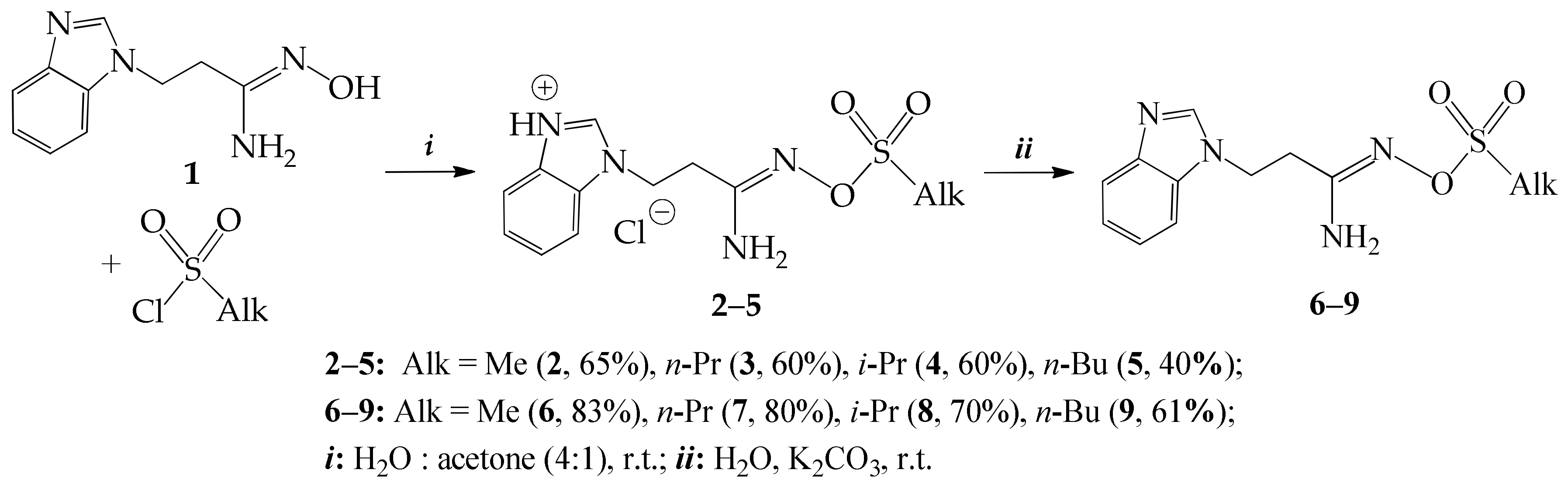
Figure 1.
Asymmetric units of hydrochlorides 3,5 and base 7 of O-alkylsulfonyl-β-(benzimidazole-1-yl)propioamidoximes. The structures of molecules 3 and 5 contain an isopropyl alcohol molecule.
Figure 1.
Asymmetric units of hydrochlorides 3,5 and base 7 of O-alkylsulfonyl-β-(benzimidazole-1-yl)propioamidoximes. The structures of molecules 3 and 5 contain an isopropyl alcohol molecule.
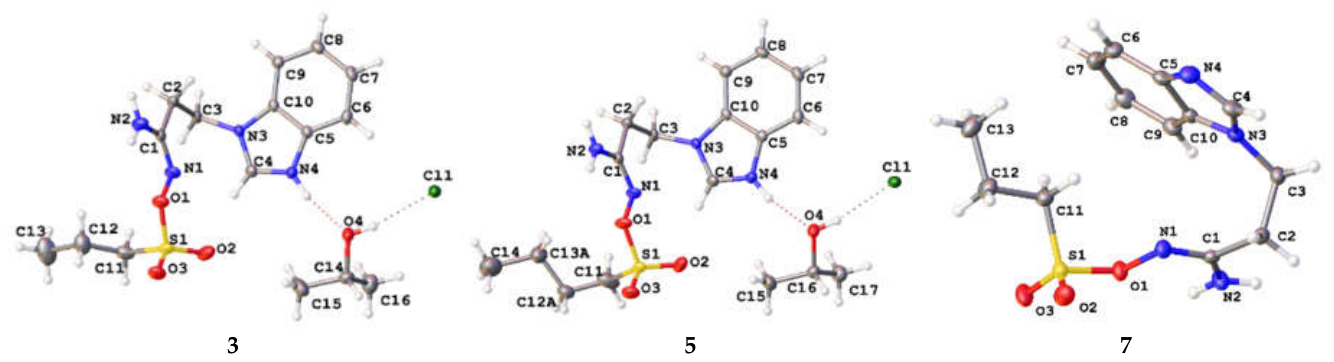
Figure 2.
Molecular view of β-(benzimidazol-1-yl)propioamidoxime (1), β-(benzimidazol-1-yl)propioamidoxime hydrochloride (10) isolated under conditions (iii).
Figure 2.
Molecular view of β-(benzimidazol-1-yl)propioamidoxime (1), β-(benzimidazol-1-yl)propioamidoxime hydrochloride (10) isolated under conditions (iii).
Scheme 2.
Alkylsulfochlorination of β-(benzimidazol-1-yl)propioamidoxime (1) in the presence of a base.
Scheme 2.
Alkylsulfochlorination of β-(benzimidazol-1-yl)propioamidoxime (1) in the presence of a base.
Scheme 3.
Plausible mechanism of alkylsulfochlorination of β-(benzimidazol-1-yl)propioamidoxime (1) with the presence of tributylamine under reaction conditions (iii): I ‒ formation of tributylamine hydrochloride, sulfen A and alkylsulfonyltributylammonium chloride B; II ‒ formation of β-(benzimidazol-1-yl)propioamidoxime hydrochloride (10).
Scheme 3.
Plausible mechanism of alkylsulfochlorination of β-(benzimidazol-1-yl)propioamidoxime (1) with the presence of tributylamine under reaction conditions (iii): I ‒ formation of tributylamine hydrochloride, sulfen A and alkylsulfonyltributylammonium chloride B; II ‒ formation of β-(benzimidazol-1-yl)propioamidoxime hydrochloride (10).
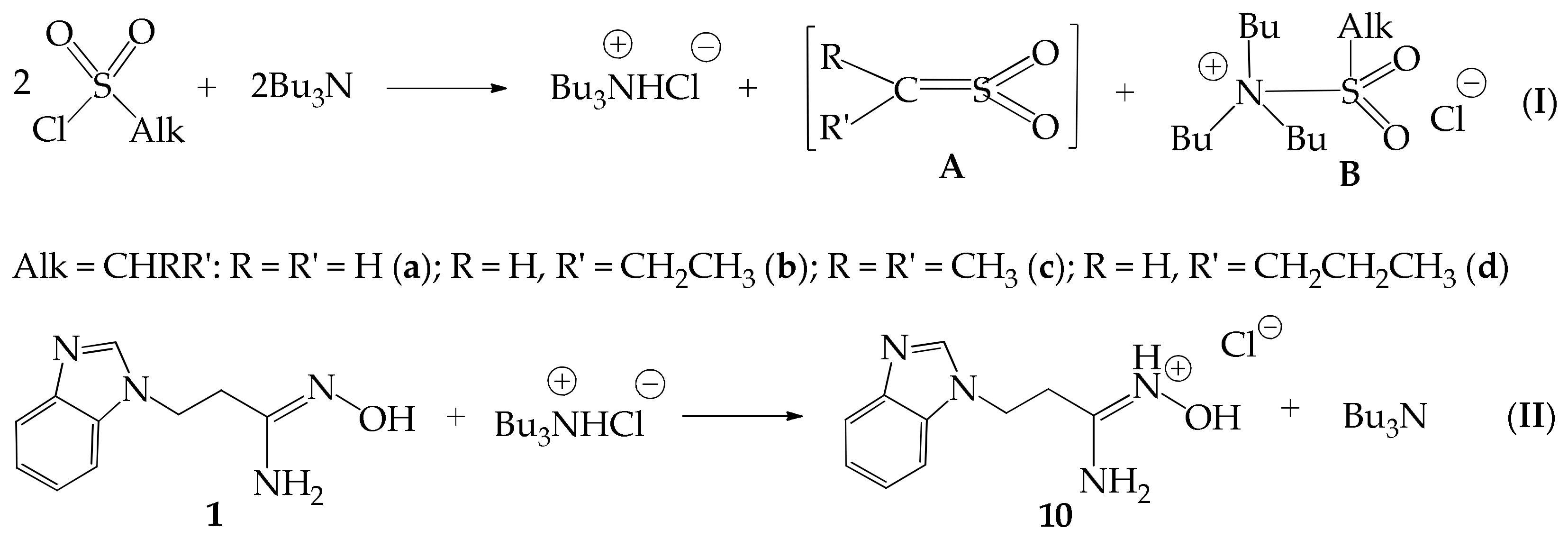

Table 1.
Physicochemical data of the starting amidoxime 1, O-alkylsulfochlorination products 2–9 and β-(benzimidazol-1-yl)propioamidoxime hydrochloride 10.
Table 1.
Physicochemical data of the starting amidoxime 1, O-alkylsulfochlorination products 2–9 and β-(benzimidazol-1-yl)propioamidoxime hydrochloride 10.
| Comp | Alk | Yield, % | Time, h | M.p., °C | Rf | Comp | Alk | Yield, % | Time, h | M.p., °C | Rf |
| 1 | - | 56(21*) | 20 | 183 | 0.45 | 6 | Me | 83 | 1 | 144‒146 | 0.79 |
| 2 | Me | 62 | 20 | - | 0.73 | 7 | n-Pr | 77 | 1 | 139‒141 | 0.78 |
| 3 | n-Pr | 67 | 16 | 89‒91 | 0.74 | 8 | i-Pr | 66 | 1 | 158‒160 | 0.79 |
| 4 | i-Pr | 58 | 20 | 163 | 0.75 | 9 | n-Bu | 68 | 1 | 130‒132 | 0.75 |
| 5 | n-Bu | 40 | 20 | 84 | 0.74 | 10 | - | 61 | 20 | 173 | 0.66 |
*The yield of amidoxime 1 in the process of alkylsulfochlorination under conditions (ii).
Table 2.
Basic crystallographic data of O-alkylsulfonyl-β-(benzimidazole-1-yl)propioamidoximes 3, 5 and 7.
Table 2.
Basic crystallographic data of O-alkylsulfonyl-β-(benzimidazole-1-yl)propioamidoximes 3, 5 and 7.
| Comp | 3 (C13H19N4O3S)Cl ٠C3H8O |
5 (C14H21N4O3S)Cl ٠C3H8O |
7 |
|---|---|---|---|
| Gross formula | C16H27ClN4O4S | C17H29ClN4O4S | C13H18N4O3S |
| Molecular weight | 406.92 | 420.95 | 310.37 |
| T, K | 140 | 140 | 140 |
| Crystal System | Monoclinic | Monoclinic | Monoclinic |
| Space Group | P21/c | P21/c | P21/c |
| Z | 4 | 4 | 4 |
| a, Å | 8.5406(5) | 8.5879(5) | 10.7338(7) |
| b, Å | 8.1749(5) | 8.3129(5) | 8.1494(5) |
| c, Å | 29.4074(17) | 29.3709(18) | 17.3782(11) |
| b, ° | 90.208(2) | 90.685(2) | 96.731(2) |
| V, Å3 | 2053.2(2) | 2096.6(2) | 1509.66(17) |
| dcalc. g٠cm-3 | 1.316 | 1.334 | 1.366 |
| m, см-1 | 0.315 | 0.311 | 0.230 |
| F(000) | 864 | 896 | 656 |
| Number of measured reflections | 24745 | 25328 | 12060 |
| Number of independent reflections | 5577 | 5719 | 4054 |
| Number of parameters | 273 | 267 | 199 |
| R1 | 0.0389 | 0.0363 | 0.0355 |
| wR2 | 0.0965 | 0.0940 | 0.0928 |
| GOF | 1.063 | 1.019 | 1.006 |
| Residual electron density e×Å-3(dmin/dmax) |
0.32/-0.33 | 0.41/-0.37 | 0.31/-0.45 |
Table 3.
Basic crystallographic data of β-(benzimidazol-1-yl)propioamide oxime (1) and its hydrochloride (10).
Table 3.
Basic crystallographic data of β-(benzimidazol-1-yl)propioamide oxime (1) and its hydrochloride (10).
| Comp | 1 | 10 |
| Gross formula | C10H12N4O | C10H13ClN4O |
| Molecular mass | 204.24 | 240.69 |
| T. K | 100 | 100 |
| Crystal system | Orthorhombic | Orthorhombic |
| Space group | P212121 | Pna21 |
| Z | 4 | 4 |
| a. Å | 5.1133(5) | 13.450(7) |
| b. Å | 12.526(2) | 11.562(5) |
| c. Å | 15.3316(16) | 7.333(3) |
| β. ° | 90 | 90 |
| V. Å3 | 982.0(2) | 1140.3(9) |
| dcalc. g٠cm-3 | 1.381 | 1.402 |
| µ. сm-1 | 0.095 | 0.320 |
| F(000) | 432 | 504 |
| Number of measured reflections | 8444 | 5921 |
| Number of independent reflections | 2514 | 1955 |
| Number of parameters | 138 | 152 |
| R1 | 0.0443 | 0.0980 |
| wR2 | 0.0952 | 0.2111 |
| GOF | 1.077 | 1.042 |
| Residual electron density, e٠Å-3(dmin/dmax) | 0.26/-0.21 | 0.62/-0.45 |
Table 4.
In vitro antimicrobial, antifungal activity (MIC, µg/ml) and α-glucosidase antidiabetic inhibition (%) of the O-alkylsulfonyl-β-(benzimidazole-1-yl)propioamidoximes (2‒9).
Table 4.
In vitro antimicrobial, antifungal activity (MIC, µg/ml) and α-glucosidase antidiabetic inhibition (%) of the O-alkylsulfonyl-β-(benzimidazole-1-yl)propioamidoximes (2‒9).
| Compd | Alk | Gram-positive strains | Gram-negative strains |
Сandida albicans |
α-Glucosidase inhibition, %* | ||
| Staphylococcus aureus |
Bacillus subtilis |
Escheriсhia coli | Pseudomonas aeruginosa | ||||
| 2 | Me | - | 50 | 12.5 | - | 25 | 64.7±3.1 |
| 3 | n-Pr | - | - | 25 | - | 25 | - |
| 4 | i-Pr | 25 | - | - | - | 12.5 | - |
| 5 | n-Bu | 12.5 | 25 | - | - | 50 | 79.5±0.2 |
| 6 | Me | - | 50 | 12.5 | - | 25 | - |
| 7 | n-Pr | 50 | - | 25 | - | - | - |
| 8 | i-Pr | 12.5 | - | - | - | 6.3 | - |
| 9 | n-Bu | 25 | - | - | - | - | - |
| Gentamicin | 6.3 | 6.3 | 3.1 | 6.3 | - | - | |
| Nistatin | - | - | - | - | 12.5 | - | |
| Acarbose | - | - | - | - | - | 44.7±1.0 | |
*Significance of differences p < 0.05 compared with the comparison group.
Disclaimer/Publisher’s Note: The statements, opinions and data contained in all publications are solely those of the individual author(s) and contributor(s) and not of MDPI and/or the editor(s). MDPI and/or the editor(s) disclaim responsibility for any injury to people or property resulting from any ideas, methods, instructions or products referred to in the content. |
© 2026 by the authors. Licensee MDPI, Basel, Switzerland. This article is an open access article distributed under the terms and conditions of the Creative Commons Attribution (CC BY) license (http://creativecommons.org/licenses/by/4.0/).
Copyright: This open access article is published under a Creative Commons CC BY 4.0 license, which permit the free download, distribution, and reuse, provided that the author and preprint are cited in any reuse.


