

Submitted:
20 May 2026
Posted:
22 May 2026
You are already at the latest version
Abstract
Sarcopenia is characterized by progressive loss of skeletal muscle mass and function and is a major contributor to frailty, disability, and mortality in older adults. Store-operated calcium entry (SOCE) is a crucial regulator of skeletal muscle calcium homeostasis, and impaired SOCE has been linked to age-related muscle weakness. Here, we investigated the role of the synaptophysin family member synaptophysin-like protein 2, also known as mitsugumin 29 (MG29/SYPL2) in regulating SOCE, muscle structure, and lipid signaling during aging. Using knockout mice (mg29−/−) as a model of accelerated sarcopenia, in combination with RNA interference against MG29/SYPL2 in adult muscle and primary myotubes, we quantified changes in muscle morphology, contractile function, SOCE activity, and targeted lipidomic profiles. We found that reduced MG29/SYPL2 expression leads to decreased muscle fiber cross-sectional area, reduced specific force, blunted SOCE, and marked alterations to membrane cholesterol content as well as fatty acid–derived lipid mediators. Cholesterol depletion by methyl-β-cyclodextrin in wild-type myotubes produced similar SOCE defects as those observed in aged wild-type and young mg29−/− muscles, indicating that MG29/SYPL2-dependent maintenance of membrane cholesterol is required for normal SOCE. Acute MG29/SYPL2 knockdown also modified myogenic differentiation, expression of calcium-handling and stress-response genes, and the release and consumption of specific polyunsaturated fatty acid–derived lipid mediators. Together, these findings identify MG29/SYPL2 as a critical regulator of SOCE and lipid signaling in skeletal muscle and suggest that its age-related decline contributes to sarcopenia by disrupting triad membrane organization and excitation-contraction coupling.
Keywords:
mitsugumin 29
; sarcopenia
; SOCE
; calcium homeostasis
; skeletal muscle
; lipid signaling
1. Introduction
The average global population age is rapidly increasing, and the proportion of people aged 60 years and older is projected to almost double between 2006 and 2050. Aging is a complex biological process that affects multiple organ systems and is characterized by genomic instability, telomere attrition, epigenetic alterations, loss of proteostasis, and deregulated nutrient sensing [1]. In skeletal muscle, normal aging leads to sarcopenia, defined as a progressive loss of muscle mass and strength or power that is only partially mitigated by increased physical activity or improved diet [1,2].
Sarcopenia affects more than 30% of adults over 60 years of age and is associated with frailty, functional impairment, physical disability, and increased mortality, contributing substantially to healthcare costs [3,4]. In addition to reduced muscle size and fiber number, sarcopenia is characterized by selective loss of type II fibers, reduced satellite cell content, and a decline in specific force, indicating that mechanisms beyond atrophy contribute to muscle weakness [5,6,7,8,9]. Interventions that primarily target functional restoration rather than muscle mass alone are more effective in older adults, underscoring the need to understand cellular mechanisms that impair muscle quality [1,10,11,12]. Multiple processes have been implicated in the atrophy-independent loss of muscle function with aging, including reduced neural drive, increased non-contractile tissue, altered cross-bridge function and Ca2+ sensitivity, and disrupted excitation-contraction (E-C) coupling [13,14,15,16,17,18,19]. Our group and others have identified store-operated Ca2+ entry (SOCE) as a physiologically relevant Ca2+ influx pathway in skeletal muscle, activated by depletion of sarcoplasmic reticulum Ca2+ stores through coordinated actions of STIM1 and Orai channels [20,21]. SOCE is essential for refilling sarcoplasmic reticulum Ca2+ during repetitive activity, and its dysregulation has been linked to impaired force production and myopathic phenotypes [13,20,21,22,23].
We previously demonstrated that SOCE is significantly blunted in muscles from aged mice and that this reduction contributes to the age-related decline in muscle-specific force [24]. We also identified mitsugumin 29 (MG29, now designated as synaptophysin-like 2, SYPL2) as a triad junction protein whose levels decline in aged skeletal muscle and whose loss recapitulates several features of aging, including reduced SOCE and impaired contractile performance. MG29/SYPL2 belongs to the synaptophysin/MARVEL family, contains four transmembrane domains, and localizes to both transverse tubule and sarcoplasmic reticulum membranes, where it participates in triad organization and lipid homeostasis [21,24,25,26,27,28,29,30,31,32,33,34].
Understanding the specific mechanisms that contribute to sarcopenia is essential for effective interventions during aging [19,35,36]. Several studies establish potential mechanisms for this discrepancy between atrophy-dependent vs. -independent loss of muscle function in aging, including reduced neural drive, increased non-contractile tissue, decreased myosin force and/or actin-myosin cross-bridge stability or sensitivity to Ca2+, and altered excitation-contraction (E-C) coupling [13,20,21,22]. SOCE is an extracellular Ca2+ entry pathway present in most cells, where the depletion of the intracellular store of Ca2+ in the endoplasmic or sarcoplasmic reticulum (ER/SR) triggers Ca2+ influx from the extracellular space via the coordinated recruitment of STIM1 and Orai1, 2, or 3. The role of SOCE in skeletal muscle was not initially appreciated. Our previous work and that of others indicate that SOCE is an essential regulator of muscle physiology and is linked to excess extracellular Ca2+ ([Ca2+] entry) in muscle pathology [24,29,32]. Recent studies from our labs and others have focused on understanding the age-related decreases in muscle strength resulting from a combination of loss of muscle mass (atrophy) and reduced muscle-specific force (i.e., muscle force per unit of cross-sectional area) [5,6]. We found that SOCE is significantly blunted in muscles from aged mice, and this reduction in SOCE appears to play an important role in the age-related decline of muscle force production [22,23,24,25].
Our previous work also determined that the MG29 protein is linked to decreased SOCE and force production in aging muscle [19]. While this protein was initially called MG29, it later received the designation of synaptophysin-like 2 (SYPL2) as it shares characteristic structural features with members of the synaptophysin and MARVEL families of proteins [19,20,21]. MG29/SYPL2 contains four transmembrane domains that allow the protein to localize at both the transverse tubule (TT) membrane and SR membranes of the triad junction in skeletal muscle [37,38]. MG29/SYPL2 levels decrease in aging mouse muscle, and normal levels of MG29/SYPL2 protein are essential for the proper formation of the TT system in skeletal muscle, maintenance of lipid content of the sarcolemmal membrane, and efficient signaling between the ryanodine receptor type 1 (RyR1) and the SOCE machinery for the refilling of Ca2+ stores in SR. Interestingly, we also found that knockout of sarcalumenin, a SR-resident Ca2+-binding protein, increased MG29/SYPL2 expression, enhanced SOCE, and improved muscle performance [39], suggesting that MG29/SYPL2 is directly involved in SOCE regulation, which in turn is essential for normal muscle function.
In the present study, we investigated how reduced MG29/SYPL2 expression contributes to age-related changes in skeletal muscle structure, function, and lipid signaling. Using mg29−/− mice, in vivo electroporation with MG29 siRNA, and MG29/SYPL2 knockdown in primary myotubes, combined with targeted lipidomics and functional Ca2+ imaging, we tested the hypothesis that MG29/SYPL2-dependent maintenance of membrane cholesterol and lipid mediators is required for normal SOCE and muscle performance during aging. By integrating structural, functional, and lipidomic data, this study aimed to define the mechanisms by which MG29/SYPL2 loss mimics key aspects of sarcopenia and to identify potential targets for preserving muscle quality in older individuals.
2. Material and Methods
2.1. Animals and Ethical Approval
MG29-null (mg29−/−) mice were generated as previously described [33]. All animal procedures were conducted in accordance with institutional guidelines and approved by the Ohio State University and the University of Texas at Arlington. Male C57BL/6J wild-type (WT) and mg29−/− mice were maintained under standard housing conditions with ad libitum access to food and water. Mice were euthanized at the indicated ages by CO2 inhalation followed by cervical dislocation.
For the systemic metabolic impact of MG29 overexpression, Male C57BL/6 mice were fed a high-fat diet (HFD; 60% kcal from fat, Research Diets Inc.) starting at 5 weeks of age and maintained on this diet for 18 weeks to establish a diet-induced metabolic condition. After 18 weeks of HFD feeding, mice received a single intravenous injection of MyoAAV2A-MHCK7-hMG29 (3x10¹³ vg/kg). Serum samples were collected at 5 weeks post-injection for subsequent biochemical analysis. All animal procedures were performed in accordance with institutional guidelines and were approved by the University of Virginia Institutional Animal Care and Use Committee (IACUC).
2.2. Reagents and Antibodies
Sixteen isotope-labeled lipid mediator internal standards were purchased from Cayman Chemical (Ann Arbor, MI, USA), including AA-d8, 6-keto-PGF1α-d4, PGF2α-d4, PGE2-d4, PGD2-d4, TXB2-d4, LTB4-d4, LTC4-d5, 5-HETE-d8, 15-HETE-d8, 12-HETE-d8, PAF C-16-d4, tetranor-PGEM-d6, OEA-d4, DHA-d5, and EPA-d5. Formic acid (reagent grade, ≥95%) was obtained from Sigma-Aldrich (St. Louis, MO, USA). HPLC-MS grade acetonitrile, water, methanol, and ethanol were purchased from J.T. Baker (Phillipsburg, NJ, USA).
Cell culture reagents were obtained as follows: penicillin–streptomycin (P/S; 10,000 U/mL each), DMEM high-glucose media, α-MEM media, and trypsin-EDTA (1×) from Mediatech Inc. (Manassas, VA, USA); Ham’s F-10 from Corning (Corning, NY, USA); fetal bovine serum (FBS), horse serum (HS), and caffeine from Thermo Fisher Scientific Inc. (Waltham, MA, USA); bovine serum albumin (BSA) and 4′,6-diamidino-2-phenylindole (DAPI) from Sigma-Aldrich; rat-tail collagen type I from BD Biosciences (San Jose, CA, USA); 16% paraformaldehyde from Alfa Aesar (Ward Hill, MA, USA); Entactin-Collagen IV-Laminin (ECL) gel from the indicated supplier; Lipofectamine RNAiMAX Transfection Reagent from ThermoFisher Scientific; and basic recombinant human fibroblast growth factor (bFGF) from Promega (Madison, WI, USA). Pronase was from EMD Millipore. Fura-2/AM was obtained from Life Technologies (Grand Island, NY, USA).
Custom MG29 siRNA and negative control siRNA were synthesized by Integrated DNA Technologies (Coralville, IA, USA). Tri Reagent was obtained from Molecular Research Center, Inc. (Cincinnati, OH, USA). The High-Capacity cDNA Reverse Transcription Kit was from Applied Biosystems (Foster City, CA, USA). RT2 Real-Time SYBR Green/ROX PCR Master Mix was from SABiosciences (Valencia, CA, USA).
Carboxyfluorescein (CFS)-conjugated mouse monoclonal anti-human myosin heavy chain (MHC) antibody was purchased from R&D Systems Inc. (Minneapolis, MN, USA) and has been previously validated [28]. C2C12 mouse myoblasts were obtained from the American Type Culture Collection (ATCC; Manassas, VA, USA).
2.3. C2C12 Myoblast Culture and Differentiation
C2C12 myoblasts were cultured as previously described [29,30]. Briefly, cells were maintained at 37 °C in a humidified 5% CO2 atmosphere in growth medium (GM) consisting of DMEM/high glucose supplemented with 10% FBS and P/S (100 U/mL each) and were maintained at 40–70% confluence. For experiments, cells were plated at 1×10⁵ cells per well in 6-well plates, and medium was changed every 48 h. To induce differentiation into myotubes, cells at approximately 75% confluence were switched to differentiation medium (DM) consisting of DMEM/high glucose supplemented with 2% HS and P/S. Fully differentiated, functional myotubes formed within 5–7 days, and the medium was changed every 48 h during differentiation.
2.4. Primary Mouse Myoblast Isolation and Culture
Primary myoblasts were isolated from the hindlimb muscles of 5-month-old C57BL/6 mice. Harvested muscles were minced and digested with 0.1% pronase. Isolated cells (fibroblasts and myoblasts) were maintained and expanded in collagen I-coated T-75 flasks in growth medium consisting of Ham’s F-10 supplemented with 20% FBS, P/S (100 U/mL each), and 5 ng/mL bFGF for 3–4 weeks for purification. Myoblasts with ≥99% purity, as confirmed by immunostaining for MyoD, were used for experiments. Primary myoblasts were cultured following established protocols [31]. Cells were grown at 37 °C in a 5% CO2 atmosphere in skeletal muscle cell growth medium and maintained at 50–70% confluence. For experiments, cells were plated at 2×10⁵ cells per well in 6-well plates coated with ECL, and medium was changed every 48 h. To induce differentiation, cells at 80% confluence were switched to DM (DMEM/high glucose + 2% HS + P/S). Fully differentiated, functional myotubes formed within 2–3 days, and medium was changed every 48 h.
2.5. siRNA Transfection
Primary myoblasts were plated at 2×10⁵ cells per well in 6-well plates coated with ECL, allowed to attach for 2 h in growth medium, then switched to DM and cultured overnight. Cells were transfected using Lipofectamine RNAiMAX according to the manufacturer’s instructions. Experimental cells received 10 nM MG29 siRNA plus 7.5 µL Lipofectamine RNAiMAX reagent, while control cells received 10 nM negative control siRNA plus 7.5 µL reagent. After transfection, cells were cultured in DM and allowed to differentiate for 3 days.
2.6. Immunostaining and Cell Morphometry
Cells were fixed with 10% neutral buffered formalin and permeabilized with 0.1% Triton X-100 in PBS as previously described [24,28,30,32]. Myosin heavy chain (MHC) was detected using CFS-conjugated anti-MHC antibody (1:50) for 30 min at room temperature, and nuclei were counterstained with DAPI. Fluorescent images were acquired using a Leica fluorescence microscope (10× or 20× objective), an Olympus system, or a Nikon Eclipse TE300 inverted fluorescence microscope. Phase-contrast images were taken with an Olympus IX73 inverted microscope equipped with a Hamamatsu digital camera C11440 using CellSens Dimension software for calibration. To quantify myogenic differentiation, the fusion index (FI) was calculated as: (nuclei within MHC-expressing myotubes / total number of myogenic nuclei) × 100 [33]. Three independent experiments were performed, with three randomly selected areas per well. Approximately 2,000 nuclei per area were analyzed.
2.7. RNA Isolation and Real-Time Quantitative PCR (RT-qPCR)
Total RNA was isolated using Tri Reagent according to the manufacturer’s protocol, and cDNA was synthesized using the High-Capacity cDNA Reverse Transcription Kit. RT-qPCR was performed using RT2 Real-Time SYBR Green/ROX PCR Master Mix. Primers used in this study are summarized in Table 1. RT-qPCR reactions (25 µL) were run in 96-well plates using a StepOnePlus instrument (Applied Biosystems). Data were analyzed using RT2 Profiler PCR Array Data Analysis software (SABiosciences). CT values were normalized to Gapdh (glyceraldehyde-3-phosphate dehydrogenase) as the reference gene. Gene expression was calculated as fold-change relative to controls. The reactions were performed at least two times (duplicates), and all experiments were repeated at least three times.
A custom muscle-specific RT-qPCR array from SABiosciences was used to simultaneously detect gene expression changes after MG29 siRNA transfection. cDNA was synthesized using the RT2 First Strand Kit (which includes genomic DNA elimination), and the PCR array was run according to the manufacturer’s protocol with a threshold of 0.25. Single peaks in melting curves validated each gene tested. Data were analyzed using RT2 Profiler PCR Array Data Analysis Software, with Ct values normalized to six built-in reference housekeeping genes, genomic DNA control, reverse transcription control, and positive PCR control. Statistical significance was set at a 2-fold difference in gene expression.
2.8. Cholesterol Depletion with Methyl-β-Cyclodextrin (MβCD)
C2C12 myotubes were treated with 5 mM MβCD to partially deplete membrane cholesterol, while primary myotubes from 5-month-old WT mice were treated with 2 mM MβCD to minimize sarcolemma disruption. After treatment, SOCE measurements were performed by Fura-2 Ca2+ imaging as described below.
2.9. MG29 Mutant Constructs
MG29 loss-of-function mutants were generated by site-directed mutagenesis. The MG29-4FA mutant contained alanine (A) substitutions at four conserved phenylalanine (F) residues (one in each transmembrane span of the MARVEL domain). The MG29-5CG mutant contained glycine (G) substitutions at all five cysteine (C) residues in the MARVEL domain. Wild-type (WT) and mutant MG29 constructs were transfected into C2C12 myoblasts and primary myotubes for functional analysis.
2.10. In Vivo Electroporation and MG29 Silencing in Intact Muscle
Flexor digitorum brevis (FDB) muscles were electroporated with either scrambled control siRNA or MG29 siRNA as previously described the previously described method. Briefly, plasmid DNA or siRNA was injected into FDB muscles, followed by electrical pulses delivered using the previously described parameters. Muscles were harvested 28 days post-electroporation for Western blot analysis and SOCE functional assays.
2.11. Store-Operated Ca2+ Entry (SOCE) Measurements
SOCE was measured using Fura-2/AM ratiometric Ca2+ imaging. Cells or intact muscle fibers were loaded with 5 µM Fura-2/AM for 30 min at room temperature, then washed in physiological saline solution. SOCE was triggered by sarcoplasmic reticulum Ca2+ depletion using the protocol described for each experiment, followed by re-addition of 2 mM extracellular Ca2+. Fluorescence was measured at dual excitation wavelengths (340 and 380 nm) with emission at 510 nm using the indicated microscope and imaging system. The 340/380 ratio was calculated to reflect intracellular Ca2+ concentration. Peak SOCE amplitude and integrated Ca2+ response (area under the curve) were quantified using the appropriate analysis software.
For Mn2+ quenching assays in intact FDB fibers, SOCE was assessed by measuring the rate of Mn2+-induced quenching of Fura-2 fluorescence at 360 nm excitation following sarcoplasmic reticulum depletion.
2.12. Lipidomic Profiling of Gastrocnemius Muscle
Gastrocnemius (GAS) muscles were snap-frozen in liquid nitrogen immediately after dissection and stored at −80 °C. For lipid extraction, 50–100 mg of muscle tissue was minced and homogenized in 1.0 mL ice-cold 80% methanol in water (v/v) with one stainless steel bead (5 mm; Qiagen, Germantown, MD) using a TissueLyser II homogenizer (Qiagen) at 30 Hz for six 30-s bursts with 20-s intervals on ice. Homogenates were spiked with 5 µL of isotope-labeled lipid mediator internal standard (IS) stock solution (5 µg/mL for AA-d8; 2 µg/mL for DHA-d5 and EPA-d5; 0.5 µg/mL for all other IS), then agitated on ice in the dark for 1 h. Samples were centrifuged at 16,000 × g for 10 min at 4 °C to remove tissue debris and precipitated proteins.
Supernatants were cleaned and concentrated by solid-phase extraction (SPE) as previously described [40]. Briefly, lipid mediators were fully protonated by adding ice-cold 0.1% (v/v) formic acid in water, then loaded onto preconditioned SPE cartridges (Strata-X 33 µm polymeric reversed phase; Phenomenex, Torrance, CA). Cartridges were washed with 0.1% formic acid in water and 15% (v/v) ethanol in water to remove salts, then lipid mediators were eluted with methanol. Solvents were removed using an Eppendorf 5301 concentrator centrifugal evaporator (Eppendorf, Hauppauge, NY), and dried extracts were stored at −80 °C until LC-MS/MS analysis.
2.13. LC-MS/MS Analysis of Lipid Mediators
All LC-MS/MS system components were from Shimadzu Scientific Instruments, Inc. (Columbia, MD). The LC system included four pumps (Pumps A/B: LC-30AD; Pumps C/D: LC-20AD XR), a SIL-30AC autosampler, and a CTO-30A column oven with a two-channel six-port switching valve. LC separation was performed on a RESTEK Ultra C8 column (150 × 2.1 mm, 3 µm; Bellefonte, PA) with a Halo guard column (Optimize Technologies, Oregon City, OR). MS/MS analysis was performed on a Shimadzu LCMS-8050 triple quadrupole mass spectrometer operated under both positive and negative electrospray ionization in multiple reaction monitoring (MRM) mode. MS/MS conditions and LC settings were optimized following our previously published methods [40,41]. Data acquisition and processing were performed using Shimadzu LabSolutions V5software.
Before LC-MS/MS analysis, dried extracts were reconstituted in 50 µL methanol, and 10 µL was injected using the autosampler. The relative peak area of each lipid mediator was normalized to the corresponding internal standard and sample weight.
2.14. Lipidomic Analysis of Conditioned Medium
After siRNA treatment of primary myoblasts, conditioned medium (CM; ≥1 mL) was collected on differentiation day 3 and centrifuged at 350 × g for 5 min at room temperature to remove cell debris. Supernatant (≥1 mL) was transferred to clean 1.5 mL low-retention microcentrifuge tubes and stored at −80 °C for lipidomic analysis using the same LC-MS/MS protocol described above.
2.15. Cholesterol and Triglyceride Measurement
In mice, blood samples were collected from mice 5 weeks after intravenous injection of MyoAAV-MHCK7-hMG29. Serum was isolated by centrifugation and stored at −80 °C until analysis. Serum total cholesterol levels were measured using a commercial assay kit (RayBiotech, MA-TC-1), and serum triglyceride levels were measured using a triglyceride assay kit (RayBiotech, MA-TG-1), according to the manufacturer’s instructions.
2.16. Statistical Analysis
All statistical analyses were performed using IBM SPSS Statistics v.23. Data are presented as individual data points with mean ± SD or SEM as indicated. Comparisons between multiple groups were made using one-way ANOVA followed by Tukey’s post hoc test (α = 0.05). For comparisons between two groups, an unpaired Student’s t-test was used. A P value < 0.05 was considered statistically significant.
3. Results
3.1. Reduced MG29/SYPL2 Expression Leads to Compromised Muscle Structure and Function
We first tested whether loss of MG29 could serve as a model of accelerated sarcopenia by comparing muscle morphology and function in young mg29−/−mice, young wild-type (WT) mice, and old WT mice. Figure 1 presents gross anatomical morphology of all three experimental cases, which clearly shows that atrophy in aging is mirrored in young MG29-/- mice (Figure 1A). Cross-sections of EDL muscles from young WT and young mg29-/- mice show preferential atrophy of type II muscle fibers, recapitulating observations in humans [42] (Figure 1B). We conducted extensive quantification and determined that cross-sectional area (CSA) of extensor digitorum longus (EDL) fibers was significantly reduced in young mg29−/− mice compared with age-matched WT controls (1154 ± 226 µm2 in WT vs. 705 ± 315 µm2 in mg29−/−, P < 0.001, ANOVA/Tukey) and was similar to values observed in aged WT mice (685 ± 355 µm2). These data indicate that MG29 deficiency reproduces an atrophic phenotype characteristic of aged muscle despite a young chronological age. Consistent with reduced fiber size, mg29−/− mice showed impaired muscle contractile performance as shown in Figure 1C. Normalized EDL muscle-specific force indicates that atrophy can only partially explain the decrease in force production, indicating the disruption of ECC coupling-related processes. To identify a direct mechanism, we measured the content of MG29 protein in skeletal muscles in MG29-/- vs WT mice at 6, 12, and 24 months, as shown in Figure 1D. MG29 protein levels decreased significantly with age, reducing by 30% at 12 months, and 40-50% at 24 months compared to the corresponding WT controls. These data suggest a direct link between skeletal muscle-generated force capacity and MG29 levels.
3.2. MG29 Domain Structure:
To mechanistically study the function of MG29, we first analyzed its domain structure, as shown in Figure 2. The MG29 protein has N- and C-terminal cystolic domains on either side of the 4 transmembrane pass (blue) MARVEL domain (Figure 2A). Target conserved phenylalanine (F) or cystidine (C) residues are shown with numbers to indicate position. The C-terminal SCT domain is shown in green. Amino acid sequence of the SCT domain highlights amino acids that are polar (red) or have negative charge (blue) as shown in Figure 2B. The predicted secondary structure appears beneath the amino acids with coil (C) and an α-helical region (H, gray shading) as also shown in Figure 2B.
3.3. Lipidomics Analysis Reveals that Cholesterol and Overall Fatty Acid Content Are Decreased in mg29−/− Muscle
To explore mechanisms underlying the sarcopenia-like phenotype in mg29−/− mice, we examined the lipid composition of skeletal muscle. Targeted lipidomic analysis of EDL muscle revealed that total cholesterol and overall total fatty acids content were significantly reduced in mg29−/− muscle compared with age-matched WT controls, as shown in Figure 3. Several species of saturated fatty acids (including myristic, palmitic, and stearic acids) and some unsaturated species (such as oleic and linoleic acids) were greatly reduced in the mg29-/- muscle (Figure 3A), indicating a global depletion of key lipid species and broader changes in membrane lipid composition. Consistent with these changes, total free cholesterol levels were also substantially decreased in mg29-/- EDL muscle relative to WT, suggesting that loss of MG29 profoundly alters the lipid composition of skeletal muscle membranes (Figure 3B). Cholesterol is normally enriched in T-Tubules (TT), where it is required for the formation and maintenance of triad membrane structures and contractile function. Given that MG29/SYPL2 contains a MARVEL transmembrane domain with predicted cholesterol-binding properties, these findings suggest that MG29 contributes to the maintenance of TT cholesterol and fatty acid content, thereby supporting normal excitation–contraction coupling (EC-Coupling).
3.4. Altered Lipidomic Profiles in mg29−/− Gastrocnemius Muscle
We next performed targeted lipidomics to quantify bioactive lipid mediators derived from arachidonic acid (AA), linoleic acid (LA), eicosapentaenoic acid (EPA), docosahexaenoic acid (DHA), α-linolenic acid (ALA), and lysophosphatidylcholine (LPC) in GAS muscle from young (13-16 weeks) and mid-aged (50-55 weeks) WT and mg29−/− mice. These lipid mediators from the polyunsaturated fatty acid (PUFA) pathways regulate inflammation, oxidative stress, and muscle metabolism and have been implicated in age-related muscle remodeling [43,44].
In WT mice, 19 lipid mediators changed between 13 and 55 weeks of age markedly, consistent with an age-related remodeling of muscle lipid signaling (Table 2). Strikingly, a similar pattern was observed in mg29−/− mice between 16 and 50 weeks, and several key lipid mediators that increased with WT muscles were already elevated in young mg29−/− animals. These included AA-derived 13,14-dihydro-15-keto-PGE2 (2.7-fold), 5-HETE (2.2-fold), and 5-KETE (1.9-fold), EPA (1.5-fold), DHA-derived 20-HDoHE (2.5-fold), and the ALA metabolite 9-HOTrE (2.4-fold) compared with young WT mice, as shown in Figure 4. Thus, mg29−/− muscle exhibits a lipid mediator profile that resembles aged WT muscle, suggesting that MG29 loss accelerates age-like remodeling of lipid signaling pathways.
3.5. Altered MG29/SYPL2 Levels and Membrane Cholesterol Similarly Impair SOCE
Because lipidomics revealed reduced cholesterol in mg29−/− muscle, we asked whether direct cholesterol depletion would mimic the SOCE defects observed in aged and MG29-deficient muscle. Partial extraction of membrane cholesterol by methyl-β-cyclodextrin (MβCD) significantly reduced SOCE in both C2C12 myotubes and primary myotubes from young WT mice (Figure 5). Immunohistochemical staining of C2C12 and mouse primary myotubes revealed successful myogenic differentiation with well-defined myosin-positive multinucleated cells after 6 days and 3 days of culture, respectively (Figure 5A & B). Treatment of C2C12 myotubes with 5 mM MβCD decreased SOCE by approximately 50% (Figure 5C), comparable to the reduction observed in aged WT and young mg29−/− muscle. To minimize potential membrane damage and better approximate physiological conditions, primary myotubes from 5-month-old WT mice were treated with 2 mM MβCD, which still reduced SOCE by 30–40% (Figure 5D). Bright-field microscopy of untreated primary myotubes demonstrated characteristic elongated, multinucleated morphology with well-organized cellular alignment (Figure 5E). Following treatment with 2mM MβCD, primary myotubes displayed structural disruption with loss of typical elongated morphology and the appearance of irregular, fragmented cellular structures (Figure 5F). These morphological changes suggest that cholesterol depletion via MβCD treatment compromises myotube structural integrity and differentiation capacity in both primary and C2C12 myotube models. Further, these results strongly support a requirement for intact membrane cholesterol to maintain normal SOCE in skeletal muscle and indicate that MG29-dependent cholesterol regulation is functionally linked to Ca2+ entry.
3.6. Acute MG29/SYPL2 Knockdown Recapitulates Chronic MG29 Deficiency and Alters Ca2+ Homeostasis
To distinguish between developmental adaptations in mg29−/− mice and direct effects of MG29 loss, we acutely silenced MG29 in adult muscle using RNA interference. In FDB muscle electroporated with MG29 siRNA, MG29 protein levels were reduced, and SOCE activity significantly decreased compared with control muscles electroporated with scrambled siRNA, closely resembling the phenotype of young mg29−/− and aged WT muscles (Supplementary Figure S1).
Similarly, MG29/SYPL2 expression was reduced by approximately 80% in primary skeletal muscle cells 48 h after MG29 siRNA transfection. By day 3 of differentiation, MG29-depleted cells formed longer, thinner myotubes compared with controls (Figure 6). Quantification results indicated a significantly decreased diameter (Figure 6C) and increased length (Figure 6D) (P < 0.05), while fusion index (Figure 6B) was paradoxically increased, in agreement with elevated expression of the myogenic markers MyoG and MyoD (Figure 6E & F). These findings indicate that MG29 is required for normal myotube morphology and suggest a role in coordinating differentiation with appropriate structural maturation.
To determine how MG29 loss impacts Ca2+ homeostasis and stress responses, we used a custom skeletal muscle-specific RT-qPCR array after MG29/SYPL2 siRNA treatment. Expression of Cacna1s, RyR3, Btk, and Sod3 increased 2.6 ± 0.48-, 4.5 ± 0.89-, 2.7 ± 0.51-, and 6.5 ± 1.06-fold, respectively, whereas Fkbp1b and Ccl2 decreased 2.8 ± 0.38- and 7.3 ± 1.74-fold as shown in Figure 6G. These changes implicate MG29 in the regulation of Ca2+ channel complexes, oxidative stress defenses, and inflammatory signaling.
Further, lipidomic analysis of conditioned medium from MG29/SYPL2 siRNA-treated cells showed increased release of the endocannabinoid-like mediators arachidonoylethanolamine (AEA) and oleoylethanolamide (OEA), and increased consumption of PGD2, 9,10-DiHOME, 9-HOTrE, and 9-HODE (P < 0.05 vs. control) as shown in Figure 7. These mediators are derived from PUFAs and are known to influence inflammation, metabolism, and cell differentiation, suggesting that MG29 modulates myogenic differentiation through complex changes in lipid signaling.
3.7. MG29/SYPL2 MARVEL Domain Mutations Uncouple Lipid Binding from SOCE Regulation
MG29/SYPL2 shares a conserved MARVEL transmembrane domain with other synaptophysin family proteins, which are known to bind cholesterol and oligomerize in membranes. Alignment of MG29 with synaptophysin (SYP) revealed several highly conserved residues in the four transmembrane spans. To dissect the contribution of these residues, we generated MG29 mutants targeting either putative cholesterol-binding residues or cysteines within the MARVEL domain.
In the MG29-4FA mutant, four conserved phenylalanine residues (one in each transmembrane span) were mutated to alanine, which altered MG29 localization relative to filipin staining and reduced co-localization with membrane cholesterol. This mutant also exhibited compromised SOCE, further linking MG29’s cholesterol association to its function in supporting Ca2+ entry. In contrast, the MG29-5C mutant, in which five cysteine residues were mutated to glycine, displayed normal localization with respect to filipin staining but showed a marked reduction in SOCE. These data indicate that MARVEL-domain cysteines are essential for MG29-dependent regulation of SOCE but are not required for cholesterol binding, suggesting separable structural determinants for lipid association and Ca2+ signaling.
3.8. MG29 MARVEL Domain Mutations Differentially Impair SOCE in Skeletal Muscle Cells
To functionally validate the SOCE defects associated with MG29 MARVEL domain mutations, we examined Ca2+ entry dynamics in both C2C12 myotubes and primary mouse skeletal muscle cells transfected with GFP-tagged MG29 constructs. Phase-contrast and fluorescence microscopy confirmed successful transfection efficiency for MG29-WT and both mutant constructs (MG29-4FA and MG29-5C) in differentiated primary muscle cells and C2C12 myotubes (Figure 8A-B). Fura-2 Ca2+ imaging was used to assess SOCE following thapsigargin-induced SR Ca2+ store depletion.
Representative Ca2+ traces in C2C12 cells demonstrated that both MG29 mutants exhibited severely compromised SOCE compared to control and MG29-WT conditions (Figure 8C). Quantification of peak SOCE responses revealed that MG29-WT slightly decreased SOCE relative to control (49.2 ± 2.7 vs 55.1 ± 3.4, p<0.0047, delta [Ca2+]ᵢ nM), while MG29-5C produced a dramatic reduction to 39.8 ± 3.6 and MG29-4FA showed the most severe impairment at 25.0 ± 2.5 (p<0.0001 for both vs control; Figure 8D). These data confirm that disruption of either cholesterol-binding residues (4FA) or MARVEL domain cysteines (5C) abolishes MG29’s ability to support robust SOCE.
To validate these findings in a more physiologically relevant system, we performed Ca2+ imaging in intact primary myotubes from 5-month-old mice (Figure 8E-F). Representative traces showed response patterns consistent with C2C12 data. Quantification of peak SOCE responses revealed that MG29-WT enhanced SOCE relative to control (221.3 ± 7.8 vs 209.8 ± 12.4 delta [Ca2+]ᵢ nM), while MG29-4FA produced the most dramatic reduction to 56.7 ± 9.2 and MG29-5C showed a severe impairment at 99.7 ± 8.6 (p<0.000026 and p<0.000035 vs control, respectively; Figure 8F). Notably, the integral response, which captures both the magnitude and duration of SOCE, was most severely compromised in the cholesterol-binding-deficient MG29-4FA mutant, supporting the hypothesis that MG29’s association with membrane lipids is essential for sustaining SOCE activity in skeletal muscle.
3.9. MG29 MARVEL Domain Mutations Differentially Regulate Cellular Lipid Composition
Having established that MG29 MARVEL domain mutations produce distinct SOCE phenotypes, we next investigated whether these functional defects correlate with alterations in cellular lipid metabolism. Lipidomic profiling of C2C12 skeletal muscle cells transfected with wild-type MG29 or MARVEL domain mutants (4FA and 5CG) revealed distinct fatty acid profiles across the MG29 variants, with both total and free fatty acid pools showing significant alterations (Figure 9).
In total fatty acid measurements (Figure 9A), cells expressing the MG29-4FA mutant exhibited elevated oleic acid content compared to control, MG29-WT, and MG29-5CG conditions, suggesting that disruption of cholesterol-binding residues specifically alters monounsaturated fatty acid accumulation. In contrast, most saturated fatty acids, including palmitic and stearic acid, showed relatively consistent levels across all conditions. Analysis of free fatty acids (Figure 9B) demonstrated that oleic acid was again the most prominently affected lipid species, with MG29-4FA displaying approximately 3.0 μg/mg protein compared to lower levels in control and MG29-WT cells. The 5CG mutant, which maintains cholesterol binding but loses SOCE function (as shown in Figure 8), showed intermediate oleic acid levels alongside elevated arachidonic acid compared to wild-type MG29.
Notably, arachidonic acid (AA) levels were substantially elevated in both MG29-4FA and MG29-5CG mutants (approximately 1.3 μg/mg protein for both) compared to control (~0.9 μg/mg protein) and MG29-WT (~0.75 μg/mg protein), indicating that disruption of MG29’s functional domains leads to accumulation of this omega-6 polyunsaturated fatty acid. In contrast, DHA levels remained relatively low and comparable across all conditions (~0.2-0.3 μg/mg protein), with MG29-4FA showing a slight elevation rather than suppression. Long-chain saturated and monounsaturated fatty acids (palmitic, palmitoleic, and stearic) showed modest variation among groups, with palmitic and stearic acid levels ranging between 1.4-2.25 μg/mg protein across conditions.
These findings demonstrate that MG29 MARVEL domain mutations produce distinct lipid signatures that parallel their SOCE phenotypes: both the cholesterol-binding-deficient 4FA mutant and the SOCE-deficient 5CG mutant accumulate arachidonic acid, a lipid species associated with inflammatory signaling and membrane remodeling, while the 4FA mutant uniquely drives oleic acid elevation. The selective accumulation of AA in dysfunctional MG29 variants suggests that proper MG29-mediated SOCE may be required to regulate omega-6 PUFA metabolism, potentially linking Ca2+ signaling defects to altered inflammatory lipid mediator pathways in skeletal muscle.
To determine whether MG29-mediated alterations in cellular lipid metabolism translate to systemic effects, we examined serum lipid profiles in mice receiving intravenous injection of MyoAAV-MHCK7-MG29 under high-fat diet (HFD) conditions. Five weeks post-injection, serum total cholesterol levels showed a trend toward reduction in MG29-treated mice (305 ± 60 mg/dL) compared to controls (478 ± 70 mg/dL), though this difference did not reach statistical significance (Supplementary Figure S2A). Similarly, serum triglyceride levels remained comparable between control (67.5 ± 11.5 mg/dL) and MG29-treated mice (70.0 ± 11.5 mg/dL, Supplementary Figure S2B). These data indicate that while MG29 profoundly influences intracellular lipid composition and fatty acid profiles in skeletal muscle cells (Figure 9), its overexpression does not significantly alter circulating lipid levels under HFD challenge, suggesting that MG29’s lipid regulatory functions are primarily local to muscle tissue rather than systemic metabolic regulators.
4. Discussion
Our results demonstrate that reduced MG29/SYPL2 expression reproduces key structural, functional, and lipid signaling features of aging skeletal muscle, identifying MG29 as a central regulator of Ca2+ homeostasis and membrane organization in sarcopenia. Young mg29−/− mice exhibit reduced muscle fiber CSA, impaired specific force, shortened lifespan, and blunted SOCE, closely mirroring phenotypes observed in aged WT muscle. These findings extend prior work linking MG29 to defective SOCE in aged muscle and strengthen the concept that age-related MG29 loss contributes causally to dynapenia rather than simply reflecting a downstream consequence of aging.
A major new insight from this study is that MG29/SYPL2 modulates muscle lipid composition and signaling, particularly cholesterol and PUFA-derived mediators, and that these changes are tightly coupled to SOCE function. Lipidomic analyses revealed decreased cholesterol and global free fatty acid content in mg29−/− muscle, together with an “aged” pattern of lipid mediator levels in young mg29−/− gastrocnemius that closely resembled those of mid-aged WT mice. Several AA-, EPA-, DHA-, and ALA-derived mediators that increased with aging in WT muscle were already elevated in young mg29−/− mice, indicating that MG29 loss accelerates age-like remodeling of lipid signaling pathways. Because cholesterol is critical for TT and triad structure, and lipid mediators regulate inflammation and metabolism, MG29 appears to integrate structural and signaling aspects of membrane biology that are central to muscle aging.
Our functional experiments support a mechanistic link between MG29-dependent cholesterol homeostasis and SOCE. Partial extraction of membrane cholesterol with MβCD in C2C12 and primary myotubes reduced SOCE by 30–50%, reproducing the magnitude of SOCE impairment seen in aged WT and mg29−/− muscles. These observations align with studies in non-excitable cells where cholesterol-rich microdomains and caveolae concentrate STIM and Orai proteins to facilitate SOCE activation. In skeletal muscle, MG29 localizes to TT and SR membranes and forms oligomers, suggesting that it could stabilize cholesterol-enriched triad microdomains that support efficient coupling between STIM, Orai, and RyR1.
The MG29 mutant analyses further refined this model by showing that distinct MARVEL-domain residues differentially control lipid association and SOCE regulation. The MG29-4FA mutant disrupted co-localization with filipin-stained cholesterol and reduced SOCE, indicating that conserved transmembrane phenylalanine is required for cholesterol binding and proper positioning of MG29 within TT membranes. In contrast, the MG29-5C mutant retained normal cholesterol co-localization but still showed markedly impaired SOCE, implying that cysteine residues are essential for MG29’s signaling function—possibly by supporting conformational changes, oligomerization, or interactions with SOCE-associated proteins. Together, these findings suggest that MG29 fulfills at least two separable roles at the triad: maintaining cholesterol-rich membrane architecture and directly modulating SOCE through protein-protein interactions. The dissociation between cholesterol binding (retained in MG29-5C) and SOCE function (lost in MG29-5C) indicates that MG29 may act as a molecular scaffold that coordinates both lipid organization and Ca2+ channel assembly at triad junctions. This dual functionality positions MG29 as a critical integrator of membrane structure and excitation-contraction coupling, whose loss during aging disrupts both aspects simultaneously.
Acute knockdown experiments in adult FDB muscle and primary myotubes demonstrate that MG29 is required for normal SOCE and muscle cell morphology independently of developmental compensation. In vivo electroporation of MG29 siRNA decreased SOCE in adult fibers, confirming that MG29 modulates Ca2+ entry in mature muscle. In primary myotubes, acute MG29 depletion produced longer, thinner fibers with increased fusion index and elevated myogenic markers, indicating that differentiation proceeds but structural maturation is abnormal. This phenotype suggests that MG29 coordinates membrane growth, triad formation, and Ca2+signaling during late stages of myogenesis, and that its loss drives a maladaptive remodeling reminiscent of aged muscle.
MG29 knockdown also altered expression of genes involved in Ca2+ handling (e.g., Cacna1s, RyR3, Fkbp1b), oxidative stress (Sod3), and inflammation (Ccl2), pointing to broader regulatory roles in muscle homeostasis. Increased Cacna1s and RyR3 levels could represent compensatory upregulation of Ca2+ channels in response to reduced SOCE, while decreased Fkbp1b may impair RyR stabilization and contribute to Ca2+ leak and fatigue. Upregulation of Sod3 and downregulation of Ccl2 suggest that MG29 influences redox and inflammatory status, which are key determinants of sarcopenia progression. The associated changes in AEA, OEA, PGD2, DiHOME, HOTrE, and HODE flux in the culture medium further demonstrate that MG29 modulates PUFA-derived lipid mediator networks that regulate metabolism, inflammation, and differentiation. The elevation of arachidonic acid-derived mediators in MG29-deficient cells, coupled with altered endocannabinoid-like lipid release, suggests that MG29 loss shifts muscle toward a pro-inflammatory, catabolic state characteristic of sarcopenia. This lipid-mediated inflammation may contribute to the reduced specific force observed in mg29−/− muscle beyond what can be explained by fiber atrophy alone.
Collectively, our data supports a working model in which age-related loss of MG29/SYPL2 disrupts triad cholesterol content and membrane organization, leading to compromised SOCE, altered Ca2+ homeostasis, and maladaptive lipid signaling that together drive atrophy-independent declines in muscle-specific force. This model is consistent with prior findings that STIM1 and Orai1 expression are not markedly reduced in aged muscle, suggesting that upstream structural regulators such as MG29 are critical determinants of SOCE impairment. By linking a synaptophysin-family MARVEL protein to both lipid metabolism and Ca2+ entry, this study highlights MG29 as a potential therapeutic target for preserving muscle quality during aging and possibly in other MG29-associated conditions, including obesity, depression, kidney dysfunction, and neurodegeneration.
5. Clinical and Translational Implications
Our findings have several important translational implications for sarcopenia intervention strategies. First, the tissue-specific nature of MG29’s lipid regulatory function (demonstrated by the lack of systemic lipid changes in Supplementary Figure S2) suggests that MG29-targeted therapies could modulate muscle metabolism without adverse systemic metabolic effects. Second, the separable cholesterol-binding and SOCE-regulatory domains of MG29 identified through our mutant analyses may enable the development of small molecules or peptides that selectively enhance one function over the other, potentially allowing fine-tuning of therapeutic interventions. Third, the accelerated sarcopenia phenotype in young mg29−/− mice suggests that MG29 protein levels or activity could serve as biomarkers for sarcopenia risk assessment in middle-aged adults, enabling earlier intervention before substantial muscle loss occurs.
The observation that multiple PUFA-derived lipid mediators exhibit an “aged” profile in young mg29−/− muscle raises the possibility that dietary omega-3 supplementation or specialized pro-resolving mediator (SPM) therapy might partially compensate for MG29 deficiency. However, our data showing that DHA levels remain low across all conditions (Figure 9B) suggest that substrate availability alone may not be sufficient if MG29-dependent membrane organization is required for efficient lipid mediator biosynthesis. This highlights the need for combination approaches that address both lipid supply and membrane structural integrity in aging muscle.
6. Study Limitations and Future Directions
Future work should define how MG29 interacts with specific SOCE components (STIM1, Orai1/2/3, TRPC channels) and triad proteins such as RyR1 and junctophilins, and whether restoring MG29 expression or modulating its lipid-binding domains can rescue SOCE and muscle function in aged muscle. In addition, dissecting the causal contribution of individual lipid mediators and cholesterol-dependent microdomains to MG29’s effects may reveal new pharmacological strategies aimed at stabilizing triad architecture and Ca2+ signaling in sarcopenic muscle.
A few limitations of the present study warrant consideration. First, while our in vitro cholesterol depletion experiments with MβCD establish a functional link between cholesterol and SOCE, MβCD may have off-target effects on membrane proteins beyond cholesterol extraction. Future studies using more selective cholesterol manipulation approaches (e.g., cholesterol oxidase, statin treatment, or genetic modulation of cholesterol biosynthesis enzymes) would strengthen these conclusions. Second, our lipidomic analyses provide correlative evidence for altered lipid signaling in mg29−/− muscle, but causality remains to be established through gain-of-function and loss-of-function experiments targeting specific lipid mediator pathways. Third, the mg29−/− model represents a complete genetic knockout, whereas aging involves gradual MG29 decline; future studies should examine whether partial MG29 reduction (e.g., through heterozygous mice or graded siRNA approaches) more faithfully recapitulates the aging trajectory.
Additionally, sex-specific differences in MG29 expression and function were not examined in the present study. Given that sarcopenia prevalence and progression differ between males and females, and that sex hormones influence both lipid metabolism and Ca2+ homeostasis, future investigations should address whether MG29’s protective effects on muscle quality are sexually dimorphic. Finally, while our mutant analyses dissociate cholesterol binding from SOCE regulation, the precise molecular mechanisms by which MARVEL-domain cysteines support SOCE remain unclear and may involve disulfide bond formation, palmitoylation, or direct protein-protein interactions with STIM1 or Orai channels.
Long-term studies are needed to determine whether pharmacological or gene therapy-based restoration of MG29 in aged muscle can reverse established sarcopenia or merely prevent further decline. The recent development of muscle-specific AAV vectors (as demonstrated in our Supplementary Figure S2 experiments) provides a promising platform for such translational studies. Furthermore, identifying the upstream regulators of MG29 expression during aging—whether transcriptional repressors, microRNAs, or protein degradation pathways—could reveal additional therapeutic entry points upstream of MG29 itself. Finally, given that MG29 expression correlates with metabolic and neuropsychiatric conditions beyond sarcopenia, multi-system investigations may uncover broader roles for this protein in organismal aging and healthspan.
7. Conclusion
This study identifies MG29/SYPL2 as a critical integrator of membrane lipid homeostasis and Ca2+ signaling in skeletal muscle, whose age-related decline contributes mechanistically to sarcopenia. Young mg29−/− mice recapitulate key features of aged muscle, including fiber atrophy, reduced specific force, blunted SOCE, and accelerated remodeling of PUFA-derived lipid mediator profiles. Our findings demonstrate that MG29 maintains triad membrane cholesterol content required for normal SOCE, and that its MARVEL domain contains separable structural determinants for cholesterol binding and Ca2+ channel regulation. Acute MG29 knockdown in adult muscle and primary myotubes impairs SOCE, disrupts myotube morphology, and alters expression of genes governing Ca2+ handling, oxidative stress, and inflammation, while simultaneously shifting lipid mediator networks toward pro-inflammatory and catabolic states. Together, these results establish MG29/SYPL2 as a molecular link between membrane organization and excitation-contraction coupling whose preservation may represent a therapeutic strategy for maintaining muscle quality during aging.
Supplementary Materials
The following supporting information can be downloaded at the website of this paper posted on Preprints.org, Figure S1: MG29 knockdown impairs store-operated calcium entry in intact muscle fibers; Figure S2:.Effects of MG29 overexpression on serum lipid levels in HFD mice.
Author Contributions
Marco Brotto and Noah Weisleder designed the conceptualization, investigation, supervision, writing-review & editing, and funding acquisition. Kamal Awad and Jian Huang conducted methodology, investigation, visualization, writing-original draft, and writing-review & editing. Karthikraj Rajendiran conducted methodology, investigation, visualization, and writing review & editing. Zhiying Wang conducted the methodology, visualization, and writing of the original draft. Leticia Brotto conducted methodology, investigation, and visualization. Marian Aziz conducted methodology, visualization, and writing-original draft and writing-review & editing: MB, NW. Methodology: JH, KA, LB, ZW, MA, MZ, KR, LVG; Investigation: MB, NW, JH, KA, LB, MZ, KR, LVG; Visualization: JH, KA, LB, ZW, MZ, KR; Supervision: MB, NW; Writing—original draft: MA, KA, JH, ZW; Writing—review & editing: MA, KA, JH, KR, VV, CJL, MB, NW;.
Funding
The authors thank the following for their generous financial support: National Institutes of Aging 5R01AG056504-02; National Institutes of Aging 1R56AG049083-01; National Institutes of Aging 5P01AG039355-12); Trauma Research and Combat Casualty Care Collaborative (TRC4) by the UT System; The George W. and Hazel M. Jay Research Endowments; UTSW-NCATs grant # 1UL1TR003163-04; The authors are grateful to the UTA Shimadzu Institute for Research Technologies and to the Bone-Muscle Research Center Core Facilities at UTA.
Conflicts of Interest
Dr. Marco Brotto is a founding partner and Chief Scientific Officer of Bioform Sciences, LCC; the manufacturer of Musculexx®, a scientifically formulated muscle cream that reduces muscle pain and inflammation. All other authors declare they have no competing interests.
Data Availability Statement
All data are available in the main text or the supplementary materials.
References
- López-Otín, C.; Blasco, M.A.; Partridge, L.; Serrano, M.; Kroemer, G. The hallmarks of aging. Cell 2013, 153, 1194–1217. [Google Scholar] [CrossRef]
- Estebsari, F.; Dastoorpoor, M.; Khalifehkandi, Z.R.; Nouri, A.; Mostafaei, D.; Hosseini, M.; Esmaeili, R.; Aghababaeian, H. The Concept of Successful Aging: A Review Article. Curr. Aging Sci. 2020, 13, 4–10. [Google Scholar] [CrossRef]
- Abellan van Kan, G. Epidemiology and consequences of sarcopenia. J. Nutr. Health Aging 2009, 13, 708–712. [Google Scholar] [CrossRef]
- Kuo, P.-L.; Schrack, J.A.; Levine, M.E.; Shardell, M.D.; Simonsick, E.M.; Chia, C.W.; Moore, A.Z.; Tanaka, T.; An, Y.; Karikkineth, A.; et al. Longitudinal phenotypic aging metrics in the Baltimore Longitudinal Study of Aging. Nat. Aging 2022, 2, 635–643. [Google Scholar] [CrossRef]
- Lexell, J. Human aging, muscle mass, and fiber type composition. J. Gerontol. A Biol. Sci. Med. Sci. 1995, 50, 11–16. [Google Scholar] [CrossRef] [PubMed]
- Lexell, J.; Taylor, C.C.; Sjöström, M. What is the cause of the ageing atrophy? Total number, size and proportion of different fiber types studied in whole vastus lateralis muscle from 15- to 83-year-old men. J. Neurol. Sci. 1988, 84, 275–294. [Google Scholar] [CrossRef] [PubMed]
- Nilwik, R.; Snijders, T.; Leenders, M.; Groen, B.B.L.; van Kranenburg, J.; Verdijk, L.B.; van Loon, L.J.C. The decline in skeletal muscle mass with aging is mainly attributed to a reduction in type II muscle fiber size. Exp. Gerontol. 2013, 48, 492–498. [Google Scholar] [CrossRef] [PubMed]
- Wilkinson, D.J.; Piasecki, M.; Atherton, P.J. The age-related loss of skeletal muscle mass and function: Measurement and physiology of muscle fibre atrophy and muscle fibre loss in humans. Ageing Res. Rev. 2018, 47, 123–132. [Google Scholar] [CrossRef]
- Verdijk, L.B.; Koopman, R.; Schaart, G.; Meijer, K.; Savelberg, H.H.C.M.; van Loon, L.J.C. Satellite cell content is specifically reduced in type II skeletal muscle fibers in the elderly. Am. J. Physiol.-Endocrinol. Metab. 2007, 292, E151–E157. [Google Scholar] [CrossRef]
- Mao, X.; Lv, K.; Qi, W.; Cheng, W.; Li, T.; Sun, Y.; Jin, H.; Pan, H.; Wang, D. Research progress on sarcopenia in the musculoskeletal system. Bone Res. 2025, 13, 78. [Google Scholar] [CrossRef]
- Huo, F.; Liu, Q.; Liu, H. Contribution of muscle satellite cells to sarcopenia. Front Physiol. 2022, 13, 892749. [Google Scholar] [CrossRef]
- Riuzzi, F.; Sorci, G.; Arcuri, C.; Giambanco, I.; Bellezza, I.; Minelli, A.; Donato, R. Cellular and molecular mechanisms of sarcopenia: The S100B perspective. J. Cachexia Sarcopenia Muscle 2018, 9, 1255–1268. [Google Scholar] [CrossRef] [PubMed]
- Delbono, O. Molecular mechanisms and therapeutics of the deficit in specific force in ageing skeletal muscle. Biogerontology 2002, 3, 265–270. [Google Scholar] [CrossRef] [PubMed]
- Brown, M.; Sinacore, D.R.; Host, H.H. The relationship of strength to function in the older adult. J. Gerontol. A Biol. Sci. Med. Sci. 1995, 50, 55–59. [Google Scholar] [CrossRef]
- Visser, M.; Harris, T.B.; Fox, K.M.; Hawkes, W.; Hebel, J.R.; Yahiro, J.Y.; Michael, R.; Zimmerman, S.I.; Magaziner, J. Change in muscle mass and muscle strength after a hip fracture: Relationship to mobility recovery. J. Gerontol. A Biol. Sci. Med. Sci. 2000, 55, M434–440. [Google Scholar] [CrossRef] [PubMed]
- Visser, M.; Newman, A.B.; Nevitt, M.C.; Kritchevsky, S.B.; Stamm, E.B.; Goodpaster, B.H.; Harris, T.B. Reexamining the sarcopenia hypothesis. Muscle mass versus muscle strength. Health, Aging, and Body Composition Study Research Group. Ann. N Y Acad. Sci. 2000, 904, 456–461. [Google Scholar] [CrossRef]
- Russ, D.W.; Grandy, J.S.; Toma, K.; Ward, C.W. Ageing, but not yet senescent, rats exhibit reduced muscle quality and sarcoplasmic reticulum function. Acta Physiol. (Oxf) 2011, 201, 391–403. [Google Scholar] [CrossRef]
- Morse, C.I.; Thom, J.M.; Reeves, N.D.; Birch, K.M.; Narici, M.V. In vivo physiological cross-sectional area and specific force are reduced in the gastrocnemius of elderly men. J. Appl. Physiol. (1985) 2005, 99, 1050–1055. [Google Scholar] [CrossRef]
- Clark, B.C.; Manini, T.M. Functional consequences of sarcopenia and dynapenia in the elderly. Curr. Opin. Clin. Nutr. Metab. Care 2010, 13, 271–276. [Google Scholar] [CrossRef]
- Pan, Z.; Brotto, M.; Ma, J. Store-operated Ca2+ entry in muscle physiology and diseases. BMB Rep. 2014, 47, 69–79. [Google Scholar] [CrossRef] [PubMed]
- Lyfenko, A.D.; Dirksen, R.T. Differential dependence of store-operated and excitation-coupled Ca2+ entry in skeletal muscle on STIM1 and Orai1. J. Physiol. 2008, 586, 4815–4824. [Google Scholar] [CrossRef]
- Lowe, D.A.; Husom, A.D.; Ferrington, D.A.; Thompson, L.V. Myofibrillar myosin ATPase activity in hindlimb muscles from young and aged rats. Mech. Ageing Dev. 2004, 125, 619–627. [Google Scholar] [CrossRef]
- Lowe, D.A.; Thomas, D.D.; Thompson, L.V. Force generation, but not myosin ATPase activity, declines with age in rat muscle fibers. Am. J. Physiol. Cell Physiol. 2002, 283, C187–192. [Google Scholar] [CrossRef]
- Zhao, X.; Weisleder, N.; Thornton, A.; Oppong, Y.; Campbell, R.; Ma, J.; Brotto, M. Compromised store-operated Ca2+ entry in aged skeletal muscle. Aging Cell 2008, 7, 561–568. [Google Scholar] [CrossRef]
- Yarotskyy, V.; Dirksen, R.T. Temperature and RyR1 regulate the activation rate of store-operated Ca2+ entry current in myotubes. Biophys. J. 2012, 103, 202–211. [Google Scholar] [CrossRef]
- Launikonis, B.S.; Murphy, R.M.; Edwards, J.N. Toward the roles of store-operated Ca2+ entry in skeletal muscle. Pflug. Arch. 2010, 460, 813–823. [Google Scholar] [CrossRef] [PubMed]
- Edwards, J.N.; Friedrich, O.; Cully, T.R.; von Wegner, F.; Murphy, R.M.; Launikonis, B.S. Upregulation of store-operated Ca2+ entry in dystrophic mdx mouse muscle. Am. J. Physiol. Cell Physiol. 2010, 299, C42–50. [Google Scholar] [CrossRef]
- Launikonis, B.S.; Ríos, E. Store-operated Ca2+ entry during intracellular Ca2+ release in mammalian skeletal muscle. J. Physiol. 2007, 583, 81–97. [Google Scholar] [CrossRef] [PubMed]
- Brotto, M.; Weisleder, N.; Ma, J. Store-Operated Ca2+ Entry in Muscle Physiology. Curr. Chem. Biol. 2007, 1, 87–95. [Google Scholar] [CrossRef]
- Touchberry, C.D.; Elmore, C.J.; Nguyen, T.M.; Andresen, J.J.; Zhao, X.; Orange, M.; Weisleder, N.; Brotto, M.; Claycomb, W.C.; Wacker, M.J. Store-operated calcium entry is present in HL-1 cardiomyocytes and contributes to resting calcium. Biochem Biophys. Res. Commun. 2011, 416, 45–50. [Google Scholar] [CrossRef]
- Zhao, X.; Moloughney, J.G.; Zhang, S.; Komazaki, S.; Weisleder, N. Orai1 mediates exacerbated Ca(2+) entry in dystrophic skeletal muscle. PLoS ONE 2012, 7, e49862. [Google Scholar] [CrossRef]
- Thornton, A.M.; Zhao, X.; Weisleder, N.; Brotto, L.S.; Bougoin, S.; Nosek, T.M.; Reid, M.; Hardin, B.; Pan, Z.; Ma, J.; et al. Store-operated Ca(2+) entry (SOCE) contributes to normal skeletal muscle contractility in young but not in aged skeletal muscle. Aging 2011, 3, 621–634. [Google Scholar] [CrossRef]
- Weisleder, N.; Brotto, M.; Komazaki, S.; Pan, Z.; Zhao, X.; Nosek, T.; Parness, J.; Takeshima, H.; Ma, J. Muscle aging is associated with compromised Ca2+ spark signaling and segregated intracellular Ca2+ release. J. Cell Biol. 2006, 174, 639–645. [Google Scholar] [CrossRef]
- Hirata, Y.; Brotto, M.; Weisleder, N.; Chu, Y.; Lin, P.; Zhao, X.; Thornton, A.; Komazaki, S.; Takeshima, H.; Ma, J.; et al. Uncoupling store-operated Ca2+ entry and altered Ca2+ release from sarcoplasmic reticulum through silencing of junctophilin genes. Biophys. J. 2006, 90, 4418–4427. [Google Scholar] [CrossRef]
- Larsson, L.; Degens, H.; Li, M.; Salviati, L.; Lee, Y.I.; Thompson, W.; Kirkland, J.L.; Sandri, M. Sarcopenia: Aging-Related Loss of Muscle Mass and Function. Physiol. Rev. 2019, 99, 427–511. [Google Scholar] [CrossRef]
- Palus, S.; Springer, J.I.; Doehner, W.; von Haehling, S.; Anker, M.; Anker, S.D.; Springer, J. Models of sarcopenia: Short review. Int. J. Cardiol. 2017, 238, 19–21. [Google Scholar] [CrossRef]
- Brandt, N.R.; Franklin, G.; Brunschwig, J.P.; Caswell, A.H. The role of mitsugumin 29 in transverse tubules of rabbit skeletal muscle. Arch. Biochem Biophys. 2001, 385, 406–409. [Google Scholar] [CrossRef] [PubMed]
- Treves, S.; Vukcevic, M.; Maj, M.; Thurnheer, R.; Mosca, B.; Zorzato, F. Minor sarcoplasmic reticulum membrane components that modulate excitation-contraction coupling in striated muscles. J. Physiol. 2009, 587, 3071–3079. [Google Scholar] [CrossRef] [PubMed]
- Zhao, X.; Yoshida, M.; Brotto, L.; Takeshima, H.; Weisleder, N.; Hirata, Y.; Nosek, T.M.; Ma, J.; Brotto, M. Enhanced resistance to fatigue and altered calcium handling properties of sarcalumenin knockout mice. Physiol. Genom. 2005, 23, 72–78. [Google Scholar] [CrossRef] [PubMed]
- Mo, C.; Wang, Z.; Bonewald, L.; Brotto, M. Multi-Staged Regulation of Lipid Signaling Mediators during Myogenesis by COX-1/2 Pathways. Int. J. Mol. Sci. 2019, 20, 4326. [Google Scholar] [CrossRef]
- Wang, Z.; Bian, L.; Mo, C.; Kukula, M.; Schug, K.A.; Brotto, M. Targeted quantification of lipid mediators in skeletal muscles using restricted access media-based trap-and-elute liquid chromatography-mass spectrometry. Anal. Chim. Acta 2017, 984, 151–161. [Google Scholar] [CrossRef] [PubMed]
- Korhonen, M.T.; Cristea, A.; Alén, M.; Häkkinen, K.; Sipilä, S.; Mero, A.; Viitasalo, J.T.; Larsson, L.; Suominen, H. Aging, muscle fiber type, and contractile function in sprint-trained athletes. J. Appl. Physiol. (1985) 2006, 101, 906–917. [Google Scholar] [CrossRef] [PubMed]
- Jannas-Vela, S.; Espinosa, A.; Candia, A.A.; Flores-Opazo, M.; Peñailillo, L.; Valenzuela, R. The Role of Omega-3 Polyunsaturated Fatty Acids and Their Lipid Mediators on Skeletal Muscle Regeneration: A Narrative Review. Nutrients 2023, 15, 871. [Google Scholar] [CrossRef] [PubMed]
- Al-Shaer, A.E.; Buddenbaum, N.; Shaikh, S.R. Polyunsaturated fatty acids, specialized pro-resolving mediators, and targeting inflammation resolution in the age of precision nutrition. Biochim. Et. Biophys. Acta (BBA) —Mol. Cell Biol. Lipids 2021, 1866, 158936. [Google Scholar] [CrossRef] [PubMed]
Figure 1.
Experimental evidence of sarcopenia in skeletal muscles from aged WT and young mg29-/- mice and decreased expression of MG29 in aged skeletal muscle. (A) Digital pictures of the hind limb muscles from young WT mice (4-month-old) compared to aged WT (24-month-old) and young MG29-/- mice demonstrate that atrophy in aging is mirrored in young MG29-/- mice. (B) Cross-sections of EDL muscles from young WT and young mg29-/- mice show preferential atrophy of type II muscle fibers, recapitulating observations in humans. Arrows denote different fiber types as distinguished by enzyme histochemistry. (C) Normalized EDL muscle-specific force indicates that atrophy can only partially explain the decrease in force production. (D) Western blots of extracts of soleus and extensor digitorum longus (EDL) muscle from WT (C57Bl/6J) mice of various ages (indicated in months). MG29 protein levels significantly decreased with aging. Myosin and succinate dehydrogenase (SDHA) levels were used to control for protein content in each sample. MG29 protein levels were normalized to the corresponding SDHA levels to control for protein quantity in each sample.
Figure 1.
Experimental evidence of sarcopenia in skeletal muscles from aged WT and young mg29-/- mice and decreased expression of MG29 in aged skeletal muscle. (A) Digital pictures of the hind limb muscles from young WT mice (4-month-old) compared to aged WT (24-month-old) and young MG29-/- mice demonstrate that atrophy in aging is mirrored in young MG29-/- mice. (B) Cross-sections of EDL muscles from young WT and young mg29-/- mice show preferential atrophy of type II muscle fibers, recapitulating observations in humans. Arrows denote different fiber types as distinguished by enzyme histochemistry. (C) Normalized EDL muscle-specific force indicates that atrophy can only partially explain the decrease in force production. (D) Western blots of extracts of soleus and extensor digitorum longus (EDL) muscle from WT (C57Bl/6J) mice of various ages (indicated in months). MG29 protein levels significantly decreased with aging. Myosin and succinate dehydrogenase (SDHA) levels were used to control for protein content in each sample. MG29 protein levels were normalized to the corresponding SDHA levels to control for protein quantity in each sample.
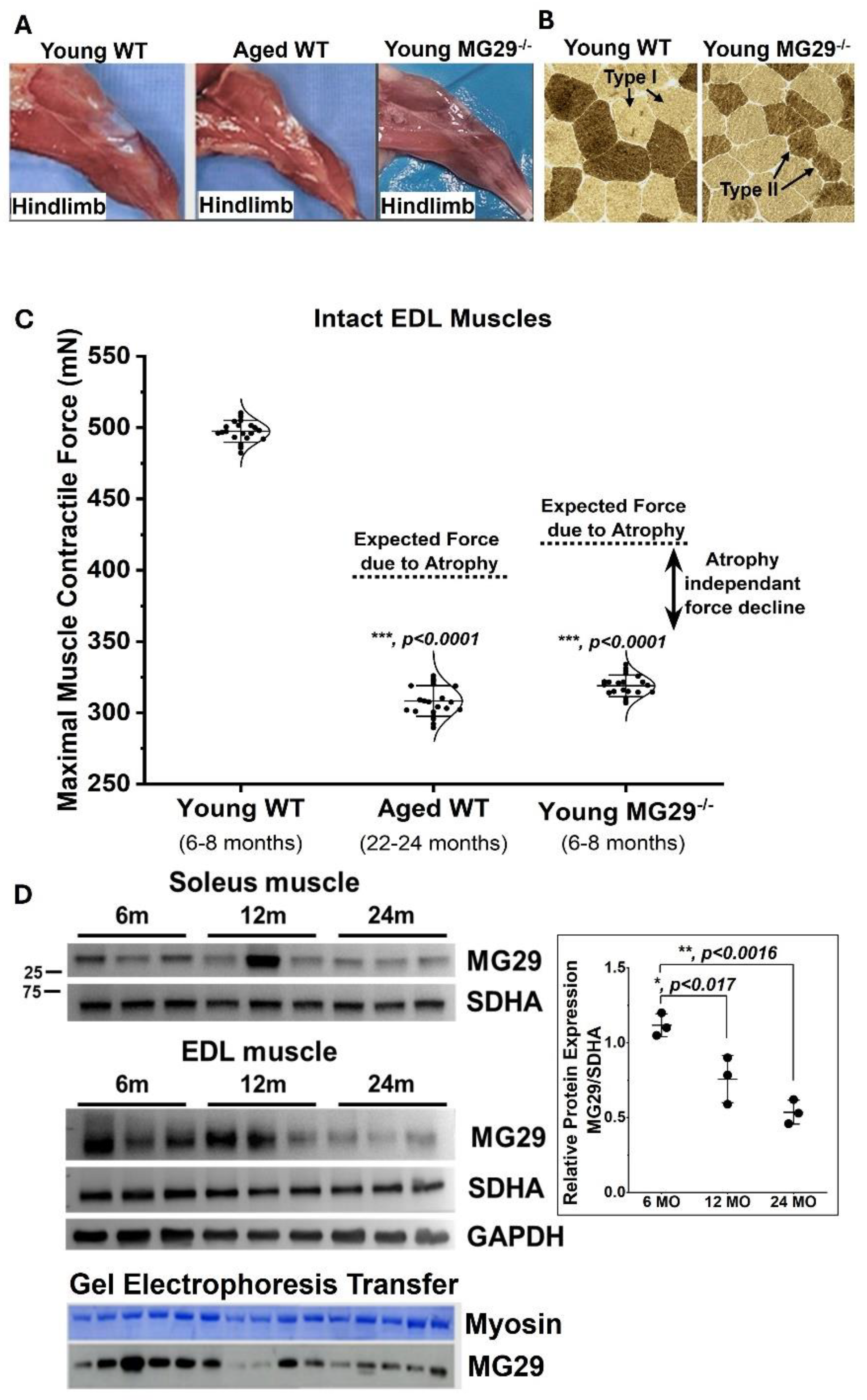
Figure 2.
Domain structure of the MG29 protein. (A) MG29 protein has N- and C-terminal cystolic domains on either side of the 4 transmembrane pass (blue) MARVEL domain. Target conserved phenylalanine (F) or cystidine (C) residues are shown with numbers to indicate position. The C-terminal SCT domain is shown in green. (B) Amino acid sequence of the SCT domain highlighting amino acids that are polar (red) or have negative charge (blue). Predicted secondary structure appears beneath the amino acids with coil (C) and an α helical region (H, gray shading).
Figure 2.
Domain structure of the MG29 protein. (A) MG29 protein has N- and C-terminal cystolic domains on either side of the 4 transmembrane pass (blue) MARVEL domain. Target conserved phenylalanine (F) or cystidine (C) residues are shown with numbers to indicate position. The C-terminal SCT domain is shown in green. (B) Amino acid sequence of the SCT domain highlighting amino acids that are polar (red) or have negative charge (blue). Predicted secondary structure appears beneath the amino acids with coil (C) and an α helical region (H, gray shading).
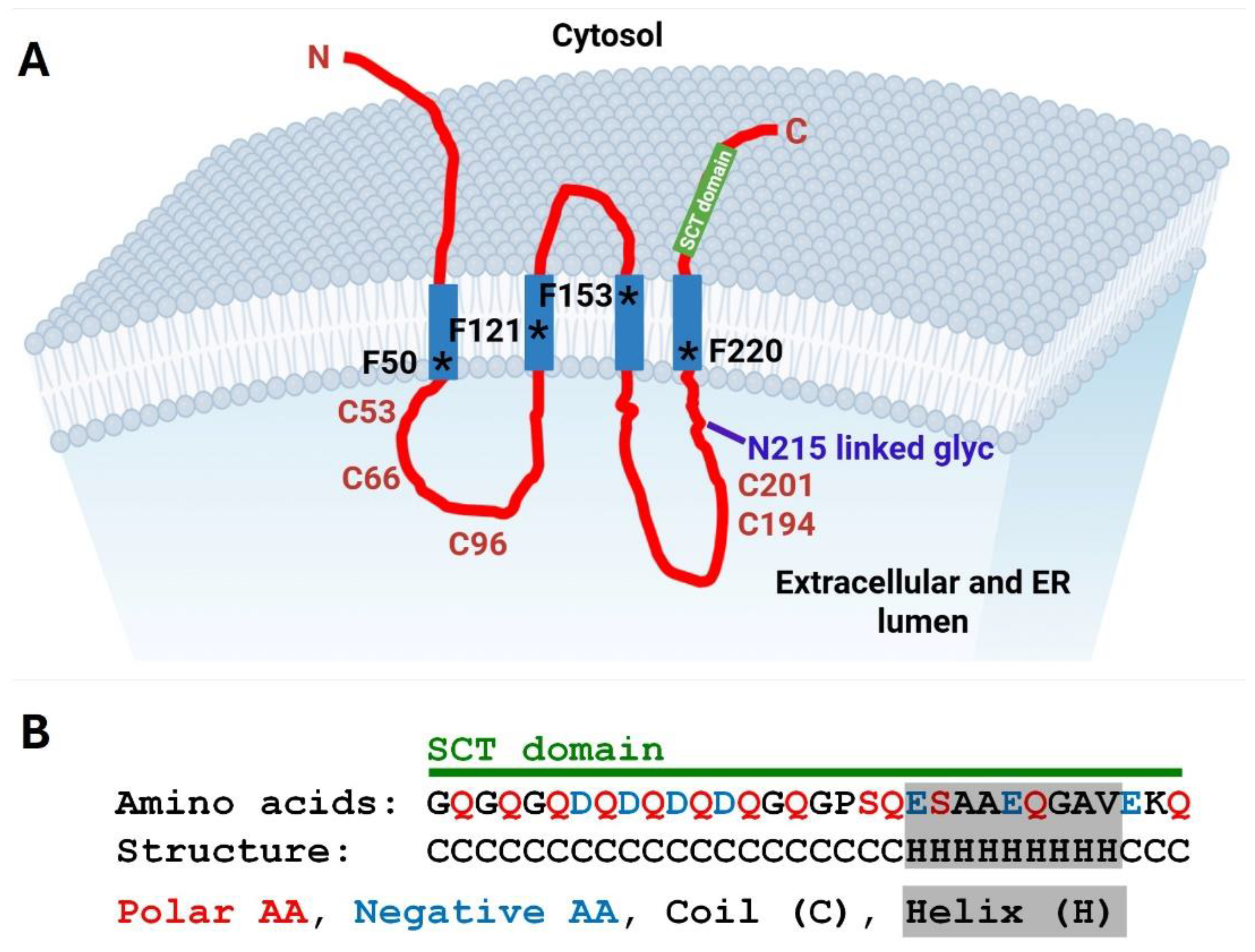
Figure 3.
Lipidomics analysis of the muscles. Lipidomics analysis indicated a decreased free cholesterol and many fatty acids in the mg29-/- EDL muscle. Total lipid extracts from young WT and mg29-/- were measured for levels of fatty acids using mass spectroscopy. A) Several species of saturated fatty acids and some unsaturated species were greatly reduced in the mg29-/- muscle. B) Total cholesterol was also drastically decreased in the mg29-/- muscle compared to the WT control.
Figure 3.
Lipidomics analysis of the muscles. Lipidomics analysis indicated a decreased free cholesterol and many fatty acids in the mg29-/- EDL muscle. Total lipid extracts from young WT and mg29-/- were measured for levels of fatty acids using mass spectroscopy. A) Several species of saturated fatty acids and some unsaturated species were greatly reduced in the mg29-/- muscle. B) Total cholesterol was also drastically decreased in the mg29-/- muscle compared to the WT control.
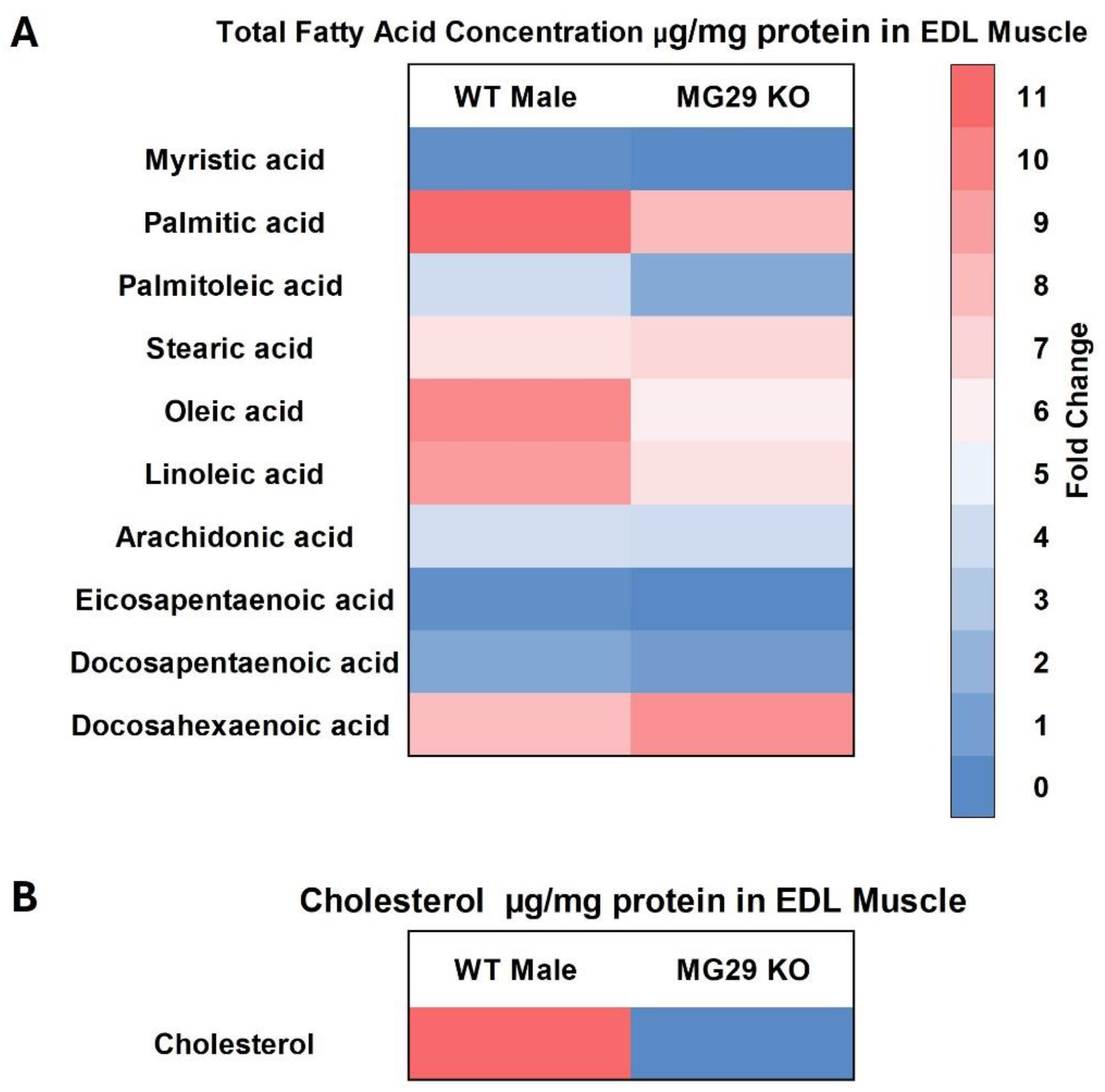
Figure 4.
Percentage concentrations of lipid mediators in gastrocnemius muscles from male C57BL6 and Mg29 knock-out mice at different ages. (A) 13,14-dihydro-15-keto-PGE2, (B) 5-HETE, (C) 5-KETE, (D) EPA, (E) 20-HDoHE, (F) 9-HOTrE. Mean ±SD, n=4. The levels of specific lipid signaling mediators increase with aging in WT mice (young vs. mid-aged). A remarkably similar pattern was observed between the young mg29-/- mice and the middle-aged WT mice.
Figure 4.
Percentage concentrations of lipid mediators in gastrocnemius muscles from male C57BL6 and Mg29 knock-out mice at different ages. (A) 13,14-dihydro-15-keto-PGE2, (B) 5-HETE, (C) 5-KETE, (D) EPA, (E) 20-HDoHE, (F) 9-HOTrE. Mean ±SD, n=4. The levels of specific lipid signaling mediators increase with aging in WT mice (young vs. mid-aged). A remarkably similar pattern was observed between the young mg29-/- mice and the middle-aged WT mice.
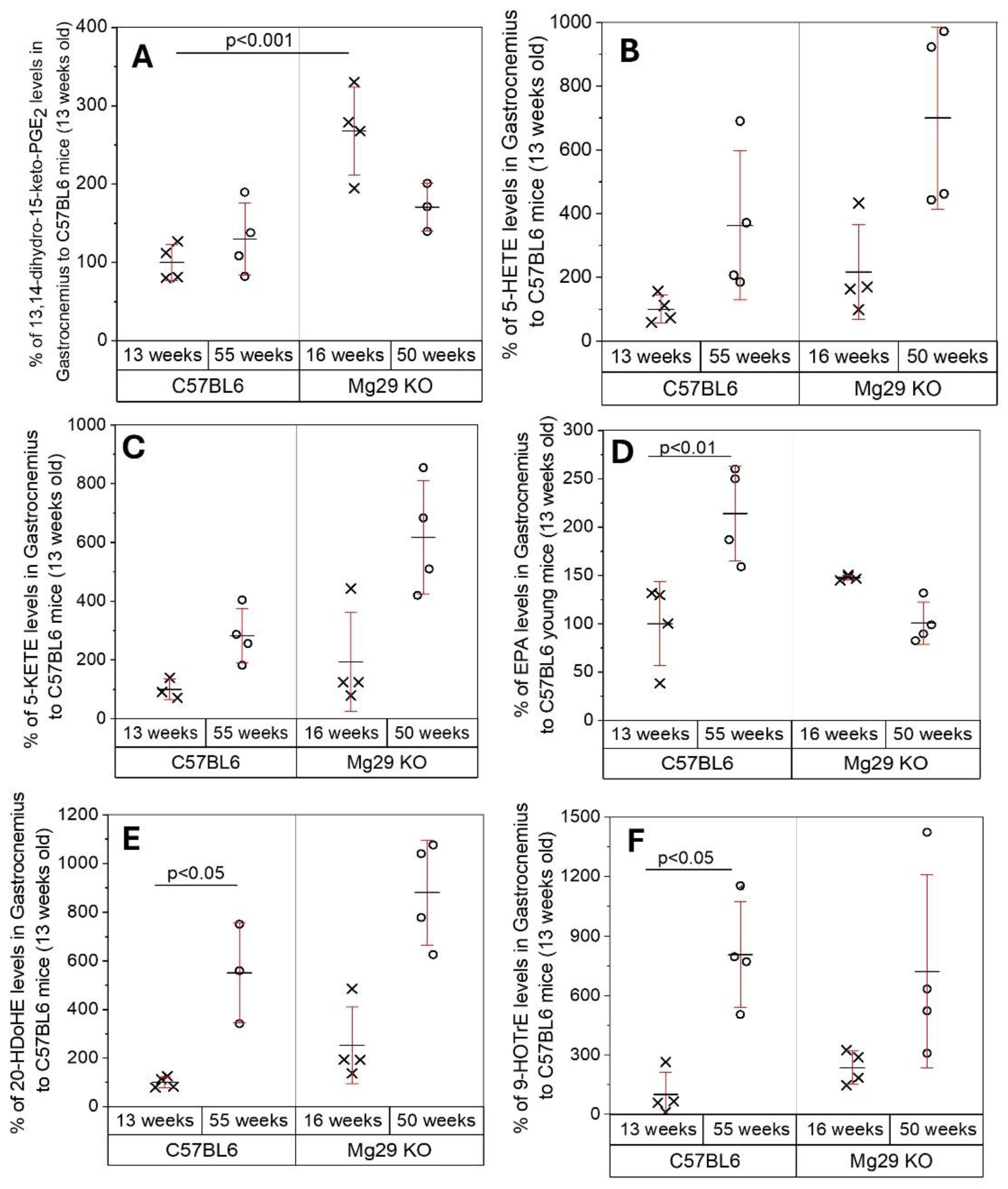
Figure 5.
Effect of cholesterol on SOCE in myotubes. (A) Myosin IHC staining of C2C12 myotubes after 6 days of differentiation. (B) Myosin IHC staining of mouse primary myotubes after 3 days of differentiation. (C) SOCE measurements on C2C12 myotubes treated with 5mM MβCD. (D) Typical representative SOCE measurement by fura-2 imaging on primary mouse myotubes (5-month-old WT mice) treated with 2mM Methyl-β-Cyclodextrin (MβCD). (E) Bright-field microscopy of untreated primary myotubes. (F) Bright field image of primary myotubes following 2mM MβCD (n=14-17).
Figure 5.
Effect of cholesterol on SOCE in myotubes. (A) Myosin IHC staining of C2C12 myotubes after 6 days of differentiation. (B) Myosin IHC staining of mouse primary myotubes after 3 days of differentiation. (C) SOCE measurements on C2C12 myotubes treated with 5mM MβCD. (D) Typical representative SOCE measurement by fura-2 imaging on primary mouse myotubes (5-month-old WT mice) treated with 2mM Methyl-β-Cyclodextrin (MβCD). (E) Bright-field microscopy of untreated primary myotubes. (F) Bright field image of primary myotubes following 2mM MβCD (n=14-17).
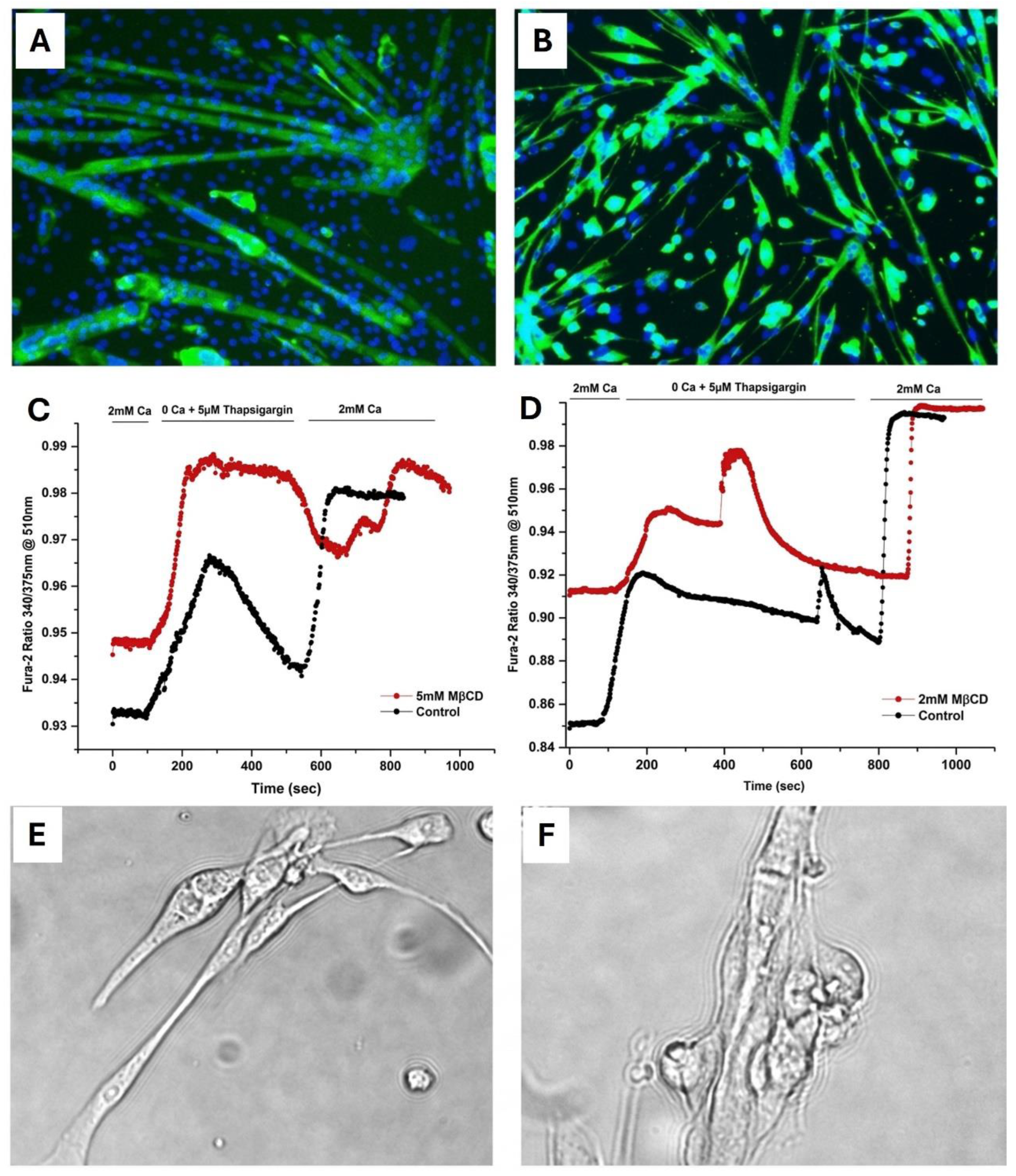
Figure 6.
Acute Knockdown of MG29 Alters Skeletal Muscle Cells Differentiation and Leads to Cellular Atrophy. (A) Representative Fluorescence images of DAPI and myosin heavy chain antibody-stained myocytes/myotubes of primary skeletal muscle cells at differentiation day 3 after MG29 siRNA treatment. (B) Summary data for fusion index (FI) for treatments of negative control and MG29 siRNA. (C) Reduced diameter and Increased length (D) in MG29 siRNA-treated myotubes. (E&F) Increased MyoD and MyoG expression in MG29 siRNA-treated myotubes. (G) Expression of genes involved in Ca2+ Homeostasis (Cacna1s, RyR3, Btk, Fkbp1b), Oxidative stress (Sod3), and immunoregulatory and inflammatory processes (Ccl2) was altered.
Figure 6.
Acute Knockdown of MG29 Alters Skeletal Muscle Cells Differentiation and Leads to Cellular Atrophy. (A) Representative Fluorescence images of DAPI and myosin heavy chain antibody-stained myocytes/myotubes of primary skeletal muscle cells at differentiation day 3 after MG29 siRNA treatment. (B) Summary data for fusion index (FI) for treatments of negative control and MG29 siRNA. (C) Reduced diameter and Increased length (D) in MG29 siRNA-treated myotubes. (E&F) Increased MyoD and MyoG expression in MG29 siRNA-treated myotubes. (G) Expression of genes involved in Ca2+ Homeostasis (Cacna1s, RyR3, Btk, Fkbp1b), Oxidative stress (Sod3), and immunoregulatory and inflammatory processes (Ccl2) was altered.
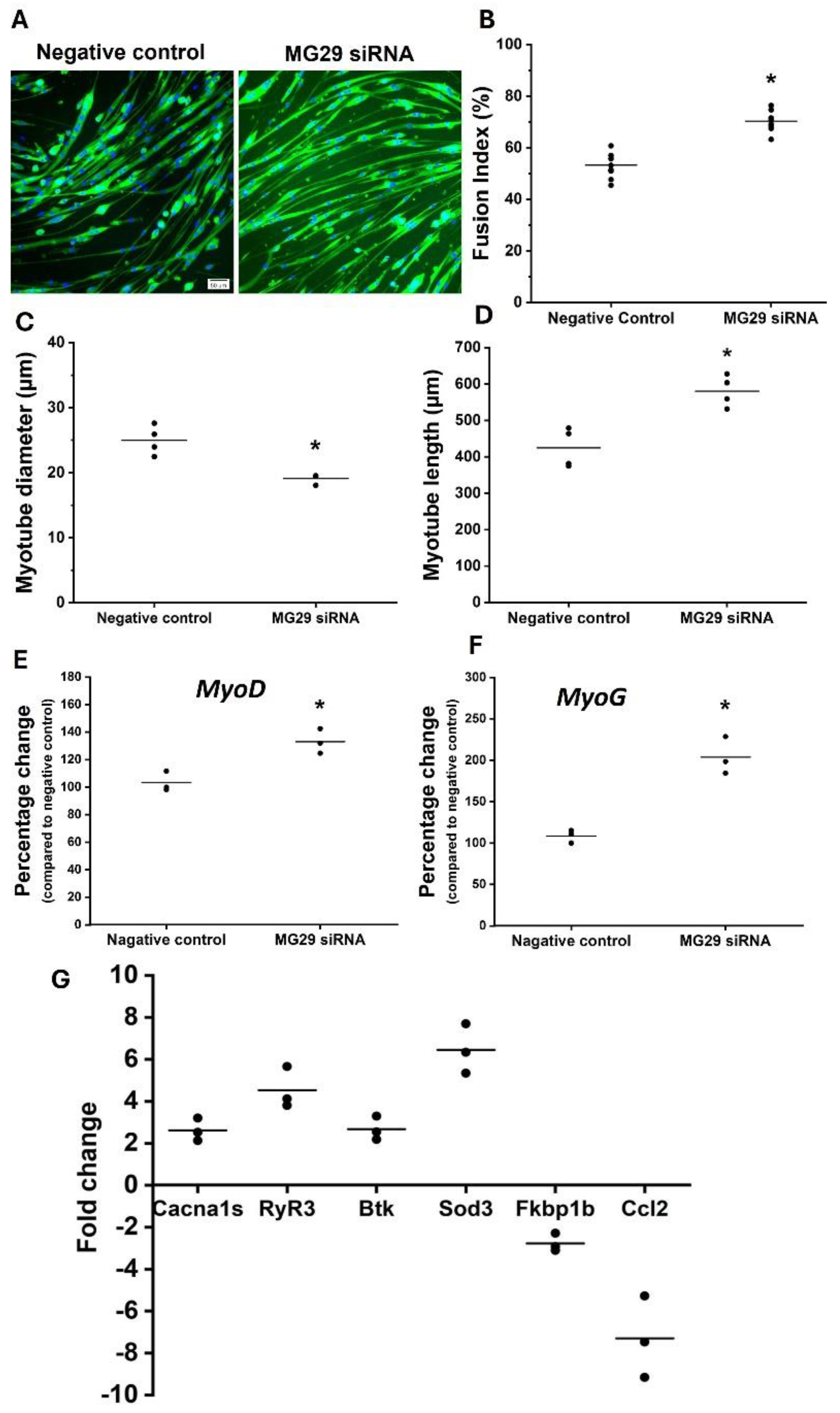
Figure 7.
Quantification of lipid signaling mediators in media of negative control and MG29 siRNA-treated primary skeletal muscle myotubes at 72h of differentiation. (A & B) Compared with the negative control, MG29 siRNA-treated cells showed an increased ratio of released lipid mediators in the cell culture media (AEA and OEA). (C-F) Ratio of consumed lipid mediators by cells in the cell culture media was also increased for PGD2, 9,10-DiHOME, 9-HOTrE, and 9-HODE. A sample size of n=3 was used for each group. A t-test was applied to compare with the negative control; p < 0.05.
Figure 7.
Quantification of lipid signaling mediators in media of negative control and MG29 siRNA-treated primary skeletal muscle myotubes at 72h of differentiation. (A & B) Compared with the negative control, MG29 siRNA-treated cells showed an increased ratio of released lipid mediators in the cell culture media (AEA and OEA). (C-F) Ratio of consumed lipid mediators by cells in the cell culture media was also increased for PGD2, 9,10-DiHOME, 9-HOTrE, and 9-HODE. A sample size of n=3 was used for each group. A t-test was applied to compare with the negative control; p < 0.05.
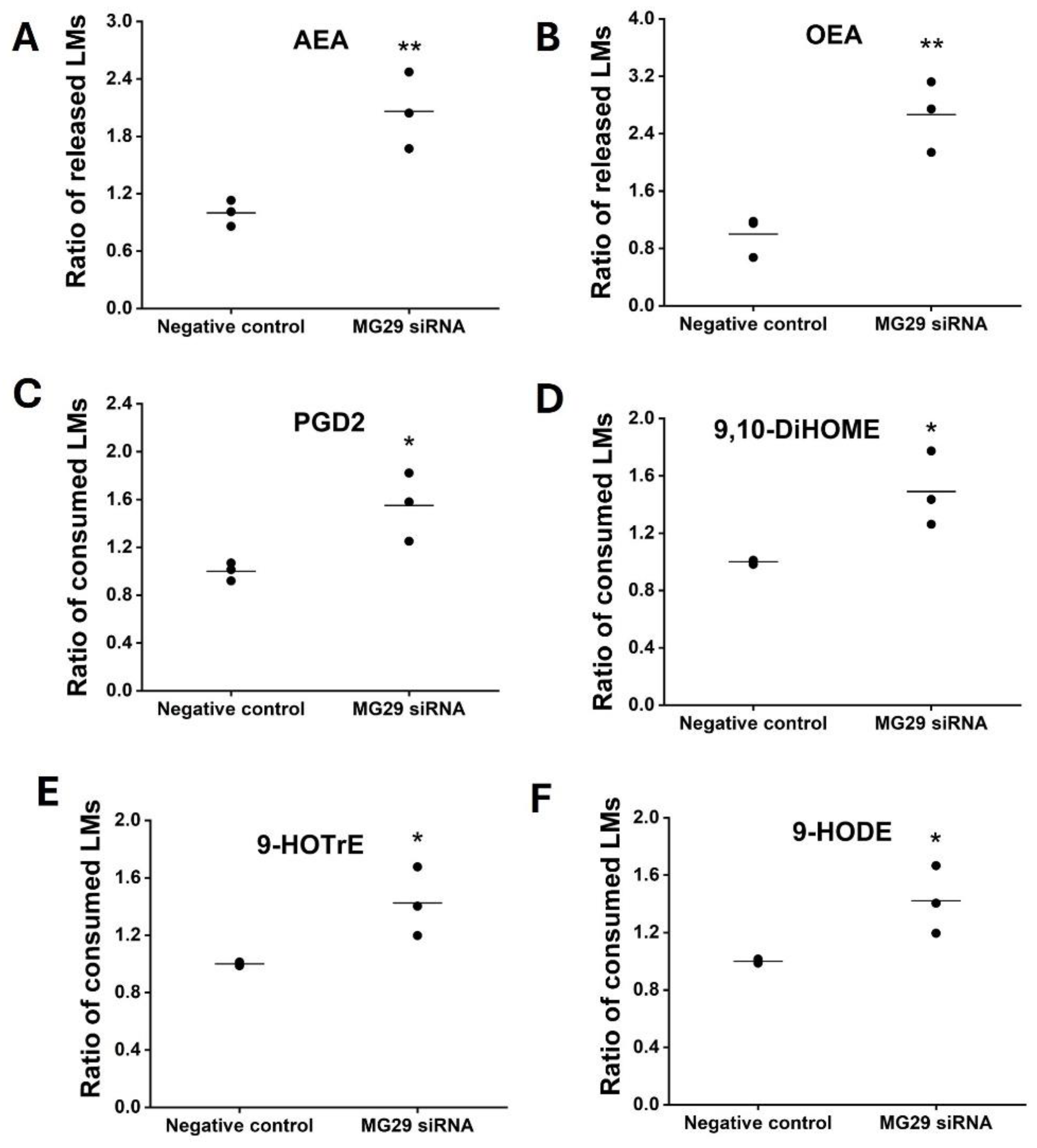
Figure 8.
Effect of MG29 mutants on SOCE activity. (A) Phase contrast images of differentiated mouse primary muscle cells and GFP images showing transfection efficiency of the MG29 WT and mutant constructs. (B) Fura-2 loading and transfection efficiency of the MG29 WT and mutant constructs in C2C12 myotubes show that we can precisely match transfection with Ca imaging. (C) Representative Ca tracing illustrates the significant changes in SOCE response for both mutants tested vs WT and control in C2C12 cells. (D) SOCE delta [Ca2+]ᵢ nM in C2C12 myotubes. (E) Representative Ca tracing of SOCE response in primary myotubes from 5-month-old mice. (F) SOCE delta [Ca2+]ᵢ nM in primary myotubes. Data is from 8-12 cells for all groups. In both C2C12 and primary myotubes, the mutants reduced both the peak and the integral response.
Figure 8.
Effect of MG29 mutants on SOCE activity. (A) Phase contrast images of differentiated mouse primary muscle cells and GFP images showing transfection efficiency of the MG29 WT and mutant constructs. (B) Fura-2 loading and transfection efficiency of the MG29 WT and mutant constructs in C2C12 myotubes show that we can precisely match transfection with Ca imaging. (C) Representative Ca tracing illustrates the significant changes in SOCE response for both mutants tested vs WT and control in C2C12 cells. (D) SOCE delta [Ca2+]ᵢ nM in C2C12 myotubes. (E) Representative Ca tracing of SOCE response in primary myotubes from 5-month-old mice. (F) SOCE delta [Ca2+]ᵢ nM in primary myotubes. Data is from 8-12 cells for all groups. In both C2C12 and primary myotubes, the mutants reduced both the peak and the integral response.
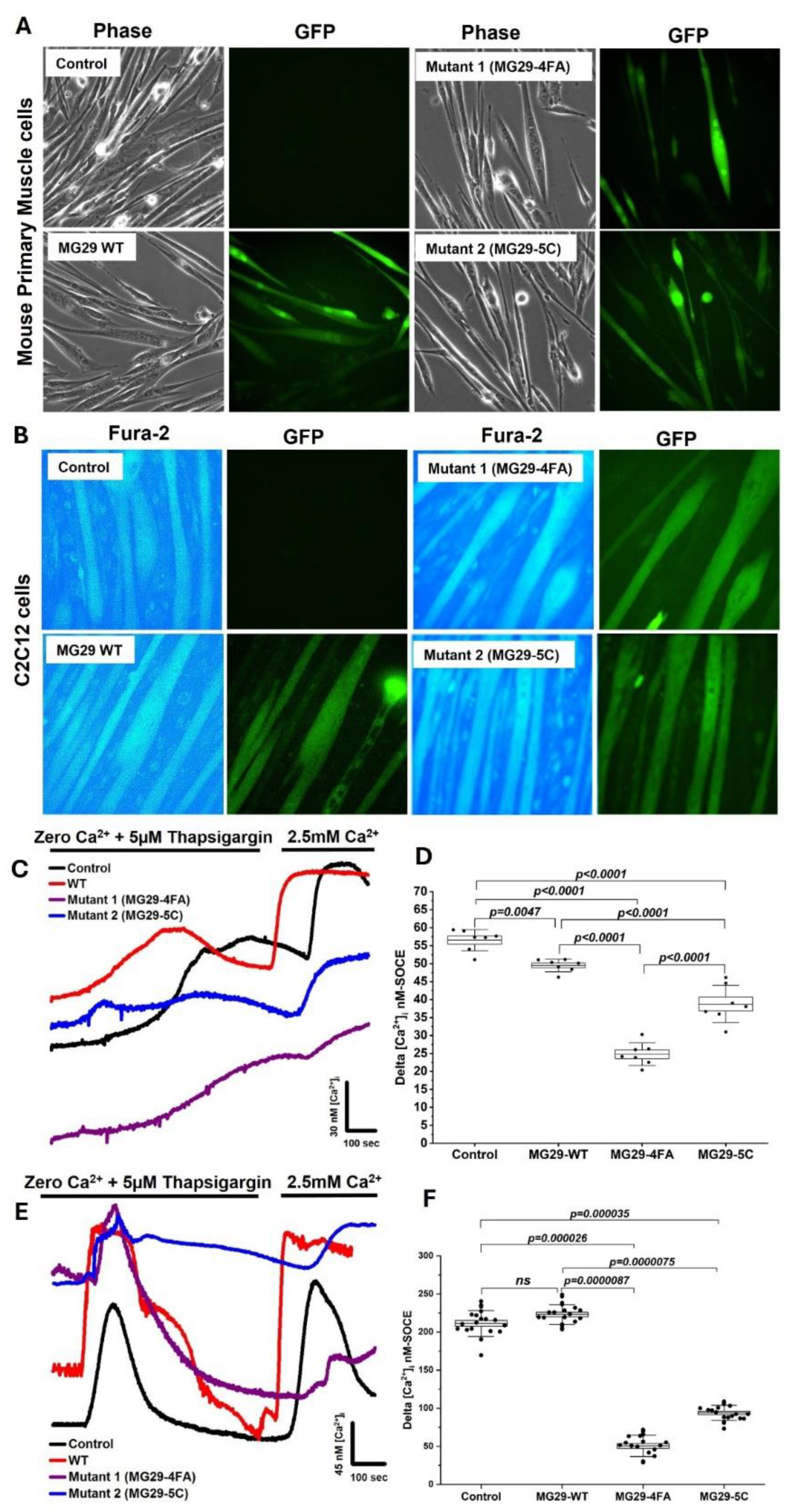
Figure 9.
The modulation of functional domains on MG29 can influence lipid content in C2C12 skeletal muscle cells, supporting the potential mechanism that MG29’s interaction with lipid metabolism in skeletal muscle could underlie its effects on TT structure and EC coupling in young and aged skeletal muscle. C2C12 cells were transfected with MG29 mutant constructs, and then total (A) and free (B) fatty acids were quantified by mass spectrometry.
Figure 9.
The modulation of functional domains on MG29 can influence lipid content in C2C12 skeletal muscle cells, supporting the potential mechanism that MG29’s interaction with lipid metabolism in skeletal muscle could underlie its effects on TT structure and EC coupling in young and aged skeletal muscle. C2C12 cells were transfected with MG29 mutant constructs, and then total (A) and free (B) fatty acids were quantified by mass spectrometry.
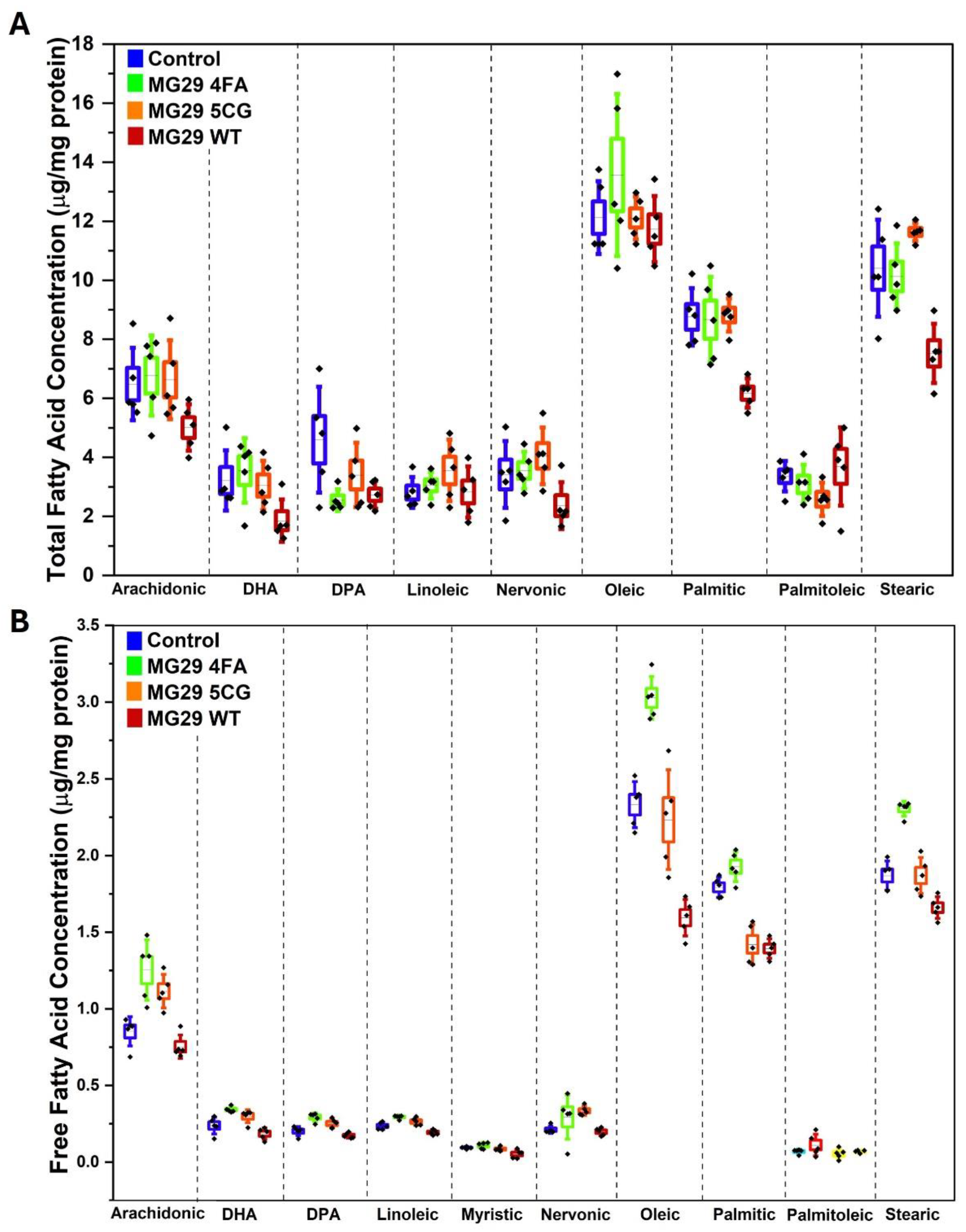

Table 1.
RT-qPCR primers used in this study.
| Primer | Primer sequence (5′ to 3′) |
|---|---|
| GAPDH F | TGCGATGGGTGTGAACCACGAGAA |
| GAPDH R | GAGCCCTTCCACAATGCCAAAGTT |
| MyoD F | CCCCGGCGGCAGAATGGCTACG |
| MyoD R | GGTCTGGGTTCCCTGTTCTGTGT |
| MyoG F | TGAGCATTGTCCAGGCCAG |
| MyoG R | GCTTCTCCCTCAGTGTGGCT |
Table 2.
Relative concentration of LMs in C57BL6 and Mg29 KO mice at different ages (% to C57BL6-13 weeks).
Table 2.
Relative concentration of LMs in C57BL6 and Mg29 KO mice at different ages (% to C57BL6-13 weeks).
| Metabolic pathways | LMs | C57BL6 | Mg29 KO | ||||||
|---|---|---|---|---|---|---|---|---|---|
| 13 weeks | 55 weeks | 16 weeks | 50 weeks | ||||||
| mean | SD | mean | SD | mean | SD | mean | SD | ||
| Arachidonic acid (AA), n-6 PUFA |
20-hydroxy-PGF2a | 100.0 | 38.7 | 310.9*** | 23.0 | 71.1bbb | 16.2 | 754.8***, aaa, bbb, ccc | 45.3 |
| 6-keto-PGF1a | 100.0 | 9.0 | 33.7** | 17.8 | 101.1bb | 37.5 | 46.1*, a, c | 17.7 | |
| 8-iso-PGE2 | 100.0 | 42.9 | 180.0 | 94.7 | 115.1 | 34.1 | 341.2***, aaa, bb | 39.5 | |
| 13,14-dihydro-15-keto-PGE2 | 100.0 | 23.2 | 129.5 | 46.1 | 267.9aaa, bb | 55.9 | 170.5* | 30.6 | |
| 8-HETE | 100.0 | 52.6 | 162.6 | 53.1 | 119.5 | 60.0 | 289.2*, aa | 85.3 | |
| 5-HETE | 100.0 | 43.8 | 363.5 | 233.4 | 216.4 | 148.1 | 700.1*, aa | 286.5 | |
| 5-KETE | 100.0 | 34.7 | 282.2 | 92.6 | 192.6 | 168.2 | 617.1**, aa, b | 192.6 | |
| AA | 100.0 | 34.7 | 35.5 | 24.6 | 143.5 | 32.1 | 45.8** | 30.9 | |
| Linoleic acid (LA), n-6 PUFA |
13-KODE | 100.0 | 14.7 | 183.7 | 47.1 | 116.6 | 39.3 | 482.1*, aa, b | 256.5 |
| Eicosapentaenoic acid (EPA), n-3 PUFA | 17,18-DiHETE | 100.0 | 81.8 | 490.8** | 176.4 | 66.4bb | 22.2 | 335.7 | 174.1 |
| EPA | 100.0 | 43.5 | 214.0** | 48.9 | 147.7 | 2.5 | 100.7bb | 21.8 | |
| Docosahexaenoic acid (DHA), n-3 PUFA | 20-HDoHE | 100.0 | 22.8 | 413.2* | 322.2 | 252.3 | 157.4 | 880.2**, aaa | 215.1 |
| 16-HDoHE | 100.0 | 38.6 | 871.3*** | 165.8 | 252.4bb | 152.5 | 1325.2***, aaa, b | 270.2 | |
| 13-HDoHE | 100.0 | 39.7 | 674.5*** | 263.8 | 222.8bb | 127.3 | 733.0**, aaa | 49.5 | |
| 10-HDoHE | 100.0 | 60.6 | 393.5* | 154.2 | 142.0b | 82.8 | 437.9*, aa | 121.4 | |
| 4-HDoHE | 100.0 | 30.5 | 945.0* | 614.4 | 225.3 | 180.4 | 1192.4*, aa | 338.8 | |
| DHA | 100.0 | 29.1 | 53.5 | 14.1 | 188.7aa, bbb | 41.4 | 64.9*** | 1.8 | |
| α-linolenic acid (ALA), n-3 PUFA |
9-HOTrE | 100.0 | 112.6 | 806.8* | 266.9 | 236.4 | 84.0 | 722.7a | 487.1 |
| Lysophosphatidylcholine (lysoPC) | Lyso-PAF | 100.0 | 10.1 | 31.3*** | 6.0 | 98.2bbb | 13.7 | 37.7***, aaa | 6.7 |
Notes: One-way ANOVA with post-hoc Tukey test (α =0.05). n=4. *p ≤ 0.05, **p ≤ 0.01, and ***p ≤ 0.001 as compared with the Young in each group. ap ≤ 0.05, aap ≤ 0.01, and aaap ≤ 0.001 as compared with C57BL6-13 weeks. bp ≤ 0.05, bbp ≤ 0.01, and bbbp ≤ 0.001 as compared with C57BL6-55 weeks. cp ≤ 0.05, ccp ≤ 0.01, and cccp ≤ 0.001 as compared with Mg29 KO-16 weeks.
Disclaimer/Publisher’s Note: The statements, opinions and data contained in all publications are solely those of the individual author(s) and contributor(s) and not of MDPI and/or the editor(s). MDPI and/or the editor(s) disclaim responsibility for any injury to people or property resulting from any ideas, methods, instructions or products referred to in the content. |
© 2026 by the authors. Licensee MDPI, Basel, Switzerland. This article is an open access article distributed under the terms and conditions of the Creative Commons Attribution (CC BY) license (http://creativecommons.org/licenses/by/4.0/).
Copyright: This open access article is published under a Creative Commons CC BY 4.0 license, which permit the free download, distribution, and reuse, provided that the author and preprint are cited in any reuse.


