

Submitted:
20 May 2026
Posted:
21 May 2026
You are already at the latest version
Abstract
Schoenoplectus californicus is a dominant freshwater wetland macrophyte with ecolog-ical, technological, and biocultural importance. This review synthesizes its ecological functioning and environmental applications through a systematized analysis of 44 studies screened by title, abstract, and full text. The literature was classified into seven thematic categories: water treatment and phytoremediation; wetland ecology, biomass, and ecosystem functioning; functional ecology, growth, and landscape connectivity; morphology, anatomy, and functional adaptation; biocultural dimensions, sustainable construction, and technological applications; nutritional and ethnobotanical uses; and cultural heritage and traditional management. Research was concentrated mainly in water treatment and phytoremediation (12 studies, 27.3%) and wetland ecology, biomass, and ecosystem functioning (10 studies, 22.7%). Functional ecology, growth, and landscape connectivity represented 4 studies (9.1%), while morphology, anatomy, and functional adaptation represented 3 studies (6.8%). The remaining three categories each included 5 studies (11.4%). Across these themes, S. californicus was associated with contaminant removal, metal tolerance, bioindication, phytostabilization, biomass production, habitat structure, biodiversity support, carbon-related functions, ecological plasticity, sustainable construction, technological applications, nutritional uses, ethnobotanical relevance, and biocultural value. Overall, S. californicus emerges as a multifunctional wetland species requiring interdisciplinary research.
Keywords:
freshwater wetlands
; phytoremediation
; ecosystem functioning
; aquatic macrophytes
; sustainable construction
; biocultural heritage
; nutrient dynamics
1. Introduction
1.1. State of the art on Schoenoplectus californicus
Schoenoplectus californicus, commonly known as totora, is a perennial emergent macrophyte widely distributed in freshwater wetlands of the Americas and recognized as a characteristic species of these ecosystems [1]. Its ecological importance is mainly associated with the formation of dense stands that contribute to habitat complexity, primary productivity, vegetation structure, and multiple biotic interactions [2]. Beyond its ecological role, totora also has strong cultural and socioeconomic relevance, since it has been historically used in subsistence activities, artisanal practices, and community-based management systems [3,4,5].
Scientific interest in this species has expanded across wetland ecology, botany, environmental engineering, ethnobotany, and sustainable resource use. Recent studies have highlighted its contribution to biomass production, sediment retention, nutrient cycling, habitat provision, and ecological functioning in shallow freshwater systems [6]. At the same time, its use in environmental remediation and applied ecological technologies has reinforced its value as a multifunctional wetland species [7]. Therefore, S. californicus represents a key biological resource whose ecological, technological, and cultural dimensions are closely interconnected.
1.2. Totora in Water Treatment, Purification, and Phytoremediation
Aquatic macrophytes are widely used in natural and constructed wetlands because they improve water quality through sediment retention, nutrient uptake, microbial support, pollutant transformation, and contaminant stabilization. Within this framework, S. californicus has gained attention due to its ecological tolerance, high biomass production, extensive root and rhizome systems, and ability to persist in disturbed freshwater environments [8,9,10].
Several studies have documented the performance of totora in wastewater treatment, constructed wetlands, and phytoremediation systems. Evidence indicates its relevance in wastewater treatment, constructed wetland and filtration contexts, tolerance to heavy-metal contamination, and contaminant removal under impacted environmental conditions [11,12,13]. These findings indicate that totora contributes not only to pollutant retention, but also to the ecological stability and operational simplicity of low-cost treatment systems.
Recent evidence has further expanded its applied value. S. californicus has been reported as a bioindicator of potentially toxic elements, including As, Cd, Cr, Ni, Pb, and Hg, with phytostabilization potential in a Ramsar urban wetland [14]. This finding is particularly relevant because it positions totora not only as a species useful for remediation, but also as a biological tool for environmental monitoring. Overall, the literature supports the role of S. californicus as a functional macrophyte for water purification, phytoremediation, and ecological management of contaminated wetlands.
1.3. Wetland Ecology, Biodiversity, and Ecosystem Services of Totora Stands
Beyond its technological applications, S. californicus is a key structural component of freshwater wetlands. Totora stands influence vegetation organization, biomass dynamics, habitat complexity, biodiversity support, and ecosystem functioning. Previous studies have related the species to vegetation distribution, plant community composition, biomass production, ecological organization, and shallow freshwater wetland functioning [15,16].
The ecological value of totora is also expressed through its role as habitat and refuge for associated organisms. Stands dominated by S. californicus support plant assemblages, arthropod communities, periphytic productivity, and trophic interactions, thereby contributing to biological connectivity and wetland integrity [8,17]. In addition, totora wetlands provide ecosystem services related to carbon storage, aquatic productivity, and biological support functions [19,20].
Importantly, changes in the cover or decline of S. californicus may reflect wetland disturbance, especially under eutrophication or invasive species expansion [21]. Thus, its ecological relevance extends beyond biomass dominance: it functions as a structural species, biodiversity-supporting habitat, ecosystem service provider, and potential indicator of wetland degradation. This integrative role makes S. californicus central to understanding the stability and functioning of freshwater wetlands.
These contrasting ecological conditions directly influence the provision of ecosystem services, particularly carbon sequestration and biological support functions [19,20]. In addition, they affect trophic interactions and periphytic productivity, which are essential for aquatic ecosystem functioning [17,18].
These ecological relationships are summarized conceptually in Figure 1. Overall, the evidence indicates that wetland stability and ecological functioning depend on the maintenance of biomass, vegetation structure, and environmental integrity.
1.4. Ecological Growth, Biomass Allocation, and Wetland Functioning
Recent research has shown that S. californicus exhibits important variation in growth and biomass allocation under contrasting wetland conditions. In this regard, previous research [22] reported that plant performance may vary according to environmental conditions, while previous research [23] linked this variability to differences in trophic status and nutrient availability. More recently, previous research [24] emphasized the influence of physicochemical characteristics of aquatic environments, thus indicating that the species responds to environmental heterogeneity through adjustments in vegetative performance and resource use.
In wetland plants, growth dynamics and biomass allocation are key components of ecological functioning because they influence nutrient uptake, structural development, and persistence under fluctuating environmental conditions. Within this framework, S. californicus has been regarded as a species with notable ecological plasticity, particularly in freshwater systems where plant development and stand performance may vary according to nutrient supply and water characteristics [22]. This view was reinforced by previous research [24], who highlighted the capacity of the species to respond functionally to environmental variation across wetland settings.
The study of biomass allocation in S. californicus is also relevant for understanding the relationship between plant performance and wetland functioning, since variations in belowground and aboveground investment may influence nutrient capture, productivity, and the contribution of macrophyte stands to ecosystem processes. In this sense, previous research [23] examined growth and allometric patterns associated with plant performance, whereas previous research [24] emphasized the functional importance of these responses across different wetland types and environmental gradients. Therefore, analyses of growth, allocation, and physiological response provide a useful basis for understanding how this species persists under contrasting ecological conditions.
From a conceptual perspective, the ecological importance of S. californicus lies not only in its presence as a dominant emergent macrophyte, but also in the way its growth responses are linked to broader wetland dynamics. Thus, the literature suggests that growth patterns, biomass allocation, and nutrient-related responses should be interpreted as part of the functional processes connecting plant development with ecosystem productivity, stability, and environmental adaptation in freshwater wetlands. In particular, previous research [22] related plant responses to environmental variability, while previous research [24] reinforced the idea that these traits are integral to the ecological functioning of wetland systems.
These ecological, technological, and cultural connections are summarized in Figure 2, which supports the development of interdisciplinary approaches aimed at improving the sustainable management and conservation of S. californicus within wetland ecosystems.
2. Materials and Methods
2.1. Review Design
This study was conducted as a systematized literature review aimed at identifying, selecting, organizing, and synthesizing scientific evidence on S. californicus. The review focused on ecological, anatomical, technological, ethnobotanical, nutritional, and cultural dimensions in order to provide an integrative understanding of the species. The methodological process followed sequential stages: database search, duplicate removal, title and abstract screening, full-text eligibility assessment, data extraction, thematic classification, qualitative synthesis, and bibliographic verification. This design allowed evidence from different disciplinary fields to be integrated through a transparent and reproducible review pathway, without claiming to be a full systematic review.
2.2. Data Sources and Search Strategy
The literature search was conducted between February 25 and May 07, 2026. Scientific articles were retrieved from Scopus, Web of Science Core Collection, ScienceDirect, SpringerLink, Wiley Online Library, Taylor & Francis Online, SciELO, and Redalyc. Google Scholar and DOAJ were used as complementary sources to identify additional studies not captured in the main databases. Crossref was consulted to verify DOI information and bibliographic consistency.
The search strategy combined English and Spanish terms related to the species and its main ecological, technological, and biocultural dimensions. The main terms were: “Schoenoplectus californicus”, “totora”, “wetlands”, “phytoremediation”, “constructed wetlands”, “water treatment”, “morphology”, “anatomy”, “biomaterial”, “ethnobotany”, “traditional knowledge”, “nutrition”, “cultural heritage”, and “ecosystem services”. These terms were searched in titles, abstracts, and keywords when the database allowed field-restricted searches.
The following representative Boolean combinations were used and adapted according to the search interface of each database:
- “Schoenoplectus californicus” AND wetlands
- “Schoenoplectus californicus” AND phytoremediation
- “Schoenoplectus californicus” AND “constructed wetlands”
- “totora” AND “wetland ecology”
- “totora” AND biomaterial
- “Schoenoplectus californicus” AND ethnobotany
- “totora” AND “traditional knowledge”
- “Schoenoplectus californicus” AND “ecosystem services”
The search was restricted to studies published in English or Spanish. Priority was given to peer-reviewed journal articles published in indexed or scientifically recognized sources. Reference lists of selected studies were also manually reviewed to identify additional relevant records.
2.3. Eligibility Criteria
Studies were included when they met the following criteria: (i) they addressed S. californicus directly; (ii) they analyzed ecological, anatomical, technological, ethnobotanical, nutritional, or cultural aspects in which the species played a central or clearly relevant role; and (iii) they presented empirical findings, analytical assessments, or documented evidence related to the objectives of the review.
The central corpus consisted of peer-reviewed scientific articles. Complementary non-peer-reviewed sources were considered only when they provided relevant technical or contextual information, were clearly identifiable, and supported the interpretation of the reviewed evidence. These complementary sources were not treated with the same evidentiary weight as peer-reviewed articles.
Studies were excluded when they were duplicates, outside the thematic scope of the review, focused mainly on other species without direct relevance to S. californicus, lacked sufficient scientific or technical support, or presented incomplete bibliographic information that prevented verification. Grey literature was excluded from the central corpus unless it offered a clearly justified and verifiable contribution.
2.4. Study Selection Procedure
The selection process followed a PRISMA-based traceability framework. All retrieved records were first compiled into a master database. Duplicates were then removed, and the remaining records were screened by title, abstract, and keywords. Potentially relevant articles were evaluated in full text according to the inclusion and exclusion criteria. A final corpus of 44 studies was retained for thematic classification and qualitative synthesis.
Two reviewers independently participated in the search, screening, and eligibility assessment. Discrepancies were resolved by discussion and consensus. When necessary, a third reviewer was consulted to confirm the final decision. This procedure strengthened the transparency and consistency of the selection process.
Because this was a systematized review rather than a full systematic review, PRISMA was used only as a traceability guide and not as a strict reporting framework. Nevertheless, the identification, screening, eligibility, and inclusion stages were documented to improve transparency and reproducibility.
2.5. Data Extraction
For each selected study, information was extracted using a structured review matrix. The recorded variables included author(s), year of publication, country or study location, database source, journal title, thematic area, research approach, objective, methodological characteristics, main findings, scientific contribution, and DOI availability.
The extraction matrix allowed consistent comparison among studies from different disciplinary fields. It also helped identify thematic patterns, methodological differences, recurring findings, research gaps, and areas of limited evidence. DOI information was verified when available, and bibliographic data were checked against publisher websites, Crossref, indexing platforms, and journal records.
2.6. Thematic Classification
The 44 reviewed studies were classified into seven non-overlapping thematic categories: water treatment and phytoremediation; wetland ecology, biomass, and ecosystem functioning; functional ecology and growth; morphology, anatomy, and functional adaptation; biomaterials and technological applications; nutritional and ethnobotanical uses; and cultural heritage and traditional management.
Each study was assigned to only one dominant category. The assignment was based on three criteria: the main objective of the study, the principal variables or evidence analyzed, and the central contribution of the article to the review. This criterion avoided duplication across categories and allowed a clearer interpretation of thematic distribution.
2.7. Analytical Synthesis
The selected studies were analyzed through a qualitative and comparative synthesis. Each article was examined according to its objective, methodological approach, main findings, and relevance to the broader understanding of S. californicus. The synthesis focused on identifying dominant research lines, convergent findings, underrepresented topics, methodological limitations, and conceptual links among ecological, technological, and biocultural dimensions.
Rather than listing previous studies, the analysis interpreted how the available evidence contributes to understanding S. californicus as a multifunctional wetland species. Particular attention was given to the relationships among wetland functioning, environmental applications, structural adaptation, material uses, nutritional value, ethnobotanical knowledge, and traditional management.
2.8. Preparation of Tables and Figures
Tables and conceptual figures were prepared to summarize thematic patterns, methodological organization, and major lines of evidence identified during the review. These visual elements were designed as analytical support tools to improve clarity and interpretation of the reviewed literature. Tables were prepared in editable format, while figures were designed to be consistent, readable, and suitable for journal submission.
2.9. Quality Control and Bibliographic Verification
Bibliographic consistency was checked by comparing all in-text citations with the final reference list. Author names, years, article titles, journal names, volume, issue, pages, and DOI identifiers were reviewed and corrected when necessary. DOI verification was conducted using Crossref, publisher websites, indexing databases, and journal platforms.
References without visible DOI were retained only when they were relevant, verifiable, and scientifically justified. When no DOI was found after verification, the reference was kept without DOI rather than assigning an unverified identifier. This quality-control step improved citation accuracy, editorial consistency, and the reliability of the final manuscript.
3. Results and Discussion
3.1. Bibliometric and Thematic Structure of the Reviewed Literature
The 44 studies included in this review reveal an uneven thematic structure, with a clear predominance of water treatment and phytoremediation (12 studies, 27.3%) and wetland ecology, biomass, and ecosystem functioning (10 studies, 22.7%). This pattern indicates that research on S. californicus has been shaped mainly by two major interests: its applied value in environmental remediation and its ecological role in freshwater wetlands. Studies on treatment systems have emphasized the species’ tolerance to disturbed environments, its contribution to contaminant retention, and its usefulness in low-energy purification technologies [10,11,14]. In parallel, ecological studies have examined totora as a structural component of wetlands, linking it to vegetation organization, biomass production, biodiversity support, and ecosystem services [6,16,19]. Overall, the strongest body of evidence has developed around the ecological and applied dimensions of the species.
By contrast, functional ecology and growth, and morphology, anatomy, and functional adaptation remain underrepresented, with only 3 studies each (6.8%). This limited representation is relevant because these areas explain the mechanisms behind plant performance, rather than merely describing ecological presence or practical use. Functional studies indicate that growth, biomass allocation, and nutrient-related responses vary according to environmental and trophic gradients [22,23,24]. Similarly, anatomical and morphological studies show that structural traits, including plant organization and fiber-related attributes, help explain both wetland adaptation and utilitarian potential [25,26,27]. Therefore, the low proportion of studies in these areas does not reflect low importance, but rather a gap in process-based and structure-based knowledge.
An intermediate level of representation was observed for biomaterials and technological applications, nutritional and ethnobotanical uses, and cultural heritage and traditional management, with 5 studies each (11.4%). Although less dominant quantitatively, these areas broaden the interpretation of S. californicus beyond conventional limnological and environmental approaches. Biomaterial studies suggest a transition from traditional recognition toward experimental evaluation of totora as a low-impact material with technical potential [28,29]. Nutritional and ethnobotanical studies show that the species is also integrated into food, forage, and local resource-use systems [30,31]. Likewise, cultural heritage research highlights its persistence in traditional knowledge, community-based management, and material culture [32]. These thematic groups confirm that totora is increasingly understood not only as a wetland macrophyte, but also as a multifunctional biological resource embedded in ecological, technological, subsistence, and cultural systems.
Figure 3 shows that the reviewed literature on S. californicus is concentrated mainly in water treatment and phytoremediation (29.5%) and in wetland ecology, biomass, and ecosystem functioning (22.7%). The temporal trend indicates a marked increase in publications from the 2000s onward, with the highest frequencies in the 2010s and 2020–2025. The database-source panel shows that Scopus and WoS were the main retrieval sources, whereas the country panel indicates that Peru and Argentina contributed the largest number of studies, followed by Bolivia and Chile.
Overall, Table 1 shows that research on S. californicus is broad but unevenly developed. Phytoremediation and wetland ecology represent the most consolidated lines of evidence. In applied studies, the species has been associated with purification processes, tolerance to disturbed environments, and remediation potential in wetland-based systems [7]. From an ecological perspective, totora has been linked to biomass dynamics, vegetation structure, community organization, and wetland functioning [2,6,16]. These findings confirm that the strongest evidence has been developed around the ecological and environmental value of the species.
In contrast, functional ecology and morphology–anatomy remain less represented, even though they are essential for explaining the mechanisms behind plant performance. Growth responses, biomass allocation, and nutrient-related dynamics have been associated with environmental, trophic, and physicochemical gradients [23,24]. Similarly, anatomical and structural studies indicate that traits linked to wetland adaptation and functional performance help explain the persistence of S. californicus under contrasting conditions [25,27]. Thus, current knowledge has advanced more in describing the ecological and applied roles of the species than in explaining the structural and physiological mechanisms that support those roles.
The intermediate thematic areas further expand the scientific interpretation of S. californicus. Studies on biomaterials have shown that totora can be evaluated as a sustainable resource with measurable technical properties [29]. Nutritional and ethnobotanical research has demonstrated its relevance in food and forage systems [30], while cultural studies have highlighted its connection with traditional uses, local knowledge, and community-based management [3]. Therefore, the table does not merely summarize thematic groups; it reveals a field with strong ecological and applied foundations, but still limited by insufficient integration among plant traits, ecosystem processes, technological applications, and biocultural significance.
This interpretation is further supported by the bibliographic and geographic pattern summarized in Figure 4, which shows that research on S. californicus is concentrated in a limited number of journals and primarily in South American countries. This distribution reflects the regional importance of the species and the scientific agendas that have shaped its study. Peru occupies a leading position, followed by Argentina, Bolivia, Chile, Colombia, and Brazil, indicating that current knowledge on S. californicus has been built mainly from regions where the species is ecologically dominant and socially relevant.
3.2. Water Treatment, Phytoremediation, and Engineered Systems
Water treatment and phytoremediation constitute the most consolidated thematic area in the reviewed literature on S. californicus, accounting for 13 of the 44 selected studies (29.5%). This predominance indicates not only a higher volume of publications, but also a stronger convergence of evidence around the applied value of the species in environmental engineering. In fact, the literature consistently shows that totora is not treated as passive wetland vegetation, but as an active biological component of engineered and semi-natural systems designed to improve water quality and stabilize disturbed environments. In this regard, previous research [11] associated S. californicus with tolerance to environmentally impacted conditions, while previous research [7] reinforced its relevance under effluent-exposure conditions, particularly because of its capacity for contaminant retention and persistence under chemical stress. Thus, scientific interest in this research line has been driven largely by the species’ ability to remain functional under salinity, metal exposure, and hydrological variability, giving it clear value in treatment-oriented contexts.
This applied relevance is further supported by studies carried out in artificial wetlands, wastewater treatment systems, and restoration settings. Previous research [8] emphasized the importance of wetland macrophytes in low-cost ecological technologies, whereas previous research [9] reported favorable performance of totora in artificial wetland systems, especially during operational phases in which treatment efficiency depends on plant establishment and system stability. Likewise, previous research [34] extended this interpretation beyond depuration alone by showing that the role of wetland plants also includes riparian rehabilitation and ecological stabilization. These findings are important because they suggest that the contribution of S. californicus should not be reduced to pollutant removal alone; rather, its value lies in supporting multiple ecological processes that enhance the functioning of treatment and restoration systems.
Previous research [35] introduced a complementary perspective to the study of S. californicus by analyzing population genetics and landscape connectivity in threatened freshwater wetlands. Unlike studies focused directly on biomass, phytoremediation, or contaminant removal, this work evaluated how wetland fragmentation influences genetic structure, gene flow, and functional connectivity among totora populations. Although it does not provide direct evidence of water depuration or phytoremediation, it is relevant to this review because the persistence and connectivity of S. californicus populations may influence the long-term conservation and functional continuity of wetland ecosystems. In contrast, previous research [36] directly addressed pollutant retention and tolerance under heavy-metal exposure, while previous research [13] associated the species with bioconcentration processes. Together, these studies show that the ecological value of S. californicus depends both on its physiological responses to pollutants and on the conservation of viable, connected wetland populations.
However, the evidence also shows that treatment performance is not uniform across systems. Previous research [10], for example, reported that removal efficiency may vary depending on seasonality and system configuration, while previous research [12] showed that treatment outcomes are closely related to operational design. This variability indicates that the success of S. californicus cannot be interpreted as an intrinsic and fixed property of the species, but rather as the result of interactions among hydraulic design, pollutant type, environmental conditions, and wetland configuration. Therefore, although the reviewed literature clearly supports the inclusion of totora in low-cost nature-based treatment systems, it also makes clear that its performance must be interpreted in relation to the technical and ecological conditions of each system.
Overall, S. californicus can be regarded as a key species in ecological water treatment, not because it guarantees uniform remediation outcomes, but because it provides a flexible and functionally robust plant basis for phytoremediation, wetland depuration, and environmental stabilization (Table 2).
3.3. Wetland Ecology, Biomass, Biodiversity, and Ecosystem Services
Beyond its role in treatment systems, S. californicus has been consistently recognized as a structural and functional component of freshwater wetlands. The reviewed literature shows that its ecological importance is expressed not only through biomass production, but also through its influence on vegetation organization, habitat provision, and ecosystem service delivery. In this sense, totora should not be interpreted merely as a dominant emergent macrophyte; rather, it acts as a species that shapes wetland functioning through its contribution to productivity, community structure, and ecological stability. This interpretation is supported by previous research [16], who examined biomass dynamics in totora stands, and by previous research [2], who linked the species to vegetation structure and floristic organization in freshwater environments.
One of the main contributions of this thematic line is the recognition that totora stands function as dynamic ecological systems rather than as static vegetation formations. Previous research [6] documented the relevance of biomass and distribution patterns in Andean wetlands, while previous research [16] showed that aboveground biomass varies in relation to wetland conditions and seasonal dynamics. These findings are important because they suggest that biomass in S. californicus is not simply a descriptive structural attribute, but a functional expression of ecosystem performance. Accordingly, totora stands can be understood as indicators of ecological processes linked to wetland metabolism, productivity, and habitat complexity.
The ecological significance of the species becomes even more evident when associated biodiversity is considered. Previous research [15] showed that S. californicus is linked to characteristic plant assemblages of relatively conserved wetland sectors, whereas previous research [18] documented its association with arthropod communities and trophic support functions. Thus, the contribution of totora extends beyond plant dominance alone, since its stands provide habitat, refuge, and ecological connectivity for multiple organisms. From this perspective, S. californicus is better understood as part of a vegetation matrix that sustains biological interactions and supports the integrity of riparian and palustrine communities.
A similar pattern is observed in the literature on ecosystem services, where totora wetlands have been associated with carbon sequestration, biological support functions, and contributions to aquatic productivity. Previous research [19] and previous research [20] related totora stands to carbon capture processes, thereby emphasizing their relevance in biogeochemical regulation, while previous research [17] highlighted the importance of these wetlands for periphytic productivity. Taken together, these studies broaden the ecological meaning of the species by showing that its contribution is not restricted to vegetation cover, but extends to processes directly related to carbon dynamics, trophic functioning, and biological support within wetland ecosystems.
This interpretation becomes particularly relevant under disturbance scenarios. Previous research [21] linked the reduction of totora stands to eutrophication and the expansion of invasive species, indicating that changes in the presence or cover of S. californicus may reflect wetland degradation rather than simple floristic turnover. In this sense, the species may also function as an ecological indicator of environmental transformation in freshwater systems subjected to nutrient enrichment and biological invasion. Therefore, the decline of totora should be interpreted not only as vegetation loss, but as evidence of broader alterations in wetland condition and functioning.
Overall, the available evidence supports the interpretation of S. californicus as an ecosystem engineer whose structural dominance influences habitat complexity, biomass accumulation, biodiversity support, and ecosystem service provision. At the same time, its sensitivity to environmental change reinforces its value for ecological assessment. Future research should therefore move beyond static descriptors such as cover or standing biomass and instead examine how variation in totora abundance affects trophic relationships, ecosystem services, and wetland resilience across different disturbance gradients.
3.4. Functional Ecology, Nutrient Dynamics, and Ecological Plasticity
A more mechanistic understanding of S. californicus emerges from studies on growth, nutrient dynamics, and biomass allocation. Although this thematic area is less represented than phytoremediation or wetland ecology, it is particularly important because it addresses the processes that underlie the ecological success of the species rather than simply describing its presence in wetlands. In this regard, previous research [22] showed that plant performance varies under contrasting environmental conditions, while previous research [23] related these responses to trophic differences and nutrient availability. More recently, previous research [24] reinforced this interpretation by demonstrating that biomass allocation and nutrient uptake are closely associated with physicochemical gradients, thus supporting the view that the persistence of S. californicus depends on functional adjustment to environmental heterogeneity.
This functional perspective is especially relevant because it helps explain why the species performs successfully across both natural and engineered wetland systems. Rather than behaving as a plant with fixed ecological traits, the available evidence indicates that totora modifies its growth patterns, biomass distribution, and resource-use strategies according to local environmental conditions. Previous research [22] linked these responses to variation in plant development under changing wetland settings, whereas previous research [24] emphasized the importance of early allometric responses for nutrient capture and stand establishment. Therefore, ecological plasticity in S. californicus should be interpreted as a central mechanism that supports its success under variable hydrological and trophic conditions.
The study of biomass allocation is particularly informative in this context, because it connects individual plant performance with broader wetland functioning. Previous research [23] examined how growth and allometric relationships vary across contrasting ecological conditions, thereby suggesting that differences in belowground and aboveground investment may influence nutrient capture, vegetative persistence, and productivity. Likewise, previous research [24] showed that these responses are functionally relevant in treatment-oriented systems, where plant establishment and nutrient uptake directly affect system performance. Thus, biomass allocation in S. californicus is not merely a morphological trait, but a functional expression of how the species interacts with nutrient availability and environmental stress.
At the same time, the low number of studies in this thematic area reveals an important weakness in the current state of knowledge. Much of the literature has focused on the usefulness of totora as a remediation resource or as a structural wetland component, whereas fewer studies have examined the physiological and developmental mechanisms that make these roles possible. This imbalance limits predictive understanding, especially under scenarios of climate variability, hydrological alteration, and intensified anthropogenic disturbance. In other words, the field has advanced more in documenting where the species is useful than in explaining why it performs well under different ecological conditions.
From a broader ecological perspective, growth dynamics, nutrient regulation, and biomass allocation should therefore be understood as integral components of wetland functioning. Previous research [22] related plant responses to environmental variability, while previous research [23] reinforced the idea that nutrient-related responses are directly linked to plant performance and ecosystem interaction. Overall, the evidence suggests that ecological plasticity is not a secondary attribute of S. californicus, but one of the main mechanisms connecting plant traits, nutrient dynamics, and wetland functioning. Strengthening this line of research will be essential for moving from descriptive evidence toward predictive frameworks capable of explaining how this species responds to environmental change across natural and managed wetlands.
3.5. Morphology, Anatomy, and Functional Adaptation
Morphological and anatomical studies provide the structural basis for understanding the success of S. californicus in flooded and environmentally variable wetlands. Although this thematic area is less represented than phytoremediation or wetland ecology, its contribution is conceptually important because it explains how plant form supports ecological persistence under fluctuating environmental conditions. In this regard, previous research [25] described anatomical features associated with the organization of wetland vegetation, while previous research [27] highlighted the relevance of scape architecture and structural configuration in environments subject to variation in water availability and other abiotic constraints. Thus, adaptive traits such as aerenchyma development, vascular organization, fiber arrangement, and scape structure should be understood not merely as descriptive botanical characters, but as functional attributes directly linked to ecological performance.
This structural interpretation becomes particularly relevant when the ecological role of the species is examined in relation to stress tolerance. The literature suggests that the persistence of S. californicus under conditions of flooding, humidity fluctuation, and salinity depends to a large extent on internal structural traits that sustain support, transport, and gas exchange. In this sense, the anatomical organization described by previous research [25] helps explain how the species maintains its performance in wetland environments, whereas previous research [27] reinforces the idea that plant architecture is not an incidental feature, but part of the adaptive strategy that allows totora to remain functionally dominant under variable ecological settings.
The value of this line of research becomes even more evident when productive and technological uses are considered. Previous research [26] showed that the same structural traits associated with ecological persistence also influence utilitarian performance, particularly in relation to fiber properties and structural behavior. This is important because it shows that the applied value of totora does not arise independently of its ecology; rather, it is rooted in the same anatomical and morphological features that support its adaptation in natural systems. In other words, traits that enable persistence in wetlands also help explain why S. californicus can function as a usable raw material in productive and technological contexts.
From this perspective, the literature helps bridge two lines of inquiry that are often discussed separately: ecological adaptation and applied value. Mechanical support, gas exchange, and fiber organization are not isolated properties, but interconnected structural characteristics that simultaneously sustain plant performance and practical utility. Accordingly, morphology and anatomy should be interpreted as the common structural basis underlying both ecological resilience and functional versatility in S. californicus. This interpretation is especially relevant in the context of the present review, because it reinforces the idea that the multifunctionality of totora cannot be fully understood without considering the structural traits that make both adaptation and use possible.
At the same time, the low number of studies in this area reveals an important research gap. Compared with the more developed literature on treatment systems or wetland ecology, morphological and anatomical evidence remains limited, even though it offers essential explanations for plant performance, tolerance, and potential utilization. Future research should therefore connect plant traits more explicitly with field performance under stress, especially in relation to biomass quality, tolerance thresholds, and material suitability. Strengthening this line would allow a more integrated understanding of how plant structure mediates the relationship between environmental adaptation, ecological success, and technological applicability in S. californicus.
3.6. Biomaterials, Sustainable Construction, and Technological Applications
Recent studies have repositioned S. californicus within a contemporary agenda of sustainable construction. This shift is important because it moves totora from a predominantly vernacular context into one of experimental validation and technological assessment. In this regard, previous research [28] examined the material potential of totora from a functional perspective, while previous research [29] demonstrated that totora-based materials can provide relevant thermal, mechanical, and fire-related performance. More recently, previous research [40] reinforced this technological line by showing that the species has practical value in sustainable construction systems.
This trend is further supported by studies focused on specific construction elements. Previous research [29] evaluated performance variables associated with totora-based components, whereas previous research [37] examined bound fiber rolls and their structural behavior under applied conditions. These studies are especially relevant because they show that material performance is not fixed, but depends on variables such as fiber arrangement, diameter, tension, and processing conditions. Thus, the technological value of S. californicus lies not merely in the availability of biomass, but in the possibility of transforming plant structure into experimentally measurable functional properties. In this sense, the literature translates historically local knowledge into technical parameters that can be tested, compared, and potentially standardized.
This interpretation is reinforced by the conceptual model presented in Figure 5, which frames S. californicus as a biocultural heritage species rather than only as a wetland plant or utilitarian resource. In this context, previous research [4] documented traditional uses associated with totora, while previous research [3] emphasized its role in subsistence and artisanal practices. More recently, previous research [5] showed that the species remains embedded in community-based management systems. Together, these studies support the view that totora is maintained not only by ecological persistence, but also by continued human use, local knowledge, and cultural transmission.
Figure 5 is especially useful because it makes explicit that the importance of S. californicus extends beyond material use alone. Previous research [32] highlighted its value within broader socio-ecological and heritage-related contexts, whereas previous research [38] linked its persistence to historical continuity and traditional systems. In the same direction, previous research [5] reinforced the idea that totora remains associated with collective practices and local decision-making. Thus, the figure supports an interpretation of biocultural heritage in which ecological presence, traditional management, and cultural memory are closely interconnected.
At the same time, the literature in this field remains less consolidated than the phytoremediation or wetland ecology literature. Even so, the available evidence clearly shows that the significance of S. californicus cannot be reduced to its ecological or technological functions alone. Instead, as shown by previous research [32] and [38], totora also operates as a cultural resource sustained through long-term interaction between people and wetlands, Figure 5 broadens the interpretation of the species by showing that its multifunctionality also includes historical continuity, local knowledge, and community-based management, all of which are central to understanding S. californicus as biocultural heritage.
3.7. Nutritional, Ethnobotanical, and Biocultural Dimensions
The reviewed literature shows that S. californicus is also embedded in food systems, forage use, traditional management, and cultural continuity, thereby preventing the species from being reduced to a strictly ecological or technological resource. In this regard, previous research [30] documented its relevance in food-related applications, while previous research [31] reinforced this perspective by describing the nutritional value of edible totora organs. These studies are important because they show that the species contributes directly to local livelihoods and practical knowledge systems, thus broadening its significance beyond wetland functioning alone. Accordingly, totora should be understood not only as a macrophyte of ecological importance, but also as a resource integrated into subsistence practices and everyday use.
This nutritional and forage value, however, is not fixed, but partly shaped by human management. Previous research [31] showed that burning alters forage quality, indicating that the usefulness of the species depends not only on its intrinsic composition, but also on the way local communities manage and transform the resource. This is particularly relevant because it links ecological processes, human intervention, and resource quality within the same analytical framework. Therefore, the value of S. californicus in local systems cannot be interpreted as purely biological; rather, it is co-produced through ecological conditions and historically developed management practices.
The ethnobotanical literature reinforces this interpretation by showing that totora has long been embedded in broader systems of use and management. Previous research [4] documented traditional practices associated with the species, while previous research [3] highlighted its cultivation and conservation within indigenous systems. More recently, previous research [5] emphasized that totora persists within community-based management systems shaped by local knowledge and long-term interaction with wetland environments. Taken together, these studies indicate that the persistence of S. californicus cannot be explained solely through ecological variables, since it also depends on social memory, local decision-making, and the intergenerational transmission of practical knowledge.
This biocultural dimension becomes even more explicit in studies addressing historical continuity and material culture. Previous research [32] examined totora as part of broader socio-ecological systems, while previous research [38] showed that its persistence is linked to historically transmitted practices rather than to ecological presence alone. From this perspective, S. californicus should be interpreted as a species whose importance lies not only in what it provides materially, but also in the ways it sustains relationships between people, territory, and knowledge. In other words, totora is not simply used within local communities; it also participates in the reproduction of cultural practices and socio-ecological identities.
Overall, the available evidence supports the interpretation of S. californicus as a biocultural resource who’s nutritional, forage, and ethnobotanical values are closely intertwined with traditional management and cultural continuity. This thematic area is especially relevant because it shows that the multifunctionality of totora extends beyond ecological functioning and technological application to include food-related practices, local livelihoods, and historically rooted knowledge systems. Future research should therefore strengthen integrative approaches capable of connecting ecological dynamics, resource quality, local management, and biocultural continuity within a common analytical framework.
3.8. Integrative Synthesis and Research Gaps
Taken together, the reviewed literature confirms that S. californicus is best understood as a multifunctional species whose ecological, technological, nutritional, and biocultural dimensions are deeply interconnected. The strongest areas of evidence remain water treatment and wetland ecology, which have established totora as both a remediation resource and a key structural component of freshwater ecosystems. At the same time, studies on functional ecology, biomaterials, and ethnobotanical uses have expanded this view by showing that the species also possesses adaptive mechanisms, material properties, and livelihood value that extend well beyond its limnological role. Therefore, the scientific importance of S. californicus lies not in any single function considered in isolation, but in the way these multiple roles converge within wetland socio-ecological systems.
This interpretation also reveals a persistent thematic imbalance in the current state of knowledge. Applied studies dominate the field, particularly those centered on phytoremediation and treatment systems, whereas mechanistic, nutritional, and integrative perspectives remain comparatively less developed. This asymmetry is important because it limits a comprehensive understanding of the species: ecological functioning is often examined separately from engineering performance, and both are frequently disconnected from cultural continuity and traditional management. As a result, the literature has advanced more in documenting specific uses of totora than in explaining how its ecological traits, technological applications, and socio-cultural roles interact within a common functional framework.
The main strength of the field lies in the breadth of evidence already available, since the reviewed studies collectively show that S. californicus contributes to pollutant removal, vegetation structure, biodiversity support, nutrient dynamics, material performance, food-related uses, and cultural continuity. However, its principal weakness lies in fragmentation across disciplines. Progress will depend not only on producing more studies within each thematic area, but also on connecting existing lines of evidence through comparative, cross-scale, and integrative research designs. In this sense, future research should prioritize interdisciplinary approaches capable of linking plant traits, wetland dynamics, treatment performance, material quality, and traditional knowledge within a shared analytical perspective.
From a broader conceptual viewpoint, the present review shows that S. californicus cannot be adequately interpreted from a single disciplinary perspective. It must instead be understood simultaneously as a wetland component, a remediation resource, a biomaterial, a food-related resource, and a biocultural element. This integrative perspective is especially relevant for conservation and sustainable management, because it shifts the focus from isolated functions toward the interactions that make the species valuable across ecological and human systems. Accordingly, the multifunctionality of totora should be regarded not as a simple accumulation of uses, but as the outcome of structural, ecological, technological, and cultural processes that reinforce one another.
Figure 6 reinforces this integrative view by showing that the relevance of S. californicus is organized around three closely connected dimensions: ecological processes, traditional knowledge, and socio-economic functions. From the ecological side, studies [16] and [2] linked totora to biomass dynamics, vegetation structure, and wetland functioning, while study [20] associated its stands with carbon-related functions and broader ecosystem services. At the same time, studies [4] and [3] documented traditional uses, subsistence practices, and artisanal applications, whereas study [5] showed that the species remains embedded in community-based management systems. This biocultural continuity is further strengthened by study [32], which linked totora to material culture and historically transmitted practices. In parallel, study [30] showed that the species also contributes to food, forage, and livelihood-related uses, with resource value shaped partly by local management. Therefore, Figure 6 does not simply summarize thematic areas; rather, it shows that ecological functioning, traditional knowledge, and socio-economic uses are mutually reinforcing dimensions within a single biocultural system.

Table 3.
Thematic distribution of reviewed studies on Schoenoplectus californicus.
| Thematic category | Number of studies | Percentage |
|---|---|---|
| Water treatment and phytoremediation | 12 | 27.3% |
| Wetland ecology, biomass, and ecosystem functioning | 10 | 22.7% |
| Functional ecology, growth, and landscape connectivity | 4 | 9.1% |
| Morphology, anatomy, and functional adaptation | 3 | 6.8% |
| Biocultural dimensions, sustainable construction, and technological applications | 5 | 11.4% |
| Nutritional and ethnobotanical uses | 5 | 11.4% |
| Cultural heritage and traditional management | 5 | 11.4% |
| Total | 44 | 100% |
Research was concentrated mainly in water treatment and phytoremediation (12 studies, 27.3%) and wetland ecology, biomass, and ecosystem functioning (10 studies, 22.7%). Functional ecology, growth, and landscape connectivity represented 4 studies (9.1%), whereas morphology, anatomy, and functional adaptation represented 3 studies (6.8%). Biocultural dimensions, sustainable construction, and technological applications; nutritional and ethnobotanical uses; and cultural heritage and traditional management each represented 5 studies (11.4%).
The PRISMA-based traceability matrix presented in Annex Table 4 documents the 44 studies included in the qualitative synthesis. This matrix strengthens the transparency and reproducibility of the review by recording the sequential selection stages, including title and abstract screening, full-text eligibility assessment, and final inclusion. It also summarizes the database source, thematic category, DOI verification status, and specific contribution of each study. Thus, the evidence base was organized through a structured workflow rather than an arbitrary compilation of references. In addition, the matrix shows differences in bibliographic completeness, since some studies include verified DOI information whereas others lack DOI visibility, reflecting heterogeneity in reporting quality across the reviewed literature. Overall, this annexed table supports the methodological rigor of the review and provides a clear basis for interpreting S. californicus as a multifunctional species studied across ecological, technological, and biocultural contexts.
4. Conclusions
- S. californicus emerges from this review as a genuinely multifunctional wetland species, supported by evidence from 44 studies distributed across seven thematic areas. Research is concentrated mainly in water treatment and phytoremediation (13 studies, 29.5%) and in wetland ecology, biomass, and ecosystem functioning (10 studies, 22.7%), confirming that totora has been studied primarily as both a remediation resource and a key structural component of freshwater wetlands.
- Despite this broad evidence base, the literature remains thematically unbalanced. Functional ecology and growth, and morphology, anatomy, and functional adaptation are still the least represented areas (3 studies each, 6.8%), whereas biocultural dimensions, sustainable construction, and technological applications; nutritional and ethnobotanical uses; and cultural heritage and traditional management each account for 5 studies (11.4%). This imbalance limits a more mechanistic and predictive understanding of how the species performs across natural and engineered wetlands.
- The main contribution of the current literature is to show that the value of S. californicus lies not in a single use, but in the convergence of ecological, technological, and biocultural functions. Future research should therefore prioritize integrative frameworks capable of linking wetland functioning, phytoremediation performance, plant traits, biomaterial applications, and traditional knowledge within a common analytical perspective.
References
- Heiser, C. B. The totora (Scirpus californicus) in Ecuador and Peru. Econ. Bot. 1978, 32(3), 222–236. [Google Scholar] [CrossRef]
- Ramírez, C.; Fariña, J. M.; Contreras, D.; Camaño, A.; San Martín, C.; Molina, M.; Moraga, P.; Vidal, O.; Pérez, Y. La diversidad florística del humedal “Ciénagas del Name” (Región del Maule) comparada con otros humedales costeros de Chile Central. Gayana Botán. 2014, 71(1), 108–119. [Google Scholar] [CrossRef]
- Banack, S. A.; Rondón, X. J.; Diaz-Huamanchumo, W. Indigenous cultivation and conservation of totora (Schoenoplectus californicus, Cyperaceae) in Peru. Econ. Bot. 2004, 58(1), 11–20. [Google Scholar] [CrossRef]
- Macía, M. J.; Balslev, H. Use and management of Totora (Schoenoplectus californicus, Cyperaceae) in Ecuador. Econ. Bot. 2000, 54(1), 82–89. [Google Scholar] [CrossRef]
- Prieto, G. Balsas de totora en la costa norte del Perú: Una aproximación etnográfica y arqueológica. Quingnam 2016, 2, 141–188. Available online: https://journal.upao.edu.pe/Quingnam/article/view/574.
- Choque, W.; Gutiérrez Choque, Z.; Paco Pérez, V. Distribución y biomasa de la totora (Schoenoplectus californicus) en el Sitio Ramsar Uru Uru y Poopó, Bolivia. Rev. De Investig. Altoandinas 2025, 27, e27673. [Google Scholar] [CrossRef]
- Romero, M.; Flores, M.; Bravo-Thais, S.; Guzman, M. Schoenoplectus californicus as potential remover of metal elements from mine effluents: A laboratory assessment. Clean. – Soil. Air Water 2023, 51(2), 2200029. [Google Scholar] [CrossRef]
- Castañeda, A. A.; Flores, H. E. Tratamiento de aguas residuales domésticas mediante plantas macrófitas típicas. Paakat Rev. De Tecnol. Y Soc. 2013, 3(5). [Google Scholar]
- Palacios, M. J.; Gualli Bonilla, D. A.; Manzano Cepeda, M. R. Planta de totora en humedal artificial de flujo subsuperficial. Revista Caribeña de Ciencias Sociales. 2020. Available online: https://ideas.repec.org/a/erv/rccsrc/y2020i2020-0901.html.
- Rojas, K.; Vera, I.; Vidal, G. Influencia de la estación y de las especies Phragmites australis y Schoenoplectus californicus en la eliminación de materia orgánica y nutrientes contenidos en aguas servidas durante la operación de puesta en marcha de humedales construidos de flujo horizontal subsuperficial. Rev. Fac. De Ing. Univ. De Antioq. 2013, 69, 289–299. Available online: https://www.redalyc.org/pdf/430/43029812022.pdf.
- Blanco, J. A. Suitability of totora (Schoenoplectus californicus) for its use in constructed wetlands in areas polluted with heavy metals. Sustainability 2019, 11(1), 19. [Google Scholar] [CrossRef]
- Chuchón, S. A.; Aybar Escobar, C. A. Evaluación de la capacidad de remoción en planta de tratamiento “La Totora”. Ecol. Apl. 2008, 7(1–2), 165–171. [Google Scholar] [CrossRef]
- Rodríguez, A.S.; Flores, R.; Rodríguez, M.; Roldan, D. Cuantificación de los factores de bioconcentración en Schoenoplectus californicus ubicada en el Lago San Pablo, Imbabura-Ecuador (año, 2017). Ciencia 2019, 20(2), 160–176. [Google Scholar] [CrossRef]
- Galindo, L. A.; Córdoba Sánchez, M. P. Bioindication and phytostabilization of potentially toxic elements by Schoenoplectus californicus in a Ramsar urban wetland, Colombia. Int. J. Phytoremediation 2025, 27(12), 1–9. [Google Scholar] [CrossRef] [PubMed]
- Hernández-R., J.; Rangel-Ch, J. O. La vegetación del humedal de Jaboque (Bogotá, D.C.). Caldasia Versión en línea. 2009, 31(2), 355–379. [Google Scholar]
- Pratolongo, P.; Kandus, P. Dinámica de biomasa aérea. Ecotrópicos 2005, 18(1), 30–37. Available online: https://ecotropicos.svecologia.org/index.php/home/article/view/133.
- Claps, M. C. Valores de pigmentos hallados en el perifiton de Schoenoplectus californicus. Limnobios 1987, 2(9). [Google Scholar]
- Sánchez, D.; Amat-García, G. D. Diversidad de la fauna de artrópodos terrestres en el humedal Jaboque, Bogotá-Colombia. Caldasia 2005, 27(2), 311–329. Available online: http://www.scielo.org.co/scielo.php?script=sci_arttext&pid=S0366-52322005000200015.
- Palomino, D.; Cabrera Carranza, C. Estimación del servicio ambiental de captura del CO2 en la flora de los humedales de Puerto Viejo. Rev. Del Inst. De Investig. FIGMMG 2007, 10(20), 49–59. Available online: https://revistasinvestigacion.unmsm.edu.pe/index.php/iigeo/article/view/494.
- Pérez, H.; Luccini, E.; Herrera, L. A.; Parodi, M.; Matar, M.; Barrea, L.; Mechni, M.; Masramón, E. Cuantificación de la captura de CO2 por la flora nativa de totora en un humedal costero de Perú. Energeia 2015, 13(13), 73–80. Available online: https://repositorio.uca.edu.ar/handle/123456789/5761.
- Fontúrbel, F.; Richard, E.; García Crispieri, G. Diversidad de flora fanerógama y aspectos ecobiológicos de la unidad vegetal de Aygachi–Cumana–Bahía Cohana, Lago Titikaka (La Paz, Bolivia). Cienc. Abierta Int. 2006, Vol. 30. [Google Scholar]
- Neubauer, M. E.; Plaza de los Reyes, C.; Pozo, G.; Villamar, C. A.; Vidal, G. Growth and nutrient uptake by Schoenoplectus californicus (C.A. Méyer) Sójak in a constructed wetland fed with swine slurry. J. Soil. Sci. Plant Nutr. 2012, 12(3), 421–430. [Google Scholar] [CrossRef]
- Pabón, G.; Vásquez-Hernández, L.; Yaguana-Jiménez, G.; Aguirre-Mejía, P. Vegetative growth analysis of Schoenoplectus californicus (totora): Dynamics and physiological mechanisms in high-altitude Andean lakes. Ecologies 2025, 6(4), 71. [Google Scholar] [CrossRef]
- Arce, W. A.; Achá, D. Allometric determinations in the early development of Schoenoplectus californicus to monitor nutrient uptake in constructed wetlands. Ecohydrol. Hydrobiol. 2025, 25(1), 34–41. [Google Scholar] [CrossRef]
- Apóstolo, N. M. Caracteres anatómicos de la vegetación costera del Rio Salado (Noroeste de la provincia de Buenos Aires, Argentina). Boletín De La Soc. Argent. De Botán. 2005, 40(3–4), 215–227. [Google Scholar]
- Benítez, F.B.; Pereira, S.C.; González, F.; Bertoni, S. Plantas nativas e introducidas utilizadas por sus fibras en Paraguay. Steviana 2009, 1, 5–23. [Google Scholar] [CrossRef]
- Corsino, B.; Boeger, M. R. T.; Maranho, L. T. Arquitetura do escapo de Schoenoplectus californicus. Iheringia Série Botânica 2013, 68(1), 27–35. [Google Scholar]
- Jiménez, G. C.; Montoya Robles, T. del P.; Loayza León, S. De la “Quesana” tradicional a un sistema modular de paneles aislantes de totora. Rev. De Arquit. 2024, 26(1), 125–146. [Google Scholar] [CrossRef]
- Aza, L. C.; Palumbo, M.; Lacasta, A. M.; González-Lezcano, R. A. Characterization of the thermal behavior, mechanical resistance, and reaction to fire of totora (Schoenoplectus californicus) panels and their potential use as a sustainable construction material. J. Build. Eng. 2023, 65, 105984. [Google Scholar] [CrossRef]
- Gavilanez, I. M.; Zurita-Polo, S. M. Divulgación de la obtención y uso de harina de totora Schoenoplectus californicus, producto no maderable por sus características físico-químicas. Dominio De Las Cienc. 2021, 7(4), 1798–1811. [Google Scholar] [CrossRef]
- Loza-Del Carpio, A.; Roque-Huanca, B. Efecto de la quema prescrita en el valor nutricional de tallos aéreos de Schoenoplectus tatora (Kunth) Palla, lago Titicaca, Perú. Bioagro 2022, 34(3), 253–264. [Google Scholar] [CrossRef]
- Ballester, B.; Cabello, G. Mitologías navieras de Atacama: El caballito de totora de Jean-Christian Spahni. Estud. Atacameños 2022, 68, e4690. [Google Scholar] [CrossRef]
- Aguilar, D. A.; Aguilar Laquis, L. F.; Vargas Maron, J. A.; Guerra Bueno, E. S.; Arazola Mamani, G. Elevar el índice de la calidad del agua del lago Titicaca con carbón activado de totora (Schoenoplectus californicus). Rev. De Investig. 2024, 13(4). [Google Scholar] [CrossRef]
- de Cabo, L. I.; Faggi, A.; Miguel, S.; Basílico, G. Rehabilitación de riberas en cuenca Matanza-Riachuelo. Biol. Acuática 2019, 33, e005. [Google Scholar] [CrossRef]
- Noriega-Rico, E.; Lobato-de Magalhães, T.; Rico, Y. Forested landscape promotes functional connectivity of California bulrush (Schoenoplectus californicus) in threatened freshwater wetlands. Aquat. Bot. 2026, 204, 103980. [Google Scholar] [CrossRef]
- Harguinteguy, C. A.; Arán, D. S.; Gudiño, G. L.; Peñaflor, M. Capacity of Schoenoplectus californicus to remove and tolerate copper, lead, and zinc in constructed wetland systems using simulated wastewater. J. Environ. Eng. 2023, 149(10), 04023069. [Google Scholar] [CrossRef]
- Hidalgo, P.; Hidalgo-Cordero, J. F.; García-Navarro, J. Estudio del comportamiento físico-mecánico de rollos de totora amarrados: Influencia de la tensión de amarre, diámetro y longitud. DAYA Diseño Arte Y Arquit. 2019, (6), 53–84. [Google Scholar] [CrossRef]
- del Rio, M. Los tesoros de los mallku de Pocona y Totora en el siglo XVI. Chungará 2010, 42(1), 199–220. [Google Scholar] [CrossRef]
- de Lange, P. J.; Gardner, R. O.; Champion, P. D.; Tanner, C. C. Schoenoplectus californicus in New Zealand. New Zealand J. Bot. 2010, 36(3), 319–327. [Google Scholar] [CrossRef]
- Hidalgo, J. F.; García-Navarro, J. Totora (Schoenoplectus californicus (C.A. Mey.) Soják) and its potential as a construction material. Ind. Crops Prod. 2018, 112, 467–480. [Google Scholar] [CrossRef]
- Hýsková, P.; Gaff, M.; Hidalgo-Cordero, J. F.; Hýsek, Š. Composite materials from totora (Schoenoplectus californicus): Is it worth it? Compos. Struct. 2020, 232, 111572. [Google Scholar] [CrossRef]
- Loza, A.; Vallenas Gaona, M.; Mamani Sairitupac, D. Contenido nutricional e importancia etnobotánica de órganos comestibles de la totora Schoenoplectus californicus (C.A.Mey.) Sojác. Bioagro 2025, 37(1), 91–100. [Google Scholar] [CrossRef]
- Moyano, J. R.; Naranjo Vargas, E. M.; Santillán Mariño, C. J. Filtros naturales para purificación de agua. Revista Observatorio de la Economía Latinoamericana. 2018. Available online: https://www.eumed.net/rev/oel/2018/11/filtro-purificacion-aguas.html.
- Rondón, X. J.; Banack, S. A.; Diaz-Huamanchumo, W. Ethnobotanical investigation of caballitos (Schoenoplectus californicus: Cyperaceae) in Huanchaco, Peru. Econ. Bot. 2003, 57(1), 35–47. [Google Scholar] [CrossRef]
Figure 1.
Conceptual pathway linking biomass, ecological status, biodiversity, and ecosystem functioning in Schoenoplectus californicus wetlands.
Figure 1.
Conceptual pathway linking biomass, ecological status, biodiversity, and ecosystem functioning in Schoenoplectus californicus wetlands.
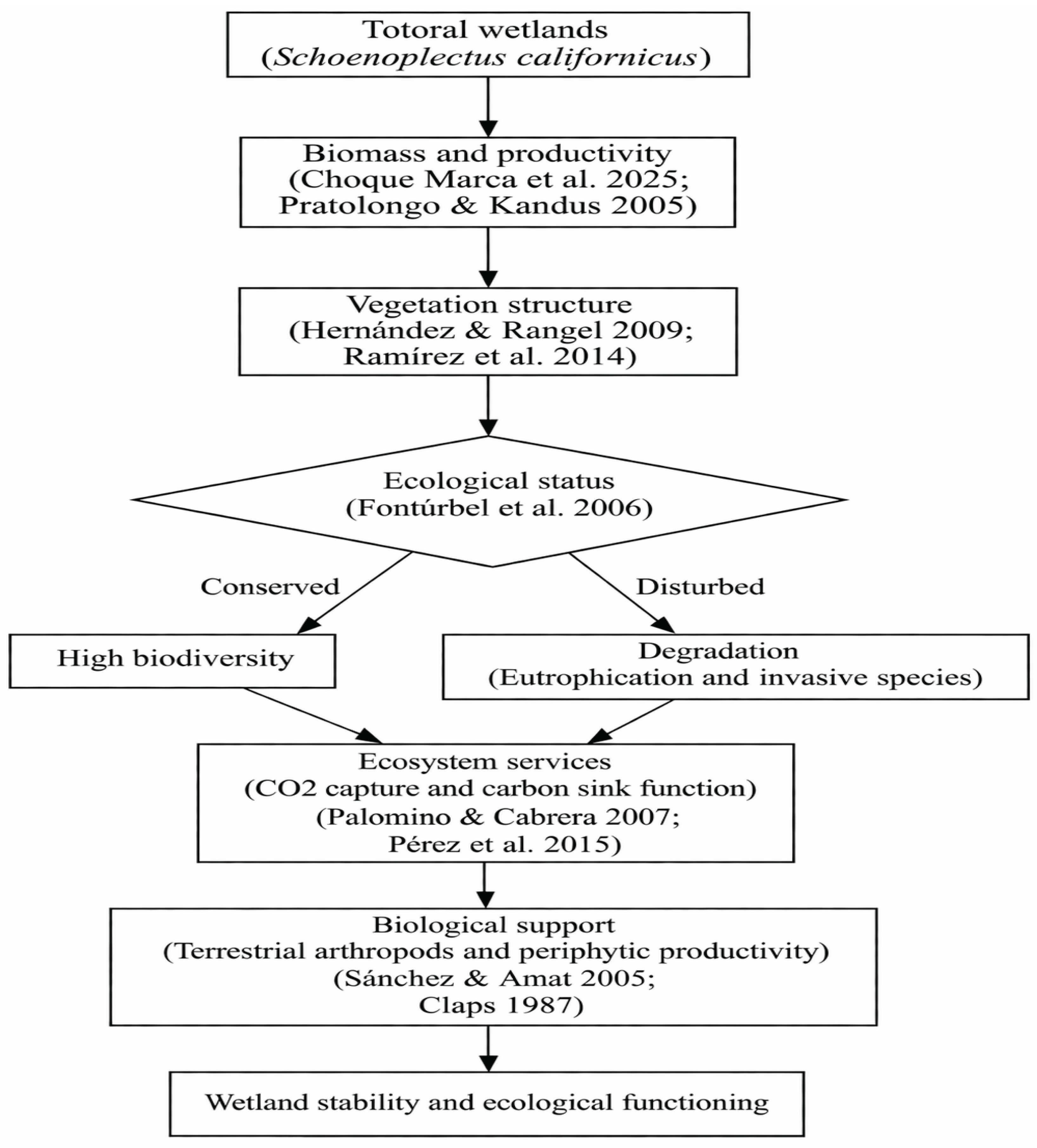
Figure 2.
Integrative framework of the multifunctional roles of Schoenoplectus californicus in socio-ecological systems.
Figure 2.
Integrative framework of the multifunctional roles of Schoenoplectus californicus in socio-ecological systems.
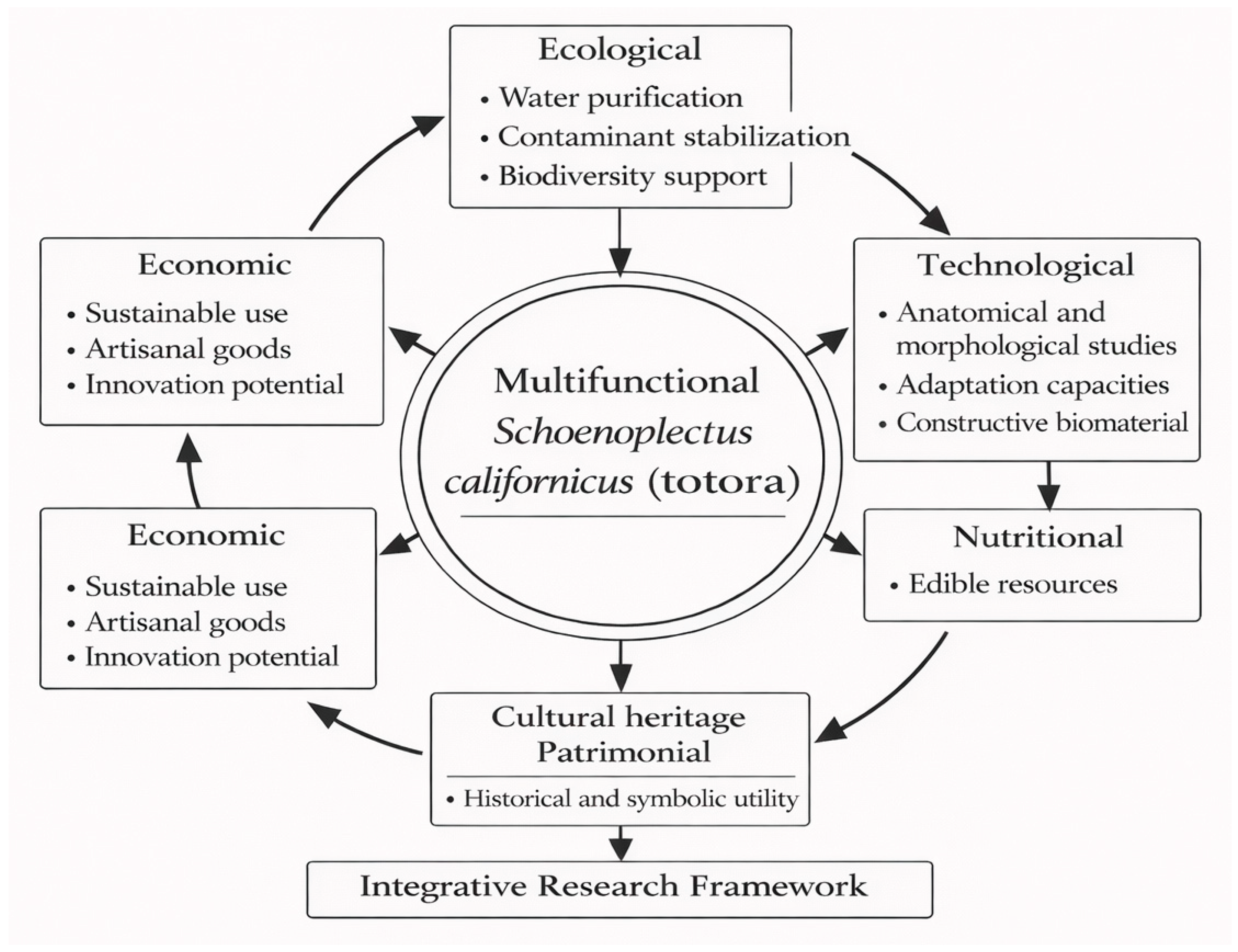
Figure 3.
Synthesis of 44 reviewed studies on Schoenoplectus californicus: (A) thematic distribution, (B) temporal trend, (C) database sources, and (D) geographic distribution.
Figure 3.
Synthesis of 44 reviewed studies on Schoenoplectus californicus: (A) thematic distribution, (B) temporal trend, (C) database sources, and (D) geographic distribution.
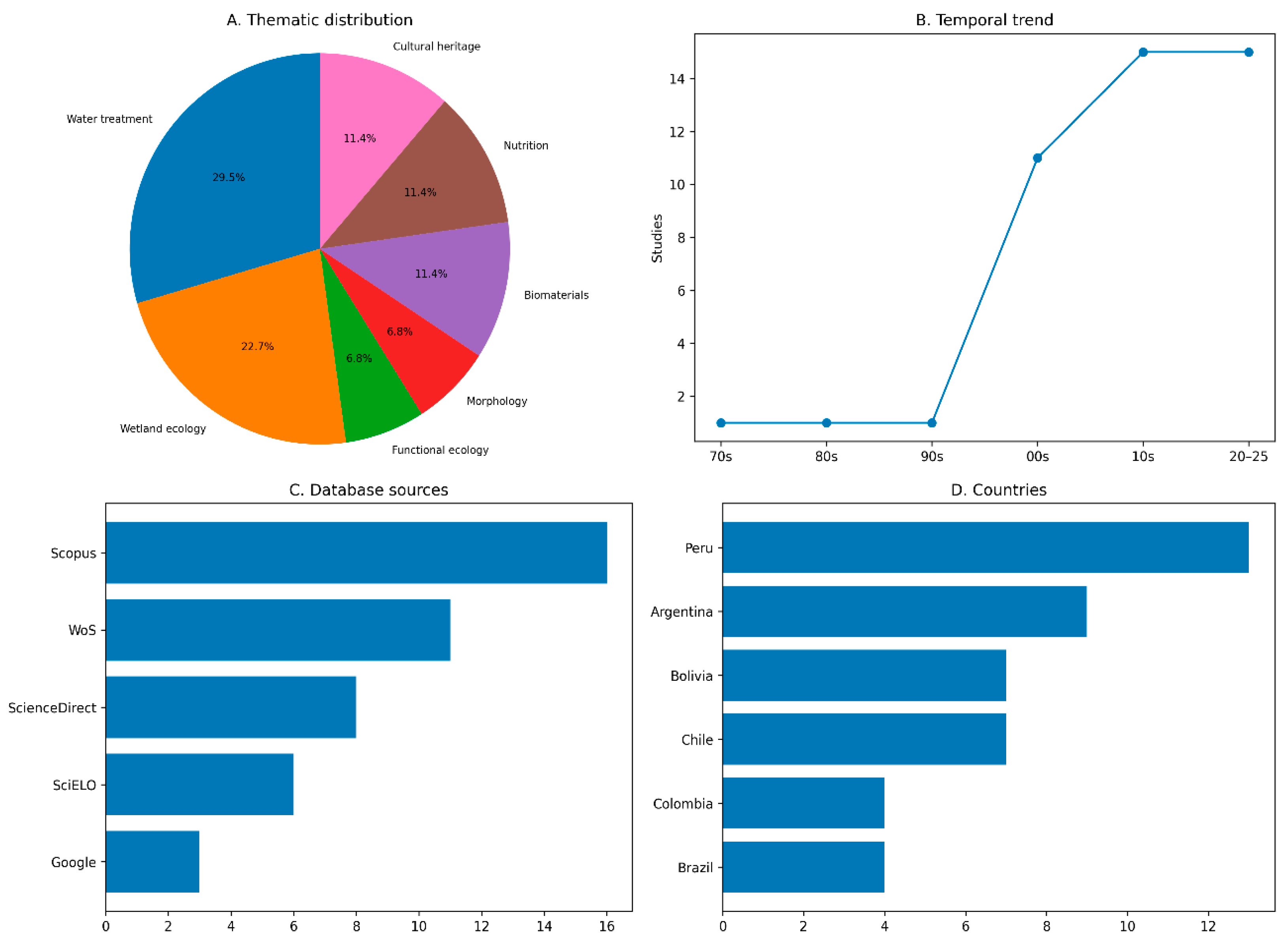
Figure 4.
Percentage distribution across journals and countries for Schoenoplectus californicus.
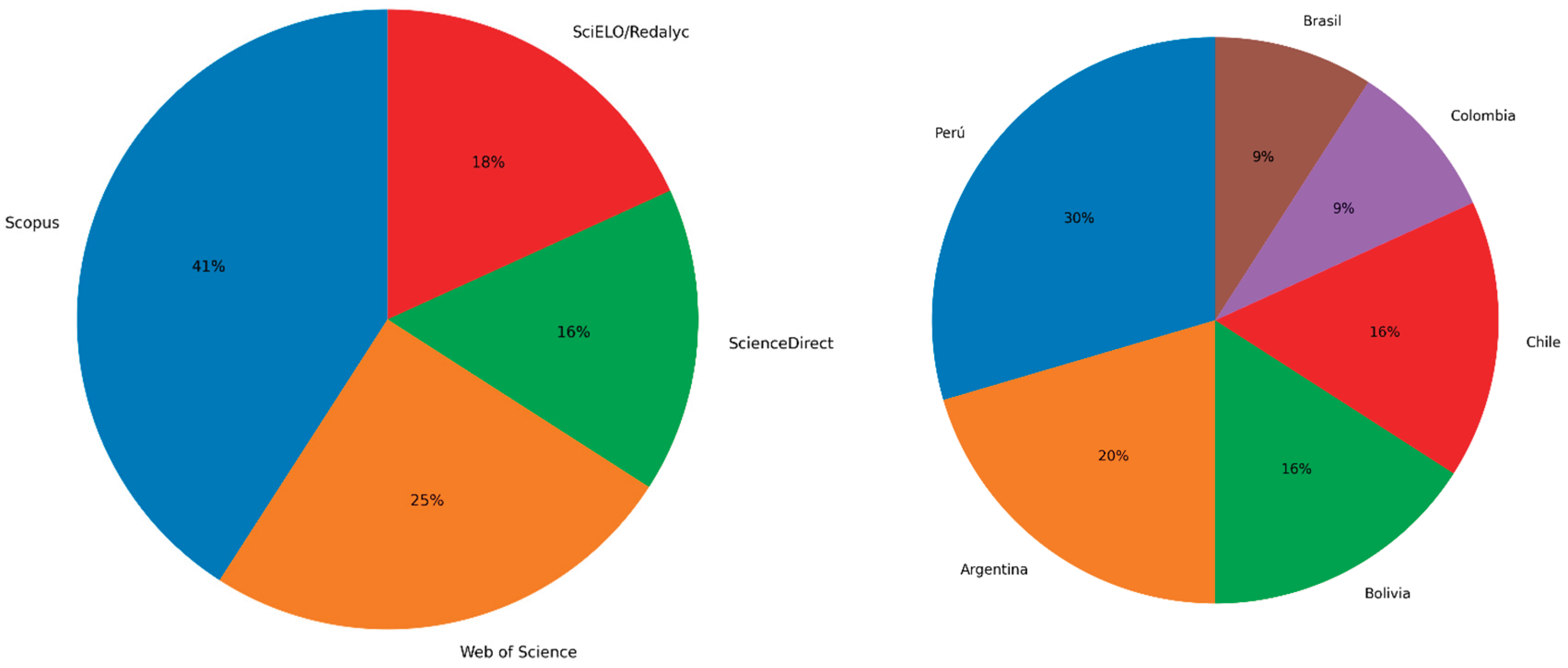
Figure 5.
Conceptual framework of Schoenoplectus californicus as a biocultural heritage species.
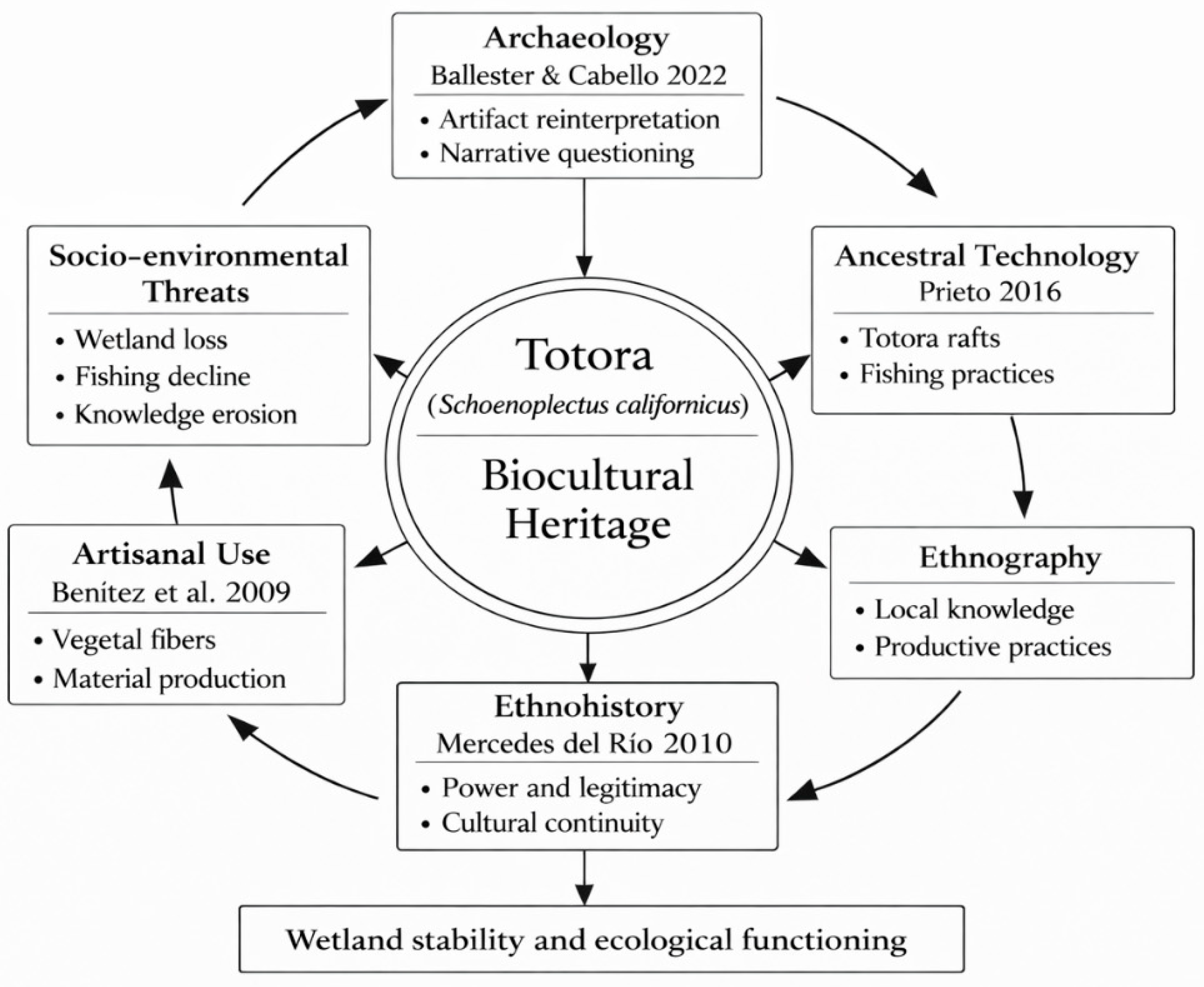
Figure 6.
Totora (Schoenoplectus californicus) as a biocultural system integrating ecological processes, traditional knowledge, and socio-economic functions.
Figure 6.
Totora (Schoenoplectus californicus) as a biocultural system integrating ecological processes, traditional knowledge, and socio-economic functions.
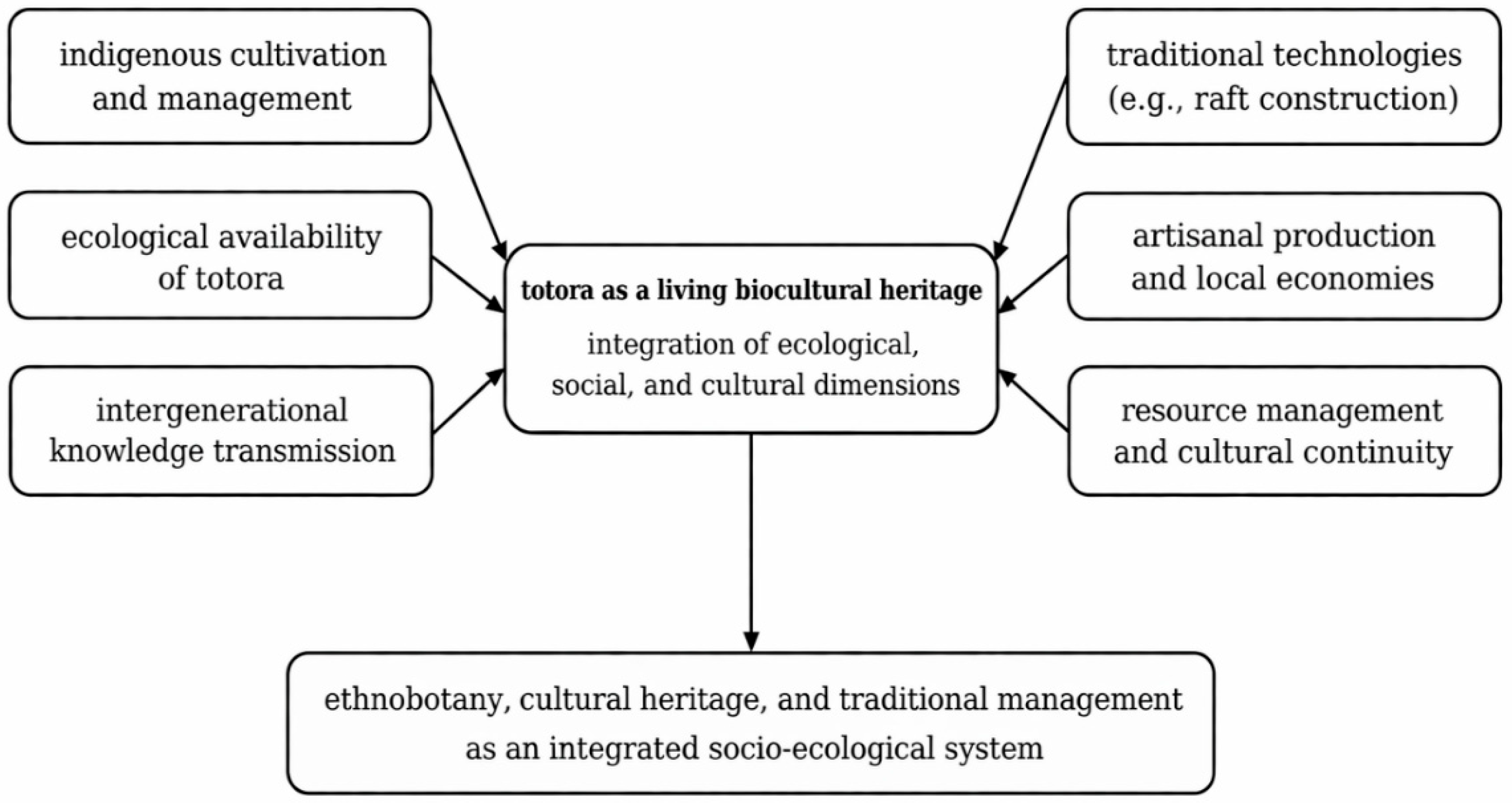
Table 1.
Thematic synthesis of 44 studies on Schoenoplectus californicus.
| Thematic area | Key findings | Representative studies |
|---|---|---|
| Phytoremediation | Contaminant retention, metal tolerance, bioindication, and phytostabilization potential in natural and engineered wetland systems | [7,11,14,33] |
| Wetland ecology | High biomass production, vegetation structuring, biodiversity support, and ecosystem service provision | [2,6,15,16] |
| Functional ecology | Growth, biomass allocation, and nutrient-related responses vary according to trophic and physicochemical conditions | [22,23,24] |
| Anatomy & morphology | Structural traits support wetland adaptation, mechanical performance, and functional persistence under environmental stress | [25,26,27] |
| Biomaterials | Totora shows potential for sustainable construction through measurable thermal, mechanical, and fire-related properties | [28,29,40] |
| Nutrition & ethnobotany | The species contributes to food, forage, and local subsistence systems, with resource value shaped partly by management practices | [30,31,42] |
| Cultural heritage | Totora is embedded in traditional knowledge, community-based management, and long-term biocultural continuity | [3,4,5,32] |
Table 2.
Summary of research outcomes on Schoenoplectus californicus and other macrophytes in water depuration, wastewater treatment, and phytoremediation.
Table 2.
Summary of research outcomes on Schoenoplectus californicus and other macrophytes in water depuration, wastewater treatment, and phytoremediation.
| Authors | Year | System / approach | Species / material | Main finding | Contribution |
| Aguilar et al. | 2024 | Water remediation using plant-derived material | Activated carbon from totora (S. californicus) | Improved water quality index and physicochemical parameters | Totora as adsorbent material |
| Castañeda & Flores | 2013 | Domestic wastewater treatment | Wetland macrophytes | Sustainable low-cost alternative | Ecological technology |
| Chuchón & Aybar | 2008 | Wastewater treatment plant | Macrophyte system | High removal of coliforms and BOD5 | Depends on design |
| Blanco | 2019 | Phytoremediation | S. californicus | Tolerance to metals | Wetland application |
| Rodríguez et al. | 2019 | Bioconcentration | S. californicus | Metal accumulation | Extraction use |
| Noriega-Rico et al. | 2026 | Landscape connectivity / functional wetland ecology | S. californicus | Wetland fragmentation affects population connectivity and genetic structure | Complementary evidence for wetland conservation and functional continuity; not direct phytoremediation |
| Rojas et al. | 2013 | Constructed wetlands | P. australis and S. californicus | Similar efficiency | Seasonal effect |
| Palacios et al. | 2020 | Artificial wetland | Totora | Good performance | Operational value |
| Moyano Arévalo, Naranjo Vargas & Santillán Mariño | 2018 | Natural fiber filtration | Totora fibers / natural fibers | Pollutant reduction | Low-cost filtration |
| de Cabo et al. | 2019 | Riparian rehabilitation | Macrophytes | Restoration of riparian vegetation | Ecological support |
Table 4.
Traceability matrix of studies included in the qualitative synthesis.
|
ID |
Reference | Year | Database / source | Title/abstract screening | Full-text eligibility | Final inclusion | Final thematic category | DOI verified | Notes |
|---|---|---|---|---|---|---|---|---|---|
| 1 | Aguilar et al. | 2024 | Google Scholar | Included | Eligible | Included | Water treatment and phytoremediation | Yes | Activated carbon from totora |
| 2 | Castañeda & Flores | 2013 | Redalyc / Google Scholar | Included | Eligible | Included | Water treatment and phytoremediation | No DOI shown in manuscript | Domestic wastewater treatment |
| 3 | Chuchón & Aybar | 2008 | SciELO / Google Scholar | Included | Eligible | Included | Water treatment and phytoremediation | No DOI shown in manuscript | Treatment plant/macrophyte system |
| 4 | Blanco | 2019 | Scopus / MDPI | Included | Eligible | Included | Water treatment and phytoremediation | Yes | Heavy-metal suitability |
| 5 | Rodríguez et al. | 2019 | Google Scholar | Included | Eligible | Included | Water treatment and phytoremediation | Yes | Bioconcentration factors |
| 6 | Noriega-Rico et al. | 2026 | Scopus | Included | Eligible | Included | Functional ecology and landscape connectivity | Yes | Population genetics, wetland fragmentation, and functional connectivity |
| 7 | Rojas et al. | 2013 | Scopus / Google Scholar | Included | Eligible | Included | Water treatment and phytoremediation | No DOI shown in manuscript | Nutrient removal in constructed wetlands |
| 8 | Palacios et al. | 2020 | Google Scholar | Included | Eligible | Included | Water treatment and phytoremediation | No DOI shown in manuscript | Artificial wetland performance |
| 9 | Moyano Arévalo et al. | 2018 | Google Scholar | Included | Eligible | Included | Water treatment and phytoremediation | No DOI shown in manuscript | Natural fiber filtration and pollutant reduction |
| 10 | de Cabo et al. | 2019 | DOAJ / Google Scholar | Included | Eligible | Included | Water treatment and phytoremediation | Yes | Riparian rehabilitation |
| 11 | Harguinteguy et al. | 2023 | Scopus | Included | Eligible | Included | Water treatment and phytoremediation | Yes | Cu, Pb, and Zn removal/tolerance |
| 12 | Romero et al. | 2023 | Wiley Online Library / Scopus | Included | Eligible | Included | Water treatment and phytoremediation | Yes | Mine effluent laboratory assessment |
| 13 | Choque et al. | 2025 | Google Scholar | Included | Eligible | Included | Wetland ecology, biomass, and ecosystem functioning | Yes | Distribution and biomass |
| 14 | Pratolongo & Kandus | 2005 | Google Scholar | Included | Eligible | Included | Wetland ecology, biomass, and ecosystem functioning | No DOI shown in manuscript | Aboveground biomass dynamics |
| 15 | Hernández-R. & Rangel | 2009 | SciELO | Included | Eligible | Included | Wetland ecology, biomass, and ecosystem functioning | No DOI shown in manuscript | Wetland vegetation |
| 16 | Ramírez et al. | 2014 | SciELO | Included | Eligible | Included | Wetland ecology, biomass, and ecosystem functioning | Yes | Floristic diversity |
| 17 | Sánchez & Amat-García | 2005 | Google Scholar | Included | Eligible | Included | Wetland ecology, biomass, and ecosystem functioning | No DOI shown in manuscript | Arthropod diversity and trophic support |
| 18 | Palomino & Cabrera Carranza | 2007 | Google Scholar | Included | Eligible | Included | Wetland ecology, biomass, and ecosystem functioning | No DOI shown in manuscript | CO₂ capture ecosystem service |
| 19 | Pérez et al. | 2015 | Google Scholar | Included | Eligible | Included | Wetland ecology, biomass, and ecosystem functioning | No DOI shown in manuscript | Quantification of CO₂ capture |
| 20 | Claps | 1987 | Manual reference check / Google Scholar | Included | Eligible | Included | Wetland ecology, biomass, and ecosystem functioning | No DOI shown in manuscript | Periphyton pigments and productivity |
| 21 | Fontúrbel et al. | 2006 | Google Scholar | Included | Eligible | Included | Wetland ecology, biomass, and ecosystem functioning | No DOI shown in manuscript | Ecological condition and flora |
| 22 | de Lange et al. | 2010 | Wiley Online Library / Google Scholar | Included | Eligible | Included | Wetland ecology, biomass, and ecosystem functioning | Yes | Ecological occurrence and distribution |
| 23 | Arce & Achá | 2025 | ScienceDirect / Scopus | Included | Eligible | Included | Functional ecology and growth | Yes | Allometry and nutrient uptake |
| 24 | Neubauer et al. | 2012 | Google Scholar / Scopus | Included | Eligible | Included | Functional ecology and growth | Yes | Biomass allocation and plant performance |
| 25 | Pabón et al. | 2025 | Google Scholar | Included | Eligible | Included | Functional ecology and growth | Yes | Growth response and ecological plasticity |
| 26 | Apóstolo | 2005 | Google Scholar | Included | Eligible | Included | Morphology, anatomy, and functional adaptation | No DOI shown in manuscript | Anatomical characters |
| 27 | Benítez et al. | 2009 | Google Scholar | Included | Eligible | Included | Morphology, anatomy, and functional adaptation | Yes | Fiber-related native plants |
| 28 | Corsino et al. | 2013 | Google Scholar | Included | Eligible | Included | Morphology, anatomy, and functional adaptation | No DOI shown in manuscript | Scape architecture |
| 29 | Galindo & Córdoba Sánchez | 2025 | Taylor & Francis Online / Scopus | Included | Eligible | Included | Water treatment and phytoremediation | Yes | Bioindication and phytostabilization of potentially toxic elements in a Ramsar urban wetland |
| 30 | Aza et al. | 2023 | ScienceDirect / Scopus | Included | Eligible | Included | Biocultural dimensions, sustainable construction, and technological applications | Yes | Thermal, mechanical, and fire behavior of totora panels |
| 31 | Hýsková et al. | 2020 | ScienceDirect / Scopus | Included | Eligible | Included | Biocultural dimensions, sustainable construction, and technological applications | Yes | Composite materials |
| 32 | Hidalgo-Cordero & García-Navarro | 2018 | ScienceDirect / Scopus | Included | Eligible | Included | Biocultural dimensions, sustainable construction, and technological applications | Yes | Construction material potential |
| 33 | Hidalgo et al. | 2019 | Google Scholar | Included | Eligible | Included | Biocultural dimensions, sustainable construction, and technological applications | Yes | Bound fiber rolls |
| 34 | Jiménez et al. | 2024 | Scopus / Google Scholar | Included | Eligible | Included | Biocultural dimensions, sustainable construction, and technological applications | Yes | Modular insulating systems |
| 35 | Gavilanez & Zurita-Polo | 2021 | DOAJ | Included | Eligible | Included | Nutritional and ethnobotanical uses | Yes | Totora flour |
| 36 | Loza et al. | 2025 | Google Scholar | Included | Eligible | Included | Nutritional and ethnobotanical uses | Yes | Edible organs and nutritional content |
| 37 | Loza-Del Carpio & Roque-Huanca | 2022 | Google Scholar | Included | Eligible | Included | Nutritional and ethnobotanical uses | Yes | Prescribed burning and forage value |
| 38 | Rondón et al. | 2003 | SpringerLink / Google Scholar | Included | Eligible | Included | Nutritional and ethnobotanical uses | Yes | Ethnobotanical investigation |
| 39 | Macía & Balslev | 2000 | SpringerLink / Google Scholar | Included | Eligible | Included | Nutritional and ethnobotanical uses | Yes | Use and management of totora treated here as ethnobotany |
| 40 | Banack et al. | 2004 | SpringerLink / Google Scholar | Included | Eligible | Included | Cultural heritage and traditional management | Yes | Indigenous cultivation and conservation |
| 41 | Prieto | 2016 | Google Scholar | Included | Eligible | Included | Cultural heritage and traditional management | No DOI shown in manuscript | Ethnographic and archaeological approach |
| 42 | Ballester & Cabello | 2022 | DOAJ / Google Scholar | Included | Eligible | Included | Cultural heritage and traditional management | Yes | Biocultural and historical continuity |
| 43 | del Rio | 2010 | SciELO / Google Scholar | Included | Eligible | Included | Cultural heritage and traditional management | Yes | Historical continuity and traditional systems |
| 44 | Heiser | 1978 | SpringerLink | Included | Eligible | Included | Cultural heritage and traditional management | Yes | Broad totora context retained as historical-cultural background |
Disclaimer/Publisher’s Note: The statements, opinions and data contained in all publications are solely those of the individual author(s) and contributor(s) and not of MDPI and/or the editor(s). MDPI and/or the editor(s) disclaim responsibility for any injury to people or property resulting from any ideas, methods, instructions or products referred to in the content. |
© 2026 by the authors. Licensee MDPI, Basel, Switzerland. This article is an open access article distributed under the terms and conditions of the Creative Commons Attribution (CC BY) license (http://creativecommons.org/licenses/by/4.0/).
Copyright: This open access article is published under a Creative Commons CC BY 4.0 license, which permit the free download, distribution, and reuse, provided that the author and preprint are cited in any reuse.


