

Submitted:
20 May 2026
Posted:
21 May 2026
You are already at the latest version
Abstract
Background: The February 2026 US presidential directive to begin releasing government files on unidentified anomalous phenomena (UAP) and extraterrestrial life, followed by releases of declassified records under the PURSUE programme in May 2026, marks a significant shift in the disclosure landscape, moving public psychological preparedness from theoretical contingency to active policy concern. Potential confirmation of non-human intelligence (NHI) could trigger ontological shock – profound disorientation when core beliefs about reality are challenged – yet no systematic health needs assessment exists to identify vulnerable populations or quantify support requirements. Methods: We applied WHO emergency preparedness methodology combined with health needs assessment principles to assess the psychological preparedness implications of disclosure scenarios increasingly discussed within governmental and public policy contexts. Using scenario-based modelling across three disclosure contexts (distant biosignature, intelligent signal, local NHI) and seven demographic personas, we assessed impacts on two dimensions: ontological (worldview/meaning coherence) and safety (perceived threat and functional disruption). Impact scoring employed a modified Delphi process involving structured expert elicitation. Results: The disclosure context of local NHI resulted in four demographic groups as being classified as high risk (scoring ≥7/9 on either dimension): individuals self-identifying as “very religious” (3% of UK adults), scientists (8.5%), individuals reporting UAP sightings or other anomalous experiences potentially attributed to NHI (7%), and individuals with severe mental health conditions (20.2%). Combined, 19.1 million UK adults (35% of the adult population) fall into high-risk categories. Applying conservative prevalence estimates from disaster literature (10–30% of high-risk populations experiencing adverse effects) yields 1.9–5.7 million UK adults (3.5–10.6% of the adult population) potentially requiring psychosocial or psychological support – representing a 37–110% surge over current annual NHS mental health referrals (5.2 million in 2024). Conclusions: These findings suggest that high-impact disclosure scenarios, such as the confirmation of local NHI, could plausibly exceed routine mental health service capacity. With the first tranche of declassified UAP records now publicly released under the US PURSUE programme, there is an urgent need to integrate paradigm-shifting disclosure scenarios into public health emergency preparedness planning. Preparedness frameworks and targeted resilience strategies should be developed without delay.
Keywords:
ontological shock
; paradigm shift
; health needs assessment
; emergency preparedness
; extraterrestrial life
; psychological resilience
; post-traumatic growth
Introduction
On 19 February 2026, US President Donald Trump directed the Department of War, formerly Defense, and other federal agencies to begin identifying and releasing government files related to UAP, extraterrestrial life, and UFOs – describing these as “highly complex, but extremely interesting and important matters” [1]. On 8 May 2026, the Department of War released the first tranche of declassified files under the Presidential Unsealing and Reporting System for UAP Encounters (PURSUE), initiating a rolling public release programme with further tranches to follow every few weeks. The released materials comprise unresolved cases – incidents for which the government has been unable to make a definitive determination as to the nature of the observed phenomena [2]. This undertaking, involving the review of tens of millions of records spanning many decades across dozens of agencies, marks a significant shift in the institutional landscape surrounding UAP disclosure and confirms that disclosure-related events can no longer be treated as purely hypothetical future scenarios. The question of public psychological preparedness for paradigm-shifting revelations has therefore moved from theoretical contingency planning to an active and urgent policy concern.
The authenticity, interpretation, and ultimate implications of released UAP materials remain contested in public, scientific, and policy discourse. This paper does not attempt to resolve those questions, but instead examines the public-health and psychological preparedness implications of disclosure scenarios currently being advanced within governmental and public policy contexts.
The possibility of confirming NHI – such as extraterrestrial or other exotic origin whose existence would challenge fundamental assumptions about humanity’s place in the universe – represents what Kuhn (1962) described as a paradigm shift: a fundamental change in the basic assumptions underlying scientific and social understanding [3]. While such discoveries remain hypothetical, recent developments in astrobiology, including findings from the James Webb Space Telescope and increasing governmental acknowledgement of unidentified anomalous phenomena (UAP), suggest that the possibility of contact with NHI is increasingly being discussed within scientific, governmental and public policy contexts [4,5].
The psychological impact of such revelations – often termed ontological shock – refers to the profound disorientation that occurs when individuals’ fundamental assumptions about reality are challenged [6,7]. It has been suggested that public responses are likely to span a continuum from distress and maladaptive coping through curiosity and intellectual engagement to awe, adaptive meaning-making, and post-traumatic growth [7,8]. Analysis of social media responses to recent UAP congressional hearings illustrates this diversity, with reactions ranging from anxiety and the invocation of conspiracy theories to scientific excitement and philosophical reflection – suggesting the phenomenon may be better characterised as ontological “fracturing” rather than universal shock [7]. Understanding these varied responses requires distinguishing between ontological needs (maintaining worldview coherence and life meaning) and safety needs (protection from physical harm and disruption to daily functioning), as disclosure scenarios may threaten each differently across population groups [9]. Certain populations may therefore face disproportionate challenges requiring targeted support. Such populations include those with deeply held religious worldviews, professional identities tied to existing scientific frameworks, prior anomalous experiences, or pre-existing mental health conditions or other factors associated with reduced psychological resilience.
Despite recognition of these risks by institutions including the Royal Society, which noted in 2011 that “if extra-terrestrial life happens to be detected, a coordinated response that takes into account all the related sensitivities should already be in place,” no systematic health needs assessment currently exists to identify vulnerable populations, quantify support requirements, or assess whether disclosure could trigger a public mental health emergency [10]. This gap represents a significant and now urgent oversight in emergency preparedness planning, particularly given that active governmental disclosure processes are now underway in the United States.
This paper presents the first systematic health needs assessment for disclosures involving NHI, using the United Kingdom (UK) as a case study. We identify differential vulnerabilities across demographic groups, quantify potential support requirements using UK population data, and assess whether such events could plausibly meet the threshold for a public mental health emergency. While the quantitative analysis focuses on the UK, the methodological framework and demographic categories are designed to be applicable across national contexts.
Theoretical Framework of Ontological Security
The transactional model of stress and coping (Lazarus & Folkman) emphasizes that stress arises not from external events alone, but from the transaction between individuals and their environment [11]. Central to this model is cognitive appraisal: individuals first evaluate whether a situation threatens their wellbeing (primary appraisal), then assess whether they have adequate resources to cope (secondary appraisal). Applied to disclosure scenarios, we identify two critical dimensions of threat assessment: ontological needs (maintaining worldview coherence and life meaning) and safety needs (physical security, financial stability, and social functioning). This distinction is critical because disclosure scenarios may threaten each differently across demographic groups – a revelation challenging religious worldviews might produce high ontological threat with minimal safety impact, whilst evidence suggesting technological vulnerability might reverse this pattern. The framework aligns with Wendt and Duvall’s (2008) distinction between ontological and physical security threats, extending these concepts from state-level to individual psychological security in scenarios involving NHI [6]. While Maslow’s hierarchy addresses individual psychological needs, Wendt & Duvall’s framework specifically theorizes ontological security threats at the societal level, providing additional theoretical grounding for analysing paradigm-shifting disclosures [9].
Responses to paradigm-shifting revelations exist on a continuum from distress through adaptation and even to psychological development. Regarding the latter possibility, Tedeschi and Calhoun’s (2004) post-traumatic growth framework demonstrates that challenges to core beliefs, whilst initially destabilizing, can catalyse positive psychological change including enhanced appreciation of life, deeper relationships, and revised life priorities [8]. Understanding the nature and scale of potential responses is essential for conducting a systematic health needs assessment to identify which populations face elevated risk and quantify the level of support that may be required.
Methods
Framework Development
We employed a scenario-based modelling approach combining qualitative expert elicitation with quantitative population extrapolation, grounded in health needs assessment principles for evidence-informed resource allocation and stakeholder-driven planning (Cavanagh & Chadwick) [12]. This approach, developed by the UK Health Development Agency (now part of NICE – the National Institute for Health and Care Excellence), provides systematic methodology for reviewing health issues facing populations, leading to agreed priorities and resource allocation.
The framework development proceeded through three phases:
- Scenario Development: Three disclosure scenarios were defined based on proximity and intelligence levels of discovered life
- Population Analysis: Seven demographic personas were created representing different vulnerability profiles
- Needs Assessment: Ontological and safety needs were mapped across scenarios and populations using structured impact scoring
Throughout this process, we intentionally considered both negative outcomes (distress, anxiety, maladaptive coping) and positive outcomes (curiosity, meaning-making, post-traumatic growth) to explore the full continuum of potential responses.
Scenario Planning
Three primary disclosure scenarios were developed to capture the range of possible revelations:
- Scenario 1: Distant Biosignature (“Life exists”) - Detection of biological markers in exoplanet atmospheres, indicating non-intelligent life
- Scenario 2: Intelligent Distant Signal (“They’re out there”) - Reception of clearly artificial signals from extraterrestrial civilizations
- Scenario 3: Local NHI (“Closer to home”) – Confirmation of intelligent non-human presence on or near Earth
These scenarios represent increasing proximity and immediacy, with Scenario 3 producing substantially higher psychological impact, and potentially safety risk, across all demographic groups. Although we completed a health needs assessment and public health emergency evaluation for all three scenarios, the current manuscript specifically examines Scenario 3, as it seems reasonable to assume that this is the scenario with the greatest plausible potential to overwhelm existing mental health infrastructure.
Population Personas
Seven population archetypes were developed based on psychological vulnerability research and demographic analysis:
| Persona | Population Characteristic Represented | Rationale for Inclusion |
| Children | Developmental stage | Represents children’s cognitive and emotional development considerations |
| Young Adults | Identity formation stage | Represents late adolescence and identity formation periods |
| Parents | Family responsibility | Represents adults managing family and caregiving stressors |
| Religious Communities | Deeply held religious worldview | Represents populations for whom disclosure challenges theological meaning frameworks |
| Scientists | Professional scientific identity | Represents individuals whose professional worldview is tied to existing scientific paradigms |
| Vulnerable Populations | Pre-existing mental health or socioeconomic vulnerability | Represents individuals with reduced psychological resilience or limited coping resources |
| Experiencers | Prior anomalous experiences | Represents individuals reporting previous UAP or anomalous encounters |
Impact Assessment
Each scenario was evaluated against each persona using a nine-point scale for both ontological and safety needs (1-3: Low impact; 4-6: Medium impact; 7-9: High impact). Impact scores were assigned using a modified Delphi process involving structured expert elicitation. Two authors with complementary subject-matter expertise – one with a background in UAP-related psychological research and experiencer support, one with a background in psychology and support for more general vulnerable groups – independently drafted initial scores grounded in established psychological literature on trauma, meaning-making, and stress responses. Scores were then refined through iterative structured discussion until consensus was reached, following Delphi methodology principles [13]. The resulting scores were subsequently reviewed by an external academic with public health expertise and then by a further subject matter reviewer. The rating process considered: (1) degree of worldview disruption (ontological dimension), (2) threat to physical safety and daily functioning (safety dimension), and (3) availability of psychological resources and social support within each demographic group.
For planning purposes, populations were classified as high-risk if they scored ≥7/9 on either ontological or safety dimensions, as severe disruption in either domain warrants systematic support planning. The nine-point scale divides into three equal bands corresponding to low (1–3), medium (4–6), and high (7–9) impact; the ≥7/9 threshold was therefore set at the lower boundary of the high band, consistent with upper-tertile risk stratification approaches used in clinical and public health assessment frameworks. This threshold was applied independently to each dimension, on the grounds that severe disruption in either domain – whether ontological or safety-related – independently warrants systematic support planning regardless of scores on the other dimension
Population-level projections for the UK were calculated by identifying UK demographic groups corresponding to each persona and applying prevalence rates from established sources (ONS, NHS England, YouGov). The demographic percentages presented (Table 2) enable extrapolation to other national populations by applying the same prevalence rates (e.g., 3% very religious, 20.2% with mental health conditions, 8.5% STEM professionals, 7% reporting UAP/anomalous experiences) to local population bases.
Results
Differential Impact Analysis
Using scenario-based structured expert elicitation with consensus refinement, we assessed differential psychological impacts across disclosure scenarios and demographic groups. Scenario 3 (Local NHI) produced highest impact scores across all groups, whilst Scenario 1 (Distant Biosignature) generated modest disruption.
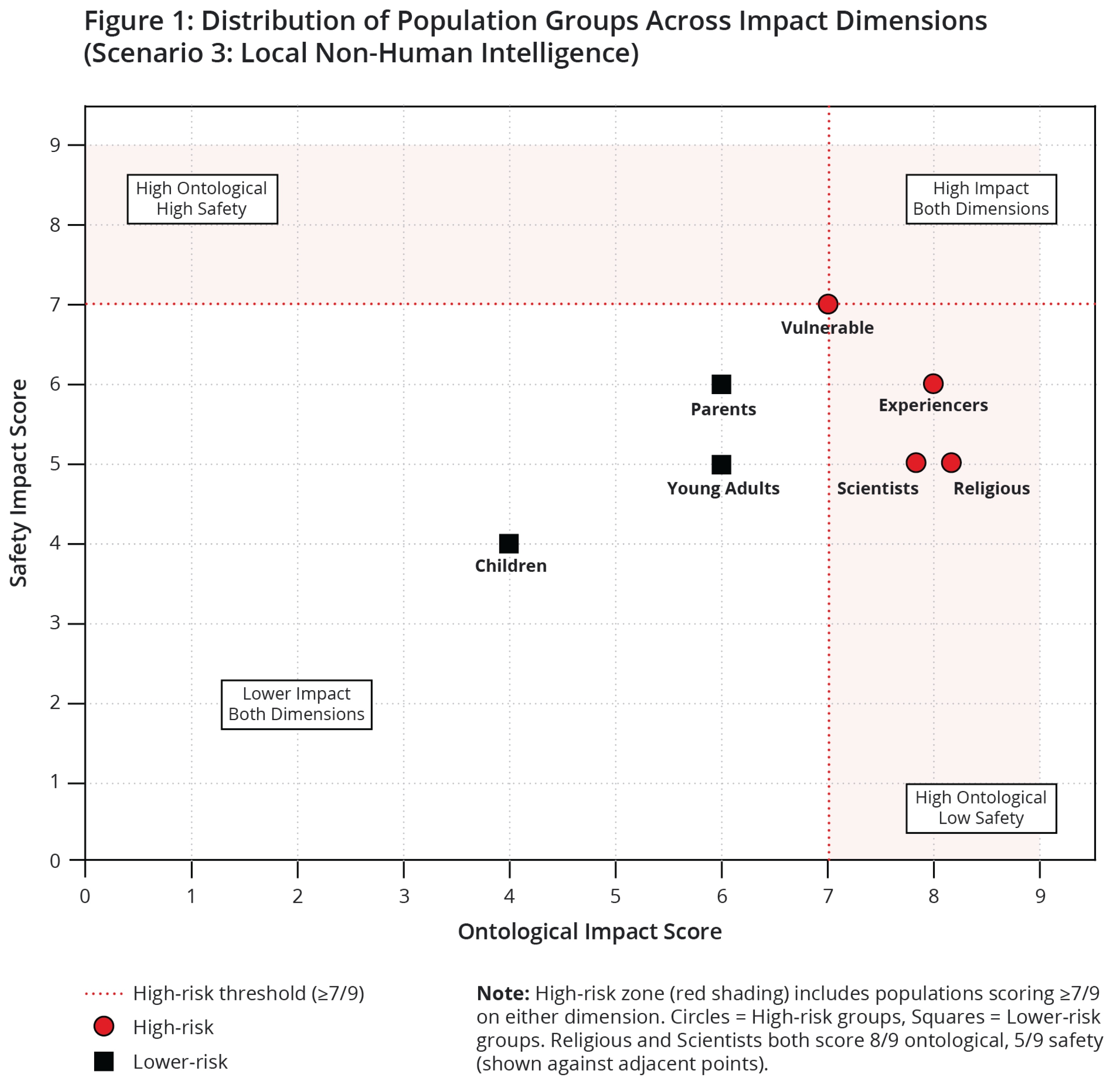
Impact patterns differed markedly across populations. Religious communities and experiencers showed highest vulnerability to ontological disruption (8/9 ontological, 5/9 safety), reflecting threats to core worldviews and meaning-making systems. Scientists demonstrated high ontological impact (8/9 ontological, 5/9 safety) related to professional identity and theoretical frameworks. Vulnerable populations faced threats across both dimensions (7/9 ontological, 7/9 safety), with limited adaptive resources creating compounded vulnerabilities. Young adults (6/9 ontological, 5/9 safety) and families with children (6/9 ontological, 6/9 safety) showed substantially lower vulnerability, benefitting from worldview flexibility and developmental adaptability.

Table 1.
Differential Impact Scores by Population Group (Scenario 3).
| Population Group | Ontological Impact | Safety Impact | High-Risk Status |
| Religious Communities | 8/9 | 5/9 | High-risk (ontological) |
| Experiencers | 8/9 | 6/9 | High-risk (ontological) |
| Scientists | 8/9 | 5/9 | High-risk (ontological) |
| Vulnerable Populations | 7/9 | 7/9 | High-risk (both) |
| Parents | 6/9 | 6/9 | Lower-risk |
| Young Adults | 6/9 | 5/9 | Lower-risk |
| Children | 4/9 | 4/9 | Lower-risk |
Figure 1 illustrates the distribution of population groups across ontological and safety impact dimensions. The threshold for classification as “high-risk for severe disruption” (≥7/9 on either dimension, indicated by red shading) captures groups facing substantial threats to worldview coherence and meaning-making systems, those experiencing safety-related disruptions, or both. Religious communities, experiencers, and scientists cluster in the high ontological/moderate safety region, whilst vulnerable populations occupy the high-impact zone across both dimensions. Young adults and families with children remain below the threshold, positioned in the lower-impact zone where worldview flexibility and developmental adaptability serve as protective factors.
These differential impact patterns informed identification of high-risk populations requiring targeted intervention planning. Groups scoring ≥7/9 on either ontological or safety dimensions were classified as high-risk for severe disruption.
Population-Level Impact Projections
To translate persona-based impact analysis into population-level estimates, we identified UK demographic groups corresponding to the four high-risk categories (scoring ≥7/9 on ontological or safety dimensions; see Table 2 for how these categories were defined and the corresponding sources):
- Individuals self-identifying as “very religious” in a recent YouGov survey: 1.7 million adults (3% of UK adult population) – ontological impact 8/9 due to potential theological challenges [14].
- Vulnerable populations: 10.8 million adults (20.2% of adults) – vulnerable populations persona scores 7/9 on both ontological and safety dimensions [15].
- Scientists and STEM professionals: 2.8 million adults (8.5% of workforce) – ontological impact 8/9 as professional identity tied to established frameworks [16].
- Individuals reporting UAP sightings or other anomalous experiences potentially attributed to NHI: 3.8 million adults (7% of adults) – ontological impact 8/9 due to complex validation and stigma-related vulnerabilities [17].
These prevalence rates (summarized in Table 2) can be applied to other national contexts to estimate high-risk populations, accounting for cultural variations in religiosity, mental health service utilization, and STEM workforce composition.
Table 2.
High-Risk Population Prevalence Rates for International Extrapolation*.
| Demographic Group | UK Population | Prevalence | Data Source |
| Very Religious | 1.7 million | 3% of adults | YouGov 2014 |
| Mental Health Conditions | 10.8 million | 20.2% of adults | NHS England 2023-24 |
| STEM Professionals | 2.8 million | 8.5% of workforce | Office for National Statistics 2022 |
| UAP Experiencers | 3.8 million | 7% of adults | YouGov 2021 |
| Net High-Risk Population* | 19.1 million (adult population) | 35% of adult population | This study |
* The four constituent rows use adult population as denominator, while STEM Professionals specifically uses workforce as denominator. ** These prevalence rates can be applied to other national adult populations to estimate high-risk groups for other countries, with appropriate adjustment for cultural variations in religiosity, mental health service utilization, and STEM workforce composition.
Combined, these four high-risk groups encompass 19.1 million UK adults, representing 35% of the adult population. The four demographic categories are not mutually exclusive – some individuals may be both very religious and have mental health conditions, for example – and the true number of unique individuals is lower than the aggregate figure; however, even allowing for substantial overlap, the scale remains sufficient to constitute a potential public health emergency.
Intervention Requirements
A public health emergency is formally defined as an extraordinary event posing public health risk requiring immediate coordinated action beyond routine service capacity (WHO [18]; Cabinet Office [19]). To assess whether disclosure scenarios would meet this threshold, we compared projected support requirements against existing mental health infrastructure capacity.
Drawing on Dolan and Zabel’s estimate that 10–30% of populations may experience adverse psychological effects following paradigm-shifting disclosure events, we developed two projection approaches [20]. To bound the plausibility of this range, we referenced disaster-response literature, noting that a recent meta-analysis reported post-disaster PTSD prevalence of ~26% within 1–3 months in both developed and developing countries, with peaks of 44.5% at 4–6 months in developed countries and 30.4% at 7–12 months in developing countries, before stabilising at approximately 21–24% at 13–36 months [21]. While we do not imply that ontological shock equates clinically to PTSD, the disaster literature is used only to bound plausible ranges of population-level distress responses in large-scale disruptive events.
While Dolan and Zabel’s estimates derive from scenario-bounding literature rather than empirical studies, the consistency with established disaster research provides methodological grounding for these projections. Direct application to the total UK adult population (54.4 million) would yield 5.4-16.1 million (i.e., 10-30% of adult population) requiring support. However, this approach does not account for differential vulnerability across demographic groups and likely overestimates impact on lower-risk populations.
Our scaled approach applies the Dolan and Zabel range specifically to the high-risk population (19.1 million, or 35% of UK adults), yielding a more conservative estimate of 1.9–5.7 million UK adults (3.5-10.6% of the total UK adult population) who may require psychological support or intervention. Even this conservative lower bound (1.9 million) represents a 37% surge over current annual NHS mental health referrals (5.2 million in 2024), whilst the upper bound (5.7 million) would more than double annual demand [22]. This scale, combined with the likely concentration of need within weeks or months of disclosure, would likely exceed routine service capacity and could constitute a public mental health emergency requiring systematic preparedness planning and surge capacity well beyond existing mental health infrastructure.
Health Needs Assessment and Next Steps
The preceding analysis identifies at-risk population groups and demonstrates that a public health emergency post-disclosure is a credible scenario. This analysis is set out in a formal health needs assessment document, available on the Unhidden Foundation website.
The next steps are to develop intervention actions to meet and address the needs identified in the Assessment. We anticipate four intervention categories:
- Building Resilience Across Populations
- Targeted Support for High-Risk Groups
- Clinical Services for Acute Distress
- Community and Peer Support: Horizontal Social Infrastructure
Detailed intervention planning is beyond the scope of this paper. The authors intend to develop a comprehensive response plan, based around a Theory of Change Model, in collaboration with a multi-disciplinary academic team. Such a plan will define roles and responsibilities for government, health providers, professional bodies, and community organizations, alongside strategic communication guidance. Developing this coordinated preparedness framework is essential to meet the Royal Society’s recommendation for a “coordinated response that takes into account all the related sensitivities” [10].
Discussion
The needs assessment is the first systematic attempt to apply established public health emergency preparedness principles to ontological shock scenarios.
First, psychological impact would be highly differentiated across population groups. Religious communities, experiencers, vulnerable populations, and scientists face elevated risk (scoring ≥7/9 on ontological or safety dimensions), whilst young adults, parents, and children show substantially lower vulnerability. This heterogeneity demonstrates that preparedness cannot adopt universal approaches but must recognize differential vulnerabilities and tailor support accordingly.
We specifically used the WHO framework to demonstrate that NHI disclosure scenarios could plausibly produce support requirements at a scale that triggers a public health emergency. Our analysis demonstrates that 1.9-5.7 million adults in the UK may require support, which represents a 37-110% surge over current capacity. We specifically found that scenarios involving imminent existential threat would produce substantially higher impacts. Results suggest significant implications for public health preparedness planning.
Public Health Implications
Second, the potential scale of impact could plausibly constitute a public health emergency. Our conservative estimate of 1.9–5.7 million UK adults potentially requiring psychological support represents a 37–110% surge over current annual NHS mental health referrals. Combined with the likely concentration of demand within weeks or months of disclosure, this scale would require coordinated action beyond routine service capacity, and could plausibly meet the formal definition of a public health emergency.
Our analysis revealed that the type of NHI disclosure and personal characteristics both play an important role in the magnitude of ontological shock and threat to physical safety. The differential impact analysis reveals that psychological preparedness cannot adopt a one-size-fits-all approach. Religious communities and experiencers face particular challenges related to worldview validation and stigma reduction, while vulnerable populations require enhanced access to mental health resources. Scientists, despite professional preparation for paradigm shifts, show high impact scores due to potential professional identity disruption.
Comparison with Existing Emergency Preparedness
Third, no systematic preparedness framework currently exists despite institutional recognition of this risk. The Royal Society noted in 2011 that “a coordinated response that takes into account all the related sensitivities should already be in place,” yet no such response has been developed [10]. This health needs assessment addresses that gap by systematically identifying vulnerable populations and quantifying support requirements.
The UK’s ‘All-Hazards’ emergency planning approach provides a useful template for ontological shock preparedness [19].
Key parallels include:
- Multi-agency coordination requirements
- Shared understanding of roles and responsibilities
- Common terminology and conceptual frameworks
- Integration of local and national response levels
However, ontological shock presents unique challenges not addressed by traditional emergency preparedness:
- No physical infrastructure damage requiring repair
- Primarily psychological rather than material impacts
- Global rather than localised effects
- Potentially permanent rather than temporary disruption
Clinical Considerations
Healthcare systems must prepare for potential surge capacity needs in psychological services. Historical data from terrorist attacks in the UK suggest that while most individuals demonstrate remarkable resilience, a small but significant proportion may require professional mental health support [23,24]. The scale of potential impact from paradigm-shifting revelations could overwhelm existing mental health infrastructure without adequate preparedness. However, most individuals are expected to demonstrate adaptive or resilient responses.
The framework emphasises the importance of avoiding over-medicalisation while ensuring appropriate clinical support is available. Health Needs Assessment frameworks emphasise stakeholder-defined priorities, population-level risk stratification and feasible, acceptable interventions. These principles are adaptable to psychological preparedness for ontological shock, particularly in identifying vulnerable groups and designing layered response strategies.
Limitations
However, these findings must be interpreted within important methodological constraints. The scenarios analysed remain hypothetical, albeit with active governmental disclosure processes now underway and initial declassified records publicly released. Our demographic projections involve considerable uncertainty, and cultural variation in psychological responses may be substantial.
Methodological constraint: These impact scores represent structured expert elicitation rather than empirically measured psychological outcomes. While grounded in psychological literature, the scores involve subjective assessment of hypothetical scenarios. Supplementary Table S1 provides the specific rationale for each impact rating. Whilst the modified Delphi process employed aimed to bound plausible ranges of impact rather than produce point estimates, the scores nonetheless involve subjective assessment of hypothetical scenarios and independent replication by different expert panels may yield different results.
Several further limitations should be acknowledged in this framework:
- Speculative Nature: The scenarios analysed remain hypothetical, limiting empirical validation opportunities
- Cultural Context: Analysis focuses primarily on UK populations; cross-cultural validation is needed
- Correlated Resilience Factors: Impact scores reflect initial vulnerability but do not capture potentially correlated resilience characteristics within the same groups. For example, highly religious individuals, whilst facing significant ontological challenge, are often embedded in socially connected community networks that may facilitate adaptive coping and moderate longer-term outcomes.
- Temporal Considerations: The framework assumes relatively sudden disclosure; gradual revelation scenarios may require different approaches.
- This Health Needs Assessment does not claim to precisely quantify psychological impact, which would require empirical data unavailable for hypothetical scenarios.
- The demographic categories identified are not mutually exclusive; some individuals fall into multiple high-risk groups. However, even accounting for substantial overlap between categories, the scale of potentially affected populations (15+ million unique individuals) would still represent a public health emergency scenario requiring systematic preparedness planning.
Despite these caveats, the precautionary principle in public health planning supports developing preparedness frameworks for plausible high-impact scenarios even when precise probability and magnitude cannot be determined. The potential consequences of unpreparedness – affecting millions simultaneously – justify systematic planning based on current understanding whilst acknowledging uncertainty.
Implications for National Risk Assessment
This health needs assessment employs scenario-based impact quantification consistent with methodologies used in UK national security risk assessment, as outlined in the Royal Academy of Engineering (RAEng) review of the National Security Risk Assessment (NSRA) framework [25]. The RAEng methodology emphasizes impact-driven preparedness planning with reduced focus on likelihood estimation, recognizing that low-probability, high-impact scenarios warrant systematic planning. Our analysis demonstrates that disclosure scenarios meet established criteria for national-scale emergency planning: affecting 3.5-10.6% of the UK adult population, requiring coordinated action beyond routine service capacity, and presenting plausible manifestations grounded in current scientific developments and governmental acknowledgment of unidentified anomalous phenomena. The differential vulnerability patterns identified across demographic groups align with RAEng principles of exploring interdependencies and identifying populations facing disproportionate impact. While the present analysis focuses on health service implications, broader system interdependencies—including workforce disruption, economic impacts, and social cohesion challenges—warrant further examination through multi-sector risk assessment processes.
This health needs assessment establishes the foundation for intervention planning. The next steps require developing detailed response strategies across the four intervention categories identified: building population-wide resilience, targeted support for high-risk groups, clinical services for acute distress, and community-based peer support. This work will require multi-disciplinary collaboration to define roles and responsibilities for government, healthcare systems, professional bodies, and civil society organisations.
The framework developed here offers a template adaptable to various paradigm-shifting scenarios beyond extraterrestrial life discovery. As scientific understanding advances, such preparedness frameworks may prove essential for maintaining societal psychological wellbeing when fundamental assumptions about reality are challenged. While we cannot predict when paradigm-shifting discoveries might occur, we can—and should—prepare populations to respond with resilience rather than crisis when they do.
Conclusions
This study presents the first systematic health needs assessment for paradigm-shifting disclosures involving NHI. Using scenario-based structured expert elicitation and population scaling, we identify population groups at elevated risk of psychological disruption and estimate that 1.9–5.7 million UK adults could require psychological support following high-impact disclosure scenarios. These findings suggest that such events could plausibly exceed routine mental health service capacity and therefore warrant inclusion in public health emergency preparedness planning. While full confirmation of NHI remains hypothetical and impact estimates uncertain, the framework developed here provides a foundation for future refinement and for the development of targeted resilience and response strategies.
Supplementary Materials
The following supporting information can be downloaded at: Preprints.org.
Funding
This research received no specific grant from any funding agency in the public, commercial, or not-for-profit sectors.
Acknowledgments
The authors would like to thank Adrian Taylor for his contribution to the development of the underlying Theory of Change framework and related conceptual discussions informing the wider Health Needs Assessment work.
Competing Interests
JP is a Director of Unhidden Foundation and Unhidden Inc.
Data Availability
Supplementary Table S1 is included within this manuscript. The Health Needs Assessment document itself is available from the Unhidden Foundation website (www.unhidden.org).
References
- Trump, D.J. Truth Social post directing federal agencies to identify and release government files on UAP and extraterrestrial life. 19 February 2026.
- United States Department of War. Presidential Unsealing and Reporting System for UAP Encounters (PURSUE): Release 01. 8 May 2026. Available online: https://www.war.gov/UFO/.
- Kuhn, T.S. The Structure of Scientific Revolutions; University of Chicago Press: Chicago, 1962. [Google Scholar]
- Lea, R. Did the James Webb Space Telescope really find life beyond Earth? Space.com. 2024 3rd May. May.
- Office of the Director of National Intelligence. Preliminary Assessment: Unidentified Aerial Phenomena; ODNI: Washington DC, 2021. [Google Scholar]
- Wendt, A.; Duvall, R. Sovereignty and the UFO. Political Theory 2008, 36(4), 607–633. [Google Scholar] [CrossRef]
- Lomas, T. Unidentified Anomalous Phenomena (UAP) Disclosure as Ontological Shock? Exploring Diversity Among Social Media Responses to a Congressional UAP Hearing. J. Humanist. Psychol. 2024. [Google Scholar] [CrossRef]
- Tedeschi, R.G.; Calhoun, L.G. Posttraumatic Growth: Conceptual Foundations and Empirical Evidence. Psychol. Inq. 2004, 15(1), 1–18. [Google Scholar] [CrossRef] [PubMed]
- Maslow, A.H. A theory of human motivation. Psychol. Rev. 1943, 50(4), 370–396. [Google Scholar] [CrossRef]
- Dominik, M.; Zarnecki, J. The detection of extra-terrestrial life and the consequences for science and society. Phil Trans. R Soc. A 2011, 369(1936), 499–507. [Google Scholar] [CrossRef] [PubMed]
- Lazarus, R.S.; Folkman, S. Stress, Appraisal, and Coping; Springer Publishing Company: New York, 1984. [Google Scholar]
- Cavanagh, S.; Chadwick, K. Health Needs Assessment: A Practical Guide; Health Development Agency: London, 2005. [Google Scholar]
- Hasson, F.; Keeney, S.; McKenna, H. Research guidelines for the Delphi survey technique. J. Adv. Nurs. 2000, 32(4), 1008–1015. [Google Scholar] [CrossRef] [PubMed]
- YouGov. Voters: Britain IS a Christian country (but we’re not religious). YouGov survey report. 23 April 2014.
- NHS Digital. Survey of Mental Health and Wellbeing, England 2023–24: Common mental health conditions. NHS Digit. Stat. Release 2024. [Google Scholar]
- Office for National Statistics. Labour Force Survey: Employment by occupation, United Kingdom, 2022. In ONS Statistical Bulletin; 2023. [Google Scholar]
- YouGov. Half of Britons think aliens exist – and 7% claim to have seen a UFO. YouGov survey report. 25 June 2021.
- World Health Organization. International Health Regulations (2005), 3rd ed.; WHO: Geneva, 2016. [Google Scholar]
- Cabinet Office. Emergency Preparedness; HM Government: London, 2013. [Google Scholar]
- Dolan, R.M.; Zabel, B. A.D. After Disclosure: When the Government Finally Reveals the Truth About Alien Contact; New Page Books: Franklin Lakes, NJ, 2012. [Google Scholar]
- Rostami Zarinabadi, C.; Daliri, S.; Rohani-Rasaf, M.; Karimi, A.; Zare, F. Post-Traumatic Stress Disorder after Disaster and Mass-Casualty Incidents in Developed and Developing Countries: A Meta-Analysis Study. Iran. J. Psychiatry 2025, 20(3), 383–404. [Google Scholar] [CrossRef] [PubMed]
- British Medical Association. Mental health services in England received a record 5.2 million referrals during 2024. BMA analysis of NHS data. 2024. Available online: https://www.bma.org.uk/advice-and-support/nhs-delivery-and-workforce/pressures/mental-health-pressures-data-analysis.
- Rubin, G.J.; Amlôt, R.; Page, L.; Wessely, S. Methodological challenges in assessing general population reactions in the immediate aftermath of a terrorist attack. Int. J. Methods Psychiatr. Res. 2008, 17(S2), S29–S35. [Google Scholar] [CrossRef] [PubMed]
- Cabinet Office. Emergency Response and Recovery; HM Government: London, 2013. [Google Scholar]
- Royal Academy of Engineering. Building Resilience: Lessons from the Academy’s Review of the National Security Risk Assessment Methodology; Royal Academy of Engineering: London, 2023. [Google Scholar]
Disclaimer/Publisher’s Note: The statements, opinions and data contained in all publications are solely those of the individual author(s) and contributor(s) and not of MDPI and/or the editor(s). MDPI and/or the editor(s) disclaim responsibility for any injury to people or property resulting from any ideas, methods, instructions or products referred to in the content. |
© 2026 by the authors. Licensee MDPI, Basel, Switzerland. This article is an open access article distributed under the terms and conditions of the Creative Commons Attribution (CC BY) license (http://creativecommons.org/licenses/by/4.0/).
Copyright: This open access article is published under a Creative Commons CC BY 4.0 license, which permit the free download, distribution, and reuse, provided that the author and preprint are cited in any reuse.


