
Submitted:
19 May 2026
Posted:
20 May 2026
You are already at the latest version
Abstract
Despite millennia of successful biological reproduction, the daily execution of child-rearing remains notoriously fraught and highly resistant to optimization. Society frequently attributes parental burnout and daily perceived failures in parenting tasks to psychological shortcomings, a lack of patience, inadequate education or organizational failure. Here, we propose a mathematically rigorous defense of the exhausted human parent by modeling routine domestic tasks as formal computational problems. We demonstrate that the pursuit of “Optimal Parenting” (OP) is (assuming P ≠ NP) fundamentally intractable. By performing polynomial-time reductions from classic NP-complete problems—specifically 0-1 Integer Linear Programming, Maximum Independent Set, and MAX-3-SAT—to simplified models of moral development, contradictory behavioral curricula, and developmental milestones, respectively, we prove that OP is strictly NP-hard. Consequently, we establish that finding an optimal parenting strategy requires exponential resources (energy, time), vastly exceeding the processing capabilities of any parent, biological or otherwise. Indeed our results indicate that optimal parenting is, in at least some instances, not achievable by any means, including with the aid of quantum computers (QC) or artificial intelligence (AI). Our results mathematically absolve both parents and children of domestic guilt and formally validate constraint relaxation (e.g. convincing a child to eat a piece of broccoli by pretending it is actually a very small tree), colloquially known as “doing one’s best”, as a necessary strategy for surviving a computationally hostile environment.
Keywords:
complexity theory
; NP-complete
; NP-hard
; parenting
1. Introduction
Despite millennia of successful human reproduction, as evidenced by planetary overpopulation [1], the day-to-day practical execution of child-rearing remains a perennial problem: fraught, unpredictable, and highly resistant to myriad optimisation strategies. Existing literature on parenting is overwhelmingly dominated by psychology, sociology, and early childhood education [2,3]. Failures of parenting, within this classical body of work—including parental burnout [4,10] and daily perceived failures in parenting tasks [11]—are attributed to a combination of poor parenting strategies [4], paucity of resources [5], parental education [6], or systemic inequities [7], amongst other causes. While these disciplines offer valuable heuristics for emotional regulation and cognitive development, as well as providing practical evidence-based strategies for better parenting, the persistent difficulties of parenting even in the presence of optimal socioeconomic and educational conditions [8] suggest that they fundamentally fail to address some core information-theoretic aspects of the human parent–child relationship.
Here, I should like to present an alternative view, rooted in computer science and focussed on the observation that a parent is, at his or her core, a single-threaded computational unit, attempting to solve a series of continuously updating, multi-objective optimisation problems in real-time. The prevailing societal expectation is that an “optimal” parent can perfectly balance a child’s nutritional, emotional, and developmental needs while simultaneously maintaining a household, career, marriage, and other variables within acceptable limits. If parents fall short of this perceived ideal and global optimum, this is often attributed to a lack of effort, patience, or skill at the individual level [9], as well as upstream issues of the type mentioned above [5,7].
In this paper, I introduce a mathematically rigorous description of the problem with an accompanying consequent defense of the exhausted parent. I argue that the difficulty of raising a child is not a failure of character or societal resource allocation but rather a fundamental feature of the relevant computational complexity setting. By modeling routine child-rearing tasks as formal decision problems, I provide evidence that “Optimal Parenting” is fundamentally intractable. Specifically, I show that the daily challenges of scheduling, feeding, and moral development of a child, as well as many other related problems, reduce to known NP-complete and, respectively, NP-hard problems.
These results indicate that finding a perfect parenting strategy requires non-deterministic polynomial time, at least in some cases. Consequently, we can establish that relying on greedy approximations, suboptimal heuristics (e.g., “bribing with rewards,” “telling small lies”), and localised state resets (e.g., “putting them to bed early”) are not just ad hoc, poorly thought-out survival strategies, but, indeed, the only mathematically valid approaches for bounded Turing machines operating under constraints within the domestic sphere.
2. The Combinatorial Explosion of Daily Life: Informal Examples
Before presenting more formal results on moral development, it is instructive to observe how the combinatorial complexity of NP-hardness permeates (informally) nearly every mundane aspect of daily parenting. To provide a flavor of this computational intractability, I briefly outline six common parenting scenarios and their corresponding classic complexity analogues.
1. The Saturday Morning Routing Problem (Travelling Salesperson Problem). A parent must visit a discrete set of locations on a given morning (the paediatrician, soccer practice, a chaotic birthday party, and the grocery store) and return home. However, the traversal must be completed before the strictly enforced, yet somehow highly volatile “naptime window” closes. Finding the absolute shortest route that visits all nodes and returns to the origin before a catastrophic system failure (meltdown) occurs is a classic variant of the Travelling Salesman Problem (TSP).
2. The Toddler Dietary Satisfiability Problem (3-SAT). A toddler’s willingness to consume a meal is governed by a complex conjunction of highly specific, often contradictory clauses. For example, a sandwich will only be eaten IF AND ONLY IF (it is cut into triangles OR the crust is removed) AND (served on the blue plate OR NOT the red cup) AND (contains peanut butter OR NOT jelly). Finding a state of the physical universe that evaluates to TRUE for all dietary clauses is notoriously and clearly intractable, often resulting in the parent defaulting to an empty-calorie approximation.
3. The Extracurricular Knapsack Problem (Knapsack). Parents are granted a strictly limited “budget” of time, financial resources, and emotional bandwidth. They are presented with a set of possible enrichment activities (piano lessons, football/cricket/netball/ballet, Mandarin tutoring), each with a distinct cost and a theoretical “enrichment value.” The parent must select a subset of activities that maximises the child’s estimated future societal competitiveness without exceeding the familial sanity budget.
4. The Daily Requirement Exact Cover (Set Cover). Societal as well as medical guidelines dictate a set of daily requirements for a child: vegetables consumed, energy burned, cognitive stimulation achieved, and emotional validation received. The parent possesses a finite set of “parenting moves.” Each move covers a specific subset of these daily requirements but expends finite, non-plastic parental energy. Finding the absolute minimum number of moves to exactly cover all daily requirements without overlap or omission closely resembles a Set Cover problem.
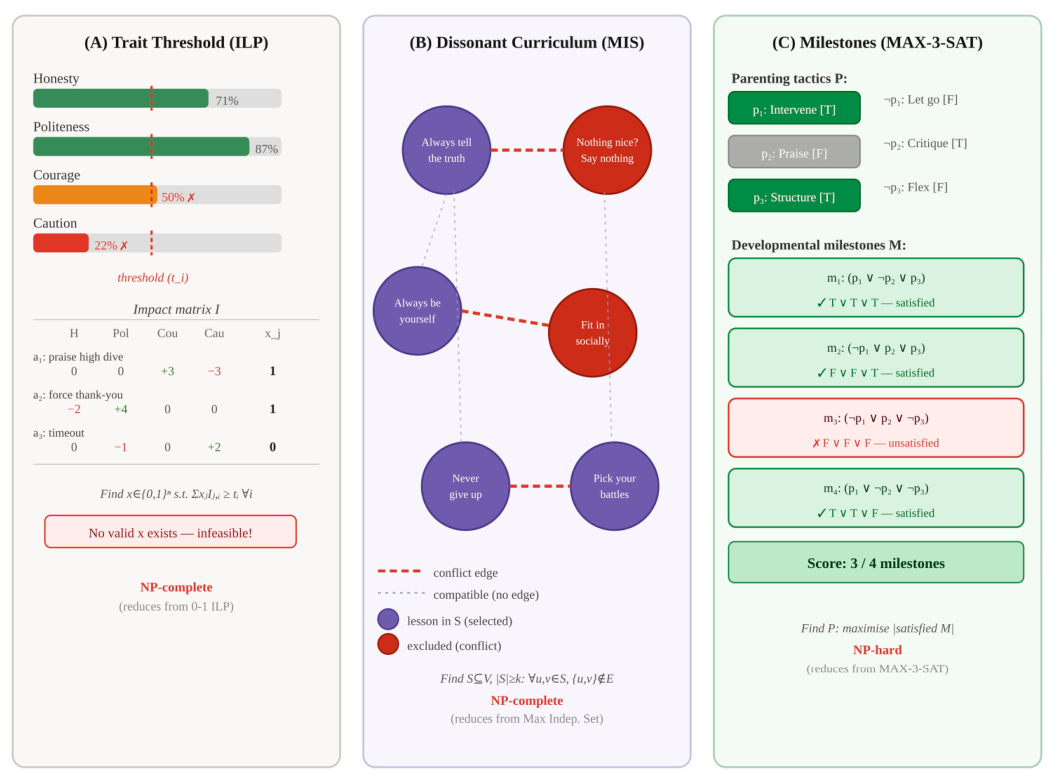
5. “Whac-A-Mole” Trait Optimisation (Integer Linear Programming). Parents attempt to instil a baseline level of various virtues (e.g., Honesty, Politeness, Courage, Caution). However, every parenting intervention has mixed effects. Praising a child for fearlessly jumping off the high dive increases Courage but severely depletes Caution. Forcing a child to thank a relative for a terrible gift increases Politeness but may critically damage Honesty. Finding a sequence of interventions that keeps all traits above a baseline threshold without any dropping into the negative (“sociopath”) range is a multidimensional optimisation puzzle.
6. The Dissonant Curriculum (Maximum Independent Set). Parents wish to impart the maximum number of life lessons on their child before they reach adulthood. Unfortunately, many essential lessons are logically contradictory when interpreted by a literal-minded child. Teaching “always tell the truth” creates a fatal graph edge with “if you don’t have anything nice to say, don’t say anything.” The parent is tasked with finding the largest possible subset of mutually compatible life lessons that can be taught without causing the child’s cognitive framework to topologically collapse.
These problems will be seen to be illustrative with little loss of generality at a formal level. The observant reader who is also a parent will recognise empirically that these examples generalise readily. While the focus in this list is on either tactical (daily) or strategic (moral development) goals, problems involving intermediate timescales (e.g., divorced parents negotiating summertime schedules) are of a rather similar character.
3. Formal Models of Parental Intractability
Having established the intuitive complexity of domestic life, we now formalize three core parenting challenges. By reducing known NP-hard problems to these formalized child-rearing models, we demonstrate that achieving the global optimum in parenting is computationally intractable for any deterministic Turing machine (and, by extension, any biological parent) operating in polynomial time.
3.1. The Vector Threshold Problem (Reduction from 0-1 ILP)
The Premise. A parent attempts to maintain a child’s psychological and moral profile above minimum societal standards. However, parenting interventions are non-orthogonal; enforcing one virtue frequently degrades another.
Formal Definition. Let V = {v1, v2, …, vm} be a set of m essential developmental traits. Let T = ⟨t1, …, tm⟩ be a target threshold vector, where each ti ∈ ℤ represents the minimum acceptable baseline for trait vi. Let A = {a1, …, an} be a set of n available parenting actions. Every action aj has an impact vector Ij ∈ ℤm, where Ij,i is the integer delta applied to trait vi if action aj is executed.

3.2. The Cognitive Dissonance Graph (Reduction from Independent Set)
The Premise. Parents aim to instil a comprehensive curriculum of life lessons. However, due to literalist childhood interpretations, many lessons are mutually exclusive. Teaching contradictory lessons simultaneously leads to critical system failures (tantrums).
Formal Definition. Let G = (V, E) be an undirected “Cognitive Dissonance Graph.” Let V be the set of all desirable life lessons. Let E be a set of edges representing logical contradictions: an edge e = {u, v} ∈ E exists if and only if teaching lesson u fatally conflicts with lesson v in the child’s processing logic.

3.3. The Double-Bind Problem (Reduction from MAX-3-SAT)
The Premise. Childhood milestones require a highly precise, often paradoxical combination of parental behaviors. Because these requirements are frequently at odds, a parent merely attempts to maximize the number of milestones achieved before the child reaches adulthood.
Formal Definition. Let P = {p1, …, pn} be a set of boolean parenting tactics (e.g., p1 = Intervene, ¬p1 = Allow natural consequences). Let M = {m1, …, mk} be a set of developmental milestones, each modeled as a disjunctive clause of exactly three tactics (positive or negative literals).

Figure 1.
Illustration of the three formal computational problems. (A) The Vector Threshold Problem (§3.1): a binary action vector x must push all trait levels (horizontal bars) above the red threshold lines; mixed positive/negative impacts make this equivalent to 0-1 ILP. The example shown is infeasible—Courage and Caution remain below threshold. (B) The Cognitive Dissonance Graph (§3.2): life lessons are vertices; red dashed edges denote logical conflicts. The goal is to find the largest independent set S (purple nodes) of mutually compatible lessons, with conflicting lessons (red) excluded. (C) The Double-Bind Problem (§3.3): boolean parenting tactics (green = TRUE, grey = FALSE) determine which milestone clauses are satisfied (green boxes) or not (red box). Maximising the number of satisfied milestones is equivalent to MAX-3-SAT.
Figure 1.
Illustration of the three formal computational problems. (A) The Vector Threshold Problem (§3.1): a binary action vector x must push all trait levels (horizontal bars) above the red threshold lines; mixed positive/negative impacts make this equivalent to 0-1 ILP. The example shown is infeasible—Courage and Caution remain below threshold. (B) The Cognitive Dissonance Graph (§3.2): life lessons are vertices; red dashed edges denote logical conflicts. The goal is to find the largest independent set S (purple nodes) of mutually compatible lessons, with conflicting lessons (red) excluded. (C) The Double-Bind Problem (§3.3): boolean parenting tactics (green = TRUE, grey = FALSE) determine which milestone clauses are satisfied (green boxes) or not (red box). Maximising the number of satisfied milestones is equivalent to MAX-3-SAT.

Proof Sketch. We reduce from 0-1 ILP. An instance asks if there exists x ∈ {0,1}n s.t. Mx ≥ b. We map columns of M to parenting actions A, rows to traits V, matrix entries to impact vectors Ij, and b to threshold vector T. Any 0-1 ILP instance maps directly to OPTIMAL-PARENTING-ILP, so the problem is NP-hard. Verifying a strategy x takes O(mn) time, placing it in NP. Therefore it is NP-complete. □

Proof Sketch. We reduce from Independent Set. Given G′ = (V′, E′), we map it to the Cognitive Dissonance Graph G, with life lessons corresponding to V′ and contradictions to E′. Finding a non-contradictory curriculum of size k is structurally identical to finding an independent set of size k. Thus OPTIMAL-PARENTING-MIS is NP-complete. □

Proof Sketch. We reduce from MAX-3-SAT. Boolean variables X map to parenting tactics P; clauses C map to milestones M. Maximising satisfied milestones is mathematically identical to solving MAX-3-SAT. Since 3-SAT is NP-complete, the optimization problem is NP-hard. □
4. Discussion
The categorization of Optimal Parenting as an NP-hard problem has profound implications not only for theoretical computer science, but for the psychological well-being of the modern family unit. By formally recognizing the domestic sphere as an intractable computational space, we can dismantle several pervasive societal myths and propose mathematically sound coping mechanisms.
4.1. The Futility of Technological “Cures”
In recent years, there has been a significant cultural push to “hack” or optimize parenting through technology. However, our proofs demonstrate that no amount of computational power can achieve the global optimum in child-rearing.
The Quantum Parenting Fallacy. It is a common misconception that future advancements in quantum computing might solve daily domestic chaos. However, it is widely theorized that NP-complete problems do not fall within the BQP (Bounded-error Quantum Polynomial time) complexity class. Therefore, even if a parent were equipped with a state-of-the-art quantum processor, they would still be unable to efficiently calculate the optimal bedtime negotiation strategy. Shor’s algorithm can factor large primes, but it cannot make a toddler eat a moderately bruised banana.
The Limits of Artificial Intelligence. Similarly, while Artificial Intelligence and deep Reinforcement Learning excel at pattern recognition, they fundamentally rely on approximation algorithms when faced with NP-hard environments. An AI attempting to optimize our “Double-Bind” model (Section 3.3) would inevitably get trapped in a local optimum—such as maximizing immediate peace by dispensing infinite screen time, thereby catastrophically failing the long-term “functional adult” metric. Thus, the Silicon Valley ethos of “disrupting” parenting is mathematically unfounded.
4.2. The Therapeutic Value of Intractability
Perhaps the most significant contribution of this paper is the potential for massive stress reduction in both parents and children. Modern parental burnout is largely driven by the false assumption that an exact, polynomial-time solution for perfect parenting exists, and that failing to find it is a result of user error.
By proving that OP is NP-hard, we mathematically absolve parents of this guilt. When a child exhibits contradictory behaviors, or a perfectly planned Saturday devolves into a screaming match in a grocery store parking lot, it is not a failure of parental execution. It is simply the universe enforcing its foundational computational limits. Acknowledging this intractability shifts the paradigm from “I am failing” to “I am operating a bounded Turing machine in a highly volatile, adversarial environment.” This conceptual shift can significantly lower domestic cortisol levels.
4.3. Constraint Relaxation: “Lowering Expectations” as a Valid Heuristic
In computer science, when an algorithm cannot solve an NP-hard problem in reasonable time, researchers turn to heuristic approaches and approximation algorithms, relaxing constraints to find a solution that, while not perfect, is “good enough” for production environments.
In the domestic sphere, this technique is colloquially known as “lowering expectations.” If solving the Exact Cover problem of daily nutritional, educational, and emotional requirements is computationally impossible, a parent must intentionally drop constraints to halt the infinite loop of anxiety.
- Serving cereal for dinner is not a parental defeat; it is a greedy approximation algorithm prioritizing immediate caloric intake over long-term macro-nutritional optimization.
- Allowing a child to leave the house wearing a superhero cape and rain boots in July is a textbook example of constraint relaxation, sacrificing the “aesthetic compliance” variable to successfully execute the “leaving the house” function.
We propose that these are not compromises, but necessary, scientifically validated strategies for navigating a computationally hostile environment.
5. Open Problems
The establishment of OP as NP-hard opens several critical avenues for future research in theoretical domestic computer science.
Two-Parent Households. The models presented in this paper assume a single-parent, single-child household—the simplest non-trivial case. Extending the framework to a two-parent household immediately introduces a cooperative (or non-cooperative) two-agent system in which both parents must jointly select an action vector x, potentially with conflicting utility functions, communication overhead, and negotiation costs. Whether the two-agent variant remains NP-hard, becomes harder, or admits polynomial-time approximations under cooperative assumptions is the first and most natural open problem in this field.
Adversarial Multi-Agent Systems (Siblings). Introducing one or more additional children transitions the environment into a non-cooperative, zero-sum game with decentralized, often adversarial, actors. We hypothesize that conflict resolution in multi-sibling environments may be PSPACE-complete, though a formal proof is required.
The “Grandparent” Offloading Algorithm. Future studies should investigate the computational latency and variable error rates associated with utilizing external, legacy mainframes (grandparents) for distributed child-rearing. We must model the trade-off between the CPU relief provided by a grandparent and the introduction of deprecated runtime instructions (e.g., “letting them eat ice cream for breakfast”).
Phase Transition Complexities. Anecdotal evidence strongly suggests that computational complexity spikes non-linearly during specific developmental windows. Formalizing the phase transition from the “Toddler Satisfiability” era into the “Teenage Cryptography” era—where the child’s internal state becomes fundamentally unobservable to the parent—remains a major open problem.
Evaluating the Approximation Ratios of Screen Time. We need rigorous mathematical bounds on the use of digital pacification as a greedy heuristic. At what precise threshold does the immediate computational relief (peace and quiet) become outweighed by the long-term technical debt (post-screen meltdowns)?
These and other problems will form the subject of future work.
6. Conclusions
In this paper, we have formally demonstrated that the pursuit of “Optimal Parenting” (OP) is an NP-hard problem. By systematically reducing classic computational challenges—specifically 0-1 Integer Linear Programming, the Maximum Independent Set, and MAX-3-SAT—to routine child-rearing scenarios, we have proven that the daily operational requirements of raising a human child exceed the processing capabilities of any deterministic Turing machine operating in polynomial time.
The profound exhaustion experienced by modern caregivers is therefore not a psychological failing, a lack of dedication, or a symptom of poor time management; it is a rigorous, mathematical certainty. Moving forward, society must pivot from demanding exact, flawless solutions from parents to embracing bounded approximations, constraint relaxation, and the mathematically validated heuristic of simply doing one’s best. More broadly, the nascent field of Theoretical Domestic Computer Science—of which this paper represents, to the best of the author’s knowledge, the founding contribution—requires and deserves further serious effort from the wider scientific community.
Acknowledgments
The author would like to thank Dan V. Nicolau, Sr. of McGill University for decades-long instruction and discussions that have been most helpful in the preparation of this manuscript; and to offer this paper as a belated present on the occasion of his recent birthday. The author would also like to thank Arjuna Nicolau for providing the inspiration for as well as substantial, practical anecdotal evidence for this paper.
References
- United Nations Department of Economic and Social Affairs, Population Division. World Population Prospects 2024: Summary of Results; UN DESA/POP/2024/TR/NO. 9; United Nations: New York, 2024. [Google Scholar]
- Baumrind, D. Child care practices anteceding three patterns of preschool behavior. Genet. Psychol. Monogr. 1967, 75, 43–83. [Google Scholar] [PubMed]
- Maccoby, E. E.; Martin, J. A. Socialization in the context of the family: Parent–child interaction. In Handbook of Child Psychology, 4th ed.; Hetherington, E. M., Ed.; Wiley: New York, 1983; vol. 4, pp. 1–101. [Google Scholar]
- Mikolajczak, M.; Gross, J.; Roskam, I. Parental burnout: What is it, and why does it matter? Clin. Psychol. Sci. 2019, 7, 1319–1329. [Google Scholar] [CrossRef]
- Engle, P. L.; Black, M. M. The effect of poverty on child development and educational outcomes. Ann. New York Acad. Sci. 2008, 1136, 243–256. [Google Scholar] [CrossRef] [PubMed]
- Magnuson, K. A. Maternal education and children’s academic achievement during middle childhood. Dev. Psychol. 2007, 43, 1497–1512. [Google Scholar] [CrossRef] [PubMed]
- Priest, N.; et al. Racism and health and wellbeing among children and youth: An updated systematic review and meta-analysis. Soc. Sci. Med. 2024, 362, 117400. [Google Scholar] [CrossRef] [PubMed]
- Séjourné, N.; et al. Parenting stress and parent support among mothers with high and low education. BMC Pregnancy Childbirth 2015, 15, 331. [Google Scholar]
- Roskam, I.; Raes, M.-E.; Mikolajczak, M. Exhausted parents: Development and preliminary validation of the Parental Burnout Inventory. Front. Psychol. 2017, 8, 163. [Google Scholar] [CrossRef] [PubMed]
- Mikolajczak, M.; Roskam, I. A theoretical and clinical framework for parental burnout: The Balance Between Risks and Resources (BR2). Front. Psychol. 2018, 9, 886. [Google Scholar] [CrossRef] [PubMed]
- Roskam, I.; Brianda, M.-E.; Mikolajczak, M. A step forward in the conceptualization and measurement of parental burnout: The Parental Burnout Assessment (PBA). Front. Psychol. 2018, 9, 758. [Google Scholar] [CrossRef] [PubMed]
Disclaimer/Publisher’s Note: The statements, opinions and data contained in all publications are solely those of the individual author(s) and contributor(s) and not of MDPI and/or the editor(s). MDPI and/or the editor(s) disclaim responsibility for any injury to people or property resulting from any ideas, methods, instructions or products referred to in the content. |
© 2026 by the authors. Licensee MDPI, Basel, Switzerland. This article is an open access article distributed under the terms and conditions of the Creative Commons Attribution (CC BY) license (http://creativecommons.org/licenses/by/4.0/).
Copyright: This open access article is published under a Creative Commons CC BY 4.0 license, which permit the free download, distribution, and reuse, provided that the author and preprint are cited in any reuse.


