

Submitted:
19 May 2026
Posted:
20 May 2026
You are already at the latest version
Abstract
This study investigates the provenance, weathering history, and tectono-sedimentary evolution of Lower Ediacaran siliciclastic rocks of the Imiter Formation (Saghro Group, Imiter Sub-inlier, Anti-Atlas, Morocco) deposited along the northern margin of Gondwana. An integrated approach combining petrography, whole-rock major and trace element geochemistry, rare earth elements (REE), Sm–Nd isotopes, and organic geochemistry (TOC and δ¹³Cₒᵣg) was used to constrain sediment sources and deposi-tional conditions. Geochemical proxies, including Th/Sc, La/Sc, and Zr/Sc ratios, to-gether with REE distribution patterns, indicate that the sediments were mainly derived from felsic to intermediate rocks of the upper continental crust, with only minor sedi-ment recycling. The negative εNd(t) values (−8.5 to −6.2) and Paleoproterozoic Nd model ages (1.6–2.1 Ga) further suggest erosion of evolved crustal sources related to the West African Craton. Weathering indices (CIA, CIW, PIA) suggest weak to moder-ate chemical weathering under predominantly arid conditions. Redox-sensitive proxies (V–Ni, V/Cr, V/(V+Ni)) and low TOC contents (0.1–0.3 wt.%) indicate deposition under mainly oxic to dysoxic conditions with only transient reducing episodes. Tectonic dis-crimination diagrams, supported by regional magmatism, point to sedimentation within an extensional basin evolving from active margin to continental rift conditions during the late Pan-African orogeny. The Imiter Formation records a system dominat-ed by crustal recycling, syn-rift tectonics, and dynamic redox conditions in a shallow marine environment.
Keywords:
Gondwana supercontinent
; Anti-Atlas basement
; neoproterozoic
; lower Ediacaran
; Saghro group
; geochemical proxies
; Sm-Nd isotopes
; total organic carbon (TOC)
; δ¹³Corg
1. Introduction
The geochemistry and isotopic composition of siliciclastic sedimentary rocks, particularly shales and sandstones, provide key constraints on sediment provenance, tectonic setting, and crustal evolution [1,2]. As products of weathering, erosion, and deposition, these rocks retain geochemical signatures reflecting both source lithology and surface processes [3,4]. Major, trace, and rare earth element (REE) systematics, together with their elemental ratios, are widely used to infer sediment provenance, paleoweathering intensity, and paleoclimatic conditions [5,6,7,8,9,10]. Ratios such as Th/Sc and La/Sc and REE fractionation patterns are particularly robust due to their relative immobility during weathering and diagenesis [1,2,11,12]. In addition, weathering indices such as Chemical Index of Alteration (CIA), Plagioclase Index of Alteration (PIA), and Chemical Index of Weathering (CIW) are widely applied to quantify source-area alteration [13,14,15]. Complementarily, Samarium–Neodymium (Sm–Nd) isotopes provide reliable constraints on sediment provenance, with epsilon neodymium value at time t [εNd(t)] distinguishing juvenile from evolved crustal sources and Nd depleted-mantle model ages (T_DM) recording crustal residence times [16,17,18].
Shales are commonly regarded as representative proxies for the average composition of the upper continental crust, including Post-Archean Australian Shale (PAAS), Upper Continental Crust (UCC), and North American Shale Composite (NASC) standards [3,19,20]. These deposits therefore constitute fundamental archives for reconstructing crustal composition and understanding sedimentary processes. In addition, because they form under variable climatic and redox conditions, they serve as valuable recorders of past environmental changes.
The Anti-Atlas belt in southern Morocco, located along the northern margin of the West African Craton (WAC), contains extensive Neoproterozoic sedimentary successions that record the evolution of sedimentary basins during this period. Among these units, the lower Ediacaran Saghro Group is particularly significant, although its depositional environment and exact age remain debated due to structural complexity and the strong overprint of Pan-African tectonic events [21,22,23,24,25]. Within this group, the Imiter Formation is composed mainly of relatively homogeneous siliciclastic rocks, including shales and sandstones. The absence of fossils, however, makes the reconstruction of its depositional environment particularly challenging.
The Imiter Formation of the Saghro Group represents an important geological archive for investigating sediment provenance, weathering conditions, and basin evolution along the northern margin of the West African Craton (WAC). It records the interaction between crustal reworking, magmatic activity, and basin development during the late stages of the Pan-African orogeny [22,26,27]. In this context, shales record time-integrated crustal signals whereas sandstones preserve more short-term source information, making the combined study of both lithologies especially valuable for provenance reconstruction.
This study presents new petrographic observations together with major and trace element data, Total Organic Carbon (TOC), stable carbon isotopic compositions of organic carbon (δ13Cₒᵣg), and Sm–Nd isotopic results from the lower Ediacaran Imiter Formation in the eastern Anti-Atlas of Morocco. The objectives are to (i) constrain sediment provenance and crustal evolution, (ii) determine the tectonic setting of basin development, (iii) assess paleoweathering intensity in the source area, and (iv) reconstruct paleoenvironmental and paleoredox conditions during deposition.
2. Geological Setting
2.1. The Anti-Atlas Belt
The Moroccan Anti-Atlas Mountains, located northwest of the West African Craton (WAC) (Figure 1a), represent a major segment of the Neoproterozoic orogenic belt surrounding the craton [28]. The belt is characterized by WSW–ENE trending inliers separated by the Anti-Atlas Major Fault (AAMF) (Figure 1b), defining two structural domains [29]. The southwestern domain is dominated by Paleoproterozoic basement rocks [30], whereas the northeastern domain belongs to the Pan-African belt and exposes Neoproterozoic successions. Both domains are unconformably overlain by Upper Ediacaran to Paleozoic sedimentary cover.
The Anti-Atlas basement consists of Paleoproterozoic crust (≈2.20–2.07 Ga) exposed mainly in the western and central sectors (Figure 1b), comprising metasedimentary rocks, paragneisses, migmatites, and granitoids [21,31,32,33]. The Taghdout Group (quartzites–carbonates–basalts), previously considered Neoproterozoic, is now partly reassigned to the Late Paleoproterozoic based on intrusion by 1710 Ma and 1639 Ma doleritic dykes and sill complexes [33,34,35]. Mesoproterozoic activity is restricted to intraplate mafic magmatism documented by U–Pb dating of baddeleyite-bearing dykes [22,36,37].
Neoproterozoic rocks records the Pan-African cycle and are subdivided into four units [22,31]: (i) Tachdamat–Bleïda Group (883 ± 2.3 Ma), a rift-related passive-margin sequence [35,38,39]; (ii) Bou-Azzer–Siroua ophiolitic and arc assemblages [28,33,40,41,42]; (iii) Lower Ediacaran siliciclastic basins of Saghro, Bou Salda, Anezi, and Tiddiline [24,43]; and (iv) Upper Ediacaran Ouarzazate Group, dominated by volcanic and plutonic rocks [21,44,45,46,47].
2.2. The Saghro Massif and the Imiter Sub–Inlier
The Saghro Massif (Eastern Anti-Atlas; Figure 2) consists of a deformed Lower Ediacaran siliciclastic basement (Saghro Group) affected by Late Pan-African deformation [27,49], overlain unconformably by Upper Ediacaran volcanic–plutonic rocks of the Ouarzazate Group [43,45,46,47,50]. These are locally overlain by Cambrian sedimentary sequences of the Taroudant–Tata Groups, with variable conformable to angular relationships [51,52].
The Saghro Group consists of up to 8000m of low-grade metamorphosed siliciclastic and volcaniclastic sequences deposited in a marine basin [27]. Coeval arc magmatism is represented by the Bouskour andesites in the western Saghro domain [27]. Detrital zircon U–Pb data from Saghro Group rocks constrain maximum depositional ages at 610 Ma and 604 ± 5 Ma, indicating a middle Ediacaran age [23,24,31]. However, the Igoudrane pluton, which intrudes the shale-dominated Tachkakkacht Formation of the Saghro Group, yields zircon crystallization ages of 677 ± 19 Ma [53] and 575 ± 10 to 538 ± 6 Ma [50]. These data imply that deposition of the Saghro Group predates 677 Ma, prior to emplacement of the pluton. Nevertheless, additional geochronological constraints are required to confirm the significance and reliability of the 677 Ma age.
The overlying Ouarzazate Group (580–550 Ma) forms a thick volcano-sedimentary and plutonic province emplaced during late Pan-African extension and magmatism [24,27,34,50,54], and is temporally associated with hydrothermal systems responsible for Ag mineralization in the Imiter district [55].
The Imiter Sub-inlier (NE Saghro; Figure 2 and Figure 3) comprises deformed siliciclastic rocks of the Saghro Group hosting Hg–Ag mineralization [27,58,59], and unconformably overlain by the Ouarzazate volcanic rocks, while being intruded by late Ediacaran subvolcanic and plutonic bodies [24,27,46,49,60]. At Imiter, the Saghro Group comprises four stratigraphic formations, from base to top: (i) the Bou Teglimt Formation, dominated by sandstone; (ii) the Izemgane Formation, characterized by sandstones and shales; (iii) the Tachkakkacht Formation, consisting mainly of shales; and (iv) the Imiter Formation (the main focus of this study), which is predominantly composed of shales.
3. Materials and Methods
3.1. Sampling
A total of 264 samples were obtained from drill cores obtained from four boreholes: SFC2904 (Imiter West; 63 samples), IC732 (Imiter Centre; 47 samples), SFC2877 (Imiter East; 139 samples), and IC954 (Imiter South; 14 samples). The samples comprise shales and sandstones from the Imiter Formation of the Saghro Group. The location of the four boreholes are shown in Figure 3, and sampling depths are provided in tables S1 and S2 of the Supplementary Materials. In addition, 20 surface samples reported by [27] were incorporated into the dataset for comparison.
3.2. Whole-Rock Geochemistry
Samples (1–2 kg each) were systematically collected along the four drill cores, targeting well preserved, unaltered intervals with minimal evidence of fluid circulation to ensure representativeness of the primary sedimentary signatures. To minimize contamination, all samples were crushed and pulverized using agate mills.
Whole-rock geochemical analyses were performed on samples from three drill cores SFC2904 (Imiter West), IC732 (Imiter Centre), and SFC2877 (Imiter East) at the Research, Mining and Exploration Centre (REMINEX) of Managem Group, Morocco. Samples from the IC954 drill core (Imiter South) were analyzed at Analytical Laboratory Services (ALS) Global Laboratories (North Vancouver, Canada), in collaboration with Carleton University, for major and trace elements, as well as rare earth elements (REE).
At the Research, Mining and Exploration Centre (REMINEX), Managem Group (Morocco), powdered rock samples (~1,000 mg) from the three drill cores (SFC2904, IC732, and SFC2877) were analyzed for major elements by X-ray fluorescence (XRF) using a MagiX XRF spectrophotometer equipped with a rhodium (Rh) target X-ray tube operated at 2.4 kW. Data acquisition and instrument control were performed using SuperQ: XRF Analysis Software (Version 3). Major element concentrations were determined on fused glass beads prepared by mixing the powdered samples with lithium tetraborate (Li2B4O7) and lithium metaborate (LiBO2), with lithium bromide (LiBr) added as a releasing agent. Fusion was carried out in platinum crucibles at 1200 °C, followed by cooling and casting into glass beads using platinum molds. Loss on ignition (LOI) was measured at 1000 °C prior to fusion.
Trace element concentrations were measured using inductively coupled plasma–atomic emission spectrometry (ICP–AES) with an Ultima 2C instrument. Before analysis, 5 g of powdered sample was dried at 180 °C for 2 hours. A representative aliquot (0.5 g) was then mixed with 2.5 g of sodium peroxide (Na2O2) in zirconium crucibles and fused at 450 °C for 45 min. The resulting melt was dissolved in a solution of 50 mL deionized water and nitric acid (HNO3, 28–34%) prior to instrumental analysis. Full precision data are provided in table S1 of the Supplementary Materials.
Additional geochemical analyses of drill core IC954 were conducted at ALS Global Laboratories (North Vancouver, Canada). Samples were fused then dissolved in nitric acid. Major elements were determined by ICP–AES, while trace elements and rare earth elements (REE) were determined using inductively coupled plasma–mass spectrometry (ICP–MS). Detailed analytical procedures, detection limits, and calibration protocols are available from ALS Global Laboratories (https://www.alsglobal.com ). Analytical quality control was maintained using internal and international reference materials, including a Carleton in-house basalt standard (10-LT-05) and the USGS reference material BHVO-2 [67,68]. Replicate analyses indicate analytical precision better than ±2% for major elements and ±5% for trace and REE. Full precision data are provided in Table S2 of the Supplementary Materials.
3.3. Sm Nd Isotopes
For Sm-Nd isotopic analysis, between 100 and 200 mg of sample powder (drill core IC954) are weighed into a screw-cap Teflon vial, to which a mixed 148Nd-149Sm spike is added. The powder-spike mix is dissolved in HNO3-HF, then further attacked with HNO3 and HCl until no residue is visible. The bulk REE are separated by cation chromatography (Dowex 50-X8) using 2.5N HCl and 6N HCl. The REE-bearing residue is dissolved in 0.26N HCl and loaded into an Eichrom Ln-Spec chromatographic column containing Teflon powder coated with HDEHP [di(2-ethylhexyl) orthophosphoric acid; [69]. Nd is eluted using 0.26N HCl, followed by Sm in 0.5N HCl. All isotope ratios were determined on a Thermo-Finnigan NEPTUNETM MC-ICP-MS. Nd residue were dissolved in 2% HNO3 and an aliquot was added to a 1.5 ml centrifuge tube containing 1ml of 2% HNO3 to yield a final concentration of 0.2 ppm. Isotope ratios are normalized to 146Nd/144Nd = 0.72190. Total procedural blanks for Nd are < 100 picograms. The laboratory average 143Nd/144Nd for the JNdi-1 standard is 0.512085 +/- 0.000011 (n=46, July 2019-August 2021), and all analyses have been normalized to the accepted value for the JNdi-1 standard of 0.512100 [70]. Analyses of the USGS standard BCR-2 yield Nd = 28.41 ppm, Sm = 6.53 ppm, and 143Nd/144Nd = 0.512626 + 0.000006 (n=8). The BCR-2 sample analyzed in this study yielded a 143Nd/144Nd = 0.512618 +/- 0.000007, and agrees well with accepted values [71]. All analytical uncertainties are 2-sigma standard deviations of the mean of ~90 scans. Sm residues were dissolved in 2% HNO3 and an aliquot was added to a 1.5 ml centrifuge tube containing 1ml of 2% HNO3 to yield a final concentration of 0.2 ppm, followed by analysis with the MC-ICP-MS. Uncertainties in all Nd and Sm concentrations are +/- 1%, but uncertainties in the 147Sm/144Nd are < 0.5% based on replicate runs (see Table S3 of the Supplementary Materials).
Epsilon values at time T are calculated using the following relation:
where CHUR is the Chondrite Uniform Reservoir (0.512630); [72], the decay constant (λ) is 6.54 × 10⁻¹² y-1, and T is generally the time the rock was formed. Depleted mantle model ages (TDM) are calculated assuming a modern upper mantle with 147Sm/144Nd = 0.214 and 143Nd/144Nd = 0.51315 [73]. The initial 143Nd/144Nd, ƐNd(t) values, and ages TDM for the Imiter Formation were calculated using the depositional age of t = 604 Ma based on data from [23,66].
εNd(t) = [(143Nd/144NdsampleT / 143Nd/144NdCHURT)-1] * 10000
3.4. Total Organic Carbon (TOC) and Organic Carbon Isotope (δ13Corg) Measurements
To quantify organic carbon abundance and composition, total organic carbon (TOC) contents and organic carbon isotopic compositions (δ13Corg) were measured on 14 shale and sandstone samples collected at different depths from drill core IC954 within the Imiter Formation of the Saghro Group, south of the Imiter Silver Mine (see Table S4 of the Supplementary Materials). This core was selected due to its relatively distal position from the mining area, thereby minimizing potential overprinting by hydrothermal fluid circulation.
Total organic carbon (TOC) concentrations and carbon isotope ratios were measured at the Department of Earth and Planetary Sciences, University of California, Riverside (USA), using a Costech 4010 Elemental Analyzer (EA) coupled to a Thermo Finnigan Delta V Advantage isotope-ratio mass spectrometer via an open-split interface (ConFlo IV, Thermo Finnigan). C isotope ratios are reported in delta notation and per mil units relative to international standards on the Vienna-Pee Dee Belemnite (V-PDB) scale. Sample nomalization was performed using the two-point calibration described in [74]. Two intralaboratory standards (acetylene and glycine) were analyzed before, between, and after unknowns in each run. A calibration line was calculated for each run by least-squares linear regression using the known and measured carbon isotope values of the calibration standards. To monitor the quality of sample preparation and analysis performance, the international standard USGS Devonian Shale SDO-1 (δ13Corg = -30.0 ± 0.1‰ V-PDB) was treated and analyzed as an unknown. Replicate analyses of the SDO-1 standard yielded the δ13Corg value of -30.0 ± 0.1‰ (n=24). Samples were analyzed in triplicates and average values are reported in Table S4 of the Supplementary Materials.
δ13C (‰) = [((13C/12C)Corganic/(13C/12C)VPDB) −1] × 1000
3.5. Data Analysis and Geochemical Proxies
The geochemical data were processed using ioGAS™ Geochemistry Software (https://www.imdex.com/software/iogas ). One of the main objectives of the whole -rock geochemistry was to evaluate key geochemical proxies providing constraints on provenance and recycling, paleoclimate and paleoweathering, as well as redox conditions [75].
This study integrates multiple complementary geochemical proxies to assess rock composition and to reconstruct both depositional and post-depositional processes.
The Al2O3/TiO2 ratio was employed to estimate the SiO2 content of the source rocks using the equation of [76]: SiO2 (wt%) = 39.34 + 1.2578 (Al2O3/TiO2) − 0.0109 (Al2O3/TiO2)2.
The Index of Compositional Variability (ICV) was calculated to quantify compositional heterogeneity among major oxides. The ICV was computed as:
ICV = (Fe2O3 + K2O + Na2O + CaO + MgO + MnO) / Al2O3 [77].
Chemical weathering intensity was evaluated using the Chemical Index of Alteration (CIA) [13]:
CIA = 100 × [Al2O3 / (Al2O3 + CaO* + Na2O + K2O)].
where CaO* represents the silicate fraction of calcium, corrected as:
Plagioclase Index of Alteration (PIA): PIA= [(Al2O3 - K2O)/(Al2O3 + CaO* + Na2O)] * 100 [78].
In addition, the Chemical Index of Weathering (CIW) [79] was used to further constrain weathering processes:
CIW = [Al2O3 / (Al2O3 + CaO + Na2O)] × 100.
Whole-rock geochemistry provides widely used proxies for reconstructing redox conditions in sedimentary environments, based on the behavior of redox-sensitive elements and their enrichment relative to detrital backgroundCommonly used elemental ratios include V/Cr, V/(V+Ni), Ni/Co, and U/Th. High values of V/Cr, V/(V+Ni), and Ni/Co are generally associated with reducing to anoxic depositional conditions, whereas elevated U/Th ratios typically indicate authigenic uranium enrichment under low-oxygen environments [80,81,82,83,84,85].
Together, these approaches provide a robust framework for interpreting sediment provenance, the extent of sediment recycling, weathering intensity, and prevailing paleoclimatic conditions.
4. Results
4.1. Drill Core Logging and Stratigraphic Correlation
Near the Imiter Silver Mine, the Imiter Formation of the Saghro Group is dominated by siliciclastic deposits. These successions, although only mildly deformed, comprise approximately 2,000 to 8,000 m of flysch-like turbiditic sequences [26]. These sequences record multiple deformation events, which contribute to its pervasive schistosity and the difficulty in recognizing clear sedimentary patterns [49], characterized by two main facies associations: dominant shales and subordinate sandstones.
Figure 4 (a) illustrates the typical surface expression of these rocks, whereas Figure 4 (b, c and d) shows their subsurface appearance in drill cores (borehole IC954, Imiter South). Figure 5 presents the stratigraphic columns logged from drill cores through the Imiter Formation, from west to east: borehole SFC2904 (Imiter West), borehole IC732 (Imiter Centre), and borehole SFC2877 (Imiter East), as well as borehole IC954 (Imiter South). These logs reveal a regionally developed unconformity separating the conglomerates of the overlying 580–538 Ma Ouarzazate Group from the underlying shales and sandstones of the 610–604 Ma Imiter Formation. The Imiter Formation is locally intruded by mafic to andesitic dykes and granitoid bodies, indicating significant post-depositional magmatic overprinting of the sedimentary sequence.
The drill core from borehole SFC2904 (Imiter West), with a thickness of 62.5 m, is dominated by shales and fine-grained sandstones, particularly toward the upper part of the succession. It is notably enriched in argentiferous mineralization. Borehole IC732 (Imiter Centre), with a thickness of 124 m, is also predominantly composed of shales and locally cuts mafic and andesitic dykes ranging in thickness from approximately 3 m to 15 m. It is also notably enriched in argentiferous mineralization. Borehole SFC2877 (Imiter East), with a total thickness of 326.5 m, is characterized by coarse-grained sandstones at its base. This succession also includes mafic dykes as well as a metre-scale granitoid intrusion. Borehole IC954 (Imiter South), with a thickness of 151 m, is dominated by shales at its base and by sandstones toward the top, and also contains a few mafic dykes.
Stratigraphic correlations are primarily established between the three northern and central boreholes (SFC2904, IC732, and SFC2877), which display broadly comparable lithostratigraphic architectures. In contrast, borehole IC954 (Imiter South) is more difficult to correlate with the others due to its more distal southern position and its distinct lithological succession.
4.2. Petrography and Mineralogy of Imiter Shales and Sandstones
Shale samples are predominantly composed of quartz, feldspar, and biotite, with minor amounts of pyrite locally observed. Quartz occurs in both monocrystalline and polycrystalline forms and is the most abundant mineral phase. Potassium feldspars (orthoclase, microcline, and perthite) are less common than plagioclase. Lithic fragments derived from plutonic, sedimentary, and metamorphic sources are also present. Muscovite is a common accessory mineral, accompanied by subordinate phases such as apatite, zircon, tourmaline, and titanium oxides (see Figure 6).
Sandstone samples are dominated by fine-grained quartz (60–65%), typically sub-angular and showing straight to undulatory extinction. Feldspars (orthoclase and plagioclase) are present but commonly exhibit signs of alteration. Lithic fragments make up approximately 10–15% of the framework. A fine-grained matrix envelops the detrital grains and occupies the spaces between them, pointing to strong mechanical compaction.
Petrographic observations also reveal a well-developed slaty cleavage (S1), oriented parallel or slightly oblique to the primary sedimentary bedding (S0). This cleavage develops within a fine-grained matrix that shows textural heterogeneity across different microstructural domains.
4.3. Elemental Geochemistry and Sm-Nd Isotopes of Imiter Shales and Sandstones
4.3.1. Major Elements
In the Herron diagram [79], the SiO2/Al2O3 ratio reflects the proportion of quartz relative to aluminosilicates (clays and feldspars), with high values indicating quartz-rich, compositionally mature sediments and low values indicating clay- and feldspar-rich compositions. The Fe2O3/K2O ratio represents the balance between Fe-bearing phases and K-bearing silicates (K-feldspar and illite): high values characterize Fe-rich, shale-like compositions, whereas low values indicate K-feldspar–rich, arkosic sandstones.
When plotted on this diagram, samples from the Imiter Formation are predominantly classified as shales and wackes, with a few plotting in the Fe-shale, litharenite, and sublitharenite fields (Figure 7). In contrast, surface samples of the same Formation reported in the literature [27] fall mainly within the arkose field.
The major element compositions of shales and sandstones from the Imiter Formation (Saghro Group, Eastern Anti-Atlas) are provided in tables S1 and S2 of the supplementary materials. SiO2 (~39.9–75.1%) shows a wide range, with higher contents in sandstones (>60%) and lower, more variable values in shales, whereas Al2O3 (~4.1–21.5%) is relatively enriched in shales. Fe2O3 (~0.2–11.6 wt%) and MgO (~0.6–11.4%) display broad variability without clear lithological control. CaO (~0.3–19.3 t%) is generally low but locally elevated, while alkali oxides are variable, with K2O (~0.01–6.1%) slightly higher in shales and Na2O (~0.01–5.8%) showing no systematic trend. TiO2 (~0.15–1.03%) and P2O5 (~0.07–2.77%) remain low, and MnO (~0.02–0.71%) is minor. The geochemistry is dominated by SiO2 and Al2O3, while Fe2O3, MgO, and alkali oxides occur in lower proportions, reflecting sediment maturity and the clear distinction between shale and sandstone facies.
4.3.2. Trace Elements
To assess variations in trace element concentrations in shales and sandstones of the Imiter Formation, values of the Upper Continental Crust (UCC) [20] were used as a reference. The data in tables S1 and S2 of the supplementary materials show significant variability relative to UCC.
Lithophile elements with large ionic radii (LILE), such as Rb, Ba, and Sr, exhibit wide variations in composition. The concentrations of Rb (~34–108 ppm) and Ba (~4.1–1,958 ppm) are generally higher in shales than in the Upper Continental Crust (UCC), whereas Sr (~0.6–509 ppm) exhibits more variable behavior in both lithologies, with no systematic enrichment or depletion. Large ion lithophile elements (LILE), notably Rb, Ba, and Sr display particularly wide dispersion. Rubidium (~34–108 ppm) and barium (~4.1–1958 ppm) are, in general, substantially enriched within shale units relative to UCC norms, although their enrichment is far from uniform. Strontium (~0.6–509 ppm), in contrast, behaves erratically: it oscillates between depletion and apparent enrichment in both lithologies, resisting any simple or consistent geochemical trend.
A similarly heterogeneous signal emerges from the high field strength elements (HFSE). Zirconium (~0.3–478 ppm), hafnium (~4.45–5.45 ppm), niobium (~4–55 ppm), and thorium (~6–155 ppm) collectively exhibit broad variability, yet Zr and Hf stand out in particular. These two elements tend to be relatively enriched in sandstones when compared with UCC values, a pattern most plausibly linked to the mechanical concentration of heavy mineral phases during sedimentary sorting processes.
Transition elements add another layer of complexity. Chromium (~0.5–285 ppm), nickel (~0.2–951 ppm), and vanadium (~0.5–213 ppm) are distributed in a highly irregular manner, with concentrations that frequently oscillate around crustal averages and, in certain localized intervals, exceed them by a considerable margin. This patchy behavior suggests multiple controls, including provenance heterogeneity and post-depositional modification.
Taken together, the trace-element systematics reveal a non-uniform pattern of enrichment and depletion relative to UCC standards. More significantly, they highlight a clear geochemical dichotomy between shale and sandstone units within the Imiter Formation, reflecting distinct sedimentary and mineralogical processes governing each lithology.
4.3.3. Rare Earth Elements (REE)
The data on rare earth elements (REE) presented here are derived exclusively from samples taken from drill core IC954, located in the southern part of the Imiter silver mine.
The samples show relatively high total rare earth element (ΣREE) concentrations, ranging from 114.33 to 216.22 ppm, with an average of 170.92 ppm. Heavy rare earth elements (ΣHREE) range from 28.28 to 55.18 ppm, with an average of 39.3 ppm, while light rare earth elements (ΣLREE) exhibit a wider range, from 86.05 to 176.68 ppm, with an average value of 131.6 ppm.
When normalized to the Post-Archean Australian Shale (PAAS) [3], the REE patterns (Figure 8a) exhibit relatively consistent distributions with moderate fractionation, suggesting a compositional affinity with average shale values. In comparison, normalization to the Upper Continental Crust (UCC) [20] (Figure 8b) reveals more pronounced fluctuations, indicating slight variations in source composition and/or post-depositional processes.
Overall, the REE patterns are characterized by coherent trends with limited dispersion. Most samples plotted are shale lithologies, except for samples 4005281, 4005348, 4005387, and 4005388, which are identified as sandstones. The samples in Diagram normalized to the PAAS, are characterized by a low La/Sm ratio, a gradual decrease in light rare earth elements (LREE) and heavy rare earth elements (HREE), and a positive Eu anomaly. Furthermore, HREE concentrations appear to be relatively more enriched in the UCC than in the PAAS. This difference could suggest a distinct mineralogical influence, possibly related to a higher zircon content in the PAAS compared to the UCC.
4.3.4. Sm-Nd Isotopes
The Sm–Nd isotopic compositions of samples from borehole IC954 are reported in table S3 of the supplementary materials. The isotopic data show limited variability and no systematic distinction between sandstone and shale lithologies. Initial 143Nd/144Nd ratios range from 0.511424 to 0.511542 (mean = 0.511491), while 147Sm/144Nd ratios vary from 0.095041 to 0.131198 (mean = 0.116729).
All samples display negative εNd(t) values, ranging from −6.21 to −8.50, with corresponding TDM model ages between 1.58 and 2.09 Ga and ƒSm/Nd values from −0.5168 to −0.3330 (Table S3 of the supplementary materials).
Despite the overall isotopic homogeneity, subtle geochemical differences are observed between lithologies. Sandstones are characterized by higher SiO2 contents, stronger enrichment in light rare earth elements (LREE; reflected by higher La/Yb and ΣLREE/ΣHREE ratios), and slightly more negative εNd(604 Ma) values compared to shales (Figure 9a, b). However, TDM model ages are broadly similar for both lithologies (~1.6–2.0 Ga), implying derivation from a common crustal source.
Furthermore, the absence of correlation between εNd(t) and La/Yb or ΣLREE/ΣHREE ratios indicates that Nd isotopic compositions are largely independent of REE fractionation processes and instead reflect source characteristics.
4.3.5. Total Organic Carbon (TOC) and Organic Carbon Isotope (δ13Corg)
Total organic carbon (TOC) contents and organic carbon isotopic compositions (δ13Cₒᵣg) were determined for 14 samples collected at different depths from drill core IC954 within the Imiter Formation (Saghro Group), located south of the Imiter Silver Mine (see table S4 in the supplementary materials).
The TOC contents of all analyzed samples are uniformly low, ranging from 0.1 to 0.3 wt.%. Although these lithologies have been described as “black shales” in previous studies [27], their organic carbon contents fall well below the commonly accepted geochemical threshold for true black shales. Such rocks are typically defined as fine-grained, often laminated sediments with TOC values exceeding 0.5 wt.%, and more commonly in the range of 1–10 wt.%. In exceptionally organic-rich or metalliferous black shales, TOC contents may reach values higher than 10–25 wt.% [87,88]. Accordingly, the studied samples are better classified as organic-lean shales rather than true black shales.
The δ13Cₒᵣg values are consistently depleted, ranging from −27.7 to −25.6‰ (VPDB).
5. Discussion
5.1. Sediment Provenance and Crustal Evolution
5.1.1. Geochemical Constraints on Provenance, Sedimentary Processes and Source Composition
The integrated whole-rock geochemical dataset, including major, trace, and rare earth elements, provides a reliable basis for interpreting sediment provenance and depositional processes [89]. In igneous rocks, aluminum is commonly linked to feldspar abundance, whereas titanium is mainly hosted in mafic minerals such as biotite, ilmenite, pyroxene, and amphibole. As a result, the Al2O3/TiO2 ratio generally increases with increasing SiO2 content [90]. Felsic igneous rocks, typically containing 66–76 wt.% SiO2, usually show Al2O3/TiO2 ratios between 21 and 70. Intermediate rocks, with 53–66 wt.% SiO2, commonly display ratios from 8 to 21, whereas mafic rocks, characterized by less than 52 wt.% SiO2, generally have lower ratios ranging from 3 to 9 [76,91,92].
Figure 10 presents two complementary discrimination diagrams used to constrain the bulk composition and provenance of the Imiter siliciclastic rocks. In the SiO2 versus Al2O3/TiO2 diagram (Figure 10a), most shale samples form a coherent cluster within the intermediate compositional field (SiO2 ≈ 52–62 wt.%), with only limited variation in Al2O3/TiO2 ratios. A few samples extend toward lower SiO2 contents, approaching the mafic field. In contrast, the sandstone samples consistently display higher SiO2 values (≈ 65–75 wt.%) and plot mainly within the felsic domain, although with slightly greater variability in Al2O3/TiO2 ratios. The literature data from [27] closely match the new dataset, supporting the consistency of these compositional trends in the drill cores.
The Al2O3–TiO2 diagram (Figure 10b) further refines these interpretations. Most shale and sandstone samples define a well-constrained linear trend between granodioritic and granitic compositions. Only a small number of samples show a slight shift toward the mafic to ultramafic fields, without reaching gabbroic or peridotitic end-members. Overall, the absence of strong ultramafic or mafic signatures, together with the clustering of samples near the granodiorite–granite trends, points to a predominantly felsic source for the Imiter sediments.
Taken together, these diagrams suggest that the sediments of the Imiter Formation were mainly derived from intermediate to felsic upper crustal sources, with a significant contribution from granitoid rocks. The shale samples reflect a more homogenized, compositionally averaged source, consistent with sediment recycling and mixing processes, whereas the sandstones retain a stronger felsic signature, likely reflecting more proximal or less mixed detrital inputs.
The lack of significant overlap with mafic or ultramafic fields indicates that juvenile, mantle-derived sources played only a minor role in sediment supply. Instead, the geochemical trends point to erosion of evolved continental crust, including granodioritic to granitic terranes. The slight shift of some samples toward mafic and ultramafic fields may reflect minor inputs from intermediate igneous rocks or variations in heavy mineral concentration during transport and sediment sorting.
Overall, Figure 10 supports a model in which the Imiter Basin was primarily fed by detritus derived from evolved continental crust, consistent with an upper crustal provenance and very limited contribution from primitive or oceanic sources.
Immobile trace elements such as Th, Sc, Zr, and Hf are widely used in provenance studies because they are relatively resistant to chemical weathering, diagenesis, and low-grade metamorphism [97].
Figure 11 combines three complementary trace-element discrimination diagrams that help clarify the provenance, compositional variability, and degree of sediment recycling affecting the siliciclastic rocks of the Imiter Formation.
In the Th/Sc versus Zr/Sc diagram (Figure 11a), the samples define a coherent trend marked by generally low to moderate Zr/Sc ratios and a progressive increase in Th/Sc. Most shale and sandstone samples fall within an intermediate field between mafic (basaltic) and felsic end-members. By contrast, the literature data from [27] are more strongly shifted toward the felsic domain, pointing to a dominant contribution from felsic upper continental crust sources.
The limited dispersion along the Zr/Sc axis suggests only minor zircon enrichment and therefore a relatively low degree of sediment recycling and sorting. Moreover, the alignment of the samples along a compositional trend, rather than a typical recycling vector, indicates that bedrock composition was the main control on trace-element signatures.
Samples from borehole IC954 show no clear evidence of sediment recycling and plot close to the felsic end of the andesite–felsic trend, supporting a predominantly felsic provenance for the Imiter Formation shales. In contrast, several samples from [27] display higher Zr/Sc ratios and plot nearer to the mafic end-member, suggesting a more variable contribution from magmatic and metamorphic sources.
The Co/Th versus La/Sc diagram (Figure 11b) further refines the interpretation of source-rock composition. The Imiter samples mainly fall within the felsic magmatic field, characterized by low Co/Th and moderate La/Sc ratios. Their clear separation from basaltic and andesitic fields reinforces a dominantly felsic provenance with a limited contribution from intermediate sources. The relatively tight clustering of shale samples points to a homogeneous source compared to the slightly more dispersed sandstone data indicating minor variability, potentially linked to limited mixing with mafic inputs or grain-size–dependent sorting during transport.
Additional constraints are provided by the La/Th versus Hf diagram (Figure 11c), which is particularly sensitive to both source-rock type and sediment recycling processes. Most samples plot within or close to the felsic arc source field, although a few extend toward the mixed felsic–mafic domain. The generally low Hf contents and moderate La/Th ratios support derivation from felsic igneous rocks, with limited enrichment in heavy minerals such as zircon.
The absence of a clear shift toward the passive margin field suggests that extensive sediment recycling and derivation from mature cratonic sources were not dominant. Instead, the data point to relatively proximal source areas, likely associated with an active continental margin or arc-related setting.
Overall, these discrimination diagrams consistently indicate that the siliciclastic rocks of the Imiter Formation were mainly sourced from felsic upper continental crust with only a limited contribution from intermediate sources, most likely linked to arc or active margin terranes. Although contributions from mafic sources are present, they remain subordinate, indicating a mixed provenance in some intervals. Sediment recycling appears to have played a minor role, with only limited zircon enrichment, suggesting relatively short transport distances and minimal reworking. This integrated geochemical signature is therefore consistent with erosion of felsic arc-related crust in an active margin tectonic setting, with minor input from mafic lithologies.
5.1.2. Sm–Nd Isotopic Constraints on Sediment Provenance and Crustal Evolution
The Sm–Nd isotopic data from the Imiter Formation provide key insights into sediment provenance and the crustal evolution of the Imiter Basin [4,101,102]. Figure 12a illustrates the relationship between εNd(t) values and Nd model ages (TDM) for the Imiter samples (this study), compared with representative igneous and metasedimentary rocks from various Anti-Atlas inliers.
The Imiter samples are characterized by consistently negative εNd(t) values (approximately −8.5 to −6.2) coupled with Paleoproterozoic model ages (~1.7–2.1 Ga). This isotopic signature points to a dominant contribution from old continental crust of the West African Craton, rather than juvenile mantle-derived material.
The clustering of the Imiter Formation data within the Paleoproterozoic field, close to the compositions of Kerdous granitoids and metapelites, suggests that these lithologies were the primary sediment sources. In contrast, more radiogenic εNd(t) values (≥ 0) observed in some Zenaga and Bas Drâa granitoids reflect more juvenile crustal inputs, which are only weakly represented in the Imiter sediments. The lack of strongly positive εNd(t) values further indicates that direct contributions from depleted mantle-derived material during sedimentation were minimal.
Figure 12b further refines this interpretation using the ƒSm/Nd versus εNd(t) diagram [103]. The Imiter samples show negative ƒSm/Nd values (−0.5 to −0.3) together with negative εNd(t), and plot mainly within or close to the field of LREE-enriched sources. This pattern is consistent with derivation from evolved continental crust, where long-term fractionation processes have led to enrichment in light rare earth elements.
Overall, the Imiter Formation samples fall outside both the “Archean crust” and “arc rocks” fields and are clearly distinct from the MORB field, which is characterized by more positive εNd(t) values and less fractionated isotopic signatures.
The comparison with regional datasets reveals a strong isotopic similarity between the Imiter siliciclastic rocks (610-604 Ma) [23,66] and the Kerdous (583 Ma) [104] and Imiter granitoids (between 582 and 538 Ma) [50,53,55,62], suggesting that erosion of these crustal blocks provided a major part of the detrital input. The slight shift toward less negative εNd(t) values in some samples may reflect minor contributions from more juvenile sources, potentially linked to Neoproterozoic magmatic activity associated with rifting.
Overall, the Sm–Nd isotopic data indicate that the Imiter basin was predominantly fed by erosion of Paleoproterozoic continental crust, with only limited input from juvenile mantle-derived magmas. This interpretation is consistent with the sedimentary geochemical signatures discussed below (see section 5.2. Tectonic Setting), which point to mixed but dominantly recycled continental sources. When integrated with the regional volcanic geochemistry indicating a rift-related setting for the Imiter Formation, the isotopic data support a model in which sedimentation occurred in an extensional basin developed on an older continental basement. In this context, syn-rift magmatism may have contributed locally to the sediment budget, but did not dominate the isotopic signature, which remained largely controlled by erosion of pre-existing crust.
Figure 13 illustrates the temporal evolution of εNd values for the Imiter siliciclastic samples (shales and sandstones) based in measured 147Sm/144Nd compared to model evolution of the Depleted Mantle (DM) [17] and the Chondritic Uniform Reservoir (CHUR) [16]. The data define a series of linear isotopic evolution trends that project backward in time toward a relatively narrow range of intersection points between the CHUR and DM curves.
The εNd values of the samples evolve with a steep slope over time due to their low 147Sm/144Nd, indicating derivation from evolved crustal sources with a long-term history of light rare earth element (LREE) enrichment rather than juvenile mantle-derived material. The broadly parallel trends of the samples imply similar Sm/Nd ratios across the siliciclastic units, pointing either to a relatively homogeneous source or to well-mixed sediment inputs.
Importantly, the back-projected intersections of these trends cluster at model ages consistent with Paleoproterozoic crustal residence times. This indicates that the sediments were mainly derived from recycling of ancient continental crust, with little contribution from contemporaneous magmatic sources. The lack of trends subparallel to the DM field further supports a minimal input from juvenile mantle-derived material during sediment generation.
Some scatter among individual sample trends is present and may reflect local variations in source lithology, sediment mixing processes, or minor post-depositional modification.
However, this variability remains limited, reinforcing the interpretation of a dominant, isotopically evolved crustal provenance.
Overall, the εNd evolution patterns in Figure 13 highlight that the Imiter siliciclastics record a strong signature of crustal recycling, with provenance linked to old continental terranes. This is consistent with sedimentation in a tectonic setting where erosion of pre-existing crustal blocks dominated over input from newly formed mantle-derived material.
5.2. Tectonic Setting
The Saghro Group, including the Imiter Formation, comprises a folded, low-grade metamorphosed sedimentary succession reaching up to ~8 km in thickness [27,60]. It is exposed within and north of the Pan-African suture zone in the central and eastern Anti-Atlas (Figure 1). This suture zone is delineated by the Anti-Atlas Major Fault [29] (AAMF; Figure 1), is characterized by ophiolitic remnants and oceanic arc assemblages exposed in the Siroua and Bou Azzer inliers [33,41,42,107]. The AAMF broadly marks the northern limit of these obducted units. South of the AAMF, the Anti-Atlas inliers are interpreted as representing the deformed northern margin of the West African Craton (WAC) [31,48,108].
Within this geodynamic framework, the Saghro Group is interpreted as a Neoproterozoic deep-marine volcano-sedimentary sequence deposited in a tectonically active basin along the northern margin of the WAC [24,27,109,110]. Its evolution records a syn-tectonic basin development, most likely in a back-arc or active margin setting, as suggested by ([24] and references therein).
Previous studies constraining the tectonic setting of Precambrian basins have mainly relied on major and trace elements geochemical diagrams proposed by [11,111]. However, as emphasized by [1,2], these approaches have important limitations and may not provide sufficiently robust discrimination of tectonic settings. To overcome these issues, [1,2] introduced new discrimination schemes based on discriminant functions and multidimensional diagrams, specifically designed for Precambrian sedimentary successions. The multidimensional discriminant-function diagrams of [1,2], based on log-ratio transformations of major and trace element data, provide a statistically robust approach for the tectonic classification of siliciclastic sediments. These diagrams show high reliability and are particularly well suited for Precambrian rocks, as they are relatively resistant to the effects of weathering, sediment recycling, and low-grade metamorphism. However, their interpretation should be supported by sedimentological and structural evidence, since bulk-rock composition can still be influenced by both provenance and recycling processes.
In the major-element discrimination diagrams (Figure 14a and b), the high-silica samples (SiO2 = 63–95 wt.% sandstones) of the Imiter Formation plot mainly within the continental rift and arc fields, with only minor extension toward the collision domain. This pattern suggests derivation from tectonically active settings, such as intracontinental rifts and/or magmatic arc environments. In contrast, the low-silica samples (SiO2 = 35–63 wt.% shales) plot predominantly within the continental rift field but show a wider spread into the arc and collision domains. This broader distribution likely reflects mixed sediment sources and a higher degree of sediment homogenization.
The DF(A–P) M diagram (Figure 14c), based on major elements, clearly distinguishes between passive and active tectonic settings. The sandstones of the Imiter Formation predominantly plot within the active field, with relatively high positive values consistent with an active-margin affinity. In contrast, the shales show a broader distribution, with many samples falling within the passive field and others clustering near or crossing the active–passive boundary. This pattern suggests a shift toward more stable tectonic conditions and an increased influence of crustal recycling.
The combined major- and trace-element DF(A–P) MT diagram (Figure 14d) further reinforces this interpretation. The sandstone samples plot almost exclusively within the active field, with strongly negative values indicative of a clear active-margin signature. By contrast, the shale samples are more widely dispersed, extending from the active domain into the passive field, with several samples lying near or beyond the boundary between the two settings. This distribution reflects a stronger contribution from mature, recycled continental sources.
Importantly, these sedimentary geochemical signatures are consistent with the regional magmatic record. The geochemistry of mafic volcanic rocks (basalts) associated with the Saghro Group in surrounding inliers of the Imiter Sub-inlier—particularly the Boumalne Dades and Qalât Mgouna Sub-inliers as well as in the Siroua massif (Figure 1 and Figure 2) indicates affinities with initial rift tholeiites, continental tholeiites, and oceanic island alkali basalts [21,110,112]. These volcanic signatures strongly support the development of a continental rift environment.
The convergence of sedimentary and volcanic geochemical evidence therefore reinforces the interpretation that the Imiter basin evolved within an extensional tectonic regime. The predominance of active-margin signatures in the sandstones likely reflects input from syn-rift magmatism and tectonically active source areas, whereas the more dispersed and passive signatures recorded in the shales point to progressive basin stabilization, increased sediment recycling, and greater contribution from mature continental crust.
DF1(Arc-Rift-Col)m1 = (−0.263 × In[TiO2/SiO2]adj) +(0.604 × In[Al2O3/SiO2]adj) +(−1.725 × In[Fe2O3t/SiO2]adj) +(0.660 × In[MnO/SiO2]adj) +(2.191 × In[MgO/SiO2]adj) +(0.144 × In[CaO/SiO2]adj) +(−1.304 × In[Na2O/SiO2]adj) +(0.054 × In[K2O/SiO2]adj) +(−0.330 × In[P2O5/SiO2]adj) +1.588.
DF2(Arc-Rift-Col)m1 = (−1.196 × In[TiO2/SiO2]adj) +(1.604 × In[Al2O3/ SiO2]adj) +(0.303 × In[Fe2O3t/SiO2]adj) +(0.436 × In[MnO/SiO2]adj) +(0.838 × In[MgO/SiO2]adj) +(−0.407 × In[CaO/SiO2]adj) +(1.021 × In[Na2O/SiO2]adj) +(−1.706 × In[K2O/SiO2]adj) +(−0.126 × In[P2O5/ SiO2]adj) −1.068.
DF1(Arc-Rift-Col)m2 = (0.608 × In(TiO2/SiO2)adj) +(-1.854 × In(Al2O3/SiO2)adj) +(0.299 × In(Fe2O3t/SiO2)adj) +(-0.550 × In(MnO/SiO2)adj) +(0.120 × In(MgO/SiO2)adj) +(0.194 × In(CaO/SiO2)adj) +(-1.510 × In(Na2O/SiO2)adj) +(1.941 × In(K2O/SiO2)adj) +(0.003 × In(P2O5/SiO2)adj) -0.294.
DF2(Arc-Rift-Col)m2 = (-0.554 × In(TiO2/SiO2)adj) +(-0.995 × In(Al2O3/SiO2)adj) +(1.765 × In(Fe2O3t/SiO2)adj) +(-1.391 × In(MnO/SiO2)adj) +(-1.034 × In(MgO/SiO2)adj) +(0.225 × In(CaO/SiO2)adj) +(0.713 × In(Na2O/SiO2)adj) +(0.330 × In(K2O/SiO2)adj) +(0.637 × In(P2O5/SiO2)adj) -3.631.
DF(AP)M = (3.0005 × ilr1TiM) +(-2.8243 × ilr2AlM) +(-1.0596 × ilr3FeM) +(-0.7056 × ilr4MnM) +(-0.3044 × ilr5MgM) +(0.6277 × ilr6CaM) +(-1.1838 × ilr7NaM) +(1.5915 × ilr8KM) +(0.1526 × ilr9PM) -5.9948.
DF(AP) MT = (3.2683 × ilr1TiMT) +(5.3873 × ilr2AlMT) +(1.5546 × ilr3FeMT) +(3.2166 × ilr4MnMT) +(4.7542 × ilr5MgMT) +(2.0390 × ilr6CaMT) +(4.0490 × ilr7NaMT) +(3.1505 × ilr8KMT) +(2.3688 × ilr9PMT) +(2.8354 × ilr10CrMT) +(0.9011 × ilr11NbMT) +(1.9128 × ilr12NiMT) +(2.9094 × ilr13VMT) +(4.1507 × ilr14YMT) +(3.4871 × ilr15ZrMT) -3.2088.
5.3. Sedimentary Paleoenvironment
5.3.1. Paleoclimate, Chemical Weathering and Depositional Environment
Paleoclimate exerts a primary control on the mineralogy and chemical composition of detrital material forming clastic sediments [113]. Major element abundances (Al2O3, Na2O, K2O) and weathering indices such as CIA, CIW, PIA, and ICV are widely used to evaluate the intensity of chemical weathering and, consequently, paleoclimatic conditions, whereas trace elements provide complementary constraints on depositional environments.
In contrast, SiO2 in sandstones primarily reflects quartz content and sediment maturity rather than acting as a direct paleoclimate proxy.
The integrated geochemical proxies displayed in Figure 15 provide coherent constraints on weathering intensity, sediment compositional maturity, paleoclimatic conditions, and depositional setting of the Imiter Formation.
In the bivariate Index of Compositional Variability (ICV) versus Chemical Index of Alteration (CIA) diagram [4] (Figure 15a), most samples cluster around CIA values of ~60–75 and ICV values generally below 2. This pattern reflects weak to moderate chemical weathering combined with a relatively mature sediment composition. The predominance of ICV values <1.5 points to enrichment in clay minerals and depletion in unstable components, consistent with sediment recycling and/or prolonged weathering [12,77]. However, the absence of very high CIA values (>80) suggests that extreme chemical leaching under strongly humid tropical conditions was unlikely. Overall, the data trend falls mainly within the “weak to moderate weathering” field, with only limited extension into the “intense weathering” domain, indicating intermediate weathering conditions in the source areas, likely controlled by fluctuating climate rather than persistently humid conditions.
This interpretation is supported by CIA values ranging from 53.9 to 75.5 (average 65.2), as well as CIW (57–89.2; average 76.62) and PIA (64.7–87.3; average 72.8), which collectively point to moderate feldspar alteration and incomplete weathering of plagioclase [78,79].
The relationship between CIA and ICV (Figure 15a), together with the relative enrichment in Al2O3, K2O, and Na2O, further supports limited to moderate chemical weathering of the parent rocks.
The SiO2 versus (Al2O3 + K2O + Na2O) diagram [114] (Figure 15b) further refines this interpretation. Most samples plot within the arid climatic field. The sandstones are characterized by relatively higher SiO2 contents and slightly lower concentrations of feldspar-related oxides, reflecting quartz enrichment through sedimentary reworking and/or progressive feldspar breakdown during weathering. In contrast, the shales show comparatively higher Al2O3 + alkali contents, consistent with a greater abundance of clay minerals.
Overall, this distribution suggests that chemical weathering was sufficient to induce partial feldspar alteration, but not intense enough to completely remove mobile cations. The inferred paleoclimate is therefore best described as arid, with episodic weathering and sediment input rather than sustained intense chemical alteration.
Mineralogical observations further support this interpretation. The presence of plagioclase, K-feldspar, and mica in thin sections (Figure 6) indicates limited chemical alteration and is consistent with relatively low weathering intensity under arid conditions [113]. This assemblage suggests that the source rocks experienced only moderate alteration, allowing the sediments to retain a composition dominated by relatively resistant primary minerals.
The V versus Al2O3 relationships [115] (Figure 15c) provide further constraints on depositional redox conditions and basin setting. The positive correlation between V and Al2O3 reflects the association of vanadium with clay minerals and fine-grained fractions, indicating that V is mainly hosted in detrital or adsorbed phases rather than resulting from authigenic enrichment under strongly reducing conditions [115].
Most samples plot within the shallow marine field. Their relatively moderate V contents (generally <200 ppm) argue against persistent anoxic conditions and instead point to predominantly oxic to dysoxic bottom-water conditions. Overall, this suggests deposition in a well-oxygenated, shallow marine environment, where short-lived fluctuations in oxygen levels may have occurred but without the development of sustained anoxia.
Taken together, these geochemical and mineralogical data point to a coherent paleoenvironmental model characterized by: (i) source areas affected by weak to moderate chemical weathering, (ii) sediments of mixed compositional maturity reflecting both primary detrital input and secondary recycling, (iii) deposition under generally arid climatic conditions, and (iv) accumulation within a shallow marine basin under predominantly oxic to mildly reducing conditions.
5.3.2. Redox Conditions and Organic Carbon Dynamics
The V–Ni systematics [82] provide important constraints on the redox structure of the Imiter Basin (Figure 16). Most samples define a consistent positive V–Ni trend within the marine–terrestrial oxic–dysoxic field, suggesting deposition under persistently oxygen-limited but not fully anoxic conditions. This is further supported by generally low V/Ni ratios (<3), indicating that the basin did not experience long-lasting euxinic conditions, but rather fluctuated under suboxic conditions typical of shallow, weakly stratified environments.
Occasional shifts of both shale and sandstone samples into the marine anoxic field likely reflect short-lived episodes of enhanced vanadium enrichment and improved organic matter preservation, pointing to transient redox intensification rather than sustained basin-wide anoxia. The convergence of these data with elevated V/(V+Cr) and V/(V+Ni) ratios (see Figure S1 a,b,c, and d in the supplementary materials) confirms that reducing conditions were episodic and spatially restricted, likely linked to transient water-column stratification or productivity pulses. High V/(V+Cr) and V/(V+Ni) ratios are widely used to infer redox conditions, with values >0.6 and >0.8, respectively, indicating strongly reducing environments [83,85]. In this study, V/(V+Cr) exceeds 0.6 in shales and approaches this threshold in sandstone-dominated intervals. Similarly, V/(V+Ni) values commonly exceed 0.8 in shales and remain close to 0.8 in sandstones, collectively indicating predominantly reducing depositional conditions. This is consistent with V/Ni ratios, where values >3 suggest reducing conditions, whereas values <3 indicate dysoxic to oxic environments [82].
Conversely, shale and sandstone samples, including those from the literature data of [27], that plot within the terrestrial oxic field record well-oxygenated, high-energy depositional environments. This supports a strong proximal continental influence and efficient sediment reworking, while their geochemical dilution patterns highlight the limited potential for trace-metal enrichment in higher-energy settings.
Overall, the V–Ni distribution reveals a dynamic redox mosaic in which oxic, dysoxic, and locally anoxic conditions coexisted within a laterally variable depositional system. This heterogeneity is best explained by a shallow marine–continental transitional basin, characterized by rapid changes in accommodation space, clastic input, and water-column ventilation, rather than a stable, persistently reducing environment.
The strong agreement between V–Ni systematics and independent redox proxies (Ni/Co, V/Cr, V/Ni, V/(V+Ni), and V/(V+Cr)) indicates that the Imiter Formation records a redox-unstable depositional setting, where oxygen limitation was frequent but rarely extreme. Local geochemical perturbations near mafic and andesitic intrusions may reflect secondary remobilization processes, but they do not significantly alter the primary basin-scale signal.
Overall, Figure 16 depicts a system controlled by short-lived redox fluctuations, where organic matter preservation and trace-metal enrichment were mainly governed by transient episodes of reducing conditions within an overall oxic to dysoxic basin during the lower Ediacaran.
The shales and sandstones of the Imiter Formation are characterized by uniformly low total organic carbon (TOC) contents, ranging from 0.1 to 0.3 wt.%. Although these rocks are commonly referred to as black shales, their TOC values remain well below the threshold generally used to define truly organic-rich black shales (>0.5 wt.% TOC), which typically contain between 1 and 10 wt.% TOC or more. This suggests that conditions favorable for long-term accumulation and preservation of organic matter were not sustained during deposition.
In contrast, the organic carbon isotope compositions are consistently depleted, with δ13Cₒᵣg values ranging from −27.7 to −25.6‰ VPDB (Table S4). These values are typical of organic matter derived mainly from marine photoautotrophic biomass and are consistent with carbon fixation through oxygenic photosynthesis via the Calvin–Benson cycle, the dominant pathway for primary productivity during the Neoproterozoic. The relatively narrow isotopic range further suggests a homogeneous organic matter source and stable primary productivity, with little to no terrestrial contribution, which is consistent with the absence of land plants during the Ediacaran.
Taken together, the low TOC contents and consistently depleted δ13Cₒᵣg values indicate that the limited accumulation of organic carbon was mainly controlled by poor preservation rather than low biological productivity. Organic matter was likely extensively remineralized under oxic to suboxic bottom-water conditions, potentially coupled with low sedimentation rates and intense early diagenetic degradation, thereby limiting TOC enrichment despite sustained marine primary production.
These conditions contrast with those required for the development of typical black shales, which form under persistent anoxic to euxinic environments that favor organic matter preservation. Instead, the Imiter Formation records a system in which redox conditions fluctuated around critical preservation thresholds, suppressing long-term carbon burial.
Finally, the depleted δ13C_org signatures are consistent with global Ediacaran trends and likely reflect large-scale perturbations of the carbon cycle during the terminal Neoproterozoic. These perturbations have been linked to post-glacial recovery following Cryogenian glaciations, enhanced nutrient delivery to marine systems, and the development of spatially heterogeneous marine redox conditions. In this context, the studied shales record typical Ediacaran marine organic matter signatures, but do not represent intervals of exceptional organic carbon burial.
5.3.3. Comparison with Ediacaran Carbon Isotope Records and Implications for Carbon Cycling
The organic carbon isotopic composition of the Imiter Formation shales exhibits a relatively restricted range (δ13Corg ≈ −25‰ to −27‰), contrasting markedly with the broader and more dynamic isotopic variability documented in Ediacaran successions such as the Yangtze platform (Wangji drill core) from South China [116]. In that system, δ13Corg values range from −22‰ to −34‰ and display large-amplitude excursions that closely co-vary with δ13Ccarb, reflecting significant perturbations of the oceanic carbon reservoir driven by episodic upwelling and the incorporation of 13C-depleted dissolved organic carbon from the deep ocean (DOC). Such coupled behavior has been interpreted as evidence for a highly dynamic carbon cycle, characterized by elevated primary productivity and sustained nutrient input in phosphogenic environments [116].
In contrast, the carbon isotope record of the Imiter Formation does not display the pronounced excursions observed in some Ediacaran successions. Instead, δ13Cₒᵣg values remain relatively stable despite variations in total organic carbon (TOC) contents and redox-sensitive trace element proxies. This decoupling between isotopic composition and TOC abundance suggests that changes in organic carbon content were mainly controlled by preservation efficiency under fluctuating redox conditions, rather than by major variations in the isotopic composition of the carbon source itself. The relatively constant δ13Cₒᵣg values further indicate that the organic matter was derived predominantly from marine photosynthetic productivity, with little influence from isotopically distinct carbon reservoirs such as deep-ocean dissolved organic carbon (DOC) or methanotrophic biomass.
The absence of strong isotopic excursions comparable to those reported from Ediacaran upwelling systems suggests that the Imiter Basin was not affected by major disturbances of the global marine carbon cycle. Instead, the basin likely functioned as a relatively stable depositional environment, where organic matter accumulation was controlled mainly by local redox stratification and sedimentary processes within a siliciclastic-dominated turbiditic setting. This interpretation is consistent with geochemical evidence from V–Ni systematics [82], which indicates fluctuating oxic to anoxic conditions and episodic bottom-water oxygenation, but does not require large-scale perturbations of the global carbon reservoir.
Overall, this comparison highlights a key difference between the Imiter system and the phosphogenic Ediacaran basins of South China. Whereas the latter record significant carbon-cycle instability linked to intensified nutrient cycling and upwelling, the Imiter Formation preserves a more stable and locally controlled organic carbon signal. This distinction emphasizes the important role of depositional setting in regulating how global biogeochemical processes are recorded in the sedimentary archive.
6. Conclusions
The integrated petrographic, geochemical, isotopic, and organic geochemical dataset from the Imiter Formation provides a consistent framework for reconstructing the provenance and tectono-sedimentary evolution of Lower Ediacaran siliciclastic basins along the northern margin of Gondwana. Major and trace element geochemistry, together with REE patterns, indicates that the sediments were derived mainly from felsic to intermediate rocks of the upper continental crust. This interpretation is reinforced by immobile trace-element ratios such as Th/Sc, La/Sc, and Zr/Sc, which show limited variability and only minor evidence of sediment recycling, suggesting relatively proximal source areas and moderate transport distances.
Sm–Nd isotopic data further constrain crustal evolution and sediment provenance. The consistently negative εNd(t) values (−8.5 to −6.2) and Paleoproterozoic Nd model ages (~1.6–2.1 Ga) demonstrate that the sediments were sourced predominantly from evolved continental crust related to the West African Craton. The absence of positive εNd(t) values indicates little to no contribution from juvenile mantle-derived material, emphasizing the dominant role of crustal recycling in sediment generation.
Weathering indices (CIA, CIW, PIA) and major element relationships indicate weak to moderate chemical weathering in the source areas. These conditions are consistent with an overall arid to semi-arid paleoclimate, as also supported by the preservation of feldspars and mica in petrographic observations. The moderate degree of alteration suggests incomplete chemical breakdown of primary minerals and limited leaching of mobile elements, reflecting episodic rather than intense weathering processes.
Paleoenvironmental reconstruction based on redox-sensitive trace element proxies (e.g., V–Ni systematics, V/Cr, V/(V+Ni)) and organic geochemistry indicates that sedimentation occurred predominantly under oxic to dysoxic conditions in a shallow marine setting. Low TOC contents (0.1–0.3 wt.%) and consistently depleted δ13Cₒᵣg values suggest that organic matter preservation was limited, mainly due to efficient remineralization under well-oxygenated bottom waters. Short-lived excursions toward more reducing conditions are recorded but were neither spatially extensive nor temporally persistent.
Tectonic discrimination diagrams and regional constraints indicate that the Imiter basin formed in an extensional setting during the late Pan-African orogeny, evolving from an active margin or back-arc system toward a continental rift. However, a purely rift model is not supported by the data. The siliciclastic rocks show LREE enrichment, negative Eu anomalies, LILE enrichment, HFSE depletion, and consistently negative εNd(t) values with Paleoproterozoic model ages, pointing to dominant recycling of evolved upper continental crust rather than significant mantle input. A more robust interpretation is that the Imiter Basin developed within a syn- to post-orogenic extensional setting, ranging from a back-arc to an intracontinental rift environment. Sediment supply was derived mainly from the erosion of Pan-African arc-related rocks and older continental basement, with only minor mafic input linked to early stages of rifting. The low TOC contents and δ13Cₒᵣg values further support deposition under relatively oxidizing, shallow marine, and moderately high-energy conditions. Overall, the Imiter Basin records the influence of extensional tectonics superimposed on an inherited arc-dominated crustal source, rather than representing a purely anorogenic rift system.
Overall, the Imiter Formation records the evolution of a tectonically active, shallow marine basin dominated by erosion of Paleoproterozoic continental crust, moderate weathering under arid climatic conditions, and dynamic but predominantly oxic depositional environments. These results contribute to refining the paleogeographic and geodynamic reconstruction of the Anti-Atlas region and provide new insights into sedimentary processes operating along the northern Gondwana margin during the Ediacaran.
Supplementary Materials
The following supporting information can be downloaded at the website of this paper posted on Preprints.org, Table S1 Supplementary Material. Major and trace element compositions of shales and sandstones from the Imiter Formation, analyzed from three boreholes: SFC2904 (Imiter West; n = 63), IC732 (Imiter Centre; n = 47), and SFC2877 (Imiter East; n = 139). Comparative data for surface samples are sourced from Ouguir et al. (1996). Analytical standards and procedures were provided by the Research, Mining and Exploration Centre (REMINEX), Managem Group (Morocco). Table S2 Supplementary Material. Major, trace and rare earth elements (REE) element compositions of shales and sandstones from the Imiter Formation, analyzed from the borehole: IC954 (Imiter South; n = 14), Analytical standards, precision and procedures were provided by Analytical Laboratory Services (ALS) Global Laboratories (North Vancouver, Canada), in collaboration with Carleton University. Table S3 _Supplementary Material. Sm-Nd isotopic compositions of shales and sandstones from the Imiter Formation, analyzed from the borehole: IC954 (Imiter South; n = 14), Analytical standards and procedures were provided by Analytical Laboratory Services (ALS) Global Laboratories (North Vancouver, Canada), in collaboration with Carleton University. ƐNd (t) values were calculated at t = 604Ma. Table S4 Supplementary Material. Total Organic Carbon (TOC) and Organic Carbon Isotope (δ13Corg) compositions of shales and sandstones from the Imiter Formation, analyzed from the borehole: IC954 (Imiter South; n = 14). Analytical standards and procedures were provided by Andrey Bekker Lab at the Department of Earth and Planetary Sciences, University of California, Riverside (USA). Figure S1 Supplementary Material. a) Profiles of Organic Carbon Isotope (δ13Corg), Total Organic Carbon (TOC), redox proxies, and sediment proxies provenance for shales and sandstones from the Imiter Formation from the borehole: IC954 (Imiter South), b) Profiles of paleoweathering-paleoclimate and redox proxies for shales and sandstones from the Imiter Formation from the borehole SFC2877 (Imiter East). c) Profiles of paleoweathering-paleoclimate and redox proxies for shales and sandstones from the Imiter Formation from the borehole IC732 (Imiter Centre), d) Profiles of paleoweathering-paleoclimate and redox proxies for shales and sandstones from the Imiter Formation from the borehole SFC2904 (Imiter West).
Author Contributions
Conceptualization, M.H. and N.Y.; methodology, M.H.; software, M.H.; validation, N.Y., A.S., B.C. and A.B.; formal analysis, M.H.; data curation, M.H.; writing—original draft preparation, M.H. and N.Y.; writing—review and editing, M.H., N.Y., B.C., A.S., E.H.C., H.O., H.H. Y.A. and L.R.; visualization, M.H.; supervision, M.H., N.Y., A.S. and E.H.C.; project administration, M.H.;. All authors have read and agreed to the published version of the manuscript.
Funding
This research received no external funding.
Acknowledgments
This work forms part of Mohamed Hamouyahia’s doctoral dissertation, to be submitted to the Department of Geology, Faculty of Sciences Semlalia, Cadi Ayyad University of Marrakech. It is the result of a collaboration between the Department of Geology, Faculty of Sciences Semlalia, Cadi Ayyad University of Marrakech, the Department of Earth Sciences, Carleton University, Ottawa, Canada; the Department of Earth and Planetary Sciences, University of California, Riverside, USA; and the Managem Group. We acknowledge the constructive and detailed reviews provided by four anonymous reviewers, as well as the handling of the manuscript by the MDPI Geosciences Editor.
Conflicts of Interest
Authors Mohamed Hamouyahia, Lhou Maacha, Mohamed Zouhair and Lahcen Rakhiss were employed by Managem Group, which had no input in the research processes or results presented. All other authors declare no conflicts of interest.
References
- Verma, S.P.; Armstrong-Altrin, J.S. New multi-dimensional diagrams for tectonic discrimination of siliciclastic sediments and their application to Precambrian basins. Chem. Geol. 2013, 355, 117–33. [Google Scholar] [CrossRef]
- Verma, S.P.; Armstrong-Altrin, J.S. Geochemical discrimination of siliciclastic sediments from active and passive margin settings. Sediment. Geol. 2016, 332, 1–12. [Google Scholar] [CrossRef]
- Yardley, B.W.D. The continental crust: Its composition and evolution by S. R. Taylor and S. M. McClennan, Blackwell Scientific Publications, Oxford, 1985. No. of pages: 312 + XV pp. Price: £16.80 (soft covers). Geol. J. 1986, 21, 85–6. [Google Scholar] [CrossRef]
- McLennan, S.M.; Hemming, S.; McDaniel, D.K.; Hanson, G.N. Geochemical approaches to sedimentation, provenance, and tectonics. In Geological Society of America Special Papers; Geological Society of America, 1993; vol. 284, pp. 21–40. [Google Scholar] [CrossRef]
- Bakkiaraj, D.; Nagendra, R.; Nagarajan, R.; Armstrong-Altrin, J.S. Geochemistry of Sandstones from the Upper Cretaceous Sillakkudi Formation, Cauvery Basin, Southern India: Implication for Provenance. J. Geol. Soc. India 2010, 76, 453–67. [Google Scholar] [CrossRef]
- Armstrong-Altrin, J.S.; Nagarajan, R.; Lee, Y.I.; Kasper-Zubillaga, J.J.; Córdoba-Saldaña, L.P. Geochemistry of sands along the San Nicolás and San Carlos beaches, Gulf of California, Mexico: implications for provenance and tectonic setting. Turk. J. Earth Sci. 2014, 23, 533–58. [Google Scholar] [CrossRef]
- Garzanti, E.; Resentini, A. Provenance control on chemical indices of weathering (Taiwan river sands). Sediment. Geol. 2016, 336, 81–95. [Google Scholar] [CrossRef]
- Armstrong-Altrin, J.S. Detrital zircon U–Pb geochronology and geochemistry of the Riachuelos and Palma Sola beach sediments, Veracruz State, Gulf of Mexico: a new insight on palaeoenvironment. J. Palaeogeogr. 2020, 9, 28. [Google Scholar] [CrossRef]
- Armstrong-Altrin, J.S.; Madhavaraju, J.; Vega-Bautista, F.; Ramos-Vázquez, M.A.; Pérez-Alvarado, B.Y.; Kasper-Zubillaga, J.J.; et al. Mineralogy and geochemistry of Tecolutla and Coatzacoalcos beach sediments, SW Gulf of Mexico. Appl. Geochem. 2021, 134, 105103. [Google Scholar] [CrossRef]
- Armstrong-Altrin, J.S.; Ramos-Vázquez, M.A.; Hermenegildo-Ruiz, N.Y.; Madhavaraju, J. Microtexture and U–Pb geochronology of detrital zircon grains in the Chachalacas beach, Veracruz State, Gulf of Mexico. Geol. J. 2021, 56, 2418–38. [Google Scholar] [CrossRef]
- Bhatia, M.R.; Crook, K.A.W. Trace element characteristics of graywackes and tectonic setting discrimination of sedimentary basins. Contr Mineral. Petrol. 1986, 92, 181–93. [Google Scholar] [CrossRef]
- Cullers, R. Geochemistry of the Mesoproterozoic Lakhanda shales in southeastern Yakutia, Russia: implications for mineralogical and provenance control, and recycling. Precambrian Res. 2000, 104, 77–93. [Google Scholar] [CrossRef]
- Nesbitt, H.W.; Young, G.M. Early Proterozoic climates and plate motions inferred from major element chemistry of lutites. Nature 1982, 299, 715–7. [Google Scholar] [CrossRef]
- Dar, S.A.; Khan, K.F.; Mir, A.R. Provenance and paleo-weathering of Paleoproterozoic siliciclastic sedimentary rocks of Bijawar Group, Sonrai Basin, Uttar Pradesh, India: using a geochemical approach. J. Sediment Env. 2020, 5, 399–413. [Google Scholar] [CrossRef]
- Ekoa Bessa, A.Z.; Ndjigui, P.-D.; Fuh, G.C.; Armstrong-Altrin, J.S.; Betsi, T.B. Mineralogy and geochemistry of the Ossa lake Complex sediments, Southern Cameroon: implications for paleoweathering and provenance. Arab J. Geosci. 2021, 14, 322. [Google Scholar] [CrossRef]
- Jacobsen, S.B.; Wasserburg, G.J. Sm-Nd isotopic evolution of chondrites. Earth Planet. Sci. Lett. 1980, 50, 139–55. [Google Scholar] [CrossRef]
- DePaolo, D.J. Neodymium isotopes in the Colorado Front Range and crust–mantle evolution in the Proterozoic. Nature 1981, 291, 193–6. [Google Scholar] [CrossRef]
- Goldstein, S.L.; O’Nions, R.K.; Hamilton, P.J. A Sm-Nd isotopic study of atmospheric dusts and particulates from major river systems. Earth Planet. Sci. Lett. 1984, 70, 221–36. [Google Scholar] [CrossRef]
- Gromet, L.P.; Haskin, L.A.; Korotev, R.L.; Dymek, R.F. The “North American shale composite”: Its compilation, major and trace element characteristics. Geochim. Et. Cosmochim. Acta 1984, 48, 2469–82. [Google Scholar] [CrossRef]
- Rudnick, R.L.; Gao, S. Composition of the Continental Crust. In Treatise on Geochemistry; Elsevier, 2003; pp. 1–64. [Google Scholar] [CrossRef]
- Thomas, R.J.; Chevallier, L.P.; Gresse, P.G.; Harmer, R.E.; Eglington, B.M.; Armstrong, R.A.; et al. Precambrian evolution of the Sirwa Window, Anti-Atlas Orogen, Morocco. Precambrian Res. 2002, 118, 1–57. [Google Scholar] [CrossRef]
- Thomas, R.J.; Fekkak, A.; Ennih, N.; Errami, E.; Loughlin, S.C.; Gresse, P.G.; et al. A new lithostratigraphic framework for the Anti-Atlas Orogen, Morocco. J. Afr. Earth Sci. 2004, 39, 217–26. [Google Scholar] [CrossRef]
- Liégeois, J.-P. The Lower Ediacaran (630–610 Ma) Saghro group: an orogenic transgressive basin development during the early metacratonic evolution of the Anti-Atlas (Morocco) 2006.
- Errami, E.; Linnemann, U.; Hofmann, M.; Gärtner, A.; Zieger, J.; Gärtner, J.; et al. From Pan-African Transpression to Cadomian Transtension at the West African Margin: New U–Pb zircon Ages from the Eastern Saghro Inlier (Anti-Atlas, Morocco). SP 2021, 503, 209–33. [Google Scholar] [CrossRef]
- El Kabouri, J.; Triantafyllou, A.; Errami, E.; Belkacim, S.; Calassou, E.; Zouicha, A.; et al. Revising the lithostratigraphic framework of the Ediacaran succession of the Anti-Atlas belt: correlation across the Cadomian domain of the West African Craton. J. Afr. Earth Sci. 2025, 229, 105696. [Google Scholar] [CrossRef]
- Ouguir, H. Cadre structural du gîte Ag-Hg d’Imiter (Anti-Atlas, Maroc); implication métallogénique. Bull. De La Société Géologique De Fr. 1994, 165(3), 233–248 233–48. [Google Scholar]
- Ouguir, H.; Macaudiere, J.; Dagallier, G. Le protérozoïque supérieur d’imiter, Saghro oriental, Maroc: un contexte géodynamique d’arrière-arc. J. Afr. Earth Sci. 1996, 22, 173–89. [Google Scholar] [CrossRef]
- Hefferan, K.; Soulaimani, A.; Samson, S.D.; Admou, H.; Inglis, J.; Saquaque, A.; et al. A reconsideration of Pan African orogenic cycle in the Anti-Atlas Mountains, Morocco. J. Afr. Earth Sci. 2014, 98, 34–46. [Google Scholar] [CrossRef]
- Choubert, G. L’accident majeur de l’Anti-Atlas. Comptes Rendus De l’Académie Des. Sci. Paris 1947, 224, 1172–1173. [Google Scholar]
- Blein, O.; Chevremont, P.; Baudin, T.; Hafid, A.; Admou, H.; Soulaimani, A.; et al. Contrasting Paleoproterozoic granitoids in the Kerdous, Tagragra d’Akka, Agadir-Melloul and Iguerda inliers (western Anti-Atlas, Morocco). J. Afr. Earth Sci. 2022, 189, 104500. [Google Scholar] [CrossRef]
- Gasquet, D.; Ennih, N.; Liégeois, J.-P.; Soulaimani, A.; Michard, A. The Pan-African Belt. In Continental Evolution: The Geology of Morocco; Michard, A., Saddiqi, O., Chalouan, A., Lamotte, D.F.D., Eds.; Springer Berlin Heidelberg: Berlin, Heidelberg, 2008; vol. 116, pp. 33–64. [Google Scholar] [CrossRef]
- Walsh, G.J.; Aleinikoff, J.N.; Benziane, F.; Yazidi, A.; Armstrong, T.R. U–Pb zircon geochronology of the Paleoproterozoic Tagragra de Tata inlier and its Neoproterozoic cover, western Anti-Atlas, Morocco. Precambrian Res. 2002, 117, 1–20. [Google Scholar] [CrossRef]
- Blein, O.; Baudin, T.; Chèvremont, P.; Soulaimani, A.; Admou, H.; Gasquet, P.; et al. Geochronological constraints on the polycyclic magmatism in the Bou Azzer-El Graara inlier (Central Anti-Atlas Morocco). J. Afr. Earth Sci. 2014, 99, 287–306. [Google Scholar] [CrossRef]
- Ikenne, M.; Souhassou, M.; Arai, S. Introduction to Geodynamics of North Africa. J. Afr. Earth Sci. 2017, 127, 1–2. [Google Scholar] [CrossRef]
- Ait Lahna, A.; Youbi, N.; Tassinari, C.C.G.; Basei, M.A.S.; Ernst, R.E.; Chaib, L.; et al. Revised stratigraphic framework for the lower Anti-Atlas Supergroup based on U–Pb geochronology of magmatic and detrital zircons (Zenaga and Bou Azzer-El Graara inliers, Anti-Atlas Belt, Morocco). J. Afr. Earth Sci. 2020, 171, 103946. [Google Scholar] [CrossRef]
- Gasquet, D.; Ennih, N.; Liégeois, J.-P.; Soulaimani, A.; Michard, A. The Pan-African Belt. In Continental Evolution: The Geology of Morocco; Michard, A., Saddiqi, O., Chalouan, A., Lamotte, D.F.D., Eds.; Springer Berlin Heidelberg: Berlin, Heidelberg, 2008; vol. 116, pp. 33–64. [Google Scholar] [CrossRef]
- Michard, A.; Gasquet, D. Comment on “U–Pb baddeleyite ages and geochemistry of dolerite dykes in the Bas Drâa Inlier of the Anti-Atlas of Morocco: Newly identified 1380Ma event in the West African Craton” by El Bahat et al. Lithos 2013, 174, 99–100. [Google Scholar] [CrossRef]
- Bouougri, E.H.; Lahna, A.A.; Tassinari, C.C.G.; Basei, M.A.S.; Youbi, N.; Admou, H.; et al. Time constraints on Early Tonian Rifting and Cryogenian Arc terrane-continent convergence along the northern margin of the West African craton: Insights from SHRIMP and LA-ICP-MS zircon geochronology in the Pan-African Anti-Atlas belt (Morocco). Gondwana Res. 2020, 85, 169–88. [Google Scholar] [CrossRef]
- Ikenne, M.; Souhassou, M.; Saintilan, N.J.; Karfal, A.; Hassani, A.E.L.; Moundi, Y.; et al. Cobalt–nickel–copper arsenide, sulfarsenide and sulfide mineralization in the Bou Azzer window, Anti-Atlas, Morocco: one century of multi-disciplinary and geological investigations, mineral exploration and mining. SP 2021, 502, 45–66. [Google Scholar] [CrossRef]
- Leblanc, M.; Lancelot, J.R. Interprétation géodynamique du domaine pan-africain (Précambrien terminal) de l’Anti-Atlas (Maroc) à partir de données géologiques et géochronologiques. Can. J. Earth Sci. 1980, 17, 142–55. [Google Scholar] [CrossRef]
- Hodel, F.; Triantafyllou, A.; Berger, J.; Macouin, M.; Baele, J.-M.; Mattielli, N.; et al. The Moroccan Anti-Atlas ophiolites: Timing and melting processes in an intra-oceanic arc-back-arc environment. Gondwana Res. 2020, 86, 182–202. [Google Scholar] [CrossRef]
- Chaib, L.; Ait Lahna, A.; Admou, H.; Youbi, N.; El Moume, W.; Tassinari, C.C.G.; et al. Geochemistry and Geochronology of the Neoproterozoic Backarc Basin Khzama Ophiolite (Anti-Atlas Mountains, Morocco): Tectonomagmatic Implications. Minerals 2021, 11, 56. [Google Scholar] [CrossRef]
- Michard, A.; Soulaimani, A.; Ouanaimi, H.; Raddi, Y.; Aït Brahim, L.; Rjimati, E.-C.; et al. Saghro Group in the Ougnat Massif (Morocco), an evidence for a continuous Cadomian basin along the northern West African Craton. Comptes Rendus Géoscience 2017, 349, 81–90. [Google Scholar] [CrossRef]
- Walsh, G.J.; Benziane, F.; Aleinikoff, J.N.; Harrison, R.W.; Yazidi, A.; Burton, W.C.; et al. Neoproterozoic tectonic evolution of the Jebel Saghro and Bou Azzer—El Graara inliers, eastern and central Anti-Atlas, Morocco. Precambrian Res. 2012, 216–219, 23–62. [Google Scholar] [CrossRef]
- Youbi, N.; Ernst, R.E.; Söderlund, U.; Boumehdi, M.A.; Lahna, A.A.; Tassinari, C.C.G.; et al. The Central Iapetus magmatic province: An updated review and link with the ca. 580 Ma Gaskiers glaciation. In Mass Extinctions, Volcanism, and Impacts: New Developments; Adatte, T., Bond, D.P.G., Keller, G., Eds.; Geological Society of America, 2020; pp. 35–66. [Google Scholar] [CrossRef]
- Oukhro, R.; Youbi, N.; Kalderon-Asael, B.; Evans, D.A.D.; Pierce, J.; Wotzlaw, J.-F.; et al. Volcanic Stratigraphy, Petrology, Geochemistry and Precise U-Pb Zircon Geochronology of the Late Ediacaran Ouarzazate Group at the Oued Dar’a Caldera: Intracontinental Felsic Super-Eruptions in Association with Continental Flood Basalt Magmatism on the West African Craton (Saghro Massif, Anti-Atlas). Minerals 2025, 15, 776. [Google Scholar] [CrossRef]
- Mediany, M.A.; Youbi, N.; Ben Chra, M.; Moutbir, O.; Hadimi, I.; Mata, J.; et al. Volcanic Response to Post-Pan-African Orogeny Delamination: Insights from Volcanology, Precise U-Pb Geochronology, Geochemistry, and Petrology of the Ediacaran Ouarzazate Group of the Anti-Atlas, Morocco. Minerals 2025, 15, 142. [Google Scholar] [CrossRef]
- Soulaimani, A.; Burkhard, M. The Anti-Atlas chain (Morocco): the southern margin of the Variscan belt along the edge of the West African craton. SP 2008, 297, 433–52. [Google Scholar] [CrossRef]
- Atif, Y.; Soulaimani, A.; Ait Lahna, A.; Yaagoub, D.; Youbi, N.; Pour, A.B.; et al. Structural Analysis and Paleostress Evolution in the Imiter Silver Mining Region, Eastern Anti Atlas, Morocco: Implications for Mineral Exploration. Minerals 2022, 12, 1563. [Google Scholar] [CrossRef]
- Baidada, B.; Ikenne, M.; Barbey, P.; Soulaimani, A.; Cousens, B.; Haissen, F.; et al. SHRIMP U–Pb zircon geochronology of the granitoids of the Imiter Inlier: Constraints on the Pan-African events in the Saghro massif, Anti-Atlas (Morocco). J. Afr. Earth Sci. 2019, 150, 799–810. [Google Scholar] [CrossRef]
- Gerd Geyer, E.L. Ediacaran–Cambrian depositional environments and stratigraphy of the western Atlas regions; 2006. [Google Scholar]
- Geyer, G.; Landing, E. Cambrian deposition in northwestern Africa: Relationship of Tamlelt massif (Moroccan‒Algerian border region) succession to the Moroccan Meseta. J. Afr. Earth Sci. 2020, 165, 103772. [Google Scholar] [CrossRef]
- Schiavo, A. Carte G’eologique du Maroc au 1/50 000, feuille Imtir. Notes Et. M’emoires Du. Serv. G’eologique Du. Maroc. 2007. [Google Scholar]
- Grappe, J. L’ancien gisement d’argent d’Imiter (Djebel Sarhro, Maroc). 1976. [Google Scholar]
- Cheilletz, A.; Levresse, G.; Gasquet, D.; Azizi-Samir, M.; Zyadi, R.; Archibald, D.A.; et al. The giant Imiter silver deposit: Neoproterozoic epithermal mineralization in the Anti-Atlas, Morocco. Min. Depos. 2002, 37, 772–81. [Google Scholar] [CrossRef]
- Hindermeyer, J. Carte géologique de l’Anti-Atlas oriental: feuille Dadès et Jbel Saghro: Notes et Mémoires du Service Géologique du Maroc 1977.
- Tuduri, J.; Chauvet, A.; Barbanson, L.; Bourdier, J.-L.; Labriki, M.; Ennaciri, A.; et al. The Jbel Saghro Au(–Ag, Cu) and Ag–Hg Metallogenetic Province: Product of a Long-Lived Ediacaran Tectono-Magmatic Evolution in the Moroccan Anti-Atlas. Minerals 2018, 8, 592. [Google Scholar] [CrossRef]
- Guillou, C. Repeatability and reproducibility of site-specific isotope ratios in quantitative 2H-NMR. 1988. [Google Scholar] [CrossRef]
- Hejja, Y.; Bourdier, J.-L.; Gaouzi, A.; Baidder, L.; Tuduri, J.; Ennaciri, A.; et al. Lithostratigraphy and structural framework of the Ediacaran volcano-plutonic complex of the Imiter Ag–Hg mining district (Jbel Saghro, Anti-Atlas, Morocco). J. Afr. Earth Sci. 2022, 196, 104687. [Google Scholar] [CrossRef]
- Tuduri, J.; Chauvet, A.; Ennaciri, A.; Barbanson, L. Modèle de formation du gisement d’argent d’Imiter (Anti-Atlas oriental, Maroc). Nouveaux apports de l’analyse structurale et minéralogique. Comptes Rendus Géoscience 2006, 338, 253–61. [Google Scholar] [CrossRef]
- Baidada, B.; Cousens, B.; Alansari, A.; Soulaimani, A.; Barbey, P.; Ilmen, S.; et al. Geochemistry and Sm–Nd isotopic composition of the Imiter Pan-African granitoids (Saghro massif, eastern Anti-Atlas, Morocco): Geotectonic implications. J. Afr. Earth Sci. 2017, 127, 99–112. [Google Scholar] [CrossRef]
- De Wall, H. Âge de mise en place et contexte géologique des granitoïdes de la boutonnière d’Imiter (Saghro oriental, Anti-Atlas, Maroc); Marrakech, Maroc, 2001. [Google Scholar]
- Gasquet, D. Géodynamique et cyclicité métallogénique au Maroc. n.d. [Google Scholar]
- Yajioui, Z.; Karaoui, B.; Chew, D.; Breitkreuz, C.; Mahmoudi, A. U–Pb zircon geochronology of the Ediacaran volcano-sedimentary succession of the NE Saghro inlier (Anti-Atlas, Morocco): Chronostratigraphic correlation on the northwestern margin of Gondwana. Gondwana Res. 2020, 87, 263–77. [Google Scholar] [CrossRef]
- Ousbih, M.; Ikenne, M.; Cousens, B.; Chelle-Michou, C.; El Bilali, H.; Gaouzi, A.; et al. Stratigraphy, geochronology, geochemistry and Nd isotopes of the Ouarzazate Group, Anti-Atlas, Morocco: Evidence of a Late Neoproterozoic LIP in the northwestern part of the West African Craton. Lithos 2024, 474–475, 107593. [Google Scholar] [CrossRef]
- Errami, E.; Linnemann, U.; Hofmann, M.; Gärtner, A.; Zieger, J.; Gärtner, J.; et al. From Pan-African Transpression to Cadomian Transtension at the West African Margin: New U–Pb zircon Ages from the Eastern Saghro Inlier (Anti-Atlas, Morocco). SP 2021, 503, 209–33. [Google Scholar] [CrossRef]
- Raczek, I.; Stoll, B.; Hofmann, A.W.; Peter Jochum, K. High-Precision Trace Element Data for the USGS Reference Materials BCR-1, BCR-2, BHVO-1, BHVO-2, AGV-1, AGV-2, DTS-1, DTS-2, GSP-1 and GSP-2 by ID-TIMS and MIC-SSMS. Geostand. Newsl. 2001, 25, 77–86. [Google Scholar] [CrossRef]
- Jochum, K.P.; Weis, U.; Schwager, B.; Stoll, B.; Wilson, S.A.; Haug, G.H.; et al. Reference Values Following ISO Guidelines for Frequently Requested Rock Reference Materials. Geostand. Geoanalytic Res. 2016, 40, 333–50. [Google Scholar] [CrossRef]
- Richard, P.; Shimizu, N.; Allègre, C.J. 143Nd/146Nd, a natural tracer: an application to oceanic basalts. Earth Planet. Sci. Lett. 1976, 31, 269–78. [Google Scholar] [CrossRef]
- Garçon, M.; Boyet, M.; Carlson, R.W.; Horan, M.F.; Auclair, D.; Mock, T.D. Factors influencing the precision and accuracy of Nd isotope measurements by thermal ionization mass spectrometry. Chem. Geol. 2018, 476, 493–514. [Google Scholar] [CrossRef]
- Weis, D.; Kieffer, B.; Maerschalk, C.; Barling, J.; De Jong, J.; Williams, G.A.; et al. High-precision isotopic characterization of USGS reference materials by TIMS and MC-ICP-MS. Geochem Geophys Geosyst 2006, 7, 2006GC001283. [Google Scholar] [CrossRef]
- Bouvier, A.; Vervoort, J.D.; Patchett, P.J. The Lu–Hf and Sm–Nd isotopic composition of CHUR: Constraints from unequilibrated chondrites and implications for the bulk composition of terrestrial planets. Earth Planet. Sci. Lett. 2008, 273, 48–57. [Google Scholar] [CrossRef]
- Faure, P.B. G. Principles of Isotope Geology. In Geol Mag, 2nd ed.; xv + 589 pp. New York, Chichester, Brisbane, Toronto, Singapore: John Wiley & Sons. Price £41.30 (hard covers), ISBN 0 471 86412 9 (hard covers). £17.20, US $25.90 (paperback), 1986; Volume 124, pp. 594–5. [Google Scholar] [CrossRef]
- Coplen, T.B.; Brand, W.A.; Gehre, M.; Gröning, M.; Meijer, H.A.J.; Toman, B.; et al. New Guidelines for δ13 C Measurements. Anal. Chem. 2006, 78, 2439–41. [Google Scholar] [CrossRef] [PubMed]
- Higginson, M.J. Geochemical Proxies (Non-Isotopic). In Encyclopedia of Paleoclimatology and Ancient Environments; Gornitz, V., Ed.; Springer Netherlands: Dordrecht, 2009; pp. 341–54. [Google Scholar] [CrossRef]
- Hayashi, K.-I.; Fujisawa, H.; Holland, H.D.; Ohmoto, H. Geochemistry of ∼1.9 Ga sedimentary rocks from northeastern Labrador, Canada. Geochim. Et. Cosmochim. Acta 1997, 61, 4115–37. [Google Scholar] [CrossRef] [PubMed]
- Cox, R.; Lowe, D.R.; Cullers, R.L. The influence of sediment recycling and basement composition on evolution of mudrock chemistry in the southwestern United States. Geochim. Et. Cosmochim. Acta 1995, 59, 2919–40. [Google Scholar] [CrossRef]
- Fedo, C.M.; Wayne Nesbitt, H.; Young, G.M. Unraveling the effects of potassium metasomatism in sedimentary rocks and paleosols, with implications for paleoweathering conditions and provenance. Geol 1995, 23, 921. [Google Scholar] [CrossRef]
- Harnois, L. The CIW index: A new chemical index of weathering. Sediment. Geol. 1988, 55, 319–22. [Google Scholar] [CrossRef]
- Algeo, T.J.; Maynard, J.B. Trace-element behavior and redox facies in core shales of Upper Pennsylvanian Kansas-type cyclothems. Chem. Geol. 2004, 206, 289–318. [Google Scholar] [CrossRef]
- Tribovillard, N.; Algeo, T.J.; Lyons, T.; Riboulleau, A. Trace metals as paleoredox and paleoproductivity proxies: An update. Chem. Geol. 2006, 232, 12–32. [Google Scholar] [CrossRef]
- Galarraga, F.; Reategui, K.; Martïnez, A.; Martínez, M.; Llamas, J.F.; Márquez, G. V/Ni ratio as a parameter in palaeoenvironmental characterisation of nonmature medium-crude oils from several Latin American basins. J. Pet. Sci. Eng. 2008, 61, 9–14. [Google Scholar] [CrossRef]
- Zhou, C.; Jiang, S.-Y. Palaeoceanographic redox environments for the lower Cambrian Hetang Formation in South China: Evidence from pyrite framboids, redox sensitive trace elements, and sponge biota occurrence. Palaeogeogr. Palaeoclimatol. Palaeoecol. 2009, 271, 279–86. [Google Scholar] [CrossRef]
- Akinlua, A.; Maende, A.; Adekola, S.A.; Swakamisa, O.; Fadipe, O.A.; Akinyemi, S.A. Source rock potential of selected Cretaceous shales, Orange Basin, South Africa. Int. Geol. Rev. 2011, 53, 1508–21. [Google Scholar] [CrossRef]
- Pi, D.-H.; Jiang, S.-Y.; Luo, L.; Yang, J.-H.; Ling, H.-F. Depositional environments for stratiform witherite deposits in the Lower Cambrian black shale sequence of the Yangtze Platform, southern Qinling region, SW China: Evidence from redox-sensitive trace element geochemistry. Palaeogeogr. Palaeoclimatol. Palaeoecol. 2014, 398, 125–31. [Google Scholar] [CrossRef]
- Whitney, D.L.; Evans, B.W. Abbreviations for names of rock-forming minerals. Am. Mineral. 2010, 95, 185–7. [Google Scholar] [CrossRef]
- Arthur, M.A.; Sageman, B.B. MARINE BLACK SHALES: Depositional Mechanisms and Environments of Ancient Deposits. Annu Rev. Earth Planet Sci. 1994, 22, 499–551. [Google Scholar] [CrossRef]
- Tyson, R.V. Sedimentary Organic Matter; Springer Netherlands: Dordrecht, 1995. [Google Scholar] [CrossRef]
- Kramer, W.; Weatherall, G.; Offler, R. Origin and correlation of tuffs in the Permian Newcastle and Wollombi Coal Measures, NSW, Australia, using chemical fingerprinting. Int. J. Coal Geol. 2001, 47, 115–35. [Google Scholar] [CrossRef]
- Moosavirad, S.M.; Janardhana, M.R.; Sethumadhav, M.S.; Moghadam, M.R.; Shankara, M. Geochemistry of lower Jurassic shales of the Shemshak Formation, Kerman Province, Central Iran: Provenance, source weathering and tectonic setting. Geochemistry 2011, 71, 279–88. [Google Scholar] [CrossRef]
- He. Hydrocarbon generation conditions of the shale in Niutitang formation of lower Cambrian, southern Chongqing, and northern Guizhou. n.d. [Google Scholar]
- Dai, S.; Li, T.; Jiang, Y.; Ward, C.R.; Hower, J.C.; Sun, J.; et al. Mineralogical and geochemical compositions of the Pennsylvanian coal in the Hailiushu Mine, Daqingshan Coalfield, Inner Mongolia, China: Implications of sediment-source region and acid hydrothermal solutions. Int. J. Coal Geol. 2015, 137, 92–110. [Google Scholar] [CrossRef]
- Armstrong-Altrin, John. Provenance of sands from Cazones, Acapulco, and Bahía Kino beaches, México. 2009, 26, 764–82. [Google Scholar]
- Bas, M.J.L.; Maitre, R.W.L.; Streckeisen, A.; Zanettin, B. IUGS Subcommission on the Systematics of Igneous Rocks. A Chemical Classification of Volcanic Rocks Based on the Total Alkali-Silica Diagram. J. Petrol. 1986, 27, 745–50. [Google Scholar] [CrossRef]
- McLennan, S.M.; Nance, W.B.; Taylor, S.R. Rare earth element-thorium correlations in sedimentary rocks, and the composition of the continental crust. Geochim. Et. Cosmochim. Acta 1980, 44, 1833–9. [Google Scholar] [CrossRef]
- Schieber, J. A combined petrographical—geochemical provenance study of the Newland Formation, Mid-Proterozoic of Montana. Geol. Mag. 1992, 129, 223–37. [Google Scholar] [CrossRef]
- Grevenitz, P.; Carr, P.; Hutton, A. Origin, alteration and geochemical correlation of Late Permian airfall tuffs in coal measures, Sydney Basin, Australia. Int. J. Coal Geol. 2003, 55, 27–46. [Google Scholar] [CrossRef]
- Zhang, Y.; Liao, Z.; Chen, A.; Cao, J.; Zhang, B.; Wei, Y.; et al. Extreme organic matter enrichment in the Ediacaran Doushantuo formation: New constraints from the NE Sichuan basin, China. Mar. Pet. Geol. 2024, 165, 106866. [Google Scholar] [CrossRef]
- Liu, H.; Wang, C.; Li, Y.; Deng, J.; Deng, B.; Feng, Y.; et al. Geochemistry of the black rock series of lower Cambrian Qiongzhusi Formation, SW Yangtze Block, China: Reconstruction of sedimentary and tectonic environments. Open Geosci. 2021, 13, 166–87. [Google Scholar] [CrossRef]
- Floyd, P.A.; Leveridge, B.E. Tectonic environment of the Devonian Gramscatho basin, south Cornwall: framework mode and geochemical evidence from turbiditic sandstones. JGS 1987, 144, 531–42. [Google Scholar] [CrossRef]
- Bankole, O.M.; El Albani, A.; Meunier, A.; Poujol, M.; Bekker, A. Elemental geochemistry and Nd isotope constraints on the provenance of the basal siliciclastic succession of the middle Paleoproterozoic Francevillian Group, Gabon. Precambrian Res. 2020, 348, 105874. [Google Scholar] [CrossRef]
- Jahn, B.-M.; Condie, K.C. Evolution of the Kaapvaal Craton as viewed from geochemical and Sm-Nd isotopic analyses of intracratonic pelites. Geochim. Et. Cosmochim. Acta 1995, 59, 2239–58. [Google Scholar] [CrossRef]
- Nelson, B.K.; DePAOLO, D.J. Rapid production of continental crust 1.7 to 1.9 b.y. ago: Nd isotopic evidence from the basement of the North American mid-continent. Geol. Soc. Am. Bull. 1985, 96, 746. [Google Scholar] [CrossRef]
- Barbey, P.; Nachit, H.; Pons, J. Magma–host interactions during differentiation and emplacement of a shallow-level, zoned granitic pluton (Tarçouate pluton, Morocco): implications for magma emplacement. Lithos 2001, 58, 125–43. [Google Scholar] [CrossRef]
- Ennih, N.; Liégeois, J.-P. The boundaries of the West African craton, with special reference to the basement of the Moroccan metacratonic Anti-Atlas belt. SP 2008, 297, 1–17. [Google Scholar] [CrossRef]
- Askkour, F.; Ikenne, M.; Chelle-Michou, C.; Cousens, B.L.; Markovic, S.; Ousbih, M.; et al. Geochronology and petrogenesis of granitoids from the Bas Draa inlier (Western Anti-Atlas, Morocco): Revived debate on the tectonic regime operating during early Paleoproterozoic at the NW edge of the West African Craton. Geochemistry 2024, 84, 126044. [Google Scholar] [CrossRef]
- Triantafyllou, A.; Berger, J.; Baele, J.-M.; Bruguier, O.; Diot, H.; Ennih, N.; et al. Intra-oceanic arc growth driven by magmatic and tectonic processes recorded in the Neoproterozoic Bougmane arc complex (Anti-Atlas, Morocco). Precambrian Res. 2018, 304, 39–63. [Google Scholar] [CrossRef]
- Ennih, N.; Liegeois, J.-P. The Moroccan Anti-Atlas: the West African craton passive margin with limited Pan-African activity. Implications for the northern limit of the craton. n.d. [Google Scholar] [CrossRef]
- Lécolle, M.; Derré, C.; Nerci, K. The Proterozoic sulphide alteration pipe of Sidi Flah and its host series. New data for the geotectonic evolution of the Pan-African Belt in the eastern Anti-Atlas (Morocco). Ore Geol. Rev. 1991, 6, 501–36. [Google Scholar] [CrossRef]
- Fekkak, A.; Boualoul, M.; Badra, L.; Amenzou, M.; Saquaque, A.; El-Amrani, I.E. Origine et contexte geotectonique des depots detritiques du groupe neoproterozoïque inferieur de Kelaat Mgouna (Anti-Atlas Oriental, Maroc). J. Afr. Earth Sci. 2000, 30, 295–311. [Google Scholar] [CrossRef]
- Roser, B.P.; Korsch, R.J. Determination of Tectonic Setting of Sandstone-Mudstone Suites Using SiO2 Content and K2 O/Na2 O Ratio. J. Geol. 1986, 94, 635–50. [Google Scholar] [CrossRef]
- Fekkak, A.; Pouclet, A.; Benharref, M. The Middle Neoproterozoic Sidi Flah Group (Anti-Atlas, Morocco): synrift deposition in a Pan-African continent/ocean transition zone. J. Afr. Earth Sci. 2003, 37, 73–87. [Google Scholar] [CrossRef]
- Pettijohn, F.J.; Potter, P.E.; Siever, R. Sand and Sandstone; Springer New York: New York, NY, 1987. [Google Scholar] [CrossRef]
- Suttner, Lee J.; Dutta, Prodip K. Alluvial Sandstone Composition and Paleoclimate, I. Framework Mineralogy. SEPM JSR 1986, Vol. 56. [Google Scholar] [CrossRef]
- Dhannoun, H.Y.; Al-Dlemi, A.M.S. The relation between Li, V, P2O5, and Al2O3 contents in marls and mudstones as indicators of environment of deposition. Arab J. Geosci. 2013, 6, 817–23. [Google Scholar] [CrossRef]
- Gao, Y.; Zhang, X.; Xu, Y.; Fang, C.; Gong, Y.; Shen, Y. High primary productivity during the Ediacaran Period revealed by the covariation of paired C-isotopic records from South China. Precambrian Res. 2020, 349, 105411. [Google Scholar] [CrossRef]
Figure 1.
a, inset) Location of the Anti-Atlas at the northern margin of the West African Craton (WAC), b) Geological sketch map showing the distribution of the different Precambrian inliers in the Anti-Atlas belt including the Saghro massif. After [36] modified by [48].
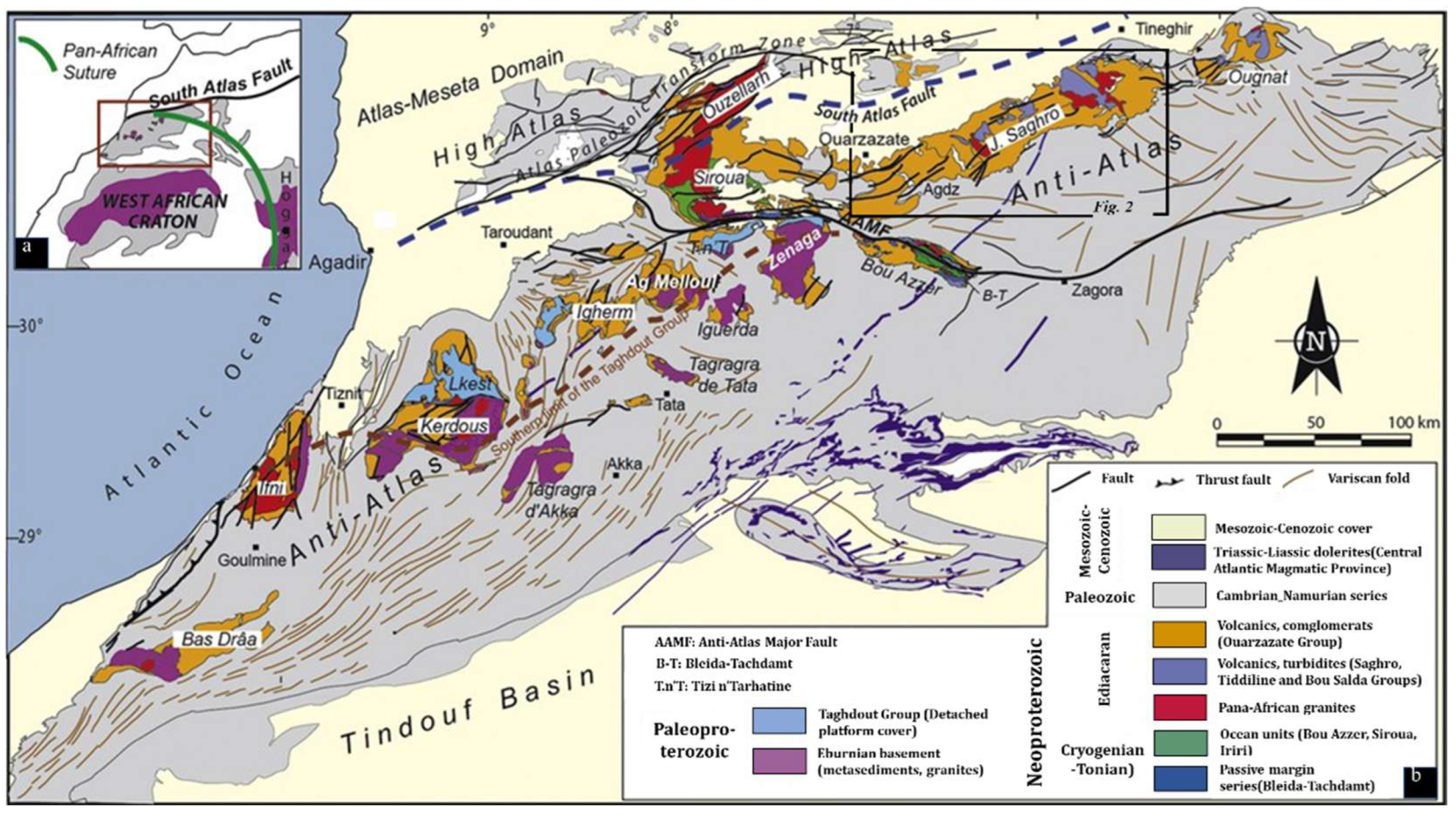
Figure 2.
Simplified geological map of the Saghro Inlier. After [56] modified by [57]. Abbreviations: Ag, Silver; Cu, Copper; Au, Gold; Hg, Mercury; Pb, Plomb.
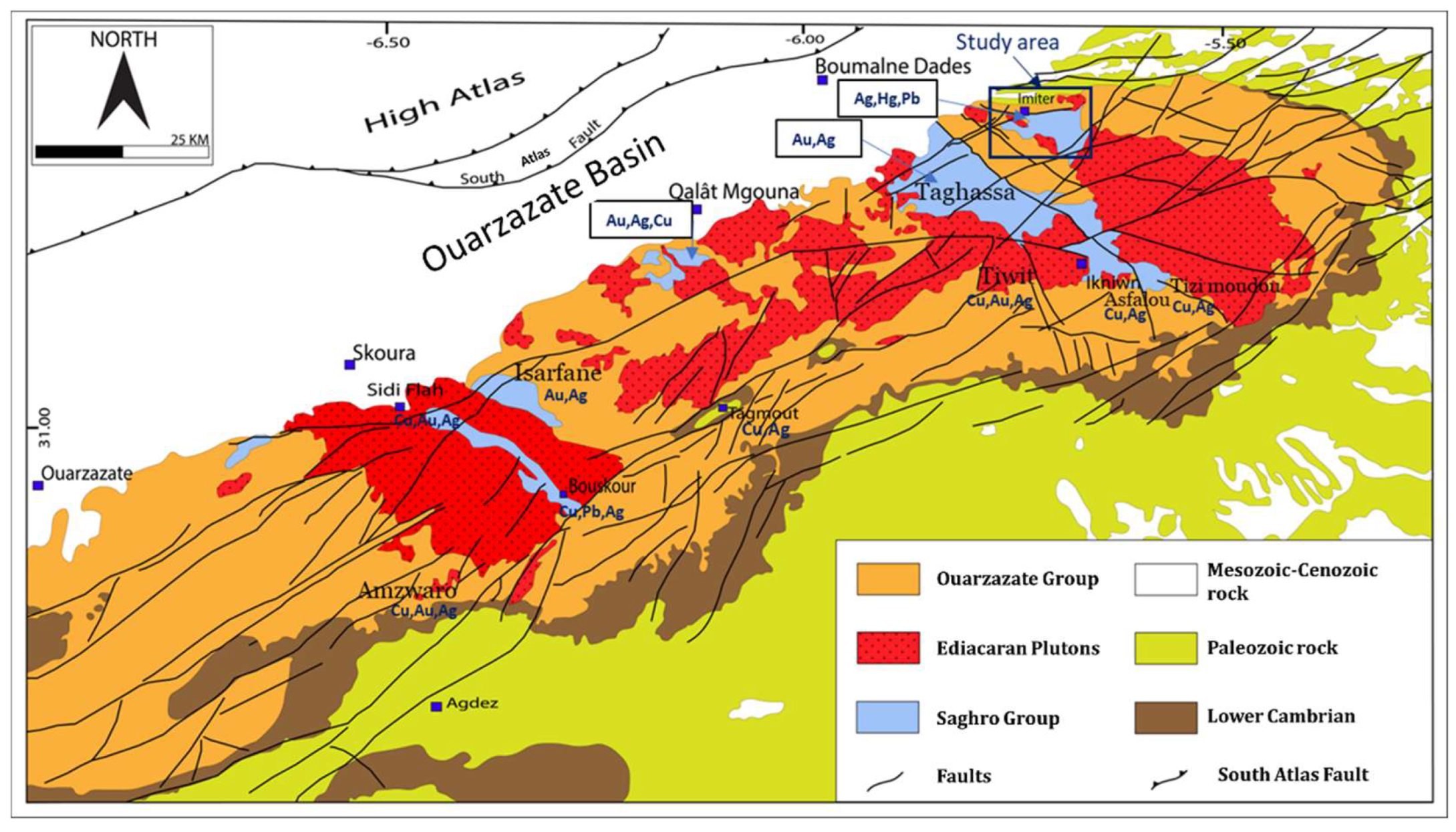
Figure 3.
Geological map of the Imiter Sub-inlier after [26] and modified by [60,61], showing the location of the studied drill cores (a,b,c, and d).. The references listed in the legend (1-13) correspond to U–Pb zircon ages of igneous rocks from the Imiter Sub-inlier: (1), [62]; (2 and 3), [55]; (4), [63]; (5), [53]; (6, 7, 8 and 9), [61]; (10 and 11), [64]; (12), [65]; (13), [66].
Figure 3.
Geological map of the Imiter Sub-inlier after [26] and modified by [60,61], showing the location of the studied drill cores (a,b,c, and d).. The references listed in the legend (1-13) correspond to U–Pb zircon ages of igneous rocks from the Imiter Sub-inlier: (1), [62]; (2 and 3), [55]; (4), [63]; (5), [53]; (6, 7, 8 and 9), [61]; (10 and 11), [64]; (12), [65]; (13), [66].
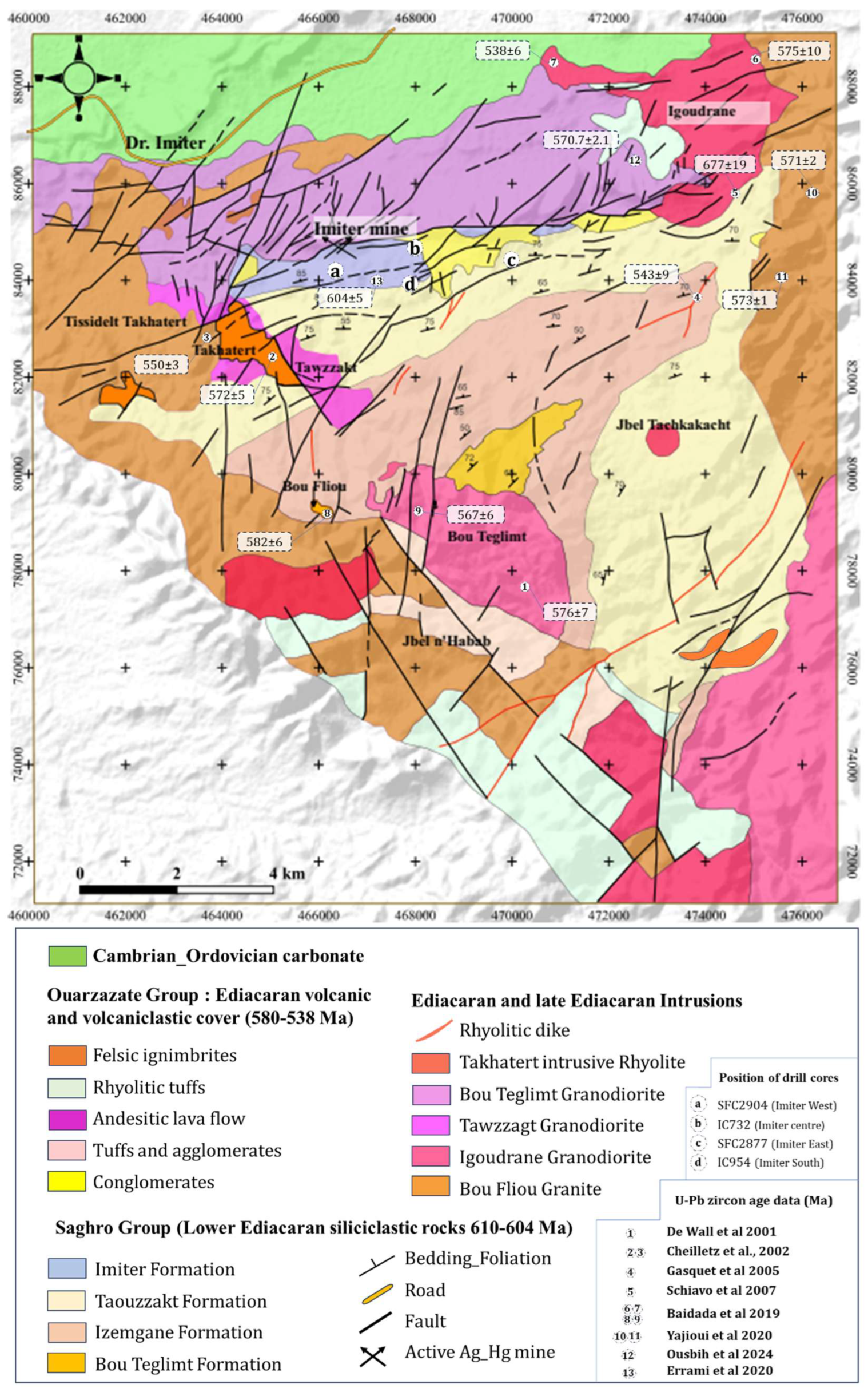
Figure 4.
a) Typical outcrop appearance of the Imiter Formation of the Saghro Group near the Imiter Silver Mine. b) Appearance of the samples in subsurface drill cores (borehole IC954, Imiter South). The yellow arrow marks points to the top of the drill core; c) Erosive surface and crossbedding between shale and sandstone; and d) erosive surface between shale and sandstone. The dashed arrow in-dicates the top of the sequence. Abbreviations: S0, bedding; the number 34 in red indicates the borehole depth (34 m).
Figure 4.
a) Typical outcrop appearance of the Imiter Formation of the Saghro Group near the Imiter Silver Mine. b) Appearance of the samples in subsurface drill cores (borehole IC954, Imiter South). The yellow arrow marks points to the top of the drill core; c) Erosive surface and crossbedding between shale and sandstone; and d) erosive surface between shale and sandstone. The dashed arrow in-dicates the top of the sequence. Abbreviations: S0, bedding; the number 34 in red indicates the borehole depth (34 m).
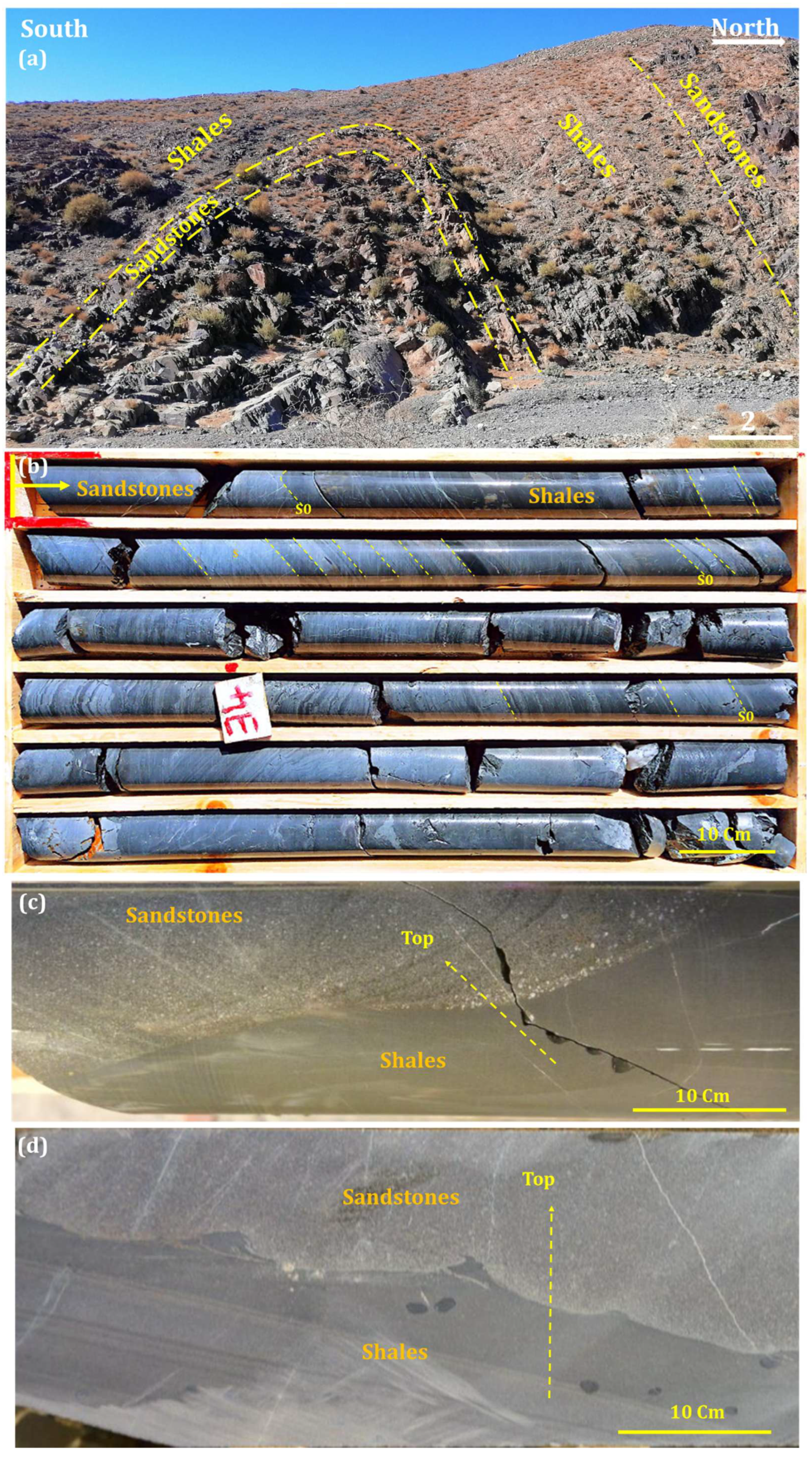
Figure 5.
Stratigraphic columns logged from drill cores through the Imiter Formation of the Saghro Group in the Imiter Sub-inlier, from west to east: borehole SFC2904 (Imiter West), borehole IC732 (Imiter Centre), and borehole SFC2877 (Imiter East), as well as borehole IC954 (Imiter South). For the location of the boreholes, refer to Figure 3 and Tables S1 and S2 of the supplementary materials.
Figure 5.
Stratigraphic columns logged from drill cores through the Imiter Formation of the Saghro Group in the Imiter Sub-inlier, from west to east: borehole SFC2904 (Imiter West), borehole IC732 (Imiter Centre), and borehole SFC2877 (Imiter East), as well as borehole IC954 (Imiter South). For the location of the boreholes, refer to Figure 3 and Tables S1 and S2 of the supplementary materials.
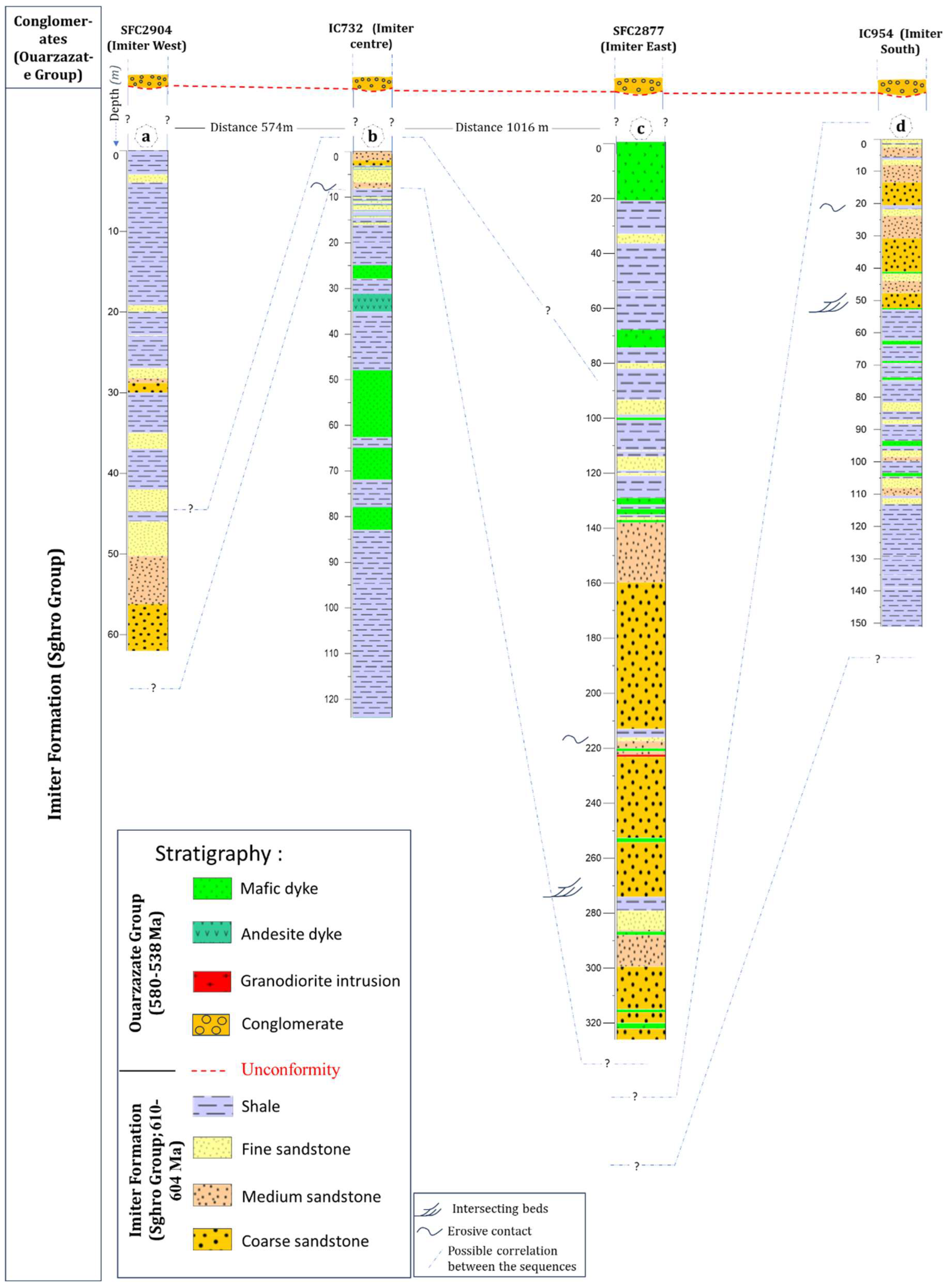
Figure 6.
Thin-section photomicrographs illustrating the textures of shales and sandstones from the Imiter Formation of the Saghro Group in the Imiter Sub-inlier; a) fine grained sandstone; b) medium grained sandstone; c) coarse grained sandstone; d) shale. (a,b, and c): Cross polarized light images; (d): Plane polarized light images). Abbreviations: S1, schistosity; S0, bedding; Qz, Quartz; Bt, Biotite; Ms; Muscovite; Opq, Opaque mineral; Fsp, Feldspar according to [86].
Figure 6.
Thin-section photomicrographs illustrating the textures of shales and sandstones from the Imiter Formation of the Saghro Group in the Imiter Sub-inlier; a) fine grained sandstone; b) medium grained sandstone; c) coarse grained sandstone; d) shale. (a,b, and c): Cross polarized light images; (d): Plane polarized light images). Abbreviations: S1, schistosity; S0, bedding; Qz, Quartz; Bt, Biotite; Ms; Muscovite; Opq, Opaque mineral; Fsp, Feldspar according to [86].
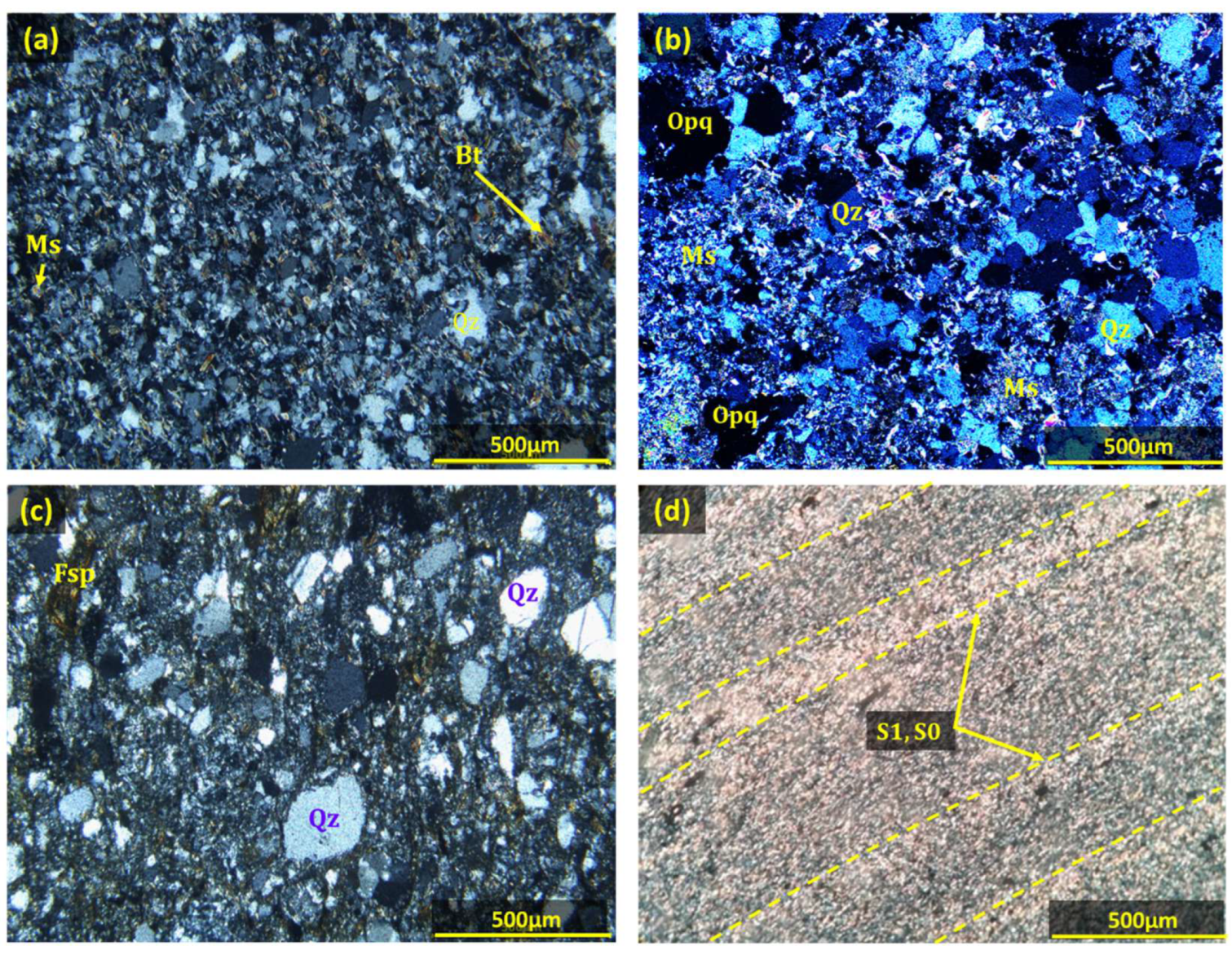
Figure 7.
Geochemical classification diagram of siliciclastic rocks from the Imiter Formation (after [79]). The literature data were taken from Ouguir et al. (1996) [27].
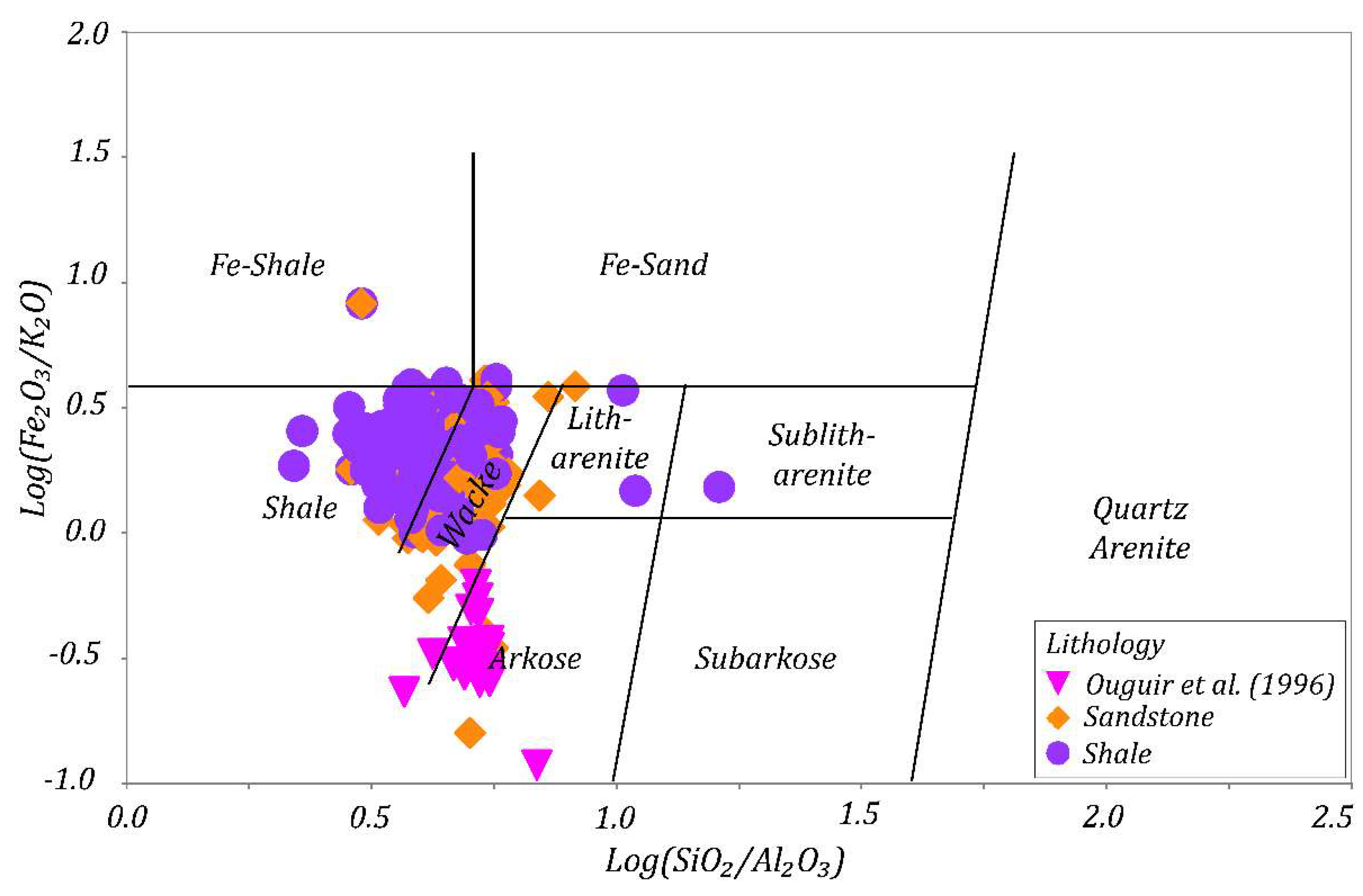
Figure 8.
Rare earth element distributions of Imiter sandstones and shales from drill core IC954 (Imiter South), normalized to (a) Post-Archean Australian Shale Composite (PAAS) [3] and (b) Upper Continental Crust (UCC) [20]. All samples are shales, except samples 4005281, 4005348, 4005387, and 4005388, which are sandstones.
Figure 8.
Rare earth element distributions of Imiter sandstones and shales from drill core IC954 (Imiter South), normalized to (a) Post-Archean Australian Shale Composite (PAAS) [3] and (b) Upper Continental Crust (UCC) [20]. All samples are shales, except samples 4005281, 4005348, 4005387, and 4005388, which are sandstones.
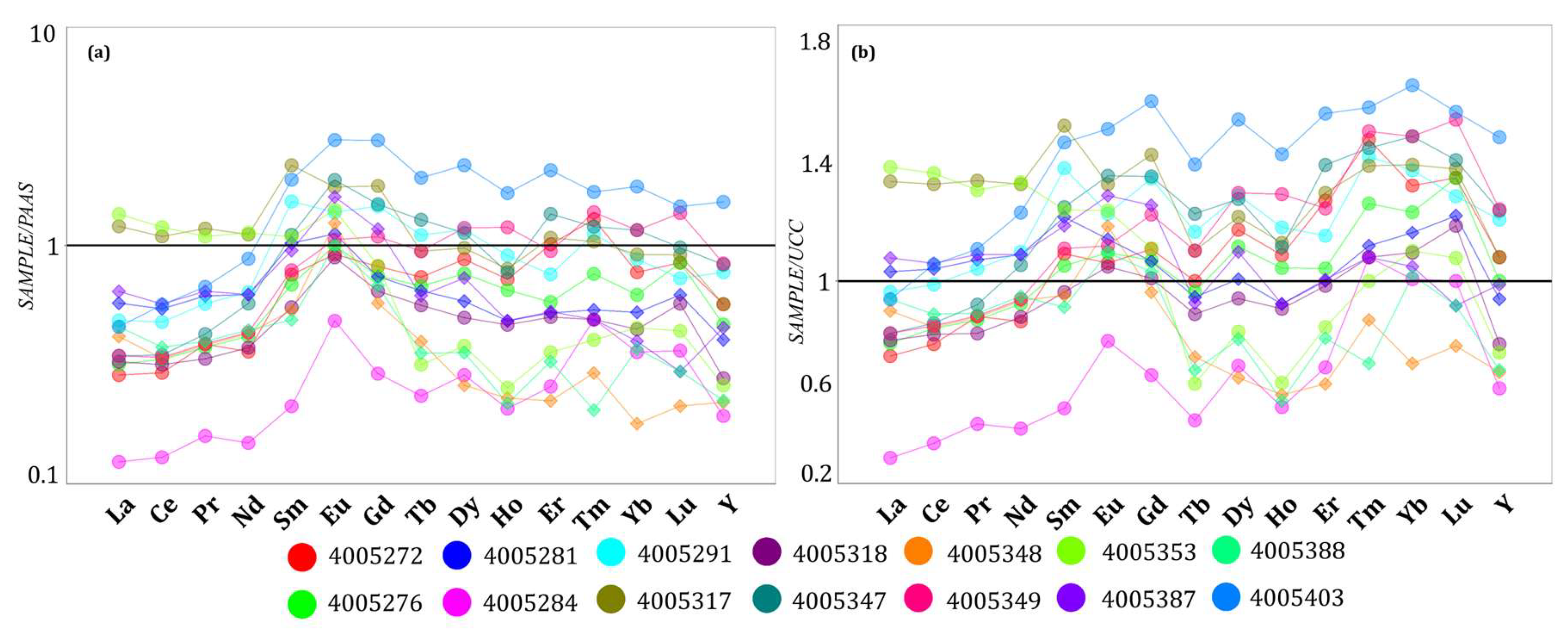
Figure 9.
(a) εNd(t) versus SiO2 and (b) εNd(t) versus La/Yb for shale and sandstone samples from borehole IC954 (Imiter South). Uncertainty in εNd(t) is ~=/- 0.3 epsilon units.
Figure 9.
(a) εNd(t) versus SiO2 and (b) εNd(t) versus La/Yb for shale and sandstone samples from borehole IC954 (Imiter South). Uncertainty in εNd(t) is ~=/- 0.3 epsilon units.
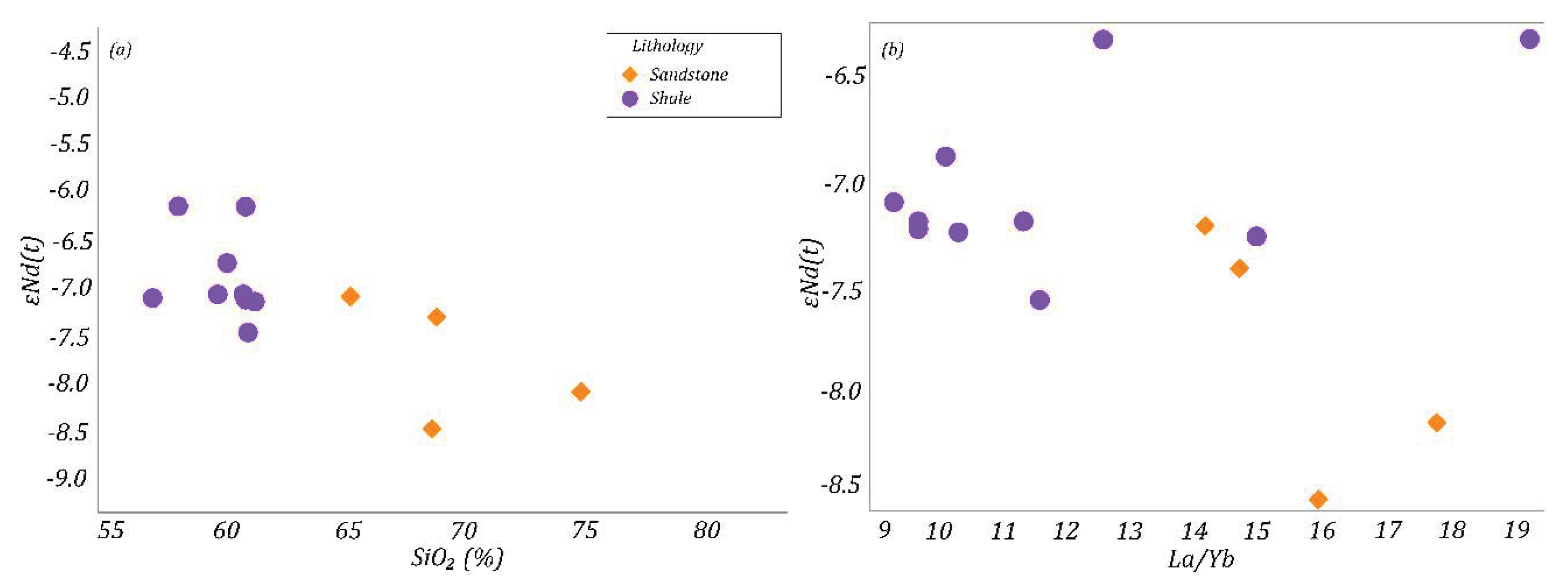
Figure 10.
Provenance diagrams for the Imiter siliciclastic rocks. a) the Al2O3/TiO2 (wt %) versus SiO2 (wt %) bivariate diagram of [93]. The Mafic, Intermediate and Felsic fields based on SiO2 are from [94]; b) the TiO2 (wt %) versus Al2O3 (wt %) diagram of [95] The “granite line” and “3 granite + 1 basalt line” are after [96]. The literature data were taken from [27].
Figure 10.
Provenance diagrams for the Imiter siliciclastic rocks. a) the Al2O3/TiO2 (wt %) versus SiO2 (wt %) bivariate diagram of [93]. The Mafic, Intermediate and Felsic fields based on SiO2 are from [94]; b) the TiO2 (wt %) versus Al2O3 (wt %) diagram of [95] The “granite line” and “3 granite + 1 basalt line” are after [96]. The literature data were taken from [27].
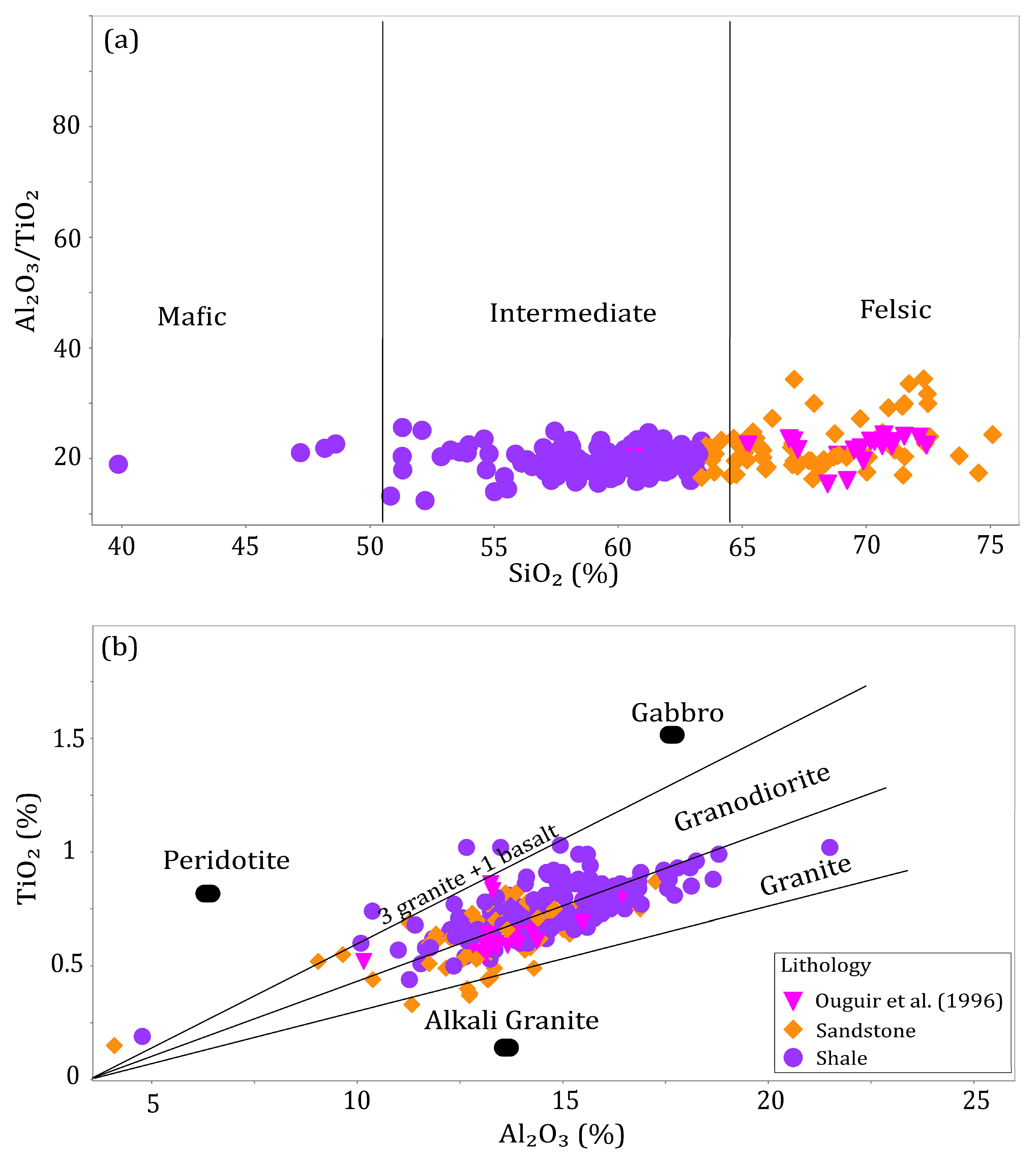
Figure 11.
Trace element compositional attributes of siliciclastic rocks of Imiter Formation from drill core IC954 (Imiter South), compared with literature data from [27]. (a) Th/Sc - Zr/Sc (ppm) discrimination diagram [98]; (b) Co/Th-La/Sc (ppm) discrimination diagram (modified after [99]). (c) La/Th-Hf (ppm) discrimination diagram [100].
Figure 11.
Trace element compositional attributes of siliciclastic rocks of Imiter Formation from drill core IC954 (Imiter South), compared with literature data from [27]. (a) Th/Sc - Zr/Sc (ppm) discrimination diagram [98]; (b) Co/Th-La/Sc (ppm) discrimination diagram (modified after [99]). (c) La/Th-Hf (ppm) discrimination diagram [100].
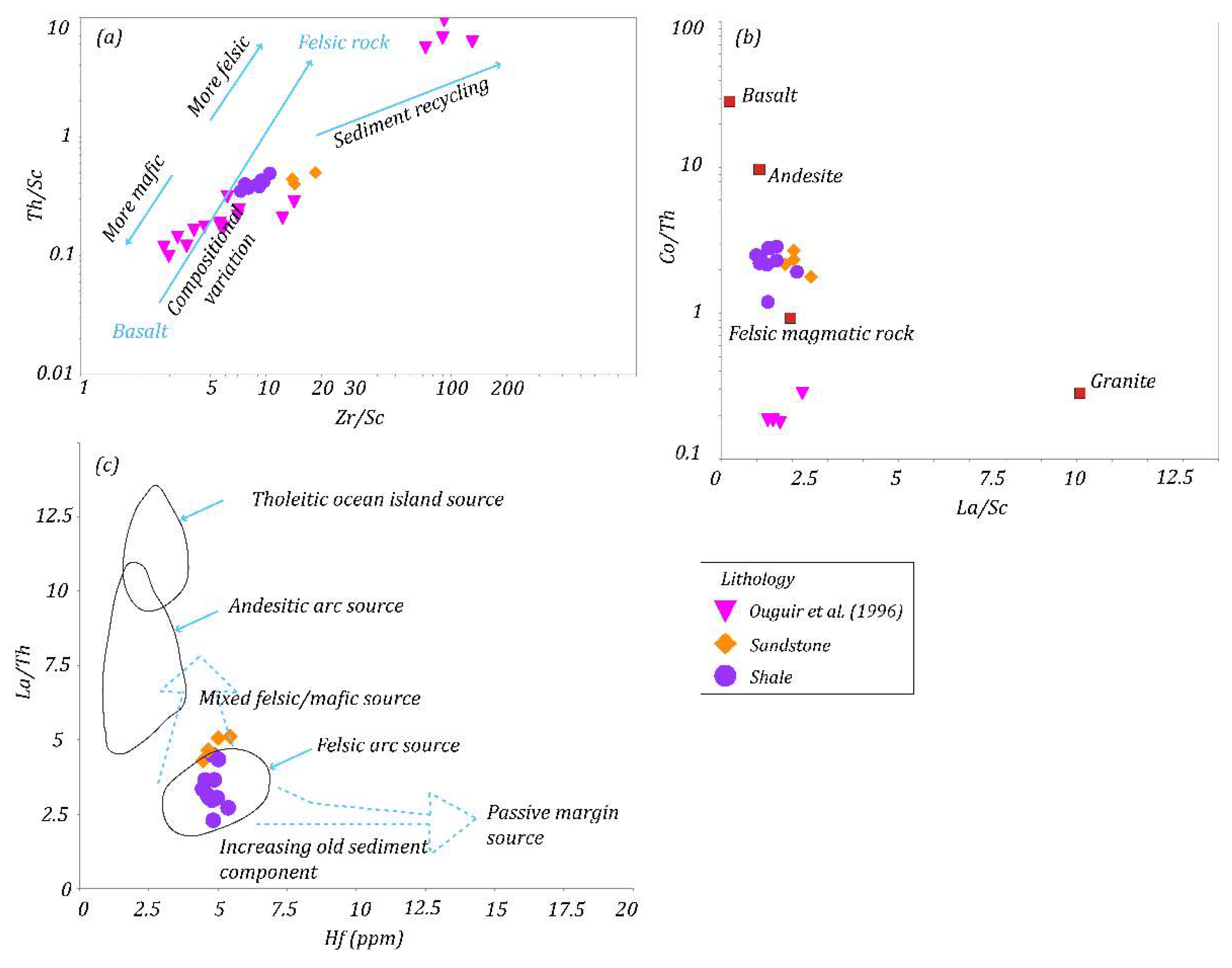
Figure 12.
(a) Nd isotopic data εNd(t) vs. TDM model age and (b) ƒSm/Nd vs. εNd(t) diagram of [4], for Imiter Formation [this study; 14 samples from drill core IC954 (Imiter South)] compared with various igneous and sedimentary rock data from some Anti Atlas Inliers, including studies by [104]: (Kerdous metapelite and granitoids; 11 samples), [105]: (Zenaga granitoids; 15 samples), [61] : (Imiter granitoids; 16 samples), [106]: (Bas Drâa granitoids; 9 samples). ƒSm/Nd: the fractionation factor f was defined by [103]. Data for MORB and Arc rocks are from [3].
Figure 12.
(a) Nd isotopic data εNd(t) vs. TDM model age and (b) ƒSm/Nd vs. εNd(t) diagram of [4], for Imiter Formation [this study; 14 samples from drill core IC954 (Imiter South)] compared with various igneous and sedimentary rock data from some Anti Atlas Inliers, including studies by [104]: (Kerdous metapelite and granitoids; 11 samples), [105]: (Zenaga granitoids; 15 samples), [61] : (Imiter granitoids; 16 samples), [106]: (Bas Drâa granitoids; 9 samples). ƒSm/Nd: the fractionation factor f was defined by [103]. Data for MORB and Arc rocks are from [3].
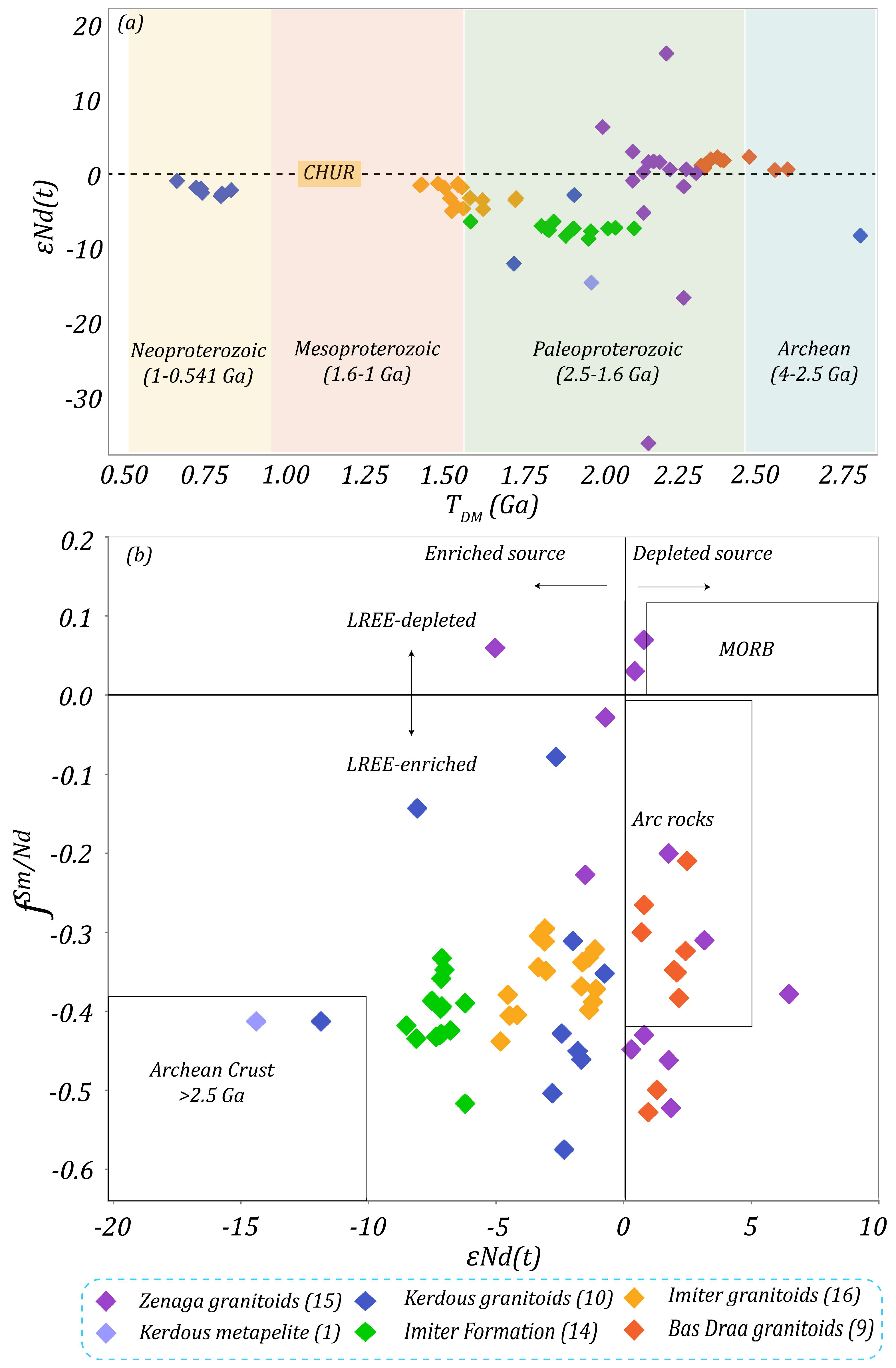
Figure 13.
εNd evolution with time model for Imiter siliciclastic rocks. DM: Depleted Mantle after [17]; CHUR: Chondritic Uniform Reservoir after [16].
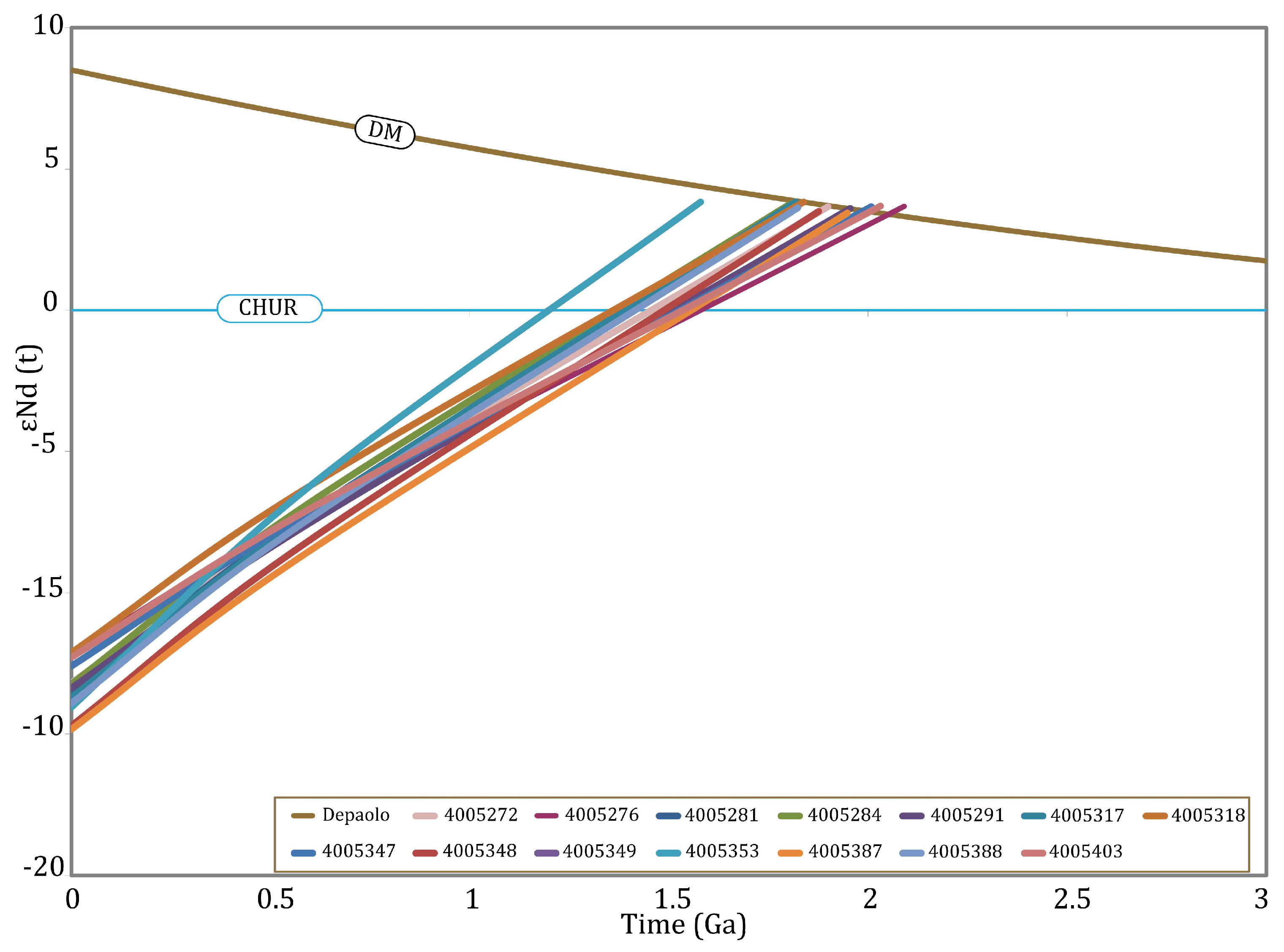
Figure 14.
Tectonic discrimination diagrams [1,2] applied to the shales and sandstones of Imiter Formation: (a) Major-element-based discrimination diagram: DF2(Arc-Rift-Col)m1 versus DF1(Arc-Rift-Col)m1 for high-silica samples (SiO2 = 63–95 wt%); (b) Major-element-based discrimination diagram: DF2(Arc-Rift-Col)m2 versus DF1(Arc-Rift-Col)m2 for low-silica samples (SiO2 = 35–63 wt%); (c) Major-element-based discrimination DF(A-P) M diagram, and (d) Combined major- and trace-element discrimination DF(A-P) MT diagram. The literature data were taken from [27]. Abbreviations: Col = Collision; A= Active margin; P = passive margin A-P Boundary= Active–Passive Margins boundary; CAM = Centroid of Active Margin for major elements; CPM = Centroid of Passive Margin for major elements; CAMT = Centroid of Active Margin for major and trace elements; CPMT = Centroid of Passive Margin for major and trace elements. The functions (DF) were calculated based on the following equations of [1,2].
Figure 14.
Tectonic discrimination diagrams [1,2] applied to the shales and sandstones of Imiter Formation: (a) Major-element-based discrimination diagram: DF2(Arc-Rift-Col)m1 versus DF1(Arc-Rift-Col)m1 for high-silica samples (SiO2 = 63–95 wt%); (b) Major-element-based discrimination diagram: DF2(Arc-Rift-Col)m2 versus DF1(Arc-Rift-Col)m2 for low-silica samples (SiO2 = 35–63 wt%); (c) Major-element-based discrimination DF(A-P) M diagram, and (d) Combined major- and trace-element discrimination DF(A-P) MT diagram. The literature data were taken from [27]. Abbreviations: Col = Collision; A= Active margin; P = passive margin A-P Boundary= Active–Passive Margins boundary; CAM = Centroid of Active Margin for major elements; CPM = Centroid of Passive Margin for major elements; CAMT = Centroid of Active Margin for major and trace elements; CPMT = Centroid of Passive Margin for major and trace elements. The functions (DF) were calculated based on the following equations of [1,2].
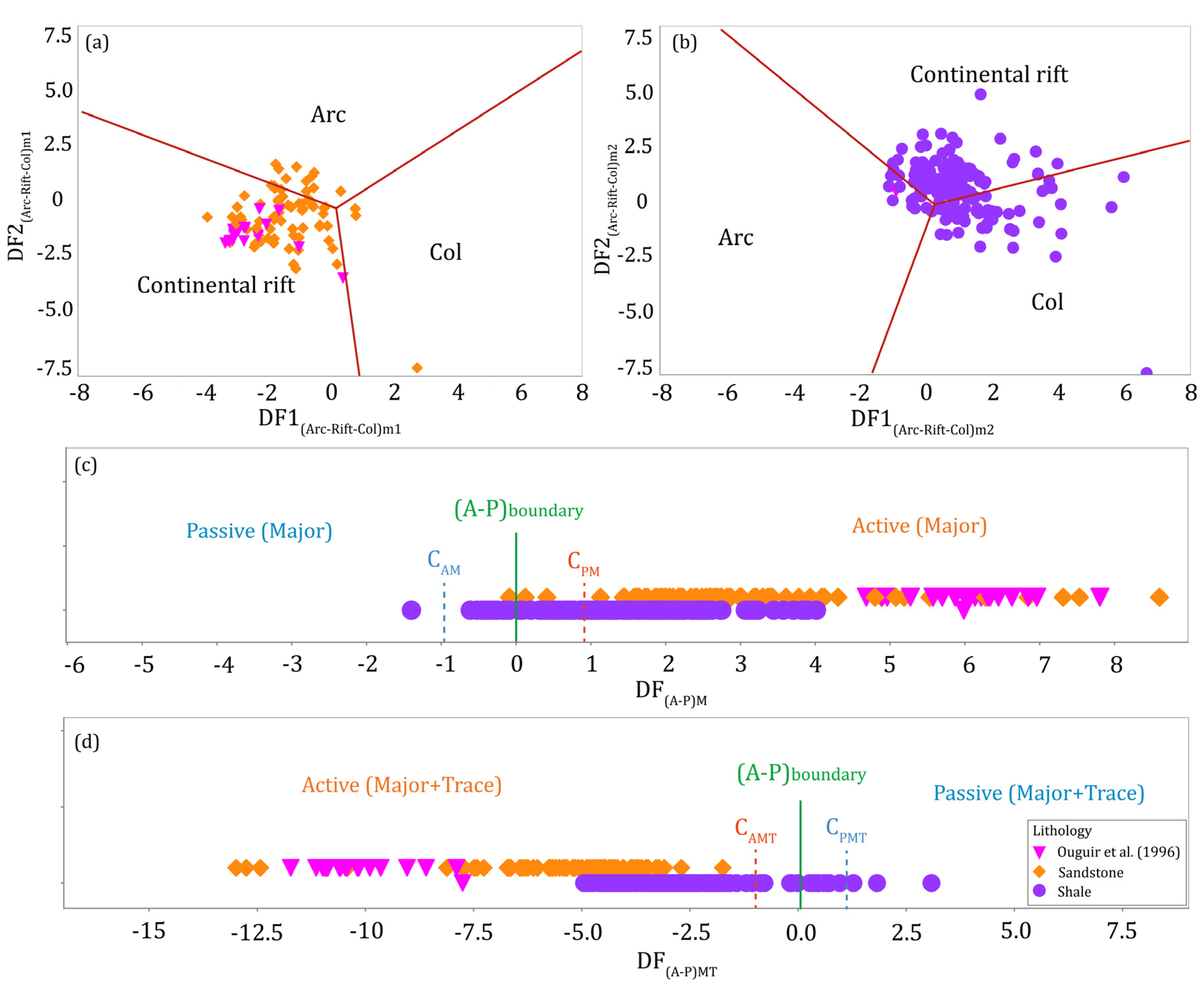
Figure 15.
Graphs illustrating a) ICV versus CIA bivariate diagram according to [4]; b) Al2O3 + K2O + Na2O (wt%) versus SiO2 (wt%) bivariate diagram from [114] and c) V (ppm) versus Al2O3 (wt%) bivariate diagram from [115]. The literature data were taken from [27].
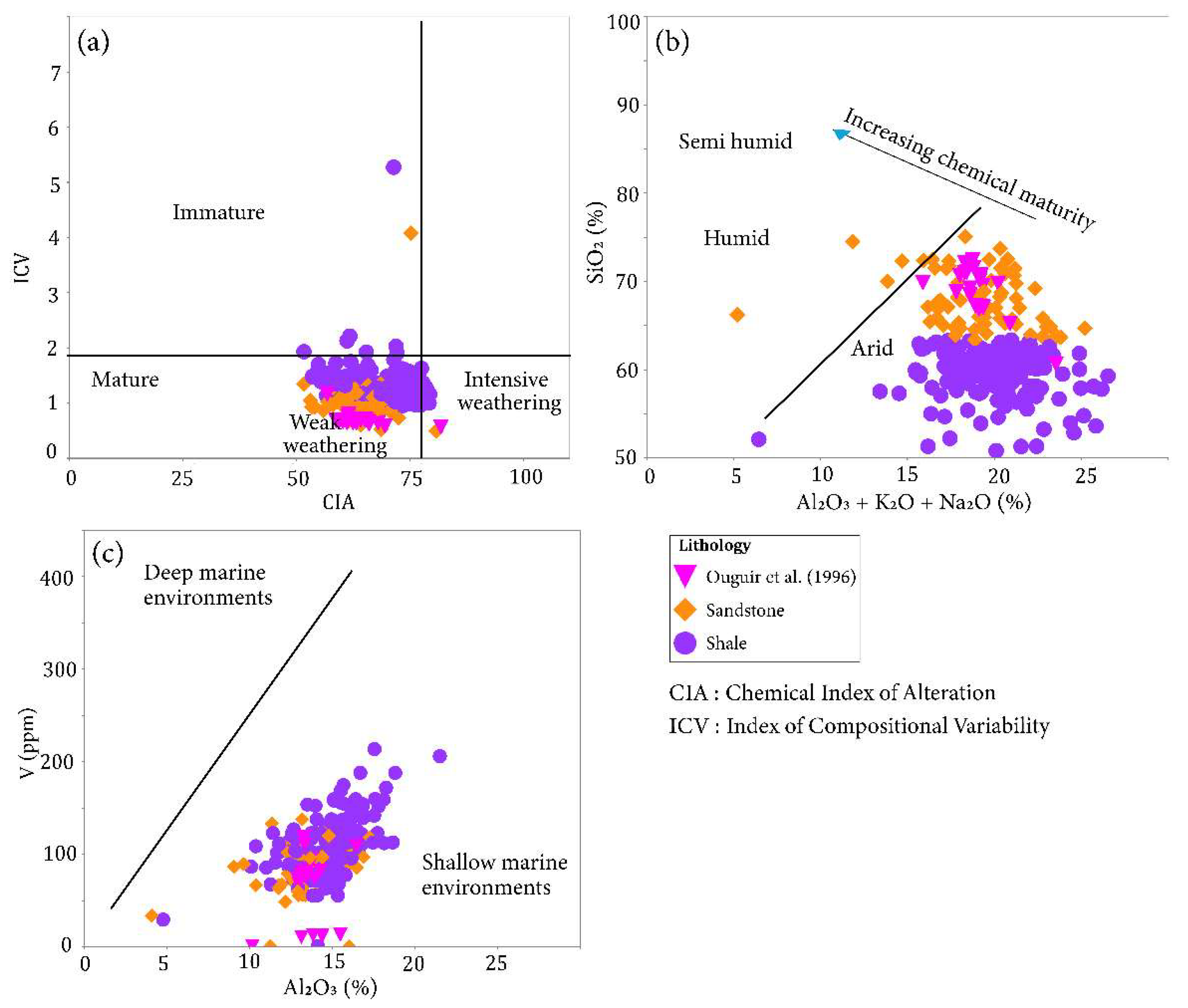
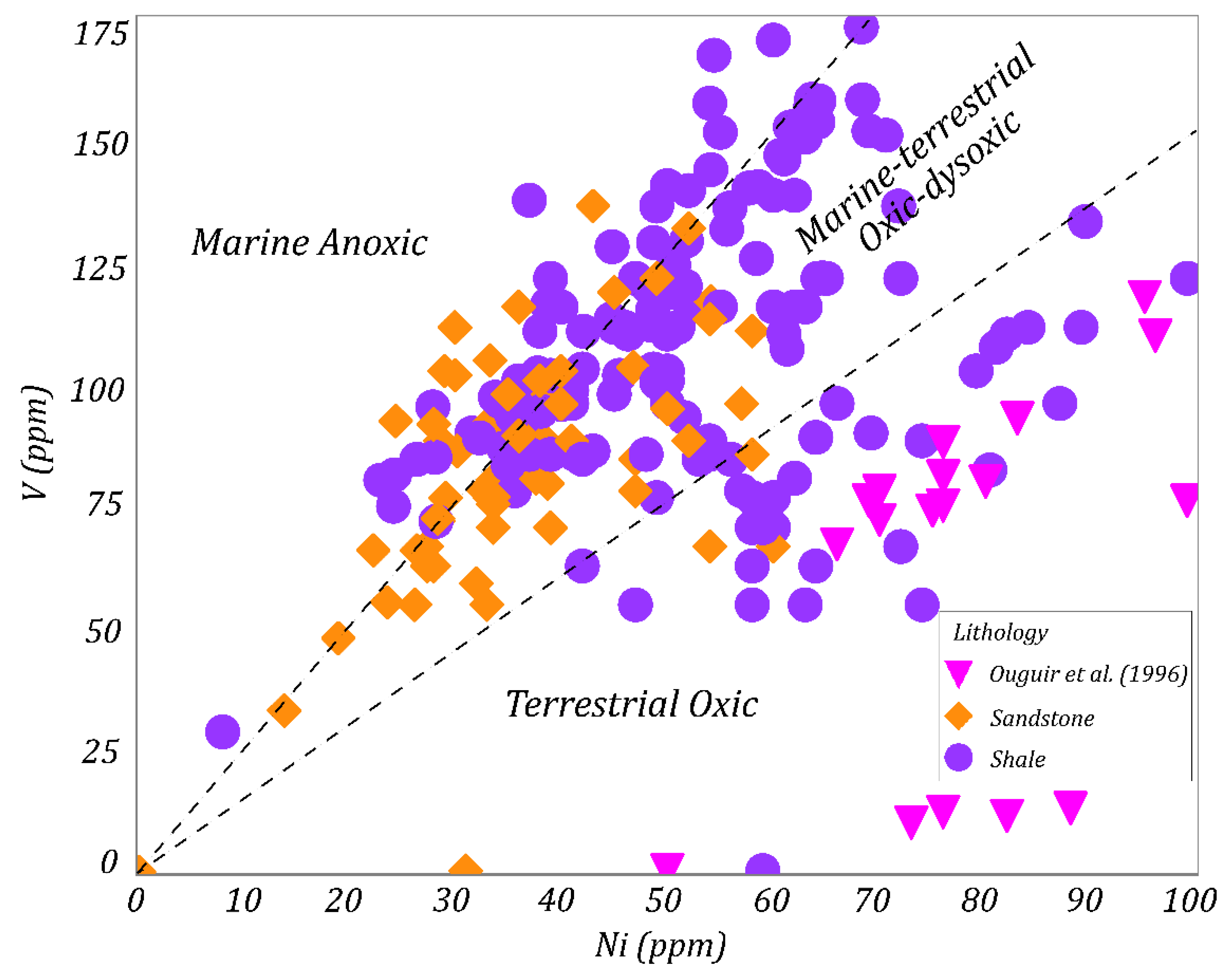
Disclaimer/Publisher’s Note: The statements, opinions and data contained in all publications are solely those of the individual author(s) and contributor(s) and not of MDPI and/or the editor(s). MDPI and/or the editor(s) disclaim responsibility for any injury to people or property resulting from any ideas, methods, instructions or products referred to in the content. |
© 2026 by the authors. Licensee MDPI, Basel, Switzerland. This article is an open access article distributed under the terms and conditions of the Creative Commons Attribution (CC BY) license (http://creativecommons.org/licenses/by/4.0/).
Copyright: This open access article is published under a Creative Commons CC BY 4.0 license, which permit the free download, distribution, and reuse, provided that the author and preprint are cited in any reuse.