

Submitted:
19 May 2026
Posted:
19 May 2026
You are already at the latest version
Abstract
This paper presents a theoretically informed critical review of climate change discourse in Sub-Saharan Africa. Drawing on peer-reviewed scholarship and authoritative policy documents, it examines how climate knowledge is framed, communicated, authorized, and translated into public and policy use. Guided by decolonial theory and the Multiple Evidence Base approach, the review assesses climate discourse through four linked dimensions: epistemic authority, communicative accessibility, representational framing, and policy relevance. The review finds that recent scholarship and policy increasingly recognize Indigenous and local knowledge, public participation, climate education, and context-specific communication. However, significant gaps remain between formal recognition and operational integration. Climate literacy continues to vary across and within African countries; climate services become useful only when institutions align them with user needs and local decision-making contexts; and educational and policy discourse can still reproduce epistemic hierarchy even when it invokes inclusion. The paper contributes to sustainability scholarship by showing that demystification and decolonization are complementary requirements for inclusive climate governance and sustainable development. Demystification improves the intelligibility and usability of climate knowledge, whereas decolonization strengthens legitimacy by challenging hierarchies that privilege some knowledge systems while marginalizing others. A stronger climate discourse for Sub-Saharan Africa, therefore, requires institutional changes in how actors authorize knowledge, translate uncertainty, frame vulnerability and agency, and design climate communication, education, and services for public and policy use.
Keywords:
climate change discourse
; decolonization
; Sub-Saharan Africa
; climate literacy
; climate change education
; Indigenous knowledge
; climate services
; epistemic authority
; sustainability
; climate governance
1. Introduction
Climate change discourse in Sub-Saharan Africa operates at the intersection of global research, national policy, development finance, education, media, and local ecological knowledge. Researchers, policymakers, and institutions increasingly agree that the region faces significant climate risks; however, disagreement remains over how knowledge about those risks should circulate, who should authorize that knowledge, and how scientific expertise should be integrated with local interpretation and action. The Africa chapter of the IPCC Sixth Assessment Report identifies significant climate-related risks affecting food systems, water resources, health, settlements, ecosystems, and livelihoods, while emphasizing the continent's internal diversity and the need for context-specific adaptation (IPCC, 2022). The African Union Climate Change and Resilient Development Strategy likewise positions climate action within the context of resilient and inclusive development (African Union, 2022). These texts establish the scale of the challenge; however, in isolation, they do not resolve the epistemic and communicative questions that shape how publics and institutions understand and use climate knowledge.
More recent continental and global assessments intensify this point. The World Meteorological Organization's State of the Climate in Africa 2024 reports that 2024 was among the warmest years on record and links African climate impacts to agriculture, food and water security, health, education, and the need for stronger early warning systems and inclusive climate services (World Meteorological Organization, 2025). The UNEP Adaptation Gap Report 2024 similarly shows that adaptation implementation continues to lag escalating climate impacts and financing needs, estimating the global adaptation finance gap at US$187-359 billion per year (United Nations Environment Program, 2024). These current assessments reinforce the paper's claim that climate discourse in Sub-Saharan Africa cannot be evaluated only by the accuracy of risk diagnosis; it must also be assessed by whether knowledge, finance, services, and decision-making authority reach affected communities in usable forms.
The 2026 WMO State of the Global Climate 2025 further underscores this urgency by reporting that 2015-2025 were the hottest 11 years on record and that 2025 was the second- or third-warmest year on record, at about 1.43°C above the 1850-1900 average (World Meteorological Organization, 2026). For this review, the significance of that finding is discursive as well as climatological: as warming accelerates, institutions must communicate risk in ways that are scientifically accurate, socially legible, and connected to practical adaptation decisions rather than only to global temperature indicators.
This study begins with a more specific claim than many broad discussions of climate justice. It does not argue that climate science is inadequate for Africa. Rather, it argues that climate discourse about Sub-Saharan Africa often carries assumptions about authority, language, legitimacy, education, and expertise that shape whether people can understand, trust, contest, and use climate knowledge. Climate discourse does more than describe climate change. It also identifies who is recognized as an expert, which terminology is considered neutral, which forms of evidence institutions privilege, and how African actors are positioned in debates about vulnerability, adaptation, and resilience. Decolonial scholarship clarifies why these questions matter. Ndlovu-Gatsheni (2015) argues that coloniality persists beyond formal colonialism through enduring structures of power and knowledge. Applied to climate discourse, this insight highlights how institutions can normalize some knowledge frameworks as universal while treating others as local, secondary, or optional.
The paper also begins from a practical concern. Effective climate communication depends on whether intended users can understand and apply climate information in real decision-making contexts. Simpson et al. (2021) demonstrate that climate change literacy varies substantially across 33 African countries and at subnational levels. They also find that education and mobility positively correlate with climate literacy, while poverty reduces it, and that women in the dataset report lower climate literacy than men on average. These findings do not imply that communities are unable to recognize environmental change. Rather, they show that formal climate discourse does not circulate evenly among African publics. Consequently, institutions cannot assume that scientific precision alone ensures public understanding, policy uptake, or sustainability-oriented action.
Research on climate change and environmental education reinforces this argument by positioning education as a central arena for climate awareness, civic agency, and institutional response. Damoah (2023a) characterizes climate change education as a critical response to climate emergencies, while Khalo and Damoah (2023) emphasize the role of universities in advancing climate-related social transformation. Related scholarship on student environmental activism, environmental education policy, and curriculum integration illustrates how learners, schools, and universities actively shape climate discourse rather than merely absorb it (Damoah & Omodan, 2022; Damoah et al., 2023; Damoah, Khalo, & Adu, 2024). Collectively, this work indicates that education is not simply a medium for disseminating scientific knowledge after it is produced. It is an institutional setting where climate knowledge becomes socially meaningful, contested, and actionable.
This study asks: How do recent scholarships and policy characterize the barriers and possibilities for demystifying and decolonizing climate change discourse in Sub-Saharan Africa? In this study, demystification refers to making climate science comprehensible, socially relevant, and practically usable while maintaining scientific integrity. Decolonization refers to challenging hierarchies that privilege dominant scientific, institutional, or externally produced knowledge while marginalizing African Indigenous, local, educational, and practice-based knowledge. These concepts are treated as linked sustainability concerns because usable climate knowledge and legitimate climate governance both require attention to knowledge systems, public participation, education, and institutional design.
This paper makes three contributions to sustainability scholarship. First, it develops an integrated framework for analyzing climate change discourse in Sub-Saharan Africa through epistemic authority, communicative accessibility, representational framing, and policy relevance. Second, it shows that demystification and decolonization are complementary processes: demystification improves the intelligibility and practical use of climate knowledge, while decolonization strengthens legitimacy by challenging epistemic hierarchies that marginalize Indigenous, local, educational, and practice-based knowledge systems. Third, it connects climate discourse to sustainable development by showing that inclusive climate communication requires not only accurate information but also institutional arrangements that support knowledge pluralism, context-specific education, public participation, and policy uptake.
2. Methodology
This paper presents a theoretically informed critical review of climate change discourse in Sub-Saharan Africa. A critical review design is appropriate because the study synthesizes and interprets a focused body of scholarship and policy literature rather than conducting a systematic evidence inventory or estimating a pooled empirical effect. This approach is also consistent with the paper's sustainability focus, which requires attention to interactions among knowledge systems, climate communication, education, governance, and institutional practice.
The review focused on peer-reviewed scholarship and authoritative policy documents published primarily between 2014 and 2026. Foundational theoretical sources were included where necessary to define the study’s conceptual orientation. Searches were conducted on Google Scholar, publisher and institutional websites, and through citation chaining from highly relevant sources. Search terms included combinations of climate change discourse, climate literacy, climate services, Sub-Saharan Africa, Indigenous knowledge, local knowledge, decoloniality, climate education, environmental education, climate activism, food security, sustainability, climate governance, and sustainable development.
The search process initially identified approximately 85 to 100 potentially relevant sources. After screening for relevance, quality, and conceptual alignment, approximately 60 to 70 sources were retained for detailed analysis. Materials were included if they met at least one of the five criteria. First, they provided empirical evidence on climate literacy or climate communication in African settings. Second, they addressed Indigenous and local knowledge in African adaptation, environmental governance, or sustainability practice. Third, they offered decolonial, environmental education, or climate education critiques relevant to African knowledge politics. Fourth, they examined climate services, food security, agriculture, public participation, livelihoods, and governance in Sub-Saharan Africa. Fifth, they represented official institutional frameworks of bodies such as the IPCC, the African Union, UNESCO, the UNFCCC, and the WMO.
Materials were excluded if they did not bear directly on discourse, communication, knowledge systems, education, participation, climate services, livelihoods, food security, sustainability, or governance in African settings. Informal commentary without clear authorship, institutional provenance, or scholarly grounding was also excluded. This evidence base supports a defensible theoretical interpretation while acknowledging that the review does not capture every relevant text.
The analysis proceeded in five stages. First, sources were identified through targeted searches and citation chaining. Second, sources were screened for relevance to the paper’s conceptual and sustainability focus. Third, retained materials were grouped into five domains: climate literacy and communication; Indigenous and local knowledge; decolonial and environmental education critique; climate services and livelihoods; and policy and institutional frameworks. Fourth, recurring patterns were coded under four analytical dimensions derived from the theoretical framework: epistemic authority, communicative accessibility, representational framing, and policy relevance. Fifth, the coded patterns were synthesized into a theoretical argument about the relationship among demystification, decolonization, climate governance, and sustainable development.
This methodological sequence positions climate discourse as a sustainability issue rather than only a communication issue. It allows the review to examine how climate knowledge becomes intelligible, legitimate, and usable for public understanding, education, adaptation, institutional planning, and policy implementation in Sub-Saharan Africa.
The methodological process was organized to move from broad source identification toward a focused, theory-guided synthesis. Table 1 summarizes the review procedure and source domains used to structure the evidence base, while Figure 1 illustrates how these steps connect across the full analytical pathway.
Note. The figure summarizes the movement from source identification to theory-guided synthesis.
Together, Table 1 and Figure 1 clarify how the review moved from source identification to theory-guided synthesis. Table 1 identifies the major procedural decisions that shaped the evidence base, while Figure 1 shows the progression from initial source identification through coding and synthesis. This structure supports the paper’s critical review design by making the analytical process explicit without treating the review as a systematic inventory of evidence.
3. Literature Review
The literature examined in this review comprises five interrelated strands. The first strand concerns climate literacy and communication. Research on climate literacy provides a crucial foundation because it shows that public understanding of climate change in Africa is neither uniform nor guaranteed by exposure to environmental stressors. Simpson et al. (2021) examine survey data from 33 African countries and identify substantial variation in climate change literacy across national and subnational contexts. Their study is significant because it demonstrates that access to climate discourse and interpretation does not necessarily spread through direct experience of environmental change. Consequently, climate discourse requires translation, mediation, and trust building.
The climate literacy literature does not suggest that African populations are uninformed about climate change. Numerous communities experience unpredictable precipitation, thermal stress, agricultural failure, biodiversity loss, and other disturbances. The literature distinguishes between the experience of environmental change and its articulation through the formal discourse of anthropogenic climate change. This gap is significant because public involvement, policy endorsement, climate service adoption, and educational responses frequently rely on institutions' ability to connect lived experience with formal explanatory language.
The second thread pertains to Indigenous and local knowledge in adaptation and governance. Tengö, Brondizio, Elmqvist, Malmer, and Spierenburg (2014) advocate for a Multiple Evidence Base approach wherein Indigenous, local, and scientific knowledge systems function as concurrent and complementary frameworks rather than as hierarchically structured sources of evidence. Leal Filho et al. (2022) examine the significance of Indigenous knowledge in climate adaptation in Africa, highlighting its importance in agriculture, ecosystems, water governance, and local decision-making. Makondo and Thomas (2018) contend that integrating Indigenous knowledge with Western science can enhance the efficacy of adaptation, provided that institutions refrain from hierarchically handling knowledge systems.
Recent scholarship sharpens this strand by showing that the challenge is not simply whether Indigenous and local knowledge is valuable, but whether institutions can remove the barriers that prevent its use. Leal Filho, Lütz, Totin, Ayal, and Mendy (2025) identify paradigmatic, geopolitical, sociocultural, and practical obstacles to implementing Indigenous and local knowledge in African climate adaptation, including the tendency of dominant scientific knowledge production systems to sideline Indigenous worldviews. Zent's (2025) World Bank report likewise frames Indigenous and local knowledge as a strategic resource for climate assessment, mitigation, and adaptation, while cautioning that these knowledge systems must be engaged as dynamic and place-based rather than treated as static cultural artifacts. The UNFCCC's 2024 Sahel report gives this argument a sector-specific form, noting that nomadic pastoralist knowledge remains only weakly reflected in adaptation policy even though pastoralist communities hold weather, mobility, and environmental knowledge that can improve dialogue with meteorological and policy actors (United Nations Framework Convention on Climate Change, 2024).
The third strand explicitly investigates epistemic hierarchy and educational exclusion. Ndlovu-Gatsheni’s (2015) analysis of decoloniality presents the issue as rooted in persistent mechanisms of power and knowledge that continue to operate in postcolonial African settings. Mbah and Ezegwu (2024) clearly address this issue within the context of climate change and environmental education in Africa. Analyzing journal articles published from 2015 to 2022, they identify ongoing epistemic exclusion and marginalization of Indigenous and local knowledge. David (2024) elaborates on this idea by demonstrating how African Indigenous knowledge might enhance climate adaptation while maintaining scientific principles.
The fourth strand concerns climate education and public engagement. This strand is particularly important because it illustrates how climate discourse moves from expert production into social learning and action. Damoah (2023a) advocates for climate change education as a critical response to climate emergencies, emphasizing coordinated support, interdisciplinary integration, social justice, and action-oriented learning. Khalo and Damoah (2023) extend this concern to universities, arguing that higher education institutions can support climate knowledge, attitudes, skills, and social transformation. Damoah et al. (2023) situate student environmental activism within the broader field of climate and environmental protest, suggesting that learners and young people can become active contributors to climate discourse rather than passive recipients of expert communication.
Shabalala (2025) extends this educational strand by arguing that the early integration of Indigenous Knowledge Systems into African environmental education can support ecological ethics, epistemic justice, and culturally grounded environmental learning. This source is especially relevant to the present review because it identifies curriculum rigidity, lack of teacher preparedness, and symbolic policy commitments as barriers that prevent Indigenous knowledge from serving as an organizing framework for environmental education rather than merely an occasional example.
Singh-Pillay and Madlala (2026) provide empirical classroom-level support for this argument in South Africa. Their qualitative case study of Grade 8 Natural Sciences teaching found that teachers could integrate Indigenous agricultural practices, storytelling, inquiry-based learning, culturally relevant visual aids, and culture-science connections in ways that positioned Indigenous Knowledge Systems as legitimate environmental science rather than merely cultural illustration. This evidence strengthens the review's claim that decolonization must move beyond adding local examples to curricula; it requires pedagogical designs that help learners navigate multiple knowledge systems without treating Western science as the only authoritative frame.
Educational literature facilitates the integration of curriculum, policy execution, and institutional design. Damoah and Omodan (2022) delineate the factors that make for effective environmental education policy in South African schools. In contrast, Damoah, Khalo, and Adu (2024) examine strategies for incorporating environmental education into the South African curriculum. These studies confirm the conceptualization of education as a bridge tool in the current paper. Climate education associates epistemic authority with communicative accessibility by determining what knowledge is included in the curriculum, how it is interpreted, and how it is applied to civic and institutional action.
The fifth strand concerns climate services, livelihoods, and policy implementation. Hansen et al. (2019) examine the requirements for climate services to effectively meet the context-specific adaptation needs of Sub-Saharan African farmers at scale. Sultan et al. (2020) demonstrate, through two stakeholder surveys in West Africa, that users require climate information; however, irrelevance and incompleteness persist as significant obstacles to its use. Antwi-Agyei, Dougill, Doku-Marfo, and Abaidoo (2021) arrive at a comparable result in their examination of climate services for resilient agricultural systems in Ghana. Ofoegbu and New (2022) similarly demonstrate that communication and usability issues remain fundamental challenges in African agricultural climate services. Agyeman, Damoah, and Manu (2025) address food security by highlighting the detrimental impact of climate change on agricultural productivity and the increased vulnerability in Sub-Saharan Africa.
Recent sources also widen this strand beyond service delivery by connecting climate services to infrastructure, finance, and resilience strategy. The World Meteorological Organization (2025) emphasizes the need for investment in infrastructure, data sharing, inclusive services, and early warning systems across Africa. Ayompe and Epie (2025) similarly argue that African climate resilience depends on integrated strategies that combine Indigenous knowledge, climate-smart agriculture, community-based adaptation, and institutional support. These sources strengthen the argument that climate services are meaningful only when embedded in broader systems of communication, financing, education, and governance.
The finance literature provides a current institutional explanation for why this embedded approach remains difficult. UNEP's Adaptation Gap Report 2025 estimates developing-country adaptation finance needs at US$310 billion per year by 2035 based on modeled costs, or US$365 billion when extrapolated from Nationally Determined Contributions and National Adaptation Plans, while international public adaptation finance flows to developing countries fell to US$26 billion in 2023 (United Nations Environment Program, 2025). A 2025 Global Center on Adaptation and Climate Policy Initiative analysis reports that tracked adaptation finance to Africa reached only US$14.8 billion in 2023, with roughly 90 percent coming from international public institutions and more than half delivered as loans (Global Center on Adaptation & Climate Policy Initiative, 2025). These findings connect the discourse problem to material conditions: communities cannot use climate knowledge effectively when communication, planning, local institutions, and adaptation finance are under-resourced.
Policy and institutional texts indicate a pronounced normative inclination towards inclusiveness. The African Union policy associates climate action with resilient development and continental collaboration (African Union, 2022). UNESCO's resources on climate and Indigenous knowledge in Africa emphasize knowledge co-production and community-based research (UNESCO, 2021; UNESCO, n.d.). The UNFCCC Local Communities and Indigenous Peoples Platform designates knowledge, engagement capacity, and climate policies and actions as fundamental functions (UNFCCC, n.d.-a, n.d.-b). These publications indicate that prominent institutions increasingly acknowledge, at least theoretically, that climate governance requires participation, diverse knowledge systems, and contextually relevant action. The tension arises because recognition often progresses more rapidly than institutional restructuring.
4. Theoretical Framework
This study uses decolonial theory as its primary theoretical framework and the Multiple Evidence Base approach as a complementary framework for understanding knowledge exchange. The two frameworks are used together because the study requires both a critical explanation of knowledge hierarchies and a practical framework for engaging multiple knowledge systems. Decolonial theory explains why climate discourse should be understood as a domain of power, hierarchy, and legitimacy, especially in contexts where coloniality continues to shape the production and validation of knowledge (Ndlovu-Gatsheni, 2015). The Multiple Evidence Base approach supports the integration of scientific, Indigenous, and local knowledge systems without privileging one system over the others (Tengö et al., 2014).
Decolonial theory analyzes the persistent presence of coloniality in knowledge and power structures. In this study, the framework directs attention to epistemic authority: who defines climate knowledge, which language and concepts shape climate discourse, and which actors are positioned as impartial experts, local informants, beneficiaries, or marginalized groups. These questions are significant because discourse does more than transmit information. It also confers legitimacy. When institutions prioritize externally generated or technical terminology without substantial engagement with African interpretive traditions, experiential knowledge, and educational contexts, they risk reproducing epistemic hierarchies under the appearance of neutrality (David, 2024; Mbah & Ezegwu, 2024; Ndlovu-Gatsheni, 2015).
The Multiple Evidence Base approach adds an operational dimension to the theoretical framework. Tengö et al. (2014) argue that Indigenous, local, and scientific knowledge systems each generate valid forms of knowledge and that such knowledge should be assessed primarily within its own validation framework rather than through external comparison. This approach does not remove the need for scrutiny, evidence, or accountability. Rather, it changes the terms of engagement. Institutions should not ask only whether local knowledge resembles scientific output. They should also ask how different knowledge systems perceive change, how they validate claims internally, and how they provide complementary insights for climate governance (Tengö et al., 2014; Leal Filho et al., 2022; Makondo & Thomas, 2018).
Together, these frameworks shape the analysis in four ways. First, they justify analyzing climate discourse by appealing to epistemic authority rather than to message content alone. Second, they support attention to communicative accessibility because control over language and framing affects who can understand and use climate knowledge. Third, they foreground representational framing, particularly how discourse positions African actors as vulnerable subjects, knowledge holders, learners, activists, or policy partners. Fourth, they clarify that policy relevance depends not only on information quality but also on legitimacy, trust, education, and institutional design.
Figure 2 summarizes this theoretical relationship by showing how decolonial theory identifies epistemic hierarchy, while the Multiple Evidence Base approach clarifies how distinct knowledge systems can inform climate governance without being treated as subordinate
Note. Decolonial theory identifies epistemic hierarchy, while the Multiple Evidence Base approach clarifies how institutions can connect distinct knowledge systems without treating one system as subordinate.
5. Conceptual Framework
The theoretical framework explains why climate discourse should be analyzed as a domain of knowledge, authority, and legitimacy. The conceptual framework translates that theoretical position into four analytical dimensions: epistemic authority, communicative accessibility, representational framing, and policy relevance. These dimensions structure the analysis that follows. They are not variables in a statistical model. Rather, they function as conceptual lenses for interpreting climate discourse within academic, policy, educational, and institutional contexts.
Epistemic authority concerns who are recognized as a legitimate producer and interpreter of climate knowledge. Communicative accessibility concerns the extent to which discourse is understandable, timely, relevant, multilingual, and usable in social contexts. Representational framing concerns how discourse positions African actors, including as vulnerable populations, knowledgeable communities, learners, experts, activists, or policy partners. Policy relevance concerns the extent to which discourse supports trust, participation, decision-making, governance, and sustainability-oriented action.
Climate education and public engagement serve as intermediary processes within this framework. They link epistemic authority to communicative accessibility by shaping who acquires climate knowledge, how that knowledge is interpreted, and whether it becomes usable for public and institutional action. Damoah (2023a), Khalo and Damoah (2023), Damoah et al. (2023), Damoah and Omodan (2022), and Damoah, Khalo, and Adu (2024) are therefore integral to the framework rather than peripheral additions. Their research explains how climate discourse moves through educational institutions, activism, curricula, and policy implementation.
The framework assumes that the four dimensions are interrelated. A discourse that narrowly centralizes authority may reduce accessibility and weaken trust. A discourse that distributes authority more collaboratively may strengthen legitimacy and uptake. Similarly, a narrative that portrays African actors solely in terms of vulnerability may obscure the educational, civic, and knowledge-generating work by which communities and institutions respond to climate change.

Table 2.
Key Concepts and Analytical Uses.
| Concept | Working definition in this paper | Analytical use |
|---|---|---|
| Climate change discourse | The language, narratives, categories, educational practices, and institutional framings through which climate change is explained and governed. | Defines the object of analysis. |
| Demystification | Making climate knowledge intelligible, socially relevant, and practically usable without weakening scientific rigor. | Connects communication to uptake. |
| Decolonization | Challenging hierarchies that privilege dominant scientific or institutional knowledge over African Indigenous, local, educational, and practice-based knowledge. | Connects discourse to epistemic justice. |
| Epistemic authority | The institutional power to define valid climate knowledge and legitimate expertise. | Shows who is recognized as a knower. |
| Communicative accessibility | The extent to which climate knowledge becomes understandable, timely, multilingual, and meaningful across social contexts. | Explains how discourse reaches users. |
| Representational framing | The way discourse positions African actors as vulnerable subjects, experts, learners, activists, communities, users, or co-producers. | Links discourse to legitimacy and agency. |
| Policy relevance | The degree to which climate discourse informs public understanding, governance, planning, education, and decision-making. | Connects discourse to practice. |
Figure 3.
Conceptual Framework for the Analysis.
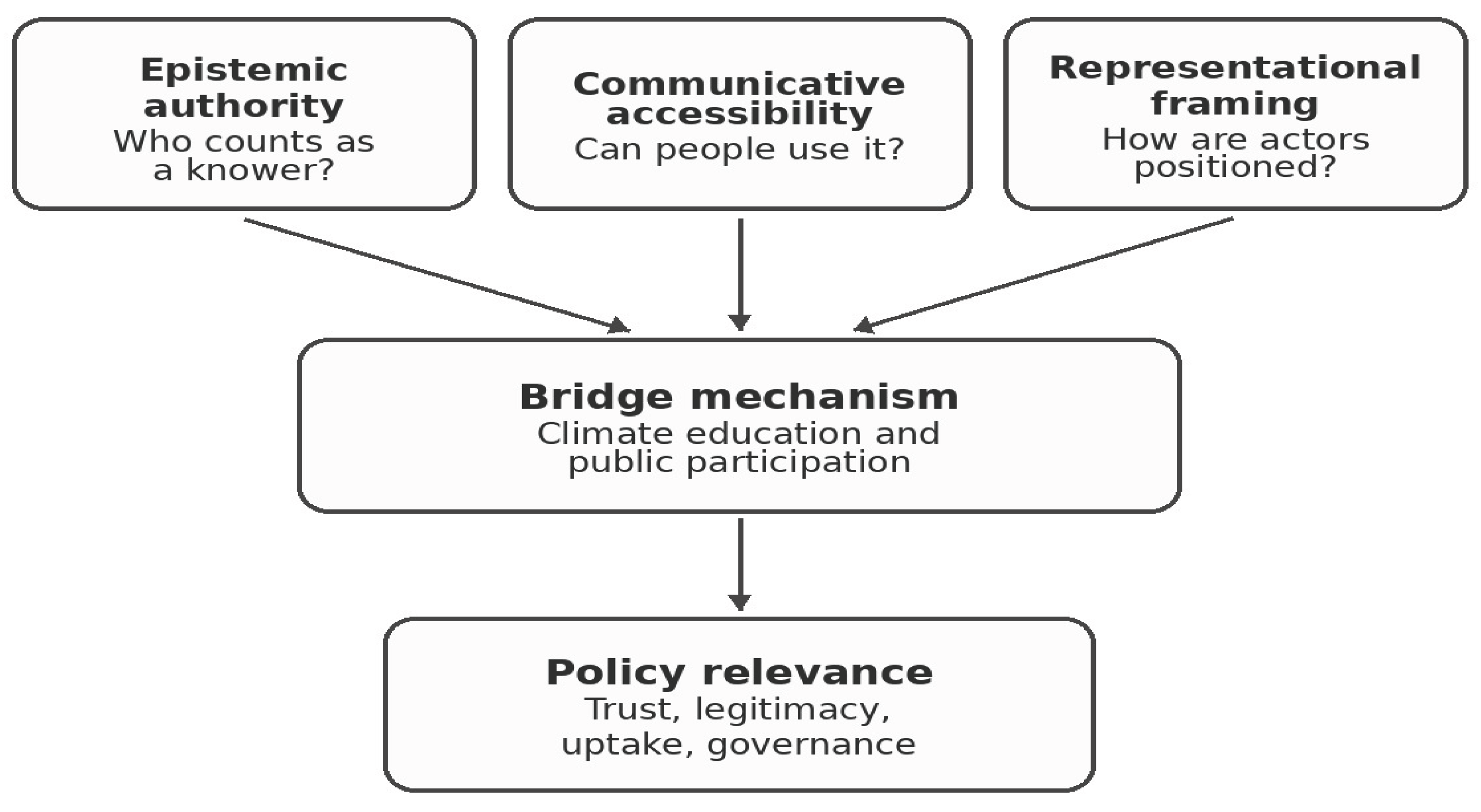
Note. Epistemic authority, communicative accessibility, and representational framing shape policy relevance through climate education and public participation.
6. Analysis and Discussion
6.1. Climate Discourse Can Be Technically Valid Without Being Publicly Intelligible
The primary finding is that climate discourse in Sub-Saharan Africa can remain technically valid without consistently becoming publicly intelligible. Literature on climate literacy provides the strongest foundational evidence. Simpson et al. (2021) demonstrate significant variation in perceptions and understandings of climate change across African countries and subnational contexts. The literature on climate services develops this point in more operational terms. Hansen et al. (2019), Antwi-Agyei et al. (2021), Sultan et al. (2020), and Ofoegbu and New (2022) collectively emphasize user needs, timing, contextual relevance, communication channels, and institutional support. They show that organizations can generate scientifically robust information without ensuring its usability for target communities.
The concept of demystification clarifies what is at stake. Demystification does not mean oversimplifying science. It means translating climate knowledge into formats that preserve scientific integrity while connecting that knowledge to specific decisions, places, timeframes, and linguistic contexts. A technical advisory may communicate probabilistic rainfall anomalies accurately yet still fail to influence action if farmers, local officials, or communities cannot connect that information to planting schedules, labor constraints, infrastructure, or local ecological indicators. The discourse may therefore be formally accurate while remaining socially limited.
6.2. Epistemic Authority Remains Uneven Despite Increased Recognition of Indigenous and Local Knowledge
The second major finding concerns epistemic authority. Contemporary policy and academic discussions increasingly recognize Indigenous and local knowledge; nevertheless, this recognition does not consistently alter the institutional order that confers legitimacy on climate knowledge. UNESCO's initiatives in Africa and the UNFCCC Local Communities and Indigenous Peoples Platform establish institutional avenues for knowledge exchange and participation (UNESCO, 2021; UNFCCC, n.d.-a). Mbah and Ezegwu (2024) identify persistent epistemic exclusion and marginalization of Indigenous and local knowledge in climate change and environmental education. Their conclusion does not imply that inclusive work is absent. It indicates that the structures through which knowledge is recognized and validated remain uneven.
The newer literature makes this gap more concrete. Leal Filho et al. (2025) show that Indigenous and local knowledge is often welcomed rhetorically but faces practical obstacles to implementation, including weak institutional mechanisms, mismatched validation standards, and limited respect for Indigenous worldviews. This finding supports the paper's central distinction between recognition and redistribution: institutions may cite Indigenous knowledge while reserving final interpretive authority for external scientific or policy actors.
The Multiple Evidence Base approach helps interpret this pattern. It advocates complementarity rather than subordination. Institutions need not eliminate differences among knowledge systems to enable productive connections. They must, however, establish frameworks that support dialogue without designating one system as universally authoritative while relegating others to merely local status. In climate discourse, this requires moving beyond consultation models that gather local perspectives while retaining interpretive authority within technical or donor organizations.
6.3. Climate Education is a Bridge Between Knowledge Production and Public USE
The third finding indicates that climate education functions as a bridge between knowledge production and public use. Damoah (2023a) argues that climate change education should be accelerated and integrated across disciplines, with attention to social justice, equity, diverse perspectives, and action-oriented learning. Khalo and Damoah (2023) extend this perspective to universities, where climate education can influence future professionals, civic participants, and institutional cultures. This literature reinforces the paper's argument that demystification depends not only on improved communication but also on educational frameworks that support the interpretation and application of climate knowledge.
Damoah's environmental education scholarship is significant because it locates climate discourse within institutional structures. Damoah and Omodan (2022) show that effective environmental education policy depends on design, clarity, implementation support, and institutional coordination. Damoah, Khalo, and Adu (2024) examine curriculum integration and the role of schools in cultivating environmentally responsible citizens. These arguments are closely related to epistemic authority. Curricula determine which knowledge counts, which perspectives appear authoritative, and whether students encounter African ecological interpretation as living knowledge rather than as residual tradition.
Student activism adds another dimension. Damoah et al. (2023) characterize climate and environmental protest as transformative defiance. This framing is significant because it positions students and young people not merely as audiences for climate communication but also as participants in climate discourse. They make claims, contest institutions, and help define climate action. This shift is important for a decolonial climate discourse because it expands the field of recognized knowledge contributors beyond scientists, policymakers, and institutional authorities.
6.4. Representation Must Hold Vulnerability and Agency Together
The fourth finding concerns representational framing. The reviewed literature indicates that climate discourse in Sub-Saharan Africa often emphasizes vulnerability, exposure, and risk. This emphasis is warranted because the IPCC Africa chapter documents significant and disproportionate climate risks across several systems (IPCC, 2022). A decolonial interpretation, however, asks whether vulnerability becomes the primary or sole lens through which African actors are represented. Excessive emphasis on vulnerability can obscure agency, adaptive practice, educational leadership, student activism, and knowledge production.
A more balanced discourse would acknowledge vulnerability while also recognizing agency. It would treat vulnerability and agency as conceptually linked rather than mutually exclusive. Communities may experience significant exposure while retaining crucial adaptive knowledge. Regions may face structural disadvantages while also generating climate expertise, experimentation, and local innovation. Leal Filho et al. (2022), Makondo and Thomas (2018), David (2024), and Zougmoré et al. (2021) support this point by showing that African Indigenous, local, and agricultural knowledge can contribute to adaptation in tangible ways.
Agyeman et al. (2025) argue that food security in Sub-Saharan Africa is shaped by climate-related constraints on agricultural output and the vulnerability of farming systems. This underscores the need for concrete rather than abstract climate communication. Climate communication should connect risk to livelihoods, agricultural systems, food security, and policy support. At the same time, it should avoid portraying farmers and communities solely as victims of climate change. They are also interpreters of environmental change and potential collaborators in adaptation efforts.
6.5. Recognition has Advanced Faster than Operational Integration
The fifth finding synthesizes the preceding findings. Official recognition of participation, local knowledge, user-focused communication, climate education, and sustainability has advanced more rapidly than operational integration. The African Union strategy, UNESCO initiatives, the UNFCCC platform, WMO guidance, and the climate services literature all support more inclusive language and design (African Union, 2022; UNESCO, 2021; UNFCCC, n.d.-b; WMO, 2011a, 2011b). However, climate literacy remains uneven, educational critiques highlight exclusion, and climate services research continues to identify barriers to communication and usability. These patterns suggest that institutions may endorse inclusiveness as a principle without fully redesigning communication systems, educational frameworks, and governance processes to put it into practice.
Current assessments of finance and climate services show why operational integration remains difficult. UNEP (2024) reports that adaptation finance remains far below estimated need, while WMO (2025) calls for stronger infrastructure, data-sharing arrangements, and inclusive service delivery. These findings indicate that decolonizing and demystifying climate discourse require more than improved narratives; they require investments that allow locally useful information, participatory planning, and community-facing services to function at scale.
Recent Sub-Saharan Africa-specific finance research further clarifies this point. Gemayel, Rosa, Maheshwari, Ungerer, and Lindner (2025) argue that SSA faces severe climate vulnerability and urgent investment needs in water management, agriculture, health, and infrastructure, while weak regulatory capacity, underdeveloped capital markets, and limited bankable projects hinder the mobilization of climate finance. Zoungrana, N'guessan, and Combary (2026) add that the proliferation of climate finance sources and instruments creates a practical challenge for SSA countries seeking to identify which mechanisms most effectively reduce climate vulnerability. Together, these sources support a more precise policy claim: demystifying climate discourse also means making finance instruments, access conditions, and institutional responsibilities intelligible to governments, intermediaries, and affected publics.
Damoah and Boglo's (2025) review of economic development and environmental sustainability in Sub-Saharan Africa sharpens this finding. They frame sustainable development as both a governance and environmental issue, emphasizing the roles of institutional structures, policy implementation, and socio-economic inequality in shaping environmental outcomes. Their argument supports this paper's claim that improved climate discourse requires institutional reform rather than only improved wording. Discursive inclusion becomes meaningful only when it changes who participates, how knowledge is validated, how education is organized, and how decisions are made.
The analysis, therefore, supports a bounded theoretical conclusion. Demystification and decolonization address distinct but interrelated limitations in climate discourse. Demystification responds to the problem of unintelligibility. Decolonization responds to the problem of unequal legitimacy. Climate education, public engagement, and climate services converge at the intersection of these concerns.
Table 3.
Synthesis of Major Findings and Implications.
| Major finding | What the review shows | Bounded implication |
|---|---|---|
| Climate discourse often remains technically dense. | Accuracy does not automatically produce public intelligibility. | Institutions should translate, not only transmit. |
| Epistemic authority remains uneven. | Local and Indigenous knowledge receives recognition, but not always parity in validation or decision-making. | Inclusion requires structural, not only rhetorical, change. |
| Climate education is a bridge mechanism. | Education connects climate knowledge to social transformation, public participation, and action. | Curricula, faculty development, and community engagement should be treated as tools for climate governance. |
| Vulnerability often dominates representation. | Risk framing can overshadow African agency, activism, expertise, and adaptation practice. | Discourse should balance exposure with knowledge, capability, and action. |
| Recognition outpaces implementation | Policy language supports inclusion more consistently than practice realizes it. | Governance reform must move beyond symbolic acknowledgment. |
7. Policy Implications
The first policy implication is that institutions should treat climate communication as a process of translation rather than one-way transmission. This means more than simplifying vocabulary. It requires aligning climate information with local decision-making contexts, communication systems, educational environments, and linguistic realities. The climate services literature directly supports this implication. Hansen et al. (2019), Sultan et al. (2020), Antwi-Agyei et al. (2021), Ofoegbu and New (2022), and WMO guidance collectively support investments in intermediary communication, local timing, and participatory service design rather than solely in upstream forecast production.
The second implication is that governments and institutions should move from symbolic recognition of Indigenous and local knowledge toward systematic incorporation. UNESCO's initiatives and the UNFCCC Local Communities and Indigenous Peoples Platform demonstrate that institutions acknowledge the importance of knowledge exchange and co-production (UNESCO, 2021; UNFCCC, n.d.-a). The challenge is to translate that acknowledgment into formal roles within climate services, strategic planning, curriculum development, advisory systems, and public communication. A Multiple Evidence Base approach suggests that local knowledge need not conform to scientific standards before institutions can use it. Instead, institutions should establish mechanisms for respectful complementarity, internal validation, and collaborative interpretation where appropriate.
The third implication concerns education. Climate change and environmental education in Africa should address knowledge hierarchies directly rather than merely incorporate local examples into dominant frameworks. Mbah and Ezegwu's (2024) review shows that epistemic exclusion persists in climate and environmental education. Damoah (2023a), Khalo and Damoah (2023), Damoah and Omodan (2022), and Damoah, Khalo, and Adu (2024) reinforce this point by demonstrating that educational policy, universities, and curricula are critical arenas for climate response. Educational reform should therefore examine whose knowledge frames define climate change and whether students encounter African ecological interpretations as living knowledge rather than as remnants of tradition.
The fourth implication concerns representation in policy and public discourse. Institutions should resist narratives that make African actors visible primarily in moments of crisis while rendering their expertise less visible. The IPCC's risk reporting remains essential, but climate discourse should also emphasize adaptive practice, local ecological insight, African scientific leadership, food security expertise, student activism, and educational innovation. More balanced representation can enhance legitimacy and expand the range of policy options considered credible.
The fifth implication concerns institutional design and financing. Inclusive climate discourse requires sustained material support. Participation, local language communication, community-based observation, climate education, curriculum change, and co-produced services require time, infrastructure, and financial resources. Institutions cannot achieve these objectives through rhetorical commitment alone. Although the reviewed literature does not provide a universal implementation framework for all African contexts, it indicates that communication and inclusion are ineffective when institutions treat them as supplementary responsibilities rather than integral components of climate governance.
A related policy implication is that adaptation finance should be evaluated partly by whether it strengthens knowledge equity and communication capacity, not only by whether it funds technical infrastructure. For example, early warning systems can be more inclusive when investments support local-language communication, trusted intermediaries, participatory mapping, community-based observation, and feedback loops among climate scientists, educators, extension workers, and Indigenous or local knowledge holders. This is the practical point at which demystification and decolonization converge: climate information must be technically credible, but also institutionally accessible and co-interpreted with the people expected to act on it.
A further implication is that climate finance readiness should be treated as part of climate communication and governance capacity. Current evidence suggests that finance gaps are not only about total funding volume; they also concern debt exposure, weak institutional preparation, limited project pipelines, and uneven access to grants or concessional instruments (Gemayel et al., 2025; Global Center on Adaptation & Climate Policy Initiative, 2025; United Nations Environment Program, 2025; Zoungrana et al., 2026). Policies that aim to decolonize climate discourse should therefore support local institutions in interpreting finance options, defining community priorities, documenting locally grounded adaptation needs, and negotiating funding arrangements that do not reproduce dependency or extractive knowledge relationships.
8. Limitations
This review has several limitations. First, it is a theoretically informed critical review, not a systematic review. It does not claim to encompass all published research on climate discourse, climate services, Indigenous knowledge, climate education, or environmental governance in Sub-Saharan Africa. Second, the source base depends primarily on English-language academic and institutional materials, which may underrepresent knowledge produced in African languages, French, Portuguese, Arabic, and other regional languages. Third, the review identifies patterns across Sub-Saharan Africa but does not claim that they apply uniformly to all countries, communities, institutions, or ecological zones. Fourth, the paper analyzes policy and academic discourse rather than directly measuring how particular communities understand climate change. Future empirical research could strengthen or refine the argument through country-specific discourse analysis, interviews, classroom studies, or evaluations of climate service programs.
9. Conclusions
This paper has presented a theoretically informed critical review of climate change discourse in Sub-Saharan Africa. Guided by decolonial theory and the Multiple Evidence Base approach, it argues that climate discourse in the region should be understood not only as a matter of scientific communication but also of epistemic authority, communicative accessibility, representational framing, education, and policy relevance. The reviewed literature supports five conclusions. Climate discourse can remain technically valid without becoming publicly intelligible. Institutions increasingly recognize local and Indigenous knowledge, although they do not consistently redistribute epistemic authority. Climate education remains an underused bridge between knowledge production and public engagement. Vulnerability remains a dominant frame that can obscure agency. Formal recognition of inclusion often exceeds operational implementation.
The paper's central claim is neither anti-scientific nor merely rhetorical. It is institutional and sustainability-oriented. Climate discourse becomes more effective when institutions make climate knowledge understandable, timely, and socially relevant. It becomes more legitimate when institutions recognize African communities, researchers, educators, students, farmers, and knowledge holders as authoritative contributors rather than as ancillary voices attached to externally defined expertise. Demystification and decolonization converge in this domain. The former enhances usability; the latter enhances legitimacy. The literature indicates that climate governance in Sub-Saharan Africa will be stronger when institutions pursue both aims together.
Future research could extend this review through comparative discourse analysis of national adaptation strategies, climate education curricula, university sustainability policies, media texts, and climate service programs in selected Sub-Saharan African countries. It could also examine how institutions operationalize inclusion in sectors such as agriculture, water management, urban planning, public health, and higher education. Such empirical work would help identify the main constraints and areas where institutional reform has produced measurable progress. The scholarship and policy materials reviewed here support a clear conclusion: improved climate discourse in Sub-Saharan Africa requires more than additional climate data. It requires more equitable relationships among knowledge, language, institutions, education, and publics.
Funding
This research received no external funding.
Data availability
This study relies on publicly available scholarly literature, policy documents, and institutional materials. No proprietary dataset was used.
Competing interests
The author declares no competing interests.
Clinical trial number
not applicable.
Ethics approval and consent to participate
Not applicable. This study analyzes publicly available scholarly, policy, and institutional materials and does not involve human participants, animal subjects, or private personal data.
Declaration of generative AI and AI-assisted technologies in the manuscript preparation process
During the preparation of this manuscript, the author used Grammarly and AI-assisted editing tools to improve clarity, readability, organization, and language consistency. After using these tools, the author reviewed and edited the manuscript and takes full responsibility for the final content.
References
- African Union. African Union climate change and resilient development strategy and action plan (2022-2032); African Union Commission, 2022. [Google Scholar]
- Agyeman, N. Y. B.; Damoah, B.; Manu, E. O. Traversing the interconnected dynamics of climate change and food security in Sub-Saharan Africa. Int. J. Environ. Sustain. Soc. Sci. 2025, 6(2), 338–352. [Google Scholar] [CrossRef]
- Antwi-Agyei, P.; Dougill, A. J.; Doku-Marfo, J.; Abaidoo, R. C. Understanding climate services for enhancing resilient agricultural systems in Anglophone West Africa: The case of Ghana. Clim. Serv. 2021, 22, Article 100218. [Google Scholar] [CrossRef]
- Ayompe, L. M.; Epie, W. N. Building Africa’s climate resilience: Understanding the impacts and future strategies in the face of climate change. Front. Clim. 2025, 7, Article 1619799. [Google Scholar] [CrossRef]
- Damoah, B. Reimagining climate change education as a panacea to climate emergencies. Int. J. Environ. Sustain. Soc. Sci. 2023a, 4(4), 977–987. [Google Scholar] [CrossRef]
- Damoah, B. Ramifications of violent protest on the environment. Int. J. Environ. Sustain. Soc. Sci. 2023b, 4(3), 652–663. [Google Scholar] [CrossRef]
- Damoah, B.; Boglo, R. Nuances of economic development and environmental sustainability in Sub-Saharan Africa. In Discover Sustainability; 2025; Volume 6, p. 999. [Google Scholar] [CrossRef]
- Damoah, B.; Omodan, B. I. Determinants of effective environmental education policy in South African schools. Int. J. Educ. Res. Open 2022, 3, 100206. [Google Scholar] [CrossRef]
- Damoah, B.; Adu, E. O.; Ofori, E.; Apraku, A. Aggravation of the climate change crisis in the Gulf regions of the United States: A review of anthropogenic factors. J. Ecohumanism 2024, 3(4), 438–449. [Google Scholar] [CrossRef]
- Damoah, B.; Keengwe, S.; Owusu, S.; Yeboah, C.; Kekessie, F. The global climate and environmental protest: Student environmental activism as a transformative defiance. Int. J. Environ. Sustain. Soc. Sci. 2023, 4(4), 1180–1198. [Google Scholar] [CrossRef]
- Damoah, B.; Khalo, X.; Adu, E. O. South African integrated environmental education curriculum trajectory. Int. J. Educ. Res. 2024, 125, 102352. [Google Scholar] [CrossRef]
- Gemayel, E.; Rosa, S.; Maheshwari, V.; Ungerer, C.; Lindner, P. IMF Working Paper No. WP/25/99; Laying the ground for scaling up climate finance in Sub-Saharan Africa: Leveraging survey insights and IMF country work to scale climate finance in SSA. International Monetary Fund, 2025.
- Global Center on Adaptation; Climate Policy Initiative. Adaptation finance flows to Africa: State and future trends. In Global Center on Adaptation; 2025. [Google Scholar]
- David, J. O. Decolonizing climate change response: African Indigenous knowledge and sustainable development. Front. Sociol. 2024, 9, 1456871. [Google Scholar] [CrossRef]
- Hansen, J. W.; Vaughan, C.; Kagabo, D. M.; Dinku, T.; Carr, E. R.; Körner, J.; Zougmoré, R. B. Climate services can support African farmers' context-specific adaptation needs at scale. Front. Sustain. Food Syst. 2019, 3, Article 21. [Google Scholar] [CrossRef]
- IPCC. Africa. In Climate change 2022: Impacts, adaptation and vulnerability. Contribution of Working Group II to the Sixth Assessment Report of the Intergovernmental Panel on Climate Change; Cambridge University Press, 2022. [Google Scholar]
- Khalo, X.; Damoah, B. Reinvigorating climate change education in universities as a social transformative agenda. Environ. Sci. Sustain. Dev. 2023, 8(4), 19–26. [Google Scholar] [CrossRef]
- Leal Filho, W.; Barbir, J.; Gwenzi, J.; Ayal, D.; Ojeh, V. N.; et al. The role of Indigenous knowledge in climate change adaptation in Africa. Environ. Sci. Policy 2022, 136, 250–260. [Google Scholar] [CrossRef]
- Leal Filho, W.; Lütz, J. M.; Totin, E.; Ayal, D.; Mendy, E. Obstacles to implementing indigenous knowledge in climate change adaptation in Africa. J. Environ. Manag. 2025, 373, 123678. [Google Scholar] [CrossRef]
- Makondo, C. C.; Thomas, D. S. G. Climate change adaptation: Linking Indigenous knowledge with Western science for effective adaptation. Environ. Sci. Policy 2018, 88, 83–91. [Google Scholar] [CrossRef]
- Mbah, M. F.; Ezegwu, C. The decolonization of climate change and environmental education in Africa. Sustainability 2024, 16(9), Article 3744. [Google Scholar] [CrossRef]
- Ndlovu-Gatsheni, S. J. Decoloniality as the future of Africa. Hist. Compass 2015, 13(10), 485–496. [Google Scholar] [CrossRef]
- Ofoegbu, C.; New, M. Evaluating the effectiveness and efficiency of climate information communication in the African agricultural sector: A systematic analysis of climate services. Agriculture 2022, 12(2), 160. [Google Scholar] [CrossRef]
- Shabalala, N. P. Decolonising environmental education in Africa through the early integration of indigenous knowledge systems guided by Zibanjwa Zisemaphuphu. In Discover Sustainability; 2025; Volume 6, p. 892. [Google Scholar] [CrossRef]
- Simpson, N. P.; Andrews, T. M.; Krönke, M.; Lennard, C.; Odoulami, R. C.; Ouweneel, B.; Steynor, A.; Trisos, C. H. Climate change literacy in Africa. Nat. Clim. Change 2021, 11, 937–944. [Google Scholar] [CrossRef]
- Singh-Pillay, A.; Madlala, A. Legitimising Indigenous knowledge systems as a pathway to sustainable development. In Discover Education; 2026; Volume 5, p. 87. [Google Scholar] [CrossRef]
- Sultan, B.; Lejeune, Q.; Menke, I.; Maskell, G.; Lee, K.; Noblet, M.; Sy, I.; Roudier, P. Current needs for climate services in West Africa: Results from two stakeholder surveys. Clim. Serv. 2020, 18, 100166. [Google Scholar] [CrossRef]
- Tengö, M.; Brondizio, E. S.; Elmqvist, T.; Malmer, P.; Spierenburg, M. Connecting diverse knowledge systems for enhanced ecosystem governance: The Multiple Evidence Base approach. Ambio 2014, 43, 579–591. [Google Scholar] [CrossRef]
- UNESCO. Knowing our changing climate in Africa. In UNESCO LINKS; 2021. [Google Scholar]
- UNESCO. Indigenous knowledge and climate change in Africa; UNESCO LINKS, n.d. [Google Scholar]
- United Nations Environment Programme. Adaptation gap report 2024: Come hell and high water; United Nations Environment Programme, 2024. [Google Scholar]
- United Nations Environment Programme. Adaptation gap report 2025: Running on empty; United Nations Environment Programme, 2025. [Google Scholar]
- United Nations Framework Convention on Climate Change. Climate change and Indigenous Peoples’ knowledge in the Sahel; United Nations Framework Convention on Climate Change, 2024. [Google Scholar]
- UNFCCC. Functions of the Local Communities and Indigenous Peoples Platform—United Nations Framework Convention on Climate Change.
- UNFCCC. Local Communities and Indigenous Peoples Platform; United Nations Framework Convention on Climate Change, n.d.-b. [Google Scholar]
- WMO. Understanding user needs for climate services in agriculture; World Meteorological Organization, 2011a. [Google Scholar]
- WMO. Improving availability, access, and use of climate information; World Meteorological Organization, 2011b. [Google Scholar]
- World Meteorological Organization. State of the climate in Africa 2024; World Meteorological Organization, 2025. [Google Scholar]
- World Meteorological Organization. State of the global climate 2025; World Meteorological Organization, 2026. [Google Scholar]
- Zent, S. Indigenous knowledge, local knowledge, and climate change: Interconnections for policy and practice; World Bank, 2025. [Google Scholar] [CrossRef]
- Zoungrana, H.; N'guessan, C. F. J.; Combary, O. S. Climate finance for adaptation in Sub-Saharan Africa: Assessing sources and instruments. Cogent Econ. Financ. 2026, 14(1), 2662079. [Google Scholar] [CrossRef]
- Zougmoré, R. B.; Läderach, P.; Campbell, B. M. Transforming food systems in Africa under climate change pressure: Role of climate-smart agriculture. Sustainability 2021, 13(8), Article 4305. [Google Scholar] [CrossRef]
Figure 1.
Analytical Pathway of the Review.
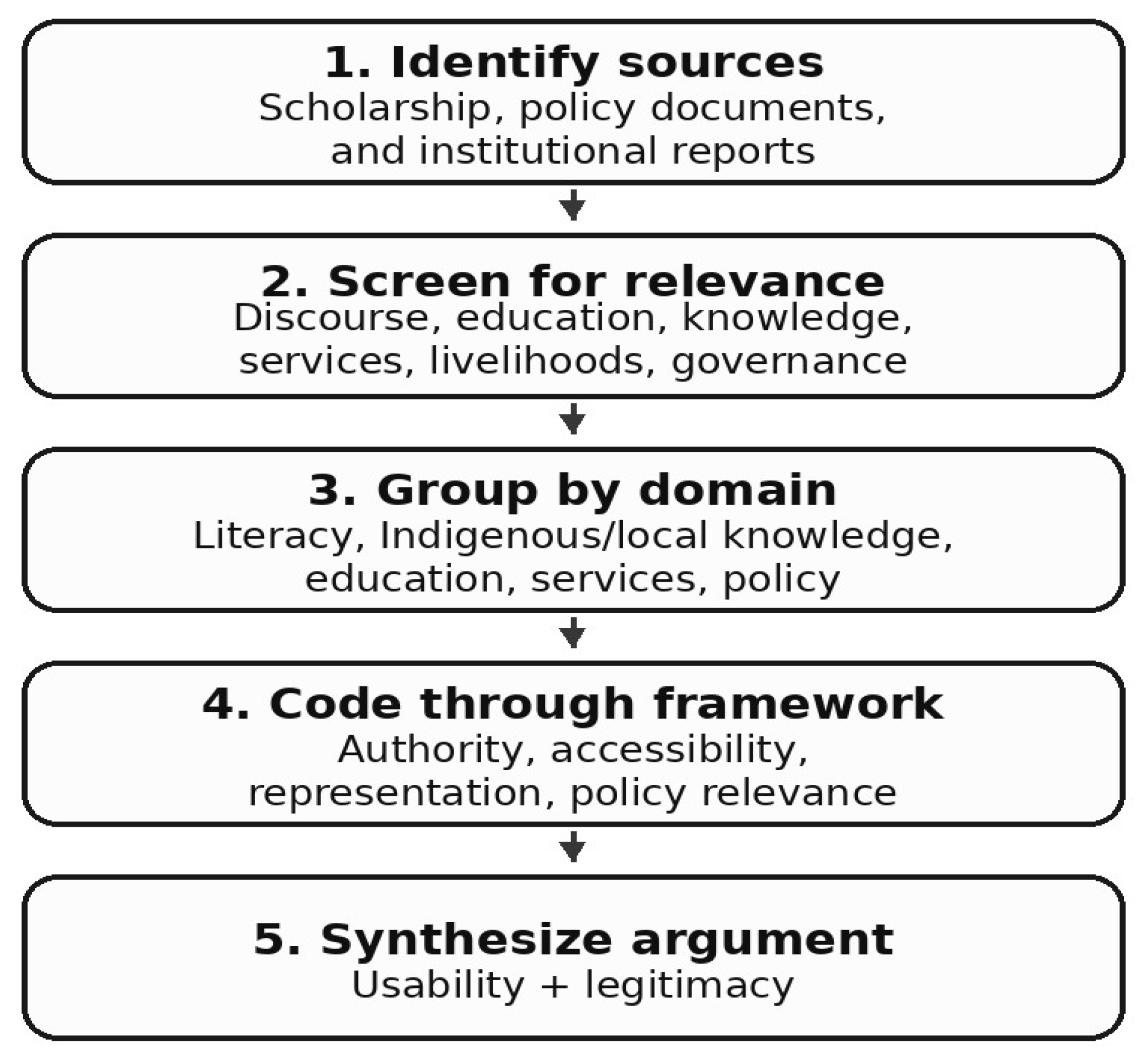
Figure 2.
Theoretical Framework Informing the Study.
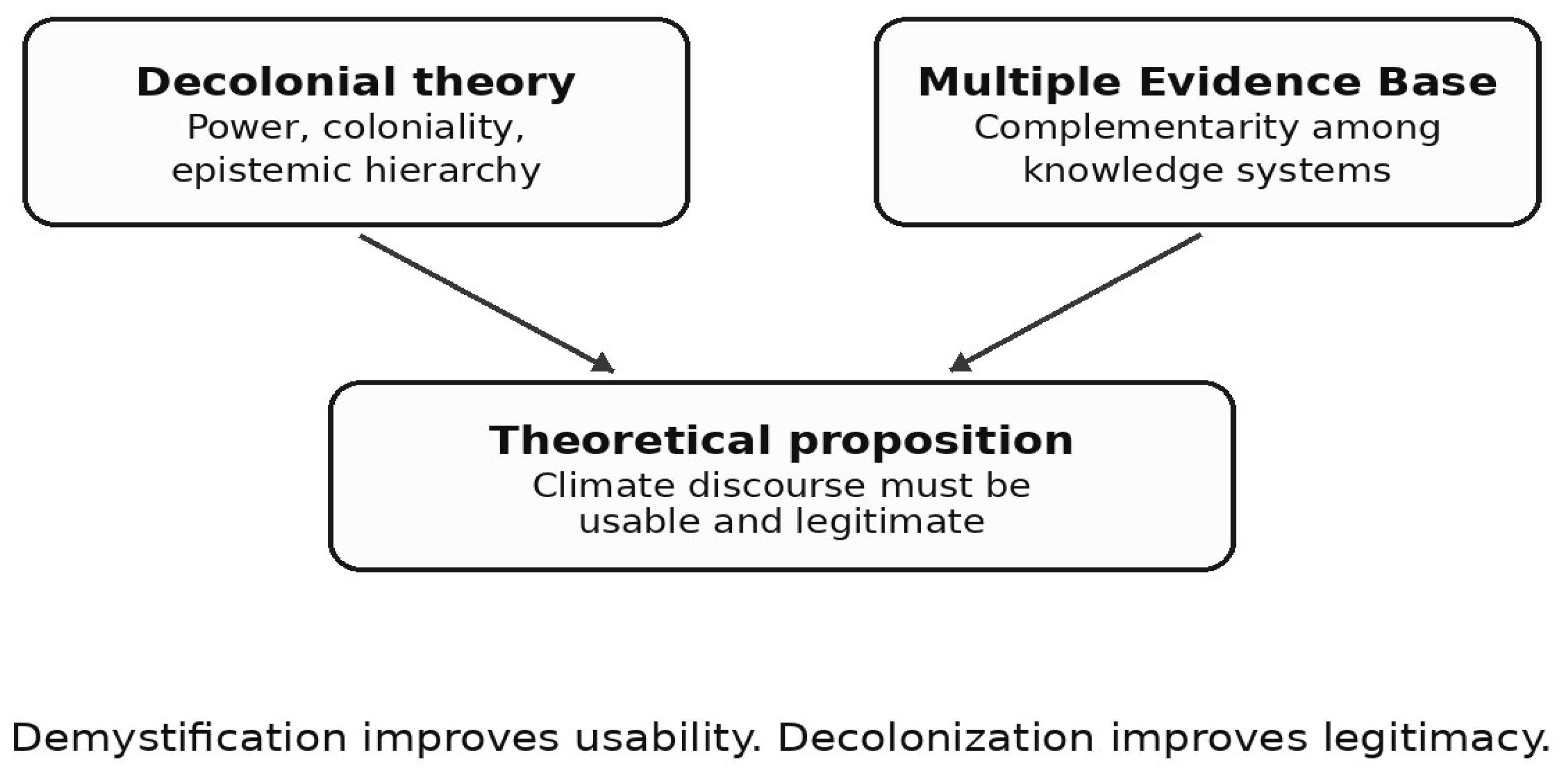
Table 1.
Review Procedure and Source Domains.
| Review component | Operational decision | Function in the paper |
|---|---|---|
| Source identification | Targeted searches through Google Scholar, publisher pages, institutional websites, and citation chaining. | Locates scholarly and policy materials relevant to climate discourse and governance. |
| Screening | Retain sources focused on discourse, education, knowledge systems, climate services, food security, public participation, or governance. | Keeps the review focused and defensible. |
| Domain grouping | Group sources into literacy and communication, Indigenous/local knowledge, decolonial education critique, climate services/livelihoods, and policy frameworks. | Organizes the evidence base before theory-guided interpretation. |
| Coding | Code recurring patterns under authority, accessibility, representation, and policy relevance. | Connects reviewed sources to the conceptual framework. |
| Synthesis | Interpret convergences, tensions, and bounded implications. | Builds the paper’s theoretical argument. |
Disclaimer/Publisher’s Note: The statements, opinions and data contained in all publications are solely those of the individual author(s) and contributor(s) and not of MDPI and/or the editor(s). MDPI and/or the editor(s) disclaim responsibility for any injury to people or property resulting from any ideas, methods, instructions or products referred to in the content. |
© 2026 by the authors. Licensee MDPI, Basel, Switzerland. This article is an open access article distributed under the terms and conditions of the Creative Commons Attribution (CC BY) license (http://creativecommons.org/licenses/by/4.0/).
Copyright: This open access article is published under a Creative Commons CC BY 4.0 license, which permit the free download, distribution, and reuse, provided that the author and preprint are cited in any reuse.