

Submitted:
18 May 2026
Posted:
19 May 2026
You are already at the latest version
Abstract
This work presents a comprehensive theoretical analysis and numerical calculation of the fundamental physical parameters surrounding a non-rotating, spherically symmetric Schwarzschild black hole. Quantitative Analysis of Schwarzschild Black Hole Spacetime Radius, Light Deflection, Redshift, and Tidal Phenomena. Utilizing General Relativity, to compute the Schwarzschild radius as the defining event horizon. The gravitational time dilation, showing the dramatic slowing of time as the event horizon is approached, and the gravitational redshift of signals emitted from near the horizon. Additionally, this study calculates the relativistic deflection angle of light in the weak-field limit using the geodesic equation. To analyse the structural integrity of objects near the black hole, I have calculated the tidal acceleration and resultant tidal force, demonstrating that tidal stresses approach infinite values at the singularity, causing powerful tidal disruptions and “spaghettification”. Planetary mass black holes have a tiny size and an intense gravitational field to tear apart objects passing nearby their external surface, in contrast to supermassive black holes. These calculations provide a unified model for validating relativistic effects, offering precise quantitative measurements for astrophysical observation. Gravitational time dilation near a black hole is a profound prediction of Einstein’s general relativity, where intense gravity causes time to pass significantly slower for objects closer to the event horizon compared to distant observers. This effect means that an observer near the horizon experiences time as almost frozen from an external viewpoint.
Keywords:
black hole radius (Schwarzschild radius)
; deflection angle of light
; gravitational redshift
; photon frequency
; gravitational time dilation
; tidal acceleration
; tidal force
1. Introduction
A planetary-mass black hole (PMBH) is a theoretical, microscopic black hole with a mass roughly equivalent to that of the Mountains, Moon or a planets, such as the Earth or Jupiter. Its volume and its radius are extremely tiny; the radius of a Jupiter mass black hole is about 2.8 meters, and an Earth-mass black hole would have a Schwarzschild radius of roughly 9 mm. Most theories suggest Primordial Black Holes (PBHs) could be formed just after the Big Bang in a violent event [1,2,3,4,5,6]. They are small in size and mass, making them difficult to detect directly. We need to use gravitational microlensing (short-duration events) or focus on their travel into the solar system to detect them directly or investigate their travel in front of stars in the galaxy to calculate their gravitational lensing or tidal effects. Recent studies estimate that they could be widely available in the arms of the Milky Way and could be involved in the light bending of stars and planets. Stellar-mass black holes with mass higher than the mass of the Sun should be formed by a supernova event or considered to become supermassive black holes (millions/billions of solar masses) after collecting huge amount of mass from their surroundings. Planetary mass black holes are hypothetical, tiny mass objects formed in the earliest moments of the universe’s inflation [7,8,9,10]. Planetary mass black holes are hypothetical objects with masses similar to planets or satellites with a mass (roughly 100 or millions of times lower than the mass of the Sun) but the size of a tennis ball or smaller. Because stellar collapse cannot produce such a size of black holes, their existence would almost certainly confirm a primordial origin or formation inside a supergiant black hole, meaning they formed in the extreme density of the very early universe shortly after the Big Bang.
The main objectives of this study are to calculate black hole Radius , the deflection angle of light , Gravitational Redshift z, Gravitational Time Dilation t, Tidal acceleration , and Tidal Force
2. Planetary Mass Black Hole
The planetary mass black hole is a tiny mass black hole with a mass lower than the mass of the sun, and its radius is several meters or millimetres. An escape velocity from the surface of a black hole is similar to the speed of light, and is necessary to calculate the radius of a black hole. A stellar mass black hole could be formed from the collapsed heart of a star, but a planetary mass black hole should be formed from collected, condensed, and collapsed tiny ratios of matter and energy inside an event horizon of a massive black hole due to tidal effects of a black hole singularity. Stellar black holes form when massive stars, with a mass over 20 solar masses, exhaust their nuclear fuel entirely and collapse under their own gravity. The core implodes, either directly forming a black hole or exploding in a supernova, where the remnant core falls back, creating a singularity and a dark compacted event horizon region around it from outside. The radius of a planetary mass black hole is only several meters or centimetres, but its gravitational lensing and tidal effects on the stars and planets are acceptable and necessary to investigate [11,12,13,14,15,16]. An Earth-mass black hole would have a Schwarzschild radius of only 9 millimetres, making it smaller than a marble. Unlike standard black holes born from dying stars, these formed from high-density fluctuations in the first second of the universe. Their event horizons are tiny; for instance, a black hole with five times Earth’s mass would be roughly the size of a tennis ball. Supermassive black holes have radii thousands or billions of times the size of the Sun or Earth. The Stellar mass black holes have the largest radius of the black dwarfs, which could be more than three kilometers. Following the general equation of escaping energetic particles at speed of light c=300,000 km/s, at a distance from the center of a black hole with mass M as shown here:
3. Gravitational Deflection of Light
Gravitational deflection of light is the bending of an electromagnetic spectrum, typically visible light paths as they pass near massive objects, particularly black holes, a phenomenon caused by the curvature of spacetime described by Einstein’s General Theory of Relativity. First confirmed in 1919 with a deflection of 1.75 arcseconds near the Sun, this effect causes gravitational lensing, allowing astronomers to observe distant, magnified stars, galaxies, and detect massive, unseen objects such as neutron stars and white dwarfs. General relativity predicts that light passing the edge of the Sun is deflected by 1.75 arcseconds. This was confirmed by Arthur Eddington’s 1919 expedition, providing strong evidence for Einstein’s theory [17,18,19,20]. While Newtonian gravity suggests light could be bent, general relativity predicts a deflection that is twice as large as the Newtonian prediction. It works by spacetime being bent around massive objects, forcing light to follow a curved path. As the black hole passes between Earth and the Sun, its gravity bends the Sun’s light. The “shift from left to the right” you observe is the formation of a secondary image or the displacement of the primary image. The deflection angle for light passing at a distance (R=b) (impact parameter) from an object or black hole center with a mass M is given by the Einstein deflection formula:
Where is the closest distance between the light rays and the mass (impact parameter) of the massive objects as black holes, and planets, and G is the gravitational constant ). is the distance of the light that located outside of an event horizon radius or behind a Schwarzschild radius . The deflection angle of light passing outside of a black hole is in radian. According to General Relativity, developed by Albert Einstein, light passing near a massive object bends since .
Where is the light passes about Schwarzschild radii from the black hole.
4. Color Change (White to Yellow)
The basics of how gravity warps light. Essentially, as light “climbs” out of a gravitational field (like leaving a planet or star), it stretches out—losing energy and shifting toward the red end of the spectrum. If it’s falling in, it gets squeezed and gains energy, turning bluer. It’s pretty wild to think Einstein figured this out nearly a decade before he even finished the full math for General Relativity. The detected gravitational redshift (z) combined with the relativistic transverse Doppler effect confirms that the star is orbiting a massive, compact black hole (Sgr A*) as predicted by Einstein. Both the Doppler effect and gravitational redshift cause light to shift in color (frequency) due to different physical mechanisms—relative motion vs. gravity—resulting in either redshift (lengthening of wavelength, lower energy) or blueshift (shortening of wavelength, higher energy). Colour changes in light (redshift/blueshift) are caused by either the relative movement of a source the Doppler effect or strong gravity the gravitational redshift [21,22,23,24,25,26]. The Doppler Effect in light is caused by the relative motion of the source and the observer. Redshift (Object Receding): When an object is moving away from the observer, light waves are stretched, making them appear lower in frequency and shifting the colour toward the red end of the spectrum. Blueshift (Object Approaching): When an object moves towards the observer, light waves are compressed, increasing their frequency and shifting the colour toward the blue/violet end. Applications: Astronomers use this to identify binary stars, rotating galaxies, and planets around other stars (radial velocity method). The Sun is naturally a white star (peaking in the green-blue spectrum) but appears yellow on Earth due to atmospheric scattering or red due to gravitational redshift. The transition from white to a deeper “glow at yellow” during this event can be explained by two physical shifts:
First a Gravitational Redshift z: As light climbs out of the black hole’s gravitational well (if it passes very close to the event horizon), it loses energy. Its wavelength increases. If the receiver is not far away, but at a closer distance from massive object or a black hole, the Gravitational Redshift Equation for Observer at Finite or closer Distance is:
We shall use Schwarzschild metric, the Redshift formula for light emitted at a distance , and light received by an observer at a distance from bright object or black hole. If , then a Gravitational Redshift Equation for an observer at an infinite Distance or distant place is:
Where , then , this shifts the Sun’s white light toward the redder (yellow/orange) end of the visible spectrum. Then is an emitted wavelength, and is an observed wavelength. The gravitational redshift (z) describes how the wavelength of light stretches as it moves through a gravitational field. Rearrange the Fundamental Formula of a gravitational redshift for a (Distant Observer):
Then is an emitted frequency of light, and it is an observed radiation frequency that received by human eyes or any technology. Then , the observed frequency of light decreases (redshifts) due to gravitational redshift. As light climbs out of a gravitational well (moves away from a massive object like stars, neutron stars, white dwarfs or black holes), it loses energy, causing its frequency to lower and its wavelength to stretch towards the yellow or red end of the spectrum. It is predicted by Einstein and a consequence of general relativity, where the electromagnetic spectrum loses energy passing out of a gravitational potential well due to the gravitational field of massive objects or black holes. The space around black holes or celestial objects is filled with dark matter particles, the fabritons, and ordinary matter, where light is trapped, absorbed, and refracted after passing through it. If , then causing the redshift factor to approach infinity by Equation (7). Where z is a Redshift parameter, and is a Radial distance of emission of radiation from the center of the black hole. This indicates that photons emitted from the event horizon (Schwarzschild radius) lose all their energy and cannot escape to an external observer. Near event horizon redshift is infinity, it is extremely redshifted and even invisible.
Problem 1: If a black hole with a mass of Sun passes between Sun and Earth at daytime since observer looks on it at distant place is 2 million kilometers far from a black hole, and light passes at a distance (300000 meters) from an evet horizon a of a solar mass black hole, calculate deflection angle of light, gravitational redshift z and observed wavelength of light ?. Let’s go step by step using standard general relativity approximation for a Solar-mass black hole. To determine the physics of light passing near a solar-mass black hole, we use the principles of General Relativity. For a black hole with the mass of the Sun . At first step, I need to calculate the black hole radius with mass of a Sun is: Then, closest approach of light, the impact parameter is At second step, I have to calculate a deflection angle of light that passed at a distance from center of a solar mass black hole, then the deflection angle of light is: Converting deflection angle of light by radians to degrees: The deflection angle of light by degree is This deflection angle is very large compared to normal gravitational lensing because the light passes extremely close to the event horizon of a black hole. At the third step, I should calculate the gravitational redshift of light: .
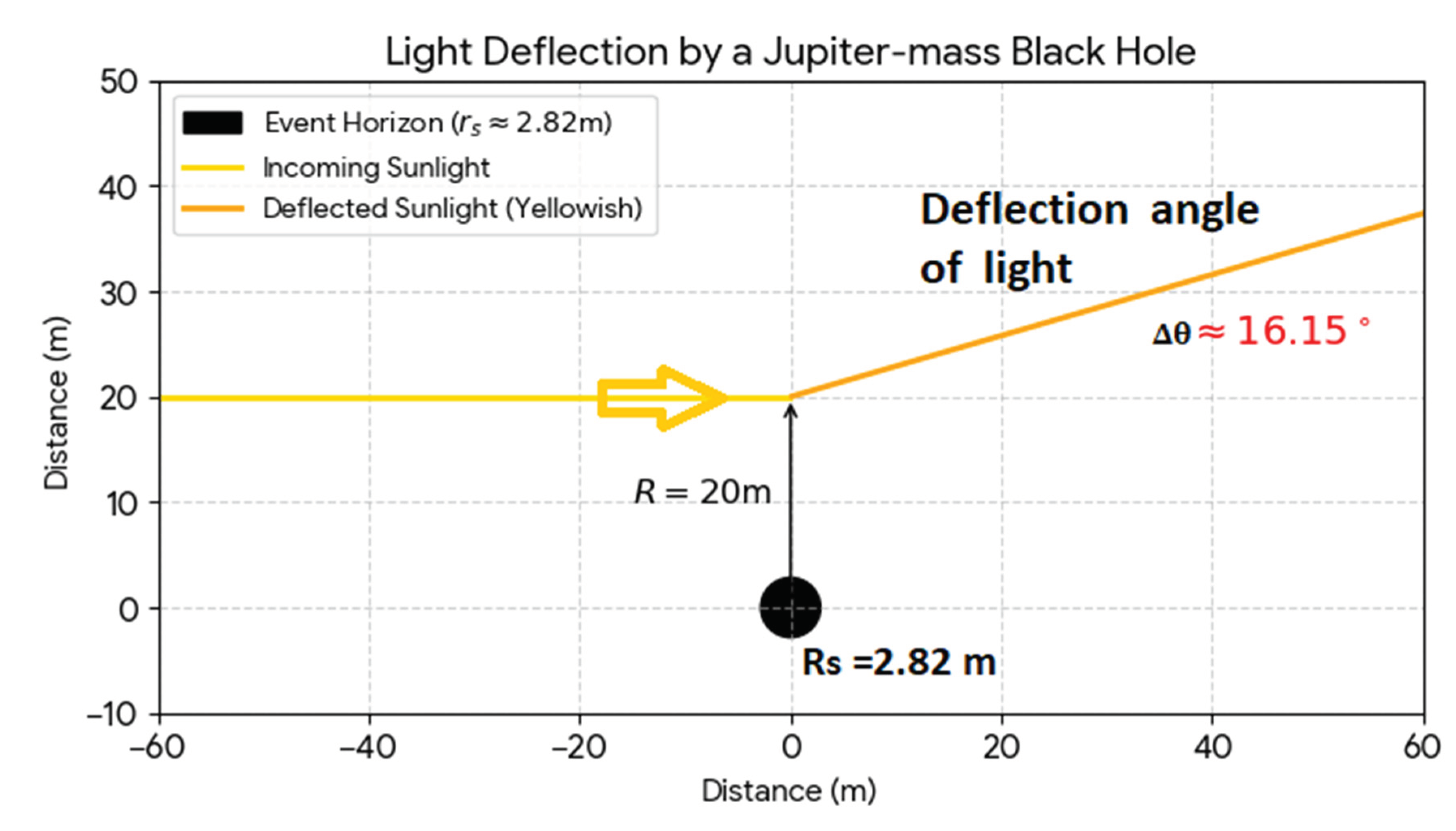
Thus, At the final step, I shall calculate an observed wavelength of light that deflected and stretched due to the gravitational field of a solar mass black hole. , then, Assuming a standard visible light wavelength emitted from the Sun is 550 nm, to calculate the deflected wavelength of light by a black hole, as observed by an observer on Earth, is: While the observer is 2 million kilometers away, these local relativistic effects (redshift and deflection) are primarily determined by how close the light path comes to the event horizon itself (300 km). At 2 million km, the observer is effectively at “infinity” for these calculations, meaning they would measure the full redshift and deflection calculated above. White light does not have a single wavelength; rather, it is a combination of all wavelengths in the visible spectrum, typically ranging from about 400 nm (violet), which is the shortest wavelength, to red colour, the longest wavelength, which is about 700-750 nm (red). It is perceived as white when all colours of the spectrum strike the human eye simultaneously without any deflection, absorption or refraction. The sunlight is a rainbow of seven colours in the visible spectrum called a white light. Problem 2: If sunlight colour changes from white to yellow at daytime since a Jupiter-mass black hole passes between Sun and Earth at daytime, R=20 meters is the closest approach (impact parameter) of light passed from center of a black hole, calculate gravitational redshift z, deflection angle of light, and observed wavelength of light ?. To determine the gravitational effects of a Jupiter-mass black hole passing between the Sun and Earth with an impact parameter of light passed at distance (R=20 meters) from center of a black hole. The Schwarzschild radius is We shall calculate the deflection angle of light is (), gravitational redshift (z=0.0789). If we assume the initial sunlight is “white” with an average wavelength , (it is the center of the visible spectrum), the observed wavelength shifted by the black hole’s gravity is: ). Then, an observed wavelength is The wavelength of yellow light is approximately 570–590 nanometers (nm). It occupies the middle region of the visible spectrum, located between green (495–570 nm) and orange (590–620 nm) light. A common reference wavelength for yellow is roughly 580 nm.
Figure 1.
Light deflection by a Jupiter-mass black hole.
Second a Doppler shift: is the change in frequency or wavelength of a wave (sound or electromagnetic wave) for an observer moving relative to its source. Waves compress (higher pitch/blue-shift) as the source approaches an observer and stretch (lower pitch/redshift) as it recedes. It is widely used in astronomy to measure stellar/galactic velocities and in medicine (ultrasound) to detect the size of stones in the kidney or measure blood flow. The Doppler shift equation calculates the change in frequency of an electromagnetic wave or sound wave due to the relative motion between a source and an observer:
Here, is an observed frequency, is a source frequency or an original emitted frequency of light or sound, is wave speed, is an observer speed, and is the source speed.
Doppler Shift Formulas for (Star Moving Away) from an observer on the Earth or in space: the Doppler shift causes its light to experience a redshift, the observed wavelength increases () and frequency decreases , indicating a positive radial velocity.
Doppler Shift Formulas for (Star Moving towards) or close to an observer on the Earth or in space: the Doppler shift causes its light to experience a blueshift, the observed wavelength decreases () and frequency increases , indicating a positive radial velocity.
The speed of moving star is calculated by following equation:
Where , then If Wavelength Shift,
Then, is the original frequency of light ray that emitted by a source as the stars.
Problem 3: The star emits a spectral line at a rest wavelength of 600 nm, but due to its motion away from an observer, it is observed on Earth at a wavelength of 601 nm. Calculate the speed of the star that moved away from Earth, an emitted, and the observed frequency of light ?.
Solution: The change in wavelength () is the difference between the observed and rest wavelengths: Since the observed wavelength is longer than the emitted wavelength, the light has been redshifted. This confirms the star is moving away from Earth.
Insert values into this equation: Then, the speed of star determined is An emitted Frequency of starlight: An observed Frequency of starlight: As the star moves away, the wavelength increases (redshifted), which corresponds to a decrease in frequency.
Problem 4: The star emits a spectral line at a rest wavelength of 601 nm, but due to its motion towards an observer, it is observed on Earth at a shortest wavelength of 600 nm. Calculate the speed of the star that moved towards an observer on the Earth, emitted wavelength, and the observed frequency of light ?.
Solution: The change in wavelength () is the difference between the emitted and observed wavelengths:
Since the observed wavelength is shorter than the emitted wavelength, the light is blueshifted, confirming the star is moving toward the observer.
Insert values into this equation: Then, the speed of star towards an observer determined is An observed Frequency of starlight: An emitted Frequency of starlight: As the star moves close to an observer, the wavelength decreases (blueshifted), which corresponds to an increase in frequency.
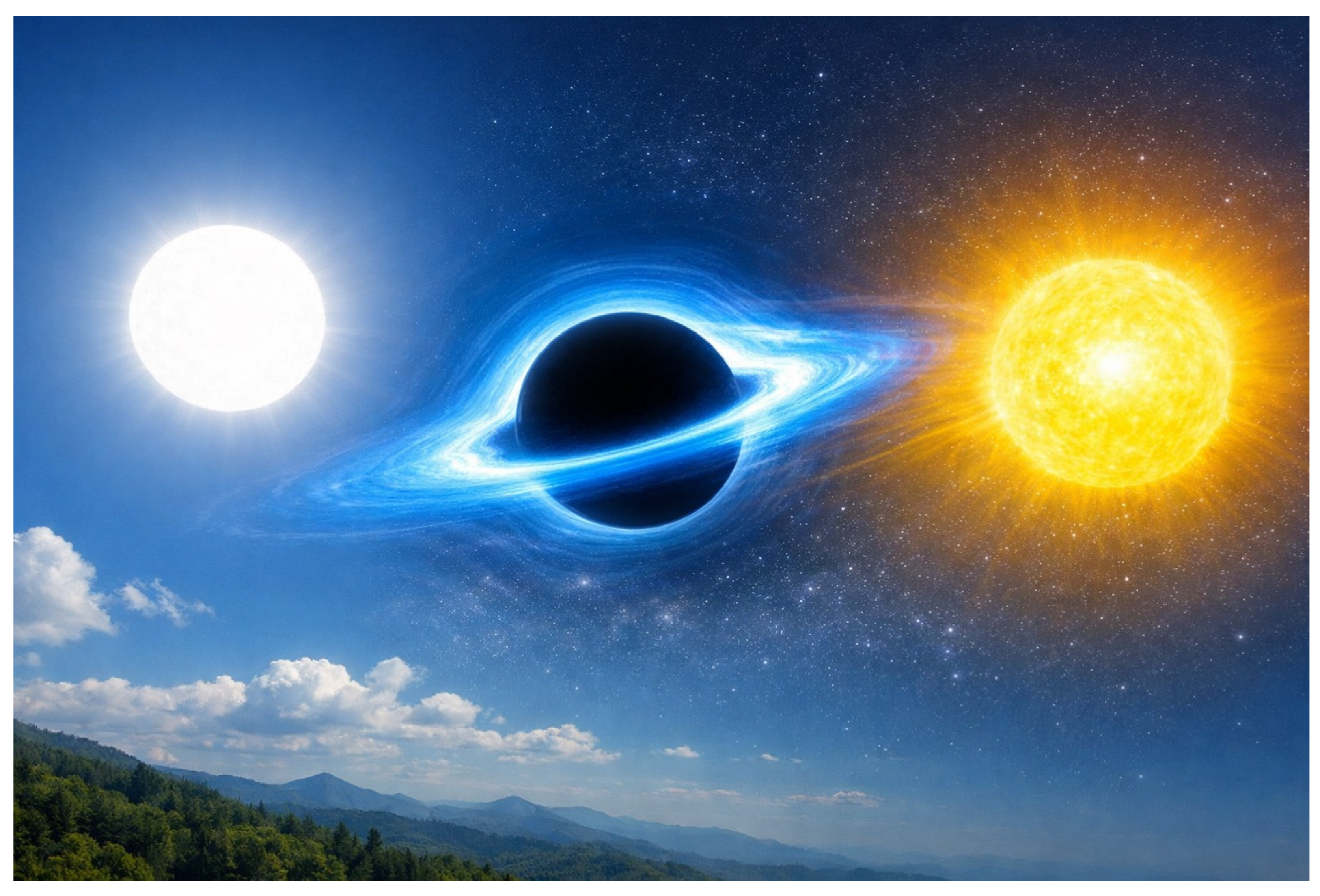
According to Einstein’s General Relativity, mass bends spacetime. Light passing near a planet-sized black hole follows this curvature. Planetary-mass objects cause subtle “weak” lensing rather than dramatic distortion unless the light passes extremely close to the event horizon. A small black hole can theoretically act as a “gravitational mirror” by acting as a strong lensing source that curves light (such as sunlight) nearly, causing it to return toward the source, a phenomenon often called “retrolensing”. This happens at the “photon sphere” (1.5 x Schwarzschild radius), where extreme gravity allows light to be distorted and deflected around the black hole. The planetary-mass black hole could enter Earth’s atmosphere, rapidly collecting water, dust, and gas particles, and glow with a hot blue accretion disc. Indeed, the light bending and deflection angle of sunlight had been increased together due to the gravitational effect and the turbulent atmosphere around the planetary-mass black hole since it was close to striking the Earth during the day. The planetary mass black hole can pass through the Earth, penetrating it rapidly, and leave a tunnel with a radius of few centimetres or meters, according to the mass of the collided black hole. The planetary mass black hole may make huge distortions, turbulence, and noise in the Earth’s atmosphere, and cause sunlight rays to be absorbed, refracted, and reflected steeply. The white colour of the sun may have changed to a yellow or red colour since a Jupiter-mass black hole passed between Earth and the Sun. The sunlight and stars’ or planets’ light can be deflected by the gravitational effects of the planetary mass black hole that travel towards the Earth.
The planetary mass black hole in a free space at a distant place from the Earth’s planet may have no accretion disc, but you can see it as a dim black sphere coming towards the Earth’s planet, before it reaches the Earth’s atmosphere. The black hole may collect a few gas and dust particles in its journey, absorbing radiation in space before collecting enough gas and dust particles from stars and planets. The gravitational deflection of sunlight from white colour to yellow or red colours will inform us of the black hole’s journey towards us on Earth, typically during the day when sunlight rays reach the Earth in clear weather. The black hole will pass between Earth and the Sun to collide with Earth during the day. At this moment, we may see the sunlight being lost due to the gravitational field of a black hole, and the Earth may be enveloped by a temporary darkness as the solar eclipse event happens due to the black hole’s gravity. In a fraction of a time, the gas and dust particles in the Earth’s atmosphere may fall into the black hole, orbit it rapidly, and glow with the hottest blue accretion disc, and return enough light to us on the Earth again. The light that comes from the hottest accretion disc of a black hole maybe contained high energy particles and gamma rays that influence our health and may aid human eyes and their skin or burn and destroy us at any fraction of time. An accretion disc of a black hole has higher speed, energy, and angular momentum due to powerful singularity tunnel waves and tidal effects of a black hole. A black hole can collect enough mass from its surroundings since entered the surface of earth and glow as hydrogen bomb explosion. It is a catastrophic moment and dangerous to the living creatures and the environment at the Erath, typically the region that faced a black hole attack. The Kinetic energy of the particles in an accretion disc around a black hole was thermalized and emitted as higher-energy photons, typically gamma rays, x-rays, and UV. High-energy particles are catastrophic to our lives and living creatures. The journey of the planetary mass black hole takes less than a minute, and it may pass through the Earth after a direct Collison with it. The planetary mass black hole has a powerful spinning singularity sphere in its heart, and enough tidal force to build a tunnel in the Earth during its journey to the solar system. It has the ability to penetrate the Earth or celestial objects without any obstacle or bounce due to its higher density and rotational kinetic energy in tunnelling through everything. Earth’s atmosphere may be warped and stretched sharply due to the tidal effects of a black hole, which causes the sunlight to become refracted in multiple locations within the atmosphere, or even multiple images of the sun can be delivered at different places in the atmosphere at the same moment. The black hole attack is a nice event, but it’s also dangerous. The black hole attack can happen during the day and cause temporary darkness and the shortest night for observers there.
In an accretion disc of a black hole, Cherenkov radiation occurs when the following conditions are met: The Dielectric Medium: The accretion disc acts as a dense, ionized plasma (dielectric medium) where the refractive index n is greater than 1, effectively slowing down the speed of light in matter v to c/n. Superluminal Particles: High-energy charged particles as electrons, protons or ions, accelerated by the black hole’s intense gravity or magnetic fields, travel at velocities v such that v greater than c/n. The “Optical Shock”: As these particles move, they polarize the local medium, creating a constructive interference pattern—a “sonic boom” of light—that manifests as a blue or ultraviolet glow. Cherenkov radiation in the accretion discs of planetary-mass black holes (PMBHs) is a theoretical phenomenon in which high-energy charged particles emit blue light when they move faster than the phase velocity of light in the disc of plasma of a black hole and water in the pool of a nuclear reactor. Cherenkov radiation is the characteristic, weird blue glow observed in nuclear reactor water pools when charged particles (like protons and electrons) travel faster than the phase velocity of light in an insulating medium, such as air, water, and glass, and creates an electromagnetic phenomenon equivalent to a sonic boom. The radiation is named after the Nobel Prize winner, Soviet scientist Pavel Cherenkov [27,28,29,30]. While planetary-mass black holes (roughly a million or thousands times lower than the mass of the Sun are currently hypothetical (often discussed as primordial black holes), their accretion environments are expected to be extremely dense and energetic to glow in Cherenkov radiation. The Jupiter mass black hole glows in a blue colour, once entered an atmosphere of stars or planets.
Figure 2.
Sunlight deflection by a Planetary mass black hole.
5. Gravitational Time Dilation
Gravitational time dilation is a phenomenon predicted by Einstein’s general theory of relativity more than 100 years ago. He stated that time passes more slowly in stronger gravitational fields (closer to massive objects, compact objects, and black holes) compared to weaker fields. Clocks closer to Earth’s surface and sea level tick more slowly than those in airplanes and space, a difference that requires correction in satellites and technologies like GPS. Massive object bends the fabric of spacetime steeply, slowing time in regions of stronger curvature. Gravity curves spacetime, and time flows more slowly in deeper gravitational potential field, so clocks tick more slowly near a black hole or massive bodies. Clock at sea level ticks slower than one in the shoreline and on the top of a mountain. A person’s head technically ages faster than their feet [31,32,33,34,35,36,37,38]. Following the Gravitational Time Dilation Equations:
Here, Dilated time interval for moving observer far away at a distant place from surface of the stars, planets, and black holes, is an original time interval for stationary object near the surface of Planets with radius R or black holes is Schwarzschild radius. is the distance that the clock is located away from the center of a black hole or massive object.
The Velocity Time Dilation Equation for moving object in space with higher speed as compared to an observer on the surface of Earth or planet is:
Velocity time dilation is governed by special relativity using the Lorentz factor ():
Here, time runs slower for an observer moving with faster speed in space at a distant place from surface of Earth or black holes , as compared to a proper time interval or is an original time interval for stationary object near the surface of Planets, as earth with radius R, and is the gravitational acceleration of an Earth’s planet. Then, is the ratio of speed of an object in space to the speed of light.
Identify Gravitational Potential : The gravitational potential at a location R from center of massive object M is the gravitational potential energy (U) at that location per unit mass (m) is given by:
The gravitational potential (often denoted as or V) at a given location R from the center of a spherically symmetric, massive object (like a planet, star and black holes) is generally given by: The SI unit for gravitational potential is joules per kilogram . Gravitational potential energy (GPE=U) is measured in joules . The gravitational time dilation ratio for an observer at a potential compared to an observer at infinity is approximately . The relative aging Factor of a first person living in a distant place at space compared to a second person who lives on the surface of planets or a celestial object is:
Relative time Dilation Factor :
In General Relativity, the exact relationship for stationary observers at different radii is given by the ratio of their proper time intervals:
When the gravitational field is weak as the gravity around Stars and planets, like Earth (meaning , we can use a Taylor expansion ( to simply the exact formula:
Numerator expansion: Denominator expansion: Multiply together: Ignoring higher-order terms, the result of deriving given is Equation (23):
The formula Equation (23) is correct as a standard approximation for weak gravitational fields around stars and planets. It accurately describes why clocks at higher altitudes tick faster than those on a planet’s surface. No, for extreme gravity: Near a black hole or neutron star, and white dwarfs, the linear approximation fails, and you must use the exact square root formula in Equation (22).
Daily time Difference:
Gravitational time dilation is a verified consequence of Einstein’s General Relativity, where time passes more slowly in stronger gravitational fields (closer to massive objects) and faster in weaker fields (further away from the surface of objects). This curvature of spacetime is pronounced around massive objects, meaning clocks closer to a massive body tick more slowly than those at higher altitudes in space or on the ISS. Statistical gravity and the entropy of spacetime represent a shift and a big jump in theoretical physics where gravity is no longer viewed as a fundamental force in nature, but as an emergent phenomenon arising from the statistical mechanics of microscopic degrees of freedom [39,40]. The central idea is that gravity emerges from the universe’s tendency to maximize its entropy and perturbation, much like an elastic band’s tension arises from the statistical behaviour of its polymer chains. Problem 4: Calculate time by Gravitational time dilation for twin brothers, Ali, who lives on the surface of Earth, and Azad, who lives inside an International Space Station ISS within Altitude approximately (h=400 km)?.
Mass of Earth is Then the gravitational constant ). At First steps, I should test the Gravitational Time Dilation Equations: Potential energy for Ali on Earth’s surface (R=6371 km=6371000 m):
Potential energy for Azad inside ISS (R+h=6771 km=6771000 m):
The relative aging Factor of Azad compared to Ali by Equation (20) and Equation (23) is:
To find how much more Azad at space ages in one Earth day (86400 seconds):
To calculate the gravitational time dilation between Ali on Earth’s surface and Azad on the International Space Station (ISS), we use Einstein’s General Theory of Relativity. Due to being further from Earth’s center, Azad experiences time slightly faster than Ali by approximately. By gravitational time dilation alone, Azad (on the ISS) ages approximately 3.5 microseconds faster per day than Ali (on Earth). Annual Gain: 0.0013 seconds/year.
In the second step, I have to use the Velocity Time Dilation Calculation:
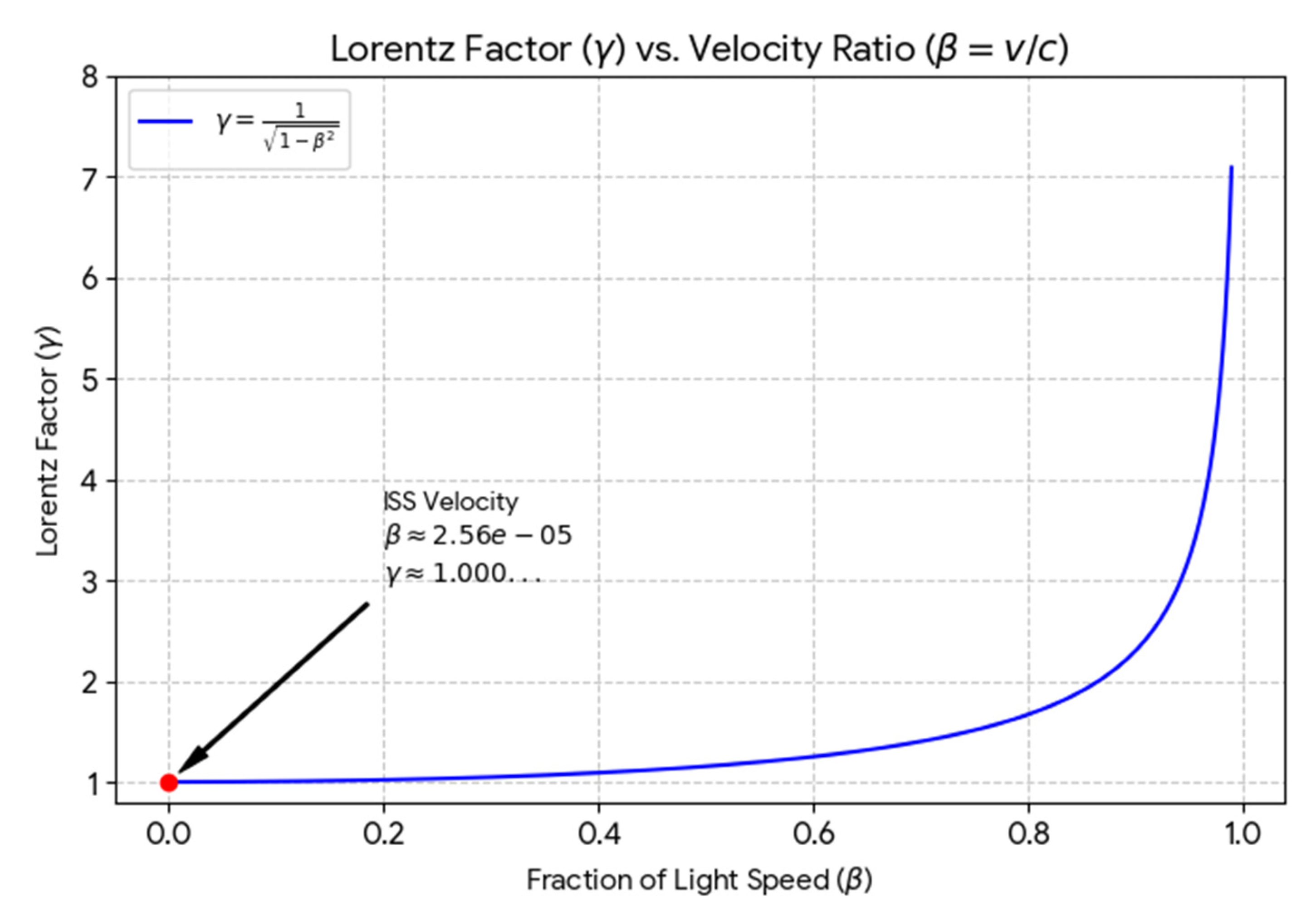
ISS Velocity: To maintain a circular orbit at altitude (h=400 km), the ISS travels at roughly . The relative aging Factor of Azad compared to Ali by Equation (17) is: Velocity time dilation is governed by special relativity using the Lorentz factor ():
To find how much more Azad at space ages in one Earth day (86400 seconds):
Azad’s clock ticks roughly 28.2 microseconds slower per day than Ali’s clock ticks due to his huge orbital velocity in ISS. For Azad on the ISS, time moves more slowly than for Ali on Earth by a factor of approximately, resulting in a time loss of about 28.2 microseconds per day due to velocity time dilation.
Figure 3.
Gravitational time dilation effects on twin brothers Ali on Earth and Azad in ISS.
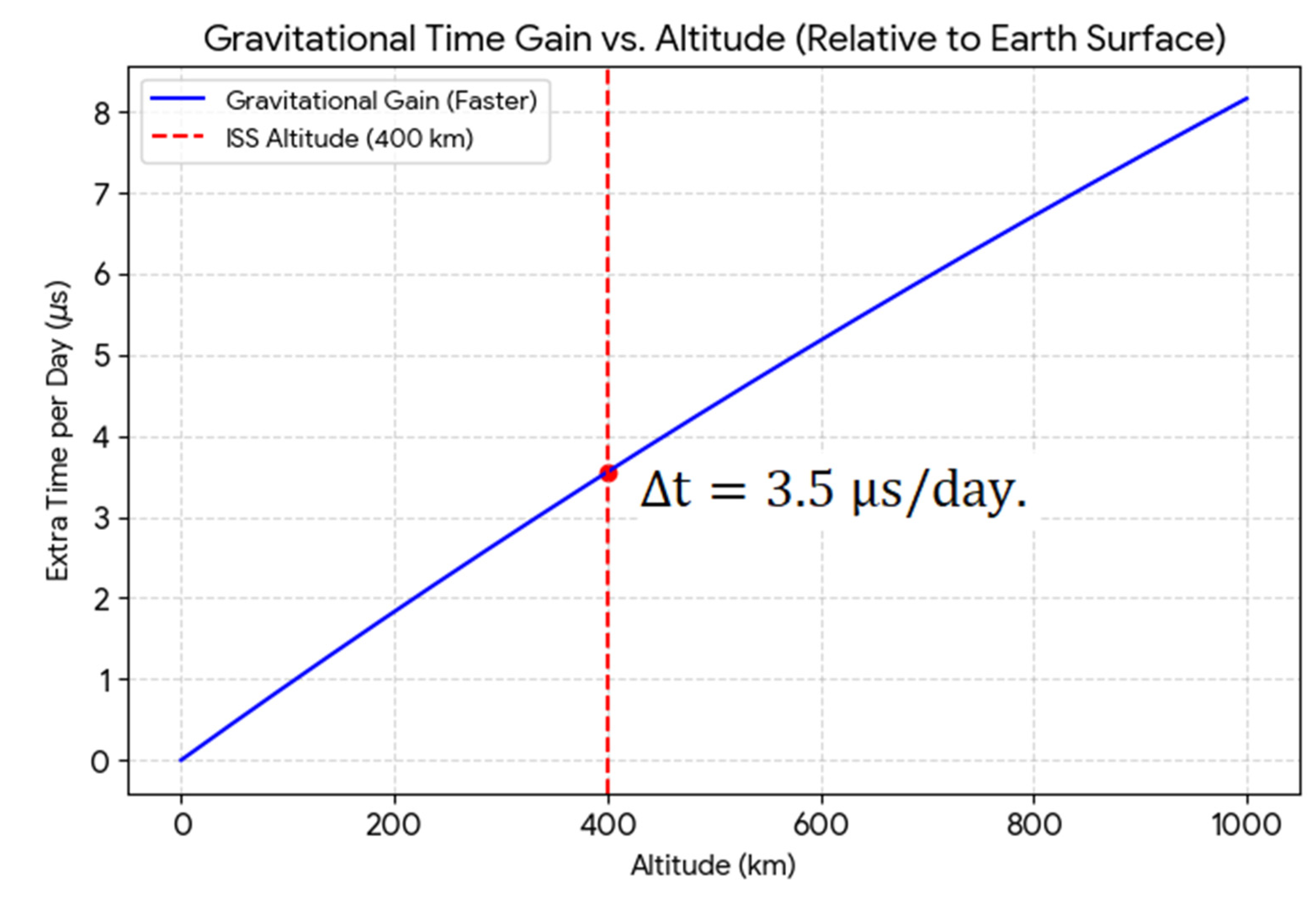
Figure 4.
Lorentz Factor vs. Velocity ratio.
6. Gravitational Tidal Effects of a Planetary Mass Black Hole
A planetary-mass black hole (roughly Earth’s mass) passing near Earth would exert extreme tidal forces, far exceeding the Moon’s, likely causing catastrophic global earthquakes, volcanic eruptions, and destroying the crust through extreme gravitational shearing. Tidal disruption (spaghettification) would shatter and tear apart a mountain on the planet, or pull or collapse planets apart. A black hole is an astronomical body so compact that Albert Einstein’s theory of general relativity, which describes its gravity as the steep curvature of spacetime, predicts that any sufficiently massive object has gravity so strong that it prevents anything, including light, from escaping. The black hole can absorb photons, make powerful turbulence and gravitational lensing, and disrupt objects near its event horizon by its powerful tidal force and tidal acceleration [41,42,43,44,45,46]. A planetary-mass black hole defined as having roughly the mass of Earth passing near Earth would indeed cause a catastrophic, extinction-level event due to extreme gravitational forces. While the black hole itself would be tiny (roughly the size of a peanut or smaller), its gravitational influence would far exceed that of the Moon. Moon’s Tidal Force causes a few-meter change in ocean tides. A tiny, planetary-mass black hole has the same total gravity and Tidal force as the planet but concentrated in a tiny space, making its tidal acceleration (gradient) vastly stronger, capable of tearing solid rock apart or occur powerful turbulences in the Earth’s atmosphere. A planetary-mass black hole (PMBH) exerts the same total gravitational pull as a planet of equal mass. Still, its tidal forces are far more extreme because its mass is concentrated into a microscopic volume. While you could safely orbit a PMBH from a distance, approaching its tiny event horizon would subject you or the Earth to destructive gravitational gradients. Tidal forces arise from the difference in gravitational pull between the near and far sides of an object. Because a black hole is a “point mass,” you can get incredibly close to its center, where this difference becomes lethal. An Earth-mass black hole would have an event horizon or Schwarzschild radius only about 9 millimetres wide (the size of a penny). While the pull at a distance is normal, the tidal stretching (spaghettification) becomes effectively danger and huge as one nears the singularity zone.
The gravitational force equation F, based on Newton’s law of universal gravitation. This formula calculates the attraction between two masses (M, m) separated by distance r, where G is the gravitational constant, a is an acceleration of a moving object, or g is the gravitational acceleration of the falling objects. We can use a Taylor expansion or differentiate the force with respect to r:
The magnitude of the change in force over a small distance is the tidal force:
Dividing the tidal force by the mass m gives the tidal acceleration:
Tidal acceleration represents the difference in gravitational pull across an object of length, Hight, distance, or radius . The standard formula for tidal acceleration caused by a spherical body of mass M and radius r, then G is the universal constant of gravity. M is the mass of the primary body (Earth or black hole). Then d is the length or Hight h of the object (the distance between head and feet) or it could be the length L of an object or radius r of spherical objects facing the tidal force. r is the distance from the center of the primary body (Earth’s radius) or r maybe the distance between center of Earth and black hole or the distance between center of Black hole and human body facing the tidal force effects. The tidal force can be described by the following formula:
If a planetary-mass black hole M were to enter our solar system or interact with Earth at distance R, the impact on Earth and the planets would be: Orbital Disruption: From a distance, it would behave like a rogue planet, potentially destabilizing orbits or throwing planets out of the solar system. Tidal Heating and Destruction: If it passed close to a planet, it could induce massive internal friction (tidal heating) and structure deformation, leading to extreme volcanic activity or earthquakes. It may make the Earth’s atmosphere turbulent and induce huge lightning belts. If the planet crossed the Roche limit, the distance where tidal forces exceed the planet’s own gravity, it would be torn apart into a ring of debris. Direct Collision: If an Earth-mass black hole “hit” Earth, it wouldn’t just crash; it may cause atmospheric turbulence on planets, it would likely tunnel through the planet, accreting matter along a narrow path and generating massive shockwaves. Problem 5: A supermassive black hole has 100 million times the mass of the sun , and an event horizon radius of 295 million kilometers. What would be the tidal acceleration and tidal force across a (d=2 meter) human length with a mass 80 kg at a distance of 1000 kilometers from the event horizon of the supermassive black hole?.
Solution: Mass of supermassive black hole about 100 million times the mass of a Sun The distance r is the total distance from the center of a black hole, this is the sum of the event horizon radius, the Schwarzschild Radius and the distance from that event horizon (h=1000 km= 1000,000 m). Then, the total distance from center of a supermassive black hole and human is: Then tidal acceleration could be:
The tidal force is the product of the human’s mass (assumed to be m=80 kg) and the tidal acceleration. Tidal force is:.
In contrast to stellar-mass black holes and planetary mass black holes, supermassive black holes have relatively weak tidal forces at their event horizons, meaning a human would not be “spaghettified” (pulled apart) upon approach. It is possible to live near the supermassive black hole or travel through an event horizon of a black hole directly to the edge of the galaxy or the universe. Most of the mass of a supermassive black hole is concentrated in its interior shells at its singularity, accumulated superparticles, and compacted dark matter sphere in its core [47,48,49,50]. As a result, powerful gravitational waves come out from the interior shells of the supermassive black hole to push on the human body and spacecrafts to travel to the edge of galaxies and the universe. The black hole is an additional machine repulsive force and energy to accelerate the speed of objects at the edge of the Galaxies.
7. Jupiter Mass Black Hole
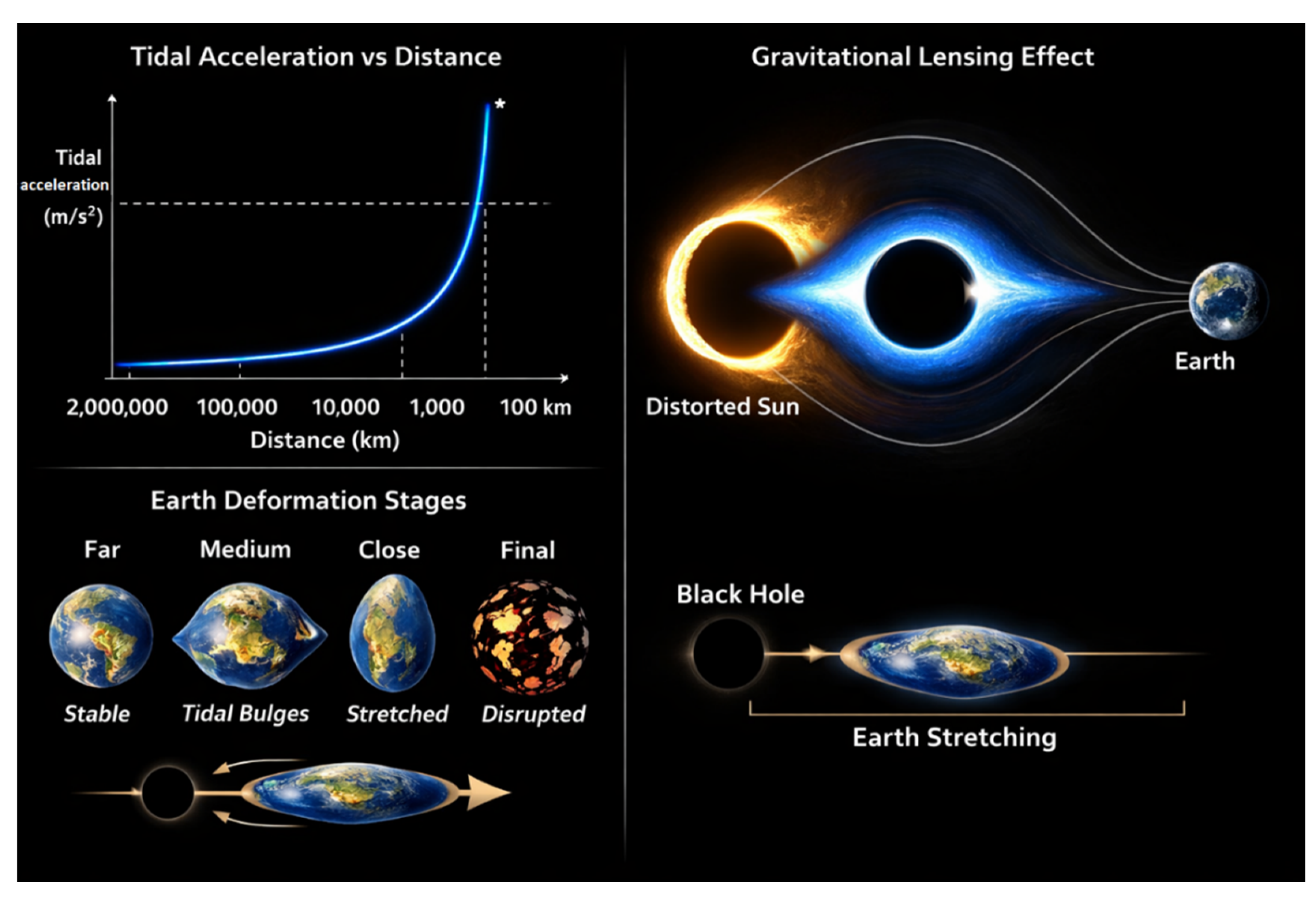
The Jupiter mass black hole is the planetary type of black holes with radius is only 2.82 meters, and matter condensed inside it steeply as compared to a stellar mass black holes and supermassive black holes. Let’s model the tidal effects of a Jupiter-mass black hole passing between Earth and the Sun, moving from two million kilometers (2000000 km) to hundred kilometers (100 km) from Earth during daytime. By using the tidal acceleration according to difference in gravity across Earth is:
Where G is gravitational constant, M is the mass of a black hole= Jupiter mass= . Then, is an Earth’s radius= and r is the total distance to the center of a black hole or the distance between Earth and center of a Jupiter mass black hole that comes to hit the Earth directly. Tidal acceleration scales as extremely sensitive to distance. . At far distance the tidal acceleration comparable to Lunar tidal acceleration , but a Tidal acceleration of a Jupiter mass black hole is stronger than a Moon at this distant location. Effects of Jupiter mass black hole at this distant place are very weak, only small ocean tides, tiny crustal stress, and Earth remains stable.
At medium distance the Tidal effects of Jupiter mass black hole still weak on earth’s planet, and only tidal bulges.
At close distance the tidal acceleration . The Tidal effects of a Jupiter-mass black hole are comparable to or stronger than Moon tides, large ocean bulges, stretched earth, increased earthquakes and volcanic activities on the Earth. The Jupiter-mass black hole has a stiff tidal force and has been accreting enough gas and dust particles since it entered Earth’s atmosphere, and glows in blue colour. At extreme distance the tidal acceleration is . The gravitational tidal effects of a Jupiter-mass black hole lead to strong crust deformation, fragmenting, Mega tsunamis, atmosphere distortion begins and strongest lightning belts glow in the Earth’s atmosphere. At distance the tidal acceleration is . The tidal force makes the earth starts to stretch, massive crust cracking, and global catastrophic quakes. At closer position the tidal acceleration is . The tidal acceleration becomes stronger than Earth’s gravity, and Earth is ripped apart (spaghettification) and stretching steeply. Even though the black hole has Jupiter mass, but its tidal effect deadly only when very close, at large distances it is harmless, at very small distances it is catastrophic due to inverse cubic law of tidal acceleration and tidal force . A Jupiter-mass black hole acting as a gravitational lens would bend light from Sun and distant stars, causing slight magnification and distortion, acting as a compact microlensing object rather than a large-scale lens. A low mass black hole or planetary mass black hole has a higher density and a powerful tidal force on the objects nearby its surface as compared to the high mass black holes or tidal effects of cosmic celestial objects [51,52,53,54,55,56,57,58]. A black hole with Jupiter’s mass would be extremely small, roughly 2.82 meters in diameter. Its gravitational lensing effects would be limited to precise alignments with background light sources. If the Sun were lensed by a black hole with the mass of Jupiter, the visual and physical effects would depend entirely on the distance between the two. While a Jupiter-mass black hole has the same gravitational “reach” as the planet Jupiter, its extreme density compressed into a radius of only about 2.82 meters allows for much more dramatic light-bending if objects pass very close to its event horizon. If a Jupiter mass black hole is at a distant place about two million kilometer from Erath, the Sun would experience a slight light bending, but the Sun could be steeply distorted, and its light would be deflected sharply since entered nearest point from Earth about a thousand or a hundred kilometers.
A planetary mass black hole with the mass of Earth or Jupiter may build a tiny tunnel in the structure of an Earth-like planet after penetrating through it directly. The gravitational field of a black hole is extremely concentrated to disrupt entire celestial objects near its surface [59,60,61]. Gravity is a dark fabric matter and energy that wraps around celestial objects and black holes [62]. The tiny mass black hole involved in tidal disruptions effects and gravitational time dilation [63]. The Jupiter-mass black hole has no accretion disk at a distant place from the surface of the Earth’s planet before reaching the Earth’s atmosphere due to free space or an insufficient amount of gas and dust particles collected during its journey to the solar system. The Jupiter-mass black hole glows with the brightest blue accretion disc since entering Earth’s atmosphere due to collecting enough gas, dust particles, and water molecules. Particles in an accretion disc of a black hole have huge temperature, speed, and glow in blue colour as Cherenkov light. Cherenkov radiation is a characteristic blue glow produced when charged particles (like electrons and protons) travel through a dielectric medium, such as water, air, or glass, with a speed faster than the phase velocity of light in that insulated medium. It acts as an optical shockwave, similar to a sonic boom, and is often seen in nuclear reactor pools at atomic energy stations or university scientific nuclear reactors. The blue accretion disc of a planetary mass black hole means extremely hot gas with a temperature of millions of kelvins, which emits high-energy radiations as X-rays, gamma rays, and UV. The particles in an accretion disc have enough speed, temperature, energy, and momentum to travel through an insulated medium of air and water with a speed higher than the speed of light, and glow in blue colour. Earth would be irradiated by catastrophic radiation and powerful lightning before destruction during collisions with a black hole. Earth can be stretched and distorted steeply since attacked by a massive black hole or a tiny mass black hole passed through it directly.
Figure 5.
Gravitational Lensing and Tidal acceleration by a Jupiter-mass black hole.
8. Results and Discussion
The Schwarzschild radius defines the event horizon of a non-rotating black hole. To determine the tidal effects and the Schwarzschild radius for this scenario, we use the physical constants and parameters. If a person with a height of 180 centimetre, and a mass of 94 Kg located 2 meters from an Asteroid or mountain-mass black hole ), the tidal acceleration is , and the resulting tidal force is approximately 2823 N. The radius of a mountain mass black hole is approximately the radius of a proton particle . A black hole with the mass of a mountain and the radius of a proton can penetrate Earth, leaving behind a tiny tunnel and minimal disruption compared to a planetary mass black hole. These microscopic, primordial black holes, if they exist, might have formed shortly after the Big Bang or formed inside a supermassive black hole after a big bang event to present time. They are far smaller than stellar-mass black holes, which typically have radii in the range of kilometers. For a person with a height of (h=1.80 meters), and a mass of (m= 94 Kg) standing (r= 400 meters) from a black hole with the mass of the Moon ), the tidal acceleration is ), and the resulting tidal force is approximately . The radius of a Lunar mass black hole is approximately . This is about the size of a tiny grain of sand or a very small dust mite, significantly smaller than the tip of a pencil. The tidal force is the difference in gravitational force exerted on the man’s feet compared to his head. This force of roughly 26 million Newtons is equivalent to the weight of over and would easily cause spaghettification of the human body and objects. The Schwarzschild radius for a black hole with the mass of Mercury is approximately 0.49 millimetres. A 180 cm tall man (94 Kg) at a distance of 400 meters from this black hole would experience a tidal acceleration of approximately , this tidal acceleration is approximately 126285 times of an Earth’s gravitational acceleration. Then, the tidal force approximately 116452934 N.
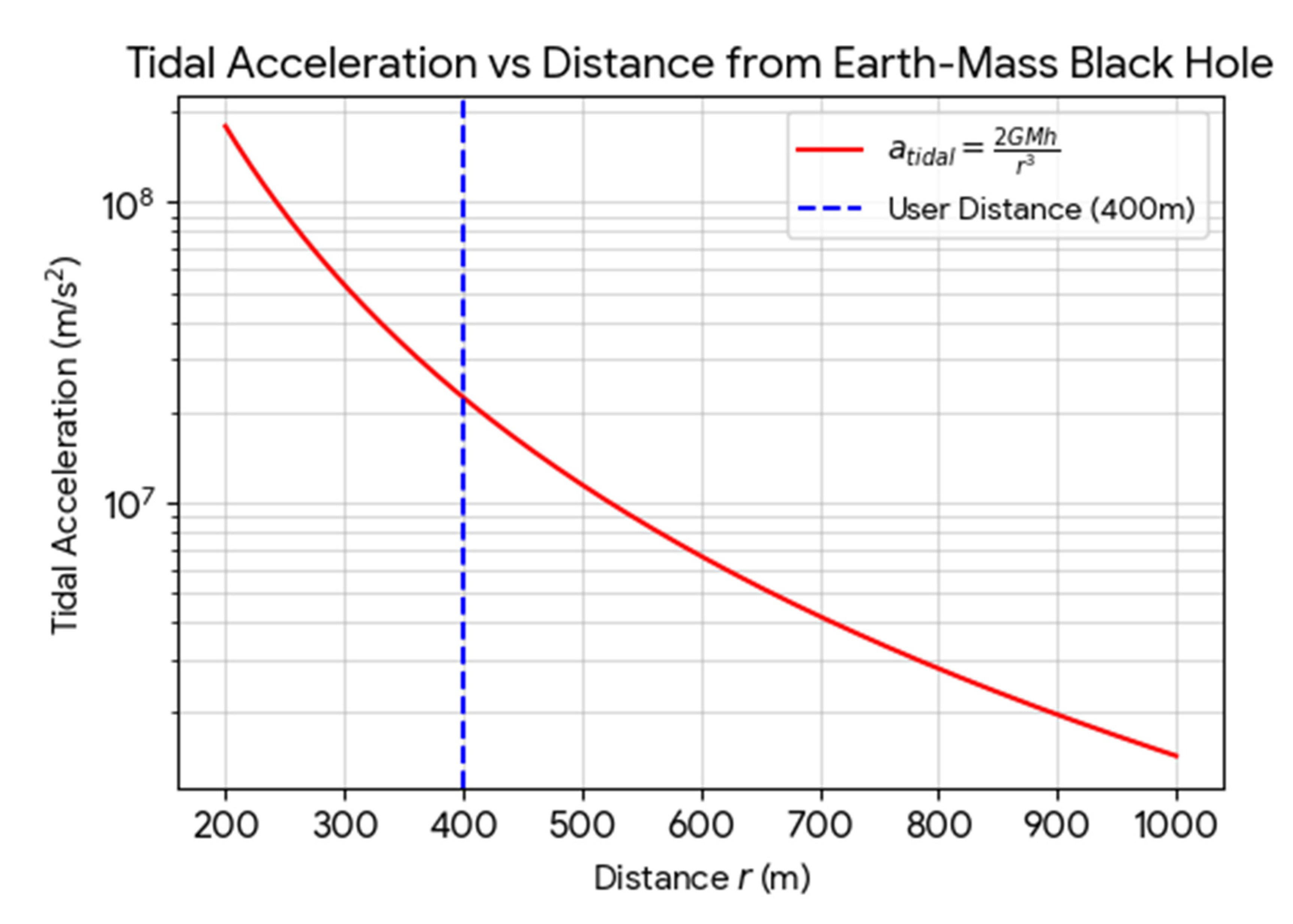
For a man with a mass of 94 kg and height of 180 cm (1.8 m) standing 400 meters from a black hole with the mass of the Earth, the calculated values are as follows: Schwarzschild Radius is 0.00887 meters (approximately 0.89 cm). Tidal acceleration is , and Tidal force about 2.11 billion Newtons. The Schwarzschild radius represents the radius of the event horizon, where the escape velocity equals the speed of light. For an Earth-mass black hole, this radius is roughly the size of a marble. Tidal acceleration is the difference in gravitational acceleration between the man’s head and feet. The tidal force is the stretching force experienced by the man, found by multiplying his mass by the tidal acceleration. Consequence of this massive force would lead to “spaghettification,” where the body is stretched into a long, thin strand. At 400 meters, this force is already far beyond what any human or biological structure could withstand.
Figure 6.
Tidal acceleration vs. Distance From Earth-Mass Black Hole.
For a girl with a mass of 75 kg and Height of 1.6 meters at a location 400 meters from center of a black hole with the mass of a Uranus Planet , the calculated values are: Schwarzschild radius , the tidal acceleration approximately ( and tidal force is . For a man with a mass of 94 kg and Height of 1.8 meters standing 400 meters from center of a black hole with the mass of a Neptune Planet , the calculated values are: Schwarzschild radius , tidal acceleration approximately ( and tidal force extremely high . This tidal force may tear a man apart violently. For a Man with a mass of 75 kg and Height of 1.6 meters at a location 400 meters from center of a black hole with the mass of a Jupiter Planet , the calculated values are Schwarzschild radius , the tidal acceleration approximately ( and tidal force is . Blue accretion discs around planetary-mass black holes (PBHs) or small stellar-mass black holes indicate extremely hot temperatures of energizing gas, dust, and charge particles (up to 20 million Kelvins), likely caused by high-energy plasma accretion. The intense blue light results from the high-temperature thermal emission of material, often enhanced by relativistic Doppler beaming, which makes the rotating side appear brighter and bluer.

Table 1.
Tidal acceleration and Tidal Force of the Lower Mass Black Holes.
|
Black Hole Mass |
Black Hole Radius |
Tidal acceleration |
Tidal Force |
| 0.128 m |
|||
| 0.152 m | |||
| 2.82 m |
9. Conclusions
Indeed, Planetary-mass black holes (PMBHs) often theorized as primordial black holes exert extreme tidal forces and accelerations due to their high density and small event horizons. Unlike supermassive black holes, where tidal forces at the event horizon can be gentle, PMBHs would cause catastrophic “spaghettification” well before an object reaches the event horizon. We model the tidal field of a compact object such as a Jupiter-mass black hole passing near Earth. The dominant physical quantity is the tidal acceleration gradient formula and tidal force. The tidal effects of a black hole are negligible, and Earth stays stable since the black hole is passing at a distant location from Earth. Ocean tides are amplified, crustal stress increases, global earthquakes occur, catastrophic volcanic eruptions occur, powerful lightning strikes in the atmosphere, strong atmospheric disturbances occur, total disruptions occur, and a long-stretching Earth. All these events are caused by a planetary-mass black hole when it closely approaches or passes directly by the Earth. The tidal physics dominate the tidal acceleration and tidal force of a black hole; the blue accretion disc would introduce relativistic Doppler boosting, blue-shift, strong gravitational lensing of the Sun, and a solar image distorted into arcs or Einstein-like rings. The Sunlight is deflected and redshifted with a clear angle, and a time dilation effect appears due to the powerful gravitational field of a black hole before it enters the Earth’s atmosphere directly. A blue accretion disc of the hottest energetic gas, dust particles, and energetic particles appears around a Jupiter-mass black hole since it entered an Earth’s Atmosphere. The charges and energetic particles in a blue accretion disc of a planetary-mass black hole, or inside a dielectric medium such as air, glass, and water, would flow with a speed close to or higher than the speed of light to glow in a blue colour as a Cherenkov radiation.
Funding
This research received no external funding.
Acknowledgments
We appreciate the cooperation with Kurdistan Space Agency.
Conflicts of Interest
The author declares no conflict of interest.
References
- Carr, G.B.J.; Hawking, S.W. Black holes in the early Universe Mon. Not. R. Astron. Soc. 1974, 168, 399. [Google Scholar] [CrossRef]
- Garcia-Bellido, J.; Ruiz Morales, E. Primordial black holes from single field models of inflation. Phys. Dark Universe 2017, 18, 47–54. [Google Scholar] [CrossRef]
- Jung, T.H.; Okui, T. Primordial black holes from bubble collisions during a first-order phase transition. arXiv [hep-ph. 2021, arXiv:2110.04271. [Google Scholar] [CrossRef]
- Lu, P.; Kawana, K.; Kusenko, A. Late-forming primordial black holes: beyond the CMB era. Phys. Rev. D. 2023, arXiv:2210.16462107, Article 103037. [Google Scholar] [CrossRef]
- Miller, Andrew L.; Clesse, Sébastien; De Lillo, Federico; Bruno, Giacomo; Depasse, Antoine; Tanasijczuk, Andres. Probing planetary-mass primordial black holes with continuous gravitational waves. Phys. Dark Univ. 2021, 32, 100836. [Google Scholar] [CrossRef]
- Hawkins, M. R. S. The signature of primordial black holes in the dark matter halos of galaxies. Astron. Astrophys. 2020, 633, A107. [Google Scholar] [CrossRef]
- Pandey, R. Origin of Quantum Space-Time and Primordial Black Hole. Open Access Libr. J. 2014, 1, 1–5. [Google Scholar] [CrossRef]
- Karas, V.; Kopáček, O.; Kunneriath, D. Magnetic Neutral Points and Electric Lines of Force in Strong Gravity of a Rotating Black Hole. Int. J. Astron. Astrophys. 2013, 3, 18–24. [Google Scholar] [CrossRef]
- Sadiq, M. Counting the Microstates at the Black Hole Horizon and the Immirzi Parameter of Loop Quantum Gravity. J. Appl. Math. Phys. 2020, 8, 2055–2062. [Google Scholar] [CrossRef]
- Ashtekar, A.; Baez, J.; Corichi, A.; Krasnov, K. Quantum Geometry and Black Hole Entropy. Phys. Rev. Lett. 1998, 80, 904–907. [Google Scholar] [CrossRef]
- Denney, K. D.; et al. 2009 ApJ 702 1353. (A REVISED BROAD-LINE REGION RADIUS AND BLACK HOLE MASS FOR THE NARROW-LINE SEYFERT 1 NGC 4051). [CrossRef]
- Zhang, M. Response Rate of a Static Charge outside a High-Dimensional Schwarzschild Black Hole. J. Appl. Math. Phys. 2018, 6, 1642–1648. [Google Scholar] [CrossRef]
- Suh, P. Quantum Cosmology Explains the General Galaxy-Black Hole Correlation. Int. J. Astron. Astrophys. 2012, 2, 101–112. [Google Scholar] [CrossRef]
- Bianconi, G. The Quantum Relative Entropy of the Schwarzschild Black Hole and the Area Law. Entropy 2025, 27, 266. [Google Scholar] [CrossRef] [PubMed]
- Schwarzschild, K. On the gravitational field of a point mass according to Einstein’s theory. In Proceedings of the Royal Prussian Academy of Sciences; 1916; pp. 189–196. [Google Scholar]
- Rickles, D. Symmetry, Structure and Space-Time; Elsevier: Amsterdam, 2008. [Google Scholar]
- Kennefick, Daniel. “The Experiment That Weighed Light.” In No Shadow of a Doubt: The 1919 Eclipse That Confirmed Einstein’s Theory of Relativity; Princeton University Press, 2019. [Google Scholar] [CrossRef]
- Almassi, B. “Trust in expert testimony: Eddington’s 1919 eclipse expedition and the British response to general relativity”. Studies in History and Philosophy of Science Part B: Studies in History and Philosophy of Modern Physics 2009, 40(1), 57–67. [Google Scholar] [CrossRef]
- Dyson, F. W.; Eddington, A. S.; Davidson, C. A Determination of the Deflection of Light by the Sun’s Gravitational Field, from Observations Made at the Total Eclipse of May 29, 1919. Philos. Trans. R. Soc. London. Ser. A 1920, 220, 291–333. [Google Scholar] [CrossRef]
- Gilmore, Gerard; Tausch-Pebody, Gudrun. The 1919 eclipse results that verified general relativity and their later detractors: a story re-told. Notes Rec. R Soc. Lond. 2022, 76(1), 155–180. [Google Scholar] [CrossRef]
- Eddington, A. S. “Einstein Shift and Doppler Shift”. Nature 1926, 117(2933), 86. [Google Scholar] [CrossRef]
- Evans, R. F.; Dunning-Davies, J. “The Gravitational Red-Shift”. arXiv 2004, arXiv:gr. [Google Scholar]
- Valente, Mário Bacelar. “Einstein’s redshift derivations: its history from 1907 to 1921”. Circumscribere Int. J. Hist. Sci. 2018, 22, 1–16. [Google Scholar] [CrossRef]
- Witze, Alexandra. “Milky Way’s black hole provides long-sought test of Einstein’s general relativity”. Nature 2018, 560(7716), 17. [Google Scholar] [CrossRef] [PubMed] [PubMed Central]
- Padilla, N. D.; Carneiro, S.; Chaves-Montero, J.; Donzelli, C. J.; Pigozzo, C.; Colazo, P.; Alcaniz, J. S. “Active galactic nuclei and gravitational redshifts”. Astron. Astrophys. 2024, arXiv:2304.13036683, 120–126. [Google Scholar] [CrossRef]
- GRAVITY Collaboration (Abuter, R., et al.), Detection of the gravitational redshift in the orbit of the star S2 near the Galactic centre massive black hole. Astron. Astrophys. 2018, vol. 615, L15. [CrossRef]
- Marguet, Serge. The Physics of Nuclear Reactors; Springer, 2017; p. 191. ISBN 978-3-319-59559-7. [Google Scholar] [CrossRef]
- Tendler, Irwin I.; Hartford, Alan; Jermyn, Michael; Pogue, Brian W. “Experimentally Observed Cherenkov Light Generation in the Eye During Radiation Therapy”. Int. J. Radiat. Oncol. Biol. Phys. Retrieved. 2019, 106(2), 422–429. [Google Scholar] [CrossRef] [PubMed]
- Luo, C.; Ibanescu, M.; Johnson, S. G.; Joannopoulos, J. D. “Cerenkov Radiation in Photonic Crystals” (PDF). Science 2003, 299(5605), 368–71. [Google Scholar] [CrossRef] [PubMed] [PubMed Central]
- Branger, E.; Grape, S.; Jacobsson Svärd, S.; Jansson, P.; Andersson Sundén, E. “On Cherenkov light production by irradiated nuclear fuel rods”. J. Instrum. (Submitted manuscript) 2017, 12((6) T06001). [Google Scholar] [CrossRef]
- Favalli, T.; Smerzi, A. Time Dilation of Quantum Clocks in a Relativistic Gravitational Potential. Entropy 2025, 27, 489. [Google Scholar] [CrossRef]
- Kamel, Ayman; Ebaid, Abdelhalim; El-Zahar, Essam R.; Chteoui, Riadh; Seddek, Laila F. Mathematical Physics of Time Dilation through Curved Trajectories with Applications. Mathematics 2023, 11(no. 10), 2402. [Google Scholar] [CrossRef]
- Friedman, Y.; Yudkin, E. Testing Relativistic Time Dilation beyond the Weak-Field Post-Newtonian Approximation. Symmetry 2020, 12(4), 500. [Google Scholar] [CrossRef]
- Ziefle, R. G. Experiments Conducted to Date to Verify the Relativistic Gravitational Time Dilation Have Limited Scientific Significance. Preprints 2024, 2024031673. [Google Scholar] [CrossRef]
- Uggerhøj, U. I.; Mikkelsen, R. E.; Faye, J. “The young centre of the Earth”. Eur. J. Phys. 2016, arXiv:1604.0550737(3), 035602. [Google Scholar] [CrossRef]
- Thornton, Stephen T.; Rex, Andrew. Modern Physics for Scientists and Engineers, 3rd, illustrated ed.; Thomson, Ed.; Brooks/Cole, 2006; p. 552. ISBN 978-0-534-41781-9. [Google Scholar]
- Taylor, Edwin F.; Wheeler, John Archibald. Exploring Black Holes; Addison Wesley Longman, 2000; pp. 8–22. ISBN 978-0-201-38423-9. [Google Scholar]
- Topper, David. How Einstein Created Relativity out of Physics and Astronomy, Extract of page 118, illustrated ed.; Springer Science & Business Media, 2012; p. 118. ISBN 978-1-4614-4781-8. [Google Scholar]
- de Haro, J.; Elizalde, E. Recovering Einstein’s Mature View of Gravitation: A Dynamical Reconstruction Grounded in the Equivalence Principle. AppliedMath 2026, 6(1), 18. [Google Scholar] [CrossRef]
- Fantoni, R. Statistical Gravity and Entropy of Spacetime. Stats 2025, 8(1), 23. [Google Scholar] [CrossRef]
- Santos, Luis C. N.; da Silva, Franciele M.; Muniz, Celio R.; Bezerra, Valdir B. “Black Holes as Gravitational Mirrors”. Universe 2025, 11(no. 5), 152. [Google Scholar] [CrossRef]
- Roupas, Z. Massive Black Hole Formation in Proto-Stellar Clusters via Early Gas Accretion. Particles 2026, 9, 18. [Google Scholar] [CrossRef]
- Sadiq, Sabir. “Life Cycle of High Mass Star”. ASRJETS-Journal 2023, vol. 97(no. 1), 11–29. Available online: https://asrjetsjournal.org/American_Scientific_Journal/article/view/9124 (accessed on Mar. 06 2026).
- Hong, Soon-Tae; Kim, Yong-Wan; Park, Young-Jai. (‘’Tidal effects in Schwarzschild black hole in holographic massive gravity’’). Sci. Elsevier Phys. Lett. B 2020, 811, 135967. [Google Scholar] [CrossRef]
- Sadiq, S. “Hydrostatic Balance of Stars and Black Hole Singularity” Preprints. 2025. [Google Scholar] [CrossRef]
- Gaete, B.; Schleicher, D.R.G.; Lupi, A.; Reinoso, B.; Fellhauer, M.; Vergara, M.C. Supermassive black hole formation via collisions in black hole clusters. Astron. Astrophys. 2024, 690, A378. [Google Scholar] [CrossRef]
- Sadiq, Sabir. Singularity Bombardment by Superparticles. Eng. Technol. J. 2025, 10(08). Available online: https://www.europub.co.uk/articles/-A-774146. [CrossRef]
- Stone, Nicholas Chamberlain. Tidal Disruption of Stars by Supermassive Black Holes. 2013. [Google Scholar] [CrossRef]
- Sadiq, S. Black Holes Effect on Rapid Stellar Jumps and Tidal Disruptions of Stars. Trans. Eng. Comput. Sci. 2024, 12(2), 21–35. [Google Scholar] [CrossRef]
- SADIQ, Sabir. Distortion and Heating an Accretion Disc of a Black Hole. Eng. Technol. J. [S. l.] 2026, v. 11(n. 01), 8680–8696. Available online: https://everant.org/index.php/etj/article/view/2497. [CrossRef]
- Mockler, Brenna; et al. 2019. ApJ 872 151, (Weighing Black Holes Using Tidal Disruption Events). [CrossRef]
- Sawicki, Mikolaj. “Myths about gravity and tides”. Phys. Teach. 1999, 37(7), 438–441. [Google Scholar] [CrossRef]
- Efroimsky, M.; Makarov, V.V. Tidal Quality of the Hot Jupiter WASP-12b. Universe 2022, 8(4), 211. [Google Scholar] [CrossRef]
- Balbi, Amedeo; Hami, Maryam; Kovačević, Andjelka. The Habitability of the Galactic Bulge. Life 2020, 10(no. 8), 132. [Google Scholar] [CrossRef]
- Tito, E.P.; Pavlov, V.I. Hypothesis about Enrichment of Solar System. Physics 2020, 2(2), 213–276. [Google Scholar] [CrossRef]
- Stuchlík, Z.; Vrba, J. Ionized Keplerian Disks Demonstrating Interplay Between Strong Gravity and Magnetism. Entropy 2025, 27, 1253. [Google Scholar] [CrossRef] [PubMed]
- Ou, J.-W.; Jiang, C.; Yang, M.; Yu, C.; Gao, D.-Y.; Long, G. Tidal Resonance: A Factor Worth Considering in the Orbital Evolution of Heartbeat Stars. Universe 2023, 9(12), 514. [Google Scholar] [CrossRef]
- Sivaram, C.; Arun, K. Thermal gravitational waves from primordial black holes. arXiv 2010, arXiv:1005.3431. [Google Scholar] [CrossRef]
- Anselmi, D. Cosmological Inhomogeneities, Primordial Black Holes, and a Hypothesis on the Death of the Universe. Symmetry 2024, 16, 1412. [Google Scholar] [CrossRef]
- Kiren, O.V.; Kenath, A.; Sivaram, C. Primordial Planets with an Admixture of Dark Matter Particles and Baryonic Matter. Universe 2023, 9(9), 401. [Google Scholar] [CrossRef]
- Stamou, Ioanna. Mechanisms for Producing Primordial Black Holes from Inflationary Models beyond Fine-Tuning. Universe 2024, 10(no. 6), 241. [Google Scholar] [CrossRef]
- Sadiq, S. An Ordinary Matter and Celestial Objects Interaction with Dark Fabric Matter and Energy. Eng. Technol. J. 2024, 9(12), 5734–5747. [Google Scholar] [CrossRef]
- Choudhary, Hemlata; Kulshreshtra, Abhijit; Bijlani, Neeraj K. Gravitational Time Dilation Near a Black Hole. Magna Sci. Adv. Res. Rev. 2026, 16(1), 036–043. [Google Scholar] [CrossRef]
Disclaimer/Publisher’s Note: The statements, opinions and data contained in all publications are solely those of the individual author(s) and contributor(s) and not of MDPI and/or the editor(s). MDPI and/or the editor(s) disclaim responsibility for any injury to people or property resulting from any ideas, methods, instructions or products referred to in the content. |
© 2026 by the author. Licensee MDPI, Basel, Switzerland. This article is an open access article distributed under the terms and conditions of the Creative Commons Attribution (CC BY) license.
Copyright: This open access article is published under a Creative Commons CC BY 4.0 license, which permit the free download, distribution, and reuse, provided that the author and preprint are cited in any reuse.