

Submitted:
15 May 2026
Posted:
18 May 2026
Read the latest preprint version here
Abstract
Lipedema affects an estimated 11–12% of women worldwide and is characterized by bilateral, symmetric adipose deposition in the lower extremities, disproportionate pressure pain, spontaneous bruising, and resistance to conventional dietary interventions. Despite its prevalence, lipedema lacks a unifying mechanistic framework. Current descriptions treat it as a fat storage disorder with secondary vascular and inflammatory features, leaving critical observations mechanistically unexplained: a highly characteristic quantitative sensory testing (QST) pattern with no published alternative mechanistic explanation, a paradoxical immunological profile, a 35–40% comorbidity with fibromyalgia, a 1.42 relative risk for ADHD, estrogen-dependent onset, and asymmetric expression in the presence of local vascular triggers.We propose the gfWAT-IIT2 framework, which posits that lipedema is fundamentally a syndrome of polarization of the gluteofemoral white adipose tissue (gfWAT) microenvironment toward innate type 2 immunity (IIT2), amplified by estrogen via mast cell estrogen receptors, and generating neuropathic pain through selective histaminergic sensitization of Aδ/C fibers (H1/H4 receptors, PPT↓) and inhibition of Aβ fibers (H3 receptor, VDT↑), with thermal thresholds remaining normal: a triad that is mechanistically explained by histaminergic peripheral sensitization.The gfWAT-IIT2 framework integrates reported clinical, sensory, immunological, and depot-specific observations into a testable mechanistic cascade, generates fourteen falsifiable predictions, and repositions the therapeutic target from adipocyte to mast cell. The framework further proposes that asymmetric lipedema (where one limb expresses the disease more severely due to an identifiable local trigger) constitutes a natural controlled experiment suggesting that local trigger removal may be disease-modifying in selected patients with documented triggers.
Keywords:
lipedema
; gfWAT-IIT2 framework
; mast cells
; type 2 innate immunity
; histamine
; QST
; fibromyalgia
; NLRP3
; gluteofemoral adipose tissue
; trigger removal
1. Introduction
Lipedema is a chronic adipose tissue disorder affecting an estimated 11–12% of women [1,52]. Its clinical hallmarks (bilateral symmetric adipose deposition sparing the feet, pressure-evoked disproportionate pain, easy bruising, and resistance to weight-loss interventions) have been recognized for over eight decades since the original description by Allen and Hines [2]. Yet a mechanistic framework capable of explaining why the disease is female-specific, why pain arises without structural nerve injury, why it associates with fibromyalgia and ADHD at rates far exceeding population prevalence, and why it confers apparent protection against certain autoimmune and oncological conditions, has never been proposed.
Recent years have produced a series of individually remarkable but conceptually disconnected findings: elevated mast cell secretory products in gfWAT, evidenced by tissue histamine elevated 2.2-fold above controls in preliminary metabolomic analysis (ref. [3]) and histological evidence of elastic fiber fragmentation consistent with, but not directly proving, mast cell elastase activity (ref. [45]), with mast cell numerical density yielding inconsistent results across studies (see Section 3.1); a dominant M2 macrophage signature with 1,171 differentially expressed genes and in vitro functional causality [4]; a selective QST abnormality affecting only 2 of 13 sensory parameters (precisely PPT and VDT) while thermal thresholds remain normal, with a classification accuracy of 95.8% [5]; a paradoxical immunological profile in which elevated IgG food reactivity coexists with reduced total IgG production [6]; reduced odds of celiac disease [7] and pre-menopausal cancer [8] in women with the lipedema fat distribution phenotype; a 1.42 relative risk for ADHD [9]; worsening in 58.8% of patients with hormonal contraceptive use [10]; superior response to low-carbohydrate ketogenic diet independent of caloric restriction [11]; and fibromyalgia in 35–40% of lipedema patients across independent cohorts [13,32], with lipedema found reciprocally in 50% of fibromyalgia patients [14].
No single framework has yet integrated these observations into a testable mechanistic cascade. Existing proposals — vascular dysfunction [15], lymphatic insufficiency [16], and adipokine dysregulation [17] — each explain a subset of features while leaving others unaddressed; they form the foundational evidence base on which the present synthesis builds. The evolutionary theory of lipedema [18] provides an adaptive context, proposing gynoid fat as ancestral energy storage selected during prehistoric scarcity and now maladaptive, but does not address the molecular mechanism.
Methods of synthesis. This article synthesizes evidence from published transcriptomic analyses, cohort studies, population-based cross-sectional studies, histological series, and mechanistic models in adjacent fields (mast cell biology, adipose immunology, histaminergic neuroscience). A formal systematic review was not performed; relevant publications were identified through systematic PubMed searches combining terms (lipedema, mast cell, type 2 innate immunity, NLRP3, histamine, quantitative sensory testing, gluteofemoral adipose tissue) and forward citation tracking of seminal papers. The framework is presented as a theory-generating synthesis, not a systematic evidence review, and is intended to generate testable predictions rather than to establish clinical recommendations.
We propose here a unifying mechanistic framework: the gfWAT-IIT2 framework of lipedema, which posits that many major clinical and paraclinical features of lipedema may arise from a shared upstream event: polarization of the gfWAT immune microenvironment toward innate type 2 immunity, driven by estrogen acting on mast cell estrogen receptors and amplified by intestinal LPS and local vascular triggers via the NLRP3 inflammasome. If correct, this framework has immediate therapeutic implications: the primary target of intervention is the mast cell, not the adipocyte, and the fundamental therapeutic principle is trigger removal, not mechanism suppression.
2. Rationale and Conceptual Definitions
2.1. The gfWAT-IIT2 Framework: Operational Definition
We designate this framework the gfWAT-IIT2 framework, reflecting its two structural anchors: (i) the gluteofemoral white adipose tissue (gfWAT) as the primary anatomical compartment; and (ii) innate type 2 immunity (IIT2) as the resulting immunological state. Within this framework, four essential components are defined: anatomical specificity of gfWAT; mast cell activation and degranulation as the central cellular event; polarization toward IIT2 as the resulting immunological state; and orchestration of a broad downstream phenotype (neuropathic pain, central sensitization, systemic immune modulation, and metabolic effects) arising from this single upstream event.
2.2. Key Operational Terms
gfWAT (gluteofemoral white adipose tissue): The subcutaneous adipose depot of the hips, thighs, and buttocks, which is anatomically, metabolically, and immunologically distinct from visceral and other subcutaneous depots. In premenopausal women, subcutaneous adipose tissue expresses ERβ at more than double the density found in intra-abdominal visceral fat, while ERα levels remain comparable across depots [19]; as a subcutaneous compartment, gfWAT shares this ERβ-enriched receptor profile. gfWAT additionally exhibits a depot-restricted immune cell composition distinct from visceral fat, including an M2-associated transcriptomic signature and upregulation of immune-inflammatory pathways — particularly IL4R — not observed in abdominal subcutaneous fat of the same patient [4,50].
IIT2 (innate type 2 immunity): A functional state of the adipose immune microenvironment characterized by M2 macrophage dominance, mast cell hyperactivation, and an IL-4/IL-13 cytokine milieu, driven by innate immune cells (mast cells, ILC2s, eosinophils) without requiring adaptive T-cell involvement. This terminology is preferred over “Th2” because current evidence identifies innate rather than adaptive effectors in lipedema tissue.
Histaminergic peripheral sensitization: Peripheral nerve sensitization driven by histamine acting on specific receptor subtypes on distinct fiber classes, producing a selective QST abnormality that is mechanistically distinguishable from mechanical compression neuropathy, diabetic neuropathy, or central sensitization. The term “sensitization” rather than “neuropathy” is used deliberately, as the proposed mechanism involves functional receptor-mediated sensitization without structural axonal lesion.
Trigger: Any stimulus that activates the gfWAT-IIT2 cascade in a patient with the genetic substrate. Three primary trigger classes are identified: (i) estrogenic: puberty, oral contraceptives, hormonal replacement therapy; (ii) microbial/metabolic: intestinal LPS via NLRP3 canonical pathway; (iii) local vascular: venous stasis, hypoxia, trauma, acting via NLRP3 non-canonical pathway (caspase-4/5/11).
2.3. What the gfWAT-IIT2 Framework Does NOT Claim
To prevent overinterpretation, the following boundaries are made explicit: (i) The framework does not claim that all lipedema cases share identical trigger profiles — trigger heterogeneity is expected and is the basis for patient stratification (Section 5.6). (ii) The framework does not claim that mast cell activation is the sole immune abnormality in lipedema; it proposes mast cell activation as the initiating node in a cascade that involves multiple immune cell types. (iii) The framework does not claim to explain every reported finding in lipedema; it claims to connect the largest number of independently documented observations under a single mechanistic cascade. (iv) The framework does not constitute clinical guidance; therapeutic implications in Section 5 are proposed as drug-repurposing hypotheses requiring prospective validation. (v) The framework does not claim completeness; it is presented as a falsifiable framework, and structural revision is expected as experimental evidence accumulates.
3. The gfWAT-IIT2 Cascade: Evidence Across Thirteen Axes
3.1. The Genetic Substrate and gfWAT Specificity
Lipedema exhibits familial clustering consistent with a heritable component, with an autosomal dominant inheritance pattern proposed in early genetic reviews [21]. A genome-wide association study of a lipedema phenotype among women in the UK Biobank identified VEGFA and GRB14-COBLL1 as replicated genetic risk loci [22]; VEGFA encodes vascular endothelial growth factor and is biologically coherent with the primary vascular fragility and endothelial permeability characteristic of lipedema. Transcriptomic analyses of lipedema adipose tissue have identified immune-metabolic gene expression alterations distinct from obesity, including a dominant M2 macrophage transcriptomic signature [4] and depot-restricted upregulation of immune-inflammatory pathways in gluteofemoral relative to abdominal subcutaneous fat of the same patient [50]. The heritability of lipedema has not been directly quantified by twin studies. However, gluteofemoral adipose tissue distribution — the defining depot in lipedema — is itself highly heritable: a genome-wide analysis of 38,965 UK Biobank participants with MRI-quantified fat volumes reported SNP-heritability of h2 = 0.41 for GFATadjBMI in sex-combined analyses and h2 = 0.52 (SE = 0.03) in women specifically, with a genetic architecture nearly independent of visceral and abdominal subcutaneous fat [58]. These estimates reflect gfWAT distribution in the general population rather than lipedema-specific heritability, which remains to be directly quantified in twin or family-based lipedema cohorts.
The gfWAT specificity of lipedema, expressed as bilateral lower extremity distribution sparing trunk and arms, is consistent with the distinct receptor composition of this depot. gfWAT, as a subcutaneous compartment, shares the ERβ-enriched receptor profile of subcutaneous fat in premenopausal women — ERβ expression more than double that of visceral abdominal fat [19] — and exhibits a resident immune cell profile characterized by mast cell hyperactivation evidenced by markedly elevated secretory products (tissue histamine 2.2-fold above controls in a preliminary metabolomic study; elastic fiber fragmentation consistent with, but not directly proving, tryptase-mediated activity) in proximity to nerve bundles and vasculature [3,45]. Mast cell numerical density per high-power field has not been consistently elevated across studies — CD117+ cell counts were not significantly different between lipedema and matched controls in the largest available histological study [55] — pointing to heightened per-cell secretory activity rather than cellular expansion as the primary pathological substrate. The framework proposes that this depot-specific immunological architecture renders gfWAT uniquely susceptible to estrogen-driven mast cell hyperactivation.
Two additional genetic-level mechanisms reinforce gfWAT’s estrogenic loading. First, the AKR1C1/AKR1C2 axis: Kaftalli et al. [23] identified three missense variants in AKR1C1 that disrupt estrogen inactivation, and a companion study documented AKR1C2 overexpression in 24% of patients without AKR1C1 mutations and an activating truncation mutation (Ser320PheTer2) that increases DHT inactivation in gfWAT [24], thereby reducing androgenic anti-lipogenic signaling — yielding both higher local estrogenic tone and greater resistance to fat mobilization. Second, an aromatase amplification loop: Strohmeier et al. [20] documented CYP19A1 upregulation in lipedema gfWAT, converting androgens to estradiol locally. Because TNF-α (produced by activated mast cells and M2 macrophages) stimulates CYP19A1 transcription, an autonomous hyperestrogen microenvironment persists even after systemic estrogen declines post-menopausally, sustaining IIT2 independently of the original hormonal trigger.
The receptor architecture of gfWAT further specifies this autonomy. Al-Ghadban et al. [40] demonstrated that lipedema adipose stem cells (ASCs) exhibit an ERβ-dominant, ERα-deficient, and GPER-deficient receptor profile at baseline compared with healthy controls. ERα deficiency removes a critical anti-inflammatory brake: ERα normally suppresses mast cell degranulation and M2 polarization, and its deficiency in lipedema gfWAT renders the stromal compartment constitutively permissive to IIT2 activation. Upon adipogenic differentiation with estradiol, ERα is paradoxically recruited in lipedema adipocytes and co-occurs with upregulation of PPARγ2 — the adipogenic isoform of PPARγ — while estrogen-induced hormone-sensitive lipase (LIPE) response is simultaneously abolished [40], mechanistically explaining resistance to estrogen-driven lipolysis independent of caloric intake. Mast cells in the same tissue express functional ERα and respond to estradiol with rapid non-genomic degranulation [25]. The receptor paradox in lipedema is therefore reframed: ERβ dominance in the gfWAT stromal compartment amplifies IIT2 permissiveness; ERα deficiency eliminates the anti-inflammatory brake; post-differentiation ERα recruitment drives adipogenic PPARγ2 without restoring lipolytic capacity; and mast cell ERα mediates estrogenic degranulation — a convergence in which both the adipogenic and inflammatory phenotypes of lipedema are estrogen-dependent and ERα-mediated, but through distinct cellular compartments and temporal sequences.
The depot-specificity of lipedema is directly supported by comparative data. Transcriptomic comparison of thigh subcutaneous adipose tissue (TSAT) versus abdominal subcutaneous adipose tissue (ASAT) in the same women with lipedema identified 1,445 differentially expressed genes, with upregulation of IL4R and immune pathway genes specifically in TSAT, directly confirming that the IIT2-associated gene expression signature is restricted to the lipedema depot and absent in the adjacent abdominal compartment of the same patient [50]. Comparative histological analysis further showed that CD163+ M2 macrophage enrichment (the cellular signature of IIT2) is specific to lipedema biopsies and absent in lipohypertrophy and secondary lymphedema controls [51], establishing the IIT2 phenotype as intrinsic to this depot rather than a generic response to adipose expansion.
3.2. Triggers and Mast Cell Activation
Three classes of trigger converge on mast cell activation in gfWAT, each via a distinct molecular entry point (Figure 1):
Estrogenic triggers act via estrogen receptors on gfWAT mast cells. ERα-mediated non-genomic signaling triggers rapid degranulation in mast cell lines [25]. ERβ is selectively expressed in uterine mast cells [26], though its functional effect on degranulation in that tissue has not been directly evaluated; the ER profile of gfWAT or adipose mast cells has not been characterized in any published study. The net effect of estradiol on gfWAT mast cells is therefore an extrapolation from in vitro mast cell line data [25], and constitutes the mechanistic assumption formalized in Prediction P2. This mechanism explains the onset of lipedema at puberty, worsening with oral contraceptives (reported by 58.8% of patients, ref. [10]), and frequent improvement after menopause.
Microbial/metabolic triggers act via intestinal-derived lipopolysaccharide (LPS). LPS binds TLR4 on adipose tissue macrophages and adipocytes, activating NF-κB and priming the NLRP3 inflammasome canonical pathway (K+ efflux → ASC speck → caspase-1 → IL-1β/IL-18). Intestinal dysbiosis, SIBO, and increased intestinal permeability (consistently reported as comorbidities in lipedema cohorts) represent upstream amplifiers of this trigger. BHB (β-hydroxybutyrate), the principal ketone body produced during ketogenic diet, directly inhibits NLRP3 assembly [27], providing a mechanistic explanation for the superior efficacy of LCHF diet in lipedema independent of caloric restriction [11].
Local vascular triggers act via the NLRP3 non-canonical pathway. Venous stasis and localized hypoxia activate caspase-4/5/11 (human) → gasdermin-D pore formation → NLRP3 activation, independently of LPS. This mechanism is directly supported by the asymmetric lipedema phenomenon described in Section 3.10.
Beyond their role as degranulation triggers, chronically activated mast cells suppress thermogenic browning in white adipose tissue. Zhang et al. [41] demonstrated that mast cell inactivation increases UCP1 and PGC-1α expression in murine subcutaneous white adipose tissue, and that mast cell reconstitution abolishes this browning response. In lipedema, persistent gfWAT mast cell activation suppresses the thermogenic capacity of this depot, preventing the UCP1-mediated heat dissipation that would otherwise attenuate fat accumulation in response to energy surplus. This mechanism explains why lipedema gfWAT resists conventional dietary and exercise interventions independently of caloric balance. LCHF diet combined with cromolyn sodium represents a browning-restorative strategy: BHB reduces NLRP3-driven mast cell priming [27] while cromolyn blocks residual degranulation, together allowing UCP1/PGC-1α re-expression in gfWAT.
Following mast cell activation, degranulation releases key mediators including histamine (the pain signal), tryptase (the fibrosis driver), and additional secreted factors; diamine oxidase (DAO), potentially active locally in histamine degradation, is discussed in Section 3.5, where its cellular source in gfWAT remains to be demonstrated.
3.3. ILC2s, Eosinophils, and M2 Polarization
In lean white adipose tissue models, resident eosinophils are the primary IL-4 source maintaining M2 macrophage polarization, acting independently of T-cell-derived cytokines [28]. ILC2s provide complementary IL-13 and sustain eosinophilia via IL-5. Wolf et al. [4] documented a dominant M2 macrophage signature in lipedema gfWAT with 1,171 differentially expressed genes, including upregulation of CLEC10A/CD301 and PPARGC1B (genes induced by IL-4/IL-10/IL-13) and downregulation of IL-1β, IL-6, and IL-23a (M1-associated genes). CD163+ macrophages were 2.58-fold increased by qPCR in lipedema gfWAT [4], corroborated at 3.8-fold by qPCR in an independent multi-modal cohort including histological characterization [51], consistent with compartmentalized M2 polarization within the tissue; circulating sCD163 has not been directly measured in published lipedema cohorts and constitutes a trackable biomarker candidate (Section 5.2). This transcriptomic profile is consistent with an established IL-4/IL-13 milieu. The specific cellular source of these cytokines in lipedema gfWAT (whether eosinophils, ILC2s, or mast cells themselves) has not been directly characterized and represents a critical open question (see Section 6.3). A tractable near-term test of the IIT2 hypothesis, distinguishing IL-4/IL-13-driven M2 from hypoxia-driven M2, is reanalysis of the Wolf et al. [4] transcriptomic dataset for HIF-1α target gene expression: absent HIF-1α target upregulation would exclude hypoxia as the primary M2 driver without requiring new tissue collection.
M2 polarization is self-amplifying via autocrine loops: IL-4 and IL-13 promote further M2 differentiation, and M2 macrophages secrete adiponectin, which in turn modulates systemic Th1 responses [29]. This autocrine sustainability has implications for therapeutic reversibility: mast cell stabilization alone may be insufficient to fully reverse established M2 polarization in advanced disease.
3.4. Histamine as the Pain Mediator: Explaining the QST Triad
To our knowledge, the gfWAT-IIT2 framework provides the first mechanistic explanation for the lipedema QST triad, the only published pattern achieving near-perfect diagnostic classification accuracy (AUC 0.958 in the primary study, ref. 5; pending independent replication) (Figure 2):
PPT↓ (pressure pain threshold, reduced): Histamine acts via H1 receptors on Aδ fibers (direct sensitization and activation) and via H4 receptors on C fibers (direct sensitization). Mast cell-derived tryptase provides additional C-fiber co-activation via PAR2, reinforcing PPT reduction. Both the histaminergic and tryptase–PAR2 arms lower pressure pain threshold.
VDT↑ (vibration detection threshold, elevated): Histamine acts via H3 autoreceptors on Aβ fibers, inhibiting presynaptic transmission. This heteroreceptor-mediated suppression of Aβ input elevates vibration detection thresholds.
Thermal thresholds: NORMAL. The gfWAT-IIT2 framework predicts thermal sparing because histamine concentrations maintained within the DAO-defined sub-anaphylactic range are predicted to act predominantly on classical histamine receptors (H1/H3/H4) rather than reaching the substantially higher concentrations associated with TRPV1/TRPA1 modulation via inflammatory cross-talk pathways. This is a framework-derived prediction; direct evidence that sub-anaphylactic histamine concentrations leave thermal thresholds intact in gfWAT is not available and constitutes a testable component of the framework.
This three-receptor, three-fiber-subtype model predicts precisely the observed QST pattern: abnormality in exactly 2 of 13 parameters (PPT and VDT), with complete sparing of all thermal parameters. To our knowledge, no existing model of lipedema pathophysiology predicts this pattern. The selective QST abnormality is not readily explained by mechanical compression, lymphatic insufficiency, or non-specific inflammation alone, all of which would be expected to produce broader QST abnormalities affecting additional sensory parameters. Critically, pressure pain threshold reduction in lipedema is independent of body mass index: while tissue stiffness differences measured by shear-wave elastography disappear after BMI matching, PPT differences persist [46], directly excluding adipose mechanical load as the nociceptive driver and implicating a neuroimmune peripheral generator.
3.5. The DAO Enzymatic Barrier and Histamine Self-Containment
Local histamine containment in gfWAT may depend on tissue-level histamine degradation pathways, potentially involving diamine oxidase (DAO) and histamine N-methyltransferase (HNMT) activity. Within this framework, such enzymatic degradation would create a local concentration window sufficient to sensitize nociceptive fibers without producing systemic histaminergic manifestations, explaining: (i) why circulating histamine is not significantly elevated in lipedema despite elevated tissue levels [3]; (ii) why systemic IgE-mediated responses are not triggered; and (iii) why the sensitization and immunological effects of histamine remain anatomically restricted to gfWAT and its adjacent neural structures. The specific cellular source of local DAO in gfWAT (mast cells, enterocyte-derived circulating DAO, or resident stromal cells) has not been directly demonstrated in lipedema tissue and constitutes a testable mechanistic component of this framework.
The DAO barrier also defines the sub-anaphylactic but supra-nociceptive concentration range that characterizes the gfWAT-IIT2 framework: tissue histamine is high enough to act on H1/H3/H4 receptors on local nociceptors but below the systemic threshold for IgE-mediated degranulation cascades.
3.6. Tryptase, Perivenular Fibrosis, and Compartmental Pressure
Mast cell-derived tryptase acts on PAR2 receptors on perivenular fibroblasts, activating COX2-dependent fibrotic remodeling [30]. Progressive perivenular fibrosis in gfWAT increases compartmental pressure, creating a self-amplifying loop: fibrosis → hypoxia → NLRP3 non-canonical → mast cell activation → more tryptase → more fibrosis.
Histological evidence from lipedema nodule biopsies [31] directly supports this model: echogenic nodules correspond histologically to steatonecrosis (central adipocyte death from diffusion-limited hypoxia), immature neoangiogenesis with fragile vessel walls, and interlobular hemorrhage with hemosiderin deposits. Doppler resistance index (RI) was elevated in affected compartments (0.83 vs. 0.68 in controls, thigh; 0.75 vs. 0.66, arm), opposite to the direction expected from inflammatory vasodilation, suggesting increased extravascular pressure as the dominant driver, a direct hemodynamic marker of subclinical compartmental syndrome.
3.7. Systemic Immunological Effects: A Hypothesis of Type-2 Immune Modulation
M2-polarized gfWAT produces adiponectin which, as demonstrated by Braun et al. [29], selectively reduces immunopathological Th1-driven inflammation without impairing antitumoral cytotoxic T-cell activity, a functional dissociation that mechanistically explains how the same adipokine signal can simultaneously reduce autoimmune disease risk and pre-menopausal cancer risk without immunocompromise. This mechanism, proposed as the “immunological shield,” is supported by convergent NHANES-derived analyses [6,7,8]: reduced odds of celiac disease (OR 0.51 in non-Hispanic White women with overweight or obesity [BMI ≥25], ref. [7]), paradoxically co-occurring with HLA-DQ2 or DQ8 in 61% of lipedema patients versus 53.7% in the Brazilian general population [57], establishing that higher genetic celiac susceptibility associates with lower clinical celiac expression, consistent with active rather than absent Th1 suppression (refs. [7,56]); HOMA-IR 44.2% lower (p < 0.001, ref. [7]); reduced odds of pre-menopausal cancer (OR 0.54, p = 0.095, hypothesis-generating, ref. [8]); and a paradoxical IgG profile in which women with lipedema showed a higher mean number of positive food reactions (14.8 vs 12.6) despite 40% lower total IgG levels (p < 0.001), a pattern consistent across 79.7% of tested antigens [6]. The IgG paradox is mechanistically coherent: IIT2/M2 promotes IgE and IgG4 while suppressing IgG1/IgG3 (Th1-dependent isotypes). This isotopic shift is directly testable: immunoglobulin subclass analysis of positive food reactivity reactions in lipedema should show IgG4 predominance over IgG1/IgG3, a prediction that does not require new patient recruitment and could be addressed by reanalysis of existing lipedema food reactivity panels. Consistent with the estrogen-dependence of this proposed mechanism, protection does not appear to extend to post-menopausal cancer (OR 1.30, 95% CI 0.70–2.40, p = 0.403, ref. [8]), where declining systemic estrogen may attenuate ERα-driven mast cell activation in gfWAT and its associated adiponectin-mediated modulation.
An additional mechanism may complement adiponectin-mediated Th1 suppression: the dense perivascular immune infiltrate of lipedema gfWAT (mast cells, ILC2s, M2 macrophages, and high IL-33 expression) constitutes a microenvironment potentially permissive to tertiary lymphoid structure (TLS) formation, independently associated with improved oncological prognosis across solid tumor types [47,48]. Whether TLS are present in lipedema gfWAT and absent in visceral fat of the same patient remains untested and is formalized as Prediction P10.
These associations require replication in independent cohorts and with clinical lipedema diagnosis rather than anthropometric proxies. The pre-menopausal cancer finding does not reach conventional significance (p = 0.095) and should be treated as a hypothesis-generating trend.
3.8. Fibromyalgia as Central Sensitization Progression Within the gfWAT-IIT2 Cascade
Fibromyalgia affects 35–40% of lipedema patients across independent cohorts [13,32], representing an 8–10-fold excess over population base rates (~3–5% in women). Reciprocally, lipedema was detected in 50% of fibromyalgia patients in a dedicated screening cohort [14], consistent with high bidirectional comorbidity. Comparative phenotyping confirms substantial overlap: both conditions present with chronic soft-tissue pain and equivalent objective walking capacity (6-minute walk distance SMD = −0.09, p = 0.640), though disease perception is more severely impaired in fibromyalgia across all SF-36 domains [12]. The gfWAT-IIT2 framework frames fibromyalgia not as an independent comorbidity but as a stage of central nervous system progression within the same cascade:
Peripheral histamine (H1/H4 on Aδ/C) → repeated nociceptor activation → spinal cord wind-up (H1/H3 in dorsal horn) → central sensitization → fibromyalgia clinical phenotype.
The MRGPRX2 pathway provides a bidirectional neuroimmune amplification circuit: nociceptor-derived substance P activates MRGPRX2 on mast cells, bypassing IgE-dependent mechanisms and amplifying mast cell degranulation [33]; the resulting histamine and tryptase release further sensitizes nociceptors via H1/H4 and PAR2, establishing a self-sustaining neuroinflammatory loop in which each cycle of nociceptor activation reinforces the mast cell-driven component of the gfWAT-IIT2 cascade.
The gfWAT-IIT2 framework predicts a specific epidemiological signature of this progression: fibromyalgia frequency in lipedema should correlate with serum tryptase and disease duration, not with anatomical lipedema stage, because the driver is cumulative histamine burden over time, not the volume of adipose deposition. This is consistent with Çakıt et al. [32], who found no correlation between morphological lipedema stage and symptom severity.
Two fibromyalgia mechanistic subgroups have been proposed in the general FM literature: a mast cell-histamine subgroup (IIT2-driven) and an autoimmune IgG-mediated subgroup [34]. The IgG paradox (Section 3.7) makes the autoimmune subgroup improbable in lipedema, since M2 suppression of IgG1/IgG3 would prevent the generation of pathogenic anti-neuronal IgG. Fibromyalgia in lipedema is therefore predicted to be predominantly driven by the mast cell pathway, a distinction with direct therapeutic implications.
3.9. ADHD: A Biphasic Histaminergic Model
Attention-deficit/hyperactivity disorder has a relative risk of 1.42 in lipedema patients [9]. The gfWAT-IIT2 framework proposes a biphasic mechanism (Figure 1):
Pre-pubertal phase: HNMT (histamine N-methyltransferase) polymorphisms reduce central histamine degradation. Hypothalamic and prefrontal mast cell activation produces excess histamine, disrupting dopaminergic and noradrenergic tone via the shared DAT/HNMT metabolic pathway. This generates ADHD symptoms before the onset of lipedema, positioning pre-pubertal ADHD as a potential biomarker of latent systemic mast cell predisposition.
Post-menarche amplification: Estrogen activates ERα/ERβ on peripheral gfWAT mast cells, establishing IIT2 and elevating peripheral histamine. Peripheral histamine overloads HNMT capacity, further reducing central histamine clearance and amplifying pre-existing ADHD via the shared metabolic pathway.
This model predicts that: (i) pre-pubertal ADHD diagnosis in girls represents a window for preventive intervention before lipedema onset; (ii) mast cell stabilization would improve ADHD symptom scores; and (iii) H3 inverse agonists (e.g., pitolisant) would simultaneously address both VDT elevation (peripheral H3 blockade on Aβ) and ADHD (central histaminergic tone restoration).
A downstream clinical corollary of this cascade is clinically compatible with observed patterns of pharmacological response. Lisdexamfetamine, a prodrug catecholamine releaser acting through the dopamine transporter (DAT) and norepinephrine transporter (NET), directly compensates the dopaminergic deficit generated by H3 heteroreceptor-mediated inhibition of dopamine neurons, without requiring resolution of the upstream histamine overload. The clinical effectiveness of lisdexamfetamine for ADHD and binge eating disorder in this population is consistent with, but does not validate, the upstream HNMT/H3/DAT pathway; this compatibility is offered as convergent, not confirmatory, evidence. DAT-mediated dopamine replenishment bypasses the HNMT bottleneck but leaves the peripheral histamine load sustaining H3-mediated inhibition unchanged, explaining the non-disease-modifying character of this agent within this framework. The gfWAT-IIT2 framework therefore predicts that upstream mast cell stabilization, by reducing peripheral histamine and relieving HNMT saturation, would decrease the lisdexamfetamine dose required to achieve equivalent ADHD symptom control (P13).
3.10. Asymmetric Lipedema as a Natural Experiment
A critical prediction of the gfWAT-IIT2 framework (that local triggers amplify the cascade in anatomically specific compartments against a shared genetic substrate) is directly supported by asymmetric lipedema cases [35]. Patients with documented unilateral vascular triggers (saphenous insufficiency with reflux, Klippel-Trénaunay syndrome, Cockett syndrome, recurrent erysipelas, lipomatous hamartoma) consistently exhibit greater lipedema severity in the affected limb compared with the contralateral limb in the same patient.
This constitutes a natural controlled experiment unavailable in conventional clinical trial design: same genetics, same hormones, same diet, same systemic inflammation, yet the limb with the additional local trigger expresses the IIT2 cascade with higher amplitude. The conclusion is mechanistically direct: local triggers modulate the expression magnitude of a systemically predisposed cascade. Consequently, local trigger removal (treatment of documented venous reflux, control of recurrent infection) may constitute disease-modifying intervention rather than merely management of a comorbidity — a hypothesis that is directly testable by Prediction P7.
3.11. Bidirectional Interaction with Venous Disease
The asymmetric lipedema observation leads to a bidirectional model of the lipedema–venous disease relationship (Figure 3):
Pathway A (IIT2 → varicose veins): Histamine produces chronic vasodilation and increased capillary permeability. Tryptase drives perivenular fibrosis via PAR2. The result is microvascular structural damage producing telangiectasias and reticular varices (CEAP C1–C2) without primary venous reflux. These are secondary to lipedema, not causative, as supported by the finding of normal venous function in lipedema patients [36].
Pathway B (venous insufficiency → IIT2 amplification): Established venous reflux with edema (CEAP C3+, documented by duplex ultrasound) produces venous stasis → hypoxia → NLRP3 non-canonical activation → mast cell degranulation as a third trigger class. In this pathway, venous disease retrofeeds the gfWAT-IIT2 cascade, amplifying IIT2 in the affected limb.
The framework-derived decision point is the duplex ultrasound: absence of reflux suggests Pathway A (varicose veins as secondary to IIT2 — IIT2 control before considering varicose intervention); documented reflux C3+ suggests Pathway B (venous insufficiency as an active trigger — ablation may function as trigger removal before or concurrently with IIT2-directed treatment, a sequencing hypothesis requiring prospective validation).
3.12. Hypermobility as an Upstream Mechanical Substrate
Hypermobility disorders, including hypermobility spectrum disorder (HSD) and hypermobile Ehlers-Danlos syndrome (hEDS), affect 44% of lipedema patients, with 60% reporting hypermobile features from childhood, years before lipedema onset [42]. This temporal sequence is mechanistically coherent within the gfWAT-IIT2 framework: defective collagen and extracellular matrix architecture in HSD/hEDS produces capillary fragility and lymphatic wall weakness, increasing transvascular extravasation. Perivascular mast cells, already primed by the genetic substrate, are activated by the resulting tissue edema and hypoxia through the NLRP3 non-canonical pathway (Section 3.2), creating a structural-mechanical trigger class that is independent of venous reflux and operates from childhood onward [42] — consistent with the well-documented association between hypermobility disorders and mast cell hyperactivation across multiple independent cohorts [43].
The hypermobility–lipedema overlap also resolves a critical epidemiological gap: not all women with AKR1C1/VEGFA genetic variants develop clinical lipedema. Hypermobility functions as a structural gating mechanism, amplifying the capillary permeability signal that converts subclinical IIT2 predisposition into overt disease and explaining why two sisters sharing an identical lipedema genetic substrate may diverge substantially in phenotypic expression.
3.13. The Sarcopenic-Valgus Cascade: Musculoskeletal Downstream of IIT2
A musculoskeletal downstream of IIT2 is encoded in the Wolf et al. [4] transcriptomic dataset: IL-1β signaling is among the most profoundly downregulated pathways in lipedema gfWAT. Because IL-1β co-activates the IGF-1/mTOR anabolic axis in skeletal muscle, M2-dominant IL-1β suppression generates disease-specific anabolic resistance in lower-extremity musculature, independent of obesity. In a cohort of 253 Brazilian women with lipedema [52], 58.1% reported knee pain — the single highest-prevalence comorbidity. The proposed sarcopenic-valgus cascade [44] connects these findings through three mechanistic steps: (i) IIT2 suppresses IL-1β → (ii) anabolic resistance in quadriceps and hip abductors → (iii) dynamic knee valgus → chondromalacia, positioning musculoskeletal pain as an immune-metabolic consequence rather than a mechanical complication of adipose load. The cascade is amplified by the hypermobility substrate (Section 3.12), where neuromuscular control deficits compound dynamic valgus in the context of sarcopenic quadriceps.
4. Model-Derived Predictions
The gfWAT-IIT2 framework generates the following falsifiable predictions. Predictions with partial support from existing literature are designated (partial); those entirely open are designated (open).
P1. ILC2 and eosinophil expansion in lipedema gfWAT
(open)
If IIT2 drives M2 polarization via IL-4/IL-13, single-cell RNA sequencing of lipedema gfWAT biopsies should reveal expanded ILC2 and eosinophil populations relative to matched controls from abdominal subcutaneous fat and from non-lipedema gluteofemoral fat. Failure to find ILC2/eosinophil expansion would require an alternative upstream source of IL-4/IL-13 (e.g., adipocyte-derived TSLP/IL-33) and would weaken but not falsify the IIT2 framework.
Falsifying result: ILC2 and eosinophil frequencies in lipedema gfWAT indistinguishable from abdominal fat controls.
P2. ER profile characterization in gfWAT mast cells
(open)
The gfWAT-IIT2 framework requires that gfWAT mast cells express ERα at sufficient density to mediate the non-genomic degranulation demonstrated in mast cell lines [25]. This is currently an untested assumption: the only tissue-level data on mast cell ER profile show ERβ — not ERα — expression in uterine mast cells [26], and no published study has characterized the ER profile of adipose or gfWAT mast cells specifically. P2 is therefore both a mechanistic requirement of the framework and a prerequisite characterization step: immunohistochemistry or flow cytometry of tryptase+ cells in lipedema gfWAT biopsies should establish which ER subtypes are expressed and at what ratio. An ERβ-dominant or ER-absent profile in gfWAT mast cells would require revision of the estrogenic trigger mechanism as proposed.
Falsifying result: Absence of ERα expression in gfWAT tryptase+ mast cells, or ERβ predominance with functional ERβ-mediated mast cell stabilization confirmed in adipose tissue.
P3. Cromolyn sodium normalizes QST parameters
(partial: tissue histamine reduction shown; QST effect not tested)
If histamine elevation directly drives PPT reduction and VDT elevation via H1/H3/H4 mechanisms, mast cell stabilization with cromolyn sodium should measurably improve both PPT and VDT within 4–8 weeks. Preliminary tissue histamine reduction by cromolyn has been reported in a small open-label series (n = 3, ref. [3]); clinical QST normalization has not.
Falsifying result: PPT and VDT unchanged after 8 weeks of cromolyn sodium at therapeutic doses, despite confirmed tissue histamine reduction.
P4. Ketogenic diet reduces NLRP3 activation markers in lipedema
(partial: clinical superiority shown; mechanism unconfirmed)
LCHF diet is superior to isocaloric low-fat diet for pain reduction in lipedema [11]. The gfWAT-IIT2 framework attributes this to BHB-mediated NLRP3 inhibition. Serum IL-18 and IL-1β (NLRP3 outputs), circulating tryptase, and urinary histamine metabolites should decrease on LCHF diet in proportion to pain improvement.
Falsifying result: Pain improvement on LCHF without corresponding reduction in NLRP3 output biomarkers.
P5. Mast cell stabilization improves ADHD symptom scores
(open)
If ADHD in lipedema is driven by peripheral histamine overloading central HNMT capacity, reducing peripheral histamine load via cromolyn sodium or rupatadine should produce measurable improvement in standardized ADHD symptom scales (ASRS-18, CAARS) within 8–12 weeks.
Falsifying result: ADHD scores unchanged after histamine load reduction confirmed by urinary metabolites.
P6. H3 inverse agonist (pitolisant) normalizes VDT and improves ADHD
(open)
Pitolisant blocks H3 autoreceptors on peripheral Aβ fibers (predicting VDT normalization) and increases central histaminergic-dopaminergic tone (predicting ADHD improvement). A single intervention targeting both endpoints would constitute strong framework support.
Falsifying result: VDT unchanged after pitolisant at therapeutic doses in confirmed lipedema.
P7. Asymmetric lipedema reversal after trigger removal
(open)
In patients with documented asymmetric lipedema and an identifiable local trigger (saphenous reflux C3+ confirmed by duplex ultrasound), venous ablation should attenuate the asymmetry, reducing limb volume, pain, and QST abnormality preferentially in the treated limb, within 12–24 months.
Falsifying result: No change in asymmetry ratio after confirmed trigger resolution.
P8. Fibromyalgia subtype in lipedema is mast-cell-driven, not IgG-mediated
(partial: IgG paradox supports; direct subtyping not performed)
If the IgG paradox (IIT2 suppresses IgG1/IgG3) prevents generation of anti-neuronal IgG, lipedema patients with fibromyalgia should have lower anti-neuronal IgG titers than age-matched fibromyalgia patients without lipedema, and passive transfer of lipedema patient IgG should not produce hyperalgesia in mouse models (in contrast to IgG from non-lipedema fibromyalgia patients, ref. 34).
Falsifying result: Elevated anti-neuronal IgG in lipedema FM patients at rates equivalent to non-lipedema FM.
P9. Venous sequencing in C3+ lipedema modifies recurrence, not morphology
(open)
In patients with lipedema and documented venous reflux C3+, early venous ablation (before IIT2 control) vs. late ablation (after cromolyn-maintained IIT2 reduction) should differ in varicose vein recurrence rate at 24 months and in tissue tryptase levels at 6 months. Morphological regression of established telangiectasias is not predicted (the fibrotic ECM component is not expected to reverse), but recurrence prevention is predicted.
Falsifying result: No difference in recurrence between early and late ablation in documented C3+ lipedema.
P10. TLS-like structures in lipedema gfWAT provide an active antitumoral surveillance mechanism
(open)
If the dense perivascular immune infiltrate of lipedema gfWAT (mast cells, ILC2s, M2 macrophages, and high IL-33) constitutes a microenvironment permissive to tertiary lymphoid structure (TLS) formation, multiplex immunohistochemistry of gfWAT biopsies should detect CD20+ B cells, CXCL13+ T follicular helper cells, and high endothelial venules (HEV) in spatial proximity, structures absent in paired abdominal or visceral fat from the same patient.
Falsifying result: Absence of CD20+/CXCL13+/HEV spatial clustering in lipedema gfWAT despite confirmed IIT2 activation (elevated tryptase, CD163+ macrophage density), with no difference from abdominal SAT of the same patient.
P11. Cromolyn sodium restores UCP1/PGC-1α browning capacity in lipedema gfWAT
(open)
If chronic mast cell activation suppresses thermogenic browning in gfWAT (Zhang et al., ref. [41]), mast cell stabilization with cromolyn sodium should increase UCP1, PGC-1α, and PRDM16 expression in paired gfWAT biopsies relative to pre-treatment baseline. Experimental design: ECR pilot (n = 20), thigh needle biopsy at baseline and week 12, UCP1/PGC-1α/PRDM16 quantified by qPCR and immunohistochemistry.
Falsifying result: No increase in UCP1/PGC-1α after 12 weeks of cromolyn sodium despite confirmed mast cell stabilization (tissue histamine reduction ≥ 30% from baseline).
P12. Grade 3+ cellulite represents intermediate IIT2 activation in gfWAT
(open)
If gynoid fat and lipedema represent a continuum of IIT2 activation in gfWAT, women with visible cellulite at rest (grade 3 by Nürnberger-Müller classification) should exhibit tissue mast cell activation markers (tryptase, histamine, and CD163+ macrophage density) at levels intermediate between age-matched controls without cellulite and lipedema patients. The PVTH-score in women with grade 3 cellulite but no pain should fall within the normal range, consistent with pre-nociceptive IIT2 activation that has crossed the ECM-fibrotic threshold but not yet the nociceptive threshold.
Falsifying result: Tryptase and tissue histamine levels in grade 3 cellulite biopsies are identical to matched controls without cellulite, with no enrichment in CD163+ macrophages.
P13. Mast cell stabilization reduces lisdexamfetamine dose requirement in lipedema with ADHD
(open)
If H3 heteroreceptor-mediated dopaminergic inhibition is sustained by peripheral histamine overloading HNMT capacity, then reducing peripheral histamine through mast cell stabilization should decrease the dose of lisdexamfetamine required for equivalent ADHD symptom control. Lipedema patients with confirmed ADHD on stable lisdexamfetamine dosing who achieve IIT2 control (cromolyn sodium + LCHF diet) should require lower maintenance doses than matched patients without IIT2 control, and dose reduction should correlate with urinary histamine metabolite reduction.
Falsifying result: No reduction in required lisdexamfetamine dose after confirmed peripheral histamine load reduction (urinary 1-methylhistamine ↓ ≥ 30%), at equivalent ADHD symptom control (ASRS-18 < 24).
P14. GLP-1 receptor agonist response in lipedema correlates with insulin resistance burden, not morphological stage
(open)
If GLP-1 receptor agonists act in lipedema primarily via NLRP3 suppression and microbial trigger attenuation, their therapeutic effect on pain and QST parameters should correlate with insulin resistance markers (HOMA-IR, fasting insulin) rather than morphological lipedema stage. In a cohort or RCT of GLP-1 RA stratified by HOMA-IR tertile, PPT improvement, tissue histamine reduction, and VAS pain at 16 weeks should be greatest in the highest HOMA-IR tertile and minimal in patients with equivalent morphological stage but normal insulin sensitivity.
Falsifying result: Equal symptomatic improvement across HOMA-IR strata in morphologically matched lipedema patients, or improvement that tracks morphological stage rather than metabolic burden.
Predictions P1–P4 represent core tests of the framework. Predictions P5–P9 address clinical and trigger-stratification extensions. Predictions P10–P14 are exploratory consequences intended to define future research rather than to support the core framework.

Table 1.
gfWAT-IIT2 framework: cascade nodes, falsifiable predictions, experimental approaches, and falsifying thresholds.
Table 1.
gfWAT-IIT2 framework: cascade nodes, falsifiable predictions, experimental approaches, and falsifying thresholds.
| Prediction | Cascade Node | Experimental Approach | Primary Readout | Falsifying Threshold |
| P1 | ILC2/eosinophil expansion in gfWAT | scRNA-seq of lipedema vs. matched control gfWAT biopsies | ILC2 and eosinophil frequency ↑ vs. abdominal SAT and non-lipedema gluteofemoral fat | ILC2 absolute frequency < 0.1% of CD45+ cells AND statistically indistinguishable from abdominal fat controls (p > 0.05, power ≥ 0.80) |
| P2 | ERα:ERβ ratio on gfWAT mast cells | IHC and flow cytometry of tryptase+ cells in surgical biopsies | ERα > ERβ in gfWAT mast cells; inverse ratio in abdominal SAT | ERβ predominance or absence of ER expression in gfWAT mast cells |
| P3 | Mast cell histamine → QST triad | 8-week crossover RCT, cromolyn sodium, co-primary PPT and VDT endpoints | PPT ↑ ≥ 20% and VDT ↓ ≥ 20% from baseline; normalized toward PVTH-score range | No QST change after 8 weeks despite tissue histamine reduction confirmed |
| P4 | BHB → NLRP3 inhibition → pain | LCHF vs. isocaloric low-fat RCT, serum IL-18, IL-1β, urinary tryptase endpoints | NLRP3 output biomarkers ↓ proportional to VAS pain improvement on LCHF | Pain ↓ on LCHF without parallel reduction in IL-18/IL-1β |
| P5 | Histamine overload → ADHD amplification | 12-week mast cell stabilizer trial (cromolyn or rupatadine), ASRS-18 primary endpoint | ADHD score ↓ ≥ 30% from baseline when urinary histamine metabolites reduced | No ADHD score change despite confirmed histamine load reduction |
| P6 | H3 inverse agonism → VDT and ADHD co-benefit | Pitolisant at approved doses, 12 weeks, co-primary VDT and CAARS-O endpoints | VDT normalization (≤ z-score −1.5) and ADHD score ↓ ≥ 30% | VDT unchanged at therapeutic pitolisant doses in confirmed lipedema |
| P7 | Local vascular trigger modulates asymmetry | Venous ablation in CEAP C3+ asymmetric lipedema; limb volume and PPT at 12 and 24 months | Asymmetry ratio (affected:unaffected limb volume) ↓; ipsilateral PPT preferentially improves | No asymmetry change after confirmed trigger resolution by duplex ultrasound |
| P8 | IgG paradox excludes IgG-mediated FM subtype | Anti-neuronal IgG panel in FM+lipedema vs. FM without lipedema; passive transfer mouse model | Anti-neuronal IgG absent or low in lipedema FM group; no hyperalgesia on passive transfer | Anti-neuronal IgG elevated in lipedema FM at rates equivalent to non-lipedema FM |
| P9 | Trigger removal reduces varicose recurrence | Randomized early vs. late ablation in CEAP C3+ lipedema; recurrence at 24 months | Lower C3+ recurrence in early ablation; tryptase ↓ at 6 months | No recurrence difference between early and late ablation sequences |
| P10 | TLS in lipedema gfWAT — antitumoral surveillance | Multiplex IHC of paired gfWAT vs. abdominal SAT biopsies: CD20+ B cells, CXCL13+ Tfh, HEV spatial clustering | CD20+/CXCL13+/HEV clusters in gfWAT, absent in abdominal SAT of the same patient | No CD20+/CXCL13+/HEV clustering despite confirmed IIT2 activation markers |
| P11 | Mast cell activation suppresses gfWAT browning | ECR pilot (n = 20): paired gfWAT needle biopsies at baseline and week 12 of cromolyn sodium | UCP1, PGC-1α, and PRDM16 ↑ from baseline; tissue histamine ↓ ≥ 30% | No UCP1/PGC-1α increase after confirmed mast cell stabilization |
| P12 | Cellulite as intermediate IIT2 activation | Paired gfWAT biopsies in grade 3+ cellulite vs. controls vs. lipedema; tryptase, histamine, CD163+, PVTH-score | Intermediate activation markers in cellulite group; PVTH-score normal (pre-nociceptive) | Tryptase and tissue histamine in cellulite group identical to controls without cellulite |
| P13 | H3/HNMT/DAT axis — lisdexamfetamine dose modulation | Observational cohort: lipedema + ADHD on stable lisdexamfetamine; compare effective doses before and after 12 weeks IIT2 control | Lower effective dose correlated with urinary histamine metabolite reduction | No dose change after confirmed peripheral histamine load reduction (urinary 1-methylhistamine ↓ ≥ 30%) |
| P14 | GLP-1 RA response tracks metabolic, not morphological burden | Prospective cohort or RCT of GLP-1 RA stratified by HOMA-IR tertile; primary readouts: PPT, VAS pain at 16 weeks | PPT improvement ≥ 20% and VAS ↓ in highest HOMA-IR tertile; minimal in lowest at equivalent stage | Equal improvement across HOMA-IR strata at equivalent morphological stage |
Abbreviations: gfWAT, gluteofemoral white adipose tissue; SAT, subcutaneous adipose tissue; IHC, immunohistochemistry; RCT, randomized controlled trial; PPT, pressure pain threshold; VDT, vibration detection threshold; PVTH-score, PPT–VDT threshold score; VAS, visual analog scale; ASRS-18, Adult ADHD Self-Report Scale; CAARS-O, Conners’ Adult ADHD Rating Scale – Observer; CEAP, Clinical-Etiology-Anatomy-Pathophysiology venous classification.
5. Translational and Clinical Implications
5.1. Trigger Identification and Removal as the Primary Therapeutic Principle
A critical implication of the gfWAT-IIT2 framework is therapeutic rather than diagnostic: if chronic inflammation in lipedema is sustained by identifiable triggers activating the NLRP3 inflammasome and mast cell degranulation, then removing triggers constitutes disease modification rather than merely symptomatic management.
This principle is demonstrated most clearly by asymmetric lipedema (Section 3.10, ref. [35]): the same genetic substrate produces measurably different disease expression in different limbs based solely on the presence or absence of a local vascular trigger. The therapeutic corollary is that identifying and removing the amplifying trigger (treating saphenous reflux, controlling recurrent erysipelas, managing SIBO, adjusting hormonal contraception) should reduce disease activity in the affected compartment.
A testable therapeutic sequencing hypothesis derived from this principle is: characterize triggers first, suppress the cascade second, remove fat last. This inverts the current standard of care in which liposuction is frequently the first-line definitive intervention. The gfWAT-IIT2 framework does not argue against liposuction; it proposes that IIT2 suppression before surgery should reduce recurrence rates and post-operative inflammatory burden.
5.2. Biomarkers
The gfWAT-IIT2 framework suggests a lipedema-specific biomarker panel: tissue histamine metabolites (1-methylhistamine, imidazole acetic acid), serum tryptase, DAO activity, circulating sCD163 (M2 macrophage marker), and the PPT/VDT QST composite (PVTH-score, AUC 0.958). Combination of QST, adipokine, and immune markers would constitute a multi-domain diagnostic panel not currently available.
5.3. Drug Repurposing Candidates
The cascade offers multiple actionable entry points for drug repurposing. The most tractable near-term candidates are: (i) colchicine (NLRP3 assembly inhibition, established cardiovascular safety data, generic); (ii) rupatadine (combined H1 inverse agonism and PAF antagonism, EU-approved for urticaria); and (iii) pitolisant (H3 inverse agonism addressing both VDT and ADHD, approved for narcolepsy). None has been tested in lipedema; proof-of-concept trials are feasible within the PPT/VDT/QST outcome framework.
A mechanistic distinction is warranted between these IIT2-modifying candidates and downstream compensatory agents already in clinical use. Lisdexamfetamine, approved for ADHD and binge eating disorder (both substantially overrepresented in lipedema [9]), compensates the H3-mediated dopaminergic deficit without modifying upstream IIT2 activity (Section 3.9). Its clinical effectiveness in this population is compatible with, but does not independently validate, the HNMT/H3/DAT pathway described by this framework. Its non-curative nature is equally consistent with the prediction that downstream compensation cannot substitute for upstream cascade control: the peripheral histamine driving H3-mediated inhibition remains untreated. The framework predicts that IIT2 control will reduce lisdexamfetamine dose requirements (P13), creating a testable pharmacological endpoint that links immunological and neuropsychiatric outcomes in the same patient.
For patients with established M2 polarization sustained by ILC2- and eosinophil-derived IL-4/IL-13 independently of ongoing mast cell degranulation [28,38], IPI-549 (a selective PI3Kγ inhibitor that repolarizes M2 macrophages toward M1) is the only pharmacological agent tested directly in lipedema tissue: Wolf et al. [4] demonstrated that IPI-549 normalized the aberrant differentiation pattern of lipedema adipose-derived stem cells in vitro. This positions IPI-549 as the mechanistically strongest second-line candidate for advanced cases where mast cell stabilization alone is insufficient to reverse established M2 polarization.
GLP-1 receptor agonists represent a mechanistically distinct entry point, operating primarily through the microbial/metabolic trigger arm. GLP-1R activation raises intracellular cAMP via PKA, directly inhibiting NLRP3 assembly — the same inflammasome node targeted by β-hydroxybutyrate on LCHF diet. Additional effects include attenuation of intestinal permeability and LPS production, improvement of insulin sensitivity, and reduction of adipose TNF-α and IL-1β. Preliminary evidence from a five-patient exenatide series [53] and a mechanistic review of tirzepatide [54] supports these effects in lipedema; the patient with the highest HOMA-IR achieved the greatest symptomatic improvement, consistent with trigger stratification.
The framework predicts heterogeneous, trigger-stratified response: patients with prominent insulin resistance should achieve the greatest benefit, as GLP-1 RA directly attenuate the dominant trigger in this subgroup; those with predominantly estrogenic or venous triggers should show attenuated response, as these agents do not address ERα-mediated mast cell priming or stasis-driven NLRP3 non-canonical activation. This constitutes P14.
A cautionary implication follows from the proposed type-2 immune modulation described in Section 3.7: if lipedema gfWAT exerts a protective immunological effect against Th1-driven autoimmunity and pre-menopausal cancer, systemic immunosuppressive agents, used off-label to manage lipedema inflammation, risk neutralizing this protective compartment. Broad-spectrum immunosuppression (methotrexate, systemic corticosteroids, anti-TNF biologics) suppresses the same IIT2 state that generates adiponectin-mediated cancer risk reduction and celiac disease protection. Compartment-specific intervention (cromolyn sodium acting locally on gfWAT mast cells, H4 receptor antagonists with peripheral restriction) is therefore preferred over systemic immunosuppression on mechanistic grounds. This principle does not preclude use of these agents for the patient’s primary indication but argues against their adoption as lipedema-specific treatments until the trade-off between local inflammation control and systemic immune protection has been evaluated.
5.4. Surgical Sequencing in Venous Disease
The bidirectional varicose model has direct research implications for surgical sequencing: duplex ultrasound to evaluate venous reflux is proposed as a necessary preliminary step before any venous intervention in lipedema. Absence of reflux suggests Pathway A (telangiectasias likely secondary to IIT2 — varicose intervention may be deferred pending IIT2 evaluation). Documented reflux C3+ suggests Pathway B (venous insufficiency as a potential trigger — ablation may function as trigger removal and could reduce ipsilateral lipedema severity, a hypothesis requiring prospective validation).
5.5. Prevention and the Pre-Pubertal Window
Pre-pubertal ADHD in girls with a positive family history of lipedema may identify a window for longitudinal observation. Whether gut health optimization or dietary modifications initiated before menarche associate with attenuated IIT2 expression at menarche is untested; prospective cohort studies tracking this population through puberty would be the minimally invasive first step. No intervention trial exists and none is proposed here.
5.6. Patient Stratification by Trigger Profile
The gfWAT-IIT2 framework supports stratification by trigger profile rather than anatomical stage: patients with estrogenic triggers (contraceptive-associated onset) may respond differently to mast cell stabilization than those with primarily microbial triggers (dysbiosis-associated) or local vascular triggers (venous reflux-associated). Clinical trials in lipedema should stratify by trigger type and measure cascade-level biomarkers as secondary endpoints (Figure 4).
5.7. Therapeutic Timeline and Patient Communication
The gfWAT-IIT2 framework predicts a mechanistically constrained hierarchy of symptom response to mast cell stabilization and trigger removal, corresponding to the biological timescale of each cascade layer:
Fast response (days–weeks): Pruritus, cutaneous burning, and warmth, directly histamine-mediated via H1/H4 on cutaneous nociceptors, should be the earliest pharmacological readout of mast cell stabilization, appearing within the first 2–4 weeks of cromolyn sodium.
Intermediate response (weeks–months): Pressure pain (PPT normalization) and fatigue, representing reversible sensitization of Aδ/C fibers, should improve within 4–12 weeks of sustained histamine reduction.
Slow response (months–years): Easy bruising and persistent edema, representing structural damage consistent with mast cell elastase activity (elastic fiber fragmentation, ref. [45]) and the tryptase→PAR2→perivenular fibrosis axis, require tissue remodeling and are not expected to normalize on a pharmacological timescale. Cohort data quantify this directly: median time to ≥50% improvement is 546 days for bruising versus 203 days for burning and warmth in a 1,300-patient longitudinal cohort [49], a difference of 343 days attributable to the structural versus functional biology of each symptom class (log-rank p < 10−10). Bruising emerging as the most treatment-resistant symptom in lipedema cohorts is therefore by mechanism, not by chance.
This temporal gradient has a direct clinical implication: early improvement in pruritus and burning within the first weeks of treatment is a biological indicator of mast cell pathway engagement: the mechanism is responding, even when structural symptoms remain unchanged. Communicating this prediction explicitly to patients serves as a framework for managing treatment expectations and preventing premature discontinuation of effective intervention.
6. Discussion
6.1. Reframing Lipedema: From fat Storage Disorder to Immune Orchestration
The dominant clinical framing of lipedema as a “fat distribution disorder” or “lipohyperplasia dolorosa” places the adipocyte at the center of pathophysiology and positions treatments accordingly: diet to reduce fat, liposuction to remove fat, compression to manage edema. The gfWAT-IIT2 framework proposes a fundamental reframing: the adipocyte may be better interpreted as a downstream participant rather than the initiating driver — a bystander of progressive hypoxia and fibrosis generated by an immunologically dysregulated microenvironment centered on the mast cell.
This reframing has immediate clinical consequences. If the adipocyte is the target, diet failure and surgical recurrence are expected and explain the persistent requirement for conservative therapy in 51% of patients even after liposuction, consistent with incomplete resolution of the underlying inflammatory cascade [37]. If the mast cell is the target, the primary therapeutic question becomes: what is activating this patient’s gfWAT mast cells, and the answer is a personalized trigger map, not a universal surgical protocol.
6.2. Comparison with Existing Mechanistic Proposals
Three mechanistic frameworks have been proposed for lipedema:
The vascular/lymphatic model attributes lipedema to primary microvascular and lymphatic dysfunction, with adipose changes as secondary [15,16]. This model explains edema and capillary fragility but does not account for the selective QST pattern, the IgG paradox, the fibromyalgia and ADHD associations, or the estrogen-dependence of onset.
The adipokine dysregulation model identifies altered adiponectin, leptin, and inflammatory cytokine profiles [17]. This model is consistent with the gfWAT-IIT2 framework (in which adiponectin is a downstream output of M2-polarized gfWAT) rather than contradicting it.
The evolutionary model [18] proposes gynoid fat as ancestral energy storage now maladaptive. The gfWAT-IIT2 framework is complementary at a different explanatory level: the evolutionary model answers why gfWAT accumulates preferentially and why it is protected from mobilization; the gfWAT-IIT2 framework answers how this tissue becomes a source of chronic pain and systemic immune dysregulation.
To our knowledge, the gfWAT-IIT2 framework is the first framework that generates a specific, testable mechanistic prediction for the lipedema QST pattern, currently the most diagnostically validated biomarker of the disease.
6.3. Lipedema as a Model for Mast-Cell-Driven Chronic Inflammatory Diseases
Although the gfWAT-IIT2 framework is proposed specifically for lipedema, its trigger-substrate architecture — genetic predisposition amplified by estrogenic, microbial, or local vascular triggers via NLRP3/mast cell activation toward type 2 immune polarization — may be relevant to other mast-cell-rich chronic inflammatory disorders where depot-specific tissue compartmentalization determines the clinical phenotype. These extensions remain outside the scope of the present article and require independent experimental testing in each candidate condition.
6.4. Limitations
1. Direct mechanistic evidence in lipedema is limited. The ERα-mast cell mechanism, the ILC2/eosinophil upstream cascade, and the HNMT-ADHD pathway are each supported by evidence in other conditions (mastocytosis, adipose immunology, histaminergic neuroscience) but have not been directly demonstrated in lipedema tissue. These represent the most vulnerable pillars of this framework.
2. The ILC2 source of IL-4/IL-13 in lipedema gfWAT is uncharacterized. No published single-cell transcriptomic study of lipedema gfWAT has reported ILC2 or eosinophil expansion. The M2 macrophage signature [4] is consistent with an IL-4/IL-13 milieu but does not identify the cellular source. If ILC2s are absent in lipedema gfWAT, the upstream architecture of the cascade requires revision.
3. The immunological shield associations are from NHANES cross-sectional analyses using a validated anthropometric proxy (leg-to-trunk DXA ratio) rather than clinical lipedema diagnosis. Effect sizes are modest and the pre-menopausal cancer association does not reach conventional significance (p = 0.095). These findings are hypothesis-generating, not confirmatory.
4. M2 autosustainability limits full reversibility. Established M2 macrophage populations may be sustained by ILC2- and eosinophil-derived IL-4/IL-13 independently of ongoing mast cell degranulation [28], as human M2 macrophages do not maintain their phenotype via autocrine loops alone — losing the M2 phenotype within approximately 12 days in the absence of exogenous IL-4/IL-13 [38]. This predicts that mast cell stabilization alone may be insufficient in advanced disease if resident ILC2 and eosinophil populations remain active, requiring additional M2-directed intervention.
5. The histamine elevation figure (2.2-fold) derives from a single published study (n = 44 lipedema vs 18 controls; ref. 3); the cromolyn treatment arm within the same study comprised only three patients. Independent replication in larger cohorts is required before this value is used as a diagnostic or therapeutic biomarker.
6. Causal directionality in the ADHD axis admits at least three non-exclusive interpretations. First, shared genetic substrate: HNMT polymorphisms generating both central histamine dysregulation (ADHD) and peripheral mast cell predisposition (lipedema) in parallel, representing genetic pleiotropy rather than causal ordering. Second, ADHD as a pre-pubertal biomarker of systemic mast cell hyperresponsiveness that subsequently manifests as lipedema at menarche, temporally preceding but not causing the peripheral IIT2. Third, ADHD-driven dietary dysregulation and impulsivity worsening gut permeability, increasing LPS-mediated NLRP3 activation, and amplifying the cascade in a bidirectional worsening loop. Cross-sectional data cannot distinguish among these, all three may co-occur, and the evidence for temporal precedence of ADHD remains indirect. Similarly, fibromyalgia may amplify perceived lipedema pain without sharing a mechanistic origin.
6.5. Gynoid fat, Cellulite, and Lipedema as a Biological Continuum
The gfWAT-IIT2 framework implies a continuum from gynoid fat through cellulite to lipedema, representing increasing IIT2 activation intensity in the same tissue rather than categorically distinct conditions.
Stage I (latent substrate): Gynoid fat with baseline mast cell density, sub-nociceptive histamine load, and normal PVTH-score. The latent IIT2 substrate shared by all women with gynoid fat distribution.
Stage II (mild IIT2 activation — cellulite): Mast cell activation crosses an ECM threshold before a nociceptive threshold. Tryptase activates PAR2 on fibroblasts [30], driving fibrous septa retraction and the dimpling appearance of cellulite. Histamine load remains insufficient to sustain H1/H4-mediated nociceptor sensitization, explaining why cellulite is typically painless and QST-normal.
Stage III (symptomatic IIT2 — lipedema): Histamine load exceeds the nociceptive threshold: PPT falls, VDT rises, and the full QST triad appears (ref. [5]). The diagnostic threshold is crossed not by a new disease starting, but by the same process intensifying beyond subclinical containment.
The PVTH-score (AUC 0.958, ref. [5]) operationalizes this boundary as a measurable threshold independent of visual morphology. This proposal is speculative: no published study has characterized mast cell density or tissue histamine in cellulite biopsies, and cellulite has multiple proposed mechanisms (lymphatic insufficiency, androgen-estrogen imbalance, microvascular changes) that are not mutually exclusive with IIT2. The continuum hypothesis is offered as a conceptual extension; Prediction P12 provides a directly testable consequence.
7. Conclusion
Published data from 2019–2026 contain all the mechanistic components of a unified model of lipedema pathophysiology that has not previously been articulated. The gfWAT-IIT2 framework proposes that lipedema is a syndrome of IIT2 polarization in gluteofemoral white adipose tissue (gfWAT), amplified by estrogen via mast cell estrogen receptors, generating neuropathic pain through differential histamine receptor action on nerve fiber subtypes, and orchestrating a broad downstream phenotype including central sensitization, fibromyalgia, ADHD amplification, systemic immune modulation, and metabolic protection.
The framework’s central, falsifiable claim is: the lipedema QST triad (PPT↓ + VDT↑ + normal thermal thresholds) is the mechanistically predicted neuroimmune signature of sub-anaphylactic tissue histamine acting on H1/H4 (Aδ/C sensitization), H3 (Aβ inhibition), and remaining below the threshold required for substantial TRPV1/TRPA1 modulation (thermal sparing), and this signature should normalize when histamine load is pharmacologically reduced.
Fourteen predictions bridge this framework to testable experiments. If the core prediction (QST normalization with mast cell stabilization) is confirmed, the therapeutic and diagnostic implications extend beyond lipedema to the broader family of mast-cell-driven chronic inflammatory conditions in which trigger identification and removal has not yet been systematically explored as a disease-modifying strategy.
Author Contributions
ACMA: conceptualization, methodology, data synthesis, writing — original draft, writing — review and editing.
Funding
No external funding.
Data Availability Statement
This is a theoretical synthesis; no primary data were generated. All published studies cited are publicly available via the referenced DOIs.
Conflicts of Interest
ACMA is founder and director of Amato Duo, a clinical practice specializing in lipedema, and has served on advisory boards for lipedema patient organizations. ACMA has authored or co-authored 14 of the 58 cited references (refs.[6,7,8,9,10,18,31,35,37,44,49,52,56], and refs. [35,49] under review). These studies are independently peer-reviewed and form parts of the evidentiary basis explicitly identified in-text; they are used here as hypothesis-generating observations rather than definitive validation of the proposed framework. ACMA has no financial interests in any pharmaceutical compound, diagnostic tool, or supplement discussed in this article (cromolyn sodium, pitolisant, GLP-1 receptor agonists, IPI-549, colchicine, rupatadine).
References
- Herbst, K.L. Rare adipose disorders (RADs) masquerading as obesity. Acta Pharmacol. Sin. 2012, 33(2), 155–172. [Google Scholar] [CrossRef] [PubMed]
- Allen, E.V.; Hines, E.A. Lipedema of the legs: a syndrome characterized by fat legs and orthostatic edema. Proc. Staff Meet. Mayo Clin. 1940, 15, 184–187. [Google Scholar] [CrossRef]
- Bonetti, G.; Michelini, S.; Donato, K.; et al. Targeting mast cells: sodium cromoglycate as a possible treatment of lipedema. Clin. Ter. 2023, 174 Suppl 2(6), 256–262. [Google Scholar] [CrossRef] [PubMed]
- Wolf, S.; Rannikko, J.H.; Virtakoivu, R.; et al. A distinct M2 macrophage infiltrate and transcriptomic profile decisively influence adipocyte differentiation in lipedema. Front Immunol. 2022, 13, 1004609. [Google Scholar] [CrossRef] [PubMed]
- Dinnendahl, R.E.; et al. Quantitative sensory testing in lipedema. Pain Rep. 2024. [Google Scholar] [CrossRef]
- Amato, A.C.M.; et al. IgG food reactivity and immunological paradox in lipedema. Cureus. 2025. [Google Scholar] [CrossRef]
- Amato, A.C.M.; et al. Exploring the immunological shield hypothesis: phenotypic divergence between lipedema and celiac disease autoimmunity. Cureus. 2026. [Google Scholar] [CrossRef] [PubMed]
- Amato, A.C.M.; et al. Lipedema-like phenotype and cancer prevalence in US women: a cross-sectional analysis of NHANES 2011–2014. Preprint. 2025. [Google Scholar] [CrossRef]
- Amato, A.C.M.; et al. ADHD prevalence in lipedema: a cross-sectional study. In Cureus.; 2023. [Google Scholar]
- Amato, A.C.M.; et al. Hormonal contraceptive use and lipedema symptom exacerbation. Cureus. 2025. [Google Scholar]
- Sørlie, V.; De Soysa, A.K.; Hyldmo, Å.A.; Retterstøl, K.; Martins, C.; Nymo, S. Effect of a ketogenic diet on pain and quality of life in patients with lipedema: The LIPODIET pilot study. Obes. Sci. Pract. 2022, 8(4), 483–493. [Google Scholar] [CrossRef] [PubMed]
- Angst, F.; Benz, T.; Lehmann, S.; Sandor, P.; Wagner, S. Common and contrasting characteristics of the chronic soft-tissue pain conditions fibromyalgia and lipedema. J. Pain Res. 2021, 14, 2931–2941. [Google Scholar] [CrossRef] [PubMed]
- Cagliyan Turk, A.; Erden, E.; Eker Buyuksireci, D.; Umaroglu, M.; Borman, P. Prevalence of fibromyalgia syndrome in women with lipedema and its effect on anxiety, depression, and quality of life. Lymphat Res. Biol. 2024, 22(1), 2–7. [Google Scholar] [CrossRef] [PubMed]
- Bolkan Günaydın, E.; Ünlü, Z.; Ay, S.; Karapınar, T.O. Lipedema awareness in fibromyalgia. Phlebology. 2025, 40(8), 559–569. [Google Scholar] [CrossRef] [PubMed]
- Forner-Cordero, I.; Forner-Cordero, A.; Szolnoky, G. Update in the management of lipedema. Int. Angiol. 2021, 40(4), 345–357. [Google Scholar] [CrossRef] [PubMed]
- Bilancini, S.; Lucchi, M.; Tucci, S.; Eleuteri, P. Functional lymphatic alterations in patients suffering from lipedema. Angiology. 1995, 46(4), 333–339. [Google Scholar] [CrossRef] [PubMed]
- Straub, L.G.; Funcke, J.B.; Joffin, N.; et al. Defining lipedema’s molecular hallmarks by multi-omics approach for disease prediction in women. Metabolism. 2025, 168, 156191. [Google Scholar] [CrossRef] [PubMed]
- Amato, A.C.M. Evolutionary theory of lipedema. Cureus. 2025, 17(7), e88809. [Google Scholar]
- Bernasochi, G.B.; Bell, J.R.; Simpson, E.R.; Delbridge, L.M.D.; Boon, W.C. Impact of Estrogens on the Regulation of White, Beige, and Brown Adipose Tissue Depots. Compr. Physiol. 2019, 9(2), 457–475. [Google Scholar] [CrossRef]
- Strohmeier, K.; et al. Multi-level analysis of adipose tissue reveals the relevance of perivascular subpopulations and an increased endothelial permeability in early-stage lipedema. Biomedicines. 2022, 10(5), 1163. [Google Scholar] [CrossRef]
- Paolacci, S.; et al. Genetic basis of lipedema: a review. In Phlebolymphology.; 2019. [Google Scholar]
- Klimentidis, Y.C.; Chen, Z.; Gonzalez-Garay, M.L.; et al. Genome-wide association study of a lipedema phenotype among women in the UK Biobank identifies multiple genetic risk factors. Eur. J. Hum. Genet. 2022. [Google Scholar] [CrossRef]
- Kaftalli, J.; Bonetti, G.; Marceddu, G.; et al. AKR1C1 and hormone metabolism in lipedema pathogenesis: a computational biology approach. Eur. Rev. Med. Pharmacol. Sci. 2023, 27, 137–147. [Google Scholar] [CrossRef]
- Kaftalli, J.; Bonetti, G.; Marceddu, G.; et al. Aldo-keto reductase 1C2 (AKR1C2) as the second gene associated to non-syndromic primary lipedema. Eur. Rev. Med. Pharmacol. Sci. 2023, 27, 127–136. [Google Scholar] [CrossRef] [PubMed]
- Zaitsu, M.; Narita, S.; Lambert, K.C.; et al. Estradiol activates mast cells via a non-genomic estrogen receptor-α and calcium influx. Mol. Immunol. 2007, 44(8), 1977–1985. [Google Scholar] [CrossRef] [PubMed]
- De Leo, V.; et al. Mast cell estrogen receptors in endometriosis. Mol. Hum. Reprod. 2017. [Google Scholar]
- Youm, Y.H.; et al. Ketone body β-hydroxybutyrate blocks the NLRP3 inflammasome. Nat. Med. 2015, 21, 263–269. [Google Scholar] [CrossRef]
- Wu, D.; et al. Eosinophils sustain adipose alternatively activated macrophages. Science. 2011, 332, 243–247. [Google Scholar] [CrossRef]
- Braun, L.M.; Giesler, S.; Andrieux, G.; et al. Adiponectin reduces immune checkpoint inhibitor-induced inflammation without blocking anti-tumor immunity. Cancer Cell. 2025, 43(2), 269–291. [Google Scholar] [CrossRef] [PubMed]
- Frungieri, M.B.; Weidinger, S.; Meineke, V.; Köhn, F.M.; Mayerhofer, A. Proliferative action of mast-cell tryptase is mediated by PAR2, COX2, prostaglandins, and PPARγ. Proc. Natl. Acad. Sci. USA. 2002, 99(23), 15072–15077. [Google Scholar] [CrossRef]
- Vargas, D.; Amato, A.C.M.; et al. Painful nodules in lipedema: QST-histological correlation. J. BioMed Sci. Eng. 2025. [Google Scholar] [CrossRef]
- Çakıt, M.O.; Atar, B.; Ayaz, S.Z.; et al. Comorbidity of lipedema and fibromyalgia; effects on disease severity, pain and health-related quality of life. J. Med. Palliat. Care. 2023, 4(3), 234–240. [Google Scholar] [CrossRef]
- Green, D.P.; Limjunyawong, N.; Gour, N.; Pundir, P.; Dong, X. A mast-cell-specific receptor mediates neurogenic inflammation and pain. Neuron. 2019, 101(3), 412–420. [Google Scholar] [CrossRef] [PubMed]
- Goebel, A.; Krock, E.; Gentry, C.; et al. Passive transfer of fibromyalgia symptoms from patients to mice. J. Clin. Invest. 2021, 131(13), e144201. [Google Scholar] [CrossRef] [PubMed]
- Amato, A.C.M.; Amato, J.L.S.; Santos, K.S.; Benitti, D.A. Asymmetric lipedema associated with local inflammatory conditions: a case series. Phlebology. Under review, 2026. [Google Scholar]
- Harwood, C.A.; Bull, R.H.; Evans, J.; Mortimer, P.S. Lymphatic and venous function in lipoedema. Br. J. Dermatol. 1996, 134(1), 1–6. [Google Scholar] [CrossRef]
- Amato, A.C.M.; et al. Efficacy of liposuction in the treatment of lipedema: a meta-analysis. Cureus. 2024, 16(3), e55260. [Google Scholar] [CrossRef] [PubMed]
- Tarique, A.A.; Logan, J.; Thomas, E.; Holt, P.G.; Sly, P.D.; Fantino, E. Phenotypic, functional, and plasticity features of classical and alternatively activated human macrophages. Am. J. Respir. Cell Mol. Biol. 2015, 53(5), 676–688. [Google Scholar] [CrossRef]
- Katzer, K.; et al. Estrogen receptors in subcutaneous and visceral adipose tissue. Int. J. Mol. Sci. 2021. [Google Scholar]
- Al-Ghadban, S.; Isern, S.U.; Herbst, K.L.; Bunnell, B.A. The expression of adipogenic marker is significantly increased in estrogen-treated lipedema adipocytes differentiated from adipose stem cells in vitro. Biomedicines. 2024, 12(5), 1042. [Google Scholar] [CrossRef] [PubMed]
- Zhang, X.; Wang, X.; Yin, H.; et al. Functional inactivation of mast cells enhances subcutaneous adipose tissue browning in mice. Cell Rep. 2019, 28(3), 792–803. [Google Scholar] [CrossRef] [PubMed]
- Fiengo, L.; Sbarbati, A. Lipedema and hypermobility spectrum disorders sharing pathophysiology: a cross-sectional observational study. J. Clin. Med. 2025, 14(20), 7195. [Google Scholar] [CrossRef]
- Monaco, A.; Choi, D.; Uzun, Ş.; Maitland, A.; Riley, B. Association of mast-cell-related conditions with hypermobile syndromes: a review of the literature. Immunol. Res. 2022, 70(4), 419–431. [Google Scholar] [CrossRef]
- Amato, A.C.M. Chondromalacia and the sarcopenic-valgus cascade in lipedema. Cureus. 2025, 17, e95299. [Google Scholar]
- Taylor, N.E.; Foster, W.C.; Wick, M.R.; Patterson, J.W. Tumefactive lipedema with pseudoxanthoma elasticum-like microscopic changes. J. Cutan. Pathol. 2004, 31(2), 205–209. [Google Scholar] [CrossRef] [PubMed]
- Ozturk, G.; Kahraman, A.N.; Akpinar, P.; et al. Relationship of tissue stiffness measured using shear wave elastography with pain threshold and quality of life in lipedema. Phlebology. 2025. [Google Scholar] [CrossRef]
- Fridman, W.H.; Meylan, M.; Pupier, G.; Calvez, A.; Hernandez, I.; Sautes-Fridman, C. Tertiary lymphoid structures and B cells: an intratumoral immunity cycle. Immunity. 2023, 56(10), 2254–2269. [Google Scholar] [CrossRef] [PubMed]
- Teillaud, J.L.; Houel, A.; Panouillot, M.; Riffard, C.; Dieu-Nosjean, M.C. Tertiary lymphoid structures in anticancer immunity. Nat. Rev. Cancer. 2024, 24(9), 629–646. [Google Scholar] [CrossRef] [PubMed]
- Amato, A.C.M.; Amato, J.L.S.; Benitti, D.A. Order of resolution and recurrence of inflammatory symptoms in lipedema: a longitudinal study of 1,300 patients. J Vasc Bras. Under review, 2026. [Google Scholar]
- Cifarelli, V.; et al. Adipose tissue biology and effect of weight loss in women with lipedema. Diabetes. 2025. [Google Scholar] [CrossRef] [PubMed]
- Von Atzigen, J.; Burger, A.; Grünherz, L.; et al. A comparative analysis to dissect the histological and molecular differences among lipedema, lipohypertrophy and secondary lymphedema. Int. J. Mol. Sci. 2023, 24(8), 7591. [Google Scholar] [CrossRef]
- Amato, A.C.M.; Amato, F.C.M.; Amato, J.L.S.; Benitti, D.A. Lipedema prevalence and risk factors in Brazil. J. Vasc. Bras. 2022, 21, e20210198. [Google Scholar] [CrossRef]
- Patton, L.; Reverdito, V.; Bellucci, A.; Bortolon, M.; Macrelli, A.; Ricolfi, L. A case series on the efficacy of the pharmacological treatment of lipedema: the Italian experience with exenatide. Clin. Pract. 2025, 15(7), 128. [Google Scholar] [CrossRef]
- Viana, DPdC; Invitti, A.L.; Schor, E. Tirzepatide as a potential disease-modifying therapy in lipedema: a narrative review on bridging metabolism, inflammation, and fibrosis. Int. J. Mol. Sci. 2025, 26(21), 10741. [Google Scholar] [CrossRef]
- Al-Ghadban, S.; Cromer, W.; Allen, M.; et al. Dilated blood and lymphatic microvessels, angiogenesis, increased macrophages, and adipocyte hypertrophy in lipedema thigh skin and fat tissue. J. Obes. 2019, 2019, 8747461. [Google Scholar] [CrossRef] [PubMed]
- Amato, A.C.M.; Amato, J.L.S.; Benitti, D.A. Assessing the prevalence of HLA-DQ2 and HLA-DQ8 in lipedema patients and the potential benefits of a gluten-free diet. Cureus. 2023, 15(7), e41594. [Google Scholar] [CrossRef]
- Cecilio, L.A.A.; Bonatto, M.W. The prevalence of HLA DQ2 and DQ8 in patients with celiac disease, in family and in general population. ABCD Arq. Bras. Cir. Dig. 2015, 28(3), 183–185. [Google Scholar] [CrossRef]
- Agrawal, S.; Wang, M.; Klarqvist, M.D.R.; Shin, J.; Dashti, H.; Diamant, N.; et al. Inherited basis of visceral, abdominal subcutaneous and gluteofemoral fat depots. Nat. Commun. 2022, 13, 3771. [Google Scholar] [CrossRef] [PubMed]
Figure 1.
The gfWAT-IIT2 cascade. The framework integrates three trigger classes (estrogenic, microbial/metabolic, local vascular) converging on mast cell activation in gluteofemoral white adipose tissue (gfWAT). Mast cell degranulation releases histamine (H1/H3/H4 receptors), tryptase (PAR2), and additional mediators; the cellular source of local diamine oxidase (DAO, dashed border) remains to be directly demonstrated. Mast cell activation drives IIT2 polarization via ILC2/eosinophil-derived IL-4/IL-13 and M2 macrophage accumulation (CD163+, 2.58-fold by qPCR ref. 4; 3.8-fold by qPCR in an independent cohort, ref. 51), with autocrine self-sustaining loops and suppression of UCP1/PGC-1α browning capacity. Downstream outputs include the QST triad (PPT↓, VDT↑, thermal thresholds normal), perivenular fibrosis (tryptase→PAR2→COX2), and systemic immunological modulation (adiponectin↑, Th1↓). Clinical consequences include fibromyalgia (35–40%), ADHD amplification (RR 1.42), and sarcopenic-valgus cascade. Solid arrows indicate established or strongly inferred pathways; dashed elements indicate hypothesized connections requiring direct experimental confirmation.
Figure 1.
The gfWAT-IIT2 cascade. The framework integrates three trigger classes (estrogenic, microbial/metabolic, local vascular) converging on mast cell activation in gluteofemoral white adipose tissue (gfWAT). Mast cell degranulation releases histamine (H1/H3/H4 receptors), tryptase (PAR2), and additional mediators; the cellular source of local diamine oxidase (DAO, dashed border) remains to be directly demonstrated. Mast cell activation drives IIT2 polarization via ILC2/eosinophil-derived IL-4/IL-13 and M2 macrophage accumulation (CD163+, 2.58-fold by qPCR ref. 4; 3.8-fold by qPCR in an independent cohort, ref. 51), with autocrine self-sustaining loops and suppression of UCP1/PGC-1α browning capacity. Downstream outputs include the QST triad (PPT↓, VDT↑, thermal thresholds normal), perivenular fibrosis (tryptase→PAR2→COX2), and systemic immunological modulation (adiponectin↑, Th1↓). Clinical consequences include fibromyalgia (35–40%), ADHD amplification (RR 1.42), and sarcopenic-valgus cascade. Solid arrows indicate established or strongly inferred pathways; dashed elements indicate hypothesized connections requiring direct experimental confirmation.
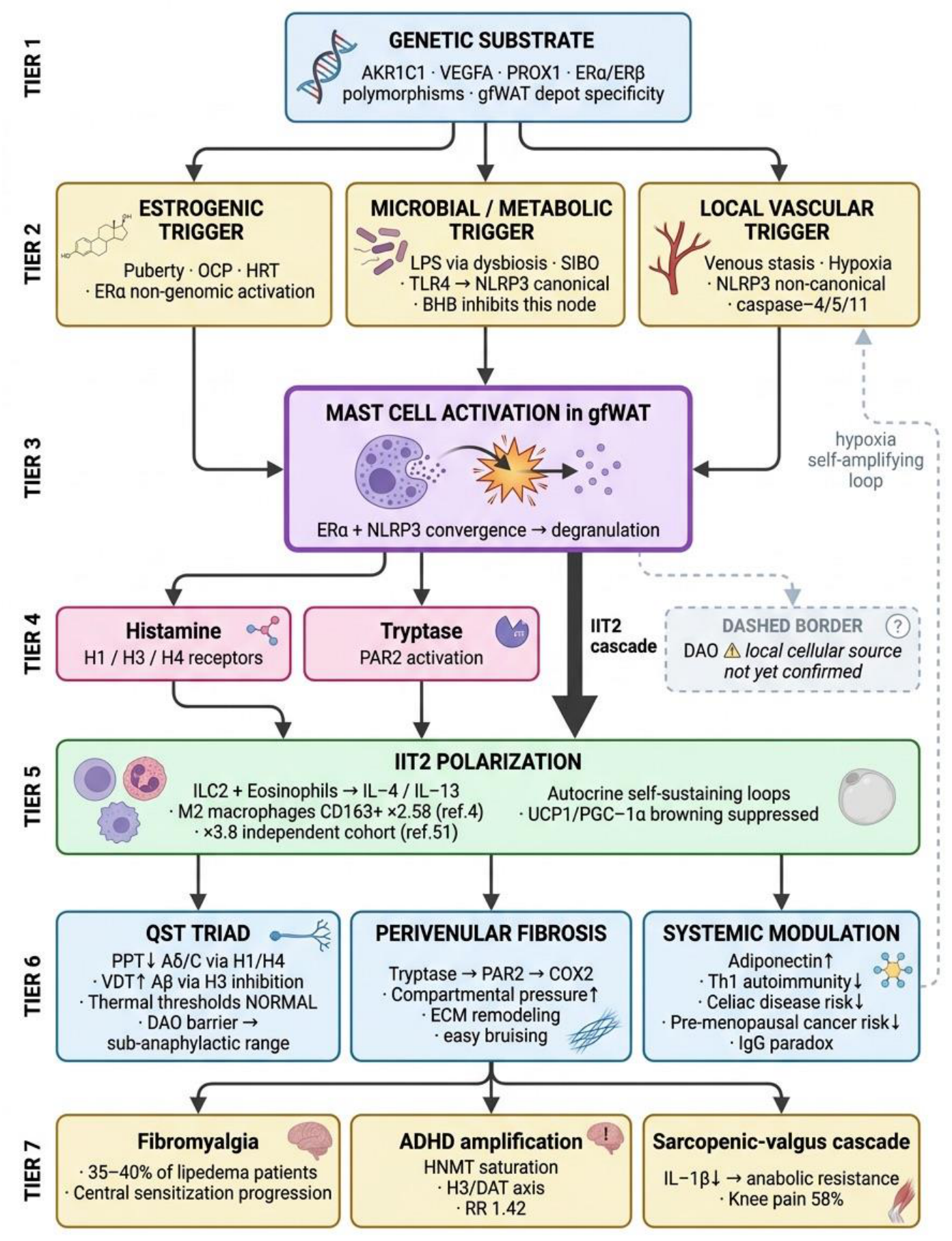
Figure 2.
Histaminergic peripheral sensitization explains the lipedema QST triad. Four fiber classes are depicted with their histamine receptor interactions. Aβ fibers express presynaptic H3 autoreceptors; histamine binding inhibits neurotransmitter release, elevating the vibration detection threshold (VDT↑). Aδ fibers express H1 receptors; histamine produces direct sensitization, lowering the pressure pain threshold (PPT↓). C fibers express H4 receptors (histamine-mediated sensitization) and are co-activated by tryptase via PAR2, reinforcing PPT reduction and generating a chronic neuroinflammatory substrate; nociceptor-derived substance P reciprocally activates MRGPRX2 on mast cells, establishing a self-amplifying neuroimmune loop. Thermal fibers (TRPV1/TRPA1) are not substantially modulated at sub-anaphylactic histamine concentrations, predicting intact thermal thresholds. This receptor-fiber model explains the specific 2-of-13 abnormality pattern (PPT and VDT only) with complete thermal sparing that characterizes lipedema QST (PVTH-score AUC 0.958, ref. [5]).
Figure 2.
Histaminergic peripheral sensitization explains the lipedema QST triad. Four fiber classes are depicted with their histamine receptor interactions. Aβ fibers express presynaptic H3 autoreceptors; histamine binding inhibits neurotransmitter release, elevating the vibration detection threshold (VDT↑). Aδ fibers express H1 receptors; histamine produces direct sensitization, lowering the pressure pain threshold (PPT↓). C fibers express H4 receptors (histamine-mediated sensitization) and are co-activated by tryptase via PAR2, reinforcing PPT reduction and generating a chronic neuroinflammatory substrate; nociceptor-derived substance P reciprocally activates MRGPRX2 on mast cells, establishing a self-amplifying neuroimmune loop. Thermal fibers (TRPV1/TRPA1) are not substantially modulated at sub-anaphylactic histamine concentrations, predicting intact thermal thresholds. This receptor-fiber model explains the specific 2-of-13 abnormality pattern (PPT and VDT only) with complete thermal sparing that characterizes lipedema QST (PVTH-score AUC 0.958, ref. [5]).
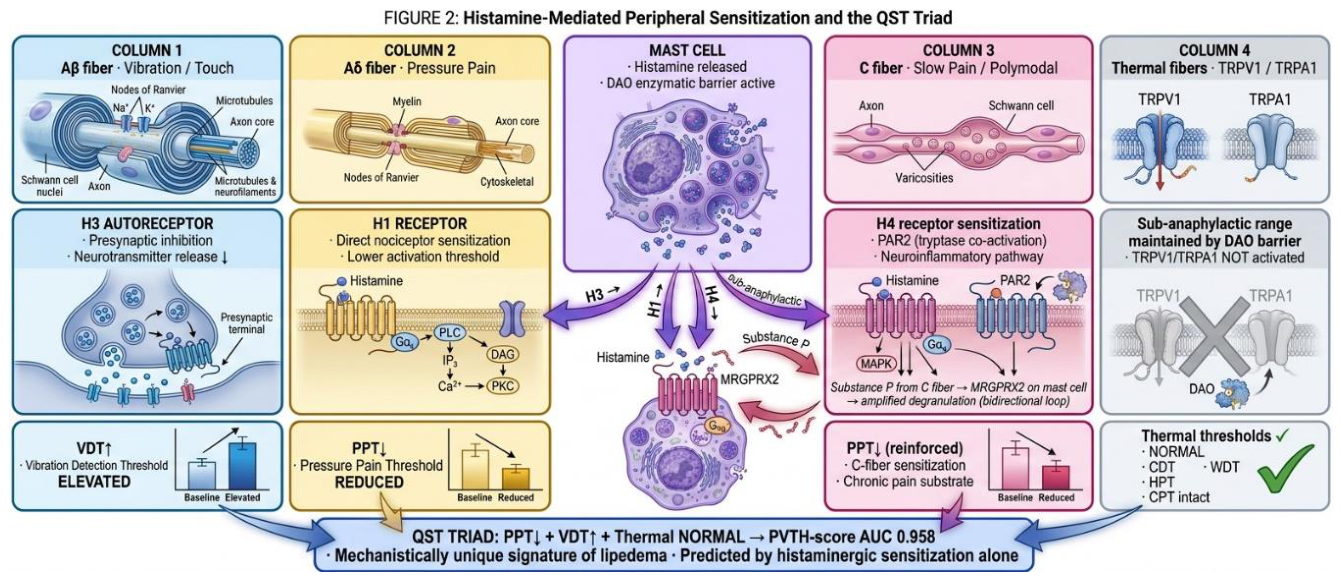
Figure 3.
Bidirectional lipedema–venous disease interaction and asymmetric lipedema as a natural controlled experiment. Panel A: Pathway A depicts IIT2-driven histamine and tryptase producing telangiectasias and reticular varices (CEAP C1–C2) without primary venous reflux — varicose disease secondary to lipedema. Pathway B depicts documented venous reflux (CEAP C3+ confirmed by duplex) causing stasis and hypoxia, activating the NLRP3 non-canonical pathway (caspase-4/5/11) and amplifying ipsilateral mast cell degranulation. Duplex ultrasound constitutes the clinical decision point: absent reflux suggests Pathway A (IIT2 control first); reflux C3+ suggests Pathway B (ablation as trigger removal, Prediction P7). Panel B: Asymmetric lipedema provides a natural controlled experiment in which the same genetic substrate, systemic hormonal environment, and diet produces measurably divergent disease severity in two limbs based solely on an additional local vascular trigger in one limb.
Figure 3.
Bidirectional lipedema–venous disease interaction and asymmetric lipedema as a natural controlled experiment. Panel A: Pathway A depicts IIT2-driven histamine and tryptase producing telangiectasias and reticular varices (CEAP C1–C2) without primary venous reflux — varicose disease secondary to lipedema. Pathway B depicts documented venous reflux (CEAP C3+ confirmed by duplex) causing stasis and hypoxia, activating the NLRP3 non-canonical pathway (caspase-4/5/11) and amplifying ipsilateral mast cell degranulation. Duplex ultrasound constitutes the clinical decision point: absent reflux suggests Pathway A (IIT2 control first); reflux C3+ suggests Pathway B (ablation as trigger removal, Prediction P7). Panel B: Asymmetric lipedema provides a natural controlled experiment in which the same genetic substrate, systemic hormonal environment, and diet produces measurably divergent disease severity in two limbs based solely on an additional local vascular trigger in one limb.
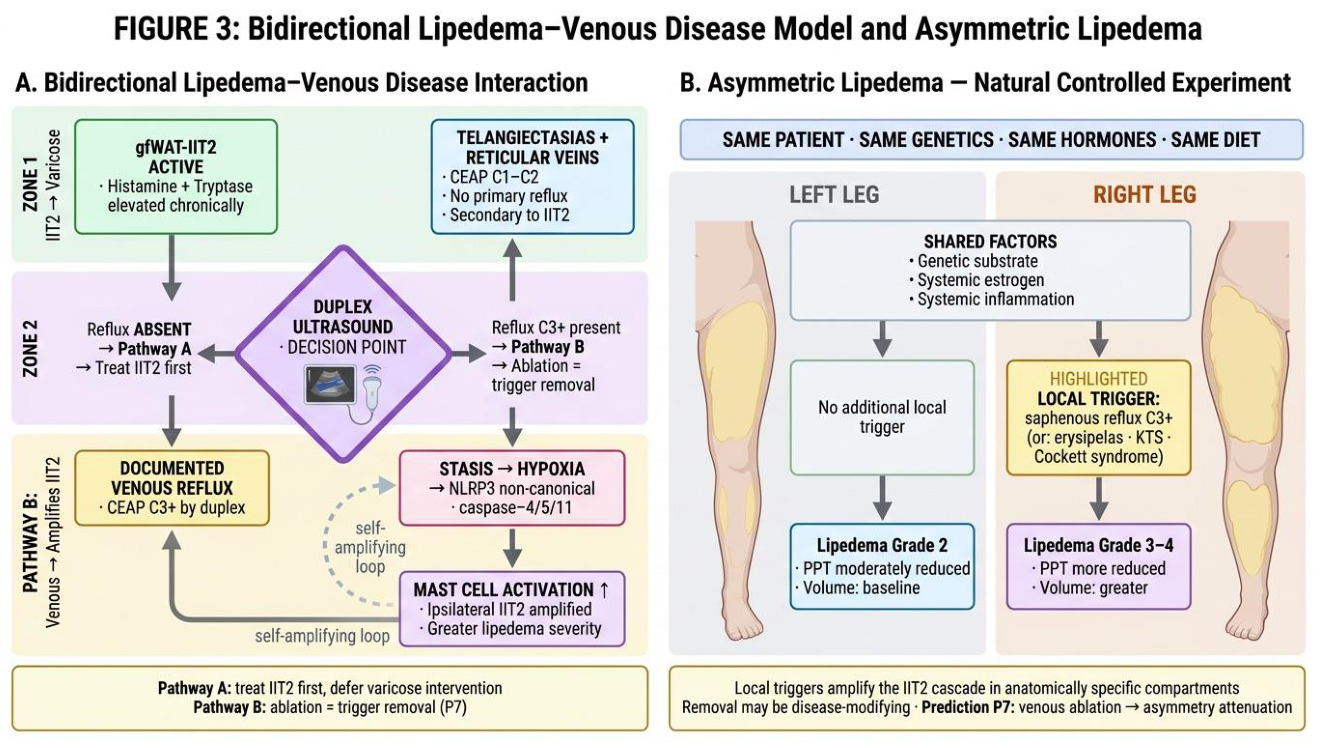
Figure 4.
Trigger-stratified therapeutic map of lipedema based on the gfWAT-IIT2 framework. The framework proposes that clinical response to interventions depends on the dominant trigger class. Estrogenic-dominant patients may benefit from hormonal modulation and mast cell stabilization (cromolyn sodium, rupatadine). Microbial/metabolic-dominant patients (elevated HOMA-IR, dysbiosis) may respond preferentially to LCHF diet (NLRP3 inhibition via β-hydroxybutyrate), GLP-1 receptor agonists (P14), and colchicine. Local vascular-dominant patients (CEAP C3+ reflux) may achieve ipsilateral disease attenuation through venous ablation as trigger removal (P7). ECM/hypermobility-dominant patients benefit from neuromuscular rehabilitation targeting the sarcopenic-valgus cascade. The universal therapeutic sequence — characterize trigger first, suppress IIT2 cascade second, consider liposuction last — inverts the current adipocyte-centric standard of care.
Figure 4.
Trigger-stratified therapeutic map of lipedema based on the gfWAT-IIT2 framework. The framework proposes that clinical response to interventions depends on the dominant trigger class. Estrogenic-dominant patients may benefit from hormonal modulation and mast cell stabilization (cromolyn sodium, rupatadine). Microbial/metabolic-dominant patients (elevated HOMA-IR, dysbiosis) may respond preferentially to LCHF diet (NLRP3 inhibition via β-hydroxybutyrate), GLP-1 receptor agonists (P14), and colchicine. Local vascular-dominant patients (CEAP C3+ reflux) may achieve ipsilateral disease attenuation through venous ablation as trigger removal (P7). ECM/hypermobility-dominant patients benefit from neuromuscular rehabilitation targeting the sarcopenic-valgus cascade. The universal therapeutic sequence — characterize trigger first, suppress IIT2 cascade second, consider liposuction last — inverts the current adipocyte-centric standard of care.
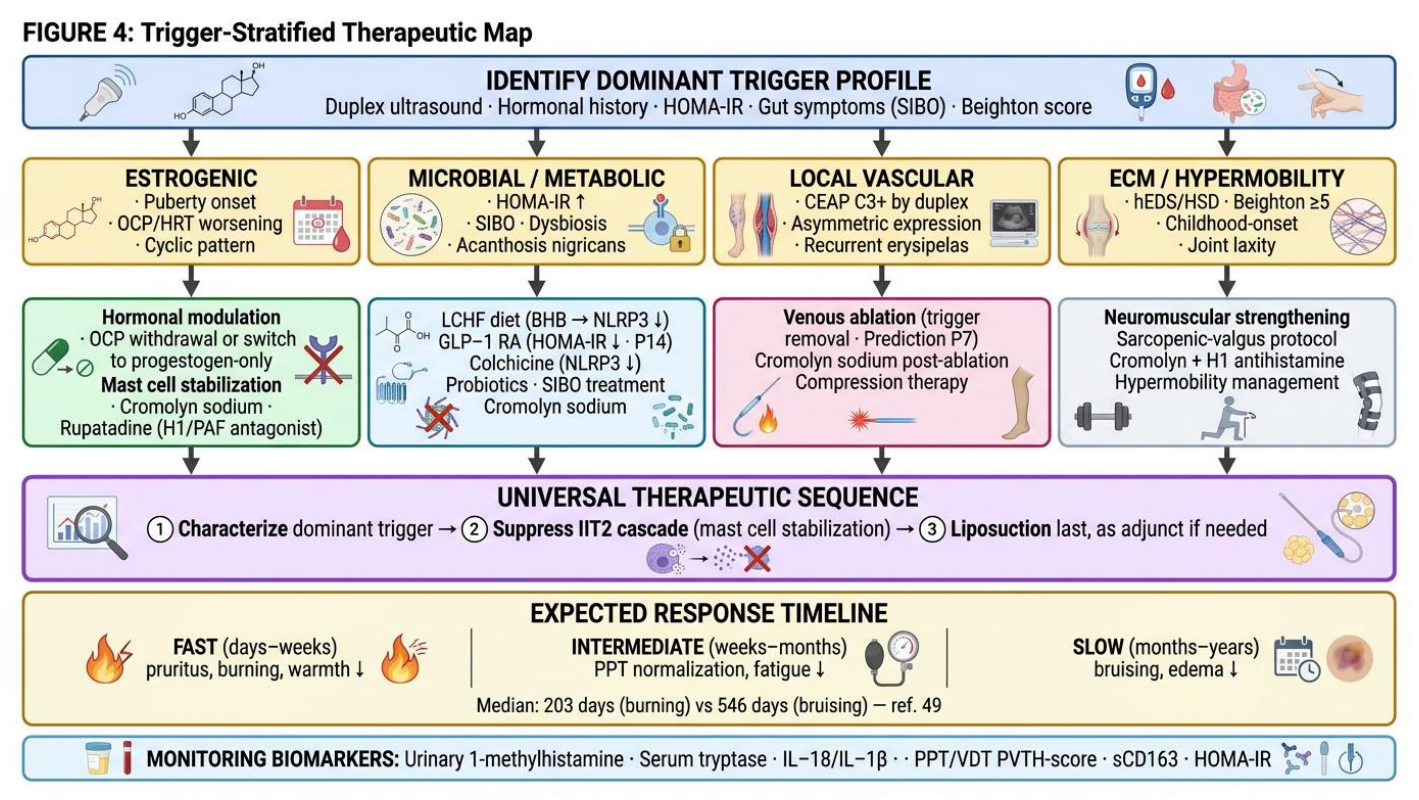
Disclaimer/Publisher’s Note: The statements, opinions and data contained in all publications are solely those of the individual author(s) and contributor(s) and not of MDPI and/or the editor(s). MDPI and/or the editor(s) disclaim responsibility for any injury to people or property resulting from any ideas, methods, instructions or products referred to in the content. |
© 2026 by the authors. Licensee MDPI, Basel, Switzerland. This article is an open access article distributed under the terms and conditions of the Creative Commons Attribution (CC BY) license (http://creativecommons.org/licenses/by/4.0/).
Copyright: This open access article is published under a Creative Commons CC BY 4.0 license, which permit the free download, distribution, and reuse, provided that the author and preprint are cited in any reuse.