

Submitted:
14 May 2026
Posted:
15 May 2026
You are already at the latest version
Abstract
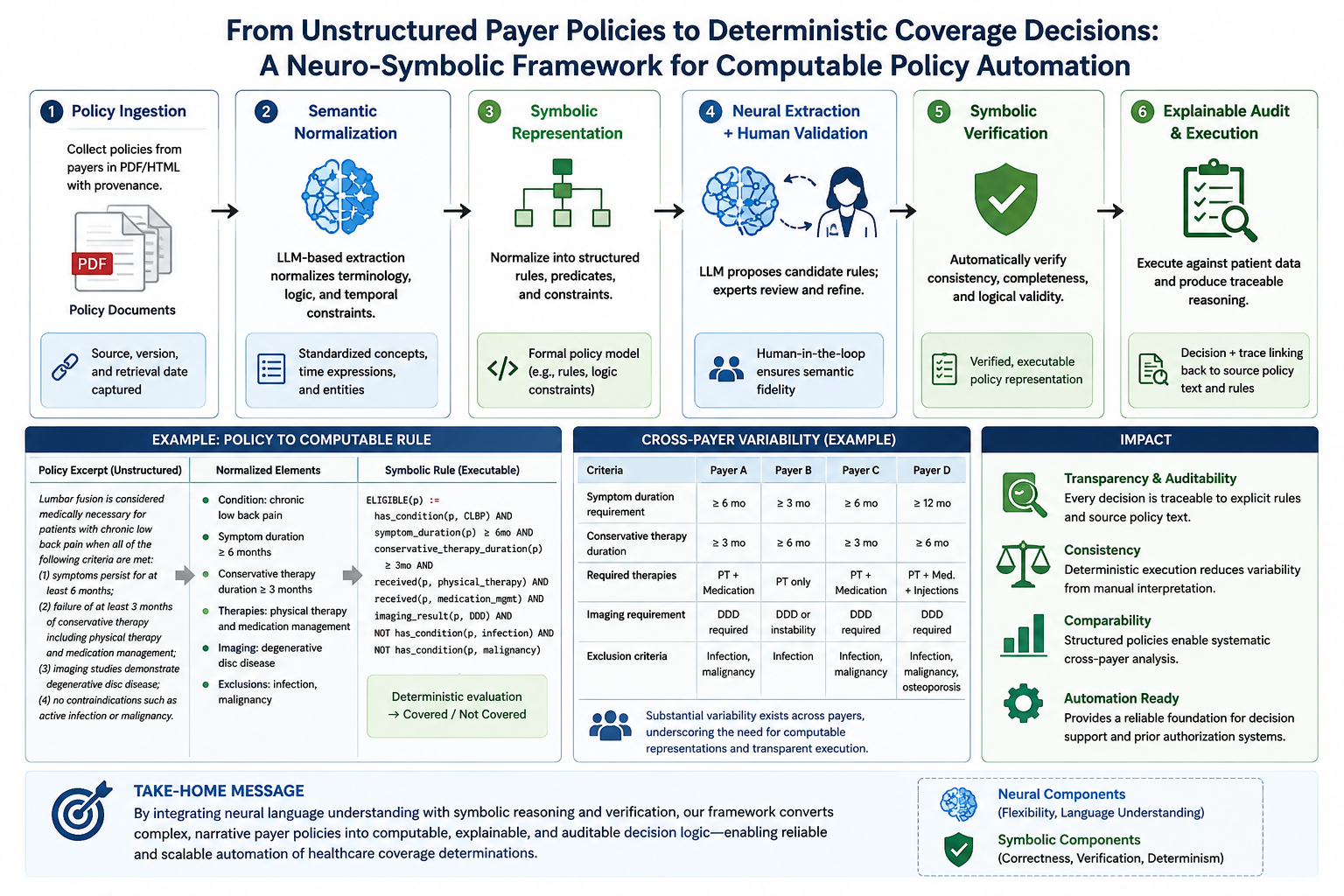
Prior authorization in the United States relies on payer coverage policies expressed as unstructured narrative text, creating fundamental barriers to automation, consistency, and auditability. Large language model (LLM) approaches to policy interpretation suffer from hallucination, nondeterminism, and clinically unsafe outputs—we argue these failures stem not from model capability but from a representation problem: policies written for human interpretation are not inherently computable. We introduce policy computability: the representation of coverage policies in machine-interpretable forms that support deterministic execution, formal verification, provenance tracking, and reproducible reasoning. To operationalize this concept, we present a six-layer neuro-symbolic framework that transforms payer policy documents into executable policy artifacts. Neural components are constrained to language-processing tasks—document ingestion, ontology normalization, and structured rule extraction under symbolic guardrails—while all coverage determinations are executed by a symbolic verification engine using deterministic logical evaluation. The framework incorporates ontology mapping, rule-graph construction, a Python-embedded domain-specific language (DSL), logical conflict resolution, and provenance-aware reasoning traces. We validate the symbolic pipeline using a lumbar fusion prior authorization policy across six synthetic clinical scenarios, demonstrating reproducible coverage determinations with complete reasoning traces. In a preliminary evaluation of the neural extraction layer, Llama 3.2 3B achieved 100% recall on inclusion and exclusion criteria from a narrative policy document across three trials, though extraction quality depended on prompt formulation. Comparative analysis of two representative payer policies reveals clinically meaningful variation—including greater than twofold differences in required conservative therapy duration—highlighting the need for structured policy representations. This work establishes a pathway from narrative payer policies toward deterministic, transparent, and machine-executable coverage systems, providing a foundation for trustworthy automation in prior authorization.
Keywords:
prior authorization
; neuro-symbolic AI
; computable policies
; coverage determination
; healthcare administration
; policy-as-code
; symbolic verification
; explainable AI
Copyright: This open access article is published under a Creative Commons CC BY 4.0 license, which permit the free download, distribution, and reuse, provided that the author and preprint are cited in any reuse.


