

Submitted:
15 May 2026
Posted:
15 May 2026
You are already at the latest version
Abstract
Mega-events like the Olympic Games present both opportunities and challenges for sustainable urban development. This study addresses a critical knowledge gap: how can temporary Olympic Villages transition into permanent, inclusive urban communities that deliver lasting social, economic, and environmental benefits. Drawing on grounded theory and cross-case analysis of six Olympic events, we establish a three-tier P-R-L model (Physical-Relational-Legacy) that explains sustainable community structure evolution. The Physical layer operationalizes resilient space design through adaptive infrastructure; the Relational layer institutionalizes equitable governance through stakeholder integration; the Legacy layer consolidates inclusive urban dividends beyond traditional metrics. Our findings demonstrate how these dimensions reinforce mutually to support sustainable community transitions, offering a replicable framework for mega-event planning aligned with SDG 11 (Sustainable Cities and Communities) and SDG 16 (Peace, Justice and Strong Institutions). The research contributes actionable guidance for policymakers, urban planners, and event organizers seeking to maximize positive sustainability outcomes.
Keywords:
Olympic Village
; grounded theory
; sustainable mega-event governance
; P-R-L model
; temporary-permanent community transition
; urban resilience
; inclusive development
1. Introduction
The Olympic Village, as the world’s most complex temporary residential system, embodies a paradigm shift in urban governance from the pursuit of instantaneous spectacle to the cultivation of long-term urban resilience. Since the 2001 Paris Olympic Village foregrounded principles of “urban stitching” and “social inclusion” (Brown, 2020), the Olympic Village has emerged as a “transformative urban prototype” for testing sustainable urban transition. Yet as the scale and cost of hosting continue to escalate, Olympic Villages face not only severe financial risks (Flyvbjerg et al., 2016; Müller et al., 2021), but also persistent post-Games challenges including difficulties in urban integration and prolonged spatial underutilization (Byers et al., 2020). How to resolve the inherent tension between the Village’s “temporary event function” and its “permanent urban value”, enabling a successful transition into a viable and enduring urban unit, has become a central issue in the planning and governance of major sporting events (Krieger & Von Wagner, 2014).
Scholarly attention to the Olympic Village has spanned multiple dimensions, including historical evolution, planning and design, community development models, and sustainability challenges (Bussell, 2023; Della Sala, 2022b; LANFRANCHI & PACE, 2020). However, existing research has predominantly focused on single-point, linear analyses of pre-Games planning, in-Games adaptation, or post-Games legacization, neglecting the structural dynamics that operate across the Village’s full lifecycle. This fragmented perspective makes it theoretically difficult to account for the risk of “systemic disconnection” inherent to the Olympic Village—whereby the intense investment of the Games period fails to translate effectively into post-Games urban capital. This study contends that resolving this dilemma requires moving beyond conventional linear-evolution frameworks, and instead adopting a logic of “dimensional co-existence” to systematically reveal the structural translation mechanisms through which three endogenous dimensions (physical, relational, and legacy) operate across distinct temporal phases.
Drawing on official documents and authoritative reports from multiple Olympic Games, this study employs systematic coding and category refinement to construct the Physical-Relational-Legacy (P-R-L) model of Olympic Village temporary community structure dynamics. The study aims to explain how, under conditions of extreme spatio-temporal compression and high cultural heterogeneity, the three dimensions of physical space, social relations, and legacy outcomes maintain structural isomorphism, and ultimately achieve a structural transition from “exceptional space” to “normalized community” through hardware translation, rule translation, and value translation. The findings of this study offer important theoretical reference and an operational assessment framework for legacy evaluation in the planning of major international sporting events and the pursuit of urban sustainable development.
2. Literature Review
Existing scholarship on the Olympic Village has yielded substantial findings, organized primarily around two analytical levels: the internal structure of the Olympic Village and the relationship between the Olympic Village and the host city.
2.1. Research on the Internal Structure of the Olympic Village
At the internal structure level, studies predominantly define the Olympic Village as athletes’ temporary residence (McCARTHY, 2012; WANG & ZHAO, 2020) and the world’s largest temporary organization (Sheath, 2014), with emphasis on its physical infrastructure and social relational perceptions. Regarding physical infrastructure, the literature examines how modular and prefabricated construction techniques enable post-Games dismantling and reconfiguration (LANFRANCHI & PACE, 2020; Pkhakadze & Tomczyk, 2021), positioning the Olympic Village as a testing ground for sustainable construction technologies (Bekhti et al., 2025; Du & Lu, 2025; Studio, 2019).
Regarding social relational perceptions, research focuses on athlete interactions within high-pressure, culturally heterogeneous environments (Kidd, 2013; Vanhegan et al., 2013), examining the psychological challenges athletes may encounter under conditions of intense competition and cultural diversity (Kidd, 2013; Sheath, 2014), as well as how high-quality services foster a shared sense of “Olympic Family” identity (Leopkey & Parent, 2012; Sheath, 2014).
2.2. Research on the Relationship Between the Olympic Village and the Host City
At the external relational level, research proceeds mainly from the perspectives of urban sustainable development and historical evolution. The sustainable development perspective emphasizes the strategic role of the Olympic Village as an engine of urban regeneration, viewing its post-Games transformation as a critical opportunity to advance urban restructuring (Della Sala, 2022b, 2022a; WANG & ZHAO, 2020). The historical evolution perspective traces the trajectory through which the Olympic Village has evolved from a simple residential facility to an “urban unit” (Liao & Pitts, 2007; Muñoz, 2006), stressing the need for it to successfully transition into “a highly valuable urban district” (Krieger & Von Wagner, 2014) that serves both present and future generations (Chappelet, 1997).
2.3. Critical Review
Taken together, existing research has delineated the significant roles of the Olympic Village in physical space, social function, and urban development; however, notable gaps remain in the following critical areas.
First, the existing literature tends to explain the Olympic Village from either the physical construction dimension or the soft environment dimension in isolation, without providing a holistic account of its temporary structural dynamics. In particular, systematic analytical frameworks are lacking for understanding how rigid structural elements and soft governance logics achieve “dual-scenario compatibility” and undergo dynamic co-evolution. This conceptual gap makes it difficult for host cities to avoid the “systemic disconnection” between Games-time investment and post-Games utilization.
Second, prevailing studies concentrate primarily on describing transformation outcomes or discussing macro-level policy, without offering clear theoretical pathways to explain the concrete process through which temporary functions are converted into lasting value. Latuf de Oliveira Sanchez et al. (2022) note that many Olympic Villages have failed to fulfill their anticipated legacy roles, reflecting the limited capacity of existing theories to guide practice (Latuf de Oliveira Sanchez et al., 2022). Operational theoretical guidance on how the Olympic Village achieves qualitative transformation through structural translation remains absent.
Third, and most critically, existing research tends to treat “Games-time temporality” and “post-Games permanence” as a linear, substitutive relationship, overlooking the feature of dimensional co-existence that characterizes both conditions structurally. This linear thinking fails to account for the structural isomorphism and functional heterogeneity of the physical, relational, and legacy dimensions across different temporal and spatial contexts (Clark et al., 2016), and cannot illuminate how such tension drives the deep integration of community building and spatial design (Leopkey & Parent, 2012; Smith, 2014).
Against this backdrop, the present study contends that a deeper understanding of the Olympic Village as a form of “temporary community structure” is central to filling the gaps identified above. Rather than offering surface-level descriptions of physical infrastructure, this research focuses on the mechanism of “dimensional co-existence and structural translation,” exploring how the Olympic Village achieves coordinated co-evolution across its physical, relational, and legacy dimensions within a distinctive contextual setting. In doing so, it seeks to provide theoretically grounded and practically actionable guidance for legacy planning in major international sport events.
3. Research Design
3.1. Research Methodology
This study adopts grounded theory as its exploratory methodological framework. Originally developed by Glaser and Strauss (2017), grounded theory is grounded in the inductive construction of theoretical frameworks from empirical data (Glaser & Strauss, 2017). Compared with other qualitative approaches, it not only describes social phenomena but also illuminates their deeper meanings and dynamic relationships (Woods et al., 2016). As a distinctive form of temporary community, the Olympic Village is characterized by exceptional complexity and heterogeneity in its membership composition, interaction patterns, and social structures. The capacity of grounded theory to yield nuanced understanding of interpersonal interactions and social relations makes it particularly well suited to the present study’s aim of uncovering the mechanisms of “dimensional co-existence and structural translation” within the Olympic Village. Without imposing pre-existing theoretical assumptions, the researcher follows three rigorous coding procedures, namely open coding, axial coding, and selective coding, to extract original propositions about Olympic Village structure from a large body of textual material. The ultimate goal is to construct a dynamic model capable of explaining the community’s development across its full life cycle.
3.2. Sample Selection and Data Collection
The planning and construction of the Olympic Village is incorporated into the Olympic Games’ Information, Knowledge and Games Learning (IKL) programme, whose standards and norms exhibit a high degree of continuity and global reference value. This study aims to analyse full-cycle textual materials relating to the Olympic Games in order to clarify the structural composition of the Village and to address the central research question of how the temporary community structure of the Olympic Village achieves “dimensional co-existence and functional transfer.”
During the data selection phase, the Olympic World Library and authoritative news databases served as the primary sources. The Olympic World Library holds the majority of official documents that have been publicly released since 1896. The study used “Olympic Village” and “Olympic Village Temporary/Transient Community” as the principal search terms. Screening criteria focused on whether each document contained full-cycle information pertaining to the planning and construction of Summer and Winter Olympic Villages, Games-time operations, post-Games legacy, urban impact, and cultural diversity.
Applying these principles, a corpus of 40 core textual documents was ultimately selected, covering six editions of the Olympic Games: Beijing 2008, London 2012, Rio 2016, Tokyo 2020, Beijing 2022, and Paris 2024. The materials include official post-Games reports, Olympic Village operational guides, and in-depth reporting by authoritative media outlets, thereby ensuring both comprehensiveness and credibility. The coding process strictly adhered to the principle of theoretical saturation, meaning that data collection ceased when no new initial categories could be identified from the textual material (Pandit, 1996). The documentary sources are presented in Table 1.
4. Categorization and Model Construction
4.1. Open Coding
Open coding refers to “the process of breaking down, examining, comparing, conceptualizing, and categorizing data” (A. Strauss & Corbin, 1990), that is, a process of decontextualizing raw materials and re-clustering them into meaningful units. First, representative statements related to the structural dimensions of the Olympic Village were extracted from news reports, official guidelines, and post-Games reports, yielding a total of 384 raw statements. Second, through comparative analysis and inductive reasoning among the initial codes, 84 preliminary concepts were derived, including “international community” and “resilient design”. Finally, concepts sharing the same directional meaning were clustered and refined, resulting in 35 initial categories. Table 2 presents a selection of initial categories along with their corresponding concepts and representative raw statements.
4.2. Axial Coding
Axial coding aims to discover and establish various connections between categories so as to reassemble the data that were fractured during open coding (A. Strauss & Corbin, 1990). In this study, the 35 initial categories were further clustered into 7 main categories, which constitute the three core dimensions of the Olympic Village temporary community structure: the Physical layer (P), the Relational layer (R), and the Legacy layer (L). The findings reveal that these three dimensions do not follow a simple linear progression; rather, they exhibit pronounced “structural isomorphism” and “functional heterogeneity”. The main categories and their respective meanings are presented in Table 3.
4.3. Selective Coding and Model Construction
Selective coding is the process of integrating categories, identifying a core category, and constructing a narrative storyline around it. In this study, the core category is defined as “dimensional co-existence and structural translation within Olympic Village temporary community structures.” The underlying logic proceeds as follows: the Olympic Village, functioning as an “exceptional space,” encompasses a Physical layer, a Relational layer, and a Legacy layer that co-evolve across the full life cycle of the Games. Through “hardware translation” at the Physical layer (multi-stakeholder coordination and compatibility-by-design), “governance translation” at the Relational layer (transfer of governance authority and multi-actor engagement), and “value translation” at the Legacy layer (from transient provision to long-term dividends), the temporary community ultimately transcends a critical structural threshold, achieving a structural transition into a permanent urban unit. On this basis, the present study constructs a dynamic evolutionary model of Olympic Village temporary community structure, as illustrated in Figure 1.
4.4. Theoretical Saturation Test
To verify theoretical saturation, three text documents not included in the initial coding process were randomly selected for re-analysis (A. L. Strauss & Corbin, 1998). After repeated comparative analysis, no new initial concepts or categories were identified, and the logical relationships among the main categories had stabilized. This indicates that the coding results have reached saturation, effectively capturing the dynamic patterns of Olympic Village temporary communities, and confirms the robustness and scientific rigor of the findings.
5. Model Interpretation
The P-R-L model developed in this study reveals the structural dynamics governing the Olympic Village as a form of “exceptional space” across distinct temporal phases. The Physical layer, the Relational layer, and the Legacy layer do not represent simple sequential stages of historical evolution; rather, they constitute three endogenous structural dimensions that operate throughout the entire life cycle of the Olympic Village. Across the two phases of “Games-time temporary community” and “post-Games permanent community,” these three dimensions exhibit notable structural isomorphism alongside functional heterogeneity: the physical infrastructure of the Physical layer, the governance rules of the Relational layer, and the value outputs of the Legacy layer all remain continuously operative in both phases, yet undergo fundamental shifts in their operational logic and the populations they serve.
Gold and Gold (2016) observed that the planning and construction of Olympic Villages are deeply embedded within the long-term urban agendas of host cities, and that the evolution of their physical form, governance structures, and legacy effects reflects the core imperatives of each host city’s urbanization strategy (Gold & Gold, 2016). This observation provides an important historical-comparative perspective for the present study. The structural dynamics captured by the P-R-L model are not idiosyncratic phenomena confined to individual Olympic Villages, but represent a universal mechanism with cross-edition regularity.
The core analytical value of the model lies in its elucidation of the structural translation mechanisms operative across the three dimensions during the transition process. The Physical layer, through “Games-time elastic spatial pre-configuration” and “multi-stakeholder collaborative hardware delivery,” accomplishes a hardware translation from “temporary high-load carrier” to “permanent livelihood space.” The Relational layer, through “dual-scenario rule elastic translation” and “soft activation of service networks,” accomplishes a rule translation from “closed-loop control logic” to “pluralistic collaborative governance.” The Legacy layer, through “spatial socialization and livelihood transition,” “industrial value appreciation of event heritage,” and “resilience sedimentation under extreme pressure,” accomplishes a value translation from “instantaneous event assurance” to “sustained urban dividend.”
The three layers of translation are mutually interdependent and sequentially progressive: the hardware translation of the Physical layer provides the spatial foundation for rule reconstruction in the Relational layer; the rule translation of the Relational layer furnishes the institutional intermediary for value release in the Legacy layer; and the value translation of the Legacy layer, in turn, reinforces the legitimacy and momentum sustaining the continued operation of both the Physical and Relational layers. Together, these three translations constitute a complete logical loop governing the structural evolution of the Olympic Village, ultimately dissolving the risk of the “white elephant effect” that has long preoccupied the field (Preuss, 2004). The three sections that follow provide detailed accounts of the structural mechanisms and categorical dimensions of the Physical, Relational, and Legacy layers respectively.
5.1. The Physical Layer: Hardware Translation from Temporary High-Load Carrier to Permanent Civic Space
The physical layer constitutes the material foundation of the Olympic Village’s temporary community structure, encompassing two main categories: “event-time elastic space pre-configuration” and “multi-stakeholder collaborative hardware delivery.” As one of the three endogenous structural dimensions, the physical layer serves simultaneously as the material prerequisite for the efficient operation of the event-time “exceptional space” and as the spatial carrier sustaining the post-Games permanent community structure. Its defining characteristics are twofold: “high-standard delivery under extreme temporal compression” and “full life-cycle elastic spatial design.” It is important to emphasize that the physical layer is not confined to the event-time phase; rather, it is an endogenous dimension that runs through the entire life cycle. Its evolutionary essence lies in the “hardware translation” from a “temporary high-load carrier” to a “permanent civic space”.
5.1.1. Event-Time Elastic Space Pre-Configuration
Event-time elastic space pre-configuration serves as the material intermediary enabling structural continuity across life-cycle phases. It is precisely through the embedding of a “dual-scenario compatibility” design logic at the pre-construction stage that the physical structure of the temporary community maintains its structural integrity across the two fundamentally different operational contexts of event-time and post-Games periods. This approach avoids the structural rupture caused by large-scale demolition and reconstruction after the Games, and constitutes the core material support for the smooth transition of the physical layer from “temporary carrier” to “permanent space.”
To balance event-time functional requirements with post-Games adaptive flexibility, the physical layer embeds the core concept of “dual-scenario compatibility” at the design stage, ensuring dimensional continuity through the pre-configured spatial translation. This compatibility is manifested in three respects:
First, the widespread application of modular construction technology. Through prefabricated steel-frame structures, demountable partition walls, and standardized functional modules, building interiors are designed with the capacity for rapid reconfiguration (Wu et al., 2021). Modular design is regarded in temporary community research as the core strategy of “reversible construction”: its essence is the decoupling of the social function of space from the physical structure, enabling the same material carrier to accommodate the social needs of different periods (Kronenburg, 2007). The Beijing Winter Olympic Village exemplifies this directly: by adopting a prefabricated steel-frame system, it completed the conversion from athlete apartments to talent rental housing in just three months after the Games, a result made possible by the modular design adopted during construction (Liu et al., 2022).
Second, the elastic configuration of infrastructure. Municipal facilities including power, communications, and water supply and drainage are designed to dual standards of “high-load event-time operation” and “normalized post-Games use,” with sufficient capacity for expansion and retrofit interfaces reserved in advance (Gordan et al., 2024). This strategy aligns closely with the concept of “over-provisioning design” in urban infrastructure resilience theory, whereby a degree of redundancy during the event phase preserves structural margin for future functional expansion (Ahern, 2011).
Third, the universal design of functional zoning. The spatial dimensions and circulation layouts of residential zones, public activity areas, and operational support areas are designed to satisfy both the closed-loop management requirements of the event period and the open accessibility needs of post-Games community life. This “forward-compatible design” transforms the Olympic Village’s physical space from a purely temporary event facility into an urban asset with cross-life-cycle value (Al Balkhi, 2023), laying a solid material foundation for the subsequent structural transition to permanent civic space.
5.1.2. Multi-Stakeholder Collaborative Hardware Delivery
Multi-stakeholder collaborative hardware delivery is the institutional mechanism through which the Olympic Village’s temporary community structure takes material form under conditions of extreme temporal constraint. It is precisely this main category that determines whether the temporary community structure can complete the substantive transition from “planning blueprint” to “operational space” before the critical event deadline, making it the initiating condition of physical-layer structural dynamics.
Because Olympic Village construction faces absolutely rigid event-timeline constraints, urban communities of equivalent scale that would conventionally require 10 to 15 years of development must be compressed into a 4 to 6-year window covering the entire process from planning to delivery. This temporal compression effect compels the formation of a distinctive multi-stakeholder collaborative construction mechanism (Siddika et al., 2023). During construction, stakeholders including government agencies, the organizing committee, development enterprises, design firms, contractors, and athlete representatives form a tightly integrated project community (Chan et al., 2025). Through innovative management approaches such as parallel approval processes, modular construction, and dynamic quality control (Liu et al., 2024), these actors minimize construction timelines while ensuring that building quality meets International Olympic Committee standards (Wang et al., 2024).
Multi-stakeholder collaboration in large-scale temporary communities represents a form of “compressed institutional integration”: under conditions of high temporal uncertainty, cross-departmental restructuring of responsibilities and authority replaces the linear decision-making processes typical of conventional project management (Flyvbjerg et al., 2016). The case of the Paris Olympic Village, where 330,000 square meters of construction was completed in just six years — approximately 60% shorter than a conventional development timeline — stands as a paradigmatic confirmation of this mechanism’s effectiveness. Multi-stakeholder collaborative hardware delivery is therefore not merely a project engineering tool; it is the structural generative mechanism through which the Olympic Village temporary community comes into being, directly shaping the initial form and structural boundaries of the physical layer.
5.2. Relational Layer: Governance Translation from Closed-Loop Control Logic to Multi-Stakeholder Collaborative Governance
The relational layer constitutes the social integration dimension of the Olympic Village temporary community structure, encompassing two main categories: dual-scenario governance translation and soft activation of service networks. As one of the three endogenous structural dimensions, the relational layer simultaneously serves as the institutional guarantee that sustains the efficient operation of the “exceptional space” during the Games, and as the core intermediary through which the post-Games normalized community achieves governance reconstruction and relational reproduction. Its evolutionary logic is characterized by a governance translation from “closed-loop control” to “multi-stakeholder collaboration,” representing the defining structural feature that distinguishes Olympic Village temporary communities from conventional construction and development projects.
Dual-scenario governance rule translation is the core mechanism through which the Olympic Village temporary community structure achieves cross-cycle institutional continuity. It is precisely through the embedding of “dual-scenario compatibility” into the governance rule logic during the Games period that the relational layer structure is able to accomplish a smooth transition between two fundamentally different operational contexts, namely closed-loop Games-time management and open post-Games governance, rather than producing institutional rupture. This mechanism constitutes the critical intermediary of relational layer structural dynamics. During the Games, the Olympic Village accommodates nearly ten thousand residents from more than 200 countries and regions. The extraordinary heterogeneity of this population far exceeds the governance experience of any conventional community: vast differences in cultural backgrounds, linguistic practices, and religious beliefs, compounded by the pressures of athletic competition and multi-layered security requirements, render the spontaneous social formation mechanisms of ordinary communities entirely ineffective. Active institutional design is therefore essential to accomplish social integration within an exceptionally compressed timeframe (Zhao et al., 2025).
At the institutional design level, the Games-time regulatory framework is organized around rigid control as its primary axis, maintaining operational order through tiered access control, 24-hour security coverage, and comprehensive emergency response systems (Bryce & Dowling, 2024). This framework exhibits the structural characteristics of classic “monocentric governance”: a singular source of authority, hierarchical rule enforcement, and an overriding priority placed on efficiency and safety. As documented in the London 2012 report, “A secure perimeter and access control systems ensured the safety of the Village.” Yet this rigid regulatory framework is not a closed, terminal state; from the outset it was designed with an institutional interface that anticipates transition toward post-Games multi-stakeholder collaborative governance.
This “dual-scenario compatible” rule flexibility aligns with the concept of “institutional nestedness” emphasized in Ostrom’s (1990) theory of polycentric governance, which holds that effective governance rules should be capable of hierarchical adaptation under different contextual pressures rather than producing systemic collapse when contexts shift (Ostrom, 1990). The rigid Games-time rules thus serve as the institutional matrix for post-Games rule translation, while post-Games multi-stakeholder governance represents a contextual restructuring and reconfiguration of those same rules.
Upon entering the post-Games transition period, the relational layer’s regulatory framework undergoes a profound “paradigm shift.” Through the mechanism of “governance authority transfer,” administrative command-and-control yields to an open, inclusive network of multi-stakeholder collaborative governance. As the Tokyo 2020 report records, “The Village governance was successfully transferred to local municipal authorities.” In governance theory terms, this process corresponds to an evolution from “monocentric authority” toward the “multi-level, multi-actor” network governance structure described by Lowndes and Skelcher (1998). The coordinated involvement of government agencies, commercial operators, social workers, and diverse resident organizations enables the rule recognition accumulated during the Games to be converted into a post-Games community governance compact, thereby achieving a structural transition in the relational layer.
5.2.1. Service Network Soft Activation
Service network soft activation functions as the functional intermediary linking physical space and social relations within the Olympic Village temporary community structure. It is precisely through the embedding of service interfaces, cultural adaptation mechanisms, and emotional bonding processes that static physical space is activated into a socially meaningful living environment. In the Games-time and post-Games phases respectively, this activation generates “instantaneous resident identity” and “permanent civic belonging,” constituting the soft-side driver of relational layer structural dynamics.
The service network of the Olympic Village is not merely a logistical support system; it represents an important social infrastructure for building interpersonal connections and community identity. At the level of cultural adaptation, the construction of an “Olympic Family” identity, combined with multicultural service provisions, effectively mitigates cultural conflicts among a highly heterogeneous population and reinforces members’ shared sense of belonging (Hansen et al., 2025). For example, the Tokyo Olympic Village provided translation services in more than 60 languages and multi-faith prayer rooms . As documented in London 2012 archival materials: “The multi-faith center provided spiritual support for athletes of all religions” (London 2012).
From the perspective of social capital theory, the core function of this service network lies in catalyzing what Putnam (2000) defines as “bridging social capital”: relationship networks characterized by weak yet trust-based ties that transcend cultural, linguistic, and national differences (Putnam, 2000). Although rooted in the temporary interactions of the Games period, this form of social capital is capable of sedimenting at the institutional level into the social trust foundation required for post-Games community governance, providing a soft accumulation that supports relational layer reconstruction in the permanent community.
Upon entering the post-Games transition, the service network undergoes a functional translation from an “athlete-centered” orientation to a “civic life-centered” one. The involvement of commercial operators introduces market-driven operational vitality, while professional social work teams and pioneering residents together establish a normalized interface for ongoing social interaction. The emotional bonds forged during the Games are sublimated into post-Games community belonging, and the temporary service relationships of the Games period are converted into enduring social ties. Through this process of soft activation, the Olympic Village successfully dismantles the enclosure of the temporary community, providing the relational layer’s critical support for the structural transition from “closed-loop control” to “socially participatory governance”.
5.3. Legacy Layer: Value Translation from “Instantaneous Games Assurance” to “Long-Term Urban Dividends”
The legacy layer constitutes one of the three endogenous structural dimensions of the Olympic Village temporary community structure, functioning as the urban development capital generated by both the Games-time exceptional space and the post-Games normalized community. As the ultimate output of community structural evolution, the legacy layer likewise spans the full life cycle of the Olympic Village rather than emerging exclusively in the post-Games phase. It is important to note that the legacy layer exhibits pronounced structural isomorphism alongside functional heterogeneity across different temporal phases. During the Games period, its core characteristics manifest as “instantaneous assurance value,” encompassing the global projection of national image, the strengthening of social cohesion, and the successful delivery of Games security under conditions of extreme pressure. In the post-Games phase, by contrast, the legacy layer translates into long-term urban dividends through the consolidation and spillover of accumulated value. This evolutionary process is essentially one of converting the physical capital of the physical layer and the social capital of the relational layer into enduring urban development capital. When the Olympic Village completes its Games-time operational mission, it enters a critical juncture of value transformation: the use scenarios of physical space shift from Games-enclosed operations to open urban life; governance authority transitions from the Games organizing committee to local governments, commercial operators, and community self-governance organizations; and the population served changes from athletes to ordinary urban residents. This scenario transition demands a systematic reconstitution of the Olympic Village’s value, enabling a qualitative transition from an event-driven space to a sustainable community (Millington et al., 2022). This value translation and release is achieved in depth through three interrelated main categories, which together form the complete structural picture of the legacy layer.
5.3.1. Spatial Socialization and Livelihood Transition
Spatial socialization and livelihood transition is one of the core outputs of the legacy layer within the Olympic Village temporary community structure, directly embodying the structural achievement of the temporary community’s transformation from an enclosed Games space to an open urban unit. If the temporary community were to serve only the Games period, its physical infrastructure and relational governance capital would face the risk of large-scale abandonment; the full developmental value of the Olympic Village temporary community structure can only be realized through the socialized conversion from an athlete-oriented use scenario to a civic life scenario. It is in this sense that spatial socialization and livelihood transition serves as a key indicator for measuring the “transition completion” of the Olympic Village temporary community structure.
Through spatial functional reengineering, improvement of public services, integration of transportation systems, and the transfer of governance authority, the Olympic Village achieves a functional conversion from temporary Games facilities to a livelihood-oriented community (Gholampour et al., 2023). This process does not occur spontaneously; it requires proactive institutional arrangements and social embedding. The generation of community identity and social trust depends on sustained mechanisms of interaction and the establishment of shared spaces (Putnam, 2000). The socialized transformation of the Olympic Village activates the reproductive process of social capital precisely by transplanting the public spaces and interactive norms accumulated during the Games into the context of a normalized community. The Beijing Winter Olympic Village, for instance, was converted into talent-oriented public rental housing after the Games, providing residential support for nearly 2,000 households of introduced talent, a direct expression of the livelihood dimension of Olympic heritage (Polito, 2024). This “livelihood-oriented” process of spatial socialization marks the point at which the achievements of the physical and relational layers are ultimately translated into a fundamental urban unit available for long-term shared use by city residents.
5.3.2. Games Legacy ‘s Industrial Value Appreciation
Games legacy and industrial value appreciation illuminates the economic dimension of the Olympic Village as an “urban development lever,” and represents a critical support mechanism for the sustainable operation of the temporary community in the post-Games phase. What distinguishes the Olympic Village from ordinary urban regeneration projects is that its structural formation process inherently incorporates the leveraging effects of the Games: international brand exposure, large-scale infrastructure investment, and the concentration of global attention. If these effects cannot be converted into sustained industrial momentum, the temporary community faces the risk of legacy hollowing.Industrial value appreciation therefore serves as the conversion mechanism through which the Games-period investment is redeemed as long-term urban returns.
Through commercial repurposing, industrial linkage development, and regional brand enhancement, the Olympic Village’s brand influence is translated into a sustained driver of regional economic growth (Blake, 2005). Relevant research indicates that the land and industrial value effects of Olympic legacy sites exhibit significant temporal delay, typically manifesting in concentrated form between five and ten years after the Games (Essex & Chalkley, 1998). “The Village transformation catalyzed the growth of a new local retail district” (Rio 2016); “The Village legacy served as a powerful tool for global city marketing” (London 2012). In the case of London, the post-Games Olympic Village contributed to a 120% rise in property values across East London over ten years and generated substantial employment, achieving a positive cycle from Games investment to economic output (Hall & Robertson, 2001). In their comparative study of multiple Olympic host cities, Gold and Gold (2016) further found that the sustained release of post-Games regional industrial value depends critically on whether commercial transition pathways were incorporated into spatial structural design during the pre-Games planning phase, a finding that closely aligns with this study’s identification of “dual-scenario compatibility design” at the physical layer, further corroborating the intrinsic linkage logic among the three structural dimensions (Gold & Gold, 2016).
5.3.3. Extreme-Pressure Resilience Sedimentation
Extreme-pressure resilience sedimentation captures the governance capacity legacy accumulated by the Olympic Village in the course of managing extreme operational pressures, and represents a distinctive value that sets the Olympic Village apart from ordinary permanent community development. The high-density population concentration, the risks of intercultural conflict, and the demands of international security that the Olympic Village must navigate constitute a governance context far exceeding that of any routine community. Yet it is precisely this extreme context that serves as a crucible for forging high-performance governance mechanisms. The systematic retention and translation of the emergency response capacities, data platforms, and cross-departmental coordination experience generated through this process into the city’s normalized governance capital constitutes the deep mechanism through which the temporary community yields long-term urban dividends.
The emergency management systems, data scheduling platforms, and inter-agency coordination mechanisms developed during the Games period are adaptively reconfigured and integrated into the city’s normalized governance framework. This significant chpathway resonates theoretically with the core logic of resilience governance research regarding “pressure testing and capacity sedimentation”: extreme-pressure contexts not only expose systemic vulnerabilities but also serve as critical catalysts for institutional innovation and capability advancement (Preuss, 2004). The pedestrian flow monitoring and public health early-warning systems deployed in the Tokyo Olympic Village during the Games were subsequently applied to community governance across metropolitan Tokyo, effectively enhancing the city’s public safety response capacity (Fischer-Preßler et al., 2024). “The emergency response experience was codified into local resilience plans” (Tokyo 2020). The redeployment of governance resilience ensures that the Olympic Village endures in the city not only in the form of physical space, but also as institutionalized capacity deeply embedded within the urban governance system, thereby endowing the temporary community with long-term value that transcends the spatial itself.
6. Discussion
6.1. Theoretical Contributions
First, this study explicitly proposes a “three-dimensional structural translation theory,” addressing the gap in existing temporary community research that lacks a dynamic evolutionary framework (Brown, 2020). Existing studies on temporary communities have largely focused on static characteristic descriptions or single-phase operational mechanism analyses, without revealing the complete life-cycle trajectory through which temporary communities progress from formation to dissolution and ultimately to value transfer. Drawing on empirical material from six editions of the Olympic Village, this study divides the evolutionary process of temporary communities into three progressively advancing critical transition phases: “rapid formation of physical space—efficient integration of social relations—systematic release of long-term value.” It identifies the core driving factors, key breakthrough markers, and underlying operational logic of each phase, thereby establishing an analytically generalized dynamic evolutionary framework for temporary communities. This theoretical contribution not only provides a systematic analytical instrument for understanding the operational patterns of large-scale temporary communities such as the Olympic Village, but also offers a transferable theoretical perspective for research on other types of temporary communities, including music festivals, emergency resettlement sites, and exhibition parks. It fills the gap in dynamic analytical frameworks within temporary community studies and holds significant applied value for the governance of large-scale temporary spaces (Byers et al., 2020).
Second, this study reveals the mechanism of “dual-attribute reservation and front-loaded embedding,” enriching the core theoretical understanding of how large-scale sporting event temporary facilities can simultaneously serve Games-time functions and post-Games value objectives. It extends the theoretical discussion on the internal compatibility between “temporariness” and “permanence” in temporary facilities (Latuf de Oliveira Sanchez et al., 2022). The study finds that large-scale Games temporary facilities such as the Olympic Village embed, at the planning and design stage, a dual layer of “functional attribute reservation” and “institutional attribute reservation,” achieving an organic integration of Games-time specialized functional requirements and long-term post-Games use value. Functional attribute reservation refers to the adoption of modular building methods, flexible infrastructure configurations, and general-purpose functional zoning at the physical spatial design level, enabling spaces to adapt across scenarios. Institutional attribute reservation refers to the concurrent consideration, within the Games-time governance framework, of the institutional continuity needs of the post-Games transition: pre-planning governance transfer pathways, social capital sedimentation mechanisms, and stakeholder coordination arrangements. The revelation of this mechanism challenges the conventional assumption that “temporary facilities inevitably result in resource waste,” providing a core theoretical basis for the sustainable design of temporary public facilities and advancing the theoretical framework for dual-objective coordination in major public projects (Smith et al., 2024).
Third, this study expands the analytical boundaries of sports event legacy research by incorporating intangible legacies, such as governance resilience , into the legacy assessment framework, thereby enriching a field long dominated by material and economic indicators. The study broadens the evaluative scope to encompass the intangible legacy value generated during event operations, including governance experience, institutional frameworks, and social capital (Kim & Grix, 2021). Through an analysis of the post-event transition process in Olympic Villages, this study demonstrates that governance capacities accumulated during the Games period, including emergency management systems, cross-departmental coordination mechanisms, and multicultural governance experience, constitute a core event legacy of greater long-term value than physical space alone. The contribution of such governance capacity to the modernization of urban governance far exceeds the economic value of venues and facilities in isolation. This finding enriches the conceptual scope of sports event legacy, provides a new dimension for developing a more comprehensive event legacy assessment framework, and offers theoretical guidance for host cities seeking to fully leverage the intangible legacy value of major sporting events.
6.2. Practical Contributions
The practical value of this study lies in breaking through the traditional path dependency of “prioritizing Games-time needs while neglecting post-Games utilization” that pervades the planning of large-scale sporting event temporary facilities worldwide (Kim & Grix, 2021), and in forming a replicable and scalable full-cycle planning and legacy utilization operational framework that provides clear action guidance for the future hosting of major sporting events and the planning of temporary spaces.
First, this study provides a three-phase operational framework of “front-loaded reservation, scenario adaptation, and long-term release” for the full-cycle planning of large-scale sporting event temporary spaces. Existing planning practices for such spaces are widely characterized by a problem of “phase fragmentation”: the planning stage addresses only Games-time functional needs, the Games-time operational stage disregards post-Games transition continuity, and the post-Games utilization stage responds reactively to spatial renovation demands, resulting in high retrofitting costs, prolonged transition periods, and low efficiency in legacy utilization. The three-phase operational framework proposed in this study clarifies the core operational priorities of each phase. The front-loaded reservation phase explicitly requires the “reservation of multi-stakeholder coordination interfaces,” mandating that a dedicated post-Games utilization plan be compiled concurrently with the planning and design process, and that requirements for spatial retrofit flexibility, infrastructure reservation, and institutional continuity design be incorporated as pre-approval conditions, thereby eliminating post-Games demolition and reconstruction waste at the source. The scenario adaptation phase requires that, throughout Games-time operations, governance experience be systematically documented, data assets accumulated, and professional teams cultivated, so as to build up the institutional capital and human capital needed for the post-Games transition. The long-term release phase requires the systematic advancement of spatial functional renewal, industrial ecosystem development, and governance system integration in accordance with the principle of “social value first, economic value in coordination, and governance value sedimentation,” so as to maximize the value of event legacies. This framework has been validated across multiple editions of Olympic Village planning practice and can serve as a direct reference for the temporary space planning of other major international events, including the Commonwealth Games, Pan American Games, and Asian Games (Smith et al., 2024).
Second, this study develops a three-dimensional qualitative assessment framework for Olympic Village transformation, providing a systematic analytical structure for evaluating the effectiveness of Games legacy utilization. Drawing on the three layers of the P-R-L model, this study establishes an assessment framework comprising three dimensions: spatial adaptability, economic sustainability, and social integration. The spatial adaptability dimension evaluates the degree of alignment between the physical space’s Games-time functions and post-Games needs, with a core focus on the feasibility of renovation schemes and the flexibility of functional transitions. The economic sustainability dimension evaluates the long-term economic value of legacy utilization, with a core focus on the rationality of operational models and the catalytic effects of industrial linkages. The social integration dimension evaluates the degree of fusion between the transformed community and the surrounding urban area, with a core focus on the level of public service provision and residents’ sense of place identity. This assessment framework can be applied both to comprehensive post-Games evaluations of legacy utilization outcomes and, prospectively, to scheme appraisal during the planning phase, providing a clear analytical perspective for organizing committees and host-city governments to systematically enhance legacy utilization efficiency. Its multi-dimensional assessment logic has been referenced in related practices of large-scale sporting event legacy planning (Thomson et al., 2019), and contributes to advancing legacy management toward systematic assessment.
6.3. Limitations and Future Research
The data for this study were drawn from textual materials including Olympic Village guides publicly released by the Olympic Library, official Games reports, and news coverage from authoritative media outlets. Although every effort was made during the collection and coding process to ensure the comprehensiveness and completeness of the material, and the principle of theoretical saturation was observed, the information disclosed in these sources may nonetheless carry a degree of subjectivity and selective emphasis. Future research could incorporate in-depth interviews as a data source to further validate and supplement the theoretical model, with closer attention to the micro-level interaction logic of diverse post-Games governance actors, such as commercial operators and community volunteers, in order to deepen understanding of the evolutionary dynamics of the relational layer. In addition, future studies could conduct comparative multi-case research to analyze variations in Olympic Village transformation mechanisms across different institutional environments and cultural contexts, thereby enhancing the generalizability of the model (Gollagher & Fastenrath, 2023).
Author Contributions
L.Y.; Conceptualization, methodology, validation, formal analysis; writing—original draft preparation, review and editing; L.H. ; supervision, writing—review and editing. All authors have read and agreed to the published version of the manuscript.
Funding
The author(s) declare that no financial support was received for the research, authorship, and/or publication of this article.
Data Availability Statement
The raw data supporting the conclusions of this article will be made available by the authors, without undue reservation.
Competing Interests
The author(s) declare no competing interests.
References
- Ahern, J. (2011). From fail-safe to safe-to-fail: Sustainability and resilience in the new urban world. Landscape and Urban Planning, 100(4), 341–343. [CrossRef]
- Al Balkhi, W. (2023). The Ontology of Lean Construction 4.0 in the Construction Industry (2023CLIL0022) [Theses, Centrale Lille Institut]. https://theses.hal.science/tel-04474366.
- Bekhti, M., Haeffelin, M., Kotthaus, S., Dominici, M., Dequiedt, F., Dupont, J.-C., Ribaud, J.-F., & Drouin, M.-A. (2025). Assessing the Environmental Impacts of Green, Blue, and Brown Infrastructures: A Case Study of the Paris 2024 Olympic Village (ICUC12-883). Copernicus Meetings. ICUC12. [CrossRef]
- Blake, A. (2005). Economic Impact of the London 2012 Olympics. https://opus.lib.uts.edu.au/handle/10453/19780.
- Brown, L. A. (2020). Planning for Legacy in the Post-War Era of the Olympic Winter Games. The International Journal of the History of Sport, 37(13), 1348–1367. [CrossRef]
- Bryce, C., & Dowling, M. (2024). The road to olympic failure is paved in poor risk management. Safety Science, 169, 106331. [CrossRef]
- Bussell, D. (2023). Beyond the Podium: Olympic village design with a community focus. [Thesis, Open Access Te Herenga Waka-Victoria University of Wellington]. [CrossRef]
- Byers, T., Hayday, E., & Pappous, A. (Sakis). (2020). A new conceptualization of mega sports event legacy delivery: Wicked problems and critical realist solution. Sport Management Review, 23(2), 171–182. [CrossRef]
- Chan, I. Y. S., Ma, P., & Ho, T. Y. K. (2025). Impacts of Relational and Formal Governance on Information Sharing and Project Management Performance in Collaborative Contracts: A Mixed-Method Approach. Journal of Construction Engineering and Management, 151(7), 04025080. [CrossRef]
- Chappelet, J.-L. (1997). From chamonix to salt lake city-evolution of the olympic village concept at the winter games.pdf. 81–89.
- Clark, J., Kearns, A., & Cleland, C. (2016). Spatial scale, time and process in mega-events: The complexity of host community perspectives on neighbourhood change. Cities, 53, 87–97. [CrossRef]
- Della Sala, V. (2022a). The Olympic Village and the Olympic Urbanism: Perception and Expectations of Olympic Specialists. Bollettino Della Società Geografica Italiana, 51–64. [CrossRef]
- Della Sala, V. (2022b). The Olympic Villages and Olympic urban planning. Analysis and evaluation of the impact on territorial and urban planning (XX-XXI centuries)—Dipòsit Digital de Documents de la UAB. https://ddd.uab.cat/record/271618.
- Du, X., & Lu, S. (2025). Transformative Approaches for Post-Olympic Adaptation in Urban Environments: From Olympic Village to Resilient Community (ICUC12-9). Copernicus Meetings. ICUC12. [CrossRef]
- Essex, S., & Chalkley, B. (1998). Olympic Games: Catalyst of urban change. Leisure Studies, 17(3), 187–206. [CrossRef]
- Fischer-Preßler, D., Bonaretti, D., & Bunker, D. (2024). Digital transformation in disaster management: A literature review. The Journal of Strategic Information Systems, 33(4), 101865. [CrossRef]
- Flyvbjerg, B., Stewart, A., & Budzier, A. (2016). The Oxford Olympics Study 2016: Cost and Cost Overrun at the Games (arXiv:1607.04484). arXiv. [CrossRef]
- Gholampour, S., Gholampour, B., Elahi, A., Noruzi, A., Saboury, A. A., Hassan, S.-U., Ahmed, F., Nawaz, R., & Terason, S. (2023). From mega-events hosting to scientific leadership: A seven-decade scientometric analysis of pioneer countries. Cogent Social Sciences, 9(1), 2210398. [CrossRef]
- Glaser, B., & Strauss, A. (2017). Discovery of grounded theory: Strategies for qualitative research. Routledge.
- Gold, J., & Gold, M. M. (2016). Olympic cities: City agendas, planning, and the world’s games, 1896–2020. Routledge.
- Gollagher, P., & Fastenrath, S. (2023). Transformative climate resilience and sport mega-events – The case of the Australian Open. Environmental Innovation and Societal Transitions, 48, 100762. [CrossRef]
- Gordan, M., Kountche, D. A., McCrum, D., Schauer, S., König, S., Delannoy, S., Connolly, L., Iacob, M., Durante, N. G., Shekhawat, Y., Carrasco, C., Katsoulakos, T., & Carroll, P. (2024). Protecting critical infrastructure against cascading effects: The PRECINCT approach. Resilient Cities and Structures, 3(3), 1–19. [CrossRef]
- Hall, T., & Robertson, I. (2001). Public Art and Urban Regeneration: Advocacy, claims and critical debates. Landscape Research, 26(1), 5–26. [CrossRef]
- Hansen, T., Johansen, R., Kirkøen, B., Stene-Larsen, K., Straiton, M., Tornes, R. A., & Reneflot, A. (2025). Digital bridges to social connection: A systematic review and meta-analysis of digital interventions for loneliness and social isolation. Internet Interventions, 41, 100856. [CrossRef]
- Kidd, B. (2013). Psychological aspects of the experiences of athletes in the Olympic Villages: Issues and challenges†. Sport in Society, 16(4), 482–490. [CrossRef]
- Kim, H.-M., & Grix, J. (2021). Implementing a Sustainability Legacy Strategy: A Case Study of PyeongChang 2018 Winter Olympic Games. Sustainability, 13(9), 5141. [CrossRef]
- Krieger, J., & Von Wagner, C. (2014). The transformation of the Olympic Village at the Olympic Winter Games – a historical analysis.
- Kronenburg, D. (2007). Flexible: Architecture that Responds to Change. Laurence King.
- LANFRANCHI, S., & PACE, M. (2020). Sustainability and re-use of materials for the modular parametric design of an Olympic village building. https://www.politesi.polimi.it/handle/10589/153936.
- Latuf de Oliveira Sanchez, Renata Koch, D., & Medrano, L. (2022). Olympic Villages as Heterotopias: Contradictions between Megaevents and Quotidian Urban Life. Housing, Theory and Society, 39(4), 420–441.
- Leopkey, B., & Parent, M. M. (2012). Olympic Games Legacy: From General Benefits to Sustainable Long-Term Legacy. The International Journal of the History of Sport, 29(6), 924–943. [CrossRef]
- Liao, H., & Pitts, A. (2007). A Brief Historical Review of Olympic Urbanization.Olympism: The Global Vision. Routledge.
- Liu, K., Liu, Y., & Kou, Y. (2024). Study on construction safety management in megaprojects from the perspective of resilient governance. Safety Science, 173, 106442. [CrossRef]
- Lowndes, V., & Skelcher, C. (1998). The dynamics of multi-organizational partnerships: An analysis of changing modes of governance. Public administration, 76(2), 313–333.
- McCarthy, W. P. (2012). The failed experiment of Vancouver’s 2010 Olympic Village. Real Estate Issues, 37(2-3), 60-77.
- Millington, R., Darnell, S. C., Ali, A. E., & Smith, T. (2022). An overview of Sustainable Development Goal 9. 收入 The Routledge Handbook of Sport and Sustainable Development. Routledge.
- Müller, M., Wolfe, S. D., Gaffney, C., Gogishvili, D., Hug, M., & Leick, A. (2021). An evaluation of the sustainability of the Olympic Games. Nature Sustainability, 4(4), 340–348. [CrossRef]
- Muñoz, F. (2006). Olympic Urbanism and Olympic Villages: Planning Strategies in Olympic Host Cities, London 1908 to London 20121 - Francesc Muñoz, 2006. The Sociological Review. https://journals.sagepub.com/doi/abs/10.1111/j.1467-954X.2006.00660.x.
- Ostrom, E. (1990). Governing the commons: The evolution of institutions for collective action. Cambridge university press.
- Pandit, N. R. (1996). The creation of theory: A recent application of the grounded theory method. The qualitative report, 2(4), 1-15.
- Pkhakadze, S., & Tomczyk, E. E. (2021). Factory home. Olympic village in Cortina d’Ampezzo for Winter Olympic Games Milano-Cortina 2026. https://www.politesi.polimi.it/handle/10589/177328.
- Preuss, H. (2004). The economics of staging the Olympics: A comparison of the Games, 1972-2008. Edward Elgar Publishing.
- Putnam. (2000). Bowling alone: The collapse and revival of American community. Simon and schuster.
- Sheath, J. (2014). A systems psychodynamic view from inside the Olympic village. Psychodynamic Practice, 20(3), 271–279. [CrossRef]
- Siddika, A., & Lu, M. (2023). Project Schedule Acceleration Optimization Integrated with Energy Source–Based Assessment of Occupational Health and Safety Risks. Journal of Construction Engineering and Management, 149(12), 04023120. [CrossRef]
- Smith, A. (2014). “De-Risking” East London: Olympic Regeneration Planning 2000–2012. European Planning Studies, 22(9), 1919–1939. [CrossRef]
- Smith, A., Gold, J. R., & Gold, M. M. (2024). Olympic urbanism: Past, present and future. Planning Perspectives, 39(3), 487–499. [CrossRef]
- Strauss, A., & Corbin, J. (1990). Basics of qualitative research (Vol 15). sage.
- Strauss, A. L., & Corbin, J. M. (1998). Basics of qualitative research: Techniques and procedures for developing grounded theory (2nd ed). Sage Publications.
- Studio, B. M. L. (2019). Rio 2016 Olympic Village Park. Landscape Architecture, 26(2), 65–70.
- Thomson, A., Cuskelly, G., Toohey, K., Kennelly, M., Burton, P., & Fredline, L. (2019). Sport event legacy: A systematic quantitative review of literature. Sport Management Review, 22(3), 295–321. [CrossRef]
- Vanhegan, I. S., Palmer-Green, D., Soligard, T., Steffen, K., O’Connor, P., Bethapudi, S., Budgett, R., Haddad, F. S., & Engebretsen, L. (2013). The London 2012 Summer Olympic Games: An analysis of usage of the Olympic Village ‘Polyclinic’ by competing athletes. British Journal of Sports Medicine, 47(7), 415–419. [CrossRef]
- Wang, L., Chan, D. W. M., Darko, A., & Oluleye, B. I. (2024). A-state-of-the-art review of risk management process of green building projects. Journal of Building Engineering, 86, 108738. [CrossRef]
- WANG, M., & ZHAO, J. (2020). Hills in Milano. Design of the Milano 2026 Winter Olympic Games village in Porta Romana. Architectural design, urban design, landscape. https://www.politesi.polimi.it/handle/10589/170120.
- Woods, P., Gapp, R., & King, M. A. (2016). Generating or developing grounded theory: Methods to understand health and illness. International Journal of Clinical Pharmacy, 38(3), 663–670. [CrossRef]
- Wu, Z., Luo, L., Li, H., Wang, Y., Bi, G., & Antwi-Afari, M. F. (2021). An Analysis on Promoting Prefabrication Implementation in Construction Industry towards Sustainability. International Journal of Environmental Research and Public Health, 18(21), 11493. [CrossRef]
- Zhao, S., Jin, Z., Li, J., & Liu, Y. (2025). Multidimensional social support and gig workers’ performance in digital platforms: A chain-mediated model integrating emotion and autonomy. Humanities and Social Sciences Communications, 12(1), 1914. [CrossRef]
Figure 1.
Dynamic Evolution Model of Olympic Village Temporary Community Structure (P-R-L Model)
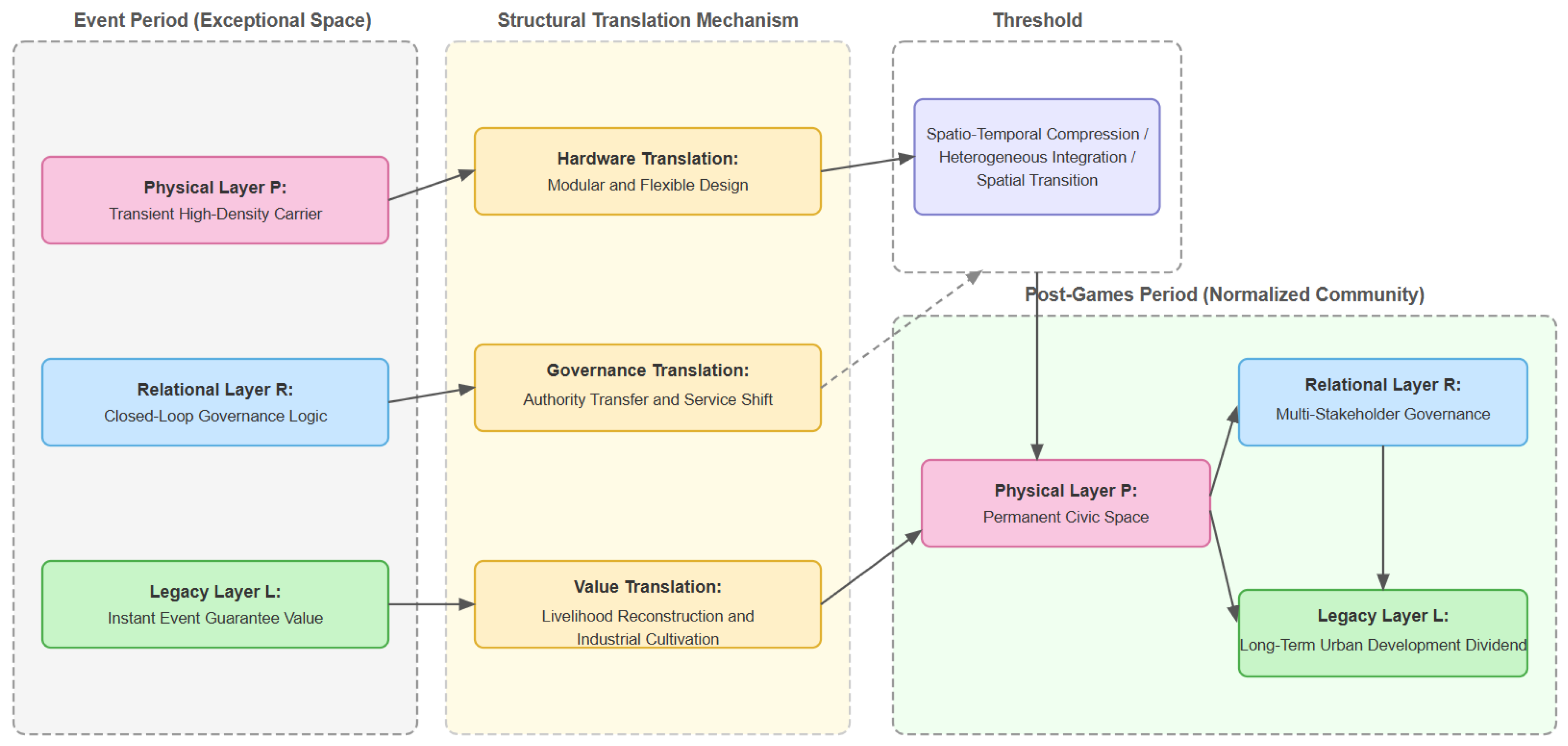

Table 1.
Distribution of Data Sources
| Type | Number | Percentage |
|---|---|---|
| Official reports (bid documents, post-Games reports, legacy reports, etc.) | 12 | 30% |
| Olympic Village guides (operational manuals, technical standards, etc.) | 8 | 20% |
| Authoritative news coverage (full-cycle tracking reports) | 20 | 50% |
| Total | 40 | 100% |
Table 2.
Formation Process of Selected Initial Categories (Opening coding)
| Initial Category | Initial Concept | Representative Original Statement |
|---|---|---|
| Short-cycle construction | Compressed construction timeline | “The 330,000 m2 Paris Olympic Village was completed in just six years, far exceeding the pace of conventional construction.” |
| Modular building | Demountable components | “The Beijing 2022 Olympic Village adopted a prefabricated steel structure system, allowing rapid reconfiguration of interior layouts after the Games.” |
| Closed-loop spatial management | Epidemic prevention and control | “The Tokyo Olympic Village implemented strict closed-loop pandemic management to ensure the safe staging of the Games.” |
| Diversified living services | Catering services | “The Olympic Village offered more than 200 types of dishes to meet the dietary needs of athletes from different countries.” |
| Spatial functional regeneration | Conversion to residential use | “After the Games, the London Olympic Village was converted into 2,818 residential units, becoming a new community hub in East London.” |
Table 3.
Correspondence between Main Categories and Initial Categories (Axial coding)
| Layer | Main Category | Initial Categories | Definition |
|---|---|---|---|
| Physical | Elastic Space Reservation for Games-time Operations | Functional zoning design, elastic infrastructure, modular construction, green building technologies, spatial transformation flexibility | Refers to the physical hardware foundation constructed to withstand the extreme spatiotemporal pressures of the Games period. It emphasizes modular and reversible design to meet the high-intensity operational demands during the event while embedding a “genetic code” for spatial conversion, ensuring that hardware facilities can be translated into permanent urban functions at low cost and high efficiency. |
| Multi-stakeholder Collaborative Hardware Delivery | Multi-stakeholder coordination mechanisms, high-standard planning, compressed construction cycles, quality control systems, cost and risk management | Refers to the complex engineering delivery achieved through cross-departmental and cross-hierarchical organizational coordination under strict time constraints and quality standards. It reflects the deep integration of government bodies, organizing committees, and market actors in planning, construction, and risk control, providing institutional guarantees for the structural transition from temporary to permanent community. | |
| Relational | “Dual-scenario” Rule Flexibility and Translation | Closed-loop spatial management, tiered access control, emergency response systems, cross-departmental linkage mechanisms, dynamic data scheduling | Refers to a flexible governance logic capable of simultaneously accommodating “extreme Games-time pressure” and “post-Games routine operation.” Through dynamic rule adjustment and elastic institutional design, it enables a smooth transition from closed security control to open community governance, serving as the core intermediary for spatial activation and functional conversion. |
| Soft Activation of Service Networks | Diversified living services, smart support systems, public exchange spaces, culturally adaptive services, professional support teams | Refers to the relational network composed of service interfaces, smart platforms, and professional teams. It emphasizes the functional translation of service spaces from “athlete-centered” to “citizen life-centered,” activating static physical spaces through soft service integration and constructing the social bonds connecting transient residents with permanent citizens. | |
| Legacy | Spatial Socialization and Civic Transition | Spatial function restructuring, public service improvement, transportation system integration, governance handover, community identity building | Refers to the output effect through which temporary community structures ultimately consolidate into permanent urban units. It manifests as the social integration of physical spaces, the civic enrichment of public service systems, and the establishment of community identity, marking the completion of the structural transition from “athletes’ village” to “citizens’ community.” |
| Games Legacy and Industrial Value Amplification | Commercial use conversion, industry linkage development, employment creation, regional brand enhancement, sustained | Refers to the long-term economic dividends catalyzed by major sports events as an “urban lever.” Through the secondary development of commercial spaces and the cultivation of industrial clusters, it converts the brand prestige of the Games period into economic momentum for regional development, achieving a value transition from “event spectacle” to “industrial hub.” | |
| Resilience Sedimentation under Extreme Pressure | Pressure Emergency system institutionalization, data platform reuse, governance experience transfer, enhanced response capacity, public service optimization | Refers to the governance resilience legacy generated through the stress-testing of extreme Games-time pressures. By institutionalizing emergency protocols, normalizing the reuse of smart platforms, and transferring governance experience across departments, it converts transient emergency response capacity into the city’s long-term resilience governance capital. |
Disclaimer/Publisher’s Note: The statements, opinions and data contained in all publications are solely those of the individual author(s) and contributor(s) and not of MDPI and/or the editor(s). MDPI and/or the editor(s) disclaim responsibility for any injury to people or property resulting from any ideas, methods, instructions or products referred to in the content. |
© 2026 by the authors. Licensee MDPI, Basel, Switzerland. This article is an open access article distributed under the terms and conditions of the Creative Commons Attribution (CC BY) license (http://creativecommons.org/licenses/by/4.0/).
Copyright: This open access article is published under a Creative Commons CC BY 4.0 license, which permit the free download, distribution, and reuse, provided that the author and preprint are cited in any reuse.