

Submitted:
13 May 2026
Posted:
15 May 2026
You are already at the latest version
Abstract
Background/Objective: Vitamin K (VK) comprises a family of quinone compounds with potential involvement in cell death-related pathways through their redox properties. However, consistent findings have not been obtained regarding the clinical significance of VK in breast cancer (BC). Thus, we used the FDA Adverse Event Reporting System (FAERS) to examine the co-reporting patterns of BC-related adverse-event terms among VK-related reports. Methods: Reporting disproportionality analysis was conducted using FAERS data spanning the first quarter of 2004 to the third quarter of 2024. BC-related reports were defined using all valid Preferred Terms included in the relevant narrow-scope Standardized MedDRA Query (SMQ). Reporting odds ratios (RORs) and proportional reporting ratios were calculated for all VK types and each homolog, followed by exploratory comparisons with other compounds containing quinone structures. Results: In total, 32,156 VK-related reports were identified, including 136 BC-related reports. VK-related reports showed significantly lower reporting disproportionality for breast cancer-related reports (ROR = 0.486, 95% confidence interval = 0.411–0.575). In homolog-specific analyses, similar trends were observed for the quinone-type homologs phytomenadione, menatetrenone, and menadione, whereas no significant reporting disproportionality was detected for the hydroquinone-type homolog menadiol. Conclusions: The differences in reporting patterns among quinone-type VK homologs, hydroquinone-type VK, and other quinone-containing compounds suggest that differences in redox properties may be partially related to the structure of reporting disproportionality. Although this study did not demonstrate causality or clinical efficacy, it provides a hypothesis-generating basis for linking basic, epidemiological, and clinical research using FAERS data. Future validation through mechanistic research and analytical epidemiological studies with stricter control of confounding is warranted.
Keywords:
breast cancer
; vitamin K
; quinone
; FAERS
; reporting disproportionality
1. Introduction
Vitamin K (VK) comprises a family of fat-soluble compounds with a quinone structure based on a 2-methyl-1,4-naphthoquinone core. According to differences in the side chain at the 3-position, VK is classified into phytomenadione (VK1), microbially derived menaquinone (VK2), and the synthetic side chain-free form of menadione (VK3) [1,2]. Because these VK homologs share a naphthoquinone core, their ability to exhibit distinct redox behavior depending on the reduction pathway is considered an important factor influencing the diversity of their physiological and pharmacological actions.
Classically, VK functions as an essential cofactor in the gamma-carboxylation of blood coagulation factors, a component of the canonical vitamin K cycle [3]. Under physiological conditions in this pathway, VK functions as the two-electron-reduced hydroquinone form, which is not considered to involve reactive oxygen species (ROS) production. Recently, VK has been reported to function as an antioxidant that suppresses lipid peroxidation through an NAD(P)H-dependent reduction pathway mediated by ferroptosis suppressor protein 1 (FSP1) [4]. This pathway also converts VK to its hydroquinone form via two-electron reduction, and it is considered to function in a cytoprotective manner because it does not generate ROS.
Conversely, VK homologs differ in their redox behavior and ROS-generating capacity. In particular, VK3, which lacks a side chain, is readily subjected to one-electron reduction mediated by enzymes such as NADPH-cytochrome P450 reductase. The resulting semiquinone radical continuously generates ROS through redox cycling [5,6]. This ROS production can lead to strong antitumor activity through mitochondrial dysfunction and apoptosis induction. However, VK3 also exhibits nonselective cytotoxicity toward normal cells, making it unsuitable for clinical application despite its anticipated antitumor effects [5,6].
Based on these considerations, VK2 homologs, particularly menatetrenone (MK-4), have received extensive basic research attention from the perspectives of relative safety and pharmacological characteristics [5,7]. For example, in hematologic cancer models using HL-60 cells, multiple reports indicated that MK-4 exerts antitumor effects through ROS-dependent apoptosis induction [8,9]. Contrarily, in models using the breast cancer (BC)-derived solid tumor cell line MDA-MB-231, MK-4 induced distinct cellular responses from those observed in hematologic cancers, and nonapoptotic cell death accompanied by autophagy induction has been observed [10].
ROS are major upstream factors that induce apoptosis through mitochondrial dysfunction and caspase activation. However, ROS can also activate autophagic pathways as an oxidative stress response, and the balance between cell survival and cell death is believed to depend on the amount and duration of ROS production and the cellular background [5,6,10]. These findings suggest that the antitumor effects of VK2 could diverge into different cell death modalities depending on the cancer type and cellular context. Nevertheless, epidemiological studies assessing dietary VK intake have not yielded consistent findings for BC, including differences among homologs. Prospective studies have identified associations between VK2 intake and BC incidence or mortality, but the direction of these associations has been inconsistent across studies. In addition, case–control studies have suggested inverse associations between the index of nutritional quality for VK and BC [11,12,13]. This discrepancy might involve redox properties arising from the quinone structure of VK, pharmacological differences among homologs, and differences in relevant conditions in actual clinical practice.
Analyses based on the FDA Adverse Event Reporting System (FAERS) database, in addition to detecting adverse-event signals, have identified specific drugs or compounds with relatively low reporting distributions for specific disease-related adverse-event terms (reporting odds ratio [ROR] <1). These distributions have been used as a basis for the multifaceted evaluation of drug–disease relationships by comparing them with mechanistic findings suggested by existing basic research [14,15]. In oncology, report distribution analyses based on FAERS and similar databases have been conducted for sodium channel-blocking antiepileptic drugs and multiple cancer types [16], as well as digoxin in gastrointestinal cancers and hematologic malignancies [17]. Similar investigations have also been performed in multiple sclerosis (MS) for antidiabetic drugs [18] and bile acids [19]. A common feature of these reports is that the reporting-distribution characteristic of ROR <1 in FAERS is positioned as a hypothesis-generating observation regarding the drug–disease relationship by comparison with mechanistic findings established in basic research.
Concerning VK homologs, MK-4 has already been reported to induce nonapoptotic cell death accompanied by autophagy induction in MDA-MB-231 BC cells [10], and VK3 has been found to induce ROS-dependent cell death in BC cell lines (MCF-7 and MDA-MB-231) [20,21]. Given these basic research findings, examining the reporting distribution of VK-related reports and breast cancer-related reports in FAERS by homolog and structure can permit a comparative evaluation of clinical reporting data against an established basic research axis linking quinone structure, redox properties, and cellular responses.
The relationship between homolog-specific differences and clinical reporting patterns should be further explored to clarify the conflicting basic research results among VK homologs and inconsistent epidemiological findings on intake and incidence or mortality in BC. Therefore, this study conducted a hypothesis-generating analysis of the reporting disproportionality of breast cancer-related reports in FAERS, specifically focusing on VK-related reports. We also conducted homolog-specific analyses and exploratory comparisons with other quinone-containing compounds.
2. Results
2.1. Relationship Between VK-Related Reports and Breast Cancer-Related Reports
The chemical structures of the VK homologs analyzed in this study are presented in Figure 1. VK1, pooled menaquinones reported as “menaquinone” in FAERS (MK-n), MK-4, menaquinone-7 (MK-7), and VK3 all have quinone-type structures sharing a common 2-methyl-1,4-naphthoquinone core, differing only in the chain length and degree of unsaturation of the side chain. Conversely, menadiol (VK4) possesses a 2-methyl-1,4-naphthohydroquinone-type structure with hydroxyl groups at the 1- and 4-positions of the naphthalene ring, and it is the only homolog lacking carbonyl groups. The results of the analysis are presented in Table 1 and Figure 2.
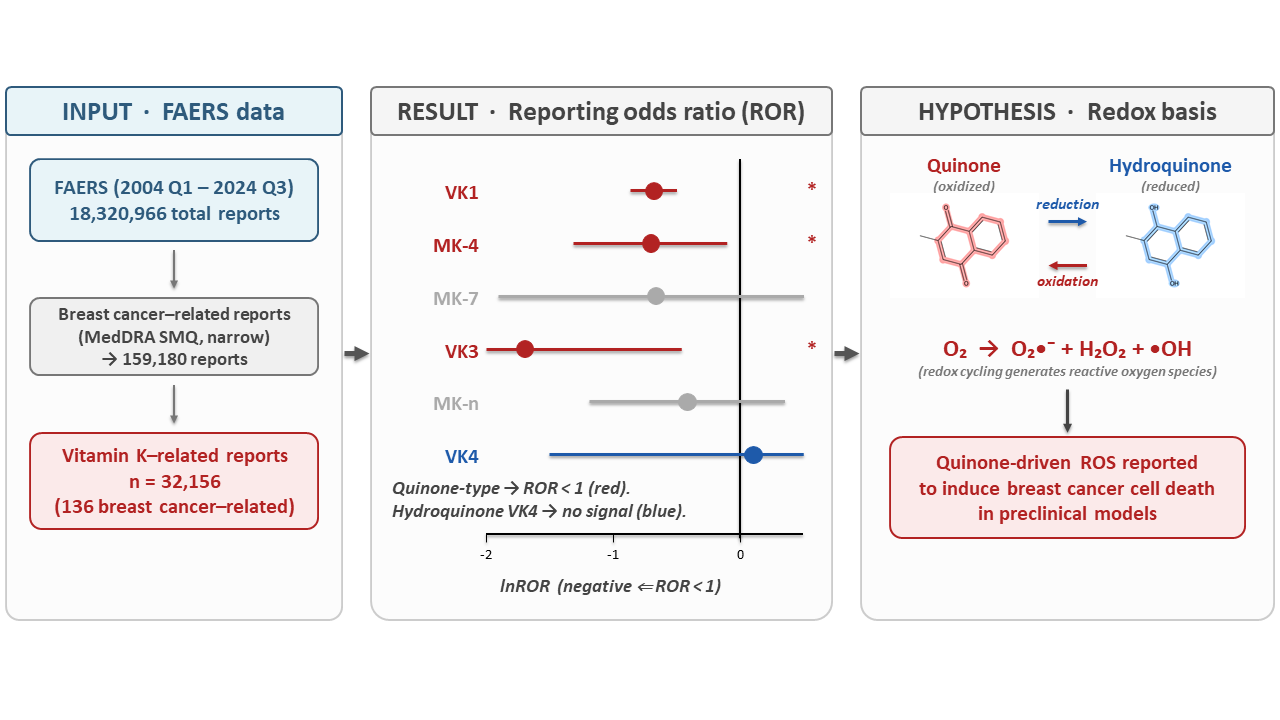
The total number of FAERS reports (2004 Q1–2024 Q3) was 18,320,966, including 159,180 breast cancer-related reports. VK-related reports totaled 32,156, of which 136 were related to BC.
Figure 1.
Chemical structures of VK homologs. (a) Quinone-type VK homologs share a common 2-methyl-1,4-naphthoquinone core (highlighted in red), with structural variation limited to the side chain at the 3-position: VK3 lacks a side chain, VK1 carries a phytyl side chain, MK-4 features a tetraprenyl side chain, and MK-7 possesses a heptaprenyl side chain. (b) The hydroquinone-type homolog VK4 shares the methylated naphthalene scaffold but carries hydroxyl groups instead of carbonyl groups at the 1- and 4-positions (highlighted in blue), therefore lacking the carbonyl moieties required for redox cycling. (c) Schematic of the redox cycling between quinone (oxidized) and hydroquinone (reduced) forms. Reduction proceeds via two-electron transfer with two protons: reverse oxidation generates a semiquinone radical intermediate that can transfer an electron to molecular oxygen to produce superoxide (O2−) and downstream reactive oxygen species (H2O2, OH). Structures were drawn using RDKit (https://www.rdkit.org).
Figure 1.
Chemical structures of VK homologs. (a) Quinone-type VK homologs share a common 2-methyl-1,4-naphthoquinone core (highlighted in red), with structural variation limited to the side chain at the 3-position: VK3 lacks a side chain, VK1 carries a phytyl side chain, MK-4 features a tetraprenyl side chain, and MK-7 possesses a heptaprenyl side chain. (b) The hydroquinone-type homolog VK4 shares the methylated naphthalene scaffold but carries hydroxyl groups instead of carbonyl groups at the 1- and 4-positions (highlighted in blue), therefore lacking the carbonyl moieties required for redox cycling. (c) Schematic of the redox cycling between quinone (oxidized) and hydroquinone (reduced) forms. Reduction proceeds via two-electron transfer with two protons: reverse oxidation generates a semiquinone radical intermediate that can transfer an electron to molecular oxygen to produce superoxide (O2−) and downstream reactive oxygen species (H2O2, OH). Structures were drawn using RDKit (https://www.rdkit.org).
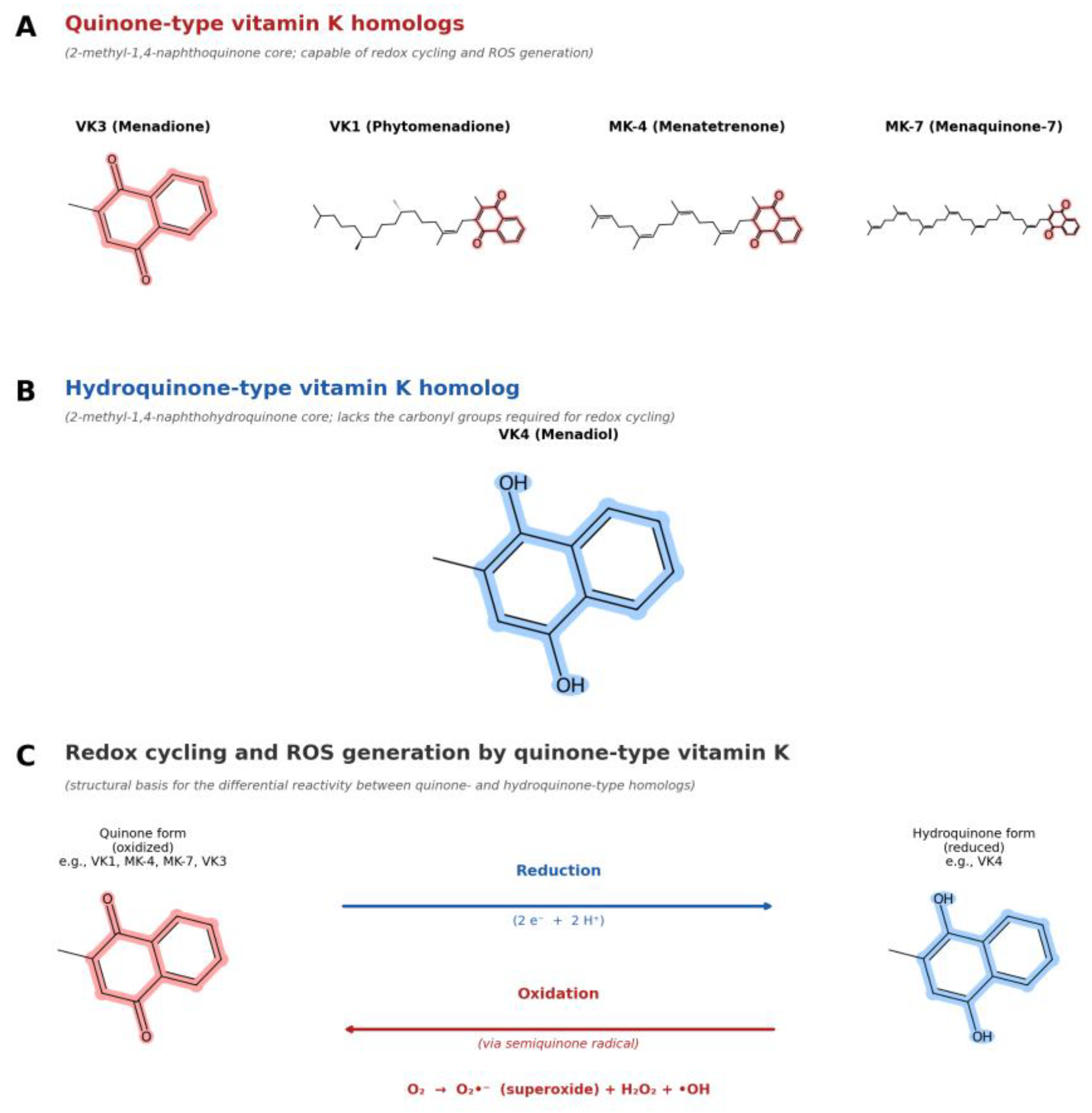

Table 1.
RORs and proportional reporting ratios (PRRs) for breast cancer-related reports across VK homologs in FAERS.
Table 1.
RORs and proportional reporting ratios (PRRs) for breast cancer-related reports across VK homologs in FAERS.
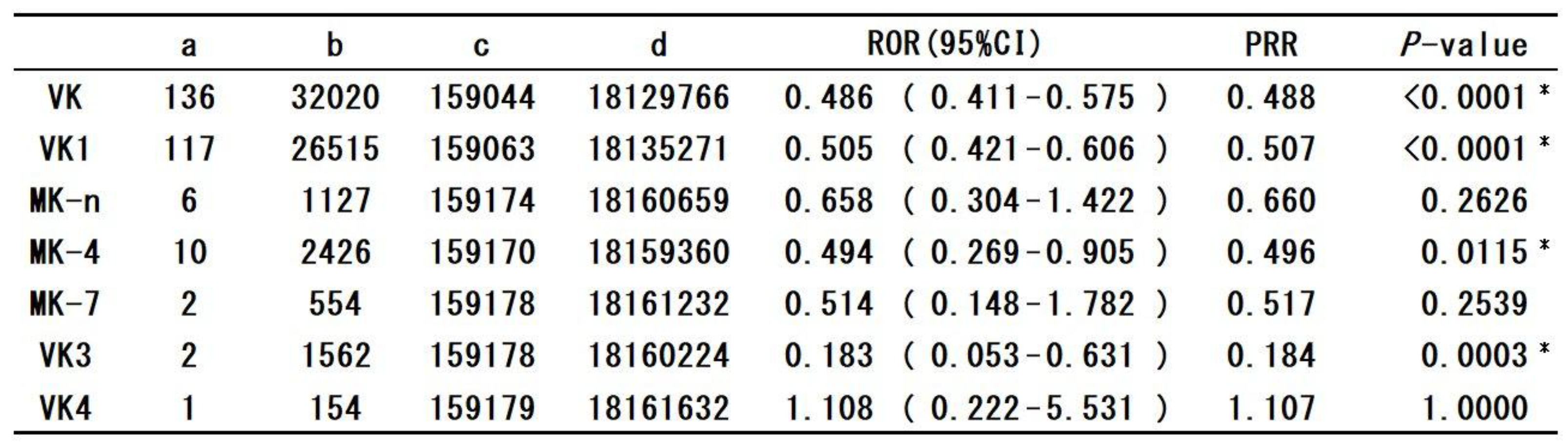
*Total number of reports: 18,320,966; number of breast cancer-related reports: 159,180. CI, confidence interval. *P < 0.05.
Figure 2.
Forest plot of lnROR with 95% confidence intervals for breast cancer-related reports across VK homologs in FAERS. Horizontal bars represent 95% confidence intervals, and the vertical line at lnROR = 0 corresponds to ROR = 1 (no reporting disproportionality).
Figure 2.
Forest plot of lnROR with 95% confidence intervals for breast cancer-related reports across VK homologs in FAERS. Horizontal bars represent 95% confidence intervals, and the vertical line at lnROR = 0 corresponds to ROR = 1 (no reporting disproportionality).
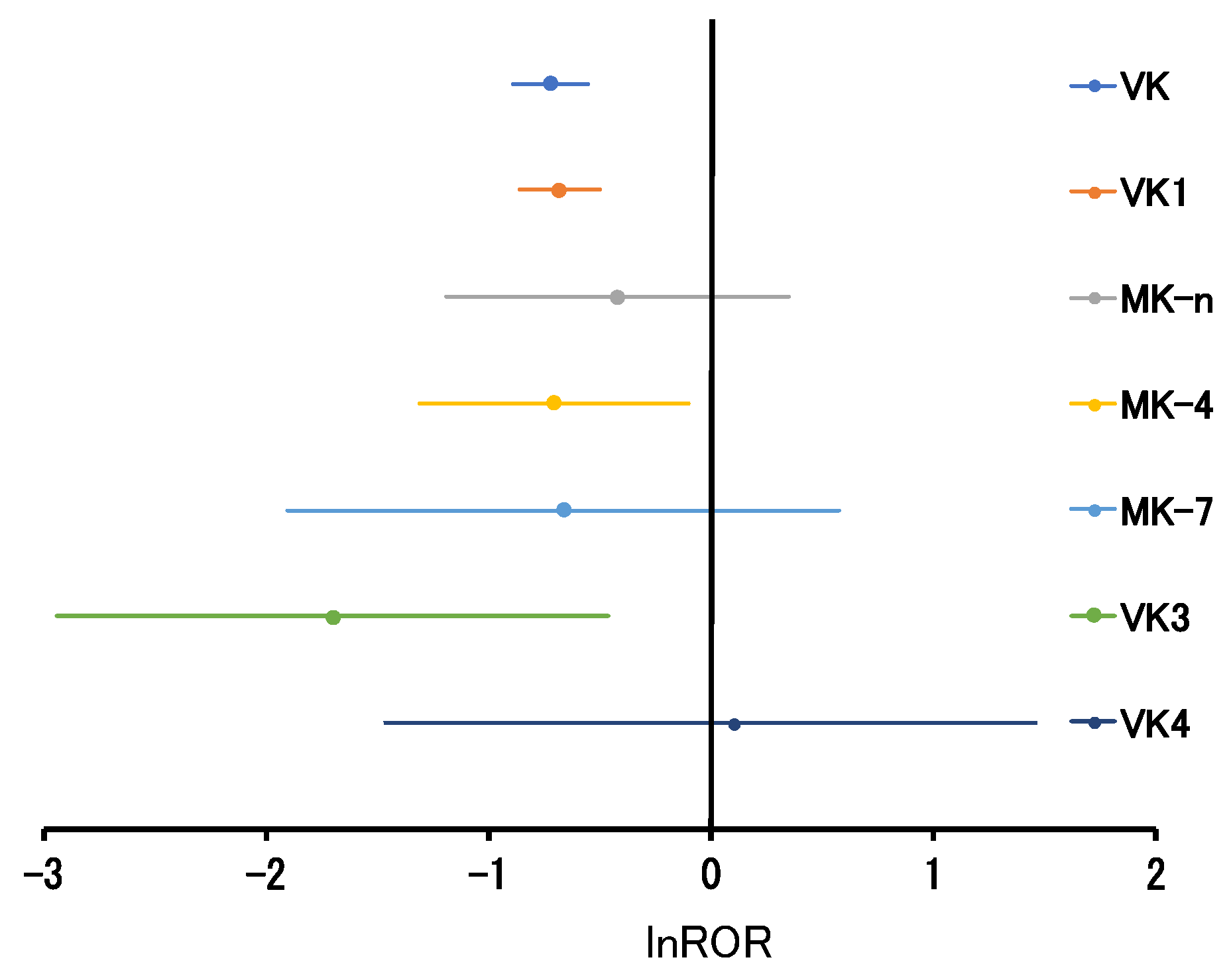
Among VK-related reports, 31,845 included a single homolog. Conversely, 311 reports included multiple homologs (two homologs, 302 reports; three homologs, nine reports), accounting for fewer than 1% of all VK-related reports. The 2 × 2 analysis indicated that VK-related reports exhibited significantly lower reporting disproportionality than breast cancer-related reports (ROR = 0.486, 95% confidence interval [CI] = 0.411–0.575, proportional reporting ratio [PRR] = 0.488, P < 0.0001).
2.1.1. Relationship Between VK1-Related Reports and Breast Cancer-Related Reports
In total, 26,632 reports were related to the quinone-type VK VK1, including 117 breast cancer-related reports. Significantly lower reporting disproportionality was observed between VK1-related reports and breast cancer-related reports (ROR = 0.505, 95% CI = 0.421–0.606, PRR = 0.507, P < 0.0001).
2.1.2. Relationship Between VK2 Homolog-Specific Reports and Breast Cancer-Related Reports
The quinone-type VK2 homologs identified in FAERS included MK-n, MK-4, and MK-7. In analyses by VK2 homolog, MK-n–related reports totaled 1133, including six breast cancer-related reports. Meanwhile, 2436 MK-4–related reports, including 10 breast cancer-related reports, and 556 MK-7–related reports, including two breast cancer-related reports, were identified. Among these reports, significantly lower reporting disproportionality was observed only for MK-4–related reports (ROR = 0.494, 95% CI = 0.269–0.905, PRR = 0.496, P = 0.015).
2.1.3. Relationship Between VK3-Related Reports and Breast Cancer-Related Reports
The number of reports related to VK3 was 1564, of which two were breast cancer-related reports. Significantly lower reporting disproportionality was observed between VK3-related reports and breast cancer-related reports (ROR = 0.183, 95% CI = 0.053–0.631, PRR = 0.184, P = 0.0003).
2.1.4. Relationship Between VK4-Related Reports and Breast Cancer-Related Reports
The number of reports related to VK4 reached 155, including one breast cancer-related report. No significant reporting disproportionality was observed between VK4-related reports and breast cancer-related reports (ROR = 1.108, 95% CI 0.222–5.531, PRR = 1.107).
2.2. Comparison of Quinone-Type VK with Other Quinone Compounds
Five quinone-type VK homologs were compared with 29 other compounds with quinone structures for reporting disproportionality for breast cancer-related reports using a volcano plot. Among the 34 analyzed compounds, 19 met the visualization criteria and were included in Figure 3. Components exhibiting relatively low reporting disproportionality for breast cancer-related reports included VK1, MK-4, and VK3, as well as daunorubicin (ROR = 0.031, 95% CI = 0.012–0.078, PRR = 0.031, P < 0.0001), idarubicin (ROR = 0.098, 95% CI = 0.045–0.211, PRR = 0.099, P < 0.0001), and ubidecarenone (CoQ10; ROR = 0.597, 95% CI = 0.520–0.685, PRR = 0.599, P < 0.0001; Figure 3). In the volcano plot, anthracycline agents used mainly to treat hematologic malignancies (daunorubicin and idarubicin) were located in the upper-left region, indicating that breast cancer-related reports were relatively sparse. Although aclarubicin displayed significance at P < 0.05, its 95% CI crossed 1, and the estimate was unstable.
3. Discussion
This study reported reporting-distribution patterns in FAERS, thus requiring careful interpretation. In FAERS, ROR <1 only indicates that reports related to the relevant disease were relatively less frequent in the drug-use reporting population. It does not directly indicate antitumor effects or risk reduction. At the same time, an analytical approach comparing reporting-distribution characteristics with mechanistic findings established in basic research has been used as a hypothesis-generating framework in previous studies, including oncology studies of sodium channel-blocking antiepileptic drugs [16] and digoxin [17], as well as MS studies of antidiabetic drugs [18] and bile acids [14,15,19]. The significant reporting disproportionality observed between VK-related reports and breast cancer-related reports in this study (ROR < 1) corresponds to previously reported preclinical findings directly involving BC, including MK-4–induced nonapoptotic cell death accompanied by autophagy induction in MDA-MB-231 cells [10] and VK3-induced ROS-dependent cell death in BC cells (MCF-7 and MDA-MB-231) [20,21]. These findings can be compared in a hypothesis-generating manner.
Using FAERS, this study examined the disproportionality of breast cancer-related reports among VK-related reports through comparative analyses, homolog-specific analyses, and exploratory comparisons with other compounds containing functional structures. A key feature of this study was its cross-sectional examination of correspondence with co-reporting patterns in clinical reporting data by comparing multiple components sharing a quinone structure. This provided a perspective for hypothesis generation concerning the relationship between chemical structures and clinical reporting distributions beyond the detection of reporting disproportionality for a single component.
As FAERS is a spontaneous reporting database, ROR <1 in this study only indicated that the reporting frequency of breast cancer-related PTs was relatively low among VK-related reports. It did not demonstrate antitumor efficacy or a reduction in BC risk. In addition, factors such as indications, concomitant medications, underlying diseases, cancer treatment history, supplement use, and reporter characteristics are not adequately controlled in this database, and reporting style or confounding by indication might have affected the results. Therefore, the reporting distributions observed in this study were organized as explanatory hypotheses while being compared with findings from existing basic and epidemiological research.
As a design-level response to confounding by indication, this study adopted a framework that, in addition to VK homolog-specific analyses, analyzed multiple quinone-containing compounds with markedly different clinical-use profiles in humans in parallel using the same method. For example, VK1 is used primarily to reverse anticoagulant effects and prevent neonatal VK deficiency bleeding, MK-4 is used mainly in Japan for postmenopausal osteoporosis in older women, whereas VK3 has limited clinical use in humans, daunorubicin and idarubicin are used mainly for hematologic malignancies such as acute myeloid leukemia, and CoQ10 is used as an adjunct for heart failure and as a dietary supplement. Thus, each compound has a distinct underlying population in terms of age distribution, sex distribution, medical care pathway, opportunities for observation, and contact with BC screening. If indication bias alone explained all observations in this study, large differences or directional inconsistencies in reporting-distribution patterns would be expected among compounds corresponding to these heterogeneous indication profiles. However, among the analyzed quinone-containing compounds, a broad trend toward relatively fewer breast cancer-related reports (ROR <1) was observed despite the heterogeneity of indications. This convergence across heterogeneous indications suggests the involvement of a cross-compound factor derived from quinone-related redox properties more than an explanation based solely on a single indication bias.
In addition, differences in directionality among the VK homologs provide evidence against an explanation based solely on indication bias. VK1, MK-4, and VK3 all possess quinone structures, and they are prescribed in VK-related clinical contexts, such as coagulation correction, bone metabolism, and nutritional supplementation. These homologs all displayed ROR <1 for breast cancer-related reports. Contrarily, no significant reporting disproportionality was observed for VK4, a VK homolog possessing a hydroquinone-type structure. Although VK4 is similar to other VK homologs regarding clinical-use context, the trend in reporting distribution differed according to chemical structure (quinone vs. hydroquinone). This is difficult to explain solely by differences in indication profiles, and it suggests the involvement of differences in redox properties derived from the chemical structure. Through two design features, namely convergence across quinone-containing compounds with heterogeneous indication profiles and the use of VK4 as an internal negative control within the VK homolog family, this study highlighted an observational structure suggesting that the observed reporting-distribution direction (ROR <1) might correspond, at least in part, to chemical-biological properties derived from the quinone structure. This does not completely exclude the contribution of indication bias, and future validation using sensitivity analyses by indication, reporter characteristics, and suspect drug role (e.g., analyses limited to primary suspect drugs) is needed.
Taken together, the results can be positioned as hypothesis-generating findings that might be consistent with differences in chemical structure and redox behavior previously demonstrated in basic research for VK homologs and related quinone-containing compounds. However, FAERS-based analyses are intended for hypothesis generation, and they cannot directly demonstrate causality. Future studies should integrate mechanistic research and validation under clinical conditions to examine the relationship between redox properties and cellular responses among compounds that share quinone structures.
3.1. Relationships Between VK-Related Reports and Breast Cancer-Related Reports
3.1.1. VK1
In this FAERS database analysis, VK1-related reports displayed significantly lower reporting disproportionality for breast cancer-related reports. From the perspective of reporting distribution in FAERS, this suggests that VK1-related reports include relatively fewer breast cancer-related reports.
Several basic studies have described the antitumor effects of VK1. In vitro research using a human gastric cancer cell line (HGC-27) and a colon cancer cell line (SW480) reported that VK1 suppressed cell proliferation and induce apoptosis [22], suggesting that VK1 can elicit direct cellular responses in specific cancer cells. Epidemiological studies have also identified associations between VK1 intake and cancer-related outcomes. A large prospective cohort study in Denmark observed a reduced risk of total cancer mortality in the group with high VK1 intake [23]. In addition, a randomized placebo-controlled trial of postmenopausal women (the ECKO trial) did not observe a significant difference for its primary endpoint, but secondary analyses reported a tendency toward fewer cancer cases in the VK1 group [24]. The reporting distribution of VK1-related reports observed in FAERS in the present study have some consistency with these epidemiological findings.
Conversely, conflicting basic research findings exist regarding the effects of VK1 on BC. In an in vitro study using triple-negative BC cells, Beaudin et al. reported that VK1 can promote cell proliferation and cancer stem cell-like properties, noting that VK1 induced different cellular responses from MK-4 [25]. Specifically, VK2 (MK-4) suppressed proliferation and metabolism, whereas VK1 exhibited contrasting behavior, emphasizing biological differences among VK homologs.
An important point in interpreting these conflicting findings is that VK1 can be converted to MK-4 in vivo. UbiA prenyltransferase domain-containing protein 1 (UBIAD1) is involved in the conversion of VK1-derived metabolites to MK-4, and it is expressed in multiple organs [26,27]. In addition, VK1 predominates in the blood, whereas MK-4 is the major homolog in tissues. Therefore, the reporting distribution observed for VK1-related reports in FAERS could reflect the effects of VK1 itself and those after conversion to MK-4 in vivo.
Overall, the relationship between VK1-related reports and breast cancer-related reports is not uniform, and behavior might differ depending on cellular background, metabolic conversion, and evaluation indices. The reporting distribution observed in FAERS in this study can be positioned as a hypothesis-generating finding for the integrated reinterpretation of existing basic and epidemiological studies. These results could help form hypotheses for future mechanistic validation and studies under clinical conditions. However, distributional differences in FAERS might reflect both the biological actions of homologs and differences in associated populations and use situations.
3.1.2. MK-4
In this study, MK-4–related reports exhibited significantly lower reporting disproportionality for breast cancer-related reports. From the perspective of reporting distribution in FAERS, this suggests that breast cancer-related reports may be relatively fewer among MK-4-related reports. Prior nonclinical studies provided important implications for interpreting the reporting distribution of MK-4–related reports. MK-4 has often been reported to induce cell death mainly via apoptosis in nonclinical studies using multiple cancer cell lines, including hematologic, lung, gastric, ovarian, and prostate cancers [8,28,29,30,31]. MK-4–induced apoptosis has been reported to occur through an ROS-dependent mitochondrial pathway, and ROS have been identified as important initiating factors [9,31].
Consistent with these findings, recent work in acute myeloid leukemia highlighted improved therapeutic responses when MK-4 was added to the standard drug combination of azacitidine and venetoclax. As a mechanism, this study uncovered a synergistic effect between MK-4–induced ROS production, which leads to apoptosis through the NOXA–MCL-1 pathway, and BCL-2 inhibition by venetoclax, suggesting that MK-4 could function as an adjuvant [9]. These findings should attract attention from the perspective of regulating cell death sensitivity through redox responses.
Several molecular mechanisms have been identified for the reporting distribution of MK-4–related reports. In addition to ROS production, MK-4–induced apoptosis has been linked to a molecular mechanism in which reactive intermediates generated in the vitamin K cycle covalently bind to the BCL-2 family protein Bak, thereby directly regulating mitochondrial outer membrane permeability [32]. This Bak modification is distinctive because it can promote apoptosis independently of the conventional caspase activation pathway, and this important finding supports, at the molecular level, antitumor effects based on the quinone structure of MK-4. Thus, MK-4 could amplify cell death signals through complementary mechanisms: formation of an oxidative stress environment through ROS and regulation of mitochondrial membranes via Bak.
Conversely, when the apoptotic pathway is defective or modified, MK-4 does not necessarily induce typical apoptosis. For example, MK-4–induced apoptosis was not observed in a BCL-2–overexpressing HL-60 cell model; instead, autophagy-mediated cell death was detected [33]. This indicates that the antitumor action of MK-4 does not depend on a single cell death pathway, as it can diverge into different cellular responses according to the molecular background of tumor cells.
MK-4 has been observed to induce nonapoptotic cell death accompanied by autophagy induction in triple-negative BC cell lines, such as MDA-MB-231 and MDA-MB-468. Furthermore, ROS have been suggested to function as important initiating factors upstream of this cell death process, indicating that the antitumor effects of MK-4 in BC models could be closely related to redox responses [10]. This finding is similar to the observation that MK-4 induced autophagy-mediated cell death in a hematologic cancer model (HL-60) with high BCL-2 expression and apoptotic pathway impairment, as previously described [10,33].
In hematologic cancer models, MK-4 has been reported to elicit differentiation induction as a cellular response distinct from cell death induction [34]. In particular, in HL-60 and NB4 cells, MK-4 treatment induced differentiation toward granulocytic or monocytic lineages, accompanied by reduced proliferative capacity and loss of the malignant phenotype. This differentiation-inducing effect can be considered a pathway that attenuates malignant properties through maturation and growth arrest and ultimately suppresses tumor growth through the physiological lifespan. However, such differentiation induction is observed mainly in highly undifferentiated hematologic cancer cells, and, as previously mentioned, cell death-related pathways are considered the principal mechanisms in solid cancers based on current evidence.
In addition to apoptosis induction through ROS-dependent mitochondrial pathways, MK-4 has been demonstrated to regulate cell-cycle control and drug sensitivity under specific tumor backgrounds or drug-combination conditions by suppressing NF-κB activity [35]. These actions do not necessarily directly induce cell death as their primary objective; rather, they might function as auxiliary pathways that mitigate tumor cell survival and resistance mechanisms [36]. Therefore, the current results mainly reflect redox responses based on the quinone structure and the associated involvement of cell death-related pathways.
Taken together, MK-4 might exert antitumor effects through multiple pathways depending on the tumor background, including ROS-dependent apoptosis and Bak-mediated mitochondrial membrane regulation as central axes, alongside autophagy induction and NF-κB suppression, against the backdrop of redox properties based on the quinone structure. The current finding that MK-4–related reports displayed significantly lower reporting disproportionality for breast cancer-related reports suggests that these multifaceted actions could be reflected in the clinical reporting distribution in FAERS.
3.1.3. VK3
VK3, which has a quinone structure, possesses stronger ability to promote ROS generation than other VK homologs. This characteristic is believed to arise from the fact that, compared with VK1 and VK2, VK3 is more readily incorporated into one-electron reduction pathways than into two-electron reduction pathways [5,6]. The semiquinone radical formed through one-electron reduction continuously generates ROS via redox cycling and induces apoptosis through mitochondrial dysfunction and caspase activation [5,6,37]. Quinone compounds have also been found to participate in ROS regulation through NADPH oxidase systems [38].
Indeed, in MCF-7 BC cells, VK3 induced apoptotic cell death via an ROS-dependent mitochondrial pathway [20]. The antitumor effects of VK3 have also been demonstrated in the human triple-negative BC cell line MDA-MB-231 and in a mouse subcutaneous xenograft model [21], and anticancer activity consistent with ROS-generating properties has been observed. However, the strong ROS-generating capacity of VK3 is accompanied by insufficient selectivity for cancer cells, as VK3 can also induce ROS-dependent cellular damage in normal cells. For example, in pancreatic acinar cells, VK3 induces apoptosis via ROS production through redox cycling [6]. Hepatotoxicity mediated by ROS production, glutathione depletion, and disruption of calcium homeostasis has also been reported in hepatocytes [37], and such normal tissue injury has substantially limited the clinical application of VK3.
In addition, when used in combination with agents such as ascorbic acid, VK3 participates in ROS-dependent autophagic responses, and its effects are not uniform. In U251 human glioblastoma cells, VK3 treatment induces ROS-dependent autophagy, which acts mainly in a cytoprotective manner. However, when ROS generation becomes excessive in combination with ascorbic acid, autophagy transforms into a cytotoxic process [39]. Similarly, in PC3 prostate cancer cells, autophagy induced by VK3 plus ascorbic acid contributes to cell survival, whereas inhibition of this autophagy by alpha-tocopheryl succinate induces cell death [40].
These findings indicate that VK3-induced autophagy has both cytoprotective and cytotoxic effects, and its behavior depends strongly on ROS levels, the cellular background, and concomitant drug use. Such duality of autophagy also exists in BC, and this finding is important for interpreting the findings of the present study. Furthermore, VK3-induced cell death mainly occurs as apoptosis mediated by mitochondrial dysfunction and caspase activation in response to strong ROS generation. However, under conditions such as disruption of the ROS environment, apoptosis-independent cell death pathways, including nonapoptotic cell death mediated by PARP activation, could also be involved [41]. Basic studies on VK3 derivatives have also been reported [42,43], but their clinical significance requires further investigation.
In this study, VK3-related reports exhibited relatively low reporting disproportionality for breast cancer-related reports, similarly as VK1 and VK2. This result suggests that VK3 could exhibit significantly lower reporting disproportionality with breast cancer-related reports, even in clinical reporting data. However, because VK3 has strong ROS-generating capacity, it is possible that in addition to antitumor activity, toxicity, differences in associated conditions, and the reporting structure resulting from restricted clinical use might have been reflected in the reporting disproportionality.
In this regard, although VK3 displayed relatively low reporting disproportionality, the clinical interpretation and applicability differ markedly from those of VK1 and VK2. The relatively low reporting disproportionality commonly observed among homologs could reflect a shared basis of ROS production derived from the quinone structure, whereas for VK3, uncontrollable ROS production could constrain clinical application. This is an important perspective for understanding qualitative differences in the meaning of relatively low reporting disproportionality among VK homologs.
Thus, the relatively low reporting disproportionality observed for VK3 might be consistent with existing nonclinical findings of ROS production based on the quinone structure, and this result could have been influenced by factors such as toxicity and restrictions on clinical use. The present findings can be positioned as hypothesis-generating observations, suggesting that both redox properties and clinical-use background should be considered when interpreting reporting distributions commonly observed among homologs.
3.1.4. VK4
In homolog-specific analyses, quinone-type VKs (VK1, VK2 [MK-n, MK-4, MK-7], and VK3) all displayed ROR <1 for breast cancer-related reports. In particular, VK1, MK-4, and VK3 exhibited relatively low reporting disproportionality with breast cancer-related reports (P < 0.05). Conversely, no significant reporting disproportionality was observed for VK4. As a hydroquinone-type compound, VK4 does not possess a structure that directly drives redox cycling, unlike quinone-type homologs. Therefore, its association with ROS-dependent mechanisms could be limited [1,3]. In this study, VK4 did not exhibit significant reporting disproportionality, but the differences in trends observed among homologs could reflect differences in chemical structure and redox properties.
3.2. Comparative Examination of Quinone-Type VK and Other Quinone Compounds
In an exploratory comparison of 34 drugs extracted comprehensively through substructure searches for quinone structures among all drugs recorded in FAERS, related reports displaying relatively low reporting disproportionality for breast cancer-related reports involved six components: the VK homologs VK1, MK-4, and VK3; the hematologic drugs daunorubicin and idarubicin; and CoQ10. In this study, we focused on the quinone structure shared by these agents and compared them in light of their pharmacological backgrounds and clinical-use contexts.
3.2.1. Anthracycline Quinone Compounds
Daunorubicin and idarubicin are both anthracycline anticancer agents with quinone structures, and both agents induce ROS production associated with redox reactions. In leukemia cell lines, these agents have been demonstrated to participate in cell death-related pathways, including apoptosis induction and autophagy. Despite their strong antitumor effects, serious adverse effects, such as cardiotoxicity, are clinical constraints [44,45,46,47].
3.2.2. CoQ10
CoQ10, possesses a quinone structure similarly as VK homologs and anthracycline agents, but its physiological role differs substantially. Specifically, CoQ10 differs from other quinone compounds in that direct cell death induction is not its main action. CoQ10 functions primarily as a cytoprotective redox molecule involved in the suppression of lipid peroxidation and ferroptosis through the FSP1-CoQ10H2 pathway, contributing to cell membrane stabilization and mitochondrial function maintenance [48,49]. Therefore, CoQ10 is generally considered a cytoprotective redox-buffering molecule.
The current finding that CoQ10-related reports exhibited relatively low reporting disproportionality for breast cancer-related reports could reflect indirect effects mediated by modification of the tumor–host environment. For example, clinical intervention studies have reported the usefulness of CoQ10 as an adjunct for reducing cardiotoxicity associated with anticancer therapy, particularly anthracyclines, consistent with its physiological actions [50].
Recently, CoQ10 was reported to regulate the mechanical properties of tumor cells and extracellular matrix signaling through UBIAD1 and modulate ferroptosis sensitivity [51]. However, the clinical significance of this finding requires further investigation.
Although CoQ10 is a quinone-containing compound, its mode of action differs markedly from that of quinone-type VK homologs. Clinically used quinone-type VK homologs, particularly MK-4, can be incorporated into two-electron reduction pathways under physiological conditions, whereas under conditions of disrupted redox homeostasis, they might diverge into cell death pathways through redox reactions or ROS signaling. By contrast, CoQ10 is clearly distinguished by its primary function as a cytoprotective redox-buffering molecule based on the suppression of lipid peroxidation.
Therefore, even among compounds sharing the same quinone structure, the implications of the relatively low reporting disproportionality observed in FAERS are not necessarily identical between compounds that drive ROS production, thus inducing cell death (e.g., some anthracycline agents, VK3), and compounds that function mainly in a cytoprotective manner through mechanisms such as lipid peroxidation suppression (e.g., CoQ10). The relatively low reporting disproportionality observed in this study could be the aggregate result of multiple biological responses and reporting structures against the background of differences in the direction and controllability of redox responses based on quinone structures.
3.3. Clinical Significance of Quinone-Type VK Homologs
Compared with other compounds possessing the same quinone structure, VK homologs are distinctive in that they can safely function through two-electron reduction pathways under physiological conditions [1,2,3], unlike anthracycline agents, which primarily induce strong and uncontrollable ROS production, or CoQ10, which functions mainly in a cytoprotective manner. This point is important when considering the clinical background of the relatively low reporting disproportionality for breast cancer-related reports observed for quinone-type VK-related reports in this study.
3.4. Positioning as a Hypothesis-Generating Study
Based on the aforementioned mechanistic considerations, the findings of this study should be interpreted as hypothesis-generating. This study does not deny the possibility that components other than VK among the quinone-containing components could also have roles under condition-dependent circumstances or in combination therapies. Future studies should conduct mechanistic validation and additional evaluations under clinical conditions while considering differences in modes of action among compounds that share quinone structures.
3.5. Limitations
This study had several limitations. First, as a spontaneous reporting database, FAERS includes inherent reporting biases such as underreporting, selective reporting, and effects of reporting media. Therefore, the ROR and PRR data calculated in this study do not directly reflect incidence or risk in the relevant populations; instead, they are signal indices based on the reporting structure.
Second, FAERS does not provide sufficient clinical information on dose, the duration of treatment, treatment adherence, indications, concomitant medications, underlying diseases, or disease severity. Therefore, it is difficult to fully adjust for confounding by indication or the effects of concomitant drugs. In addition, some reports included multiple VK homologs, making it impossible to completely separate the effects among homologs. Because the temporal relationship between administration and BC onset cannot be rigorously verified, causality cannot be inferred. Even when multiple drug names are recorded in a single FAERS report, this does not necessarily reflect actual concomitant use or administration relationships. Thus, the inclusion of multiple VK homologs in some reports do not imply combination therapy, and they could reflect duplicate entries or reporting style.
Third, although BC outcomes were defined using Standardized MedDRA Queries (SMQs; narrow scope), detailed clinical information, such as stage, molecular subtype, and diagnostic certainty, could not be obtained. Furthermore, for components with small numbers of reports, estimates could become unstable because of the influence of the 0.5 correction, and these results should be interpreted exploratory and hypothesis-generating. Because this was an exploratory analysis involving many components, the possibility of false-positive findings caused by multiple comparisons cannot be excluded.
4. Materials and Methods
4.1. Data Source and Construction of the Integrated Table
Analyses were conducted using public quarterly data from the FAERS database [52], which reports seven tables: DEMO, DRUG, REAC, OUTC, RPSR, INDI, and THER [52]. This study used data from the first quarter of 2004 through the third quarter of 2024. The DRUG and REAC tables were merged by PRIMARYID to construct an integrated table for analysis. To avoid overestimation in case counts, construction of the integrated table and removal of duplicate cases were performed in line with previous FAERS analyses [53,54].
4.2. Extraction of Quinone- and Hydroquinone-Containing Compounds
For drug names listed in the FAERS DRUG table, the PubChem database was searched using the Python library PubChemPy, and Simplified Molecular Input Line Entry System (SMILES) strings corresponding to each drug were obtained [55,56]. The obtained SMILES strings were imported into Molecular Operating Environment version 2022.02 (Chemical Computing Group, Montreal, Quebec, Canada), and substructure searches were performed using SMiles ARbitrary Target Specification (SMARTS) expressions [53,54,57].
Because SMILES representations of quinone structures vary depending on the treatment of aromaticity, multiple SMARTS expressions were used. Specifically, SMARTS expressions capable of detecting para-benzoquinone, para-benzoquinone-singleA, and para-benzoquinone-doubleA were used to extract quinone skeletons. To identify hydroquinone-type homologs, SMARTS expressions for hydroquinone were also used. Components matching any of these SMARTS expressions were extracted as candidate components, and generic names, structural formulas, alternative names, and duplicates were individually reviewed to determine the final components for analysis. The SMARTS expressions are listed in Supplementary Table S1.
The VK homologs analyzed in this study included VK1, MK-n, MK-4, MK-7, VK3, and VK4. In the exploratory compound comparison, in addition to the quinone-type VK homologs, 29 other components containing quinone skeletons were analyzed after a priori exclusion of doxorubicin and epirubicin, which are used as BC therapies. These 34 agents were analyzed using the same reporting disproportionality method. The 34 quinone-containing compounds extracted using these SMARTS queries are listed in Supplementary Table S2. VK4 was included in the homolog-specific analyses because it is a VK homolog, but it was excluded from the exploratory comparison among quinone-type compounds because it is a hydroquinone-type compound.
4.3. Definition of VK-Related and Breast Cancer-Related Reports
The unit of analysis in this study was the FAERS report unit PRIMARYID. When one or more names of a given component appeared within a PRIMARYID, the report was defined as related to that component. Therefore, this study did not distinguish between monotherapy and combination therapy. When multiple VK homologs or other drugs were listed in the same report, each component was dichotomized and analyzed separately. VK-related reports were defined as reports listing VK1, MK-n, MK-4, MK-7, VK3, and/or VK4. Homolog-specific analyses were then conducted for VK1-, MK-n–,MK-4–,MK-7–, VK3-, and VK4-related reports.
Breast cancer-related reports were defined using all valid Preferred Terms (PTs) included in the narrow scope of the lower-level SMQs “Breast malignant tumours” (20000198) and “Breast tumours of unspecified malignancy” (20000199), which belong to the SMQ “Breast neoplasms, malignant and unspecified” (20000149) [58,59]. The target PTs totaled 66 terms (Supplementary Table S3). Even when multiple such PTs were included within a single PRIMARYID, the report was counted as a breast cancer-related report only once.
4.4. Disproportionality Analysis
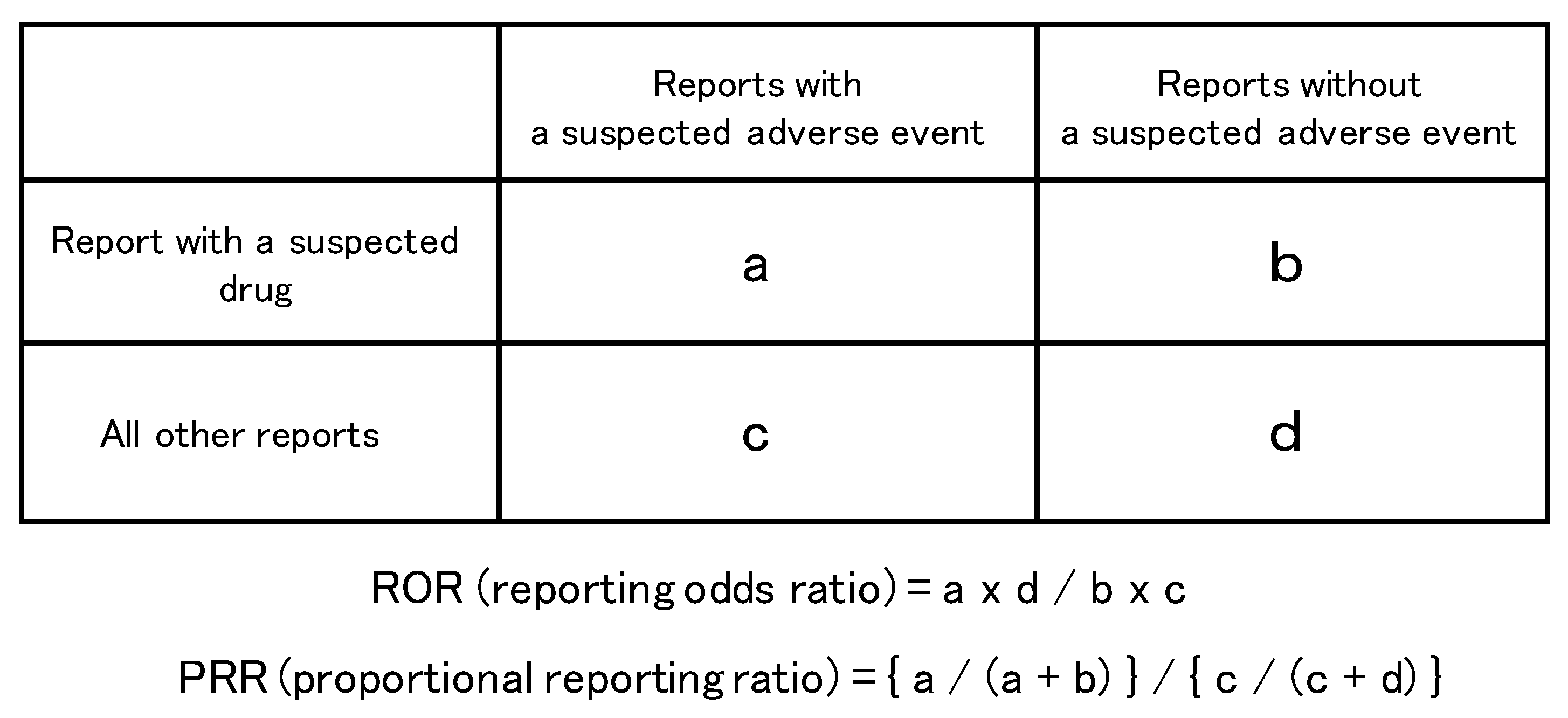
For each component analyzed, a 2 × 2 contingency table was constructed according to the presence or absence of breast cancer-related reports and the presence or absence of reports related to the component. Fisher’s exact test was performed, and the ROR with its 95% CI and the PRR were calculated. ROR was calculated as (a × d)/(b × c), and PRR was calculated as [a/(a + b)]/[c/(c + d)] (Figure 4). When any cell contained 0, Haldane–Anscombe correction was applied by adding 0.5 to all cells [60,61].
Significantly lower relative disproportionality was defined as meeting both Fisher’s exact test P < 0.05 and ROR < 1 with the upper limit of the 95% CI below 1. PRR was calculated as an auxiliary index to confirm directional consistency, and PRR <1 was reported as reference information. In addition, a volcano plot was generated for the 34 components, with lnROR presented on the x-axis and −log10(P-value) presented on the y-axis, to visualize the distribution of reporting disproportionality [62].
Figure 4.
Cross-tabulation and formula used to calculate the ROR and PRR for an adverse event. The table is organized with reports for the suspected drug, all other reports, reports with an adverse event, and reports without an adverse event (a–d represent the number of reports).
Figure 4.
Cross-tabulation and formula used to calculate the ROR and PRR for an adverse event. The table is organized with reports for the suspected drug, all other reports, reports with an adverse event, and reports without an adverse event (a–d represent the number of reports).
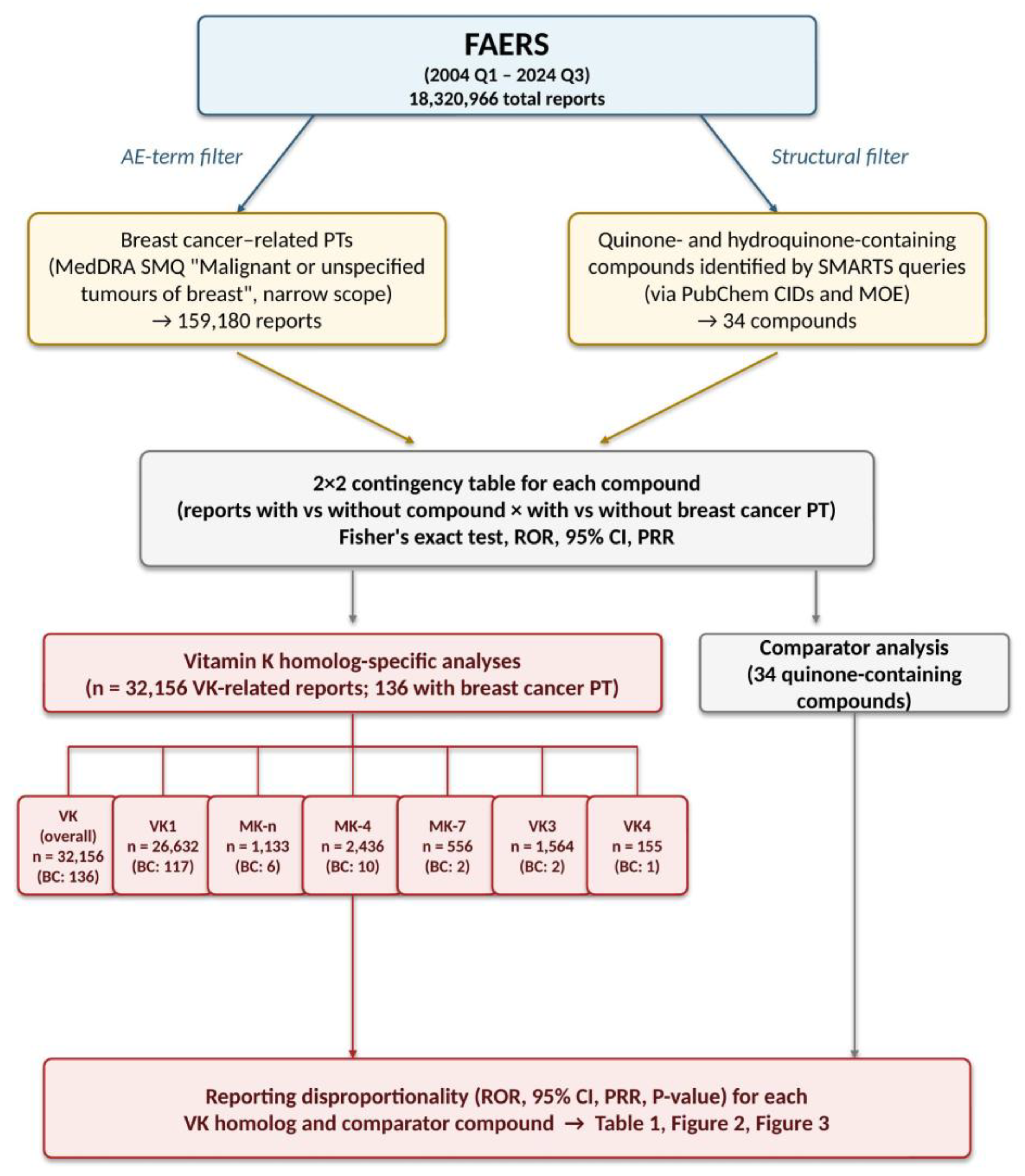
The overall analytical flow from data extraction to final reporting disproportionality analysis is presented in Figure 5. From the total FAERS reports, data extracted through two parallel pathways, an adverse-event term filter (MedDRA SMQ) and a compound-structure filter (SMARTS), were integrated. For each component, reporting disproportionality analysis was performed using a 2 × 2 contingency table, and results were derived in two analytical streams: VK homolog-specific analyses and comparative analyses with 34 quinone-containing compounds.
5. Conclusions
This study demonstrated that breast cancer-related terms were infrequently co-reported with VK-related reports in FAERS. These findings are hypothesis-generating, and they do not directly demonstrate causality, reduced breast cancer (BC) risk, or clinical efficacy. The results could reflect the influence of indications, patient background, concomitant drugs, use situations, reporting structure, and other factors. At the same time, these co-reporting patterns could be consistent with differences in redox behavior and cellular responses previously demonstrated in basic research for VK homologs and some quinone-containing compounds. Therefore, this study provides a basis for examining the relationship between the biological properties of quinone-containing compounds and clinical reporting data.
The differences in reporting distribution among VK homologs, particularly ROR <1 for quinone-type homologs and the absence of significant findings for VK4, might provide a basis for examining the relationship between the redox properties of the quinone structure and BC cellular responses when compared with preclinical findings for MK-4 in MDA-MB-231 BC cells [10] and the ROS-dependent antitumor effects of VK3 in BC cell models [20,21]. Future validation through mechanistic and analytical epidemiological studies with stricter control of confounding is warranted.
Supplementary Materials
The following supporting information can be downloaded at the website of this paper posted on Preprints.org.
Author Contributions
Conceptualization, S.M.; methodology, S.M. and Y.U.; software, S.M. and Y.U.; validation, S.M. and Y.U.; formal analysis, S.M.; investigation, S.M.; data curation, S.M. and Y.U.; visualization, S.M. and Y.U.; writing—original draft preparation, S.M.; writing—review and editing, S.M. and Y.U.; supervision, S.M.; project administration, S.M.; funding acquisition, S.M. All authors have read and agreed to the published version of the manuscript.
Informed Consent Statement
Patient consent was waived because this study used publicly available anonymized data from the FAERS database.
Data Availability Statement
The data analyzed in this study are publicly available from the FDA Adverse Event Reporting System.
Acknowledgments
During the preparation of this manuscript, the authors used Claude (Anthropic, https://claude.ai/, accessed in 2026) for the purpose of assisting in the generation of draft figures and a draft graphical abstract illustration. The authors reviewed, edited, and integrated the generated content and take full responsibility for the final content of this publication.:
Conflicts of Interest
The authors declare no conflicts of interest.
Abbreviations
The following abbreviations are used in this manuscript:
| BC | Breast cancer |
| MS | Multiple sclerosis |
| PRR | Proportional reporting ratio |
| PT | Preferred Terms |
| ROR | Reporting odds ratio |
| ROS | Reactive oxygen species |
| SMARTS | SMiles ARbitrary Target Specification |
| SMILES | Simplified Molecular Input Line Entry System |
References
- Shearer, M.J.; Newman, P. Metabolism and cell biology of vitamin K. Thromb. Haemost. 2008, 100, 530–547. [CrossRef]
- Vermeer, C. Vitamin K: The effect on health beyond coagulation: An overview. Food Nutr. Res. 2012, 56, 5329. [CrossRef]
- Stafford, D.W. The vitamin K cycle. J. Thromb. Haemost. 2005, 3, 1873–1878. [CrossRef]
- Mishima, E.; Ito, J.; Wu, Z.; Nakamura, T.; Wahida, A.; Doll, S.; Tonnus, W.; Nepachalovich, P.; Eggenhofer, E.; Aldrovandi, M.; Henkelmann, B.; Yamada, K.I.; Wanninger, J.; Zilka, O.; Sato, E.; Feederle, R.; Hass, D.; Maida, A.; Mourão, A.S.D.; Linkermann, A.; Geissler, E.K.; Nakagawa, K.; Abe, T.; Fedorova, M.; Proneth, B.; Pratt, D.A.; Conrad, M. A non-canonical vitamin K cycle is a potent ferroptosis suppressor. Nature 2022, 608, 778–783. [CrossRef]
- Ivanova, D.; Zhelev, Z.; Getsov, P.; Nikolova, B.; Aoki, I.; Higashi, T.; Bakalova, R.V. Vitamin K: Redox-modulation, prevention of mitochondrial dysfunction and anticancer effect. Redox Biol. 2018, 16, 352–358. [CrossRef]
- Criddle, D.N.; Gillies, S.; Baumgartner-Wilson, H.K.; Jaffar, M.; Chinje, E.C.; Passmore, S.; Chvanov, M.; Barrow, S.; Gerasimenko, O.V.; Tepikin, A.V.; Sutton, R.; Petersen, O.H. Menadione-induced reactive oxygen species generation via redox cycling promotes apoptosis of murine pancreatic acinar cells. J. Biol. Chem. 2006, 281, 40485–40492. [CrossRef]
- Kaźmierczak-Barańska, J.; Karwowski, B.T. Vitamin K contribution to DNA damage-advantage or disadvantage? A human health response. Nutrients 2022, 14, 4219. [CrossRef]
- Yaguchi, M.; Miyazawa, K.; Katagiri, T.; Nishimaki, J.; Kizaki, M.; Tohyama, K.; Toyama, K. Vitamin K2 and its derivatives induce apoptosis in leukemia cells and enhance the effect of all-trans retinoic acid. Leukemia 1997, 11, 779–787. [CrossRef]
- Tauchi, T.; Moriya, S.; Okabe, S.; Kazama, H.; Miyazawa, K.; Takano, N. Vitamin K2 sensitizes the efficacy of venetoclax in acute myeloid leukemia by targeting the NOXA-MCL-1 pathway. PLoS One 2024, 19, e0307662. [CrossRef]
- Miyazawa, S.; Moriya, S.; Kokuba, H.; Hino, H.; Takano, N.; Miyazawa, K. Vitamin K2 induces non-apoptotic cell death along with autophagosome formation in breast cancer cell lines. Breast Cancer 2020, 27, 225–235. [CrossRef]
- Nimptsch, K.; Rohrmann, S.; Kaaks, R.; Linseisen, J. Dietary vitamin K intake in relation to cancer incidence and mortality: Results from the Heidelberg cohort of the European Prospective Investigation into Cancer and Nutrition (EPIC-Heidelberg). Am. J. Clin. Nutr. 2010, 91, 1348–1358. [CrossRef]
- Wang, K.; Wu, Q.; Li, Z.; Reger, M.K.; Xiong, Y.; Zhong, G.; Li, Q.; Zhang, X.; Li, H.; Foukakis, T.; Xiang, T.; Zhang, J.; Ren, G. Vitamin K intake and breast cancer incidence and death: Results from a prospective cohort study. Clin. Nutr. 2021, 40, 3370–3378. [CrossRef]
- Behrad Nasab, M.; Afsharfar, M.; Ahmadzadeh, M.; Vahid, F.; Gholamalizadeh, M.; Abbastorki, S.; Davoodi, S.H.; Majidi, N.; Akbari, M.E.; Doaei, S. Comparison of the index of nutritional quality in breast cancer patients with healthy women. Front. Nutr. 2022, 9, 811827. [CrossRef]
- Morris, R.; Ali, Q.; Kavi, A.; Cheng, F. Drug repurposing using FDA adverse event reporting system (FAERS) database. Curr. Drug Targets 2024, 25, 454–464. [CrossRef]
- Böhm, R.; Bulin, C.; Waetzig, V.; Cascorbi, I.; Klein, H.J.; Herdegen, T. Pharmacovigilance-based drug repurposing: The search for inverse signals via OpenVigil identifies putative drugs against viral respiratory infections. Br. J. Clin. Pharmacol. 2021, 87, 4421–4431. [CrossRef]
- Takada, M.; Fujimoto, M.; Yamazaki, K.; Takamoto, M.; Hosomi, K. Inverse association between sodium channel-blocking antiepileptic drug use and cancer: Data mining of spontaneous reporting and claims databases. Int. J. Med. Sci. 2016, 13, 48–59. [CrossRef]
- Hosomi, K.; Fujimoto, M.; Ushio, K.; Mao, L.; Kato, J.; Takada, M. An integrative approach using real-world data to identify alternative therapeutic uses of existing drugs. PLoS One 2018, 13, e0204648. [CrossRef]
- Shirani, A.; Cross, A.H.; Stuve, O. Exploring the association between weight loss-inducing medications and multiple sclerosis: Insights from the FDA adverse event reporting system database. Ther. Adv. Neurol. Disord. 2024, 17, 17562864241241383. [CrossRef]
- Asada, M.; Aizawa, F.; Mikami, T.; Goda, M.; Sonoda, Y.; Niimura, T.; Zamami, Y.; Chuma, M.; Uesawa, Y.; Ishizawa, K. Bile acids as candidate therapies for multiple sclerosis: Inverse signal analysis using the FDA adverse event reporting system and preclinical validation. Mult. Scler. Relat. Disord. 2026, 109, 107113. [CrossRef]
- Akiyoshi, T.; Matzno, S.; Sakai, M.; Okamura, N.; Matsuyama, K. The potential of vitamin K3 as an anticancer agent against breast cancer that acts via the mitochondria-related apoptotic pathway. Cancer Chemother. Pharmacol. 2009, 65, 143–150. [CrossRef]
- Yamada, A.; Osada, S.; Tanahashi, T.; Matsui, S.; Sasaki, Y.; Tanaka, Y.; Okumura, N.; Matsuhashi, N.; Takahashi, T.; Yamaguchi, K.; Yoshida, K. Novel therapy for locally advanced triple-negative breast cancer. Int. J. Oncol. 2015, 47, 1266–1272. [CrossRef]
- Linsalata, M.; Orlando, A.; Tutino, V.; Notarnicola, M.; D’Attoma, B.; Russo, F. Inhibitory effect of vitamin K1 on growth and polyamine biosynthesis of human gastric and colon carcinoma cell lines. Int. J. Oncol. 2015, 47, 773–781. [CrossRef]
- Palmer, C.R.; Bellinge, J.W.; Dalgaard, F.; Sim, M.; Murray, K.; Connolly, E.; Blekkenhorst, L.C.; Bondonno, C.P.; Croft, K.D.; Gislason, G.; Tjønneland, A.; Overvad, K.; Schultz, C.; Lewis, J.R.; Hodgson, J.M.; Bondonno, N.P. Association between vitamin K1 intake and mortality in the Danish Diet, Cancer, and Health cohort. Eur. J. Epidemiol. 2021, 36, 629–639. [CrossRef]
- Cheung, A.M.; Tile, L.; Lee, Y.; Tomlinson, G.; Hawker, G.; Scher, J.; Hu, H.; Vieth, R.; Thompson, L.; Jamal, S.; Josse, R. Vitamin K supplementation in postmenopausal women with osteopenia (ECKO trial): A randomized controlled trial. PLoS Med. 2008, 5, e196. [CrossRef]
- Beaudin, S.G.; Kokabee, L.; Welsh, J. Differential effects of vitamin K1 and K2 on triple negative breast cancer cells. Oncotarget 2019, 10, 26765–26779. [CrossRef]
- Nakagawa, K.; Hirota, Y.; Sawada, N.; Yuge, N.; Watanabe, M.; Uchino, Y.; Okuda, N.; Shimomura, Y.; Suhara, Y.; Okano, T. Identification of UBIAD1 as a novel human menaquinone-4 biosynthetic enzyme. Nature 2010, 468, 117–121. [CrossRef]
- Okano, T.; Nakagawa, K.; Kamao, M. In vivo metabolism of vitamin K: In relation to the conversion of vitamin K1 to MK-4. Clin. Calcium 2009, 19, 1779–1787.
- Yoshida, T.; Miyazawa, K.; Kasuga, I.; Yokoyama, T.; Minemura, K.; Utsumi, K.; Aoshima, M.; Ohyashiki, K. Apoptosis induction of vitamin K2 in lung carcinoma cell lines: The possibility of vitamin K2 therapy for lung cancer. Int. J. Oncol. 2003, 23, 627–632. [CrossRef]
- Tokita, H.; Tsuchida, A.; Miyazawa, K.; Ohyashiki, K.; Katayanagi, S.; Sudo, H.; Enomoto, M.; Takagi, Y.; Aoki, T. Vitamin K2-induced antitumor effects via cell-cycle arrest and apoptosis in gastric cancer cell lines. Int. J. Mol. Med. 2006, 17, 235–243. [CrossRef]
- Shibayama-Imazu, T.; Fujisawa, Y.; Masuda, Y.; Aiuchi, T.; Nakajo, S.; Itabe, H.; Nakaya, K. Induction of apoptosis in PA-1 ovarian cancer cells by vitamin K2 is associated with an increase in the level of TR3/Nur77 and its accumulation in mitochondria and nuclei. J. Cancer Res. Clin. Oncol. 2008, 134, 803–812. [CrossRef]
- Duan, F.; Yu, Y.; Guan, R.; Xu, Z.; Liang, H.; Hong, L. Vitamin K2 induces mitochondria-related apoptosis in human bladder cancer cells via ROS and JNK/p38 MAPK signal pathways. PLoS One 2016, 11, e0161886. [CrossRef]
- Karasawa, S.; Azuma, M.; Kasama, T.; Sakamoto, S.; Kabe, Y.; Imai, T.; Yamaguchi, Y.; Miyazawa, K.; Handa, H. Vitamin K2 covalently binds to Bak and induces Bak-mediated apoptosis. Mol. Pharmacol. 2013, 83, 613–620. [CrossRef]
- Yokoyama, T.; Miyazawa, K.; Naito, M.; Toyotake, J.; Tauchi, T.; Itoh, M.; Yuo, A.; Hayashi, Y.; Georgescu, M.M.; Kondo, Y.; Kondo, S.; Ohyashiki, K. Vitamin K2 induces autophagy and apoptosis simultaneously in leukemia cells. Autophagy 2008, 4, 629–640. [CrossRef]
- Miyazawa, K.; Yaguchi, M.; Funato, K.; Gotoh, A.; Kawanishi, Y.; Nishizawa, Y.; Yuo, A.; Ohyashiki, K. Apoptosis/differentiation-inducing effects of vitamin K2 on HL-60 cells: Dichotomous nature of vitamin K2 in leukemia cells. Leukemia 2001, 15, 1111–1117. [CrossRef]
- Zhang, H.; Ozaki, I.; Hamajima, H.; Iwane, S.; Takahashi, H.; Kawaguchi, Y.; Eguchi, Y.; Yamamoto, K.; Mizuta, T. Vitamin K2 augments 5-fluorouracil-induced growth inhibition of human hepatocellular carcinoma cells by inhibiting NF-κB activation. Oncol. Rep. 2011, 25, 159–166. [CrossRef]
- Fan, X.V.; Chen, J.; Duan, L.; Li, S. Research progress on the anticancer effects of vitamin K2. Oncol. Lett. 2018, 15, 8926–8934. [CrossRef]
- Thor, H.; Smith, M.T.; Hartzell, P.; Bellomo, G.; Jewell, S.A.; Orrenius, S. The metabolism of menadione (2-methyl-1,4-naphthoquinone) by isolated hepatocytes: A study of the implications of oxidative stress in intact cells. J. Biol. Chem. 1982, 257, 12419–12425.
- Nguyen, M.V.C.; Lardy, B.; Rousset, F.; Hazane-Puch, F.; Zhang, L.; Trocmé, C.; Serrander, L.; Krause, K.-H.; Morel, F. Quinone compounds regulate the level of ROS production by the NADPH oxidase Nox4. Biochem. Pharmacol. 2013, 85, 1644–1654. [CrossRef]
- Despotović, A.; Mirčić, A.; Misirlić-Denčić, S.; Harhaji-Trajković, L.; Trajković, V.; Zogović, N. Combination of ascorbic acid and menadione induces cytotoxic autophagy in human glioblastoma cells. Oxid. Med. Cell. Longev. 2022, 2022, 2998132. [CrossRef]
- Tomasetti, M.; Nocchi, L.; Neuzil, J.; Goodwin, J.; Nguyen, M.; Dong, L.F. Alpha-tocopheryl succinate inhibits autophagic survival of prostate cancer cells induced by vitamin K3 and ascorbate to trigger cell death. PLoS One 2012, 7, e52263. [CrossRef]
- Loor, G.; Kondapalli, J.; Schriewer, J.M.; Chandel, N.S.; Vanden Hoek, T.L.; Schumacker, P.T. Menadione triggers cell death through ROS-dependent mechanisms involving PARP activation without requiring apoptosis. Free Radic. Biol. Med. 2010, 49, 1925–1936. [CrossRef]
- Bajor, M.; Graczyk-Jarzynka, A.; Marhelava, K.; Kurkowiak, M.; Rahman, A.; Aura, C.; Russell, N.; Zych, A.O.; Firczuk, M.; Winiarska, M.; Gallagher, W.M.; Zagozdzon, R. Triple combination of ascorbate, menadione and the inhibition of peroxiredoxin-1 produces synergistic cytotoxic effects in triple-negative breast cancer cells. Antioxidants 2020, 9, 320. [CrossRef]
- Yang, C.-R.; Liao, W.-S.; Wu, Y.-H.; Murugan, K.; Chen, C.; Chao, J.-I. CR108, a novel vitamin K3 derivative induces apoptosis and breast tumor inhibition by reactive oxygen species and mitochondrial dysfunction. Toxicol. Appl. Pharmacol. 2013, 273, 611–622. [CrossRef]
- Liu, F.T.; Agrawal, S.G.; Gribben, J.G.; Ye, H.; Du, M.Q.; Newland, A.C.; Jia, L. Liposomal encapsulation diminishes daunorubicin-induced generation of reactive oxygen species and necrotic cell death but enhances apoptosis in leukaemic cells. Br. J. Haematol. 2002, 117, 333–342. [CrossRef]
- Liu, F.-T.; Kelsey, S.M.; Newland, A.C.; Jia, L. Generation of reactive oxygen species is not involved in idarubicin-induced apoptosis in human leukaemic cells. Br. J. Haematol. 2001, 115, 817–825. [CrossRef]
- Han, W.; Sun, J.; Feng, L.; Wang, K.; Li, D.; Pan, Q.; Chen, Y.; Jin, W.; Wang, X.; Pan, H.; Jin, H. Autophagy inhibition enhances daunorubicin-induced apoptosis in K562 cells. PLoS One 2011, 6, e28491. [CrossRef]
- Ristic, B.; Bosnjak, M.; Arsikin, K.; Mircic, A.; Suzin-Zivkovic, V.; Bogdanovic, A.; Perovic, V.; Martinovic, T.; Kravic-Stevovic, T.; Bumbasirevic, V.; Trajkovic, V.; Harhaji-Trajkovic, L. Idarubicin induces mTOR-dependent cytotoxic autophagy in leukemic cells. Exp. Cell Res. 2014, 326, 90–102. [CrossRef]
- Doll, S.; Freitas, F.P.; Shah, R.; Aldrovandi, M.; da Silva, M.C.; Ingold, I.; Goya Grocin, A.; Xavier da Silva, T.N.; Panzilius, E.; Scheel, C.H.; Mourão, A.; Buday, K.; Sato, M.; Wanninger, J.; Vignane, T.; Mohana, V.; Rehberg, M.; Flatley, A.; Schepers, A.; Kurz, A.; White, D.; Sauer, M.; Sattler, M.; Tate, E.W.; Schmitz, W.; Schulze, A.; O’Donnell, V.; Proneth, B.; Popowicz, G.M.; Pratt, D.A.; Angeli, J.P.F.; Conrad, M. FSP1 is a glutathione-independent ferroptosis suppressor. Nature 2019, 575, 693–698. [CrossRef]
- Bersuker, K.; Hendricks, J.M.; Li, Z.; Magtanong, L.; Ford, B.; Tang, P.H.; Roberts, M.A.; Tong, B.; Maimone, T.J.; Zoncu, R.; Bassik, M.C.; Nomura, D.K.; Dixon, S.J.; Olzmann, J.A. The CoQ oxidoreductase FSP1 acts parallel to GPX4 to inhibit ferroptosis. Nature 2019, 575, 688–692. [CrossRef]
- l Qahtani, A.; Al Balawi, H.; Al Jowesim, F. Protective effect of coenzyme Q10 against doxorubicin-induced cardiotoxicity: Scoping review article. Saudi Pharm. J. 2024, 32, 101882. [CrossRef]
- Tosi, G.; Paoli, A.; Zuccolotto, G.; Turco, E.; Simonato, M.; Tosoni, D.; Tucci, F.; Lugato, P.; Giomo, M.; Elvassore, N.; Rosato, A.; Cogo, P.; Pece, S.; Santoro, M.M. Cancer cell stiffening via CoQ10 and UBIAD1 regulates ECM signaling and ferroptosis in breast cancer. Nat. Commun. 2024, 15, 8214. [CrossRef]
- FDA. Available online: https://www.fda.gov/drugs/drug-approvals-and-databases/fda-adverse-event-reporting-system-faers-database (accessed on 13 June 2025).
- Watanabe, A.; Uesawa, Y. Steroid-induced thrombosis: A comprehensive analysis using the FAERS database. Pharmaceuticals 2025, 18, 1463. [CrossRef]
- Yamada, S.; Uesawa, Y. Exploring adverse event associations of predicted PXR agonists using the FAERS database. Int. J. Mol. Sci. 2025, 26, 7630. [CrossRef]
- Swain, M. Available online: https://github.com/mcs07/pubchempy (accessed on 13 June 2025).
- Kim, S.; Thiessen, P.A.; Bolton, E.E.; Chen, J.; Fu, G.; Gindulyte, A.; Han, L.; He, J.; He, S.; Shoemaker, B.A.; Wang, J.; Yu, B.; Zhang, J.; Bryant, S.H. PubChem substance and compound databases. Nucleic Acids Res. 2016, 44, D1202–D1213. [CrossRef]
- Molecular Operating Environment. Available online: https://www.chemcomp.com/en/Products.htm (accessed on 2 September 2025).
- Introductory Guide for Standardised MedDRA Queries (SMQs) Version 27.1. Available online: https://www.jmo.pmrj.jp/download/2361 (accessed on 2 September 2025).
- Introductory Guide MedDRA Version 27.1. Available online: https://www.jmo.pmrj.jp/download/2360 (accessed on 2 September 2025).
- Haldane, J.B.S. The estimation and significance of the logarithm of a ratio of frequencies. Ann. Hum. Genet. 1956, 20, 309–311. [CrossRef]
- Anscombe, F.J. On estimating binomial response relations. Biometrika 1956, 43, 461–464. [CrossRef]
- Zink, R.C.; Wolfinger, R.D.; Mann, G. Summarizing the incidence of adverse events using volcano plots and time intervals. Clin. Trials 2013, 10, 398–406. [CrossRef]
Figure 3.
Volcano plot of reporting disproportionality for breast cancer-related reports among 19 of the 34 quinone-containing compounds analyzed in FAERS. The x-axis presents lnROR, and the y-axis presents −log10(P-value). Color indicates the logarithm of the total number of reports, i.e., log10 (a + b). The horizontal line indicates P = 0.05.
Figure 3.
Volcano plot of reporting disproportionality for breast cancer-related reports among 19 of the 34 quinone-containing compounds analyzed in FAERS. The x-axis presents lnROR, and the y-axis presents −log10(P-value). Color indicates the logarithm of the total number of reports, i.e., log10 (a + b). The horizontal line indicates P = 0.05.
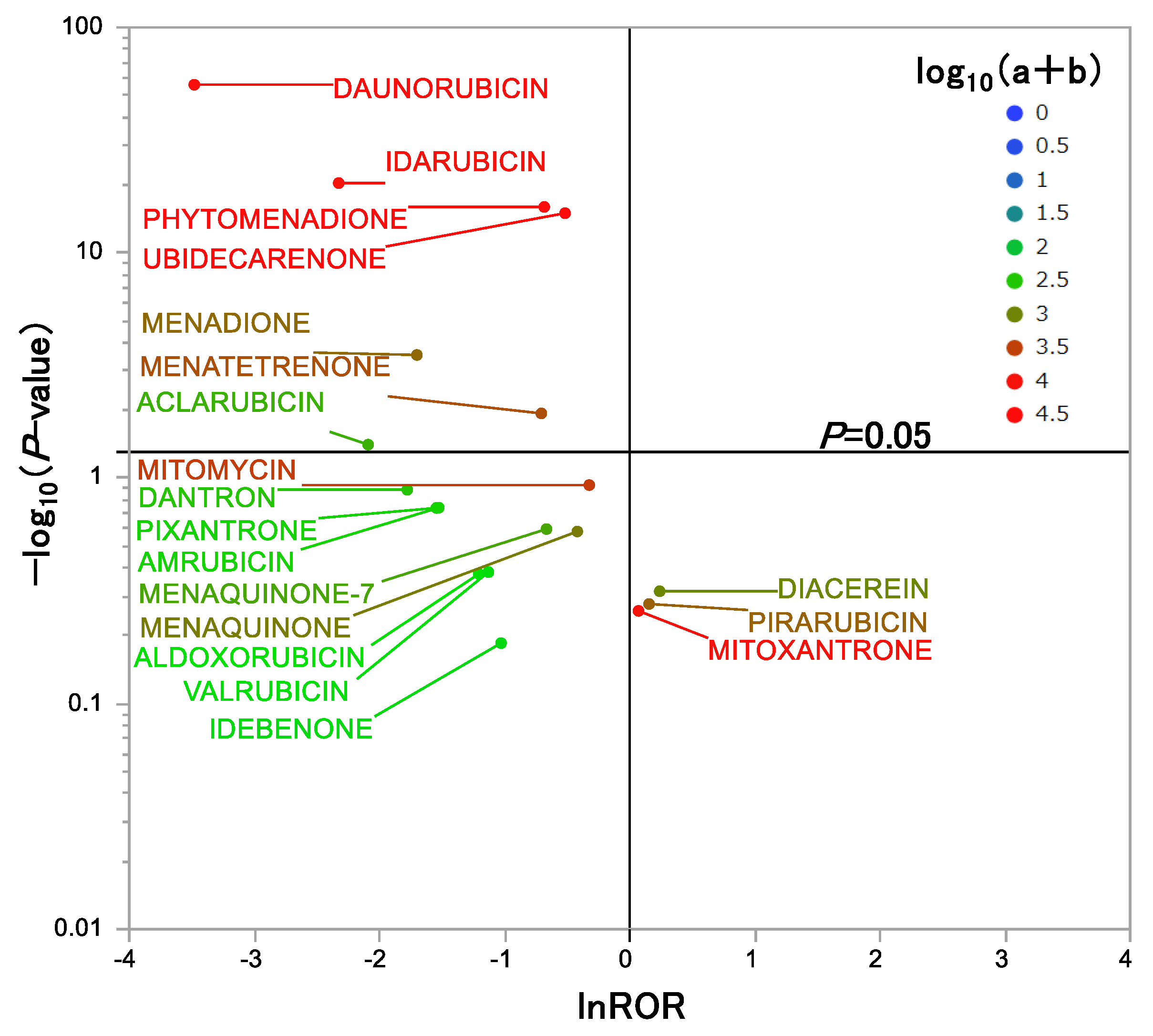
Figure 5.
Study flow diagram of the FAERS-based pharmacovigilance analysis of VK homologs and breast cancer-related reports. Reports in the FAERS database (2004 Q1–2024 Q3; 18,320,966 total reports) were filtered through two parallel pipelines: an adverse-event term filter that identified breast cancer-related reports using narrow-scope PTs within the SMQ “Malignant or unspecified tumors of breast” (159,180 reports) and a structural filter that identified quinone- and hydroquinone-containing compounds via SMARTS substructure searches against PubChem-derived SMILES using Molecular Operating Environment (34 compounds). For each compound, a 2 × 2 contingency table was constructed, and the ROR and its associated 95% CI, PRR, and P-value (Fisher’s exact test) were calculated. VK homolog-specific analyses (n = 32,156 VK-related reports, of which 136 were breast cancer-related) examined all VK homologs and the six homologs separately (VK1, MK-n, MK-4, MK-7, VK3, and VK4). The comparator analysis examined all 34 quinone-containing compounds. Note that VK4 (the hydroquinone-type homolog) was included in the homolog-level analyses but excluded from the comparator volcano plot (Figure 3), which was restricted to quinone-type compounds. BC, breast cancer.
Figure 5.
Study flow diagram of the FAERS-based pharmacovigilance analysis of VK homologs and breast cancer-related reports. Reports in the FAERS database (2004 Q1–2024 Q3; 18,320,966 total reports) were filtered through two parallel pipelines: an adverse-event term filter that identified breast cancer-related reports using narrow-scope PTs within the SMQ “Malignant or unspecified tumors of breast” (159,180 reports) and a structural filter that identified quinone- and hydroquinone-containing compounds via SMARTS substructure searches against PubChem-derived SMILES using Molecular Operating Environment (34 compounds). For each compound, a 2 × 2 contingency table was constructed, and the ROR and its associated 95% CI, PRR, and P-value (Fisher’s exact test) were calculated. VK homolog-specific analyses (n = 32,156 VK-related reports, of which 136 were breast cancer-related) examined all VK homologs and the six homologs separately (VK1, MK-n, MK-4, MK-7, VK3, and VK4). The comparator analysis examined all 34 quinone-containing compounds. Note that VK4 (the hydroquinone-type homolog) was included in the homolog-level analyses but excluded from the comparator volcano plot (Figure 3), which was restricted to quinone-type compounds. BC, breast cancer.
Disclaimer/Publisher’s Note: The statements, opinions and data contained in all publications are solely those of the individual author(s) and contributor(s) and not of MDPI and/or the editor(s). MDPI and/or the editor(s) disclaim responsibility for any injury to people or property resulting from any ideas, methods, instructions or products referred to in the content. |
© 2026 by the authors. Licensee MDPI, Basel, Switzerland. This article is an open access article distributed under the terms and conditions of the Creative Commons Attribution (CC BY) license (http://creativecommons.org/licenses/by/4.0/).
Copyright: This open access article is published under a Creative Commons CC BY 4.0 license, which permit the free download, distribution, and reuse, provided that the author and preprint are cited in any reuse.


