

Submitted:
14 May 2026
Posted:
15 May 2026
You are already at the latest version
Abstract
Mission diminishment and creep which is the gradual dilution of a faith-based organisation’s founding spiritual or theological purpose poses a defining challenge for faith-based organisations of many traditions navigating secular environments, leadership transitions, and the competing demands of contemporary governance. This paper reviews scholarship from theology, organisational studies, personnel psychology, and the sociology of religion, to examine the mechanisms through which faith-based identity erodes and to identify the structural factors that protect against it. Central to the analysis is the phenomenon of values camouflage, a term this paper introduces, where leaders adopt the language of faith for employability or cultural fit without necessarily embodying the spiritual, ethical, or pastoral commitments necessary to sustain organisational mission. The experience of Mary Aitkenhead Ministries (MAM) a Catholic mission-based organisation operating across health, education, and welfare in the tradition of the Religious Sisters of Charity is used to illustrate how founding charism, when institutionally sustained through Catholic Social Teaching, careful stewardship, and community engagement, can function as ways to navigate secular pressures rather than a liability to be concealed. Finally, the paper identifies four interconnected domains of protective action: engagement with modernity, recruitment integrity, the preservation of founding charism, and ongoing organisational formation. It also offers six evidence-based recommendations for boards, leaders, and chaplains across faith traditions committed to maintaining theological distinctiveness without sacrificing organisational effectiveness. Limitations and future research opportunities are also discussed.
Keywords:
values camouflage
; mission creep
; faith-based organisations
; values alignment
; leadership recruitment
; organisational identity
; secularisation
; charism
; mission
Introduction
The $100M Application: Board members and the executive team sat around a table with tender documents. One hundred million dollars in Commonwealth contracts were due for renewal. Six weeks to submission. “Page three,” the CEO said. “Organisational overview. This is where we decide.” The organisation had been founded one hundred years earlier by a pastor with a handful of volunteers. Its founding documents, its foyer walls, its staff devotions all said the same thing plainly: a faith-based organisation compelled by the Gospel to serve the most vulnerable. That had always been true. The question was whether to say so. The board chair said, “The moment we start hiding what we are to get money, we’ve already begun to drift. And once you start, you don’t stop.” Across the table, the CFO leaned forward. “I’m not saying we hide it. I’m saying we’re strategic. If a procurement assessor hits theological language on page three while ticking a compliance checklist, we lose before we’ve shown them a single outcome.” “The work is the Gospel,” the chair said. “You can’t separate them.” “Tell that to the clients we won’t be able to house if we lose the contract.” The room went quiet.
This true account, with names and numbers changed, illustrates a central tension this paper seeks to address. Beyond the contracts and compliance frameworks lie questions that predate them: what is an organisation is fundamentally for, whose does it ultimately serve and why and can these aspects be held together without one displacing the other.
Mission diminishment and creep which includes the gradual dilution or redirection of an organisation’s founding purpose or even mission loss have become a defining challenge for faith-based organisations operating in increasingly secular, competitive, and regulated environments. While originally a military term describing incremental expansion of objectives (Avant et al., 2010), mission creep now describes how faith-based organisations (FBOs) drift from their theological identity due to leadership transitions, funding pressures, cultural adaptation, or strategic repositioning (Jeavons, 2004; Smith, Emerson, & Snell, 2008).
A contemporary and often under-examined driver of mission diminishment is the misalignment between stated and lived values among senior leaders. Anecdotally, some faith-based organisations report that CEO candidates or senior executives profess alignment with the organisation’s faith-based mission, yet over time demonstrate limited commitment to faith-based practices, spiritual or theological literacy, or in Christian context, a Gospel-centred ethos that historically shaped the organisation. This paper terms this phenomenon values camouflage: where leaders adopt the language of faith for employability or cultural fit but do not embody the spiritual, ethical, or pastoral commitments necessary to sustain faith-based identity (Bourdage, Roulin, & Levashina, 2017).
Across the sector, there has been a gradual shift in some faith-based organisations from religion anchored in individual faith and a personal commitment toward commitments grounded institutionally through secular, values-language (Askeland, Espedal, & Sirris, 2019; Héliot, Gleibs, Coyle, Rousseau, & Rojon, 2020). No criticism is offered and one respects that activities are often conducted in secular settings. There is also the need to serve compassionately where needs are found, regardless of creed. However, the risk is that when some leaders assume executive authority, the organisation’s mission, culture, and spiritual or theological distinctiveness can shift, almost indiscernibly at first, and over time erode or stop being expressed altogether.
In a Christian context, the Christian Gospel warns of a dynamic where actions speak louder than words. Jesus cautions that “by their fruits you will know them” (Matthew 7:16), emphasising that authentic discipleship is demonstrated not by verbal assent but by lived practice. Faith-based organisations founded on the Great Commission (Matthew 28:18–20) and the call to remain rooted in Christ (“apart from me you can do nothing,” John 15:5) face profound risks when leadership is entrusted to individuals whose commitment to faith-based identity is nominal, strategic, superficial or absent. Another issue is that in recruitment and induction these issues may not be made apparent.
While this paper draws primarily on Christian organisational contexts, the pressures it describes are not confined to any single tradition. Recent research describe similar dynamics among Ultra-Orthodox Jewish welfare providers navigating digital modernity (Gemara, 2025). So too, Buddhist organisations in Britain are managing the tension between government-funded secular programming and doctrinal integrity (Starkey, 2023). This suggests that mission diminishment and creep is best understood not as a specifically Christian institutional problem but as a defining challenge for faith-based organisations across traditions operating in secular service-delivery environments.
Aims
From this, the paper seeks to examine how faith-based organisations experience mission creep, particularly following CEO appointments, board changes, or strategic shifts aimed at securing secular funding. It explores the mechanisms through which faith-based identity is diluted, the organisational and theological implications of such drift, and the tensions leaders face in balancing faithfulness with institutional sustainability. The analysis integrates organisational theory, leadership studies, and theological reflection to support faith-based leaders, boards, and chaplains in recognising and resisting identity drift.
The paper has three interconnected aims. The first is analytical: to synthesise interdisciplinary scholarship across spirituality, theology, organisational studies, personnel psychology, and the sociology of religion in order to map the mechanisms through which faith-based identity erodes, with particular attention to the role of leadership recruitment and the concept of values camouflage introduced here as a descriptive frame for leaders who perform the language of faith without embodying its commitments. The second aim is constructive: to identify the structural factors that protect against mission drift, drawing on both the empirical literature and draw on an illustrative experience an organisation that seeks to hold to theological fidelity and offer contemporary care. The third aim is practical: to translate these findings into evidence-based recommendations that boards, leaders, and mission leads and chaplains can act upon, regardless of tradition, to protect mission integrity without sacrificing organisational effectiveness.
This paper is motivated by a concern that is at once practical and theological: that faith-based organisations across many traditions are losing their founding distinctiveness not through deliberate abandonment but through the accumulated weight of incremental accommodation — to funding requirements, leadership transitions, governance norms, and cultural pressures that reward the language of faith while remaining indifferent to its substance. The phenomenon is widely observed by practitioners, yet remains insufficiently theorised in ways that equip boards, leaders, and chaplains to recognise and resist it before drift becomes irreversible.
The call to serve regardless of belief is not a concession to modernity but an expression of the very spiritual and theological commitments that brought these organisations into existence. The tension, then, is not between faith and service, rather between maintaining the spiritual foundations that animate compassionate action and the structural pressures that gradually hollow those foundations out, leaving the service intact while the animating source quietly recedes. It is this tension, between fidelity to tradition and wholehearted engagement with a pluralist, secular, and suffering world, that this paper seeks to examine, name, and, where possible, help resolve or at least offer some insights to navigate tensions.
Research Question
This paper is oriented by the research question: In the context of faith-based organisations maintaining or failing to maintain alignment between their founding spiritual foundations and current focus and activities, what factors contribute to or protect against mission drift?
Method
This study employs a narrative literature review methodology, synthesising interdisciplinary scholarship from theology, organisational leadership, non-profit management, and the sociology of religion. Sources were identified through ATLA Religion Database, Scopus, Web of Science, and Google Scholar using search terms including mission creep, faith-based organisations, faith-based identity, secularisation, non-profit leadership, values drift, and religious governance. Searches were conducted across English-language publications, with the primary focus on peer-reviewed literature from 2018–2025, supplemented by foundational theological and organisational works of enduring scholarly significance.
Priority was given to four categories of source: peer-reviewed empirical and conceptual literature from 2018–2025; spiritual and theological works grounding faith-based mission imperatives; organisational studies examining leadership influence, identity formation, and values drift; and empirical research on faith-based organisations navigating secular funding environments. Sources were selected iteratively through a process of thematic relevance, methodological rigour, and disciplinary breadth, with additional works identified through backward citation tracing from key articles.
Inclusion and exclusion criteria were applied consistently. Studies were included where they addressed at least one of the following: leadership values alignment in mission-driven organisations; the secularisation of organisational identity; recruitment and governance in faith-based contexts; or the theological dimensions of organisational mission. Sources were excluded where they lacked scholarly grounding, were not retrievable in full text, or addressed faith-based organisations in contexts where transferability could not be reasonably assumed.
Thematic analysis was used to organise and synthesise the literature, identifying recurring patterns across four domains: engagement with modernity, recruitment integrity, the preservation of founding charism, and ongoing organisational formation. This integrative approach enables a comprehensive analysis of the theological, organisational, and sociocultural dimensions of mission creep, while acknowledging that narrative review is by nature interpretive and does not claim the exhaustiveness of a systematic review.
Note on scope: The author draws substantially on the Christian tradition as a primary illustrative example. However, wherever possible the paper seeks to draw broader, preliminary faith-based conclusions that may apply across faith traditions.
Literature Review
The tensions illustrated in the opening vignette, that is, between naming a founding faith commitment and burying it for strategic advantage, are not isolated to one boardroom or one funding round. The literature across spirituality, theology, organisational studies, personnel psychology, and the sociology of religion will be examined to see how faith-based organisations arrive at that moment of compromise: the gradual institutionalisation of values-language in place of personal formation, the structural incapacity of conventional recruitment to detect the gap between performed and embodied faith, the compounding pressure of funding dependency, and the decisive but often underestimated influence of individual leaders on organisational culture and identity.
Values Alignment and the Recruitment Vulnerability
A growing body of scholarship highlights the vulnerability of faith-based organisations during leadership recruitment, particularly when candidates present themselves as aligned with the organisation’s faith commitments but lack the spiritual maturity or theological grounding required to sustain its mission. Zigan, Héliot, and Le Grys (2021a) demonstrate that in faith-based organisations, significant incongruence exists between the ideal leadership attributes that organisations seek and the actual behaviour leaders display, with ethical attributes such as the capacity to help others flourish proving especially difficult to assess reliably through conventional selection processes.
Sirris (2023), in a case study of a Norwegian diaconal hospital, found that managers simultaneously drew on their organisation’s distinctive faith-based leadership discourse to navigate professional dilemmas while also adopting elements of generic managerial language in ways that progressively individualised rather than institutionalised their values commitments. This dynamic which is leaders inhabiting institutional faith-language while their actual formation remains personal, selective, and susceptible to secular drift, shows precisely the structural vulnerability that can occur in recruitment and leadership succession.
Complementing this, Zigan, Héliot, and Le Grys (2021b), studying the lived experience of leaders in the Roman Catholic Church, examined the complex relationship between institutional and personal values, and how individual agency interacts with strong institutional values. They found that the tension between espoused institutional commitments and personally held values is not merely theoretical but is experienced as a daily, often unresolved, feature of leadership in Christian organisations.
This gap between espoused and enacted values is compounded by well-established findings from the personnel selection literature. Roulin, Bangerter, and Levashina (2015) show that interviewers are generally poor at detecting deceptive impression management, meaning candidates who have learned to perform the language of faith or virtue convincingly are unlikely to be identified as such during interview. Héliot et al. (2020) further demonstrate that the degree of congruence between a candidate’s genuine religious identity and the expectations of the employing organisation has significant consequences for both individual and organisational outcomes, yet such congruence is rarely verified robustly at the point of hire.
The structural conditions enabling this vulnerability are identified by Askeland, Espedal, and Sirris (2019), who document how faith-based organisations have progressively shifted from religion anchored in personal commitment toward institutionally expressed values-language — a transition that can make it easier for candidates to adopt and perform the surface vocabulary of faith without the inner formation it represents. When such leaders are appointed, the gap between espoused and enacted values can accelerate mission drift as organisational identity gradually shifts away from its theological foundations toward more secular, compliance-driven, or market-oriented priorities (Jones, 2007).
McManus (2025) argues that when faith-inspired values are genuinely embodied rather than merely stated, they can transform organisational leadership by grounding it in virtue, service, and moral purpose rather than managerial technique alone. He warns that many leaders use the language of faith rhetorically without the inner formation or ethical depth required, resulting in leadership that is performative rather than authentically values-driven.
Mission Creep and Organisational Identity
Mission drift is widely recognised as a gradual shift away from an organisation’s founding purpose (Jones, 2007). For faith-based organisations, this shift often involves the dilution of explicit religious identity, practices, or theological commitments (Jeavons, 2004). Organisational identity theory emphasises that identity is shaped by shared values, narratives, and practices (Albert & Whetten, 1985). When these elements weaken, identity loss or drift can occur.
Zigan, Héliot, and Le Grys (2024), investigating followership across four British Christian denominations, found that church members experienced a dialectic relationship between institutional norms and local settings, with faith-related, ethical, and relational attributes identified as the most prevalent expectations of those in leadership — yet also the attributes most shaped by, and therefore most vulnerable to, contextual variation. If follower expectations of leaders are themselves shaped by local and institutional context, candidates who learn to read and perform those contextual signals may satisfy both the hiring panel and initial expectations without possessing the deeper formation those expectations were designed to reflect.
At the organisational level, Wæraas, Hellevik, Sirris, and Hathaway (2025), drawing on survey data from four diaconal nonprofits, found that organisational identification among staff is significantly enhanced by perceptions of a normative organisational identity, identity category, and institutional identity. This suggests that when leaders undermine or dilute the clarity of an organisation’s faith-based identity, the consequences extend beyond governance to the motivation, cohesion, and retention of staff whose commitment sustains the mission.
Recent research highlights that faith-based organisations are particularly vulnerable because their mission is both spiritual and social (Smith, Emerson, & Snell, 2008). As they professionalise, adopt corporate governance models, or expand service delivery, they may unintentionally prioritise efficiency, compliance, or market competitiveness over spiritual values, formation, or faith-based witness (Bielefeld & Cleveland, 2013).
Secularisation and the Pressure to Modernise
Secularisation theory provides a broader lens for understanding identity drift. Casanova (1994) and Bruce (2011) argue that modern societies increasingly expect institutions to operate according to secular norms, even when founded on religious principles. Faith-based organisations may therefore feel pressure to downplay religious identity to appear modern, inclusive, or professionally credible. Markofski, Fulton, and Wood (2020) offer a useful distinction between strategic secularisation, minimising explicit faith-based language in public documents while maintaining internal faith commitments and substantive secularisation, which involves abandoning faith-based identity as irrelevant or outdated. Both forms can contribute to mission creep, though the latter represents a deeper theological rupture from founding faith-based purposes.
Evidence from non-Christian faith traditions confirms that the pressures producing mission loss or drift are not unique to Christian organisations but reflect a structural condition of faith-based service delivery in secular environments. Research on Ultra-Orthodox Jewish social welfare organisations in Israel has identified how resistance to secular technologies and professional norms creates significant friction in contemporary service delivery, while simultaneously functioning as a marker of institutional identity that organisations are unwilling to dissolve (Gemara, 2025). Similarly, Buddhist organisations in Britain have increasingly offered “secular” mindfulness and wellbeing programmes alongside explicitly doctrinal activities as a strategy for broadening reach, yet scholars note that this accommodation risks decontextualising practice and progressively eroding the theological foundations that give organisational mission its animating coherence (Starkey, 2023). This is what Markofski, Fulton, and Wood (2020) describe as strategic secularisation. It is about adapting language and method for contemporary audiences while raising the same question this paper poses: at what point does contextualisation become substitution?
Leadership Appointments and Board Culture
Leadership transitions are a critical factor in mission creep. CEOs shape organisational culture, strategic priorities, and external relationships (Schein & Schein, 2017). When a new CEO lacks deep grounding in the organisation’s faith-based heritage or views religious identity as a liability, mission drift can accelerate. Board composition also matters significantly. Boards with fewer members from faith-based backgrounds or limited theological understanding may prioritise financial sustainability or risk management over mission fidelity (Reimer & Wilkinson, 2015).
Funding Dependencies and Market Pressures
Government and philanthropic funding often comes with expectations of religious neutrality, measurable outcomes, and professional standards (Bielefeld & Cleveland, 2013). While these expectations can improve accountability, they may also incentivise organisations to modify mission statements, reduce religious activities, or adopt secular language to secure grants. Marketisation pressures can push faith-based organisations toward efficiency, branding, and measurable outcomes that may conflict with a Gospel-centred mission based on compassion, justice, and witness.
Theological Perspectives on Identity and Mission
Theological literature emphasises that faith-based mission is rooted in discipleship, service, and witness (Newbigin, 1989). The Gospel frames faith-based mission as participation in God’s redemptive work, not merely social service delivery. For Christians, this is grounded in Jesus’ call to “make disciples of all nations” (Matthew 28:19), underscoring that faith-based mission is inseparable from spiritual identity and formation.
Nouwen (1989) warns that faith-based leaders can become busy professionals rather than spiritual shepherds, prioritising efficiency over formation. Rohr (2011) similarly argues that faith-based mission requires grounding in contemplative identity; without this, organisations become reactive to external pressures rather than rooted in internal purpose.
Discussion
Six months into her tenure, the new CEO was being praised for her sharp metrics and rapid strategic and operational wins. At the start of a board meeting, when the Chair opened his Bible for the customary reflection, she glanced at her watch and said lightly, “Do we still need to do this? I don’t really see the point of prayers at meetings.” Board members froze for a moment. Her results had been excellent, but in that single sentence they heard something else: a signal that the organisation’s spiritual heart may not be shared by its leader. It was a small, almost casual statement and the potential beginning of a fundamental values shift.
Mission diminishment and creep in faith-based organisations unfolds through a complex interplay of internal leadership dynamics, external pressures, and subtle cultural shifts. While the literature identifies mission drift as a gradual process, its cumulative impact can be profound, reshaping not only organisational identity but also the lived experience of staff, volunteers, and the communities served. This section synthesises the key findings from the literature and expands on the mechanisms through which mission creep manifests, the theological implications of identity erosion, and the organisational consequences that follow.
A central theme emerging from the literature is the decisive influence of leadership transitions. When CEOs or senior executives lack grounding in faith-based theology or view religious identity as a reputational liability, organisational culture can shift rapidly. Leaders set priorities, shape language, and determine which practices are emphasised or sidelined. As Schein and Schein (2017) argue, culture is created and reinforced by what leaders pay attention to, reward, and tolerate.
The consequences of values misalignment extend well beyond the individual leader and reshape the relational fabric of the organisation as a whole. Zigan, Héliot, and Le Grys (2024) found that in Christian church settings, effective leader-follower relationships depend critically on shared faith-related and ethical attributes, and that the dialectic between institutional norms and local context profoundly shapes what followers expect of, and are willing to extend trust toward, those who lead them. When a leader lacks the faith formation that followers implicitly expect, this trust is not dramatically withdrawn but quietly withheld — a gradual erosion of relational authority that mirrors the gradual erosion of organisational identity described throughout this paper.
The organisational stakes of this erosion are confirmed by Wæraas et al. (2025), whose survey evidence from diaconal nonprofits demonstrates that staff identification with the organisation is materially enhanced by the perceived clarity and normativity of organisational identity. When leadership transitions blur or dilute that identity, staff identification, and with it the motivated, values-driven commitment that distinguishes faith-based organisations from their secular counterparts can be placed at measurable risk. Mission drift, in other words, is not only a theological and governance problem; it is a human one, felt by the people who joined because they believed the foundation was real.
The internal dynamics through which mission drift unfolds at the leadership level are brought into sharp relief by recent empirical work. Sirris (2023) found that managers in a diaconal organisation emphasised individuation through pro-social values and connected values to core work, but were simultaneously marked by individualisation. Moreover, adopting elements from a generic leadership discourse in which managerial work can become a means to self-realisation rather than an expression of institutional charism. This is a subtle but consequential distinction: a leader may speak the language of the organisation’s values fluently and sincerely, yet over time ground those values in personal professional identity rather than the theological tradition the organisation exists to embody. Once this shift occurs, the leader’s continued alignment with the mission becomes contingent on personal conviction rather than structural accountability. This can be precisely the condition under which a glance at a watch during opening prayer signals not rudeness but a genuinely different understanding of what the organisation is for.
Zigan, Héliot, and Le Grys (2021b) deepen this by showing that in strongly institutionalised Christian organisations, the tension between personal values and institutional expectations is experienced not as occasional friction but as a persistent feature of leadership life. This is one that organisations must actively monitor and govern rather than assume will resolve itself through goodwill or cultural osmosis.
Even subtle changes such as replacing prayer with “reflection time,” reframing pastoral care as “wellbeing services,” or removing faith-based symbols from public spaces may signal a shift in organisational values. It is also important to be inclusive and welcoming of all faith traditions and even those with no belief. However, over time, changes accumulate, creating a culture where faith-based identity becomes optional rather than foundational.
Another significant driver of mission creep is the pressure to secure government or philanthropic funding. Funding agreements often require religious neutrality, leading organisations to modify mission statements, remove faith-based symbols, or restrict spiritual care. While these adjustments may be framed as pragmatic, they can unintentionally reshape organisational identity. Marketisation pressures push faith-based organisations toward efficiency, branding, and measurable outcomes that may conflict with a Gospel-centred mission based on compassion. The tension between faithfulness and funding becomes particularly acute when organisations rely heavily on external grants, creating a dependency that incentivises further secularisation.
Cultural drift also plays a critical role. As organisations grow, they often recruit staff based on technical competence rather than faith-based formation. While professional expertise is essential, the absence of shared theological understanding can dilute organisational ethos. Staff who do not share the organisation’s spiritual commitments may unintentionally reshape practices, language, and priorities, leaving the organisation culturally indistinguishable from secular providers even if its founding documents remain explicitly faith-based.
For Christian organisations, by way of example, mission diminishment represents a failure to remain grounded in Christ. The Gospel calls faith-based communities to bear witness through both word and deed (Matthew 5:14–16). When organisations downplay their faith-based identity, they risk cutting themselves off from the foundational source that animates their mission. John 15:5 emphasises that apart from Christ, the community “can do nothing.” Mission drift becomes not only an organisational issue but a spiritual one, undermining the organisation’s capacity to embody the love, compassion, and justice central to faith-based witness.
The consequences of mission creep are far-reaching. Staff morale may decline as employees who joined for the faith-based mission feel disillusioned or marginalised. Community trust may erode if stakeholders perceive the organisation as abandoning its roots. Strategic confusion can arise when competing priorities — financial sustainability, compliance, and spiritual formation — are not held together within a coherent theological framework. Ultimately, mission creep threatens the distinctiveness that enables faith-based organisations to offer a unique contribution to society.
The literature also highlights pathways for resisting mission drift. Strong governance structures, theologically literate boards, and mission-aligned leaders are essential. Regular theological formation for staff, intentional spiritual practices, and clear articulation of faith-based identity in public documents can reinforce organisational ethos. Chaplains play a vital role as custodians of charism, offering spiritual leadership, theological interpretation, and pastoral presence — maintaining a living connection between organisational practice and founding identity.
Engagement with Modernity, Recruitment, Charism, and Formation
From this analysis, several key ideas and recommendations emerge across four interconnected domains: engagement with modernity, recruitment integrity, respectful articulation of founding charism, and the ongoing living expression of original purpose. Faith-based organisations need not choose between faithfulness and contemporary relevance, but they must resist the assumption that modernity requires theological silence. Vanderwoerd (2004) demonstrates that organisations which treat their religious identity as non-negotiable, even under secular pressure, are more, not less, capable of sustaining effective service delivery. Engagement with government funding, regulatory frameworks, and professionalised governance is both legitimate and necessary; what is required is theological confidence in that engagement, not apologetic retreat.
Example: Mary Aitkenhead Ministries (MAM), a Catholic mission-based organisation operating across health, education, and welfare in the tradition of the Religious Sisters of Charity
Organisations such as Mary Aitkenhead Ministries (MAM), the governance successor to Australia’s Sisters of Charity, offers an illustrative example of how faith-based organisations can engage deliberately and confidently with the secular world without surrendering the theological foundations that animate their mission. Rather than treating contemporary even secular engagement and relevance and Gospel fidelity as competing demands, MAM holds them together through what it describes as innovative stewardship. They say that stewardship of ministries “involves promoting and assuring the healing mission of Jesus”. This is about responding to contemporary needs in health, education, and welfare not despite its Catholic identity but precisely because of it, inspired by the founding spirit of Mary Aitkenhead herself.
This approach is grounded deliberately and structurally in Catholic Social Teaching, ensuring that organisational decisions in areas of love, justice, and compassion remain anchored to a coherent theological framework rather than drifting toward market-driven or compliance-driven priorities. Of course, that said, MAM must still engage with secular governance, risk and compliance frameworks constantly.
MAM’s commitment to inclusivity. MAM’s health, social and health action strives to be welcoming communities that honour secular values while maintaining a commitment to the Gospel. This reflects engagement in what Markofski, Fulton, and Wood (2020) term adapting language and method for different audiences without abandoning the convictions those methods are designed to serve. Critically, MAM’s community engagement practices especially creating conditions for the voices of the marginalised and vulnerable to be heard and amplified and cared for embodies precisely the charism that mission drift erodes.
MAM would appear to strive for living, outward-facing expression of founding purpose that Askeland, Espedal, and Sirris (2019) argue must be institutionally sustained rather than left to chance or individual goodwill. In this sense, MAM represents not just a case study in survival under secular pressure, but a model of what Vanderwoerd (2004) identifies as treating religious identity as non-negotiable. Mary Aitkenhead Ministries connects with the secular world while staying true to it foundations. Drawing from their stated intentions, their approach can be summarised as:
- Innovative Stewardship: respond to contemporary needs through health, education, and welfare services, inspired by the spirit of Mary Aikenhead.
- Catholic Social Teaching: The ministries operate in accordance with Catholic teachings, ensuring that their actions align with the values of love, justice, and compassion.
- Inclusivity: aim to be welcoming communities that support secular values while maintaining a commitment to the Gospel.
- Stewardship of Faith: ministries are guided by the principles of the Roman Catholic Church ensuring that their actions reflect the mission of Jesus Christ.
- Community Engagement: seek to create conditions that enable the voices of the marginalized and vulnerable to be heard and amplified, fostering a sense of community.
From the MAM example and recalling Markofski, Fulton, and Wood (2020) organisations can adapt their language for different audiences without abandoning the convictions that language is meant to carry. The board chair in the opening vignette was not wrong. For many, the work is the Gospel but neither is all strategic communication inherently a betrayal. The danger lies not in contextualisation but in the gradual substitution of institutional values-language for genuine spiritual, theological, and pastoral formation, a substitution that Askeland, Espedal, and Sirris (2019) show is already well underway across many sectors.
The discussion points clearly to the structural factors most significant in either accelerating or resisting mission drift. On the side of vulnerability, three conditions emerge as most consequential: funding arrangements that create material dependency on secular compliance; recruitment processes that are structurally incapable of distinguishing authentic values alignment from its performance (Roulin, Bangerter, & Levashina, 2015; Zigan, Héliot, & Le Grys, 2021a); and the progressive institutional shift from personal faith commitment toward values-language that can be learned and performed without the spiritual or theological formation it was originally designed to express (Askeland, Espedal, & Sirris, 2019).
On the side of protection, the literature is consistent: boards with genuine spiritual and theological literacy, leaders whose professional competence is inseparable from their spiritual formation, intentional communal practices that sustain organisational identity over time, and chaplains invested with genuine institutional authority rather than symbolic pastoral roles. These are not peripheral enhancements to good governance. They can be the structural conditions without which theological or spiritual charism cannot be shared across leadership generations. It is these protective factors that the recommendations which follow are designed to directly strengthen.
The preservation of founding charism is not a conservative instinct to resist change but a living, generative discipline. Nouwen (1989) warns that faith-based leaders risk becoming busy professionals rather than spiritual shepherds, and Rohr (2011) argues that without contemplative grounding, organisations become reactive to external pressures rather than rooted in internal purpose. For faith-based organisations, this means investing intentionally in the ongoing formation of staff at every level, maintaining spiritual practices such as prayer, Scripture, communal reflection, as vital organisational rather than merely personal acts, and ensuring that chaplains and pastorally formed leaders occupy genuine institutional authority rather than symbolic roles.
The question posed in that boardroom, that is whether to name their foundation on page three or bury it on page one hundred was, in the end, a question about organisational soul. Organisations that have done the internal work of formation will find that question far easier to answer, because the foundation will be visible not only in the application but in everything the organisation does, long before any assessor reads a single word.
Four Domains and Six Recommendations
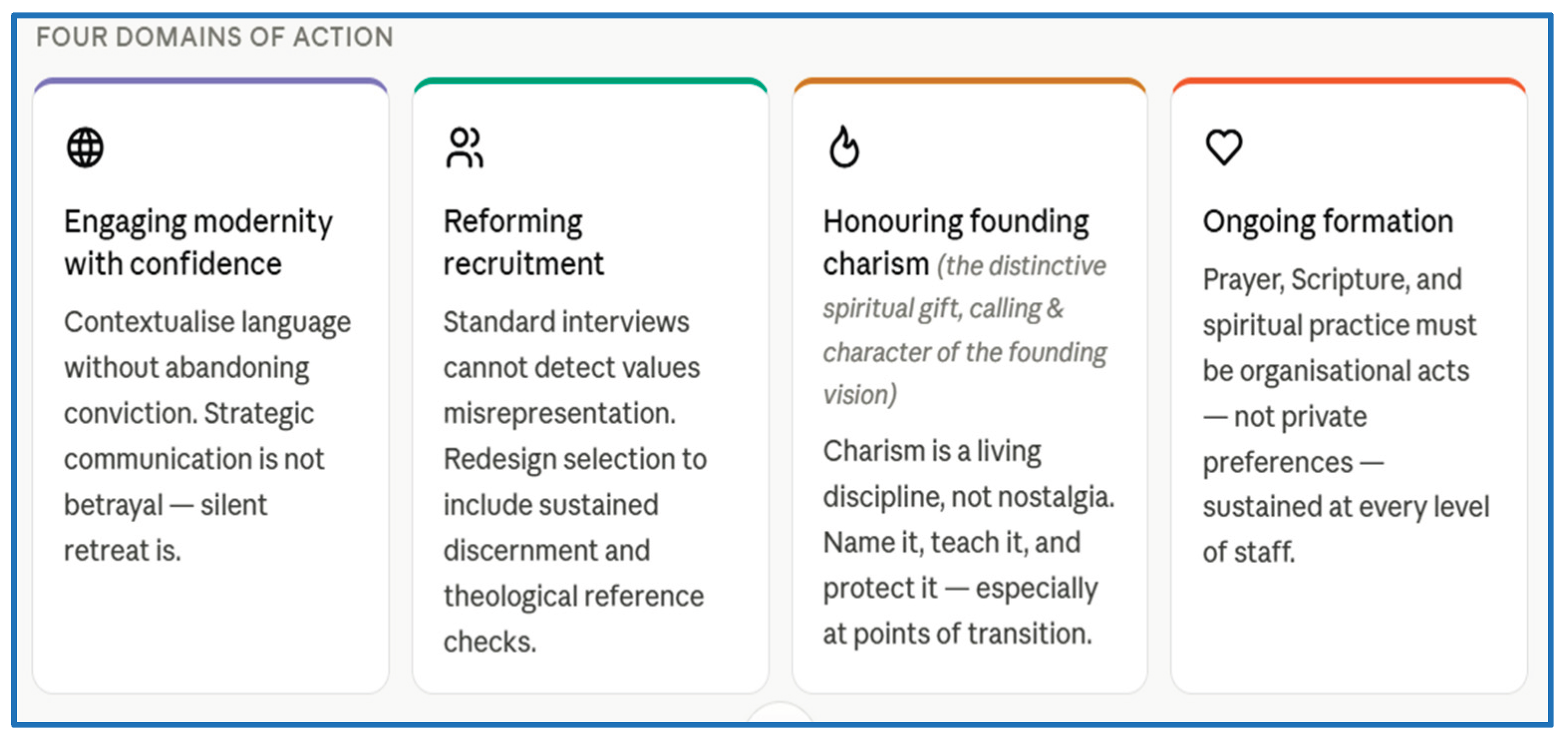
The mechanisms and protective factors identified in this discussion do not operate independently. They can be grouped into four interconnected domains: engagement with modernity, recruitment and human resource integrity, preservation of founding charism, and ongoing personal and organisational formation. Each, is all at once, a potential vulnerability and an opportunity for deliberate connection to founding purpose and living in what it impels the organisation to do and how it will do it. They are represented schematically in Figure 1.
Six Recommendations
Protecting mission integrity requires deliberate, structural action, not goodwill alone. The following six recommendations address the most critical points of vulnerability identified across the literature:
- Spiritual and theological reference checks: go beyond competency. Ask referees specifically about a candidate’s faith practice, spiritual formation, and embodiment of faith-based values in previous roles.
- Probationary discernment: make values alignment an ongoing accountability rather than a pre-appointment declaration that is signed and never revisited.
- Board formation: ensure boards include members with genuine theological literacy and lived faith-based formation, not governance expertise alone.
- Protect spiritual practices: prayer, devotion and chaplaincy are not optional extras. They are the living connective tissue of organisational identity and must be protected as such.
- Name and substantiate identity publicly: state faith-based foundations clearly and early in strategic documents, funding applications, tender documents, and public communications. Clarity is not a liability; obscuring identity is.
- Mission leaders and chaplains as custodians: invest mission leads and chaplains with genuine institutional authority as custodians of charism (the organisation’s distinctive spiritual calling and founding character), not merely as pastoral support for individual staff.
The most recent empirical work confirms that these concerns are neither theoretical nor peripheral. Wæraas et al. (2025) demonstrate that staff identification with mission-based organisations is materially dependent on the perceived clarity and normativity of organisational identity, while Zigan, Héliot, and Le Grys (2024) show that the trust followers extend to leaders in faith-based organisations rests fundamentally on shared faith-related and ethical attributes — findings which together make the case that values misalignment at the leadership level does not stay at the top of the organisation but travels downward, quietly diminishing the motivated, faith-driven commitment of every person who joined because they believed the foundation was real.
Limitations
The following limitations are offered in the spirit of scholarly transparency, acknowledging the boundaries of what a narrative literature review, however carefully constructed, can establish or claim.
First, narrative reviews are inherently selective rather than exhaustive. While sources were identified across multiple databases using systematic search terms, the final selection reflects interpretive judgements about relevance, disciplinary weight, and thematic fit. A different scholar drawing on the same databases might legitimately construct a different account of the same phenomenon.
Second, the paper synthesises literature across four distinct disciplines: spirituality/theology, organisational studies, personnel psychology, and the sociology of religion. Each has its own epistemological assumptions and standards of evidence. Bringing these together requires interpretive bridging, and in places the connections drawn between impression management theory and theological formation are inferential rather than empirically demonstrated. The paper argues these connections are conceptually warranted; it does not claim they have been empirically tested in the specific context of faith-based organisations.
Third, the theological literature drawn upon, including Newbigin (1989), Nouwen (1989), and Rohr (2011), operates from a different intellectual tradition and way of knowing from the empirical social science sources. These works are treated as normative frameworks illuminating what faith-based mission means and what is at stake when it erodes, rather than as empirical evidence of organisational behaviour. Readers operating from a strictly secular or positivist framework may weight these sources differently.
Fourth, the concept of values camouflage, introduced here as a descriptive frame for leaders who perform faith-language without embodying its commitments, has not yet been empirically tested. It is offered as a conceptual contribution intended to name and focus attention on a recognisable but under-theorised dynamic. Its prevalence and relationship to measurable organisational outcomes remain open questions that future qualitative and quantitative research is well positioned to adder.
Future Research
This paper has identified a series of conceptual, empirical, and contextual gaps representing genuine opportunities for future scholarship. Five directions are proposed.
First, and most pressing, is the need for empirical research in the Australian context. The structural conditions for mission drift identified here are well documented in North American, British, and Scandinavian settings, but no equivalent body of empirical work exists for Australian faith-based organisations. A qualitative study involving semi-structured interviews with CEOs, board chairs, and chaplains of Australian Christian nonprofits engaged in government-funded service delivery could represent a significant and original contribution.
Second, the concept of values camouflage warrants empirical investigation as a construct in its own right. What remains unknown is how prevalent this phenomenon is, under what conditions it is most likely to occur, and whether it reflects conscious misrepresentation or a more ambiguous self-understanding on the part of candidates. Qualitative research exploring the lived experience of both recruiters and candidates in faith-based senior appointments would begin to address these questions.
Third, research is needed on the effectiveness of alternative recruitment and discernment practices. No empirical evidence currently establishes whether theological reference checking, sustained discernment periods, or probationary governance arrangements actually improve values alignment outcomes over time. Comparative case study research across denominations and organisational types could generate evidence of practical and policy significance.
Fourth, the role of chaplains as institutional custodians of charism deserves dedicated scholarly attention. Research examining how chaplains understand and exercise their institutional role, and how boards and CEOs relate to chaplaincy as a governance resource, would address a genuine gap in both chaplaincy studies and nonprofit governance literature.
Fifth, longitudinal research tracking how organisational culture, spiritual practices, and governance structures change across multiple leadership transitions is needed to move the field from describing mission drift after it has occurred to identifying the early warning signals that allow leaders to act before drift becomes irreversible
Conclusion
This paper has examined how faith-based organisations lose alignment between their founding theological charism and their enacted leadership, governance, and organisational culture and what structural factors most significantly predict or protect against that drift. The literature is both sobering and, ultimately, hopeful.
The mechanisms of mission drift are now well enough understood to be named clearly. Culture is shaped by what leaders pay attention to, reward, and tolerate (Schein & Schein, 2017), and when leaders lack genuine grounding in an organisation’s theological foundations, drift begins not necessarily with a strategic decision but with something as small and unremarked as a glance at a watch during opening prayer. Conventional recruitment processes are structurally incapable of detecting the gap between performed and embodied values (Roulin, Bangerter, & Levashina, 2015; Zigan, Héliot, & Le Grys, 2021a), and funding dependencies compound these vulnerabilities, incentivising religious neutrality in tenders, mission statements, public communications.
The protective factors are equally clear. This includes boards with genuine theological literacy. It also is about leaders whose professional competence is inseparable from their spiritual formation, recruitment processes redesigned around sustained discernment, communal spiritual practices treated as organisational rather than merely personal acts. Although have a shared responsibility, mission leads/chaplains invested with genuine institutional authority assist with enabling the charism. These are the structural conditions without which theological identity cannot be transmitted across leadership generations.
The experience of Mary Aitkenhead Ministries illustrates that faithfulness and effectiveness need not be in conflict. When founding charism is institutionally protected and outwardly expressed through care of the marginalised, it becomes not an obstacle to secular engagement but its animating source.
Mission loss, diminishment, or creep is not inevitable. The task for faith-based organisations is the one it has always been: to hold faithfulness and excellence together, to engage the world they are called to serve with creativity and courage, and to remain, through every governance reform, every funding round, and every leadership transition, unmistakably themselves.
The most recent scholarship makes the urgency plain. Sirris (2023) and Wæraas et al. (2025) together demonstrate that identity drift is already measurably underway in faith-based organisations and that what must be protected is known. The question is whether those with the authority to act will do so before drift becomes irreversible
| 1 |
About the Author: Professor Peter Devenish-Meares OStJ KHS FRSA FRGS FFin BBus(Accounting) MCom(Hons) MLitt DBA etc Peter’s career weaves together governance, service, scholarship, and clinical care. Alongside his academic work, he has served as a board director across education, health, community, and mission-driven organisations, bringing strategy, finance and governance experiences to boards. His clinical formation was as a psychotherapist. 20 years ago after 25 years in the corporate world, Peter was ordained and began his vocation a workplace and Army chaplain. Concurrently for 17 years he was the senior chaplain to community care and homeless charities across two states. He has been a police chaplain too for 10 years. His post-doctoral research focuses on leadership, ethics, spirituality, and integrative pastoral care. devenip@hotmail.com
|
References
- Albert, S., & Whetten, D. A. (1985). Organizational identity. In B. M. Staw & L. L. Cummings (Eds.), Research in Organizational Behavior, 7, pp. 263–295.
- Askeland, H., Espedal, G., & Sirris, S. (2019). Values as vessels of religion? The role of values in everyday work at faith-based organisations. Diaconia: Journal for the Study of Christian Social Practice, 10(1), 27–49. [CrossRef]
- Avant, D., Finnemore, M., & Sell, S. (Eds.). (2010). Who governs the globe? Cambridge University Press. [CrossRef]
- Bielefeld, W., & Cleveland, W. S. (2013). Defining faith-based organizations and understanding them through research. Nonprofit and Voluntary Sector Quarterly, 42(3), 442–467. [CrossRef]
- Bourdage, J. S., Roulin, N., & Levashina, J. (2017). Editorial: Impression management and faking in job interviews. Frontiers in Psychology, 8, 1294. [CrossRef]
- Bruce, S. (2011). Secularization: In defence of an unfashionable theory. Oxford University Press.
- Casanova, J. (1994). Public religions in the modern world. University of Chicago Press.
- Gemara, N. (2025). The medium is a mess: Virtual communication in social service provision with the Ultra-Orthodox Jewish community. Journal of Technology in Human Services, 43(4), 321–345. [CrossRef]
- Héliot, Y., Gleibs, I. H., Coyle, A., Rousseau, D. M., & Rojon, C. (2020). Religious identity in the workplace: A systematic review, research agenda, and practical implications. Human Resource Management, 59(2), 153–173. [CrossRef]
- Jeavons, T. H. (2004). Religious and faith-based organizations: Do we know one when we see one? Nonprofit and Voluntary Sector Quarterly, 33(1), 140–145. [CrossRef]
- Jones, M. B. (2007). The multiple sources of mission drift. Nonprofit and Voluntary Sector Quarterly, 36(2), 299–307. [CrossRef]
- Markofski, W., Fulton, B. R., & Wood, R. L. (2020). Secular evangelicals: Faith-based organizing and four modes of public religion. Sociology of Religion, 81(2), 158–184. [CrossRef]
- McManus, J. (2025). Beyond “conventional” leadership: How faith-inspired values can transform, improve and challenge traditional leadership models for more inclusive organisations [Conference paper]. Shared Values, Shared Care: Empowering Workforce and Community Wellbeing through Pastoral and Religious Support Conference. https://www.academia.edu/.
- Newbigin, L. (1989). The gospel in a pluralist society. Eerdmans.
- Nouwen, H. J. M. (1989). In the name of Jesus: Reflections on Christian leadership. Crossroad.
- Reimer, S., & Wilkinson, M. (2015). A culture of faith: Evangelical congregations in Canada. McGill-Queen’s University Press.
- Rohr, R. (2011). Falling upward: A spirituality for the two halves of life. Jossey-Bass.
- Roulin, N., Bangerter, A., & Levashina, J. (2015). Honest and deceptive impression management in the employment interview: Can it be detected and how does it impact evaluations? Personnel Psychology, 68(2), 395–444. [CrossRef]
- Schein, E. H., & Schein, P. (2017). Organizational culture and leadership (5th ed.). Wiley.
- Sirris, S. (2023). Minding the gaps in managers’ self-realisation: The values-based leadership discourse of a diaconal organisation. Religions, 14(6), 722. [CrossRef]
- Smith, C., Emerson, M. O., & Snell, P. (2008). Passing the plate: Why American Christians don’t give away more money. Oxford University Press. [CrossRef]
- Gemara, N. (2025). The medium is a mess: Virtual communication in social service provision with the Ultra-Orthodox Jewish community. Journal of Technology in Human Services, 43(4), 321–345. [CrossRef]
- Starkey, C. (2023). British Buddhism, secular mindfulness, and the politics of sustainability. Religion, 54(2), 179–202. [CrossRef]
- Vanderwoerd, J. R. (2004). How faith-based social service organizations manage secular pressures associated with government funding. Nonprofit Management and Leadership, 14(3), 239–262. [CrossRef]
- Wæraas, A., Hellevik, Ø. B., Sirris, S., & Hathaway, J. C. (2025). The nonprofit, that’s us: Linking organizational identity and identification in social mission-based organizations. Nonprofit and Voluntary Sector Quarterly. [CrossRef]
- Zigan, K., Héliot, Y., & Le Grys, A. (2021a). Analyzing leadership attributes in faith-based organizations: Idealism versus reality. Journal of Business Ethics, 170, 743–757. [CrossRef]
- Zigan, K., Héliot, Y., & Le Grys, A. (2021b). When values and ethics of care conflict: A lived experience in the Roman Catholic Church. Work, Employment and Society, 36(1). [CrossRef]
- Zigan, K., Héliot, Y. G., & Le Grys, A. (2024). Followership in British Christian churches: A comparative study. Nonprofit Management and Leadership. [CrossRef]
Figure 1.
Four domains essential to sustaining mission integrity.
Disclaimer/Publisher’s Note: The statements, opinions and data contained in all publications are solely those of the individual author(s) and contributor(s) and not of MDPI and/or the editor(s). MDPI and/or the editor(s) disclaim responsibility for any injury to people or property resulting from any ideas, methods, instructions or products referred to in the content. |
© 2026 by the authors. Licensee MDPI, Basel, Switzerland. This article is an open access article distributed under the terms and conditions of the Creative Commons Attribution (CC BY) license (http://creativecommons.org/licenses/by/4.0/).
Copyright: This open access article is published under a Creative Commons CC BY 4.0 license, which permit the free download, distribution, and reuse, provided that the author and preprint are cited in any reuse.