
Submitted:
13 May 2026
Posted:
14 May 2026
You are already at the latest version
Abstract
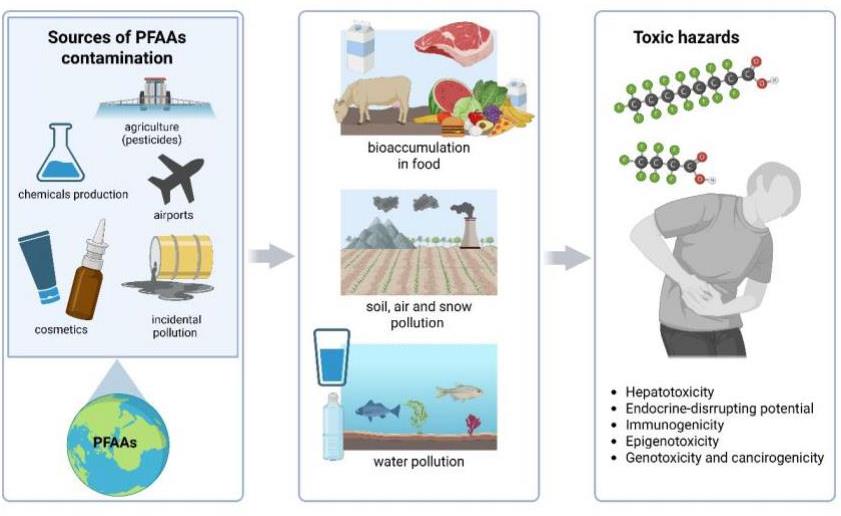
In this review, the occurrence in the environment and human surrounding, as well as toxic action of perfluorooctanoic acid (PFOA) and its selected short-chain analogs – perfluorohexanoic acid (PFHxA) and perfluorobutanoic acid (PFBA) has been described. These substances belong to a group of polyfluoroalkyl substances (PFASs) widely represented in various compartments of the environment, including air, water and soil. They are also present in dust, drinking water and food, which are main sources of the exposure of humans to these compounds. Due to physico-chemical properties PFASs are strongly resistant to degradation in the biosphere and therefore, effectively accumulate in biota, including humans. PFOA has been produced from decades, but due to its toxicity it has been successively replacing by PFASs of shorter chain, including PFHxA and PFBA, which presence in the environment, as well as risk of human exposure and toxicity has been poorly investigated. It has been proven that PFOA reveals hepatotoxic and endocrine-disrupting activities, as well as exhibits prooxidative, immunotoxic, epigenetic and carcinogenic potential. Hitherto conducted researches have shown that PFHxA and PFBA are less toxic than PFOA, nevertheless additional extensive studies should be conducted in order to determine environmental and toxicological status of these compounds.
Keywords:
perfluorooctanoic acid
; perfluorohexanoic acid
; perfluorobutanoic acid
; environment
; hepatotoxicity
; epigenotoxicity
; immunotoxicity
Copyright: This open access article is published under a Creative Commons CC BY 4.0 license, which permit the free download, distribution, and reuse, provided that the author and preprint are cited in any reuse.


